

Submitted:
16 January 2026
Posted:
21 January 2026
You are already at the latest version
Abstract
Marijuana use in the United States (U.S.) has diversified alongside expanding legalization, yet little is known about the psychosocial factors that distinguish medical from recreational use. This study examined whether psychological distress mediates the association between perceived social isolation and marijuana use type among U.S. adults. We analyzed cross-sectional, nationally representative data from the 2024 Health Information National Trends Survey (HINTS, cycle 7). Marijuana use was categorized as medical (including medical and both medical/recreational) versus recreational. Perceived social isolation was measured using the Patient-Reported Outcomes Measurement Information System (PROMIS) Social Isolation t-score, and psychological distress was assessed with the Personal Health Questionnaire (PHQ)-4. Sur-vey-weighted descriptive analyses and a structural equation mediation model accounting for the complex sampling design were conducted. Medical marijuana users reported significantly higher levels of psychological distress and perceived social isolation than recreational users. Greater social isolation was strongly associated with higher psychological distress, and higher distress was associated with a greater likelihood of medical (vs. recreational) marijuana use. The indirect effect of social isolation on marijuana use type through psychological distress was statistically significant, while the direct effect of social isolation was not significant after accounting for distress. Overall, greater perceived social isolation predicted medical marijuana use primarily through elevated psychological distress. These findings suggest that medical marijuana use among U.S. adults may reflect coping with psychological distress linked to social disconnection, under-scoring the importance of integrating mental health and social context in-to clinical and public health approaches to cannabis use.
Keywords:
medical marijuana
; recreational marijuana
; cannabis
; psychological distress
; perceived social isolation
; mediation analysis
; coping motives
1. Introduction
Marijuana use in the United States (U.S.) has undergone dramatic transformation over the past several decades, shaped by shifting cultural norms, expanding legalization, and growing interest in potential therapeutic benefits. Population-level data show that cannabis consumption has risen steadily since the late 1970s, affecting youth, adults, and older populations alike [1,2,3]. As legal access has widened, marijuana-related outcomes have also diversified, ranging from increased emergency department visits for cannabinoid hyperemesis syndrome [4,5] to rising prevalence of marijuana-related disorders, particularly among older adults and Medicare beneficiaries [6,7]. These trends have unfolded against a rapidly evolving policy landscape in which states adopt medical and recreational marijuana laws at different paces, generating heterogeneous patterns of health-related behaviors, such as frequency and mode of cannabis use, polysubstance use (e.g., alcohol simultaneous and co-use), and help-seeking for mental health or substance use concerns as well as downstream health consequences. These patterns vary sociodemographically, with differences observed by age, sex, race/ethnicity, socioeconomic status, and sexual orientation, reflecting unequal exposure, access, and vulnerability across diverse populations [8,9,10].
One of the most notable developments within this shifting landscape is the growth of medical marijuana use. Medical cannabis users, particularly those who are licensed, tend to be distinguished from recreational users by their health-related motives, more regulated patterns of use, and greater integration into medical systems, whereas recreational users primarily use cannabis for pleasure and social reasons, with unlicensed “medical” users often falling somewhere in between these groups [11]. Recent national data show substantial increases in medical marijuana registrations, changes in authorizing clinicians, and evolving reasons for certification, particularly between 2020 and 2022 [12]. Several studies have documented how medical marijuana is used to manage pain, improve quality of life, and serve as an adjunct to conventional care [13,14], leading to increased interest among both patients and healthcare providers. This expansion has occurred alongside evolving perceptions of risk and benefit, particularly among older adults, who represent one of the fastest-growing groups of marijuana users [15,16]. Research has also examined the broader social and behavioral effects of marijuana policies, including associations with crime [17], traffic fatalities [8], mental health [18,19], and emerging psychoactive markets such as hemp-derived cannabinoids [20]. Youth and young adult patterns have also shifted, with notable changes in coping-motivated marijuana use [21] and evolving co-use of tobacco products in states with differing policy environments [9].
Loneliness and social isolation are increasingly recognized as important psychosocial correlates of marijuana use across the life course. Qualitative and mixed-methods research suggests that cannabis is often used to cope with feelings of disconnection, psychological distress, and stress, particularly in contexts marked by limited social support or stigma surrounding both mental health and cannabis use [22,23,24]. Among young adults, marijuana use has traditionally been embedded in social contexts; however, disruptions to social networks, most notably during the COVID-19 pandemic, have been associated with shifts toward more solitary use, which may exacerbate loneliness rather than mitigate it [25,26,27]. At the population level, increasing normalization of cannabis use over time may further blur distinctions between recreational, social, and self-medicative use, particularly during periods of heightened social stress [28,29,30].
Emerging evidence also highlights loneliness as a salient factor in marijuana use among older adults, a population historically underrepresented in cannabis research. National survey data from Canada collected during the COVID-19 pandemic demonstrated a significant association between loneliness and cannabis use among older adults, suggesting that cannabis may function as a coping strategy for social isolation later in life [31]. Across age groups, loneliness appears to act both as a risk factor for increased use and as a contextual driver of self-medication motives, particularly among individuals experiencing psychological distress or hazardous cannabis use patterns [23,24]. These findings underscore the importance of incorporating social connection and loneliness into prevention and intervention frameworks addressing marijuana use, especially during periods of social disruption.
Much remains unknown about the psychosocial factors that differentiate medical from recreational cannabis use in the general adult population despite this rich and rapidly expanding evidence base. Prior work has highlighted demographic correlates of cannabis use disorders among medical cardholders [32], the role of political polarization in the destigmatization of medical cannabis markets [33], and long-term research trends across biopsychosocial domains [34]. Relatively few studies have examined how social and psychological experiences shape individuals’ reasons for using marijuana, particularly within nationally representative samples. While mental health and coping motivations have been increasingly recognized as important drivers of marijuana use especially among individuals experiencing serious psychological distress or social stressors [21,35], little research has directly compared how social isolation and psychological distress relate to medical versus recreational marijuana use. Even less is known about whether psychological distress may function as a mechanism linking social isolation to decisions about marijuana use type, despite theoretical and clinical relevance. In particular, the extent to which perceived social isolation influences marijuana use type and whether this association is explained by underlying psychological distress remains understudied in population-level research.
To address this gap, the present study examines whether psychological distress mediates the relationship between perceived social isolation and the likelihood of medical versus recreational marijuana use among U.S. adults. We hypothesized that greater perceived social isolation would be associated with higher medical marijuana use, and that this association would operate indirectly through elevated psychological distress. To test this hypothesis, we analyzed nationally representative data from the 2024 Health Information National Trends Survey (HINTS, cycle 7) using a cross-sectional survey design to characterize sociodemographic and psychosocial differences between medical and recreational users, followed by a survey-weighted structural equation model to evaluate the proposed mediation pathway.
2. Materials and Methods
2.1. Study Design and Data
Data for this study were drawn from the 2024 HINTS, cycle 7, a cross-sectional survey that provides nationally representative information on adults aged 18 and older living in the U.S., including all 50 states and the District of Columbia [36]. Conducted by the National Cancer Institute, the HINTS tracks patterns in how U.S. residents seek, access, and use health information, as well as assessing related health behaviors in the population. The survey uses a stratified, probability-based sampling framework to obtain a sample reflective of the U.S. population. Comprehensive documentation of sampling methods, survey administration, and weighting procedures is available in HINTS methodology reports. This project met criteria for exemption from institutional review board (IRB) review.
2.2. Measures
2.2.1. Sociodemographic Variables
Participants provided information on a range of sociodemographic characteristics that were examined in relation to type of marijuana use (medical vs. recreational). Age was categorized into four commonly used life-stage groups: 18–29, 30–44, 45–64, and 65 years and older. Sex was self-reported as male or female. Race/ethnicity was assessed using standard federal classification categories and included non-Hispanic (NH) White, NH Black, Hispanic, NH Asian, and NH Other. Educational attainment was measured as the highest level of education completed and grouped into four categories: less than high school, high school graduate, some college or associate degree, and bachelor’s degree or higher. Participants also reported their general health status, which was measured using a widely used single-item global health indicator with five response options: excellent, very good, good, fair, and poor.
2.2.2. Marijuana Use Type
Marijuana use type was assessed using a HINTS item asking respondents to indicate the primary reason they use marijuana. Response options included: (1) for medical reasons, (2) for recreational reasons, and (3) for both medical and recreational reasons. We dichotomized the categories into (1) medical (e.g., medical, medical and recreational) and (2) recreational for entry in our analytical models. Several system-coded categories were present to account for nonresponse, skip patterns, and data entry issues. These included values for not ascertained, web partial, filter missing, multiple responses selected in error, commission errors, and an inapplicable category for respondents who indicated that they did not use marijuana. These system-coded values reflected most of the sample and were excluded from analysis because they did not represent valid reports of marijuana use behavior.
2.2.3. Personal Health Questionnaire (PHQ)-4 Score
Depressive and anxiety symptoms were assessed using the Patient Health Questionnaire-4 (PHQ-4), a validated ultra-brief screening measure of psychological distress [37]. The PHQ-4 consists of four items, with two items assessing anxiety symptoms (from the GAD-2) and two items assessing depressive symptoms (from the PHQ-2). Each item asks respondents how often they have been bothered by a symptom over the past two weeks, rated on a 4-point scale: 0 = not at all, 1 = several days, 2 = more than half the days, and 3 = nearly every day. Total scores range from 0 to 12, with higher scores indicating greater overall psychological distress. Standard cut points identify normal (0–2), mild (3–5), moderate (6–8), and severe (9–12) symptom severity. The anxiety and depression subscales each range from 0 to 6. Example items include: “Feeling nervous, anxious, or on edge” (anxiety subscale); “Not being able to stop or control worrying” (anxiety subscale); “Little interest or pleasure in doing things” (depression subscale); “Feeling down, depressed, or hopeless” (depression subscale). The PHQ-4 has demonstrated strong reliability and validity across diverse population groups and is widely used in epidemiologic and clinical research as an efficient indicator of mental health symptom burden.
2.2.4. Patient-Reported Outcomes Measurement Information System (PROMIS) Social Isolation t-Score
Perceived social isolation was assessed using the PROMIS Social Isolation Short Form, a validated measure designed to capture individuals’ subjective sense of being disconnected from others [38]. The scale includes items that assess feelings of loneliness, exclusion, and lack of companionship, focusing on how often respondents experience social disconnection in their daily lives. Each item is rated on a 5-point Likert scale, ranging from 1 = never to 5 = always, with higher raw scores reflecting greater perceived social isolation. Raw scores are converted to t-scores, which are standardized to have a mean of 50 and a standard deviation of 10 in the U.S. general population. A t-score above 50 indicates higher-than-average perceived isolation, whereas a score below 50 reflects lower levels of isolation. The t-score metric allows comparisons across studies and populations using a common normed framework. Example items from the PROMIS Social Isolation item bank include statements such as: “I feel left out.”; “I feel that people avoid me.”; “I feel isolated from others.”; “I feel that people barely know me.” The PROMIS system uses item-response theory to ensure that the short form maintains strong reliability, precision, and validity, even with a brief set of questions. This measure is widely used in population health and behavioral research to assess subjective social disconnection and its relationship to mental and physical health outcomes.
2.3. Statistical Analysis
All analyses accounted for the complex survey design of the HINTS. The HINTS provides person-level final sample weights that allow estimates to be generalized to the U.S. adult population. These weights adjust for differential probabilities of selection, nonresponse, and known population benchmarks through iterative proportional fitting. In addition to the primary sampling weights, the HINTS includes replicate jackknife weights, which were used to obtain appropriate variance estimates under the survey’s stratified, two-stage probability sampling design. Prior to analysis, the survey design was specified by applying the final person-level weight as the probability weight and incorporating the 50 replicate weights for variance estimation.
For descriptive analyses, weighted frequencies, proportions, means, and standard errors were generated to characterize the sample. We calculated descriptive statistics for the full sample and separately for individuals reporting medical versus recreational marijuana use. We used Rao-Scott chi-square tests to assess weighted group differences for categorical variables, while weighted one-way ANOVA tests were used to evaluate differences in continuous measures (i.e., PHQ-4 scores and PROMIS Social Isolation t-scores).
To examine the hypothesized relationships among psychological distress, perceived social isolation, and marijuana use type, we used a weighted structural equation modeling (SEM) approach. We conducted SEM while incorporating the full complex survey design to ensure unbiased parameter estimates and standard errors. The final sampling weights were applied to produce nationally representative point estimates, and replicate jackknife weights were incorporated so that standard errors and significance tests accurately reflected the complex sampling structure. We estimated the paths using a robust estimator appropriate for weighted survey data. All SEM procedures were conducted using Stata 19.5’s gsem with svy features (StataCorp, LLC., College Station, TX, USA).
3. Results
3.1. Sample Distribution and Prevalence of Marijuana Use by Type
Table 1 presents weighted descriptive characteristics by marijuana use type (medical vs. recreational). We observed significant differences by age group (p = 0.017). Recreational use was more common among younger adults, with 57.3% of adults aged 18–29 reporting recreational use compared with 37.0% among those aged 65 years and older. Sex differences were also significant (p = 0.005), with males more likely to report recreational use (55.1%) than females (40.3%). Race and ethnicity distributions did not differ significantly between groups (p = 0.266). However, marijuana use type varied significantly by education level (p = 0.002). Individuals with a college degree were more likely to report recreational use (59.4%), whereas those a high school education more frequently reported medical use (63.6%).
Self-rated health status was not significantly associated with marijuana use type (p = 0.087). Mean PHQ-4 scores differed significantly between groups (p = 0.001), with medical users reporting higher levels of psychological distress (M = 4.16, SE = 0.27) compared with recreational users (M = 2.78, SE = 0.26; Table 1). PROMIS Social Isolation t-scores were also higher among medical users (M = 50.40, SE = 0.78) than recreational users (M = 47.17, SE = 0.93), indicating greater perceived social isolation (p = 0.017).
3.2. Path Estimates from the Survey-Weighted Mediation Model
Table 2 presents the survey-weighted path estimates from the mediation model examining whether PHQ-4 psychological distress mediates the association between PROMIS Social Isolation and marijuana use type (medical vs. recreational) and is graphically displayed in Figure 1.
3.2.1. Path A: Social Isolation → PHQ-4
Higher PROMIS Social Isolation scores were strongly associated with greater psychological distress (b = 0.18, SE = 0.01, p < 0.001; Table 2; Figure 1). Several demographic covariates also predicted PHQ-4 scores. Compared with adults aged 18–29, older adults reported significantly lower distress, including those aged 45–64 (b = -0.78, p < 0.001) and 65+ (b = -1.25, p < 0.001). Individuals with some college (b = -0.41, p = 0.009) or a college degree (b = -0.58, p < 0.001) also showed lower distress, and poorer self-rated health strongly predicted higher PHQ-4 scores.
3.2.2. Path B: PHQ-4 → Marijuana Use Type
Controlling for all covariates and social isolation, higher PHQ-4 scores were significantly associated with a greater likelihood of medical (vs. recreational) marijuana use (b = -0.09, SE = 0.04, p = 0.019). This finding indicates that individuals with higher distress were more likely to use marijuana for medical reasons (Table 2; Figure 1). Older age groups were significantly more likely to use marijuana for medical reasons rather than recreational reasons, with the strongest effects observed among adults aged 45–64 and 65+. Males were more likely than females to report recreational use (b = -0.52, p = 0.013). NH Asian respondents had higher odds of recreational use compared with NH White respondents (b = 1.06, p = 0.040). Other covariates were not statistically significant predictors in the marijuana use equation.
3.2.3. Path C′: Direct Effect of PROMIS Social Isolation t-Score → Marijuana Use Type
After accounting for PHQ-4, the direct association between social isolation and marijuana use type was not statistically significant (b = -0.01, SE = 0.01, p = 0.526), suggesting that the effect of social isolation on marijuana use type operates primarily through psychological distress rather than a direct pathway (Table 2; Figure 1).
3.3. Mediation Effect Estimates
Table 3 summarizes the survey-weighted mediation effects estimating whether PHQ-4 score mediates the association between social isolation and marijuana use type. The indirect effect of PROMIS Social Isolation t-score on marijuana use type through PHQ-4 was statistically significant (b = -0.02, SE = 0.01, p = 0.020), indicating that higher levels of social isolation were associated with greater psychological distress, which in turn increased the likelihood of medical (vs. recreational) marijuana use. The direct effect of social isolation on marijuana use type, adjusting for PHQ-4, was not statistically significant (b = -0.01, SE = 0.01, p = 0.526), suggesting no independent association beyond the mediated pathway. The total effect, combining direct and indirect components, was significant (b = -0.02, SE = 0.01, p = 0.015), indicating that overall, greater social isolation predicted a greater likelihood of medical marijuana use, and that this association was largely explained by psychological distress.
4. Discussion
This study examined whether psychological distress mediates the association between perceived social isolation and the likelihood of using marijuana for medical versus recreational purposes among U.S. adults. Consistent with our expectations, the findings indicate that higher perceived social isolation was associated with a greater likelihood of medical (rather than recreational) marijuana use, and this relationship was largely explained by elevated psychological distress. Individuals reporting stronger feelings of social disconnection tended to exhibit higher PHQ-4 distress scores, and in turn, those with greater distress were more likely to use marijuana primarily for medical reasons. After accounting for distress, perceived social isolation no longer had a direct association with marijuana use type, underscoring the central mediating role of psychological distress in this pathway. Secondary findings revealed several demographic distinctions, most notably that older adults and those with poorer self-rated health were more likely to report medical marijuana use, whereas younger adults and males were more likely to report recreational use, but these patterns did not alter the core mediated relationship. The results provide clear support for the study’s central research question that psychological distress serves as a key mechanism linking perceived social isolation to individuals’ motivations for marijuana use within this nationally representative sample of adults.
Prior cannabis research has largely emphasized prevalence, policy contexts, and health-related outcomes, with comparatively less attention to the motivations underlying different patterns of use. Within this literature, medical marijuana users are typically characterized as older and in poorer physical health than recreational users, reinforcing a predominantly biomedical framing of medical cannabis use [39,40,41]. However, emerging evidence suggests that motivations for medical use extend beyond symptom management to include emotional regulation, stress relief, and coping with psychological distress [42,43]. Typology-based studies using latent class or profile approaches further demonstrate substantial heterogeneity in cannabis use motivations, with overlapping medical and recreational motives across user groups [43,44]. Despite these advances, psychological distress is often treated as a covariate or outcome rather than as a mechanism shaping use type, even though distress appears more prevalent among individuals using cannabis medically, particularly in policy contexts that expand access [45]. There remains limited understanding of how psychosocial stressors differentiate medical versus recreational marijuana use in nationally representative samples prior to our study.
A growing body of literature links loneliness and perceived social isolation to increased marijuana use, particularly consumption motivated by coping and emotional regulation. Evidence for this association spans qualitative accounts, prospective cohort studies, pandemic-era surveys, and emerging work among older adults, collectively suggesting that social disconnection may function as an important psychosocial stressor driving substance use behaviors [31,46,47]. Studies further indicate that solitary patterns of cannabis use are associated with greater depressive symptoms and elevated risk of cannabis use disorder, underscoring the potential role of isolation-related processes in problematic use trajectories [48,49]. However, much of this literature focuses on any marijuana use or frequency of use rather than distinguishing medical from recreational use, limiting insight into how social isolation may shape use motivations and self-identification as a medical user. Perceived social isolation is rarely disentangled from co-occurring mental health symptom burden, such as depression and anxiety, which are often treated as confounders or mediators rather than analytically distinct constructs. It remains unclear whether social isolation exerts a direct influence on marijuana use type or operates primarily through psychological distress.
Our findings highlight psychological distress as a key mediating mechanism linking perceived social isolation to marijuana-use motivations, offering an important contribution to the literature. Psychological distress is a well-established correlate of cannabis use and is frequently attributed within self-medication frameworks, yet few studies have explicitly tested distress as a mechanism through which social stressors shape the reasons individuals use marijuana. Using a mediation framework, the present study demonstrates that psychological distress mediates the association between perceived social isolation and medical (vs. recreational) marijuana use among U.S. adults. Notably, perceived social isolation was no longer independently associated with use type after accounting for distress, underscoring the central role of mental health in this pathway. By situating social isolation, psychological distress, and marijuana-use motivation within a nationally representative sample, these findings advance biopsychosocial models of cannabis use and suggest that mental health processes may be more proximal drivers of medical use than social disconnection alone.
The findings of this study carry meaningful implications for both clinical practice and population-level public health efforts aimed at understanding and addressing patterns of marijuana use in the U.S. By demonstrating that psychological distress mediates the association between perceived social isolation and the likelihood of using marijuana for medical rather than recreational purposes, the results underscore the interconnectedness of mental health, social connectedness, and marijuana-use behaviors. For clinicians, these findings highlight the importance of routinely assessing not only symptom burden but also the social context in which individuals are experiencing distress. Patients who report using marijuana for medical reasons may be doing so not solely in response to physical health concerns, but also as a coping mechanism for emotional strain linked to loneliness or social disconnection. This insight may help providers better identify individuals who could benefit from integrated behavioral health support, mental health screening, or social prescribing interventions that address isolation as an underlying driver of symptom burden.
From a public health perspective, the study contributes to a growing recognition that perceived social isolation is not simply a psychosocial condition but a determinant of health behavior with implications for substance-use patterns. As cannabis policies continue to evolve nationally, understanding who is using marijuana for medical purposes and why can inform community-level harm reduction strategies, communication campaigns, and policy decisions that extend beyond clinical settings. For example, public health initiatives aimed at promoting social connectedness, strengthening community infrastructure, or reducing psychological distress may also indirectly influence patterns of medical cannabis use. Furthermore, the identification of high-distress subgroups among medical users suggests opportunities for targeted outreach and early intervention, particularly for populations that may be relying on marijuana as a self-managed approach to distress or social isolation.
For researchers, the study invites further inquiry into the mechanisms linking psychosocial stressors and cannabis use motivations, including potential moderators such as chronic health conditions, social support, or state-level regulatory environments. For policymakers and patient communities, the findings reinforce the importance of viewing marijuana use through a holistic lens that integrates psychological and social determinants alongside medical need. The results emphasize that efforts to address marijuana use in the U.S. should incorporate mental health assessment and supports for social well-being, ultimately strengthening the precision and impact of both clinical care and public health policy.
Strengths and Limitations
This study offers several notable strengths that enhance confidence in the findings and contribute meaningfully to the literature on social isolation, mental health, and marijuana use. First, the use of a large, nationally representative dataset allows for population-level inferences that extend beyond localized or clinic-based samples commonly used in cannabis research. By leveraging the complex stratified design and incorporating both final sampling weights and replicate jackknife weights, the analyses appropriately reflect the demographic distribution of U.S. adults and minimize the risk of biased variance estimates. Second, the study applied a survey-weighted structural equation modeling framework, which is still relatively uncommon in cannabis epidemiology. This analytic approach provides a rigorous test of mediating pathways while maintaining fidelity to the complex sampling structure of the HINTS dataset. Third, the integration of validated, psychometrically robust measures, including the PROMIS Social Isolation T-score and the PHQ-4, ensures high-quality assessment of the central psychological constructs, improving the conceptual clarity and reproducibility of the study.
Several limitations warrant careful consideration. The cross-sectional design prohibits causal inference, meaning that conclusions about temporal ordering among perceived social isolation, psychological distress, and marijuana use motivations should be interpreted with caution. Although the mediation model aligns with theoretically grounded pathways, the temporal relationships remain untested, and reverse or bidirectional effects are plausible. In addition, while HINTS provides rich behavioral and psychosocial data, the measure of marijuana use relies on a single self-reported item about users’ “primary reason” for use. This may oversimplify the motivations of individuals who use cannabis for multiple or evolving purposes, and it does not account for dosage, frequency, or product type, which are factors that may influence both mental health and functional outcomes. The exclusion of system-coded nonresponse categories, although necessary to identify valid users, limits the analytic sample to a relatively small subgroup and may introduce selection bias if individuals with missing marijuana-use data differ systematically from those who responded. Unmeasured confounding also remains possible, particularly regarding factors such as chronic pain severity, medical diagnoses, social support networks, and state-level cannabis policies, none of which were available in the dataset but could influence both distress and medical versus recreational use.
To mitigate these limitations, we incorporated a broad set of sociodemographic and health variables, relied on validated measurement instruments, and used appropriate survey-weighted modeling techniques designed to reduce estimation bias. Still, the results should be understood as associations within the specific population of U.S. adults who reported marijuana use and provided complete data. While generalizability to the broader U.S. population is supported by the national sampling frame, generalizability to clinical subgroups (e.g., individuals with chronic pain, those seeking medical certification) may be more limited. Despite these constraints, the analytic rigor, validated measures, and nationally representative scope strengthen the robustness of the findings and offer a solid foundation for future longitudinal or experimental work to clarify causal mechanisms and refine understanding of how social isolation and psychological distress shape patterns of marijuana use.
5. Conclusions
This study provides novel nationally representative evidence that psychological distress mediates the relationship between perceived social isolation and the likelihood of using marijuana for medical rather than recreational purposes among U.S. adults. While greater social isolation was associated with medical marijuana use, this association operated primarily through elevated psychological distress, and social isolation no longer independently predicted use type after accounting for distress. These findings move beyond descriptive distinctions between medical and recreational users by clarifying a key psychosocial mechanism underlying marijuana-use motivations.
By integrating social isolation, mental health, and cannabis-use motivation within a biopsychosocial framework, the study highlights that medical marijuana use may reflect efforts to cope with emotional distress in addition to physical symptoms. These results underscore the importance of incorporating mental health and social connectedness into clinical assessments and public health approaches addressing cannabis use. Future longitudinal research is needed to establish temporal pathways and to examine how changes in social and psychological contexts shape marijuana-use motivations as cannabis policies and norms continue to evolve.
Author Contributions
Conceptualization, D.S.F. and C.E.V.; methodology D.S.F.; software, D.S.F.; validation, D.S.F., C.E.V. and S.H.; formal analysis, D.S.F.; investigation, D.S.F.; resources, D.S.F.; data curation, D.S.F.; writing—original draft preparation, D.S.F.; writing—review and editing, D.S.F., C.E.V. and S.H..; visualization, D.S.F.; supervision, D.S.F.; project administration, D.S.F.; funding acquisition, C.E.V. All authors have read and agreed to the published version of the manuscript.
Funding
C.E.V. was supported by grants, 5K01AG081455 and L60AG084095, awarded to the University of Texas at Arlington by the National Institutes of Health/National Institute on Aging. The content is solely the responsibility of the authors and does not necessarily represent the official views of the National Institutes of Health.
Institutional Review Board Statement
Ethical review and approval were waived for this study due to the data being openly and publicly available and deemed not human subjects research.
Informed Consent Statement
Not applicable.
Data Availability Statement
Data are freely and publicly available at hints.cancer.gov.
Acknowledgments
Not applicable.
Conflicts of Interest
The authors declare no conflicts of interest.
Abbreviations
The following abbreviations are used in this manuscript:
| PHQ | Personal Health Questionnaire |
| PROMIS | Patient-Reported Outcomes Measurement Information System |
References
- Caulkins, J.P. Changes in self-reported cannabis use in the United States from 1979 to 2022. Addiction (Abingdon, England) 2024, 119, 1648–1652. [Google Scholar]
- Mattingly, D.T.; Richardson, M.K.; Hart, J.L. Prevalence of and trends in current cannabis use among US youth and adults, 2013–2022. Drug and Alcohol Dependence Reports 2024, 12, 100253. [Google Scholar] [CrossRef]
- Patrick, M.E.; Pang, Y.C.; Terry-McElrath, Y.M.; Arterberry, B.J. Historical trends in cannabis use among US adults ages 19–55, 2013–2021. Journal of Studies on Alcohol and Drugs 2024, 85, 477–486. [Google Scholar]
- Costales, B.; Lu, Y.; Young-Wolff, K.C.; Cotton, D.M.; Campbell, C.I.; Iturralde, E.; Sterling, S.A. Prevalence and trends of suspected cannabinoid hyperemesis syndrome over an 11-year period in Northern California: An electronic health record study. Drug and Alcohol Dependence 2024, 263, 112418. [Google Scholar] [CrossRef]
- Soh, J.; Kim, Y.; Shen, J.; Kang, M.; Chaudhry, S.; Chung, T.H.; Kim, S.H.; Hwang, Y.; Lim, D.; Khattak, A. Trends of emergency department visits for cannabinoid hyperemesis syndrome in Nevada: An interrupted time series analysis. Plos ONE 2024, 19, e0303205. [Google Scholar]
- Perez-Vilar, S.; Duenas, P.F.; Radin, R.; Akhtar, S.; Wernecke, M.; Kelman, J.A.; Graham, D.J. State cannabis legalization and trends in cannabis-related disorders in US older adults, 2017 to 2022. JAMA Network Open 2024, 7, e2417634–e2417634. [Google Scholar] [CrossRef] [PubMed]
- Perez-Vilar, S.; Kazemian, S.; Greene, C.; Duenas, P.F.; Radin, R.; Lindaas, A.; Akhtar, S.; Wernecke, M.; Chillarige, Y.; Kelman, J.A. Trends in medical encounters involving cannabis-related disorders among US Medicare beneficiaries, 2017–2022. American Journal of Public Health 2024, 114, S694–S697. [Google Scholar] [CrossRef]
- Braslavskiy, A. In the Weeds of Traffic Fatalities: Revisiting the Effect of Medical Marijuana Laws. Available online: https://papers.ssrn.com/sol3/papers.cfm?abstract_id=5232936 (accessed on 2 January 2026).
- Glasser, A.M.; Uriarte, C.; Jensen, J.K.; Sterling, K.; Shang, C.; Hammond, D.; Villanti, A.C. Temporal trends in young adult cannabis and tobacco use in states with different cannabis policies. Cannabis 2025. [Google Scholar]
- Salehin, M.; Pillai, V.K. Influence of socio-ecological and economic correlates on marijuana legalization policy across the states of America. International Journal of Environmental Research and Public Health 2025, 22, 823. [Google Scholar] [CrossRef]
- Sznitman, S.R. Do recreational cannabis users, unlicensed and licensed medical cannabis users form distinct groups? International Journal of Drug Policy 2017, 42, 15–21. [Google Scholar] [CrossRef] [PubMed]
- Boehnke, K.F.; Sinclair, R.; Gordon, F.; Hosanagar, A.; Roehler, D.R.; Smith, T.; Hoots, B. Trends in US medical cannabis registrations, authorizing clinicians, and reasons for use from 2020 to 2022. Annals of Internal Medicine 2024, 177, 458–466. [Google Scholar] [CrossRef] [PubMed]
- Kelly, M.D.; Obaid, M.; Miller, E.M.; Bowie, M.; Heetera, Z.S. Observational analysis of the influence of medical marijuana use on quality of life in patients. Medical Cannabis and Cannabinoids 2024, 7(1), 44–50. [Google Scholar] [CrossRef] [PubMed]
- Zanker, T.; Sacco, J.; Prota, J.; Palma, M.; Viola Lee, K.A.; Wang, R.R.; Liang, Y.; Cunningham, J.; Mackary, M.; Ovchinnikova, P. Medical marijuana for pain management in hospice care as a complementary approach to scheduled opioids: A single arm study. American Journal of Hospice and Palliative Medicine® 2024, 41, 1002–1010. [Google Scholar] [CrossRef] [PubMed]
- Enos, G. Cannabis use among older adults on rise, causing health concerns. Alcoholism & Drug Abuse Weekly 2025, 37, 1–7. [Google Scholar] [CrossRef]
- Han, B.H.; Yang, K.H.; Cleland, C.M.; Palamar, J.J. Trends in past-month cannabis use among older adults. JAMA Internal Medicine 2025. [Google Scholar] [CrossRef]
- Lee, Y.-H.; Hu, J.-C.; Kimura Park, I.; Kim, D.; Chiang, T.; Shelley, M.; Liu, C.-T. Examining the association between medical marijuana legalization and criminal behaviors: Evidence from a US representative sample. Substance Use & Misuse 2024, 59, 119–125. [Google Scholar]
- Kalbfuß, J.; Odermatt, R.; Stutzer, A. Medical marijuana laws and mental health in the United States. Health Economics, Policy and Law 2024, 19, 307–322. [Google Scholar] [CrossRef]
- Huang, Z.; Forte, R.J.; Goehring, R.; Fogliano, M. Statistical Investigation of the Relationship Between Mental Health & Marijuana use from NHANES Database. In Proceedings of the ASEE Mid-Atlantic Section Spring Conference, 19 April 2024. [Google Scholar]
- Pawson, M.; Kelly, B.C. Hemp-based psychoactive use and risk among young adults: Trend theory, policy, and regulation beyond legality. International Journal of Drug Policy 2024, 130, 104523. [Google Scholar] [CrossRef]
- Patrick, M.E.; Peterson, S.J.; Terry-McElrath, Y.M.; Rogan, S.E.B.; Solberg, M.A. Trends in coping reasons for marijuana use among US adolescents from 2016 to 2022. Addictive Behaviors 2024, 148, 107845. [Google Scholar]
- Bottorff, J.L.; Bissell, L.J.; Balneaves, L.G.; Oliffe, J.L.; Capler, N.R.; Buxton, J. Perceptions of cannabis as a stigmatized medicine: A qualitative descriptive study. Harm Reduction Journal 2013, 10, 2. [Google Scholar] [CrossRef]
- Wallis, D.; Coatsworth, J.D.; Mennis, J.; Riggs, N.R.; Zaharakis, N.; Russell, M.A.; Brown, A.R.; Rayburn, S.; Radford, A.; Hale, C. Predicting self-medication with cannabis in young adults with hazardous cannabis use. International Journal of Environmental Research and Public Health 2022, 19, 1850. [Google Scholar] [CrossRef] [PubMed]
- Gulliver, T.L.; Fowler, K. Exploring social context and psychological distress in adult Canadians with cannabis use disorder: To what extent do social isolation and negative relationships predict mental health? Psychiatric Quarterly 2022, 93, 311–323. [Google Scholar] [CrossRef]
- Chong, W.W.-Y.; Acar, Z.I.; West, M.L.; Wong, F. A scoping review on the medical and recreational use of cannabis during the COVID-19 pandemic. Cannabis and Cannabinoid Research 2022, 7, 591–602. [Google Scholar]
- DiGuiseppi, G.T.; Fedorova, E.V.; Conn, B.; Lankenau, S.E.; Davis, J.P.; Ataiants, J.; Wong, C.F. Understanding changes in social cannabis use among young adults during the covid-19 pandemic: A social network analysis. Cannabis 2023, 6, 20. [Google Scholar] [CrossRef]
- Mehra, K.; Rup, J.; Wiese, J.L.; Watson, T.M.; Bonato, S.; Rueda, S. Changes in self-reported cannabis use during the COVID-19 pandemic: A scoping review. BMC Public Health 2023, 23, 2139. [Google Scholar] [CrossRef]
- Hasin, D.; Walsh, C. Trends over time in adult cannabis use: A review of recent findings. Current Opinion in Psychology 2021, 38, 80–85. [Google Scholar] [CrossRef]
- Holmes, L.M.; Popova, L.; Ling, P.M. State of transition: Marijuana use among young adults in the San Francisco Bay Area. Preventive Medicine 2016, 90, 11–16. [Google Scholar] [CrossRef]
- Turna, J.; Balodis, I.; Munn, C.; Van Ameringen, M.; Busse, J.; MacKillop, J. Overlapping patterns of recreational and medical cannabis use in a large community sample of cannabis users. Comprehensive Psychiatry 2020, 102, 152188. [Google Scholar] [CrossRef] [PubMed]
- Li, L.; Deng, Q. Loneliness and cannabis use among older adults: findings from a Canada national survey during the COVID-19 pandemic. BMC Public Health 2024, 24, 2983. [Google Scholar] [CrossRef] [PubMed]
- Kumpf, M.I.P. Relationship Between Demographic Factors and Prevalence of Cannabis Use Disorder Among Adults Holding a Medical Marijuana Card in a Rural Community; Walden University, 2024. [Google Scholar]
- Verhaal, J.C.; Reis, S.; Khessina, O.M. Conquering the divide? The role of political polarization in the destigmatization of a US medical marijuana platform market. Journal of Management 2025, 01492063251359947. [Google Scholar] [CrossRef]
- Sixto-Costoya, A.; Garcia-Zorita, C.; Valderrama-Zurian, J.C.; Sanz-Casado, E.; Serrano-Lopez, A.E. Evolution of marijuana research at the biopsychosocial level: A general view. International Journal of Mental Health and Addiction 2025, 23, 603–617. [Google Scholar]
- Rubenstein, D.; Vilardaga, R.; Evins, A.E.; McClernon, F.J.; Pacek, L.R. US cannabis use trends at the intersection of serious psychological distress and race/ethnicity, 2008–2019. Journal of Racial and Ethnic Health Disparities 2025, 1–8. [Google Scholar]
- National Cancer Institute. Health Information National Trends Survey. Available online: https://hints.cancer.gov/ (accessed on 1 October 2025).
- Löwe, B.; Wahl, I.; Rose, M.; Spitzer, C.; Glaesmer, H.; Wingenfeld, K.; Schneider, A.; Brähler, E. A 4-item measure of depression and anxiety: Validation and standardization of the Patient Health Questionnaire-4 (PHQ-4) in the general population. Journal of Affective Disorders 2010, 122, 86–95. [Google Scholar] [CrossRef]
- Hahn, E.A.; DeVellis, R.F.; Bode, R.K.; Garcia, S.F.; Castel, L.D.; Eisen, S.V.; Bosworth, H.B.; Heinemann, A.W.; Rothrock, N.; Cella, D. Measuring social health in the patient-reported outcomes measurement information system (PROMIS): Item bank development and testing. Quality of Life Research 2010, 19, 1035–1044. [Google Scholar] [CrossRef] [PubMed]
- Lin, L.A.; Ilgen, M.A.; Jannausch, M.; Bohnert, K.M. Comparing adults who use cannabis medically with those who use recreationally: Results from a national sample. Addictive Behaviors 2016, 61, 99–103. [Google Scholar] [CrossRef]
- Leung, J.; Chan, G.; Stjepanović, D.; Chung, J.Y.C.; Hall, W.; Hammond, D. Prevalence and self-reported reasons of cannabis use for medical purposes in USA and Canada. Psychopharmacology 2022, 239, 1509–1519. [Google Scholar] [CrossRef]
- Ciesluk, B.; Erridge, S.; Sodergren, M.H.; Troup, L.J. Cannabis use in the UK: A quantitative comparison of individual differences in medical and recreational cannabis users. Frontiers in Psychology 2024, 14, 1279123. [Google Scholar] [CrossRef] [PubMed]
- Vedelago, L.; Metrik, J.; Amlung, M. Differentiating medicinal and recreational cannabis users via cannabis use motives. Cannabis 2020, 3, 52–63. [Google Scholar] [CrossRef]
- Cloutier, R.M.; Kearns, N.T.; Knapp, A.A.; Contractor, A.A.; Blumenthal, H. Heterogeneous patterns of marijuana use motives using latent profile analysis. Substance Use & Misuse 2019, 54, 1485–1498. [Google Scholar] [CrossRef]
- Manning, K.; Garey, L.; Paulus, D.J.; Buckner, J.D.; Hogan, J.B.; Schmidt, N.B.; Zvolensky, M.J. Typology of cannabis use among adults: A latent class approach to risk and protective factors. Addictive Behaviors 2019, 92, 6–13. [Google Scholar] [CrossRef]
- McBain, R.K.; Wong, E.C.; Breslau, J.; Shearer, A.L.; Cefalu, M.S.; Roth, E.; Burnam, M.A.; Collins, R.L. State medical marijuana laws, cannabis use and cannabis use disorder among adults with elevated psychological distress. Drug and Alcohol Dependence 2020, 215, 108191. [Google Scholar] [CrossRef] [PubMed]
- Gutkind, S.; Gorfinkel, L.R.; Hasin, D.S. Prospective effects of loneliness on frequency of alcohol and marijuana use. Addictive Behaviors 2022, 124, 107115. [Google Scholar] [CrossRef] [PubMed]
- Espinoza, S.; Lagunas, M.-A.; Claudia, R.; Lovell, J.L. Association between loneliness and cannabis consumption among older adults: Insights from a nationwide Canadian survey amid the COVID-19 pandemic. Bulletin of Pioneering Researches of Medical and Clinical Science 2025, 5, 73–85. [Google Scholar] [CrossRef]
- Chassagne, J.; Raynal, P.; Bronchain, J.; Chabrol, H. Smoking mostly alone as a risk factor for cannabis use disorders and depressive symptoms. International Journal of Mental Health and Addiction 2024, 22, 1761–1770. [Google Scholar] [CrossRef]
- Ma, T. The causal effect of social isolation on cannabis use disorder and the mediating role of depression: Evidence from a Mendelian randomization study. Brain and Behavior 2025, 15, e71102. [Google Scholar] [CrossRef] [PubMed]
Figure 1.
Mediation model with Personal Health Questionnaire (PHQ)-4 score as a Mediator of PROMIS Social Isolation t-score and marijuana use type.
Figure 1.
Mediation model with Personal Health Questionnaire (PHQ)-4 score as a Mediator of PROMIS Social Isolation t-score and marijuana use type.
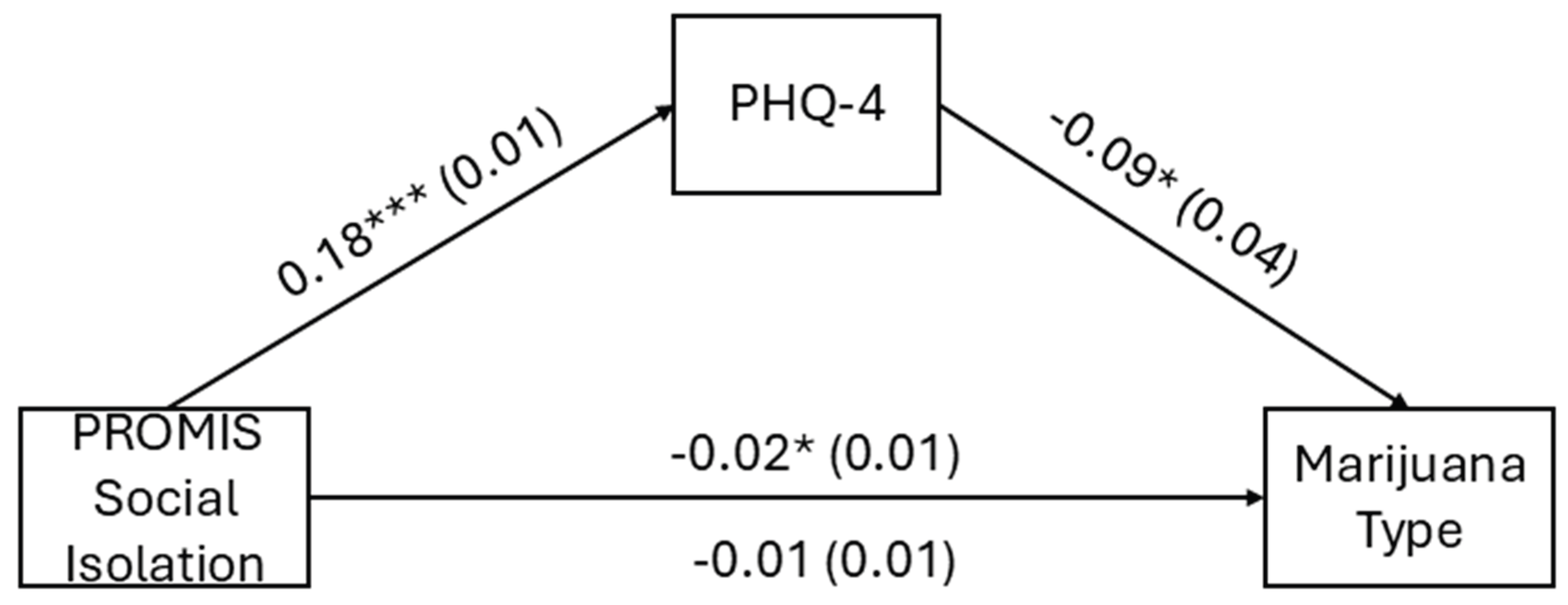

Table 1.
Sample characteristics and bivariate comparison by marijuana use type (medical vs. recreational).
Table 1.
Sample characteristics and bivariate comparison by marijuana use type (medical vs. recreational).
| Marijuana Use Type | ||||
| Medical | Recreational | |||
| n | % or M (SE) | % or M (SE) | p-Value | |
| Age group | 0.017 | |||
| 18-29 | 222 | 42.7 | 57.3 | |
| 30-44 | 377 | 52.4 | 47.6 | |
| 45-64 | 427 | 55.1 | 44.9 | |
| 65+ | 330 | 63.0 | 37.0 | |
| Sex | 0.005 | |||
| Female | 783 | 59.7 | 40.3 | |
| Male | 539 | 44.9 | 55.1 | |
| Race/ethnicity | 0.266 | |||
| NH White | 740 | 52.4 | 47.6 | |
| NH Black | 196 | 48.4 | 51.6 | |
| Hispanic | 259 | 57.3 | 42.7 | |
| NH Asian | 39 | 18.7 | 81.3 | |
| NH Other | 72 | 53.2 | 46.8 | |
| Education level | 0.002 | |||
| Less than high school | 78 | 42.6 | 57.4 | |
| High school | 198 | 63.6 | 36.4 | |
| Some college | 427 | 55.9 | 44.1 | |
| College | 634 | 40.6 | 59.4 | |
| Health Status | 0.087 | |||
| Excellent | 131 | 42.1 | 57.9 | |
| Very good | 406 | 46.6 | 53.4 | |
| Good | 502 | 54.2 | 45.8 | |
| Fair | 252 | 63.2 | 36.8 | |
| Poor | 60 | 60.2 | 39.9 | |
| PHQ-4 | 1336 | 4.16 (0.27) | 2.78 (0.26) | 0.001 |
| PROMIS Social Isolation t-score | 1335 | 50.40 (0.78) | 47.17 (0.93) | 0.017 |
Note. M=mean; SE=standard error; PHQ-4=Personal Health Questionnaire-4; NH=non-Hispanic; PROMIS=Patient-Reported Outcomes Measurement Information System.
Table 2.
Path estimates from the survey-weighted mediation model predicting Personal Health Questionnaire (PHQ)-4 score and marijuana use type (medical vs. recreational).
Table 2.
Path estimates from the survey-weighted mediation model predicting Personal Health Questionnaire (PHQ)-4 score and marijuana use type (medical vs. recreational).
| Predictor | PHQ-4 b (SE) | p-Value | 95% CI | Marijuana use type b (SE) | p-Value | 95% CI |
| Constant | -5.27 (0.32) | <0.001 | (-5.89, -4.64) | 1.75 (0.83) | 0.035 | (0.12, 3.38) |
| Age group (ref.=18-29) | ||||||
| 30-44 | -0.24 (0.20) | 0.235 | (-0.63, 0.16) | -0.70 (0.31) | 0.022 | (-1.30, -0.10) |
| 45-64 | -0.78 (0.17) | <0.001 | (-1.10, -0.46) | -0.84 (0.31) | 0.006 | (-1.44, -0.24) |
| 65+ | -1.25 (0.16) | <0.001 | (-1.57, -0.93) | -1.33 (0.35) | <0.001 | (-2.01, -0.66) |
| Sex (ref.=Female) | ||||||
| Male | 0.18 (0.11) | 0.115 | (-0.04, 0.39) | -0.52 (0.21) | 0.013 | (-0.93, -0.11) |
| Race/ethnicity (ref.=NH White) | ||||||
| NH Black | -0.08 (0.15) | 0.591 | (-0.38, 0.22) | 0.49 (0.29) | 0.088 | (-0.07, 1.06) |
| Hispanic | 0.23 (0.15) | 0.111 | (-0.05, 0.52) | -0.23 (0.29) | 0.428 | (-0.79, 0.34) |
| NH Asian | -0.28 (0.18) | 0.126 | (-0.63, 0.08) | 1.06 (0.52) | 0.040 | (0.05, 2.07) |
| NH Other | 0.25 (0.33) | 0.456 | (-0.41, 0.90) | 0.19 (0.44) | 0.671 | (-0.68, 1.05) |
| Education level (ref. = < high school) | ||||||
| High school | -0.10 (0.22) | 0.636 | (-0.53, 0.32) | -0.81 (0.42) | 0.055 | (-1.63, 0.02) |
| Some college | -0.41 (0.16) | 0.009 | (-0.72, -0.11) | -0.34 (0.37) | 0.354 | (-1.06, 0.38) |
| College | -0.58 (0.15) | <0.001 | (-0.88, -0.28) | 0.09 (0.37) | 0.815 | (-0.63, 0.81) |
| Health Status (ref.= Excellent) | ||||||
| Very good | 0.19 (0.13) | 0.146 | (-0.07, 0.45) | 0.08 (0.39) | 0.841 | (-0.69, 0.85) |
| Good | 0.35 (0.14) | 0.010 | (0.08, 0.62) | 0.02 (0.38) | 0.961 | (-0.72, 0.76) |
| Fair | 1.21 (0.26) | <0.001 | (0.70, 1.71) | -0.25 (0.43) | 0.552 | (-1.09, 0.58) |
| Poor | 3.03 (0.34) | <0.001 | (2.35, 3.70) | 0.35 (0.70) | 0.615 | (-1.01, 1.72) |
| PHQ-4 | - | - | - | -0.09 (0.04) | 0.019 | (-0.17, -0.02) |
| PROMIS Social Isolation t score | 0.18 (0.01) | <0.001 | (0.17, 0.19) | -0.01 (0.01) | 0.526 | (-0.03, 0.02) |
Note. SE=standard error; PHQ-4=Personal Health Questionnaire-4; CI=confidence interval; NH=non-Hispanic; PROMIS=Patient-Reported Outcomes Measurement Information System.
Table 3.
Mediation effect estimates.
| b (SE) | p-Value | 95% CI | |
| Indirect path | -0.02 (0.01) | 0.020 | (-0.03, 0.00) |
| Direct path | -0.01 (0.01) | 0.526 | (-0.03, 0.02) |
| Total | -0.02 (0.01) | 0.015 | (-0.05, 0.00) |
Note. SE=standard error; CI=confidence interval.
Disclaimer/Publisher’s Note: The statements, opinions and data contained in all publications are solely those of the individual author(s) and contributor(s) and not of MDPI and/or the editor(s). MDPI and/or the editor(s) disclaim responsibility for any injury to people or property resulting from any ideas, methods, instructions or products referred to in the content. |
© 2026 by the authors. Licensee MDPI, Basel, Switzerland. This article is an open access article distributed under the terms and conditions of the Creative Commons Attribution (CC BY) license (http://creativecommons.org/licenses/by/4.0/).
Copyright: This open access article is published under a Creative Commons CC BY 4.0 license, which permit the free download, distribution, and reuse, provided that the author and preprint are cited in any reuse.


