

Submitted:
21 January 2026
Posted:
22 January 2026
You are already at the latest version
Abstract
Based on the latest cosmological observational and theoretical advancements, this paper proposes a unified systems theory framework, conceptualizing the universe as an adaptive ecosystem with a fundamental architecture of "spacetime-dark matter-dark energy". Through the metaphor of a "computer operating system", it elaborates on the roles of spacetime as a structural entity, dark matter as a gravitational framework, and dark energy as a functional core. It also explores the implications of this framework for understanding physical laws, cosmic evolution, and the nature of information, attempting to establish a unified theory for comprehending the universe. It is important to emphasize that all physical theories are essentially sets of "models" or "metaphorical systems" used to explain and predict observational phenomena. The "operating system" paradigm presented herein is also an approximate description of the complex cosmic reality, not the ultimate answer.
Keywords:
dark energy
; spacetime
; dark Matter
; adaptive ecosystem
; black Hole
; framework
; wormholes
; cosmological constant
; standard ΛCDM model
; computer
1. Introduction
When Einstein spent the latter half of his life pursuing the "Unified Field Theory", he firmly believed that behind the forces and fields of the universe, there must exist a single, harmonious underlying reality. Nearly a century later, we may be approaching the shore of his dream—the universe is essentially an adaptive ecosystem that has evolved continuously for 13.8 billion years, based on the unified framework of "spacetime-dark matter-dark energy". Interpreting it as a "supercomputer" following precise rules is a highly insightful research paradigm: spacetime serves as the motherboard and operating system of this computer, defining the rules and stage for interactions; dark matter is its invisible internal structural framework, shaping the cosmic macrostructure; dark energy corresponds to the system's "energy supply module", whose negative pressure property acts as the intrinsic dynamic tension driving expansion, providing the fundamental guarantee for the system's existence and stable expansion. Everything we observe, from rotating galaxies to spacetime ripples, is a macroscopic manifestation of the collaborative interaction between this underlying unified framework and the upper cosmic ecosystem.
2. Core Architecture: Framework, Ecosystem, and Interface
If the universe is regarded as a unified adaptive ecosystem, its stable existence and evolution are rooted in a deeply coupled three-layer architecture:
(I) The Cosmic Framework: Hierarchical Structure and Functional Core
Spacetime Framework: As a "structural entity", it is the innermost, all-bearing framework, analogous to the "motherboard" and "operating system kernel" of a computer, defining the basic rules and resources for interactions.
Dark Matter Framework: As a "gravitational structure", it is built upon the spacetime framework and determines structural formation. Through gravity, it carves "gravitational potential wells" in spacetime, similar to an "invisible chassis" and "internal structure", guiding and confining ordinary matter to converge into macrostructures such as galaxies and galaxy clusters.
Dark Energy Framework: As the "functional core", it is more likely an inherent attribute of the spacetime framework. Its negative pressure provides the intrinsic dynamic tension for the universe's continuous expansion; for ease of understanding, it can be analogized to the system's "energy supply module".
These three collectively form a pyramid-shaped support system, and the dynamic process of their co-evolution can be accurately traced and verified with the latest numerical simulation tools.
(II) The Cosmic Ecosystem: Dynamic Evolution on the Framework
On top of the stable framework operates a cosmic ecosystem composed of ordinary matter, energy, and information. From stellar birth to biological evolution, all are complex dynamic "processes" within the ecosystem. Like software running on a motherboard (spacetime), they are constrained by the framework's rules while forming real-time feedback with the framework through gravity, energy distribution, and other means, constituting a "framework-ecosystem" co-evolutionary relationship.
(III) The Reality Interface: Observable Output of the System
The three-dimensional space and one-dimensional time we directly perceive form the reality interface of this system. Philosophically, this concept aligns with the "Space-Time Cube" model in information visualization, which aims to integrate discrete spatiotemporal data into continuous images to assist human cognition. It maps the profound underlying quantum spacetime framework and its contained information into the classical images we can perceive, serving as a 'user interface' generated by the system for interaction with observers, not the ultimate physical reality.
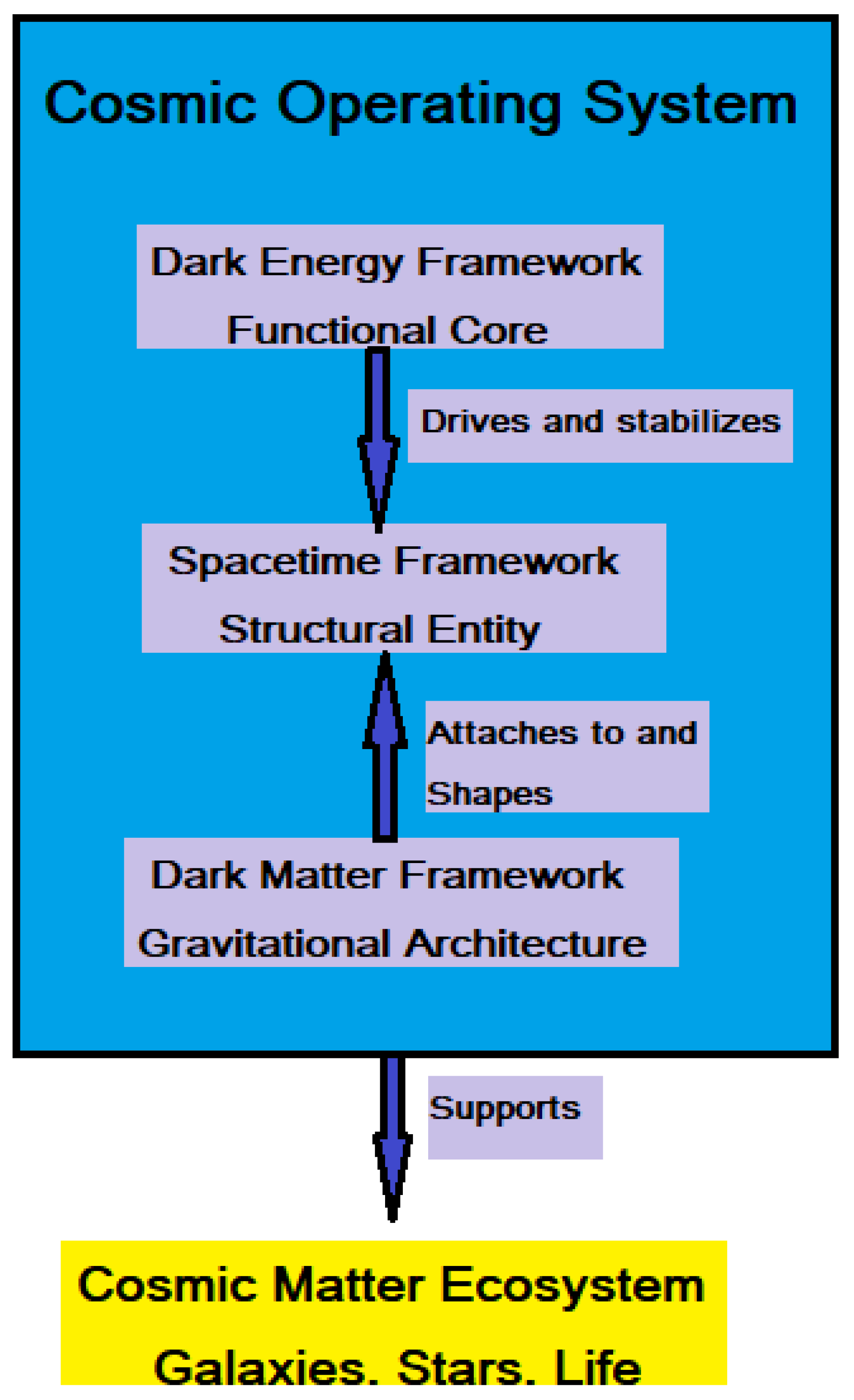
Architecture of the Cosmic Framework
3. Holographic Principle: The System Mapping Mechanism of "3D Encoded in 2D"
The holographic principle profoundly reveals the efficient operation mode of the spacetime framework: all information in a three-dimensional spatial region can be completely encoded on its two-dimensional boundary. This principle has evolved from a purely theoretical concept into a physical hypothesis testable through cosmological observations (such as gravitational wave astronomy).
The three-dimensional dynamic scenes of our "reality interface" are essentially "holographic projections" of information from the underlying quantum spacetime framework. A 2024 new analysis of the binary black hole merger event showed that the unique information pattern exhibited by its gravitational wave radiation provides a key observational window for testing the holographic principle. This strongly suggests that the spacetime framework may support the grand manifestation of the entire ecosystem through an extremely economical information encoding and mapping method.
4. Spacetime: The Structural Entity and Ecological Carrier of the Framework
From the perspective of an adaptive ecosystem based on the framework, the role of spacetime has undergone a fundamental transformation. It is no longer Newton's absolute stage nor Einstein's passive elastic membrane, but a structural entity of the framework itself, possessing the dual attributes of a "bearing carrier" and a "rule core". On the macroscale, it is smooth and continuous; on the Planck scale, it exhibits a quantum fragmented nature. As the underlying framework of the system, the geometric properties of spacetime directly respond to the distribution of matter-energy and dark matter in the upper ecosystem, becoming a dynamic carrier within the indivisible "matter-energy-spacetime" synergy. It is not merely a stage, but the very "breath" of the system's dynamic evolution, the ultimate foundational platform for the operation of ecological processes.
5. Dark Matter: The Gravitational Architecture of the Framework
In the hierarchical structure of the universe, dark matter plays a key role as the "gravitational architecture". In July 2025, Space reported high-precision observational images of the Bullet Cluster from the James Webb Space Telescope and the Chandra X-ray Observatory, clearly revealing the spatial separation between dark matter and ordinary matter: diffuse hot gas was slowed during the collision due to electromagnetic interactions, while dark matter passed through unimpeded along with galaxies. Its mass distribution, manifested through gravitational lensing, is highly consistent with the positions of star-containing galaxies. This strongly confirms that dark matter is the invisible gravitational framework that constructs and stabilizes cosmic macrostructures. Like invisible scaffolding and steel frameworks used in constructing grand buildings, though unobservable, it determines the shape and stability of visible cosmic structures.
The latest cosmological zoom simulations generate "digital twin" galaxies for comparison with real observations by altering the physical properties of dark matter (such as introducing self-interactions or interactions with ordinary matter). Simulation results show that the properties of dark matter precisely determine the number, distribution, and internal structure of galaxies and their satellite galaxies.
Through its powerful gravitational effect, dark matter carves gravitational potential wells in the spacetime framework, providing blueprints and molds for the accumulation of ordinary matter. Galaxies and galaxy clusters can form and remain stable within these wells without disintegrating during rapid rotation, relying entirely on the gravitational support provided by the dark matter framework. Thus, dark matter is not an insignificant supporting actor in the universe, but an indispensable component of the framework that sustains the structural stability of the entire cosmic ecosystem.
6. Dark Energy: The Functional Core and Stabilizing Cornerstone of the Framework
Dark energy occupies a crucial position in this paradigm. It is the functional core of the framework and the intrinsic power source derived from spacetime that sustains the existence and evolution of the entire system. It is not some mysterious external force, but more likely an inherent attribute of the spacetime framework, whose negative pressure provides the intrinsic dynamic tension for cosmic expansion.
Current observations indicate that dark energy, by driving the accelerated expansion of the universe, influences the formation and morphology of large-scale cosmic structures. Morever, the first-year data released by the 2024 DESI (Dark Energy Spectroscopic Instrument) project provides the strongest observational hint to date for the "dynamic dark energy" model. This suggests that the properties of dark energy may be an intrinsic, time-evolving dynamic manifestation of the cosmic framework, though this finding requires confirmation from subsequent data.
Its core functions are twofold: first, to provide intrinsic tension counteracting the contraction caused by gravity (primarily generated by ordinary matter and dark matter), directly ensuring the structural integrity of the spacetime framework and preventing system "collapse"; second, to form a dynamic balance with gravity, optimizing the energy layout of the entire ecosystem through adaptive adjustments and safeguarding its sustainable evolution over 13.8 billion years. A very recent publication by Liang et al. (Eur. Phys. J. C, March 2025) probes black holes via a model where " Dark energy affects the distribution of dark matter around black holes through a mechanism that gives mass to gravitons, thereby forming new spacetime structures," a concept the authors term "dark energy-induced dark matter." This provides new theoretical support for understanding the mechanism of dark energy in large-scale cosmic structures and broadens the research perspective on the relationships between black hole physics, dark matter, and dark energy.
7. Gravity: An Equilibrium Mechanism for Ecosystem-Framework Synergy
Within the framework of the Cosmic Architecture Theory, gravity is not a "pulling force" acting at a distance, but an intrinsic regulatory mechanism evolved by the cosmic system to maintain the stable deep coupling between the ecosystem (matter and energy) and the framework (spacetime, dark matter, and dark energy structures). Its essence lies in the dynamic response of the cosmic framework to the existence of mass-energy: through additional gravitational contributions from the dark matter architecture and adjustments to spacetime curvature, a "resource gradient field" is formed to guide celestial motions. This macroscopic coordinated effect is what we perceive as gravity. Observations of the Bullet Cluster further reveal dark matter’s role as the cosmic "gravitational backbone": its enormous mass dominantly shapes local spacetime structures, and the resulting gravitational field regulates the trajectories of all objects—from stars to light itself. This mechanism provides a unified explanation for two typical astronomical phenomena:
(I) The Principle of Earth’s Orbit Around the Sun
Massive celestial bodies (e.g., the Sun) act as "high-density information-energy nodes" in the cosmic ecosystem, occupying substantial computational and bandwidth resources of the cosmic framework. To avoid local resource overload and maintain the overall balance of the system, the cosmic framework constructs a dynamic "resource gradient field" through curvature adjustments. The Earth’s orbital trajectory is essentially a macroscopic "load balancing operation" executed by the system. The geometric description in traditional physics—"the Sun’s mass curves spacetime, and the Earth moves along this curved path"—acquires a deeper systemic interpretation under our framework: the Earth’s revolution is an inevitable motion state arising from the deep coupling between the ecosystem and the cosmic framework, as the system strives to maintain global stability. It represents a typical manifestation of the gravitational regulatory mechanism at the scale of ordinary celestial bodies.
(II) The Principle of Black Holes "Capturing Light"
The extreme mass of a black hole induces extreme distortions in the surrounding cosmic framework—distortions that are not mere geometric curvatures, but a fundamental reshaping of spacetime’s structural essence. Light propagates throughout the universe along the geometric structure of the spacetime framework (geodesics). When passing near a black hole, it is not actively "attracted" by a gravitational force, but travels naturally along the spacetime path reshaped by the black hole. Beyond the event horizon, the degree of spacetime distortion reaches a critical state where all possible propagation directions point toward the black hole’s center, leaving light with no escape route. In brief, black holes do not "attract" light; instead, their mass completely alters the "spacetime path" on which light depends. Light travels along the only viable geodesic after the distortion, ultimately falling into the black hole. This constitutes a unique manifestation of the gravitational regulatory mechanism under extreme mass density conditions.
From ordinary scales to extreme environments, these two phenomena collectively demonstrate that gravity is an intrinsic regulatory mechanism of the cosmic system, arising from the deep synergy between the cosmic framework and the mass-energy system. Its manifestations are jointly determined by the mass scale of celestial bodies and the adjustments of the cosmic framework.
8. Wormholes: Built-in Ecological Information Channels of the Framework
The "spooky action at a distance" exhibited by quantum entanglement is precisely the inherent non-local connectivity of the framework's underlying structure. Wormholes may be a theoretical manifestation of this connectivity in spacetime geometry, regarded as "faster-than-light data buses" or hidden jumpers on the motherboard connecting different ecological regions, linking distant areas through folding spacetime topology without physical movement. (The ER=EPR conjecture provides strong mathematical support for this association, though its physical reality remains a core topic of cutting-edge research.)
The 2022 "holographic wormhole" experiment simulated by Google Quantum AI verified the mathematical correspondence between quantum entanglement and spacetime geometry (wormholes) (ER=EPR) on a quantum processor. This provides preliminary laboratory evidence for the idea that "wormholes are built-in network channels of the cosmic framework", even though it was a simulation of the principle in a quantum system rather than the construction of a real spacetime channel.
Different types of wormholes can be analogized to network hardware: stable wormholes supported by bidirectional entanglement are like full-duplex Ethernet cables, while theoretically predicted one-way wormholes resemble simplex cables for unidirectional transmission. In the real universe, wormholes and black holes form a complementary "connection-isolation" structure serving the ecosystem within the framework, a key design ensuring efficient information flow in the system.
9. Cosmological Constant: The Foundation of Cosmic Framework Stability or a Signature of Its Evolution?
Based on existing observational data and theoretical models, the cosmological constant exhibits a high degree of statistical stability within the scope of traditional cosmological observations. This stability plays a crucial role in maintaining the macroscopic equilibrium of the current cosmic expansion dynamical framework. However, high-precision observational experiments in recent years have raised doubts about the absolute constancy of the cosmological constant: observations of the dark energy equation-of-state parameter w from the DESI project suggest a potential temporal evolution of this parameter over cosmic time. Meanwhile, high-redshift cosmological observations of the fine-structure constant (α) have yielded indications that this fundamental parameter governing the strength of electromagnetic interactions might have differed from its present-day value in the early universe.
These observational hints imply that the "constancy" of physical constants measured by humans within limited spacetime and energy scales could be a phenomenological appearance. The stability observed in laboratory settings and across the scales accessible to current cosmological observations may not reflect the ultimate invariance of physical laws; instead, it is more likely a macroscopic steady state—an effective approximation of a deeper, dynamic underlying physical framework in the present cosmic epoch. This relationship is analogous to how classical physical laws represent a macroscopic limit of quantum theory under appropriate conditions.
Collectively, these findings point to a profound inference: the physical laws we currently understand (including the value of the cosmological constant) are likely all emergent phenomena of a unified, more fundamental dynamical framework under varying conditions. In other words, the so-called "constancy" may be an observational-scale-induced illusion. The deeper dynamical evolution manifests as an extremely slow process that appears quasi-static given the precision of current observations. Nevertheless, if future observational precision approaches cosmic timescales (e.g., through ultra-high-redshift celestial objects) or the Planck energy scale, this "steady-state" facade could be lifted, thereby revealing the underlying slow evolutionary behavior. This principle is universal—the effective forms of the physical laws we have deduced are strongly dependent on their local environments:
(I) Hierarchical Variation: Quantum mechanics governing the microcosm and general relativity describing the macrocosm are fundamentally different in mathematical form.
(II) Spatial Variation: Significant differences exist between gravitational acceleration on Earth and the Moon.
(III) Intensity Variation: A stark contrast exists between the flat spacetime surrounding the Solar System and the extreme curvature near black hole event horizons.
These phenomena demonstrate that the cosmic dynamical framework achieves a dynamic balance between macroscopic stability and long-term evolution by adjusting its effective parameters under different physical conditions. Therefore, if future observations detect subtle systematic deviations of constants under conditions of ultra-high redshift (z> 10) or near the Planck energy scale, such deviations should not be regarded merely as local modifications to the existing physical paradigm. Instead, they should be interpreted as key evidence supporting the macroscopic steady-state hypothesis—indicating that the universe is evolving within its underlying dynamical framework. It must be emphasized that such "variations" are local and conditional manifestations inherent to a unified physical architecture—the fundamental physical laws and logical structures that drive all evolutionary processes (i.e., the "basic principles" on which the cosmic "ecosystem" relies) remain internally consistent. All physical constants and local effective laws measured by humans at the current stage can be viewed as transient reflections of specific phases in the cosmic evolutionary history, all governed by the same universal and self-consistent system of physical logic.
10. Unified Picture: A Co-Evolving Adaptive Ecosystem
Integrating all components, a clear unified picture emerges: the universe is an adaptive ecosystem based on the unified "spacetime-dark matter-dark energy" framework.
(I) The underlying framework consists of spacetime (structural entity), dark matter (gravitational architecture), and dark energy (functional core), providing the system with a stable operating carrier, structural framework, and expansion energy.
(II) The upper ecosystem drives complex evolution from elementary particles to intelligent life on the support of the framework, forming real-time feedback with the framework through mechanisms such as gravity.
(III) The reality interface maps the complex computations of the underlying framework into the classical world we can perceive.
(IV) Gravity and dark energy form a pair of dynamic balancing forces: the former reflects the ecosystem's influence on the framework, while the latter represents the framework's response to stabilize itself, collectively maintaining the system's dynamic stability.
(V) Non-local channels such as wormholes ensure deep connections of information within the system.
Cosmological numerical simulations using supercomputers like 'Frontier' can test this multi-level framework logic. Under this framework, the universe can naturally evolve macrostructures such as galaxies that highly match observations, providing preliminary computational support for its mathematical self-consistency.
11. Key Predictions and Future Tests
A scientific theory must not only explain existing phenomena but also make unique predictions amenable to future observational tests. The following table outlines several key predictions of the "Cosmic Operating System" framework and their verification paths:
| Theoretical Predictions | Observational Verification Methods | Key Differences from Standard Model Predictions |
|
Established evidence: Dark energy influences the large-scale structure and morphology of the universe by driving its accelerated expansion. Core prediction: The dark energy equation of state (parameter w) evolves dynamically with cosmic time. |
Subsequent DESI data, Euclid Space Telescope, Roman Space Telescope | The standard ΛCDM model assumes w ≈ -1 is constant; this framework, however, regards it as a more generalized, potentially dynamically evolving intrinsic property of spacetime—a manifestation of the cosmic framework's adaptive character—and predicts that it has a detectable dynamic range. |
| A correlation exists between galaxy morphology and the nodal properties of the dark matter framework it inhabits. | JWST high-redshift galaxy observations, next-generation 21cm surveys | The correlation is clearer and more decisive than predicted by existing models, enabling more precise revelation of the details of the dark matter gravitational architecture. |
| The high degree of constancy of the cosmological constant is a macroscopic manifestation of the cosmic fundamental framework being in a state of long-term dynamical equilibrium. Any subtle systematic variation confirmed on a cosmic timescale would serve as direct observational evidence for the evolution of the framework itself. | ELT/HIRES spectrograph, SKA radio telescope. | The Standard Model presupposes the absolute invariance of fundamental constants. By contrast, this framework proposes a unified interpretation: the constancy of these constants is a direct reflection of the cosmic dynamical framework being in a stable phase, while their systematic evolution signals a transition of the framework's stable state and its adaptive characteristic. |
12. Theoretical Limitations and Future Outlook
Despite the significant advantages of the "Cosmic Operating System" paradigm in integrating cutting-edge observations and theories, we must clearly recognize its limitations: the particle physical nature of dark matter, the physical origin of dark energy, and how quantum gravity perfectly integrates within this framework remain unresolved major puzzles. Additionally, while the "operating system" metaphor is insightful, it may simplify or obscure certain unknown physical mechanisms. Any theoretical model, including the one presented herein, is an approximation of ultimate reality rather than the final answer. In the future, more precise data from next-generation observational facilities (such as the LISA gravitational wave detector and Euclid Space Telescope) will enable rigorous empirical testing of the key predictions outlined in the table above, thereby promoting its further refinement or replacement by more explanatory theories.
13. Conclusion: Toward a New Paradigm of Unified Systems Theory
This is not a mere metaphor, but a fundamental transformation in descriptive paradigm. From Newton's geometry to Einstein's fields, the advancement of physics has always been accompanied by linguistic innovation. Today, we may be standing at a historical juncture transitioning from the "Unified Field Theory" to "Unified Systems Theory".
The perspective of an adaptive ecosystem based on the unified "spacetime-dark matter-dark energy" framework conceptualizes the universe as a grand integrated whole with deeply coupled, self-regulating parts. Spacetime as the motherboard defines the boundaries of possibility; dark matter as the structural framework shapes the abode of stars; dark energy as the energy supply module ensures the endurance of existence. When we gaze at the starry sky, what we see is not merely brilliant celestial bodies, but this grand system—performing a 13.8-billion-year magnificent epic through the delicate synergy between its stable framework and active ecosystem. This may be the unified logic behind the operation of everything.
Author Contributions
T.Z. conceived the study, developed the theoretical framework, performed the analysis, and wrote the manuscript.
Funding
This research received no specific grant from any funding agency in the public, commercial, or not-for-profit sectors.
Acknowledgments
I thank the anonymous reviewers for their constructive feedback, which has improved the presentation of this work.
Conflicts of Interest
The author declares no competing interests.
Note
An earlier version of this work was shared as a pre-print on Zenodo (https://doi.org/10.5281/zenodo.18158486). The current manuscript includes revisions for Preprints submission. This work supersedes the earlier version available https://doi.org/10.5281/zenodo.18158486.
References
- Universe. Prediction of Individual Halo Concentrations Across Cosmic Time Using Neural Networks. Universe 2025, 11, 37. [Google Scholar]
- Argonne National Laboratory; Oak Ridge National Laboratory. Record-breaking run on Frontier sets new bar for simulating universe at exascale era. 2024. Available online: https://www.ornl.gov/news/record-breaking-run-frontier-sets-new-bar-simulating-universe-exascale-era.
- DESI Collaboration. First results from the Dark Energy Spectroscopic Instrument (DESI) year 1 survey. 2024. Available online: https://www.desi.lbl.gov.
- Li, H.; Chen, X.; Wang, Y. KarmaTS: A Universal Simulation Platform for Multivariate Time Series with Functional Causal Dynamics. arXiv 2025, arXiv:2511.11357. [Google Scholar] [CrossRef]
- Jafferis, D.; Zlokapa, A.; Lykken, J. D.; et al. Traversable wormhole dynamics on a quantum processor. Nature 2022, 612, 51–55. [Google Scholar] [CrossRef]
- Martins, C. J. A. P. The status of varying constants: a review of the physics, searches and implications. Reports on Progress in Physics 2023, 86, 026901. [Google Scholar] [CrossRef] [PubMed]
- Liang, Jie; Liu, Dong; Lin, Hao-Jie; et al. Probing black holes via quasinormal modes in a dark energy-induced dark matter. Eur. Phys. J. C 2025, 612, 251. [Google Scholar]
Disclaimer/Publisher’s Note: The statements, opinions and data contained in all publications are solely those of the individual author(s) and contributor(s) and not of MDPI and/or the editor(s). MDPI and/or the editor(s) disclaim responsibility for any injury to people or property resulting from any ideas, methods, instructions or products referred to in the content. |
© 2026 by the authors. Licensee MDPI, Basel, Switzerland. This article is an open access article distributed under the terms and conditions of the Creative Commons Attribution (CC BY) license (http://creativecommons.org/licenses/by/4.0/).
Copyright: This open access article is published under a Creative Commons CC BY 4.0 license, which permit the free download, distribution, and reuse, provided that the author and preprint are cited in any reuse.


