

Submitted:
11 May 2026
Posted:
19 May 2026
You are already at the latest version
Abstract
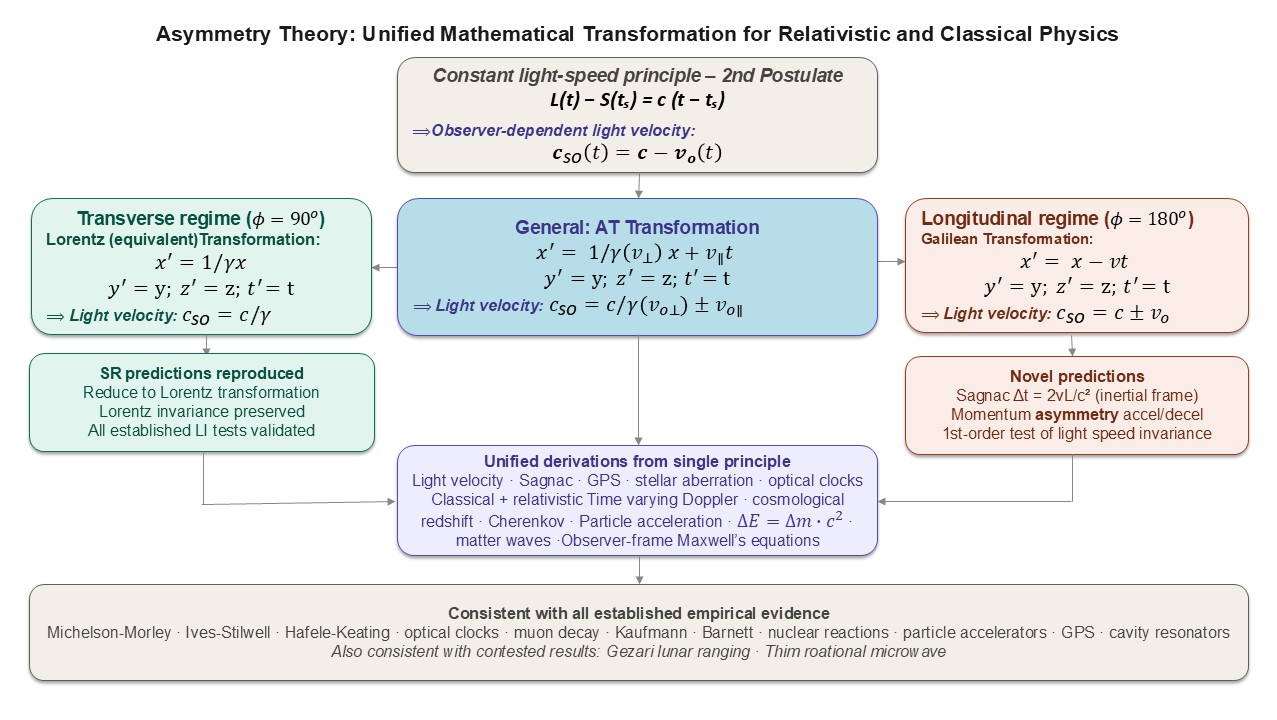
Asymmetry Theory (AT) is derived from a single empirically validated principle: light propagates at constant speed c from its emission origin, addressing the foundational question: is STR's principle of relativity empirically necessary? AT transformation covers Lorentz and Galilean transformations as limiting cases while retaining absolute time. AT unifies classical and relativistic physics: In “Transverse Regime” — observer motion is perpendicular to the ‘source-observer’ line — AT is equivalent to Lorentz transformation, preserving Lorentz invariance and reproducing all validated predictions of STR, while naturally handling non-inertial frames. In “Longitudinal Regime”, AT reduces to Galilean transformation. A central insight is that “Transverse Regime” is the natural equilibrium state of conservative systems in motion. This explains why established high-precision Lorentz invariance tests operate predominantly in the transverse regime and are therefore consistent with both AT and STR. The longitudinal regime is the untested empirical frontier where AT makes testable novel predictions distinguishing it from STR: (1) Sagnac phase shift in inertial frame; (2) momentum asymmetry for parallel acceleration versus deceleration. AT derives: (1) a light observed velocity formula explaining Sagnac effect, GPS one-way light speed, stellar aberration, and optical clock variation; (2) a unified formula encompassing both classical and relativistic Doppler effects, cosmological redshift, and Cherenkov radiation; (3) electrodynamics equations addressing particle acceleration, mass-energy equivalence, and matter waves; (4) a unified Maxwell's equations yielding classical and transverse Doppler and Sagnac effects as solutions.AT maintains consistency with all established empirical evidence: Michelson-Morley, optical cavity resonators, Hafele-Keating, optical clock, Ives-Stilwell spectroscopy, particle accelerators, muon decay, nuclear reactions and GPS Sagnac corrections. AT is also consistent with the anomalous Gezari lunar ranging and Thim microwave results, which remain unexplained within STR. A first-order sensitive motion-controlled interferometer is proposed for the decisive test of AT. In summary, AT is a mathematically rigorous, self-consistent and empirically supported framework that unifies classical and relativistic physics under a single derivable principle, with a decisive test proposed.
Keywords:
Lorentz transformation
; Lorentz invariance
; QED
; Maxwell’s Equations
; Sagnac effect
; doppler effect
; light speed invariance
; special relativity
; at transformation
; ASR
; time dilation
; mass-energy
; matter waves
; cosmological redshift
; Cherenkov radiation
; Michelson-Morley
; twin paradox
; Hafele-Keating
; Ives-Stilwell
; optical clocks
; muon lifetime
; lunar range test
; Galilean transformation
Copyright: This open access article is published under a Creative Commons CC BY 4.0 license, which permit the free download, distribution, and reuse, provided that the author and preprint are cited in any reuse.


