

Submitted:
19 January 2026
Posted:
21 January 2026
You are already at the latest version
Abstract
Theoretical background: Occupational burnout remains a key organizational challenge, while the phenomenon of quiet quitting (QQ - conscious limitation of effort to formal requirements) gains significance in contemporary workplaces. However, existing literature lacks frameworks for distinguishing deliberate disengagement from unintentional, apathetic withdrawal. To address this gap, the concept of passive quitting (PQ - apathetic withdrawal from exhaustion and loss of meaning) is introduced and both mechanisms' unique contributions to explaining burnout are examined.Purpose of the article: To determine the impact of quiet quitting and passive quitting phenomena on occupational burnout and empirically assess their unique contributions within a single coherent latent model.Research methods: Cross-sectional CAWI study on a nationwide sample of Polish employees (N = 1040). QQ and PQ were measured using validated scales, burnout was assessed with the OLBI questionnaire. Covariance-based structural equation modeling (CB-SEM) was employed to test hypotheses assuming both phenomena as significant predictors of occupational burnout.Main findings: Passive quitting is a strong and significant predictor of occupational burnout (β = 0.475, p < 0.001), while quiet quitting shows virtually no relationship (β = 0.0012, p > 0.001). The most influential factors were items related to loss of job satisfaction and meaning (PQS6, PQS7), distinguishing apathetic withdrawal from conscious boundary-setting. PQ may serve as a practical early warning indicator, while QQ behaviors alone do not increase burnout risk when PQ is controlled for.
Keywords:
occupational burnout
; quiet quitting
; passive quitting
; structural equation modeling (SEM)
Introduction
Occupational burnout remains one of the key challenges facing contemporary organizations - it reduces efficiency, increases turnover, and deteriorates employee well-being. In the context of growing performance pressure, remote work, and market uncertainty, phenomena related to the reduction of engagement gain particular significance. After 2022, the concept of "quiet quitting" rapidly entered the discourse of both practitioners and researchers, most often understood as the deliberate limitation of effort to formal requirements (Moczydłowska, 2024). At the same time, behaviors resembling apathetic withdrawal are increasingly observed in practice - stemming more from exhaustion and loss of meaning than from intentional boundary-setting.
The existing literature reveals several gaps. First, there is a lack of coherent definitional frameworks distinguishing between deliberate disengagement (quiet quitting) and unintentional, apathetic disengagement. Second, few studies simultaneously address both mechanisms and assess their unique contributions to explaining burnout - research often measures general "withdrawal" or "lack of engagement," which hinders conclusions about specific causal pathways. Third, quantitative studies on large samples that utilize structural equation modeling to estimate measurement and structural models concurrently are rare. Finally, the Polish organizational context remains poorly documented.
The aim of the article is to determine the impact of the phenomena of quiet quitting (QQ) and passive quitting (PQ) on employee burnout. Addressing the aforementioned gap, we formulate two research hypotheses:
H1. Quiet quitting is a significant predictor of occupational burnout.
H2. Passive quitting is a significant predictor of occupational burnout.
We conducted a quantitative survey using the CAWI method on a large sample of employees in Poland (N = 1040). Validated scales were used to measure QQ and PQ, while burnout was assessed using the OLBI. Hypotheses were tested through structural equation modeling (CB-SEM) in a two-step procedure: (1) assessment of the measurement models for QQ, PQ, and burnout, and (2) estimation of the structural model with paths from QQ and PQ to burnout, using standard fit indices (including RMSEA, CFI).
The article contributes two key theoretical innovations:
- An empirical assessment of the unique contribution of quiet and passive quitting to explaining burnout within a single, coherent latent model;
- A proposal for framing the phenomena of quiet and passive quitting within the logic of job demands–resources models, allowing for more precise design of organizational interventions tailored to the observed withdrawal profile.
The second section provides a concise literature review in two areas: occupational burnout and the phenomena of quiet and passive quitting. The third section outlines the research methodology, particularly the measurement scales and the use of structural equation modeling. The fourth section presents the results of the conducted study. The article concludes with a summary highlighting its theoretical contributions, practical implications, limitations of the proposed method, and directions for future research.
Literature Review
Occupational burnout is a complex psychosocial phenomenon that has been at the forefront of research on work and human resource management for many years. The classic definition by Maslach, Schaufeli, and Leiter (2001) describes it as a syndrome encompassing emotional exhaustion, depersonalization (or cynicism), and reduced personal accomplishment, arising in response to chronic workplace stress. The three-dimensional concept of the Maslach Burnout Inventory (MBI) has had a significant impact on the development of research, but it is not without criticism. Some scholars point out, for instance, that the "reduced professional efficacy" component tends to be less stable in measurements, and that depersonalization overlaps substantially with concepts of disengagement or distancing from work. Moreover, the World Health Organization classified burnout in the ICD-11 not as a medical condition but as an “occupational phenomenon,” emphasizing its roots in working conditions rather than non-work-related factors (WHO, 2019).
A particularly prominent framework in the literature is the Job Demands–Resources (JD-R) model, proposed by Demerouti, Bakker, Nachreiner, and Schaufeli (2001) and further developed by Bakker and Demerouti (2007). This model describes two core mechanisms: the exhaustion pathway, where excessive demands lead to energy depletion, and the motivational pathway, in which individual and organizational resources foster engagement and protect against burnout. The popularity of the JD-R model stems from its flexibility; however, this very trait has also attracted criticism - almost any workplace factor can be categorized as either a demand or a resource, making the model heuristically useful but sometimes lacking in precision.
Burnout measurement relies on several validated tools. The most commonly used is the Maslach Burnout Inventory (MBI), though it has been criticized for being overly tailored to service-sector employees. Alternatives such as the Copenhagen Burnout Inventory (CBI) (Kristensen et al., 1999) and the Oldenburg Burnout Inventory (OLBI) (Halbesleben & Demerouti, 2005; Reis, Xanthopoulou and Tsaousis 2015) offer a more universal approach, incorporating both exhaustion and disengagement from work. Validation studies confirm their applicability across various industries - from manufacturing and logistics to the creative sectors (Xu et al., 2022). At the same time, these tools also face criticism: the CBI focuses too heavily on the exhaustion dimension, while the OLBI, although broader, can be more challenging to use for cross-cultural comparisons.
The relationship between burnout and depression also remains an open question. Meta-analyses indicate very strong correlations, raising concerns about the distinctiveness of the two constructs (Bianchi et al., 2015), though there is also evidence supporting their differentiation (Koutsimani et al., 2019). The lack of consensus complicates both diagnosis and the design of effective interventions.
In organizational practice, burnout is particularly prevalent under conditions of high time pressure, excessive performance demands, and low decision-making autonomy. Cross-sectional analyses show elevated burnout levels in project-based sectors, in technology companies facing innovation pressure, and in environments where task cycles are short and closely aligned with customer expectations (Salvagioni et al., 2017). The consequences for organizations are substantial: increased turnover, decreased productivity, and reduced team creativity directly weaken competitive positioning.
Organizational factors play a key role in the development of burnout: staff shortages, lack of supervisor support, misalignment between personal and organizational values, and ineffective internal communication all contribute to increased risk. In contrast, high-quality collaboration, a sense of meaning in work, and organizational flexibility serve as protective factors. Research indicates that structural elements of work - such as task distribution, role clarity, and process transparency - can serve as effective intervention points (Hodkinson et al., 2022; Li et al., 2024).
The consequences of burnout are evident at both the individual and organizational levels. Employees experiencing burnout exhibit reduced motivation, increased absenteeism, a higher risk of psychosomatic issues, and deteriorating relationships with colleagues. From the organizational perspective, this translates into lower quality of products and services, weakened relationships with clients and stakeholders, and, in the long term, declining financial performance (Salvagioni et al., 2017).
Interventions can be categorized as individual or organizational. Popular programs focused on “psychological resilience” or mindfulness training have shown limited effectiveness, whereas research demonstrates that systemic actions - such as reducing unnecessary procedures, introducing flexible work models, improving information flow, and fostering a feedback culture - yield more sustainable results (West et al., 2018). At the same time, meta-analyses and recent studies suggest that the effectiveness of most interventions is moderate, indicating the need to combine structural changes with programs that support individuals, such as mentoring or coaching (Haslam et al., 2024). Importantly, employees clearly prefer systemic solutions that improve working conditions rather than measures focused solely on individual adaptation (Aiken et al., 2023).
In summary, occupational burnout in organizations should be viewed not merely as an individual issue, but primarily as a strategic organizational challenge. Effective prevention requires a combination of thorough diagnosis (using appropriate tools), analysis of risk and resource factors in line with the JD-R model, and the implementation of interventions that simultaneously empower individuals and modify the work environment. In the context of increasing competition and innovation pressure, managing burnout risk becomes a key component of building sustainable competitive advantage.
The concept of quiet quitting gained rapid popularity after 2022; however, some researchers argue that it is not an entirely new phenomenon, but rather “old tendencies in new packaging” (Hungerford et al., 2025). Two recent syntheses - a systematic review in Management Review Quarterly (48 articles from 2019–2025) (Bordoloi et al., 2025) and a scoping review in Current Psychology (22 studies from 2022–2024) (Bernuzzi et al., 2025) - highlight the lack of a unified definition and the fragmentation of research themes. Most commonly, QQ is described as the deliberate limitation of engagement to formal job requirements, avoiding extra tasks while remaining within the organization (Mahand & Caldwell, 2023).
Recent empirical studies published in Human Resource Management further emphasize that QQ is not a monolithic phenomenon - it takes on different forms depending on factors such as an employee’s commitment profile, and it can have both positive (short-term relief) and negative (deterioration of relationships, limited development) consequences for employees (Harris, 2025). In practical terms, Gallup research equates “quiet quitters” with not engaged employees - those who meet minimum expectations but are psychologically detached. In many populations, this group constitutes approximately half of the workforce. However, this reflects a general measure of engagement rather than a precise diagnosis of QQ as a distinct behavioral pattern (Harter, 2022).
The phenomenon of QQ most frequently co-occurs with the following theoretical constructs:
- − engagement and burnout – QQ is often interpreted as a manifestation of declining engagement (Kahn, 1990) and as a response to high demands and insufficient job resources (Schaufeli & Bakker, 2004);
- − psychological contract breach – a meta-analytic review on psychological contract breach shows that violations of the psychological contract reduce job satisfaction and organizational citizenship behaviors (OCBs), while increasing turnover intentions. Quiet quitting can be seen as a form of neglect or withdrawal that emerges after unmet expectations (Zhao et al., 2007);
- − EVLN (exit–voice–loyalty–neglect) – the EVLN model describes four typical employee responses to job dissatisfaction: exit, voice, loyalty, and neglect. This framework helps to understand how individuals respond to unmet expectations -ranging from actively seeking solutions to passively withdrawing engagement (Rusbult et al., 1988);
- − OCB and performance – if quiet quitting entails a withdrawal from engaging in organizational citizenship behaviors (OCBs), then meta-analytic findings suggest potential negative consequences of such behavior for team functioning and overall organizational effectiveness. A reduction in OCBs may weaken collaboration, knowledge sharing, and a climate of mutual support (Podsakoff et al., 2009).
Among the most important and frequently cited measurement tools for the phenomenon of quiet quitting are several well-developed and validated scales. One of the first and most widely used is the Quiet Quitting Scale (QQS) designed by Galanis and colleagues, based on a three-factor structure encompassing detachment, lack of initiative, and lack of motivation. The scale has been empirically validated, showing strong correlations with occupational burnout, low job satisfaction, and turnover intention (Galanis et al., 2023). In parallel, Talukder and Prieto developed an original QQ scale grounded in social exchange and perceived organizational support theories, whose validity was confirmed in a sample of over 1,400 employees from various industries (Talukder & Prieto, 2025). Additionally, Anand, Doll and Ray (2024) proposed a QQ scale measuring engagement and withdrawal at the individual level, which demonstrated high reliability and validity in factor analyses (Anand et al., 2024).
The most important determinants of quiet quitting include both organizational and individual factors. One of the most frequently cited is the lack of recognition and support from supervisors, which weakens the employee–organization bond and leads to gradual disengagement (Mahand & Caldwell, 2023). Similarly, perceived unfairness in compensation relative to job responsibilities, and lack of professional development opportunities, are identified as key drivers of QQ (Yılar Erkek & Öztürk Altınayak, 2025). A study conducted in the healthcare sector found that underappreciation of effort by managers and unfair reward systems strongly correlate with lack of motivation and initiative - two core components of QQ (Toska et al., 2025).
The essence of the quiet quitting attitude lies in its conscious nature - it is a deliberate stance adopted by the employee (Moczydłowska, 2024). Until recently, there was a lack of definitional and theoretical frameworks for a type of withdrawal that is not intentional, but rather apathetic in nature - stemming from fatigue, indifference, lack of motivation, or occupational burnout. To address this gap, the concept of passive quitting was introduced to describe such disengagement (Nowak, 2026). Thus, there are two distinct mechanisms leading to a decline in organizational engagement: quiet quitting (deliberate and conscious) and passive quitting (unintentional and unconscious) (Nowak, 2026).
Distinguishing between these two phenomena has real practical implications. For managers, it is crucial to accurately determine whether an employee is primarily exhibiting quiet quitting or passive quitting, as each attitude requires fundamentally different strategies for rebuilding engagement. In the proposed framework, the categories of quiet and passive quitting are not mutually exclusive - interactions between them may occur. For example, a high level of passive quitting may lead an employee to consciously adopt an attitude that was previously unintentional. Conversely, quiet quitting may foster indifference and apathy: a person makes a conscious decision to withdraw engagement while simultaneously exhibiting symptoms typical of passive quitting.
Methodology
Validated measurement scales for quiet quitting and passive quitting were employed (Nowak, 2026). The full methodology of the conducted validation studies is detailed in (Nowak, 2026). The scales underwent face validity analysis. The Content Validity Index (CVI) for content relevance and clarity was 0.929 and 0.914, respectively, while the Content Validity Ratio (CVR) for item essentiality reached 1.00. Exploratory factor analysis (EFA) was subsequently conducted. The floor effect ranged from 3.46% (QQS3) to 13.75% (PQS3), while ceiling effects ranged from 6.25% (PQS3) to 13.65% (QQS6). Low skewness values and negative kurtosis across all items indicated that respondents’ answers were approximately normally distributed. The KMO test score was 0.918, indicating sufficiently high inter-item correlations to justify factor analysis. Bartlett’s test was also significant (χ² = 9026.24, p = 0.0000), supporting the factorability of the data. For the combined scale sheet, Kaiser’s criterion indicated two factors (quiet and passive quitting) with eigenvalues greater than 1. These findings were corroborated by the scree plot analysis. Factor extraction was conducted using the Principal Axis Factoring (PAF) method. Exploratory factor analysis with oblique rotation (oblimin) confirmed a two-factor structure, fully aligned with theoretical assumptions. Using PCA methodology, the two factors explained over 66% of the variance (with similar results under PAF+Oblimin). Furthermore, Cronbach’s alpha coefficients were 0.910 for the quiet quitting scale and 0.916 for the passive quitting scale, indicating high internal consistency. All items within each scale were strongly interrelated, suggesting that they effectively measure a common construct -namely, quiet quitting and passive quitting, respectively.
To measure the phenomenon of occupational burnout, the widely recognized Oldenburg Burnout Inventory (OLBI) was used (Halbesleben & Demerouti, 2005). Table 1 presents the measurement scales employed for the analysis of quiet quitting, passive quitting, and occupational burnout.
Rating scale for the phenomena of quiet and passive quitting:
- − 1 – Strongly disagree
- − 2 – Rather disagree
- − 3 – Neither agree nor disagree
- − 4 – Rather agree
- − 5 – Strongly agree
Rating scale for occupational burnout:
- − 1 – Strongly disagree
- − 2 – Rather disagree
- − 3 – Rather agree
- − 4 – Strongly agree
The research methodology aimed at verifying whether quiet and passive quitting constitute significant predictors of occupational burnout can be presented as a three-step procedure:
Step 1. Development of a database for structural equation modeling regarding quiet quitting, passive quitting, and occupational burnout
In this step, a survey is conducted using the CAWI method, applying the measurement scales presented in subsection 3.1. Considering the requirements of the structural equation modeling method (CB-SEM), the research sample should not be smaller than 200 participants (Kline, 2023).
Step 2. Construction and verification of the structural model
To verify the research hypotheses - assuming that the phenomena of quiet and passive quitting are significant predictors of occupational burnout - it is proposed to apply the structural equation modeling (SEM) method. The structural model assumes direct effects of the latent variables, namely quiet quitting (QQ) and passive quitting (PQ), on the latent variable occupational burnout (OB), in accordance with the regression paths represented by the relationship:
OB ~ QQ + PQ
Structural equation modeling should be conducted in two stages:
-
Development of the measurement model – creation of three latent variables:
- −
- Quiet quitting – a latent variable represented by seven items from the QQS scale, which allow for the measurement of conscious and controlled reduction of engagement in work tasks;
- −
- Passive quitting – a latent variable represented by seven items from the PQS scale, which allow for the measurement of reduced engagement in work that does not result from a conscious decision;
- −
- Occupational burnout – a latent variable reflected by 16 items from the OLBI scale.
- Development of the structural model – defining the causal relationships between the latent variables. The model assumes that the level of occupational burnout (OB) is directly explained by the levels of quiet and passive quitting. This relationship can be represented in the form of the following regression equations:
- − , represent the strength and direction of the influence of the independent variables on occupational burnout,
- − represents the error term.
To estimate the model parameters, the Maximum Likelihood (ML) method will be used. The assessment of model fit will be conducted using indicators such as: the χ² statistic, Root Mean Square Error (RMSE), Standardized Root Mean Square Residual (SRMR), and the Comparative Fit Index (CFI). It is assumed that the model fit will be considered acceptable when RMSEA < 0.08 and CFI > 0.90.
Step 3. Conducting an analysis of the impact of individual items from the quiet and passive quitting scales on occupational burnout
As part of this step, a structural model is constructed to examine the impact of individual items from both the quiet and passive quitting scales on occupational burnout. Similar to Step 2, the Maximum Likelihood method is applied, and model fit is evaluated using the same set of indicators. The implementation of Step 3 contributes to identifying the specific factors that have the strongest influence on occupational burnout.
Research Results
Step 1. Development of a database for structural equation modeling regarding quiet quitting, passive quitting, and occupational burnout
Through the implementation of a study using the CAWI method, conducted between May 23–29, 2025 (via the Ariadna panel), a database was developed consisting of responses concerning quiet quitting, passive quitting, and occupational burnout from 1,040 Polish employees. To illustrate the structure of the database, Table 2 presents the responses of one of the 1,040 respondents.
Step 2. Construction and verification of the structural model
The measurement model was developed in accordance with the principles outlined in the methodological chapter. Example regression equations in the measurement model are as follows (for the latent phenomenon of passive quitting):
- − PQS1 = 1 PQ + ε1
- − PQS2 = 1.041 PQ + ε2
- − PQS3 = 1.013 PQ + ε3
- − PQS4 = 1.023 PQ + ε4
- − PQS5 = 1.033 PQ + ε5
- − PQS6 = 1.106 PQ + ε6
- − PQS7 = 1.091 PQ + ε7
Table 3 presents the estimated regression coefficients in the structural model (paths leading to occupational burnout).
A strong, positive, and statistically significant relationship was found between passive quitting and occupational burnout (β = 0.475). In contrast, no such relationship was observed between quiet quitting and occupational burnout - the association proved to be virtually zero and statistically insignificant (β = 0.0012). Due to the negligible impact of quiet quitting (QQ), the estimation of moderating effects of PQ and QQ on OB was omitted to maintain model parsimony and reduce the risk of a Type I error. As a result of structural equation modeling, the final regression equation representing occupational burnout as a function of quiet and passive quitting is as follows:
Figure 1 presents the relationships identified between quiet quitting, passive quitting, and occupational burnout.
The figure illustrates that the path from passive quitting to occupational burnout is clearly positive and significant (β = 0.475), while the path from quiet quitting is virtually zero and statistically insignificant (β = 0.0012). The model remains additive, with no moderating effects. Table 4 presents the key fit indices for the structural model.
The set of fit indices indicates good model fit: the CFI = 0.9069 exceeds the accepted threshold of 0.90, and the reported Root Mean Square Error (RMSE) of 0.0794 falls below the 0.08 cutoff, in line with methodological criteria. The χ² value of 1281 with 402 degrees of freedom is expectedly elevated due to this statistic’s sensitivity to model complexity, but it does not undermine the model's acceptability. The AIC = 118.64 and BIC = 361.32 are considered for comparative purposes - they will be useful when evaluating alternative model specifications (lower values indicate better fit).
Step 3. Analysis of the impact of individual items from the quiet and passive quitting scales on occupational burnout
Table 5 presents the estimated regression coefficients in the structural model, illustrating the relationships between individual items from the PQS and QQS scales and occupational burnout.
The results in the table clearly show a descriptive dominance of the PQS items: the highest estimates are for PQS6 = 0.122823 and PQS7 = 0.106533, followed by slightly lower values for PQS4 ≈ 0.0528 and PQS5 ≈ 0.0529, while the remaining PQS items have small coefficients. In contrast, QQS items cluster around zero, with QQS4 = −0.05472 and QQS5 = −0.03913 being slightly negative, and the rest showing small positive values. The standard errors of all estimates are similar (≈ 0.036–0.043), which highlights that most individual effects are small relative to their uncertainty. Descriptively, this pattern aligns with the main model’s findings: components of passive quitting - especially loss of satisfaction and meaning (PQS6, PQS7) - contribute the most to explaining burnout, while quiet quitting plays a marginal role. Table 6 presents the fit indices for the model analyzing the paths from individual QQS and PQS scale items to occupational burnout.
The set of fit indices confirms good model fit: CFI = 0.9343 exceeds the 0.90 threshold, the error index = 0.0655 falls below the 0.08 limit, and the χ²/df ratio = 449/419 ≈ 1.07 indicates very good relative fit. The AIC = 86.00 and BIC = 263.20 are comparative in nature - lower values would support alternative model specifications. The influence of individual PQS and QQS scale items on occupational burnout (in absolute values) is also visualized in Figure 2.
In Figure 2, it is evident that the strongest impact on occupational burnout comes from PQS6 ("work no longer brings satisfaction – I only do what’s necessary to get through the day") and PQS7 ("lack of development and meaning at work has made me care less and less"). These are followed - though to a lesser extent - by PQS4 (mechanical work without initiative) and PQS5 (discouragement due to lack of recognition). This presents a logically coherent pattern: PQS6–PQS7 reflect the loss of meaning, satisfaction, and perspective - the core of the motivational path leading to cynicism and disengagement - while PQS1 (fatigue/overwhelm) and PQS3 (exhaustion lowering care for quality) represent the energetic depletion path. In other words, passive quitting encapsulates both an exhaustion-related and a motivational component, which explains why PQ strongly predicts burnout in the main model.
In contrast, QQS items cluster near zero, with QQS4 (limiting to basic duties due to lack of recognition) and QQS5 (declining extra-role tasks) showing slight negative relationships. Conceptually, the QQ scale measures conscious boundary-setting: limiting oneself to contractual roles (QQS1, QQS5), prioritizing work-life balance (QQS2), deliberately reducing effort under overload (QQS3), responding to lack of support or recognition (QQS4, QQS6), and distancing for mental well-being (QQS7). From this perspective, quiet quitting does not necessarily drive burnout - it may serve as a regulatory strategy which, once the symptoms of passive quitting are accounted for, does not exert a meaningful or unique effect on burnout.
Our findings are consistent with this view: when the model simultaneously controls for exhaustion, cynicism, and mechanical task execution captured by PQ, the "bare" boundary-setting behaviors from QQ appear at most neutral in relation to burnout. In practical terms, this means that reducing burnout should focus on the underlying factors of PQS6–PQS7 (meaning, development, purpose) and PQS4–PQS5 (work design reducing mechanicality, systemic recognition, and feedback). Importantly, not engaging beyond one’s job description is not pathological - setting boundaries does not harm well-being and can in fact be adaptive.
Of course, these results are cross-sectional, and thus do not establish causal direction, but they clearly suggest that it is the loss of meaning, development, and recognition - more than deliberate restraint in effort - that constitutes the core mechanism linked to burnout. The SEM results did not support the first hypothesis - the path from quiet quitting to burnout was virtually zero and statistically insignificant (β = 0.0012; z = 0.415; p » 0.001), indicating that conscious disengagement is not an independent predictor of burnout. Conversely, the second hypothesis received strong empirical support: passive quitting significantly and positively predicts burnout (β = 0.475; z = 10.095; p < 0.001), and item-level analysis identified that loss of satisfaction, meaning, and mechanical work execution are the most influential components. Given the good model fit (CFI > 0.90; RMSE < 0.08), it can be concluded that the article’s objective - empirically determining the influence of quiet and passive quitting on occupational burnout - has been achieved.
Summary
The article empirically situates the distinction between quiet and passive quitting, proposed by Nowak (Nowak, 2026), within the framework of the JD-R model and demonstrates that it is passive quitting (PQ), not quiet quitting (QQ), that is closely linked to burnout. In the latent model, the PQ→BO (burnout) path is clearly positive and significant, whereas the impact of QQ fades, which theoretically differentiates conscious "boundary-setting" from apathetic withdrawal. The key contribution lies in the fact that measuring a single construct – PQ – allows for reliable estimation of burnout risk, making a single scale a practical proxy indicator for burnout (especially its distancing and exhaustion components) and shortening the diagnostic pathway.
The findings provide managers with a simple early warning tool: the brief PQ scale is suitable for regular pulse surveys and rapid screening within teams, reducing diagnostic costs. Elevated PQ levels indicate where to direct interventions first: restoring meaning and developmental prospects, designing work to reduce mechanical task execution, and strengthening systemic recognition and qualitative feedback. At the same time, the results discourage the pathologization of QQ – merely limiting one’s activity to contractual obligations does not necessarily harm well-being, as long as symptoms of passive withdrawal are controlled.
The conclusions are based on a cross-sectional CAWI study within a single national population, which limits generalizability and does not allow for causal inferences; there is also a possibility of method bias due to self-reporting. Interaction effects were not tested, and the number of control variables was deliberately limited in the interest of parsimony. Although SEM model fit is good, cross-industry and cross-cultural replications and indicator triangulation are needed.
The priority lies in conducting longitudinal studies (e.g., with cross-lagged designs) to verify the direction of PQ↔BO influences, testing measurement invariance of PQ, and developing shortened versions of the PQ scale with risk thresholds for operational applications. It is also worthwhile to analyze mediators (meaning of work, recognition, workload) and moderators (individual resources, team climate), and to conduct intervention experiments aimed at reducing PQS6–PQS7 components and assessing their impact on burnout indicators and hard organizational outcomes (absenteeism, turnover, quality). Analyses of QQ↔PQ transition trajectories are also needed to better capture the dynamics of withdrawal.
References
- Aiken, L. H., Lasater, K. B., Sloane, D. M., Pogue, C. A., Fitzpatrick Rosenbaum, K. E., Muir, K. J.,... & US Clinician Wellbeing Study Consortium. (2023). Physician and nurse well-being and preferred interventions to address burnout in hospital practice: Factors associated with turnover, outcomes, and patient safety. JAMA Health Forum, 4 (7), e231809. Jurnal Ekonomi dan Bisnis Digital, 2(1), 265-271. [CrossRef]
- Anand, A., Doll, J., & Ray, P. (2024). Drowning in silence: a scale development and validation of quiet quitting and quiet firing. International Journal of Organizational Analysis, 32(4), 721-743. [CrossRef]
- Bakker, A. B., & Demerouti, E. (2007). The job demands-resources model: State of the art. Journal of managerial psychology, 22(3), 309-328. [CrossRef]
- Kristensen, T. S., Borritz, M., Villadsen, E., & Christensen, K. B. (1999). Copenhagen Burnout Inventory. Work & Stress. [CrossRef]
- Bernuzzi, C., Paganin, G., Petrilli, S., & Margheritti, S. (2025). Old trends in new clothing? Exploring the quiet quitting phenomenon through a scoping review. Current Psychology, 1-21. [CrossRef]
- Bianchi, R., Schonfeld, I. S., & Laurent, E. (2015). Burnout–depression overlap: A review. Clinical psychology review, 36, 28-41. [CrossRef]
- Bordoloi, S., Sharma, A., & Dhar, R. L. (2025). Leveraging SOR theory to understand quiet quitting: systematic insights from existing research. Management Review Quarterly, 1-30. [CrossRef]
- Demerouti, E., Bakker, A. B., Nachreiner, F., & Schaufeli, W. B. (2001). The job demands-resources model of burnout. Journal of Applied psychology, 86(3), 499.
- Galanis, P., Katsiroumpa, A., Vraka, I., Siskou, O., Konstantakopoulou, O., Moisoglou, I.,... & Kaitelidou, D. (2023). The quiet quitting scale: Development and initial validation. AIMS Public Health, 10(4), 828.
- Halbesleben, J. R., & Demerouti, E. (2005). The construct validity of an alternative measure of burnout: Investigating the English translation of the Oldenburg Burnout Inventory. Work & stress, 19(3), 208-220. [CrossRef]
- Harris, L. C. (2025). Commitment and quiet quitting: a qualitative longitudinal study. Human Resource Management, 64(2), 565-582. [CrossRef]
- Harter, J. (2022). Is quiet quitting real. Gallup. com. https://www.celynarden.com/uploads/2/0/1/3/2013557/is_quiet_quitting_real_.pdf.
- Haslam, A., Tuia, J., Miller, S. L., & Prasad, V. (2024). Systematic review and meta-analysis of randomized trials testing interventions to reduce physician burnout. The American journal of medicine, 137(3), 249-257. [CrossRef]
- Hodkinson, A., Zhou, A., Johnson, J., Geraghty, K., Riley, R., Zhou, A.,... & Panagioti, M. (2022). Associations of physician burnout with career engagement and quality of patient care: systematic review and meta-analysis. bmj, 378. [CrossRef]
- Kahn, W. A. (1990). Psychological conditions of personal engagement and disengagement at work. Academy of management journal, 33(4), 692-724. [CrossRef]
- Kline, R. B. (2023). Principles and practice of structural equation modeling. Guilford Publications.
- Koutsimani, P., Montgomery, A., & Georganta, K. (2019). The relationship between burnout, depression, and anxiety: A systematic review and meta-analysis. Frontiers in psychology, 10, 429219. [CrossRef]
- Li, L. Z., Yang, P., Singer, S. J., Pfeffer, J., Mathur, M. B., & Shanafelt, T. (2024). Nurse burnout and patient safety, satisfaction, and quality of care: a systematic review and meta-analysis. JAMA network open, 7(11), e2443059-e2443059. [CrossRef]
- Mahand, T., & Caldwell, C. (2023). Quiet quitting–causes and opportunities. Business and Management Research, 12(1), 9-19. [CrossRef]
- Maslach, C., Schaufeli, W. B., & Leiter, M. P. (2001). Job burnout. Annual review of psychology, 52(2001), 397-422. [CrossRef]
- Moczydłowska, J. M. (2024). Quiet quitting as a challenge for human capital management–the results of qualitative research. Zeszyty Naukowe. Organizacja i Zarządzanie/Politechnika Śląska. http://dx.doi.org/10.29119/1641-3466.2024.199.33.
- Moczydłowska, J. M. (2024). Quiet Quitting in Generation Z Employees: The Managerial Perspective in the Human–Centric Business Era. Human Resource Management/Zarzadzanie Zasobami Ludzkimi, 160(6).
- Nowak, M. (2026). Spadek zaangażowania organizacyjnego – ciche i bierne odchodzenie. Polskie Towarzystwo Ekonomiczne (in progress).
- Podsakoff, N. P., Whiting, S. W., Podsakoff, P. M., & Blume, B. D. (2009). Individual-and organizational-level consequences of organizational citizenship behaviors: A meta-analysis. Journal of applied Psychology, 94(1), 122. [CrossRef]
- Reis, D., Xanthopoulou, D., & Tsaousis, I. (2015). Measuring job and academic burnout with the Oldenburg Burnout Inventory (OLBI): Factorial invariance across samples and countries. Burnout research, 2(1), 8-18. [CrossRef]
- Rusbult, C. E., Farrell, D., Rogers, G., & Mainous III, A. G. (1988). Impact of exchange variables on exit, voice, loyalty, and neglect: An integrative model of responses to declining job satisfaction. Academy of Management journal, 31(3), 599-627. [CrossRef]
- Salvagioni, D. A. J., Melanda, F. N., Mesas, A. E., González, A. D., Gabani, F. L., & Andrade, S. M. D. (2017). Physical, psychological and occupational consequences of job burnout: A systematic review of prospective studies. PloS one, 12(10), e0185781. [CrossRef]
- Schaufeli, W. B., & Bakker, A. B. (2004). Job demands, job resources, and their relationship with burnout and engagement: A multi-sample study. Journal of Organizational Behavior: The International Journal of Industrial, Occupational and Organizational Psychology and Behavior, 25(3), 293-315. [CrossRef]
- Talukder, M. F., & Prieto, L. (2025). A “quiet quitting” scale: development and validation. International Journal of Organizational Analysis, 33(6), 1487-1510. [CrossRef]
- Toska, A., Dimitriadou, I., Togas, C., Nikolopoulou, E., Fradelos, E. C., Papathanasiou, I. V.,... & Saridi, M. (2025). Quiet quitting in the hospital context: investigating conflicts, organizational support, and professional engagement in Greece. Nursing Reports, 15(2), 38. [CrossRef]
- West, C. P., Dyrbye, L. N., & Shanafelt, T. D. (2018). Physician burnout: contributors, consequences and solutions. Journal of internal medicine, 283(6), 516-529. [CrossRef]
- WHO. (2019). Burn-out an "occupational phenomenon": International Classification of Diseases. World Health Organization. 28 May 2019. https://www.who.int/news/item/28-05-2019-burn-out-an-occupational-phenomenon-international-classification-of-diseases.
- Xu, H., Yuan, Y., Gong, W., Zhang, J., Liu, X., Zhu, P.,... & Jiao, J. (2022). Reliability and validity of the Chinese version of Oldenburg Burnout Inventory for Chinese nurses. Nursing open, 9(1), 320-328. [CrossRef]
- Yılar Erkek, Z., & Öztürk Altınayak, S. (2025). Factors causing the development of quiet quitting in female employees and the role of motherhood: The case of Türkiye. Health Care for Women International, 1-17. [CrossRef]
- Zhao, H. A. O., Wayne, S. J., Glibkowski, B. C., & Bravo, J. (2007). The impact of psychological contract breach on work-related outcomes: a meta-analysis. Personnel psychology, 60(3), 647-680. [CrossRef]
Figure 1.
SEM Model – The Impact of Quiet and Passive Quitting on Occupational Burnout.
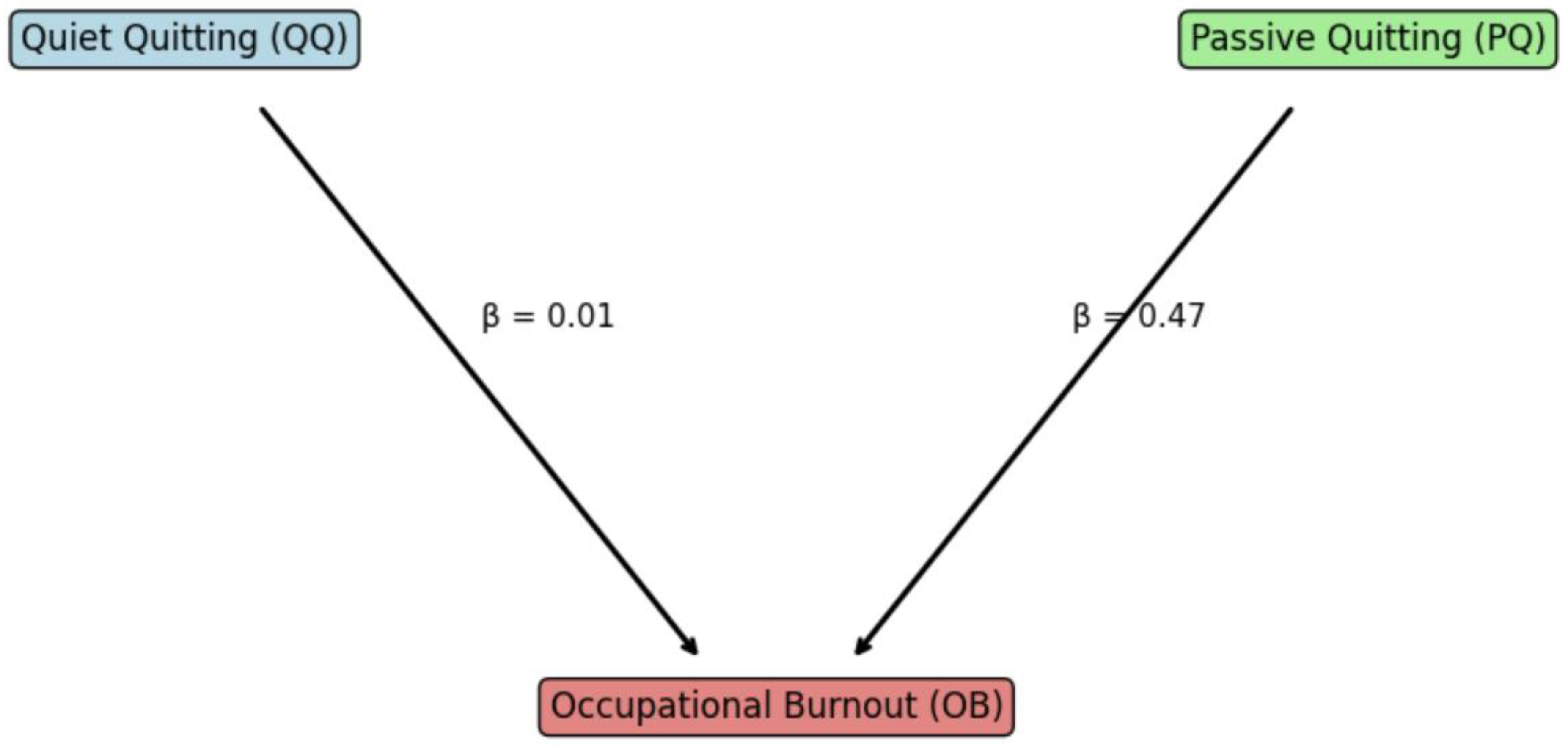
Figure 2.
Impact of individual QQS and PQS scale items on occupational burnout.
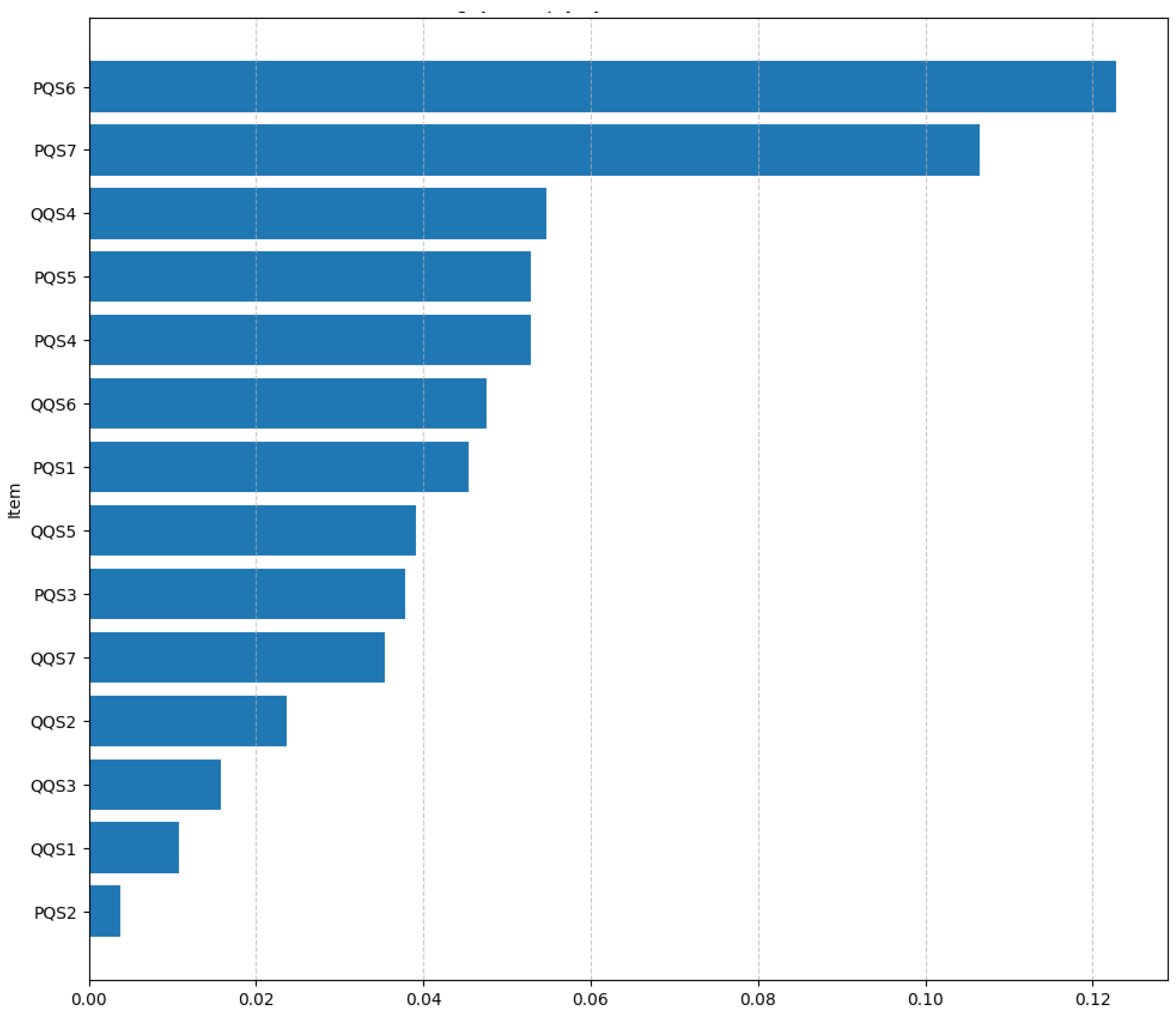

Table 1.
Measurement Scales for the Phenomena of Quiet Quitting, Passive Quitting, and Occupational Burnout.
Table 1.
Measurement Scales for the Phenomena of Quiet Quitting, Passive Quitting, and Occupational Burnout.
| No. | Items | 1 | 2 | 3 | 4 | 5 |
| Quiet Quitting | ||||||
| QQS1 | At work, I consciously limit myself to performing only those tasks that fall within my responsibilities and for which I receive compensation. | ☐ | ☐ | ☐ | ☐ | ☐ |
| QQS2 | I deliberately do only as much as necessary because maintaining a work-life balance is more important to me than going beyond my duties. | ☐ | ☐ | ☐ | ☐ | ☐ |
| QQS3 | When I know I’m overworking, I consciously reduce my effort to only what is necessary to keep my job. | ☐ | ☐ | ☐ | ☐ | ☐ |
| QQS4 | Since additional effort is not recognized in my company, I have decided to limit myself to basic responsibilities. | ☐ | ☐ | ☐ | ☐ | ☐ |
| QQS5 | I consciously avoid taking on tasks beyond my duties, even if they are interesting. | ☐ | ☐ | ☐ | ☐ | ☐ |
| QQS6 | Because I do not feel supported by the company, I have decided not to engage more than my responsibilities require. | ☐ | ☐ | ☐ | ☐ | ☐ |
| QQS7 | To maintain psychological balance, I consciously distance myself from work and do not engage more than necessary. | ☐ | ☐ | ☐ | ☐ | ☐ |
| Passive Quitting | ||||||
| PQS1 | I am often too tired or overwhelmed to put more into work than the bare minimum. | ☐ | ☐ | ☐ | ☐ | ☐ |
| PQS2 | I care less and less about my work and its outcomes – I find it hard to engage. | ☐ | ☐ | ☐ | ☐ | ☐ |
| PQS3 | I feel so exhausted by work that it is difficult to care about the quality of what I do. | ☐ | ☐ | ☐ | ☐ | ☐ |
| PQS4 | Sometimes I perform my duties mechanically, without engagement or initiative. | ☐ | ☐ | ☐ | ☐ | ☐ |
| PQS5 | I feel that a lack of recognition discourages me from putting effort into my work. | ☐ | ☐ | ☐ | ☐ | ☐ |
| PQS6 | Work no longer gives me satisfaction – I only do what is necessary to get through the day. | ☐ | ☐ | ☐ | ☐ | ☐ |
| PQS7 | I feel that the lack of growth and meaning in my work has made me care less and less about what I do. | ☐ | ☐ | ☐ | ☐ | ☐ |
| Occupational Burnout | ||||||
| No. | Items | 1 | 2 | 3 | 4 | |
| 1 | I always discover new and interesting aspects of my work. | ☐ | ☐ | ☐ | ☐ | |
| 2 | There are days when I feel tired even before starting work. | ☐ | ☐ | ☐ | ☐ | |
| 3 | I increasingly find myself speaking negatively about my work. | ☐ | ☐ | ☐ | ☐ | |
| 4 | After work, I usually need more time than before to relax. | ☐ | ☐ | ☐ | ☐ | |
| 5 | I cope quite well with the pressure associated with my job. | ☐ | ☐ | ☐ | ☐ | |
| 6 | Lately, I think less at work and perform my tasks almost mechanically. | ☐ | ☐ | ☐ | ☐ | |
| 7 | My work presents many positive challenges. | ☐ | ☐ | ☐ | ☐ | |
| 8 | During work, I increasingly feel emotionally exhausted. | ☐ | ☐ | ☐ | ☐ | |
| 9 | Over time, one can lose engagement in performing this type of work. | ☐ | ☐ | ☐ | ☐ | |
| 10 | After work, I have enough energy to do something for pleasure. | ☐ | ☐ | ☐ | ☐ | |
| 11 | Sometimes, what I do at work disgusts me. | ☐ | ☐ | ☐ | ☐ | |
| 12 | After work, I usually feel exhausted and weary. | ☐ | ☐ | ☐ | ☐ | |
| 13 | This is the only type of work I can imagine doing. | ☐ | ☐ | ☐ | ☐ | |
| 14 | I usually cope well with the amount of work I have to do. | ☐ | ☐ | ☐ | ☐ | |
| 15 | Over time, I become more engaged in my work. | ☐ | ☐ | ☐ | ☐ | |
| 16 | When I work, I usually feel full of energy. | ☐ | ☐ | ☐ | ☐ | |
Table 2.
Sample respondent's answers to the measurement scale items for QQ, PQ, and OB.
| QQS1 | QQS2 | QQS3 | QQS4 | QQS5 | QQS6 | QQS7 | |
| 2 | 2 | 2 | 2 | 2 | 2 | 3 | |
| PQS1 | PQS2 | PQS3 | PQS4 | PQS5 | PQS6 | PQS7 | |
| 2 | 2 | 2 | 4 | 2 | 2 | 2 | |
| OB1 | OB 2 | OB 3 | OB 4 | OB 5 | OB 6 | OB 7 | OB 8 |
| 3 | 3 | 2 | 3 | 3 | 3 | 3 | 3 |
| OB 9 | OB 10 | OB 11 | OB 12 | OB 13 | OB 14 | OB 15 | OB 16 |
| 3 | 2 | 2 | 3 | 3 | 3 | 3 | 3 |
Table 3.
Estimated regression coefficients in the structural model.
| Path | Estimate (β) | Standard Error (SE) | z- statistic | p-value |
| OB ~ PQ | 0.475 | 0.047 | 10.095 | < 0,001 |
| OB ~ QQ | 0.0012 | 0.012 | 0.415 | >> 0,001 |
Table 4.
Key model fit indices for the structural model.
| Fit Index | Value |
| Degrees of freedom (dof) | 402 |
| Chi-square statistic (χ²) | 1281 |
| Root Mean Square Error | 0.0794 |
| Comparative Fit Index | 0.9069 |
| Akaike Information Criterion (comparative) | 118.64 |
| Bayesian Information Criterion (comparative) | 361.32 |
Table 5.
Path coefficients of PQS and QQS items influencing occupational burnout in the SEM model.
| Latent Factor | Predictor | Estimate (β) | Standard Error (SE) |
| OB | PQS1 | 0.045381 | 0.035959 |
| OB | PQS2 | 0.003841 | 0.040263 |
| OB | PQS3 | 0.037822 | 0.039279 |
| OB | PQS4 | 0.052796 | 0.03988 |
| OB | PQS5 | 0.052876 | 0.040256 |
| OB | PQS6 | 0.122823 | 0.042427 |
| OB | PQS7 | 0.106533 | 0.043367 |
| OB | QQS1 | 0.010844 | 0.037485 |
| OB | QQS2 | 0.0236 | 0.03593 |
| OB | QQS3 | 0.015748 | 0.030546 |
| OB | QQS4 | -0.05472 | 0.040732 |
| OB | QQS5 | -0.03913 | 0.035531 |
| OB | QQS6 | 0.047544 | 0.039837 |
| OB | QQS7 | 0.035357 | 0.037078 |
Table 6.
Model fit indices (paths from individual QQS and PQS scale items to occupational burnout).
| Fit Index | Value |
| Degrees of freedom (dof) | 419 |
| Chi-square statistic (χ²) | 449 |
| Root Mean Square Error | 0.0655 |
| Comparative Fit Index | 0.9343 |
| Akaike Information Criterion (comparative) | 86.00 |
| Bayesian Information Criterion (comparative) | 263.20 |
Disclaimer/Publisher’s Note: The statements, opinions and data contained in all publications are solely those of the individual author(s) and contributor(s) and not of MDPI and/or the editor(s). MDPI and/or the editor(s) disclaim responsibility for any injury to people or property resulting from any ideas, methods, instructions or products referred to in the content. |
© 2026 by the authors. Licensee MDPI, Basel, Switzerland. This article is an open access article distributed under the terms and conditions of the Creative Commons Attribution (CC BY) license (http://creativecommons.org/licenses/by/4.0/).
Copyright: This open access article is published under a Creative Commons CC BY 4.0 license, which permit the free download, distribution, and reuse, provided that the author and preprint are cited in any reuse.


