

Submitted:
18 January 2026
Posted:
20 January 2026
You are already at the latest version
Abstract
Objective of the study: This study utilized Latent Profile Analysis (LPA) to identify distinct personality profiles in a sample of 523 adults with Substance Use Disorder (SUD) from Punjab, Pakistan. Methodology: Using the NEO-120-IPIP inventory, a statistically optimal four-profile solution demonstrated an excellent model fit (Entropy = 0.875). One-way ANOVA confirmed highly significant differences between profiles across all five personality domains (p < 0.001), with particularly large effect sizes for Conscientiousness (η² = 0.75) and Agreeableness (η² = 0.55). Results: The derived profiles were labeled as: (1) Conscious-Warrior (high neuroticism and conscientiousness); (2) Socially Expressive (high extraversion, lower agreeableness); (3) Highly Expressive and Emotionally Intense (extremely high extraversion, neuroticism, openness); and (4) Agreeable-Achiever (high conscientiousness and extraversion). These results reveal significant personality heterogeneity within the SUD population. Conclusions: The findings highlight the clinical utility of person-centered approaches for culturally informed assessment, individualized treatment planning, and targeted relapse prevention strategies.
Keywords:
latent profile analysis
; personality traits
; substance use disorders
1. Introduction
In Pakistan, substance use disorders represent a growing public health crisis, with an estimated 6.7 million people affected by drug use disorders, yet mental health and addiction services remain under-resourced and highly stigmatized (UNODC, 2023). Cultural factors such as familial shame, limited public awareness, and gender-restricted access to treatment further complicate prevention and recovery efforts (Khan & Hyder, 2020). While previous grants emphasized neurobiological and pharmacological explanations of addiction, contemporary perspectives argue that SUDs are a complex, multi-determined condition shaped by psychological, social, cultural, and environmental influences (Skewes & Gonzalez, 2013; Volkow et al., 2017). SUDs are recognized as a chronic, relapsing condition influenced by biological, psychological, and social determinants. Contemporary models conceptualize addiction not merely as a pharmacological phenomenon but as an intricate behavioral and psychosocial process shaped by personality, environmental exposures, early life experiences, and socio-cultural contexts (American Psychiatric Association, 2022; Volkow et al., 2017). Personality theories and psychosocial frameworks provide valuable insights into individual differences in vulnerability to SUDs.
Hans Eysenck’s personality theory is among the earliest trait-based explanations relevant to addiction research. Eysenck proposed that personality is structured around three broad super factors: psychoticism, extraversion, and neuroticism (PEN-model), each grounded in biological and genetic influences (Eysenck and Eysenck, 1997). The Five-Factor Model (FFM), developed by Costa and McCrae (1986, 2003), provides a comprehensive taxonomy of personality traits (Neuroticism, Extraversion, Openness to Experience, Agreeableness, and Conscientiousness). Understanding these trait-based predispositions is critical for identifying high-risk groups and customizing treatment strategies. These traits may interact with socio-contextual factors such as adverse childhood experiences, peer influence, socioeconomic pressures, and family dysfunction (Kendler et al., 2019; Hawkins et al., 1992). Summarizes the five domains of the FFM, which provide a framework for understanding trait-based vulnerability to SUDs.

Table 1.
caption.
| Sr. | Personality Domains | Characteristics |
| 1 | Neuroticism | Anxiety, anger, depression, self-consciousness, immoderation, and vulnerability |
| 2 | Extraversion | Friendliness, gregariousness, assertiveness, activity level, excitement seeking, and cheerfulness |
| 3 | Openness | Imagination, artistic interests, emotionality, adventurousness, intellect, and liberalism |
| 4 | Agreeableness | Trust, morality, altruism, cooperation, modesty, and sympathy |
| 5 | Conscientiousness | Self-efficacy, orderliness, dutifulness, achievement striving, self-discipline, and cautiousness |
Note: Adapted from Johnson (2014).
These five dimensions provide a meaningful framework for analyzing individual variations in behavior, cognition, and emotional processing. Extensive literature supports their relevance in predicting substance-related behaviors and treatment outcomes (Johnson, 2014; McCrae & Costa, 2003). While trait-level analyses have elucidated broad risk factors, they often fail to capture the complex, person-specific configurations of traits that may interact with social determinants such as poverty, education, and social support (Spurk et al., 2020). By contrast, the LPA model allows for the identification of naturally occurring subgroups, offering a more nuanced lens through which to examine how personality interfaces with social context, a perspective highly aligned with contemporary social science and public health frameworks (Muthén & Muthén, 2000). Furthermore, from a social science perspective, addiction cannot be disentangled from the social structures that shape identity, opportunity, and marginalization. Stigma theory (Link & Phelan, 2001) suggests that individuals with certain personality profiles may be more vulnerable to social exclusion, which in turn exacerbates substance use. This study thus sits at the intersection of personality psychology and medical sociology, aiming to uncover how intra-individual traits interact with extra-individual social forces.
This study aims not only to advance personality typology but to provide actionable insights for social workers, clinicians, and policymakers in Pakistan. By identifying distinct personality profiles, we hope to inform the development of tailored psychosocial interventions, reduce treatment attrition, and advocate for person-centered policy reforms in addiction care. The study aims to: (1) Identify latent personality profiles among individuals with substance use disorders using the NEO-120-IPIP Personality Scale. (2) Examine the distinctiveness of these profiles across personality domains. Notably, this study represents one of the first applications of Latent Profile Analysis to examine personality typologies among individuals with SUDs in Pakistan, thereby contributing culturally informed insights to the global literature on personality and addiction.
2. Materials and Methods
2.1. Research Design
A survey method design was utilized. The analytical strategy was a person-centered approach, specifically Latent Profile Analysis (LPA), a model-based clustering technique to identify unobserved homogeneous subgroups (latent profiles) within a heterogeneous population based on their pattern of responses across a set of continuous indicator variables (Spurk et al., 2020). This design was optimal for identifying distinct psycho-social profiles and their correlates at a single point in time, without any manipulation of variables.
2.1.1. Participants and Sampling Strategy
Sample Characteristics: A purposive sample of N = 523 adults with a clinically diagnosed Substance Use Disorder was recruited from multiple rehabilitation centers and inpatient addiction treatment clinics in Punjab, Pakistan. The sample size was determined a priori based on simulation studies in latent mixture modeling. Nylund et al. (2007) demonstrated that a sample size of approximately N = 500 provides adequate accuracy for correctly identifying the number of latent profiles under conditions of moderate separation and realistic effect sizes. Our sample of N = 523 meets this recommended threshold, supporting the reliability of the profile solution.
Table 2.
Inclusion and Exclusion Criteria.
| Inclusion Criteria | Exclusion Criteria |
| A formal diagnosis of Substance Use Disorder as per the Diagnostic and Statistical Manual of Mental Disorders, Fifth Edition (2013). | Presence of severe cognitive impairment or intellectual disability. |
| Proficiency in Urdu to comprehend the study instruments | Active psychosis or acute mania could compromise the validity of self-report measures. |
| Willingness to provide written informed consent. | Unwillingness to participate |
2.2. Measures
Data was collected using a NEO-120-IPIP Personality Inventory instrument that was translated and administered in the Urdu version. Personality traits were assessed using well-validated measures of the Five-Factor Model, the NEO-120-IPIP Urdu version (Johnson, 2014), a public-domain measure that closely corresponds to the proprietary NEO Personality Inventory-Revised (Costa & McCrae, 2003). The instrument consists of 120 item statements measuring the Five-Factor Model (FFM) of personality, encompassing five broad domains: Neuroticism, Extraversion, Openness to experience, Agreeableness, and Conscientiousness. Participants rated their agreement with each statement on a 5-point Likert scale ranging from 1 (Very Inaccurate) to 5 (Very Accurate). The Urdu version of IPIP-NEO-120 has demonstrated strong psychometric properties in previous validation studies, which showed high internal consistency (Cronbach’s α = 0.93-0.99) and test-retest reliability (r = 0.94-0.99) among Urdu-speaking populations (Khan et al., 2019), making it a reliable instrument for personality assessment in the Pakistani cultural context.
2.2.1. Data Collection
Before data collection, ethical approval was obtained from the NUMS-IRB & Ethical Committee (ORIC). Administrative permission was secured from the heads of all participating facilities. The data collection procedure was standardized; eligible participants were provided with a detailed information sheet explaining the study’s purpose, procedures, risks, benefits, and confidentiality assurances. Written informed consent was obtained from all participants before their inclusion. The questionnaire was administered in a quiet, private room within the facility. The IPIP-NEO-120 (Urdu version) was administered first to prevent potential bias from the subsequent questionnaire forms. All participants were assigned a unique identification code to maintain anonymity. No personally identifiable information was collected on the survey forms.
2.3. Data Analysis
Data were analyzed using Jamovi (v2.6.13) with the tidyLPA package. A series of LPA models were estimated using the tidyLPA package in Jamovi, specifying varying covariance structures (Models 1, 2, 3, and 6) with 1–5 profiles. Model fit was evaluated using multiple information criteria: Akaike Information Criterion (AIC), Bayesian Information Criterion (BIC), Sample-Size Adjusted BIC (SABIC), and entropy (with values closer to 1.0 indicating clear profile separation). Following identification of the optimal LPA solution, one-way ANOVA and Tukey’s HSD post-hoc tests were conducted to examine between-profile differences. All analyses were performed in jamovi (Version 2.6) with the tidyLPA package.
3. Results
3.1. Latent Profile Analysis
To identify the optimal number of personality profiles, the multiple latent profile models with varying class solutions (2-5 classes) and covariance structures (Models 1, 2, 3, and 6) were estimated and compared. As shown in Table 3, Models 2 and 6 failed to converge across all class solutions, indicating estimation problems, and were therefore excluded from further consideration (Nylund et al., 2007). Among the converging models, Model 3 with 4 classes demonstrated superior fit based on multiple criteria. This solution showed the lowest Bayesian Information Criterion (BIC = 19594) and excellent classification accuracy (Entropy = 0.875), exceeding the recommended edge of 0.80 for good class separation (Tein et al., 2013). The analytic hierarchy process consistently identified Model 3 with 4 classes as the optimal solution, which integrated multiple fit indices (Akoglu & Erisoglu, 2017). Multiple LPA solutions were estimated and compared. Model 3 with 4 classes was selected as optimal based on the lowest BIC (19594) and favorable entropy (0.875), indicating clear profile separation. Fit indices for competing models are presented in Table 3.
The final four-profile model classified the total analytic sample (N = 523) into distinct subgroups with the following distribution: Profile 1 (n = 79, 15.1%), Profile 2 (n = 276, 52.8%), Profile 3 (n = 34, 6.5%), and Profile 4 (n = 108, 20.7%). Initial descriptive examinations revealed that a small subset of participants (n = 26) exhibited a configuration of globally low scores across all personality domains. The raw mean scores and standard deviations for each of the five personality domains are presented in Table 4, disaggregated by profile membership. For enhanced comparability, the standardized personality configurations are visualized in Figure 1. One-way ANOVA revealed significant between-profile differences on all five personality dimensions (p < 0.001) with large effect sizes: Neuroticism, F (3,519) = 141.6, η² = 0.45; Extraversion, F (3,519) = 114.2, η² = 0.40; Openness, F (3,519) = 86.2, η² = 0.33; Agreeableness, F (3,519) = 208.8, η² = 0.55; Conscientiousness, F (3,519) = 507.7, η² = 0.75, confirming that the profiles are meaningfully distinct. Descriptive statistics for each profile are presented in Table 4.
Figure 1.
Percentage of class. Note: Bar chart showing the percentage of the sample classified into each of the five latent profiles.
Figure 1.
Percentage of class. Note: Bar chart showing the percentage of the sample classified into each of the five latent profiles.
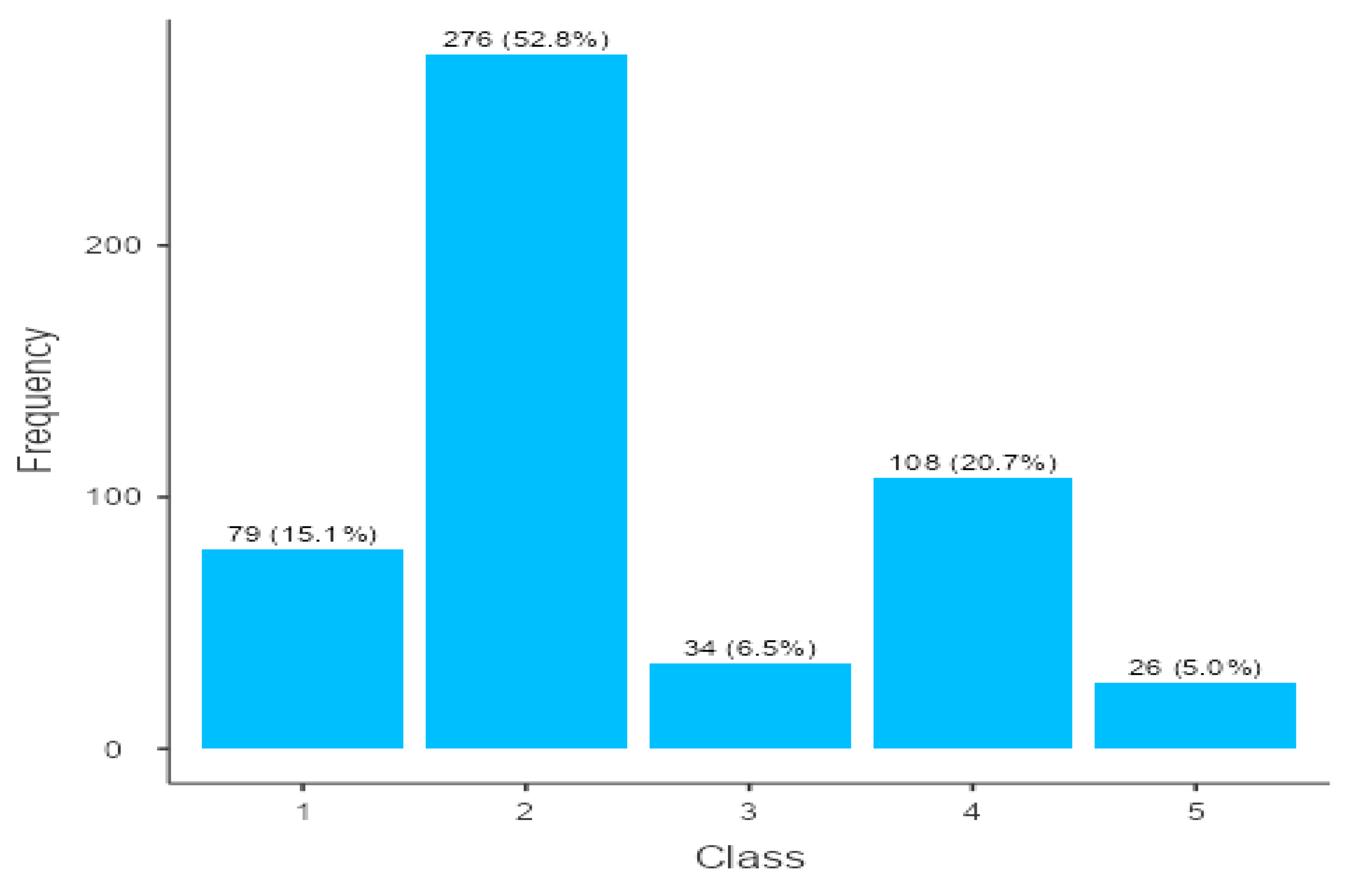
Figure 2.
Line plot of latent profile. Note: Line plot displaying standardized personality trait scores (z-scores) for the five latent profiles.
Figure 2.
Line plot of latent profile. Note: Line plot displaying standardized personality trait scores (z-scores) for the five latent profiles.
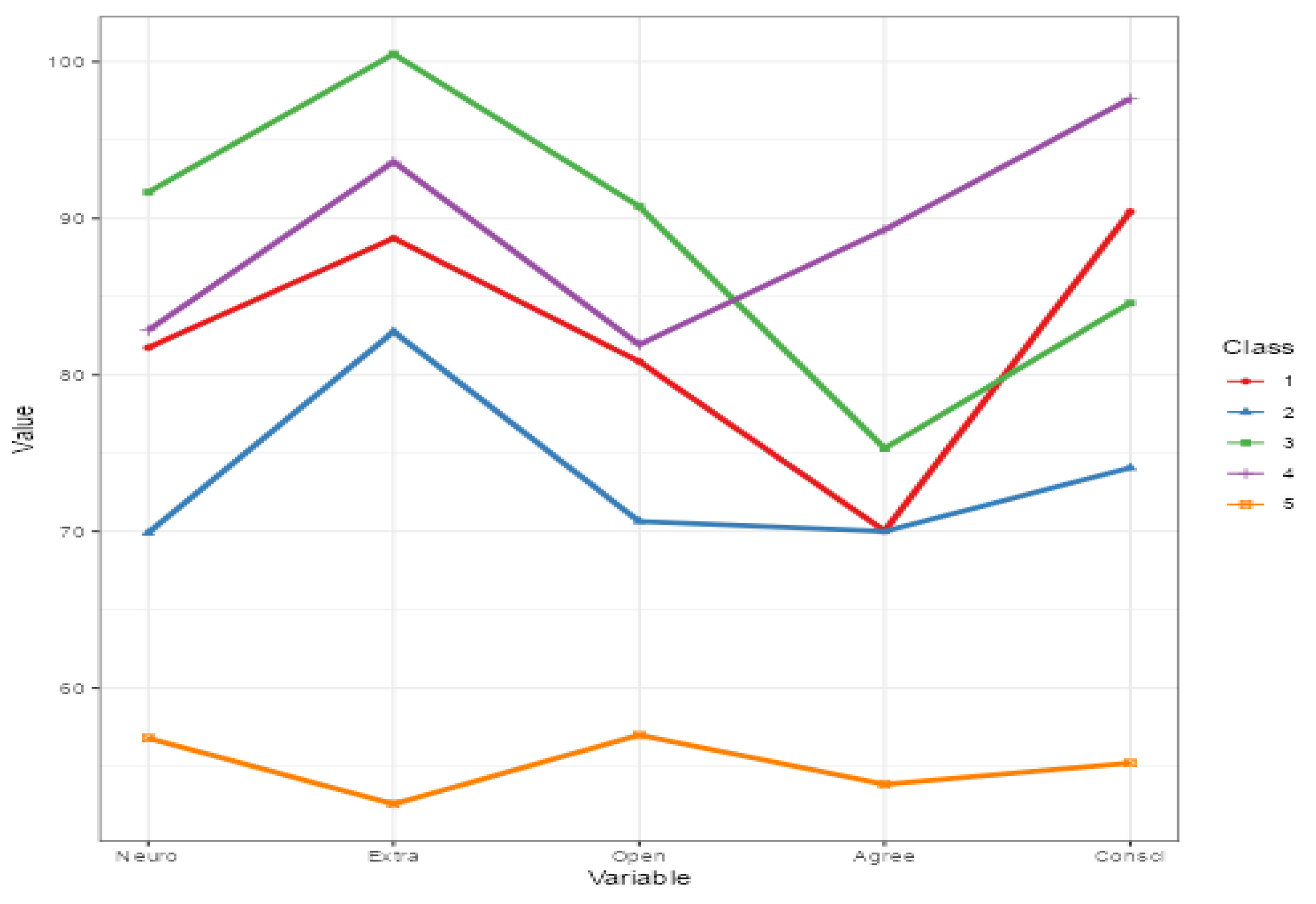
Based on the distinct configurations of standardized personality trait scores (see Figure 1 and Table 4), descriptive and theory-informed labels were assigned to each of the four latent profiles to reflect their core psychological signatures. These labels were derived from the patterns of trait elevations and characterize the profiles as follows:
- Profile 1 (Conscious-Warrior Personality Pattern) characterized by high neuroticism and conscientiousness, average extraversion and openness, and lower agreeableness.
- Profile 2 (Socially Expressive Personality Pattern) is distinguished by high extraversion, average neuroticism, openness, and conscientiousness, and lower agreeableness.
- Profile 3 (Highly Expressive and Emotionally Intense Personality Pattern) is marked by very high extraversion, high neuroticism and openness, average conscientiousness, and lower agreeableness.
- Profile 4 (Agreeable-Achiever Personality Pattern) is defined by high conscientiousness and extraversion, with average levels of neuroticism, openness, and agreeableness.
3.2. Post-Hoc Comparisons
To statistically validate the distinctiveness of the latent profiles and further explore the characteristics of the small residual group, post-hoc comparisons were conducted. A small subset of participants (n = 26) exhibited globally low scores across all traits and did not align clearly with the four primary profiles. This residual group was retained in post-hoc comparisons as ‘Profile 5’ for analytical contrast but was not included as a distinct class in the final LPA solution due to lack of theoretical coherence and minimal size. ANOVA results confirmed significant omnibus differences across all five personality domains with large effect sizes (see Table 4). Post-hoc Tukey HSD tests revealed that 48 of 50 pairwise comparisons were statistically significant (p < 0.05), allowing a clear hierarchical ranking of the subgroups on each trait (see Table 5). Specifically, Profile 3 consistently scored highest on Neuroticism, Extraversion, and Openness, while Profile 4 scored highest on Agreeableness and Conscientiousness. In contrast, Profile 5 scored lowest across all five domains. Notably, Profiles 1 and 4 did not differ significantly on Neuroticism or Openness, and Profiles 1 and 2 were similar on Agreeableness, highlighting specific areas of overlap within an otherwise differentiated typology.
Further examination of pairwise comparisons revealed a distinct pattern of trait elevations (Table 5). For Neuroticism, Profile 3 scored significantly higher than all others (all p < 0.001), while Profile 5 scored the lowest (all p < 0.001). Profiles 1 and 4 displayed intermediate and statistically equivalent levels. Extraversion followed a clear gradient: Profile 3 > Profile 4 > Profile 1 > Profile 2 > Profile 5, with all pairwise differences significant. Openness was highest in Profile 3 and lowest in Profile 5, with Profiles 1 and 4 again not differing from each other. Agreeableness was highest in Profile 4, followed by Profile 3, while Profiles 1 and 2 were statistically similar. Finally, Conscientiousness demonstrated the most pronounced gradient: Profile 4 > Profile 1 > Profile 3 > Profile 2 > Profile 5 (all p < 0.001). Across all personality domains, Profile 5 consistently ranked lowest, whereas Profiles 3 and 4 alternated in occupying the highest positions. This pattern underscores the robust differentiation among the latent profiles and validates the four-profile solution identified through LPA.
3.3. Distinctiveness Latent Personality Profile
This profile (Conscious-Warrior Personality Pattern) comprised 15.1% of the sample (n = 79) and is characterized by a distinct configuration of traits relative to other profiles. Within this group, conscientiousness is notably higher, indicating a tendency toward organization, diligence, and reliability. Extraversion, neuroticism, and openness are average, reflecting balanced sociability, emotional stability, and cognitive flexibility. Agreeableness is relatively lower, suggesting reduced cooperation and interpersonal warmth. Overall, this profile represents individuals with a conscious-Warrior personality structure, exhibiting no extreme tendencies in any trait domain. This profile (Socially Expressive Personality Pattern) represents the largest proportion of the sample (52.8%, n = 276). This profile is defined by elevated extraversion, reflecting high sociability, assertiveness, and energy. Neuroticism, openness, and conscientiousness fall within average ranges, indicating emotional stability, cognitive flexibility, and adequate self-regulation. Agreeableness is comparatively lower, pointing to diminished cooperativeness and interpersonal warmth. In summary, individuals in this profile display a socially expressive personality while maintaining overall psychological stability.
This profile (Highly Expressive and Emotionally Intense Personality Pattern) accounts for 6.5% of the sample (n = 34) and is distinguished by extremely high extraversion, coupled with high levels of neuroticism and openness. Conscientiousness is average, suggesting reasonable self-discipline and behavioral control. Agreeableness remains lower relative to other traits, indicating reduced interpersonal accommodation. Collectively, this profile reflects individuals who are highly expressive and emotionally intense, yet exhibit moderate behavioral regulation and lower interpersonal warmth. This profile (Agreeable-Achiever Personality Pattern) comprising 20.7% of participants (n = 108), this profile is marked by high conscientiousness and extraversion, reflecting strong goal-directed behavior, self-discipline, and active social engagement. Neuroticism, openness, and agreeableness are average, suggesting balanced emotional regulation, cognitive openness, and interpersonal cooperation. Overall, this profile describes individuals who are agreeable-achievers, demonstrating both achievement orientation and interpersonal balance.
3.4. Validation of the Distinctiveness Personality Profile
To statistically validate the meaningful differences between the four latent profiles, a series of one-way analyses of variance (ANOVAs) was conducted on each of the five personality domain scores, using profile membership as the independent variable. The results confirmed statistically significant omnibus differences among the profiles for every domain: Neuroticism F(3, 519) = 141.6, Extraversion F(3, 519) = 114.2, Openness F(3, 519) = 86.2, Agreeableness F(3, 519) = 208.8, and Conscientiousness F(3, 519) = 507.7. Follow-up Tukey HSD post-hoc tests indicated that the overwhelming majority of pairwise comparisons were statistically significant (p < 0.05), providing robust empirical support for the distinctiveness of each profile’s personality configuration.
4. Discussion
4.1. Discussion
The present study employed the LPA model to identify distinct personality-based subgroups among individuals with substance use using the Five-Factor Model (FFM) of personality (Urdu version). Unlike traditional variable-centered approaches, LPA allows for the identification of unobserved heterogeneity within populations by classifying individuals into homogeneous profiles based on shared patterns of traits (Muthén & Muthén, 2000). This person-centered approach is mainly relevant for substance use research, where individuals often exhibit diverse psychological pathways to substance use disorders. The findings supported a four-profile solution, which demonstrated superior statistical fit, high classification accuracy, and strong theoretical interpretability. These profiles reveal meaningful differences in personality configurations that contribute to a more nuanced understanding of substance use vulnerability. The identified profiles should be interpreted within the Pakistani cultural context, where collectivism, family honor, and social stigma may shape both personality expression and substance use behaviors. For example, the Socially Expressive Personality Pattern (Profile 2) may reflect adaptive sociability in a highly communal society, whereas lower agreeableness could indicate resistance to social conformity, a potential risk factor for SUDs in environments where substance use is stigmatized (Khan & Hyder, 2020). Similarly, the Highly Expressive and Emotionally Intense Pattern (Profile 3) may be particularly vulnerable to emotional dysregulation in contexts with limited mental health resources. For instance, the lower agreeableness observed in Profiles 2 and 3 may reflect not only interpersonal friction but also a form of resistance to collective pressures in a high-stigma environment, where substance use is often met with social ostracization. This trait configuration, when coupled with high extraversion, may drive individuals toward deviant peer networks as alternative sources of social reinforcement, a risk pathway particularly salient in collectivist societies (Khan & Hyder, 2020).
4.2. Interpretation of the Latent Profiles
The four-profile Model 3 solution was selected based on multiple fit indices, including the lowest Bayesian Information Criterion (BIC) and high entropy values exceeding the recommended threshold of 0.80, indicating accurate class separation (Tein et al., 2013). Models that failed to converge were excluded, consistent with best practices in mixture modeling that emphasize model stability and interpretability (Nylund et al., 2007). The use of an analytic hierarchy process further strengthened model selection by integrating several information criteria, minimizing reliance on a single statistical indicator. This multi-criteria approach is consistent with contemporary recommendations in latent variable modeling (Akoglu & Erisoglu, 2017).
Profile 1 (Conscious-Warrior Personality Pattern), representing 15.1% of participants, was characterized by moderate levels across all five personality traits. This profile suggests individuals who do not exhibit extreme trait expressions, maintaining a conscious-Warrior personality functioning across social, emotional, and cognitive domains. Such moderate configurations have been associated with adaptive adjustment and stability in life outcomes, reflecting flexibility and resilience across various contexts. This pattern aligns with research indicating that individuals with moderate trait levels often demonstrate stable functioning without pronounced psychological distress or maladaptive behavior (Merz & Roesch, 2012). Profile 2 (Socially Expressive Personality Pattern) constituted the largest segment of the sample (52.8%). It was characterized by relatively high Extraversion and lower Agreeableness, with Conscientiousness, Neuroticism, and Openness at moderate levels. Elevated Extraversion reflects pronounced sociability, energetic engagement, and active interpersonal behavior, whereas lower Agreeableness suggests a lesser emphasis on cooperation and interpersonal compliance. This combination may indicate individuals who are socially dynamic and expressive but less inclined to conform to social expectations emphasizing harmony, a profile configuration similar to those found in other latent profile studies where high Extraversion coexists with lower Agreeableness, shaping distinct social behavioral patterns (Ferguson & Hull, 2018).
Profile 3 (Highly Expressive and Emotionally Intense Personality Pattern) represented 6.5% of the sample and was distinguished by extremely high Extraversion, coupled with high Openness and Neuroticism, and low Agreeableness. Individuals scoring very high in Extraversion tend to be highly social, assertive, and active, while high Openness reflects imaginative and exploratory cognitive styles. Elevated Neuroticism indicates emotional reactivity and heightened sensitivity to stress, which may contribute to greater variability in emotional experiences. Personality research suggests that combinations of high Extraversion, Openness, and Neuroticism can relate to both enhanced creativity and increased emotional lability, particularly when Agreeableness is low (Merz & Roesch, 2012). This profile may thus represent individuals with intense emotional and social engagement alongside a propensity for variable emotional reactions. Profile 4 (Agreeable-Achiever Personality Pattern) comprised 20.7% of participants and was defined by high Conscientiousness and high Extraversion, with moderate levels of Agreeableness, Neuroticism, and Openness. High Conscientiousness typically reflects strong organizational skills, discipline, and a goal-oriented approach, whereas high Extraversion supports active social engagement and proactive interpersonal behavior. Moderate levels of the other traits suggest balanced emotional regulation and openness to experience. This profile may represent individuals who are effective in structured social environments due to their combined discipline and sociability.
4.3. Validation of the Distinctiveness Latent Personality Profile
The statistically significant omnibus ANOVA results across all five personality domains provided strong empirical support for the distinctiveness of the latent profiles. The large effect sizes, particularly for Conscientiousness and Agreeableness, indicated substantial between-profile variability, reinforcing the theoretical importance of these traits in differentiating substance use risk patterns. Consistent with recommendations for validating mixture models, the significant post-hoc comparisons confirmed that the profiles represent meaningful psychological subgroups rather than statistical artifacts (Marsh et al., 2009).
4.4. Limitations and Strength
The LPA model is subject to several analytic decisions that influence results. The selection of a four-profile solution based on fit indices represents one plausible configuration; alternative models with different covariance structures or class numbers might yield equally valid solutions (Nylund et al., 2007). The relatively small cell sizes for the smaller profiles, particularly Profile 3 (n = 34, 6.5%), raise concerns about profile stability and external validity. Furthermore, the cross-sectional nature of the analysis precludes examination of profile stability, transitions between states, or developmental trajectories of profile membership. This study has several limitations. First, while fit indices supported the four-profile solution, LPA results can vary based on analytic decisions (e.g., covariance structures, class numbers), and alternative models may be plausible (Nylund et al., 2007). Second, the cross-sectional design precludes causal inferences; it remains unclear whether the identified personality profiles are antecedents, correlates, or consequences of SUD (Yin et al., 2021). Third, generalizability is constrained by the purposive sampling of adults from rehabilitation centers in Punjab, Pakistan. The study did not examine how demographic factors (e.g., age, gender, socioeconomic status) or clinical characteristics (e.g., primary substance) might influence profile membership (Merz & Roesch, 2012). Fourth, reliance on self-reported data from the NEO-120-IPIP, though validated, may be susceptible to biases such as social desirability (Podsakoff et al., 2003). Finally, one profile comprised a very small subgroup (n = 26), which may affect its replicability and clinical interpretability. Despite these limitations, the study provides significant strengths. It introduces a novel, person-centered typology within a clinical SUD population in a culturally understudied context, moving beyond variable-centered approaches. The use of a well-validated instrument and robust LPA methodology resulted in a solution with high classification accuracy (Entropy = 0.875) and large, significant between-profile effect sizes across all five major personality domains, offering a nuanced framework for clinical assessment.
Future research should employ longitudinal designs to examine profile stability and its predictive validity for treatment outcomes (e.g., relapse). Multi-sample replications across diverse cultural and clinical settings are crucial. Integrating LPA with multi-method assessments (e.g., behavioral, neurobiological) could illuminate biopsychosocial mechanisms. Ultimately, intervention studies testing the efficacy of profile-matched treatments are needed to translate these findings into personalized care.
4.5. Implications of the study
The study contributes to both theory and practice in the field of personality psychology. The use of LPA demonstrates the importance of person-centered approaches in personality research. Identifying latent profiles emphasizes the interaction of traits, rather than treating traits independently, providing a more nuanced understanding of personality heterogeneity (Yin et al., 2021). This approach reinforces the view that personality is a complex configuration of traits rather than isolated dimensions.
4.5.1. Theoretical Implications
This study advances personality theory by demonstrating the utility of a person-centered approach within a clinical SUD population. The identification of four distinct latent profiles underscores the configural nature of personality, wherein traits interact to form meaningful, holistic patterns rather than operating in isolation (Yin et al., 2021). This finding reinforces the perspective that personality is best understood as a complex system of interrelated dimensions, and it validates the application of Latent Profile Analysis (LPA) to capture the significant heterogeneity that may be obscured in traditional variable-centered analyses.
4.5.2. Clinical and Practical Implications
The profiles offer a pragmatic framework for tailoring assessment and intervention. Clinically, they can guide personalized treatment planning. For instance, individuals in the Highly Expressive and Emotionally Intense profile (high Neuroticism/Extraversion) may benefit most from dialectical behavior therapy (DBT) targeting emotional dysregulation, whereas those in the Agreeable-Achiever profile (high Conscientiousness/Extraversion) may respond optimally to structured, goal-oriented approaches like contingency management. This typology also aids in relapse prevention by identifying profile-specific vulnerabilities, such as social friction or reward sensitivity. In forensic and rehabilitative settings within Pakistan, these profiles can inform culturally sensitive risk assessments and rehabilitation plans that account for local familial and social dynamics (Khan & Hyder, 2020).
4.5.3. Organizational and Educational Applications
Beyond clinical contexts, the profile-based approach has utility in career counseling, academic advising, and organizational development. Understanding an individual’s broader personality configuration, rather than single traits, can improve person-environment fit. For example, Socially Expressive profiles may thrive in roles requiring networking and persuasion, while Conscious-Warrior profiles may excel in detail-oriented, autonomous positions. Institutions can integrate such typologies into development programs to enhance engagement and performance through tailored support strategies.
5. Conclusions
The identification of four distinct latent profiles (Conscious-Warrior, Socially Expressive, Highly Expressive/Emotionally Intense, and Agreeable-Achiever) highlights the value of person-centered approaches in personality and addiction research. These profiles differ not merely in trait elevation but in configuration, revealing complex patterns of strength and vulnerability that may inform tailored clinical interventions. The identification of these profiles underscores several theoretical and practical implications. First, it supports the utility of person-centered approaches in personality research, demonstrating that individuals can be meaningfully grouped based on trait combinations rather than single traits alone (Yin et al., 2021). This approach captures trait interactions and behavioral patterns that may be missed in traditional variable-centered analyses. Second, the profiles illustrate heterogeneity in emotional and social functioning, highlighting that even within a single population, personality patterns vary significantly in terms of social expressiveness, emotional reactivity, and regulatory capacity.
From a practical standpoint, these findings support the integration of personality assessment into routine clinical evaluation for SUDs. By identifying an individual’s profile membership, clinicians can develop more personalized treatment plans that address specific personality-based strengths and challenges. Furthermore, these profiles offer a framework for research on treatment matching, relapse prevention, and long-term recovery outcomes. Ultimately, this study contributes to a more nuanced, culturally informed understanding of personality in substance use disorders and underscores the importance of considering whole-person approaches in both research and clinical practice.
Author Contributions
The first author is responsible for the study design, data collection, statistical analysis, and manuscript preparation. The second author contributed through supervision, methodological consultation, and critical review of the manuscript. Both authors contributed to data interpretation and approved the final manuscript.
Funding
This study received financial support from the Office of Research, Innovation and Commercialization (ORIC), National University of Medical Sciences (NUMS), Pakistan. The funding body had no role in the study, data collection, data analysis, interpretation of results, or manuscript preparation.
Institutional Review Board Statement
All procedures performed in studies involving human participants were in accordance with the ethical standards of the institutional and/or national research committee and with the 1964 Helsinki declaration and its later amendments or comparable ethical standards.
Conflicts of Interest
The authors declare no competing interests.
References
- American Psychiatric Association. Diagnostic and statistical manual of mental disorders, 5th ed., text rev.; 2022. [Google Scholar] [CrossRef]
- Costa, P. T., Jr.; McCrae, R. R. Revised NEO Personality Inventory (NEO-PI-R) and NEO Five-Factor Inventory (NEO-FFI) professional manual. In Psychological Assessment Resources; 1992. [Google Scholar]
- Eysenck, H. J.; Eysenck, M. W. Personality and individual differences: A natural science approach; Plenum Press, 1997. [Google Scholar]
- Hawkins, J. D.; Catalano, R. F.; Miller, J. Y. Risk and protective factors for alcohol and other drug problems in adolescence and early adulthood: Implications for substance abuse prevention. Psychological Bulletin 1992, 112(1), 64–105. [Google Scholar] [CrossRef] [PubMed]
- Johnson, J. A. Measuring thirty facets of the Five Factor Model with a 120-item public domain inventory: Development of the IPIP-NEO-120. Journal of Research in Personality 2014, 51, 78–89. [Google Scholar] [CrossRef]
- Kendler, K. S.; Ohlsson, H.; Sundquist, J.; Sundquist, K. The rearing environment and risk for drug use: A Swedish national high-risk home-reared and adopted-away co-sibling control study. Psychological Medicine 2019, 49(12), 1995–2003. [Google Scholar] [CrossRef]
- Khan, A. A.; Hyder, S. Cultural considerations in the treatment of substance use disorders in Pakistan: A review. Journal of Pakistan Psychiatric Society 2020, 17(2), 45–52. [Google Scholar]
- Khan, I. A.; Khan, A.; Nazir, B.; Hussain, S. S.; Khan, F. G.; Khan, I. A. Urdu translation: The validation and reliability of the 120-item Big Five IPIP personality scale. Current Psychology 2019, 38(6), 1530–1541. [Google Scholar] [CrossRef]
- Khan, U.; Hyder, S. Substance use disorders in Pakistan: A scoping review. Journal of Substance Use 2020, 25(2), 115–122. [Google Scholar] [CrossRef]
- McCrae, R. R.; Costa, P. T., Jr. Personality in adulthood: A five-factor theory perspective, 2nd ed.; Guilford Press, 2003. [Google Scholar]
- Merz, E. L.; Roesch, S. C. Modeling trait and state heterogeneity using latent class analysis. In Handbook of structural equation modeling; Hoyle, R. H., Ed.; Guilford Press, 2012; pp. 549–563. [Google Scholar]
- Muthén, B.; Muthén, L. K. Integrating person-centered and variable-centered analyses: Growth mixture modeling with latent trajectory classes. Alcoholism: Clinical and Experimental Research 2000, 24(6), 882–891. [Google Scholar] [CrossRef] [PubMed]
- Nylund, K. L.; Asparouhov, T.; Muthén, B. O. Deciding on the number of classes in latent class analysis and growth mixture modeling: A Monte Carlo simulation study. Structural Equation Modeling: A Multidisciplinary Journal 2007, 14(4), 535–569. [Google Scholar] [CrossRef]
- Podsakoff, P. M.; MacKenzie, S. B.; Lee, J.-Y.; Podsakoff, N. P. Common method biases in behavioral research: A critical review of the literature and recommended remedies. Journal of Applied Psychology 2003, 88(5), 879–903. [Google Scholar] [CrossRef] [PubMed]
- Skewes, M. C.; Gonzalez, V. M. The biopsychosocial model of addiction. In Principles of addiction: Comprehensive addictive behaviors and disorders; Miller, P. M., Ed.; Academic Press, 2013; Vol. 1, pp. 61–70. [Google Scholar]
- Spurk, D.; Hirschi, A.; Wang, M.; Valero, D.; Kauffeld, S. Latent profile analysis: A review and “how to” guide of its application within vocational behavior research. Journal of Vocational Behavior 2020, 120, 103445. [Google Scholar] [CrossRef]
- Tein, J.-Y.; Coxe, S.; Cham, H. Statistical power to detect the correct number of classes in latent profile analysis. Structural Equation Modeling: A Multidisciplinary Journal 2013, 20(4), 640–657. [Google Scholar] [CrossRef] [PubMed]
- United Nations Office on Drugs and Crime. World Drug Report 2023; United Nations, 2023. [Google Scholar]
- Volkow, N. D.; Wise, R. A.; Baler, R. The dopamine motive system: Implications for drug and food addiction. Nature Reviews Neuroscience 2017, 18(12), 741–752. [Google Scholar] [CrossRef] [PubMed]
- Yin, X.; Zhao, W.; Zhou, R. A person-centered approach to personality and health: A systematic review. Health Psychology Review 2021, 15(2), 219–248. [Google Scholar] [CrossRef]
- Yin, Y.; Zhao, J.; Zhou, C. Personality and substance use: A review of recent research. Current Opinion in Psychology 2021, 38, 96–101. [Google Scholar] [CrossRef]
Table 3.
Fit Indices for Latent Profile Analysis Models.
| Model | Classes | AIC | BIC | SABIC | Entropy |
| 1 | 2 | 19974 | 20043 | 19992 | 0.862 |
| 1 | 3 | 19677 | 19771 | 19701 | 0.923 |
| 1 | 4 | 19579 | 19698 | 19609 | 0.874 |
| 1 | 5 | 19561 | 19706 | 19598 | 0.872 |
| 3 | 2 | 19592 | 19703 | 19620 | 0.847 |
| 3 | 3 | 19461 | 19598 | 19496 | 0.846 |
| 3 | 4 | 19432 | 19594 | 19473 | 0.875 |
| 3 | 5 | 19431 | 19618 | 19478 | 0.855 |
Note: AIC = Akaike Information Criterion, BIC = Bayesian Information Criterion, SABIC = Sample-Size Adjusted BIC.
Table 4.
Descriptive Statistics for Personality Domains Across the Four Latent Profiles.
| Profile 1 | Profile 2 | Profile 3 | Profile 4 | ||||||||
| Traits | M | SD | M | SD | M | SD | M | SD | F (3, 519) | p | η² |
| Neuroticism | 82.0 | 5.93 | 70.0 | 7.49 | 93.0 | 4.62 | 82.2 | 10.13 | 141.6 | < .001 | 0.5 |
| Extraversion | 89.1 | 10.02 | 82.8 | 11.44 | 100.4 | 6.15 | 93.5 | 6.95 | 114.2 | < .001 | 0.4 |
| Openness | 80.3 | 8.06 | 70.6 | 9.54 | 93.3 | 3.06 | 81.6 | 11.91 | 86.2 | < .001 | 0.4 |
| Agreeableness | 68.5 | 4.51 | 69.9 | 8.29 | 76.8 | 6.87 | 89.9 | 5.86 | 208.8 | < .001 | 0.6 |
| Conscientiousness | 91.4 | 5.17 | 74.0 | 5.30 | 84.3 | 3.70 | 97.2 | 6.63 | 507.7 | < .001 | 0.7 |
Note: M (mean), SD (standard deviation), η² (eta-squared effect size), p < 0.001.
Table 5.
Hierarchical Ranking of Latent Profiles Across Personality Domains Based on Post-Hoc Comparisons.
Table 5.
Hierarchical Ranking of Latent Profiles Across Personality Domains Based on Post-Hoc Comparisons.
| Traits | Comparison (non-significant) | Profile Ranking |
| Neuroticism | Profile 1 vs 4 (p = 1.000) | 3 > 1 = 4 > 2 > 5 |
| Extraversion | All comparisons significant | 3 > 4 > 1 > 2 > 5 |
| Openness | Profile 1 vs 4 (p = 0.888) | 3 > 4 = 1 > 2 > 5 |
| Agreeableness | Profile 1 vs 2 (p = 0.589) | 4 > 3 > 2 = 1 > 5 |
| Conscientiousness | All comparisons significant | 4 > 1 > 3 > 2 > 5 |
Disclaimer/Publisher’s Note: The statements, opinions and data contained in all publications are solely those of the individual author(s) and contributor(s) and not of MDPI and/or the editor(s). MDPI and/or the editor(s) disclaim responsibility for any injury to people or property resulting from any ideas, methods, instructions or products referred to in the content. |
© 2026 by the authors. Licensee MDPI, Basel, Switzerland. This article is an open access article distributed under the terms and conditions of the Creative Commons Attribution (CC BY) license (http://creativecommons.org/licenses/by/4.0/).
Copyright: This open access article is published under a Creative Commons CC BY 4.0 license, which permit the free download, distribution, and reuse, provided that the author and preprint are cited in any reuse.


