
Submitted:
17 January 2026
Posted:
20 January 2026
You are already at the latest version
Abstract
The informal learning spaces (ILSs), as the core carrier supporting students’ autonomous learning and social interaction, has become an indispensable component of modern campuses. However, the existing researches still have limitations in terms of the ambiguous concept of ILSs, and the lack of analysis of the synergy effect of social and physical dimension factors on students’ performances. To further explore the above problems, this review conducts a systematic literature review and retrieved 33 empirical studies in the fields of education, architecture and library science from 2000 to 2025. The results of this review show that ILSs can be defined as a dynamic ecosystem that integrate technological infrastructure, flexible layouts, and social interaction to accommodate diverse learning needs. Meanwhile, ILSs design needs to coordinate and balance the multiple influencing factors of the social dimension and the physical dimension. This review can provide design guidelines for educators, architects and policymakers that take into account both students’ needs and adaptive functional configurations, thereby providing a practical path for achieving inclusive learning environments and sustainable campus development.
Keywords:
informal learning spaces
; higher education
; social dimension
; physical dimension
; sustainable campus
1. Introduction
The evolution of higher education has increasingly emphasized the role of physical and virtual environments in shaping learning experiences. Over the past two decades, Informal Learning Spaces (ILSs) have become vital in addressing the diverse needs of students [11,15]. ILSs, ranging from libraries and cafés to digitally mediated platforms, are designed to foster intellectual socialization, peer interaction, and interdisciplinary engagement by integrating physical and digital infrastructures to support connected learning across fragmented contexts [12], while flexible spatial configurations enable serendipitous peer interactions that enhance community building [12,35]. Importantly, the design and utilization of university spaces, especially the joint design and production with other institutions, are closely related to the principles of sustainability, encompassing environmental efficiency, social equity, and long-term adaptability of learning infrastructures [36]. Despite the increasing emphasis on ILSs by educators and architects, the ambiguity of the concept of ILSs in a multidisciplinary context, and the determinants of students’ performance within ILSs have not been fully studied. Therefore, it is necessary to rigorously synthesize interdisciplinary evidence.
Despite widespread recognition of ILSs as an important environment for self-directed learning, definitions of ILSs remain inconsistent across different disciplines, which leads to multidimensional interpretations and a lack of standardized definitions. From an educational perspective, ILSs are emphasizes as catalysts for collaborative learning and social knowledge construction. Cunningham and Walton [10] demonstrated that geographical proximity of ILSs to academic departments fosters stable learning communities. These spatially anchored communities provide a physical foundation for collaborative engagement. Furthermore, this review identified functional distinctions between library and other ILSs, revealing how these ILSs support discipline-specific collaboration across diverse academic cohorts. Architectural research prioritizes the physical dimension factors of ILSs, focusing on elements such as lighting, thermal comfort, and spatial flexibility. For instance, Cox [8] identified sensory factors like air quality and lighting as critical to user behaviors, while Riddle and Souter [31] established seven design consideration elements, including comfort, aesthetics, flow, equity, blending, affordances and repurposing, to guide functional space planning. In library science, ILSs are framed as extensions of library services, emphasizing resource accessibility and user support. For example, Walton and Matthews [39] advocated that universities libraries should take the lead in evaluating ILSs, such as using it to analyse students’ usage behaviours, whereas Ramsden [29] highlighted the role of library staff in guiding space utilization and evaluating students’ behaviours. These divergent disciplinary perspectives underscore the absence of a unified framework for ILSs classification, necessitating interdisciplinary approaches to bridge theoretical and practical gaps in learning space design.
Determinants of students’ performances in ILSs are frequently broken down into social or physical domains, with limited integration into an overall framework. Social dimension factors, such as students’ need for privacy, are rarely examined together with physical dimension factors, such as lighting, despite evidence of their interdependence [13]. It is crucial to pay attention to the synergistic effect of social and physical dimension factors on students’ performances, as such an integrated perspective is consistent with the goal of educational sustainability. Equitable access to inclusive learning environments fosters academic retention and reduces disparities among diverse student populations. To address these gaps, this review aimed to synthesize empirical evidence on ILSs in higher education by addressing the following three research questions:
- 1)
- How can an interdisciplinary synthesis advance the conceptual understanding of ILSs in higher education?
- 2)
- What factors affect students’ performances in ILSs?
The significance of this review lies in its multidimensional contributions to understanding and optimizing ILSs. By systematically summarizing and comparing the concept of ILSs in the past 25 years, this review can bridge the fragmented understanding of the definition of ILSs in different disciplines. Meanwhile, analysing how social and physical dimensions factors affect students' performance provides a practical framework for spatial design, which can help architects to deeply consider how to achieve a balance between psychological comfort and physiological comfort in order to improve students’ learning efficiency and their satisfaction. Importantly, the adaptability of ILSs offers inherent potential for sustainable educational practices, as their diverse designs and multifunctional layouts align with resource-efficient campus development. As universities globally invest in ILSs to enhance inclusivity and innovation, this review provides timely insights for policymakers, educators, and architects navigating the complexities of 21st-century education.
2. Materials and Methods
A systematic review was conducted in strict accordance with the Cochrane Handbook for systematic reviews to ensure methodological rigor, transparency and reproducibility. This systematic review study aimed to answer the following two questions: (1) How can an interdisciplinary synthesis advance the conceptual understanding of ILSs in higher education? (2) What factors affect students’ performances in ILSs? Literature search and collection, inclusion and exclusion selection criteria and data synthesis were conducted in this part. The selection of these questions was driven by critical gaps in the literature, including the ambiguity of the concept of ILSs in a multidisciplinary context, and current fragmented research status of effects of social and physical dimension factors on students’ performances.
2.1. Literature Search and Collection
A comprehensive multi-database search was conducted from September to November 2025 using Web of Science, ScienceDirect, ProQuest, and Scopus in the fields of architecture, education and social sciences. In addition, a manual search for references in the selected full-text materials by using Google Scholar were also used. The following terms were used for these queries based on the research questions of this review, which are respectively named ‘informal learning spaces’, ‘higher education’, ‘university student’, ‘indoor environment quality’, ‘social dimension factor’, ‘physical dimension factor’ and ‘spatial design’. To ensure both foundational and contemporary insights, the search was restricted to peer-reviewed journal articles published in English between 2000 to 2025. Review journal articles, conference proceedings, books, chapters in books and reports were excluded to prioritize methodological rigor. Search terms were iteratively refined through pilot testing to optimize sensitivity and specificity.
2.2. Inclusion and Exclusion Criteria
This systemic review includes any research that contain the key terms ‘informal learning spaces’, ‘higher education’, ‘university student’, ‘indoor environment quality’, ‘social dimension factor’, ‘physical dimension factor’, and “spatial design’. The selected studies in this review were filtered through the following inclusion criteria: (1) Only studied published in English and published in the last 25 years (from 2000 to 2025) were selected. This period was chosen because it can better reflect the most outstanding work and recent enthusiasm for the interdisciplinary field related to this study. (2) Research methods involve empirical data analysis, such as qualitative, quantitative or mixed research methods, to ensure sufficiently scientific methodology suitable for further and rigorous analysis. (3) Focused on university students in higher education. (4) Only those studies that pertain to ILSs or open-plan learning environments in higher education from architectural or urban planning contexts were selected. (5) Provided actionable insights into ILS design, student behavior or environment psychology. Exclusion criteria encompassed theoretical essays, non-English studies, pre-2000 publications, theoretical works and research on non-student populations.
2.3. Data Synthesis
After 1466 articles were retrieval based on the above inclusion and exclusion criteria, the two sequential phases workflow comprised by deduplication and two-stage screening were conducted, which designed to minimize bias and enhance the reliability of study selection. Initial deduplication was performed using EndNote 20, a reference management software, to eliminate redundant articles across the four databases, including Web of Science, ScienceDirect, ProQuest and Scopus. A total of 298 duplicates were identified and removed from the initial pool of 1466 articles, resulting in 1168 unique studies for subsequent screening.
The literature screening process rigorously followed a two-stage screening to ensure methodological transparency and reproducibility. Title and abstract screening was conducted independently by two reviewers, Author 1 and Author 3, on 1168 deduplicated articles using a standardized form that against the predefined inclusion and exclusion criteria. 228 articles were resolved through iterative discussions, with unresolved conflicts adjudicated by a third reviewer (Author 2). A total of 932 articles were excluded, primarily due to irrelevance to ILSs (451), non-empirical methodologies (187), or non-student populations (294). For full-text assessment, the remaining 236 studies underwent eligibility evaluation. Author 1 and Author 3 independently annotated articles using a structured template to document study objectives, methodologies, geographical contexts, and alignment with research questions. Methodological quality was assessed via the Mixed Methods Appraisal Tool, with studies scoring lower than 60 excluded to prioritize rigor, such as the inadequate sample sizes, insufficient validity or reliability reporting. Final exclusions (n = 203) were cataloged as follows: scope mismatch (n = 141), pre-2000 publications (n = 28), non-English studies (n = 23), and methodological weaknesses (n = 11). The literature screening process minimized selection bias while ensuring alignment with the study objectives.
The screening process was rigorously visualized through the flowchart Figure 1, which systematically detailed the progression from identification (1466 studies) to final inclusion (33 studies). Figure 1 explicitly reported exclusion rationales and study allocations. All screening data were archived on the authors’ laptops and on the Baidu Web disk for long-term preservation and to facilitate auditability and future replication.
3. Conceptual Review Based on Interdisciplinary Context
3.1. Informal Learning
Before discussing ILSs, formal learning and informal learning need to be explored first. There are a variety of different uses and definitions of formal learning and informal learning across the literature. To clarify the core distinctions between formal learning and informal learning, this section synthesizes and contrasts formal and informal learning across six key perspectives derived from the literature: learning purpose, learning form, learning content, learning place, learning subject and type of knowledge (as summarized in Table 1). Learning purpose, denoting the ultimate goal and evaluation criteria of a kind of learning activity; learning form, referring to the structure and organization of the learning process; learning content, indicating the specific scope and substance of the knowledge or skill involved; learning place, describing the characteristics of the physical or virtual environment where learning occurs; learning subject, representing the role that holds initiative and control in the learning environment; and type of knowledge, which captures the nature of the knowledge acquired. Table 1 summarized the typical characteristics and distinctions between formal learning and informal learning across these six perspectives based on existing literature, thereby provides a structure basic for understanding the essential characteristics of informal learning.
Early definitions by Schugurensky [32] and Lohman [25] distinguish informal from formal learning across key perspectives, particularly learning subject, learning purpose, and learning form. Schugurensky [32] fundamentally defined informal learning as learners driven activities that occur outside of institutional curricula, which contrast with the structured and teacher-leaded paradigm of formal learning. Schugurensky’s [32] point addressed learning subject and purpose. In the same year, Lohman [25] pointed out that formal learning is designed and the learning forms are constructed, and the learning content can remain unchanged for a long time. In terms of learning form, Lohman [25] noted that informal learning can be planned or unplanned and has a wider range of learning content such as action imitation, exploratory development and context awareness. Furthermore, Lohman [25] clarified that the distinction between formal and informal learning fundamentally concerns the learning subject. Formal learning is typically organized and provided by the school district, whereas informal learning is self-initiated with its goals and processes autonomously controlled by the learners themselves.
Subsequent research by Jamieson [20] and Beddie and Halliday-Wynes [4] deepened the understanding of learning subject, purpose, and place. According to Table 1, Jamieson [20] contributes to the perceptive of learning subject. He defined informal learning as a complex network of interactions and experiences, where knowledge is constructed by individuals or groups through active engagement, thereby emphasizing the learner-led nature of the process. Jamieson [20] also believed that informal learning was generally viewed as those other activities for students to learn between formal classrooms, including course reading, classroom preparation, homework and project activities. Informal learning also involves social interaction and it is not easy to distinguish pure social activities from informal learning activities, which means that informal learning has no fixed structure. In parallel, Beddie and Halliday-Wynes [4] were cited for the perspective of learning purpose and learning place. They proposed that formal learning refers to learning through educational institutions, adult training centres or teaching programs in the workplace which are usually recognised in qualifications or certificates. Informal learning refers to learning resulting from daily work-related, family or leisure activities, which normally has no fixed learning objectives and occurs in a relaxed and free learning environment with no restriction on location.
In the 21st century, the conceptualization of informal learning has evolved to reflect its growing importance. As presented in Table 1, Greenhow and Lewin [14] contributed to the perceptive of learning subject and type of knowledge. They presented that formal learning was described as structured, curriculum-aligned activities occurring in physical or virtual classrooms with standardized assessments and teacher-leaded goals, while informal learning is self-directed social practice. Learners enhance their experiences and improve their social skills through non-institutional compulsory learning, which underscores the acquisition of tacit knowledge such as experience and social skills during informal learning process. Greenhow and Lewin’s [14] view aligns with the ongoing pedagogical transformation noted by [30]. They proposed that due to pedagogical transformation, informal learning is becoming equally important to formal learning. Twenty-first-century learning environments are networked with broadband and mobile communication tools, which leads to learners who are more active and conducive to using mobile communication tools in their daily learning activities. More concisely, these devices inevitably change the ways students communicate, collaborative, cooperate, develop and transmit knowledge and information. Consequently, students are moving away from the old norm of formal face-to-fact learning and entering into the new norm of informal non-face-to-face learning.
The comparisons outlined above demonstrate that informal learning is fundamentally distinct from formal learning across multiple perspectives. Informal learning is a type of spontaneous individual learning or group collaborative learning behaviour which emphasises individual learning or knowledge-sharing. The driving force for learning mainly comes from learners’ own desire for knowledge or skills. Informal learning is a form of learning driven by existing problems with strong practicality. The synthesis of these perspectives, including learning purpose, form, content, place, subject, and knowledge type, provides a comprehensive understanding of its nature. Crucially, all these defining characteristics should be considered in the design of ILSs to effectively support the diverse ways in which students learn outside the classroom.
3.2. Systematic Synthesis of Definition of ILSs
From the perspective of pedagogy, the core of ILSs lies in supporting a process where knowledge is note delivered by teachers but instead constructed by individuals or groups through active engagement in meaningful experiences. Students identify ILSs as their own spaces and use them for recreational activities in addition to learning. In other words, students themselves also have a sense of self-learning and self-regulatory ability. ILSs can be defined as any spaces outside classrooms that can be used for learning by students with a high degree of freedom. Jackson and Shenton [19] emphasised two important features of ILSs, including providing learning spaces and learners’ interaction with others. Therefore, ILSs are ideally environments that promote informal learning processes and their characteristics encourage students to engage in informal individual and collaborative learning.
The expansion of information and communication technologies has established a new way of learning and teaching for students and teachers, resulting in the physical learning ecosystem needing to be upgraded [2]. Advancement in information and communication technologies has fostered a new way of learning where learners can learn anytime, anywhere and everywhere [3]. Face-to-face learning methods in pedagogy have been separated from traditional classroom time, which leads to informal learning occurring outside the classrooms such as in libraries, corridors and cafes. Due to the social characteristics of the learning process, which require feedback and interaction among students, ILSs enable students to get know each other and interact in a variety of way. Furthermore, in order to meet the expectations of future students, universities must be more creative and innovative in using, reconfiguring or building new ILSs.
In response to these challenges, the design of education buildings should arrange and engage ILSs with adequate social and physical features, thereby creating student-centred, technology-supported, and innovative learning environments from the perspective of architecture [30]. The public image of contemporary university campuses is gradually providing for students’ informal learning activities with more flexibility, collaboration, engagement and independence on the site [24,30]. Students normally spend more time in ILSs, which provides opportunities to change the layout of learning spaces to accommodate students' variety of needs. In order to create a dynamic atmosphere, the layout, furniture and available technologies of these spaces aim to enhance movement and flow, reflecting the multiple tasks and relationships that occur or may form within these spaces [5]. ILSs aim to promote a free and open culture to encourage student interaction and engagement, as well as the pursuit of independent learning [9,38].
In the practical context of campuses, ILSs manifest in various forms. Carnell [6] found that in-between spaces between classrooms and lectures are well-used by students because they are happy to study there. Harrop and Turpin [15] argued that ILSs refer to non-discipline-specific spaces frequented by both students and staff for self-directed learning activities and they can be within and outside library spaces. Research and practice in library science have significantly enriched the concept of ILSs, promoting the transformation of the library from a traditional repository into one of the most important ILSs on campuses. The concept of a model library on campus is changing to ILSs which encourage individually focused work, collaborative learning, active interaction among students and relaxation [24]. Libraries on campus are developing to reflect the new learning paradigm by providing various types of ILSs. Common learning areas are a typical example of ILSs which are usually located within a university library or learning centre [5]. In order to meet the growing demand for ILSs, some campuses are creating social hubs, learning streets and other designated spaces to promote social and learning-related activities outside the classroom [28].
In summary, learning spaces on campuses can be regarded as a continuum between formal learning spaces and ILSs. As shown in Figure 2, formal learning spaces are constructed for conventional teaching or particular utilisation by specific students and mainly comprise classrooms, laboratories, computer labs, lecture halls, and meeting rooms. In contrast, ILSs include all spaces outside the classroom where knowledge-sharing and learning activities can take place, including libraries, common centre, cafes, corridors and other in-between spaces. As carriers of informal learning behaviour, ILSs are complex network spaces which can be generated in a wide range of physical environments, including the internal and external environments of university campuses. With the transformation of contemporary teaching concepts, spaces that support student learning behaviour have evolved from traditional classrooms to a space system that includes classrooms, buildings and campuses. Furthermore, Doshi et al. [11] concluded that students’ learning behaviour have a clear connection with the physical space. It is also necessary to understand what students want from ILSs, how they use them and how these spaces can be improved.
Through the synthesis of the definitions above, it is evident that ILSs are a composite concept integrating concerns from multiple disciplines. Education research reveals role of ILSs in supporting learning behaviours, architecture and design disciplines respond by shaping their physical spaces and environments, and library science has crucially promoted the transformation and practice of libraries, which are one of the core carriers of ILSs on campuses. Despite the disciplines have different focuses, these perspectives collectively shape the understanding of ILSs as a dynamic ecosystem that integrates technological infrastructure, flexible layouts, and social interaction to accommodate diverse learning needs, which aligns with the shift toward hybrid and self-directed educational models in the 21st century.
4. A Synthesis of Factors Influencing Students’ Performances
Due to the development of information and communication technologies, students can study anywhere and anytime, which make it possible for every square metre of the built environment has the potential to support students’ learning activities. It is notable that students’ choice of a specific learning space is highly related to the actual and perceived quality of the factors in social and physical dimensions in comparison to other ILSs. In other words, the psychological and physical responses brought about by the social or physical factors can affect students’ performances in ILSs. It is crucial to explore the influencing mechanisms of the factors affecting students’ performances in ILSs and what factors affect students’ performances in ILSs in social and physical dimensions?
4.1. Social Dimension Factors of Interaction and Privacy
Some researchers have paid attention to educational buildings in terms of the social dimension factors that affect users (Shown in Table 2). It is imperative to understand that the social experience of learning has led to the design of ILSs and it is important to understand more about how the actual social interactions in the variety of ILSs support or impede the study performances. To understand how the actual interaction in the current variety of learning spaces supports or hinders students’ learning experiences and how students organise their own activities in learning spaces with strong affordance of social exchange, mixed methods including audio diaries, behavioural observations, on-task conversations and focus groups were used by Crook and Mitchell [9]. Their study concluded four interaction categories. The first type of interaction was focused collaboration, which was likely to be planned and strongly outcome-oriented. Focuses collaboration often took place on traditional occasions and joint problem-solving was relatively intense. The second type of interaction was intermittent exchange, where students gathered for independent study allowing occasional and improvised to-and-fro of questions or comments. The third type of interaction was serendipitous encounter, where students met with peers occasionally and discussed study-related issues briefly. The fourth type of interaction was ambient social interaction, which meant that students identified the importance of simply being there as participants in a study community. In summary, these four categories of interaction can help researchers better understand interaction forms that occur in learning environments. Crook and Mitchell’s [9] research laid a foundation for understanding students’ interactions in ILSs.
The educational value of interaction and the role of space in promoting interaction has been empirically supported by several researchers. To determine students’ perceptions of the value of the interaction that take places in learning spaces, Hurst et al. [18] explored a model of instructional delivery where students had opportunities for daily interaction with each other in university classrooms. Their findings revealed that interaction improved students’ learning by enhancing their knowledge of literacy and their critical thinking and problem-solving abilities. In the same year, van Sprang et al. [37] constructed a conceptual model to describe the impact of the work environment on satisfaction and productivity. They found that optimising and promoting knowledge production required both the centralized space that supports the internalisation of knowledge, and the interactive space that supports the externalisation of knowledge. They concluded that the physical dimension, including comfort and layout, was more important for collective productivity, whereas the social dimension, including interaction, was more important for individual productivity. Physical spaces itself are regarded as a kind of strategic management tool for educational institutions to facilitate interaction among students. Storvang and Nguyen [34], in their university case studies, positioned learning spaces as an ‘organizational meeting place’ aimed to eliminating disciplinary silos and promoting spontaneous encounters and teamwork among students. Similarly, Soares et al. [33] explored the relationship between spatial configuration and the sustainable dimension of creativity based on a case study of Groningen Zernike Campus in the Netherlands. They found that creativity could not be explained simply by analysing spatial configurations, but also depended on the combination of physical features, positive experiences and perceptions of a sense of place which enabled trust and interaction.
It is noteworthy that research on interaction in special contexts has been further deepened. Based on the background of preventing the rapid transmission of the virus among students during the COVID-19 epidemic, the unexpected disruption of face-to-face learning means pedagogical methods are changing, leading to the rapid development of online instruction. To understand the factors impacting the learning performance of university students after the adoption of online learning because of COVID-19, a well-structured questionnaire was prepared by Kedia and Mishra [22] to collect data through a network. Their finding showed that instructor–student interaction had a positive relationship with students’ learning performance through student engagement, while peer interaction had a minor influence on learners’ performance. Extending Kedia and Mishra’s [22] finding, Huang and Lajoie [17] highlighted the importance of socio-emotional interaction in collaborative learning, defining it as a social interaction process in which students strive to maintain cohesive and respectful social interaction that is dynamically generated by learners in the interpersonal environment. They proposed that when socio-emotional interaction occurs, learners can adopt a higher level of thinking by obtaining insights and immediate feedback from peers [17].
Privacy also has received widespread attention as a critical requirement for ensuring focused learning and psychological comfort. Wu et al. [40] identified six significant design characteristics affecting students' use of informal learning environments, among which spatial hierarchy and openness could be classified under the social dimension. They noted that privacy, contained within spatial hierarchy, could be enhanced through the control of the boundary and reconfiguration of the learning environment. To address higher education students’ learning space preferences, Beckers et al. [3] study was based on a survey that involved 697 business management students of a Dutch university of applied sciences. The study mainly focused on preferred ILSs for collaborative study activities with peers, which required communication, and preferred ILSs for individual study activities, which required concentration. They found that students' learning space preferences are not solely determined by their individual preferences for interaction or privacy but are also influenced by the perceived importance of quietness. In their study, quietness emerged as a key reason for students' preference for learning spaces that offer the possibility of retreat, highlighting the importance of providing environments that balance social interaction with individual privacy.
However, some researches indicated that interaction and privacy are not mutually exclusive but are two integrated aspects that need to be synergistically considered and balanced in spatial design. The findings of Beckers et al. [3] already pointed out that students preferences for learning spaces are not determined by a single factor of interaction or privacy. Zhang et al. [42] highlighted that interaction and privacy in ILSs plays a significant role in shaping students' learning behaviors and performances. They found that students’ preferences for privacy and interaction are influenced by individual differences. Meanwhile, the spatial configuration of ILS, such as active-public space, active-private space, quiet-public space and quiet-private spaces, is crucial in facilitating or inhibiting interaction and privacy. The research underscores the importance of providing a variety of interaction and privacy levels within ILS to cater to different learning tasks and personal preferences, with research in the post-pandemic era offering further reinforcement. Kim and Yang’s [24] study found that even after the pandemic, students prefer to go on campus to use ILSs and meet peers. Balancing the needs for privacy and interaction is still essential and important, students require both private individual study spaces to support focused learning and task completion, as well as open spaces suitable for social interactions.
4.2. Physical Dimension Factors
Students' performance in ILSs is systematically influenced by a variety of physical dimension factors. Through a systematic review of existing literature, this review identifies nine key physical dimension factors influencing students’ performance, namely temperature, sound environment, lighting, air quality, layout, crowdedness, comfort of furniture, adjustability of furniture, and facility. To establish a clear analytical framework, these nine physical dimension factors are synthesized into three comprehensive categories, which are indoor environmental quality factors, spatial configuration factors, and ergonomic and technological factors. Classifying temperature, sound environment, lighting, and air quality under indoor environmental quality factors follows the established academic standards in the fields of architecture and environmental sciences. Temperature, sound environment, lighting, and air quality collectively constitute the physical foundation affecting student comfort and cognitive performance. In this review, layout and crowdedness are grouped as spatial configuration factors primarily because these two physical dimension factors influence students’ behavioural patterns and social interactions. Comfort of furniture, adjustability of furniture, and facility are categorized as ergonomic and technological factors as these three physical dimension factors provide the most direct physical components to support the realization of various learning activities. Synthesizing the nine physical dimension factors into these three categories aims to systematically and hierarchically reveal the pathways through which the physical dimension influences learning behaviours. Table 3 presents these nine physical dimension factors and provides an overview of the studies associated with each.
4.2.1. Indoor Environmental Quality Factors
Temperature is universally recognized as a critical factor, though its influence varies across contexts. Huang et al. [16] showed that thermal discomfort amplifies dissatisfaction with other environmental factors such as sound environment and lighting. The aforementioned finding regarding the primacy of thermal comfort is consistent with the later work of Andargie and Azar [1], which highlighted the interplay between temperature and cognitive performance, with demographic factors like age and gender modulating responses. Similarly, Yang and Moon [41] identified thermoneutral conditions (25°C) as optimal for balancing sound and visual comfort, emphasizing temperature's role as a mediator of multisensory interactions. However, Kang et al. [21] pointed out that temperature ranks lower in importance compared to sound environment factors. Mahyuddin [26] found that temperature did not cause obvious health problems, but low temperature leads to clod discomfort.
The sound environment emerges as a dominant factor in spaces requiring concentration. Cha and Kim [7] identified noise as a top concern in academic libraries, where conversational disruptions and ambient sounds deter spatial choice and productivity. Kang et al. [21] reinforced Cha and Kim’s points by revealing that occupants prioritize sound environment quality over temperature and lighting. Yang and Moon [41] further demonstrated that sound environment comfort has the strongest correlation with overall environmental satisfaction, surpassing temperature and lighting effects in controlled settings. Regarding low decibel sound level, Mahyuddin [26] found that intermittent noise in quiet learning spaces significant reduced occupants’ satisfaction. Furthermore, Khoshbakht et al. [23] and Zhang et al. [43] respectively pointed out that task type and individual characteristics affect occupants’ perception of the importance of sound environment. Based on the similar views, Wu et al. [40] noted that ILSs with adaptable sound environment better support group discussions without compromising individual study needs, and underscores the need for context-specific sound management. Kim and Yang [24] pointed out that students in the open-plan space considered the level of background noise to be appropriate. However, very small sounds in the quiet zone can distract students.
Lighting conditions exhibit both direct and indirect effects on students’ performances. Huang et al. [16] observed that occupants’ satisfaction with lighting correlated strongly with task requirements. Meanwhile, natural lighting was regarded as very important factor affecting students’ work satisfaction, mood and performance [24,37]. Wu et al. [40] pointed out that comfort as one of the key design features influencing students’ preference, with visual conditions such as lighting being a primary aspect. Students paid attention to natural lighting and sufficient artificial lighting. Yang and Moon [41], however, revealed that indoor environmental comfort with a decrease in the noise level at thermoneutrality in brighter conditions. Mahyuddin [26] added that poor lighting in libraries correlates with eye strain and reduced focus, emphasizing the need for task-specific illumination standards.
Andargie and Azar [1] established a comprehensive framework for evaluating air quality as part of indoor environmental quality, integrating subjective surveys and objective cognitive tests to link poor air quality to reduced productivity and impaired cognitive performance. Through controlled experiments, Huang et al. [16] identified air quality as a latent factor influencing overall indoor environment quality satisfaction, noting that extreme thermal or sound stressors often overshadow air quality concerns. Kang et al. [21] ranked air quality as the third importance factor among indoor environment quality factors for research productivity. In contrast, Mahyuddin [26] evaluated air quality in Green Zoon in the academic library and finds that the high occupancy density led to the poor air quality, which in turn cause occupants’ health problems.
4.2.2. Spatial Configuration Factors
Layout significantly influences students’ comfort, behaviors and collaboration. Layout was regarded as the physical dimension factor that has the strongest impact on occupants’ productivity, which directly affects concentration and collaborative interaction [37]. Cha and Kim [7] highlighted crowdedness and amount of space as key determinants of library productivity, with inefficient layouts exacerbating perceived density. Kang et al. [21] further linked poor layouts to visual and auditory distractions, even when spatial metrics meet design standards. Nja et al. [27] demonstrated that U-shaped spatial layouts enhance teacher-student interaction and academic outcomes compared to fixed-row arrangements, while Wu et al.[40] pointed out that flexible designs such as movable furniture enable ILSs to quickly adjust their layout to adapt to different learning activities. The spatial hierarchy design ensures that group discussions of different scales and individual learning do not interfere with each other through spatial isolation. Khoshbakht et al. [23] contrasted academic and commercial settings, noting that academics favor smaller, private workspaces, whereas commercial environments prioritize open layouts for teamwork.
Crowdedness, which reflects subjective density perceptions, also affect students’ performances. Cha and Kim [7] ranked it among the top five library stressors, as high occupancy limits personal space and increases distractions. Mahyuddin [26] identified that high occupancy density leads to poor air quality, correlating with increased respiratory symptoms such as coughing among occupants. Students’ pointed out that crowdedness was prone to occur in open-plan space for group work and lounge spaces [24].
4.2.3. Ergonomic and Technological Factors
Comfort of furniture and adjustability of furniture reveal distinct emphases across different learning and working environments. Cha and Kim [7] identified comfort of furnishing as one of the top five factors influencing students’ spatial choices in academic libraries. Their survey highlights that ergonomic seating directly impacts perceived productivity, particularly in high-density zones where prolonged sitting is common. Kang et al. [21] extended Cha and Kim’s [7] point by emphasizing comfort of furniture as a critical sub-factor within the indoor environmental quality, where inadequate seating comfort correlates with fatigue during extended research tasks. Students emphasized the importance of furniture comfort for long-term study [24]. Beckers et al. [3] proposed that comfort is the most important assessment element for students to evaluate the learning environment. Students regarded the comfort of furniture and temperature as the core elements of the comfort.
Adjustability of furniture emerges as an important design characteristic in ILSs. The adjustability of furniture, such as movable seats, can provide the autonomy for students to reorganize learning spaces and stimulate spontaneous social interaction, which is regarded as a key physical dimension factor for public spaces to support creativity [33]. Wu et al. [40] identified adjustable and modular furniture as essential for supporting diverse activities in informal learning environments, with flexibility enabling students to self-select configurations aligned with task demands. Nja et al. [27] found that U-shaped seating arrangements in classrooms enhance teacher-student interaction while allowing reconfiguration for collaborative activities, demonstrating how spatial adaptability mediates academic outcomes. Students hope that learning spaces should provide movable furniture, fixed furniture and different heights furniture to meet the individualized needs of students [24].
In the context of ILSs, this review defines ‘facility’ as technological hardware and network services that support diverse learning activities, primarily comprising hardware devices such as computers, charging stations, printing facility, and network services such as Wi-Fi coverage and computer access. Wu et al. [40] identified IT-rich facilities, including Wi-Fi coverage, computer access, and charging stations, as critical design characteristics in ILSs, enabling diverse activities such as group collaboration and individual study. The study highlights that students prioritize IT infrastructure adaptability, as these facilities support technology-dependent tasks and enhance spatial utility. Beckers et al. [3] found that students believed that the existence of printing facilities in the learning environment was almost as important as that of desktop computers. In Kim and Yang’s [24] study, students pointed out that whiteboards and screens were very useful when studying with friends or working on group projects.
In summary, students' performances in ILSs are synergistically influenced by social and physical dimension factors. The social dimension factors focus on interaction and privacy, while physical dimension factors are categorized into three distinct categories, namely indoor environmental quality factors, spatial configuration factors and ergonomic and technological factors. Indoor environmental quality factors, primarily including temperature, sound environment, lighting, and air quality, which collectively constitute the physical foundation affecting student comfort and cognitive performance. Spatial configuration factors, involving layout and crowdedness, which focus on affecting students' behavioural patterns and social interactions at a macro scale. Ergonomic and technological factors, including comfort of furniture, adjustability of furniture and facility, which serve as the direct interface for student-space interaction, providing the most direct physical components to support the realization of various learning activities. Empirical evidence indicates that even in the post-pandemic era, students continue to prefer utilizing ILSs for face-to-face interaction, while also expressing a heightened demand for spatial functions that support blended learning. The in-depth analysis of the impact of social and physical dimension factors on student performance can be used to better guide spatial design, which is not only the key to enhancing the efficiency of ILS usage and improving student performance, but also in line with the overall goal of building an inclusive and sustainable campus learning environment.
5. Discussion
This review reveals the ambiguity of the concepts of ILSs due to differences in focus among different disciplines. The perspectives of these different disciplines are integrated by this review to propose ILSs as dynamic ecosystems that integrate technological infrastructure, flexible layouts, and social interaction to accommodate diverse learning needs. The resulting conceptual framework breaks through early fragmentation analysis by emphasizing the multifunctionality of ILSs in the formal and informal continuum, which fills the gap in standardized definitions. The research findings support Doshi et al.’s [11] assertion that students’ learning behavior have a clear connection with the physical space. At the same time, this review responds to the viewpoint of Ramu et al.'s [30] on the collaboration between pedagogical goals and spatial design, emphasizing the necessity of the cooperation in the design practice.
Compared with the fragmented views in previous research, this review reveals comprehensive perspective on the determinants of students' performances in ILSs. For instance, Beckers et al. [3] proposed that students prefer quiet learning spaces with the possibility to retreat, while weakening the influence of social or physical dimension factors on students’ performances. Similarly, Cha and Kim [7] considered that noise control and furniture ergonomics as key physical drivers of productivity, but overlook the integration with social dimensions factors. By reviewing the fragmented disciplinary perspective, this review aims to promote the development of ILSs design towards multifunctionality and sustainability.
6. Conclusions
This review systematically illuminates the conceptual connotation of ILSs by integrating interdisciplinary perspectives from education, architecture, and library science. The review findings indicate that ILSs should be defined as multifunctional ecosystems that integrate flexible spatial design, technological infrastructure, and social interaction to support diverse learning behaviors. By integrating fragmented definitions of ILSs from different disciplines, a theoretical basis can be provided for designing learning spaces that in line with the educational paradigm of the 21 century. It is worth noting that the design principle of multifunctional layout and efficient space utilization of ILSs highlights the inherent potential for sustainable campus development.
Students performances in ILSs are synergistically influenced by social dimension factors including interaction and privacy, and physical dimension factors including indoor environmental quality factors, spatial configuration factors and ergonomic and technological factors. This recognition of synergistic influence emphasizes the need for adaptive space design to meet students’ diverse learning task and personal preferences. Moreover, such an integrated perspective can provide design ideas for architects to specifically optimize ILSs to adapt to the evolving educational needs, ultimately achieving the goal of improving space utilization and learning outcomes, which can echo the core mission of high education institutions in promoting social equity and sustainable campus development.
As an important carrier for promoting educational equity and sustainable campus development, the design of ILSs needs to systematically integrate multiple factors across both social and physical dimensions. This kind of comprehensive approach not only helps to conduct more detailed environmental behavior research but also promote more adaptive spatial innovation. Furthermore, it enables the optimization of spatial configurations to effectively support the learning needs of students from diverse backgrounds, including the balance between privacy and interaction, as well as the consideration of differentiated demands for physical dimension factors such as temperature, sound environment and lighting. Student-centred learning space design makes ILSs a key medium for promoting educational equity and narrowing the academic gap among student groups.
Author Contributions
Writing—review and editing, Conceptualization, CL.L. and J.Z.; methodology and software, JC.C. All authors have read and agreed to the published version of the manuscript.
Funding
This research received no external funding.
Data Availability Statement
Data is unavailable due to privacy or ethical restrictions.
Conflicts of Interest
The authors declare no conflicts of interest.
Abbreviations
The following abbreviation is used in this manuscript:
| ILSs | Informal learning spaces |
References
- Andargie, M.S.; Azar, E. An applied framework to evaluate the impact of indoor office environmental factors on occupants’ comfort and working conditions. Sustainable Cities and Society 2019, 46, 101447. [Google Scholar] [CrossRef]
- Beckers, R.; van der Voordt, T.; Dewulf, G. A conceptual framework to identify spatial implications of new ways of learning in higher education. Facilities 2015, 33(no. 1/2), 2–19. [Google Scholar] [CrossRef]
- Beckers, R.; Van der Voordt, T.; Dewulf, G. Learning space preferences of higher education students. Building and Environment 2016, 104, 243–252. [Google Scholar] [CrossRef]
- Beddie, F.; Halliday-Wynes, S. Informal and Non-Formal Learning in Vocational Education and Training. International Encyclopedia of Education 2010, 240–246. [Google Scholar] [CrossRef]
- Berman, N. A critical examination of informal learning spaces. Higher Education Research and Development 2020, 39(no. 1), 127–140. [Google Scholar] [CrossRef]
- Carnell, B.S. Connecting physical university spaces with research-based education strategy. Journal of Learning Spaces 2017, 6(no. 2), 1–12. Available online: https://www.researchgate.net/publication/319542978_Connecting_physical_university_spaces_with_research-based_education_strategy.
- Cha, S.H.; Kim, T.W. What Matters for Students' Use of Physical Library Space? The journal of academic librarianship 2015, 41(no. 3), 274–279. [Google Scholar] [CrossRef]
- Cox, A.M. Space and embodiment in informal learning. Higher Education 2018, 75(no. 6), 1077–1090. [Google Scholar] [CrossRef]
- Crook, C.; Mitchell, G. Ambience in social learning: Student engagement with new designs for learning spaces. Cambridge Journal of Education 2012, 42(no. 2), 121–139. [Google Scholar] [CrossRef]
- Cunningham, M.; Walton, G. Informal learning spaces (ILS) in university libraries and their campuses: a Loughborough University case study. New Library World 2016, 117(no. 1/2), 49–62. [Google Scholar] [CrossRef]
- Doshi, A.; Kumar, S.; Whitmer, S. Does space matter? Assessing the undergraduate" lived experience" to enhance learning. Planning for Higher Education 2014, 43(no. 1), 1–15. Available online: https://www.scup.org/resource/does-space-matter/.
- Ellis, R.A.; Goodyear, P. Models of learning space: integrating research on space, place and learning in higher education. Review of Education 2016, 4(no. 2), 149–191. [Google Scholar] [CrossRef]
- Gifford, R. Environmental Psychology Matters. Annual Review of Psychology 2014, 65(no. 1), 17.11–17.39. [Google Scholar] [CrossRef]
- Greenhow, C.; Lewin, C. Social media and education: reconceptualizing the boundaries of formal and informal learning. Learning media & technology 2015, 41(no. 1), 1–25. [Google Scholar] [CrossRef]
- Harrop, D.; Turpin, B. A study exploring learners' informal learning space behaviors, attitudes, and preferences. New Review of Academic Librarianship 2013, 19(no. 1), 58–77. [Google Scholar] [CrossRef]
- Huang, L.; Zhu, Y.; Ouyang, Q.; Cao, B. A study on the effects of thermal, luminous, and acoustic environments on indoor environmental comfort in offices. Building and Environment 2012, 49, 304–309. [Google Scholar] [CrossRef]
- Huang, X.; Lajoie, S.P. Social emotional interaction in collaborative learning: Why it matters and how can we measure it? Social sciences & humanities open 2023, 7(no. 1), 100447. [Google Scholar] [CrossRef]
- Hurst, B.; Wallace, R.; Nixon, S. The Impact of social interaction on student learning. Reading Horizons 2013, 52(no. 4), 375–398. Available online: https://scholarworks.wmich.edu/reading_horizons/vol52/iss4/5.
- Jackson, M.; Shenton, A.K. Independent learning areas and student learning. Journal of Librarianship & Information Science 2010, 42(no. 4), 215–223. [Google Scholar] [CrossRef]
- Jamieson, P. The serious matter of informal learning. Planning for higher education 2009, 37(no. 2), 18–25. Available online: https://www.semanticscholar.org/paper/The-Serious-Matter-of-Informal-Learning.-Jamieson/c52db19e108ca8498915a2c8791b68e7a4b4391b.
- Kang, S.; Ou, D.; Mak, C.M. The impact of indoor environmental quality on work productivity in university open-plan research offices. Building and Environment 2017, 124, 78–89. [Google Scholar] [CrossRef]
- Kedia, P.; Mishra, L. Exploring the factors influencing the effectiveness of online learning: A study on college students. Social sciences & humanities open 2023, 8(no. 1), 100559. [Google Scholar] [CrossRef]
- Khoshbakht, M.; Baird, G.; Rasheed, E.O. The influence of work group size and space sharing on the perceived productivity, overall comfort and health of occupants in commercial and academic buildings. Indoor and Built Environment 2021, 30(no. 5), 692–710. [Google Scholar] [CrossRef]
- Kim, Y.; Yang, E. Academic library spaces and student activities during the COVID-19 pandemic. The journal of academic librarianship 2022, 48(no. 4), 102529. [Google Scholar] [CrossRef]
- Lohman, M.C. Environmental inhibitors to informal learning in the workplace: A case study of public school teachers. Adult Education Quarterly 2000, 50(no. 2), 83–101. [Google Scholar] [CrossRef]
- Mahyuddin. Indoor Environmental Quality in the Main Library of the University of Malaya. Jouranl of Surveying, Construction and Property 2019, 10(no. 1), 1–15. [Google Scholar] [CrossRef]
- Nja, C.O.; Anari, M.I.; Erim, C.M.; Idiege, K.J.; Ukah, J.U.; Eneyo, O.E.; Uwe, U.E.; Cornelius-Ukpepi, B.U.; Ilhami, A. Learning space, students' collaboration, educational outcomes, and interest: Exploring the physical, social and psychological mediators. Heliyon 2023, 9(no. 4), e15456. [Google Scholar] [CrossRef]
- O'Neill, M. Limitless Learning: Creating Adaptable Environments to Support a Changing Campus. Planning for higher education 2013, 42(no. 1), 11–27. Available online: https://www.scup.org/resource/limitless-learning/.
- Ramsden, B. Evaluating the impact of learning space. Reference Services Review 2011, 39(no. 3), 451–464. [Google Scholar] [CrossRef]
- Ramu, V.; Taib, N.; Massoomeh, H.M. Informal academic learning space preferences of tertiary education learners. Journal of Facilities Management 2022, 20(no. 5), 679–695. [Google Scholar] [CrossRef]
- Riddle, M.D.; Souter, K. Designing informal learning spaces using student perspectives. Journal of Learning Spaces 2012, 1(no. 2). Available online: https://files.eric.ed.gov/fulltext/EJ1152692.pdf.
- Schugurensky, D. The forms of informal learning: towards a conceptualization of the field. Centre for the Study of Education & Work Oise/ut 2000, 1–8. Available online: https://utoronto.scholaris.ca/items/230cafd2-a973-4cae-908b-da9dc65062f0.
- Soares, I.; Yamu, C.; Weitkamp, G. The relationship between the spatial configuration and the fourth sustainable dimension creativity in University Campuses: The case study of Zernike Campus, Groningen, The Netherlands. Sustainability 2020, 12(no. 21), 9263. [Google Scholar] [CrossRef]
- Storvang, P.; Nguyen, B. The Next Frontier: Space As Organizational Strategy – An Exploratory Study. The Bottom Line 2020, 33(no. 3), 217–229. [Google Scholar] [CrossRef]
- Temple, P. Learning spaces in higher education: an under-researched topic. London Review of Education 2008, 6(no. 3), 229–241. [Google Scholar] [CrossRef]
- Trencher, G.; Bai, X.; Evans, J.; Mccormick, K.; Yarime, M. University partnerships for co-designing and co-producing urban sustainability. Global Environmental Change 2014, 28, 153–165. [Google Scholar] [CrossRef]
- van Sprang, H.; Groen, B.; van der Voordt, T. Spatial support of knowledge production in higher education. Corporate Real Estate Journal 2013, 3(no. 1), 75–88. Available online: https://repository.tudelft.nl/record/uuid:6b0fb00c-c287-4517-934f-32d263603f0d. [CrossRef]
- Waldock, J.; Rowlett, P.; Cornock, C.; Robinson, M.; Bartholomew, H. The role of informal learning spaces in enhancing student engagement with mathematical sciences. International Journal of Mathematical Education in Science and Technology 2017, 48(no. 4), 587–602. [Google Scholar] [CrossRef]
- Walton, G.; Matthews, G. Evaluating University's Informal Learning Spaces: Role of the University Library? New Review of Academic Librarianship 2013, 19(no. 1), 1–4. [Google Scholar] [CrossRef]
- Wu, X.; Kou, Z.; Oldfield, P.; Heath, T.; Borsi, K. Informal learning spaces in higher education: Student preferences and activities. Buildings 2021, 11(no. 6), 1–27. [Google Scholar] [CrossRef]
- Yang, W.; Moon, H.J. Combined effects of acoustic, thermal, and illumination conditions on the comfort of discrete senses and overall indoor environment. Building and Environment 2019, 148, 623–633. [Google Scholar] [CrossRef]
- Zhang, J.; Ding, D.; Liu, C.; Luther, M.; Zhao, J.; Liu, C. Privacy and interaction preferences of students in informal learning spaces on university campus. Facilities 2022, 40(no. 9/10), 638–655. [Google Scholar] [CrossRef]
- Zhang, J.; Liu, C.; Luther, M.; Chil, B.; Zhao, J.; Liu, C. Students' sound environment perceptions in informal learning spaces: a case study on a university campus in Australia. Engineering, Construction and Architectural Management 2025, 32(no. 1), 109–130. [Google Scholar] [CrossRef]
Figure 1.
Flowchart for the selected articles.
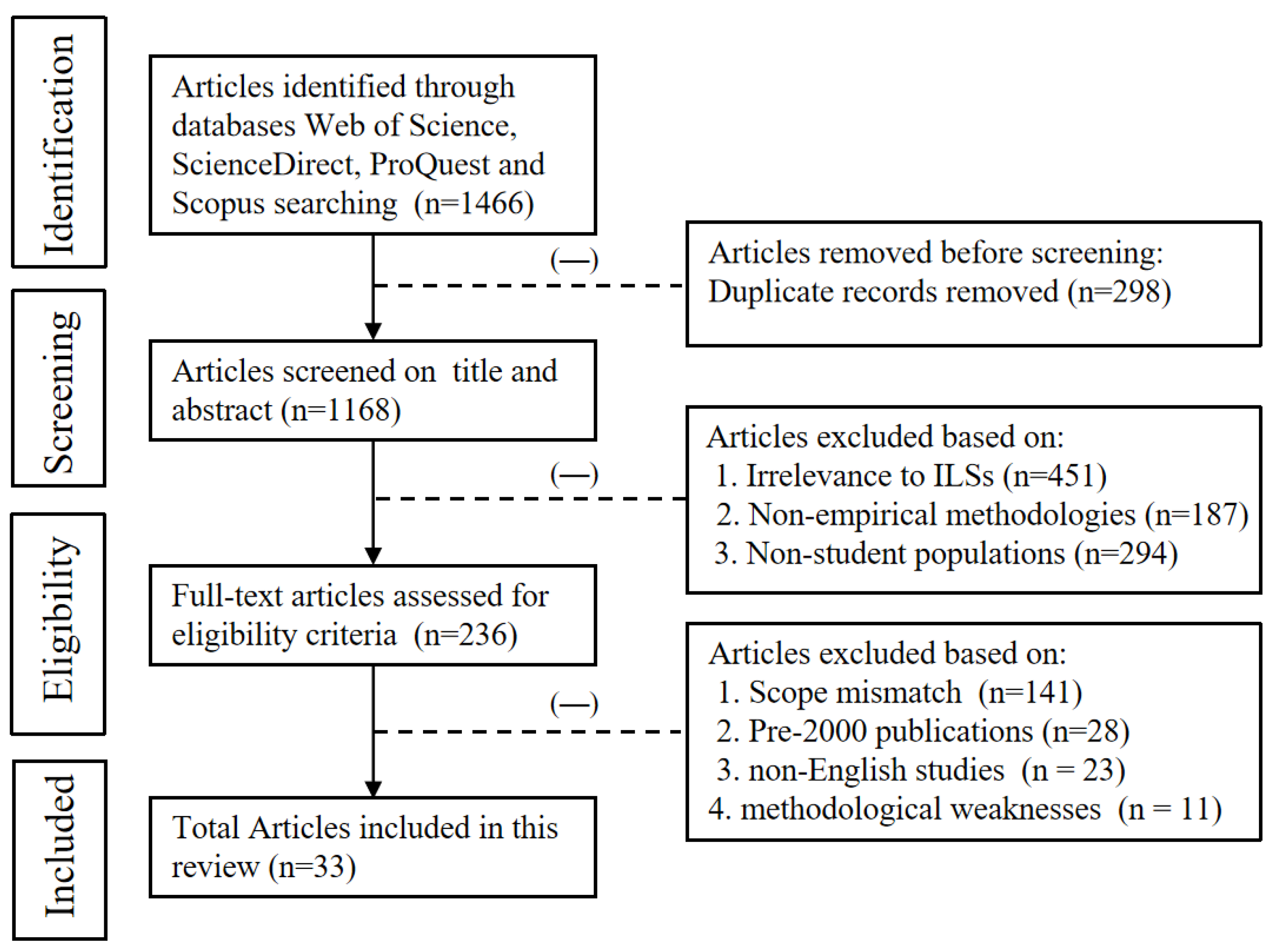
Figure 2.
Distribution of formal learning spaces and ILSs of teaching building on campus.
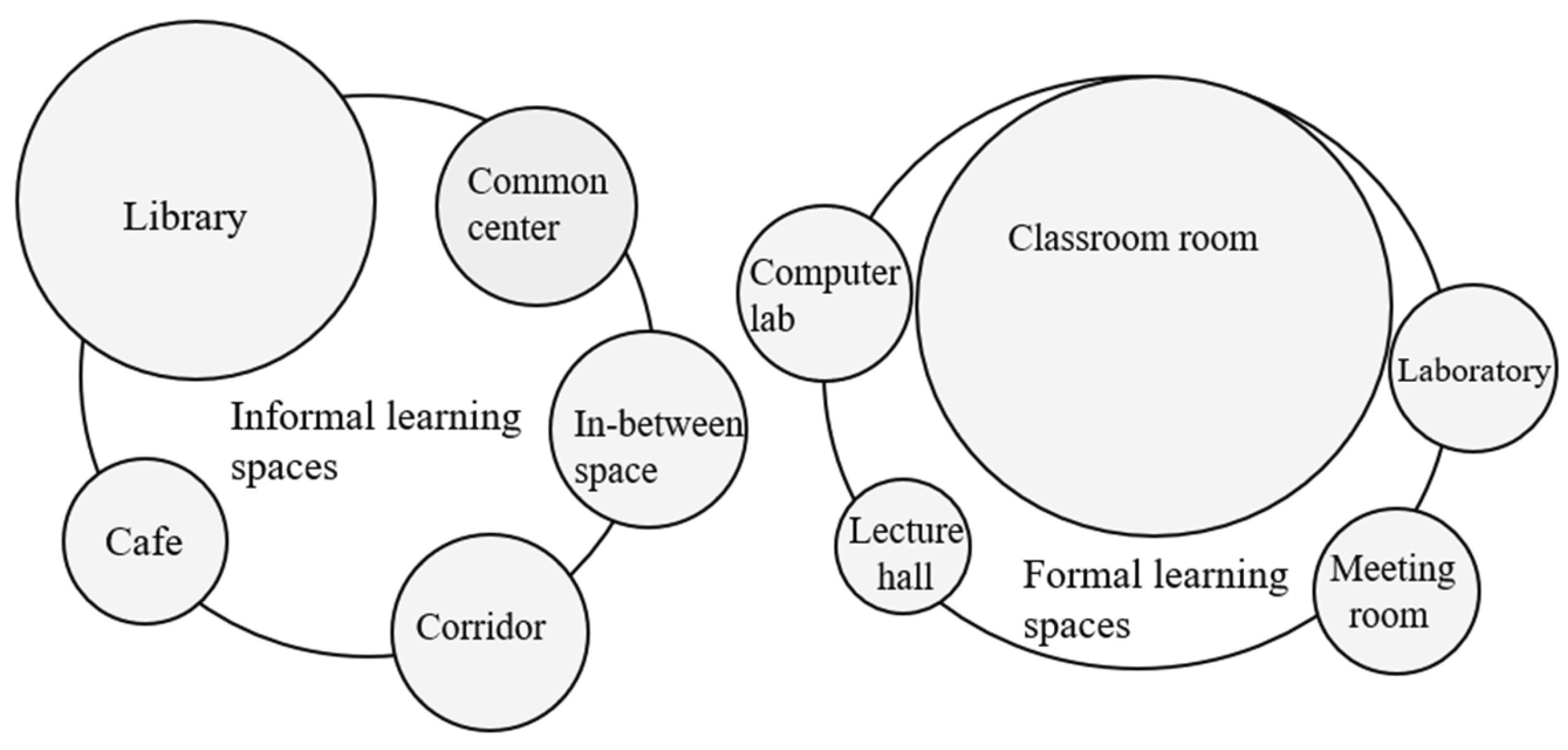

Table 1.
Characteristics of formal learning and informal learning.
| Perspective | Formal Learning | Informal Learning | References |
|---|---|---|---|
| Learning purpose | Assessed by performance results or certificates | Normally no fixed learning objectives or performance evaluation | [4,32] |
| Learning form | Learning content and methods are designed | Spontaneous learning by individuals or collaboration | [25,30] |
| Learning content | Planned ahead with clear content | Broad content and control by individuals or groups | [25] |
| Learning place | Organised and structured learning environment (e.g. classrooms, laboratories) | Relaxed and free learning environment with no restriction on location | [4] |
| Learning subject | Structured cources Teacher-led |
No fixed structure Learner-led |
[14,20,25,32] |
| Type of knowledge | Explicit knowledge (declarative knowledge, technical specifications) |
Tacit knowledge (experience, social skills) | [14] |
Table 2.
Summary of social dimension factors.
| Interaction | Privacy | |
|---|---|---|
| Crook and Mitchell [9] |
√ | |
| van Sprang et al. [37] | √ | |
| Hurst et al.[18] | √ | |
| Beckers et al.[3] | √ | √ |
| Soares et al.[33] | √ | |
| Storvang and Nguyen [34] | √ | |
| Wu et al. [40] | √ | |
| Kim and Yang [24] | √ | √ |
| Zhang et al.[42] | √ | √ |
| Kedia and Mishra [22] | √ | |
| Huang and Lajoie [17] | √ |
Table 3.
Summary of physical dimension factors.
| Indoor Environmental Quality Factor |
Spatial Configuration Factor | Ergonomic and Technological Factor |
|||||||
|---|---|---|---|---|---|---|---|---|---|
| Temperature | Sound environment | Lighting | Air quality | Layout | Crowdedness | Comfort of furniture | Adjustability of furniture | Facility | |
| Huang et al.[16] | √ | √ | √ | ||||||
| van Sprang et al.[37] | √ | √ | |||||||
| Cha and Kim [7] | √ | √ | √ | √ | |||||
| Beckers et al. [3] | √ | √ | |||||||
| Kang et al. [21] | √ | √ | √ | √ | √ | ||||
| Andargie and Azar [1] | √ | √ | |||||||
| Yang and Moon [41] | √ | √ | √ | ||||||
| Mahyuddin [26] | √ | √ | √ | √ | √ | ||||
| Khoshbakht et al.[23] | √ | √ | |||||||
| Soares et al.[33] | √ | ||||||||
| Wu et al. [40] | √ | √ | √ | √ | √ | ||||
| Kim and Yang [24] | √ | √ | √ | √ | √ | √ | |||
| Nja et al. [27] | √ | √ | |||||||
| Zhang et al. [43] | √ | ||||||||
Disclaimer/Publisher’s Note: The statements, opinions and data contained in all publications are solely those of the individual author(s) and contributor(s) and not of MDPI and/or the editor(s). MDPI and/or the editor(s) disclaim responsibility for any injury to people or property resulting from any ideas, methods, instructions or products referred to in the content. |
© 2026 by the authors. Licensee MDPI, Basel, Switzerland. This article is an open access article distributed under the terms and conditions of the Creative Commons Attribution (CC BY) license (http://creativecommons.org/licenses/by/4.0/).
Copyright: This open access article is published under a Creative Commons CC BY 4.0 license, which permit the free download, distribution, and reuse, provided that the author and preprint are cited in any reuse.


