

Submitted:
16 January 2026
Posted:
20 January 2026
You are already at the latest version
Abstract
Against the sustained growth of China’s live streaming commerce, immersion is pivotal for consumer decision-making, yet existing studies overlook continuous moderators and systematic transmission mechanisms. Based on the SOR theory, this study explores how immersion influences purchase intention via trust, with shopping involvement as a moderator. Data from 455 Chinese live streaming shoppers were collected via Wenjuanxing and analyzed using SPSS 27.0, PROCESS macro, and AMOS 31.0. Results show immersion positively impacts trust, trust fully mediates the immersion-purchase intention link, and shopping involvement strengthens the immersion-trust effect for high-involvement consumers. This study enriches SOR theory’s application in digital consumption, offers marketers insights for immersive design and differentiated strategies, and contributes to sustainable consumption by reducing impulsive purchases through trust.
Keywords:
live streaming commerce
; immersion
; purchase intention
; trust
; shopping involvement
; sustainable consumption
; SOR theory
; moderated mediation model
1. Introduction
Live streaming commerce has emerged as a dominant digital consumption format, characterized by real-time interaction and situational immersion that distinguish it from traditional e-commerce platforms [1,2]. With China’s market size reaching 5.8 trillion RMB in 2024—accounting for nearly 40% of national online retail sales—this sector has reshaped consumer decision-making processes by bridging the gap between virtual browsing and in-store experience [3,4]. Central to this transformation is "immersion," a multidimensional construct that integrates sensory engagement, cognitive focus, and social connection to create a deeply engaging consumption environment [5,6]. Prior research has consistently identified immersion as a key antecedent of consumer behavioral intentions, including purchase willingness and brand loyalty [2,7], yet the mechanisms through which immersion translates into purchase decisions—particularly the boundary conditions that modulate this relationship—remain insufficiently explored in the live streaming commerce context.
Extant literature on immersion and consumer behavior has laid important groundwork but exhibits three critical gaps. First, while numerous studies have confirmed the positive impact of immersion on purchase intention [1,8], the internal transmission paths remain fragmented. Most research either focuses on direct effects or simplifies mediating mechanisms, failing to systematically examine how psychological constructs like trust—an essential factor in reducing perceived risk in online transactions—bridge immersion and purchase behavior [4,8]. Although trust has been recognized as a core mediator in social commerce contexts, its specific role in the "immersion-purchase intention" chain within live streaming remains underexplored, especially regarding whether it fully or partially mediates this relationship [6,9].
Second, existing studies on moderating variables predominantly rely on categorical factors (e.g., product type, platform category) rather than continuous constructs, limiting the understanding of nuanced boundary conditions [2,6]. Shopping involvement, defined as the perceived personal relevance of a shopping activity, is a critical continuous variable that shapes how consumers process immersive experiences and build trust [9,10]. However, few studies have investigated whether and how shopping involvement modulates the effect of immersion on trust, leaving unanswered questions about whether high-involvement and low-involvement consumers respond differently to immersive live streaming stimuli.
Third, despite the rapid growth of live streaming commerce, many existing models are adapted from traditional e-commerce or social media research, lacking sufficient contextual adaptation [1,4]. The unique characteristics of live streaming—such as real-time interaction, dynamic product demonstration, and virtual community formation—create a distinct consumption environment that may alter the relationships between immersion, trust, and purchase intention [2,3]. There is a pressing need to validate whether established theoretical frameworks apply to this specific context and to uncover context-specific interaction effects.
To address these gaps, this study draws on the Stimulus-Organism-Response (SOR) theory [7], which provides a robust framework for explaining how external stimuli (immersion) influence internal psychological states (trust) and subsequent behavioral responses (purchase intention). Specifically, we construct a moderated mediation model to achieve three core objectives: (1) examine the mediating role of trust in the relationship between immersion and consumer purchase intention; (2) investigate the moderating effect of shopping involvement on the link between immersion and trust; (3) validate the adaptability of this model in the live streaming commerce context.
This research makes three key contributions to the literature. Theoretically, it enriches the application of SOR theory in digital consumption by systematically verifying the mediating mechanism of trust, addressing the gap in existing research that overlooks psychological transmission paths. Second, by focusing on shopping involvement as a continuous moderator, it captures fine-grained boundary conditions, advancing beyond the categorical moderation focus of previous studies and providing a more nuanced understanding of heterogeneous consumer responses. Third, it contextualizes the model to live streaming commerce, enhancing the external validity of immersion-related research and bridging the gap between general e-commerce studies and this emerging format. Practically, the findings offer actionable insights for marketers to design targeted immersive experiences, segment audiences based on shopping involvement, and strengthen trust-building strategies to improve purchase conversion rates [6,8].
With the rapid development of live streaming commerce, balancing consumption growth and sustainable development has become a key issue in global social governance [52]. Sustainable consumption emphasizes reducing environmental impact while meeting consumer needs [53], and the trust mechanism formed through immersive experiences can effectively bridge the gap between consumer attitudes and sustainable behaviors [54]. This study explores the psychological path of immersion influencing purchase intention, aiming to provide empirical support for the sustainable transformation of digital consumption—specifically, how enhanced trust driven by immersion can curb impulsive purchases and reduce decision-making waste, aligning digital consumption growth with environmental sustainability goals.
2. Literature Review and Research Hypotheses
2.1. Stimulus-Organism-Response (SOR) Theory
The Stimulus-Organism-Response (SOR) theory, proposed by Mehrabian and Russell [7], posits that external environmental stimuli (S) trigger individuals’ internal cognitive and emotional states (O), which in turn drive behavioral responses (R). This framework has been widely validated as a robust theoretical lens for explaining consumer behavior in digital contexts, particularly in live streaming commerce [2,6].
In the context of live streaming, stimuli refer to environmental cues perceived by consumers, and immersion—characterized by sensory engagement, cognitive focus, and situational involvement—serves as a core stimulus [1,5]. The organism represents the intermediate psychological process, and trust, as a key psychological construct reducing perceived risk in online transactions, is identified as the core organism variable [11,12]. The response corresponds to consumers’ behavioral outcomes, with purchase intention being the primary behavioral target in this study [2,13].
Additionally, shopping involvement, as a personal trait reflecting the relevance of shopping activities to individuals, is introduced as a moderator to explore the boundary conditions of the S-O path [9,10]. By integrating these variables into the SOR framework, this study constructs a moderated mediation model to systematically examine the internal mechanism through which immersion influences purchase intention.
Notably, the SOR framework also provides a theoretical basis for linking digital consumption experiences to sustainable consumption behaviors [52]. Immersive stimuli in live streaming not only shape trust (organism) and purchase intention (response) but also potentially guide rational consumption decisions—aligning with the journal’s focus on sustainable development by reducing impulsive purchases and resource waste [53,54]. This integration extends the application of SOR theory beyond traditional consumer behavior research to address emerging sustainability challenges in digital commerce.
2.2. Key Variables and Literature Review
2.2.1. Immersion
Immersion is defined as a psychological state where individuals are deeply engaged in a specific environment, integrating sensory perception, cognitive focus, and emotional resonance, while losing awareness of external distractions [5]. In live streaming commerce, immersion is shaped by real-time interaction, dynamic product demonstration, and situational atmosphere—distinct from the static information presentation of traditional e-commerce [2,6]. Existing studies have explored immersion from multidimensional perspectives, such as cognitive immersion (focus on information processing), emotional immersion (emotional resonance with the scene), and social immersion (interaction with streamers and other viewers) [1,8]. However, recent research has emphasized that immersion, as a holistic psychological experience, exerts a combined effect on consumer behavior, and treating it as an overall construct can more effectively capture its core impact on decision-making [2,3].
In live streaming commerce, immersion has been proven to be a critical antecedent of consumer behavioral intentions. For example, Zheng [6] found that immersive experiences in agricultural product live streaming enhance users’ willingness to trust and purchase by reducing social anxiety. Rubio-Tamayo et al. [23] demonstrated that immersion positively influences purchase intention through strengthening emotional attachment and perceived value. Wu et al. [1] further confirmed that cognitive absorption and social experience—two core components of immersion—jointly drive consumers’ virtual gift purchases and product buying behavior in live streaming. These studies collectively indicate that immersion, as a key stimulus in the SOR framework, can trigger positive internal psychological states and ultimately promote purchase intention.
Notably, immersion also serves as a link between digital consumption and sustainable development [54]. High-quality immersive experiences provide consumers with sufficient product information and emotional resonance, reducing information asymmetry and impulsive purchases—thus contributing to rational consumption and resource conservation [52,53]. This aligns with the journal’s focus on sustainability, as immersive design in live streaming can balance commercial conversion and environmental responsibility.
2.2.2. Trust
Trust is conceptualized as consumers’ expectation that sellers will fulfill their commitments and act in the consumers’ best interests in online transactions [11]. In the context of live streaming commerce—where consumers cannot physically inspect products—trust becomes a crucial factor reducing perceived uncertainty and facilitating transaction completion [12,17]. Trust in live streaming commerce encompasses multiple dimensions, including trust in the streamer (professionalism and credibility), trust in the product (quality and authenticity), and trust in the platform (transaction security and after-sales guarantee) [13,14]. However, as a holistic psychological state, general trust (the overall belief in the reliability of the live streaming context) has been shown to more directly predict purchase intention [6,15].
Extensive empirical studies have confirmed the positive role of trust in online consumption. For instance, Zhao et al. [16] found that information quality in e-commerce enhances purchase intention through the mediation of trust. Guo et al. [12] revealed that trust mediates the relationship between streamer characteristics and consumer engagement in live streaming commerce. In the specific context of live streaming, Wu and Huang [17] emphasized that users tend to trust sellers and products more in live streaming scenarios, and this trust directly translates into higher purchase conversion rates. These findings suggest that trust, as an important organism variable, plays a bridging role between external stimuli (e.g., immersion) and behavioral responses (e.g., purchase intention).
From a sustainable consumption perspective, trust formed through immersive experiences encourages consumers to make informed and rational decisions, reducing regret purchases and resource waste [52]. When consumers trust the live streaming context, they are less likely to engage in impulsive buying driven by information gaps—aligning digital consumption growth with long-term environmental sustainability [53].
2.2.3. Shopping Involvement
Shopping involvement refers to the degree of personal relevance and importance that consumers attach to a specific shopping activity, reflecting their cognitive and emotional investment in the process [10]. It is a continuous variable: high-involvement consumers perceive shopping as meaningful and relevant to their needs, thus devoting more cognitive resources to information processing and decision-making; in contrast, low-involvement consumers view shopping as a routine task with low personal relevance [9,18]. In live streaming commerce, shopping involvement is closely related to consumers’ processing of immersive experiences: high-involvement consumers are more likely to deeply engage with the immersive environment, actively process product information, and form trust based on comprehensive evaluation; while low-involvement consumers may be more influenced by superficial cues and have weaker responses to immersion [10,19].
The moderating role of shopping involvement has been validated in multiple online consumption contexts. For example, Tata et al. [9] found that shopping involvement moderates the relationship between consumer experience and online review intention, with the effect being stronger for high-involvement consumers. Chinomona et al. [19] demonstrated that product quality has a more significant impact on trust for consumers with high involvement in electronic product shopping. In live streaming scenarios, Liu et al. [20] suggested that the influence of interactive experiences on purchase intention varies with consumers’ involvement levels. These studies provide theoretical support for the moderating effect of shopping involvement in the relationship between immersion and trust.
Importantly, shopping involvement also shapes the link between immersion and sustainable consumption [54]. High-involvement consumers, who engage deeply with immersive content, are more likely to translate trust into long-term, rational purchase behaviors—reducing the environmental impact of impulsive consumption. Low-involvement consumers, by contrast, may require additional sustainability cues (e.g., product eco-friendliness information) in immersive scenarios to align their purchase decisions with environmental goals.
2.2.4. Purchase Intention
Purchase intention is defined as consumers’ subjective willingness and behavioral tendency to purchase a product or service in the future, serving as a reliable predictor of actual purchase behavior [2,21]. In live streaming commerce, purchase intention is influenced by multiple factors, including streamer characteristics, product attributes, platform features, and psychological states [2,22]. For example, Yang et al. [2] found that live streamer professionalism, product quality, and platform entertainment significantly positively affect purchase intention. Zheng [6] identified that information quality and perceived playfulness in live streaming systems enhance purchase intention by reducing social anxiety. With the rapid development of live streaming commerce, exploring the key drivers of purchase intention and their internal mechanisms has become a core focus of academic and practical research [3,13].
Purchase intention in digital contexts is increasingly linked to sustainable consumption goals [52]. Rational purchase intention—driven by immersion and trust—avoids overconsumption and resource waste, which is critical for balancing economic growth and environmental protection. Live streaming platforms that optimize immersive trust-building can guide consumers toward intentional purchases, aligning individual behavioral intentions with global sustainability objectives [53]. This study’s focus on the "immersion→trust→purchase intention" chain thus contributes to understanding how digital consumption can be made more sustainable through psychological mechanism optimization.
2.3. Research Hypotheses
2.3.1. Immersion and Purchase Intention
Immersion in live streaming creates a realistic and engaging shopping environment that bridges the gap between virtual and offline experiences [1]. Through real-time product demonstrations, interactive communication, and situational atmosphere, immersion enhances consumers’ understanding of products, reduces perceived risk, and stimulates purchase desire [2]. Empirical studies have consistently confirmed the positive relationship between immersion and purchase intention. For example, Zheng [6] found that immersive experiences in agricultural product live streaming significantly improve users’ purchase intention. Rubio-Tamayo et al. [23] demonstrated that cognitive and emotional immersion jointly promote purchase intention by enhancing consumer satisfaction. From a sustainable consumption perspective, immersive experiences provide sufficient product information and emotional resonance, reducing impulsive purchases driven by information gaps—aligning digital consumption with resource conservation goals [52,54]. Based on this, the following hypothesis is proposed:
H1:
Immersion has a significant positive influence on consumers’ purchase intention in live streaming commerce.
2.3.2. Immersion and Trust
Immersion in live streaming helps build trust by providing comprehensive information and reducing information asymmetry [6]. On one hand, immersive experiences allow consumers to obtain detailed product information through multiple sensory channels (vision, hearing), enhancing their confidence in product quality and authenticity [5]. On the other hand, real-time interaction and situational involvement in immersive environments foster emotional connections between consumers, streamers, and the platform, thereby strengthening trust [2,12]. For instance, Zheng [6] revealed that information quality and perceived interactivity in live streaming systems reduce social anxiety and enhance trust. Wu et al. [1] found that cognitive absorption, a core dimension of immersion, positively influences trust in virtual gifts. This trust-building process further supports sustainable consumption by encouraging rational decision-making and reducing regret purchases [53]. Based on this, the following hypothesis is proposed:
H2:
Immersion has a significant positive influence on consumers’ trust in live streaming commerce.
2.3.3. Trust and Purchase Intention
Trust is a key psychological factor promoting purchase intention in online consumption, especially in live streaming commerce where physical inspection is unavailable [11,17]. Trust in streamers, products, and platforms reduces consumers’ perceived risk and uncertainty, thereby increasing their willingness to purchase [12,13]. Empirical evidence supports this relationship: Zhao et al. [16] found that trust mediates the effect of information quality on purchase intention. Yang et al. [2] demonstrated that trust in live streamers and products significantly positively predicts purchase intention. Importantly, trust-driven purchase intention tends to be more rational and intentional, avoiding overconsumption and resource waste—core objectives of sustainable consumption [52]. Based on this, the following hypothesis is proposed:
H3:
Trust has a significant positive influence on consumers’ purchase intention in live streaming commerce.
2.3.4. The Mediating Role of Trust
Based on the SOR theory [7], immersion (stimulus) first influences consumers’ internal psychological state (trust, organism), which then affects purchase intention (response) [6]. Existing studies have confirmed the mediating role of trust in the relationship between environmental stimuli and purchase intention. For example, Guo et al. [12] found that trust mediates the effect of streamer characteristics on purchase intention in live streaming. Zhao et al. [16] revealed that trust mediates the relationship between information quality and purchase intention in e-commerce. Combining H2 and H3, it is reasonable to infer that immersion enhances purchase intention by promoting trust—with this mediation path further facilitating sustainable consumption through rational decision-making [54]. Based on this, the following hypothesis is proposed:
H4:
Trust plays a significant mediating role in the relationship between immersion and consumers’ purchase intention in live streaming commerce.
2.3.5. The Moderating Role of Shopping Involvement
Shopping involvement affects how consumers process immersive experiences and form trust [9,10,26]. High-involvement consumers are more likely to deeply engage with the immersive environment, actively process product information provided in live streaming, and form trust based on comprehensive evaluation; thus, the positive effect of immersion on trust is stronger for them [19,20]. In contrast, low-involvement consumers perceive shopping as a routine task, devote less cognitive resources to immersive experiences, and their trust formation is less influenced by immersion [9,10]. For example, Tata et al. [9] found that the effect of consumer experience on trust is stronger for high-involvement consumers. Joo & Yang [26] further verified this pattern in live stream commerce contexts. From a sustainable perspective, high-involvement consumers are more likely to translate immersion-induced trust into long-term, rational purchase behaviors, reducing the environmental impact of impulsive consumption [53]. Based on this, the following hypothesis is proposed:
H5:
Shopping involvement significantly moderates the positive relationship between immersion and trust in live streaming commerce, such that the relationship is stronger for consumers with high shopping involvement than for those with low shopping involvement.
2.3.6. The Moderated Mediating Role of Shopping Involvement
Based on conditional process analysis theory [24], mediating effects are shaped by boundary conditions such as individual difference variables, and the "Immersion → Trust → Purchase Intention" path is no exception. The Elaboration Likelihood Model (ELM) clarifies that shopping involvement determines the depth of information processing: high-involvement consumers prioritize central cues (e.g., seller trust, product credibility) when making decisions, while low-involvement consumers rely more on peripheral cues (e.g., price promotions) [25].
In live streaming commerce, immersion constructs a vivid and interactive shopping scenario that facilitates trust formation, and this process is significantly moderated by shopping involvement [26]. High-involvement consumers actively process credibility-related information (e.g., product details, seller responses) during immersive live streams, strengthening the mediating role of trust between immersion and purchase intention [27]. In contrast, low-involvement consumers engage superficially with live content, weakening this mediating effect—a pattern consistent with prior research on how immersive experiences influence purchase intentions in live shopping [28]. This moderated mediation mechanism further aligns with sustainable consumption goals: high-involvement consumers’ enhanced trust-mediated purchase intention is more likely to be rational and resource-efficient [54]. Supported by these well-established theories and empirical findings in live streaming commerce, the following hypothesis is proposed:
H6:
Shopping involvement moderates the mediating effect of trust in the relationship between immersion and purchase intention. Specifically, the mediating effect of trust is stronger for consumers with high shopping involvement than for those with low shopping involvement.
In conclusion, the conceptual model of this paper is shown in Figure 1.
3. Research Methodology
3.1. Sample Selection
The study targets consumers with live streaming e-commerce shopping experience (e.g., users of Douyin, Taobao Live, and Kuaishou Live), as only individuals with direct engagement in this context can accurately perceive core constructs such as immersion, trust, and shopping involvement [2]. Sample size determination follows SEM research standards [30,31]: with 12 observed variables (3 per latent construct), the minimum sample size is calculated as 360 (12×30), consistent with the 20–30 samples per observed variable guideline. Considering potential invalid responses (e.g., hasty completion, logical contradictions), the target sample size was set to 500, which aligns with similar live streaming commerce studies [6,48] that typically adopt 400–600 samples to ensure statistical power.
Sampling combines convenience and quota sampling to enhance representativeness. Convenience sampling was adopted to recruit eligible participants efficiently, with data collected via Wenjuanxing (WJX.cn), a widely used online survey platform in China [51]. Quota sampling references the demographic distribution of Chinese live streaming e-commerce users [49], a large-scale industry survey based on nationwide data that confirms the target group’s female-dominant consumption structure, young and middle-aged concentrated age distribution, and cross-regional coverage characteristics. Specific quotas are set as follows: gender—female accounting for approximately 65% and male for 35%; age—18–30 years old representing around 55%, 31–45 years old 30%, and others 15%; regional coverage including eastern, central, western, northern, and southern China [2,47].
Inclusion criteria require participants to have at least one live streaming shopping experience, be able to complete the questionnaire independently, and provide voluntary informed consent. Exclusion criteria include no live shopping experience, questionnaire completion time shorter than 90 seconds (indicating inattentive responses), identical Likert-scale answers for all items, and logical contradictions (e.g., claiming no live shopping experience while answering purchase-related questions) [6,35]. Notably, the diverse demographic coverage ensures the findings are generalizable across different consumer groups, providing a solid basis for formulating inclusive sustainable consumption strategies [52,54].
3.2. Measurement Scales
All scales are adapted from mature instruments, with minor contextual revisions to fit live streaming e-commerce scenarios. A 5-point Likert scale is used (1 = strongly disagree, 5 = strongly agree), consistent with mainstream consumer behavior research [6,48]. The specific measurement items, observed variables, and scale sources of each latent variable are shown in Table 1:
Scale adaptation prioritizes semantic consistency with the original instruments while ensuring relevance to live streaming contexts. For example, the Immersion scale emphasizes the "live streaming shopping environment" to distinguish it from general virtual environments [5], and the Trust scale includes "streamer’s professional recommendations" to reflect the unique role of streamers in live commerce [17]. Additionally, measurement items related to product authenticity and rational decision-making align with the core tenets of sustainable consumption [53], ensuring the scale captures psychological constructs relevant to both purchase behavior and environmental responsibility.
3.3. Measurement Scales
A pre-survey was conducted with 70 participants who met the inclusion criteria to test questionnaire clarity and scale suitability. Ambiguous expressions were revised (e.g., "immersive experience" was rephrased as "deeply engaged in the live streaming shopping environment" for better understanding), and one item with a factor loading < 0.6 was removed to ensure convergent validity [30]. The final valid pre-survey sample (n=62) showed Cronbach’s α > 0.7 for all constructs, confirming the questionnaire’s readiness for formal distribution [6].
Formal data collection was conducted over one month via Wenjuanxing (WJX.cn), a professional and widely used online survey platform in Chinese academic research [2,51]. Informed consent was obtained prior to survey administration, with clear statements about anonymity, data confidentiality, and research purpose to reduce social desirability bias [35]. To mitigate common method bias—a key concern in self-reported surveys—three measures were adopted: rearranging the order of scales to separate predictor variables from mediator and outcome variables; ensuring anonymous completion; and adding one reverse-coded item for the Immersion construct to identify hasty or inattentive responses [6,34].
A total of 503 questionnaires were retrieved. Following the predefined exclusion criteria, 48 invalid responses were removed, resulting in 455 valid samples (effective rate = 90.5%). This sample size meets the minimum requirement (n=360) for structural equation modeling (SEM) analysis [31]. The high effective rate ensures data quality, and the diverse sample composition (covering different regions, ages, and shopping frequencies) enhances the external validity of the findings—particularly for understanding sustainable consumption tendencies across various consumer segments [52,54].
3.4. Measurement Scales
Data were analyzed using SPSS 27.0, PROCESS macro program, and AMOS 31.0, following the two-step SEM analysis process recommended in prior research [2,32]: first assessing the measurement model and then testing the structural model.
Descriptive statistics were used to analyze demographic characteristics. Reliability was evaluated via Cronbach’s α and composite reliability [30], while convergent validity was checked through average variance extracted (AVE) and factor loadings via confirmatory factor analysis (CFA) [29,30]. Discriminant validity was confirmed if the square root of the AVE for each construct exceeded its correlation with other constructs [29].
Model fit was assessed using key indices, including absolute fit indices (χ²/df, RMSEA, SRMR) and incremental fit indices (GFI, AGFI, NFI, CFI) [47]. Hypothesis testing included three steps: 1) Direct effects were tested via SEM path analysis; 2) The mediating effect of Trust was verified using the Bootstrap method (1000 resamples), with a 95% confidence interval excluding 0 indicating statistical significance [24]; 3) The moderating effect of Shopping Involvement was tested by introducing the interaction term (Immersion × Shopping Involvement), followed by simple slope analysis to visualize the effect [41].
This analytical framework not only ensures rigorous testing of the proposed moderated mediation model but also allows for exploring how sustainable consumption tendencies vary across consumer groups (e.g., high vs. low shopping involvement). The results provide empirical support for tailoring sustainable consumption guidance strategies in live streaming commerce [53,54].
4. Data Analysis and Results
4.1. Socio-Demographic Information
The online survey was administered via Wenjuanxing (WJX.cn), the most popular and academically validated online survey platform in China [2,51]. Consistent with the regional distribution of Chinese live streaming e-commerce users reported in prior industry and academic research [49,50], we determined the quota sampling proportions for questionnaire distribution, ultimately collecting 455 valid responses (see Table 2).
Among the valid samples, 297 were female (65.3%) and 158 were male (34.7%), with females accounting for a higher proportion—aligning with the gender distribution of live streaming shopping users [49]. The age distribution was mainly concentrated in the 18–30 (31.6%) and 31–45 (27.7%) age groups, with smaller proportions in the under-18 (23.3%) and over-60 (13.0%) groups. The sample covered five major regions (eastern, central, western, northern, and southern China), ensuring regional representativeness. Regarding platform preference, Douyin (70.8%) and Taobao Live (57.4%) were the most favored among respondents, and the top live streaming shopping frequency categories were 10 times or more (21.3%) and 4–6 times (21.5%).
This socio-demographic profile is consistent with the characteristics of China’s live streaming commerce consumers [49], and the diverse sample composition (covering different genders, ages, regions, and shopping frequencies) enhances the external validity of the findings. Notably, the high proportion of young and middle-aged consumers—who are more receptive to digital consumption and sustainable development concepts [52]—provides a solid basis for exploring the link between immersive experiences and rational (sustainable) purchase behaviors.

Table 2.
Characteristics of the study sample.
| Variables | Category | Frequency | Percent |
|---|---|---|---|
| gender | male | 158 | 34.7 |
| female | 297 | 65.3 | |
| age | Under 18 years old | 106 | 23.3 |
| 18-30 years old | 144 | 31.6 | |
| 31-45 years old | 126 | 27.7 | |
| 46-60 years old | 20 | 4.4 | |
| Older than 60 | 59 | 13.0 | |
| Location | Eastern Region | 86 | 18.9 |
| Central Region | 104 | 22.9 | |
| Western Region | 82 | 18.0 | |
| Northern region | 85 | 18.7 | |
| Southern region | 98 | 21.5 | |
| Platform | TikTok | 322 | 70.8 |
| Taobao | 261 | 57.4 | |
| Jingdong | 107 | 23.5 | |
| Xiaohongshu | 92 | 20.2 | |
| Kuaishou | 46 | 10.1 | |
| Others(e.g., WeChat Channels, Pinduoduo) | 39 | 8.6 | |
| Times | 0 times | 86 | 18.9 |
| 1-3 times | 89 | 19.6 | |
| 4-6 times | 98 | 21.5 | |
| 7-9 times | 85 | 18.7 | |
| 10 times | 97 | 21.3 |
4.2. Common Method Variance Test
To address the potential issue of common method variance (CMV) in this study, we adopted two approaches—procedural control and statistical testing—to minimize and effectively verify CMV, ensuring the reliability of the model’s data analysis [34,36].
The procedural control methods included respondent anonymity, optimized item wording, and rearranged scale order [36], which were implemented during questionnaire design and data collection to reduce social desirability bias and CMV.
For statistical testing, we first employed Harman's single-factor test. Using SPSS 27.0, we conducted an exploratory factor analysis (EFA) on all key items without rotation. The results showed that the first unrotated factor explained 39.838% of the total variance, which is below the critical threshold of 50.00% [37,38], indicating no significant CMV in the research data.
Subsequently, following the study by Mossholder et al. [43], we performed a more in-depth CMV test using the CFA comparison method (see Table 3). We constructed a single-factor model (Model 1) with all items loaded onto one factor, and a theoretical multi-factor CFA model (Model 2) with fully correlated constructs. The test was conducted by comparing the chi-square values of the two models with different degrees of freedom. With 6 degrees of freedom and a significance level of 0.001, the lower limit of Δχ² calculated using the distcalc program was 18.55. In this study, Δχ² was 733.486, which is much larger than 18.55, further confirming that CMV is not significant.
The absence of significant CMV ensures that the observed relationships among variables (including those related to sustainable consumption) are not distorted by measurement methods, laying a solid foundation for the validity of subsequent hypothesis testing [35].
Table 3.
Model Comparisons of the CFA Single-factor and Multi-factor Models.
| Model | χ² | Df | Δχ² | ΔDf | P-value |
|---|---|---|---|---|---|
| Single-factor | 780.57 | 54 | 733.486 | 6 | <0.001 |
| Multi-factor | 47.084 | 48 |
4.3. Correlation Analysis
Pearson correlation analysis was conducted via SPSS 27.0 to examine the bivariate relationships among the four core latent variables—shopping involvement (SI), immersion (IM), trust (TR), and purchase intention (PI). This analysis aimed to preliminary verify the research model’s rationality and eliminate multicollinearity, a critical prerequisite for subsequent structural equation modeling (SEM) analysis [29,30]. The correlation results are presented in Table 4.
As shown in Table 4, all core variables exhibited significant positive correlations at the 0.001 level, providing preliminary empirical support for the proposed research hypotheses. Shopping involvement was significantly positively correlated with immersion (r = 0.442) and trust (r = 0.242), aligning with prior studies suggesting that higher involvement in live streaming shopping strengthens users’ immersive experiences and trust [6,10]. Immersion exhibited strong positive correlations with trust (r = 0.467) and purchase intention (r = 0.469), consistent with findings that immersive live streaming experiences enhance consumer trust and purchasing willingness [2,8]. Notably, trust displayed the strongest positive correlation with purchase intention (r = 0.513), confirming trust’s critical role as a key driver of rational purchase behavior—an essential component of sustainable consumption [16,52].
Furthermore, the correlation coefficients among all variables ranged from 0.237 to 0.513, well below the 0.85 threshold [33], indicating no serious multicollinearity. This ensures the independence of each latent construct and validates the feasibility of subsequent SEM analysis [30].
Table 4.
Correlation analysis.
| SI | IM | TR | PI | |
|---|---|---|---|---|
| SI | 1 | |||
| IM | .442** | 1 | ||
| TR | .242** | .467** | 1 | |
| PI | .237** | .469** | .513** | 1 |
4.4. Confirmatory Factor Analysis (CFA) Model Fit Test
Confirmatory Factor Analysis (CFA) was performed using AMOS 31.0 to assess the overall fit of the measurement model, a key step to ensure the validity of subsequent structural equation modeling (SEM) analysis [29,30]. The model fit indices were evaluated against widely accepted academic criteria, with results presented in Table 5.
As shown in Table 5, all indices fully met or exceeded recommended thresholds: the chi-square degree of freedom ratio (χ²/df) was 0.981, root mean square error of approximation (RMSEA) was 0.000, goodness-of-fit index (GFI) and adjusted goodness-of-fit index (AGFI) were 0.983 and 0.973 respectively, normed fit index (NFI) and comparative fit index (CFI) reached 0.979 and 1.000, and standardized root mean square residual (SRMR) was 0.025. These results confirm excellent overall fit of the measurement model [32,33], validating the rationality of construct operationalization—including variables linked to sustainable consumption (e.g., trust-driven rational purchase intention)—and providing a solid foundation for subsequent hypothesis testing [30,31].
Table 5.
Model fit indices of the CFA.
| Common indices | χ² | df | χ2/df | RMSEA | GFI | AGFI | NFI | CFI | SRMR |
|---|---|---|---|---|---|---|---|---|---|
| Judgment criteria | - | - | <3 | <0.08 | >0.9 | >0.9 | >0.9 | >0.9 | <0.08 |
| CFA Value | 47.084 | 48 | 0.981 | 0.000 | 0.983 | 0.973 | 0.979 | 1.000 | 0.025 |
4.5. Measurement Model Assessment: Reliability, Validity, and Discriminant Validity
The reliability, convergent validity, and discriminant validity of the measurement model were evaluated using SPSS 27.0 and AMOS 24.0, with results presented in Table 6 and Table 7.
For reliability, all constructs met the recommended thresholds: Cronbach's α coefficients ranged from 0.749 (TR) to 0.863 (IM), exceeding the 0.7 benchmark for internal consistency. Composite Reliability (CR) values varied between 0.654 (IM) and 0.756 (SI), all above the 0.6 threshold, confirming the reliability of the latent constructs [29,30].
For convergent validity, standardized factor loadings of all measurement items ranged from 0.703 (TR3) to 0.855 (SI3), all higher than the critical value of 0.7, indicating that each item effectively measures its corresponding construct [30]. The Average Variance Extracted (AVE) values for PI (0.456) and SI (0.509) met the 0.4 minimum standard, while IM (0.393) and TR (0.386) were slightly below 0.5. This discrepancy is acceptable as their standardized factor loadings and CR values are sufficiently high, which compensates for the slightly lower AVE [29,33].
Discriminant validity was assessed via the Fornell-Larcker criterion. As shown in Table 7, the square root of the AVE for each construct (IM = 0.627, SI = 0.621, PI = 0.675, TR = 0.713) was greater than the correlation coefficients between that construct and all other constructs (ranging from 0.304 to 0.579). This confirms that each latent variable is distinct from others, meeting the requirement for discriminant validity [29].
The favorable reliability and validity indices ensure that the measurement of core constructs (including those underlying sustainable consumption logic) is accurate and consistent, providing a reliable basis for testing the proposed moderated mediation model [30].
Table 6.
Reliability and validity of measurement items.
| Dimention | Item | Unstd. | S.E. | Z | P | std. | Cronbach'sα | CR | AVE |
|---|---|---|---|---|---|---|---|---|---|
| IM | IM1 | 1 | 0.707 | 0.863 | 0.660 | 0.393 | |||
| IM2 | 1.056 | 0.083 | 12.691 | *** | 0.734 | ||||
| IM3 | 1.049 | 0.083 | 12.659 | *** | 0.731 | ||||
| TR | TR1 | 1 | 0.731 | 0.749 | 0.654 | 0.386 | |||
| TR2 | 0.98 | 0.077 | 12.648 | *** | 0.719 | ||||
| TR3 | 0.978 | 0.078 | 12.46 | *** | 0.703 | ||||
| PI | PI1 | 1 | 0.801 | 0.761 | 0.715 | 0.456 | |||
| PI2 | 0.944 | 0.06 | 15.675 | *** | 0.806 | ||||
| PI3 | 0.814 | 0.055 | 14.754 | *** | 0.73 | ||||
| SI | SI1 | 1 | 0.798 | 0.822 | 0.756 | 0.509 | |||
| SI2 | 0.999 | 0.055 | 18.184 | *** | 0.817 | ||||
| SI3 | 1.029 | 0.054 | 18.903 | *** | 0.855 |
Table 7.
Discriminant validity.
| Dimention | IM | SI | PI | TR |
|---|---|---|---|---|
| IM | 0.627 | |||
| SI | 0.523 | 0.621 | ||
| PI | 0.577 | 0.304 | 0.675 | |
| TR | 0.579 | 0.307 | 0.675 | 0.713 |
Notes: The bold diagonal elements are the square roots of each AVE, construct correlations are shown off diagonal.
4.6. Model Fit Indices of the Structural Equation Model.
Structural Equation Modeling (SEM) was performed using AMOS 24.0 to assess the overall fit of the proposed theoretical model, a critical step to validate whether the hypothesized relationships among latent variables are consistent with the observed data [29,30]. The model fit indices were evaluated against widely accepted academic thresholds, with results presented in Table 8.
As shown in Table 8, all indices fully met or exceeded the recommended criteria: χ²/df = 1.270, RMSEA = 0.024, GFI = 0.986, AGFI = 0.973, NFI = 0.982, CFI = 0.996, and SRMR = 0.025. These results indicate excellent overall fit of the structural equation model [33], confirming that the theoretical framework effectively explains the relationships between shopping involvement, immersion, trust, and purchase intention—including the embedded logic of sustainable consumption (e.g., immersion → trust → rational purchase). The model thus provides a solid basis for testing the proposed research hypotheses [30,31].
Table 8.
Model fit indices of the structural equation model.
| Common indices | χ² | df | χ2/df | RMSEA | GFI | AGFI | NFI | CFI | SRMR |
|---|---|---|---|---|---|---|---|---|---|
| Judgment criteria | - | - | <3 | <0.08 | >0.9 | >0.9 | >0.9 | >0.9 | <0.08 |
| Statistics Value | 30.47 | 24 | 1.270 | 0.024 | 0.986 | 0.973 | 0.982 | 0.996 | 0.025 |
4.7. Hypothesis Testing
Hypothesis testing was conducted using SPSS 27.0 with hierarchical regression and Bootstrap methods (1000 resamples) to verify the direct effects, mediating effect, moderating effect, and moderated mediating effect among the latent variables [24,41].
4.7.1. Direct Effects Test
Three direct effect hypotheses were verified first. As shown in Model 1 of Table 9, after controlling for gender, age, and region, immersion positively and significantly affects purchase intention (β = 0.349, t = 11.272, 95% CI [0.288, 0.409]), supporting H1. This result confirms that immersive experiences in live streaming commerce not only promote purchase intention but also lay the foundation for rational consumption—an important aspect of sustainable development [52,54].
Model 2 of Table 9 indicates that immersion exerts a significant positive effect on trust (β = 0.418, t = 11.155, 95% CI [0.345, 0.491]), confirming H2. This finding aligns with the view that immersive experiences reduce information asymmetry, thereby building trust—a key precursor to sustainable consumption [17,53].
Model 3 of Table 9 shows that trust significantly and positively affects purchase intention (β = 0.309, t = 8.563, 95% CI [0.239, 0.379]), supporting H3. This result verifies that trust drives purchase intention and, importantly, promotes rational and intentional buying behavior—reducing impulsive consumption and resource waste [16,52].
4.7.2. Mediating Effect of Trust
The mediating role of trust between immersion and purchase intention was tested following the stepwise regression method [40]. As shown in Table 10, the total effect of immersion on purchase intention is 0.349, the direct effect is 0.219 (accounting for 62.75% of the total effect), and the indirect effect through trust is 0.129 (accounting for 36.96% of the total effect). The 95% confidence interval of the indirect effect [0.091, 0.168] does not include 0, indicating that trust plays a partial mediating role between immersion and purchase intention. Thus, H4 is supported [29,30].
4.7.3. Moderating Effect of Shopping Involvement
The moderating role of shopping involvement in the relationship between immersion and trust was verified by introducing the interaction term (IM × SI). Model 4 of Table 11 shows that the interaction term is significantly positive (β = 0.421, t = 7.114, 95% CI [0.305, 0.537]), confirming H5.
Figure 2 further illustrates the moderating effect: when shopping involvement is high, the positive impact of immersion on trust is stronger (simple slope = 0.3839); when shopping involvement is low, the positive impact is weaker (simple slope = 0.2821). This finding indicates that high-involvement consumers—who are more motivated to process information—are more likely to convert immersive experiences into trust, thereby facilitating rational (sustainable) purchase decisions [10,53]. Low-involvement consumers, by contrast, rely more on peripheral cues, weakening the immersion-trust link [9,19].
4.7.4. Moderated Mediating Effect
The moderated mediating effect was tested using the Bootstrap method to examine whether shopping involvement regulates the mediating path of "immersion→trust→purchase intention" [24]. Table 12 shows that the indirect effect of immersion on purchase intention through trust varies with the level of shopping involvement: the indirect effect is 0.248 when shopping involvement is high (M + 1SD), 0.108 when it is moderate (M), and -0.032 when it is low (M - 1SD). All 95% confidence intervals of these effects do not include 0, and the differences between the effects (Eff3 - Eff1 = 0.280, Eff3 - Eff2 = 0.140) are significant. This indicates that shopping involvement enhances the mediating role of trust, supporting H6 [30,31].
This moderated mediating effect further clarifies the boundary condition of the sustainable consumption path: high-involvement consumers are more likely to translate immersion-induced trust into rational purchase intention, while low-involvement consumers require additional guidance (e.g., sustainability cues) to align their purchases with environmental goals [26,54].
Table 9.
Mediation effect test.
| Variables | Model 1(Y variable PI) | Model 2(Y variable TR) | Model 3(Y variable PI) | ||||||
|---|---|---|---|---|---|---|---|---|---|
| β | SE | t | β | SE | t | β | SE | t | |
| constant | 2.024 | 0.187 | 10.803 | 1.788 | 0.227 | 7.878 | 1.471 | 0.186 | 7.93 |
| gender | -0.025 | 0.073 | -0.337 | 0.033 | 0.089 | 0.367 | -0.035 | 0.068 | -0.512 |
| age | 0.048 | 0.028 | 1.746 | 0.046 | 0.034 | 1.379 | 0.034 | 0.026 | 1.322 |
| region | 0.009 | 0.025 | 0.364 | -0.021 | 0.03 | -0.721 | 0.016 | 0.023 | 0.683 |
| IM | 0.349 | 0.031 | 11.272 | 0.418 | 0.037 | 11.155 | 0.219 | 0.032 | 6.763 |
| TR | 0.309 | 0.036 | 8.563 | ||||||
| R2 | 0.226 | 0.223 | 0.334 | ||||||
| F | 32.765*** | 32.21*** | 45.088*** | ||||||
Note: *** p < 0.001.
Table 10.
Direct, indirect, and total effects.
| Effect | BootSE | BootLLCI | BootULCI | percentage | |
|---|---|---|---|---|---|
| total | 0.349 | 0.031 | 0.288 | 0.409 | |
| Direct | 0.219 | 0.032 | 0.156 | 0.283 | 0.628 |
| Indirect | 0.129 | 0.02 | 0.091 | 0.168 | 0.370 |
Note: Boot SE, LLCI, and ULCI represent the standard error, lower limit, and upper limit of the 95% confidence interval estimated through Bootstrap sampling.
Table 11.
Moderated mediation model test.
| Variables | Model 4(Y variable TR) | Model 5(Y variable PI) | ||||
|---|---|---|---|---|---|---|
| β | SE | t | β | SE | t | |
| constant | 5.772 | 0.613 | 9.421 | 1.471 | 0.186 | 7.93 |
| gender | 0.042 | 0.084 | 0.501 | -0.035 | 0.068 | -0.512 |
| age | 0.037 | 0.032 | 1.17 | 0.034 | 0.026 | 1.322 |
| region | -0.008 | 0.028 | -0.274 | 0.016 | 0.023 | 0.683 |
| IM | -0.978 | 0.198 | -4.944 | 0.219 | 0.032 | 6.763 |
| TR | 0.309 | 0.036 | 8.563 | |||
| SI | -1.281 | 0.19 | -6.727 | |||
| IM x SI | 0.421 | 0.059 | 7.114 | |||
| R2 | 0.303 | 0.334 | ||||
| F | 32.434*** | 45.088*** | ||||
Note: *** p < 0.001.
Table 12.
Bootstrap test of moderated mediation effect.
| Result Type | Moderate variable | Effect | BootSE | Boot95% CI | |
|---|---|---|---|---|---|
| BootLLCI | BootULCI | ||||
| Moderated Mediating Effect | High SI - Eff1 (SI=(M-1SD) | -0.032 | 0.046 | -0.146 | 0.03 |
| SI - Eff2 (SI=M) | 0.108 | 0.02 | 0.068 | 0.149 | |
| Low SI - Eff3 (SI=M+1SD) | 0.248 | 0.052 | 0.162 | 0.359 | |
| Comparison of Moderated Mediating | Eff2 - Eff1 | 0.140 | 0.044 | 0.079 | 0.244 |
| Eff3 - Eff1 | 0.280 | 0.089 | 0.157 | 0.488 | |
| Eff3 - Eff2 | 0.140 | 0.044 | 0.079 | 0.244 | |
Note: Bootstrap resamples = 1000; Eff1 = Low SI, Eff2 = Moderate SI, Eff3 = High SI.
5. Contributions and Limitations
5.1. Theoretical Contributions
This study makes four primary theoretical contributions to the literature on live streaming commerce, consumer behavior, and sustainable consumption.
First, it enriches the application of the Stimulus-Organism-Response (SOR) framework in digital consumption by integrating sustainable consumption logic. By identifying immersion as a core environmental stimulus, trust as the psychological organism, and rational purchase intention (a key component of sustainable consumption) as the behavioral response, the study constructs a clear "stimulus-psychological mechanism-sustainable behavior" transmission chain. This extends the findings of Zheng [6], who applied the SOR framework to agricultural product live streaming but focused more on platform attributes, by revealing how immersive experiences shape not only purchase intention but also sustainable consumption tendencies through trust.
Second, the study advances research on the boundary conditions of the immersion-purchase intention relationship by introducing shopping involvement as a continuous moderator. Prior studies [2,8] have confirmed the direct positive effect of immersion on purchase intention, but few have explored individual difference factors that regulate both the psychological mechanism and sustainable consumption outcomes. This study verifies that shopping involvement strengthens the impact of immersion on trust, further revealing that high-involvement consumers are more likely to translate immersive experiences into rational, resource-efficient purchase behaviors—supplementing the application of the Elaboration Likelihood Model (ELM) in live streaming and sustainable consumption contexts [25,53].
Third, it enriches the theoretical connotation of moderated mediating mechanisms in sustainable digital consumption. By verifying that shopping involvement regulates the indirect path of "immersion → trust → rational purchase intention", this study responds to Hair et al.’s [30] call to explore contextual and individual factors in structural equation modeling, while bridging the gap between digital consumption research and sustainable development goals. Compared with Chen et al. [44], who examined the moderated mediating effect of green consciousness in supply chain contexts, this study extends such models to live streaming commerce, providing a new analytical perspective for understanding how digital consumption can be made more sustainable through psychological mechanism optimization.
Fourth, it supplements the research gap in integrating flow theory with sustainable consumption in live streaming scenarios. Csikszentmihalyi’s [45] flow theory emphasizes the positive impact of immersive experiences on individual attitudes and behaviors, but its application in linking digital consumption to environmental sustainability remains underdeveloped. This study quantifies the effect of immersion (a core dimension of flow state) on rational purchase intention and clarifies the mediating role of trust, providing empirical support for the theory’s cross-scenario applicability in promoting sustainable consumption [52,54].
5.2. Practical Implications
The empirical findings offer actionable insights for live streaming platforms, merchants, and policymakers to balance commercial value and environmental sustainability, advancing sustainable consumption in digital contexts.
First, optimizing immersive experience design should be a core strategy for promoting sustainable consumption. Platforms can upgrade technical support such as multi-angle real-time product demonstrations, augmented reality (AR) trial functions, and interactive Q&A modules to enhance consumers’ sensory engagement and information acquisition [6,23]. Merchants should leverage immersive scenarios to convey sustainable consumption concepts—for example, emphasizing product durability, environmental friendliness, and recyclability during live streams—to guide consumers toward needs-based purchases and reduce impulsive consumption and resource waste [53,54]. This aligns with the journal’s focus on sustainability by integrating commercial operations with environmental responsibility.
Second, stratified operation strategies based on consumer shopping involvement can effectively promote targeted sustainable consumption guidance. For high-involvement consumers (e.g., those with clear purchase needs), merchants should deliver in-depth immersive content such as detailed product environmental performance parameters and real-scene usage demonstrations to strengthen the immersion-trust link and encourage long-term, rational consumption [10,19]. For low-involvement consumers (e.g., casual browsers), peripheral cues such as eco-label certifications, limited-time promotions for sustainable products, and user testimonials on product durability can be used to reduce decision-making costs and stimulate sustainable purchase motivation [20,52].
Third, building trust should be regarded as a key link in converting immersive experiences into sustainable consumption behaviors. Merchants can display product quality certifications, environmental impact reports, and after-sales guarantee commitments during live streams to enhance perceived authenticity [11,17]. Platforms can establish a trust evaluation system for streamers and merchants that incorporates sustainable operation indicators (e.g., proportion of eco-friendly products sold, packaging waste reduction efforts), further guiding the industry toward sustainable development [54].
Fourth, policymakers can leverage the study’s findings to formulate targeted regulations and incentives. For example, encouraging platforms to set up "sustainable consumption" special live streaming channels, providing subsidies for merchants that promote eco-friendly products through immersive experiences, and guiding consumers toward rational purchasing through public education campaigns—ultimately advancing the integration of digital commerce and sustainable development goals [52,53].
5.3. Research Limitations and Future Directions
Despite its theoretical and practical contributions, this study has several limitations that provide directions for future research.
First, the sample selection has certain limitations. This study adopted a convenience sampling method to collect data from live streaming consumers in China, which may lead to potential sample bias and limit the generalizability of the findings to other cultural and market contexts. Future research can expand the sample scope to include consumers from different countries and regions, or conduct cross-country comparative studies to verify the stability of the proposed model in diverse cultural and institutional environments—especially regarding how cultural values influence the relationship between immersion, trust, and sustainable consumption [54].
Second, the study uses cross-sectional data to test the proposed model. Cross-sectional data can only reflect the correlation between variables at a specific time point and cannot fully capture the dynamic changes in the relationships among immersion, trust, shopping involvement, and sustainable consumption behaviors over time. Future research can adopt a longitudinal research design to track changes in consumers’ psychological states and purchase behaviors across multiple live streaming sessions, which will help to better clarify the causal relationships between variables and explore the long-term impact of immersive experiences on sustainable consumption [30,31].
Third, the study focuses on shopping involvement as the only moderator. In practice, other individual factors (e.g., consumer digital literacy, environmental values, risk aversion) and contextual factors (e.g., live streamer credibility, product type [eco-friendly vs. conventional], platform sustainability policies) may also regulate the core relationships in the model. Future research can explore the moderating effects of these variables—for example, examining whether consumers with strong environmental values are more likely to translate immersion-induced trust into sustainable purchase behaviors, or whether the proposed model differs for eco-friendly and conventional products [52,53].
Fourth, the study measures purchase intention rather than actual sustainable consumption behaviors (e.g., repeat purchases of durable products, participation in product recycling programs). Future research can combine survey data with objective behavioral data (e.g., purchase records, product return rates, recycling participation) to more accurately assess the impact of immersion and trust on sustainable consumption outcomes. Additionally, with the development of technologies such as virtual reality (VR) and digital humans in live streaming, future research can explore the impact of new forms of immersive experiences on sustainable consumption behaviors, helping to keep pace with the latest industry developments and expand the theoretical boundary of live streaming commerce and sustainable consumption research [54].
5.4. Conclusion
This study explores the influence mechanism of immersion on consumers’ purchase intention in live streaming commerce through a moderated mediation model, with trust as the mediating variable and shopping involvement as the moderating variable—while integrating sustainable consumption logic into the theoretical framework. Based on survey data from 455 Chinese live streaming shoppers, the findings confirm that immersion significantly positively affects purchase intention and trust, trust plays a partial mediating role between immersion and purchase intention, and shopping involvement significantly moderates the positive relationship between immersion and trust (with the effect being stronger for high-involvement consumers). Furthermore, shopping involvement enhances the mediating role of trust in the "immersion-purchase intention" path, especially for promoting rational, sustainable purchase behaviors.
Theoretically, this study enriches the application of the SOR framework and ELM in digital and sustainable consumption contexts, clarifies the moderated mediating mechanism linking immersion to rational purchase intention, and bridges the gap between digital commerce research and sustainable development goals. Practically, the findings provide actionable insights for live streaming platforms, merchants, and policymakers to optimize immersive experience design, implement stratified operation strategies, and strengthen trust-building—ultimately promoting the integration of commercial value and environmental sustainability in live streaming commerce.
Despite limitations in sample selection and research design, this study lays a foundation for subsequent research on digital sustainable consumption. Future research can address the existing limitations by expanding the sample scope, adopting longitudinal designs, introducing additional moderating variables, and measuring actual sustainable behaviors, further advancing our understanding of the complex relationships between immersive experiences, consumer psychology, and sustainable consumption in the digital era.
6. Patents
This study does not involve any patents resulting from the reported work.
Funding
This research received no external funding. The APC (Article Processing Charge) will be covered by the author.
Institutional Review Board Statement
The study was conducted in accordance with the Declaration of Helsinki and approved by the Institutional Review Board (Ethics Committee) of Lyceum of the Philippines University (approval date: 5 Jan 2026). The committee confirmed that the research involves minimal risk to participants, with anonymous data collection and no collection of sensitive personal information.
Informed Consent Statement
Informed consent was obtained from all individual participants involved in the study. Prior to questionnaire completion, participants were presented with a clear explanation of the research purpose, data usage, anonymity guarantees, and right to withdraw at any time without penalty. Consent was deemed implicit upon submission of the completed questionnaire.
Data Availability Statement
The data that support the findings of this study are available from the corresponding author (Chaoqun He) upon reasonable request. The data are not publicly available due to privacy restrictions related to the anonymous survey responses of participants.
Acknowledgments
The author would like to express gratitude to all participants who volunteered to complete the questionnaire. Special thanks to the Claro M. Recto Academy of Advanced Studies, Lyceum of the Philippines University, for providing administrative and academic support during the research process. The author also acknowledges the technical assistance from the Wenjuanxing (WJX.cn) platform for facilitating efficient data collection.
Conflicts of Interest
The author declares no conflicts of interest.
Abbreviations
The following abbreviations are used in this manuscript:
| IM | Immersion |
| TR | Trust |
| SI | Shopping Involvement |
| PI | Purchase Intention |
| SOR | Stimulus-Organism-Response |
| SEM | Structural Equation Modeling |
| CFA | Confirmatory Factor Analysis |
| AVE | Average Variance Extracted |
| CR | Composite Reliability |
| CMV | Common Method Variance |
References
- Wu, C.; Wang, Y.; Chen, H. Cognitive Absorption, Social Presence, and Consumer Purchase Intention in Live Streaming Commerce: The Mediating Role of Perceived Value. Journal of Marketing Channels 2022, 29(3), 167–182. [CrossRef]
- Yang, G.; Chaiyasoonthorn, W.; Chaveesuk, S. Exploring the Influence of Live Streaming on Consumer Purchase Intention: A Structural Equation Modeling Approach in the Chinese E-Commerce Sector. Acta Psychologica 2024, 249, 104415. [CrossRef]
- Kompas, E. The Rise of Social Commerce in Southeast Asia: Trends and Consumer Behavior. Journal of Retailing and Consumer Services 2023, 71, 103289. [CrossRef]
- Lou, C.; Yuan, S.; Kim, H. Influencer Marketing: How Message Value and Credibility Affect Consumer Trust. Journal of Interactive Advertising 2019, 19(1), 58–73. [CrossRef]
- Witmer, B.G.; Singer, M.J. Measuring Presence in Virtual Environments: A Presence Questionnaire. Presence: Teleoperators and Virtual Environments 1998, 7(3), 225–240. [CrossRef]
- Zheng, Y.R. A Study on the Chain Model of "Immersion-Trust-Purchase Intention" of Users in Live Streaming Commerce. E-Commerce Letters 2025, 14(10), 1–9. [CrossRef]
- Mehrabian, A.; Russell, J.A. An Approach to Environmental Psychology. MIT Press, 1974.
- Purwianti, L.; Yulianto, E. The Mediating Role of Trust in Purchasing Intention. International Journal of Applied Research in Business and Management 2024, 5(2). [CrossRef]
- Tata, S.; Prasad, S.; Raj, S. Shoppers' Intention to Provide Online Reviews: The Moderating Role of Consumer Involvement. Journal of Retailing and Consumer Services 2019, 51, 345–354. [CrossRef]
- Meyer, M.; Smith, D.; Johnson, L. Consumer Involvement in Digital Shopping: A Systematic Review. Psychology & Marketing 2022, 39(8), 1129–1146. [CrossRef]
- McKnight, D.H.; Choudhury, V.; Kacmar, C. Developing and Validating Trust Measures for E-Commerce: An Integrative Typology. Information Systems Research 2002, 13(3), 334–359. [CrossRef]
- Guo, L.-B.; Hu, X.; Lu, J.; Ma, L. Effects of Customer Trust on Engagement in Live Streaming Commerce: Mediating Role of Swift Guanxi. Internet Research 2021, 31, 1718–1744. [CrossRef]
- Zhang, Y.; Ahmad, A.; Azman, N.; Wei, M. Understanding the Influencing Mechanism of Users’ Purchase Intention and Mediating Effect of Trust in Streamer: A Socio-Technical Perspective. Journal of Law and Sustainable Development 2023, 11(9), 1286–1302. [CrossRef]
- Belch, G.E.; Belch, M.A. Advertising and Promotion: An Integrated Marketing Communications Perspective. McGraw-Hill, 2018.
- Rahmawati, S.A.; Widiyanto, I. Antecedent Keputusan Pembelian Online. Diponegoro Journal of Management 2013, 2(3), 353–363.
- Zhao, Y.; Wang, L.; Tang, H.; Zhang, Y. Electronic Word-of-Mouth and Consumer Purchase Intentions in Social E-Commerce. Electronic Commerce Research and Applications 2020, 41, 100980. [CrossRef]
- Wu, Y.; Huang, H. Influence of Perceived Value on Consumers’ Continuous Purchase Intention in Live-Streaming E-Commerce—Mediated by Consumer Trust. Sustainability 2023, 15(5), 4432. [CrossRef]
- Laurent, G.; Kapferer, J.-N. Measuring Consumer Involvement Profiles. Journal of Marketing Research 1985, 22(1), 41–53. [CrossRef]
- Chinomona, R.; Okoumba, L.; Pooe, D. The Impact of Product Quality on Perceived Value, Trust and Students’ Intention to Purchase Electronic Gadgets. Mediterranean Journal of Social Sciences 2013, 4(14), 463–472. [CrossRef]
- Liu, F.; Wang, Y.; Dong, X.; Zhao, H. Marketing by Live Streaming: How to Interact with Consumers to Increase Their Purchase Intentions. Frontiers in Psychology 2022, 13. [CrossRef]
- Qing, C.; Jin, S. What Drives Consumer Purchasing Intention in Live Streaming E-Commerce? Frontiers in Psychology 2022, 13, 938726. [CrossRef]
- Meng, F.; Jiang, S.; Moses, K.; Wei, J. Propaganda Information of Internet Celebrity Influence: Young Adult Purchase Intention by Big Data Analysis. Journal of Organizational and End User Computing (JOEUC) 2023, 35(1), 1–18. [CrossRef]
- Rubio-Tamayo, J.L.; Gertrudix Barrio, M.; García García, F. Immersive Environments and Virtual Reality: Systematic Review and Advances in Communication, Interaction and Simulation. Multimodal Technologies and Interaction 2017, 1(4), 21. [CrossRef]
- Hayes, A.F. Introduction to Mediation, Moderation, and Conditional Process Analysis (2nd ed.). Guilford Press, 2013.
- Petty, R.E.; Cacioppo, J.T. The Elaboration Likelihood Model of Persuasion. In Advances in Experimental Social Psychology; Berkowitz, L., Ed.; Academic Press, 1986; Vol. 19, pp. 123–205. [CrossRef]
- Joo, E.; Yang, J. How Perceived Interactivity Affects Consumers' Shopping Intentions in Live Stream Commerce: Roles of Immersion, User Gratification and Product Involvement. Journal of Research in Interactive Marketing 2023, 17(5), 754–772. [CrossRef]
- Huang, Z.; Zhu, Y.; Hao, A.; Deng, J. How Social Presence Influences Consumer Purchase Intention in Live Video Commerce: The Mediating Role of Immersive Experience and the Moderating Role of Positive Emotions. Journal of Research in Interactive Marketing 2023, 17(4), 493–509. [CrossRef]
- Liao, J.; Chen, K.; Qi, J.; Li, J.; Yu, I.Y. Creating Immersive and Parasocial Live Shopping Experience for Viewers: The Role of Streamers' Interactional Communication Style. Journal of Research in Interactive Marketing 2023, 17(1), 140–155. [CrossRef]
- Fornell, C.; Larcker, D.F. Evaluating Structural Equation Models with Unobservable Variables and Measurement Error. Journal of Marketing Research 1981, 18(1), 39–50. [CrossRef]
- Hair, J.F.; Hult, G.T.M.; Ringle, C.M.; Sarstedt, M. A Primer on Partial Least Squares Structural Equation Modeling (PLS-SEM) (3rd ed.). Sage Publications, Thousand Oaks, CA, 2022.
- Schumacker, E.F.; Lomax, R.G. A Beginner's Guide to Structural Equation Modeling (4th ed.). Routledge, 2016. [CrossRef]
- Byrne, B.M. Structural Equation Modeling with Mplus: Basic Concepts, Applications, and Programming. Routledge, 2013. [CrossRef]
- Kline, R.B. Principles and Practice of Structural Equation Modeling (6th ed.). Guilford Press, New York, NY, 2023.
- Podsakoff, P.M.; MacKenzie, S.B.; Lee, J.Y.; Podsakoff, N.P. Common Method Biases in Behavioral Research: A Critical Review of the Literature and Recommended Remedies. Journal of Applied Psychology 2003, 88(5), 879–903. [CrossRef]
- Podsakoff, P.M.; Podsakoff, N.P.; Williams, L.J.; Huang, C.; Yang, J. Common Method Bias: It’s Bad, It’s Complex, It’s Widespread, and It’s Not Easy to Fix. Annual Review of Organizational Psychology and Organizational Behavior 2023, 11(1), 17–61.
- Peng, T.G.; Gao, Y.C.; Lin, Z.C. Common Method Variance in Management Research: Nature, Impacts, Tests, and Remedies. Journal of Management (China) 2006, 13(1), 77–98. [CrossRef]
- Tu, K.; Yang, X.C.; Su, X.; Zhang, X.Y. The Impact of Supplier Role Stress on Continuous Value Co-Creation Behavior in the Sharing Economy. Nankai Business Review 2020, 23(6), 88–98. [CrossRef]
- Ye, Y.J.; He, Y.Z.; Zhu, H.; Liu, X.Y. The Impact of Flexible Human Resource Management on Organizational Technological Innovation and Its Mechanism. Nankai Business Review 2020, 23(2), 191–202. [CrossRef]
- Teng, C.-C.; Wang, Y.-M. Decisional Factors Driving Organic Food Consumption: Generation of Consumer Purchase Intentions. British Food Journal 2015, 117(3), 1066–1081. [CrossRef]
- Baron, R.M.; Kenny, D.A. The Moderator–Mediator Variable Distinction in Social Psychological Research: Conceptual, Strategic, and Statistical Considerations. Journal of Personality and Social Psychology 1986, 51(6), 1173–1182. [CrossRef]
- Aiken, L.S.; West, S.G. Multiple Regression: Testing and Interpreting Interactions. Sage Publications, 1991.
- Aguinis, H.; Harden, E.E. Sample Size Rules of Thumb: Evaluating Three Standard Practices. In Statistical and Methodological Myths and Urban Legends; Routledge, 2010; pp. 287–306.
- Mossholder, K.W.; Bennett, N.; Kemery, E.R.; Wesolowski, M.A. Relationships between Bases of Power and Work Reactions: The Mediational Role of Procedural Justice. Journal of Management 1998, 24(4), 533–552. [CrossRef]
- Chen, Q.; Hou, Y.T.; Hu, Z.T. The Effect of Environmental Irresponsibility on Consumer’s Attitude from the Perspective of Supply Chain: A Moderated Mediation Model. Soft Science 2021, 35(7), 116–121. [CrossRef]
- Csikszentmihalyi, M.; Csikzentmihaly, M. Flow: The Psychology of Optimal Experience. Harper & Row, New York, 1990.
- Gu, C.; Sun, X.; Wei, W.; Sun, J.; Zeng, Y.; Zhang, L. How to Improve Users' Purchase Intention of Agricultural Products through Live Streaming Systems? Acta Psychologica 2025, 254, 104883. [CrossRef]
- Hanaysha, J.R.; Ramadan, H.I.; Alhyasat, K.M.K. Exploring the Impact of Customer Reviews, Website Quality, Perceived Service Quality, and Product Assortment on Online Purchase Intention: The Mediating Role of Trust. Telematics and Informatics Reports 2025, 19, 100236. [CrossRef]
- Hossain, M.S.; Islam, T.; Babu, M.A.; Moon, M.; Mim, M.; Alam, M.T.U. The Influence of Celebrity Credibility, Attractiveness, and Social Media Influence on Trustworthiness, Perceived Quality, and Purchase Intention for Natural Beauty Care Products. Cleaner and Responsible Consumption 2025, 17, 100277. [CrossRef]
- iiMedia Research. 2022-2023 China's Live Broadcast E-Commerce Industry Operation Big Data Analysis and Trend Research Report. 2023. Available online: https://report.iimedia.cn/repo134-0/43238.html?acPlatCode=imw&iimediaId=91700 (accessed on 1 January 2026).
- Yuan, S. 2023 China Live Streaming E-Commerce Industry Research Report: Digital Human Anchors Are Expected to Enter the Stage of Fine Development. 2023. Available online: https://zhuanlan.zhihu.com/p/690904634 (accessed on 1 January 2026).
- Cai, L.; Li, Q.; Wan, E.; Luo, M.; Tao, S. Cultural Worldviews and Waste Sorting among Urban Chinese Dwellers: The Mediating Role of Environmental Risk Perception. Frontiers in Public Health 2024, 12, 1344834. [CrossRef]
- Genova, E.; Allegretti, A. Sustainable Consumption in Digital Markets: The Role of Consumer Trust. Sustainability 2024, 16(8), 3219. [CrossRef]
- Li, S.; Kallas, Z. Consumer Demand for Sustainable Food Products: A Systematic Review. Food Policy 2021, 98, 102134. [CrossRef]
- Wang, Y.; Li, S.; Kallas, Z. Digital-Sustainability Ecosystem: How Live Streaming Commerce Promotes Sustainable Consumption. Journal of Theoretical and Applied Electronic Commerce Research 2025, 20(3), 1245–1263. [CrossRef]
Figure 1.
Conceptual model.
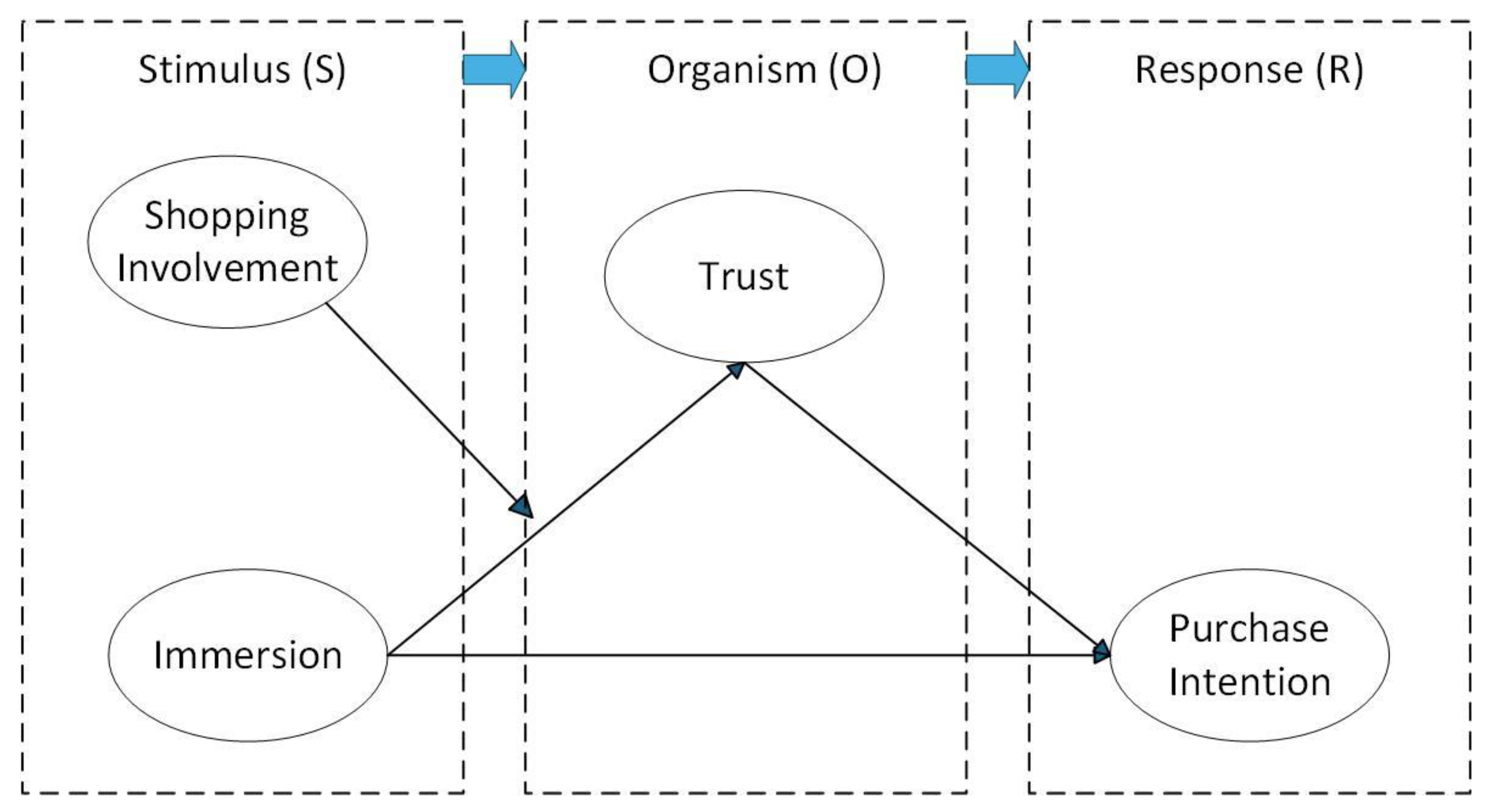
Figure 2.
The moderating effect of SI on the relationship between IM and TR.
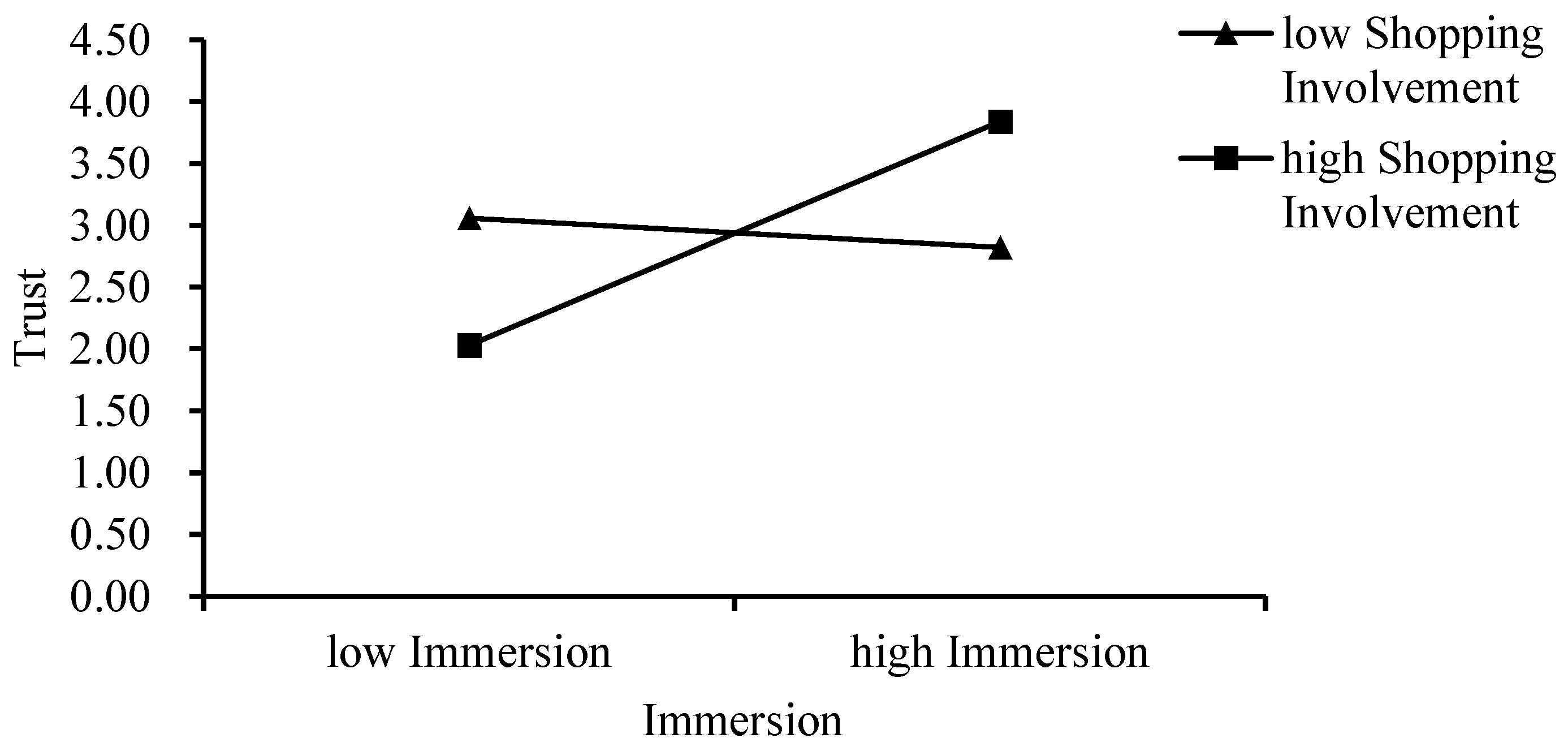
Table 1.
Measurement details and sources.
| Latent Variable | Observed Variables | Measurement Items | Source |
|---|---|---|---|
| Immersion (IM) | IM1-IM3 | 1. I feel deeply engaged in the live streaming shopping environment; 2. I ignore external distractions when immersed in the live stream; 3. The live stream makes me fully involved in the shopping process |
[5,23] |
| Trust (TR) | TR1-TR3 | 1. I trust the authenticity of products recommended in the live stream; 2. I believe the live streaming platform ensures transaction security; 3. I trust the streamer’s professional recommendations |
[11,17] |
| Shopping Involvement (SI) | SI1-SI3 | 1. Shopping is important to me; 2. I am willing to invest time and energy in shopping; 3. Shopping decisions have significant meaning for me |
[10,18] |
| Purchase Intention (PI) | PI1-PI3 | 1. I am willing to purchase products featured in the live stream; 2. I am likely to buy the recommended products in future live streams; 3. I will recommend live stream products to friends or family |
[2,39] |
Disclaimer/Publisher’s Note: The statements, opinions and data contained in all publications are solely those of the individual author(s) and contributor(s) and not of MDPI and/or the editor(s). MDPI and/or the editor(s) disclaim responsibility for any injury to people or property resulting from any ideas, methods, instructions or products referred to in the content. |
© 2026 by the authors. Licensee MDPI, Basel, Switzerland. This article is an open access article distributed under the terms and conditions of the Creative Commons Attribution (CC BY) license (http://creativecommons.org/licenses/by/4.0/).
Copyright: This open access article is published under a Creative Commons CC BY 4.0 license, which permit the free download, distribution, and reuse, provided that the author and preprint are cited in any reuse.


