
Submitted:
15 January 2026
Posted:
16 January 2026
You are already at the latest version
Abstract
For nearly a century screened Coulomb potentials have been of recognized importance in diverse areas of physics and chemistry. A key feature of interest in these potentials is the phenomenon of critical screening. This paper has three main purposes: To present an extensive, open-access, high accuracy (60 digit) benchmark reference data set of critical screening parameters, with validation; to confirm excellent past work in the field (to 30 digits), and to correct an historical oversight in its literature; and to present the essentials of our new approach, the “Phase Method” (PM), for computing them. Using the PM we calculate critical screening parameters, accurate to 60 decimal digits, for the Yukawa/Debye, Hulthén, Pseudo-Hulthén, and Exponential Cosine Screened Coulomb (ECSC)) potentials. The practical feasibility of such calculations on inexpensive hardware opens up new possibilities in research and education. We highlight an apparently overlooked 1989 paper of Demiralp on critical screening parameters of the Yukawa potential, which accurately calculated them to 30 decimal digits. Our main results are computations of the critical screening parameters µc= 1/Dc for screening lengths D ≤ 1000 au and angular momenta l = 0 . . . 20. The claimed accuracy of our results is supported by several independent lines of evidence: comparison with the most accurate (30 digit) values available in the print literature for the Yukawa, Hulthén, and ECSC potentials; comparison to 60 decimal digits accuracy with exactly known eigenvalues and critical binding parameters of the Pseudo-Hulthén potential; consistency tests between computed critical parameters, for various l-values for the Pseudo-Hulthén Potential, and known exact relations between eigenvalues; and application of a novel consistency test between results with different potential parameters, that exploits an exact scaling symmetry of this entire class of potentials. Similar calculations were done for ECSC and Yukawa potentials for screening lengths up to D ≤ 105 and l ≤ 12, to 30 digit accuracy, which show interesting (and to our knowledge not previously reported) periodic structure in Dc(n, l) for the ECSC potential that is not observed for the Yukawa potential. The asymptotic scaling behavior for the Yukawa and Hulthén potentials is explained quantitatively by simple semiclassical calculations.
Keywords:
screened coulomb
; critical screening
; critical binding
; Yukawa potential
; Debye potential
; Hulthén potential
; ECSC potential
; plasma physics
; Schrödinger equation
; phase method
1. Introduction
1.1. Background
The Coulomb interaction between two point charges tends to become exponentially screened when the charges are embedded in a medium with mobile or virtual charges. In plasmas, semiconductors, or electrolyte solutions the characteristic length over which this occurs is called the Debye (or screening) length. The screening phenomenon appears in many areas of science and engineering, including nuclear and particle physics; dark matter; cosmology; astrophysics; plasma physics; inertial confinement fusion; condensed matter physics; biophysics; chemistry; semiconductor device physics; nanotechnology; and nanophotonics.
This behavior can be modeled by Screened Coulomb Potentials, such as Yukawa/Debye: ; Exponential Cosine Screened Coulomb (ECSC): ; and Hulthén with ; for the moment, for simplicity, we suppress writing the centrifugal potential. is the screening parameter, and Z is a strength parameter (coupling constant, or atomic number, depending on context). As is well-known, and we will show below, Z can be set to 1 without loss of generality - doing so effectively rescales the screening length.
In this paper we have a simple goal: to directly determine the number of bound quantum states there are for these potentials as a function of screening length and angular momentum l. Our initial motivation for addressing this subjects was as a physically important and nontrivial application of our “Phase Method” [1] (PM). The PM accurately, robustly, and automatically calculates quantum energy eigenvalues and wave functions for a broad range of potentials, including discontinuous and singular ones, as described in [1]. It also turns out to be quite effective (with slight variations) and accurate for our present task of directly calculating critical binding parameters. The exact solutions for the Pseudo-Hulthén Potential provide important benchmarks against which to test our methods to high accuracy, as do several other analytical results (e.g. eigenvalues for pure Coulomb potential), and also other internal cross-checks and exact scaling relations, which are described below.
1.2. Preliminaries
It is well-known e.g. [8] that the three-dimensional time independent Schrödinger equation can be separated into an effective radial one-dimensional equation, and another, angular, equation, yielding spherical harmonics as solutions, by adding a centrifugal potential term into the radial equation: , with being the solution to the radial differential equation and l being the angular momentum quantum number. A proper wave function solution vanishes at and , but we make use of more general divergent solutions in the Phase Method. With no loss of generality we also will use atomic-like units in which , where m is the reduced mass of the two-particle (e.g. electron-ion) system. In the limit of infinite ion mass this is equivalent to atomic units and henceforth we will refer to our units as au.
Following Lam and Varshni [4] we define a variable that serves as an approximation to r that is accurate at short distances, which allows the problem to be exactly solved analytically [6] for (i.e. no centrifugal potential), but which deviates significantly from r at large distances. This Hulthén Potential is not exactly soluble for , but following Greene and Aldrich [7] it can be extended to what we call the “Pseudo-Hulthén” potential (Greene and Aldrich call it the “Hulthén effective potential”) which is identical to the Hulthén potential except that it replaces the factor in the centrifugal potential with while also multiplying it by a damping factor, which has the effect of partially compensating for the fact that rather than at large distances. Evidently for the “Pseudo-Hulthén” and Hulthén’ potentials are identical. Although this modifies the asymptotic potential, it renders the problem exactly soluble [6] in terms of Hypergeometric Functions for all l, for the energy eigenvalues and critical binding parameters, making it invaluable for our benchmark comparisons.
We first observe that for the screened Coulomb Potentials considered here, the change of variable transforms our original Schrödinger equation
to
with and . The coefficient Z of the potential is absorbed in the rescaling; if the (reduced) mass m is not set to 1, the product of sets the scale. It is easily shown in a similar manner that the Hulthén potential, ECSC, and pseudo-Hulthén potentials have this same scaling property, indeed any potential of the form or + centrifugal potential. Without loss of generality we therefore take , unless otherwise noted. Below we will use a variant of this scaling symmetry as an internal check on the accuracy of our higher precision calculations.
The attractive Coulomb potential possesses an infinite number of bound states. General arguments [8] show that potentials that decrease faster than at large distances only have a finite number of bound states. The Yukawa potential at short distances is Coulomb-like, as are the other potentials considered here, with the same infinite attractive singularity at . At large distances the exponential decay factor reduces the attraction relative to a Coulomb potential, so that it admits only a finite number of bound states, the number depending critically on the value of (or equivalently its inverse ), and the angular momentum l. For example, for the Yukawa/Debye potential and , the critical screening parameter at which a single s-state just becomes bound is ; a second state becomes bound for at .
A key point regarding the critical binding parameters is that new physical processes/channels turn on or off at these critical values. This strongly affects photoionization processes in plasma physics and astrophysics [9,10], affecting spectra and opacity of stellar atmospheres. The related potentials Hulthén and Exponential Cosine Screened Coulomb (ECSC) have analogous behavior, but with their own critical binding parameters. These have been studied for many decades. Past work has been reviewed by Roy [11], and more recently by Jiao et al [3].
Here we present direct calculations of these parameters to substantially greater accuracy than in the past, i.e. 60 decimal digits, and demonstrate agreement with independent calculations [2,3] at their upper limit of 30 digits. This consensus, using quite different methods, is a strong validation of all of these results, over the range of digits that they happen to agree.
Although our computational approach calculates critical binding parameters directly, without the need to compute sequences of eigenvalues as a function of and extrapolating them to zero energy, it is still edifying to show eigenvalues can be accurately calculated by our methods for these potentials. We compare our eigenvalues with those of Stubbins [12] and Vrscay [13] for their selected values of and l for the Yukawa and Hulthén potentials, and also compare with exact values for Pseudo-Hulthén potential, with excellent agreement.
It should be noted that our methods and code readily can be used to calculate a greater number of accurate digits (if there is a need), higher l values, longer screening lengths, and other potentials – it is simply a matter of computation time. Our main data set presented here includes critical binding parameters to 60 accurate digits for Yukawa/Debye, Hulthén, Pseudo-Hulthén, and Exponential Cosine Screened Coulomb (ECSC) for –20, and critical screening lengths up to . We also compute to the lower level of accuracy of 30 digits all critical binding parameters for Yukawa/Debye and ECSC for –12 and up to au and find intriguing structure in vs n in the latter.
There has been some disagreement in the literature about these values in recent years. Edwards [14] claimed highest accuracy to 10 digits, which disagreed with our own early (unpublished) calculations at the time, which were accurate to 30 digits, as well as Demiralp’s [2], Rogers [15], and others. To help clarify this confusion our main original purpose in these investigations was to help clarify the problem by independently computing the critical parameters, and secondarily to demonstrate the method that we have developed to obtain them.
We initially found (in preliminary unpublished work) that our results were almost entirely in agreement with the work of Demiralp [2], which claimed 30 digits of accuracy. This very high degree of accuracy at the time (1989) was attained using minimal computational resources by modern standards, on a DEC VAX 11-780 using quadruple-precision arithmetic, by developing sophisticated variational methods with basis sets that were specifically constructed and optimized for each state so as to obtain rapid convergence. Our results, which are relatively simple and direct, but have the benefit of modern computational tools that we use in unconventional ways, also agree (to within their stated accuracies) with those of Rogers [15] (5 digits, 1970), Diaz [20](15 digits, 1991), Singh [16] (15 digits,1993), Napsuciale [17] (10 digits, 2021), Del Valle [18] (17 digits, 2018); yet disagree in the least few significant digits with those of Gomes et al [19] (1994), and Edwards et al [14] (10 digits, 2017).
In the literature the discrepancies in these claimed values appeared to have caused some investigators to doubt some results that actually were correct at higher accuracy, such as those of Diaz [20]. Yet the singular paper of Demiralp [2] appears to have been overlooked by all, and is rarely if ever cited. The high degree of agreement with Demiralp’s tables of results independently calculated (to 30+) digits by two other groups, using quite different methods, indicates that his work continued to be the most accurate for decades until matched by the recent work of Jiao et al [3], and our own unpublished work, which were of the same level of accuracy as [2]. Secondarily, the observed agreement between our results and Demiralp’s also lends support to our new methods, which were independently developed before we became aware of either Demiralp’s or Jiao’s prior work.
The Phase Method [1] allows calculations to much higher accuracy than previously have been published on this topic to date. Here we present critical exponents to 60 decimal digits for screened coulomb potentials up to and . They are validated by comparison with exact results (Coulomb, Hulthén , and Pseudo-Hulthén for arbitrary l); with prior publications up to their maximum of 30 digits; and by independent calculations using our -scaling test. We also find that we obtain the same level of accuracy for other potentials including Hulthén, extended Hulthén, and Exponential Cosine Screened Coulomb (ECSC). More generally, we observe that the Phase Method can be conveniently applied to many other potentials when more normal levels of accuracy (say, 15-30 digits) are required. Our Mathematica [23] code is freely available for download for independent verification and use at http://gbxafs.iit.edu/phase-method/.
2. Materials and Methods
2.1. Preliminaries
The Yukawa/Debye/Static Screened Coulomb potential is a central (isotropic) potential. It is well known [8] that for non-zero angular momentum l, by addition of a centrifugal potential term, the three-dimensional problem becomes reducible to solving an equivalent one-dimensional potential
in the Schrödinger equation
Here and is the radial wave function. The appropriate boundary conditions are and . We solve this here through direct calculation by a variant of the Phase Method [1]. As shown in [1] this approach is equally applicable to many potentials including other Yukawa/Debye-related potentials such as Hulthén and Exponential Cosine Screened Coulomb (ECSC).
2.2. Computational Approach
To calculate values we use essentially the same logic (and only slightly modified code) as the Phase Method [1] for finding the eigenvalues. Solving for all the energy eigenvalues for a fixed potential parameter (or equivalently, ) within a given range of energies is isomorphic to the problem of solving for all the values within a specified range of , for fixed . As described below, there are differences, however, when it comes to the choice of data range.
In this work we directly calculate the critical parameters (or ). In contrast to most other approaches, we do not determine them by calculating a sequence of eigenvalues as a function of and extrapolating it to zero energy. Our approach is similar in spirit to Schey and Schwartz [22], and Edwards [14], but our methods are distinct from theirs. As recognized by these authors, calculation of is less computationally demanding than that of general eigenvalues, because the integration occurs very close to zero energy, where the asymptotic behavior as is very smooth () – it is close to a straight line for . Because of this, large steps can be taken in that region by the adaptive ODE solver, and only modest amounts of computation time is spent in doing so. In contrast, integrating the ODE for arbitrary energies is much more time consuming, because of the oscillatory nature of the solutions. In that case choosing the range more carefully can substantially reduce the time required. In the Phase Method, as applied to general energy levels (rather than just those near the continuum limit), a useful heuristic in such cases is to calculate the classical turning points at the highest considered energy, and multiply them by “turning point scale factors” to estimate a sufficient range at that energy. In this work, for energies near zero, such care is not needed to obtain practical computation times over extremely long ranges.
2.3. Number of Accurate Digits
A peculiar but very useful characteristic of the PM, as presently implemented, is that if the range is sufficient, the ultimate number of accurate digits is reliably half the working precision (as specified in numbers of decimal digits). This is related to the ODE solver being unable to continue (i.e. not registering a legitimate transition/zero appearing within the data range) when the square of the deviation of the test energy from the exact eigenvalue becomes too small to represent at the selected working precision. With arbitrary precision arithmetic we are not much concerned about wasting digits of precision, as long as the ultimate accuracy and run time are reasonable. A very useful consequence is that the number of accurate digits can be “dialed-in” before running the job simply by choosing the working precision, i.e. just by changing a single number at runtime, provided the x-range is sufficient. This applies to calculating eigenvalues in the PM, but also to calculating critical screening lengths .
The merits of calculating such quantities to high precision of 60 digits are several-fold. Taking in quantities that are nearly equal can stretch the limits of accuracy of computed numerical results. Very accurate numerical results may suggest patterns to investigate, or to provide critical tests of analytical results. More generally, the methods demonstrated here may be of use in much broader contexts in physics, and mathematics.
The probability of getting 9 digits correct randomly is one in a billion. The probability of randomly getting 60 digits correct is one in a quadrillion quadrillion quadrillion quadrillion. If this happens, you’re probably onto something.
2.4. Working Precision, Data Range, and Accuracy
Computationally, to avoid divide by zero errors, we must approximate the singular potential. We do it here simply by starting the ODE solution at a very short distance above , at which we set the initial value of the ODE solution to be zero. The value of the initial slope is relatively unimportant as long as it is nonzero. Setting the initial function value to zero effectively places an infinitely high potential barrier at this short distance . To attain the desired high level of accuracy of (or eigenvalues) for these potentials with the singularity it is necessary to choose a range that extends to extremely short distances, related to the desired accuracy, and also rather long distances.
The short distance criteria are different for and owing to the presence of the repulsive centrifugal potential. The ODE solution for samples the attractive singular potential very close to . In contrast, for , the repulsive centrifugal potential shifts the weight of the solution away from , making it less sensitive to the potential at very small r. For the minimum distance required for these potentials for precision is close to ; for 60 digits this is , but there is little reason not to go further as a safety factor. For the calculations presented here we used which is empirically found to be vastly more than sufficient. The short distance cutoff that is needed for is much less stringent than this. To set the upper limit , rather than adjusting it incrementally upward in a series of calculations until sufficient convergence is obtained, we find it practical to choose a very large cutoff, and rely on the adaptive sampling of the ODE solver algorithm to obtain the desired accuracy within a reasonable time frame. This could be optimized but it is not clear there is a practical need to do so for this application.
For this reason we choose very (arguably, unnecessarily) large upper r-limits, yet still obtain reasonable computation times. The run time likely might be reduced somewhat by optimization, but we agree with the programming aphorism (usually attributed to Knuth) that “premature optimization is the root of all evil’, meaning, don’t optimize code unless there is a practical reason to do so. For this reason we have not followed the conventional procedure of selecting sensible ranges and then incrementally extending them until the computed values converge to the desired accuracy. This can be time-consuming and as we have seen, unnecessary for this work. Rather, we have started with very large ranges and decreased them if needed. Convergence still can be assessed by reducing the range moderately and comparing results, but this need be done only rarely.
The ranges that ultimately were used in this work were indexed to the desired accuracy via the working precision “” as for , and for . These ranges are purely heuristic and not especially optimized, and so might warrant some systematic study. Actual values for were for and for . For the lower cutoff that was initially used was , but the calculation spontaneously aborted for using that cutoff, presumably because of numerics associated with the centrifugal potential; relaxing the lower cutoff by increasing it to for was found to be both stable and sufficient for the desired accuracy up to , at least. These ranges were checked by comparing with exact results for Pseudo-Hulthén potential, then consistently used for the other potentials considered here.
2.5. Phase Method
2.5.1. PM in a nutshell
Here we give a brief outline of key aspects of the Phase Method for solving the Time Independent Schrödinger Equation for 1D potentials, and central/separable potentials (and for good measure, the Helmholtz Equation). First, eigenvalues are accurately found, then wave functions are generated from them, as needed. The PM is described in more detail below (with the adaptations used for the critical binding parameter problem), and in expanded form with many applications in [1].
- Phase Method is related to Shooting Method, but upside down and backwards.
- Sturm’s separation theorem implies the number of zeros in the solution doesn’t change even if the initial conditions do: their locations just move around.
- You don’t have to find a proper convergent wave function to find eigenvalues.
- “Shoot First” Method - uses nominal initial slope/value conditions for specified energy parameter (no tweaking initial conditions/boundary conditions is needed).
- Choose x-range so as to promote divergent solutions by placing initial point far enough into the classically forbidden region. It actually is beneficial for reasons described below and in [1]
- Automatic x-range setting is/can be done by scaling computed classical turning points at highest energy (easily overridden if desired). The small x (aka r) criterion is different for potentials singular at , see below.
- “Phase Plot” digitizes divergent ODE solution for the purpose of counting transitions/ # of bound states, and visualizing to check appropriate x-range.
- Use Adaptive ODE solver (no fixed grids!) with Stiffness Switching for robustness.
- Parallel interval-based evolutionary solver finds all eigenvalues accurately and efficiently, no initial guessing is needed, as it is in Shooting Method.
- Automatic maximum and minimum -search range setting is/can be calculated based on potential (easily overridden if desired).
- Use Arbitrary Precision Arithmetic - really big numbers are fine. Take care not to pollute high precision numbers with low precision.
- The number of accurate digits of the computed eigenvalues is reliably half the number of digits of working precision, iff range is adequate. The reason is explained below. User chooses the accuracy, you just have to wait for the answer.
- “Shoot First” method can be used to compute wave functions starting with the very accurate eigenvalues from above, with automatic divergence detection/truncation at large x.
- “Self-healing” of differences in the logarithmic derivatives owing to different initial conditions occurs well into classically forbidden region (see below); solution is robust even if transient overflow occurs.
- Automatic validation of wave functions: Virial Theorem tests, expectation value vs eigenvalue; wave function convergence tests.
2.5.2. Expanded Description
In this paper we borrow some ideas and methods from the Phase Method (PM) [1] an approach that we have developed for solving the Schrödinger equation in 1D, and central and separable potentials. It automatically maps out all of the (finite number of) eigenvalues within a designated energy range, without discretizing the potential as in matrix methods, or needing to guess locations of eigenvalues or tweak boundary conditions as in the Shooting Method, to which the PM is most closely related. It uses standard highly performant ODE solvers with stiffness switching algorithms (originally LSODA, currently, StiffnessSwitching) that automatically switch between stiff/nonstiff algorithms, according to the numerical conditions encountered during the solution process. This is basically an insurance policy so as to obtain a robust solution – many ODEs can become stiff under conditions that are not obvious to the user. Algorithms that are appropriate under stiff conditions (e.g. Backward Differentiation Formula, implicit methods) are computationally expensive, and so are used only when needed, on a step by step basis. Otherwise non-stiff algorithms are used where they are appropriate.
The PM is closely related to Shooting Methods, but in a sense it is a conceptual inversion of them. Importantly, it does not seek to find convergent wave functions from the start. We call this the “Shoot First Method” (as in “shoot first and ask questions later”) because we just don’t worry about the initial conditions: we can just use nominal initial conditions appropriate to the general class of potentials (e.g. singular at the origin, or not). Indeed the PM actively promotes divergent solutions, from which it extracts useful information, allowing the algorithm to accurately locate the eigenvalues. In a most basic sense it is node-counting, but not of a proper wave function: to paraphrase, the key point from Sturm’s separation theorem is that the number of zeroes in the integration range (if it is set wide enough) is invariant if the initial conditions are changed. Convergent wave functions are not needed or even sought in the determination of energy eigenvalues. We count zeroes, or equivalently, transitions in the Phase Plot described below. Once the eigenvalues are accurately determined (through a sort of parallel evolutionary binary search), proper wave functions then can be readily computed if they are needed, but again, without the need to adjust initial conditions.
2.5.3. “Self-healing” Logarithmic Derivative
It is not difficult to show that as long as the initial starting point for the ODE solver is placed well into the classically forbidden region (well before the lowest (in x) classical turning point), the difference between logarithmic derivatives of two solutions starting with different initial conditions rapidly vanishes in the ODE integration process.
Consider two solutions and of the time independent Schrödinger equation with the same energy and potential but with different boundary conditions. We have then , and . Multiplying the first equation by and the second by , and subtracting the two equations gives
Recognizing the left side of the equation as the derivative of and integrating, we get ; dividing by we get .
In the classically forbidden region the solutions and diverge exponentially and the product of their inverses rapidly approaches zero. We also recognize the left side of the equation as the difference of the logarithmic derivatives of the two solutions, which therefore rapidly approach zero. Integrating, we find which implies the ratio of the two solutions is a proportionality constant, which is normalized away for a wave function. Another way to describe this is the Wronskian of the two functions rapidly approaches zero when the ODE solution is started well into the classical forbidden region, so the two solutions rapidly become linearly dependent.
This “self-healing” of differences between two solutions with different initial conditions when started in the classically forbidden region is the basic reason we don’t have to fuss with precise initial conditions in the PM. It is a great operational simplification. It also provides more robustness to the solution (e.g. in the event of transient numeric overflow) because any such glitch is just a difference of initial conditions for subsequent points at larger x, so the solution tends to “heal” itself.
2.5.4. Phase Plot
The PM makes use of what we call the Phase Plot, which is simply the tanh (hyperbolic tangent) of the diverging solutions of the Schrödinger equation. Alternatively could be used instead of tanh, whence the “phase”. We use fixed nominal initial conditions, for reasons described above. Reining in the very large magnitude exponentially diverging solutions by using the tanh (or arctan) effectively digitizes the solution, with useful results, as described below. Other compression functions could be used but it is helpful for visualization purposes to have ones that are differentiable.
In the Phase Method, for most potentials, the ODE integration, treated as an initial value problem, is started and ended well past the extremal classical turning points, i.e. far into the classically forbidden region where (in general for the PM we use the independent variable x because we are not only concerned with central potentials, for which r is conventional). However, for “one-sided potentials”, i.e. those in which the independent variable is restricted to , as in the potentials considered here, the ODE solution is started at a very small positive value , at which the solution is set to zero, and the initial slope is set to some larger but nominal value. In the case of Coulomb-like potentials when high accuracy is sought, the value of must be quite small. However, it is not necessary to adjust or tweak the initial conditions for the particular solution.
If there are n bound states below the specified energy the Phase Plot will show n step-like transitions, jumping between . These are easily counted by a human by eye, or by a computer – they are most directly counted within the ODE solver itself (in Mathematica [23], by using WhenEvents). The Phase Plot essentially digitizes the analog ODE solution, much like digital circuits, which in reality are just analog circuits that are driven into saturation, yet in doing so, afford new kinds of uses. The morphology (e.g. sharp vs rounded transitions) of the Phase Plot tells the user at a glance if the range is insufficient and needs to be extended. Another way to say this is the transition counting process rapidly evaluates the integrated density of states at the specified energy, typically in milliseconds. This is the sharp computational tool that provides the accuracy, along with arbitrary precision arithmetic.
2.5.5. Arbitrary Precision Arithmetic
If we were limited to machine precision ( decimal digits, 64 bit real numbers, divided up between exponent and mantissa) other methods may be more accurate than the PM. For smooth potentials, spectral methods are especially rapidly convergent. Example code to implement these can be found in [1]. On the other hand, these other rapidly convergent methods may break for non-smooth potentials. The PM handles everything with about equal facility.
There are unique advantages that come with using arbitrary precision arithmetic in the PM. It allows us to better handle diverging solutions (which are beneficial) without encountering floating point overflow. If overflow is encountered, the range just needs to be reduced slightly. Also, we can effectively dial-in the accuracy of the results we desire.
Modern implementations of arbitrary precision are surprisingly efficient. Of course greater accuracy involves somewhat longer run times, but we find that these are quite acceptable on modern computers. Effectively we reduce the human user time in exchange for increased computer time. To use arbitrary precision in Mathematica we simply specify WP, the working precision, given in decimal digits. However attention still needs to be given to not polluting high precision numbers with lower precision ones.
A simple python port has been written and posted, giving quite acceptable performance running in the Pyto environment on a Gen8 iPad, using machine precision. This demonstrates a good degree of portability. The Julia language/environment seems especially promising as an open source alternative to Mathematica for the PM, because of its integrated support for arbitrary precision arithmetic, sophisticated ODE solvers, and parallel evaluation.
2.5.6. Evolutionary Search: Sifting and Refining
The ability to quickly count the number of bound states that exist below a given energy allows us to rapidly determine if an energy interval contains one or more eigenvalues. This is then used to systematically map out all of the energy eigenvalues within a specified initial search interval, using a simple kind of parallel evolutionary binary search process. We define a simple function that takes a given energy interval as input; divides it in half; and tests if each subinterval contains one or more eigenvalues, by applying the state counting function to each end of each subinterval. If there are eigenvalues within a subinterval, it is retained and passed along to a common pool (list) of intervals; if not, the subinterval is discarded. This function then is repeatedly mapped in parallel (using Mathematica’s ParallelMap) across the list of intervals until a fixed point is attained, or otherwise it is determined that sufficient accuracy is achieved. It is very helpful to cache ("memoize") previously computed values to avoid the need to recompute them, which speeds up the process about threefold. This is easy to do in Mathematica using the idiom e.g. .
The list of intervals initially roughly doubles in length each iteration, but then rapidly converges to only those intervals containing a single eigenvalue, or nearly so (a process we call "sifting", which normally is done serially, but could be parallelized). Those intervals are then "refined" in parallel using the same basic process, bringing it to completion. A great virtue of this approach is that it automatically and efficiently separates even nearly-degenerate eigenvalues, and no guessing is needed whatsoever (as is normally the case for the shooting method). Basically the user defines the potential to solve (analytically or numerically), puts an upper limit on the energy below which to look for eigenvalues (or defines a specific energy range to look within), specifies the accuracy desired, and the algorithm does the rest automatically. In this paper, it is this Phase Method algorithm that we have adapted to calculate critical binding parameters to high accuracy, instead of the eigenvalues.
Once all of the energy eigenvalues are determined to sufficient accuracy, the wave functions are easy to calculate, again without any need to match boundary conditions. With accurate eigenvalues in hand, the ODE solver is started well into the classically forbidden region, using only nominal initial conditions. The “self-healing” of the solution described above comes into play, giving an accurate solution where it is substantial. Then, in the final classically forbidden region at large x, at some point, the solution will tend to exponentially diverge again, if only because of the errors associated with representation of real numbers on a computer by a finite number of bits. At that point the program simply detects the location of first divergence using a simple algorithm (find the local minimum closest to of ), and truncates the solution there, setting the solution to zero above that point. The resulting approximate wave function is then normalized by dividing by the integral of its square. These approximate wave functions are satisfactory for many purposes, and refinements to them for improving accuracy are feasible, if needed.
As described above, it is a peculiar but very useful property that the ultimate accuracy of the eigenvalues in the PM is reliably equal to, or better than, the working precision (number of decimal digits) divided by two. This behavior is related to the following observation: in the ODE solution, the transitions will stop registering (i.e. zeros are not counted) in the ODE solution process when , where is the test energy, is the eigenvalue, and numeps is the numerical epsilon, i.e. the minimum difference representable by numbers at the designated working precision.
For example if one wants 30 digits of accuracy, just use WorkingPrecision=60. This is straightforward to do using arbitrary-precision arithmetic, where adding more digits of precision simply requires longer execution time (and a little more memory), which are readily available on modern computers.
The computations in this paper were mostly done on M4 Mac Mini computers with 16GB RAM which is more than enough: each process running on a single cores takes about 200MB RAM on Mac OS, so 10 cores requires only about 2 GB RAM. With arbitrary precision arithmetic in Mathematica, the penalty for using WP of twice the desired accuracy is very modest, at least for the range accuracy we are most interested in. Our approach to this issue has the benefit of allowing the user to simply specify up-front the minimum accuracy that is needed, by specifying the WP. The computer then chips away until the eigenvalues are revealed, which usually takes from minutes to hours on a desktop or laptop computer. It takes longer to process a greater number of eigenvalues, more or less in proportion to their number, as does computation of very high n ODE solutions, with their highly oscillatory structure.
But unlike most matrix methods, it is not necessary to calculate all the states, if only a few are needed, because the algorithm searches within an energy range that is specified by the user. The user only has to ensure the x-ranges are large enough, and the Phase Plot is a useful guide to that. But for most eigenvalue problems, a better heuristic is to define a range that is scaled from the the extremal classical turning points, which are automatically calculated, as described in [1]. In our PM software this is the default option, but easily can be overridden if desired. The whole process naturally parallelizes, and runs very well on modern multicore desktop computers. The computations readily could be farmed across a compute cluster, or even supercomputers if hundreds of thousands, or millions of accurate eigenvalues were needed. The code should be readily portable to the Julia language; a very basic Python port is currently downloadable for eigenvalues.
2.6. Eigenvalues and Critical Binding Parameters
The energy levels for the Yukawa and similar potentials as a function of (or are quite straightforward to determine by the Phase Method, as described above. Determining the critical screening parameters by the appearance and disappearance of transitions in the Phase Plot as a function of screening parameter (with a fixed upper energy limit of zero), is essentially the same process as finding the eigenvalues. Rough intervals in that contain transitions are automatically calculated from the Phase Plot, and then refined further. The evolutionary iterative bisection mechanic is virtually the same as in the standard Phase Method, and is also done in parallel.
Only a few user-inputs are needed for the critical binding parameter calculation: the potential; the angular momentum (needed to calculate the centrifugal potential); the desired accuracy (via working precision parameter); and the range of values within which to look for bound states. Applying the -scaling test is another option. The rest of the process is automatic, typically taking a few hours, depending on the accuracy desired, on an inexpensive desktop computer to obtain critical exponents for all of the bound states of the specified angular momentum l.
2.7. Adapting the Phase Method for Determining Critical Screening Lengths
It is helpful to use as our screening parameter, as in Rogers [15]. In applying the Phase Method (PM) to calculating eigenvalues of the Yukawa potential we vary the energy for a fixed and l and look for changes in the number of transitions in the Phase Plot that reflect changes in the number of bound states. This is done without any need to guess locations of eigenvalues or fiddle with boundary conditions. The task we are now faced with is the flip side of this process for finding eigenvalues: we fix and vary to see when new states become bound/unbound. The computational apparatus is essentially the same as the usual PM. For the purpose we simply adapted our a simple example code for computing eigenvalues which is posted for download at https://gbxafs.iit.edu/phase-method/. Here we adapted it to very accurately compute, for a given l, all the values that are less than a specified . This problem is isomorphic to that of computing all the eigenvalues that are less than a specified . Note that this variation on the PM allows us to find critical screening lengths without the necessity to calculate eigenvalues for , although those also readily can be calculated using the PM, if needed.
2.8. -Scaling Test
As mentioned above, multiplying the prefactor of the exponential term in the potential (i.e. coupling constant or atomic number, which is here by default taken as 1, with no loss of generality) by a scaling factor , while dividing the screening length D by the same factor, has the sole effect of multiplying the eigenvalues by . This is physically plausible because increasing the coupling constant (or atomic charge ) and decreasing screening length D have opposite effects on the propensity to bind states. But for these potentials, indeed for any that scale as using a single length scale parameter (here ) describing the potential, they are exactly equivalent.
Here we exploit this symmetry as one check on the accuracy (or at least, self-consistency) of our calculations. We multiply the exponential term by a factor while dividing the screening length by the same factor . In doing so, the energy eigenvalues get rescaled by , but in the case of critical binding, these are identically zero. This implies that this double-rescaling transformation (e.g. coupling constant increased, screening length decreased by the same amount) should leave the critical screening parameters invariant, exactly. By doing two independent calculations, with unscaled () and scaled (), which result in quite different spatial dependencies and computational numerics, we have an independent test as to whether our computed critical screening lengths are identical at the claimed accuracy. This zeta-scaling test is built into our code as a clickable option. Our tests have passed every time they have been applied.
The explicit scaled forms of the potential used in the calculations, including the centrifugal potential term (which is modified for the Pseudo-Hulthén potential), and including -rescaling form of are:
- Yukawa:
- Hulthén:
- Pseudo-Hulthén:
- ECSC: .
Note: for the Hulthén and Pseudo-Hulthén potentials are identical.
In summary, critical screening lengths are invariant under changes in . We use this to verify the accuracy of our calculations to the indicated number of digits by comparing independent runs with different instances of the potential and . In all of the tests, our results were confirmed to the claimed accuracy.
2.9. Pseudo-Hulthén Internal Self-Consistency Tests
The values for the PH potential are exactly known and highly regular: . This symmetry is evident from inspection of the PH data tables. This structure implies that incrementing the index l while decrementing n in the table by the same amount should give the same to within the tolerance of , determined by setting the working precision to 120. We have programmatically checked this relation for 192 distinct pairs of l, n values for the tables, and find all discrepancies in to be below the specified tolerance. As these correspond to independent computational runs for different l, with different centrifugal potentials, this is a stringent test of our computational methods.
The agreement in all cases with the exact known values is even more so. All 714 (for ) values for the Pseudo-Hulthén Potential that are presented in the tables in the Appendix were compared programmatically with exact values, and agree to the claimed 60 decimal digits (i.e. the absolute value of the error ). The code and parameters used to generate these results were then applied to calculation of the Yukawa, Hulthén, and ECSC tables.
2.10. Alternative Method for Calculating Critical Screening Lengths
We also implemented a alternative approach based on considerations that are also shared by our own methods used here, but have been exploited by few investigators tackling this problem. The central point is that the asymptotic dependence of solutions near zero energy are very smooth and therefore relatively fast to calculate with an adaptive ODE solver, even over extremely long ranges. At zero energy, in spherical coordinates, the wave function at large distances has the asymptotic form , which at large r is dominated by . Dividing the ODE solution by produces a straight line. A zero slope line demarcates bound from unbound states. These considerations are invoked by Schey and Schwartz [22], and also Edwards [14]. Using this observation, as an alternative to the Phase method, we sought the solution with zero slope, which is straightforward to calculate numerically in our usual way out to very large distances. However, extrapolating the slope solely from smaller values of r isn’t sufficient or reliable: a long lever arm (range) is needed to achieve high accuracy of the slope estimation. Further, we must exclude the region at low r to ensure that we are in an asymptotically appropriate region. Here we chose to use the range to for slope determination.
We sought the value of that gives zero slope when the energy is set to zero. This was done in an evolutionary search process like that used in the Phase Method. As before, we defined an interval in within which to search for critical values. Our metric was simple: we varied and (programmatically) looked for changes in the sign of the slope corresponding to values at the ends of the interval. As in the PM, we then bisect the interval, apply the sign change criterion to see in which half the desired resides, retain the viable subinterval if it exists, and discard the other, and iterate (using ParallelMap to map across the common list of intervals). As in the PM we "memoize" (cache) previously computed results to avoid unnecessarily recomputing them.
The initial bracketing intervals were determined by applying the state-locating function to roughly map out the transitions, evaluating (in parallel) on a simple grid search. These brackets compared well to those of Bylicki’s numerical tables [21] that are posted online; the bound-unbound transitions were judged by the values at which the energies first acquired an imaginary part. This alternative approach worked well (to 30 digit accuracy) when paying attention to the “points on accuracy” listed above.
However, our adapted Phase Method that was used to generate all of the tables in this work is simpler and more efficient, mostly because the evolutionary binary search automates the entire process, so no bracketing of the transition locations by other means is needed.
2.11. Recommendations for Obtaining Accurate Calculations
It may be helpful to outline certain details that have needed attention to achieve the claimed accuracy in our present computing environment.
- Use arbitrary precision arithmetic sufficient to get the desired accuracy. It is not necessary to limit oneself to machine arithmetic or to use GPUs, which normally support at most double precision floating point. Our code for this class of problems (and more generally, Phase Method) primarily uses CPU cores, not GPU.
- Take care to avoid polluting high precision numerics by introducing lower precision numbers into the calculation, intentionally or inadvertently. For example "1./2."≠ "1/2": the real number is machine precision, while the rational fraction has infinite precision. Mathematica/Wolfram Language automatically tracks precision and accuracy of real numbers in its computations, a powerful feature. SetPrecision is your friend.
- For robustness use adaptive ODE solvers with stiffness detection and switching. Alternatively change variables so the function being integrated is rather smooth. Or do both.
- Use very short and reasonably long distance cutoffs sufficient to obtain the desired accuracy. For singular potentials, and for , the short distance cutoff needs to be much shorter than it does for because in the latter the centrifugal potential pushes the wave function to larger r. For near-zero energies the time cost is very modest to use an absurdly long range with an adaptive ODE solver. For , the solution at large r where , is close to a straight line. But to determine a near-zero slope of a computed solution a long lever-arm (i.e. long range) is still needed.
- Compare with known exact values as benchmarks (and of course literature values) to validate the computational apparatus. Use -scaling tests and internal cross checks as applicable.
3. Results
In this section we first present evidence supporting our accuracy claims for the PM-calculated results. We then present numerical results in 84 tables n the Appendix, with some limited graphics and limited analysis.
- Compare PM eigenvalues to 60 digit accuracy with exact values for Coulomb and Pseudo-Hulthén potentials.
- Compare PM eigenvalues to 30 digit accuracy with Stubbins’s variational calculations for the Yukawa, Hulthén, and Pseudo-Hulthén potentials for , confirming the correct ordering of levels at small , and Stubbins’s values.
- Compare our results to 30 digits with Demiralp’s for the Yukawa and Hulthén potentials.
- Compare our results to 30 digits to those of Jiao’s values printed in the paper, for several potentials.
- Compare PM results to 60 digit accuracy with exact values for Pseudo-Hulthén potentials.
- Present our tables at 60 digits accuracy of values for PseudoHulthén, Hulthén, Yukawa, and ECSC potentials for all states up to and .
- These are followed by our computed values at 30 digits accuracy up to for for the Yukawa potential and ECSC potentials. Over this range the asymptotic dependence is clear. The ECSC values show interesting structure that is not present in the former. Asymptotic convergence is clear.
- Confirm the correct ordering of for the various potentials in all cases:
- Using semiclassical approximation, we analytically derive the asymptotic forms of vs for Yukawa and Hulthén potentials, which agree with fits to the numerically calculated behavior.
3.1. Phase Method Eigenvalues - Validation Tests
Here we give some examples of the accuracy of eigenvalue calculation using the PM. PM-calculated Energy eigenvalues to 60 digits. Comparing to exact eigenvalues of the Coulomb and Pseudo-Hulthén potential, we confirm PM calculations are accurate to the 60 digit accuracy chosen by setting . Specifically what is meant by this is the worst case absolute value of the difference between computed and exact value is of order . The median of the errors of the eigenvalues typically is one or two orders of magnitude lower than the maximum.
3.1.1. Comparison with Exact Pseudo-Hulthén Potential Eigenvalues
The computed results for for are tabulated for , at working precision . Our claimed accuracy for these tables is 60 digits, specifically meaning the absolute value of the difference between the calculated values and the exact values are all . As support for this, we compare to exact solutions for the eigenvalues of the Pseudo-Hulthén potential. These have the simple form for . Setting and solving for gives .
3.1.2. Comparison with Exact Coulomb Eigenvalues, Confirmation of SO(4) Degeneracy
Test calculations were done to verify accuracy of eigenvalues for coulomb potentials with various angular momenta. We conclude that the full 60 digit accuracy is readily attained, provided the working precision is set to 120 and the r-ranges are set appropriately. We simply give a summary of the results here.
A test calculation was made for for the Coulomb potential (, including centrifugal potential) over the r-range at , which gave maximum error of order (median error ) for all the states that were calculated, which were the 12 s-states below the designated upper energy limit of au. Another calculation was done for over the range at which gave maximum error of order for all the states that were calculated, i.e. the lowest 11 p-states below au. Choices of these ranges for and depend on desired accuracy and working precision as described above.
We note that, to the same level of accuracy, the energy eigenvalues corresponding to the different l values are degenerate, a consequence of the well-known SO(4)-symmetry of the Coulomb potential. This is a broken symmetry for the screened Coulomb potentials, Yukawa et al, which do not have energy-degenerate levels for different l.
It is important to note that each of our calculations for different l involves a numerically different centrifugal potential, and an independent computation, so the high degree of consistency among the degenerate eigenvalues for different l also is a significant confirmation of numerical consistency and robustness of the Phase Method.
To verify the accuracy (here at WP60, giving accuracy of , to compare with earlier work) for high angular momentum states, a calculation for , and also a repeat run of , were done with the lower energy search limit set to , so as to include all the bound states. For , the 50 energy eigenvalues for states were automatically located and calculated to an accuracy of order . For , all energy eigenvalues for were located and calculated with an accuracy better than . These calculations took about hours on a Mac M1 Studio Ultra, and would be perhaps twice that on a M4 Mac Mini computer; fewer eigenvalues would take less time. These results show that accurate eigenvalues can be obtained close to the continuum limit for the Coulomb case, and for higher angular momentum states (up to ).
3.1.3. Comparison with Exact Coulomb Eigenvalues Near
The critical binding parameter problem addressed in this work focusses on states at the continuum limit. Unlike the screened-Coulomb potentials that are the focus of this paper, which have a finite number of bound states for , the Coulomb Potential has an infinite number of bound states, accumulating near . For this reason in these calculations we set an upper energy limit below , to avoid requiring the PM to compute an infinite number of eigenvalues, which could take a while.
Ordinarily, to compute eigenvalues we often employ the heuristic of choosing the r-range by scaling the classical turning points, evaluated at the highest computed energy. For attractive potentials like those considered here, which are singular at , is chosen as small as the numerics allow at the specified WP. For Coulomb-like potentials this is . For the upper range limit, we use the turning point scaling recipe. The upper classical turning point for energy limit au is au, and we scale that by a factor of 10, to set (the exact value is not critical, as long as it is large enough). For this test, because we are particularly interested in states near , we set the lower end of the energy search interval to au, i.e. reasonably close to the continuum.
For this test we calculated energy eigenvalues for at WP60 (expected accuracy of 30 digits, iff the r-range is sufficient). The r-range was set to au with an energy search range from au. For l=0 the PM, using its sifting and refining process, computed eigenvalues for all 48 states from with an energy error au or better, which, as is typical, is slightly more accurate than the nominal expected 30 digits. This illustrates the importance of a using a sufficiently small . The calculations took about half an hour to calculate on a Mac M1 Studio Ultra.
3.1.4. Comparison of PM-calculated Energy eigenvalues to Stubbins, and Vrscay
Using the Phase Method also we readily confirm the full 30 digits of accuracy of the tabulation by Stubbins [12] of the Yukawa and Hulthén potentials, for the smallest n s-levels, as well as the claimed accuracy of his upper levels. We also readily confirm Vrscay’s [13] 20-digit values for all levels.
3.1.5. Comparison of PM eigenvalues with Stubbins for ; Perturbation Theory
Stubbins’s paper [12] reported accurate variational calculations of eigenvalues for selected states, for Yukawa and Hulthén potentials over an assortment of screening parameters , the values being specific to each state. In contrast, our Phase Method approach automatically computes all the energy eigenvalues up to the specified upper energy for a selected and l (or if desired, only those within a chosen energy window).
The () case is an extreme test self-imposed by Stubbins. We applied the same test to the PM. Our computed eigenvalues for for and for Yukawa and Hulthén potentials agree with Stubbins’s to all of his listed digits (with the slight discrepancy of his 1s value, in the least significant digit). Other values up to were also computed for and .
Stubbins [12] also showed that his computed eigenvalues conformed to the correct ordering of eigenvalues: even at the small values of , supporting the accuracy of his calculations in this extreme limit, where the variational basis set might become inadequate. We confirm his results with our (non-variational) PM calculations finding , and also find it is quantitatively consistent with first order perturbation theory, as we show next.
Using the exact Coulomb eigenvalues as references, in first order perturbation theory, the shift in eigenvalues for the other potentials is just the expectation value of the perturbation Hamiltonian , evaluated in the relevant eigenstates of the unperturbed (Coulomb) system. is the difference in the potential from (Yukawa, Hulthén ) from the Coulomb potential. The perturbation Hamiltonian for must include the centrifugal potential, which is slightly different in form for Pseudo-Hulthén than the others, so that term doesn’t cancel out. Expanding those perturbations to first order in simply gives the constant for the Yukawa potential, and for Hulthén/Pseudo-Hulthén. This makes evaluation of the expectation value trivial. We conclude the corresponding eigenvalues (when they are exist) are shifted from the Coulomb eigenvalues upward by (for Yukawa/Debye) or (Hulthén and Pseudo-Hulthén) potentials. Our computed results agree with this fully, with residual differences of second order in , or .
Other eigenvalues for various choices of in Stubbins’s article were also computed and compared with excellent agreement to Stubbins’s listed digits, which are variable in number, up to 30 digits. This mutually confirms the accuracy of Stubbins’s variational eigenvalues, and our own PM-calculated ones.
3.2. Critical Binding Parameters
3.2.1. Comparison with Exact Pseudo-Hulthén Potential Eigenvalues
The computed results for for are tabulated for , at working precision . Our claimed accuracy for these tables is 60 digits, specifically meaning the absolute value of the difference between the calculated values and the exact values are all . As support for this, we compare to exact solutions for the eigenvalues of the Pseudo-Hulthén potential. These have the simple form for . Setting and solving for gives .
3.2.2. Comparison with Demiralp’s1989 calculations for the Yukawa Potential
A remarkable paper [2] apparently has been overlooked in subsequent literature. In 1989 Demiralp [2] developed a sophisticated variational approach by constructing basis sets specially“tuned” to provide optimal convergence for each state. His Table 1 presents critical binding parameters to 30 digit accuracy for the first 44 bound states of the Yukawa potential, with ranging from to (roughly –). Over this range the following states become bound: –; –; –; –; –; –; –; .
Comparing with our own earliest results on this problem calculated to 30 digits (which were calculated, but not published, before learning of Demiralp’s or Jiao’s results) we found full agreement with Demiralp’s claimed 30 digits for the entire manifolds (27 s,p,d states), with the only discrepancies being in the least significant digits (28–30) for manifolds (17 f,g,h,i,k states), and a single clerical error described below. The number of digits of agreement between our results and Demiralp’s can be summarized approximately as digits. Since our initial (unpublished) 30 digit calculations were done, we have subsequently performed 45 digit and 60 digit calculations (those presented here) with the same conclusions.
We note that in Demiralp’s table 1 there appears to be a single clerical error (transposition in the eighth– ninth decimal places) for the state: (compared to our value ). As our own numbers and typeset tables are manipulated solely by machine (but checked by the author, who reportedly is human) we think such clerical errors in our table are highly unlikely.
As is common in this subfield, Demiralp used state labeling that is conventional for atomic physics and plasma physics, and chemistry (except the state is mistakenly labeled “j” rather than the spectroscopic convention “k”). As this numbering scheme is not appropriate for nuclear systems, and as this work is relevant to them, we simply label the states with the angular momentum quantum number , and within a given l manifold, number them sequentially from their lowest energy level as . This also is the natural way in which they are computed, one l-manifold at a time. The first state of angular momentum l appears at , where is the principal quantum number, so our sequence number .
The complete agreement of our results with the (totally different, computationally) variational calculations of Demiralp for and the near-complete agreement for is a strong confirmation of both results to the consensus accuracy. In 1989, and for three decades afterward, no other known published computations came close to the accuracy of Demiralp’s results. It is unfortunate that they had been largely overlooked over that time frame. We expect the full set of Jiao’s recent results which are expected to be accurate to 30 digits will agree with our own that are presented here. However, to ensure independence, we have kept a “firewall” (and a paywall) between them, for others to independently verify.
3.3. Comparison with Singh and Varshni’s [16] Calculations of for the ECSC Potential
Singh and Varshni in 1983 published their calculations to an accuracy of 8 digits (10 for the state) of critical screening parameters for the ECSC potential. Their tabulations covered bound states ranging from and principal quantum number , explicitly states . Our computed values fully agree with theirs to their accuracy of digits.
3.4. Comparison with of Jiao et al [3] for Yukawa, ECSC, and Hulthén Potentials
In addition to their extensive benchmark calculations of to an accuracy of 30 digits, and interesting observations, Jiao et al published a rather thorough review of the chronology of the apparently steady advances in accuracy of past calculations of critical parameters. Unfortunately, the community and review articles seem to have missed Demiralp’s 1989 paper [2], which gave results accurate in most cases to 30 digits, which was a significant advance at the time. The historical record will need to be corrected.
The computational method Jiao et al have used (Generalized Pseudo-Spectral Method), like previous investigators such as Bylicki et al [21] and Roy [11], calculates the critical parameters, energies of the bound states, as well as resonances and widths at positive energies. This is quite different in method from the results presented here, which directly determines the critical parameters.
We have compared our critical parameters to those explicitly listed in the paper, for and (our , , and , ) states of the Yukawa, ECSC, and Hulthén potentials. To maintain independence (and because their supplementary data is behind a paywall) we have not yet compared our full tabulations. However there is perfect agreement between our results and their printed values to their full listed 30 digits that are presented in their Tables 1–3. Our values to 60 digits below are quoted directly from our tables in the appendix.
Yukawa :
1.190 612 421 060 617 705 342 777 106 361 046 347 275 901 572 981 749 063 530 790
Yukawa :
0.220 216 806 606 573 040 405 041 463 289 577 110 508 548 104 023 305 084 754 657
ECSC :
0.720 524 085 881 953 095 871 917 136 918 578 087 183 481 757 107 097 035 500 102
ECSC :
0.148 205 032 642 758 419 285 886 459 123 248 041 030 459 181 523 505 707 250 28
Hulthén :
2.000 000 000 000 000 000 000 000 000 000 000 000 000 000 000 000 000 000 000 000
Hulthén :
0.376 935 996 093 545 491 107 886 597 464 844 838 761 579 551 432 087 617 184 727
3.5. -Scaling Tests
As described above, the screened Coulomb potentials considered here (Yukawa, ECSC, Pseudo-Hulthén, Hulthén) all have the same exact scaling symmetry: multiplying the coupling constant/atomic number (i.e. the coefficient of the term) by a factor is exactly equivalent to multiplying the screening length by the same factor, with the only consequence being a rescaling of the energy eigenvalues by a factor of . If the rescalings both have the effect of increasing the propensity to bind states.
Our search for critical binding parameters refers specifically to the case of energy eigenvalues, and we can conclude that multiplying the exponential factor(s) by while simultaneously dividing the screening length by must leave the critical parameters strictly invariant. We use this symmetry as an exacting test of our numerical values. The rescaling also applies to the exponential terms in and to the exponential decay factor of the centrifugal term in the Pseudo-Hulthén potential.
The scaled and unscaled potentials are quite different numerically in these two cases if the scale factor is substantial. In our case we use , which gives dramatically different spatial dependencies in the two cases, and the detailed numerics during the calculations in the two cases are inevitably quite different. We apply this critical -scaling test to support our claim of accuracy of critical exponents to the full 60 digits.
3.6. Our Tables
Here we present our tables of for Pseudo-Hulthén, Hulthén, Yukawa, and ECSC potentials, from at 60 digit accuracy, for all states up to screening lengths of au. Elsewhere we will present similar tables accurate to 30 digits up to au for all four of these potentials. We have also computed a few up to au which produces values. These calculations are straightforward, but take about 40 hours to compute all the values to 30 digits for a single l, on a M4 Mac Mini, because their large number. The computation is easily job-farmed, or it could be sped up by clustering if there a need.
We start with the Pseudo-Hulthén potential [7] as a benchmark, as it is similar to the other screened Coulomb potentials, but was contrived to be exactly soluble for both critical binding parameters and energy eigenvalues, for all l for which there is a bound state.
In these PH tables, it will be noted that many of the entries for angular momentum are equal (to within rounding to in the last digit) but are shifted upward for each increase in l by 1 by dropping the top row. The exact expression is [7], , where . All of the presented results agree with the theoretical expressions to the claimed accuracy. Since each of the calculations for the 21 different l values is computationally independent of the others (they are executed in different jobs, and often, on different computers), and as each run employs different l and different centrifugal potential terms, this demonstrates a remarkable consistency of the tabulated values. This supports our claims of accuracy to the indicated number of digits. Each of the following tables in the Appendix were done in the same way.
Our results for at are tabulated for , using working precision . We claim accuracy to 60 digits, specifically meaning the difference between the calculated values and the exact values are claimed to be . For this potential, the maximum error of was found for and ; the median of the errors of all the 21 values of l was .
3.7. Comparison with Rogers et al
Rogers et al [15], in their Figure 5, showed useful relationships between the total number of bound states (), and with the square of the number of bound s-states (), both expressed as a linear functions of the critical screening parameter . Our tables reproduce their figure quite accurately, as seen in Figure 1, but also extend it to a much larger range. In this we have limited the range in the plot and fits to that for which angular momenta do not contribute (as they were not included in this dataset for ). The inset box in the figure represents the approximate range covered in Figure 5 of Rogers et al.
We also have performed least squares fits (shown as the straight lines in the figure) using their same parameterizations: ; ; and . The best fit values are: ; ; ; ; , where the quantities in the parentheses are 95% confidence intervals. These values are quite close to those of both Rogers [15] et al and Schey and Schwartz [22].
We show below by semiclassical quantization of the phase space integral that the number of s-states scales as as previously observed, and confirmed here. Further, the coefficient agrees very well with our numerical fits above. These fits may be useful for roughly predicting the total number of bound states for other values of .
3.8. Yukawa
It is clear from the data shown in Figure 3 that the Yukawa, Hulthén, and of course, the exactly known Pseudo-Hulthén critical screening lengths are rather smooth functions of l and n. The ECSC potential is also, but with some added rough structure we will show over an extended range below. This is made especially clear by plotting vs and n in Figure 4, for the Yukawa Potential. The maximum n for the higher l states is limited by and l so we have selected a square region for . The Yukawa critical values evidently are not functions only of , as is the case for Pseudo-Hulthén potential: for example, exchanging values of n and l gives a different value for . This is seen in the contour plot of Figure 2. The contours are labeled with , so, for example, the , value is about 19, and au.
For Pseudo-Hulthén, , exactly. In this case the coefficients of the linear relation for between and n and l are precisely equal and constant, which is not the case for the Yukawa Potential.
3.9. Inequality Plots
As is well-known, there is a rigorous ordering of the energy levels in these potentials, owing to the strict inequality of the potential energies at all values of r, for the same and l. As a consequence there is the reverse ordering of the values, and the same ordering of values. Figure 3 shows this clearly for all computed . These represent 84 independent runs and 2167 different levels – all conform to the known strict ordering of the levels.
It will be noticed that the curves for all potentials are close to a straight line on a log-log plot, which indicates a power law relation, in this case, . This is explained below. However, note the “kinks” in the ECSC curves for : they are not artifacts – they are real. A larger range of is needed to see this structure clearly, which is done below.
4. Discussion
4.1. Asymptotic Behavior of vs
For the Yukawa Potential, the log-log plot of vs in Figure 4 and Figure 5 show convergence to the curve at large for all l values. Fits to our computed values are very close to behavior, with a coefficient that is close to . Similar fits in the Hulthén (Figure 3) and Pseudo-Hulthén cases give the same dependence, with the coefficient close to . The ECSC potential shows a similar trend as the Yukawa case, but with additional structure superimposed on it, which does not smoothly converge.
(Note: in the tables and figures below, for simplicity we suppress the l subscript in . n simply numbers the states for each l manifold; it is not generally equal the conventional principal quantum number from atomic physics, which ties state numbering to angular momentum.)
The convergence of the curves in Figure 4, Figure 5, Figure 6 and Figure 7 to the curve at sufficiently large n can be rationalized by a simple argument. Large n corresponds to large , and therefore small , which is the Coulomb limit of both the Yukawa and ECSC potentials (similarly for Hulthén and Pseudo-Hulthén. Coulomb potential eigenvalues depend on l and (state number for a given l) through their sum, as , . For a given l, if the eigenvalues approach the limit as increases, regardless of l.
We can explain the Yukawa and (Pseudo)-Hulthén fitting results quantitatively using semiclassical quantization of the phase space integral in units of Planck’s constant h, which becomes increasingly accurate as n increases. As usual, we employ units in which where m is the reduced mass of the two body system. The phase space integral is
where and are the classical turning points for energy , i.e. the extremal points at which . For the Yukawa Potential (with , i.e. the centrifugal potential is zero), , and where W is the (principal branch of the) Lambert W function (ProductLog in Mathematica). For the Hulthén/Pseudo-Hulthén Potential we have .
Quantizing in multiples of Planck’s constant , and taking as usual, we have . Here is the negative of a Maslov Index (we number states ), a refinement we can neglect in the limit of large n. This condition amounts to requiring an integer number of half-oscillations of the solution to reside between the classical turning points. Its energy parameter provides an upper bound to the true energy eigenvalue; the true eigenvalues is reduced below that limit by tunneling [1]. This quantization condition gives an approximate relationship between and n. Taking , , we get
For these potentials, the integral can be factored into a dimensionless definite integral (pure number) times . Equating it to implies that , and the question is, what are the proportionality constants? The integrals for the Yukawa and Hulthén/Pseudo-Hulthén potentials are straightforward to work out, and they evaluate respectively to and , which for large n gives the observed and behaviors.
The phase space integral for the ECSC potential is more involved, as is the physics it represents. The ECSC potential crosses at , unlike the others, which smoothly approach as . A detailed analysis of this interesting behavior of the bound states and resonant states of the ECSC potential is out of the scope of the present paper, which is focussed on critical binding parameters at .
5. Conclusions
This work has had three main purposes: to validate and confirm excellent historical work, some done to as much as 30 digit accuracy with very limited computational resources; to build on all past work to extend the database to 60 digits over extended parameter ranges; and to introduce and explain the “Phase Method” [1] which allows such computations to be easily done in hours on ordinary desktop computers.
Specifically we have calculated tables of critical exponents for four potentials: Yukawa/Debye, Exponential Cosine Screened Coulomb (ECSC); Hulthén; and Pseudo-Hulthén (PH) for for screening lengths up to . The PH potential has the advantage of being exactly soluble and is used as a benchmark, and one of several checks on the accuracy of our calculations. We have highlighted the apparently-overlooked 1989 paper of Demiralp, which accurately calculated for s and p states for the Yukawa potential up to with an accuracy to 30 digits, and other angular momenta from to 27– 29 digits. We further test our values by comparison with the most accurate values currently available in print by Jiao et al [3], and by applying cross checks between many independent calculations with different potential parameters by employing a well-known scaling relation in a novel way. Similar calculations (tables to be presented elsewhere) for the same potentials and l values at 30 digits accuracy also were performed for 100-fold larger screening lengths and for a couple, up to to demonstrate feasibility, with initial results presented here.
We find interesting not-yet-unexplained roughly periodic structure in plots of vs n for the ECSC potential, while corresponding plots of vs n plots for Yukawa are smooth. These imply that there are certain ranges of state number n in which the rate of state-binding suddenly but temporarily increases, perhaps owing to shape resonances. This should prove interesting to explore.
The Phase Method [1] and variations described here have a vast array of other potential applications, among them the study of related potentials (e.g. generalized ECSC potential), and unrelated ones; semiclassical limiting behavior and approximations; and dimensionalities , including fractal dimensions. The demonstrated ability to easily compute eigenvalues and critical binding parameters to exceptional accuracy, as well as wave functions, on inexpensive hardware, offers new possibilities for research and education in diverse fields. Mathematica code and data files are freely available for download. It is our hope that the data and methods presented here will prove to be of lasting value.
Funding
This research received no external funding.
Data Availability Statement
Tables generated in this work are freely available for download at https://gbxafs.iit.edu/criticalscreening/.
Acknowledgments
This paper is dedicated to the memory of Professor Kathie Elaine Newman. The author wishes to acknowledge Illinois Tech for office space, library and support facilities, and Mathematica site license. This work includes no content from generative AI.
Conflicts of Interest
The author declares no conflicts of interest.
Appendix A. Data Tables
Appendix A.1. Yukawa Potential μ c vs l for D=1/μ≤1000 au

Table A1.
Critical binding parameters (au−1) for Yukawa potential, l=0
Table A2.
Critical binding parameters (au−1) for Yukawa potential, l=1
Table A3.
Critical binding parameters (au−1) for Yukawa potential, l=2
Table A4.
Critical binding parameters (au−1) for Yukawa potential, l=3
Table A5.
Critical binding parameters (au−1) for Yukawa potential, l=4
Table A6.
Critical binding parameters (au−1) for Yukawa potential, l=5
Table A7.
Critical binding parameters (au−1) for Yukawa potential, l=6
Table A8.
Critical binding parameters (au−1) for Yukawa potential, l=7
Table A9.
Critical binding parameters (au−1) for Yukawa potential, l=8
Table A10.
Critical binding parameters (au−1) for Yukawa potential, l=9
Table A11.
Critical binding parameters (au−1) for Yukawa potential, l=10
Table A12.
Critical binding parameters (au−1) for Yukawa potential, l=11
Table A13.
Critical binding parameters (au−1) for Yukawa potential, l=12
Table A14.
Critical binding parameters (au−1) for Yukawa potential, l=13
Table A15.
Critical binding parameters (au−1) for Yukawa potential, l=14
Table A16.
Critical binding parameters (au−1) for Yukawa potential, l=15
Table A17.
Critical binding parameters (au−1) for Yukawa potential, l=16
Table A18.
Critical binding parameters (au−1) for Yukawa potential, l=17
Table A19.
Critical binding parameters (au−1) for Yukawa potential, l=18
Table A20.
Critical binding parameters (au−1) for Yukawa potential, l=19
Table A21.
Critical binding parameters (au−1) for Yukawa potential, l=20
Appendix A.2. Exponential Cosine Screened Coulomb (ECSC) Potential μ c vs l for D=1/μ≤1000 au
Table A22.
Critical binding parameters (au−1) for ECSC potential, l=0
Table A23.
Critical binding parameters (au−1) for ECSC potential, l=1
Table A24.
Critical binding parameters (au−1) for ECSC potential, l=2
Table A25.
Critical binding parameters (au−1) for ECSC potential, l=3
Table A26.
Critical binding parameters (au−1) for ECSC potential, l=4
Table A27.
Critical binding parameters (au−1) for ECSC potential, l=5
Table A28.
Critical binding parameters (au−1) for ECSC potential, l=6
Table A29.
Critical binding parameters (au−1) for ECSC potential, l=7
Table A30.
Critical binding parameters (au−1) for ECSC potential, l=8
Table A31.
Critical binding parameters (au−1) for ECSC potential, l=9
Table A32.
Critical binding parameters (au−1) for ECSC potential, l=10
Table A33.
Critical binding parameters (au−1) for ECSC potential, l=11
Table A34.
Critical binding parameters (au−1) for ECSC potential, l=12
Table A35.
Critical binding parameters (au−1) for ECSC potential, l=13
Table A36.
Critical binding parameters (au−1) for ECSC potential, l=14
Table A37.
Critical binding parameters (au−1) for ECSC potential, l=15
Table A38.
Critical binding parameters (au−1) for ECSC potential, l=16
Table A39.
Critical binding parameters (au−1) for ECSC potential, l=17
Table A40.
Critical binding parameters (au−1) for ECSC potential, l=18
Table A41.
Critical binding parameters (au−1) for ECSC potential, l=19
Table A42.
Critical binding parameters (au−1) for ECSC potential, l=20
Appendix A.3. Hulthén Potential μ c vs l for D=1/μ≤1000 au
Table A43.
Critical binding parameters (au−1) for Hulthén potential, l=0
Table A44.
Critical binding parameters (au−1) for Hulthén potential, l=1
Table A45.
Critical binding parameters (au−1) for Hulthén potential, l=2
Table A46.
Critical binding parameters (au−1) for Hulthén potential, l=3
Table A47.
Critical binding parameters (au−1) for Hulthén potential, l=4
Table A48.
Critical binding parameters (au−1) for Hulthén potential, l=5
Table A49.
Critical binding parameters (au−1) for Hulthén potential, l=6
Table A50.
Critical binding parameters (au−1) for Hulthén potential, l=7
Table A51.
Critical binding parameters (au−1) for Hulthén potential, l=8
Table A52.
Critical binding parameters (au−1) for Hulthén potential, l=9
Table A53.
Critical binding parameters (au−1) for Hulthén potential, l=10
Table A54.
Critical binding parameters (au−1) for Hulthén potential, l=11
Table A55.
Critical binding parameters (au−1) for Hulthén potential, l=12
Table A56.
Critical binding parameters (au−1) for Hulthén potential, l=13
Table A57.
Critical binding parameters (au−1) for Hulthén potential, l=14
Table A58.
Critical binding parameters (au−1) for Hulthén potential, l=15
Table A59.
Critical binding parameters (au−1) for Hulthén potential, l=16
Table A60.
Critical binding parameters (au−1) for Hulthén potential, l=17
Table A61.
Critical binding parameters (au−1) for Hulthén potential, l=18
Table A62.
Critical binding parameters (au−1) for Hulthén potential, l=19
Table A63.
Critical binding parameters (au−1) for Hulthén potential, l=20
Appendix A.4. Pseudo-Hulthén Potential μ c vs l for D=1/μ≤1000 au
Table A64.
Critical binding parameters (au−1) for PseudoHulthén potential, l=0
Table A65.
Critical binding parameters (au−1) for PseudoHulthén potential, l=1
Table A66.
Critical binding parameters (au−1) for PseudoHulthén potential, l=2
Table A67.
Critical binding parameters (au−1) for PseudoHulthén potential, l=3
Table A68.
Critical binding parameters (au−1) for PseudoHulthén potential, l=4
Table A69.
Critical binding parameters (au−1) for PseudoHulthén potential, l=5
Table A70.
Critical binding parameters (au−1) for PseudoHulthén potential, l=6
Table A71.
Critical binding parameters (au−1) for PseudoHulthén potential, l=7
Table A72.
Critical binding parameters (au−1) for PseudoHulthén potential, l=8
Table A73.
Critical binding parameters (au−1) for PseudoHulthén potential, l=9
Table A74.
Critical binding parameters (au−1) for PseudoHulthén potential, l=10
Table A75.
Critical binding parameters (au−1) for PseudoHulthén potential, l=11
Table A76.
Critical binding parameters (au−1) for PseudoHulthén potential, l=12
Table A77.
Critical binding parameters (au−1) for PseudoHulthén potential, l=13
Table A78.
Critical binding parameters (au−1) for PseudoHulthén potential, l=14
Table A79.
Critical binding parameters (au−1) for PseudoHulthén potential, l=15
Table A80.
Critical binding parameters (au−1) for PseudoHulthén potential, l=16
Table A81.
Critical binding parameters (au−1) for PseudoHulthén potential, l=17
Table A82.
Critical binding parameters (au−1) for PseudoHulthén potential, l=18
Table A83.
Critical binding parameters (au−1) for PseudoHulthén potential, l=19
Table A84.
Critical binding parameters (au−1) for PseudoHulthén potential, l=20
References
- Bunker, G.B.; Bunker, G. B. The Phase Method: for Numerical Solution of the Schrödinger Equation; Kindle Edition: Oak Park, Illinois, 2024. [Google Scholar]
- Demiralp, M. Rapidly converging threshold value calculations in screened coulomb potential systems: Critical values of the screening parameter for the Yukawa case Theor. Chim. Acta 1989, 75, 223–232. [Google Scholar] [CrossRef]
- Jiao, L.G.; Xie, H.H.; Liu, A.; Montgomery, H.E., Jr.; Ho, Y. K. Critical screening parameters and critical behaviors of one-electron systems with screened Coulomb potentials J. Phys. B: At. Mol. Opt. Phys. 2021, 54, 175002–175015. [Google Scholar] [CrossRef]
- Lam, C.S.; Varshni, Y.P. Energies of s Eigenstates in a Static Screened Coulomb. Phys. Rev. A 1971, 4(5), 1875–1881. [Google Scholar] [CrossRef]
- Hulthén; Hulthsn, L. L.; Arkiv Mat. Astron. Fysik 1942, 23A(No. 5), 12. [Google Scholar]
- Flügge, S. Practical Quantum Mechanics; Springer-Verlag: Berlin, Heidelberg, New York, 1971. [Google Scholar]
- Greene, R.L.; Aldrich, C. Variational wave functions for a screened Coulomb potential. Phys. Rev. A 1976, 14(6), 2363–2366. [Google Scholar] [CrossRef]
- Landau, L.D.; Lifshitz, E.M. Quantum Mechanics Non-Relativistic Theory; Pergamon Press Inc.: Elmsford, New York, 1977. [Google Scholar]
- Qi, Y.Y.; Wang, J.G.; Janev, R.K. Dynamics of photoionization of hydrogenlike ions in Debye plasmas. Phys. Rev. A 2009, 80, 063404-1–15. [Google Scholar] [CrossRef]
- Janev, R.K; Zhang, S.; Wang, J. Review of quantum collision dynamics in Debye Plasmas, Matter Radiat. Extremes 2016, 1, 237–248. [Google Scholar]
- Roy, A. K. Critical Parameters and Spherical Confinement of H Atom in Screened Coulomb Potential. Int. J. Quantum Chem. 2016, 116, 953–960. [Google Scholar] [CrossRef]
- Stubbins, C. Bound states of the Hulthén and Yukawa potentials. Phys. Rev. A 1993, 48, 220–227. [Google Scholar] [CrossRef] [PubMed]
- Vrscay, E. R Hydrogen atom with a Yukawa potential: Perturbation theory and continued-fractions-Padé approximants at large order. Phys. Rev. A 1986, 33(2), 1433–1436. [Google Scholar] [CrossRef] [PubMed]
- Edwards, J.P.; Gerber, U.; Schubert, C.; Trejo, M.A.; Weber, A. The Yukawa potential: ground state energy and critical screening Prog. Theor. Exp. Phys. 2017, 8, 083A01. [Google Scholar] [CrossRef]
- Rogers, F. J; Graboske, H. C., Jr.; Harwood, D. J Bound Eigenstates of the Static Screened Coulomb. Phys. Rev. A 1970, 6, 1577–1586. [Google Scholar] [CrossRef]
- Singh, D.; Varshni, Y.P. Accurate eigenvalues and oscillator strengths for the exponential-cosine screened Coulomb potential. Phys. Rev. A. 1983, 28(5), 2606–2610. [Google Scholar] [CrossRef]
- Napsuciale, M.; Rodríguez, S. Complete analytical solution to the quantum Yukawa potential Phys. Lett. B 2021 816, 136218-1–5. [Google Scholar]
- del Valle, J.C.; Nader, D.J. Toward the theory of the Yukawa potential J. Math. Phys. 2018, 59, 102103-1–19. [Google Scholar] [CrossRef]
- Gomes, O.A.; Chacham, H.; Mohallem, J. R. Variational calculations for the bound-unbound transition of the Yukawa potential. Phys. Rev. A 1994, 50, 228–231. [Google Scholar] [CrossRef] [PubMed]
- Diaz, C.G.; Fernández, F. M.; Castro, E. A. Critical screening parameters for screened Coulomb potentials J. Phys. A 1991, 24, 2061–2068. [Google Scholar] [CrossRef]
- Bylicki, M; Stachów, A.; Karawowski, J.; Mukherjee, P. K. The resonance levels of the Yukawa potential Chem. Phys. 2007, 331, 346–350. [Google Scholar]
- Schey, H.M; Schwartz, J.L. Counting the Bound States in Short-Range Central Potentials. Phys. Rev. 1965, 138(5), B1428–1432. [Google Scholar] [CrossRef]
- Wolfram Research; Inc. Mathematica, Version 14.3; Champaign, IL, 2025. [Google Scholar]
Figure 1.
Number of Bound States vs for Yukawa potential. The inset rectangle shows the range covered by Rogers et al [15].
Figure 1.
Number of Bound States vs for Yukawa potential. The inset rectangle shows the range covered by Rogers et al [15].
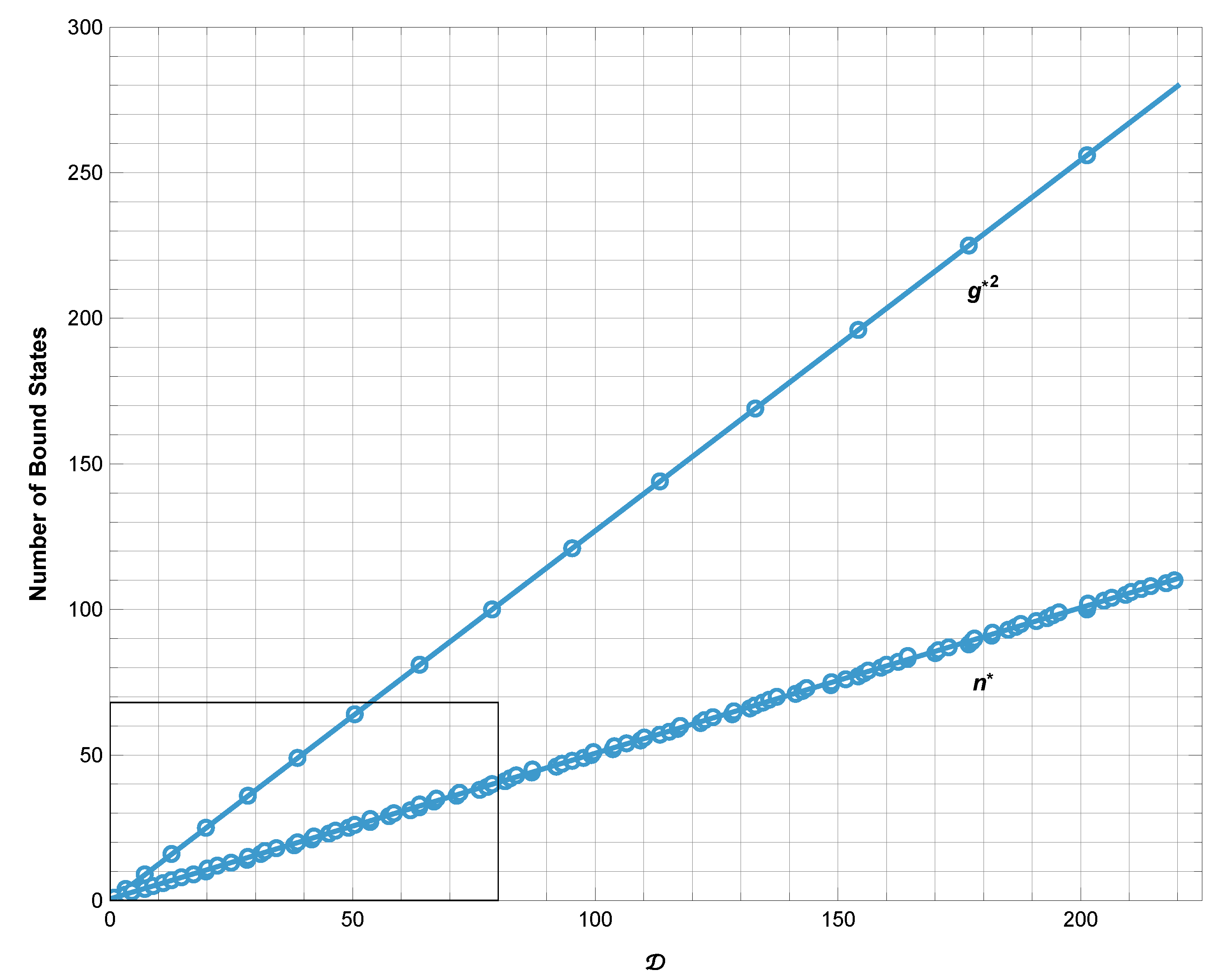
Figure 2.
Contour map of interpolated values of for the Yukawa Potential as a function of and n, for ranges . The nearly equally-spaced parallel contours show that is approximately a linear function of both l and n, but with unequal coefficients. Each contour is labeled with the value of .
Figure 2.
Contour map of interpolated values of for the Yukawa Potential as a function of and n, for ranges . The nearly equally-spaced parallel contours show that is approximately a linear function of both l and n, but with unequal coefficients. Each contour is labeled with the value of .
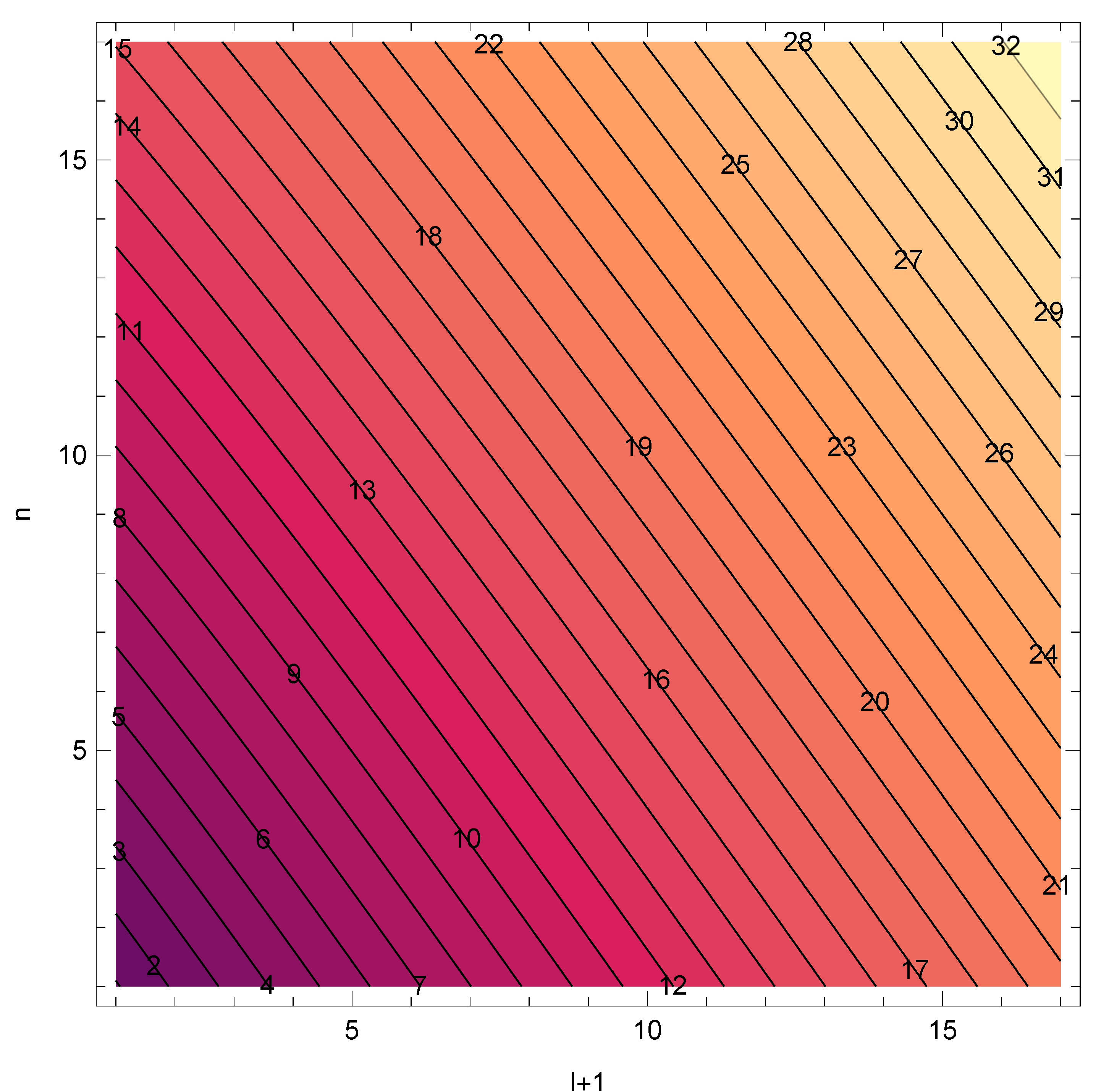
Figure 3.
Log-log Plots of vs n for ECSC, Yukawa, Hulthén, and Pseudo-Hulthén potentials vs n for all 21 values of l. The correct ordering of all n and l values is evident.
Figure 3.
Log-log Plots of vs n for ECSC, Yukawa, Hulthén, and Pseudo-Hulthén potentials vs n for all 21 values of l. The correct ordering of all n and l values is evident.
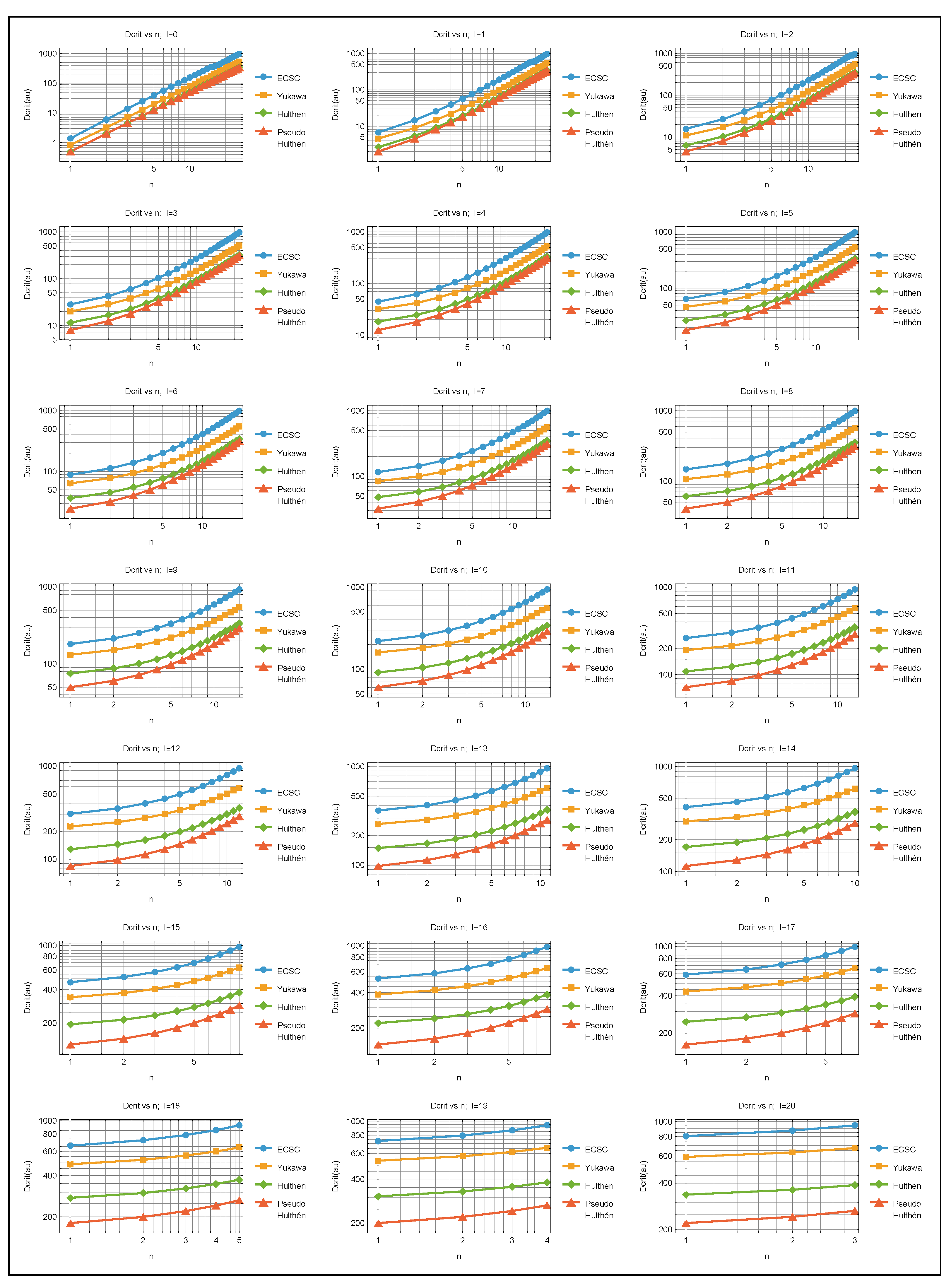
Figure 4.
vs for Yukawa potential up to au calculated to 30 digits.
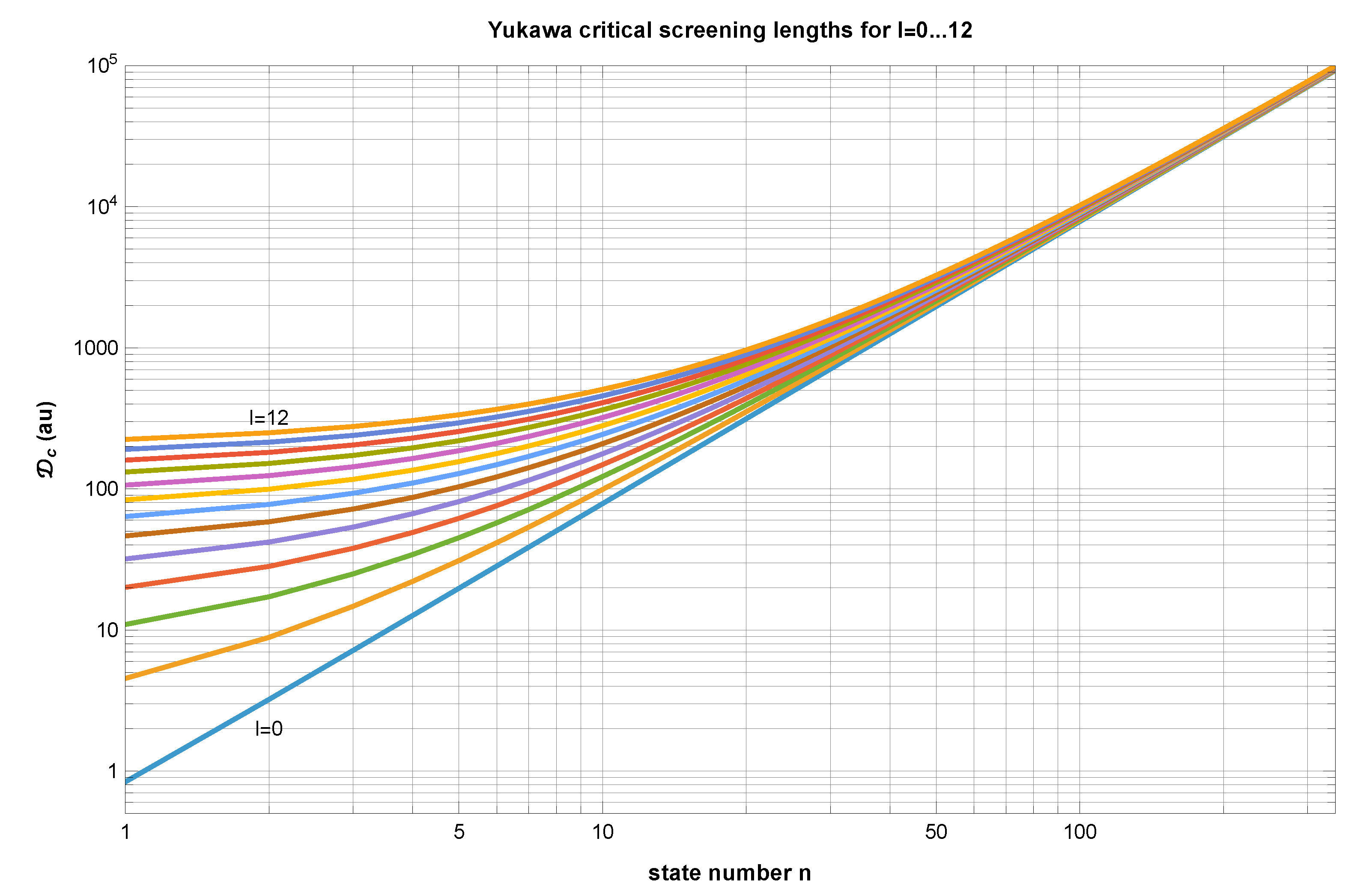
Figure 5.
vs for ECSC potential up to au calculated to 30 digits.
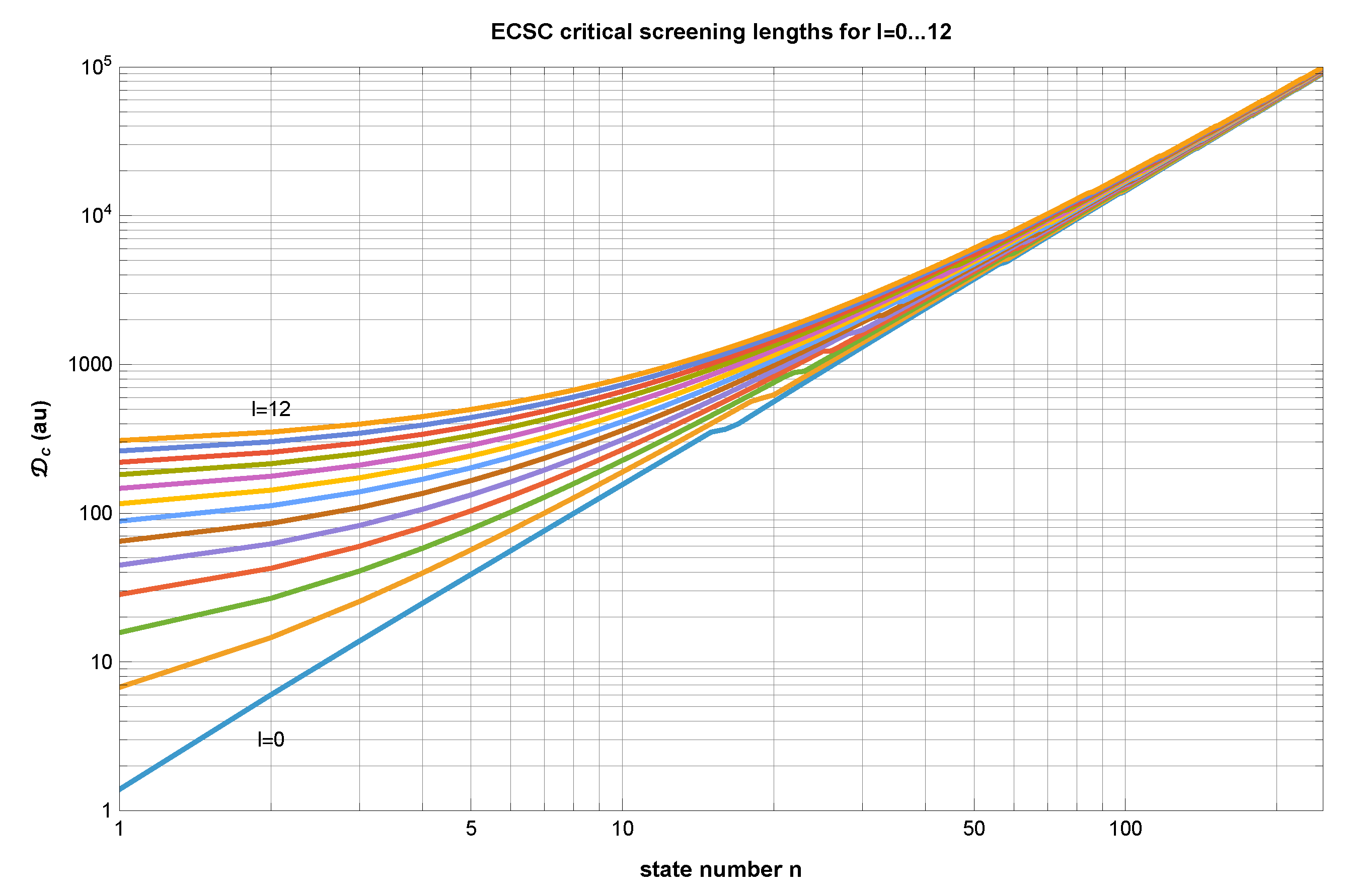
Figure 6.
vs for Yukawa potential up to au calculated to 30 digits.
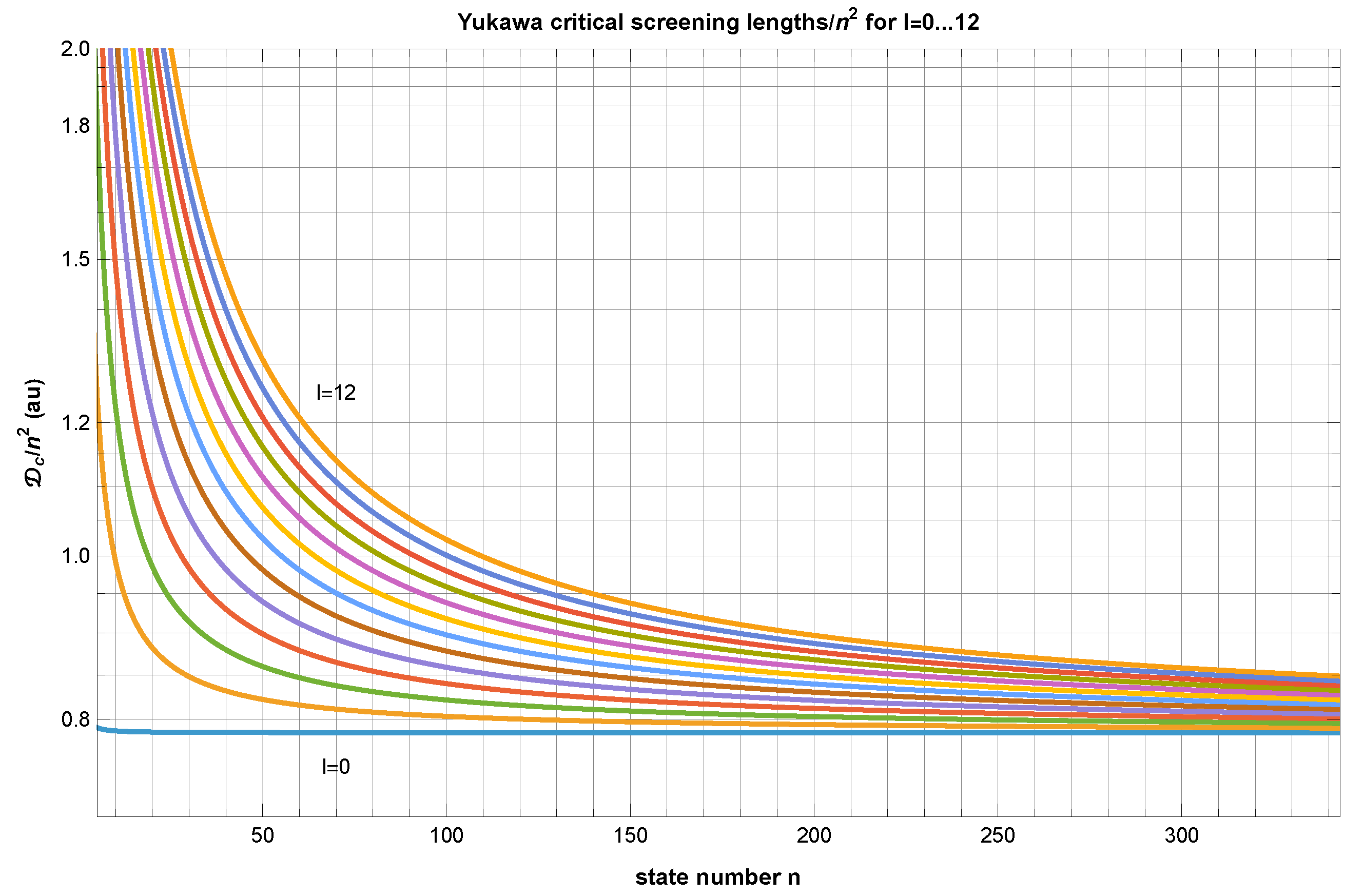
Figure 7.
vs for ECSC potential up to au calculated to 30 digits.
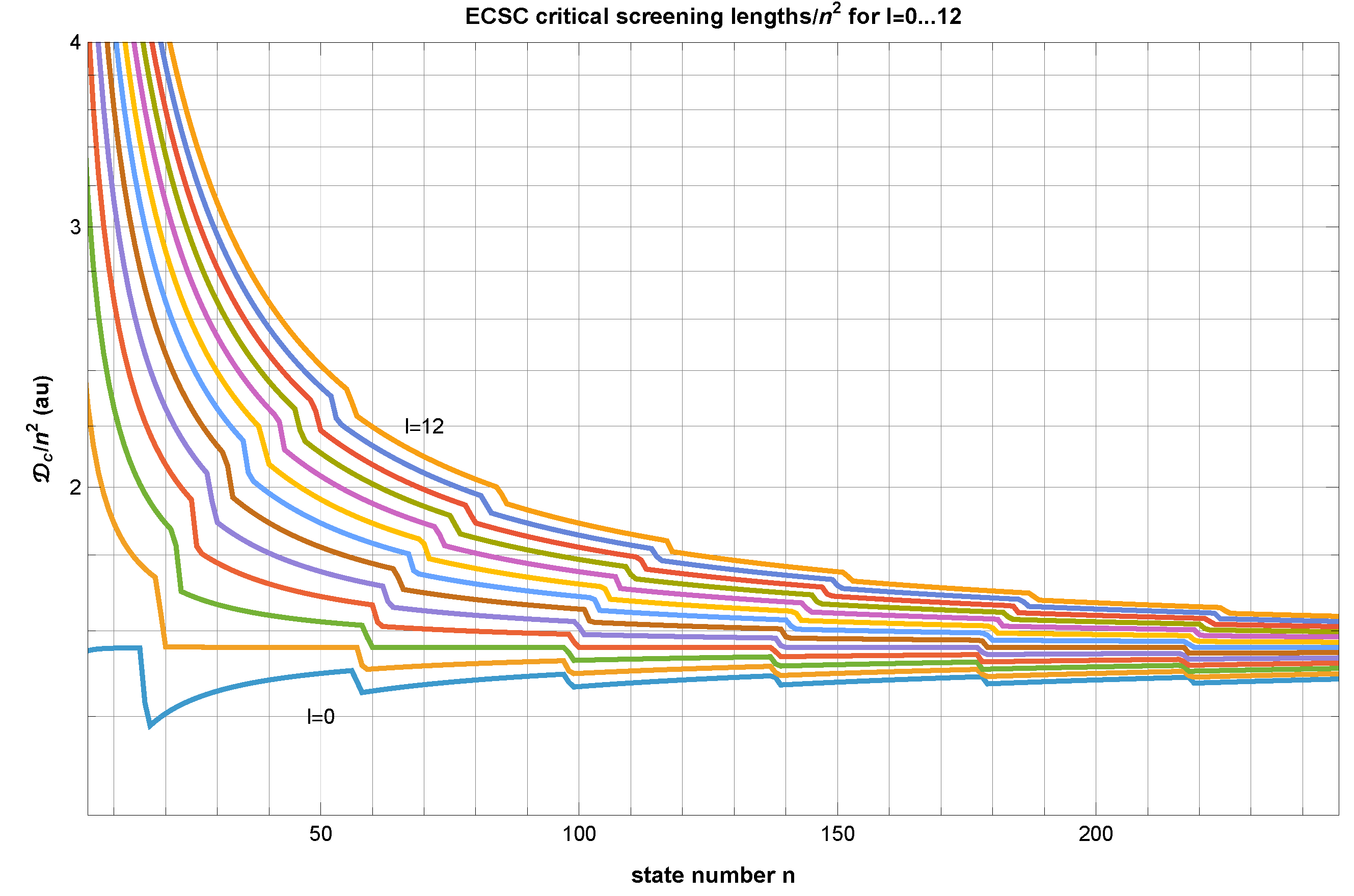
Disclaimer/Publisher’s Note: The statements, opinions and data contained in all publications are solely those of the individual author(s) and contributor(s) and not of MDPI and/or the editor(s). MDPI and/or the editor(s) disclaim responsibility for any injury to people or property resulting from any ideas, methods, instructions or products referred to in the content. |
© 2026 by the authors. Licensee MDPI, Basel, Switzerland. This article is an open access article distributed under the terms and conditions of the Creative Commons Attribution (CC BY) license (http://creativecommons.org/licenses/by/4.0/).
Copyright: This open access article is published under a Creative Commons CC BY 4.0 license, which permit the free download, distribution, and reuse, provided that the author and preprint are cited in any reuse.


