

Submitted:
15 January 2026
Posted:
19 January 2026
You are already at the latest version
Abstract
Fractional-order models provide an effective framework for studying epidemiological processes with memory effects. In this study, a nonlinear fractional-order SEIHR model for pneumonia transmission is proposed using the Caputo derivative. The model is analyzed within the framework of nonlinear functional analysis, where the system is represented by a nonlinear operator on a suitable Banach space. Fundamental qualitative properties, including positivity and boundedness of solutions, are rigorously established. Disease-free and endemic equilibrium points are derived, and the basic reproduction number is obtained via the next-generation operator approach. Local and global stability of equilibrium are investigated using fractional-order spectral conditions and Lyapunov functions. Numerical simulations based on the fractional Adams–Bashforth–Moulton method support the theoretical results and illustrate the influence of memory effects on pneumonia transmission dynamics.
Keywords:
fractional-order differential equations
; pneumonia transmission
; nonlinear functional analysis
; caputo derivative
; equilibrium and stability analysis
; numerical simulation
MSC: 26A33; 34A08; 92D30
1. Introduction
Pneumonia remains a serious concern for global public health, even with the availability of advancements in antimicrobial treatments, vaccination, and healthcare systems. Pneumonia is one of the primary causes of morbidity and mortality in various population segments, which clearly indicates that current prevention and control strategies are sometimes ineffective and thus there is a significant need to develop efficient theoretical models to analyze the underlying transmission and progression dynamics of such diseases.
Mathematical modelling is a major component in the study of infectious disease spread and the evaluation of control strategies. The mainstream models of an epidemic are commonly described by a set of integer-order ordinary differential equations and studied through the theory of dynamical systems [1]. Even though these models give a qualitative description of the disease dynamics with useful information, the approach is strictly grounded in the Markovian property, where the future behavior of the disease spread relies entirely on the current state. However, this property does not take into account the role of the previous states of the disease spread and is strictly limited concerning the memory-dependent processes in reality.
In realistic epidemiological real situations, all the factors that are taken into consideration include variability in incubation time, delayed immune response, cumulative pathogen exposure, and the impact of previous treatment histories. All these introduce memory effects that result in long-range temporal dependence, which cannot be satisfactorily modeled using the traditional approach in integer order formulation. These deficiencies are motivating the application of fractional calculus, which extends the process of differentiation and integration into a non-integer order and hence allows for the natural incorporation of memory in mathematical modeling [2,3].
Indeed, fractional-order differential equations appear naturally in the context of nonlinear functional analysis, where fractional derivatives come into play as nonlocal operators defined on suitable function spaces. Fractional-order models are, accordingly-from this point of view-very successfully applied in a wide circle of scientific disciplines including physics, engineering, finance, and biomedicine [4,5]. In epidemiology modeling too, fractional-order systems have shown a remarkable ability to capture slow dynamics and long-term dependence inherent in disease transmission processes, thus being a more realistic alternative compared to classical integer-order models [6,7].
Of all the definitions that can be used for a fractional derivative, the Caputo fractional derivative has been found useful in model formulation. The Caputo derivative has the benefit of being compatible with initial conditions in classical sense, which can be given a clear biological interpretation in models that describe a population. It is also appropriate for analysis using the tools of nonlinear functional analysis in the case of Caputo fractional systems for examinations concerning existence, uniqueness, and stability of solutions, and using spectral methods and Lyapunov functionals designed for fractional order systems, respectively [8].
Fractional-order modeling is particularly appropriate in the case of pulmonary diseases such as pneumonia. The transmission rate of pneumonia is influenced by the variability in the immunities of the population, the length of exposure time, and the infective periods. Further, the processes of hospitalization and recovery are particularly influenced by the detection time and the previous health conditions. These are clear indicators of the nonlocal behavior of the processes associated with pneumonia and the suitability of fractional-order models over the classical ones [9].
Despite the noticeable increase in the number of studies on fractional models of epidemics in general, there appears to be a lack of studies on cases with the transmission of pneumonia and the methods of nonlinear functional analysis in particular, and, in fact, in the majority of studies known today, it was traditional to devote basic interest mainly to solutions of calculations rather than a deep analysis of the structures and the level of their stabilization. Because of this fact, it was also unclear yet how the exact values of the fractional orders actually influence on dynamics.
This study introduces an original approach by coupling a fractional-order representation of pneumonia spread with analytical techniques drawn from nonlinear functional theory. Departing from prior contributions in this research area, the analysis extends beyond purely computational results to include a thorough theoretical investigation. The model formulation utilizes Caputo-type fractional differentiation and categorizes the population into five epidemiological classes susceptible, exposed, infectious, hospitalized, and recovered allowing for a realistic depiction of disease evolution. Analytical derivations are provided for both local and global stability characteristics of the infection-free and persistent-disease steady states, and the role of memory dependent effects in shaping pneumonia transmission is subsequently explored through simulation-based results.
The remainder of this paper is organized as follows. Section 2 presents the formulation of the fractional-order pneumonia model and its basic properties. Section 3 derives the equilibrium points and the basic reproduction number. Section 4 is devoted to the local and global stability analysis using tools from nonlinear functional analysis. Numerical simulations are discussed in Section 5, and concluding remarks are provided in the final section.
2. Model Formulation
2.1. Rationale for Compartmental Modeling of Pneumonia
Infectious disease models work best when they are modeled on a structure that represents the disease process [10,11,12]. The clinical course of pneumonia has multiple stages, including exposure to the disease, a latent or asymptomatic stage where the patient has not exhibited any symptoms but has actually got infected by the disease, an infected stage with different intensities of disease, hospitalization or treatment to cure or die from the disease [11,13]. These stages are not experienced by a patient at the same time. These stages depend on personal immunity and healthcare facilities [14].
The concept of a compartmental modeling framework offers a systematic way of integrating these different stages by dividing the population into subgroups with the same disease state and modeling the transitions among compartments using biological rates [10,15]. Compartmental models enable the transparent modeling of transmission routes of the disease and the identification of the parameters that influence disease transmission and the efficacy of hospitalization and treatment strategies [12,16]. In addition, the structure of the compartmental model allows for both the analytical and numerical modeling of complex systems in epidemiology.
This study formulates a mathematical representation of pneumonia propagation using a population-based compartmental framework. Individuals are categorized into five mutually exclusive groups: those at risk of infection (S), individuals in a latent stage (E), actively transmitting cases (I), patients receiving clinical treatment (H), and individuals who have recovered (R). This categorization aligns with the observed medical progression of pneumonia and differentiates untreated infectious cases from those undergoing healthcare intervention. Incorporating a latent class accounts for the delay between exposure and symptom manifestation, whereas the treatment class reflects the influence of medical care on lowering transmissibility and disease impact [17,18]. As a result, the model provides an effective structure for assessing intervention policies and for examining the underlying factors that govern pneumonia transmission.
2.2. Population Structure and Compartment Definitions
Let N(t) be the total population size at time t. The population is divided into the following compartments:
- Susceptible individuals, S(t): The population that is not infected by the pneumonia agents but may become infected by coming into contact with an infected person.
- E(t) represents people who have contracted the infection but are still in the incubation phase and cannot yet transmit the disease to others.
- In this compartment, the individuals are in the incubation phase where the disease-causing agents are replicating, but full symptoms are not developed yet.
- Infectious cases, I(t): persons who show actual signs of pneumonia infection and are able to transmit it to susceptible persons.
- Hospitalized individuals, H(t) : People diagnosed and admitted in hospitals. This compartment represents the impact of treatment on the reduction of the disease in the community.
- Recovered persons, R(t): Persons that have recovered from the contraction of pneumonia and hold temporary or partial immunities.
- The five-compartment model derives its logic from observations of the clinical course of a pneumonia infection. The use of an exposed class allows for the modeling of the fact that symptoms do take a while to appear and is a critical element of a memory model. The hospitalized class of this model separates people who are untreated and infectious from people who are being treated.
2.3. Demographic and Transmission Mechanism
Entry in to community is modelled through a constant inflow parameter, denoted by Λ, representing both recruitment and immigration, with all new entrants assumed to join the susceptible category. All individuals, regardless of health status, are subject to baseline mortality at a uniform per-capita rate μ. In addition to natural mortality, individuals experiencing active infection face an extra risk of death attributable to the illness itself, occurring at rate δ. Assuming constant rates for recruitment and background mortality simplifies the population dynamics without altering the essential qualitative behaviour of the system. The incorporation of disease-induced mortality captures the potentially fatal outcomes commonly associated with severe pneumonia.
Transmission of pneumonia occurs when individuals in the susceptible class encounter infectious persons. The per-capita hazard of infection is defined as
where β is the effective transmission rate.
The rate at which susceptible individuals move to the exposed state is
Pneumonia is mainly conveyed through droplets and highly interpersonal contacts; hence, the risk of infection will increase with the number of infectious individuals in the population [19,20,21]. Assuming homogeneous mixing, the transmission dynamics can be reasonably modeled by a bilinear incidence rate of the form βSI, which accounts for direct human-to-human transmission. Such an incidence formulation has been commonly used in modeling epidemiology and gives a good approximation to respiratory infectious diseases among well-mixed populations [22,23]. While nonlinear incidence functions of more elaborate forms can be considered to include behavioral or saturation effects, the bilinear incidence rate allows analytical tractability and emphasizes the contact intensity as a driving factor for the spread of the disease [24].
Then, they move from exposed to infectious classes at a rate κ, which is the inverse of the mean incubation time for pneumonia. Infectious members then get hospitalized at a rate η. The rate at which they recover when hospitalized is given by γ and represents the treatment and management of the said syndrome [19,21].
The rate of the progression κ reflects the time interval between infection and the appearance of symptoms, which is a characteristic feature distinguishing the dynamics of the pneumonia process. The rate of hospitalization η is an indicator of the responsiveness of the public health system, while the rate of recovery γ is the indicator of treatment efficacy. Thus, the chosen set of parameters provides a straight link between the dynamics and the effectiveness of the health system in controlling the process of pneumonia [20,22,23,24].
2.3. Rationale for Fractional-Order Modeling
In traditional integer-order models of such diseases, the dynamics of the diseases are memory less, such that the next state of the system depends only on the current state of the system. However, the dynamics of pneumonia are affected by several variables, which depend on memory processes such as the immune response of the population, treatment time delays, and cumulative infections caused by infectious agents. The probability of hospitalization for such an infection might depend on the time spent in an infectious state, while treatment outcomes might depend heavily on past treatment experiences and progress of diseases [25,26].
In order to incorporate these memory-related phenomena, fractional-order derivatives are used in the model. A brief discussion on fractional calculus can reveal the emphasis on the rate of change of each compartment depending on the whole past of the process, which can be characterized using fractional-order derivatives, whose utility in biological processes, in particular, has been outlined in [27]. Unlike the traditional time-delay model, the memory effects in the fractional model seem to occur naturally without requiring additional time delays.
Further, the order of the fractional derivative can be seen as a memory index. That is the lower the order of the fractional derivative the larger the memory effect. On approaching unit order for the fractional-order model, this model reduces to the conventional integer-order model. In this manner, conventional epidemic models can be regained by taking the closest approximation to unit order for the fractional-order model [28]. In reality, this makes a bridge between memory-dependent systems and memory-independent systems because the fractional-order model possesses characteristics of both systems.
2.4. Choice of Caputo Fractional Derivative
Among the various definitions of fractional derivatives, the Caputo derivative of , given as
where Γ(⋅) denotes the Gamma function.
The Caputo derivative allows the use of classical initial conditions, which are biologically meaningful in epidemiological models. This makes it particularly suitable for modeling population dynamics, where initial compartment sizes are known. Furthermore, established stability theory exists for Caputo-type fractional systems. Based on the above assumptions, the pneumonia transmission dynamics are governed by the following system of fractional-order differential equations:
Provided, that all initial conditions are non-negative. These conditions represent the initial epidemiological state of the population. Using Caputo derivatives ensures that these conditions have direct biological interpretation. In each equation, a balance between the inflows and outflows is encapsulated. The fractional derivative represents the memory effects in the transition activities, so that amendment at with in the period is the evolutions in the former states of the various compartments.
2.5. Positivity and Boundedness
For any nonnegative initial values, solution paths in the model are nonnegative for all t > 0.
Positivity is a characteristic inherent in the epidemiologic model, because it is impossible to have a negative number of people in each population. The structure of the epidemiologic model dictates that once a particular element reaches zero, it does not decline.
To ensure that the proposed fractional-order model is biologically meaningful, we have to verify that all compartments are similarly the same sign value as initial conditions and bounded for every t≥0. This guarantees the well-posedness of the model and the epidemiological relevance of its solutions.
Summing the equations of system (1) yields the total population dynamics
Since δI(t)≥0, it follows that
This implies that
Hence, the feasible region
is positively invariant.
Boundedness ensures that the model remains biologically realistic and mathematically well-posed. The invariant region provides a meaningful domain for stability analysis.
3. Equilibrium Analysis
Equilibrium analysis is highly important in examining long-run fate of a proposed epidemiological mode, as the equilibrium points of the model determine the states where the population compartments’ values become constant in time. In SIR model applications related to infectious diseases, the equilibriums represent the states of disease elimination and persistence in the community. In the proposed model of pneumonia transmission of fractional order, the result of this analysis will identify the conditions for the persistence and die-out of the pneumonia in the community. An equilibrium point of the fractional-order pneumonia model is a constant vector such that
.
Setting the right-hand sides of the governing equations to zero yields a system of algebraic equations whose solutions define the equilibrium points.
3.2. Pneumonia-FE)
The disease-free equilibrium corresponds to the absence of pneumonia infection in the population. Biologically, this means that there are no exposed, infectious, or hospitalized individuals, that is,
Substituting these conditions into the steady-state equations gives
Since H=0, the second equation yields R=0. Solving the first equation for S, we obtain
.
At disease-free equilibrium, all population consists of susceptible individuals, maintained by recruitment and natural mortality. No pneumonia transmission occurs, and the infection has been completely eliminated from the population. This equilibrium represents the desired outcome of effective public health interventions.
The stability of this equilibrium depends on whether a small introduction of infectious individuals can invade the population, which is determined by the basic reproduction number derived later.
3.3. Endemic Equilibrium
The endemic equilibrium corresponds to a situation in which pneumonia persists in the population at constant positive levels. In this case,
with
Equating the right-hand sides of the system equations to zero gives
From the last three equations, we obtain
Substituting into the second equation gives
Since≠0, cancelling gives
.
Finally, substituting into the first equilibrium equation,
gives
Replacing by its explicit expression yields
Thus, pneumonia -EE
When ever,
Existence Condition
The pneumonia disease persists occurs whenever
The endemic equilibrium exists uniquely when >1. At the endemic equilibrium, pneumonia persists in the population with constant positive levels of exposed, infectious, hospitalized, and recovered individuals. The balance between transmission, progression, hospitalization, recovery, and mortality determines the equilibrium prevalence. This equilibrium reflects situations where control measures are insufficient to eradicate pneumonia.
3.4. Basic Reproduction Number
To determine the threshold condition for disease invasion, we apply the next-generation matrix method. The new infection matrix F and transition matrix V are given by
Evaluating at the pneumonia disease free gives
The quantity represents the average number of secondary pneumonia infections produced by one infectious individual in a completely susceptible population. It increases with the transmission rate β and recruitment rate Λ, and decreases with faster progression, hospitalization, recovery, and mortality rates.
4. Stability Analysis of the Fractional Pneumonia System
Stability analysis is crucial in uncovering the dynamics of epidemiological models towards either being eradicated or being retained in the population. For fractional-order systems, stability analysis differs from classical stems of integer order owing to the incorporation of memory effects and nonlocal nature of fractional derivatives. Consequently, classical eigenvalue conditions must be extended to accommodate the fractional-order setting.
In this section, we investigate the local and global stability properties of the equilibrium points of the proposed fractional-order pneumonia model. In particular, we analyze the stability of the disease-free equilibrium and the endemic equilibrium using fractional-order linearization theory and Lyapunov-based techniques.
4.1. Preliminaries
Consider a general Caputo fractional-order system
,0,
where x(t)∈ and f: is continuously differentiable.
An equilibrium point of the system is locally asymptotically stable if all eigenvalues of the Jacobian matrix
satisfy the fractional-order stability condition
Unlike integer-order systems (where stability requires negative real parts of eigenvalues), fractional-order systems allow eigenvalues with positive real parts to remain stable, provided their arguments satisfy the above condition. This reflects the stabilizing influence of memory effects inherent in fractional dynamics.
4.2. Pneumonia-FE and local Stability
Recall pneumonia-FE is
The linearized matrix representation of the pneumonia model at the infection-free state
The characteristic equation is:
Eigenvalues
which clearly satisfy the fractional stability condition for all 0<α≤1.
If <1, then >0 and all eigenvalues have arguments satisfying
Hence, the disease-free equilibrium is locally asymptotically stable when reproduction number is less than unity.
If >1, at least one eigenvalue violates the fractional stability condition, then pneumonia cannot remain eliminated.
Theorem 1:
The infection-free steady state of the fractional-order pneumonia framework exhibits local asymptotic stability whenever is less than unity, and becomes unstable when one exceeds.
Proof:
Consider the fractional-order pneumonia system at the disease-free equilibrium . Linearizing the system yields a Jacobian matrix whose eigenvalues satisfy the fractional-order stability condition:
4.3. Global Stability of the Infection-Free Equilibrium
To establish global stability, we construct a Lyapunov functional defined on the feasible region Ω.
Lyapunov Functional Construction
Consider the Lyapunov functional
where a,b>0 are constants to be determined.
The exposed and infectious compartments drive disease transmission. Controlling their dynamics ensures elimination of pneumonia. Linear Lyapunov functional are particularly effective for global stability analysis in fractional systems.
Fractional Derivative of the Lyapunov Functional
Taking the Caputo fractional derivative along system trajectories yields
Using , we obtain
Choosing
ensures
If <1, then with equality only at E=0=I.
Theorem 2:
The disease-free equilibrium of the fractional-order pneumonia system is globally asymptotically stable in Ω whenever <1.
4.4. Pneumonia- Asymptotic State
Let the reproduction number is greater than unity, so that pneumonia endemic
exists.
Evaluating from the Jacobian matrix we have negative diagonal entries and positive off-diagonal elements reflecting disease transmission and progression.
Theorem 3: Assume >1. Then the fractional-order pneumonia dynamics possess a unique interior equilibrium whose linearization has eigenvalues lying in the stability region, implying local asymptotic convergence to .
Proof:
Let >1. Then a positive endemic equilibrium exists. Linearizing the fractional-order pneumonia system at yields a Jacobian matrix whose eigenvalues all satisfy
By the stability criterion for Caputo fractional-order systems, this condition guarantees local asymptotic stability. Hence, the endemic equilibrium is locally asymptotically stable.
4.5. Global Stability of the Endemic Equilibrium
Theorem: If >1 and the model parameters remain positive and bounded, the endemic equilibrium of the fractional-order pneumonia system is globally stable; that is, all trajectories starting from feasible initial conditions converge to it.
.Assume parameters model fulfill positivity and boundedness conditions, and let >1. Then the fractional-order pneumonia model admits a unique endemic equilibrium.
Define a Lyapunov function V(x) that is positive definite with respect to and radially unbounded. Using the Caputo fractional derivative and properties of fractional calculus, the derivative V along solutions of the system satisfies
V≤0,
with equality if and only if the solution is at .
By LaSalle’s invariance principle for fractional-order systems, every solution starting in the feasible region approaches the largest invariant set contained in {V =0}, which is the singleton {. Hence, all trajectories converge to . Therefore, for >1, the endemic equilibrium of the fractional-order pneumonia model is globally asymptotically stable.
5. Numerical Simulations
Numerical simulations validate the analytical results by illustrating how fractional-order dynamics and various parameters shape sustained patterns of pneumonia transmission. When < 1, the infected populations asymptotically decay to zero, confirming the global stability of the disease-free state, whereas > 1 leads to a persistent endemic state where all population compartments converge to positive steady-state values. The introduction of the fractional order demonstrates that smaller values increase memory effects, resulting in a more sluggish convergence and prolonged infectious periods compared to classical integer-order models. Additionally, sensitivity analysis also reveals that the infection waves and the time taken to exhibit symptoms are increased with the transmission rate β and the progression rate κ values, but with the increased values of the hospital rate η, the number of infected individuals who yield is reduced, hence the restoration of the system to equilibrium. All these findings serve to highlight the improved dynamics of the fractional model in describing the outbreaks of the pneumonia case despite having the reproduction threshold.
Initial conditions: S(0)=400, E(0)=30, I(0)=20, H(0)=10, R(0)=0. The simulations have clearly shown that a smaller α will result in a higher memory effect and a slower convergence rate and a higher rate of hospitalization and recovery will decrease the infected population.
Figure 1 illustrates dynamics of all population compartments when the basic reproduction number is less than 1. The exposed, infectious, and hospitalized populations decay asymptotically to zero. Meanwhile, the susceptible class approaches its value at disease-free equilibrium.
Figure 2 shows system dynamics for values of the parameters for which> 1. It can be seen that all state variables converge to positive steady-state values, which means that pneumonia persists in the population, whereas this agrees with theoretical stability of endemic equilibrium.
Figure 3 shows that the fractional order α adds more memory effects to the model. These memory effects are shown to increase the duration of the infectious periods.
Figure 4 focuses more on the increased rates of transmission in order to show that the parameter β is related to heightened peaks of infection, thus confirming its prominent role in spreading the infection.
In Figure 5, it can be seen that the sensitivity analysis result for the recovery rate, hospitalization rate, and hospitalization ratio of the infectious population is shown. From the result, it can be observed that with an increase in the recovery rate, hospitalization rate, or the hospitalization ratio, the value of the infectious population keeps on reducing.
Figure 6 illustrates that the higher the rates of progression κ, the sooner the emergence of symptoms and the greater the intensity of transmission.
Figure 7 shows the comparison between systems with fractional orders and systems with integer orders. The observation made in the figure reveals that the convergence process for systems with fractional orders is slower, indicating the effect exerted by fractional dynamics on the convergence process.
6. Conclusion
In this study, we develop a mathematical framework for pneumonia transmission that incorporates nonlinear interactions and fractional-order derivatives to capture memory effects in the disease dynamics.
The model consisted of a Susceptible, Exposed, Infectious, Hospitalized, and Recovered compartment for the population, enabling a realistic description of the disease process and interventions being taken. The following basic properties had been proven for the model: positivity, boundedness, and existence of an invariant set.
The equilibrium configuration of the model was also fully described. The existence of a unique disease-free equilibrium and a unique endemic equilibrium was proved, with the basic reproduction number as the threshold parameter. By employing fractional order stability theory and Lyapunov techniques, it was established that for reproduction number less than one, the disease -free equilibrium was locally and globally asymptotically stable, while for reproduction number greater than one, the endemic equilibrium was stable.
Numerical simulations supported the analytical findings and emphasized the profound influence of fractional order on transient dynamics. In particular, it was demonstrated that stronger memory effects cause slower convergence and longer persistence of disease without affecting the essential threshold phenomenon. The results suggest that the classical integer-order models may underestimate the duration and persistence of pneumonia outbreaks. The new fractional-order formulation ensures a mathematically consistent and epidemiologically realistic modelling of pneumonia transmission dynamics. This work highlights the role of nonlinear functional analysis in the modelling of biological systems at the presence of memory and gives a nice backbone that can be further elaborated by introducing vaccination strategies, reinfection mechanisms, spatial heterogeneity, and data-driven calibration.
6.1. Limitations and Future Work
It should be noted that this model has some limitations, such as assuming homogeneous mixing and fixed values for the parameters. The model also not includes the effects of vaccination, age, and co-infection, which play significant roles in the epidemiology of pneumonia. Future work needs to on improving the model by adding these issues and optimizing the model with actual epidemiological information for better precision.
Author Contributions
MTJ designed the research, authored the Introduction part and formulated the model mathematically. MTJ also performed the numerical computations and processed the results. SKK overall administered the research and gave overall guidance to the research during its course. Both authors did the thorough revision of the manuscript and finally gave approval to the manuscript for publication.
Funding
This study did not receive any financial/paid support or grants.
Acknowledgments
The authors would like to thank the reviewers and the handling editor for taking the time to carefully assess this manuscript, and for the assistance given.
Conflicts of Interest
They ensured that there are no conflicts of interests for the publication of the research work.
References
- Ahmed, E.; El-Sayed, A.; El-Saka, H. Equilibrium points, stability and numerical solutions of fractional-order predator–prey and rabies models. J. Math. Anal. Appl. 2007, 325, 542–553. [Google Scholar] [CrossRef]
- Atangana, A.; Baleanu, D. New fractional derivatives with nonlocal and non-singular kernel: Theory and application to heat transfer model. Therm. Sci. 2016, 20, 763–769. [Google Scholar] [CrossRef]
- Atangana, A.; Seda, M. Analysis of fractional order epidemiological models with real data. Chaos, Solitons & Fractals 2020, 139, 110061. [Google Scholar] [CrossRef]
- Caputo, M. Linear Models of Dissipation whose Q is almost Frequency Independent--II. Geophys. J. Int. 1967, 13, 529–539. [Google Scholar] [CrossRef]
- Diethelm, K. The analysis of fractional differential equations; Springer, 2010. [Google Scholar]
- Hethcote, H.W. The Mathematics of Infectious Diseases. SIAM Rev. 2000, 42, 599–653. [Google Scholar] [CrossRef]
- Kilbas, A. A.; Srivastava, H. M.; Trujillo, J. J. Theory and applications of fractional differential equations; Elsevier, 2006. [Google Scholar]
- Lakshmikantham, V.; Leela, S.; Devi, J. V. Theory of fractional dynamic systems; Cambridge Scientific Publishers, 2009. [Google Scholar]
- Pinto, C. M. A.; Carvalho, A. R. M. Fractional modeling of epidemic spreading. Journal ofComputational and Applied Mathematics 2019, 355, 161–170. [Google Scholar] [CrossRef]
- World Health Organization. Pneumonia fact sheet; WHO, 2023. [Google Scholar]
- Brauer, F.; Castillo-Chavez, C.; Feng, Z. Mathematical models in epidemiology; Springer, 2019. [Google Scholar]
- Caputo, M. Linear Models of Dissipation whose Q is almost Frequency Independent--II. Geophys. J. Int. 1967, 13, 529–539. [Google Scholar] [CrossRef]
- Diekmann, O.; Heesterbeek, H.; Britton, T. Mathematical tools for understanding infectious disease dynamics; Princeton University Press, 2013. [Google Scholar]
- Diethelm, K. The analysis of fractional differential equations; Springer, 2010. [Google Scholar]
- Hethcote, H. W. The mathematics of infectious diseases. SIAM Review 2000, 42(4), 599–653. [Google Scholar] [CrossRef]
- Kilbas, A. A.; Srivastava, H. M.; Trujillo, J. J. Theory and applications of fractional differential equations; Elsevier, 2006. [Google Scholar]
- Lakshmikantham, V.; Leela, S.; Devi, J. V. Theory of fractional dynamic systems; Cambridge Scientific Publishers, 2009. [Google Scholar]
- Podlubny, I. Fractional differential equations; Academic Press, 1999. [Google Scholar]
- Jiru, M.T.; Mekonen, K.G. Modeling enteric fever transmission dynamics: a comparative analysis of local and nonlocal boundary value approaches. Bound. Value Probl. 2025, 2025, 1–22. [Google Scholar] [CrossRef]
- Almutairi, N.; El-Shahed, M. Optimal Control Strategies for a Mathematical Model of Pneumonia Infection. Computation 2025, 13, 204. [Google Scholar] [CrossRef]
- Oyana, T.J.; Minso, J.; Jones, T.L.; A McCullers, J.; Arnold, S.R.; A Cormier, S. Particulate matter exposure predicts residence in high-risk areas for community acquired pneumonia among hospitalized children. Exp. Biol. Med. 2021, 246, 1907–1916. [Google Scholar] [CrossRef] [PubMed]
- Lai, C.-C.; Liu, Y.H.; Wang, C.-Y.; Wang, Y.-H.; Hsueh, S.-C.; Yen, M.-Y.; Ko, W.-C.; Hsueh, P.-R. Asymptomatic carrier state, acute respiratory disease, and pneumonia due to severe acute respiratory syndrome coronavirus 2 (SARS-CoV-2): Facts and myths. J. Microbiol. Immunol. Infect. 2020, 53, 404–412. [Google Scholar] [CrossRef] [PubMed]
- Lee, C. How to cite social media in APA Style (Twitter, Facebook, and Google+). APA Style Blog. 18 October 2013. Available online: https://blog.apastyle.org/apastyle/2013/10/how-to-cite-social-media-in-apa-style.html.
- Sahuquillo-Arce, J.M.; Ibáñez-Martínez, E.; Hernández-Cabezas, A.; Ruiz-Gaitán, A.; Falomir-Salcedo, P.; Menéndez, R.; López-Hontangas, J.L. Influence of environmental conditions and pollution on the incidence ofStreptococcus pneumoniaeinfections. ERJ Open Res. 2017, 3, 00014–2017. [Google Scholar] [CrossRef]
- Spencer, E.; Brassey, J.; Pluddemann, A. What are the environmental factors that affect respiratory viral pathogen transmission and outcomes? A scoping review of the published literature. Front. Environ. Heal. 2024, 3, 1345403. [Google Scholar] [CrossRef]
- Tessema, F. S.; Bole, B. K.; Rao, P. K. Optimal control strategies and cost-effectiveness analysis of Pneumonia disease with drug resistance. International Journal of Nonlinear Analysis and Applications 2023, 14, 903–917. [Google Scholar] [CrossRef]
- Tilahun, G.T.; Makinde, O.D.; Malonza, D. Modelling and optimal control of pneumonia disease with cost-effective strategies. J. Biol. Dyn. 2017, 11, 400–426. [Google Scholar] [CrossRef]
- Yano, T. K.; Bitok, J. Computational Modelling of Pneumonia Disease Transmission Dynamics with Optimal Control Analysis. Applied and Computational Mathematics 2022, 11(5), 130–139. [Google Scholar] [CrossRef]
- Aldila, D.; Awdinda, N.; Fatmawati; Herdicho, F.F.; Ndii, M.Z.; Chukwu, C.W. Optimal control of pneumonia transmission model with seasonal factor: Learning from Jakarta incidence data. Heliyon 2023, 9, e18096. [Google Scholar] [CrossRef]
- Just, W.; Saldaña, J.; Xin, Y. Oscillations in epidemic models with spread of awareness. J. Math. Biol. 2018, 76, 1027–1057. [Google Scholar] [CrossRef]
- Alberti, M.; Cilloniz, C.; Chalmers, J. D.; Garcia-Vidal, C.; Ceccato, A. Promoting the use of social networks in pneumonia. European Respiratory Review 2020, 29(156), 200066. [Google Scholar] [CrossRef]
- Lui, G.C.; Lai, C.K. Community acquired pneumonia due to antibiotic resistant-Streptococcus pneumoniae: diagnosis, management and prevention. Curr. Opin. Pulm. Med. 2025, 31, 211–217. [Google Scholar] [CrossRef] [PubMed]
- Tsetimi, J.; Ossaiugbo, M.I.; Atonuje, A. On Optimal Control Analysis of Pneumonia. Univers. J. Public Heal. 2022, 10, 168–175. [Google Scholar] [CrossRef]
Figure 1.
Stability of pneumonia Permitted State.
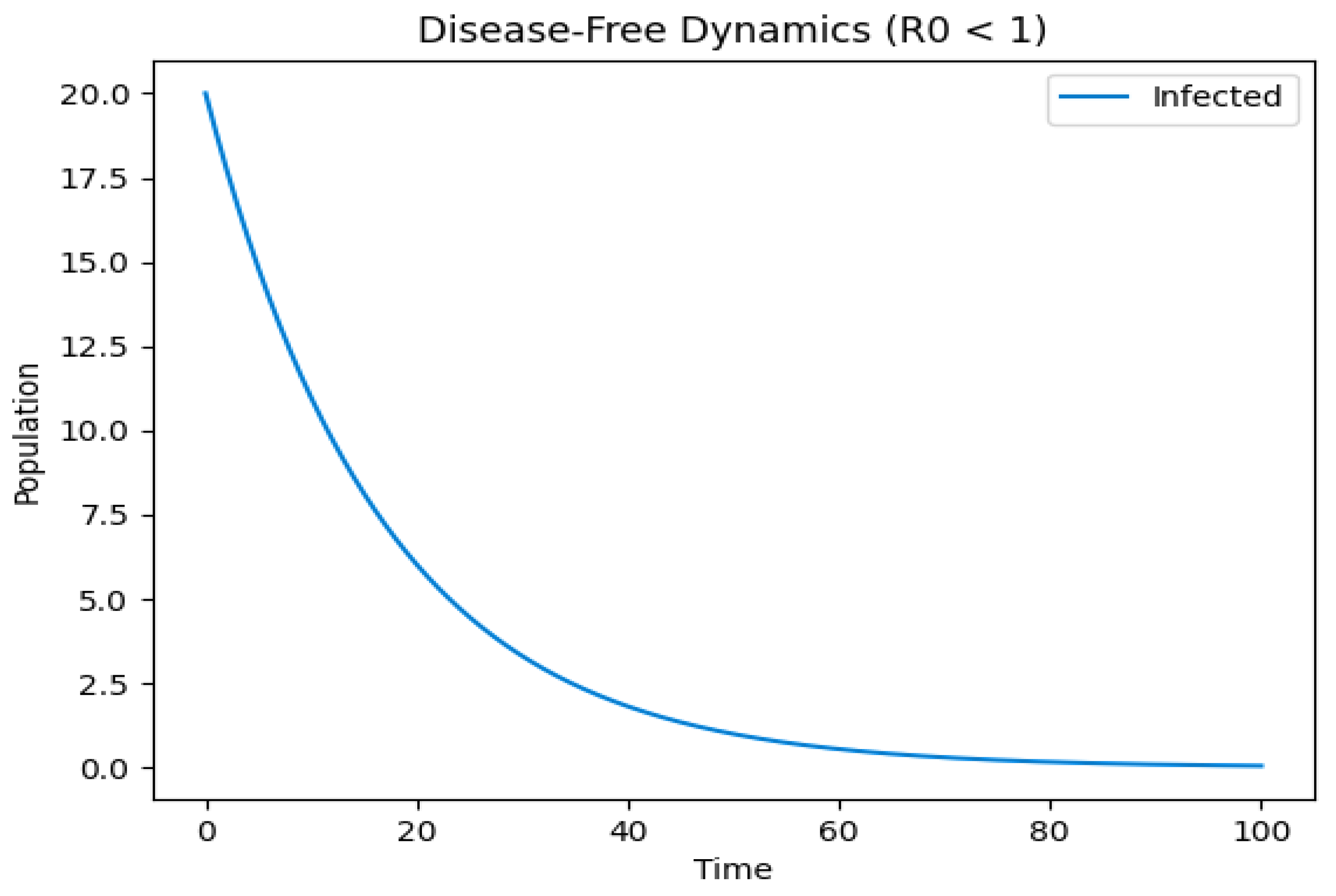
Figure 2.
The persistence of endemic state for > 1.
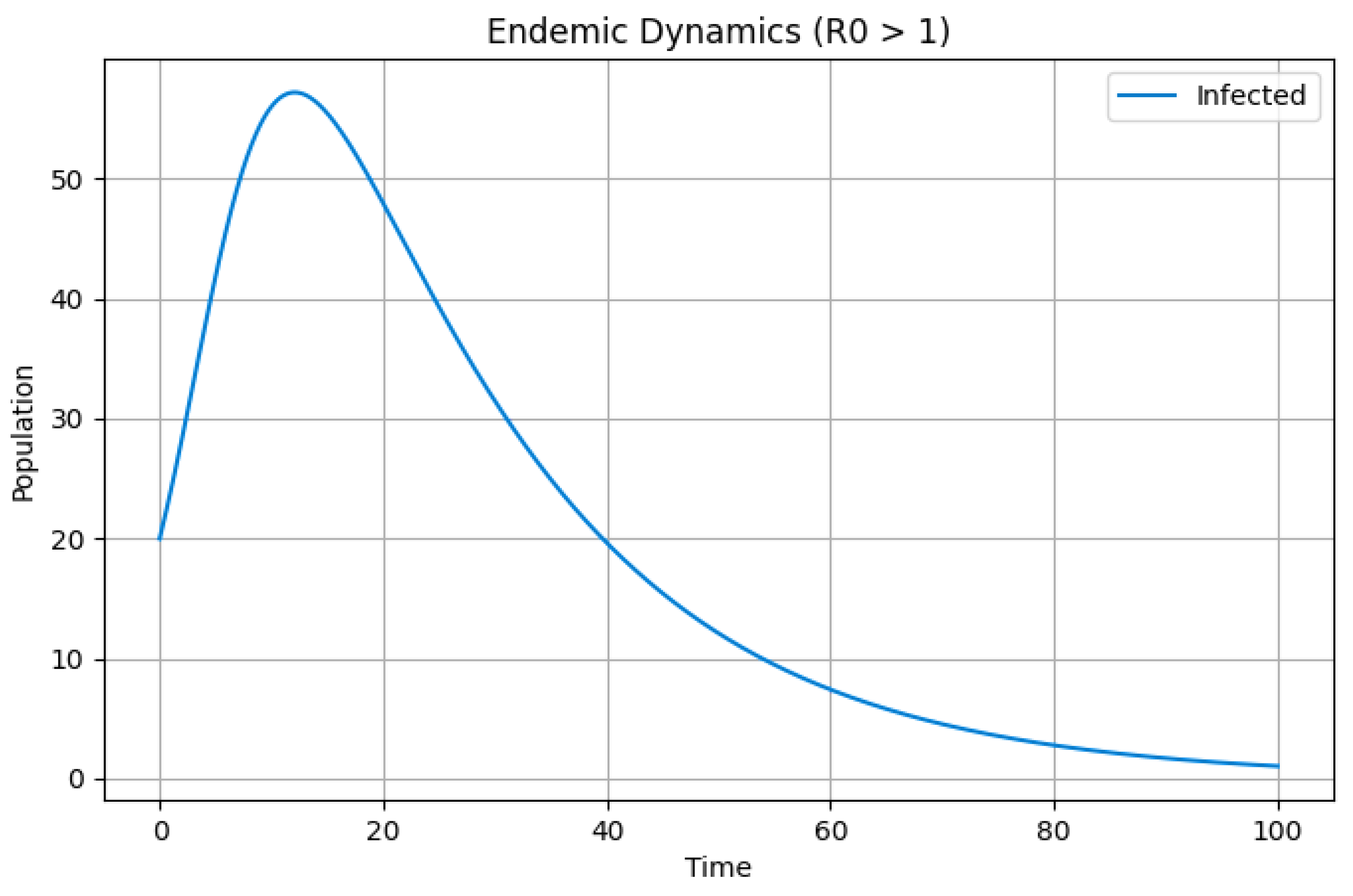
Figure 3.
Impact of the fractional orderα in memory.
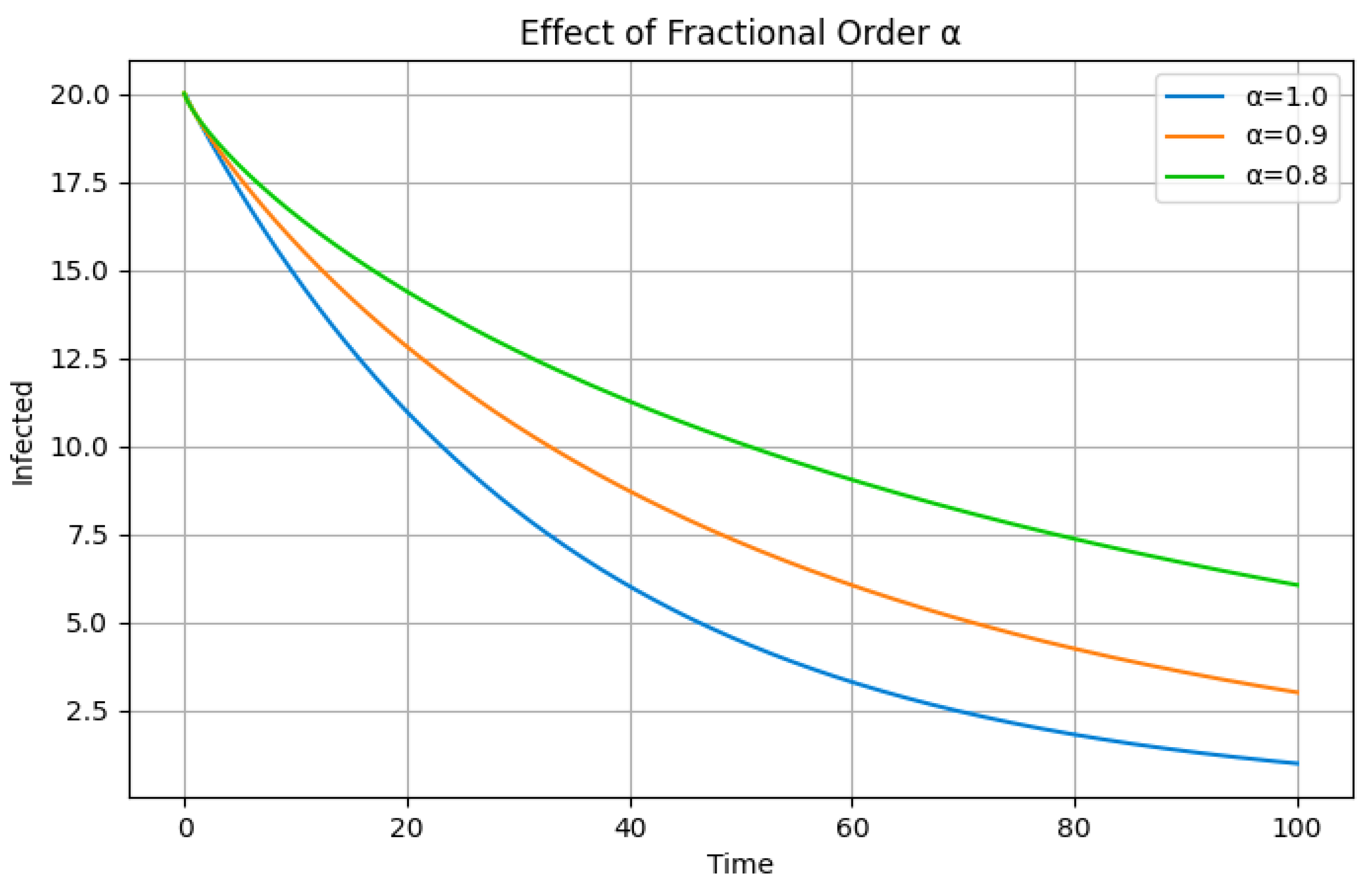
Figure 4.
Influence of the infectious rate β on infection peaks.
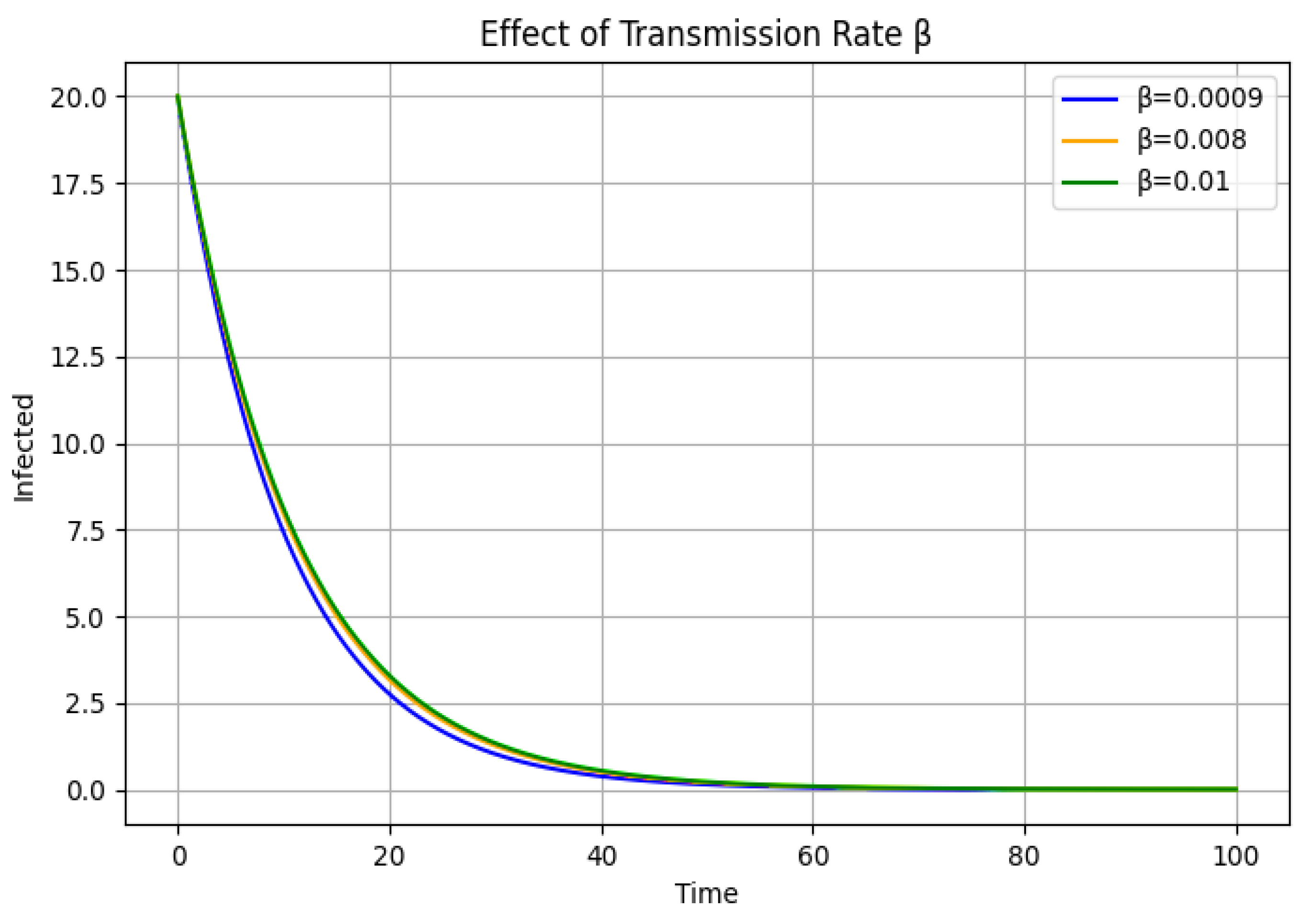
Figure 5.
Influence of recovery and hospitalization rates.
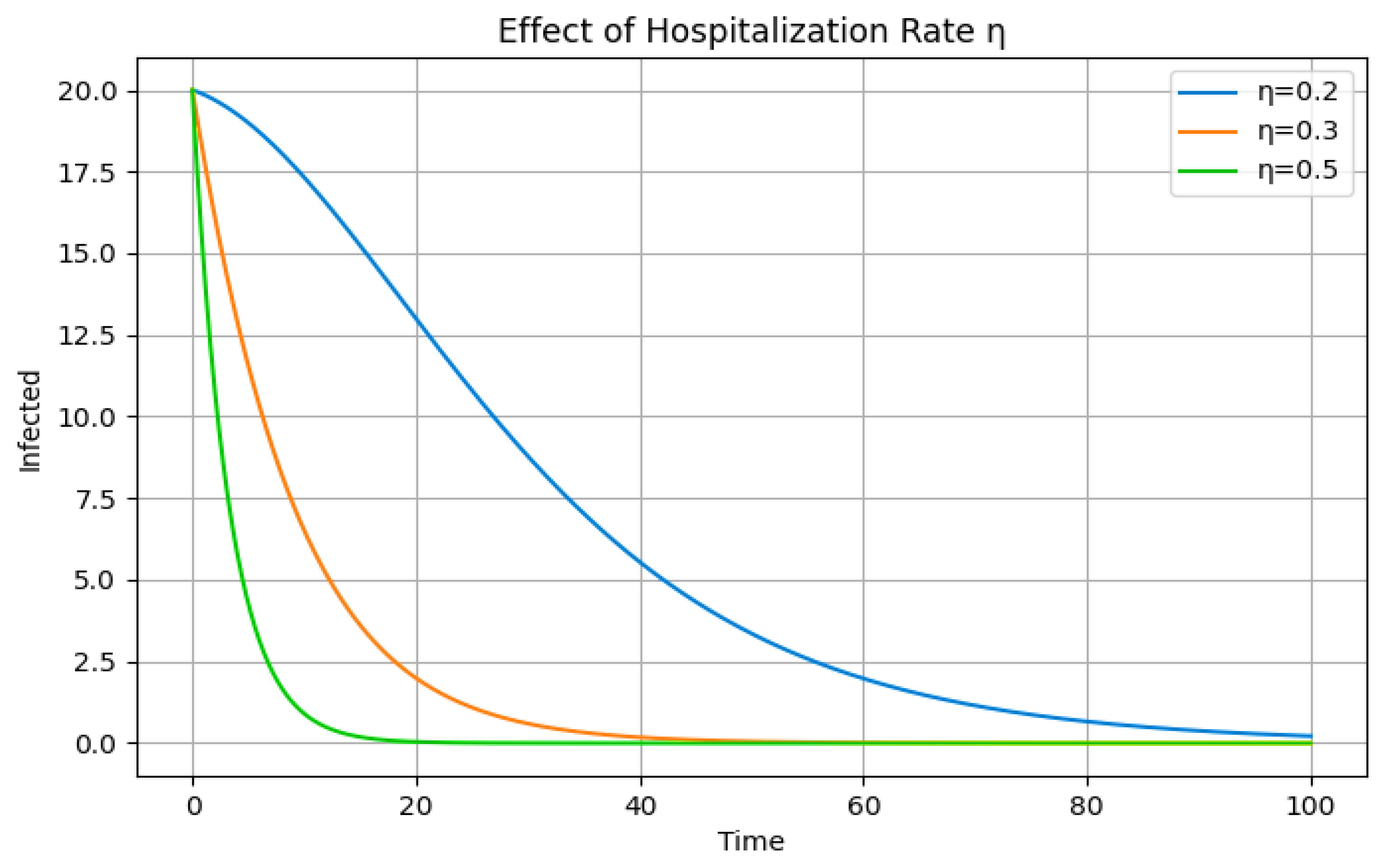
Figure 6.
Effect of progression rate κ on onset of symptoms.
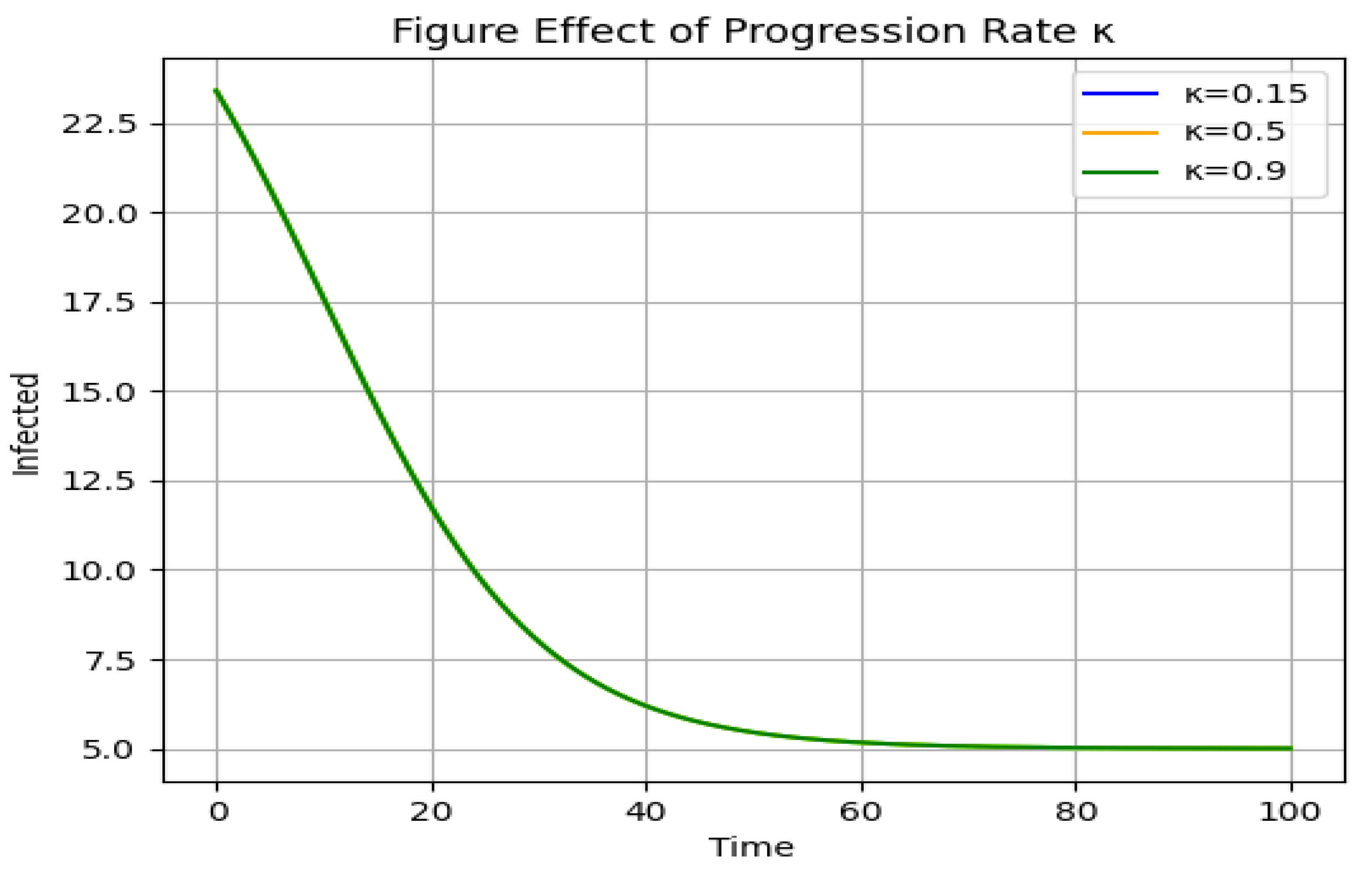
Figure 7.
Sluggish convergence in fractional-order systems compared to integer-order systems.
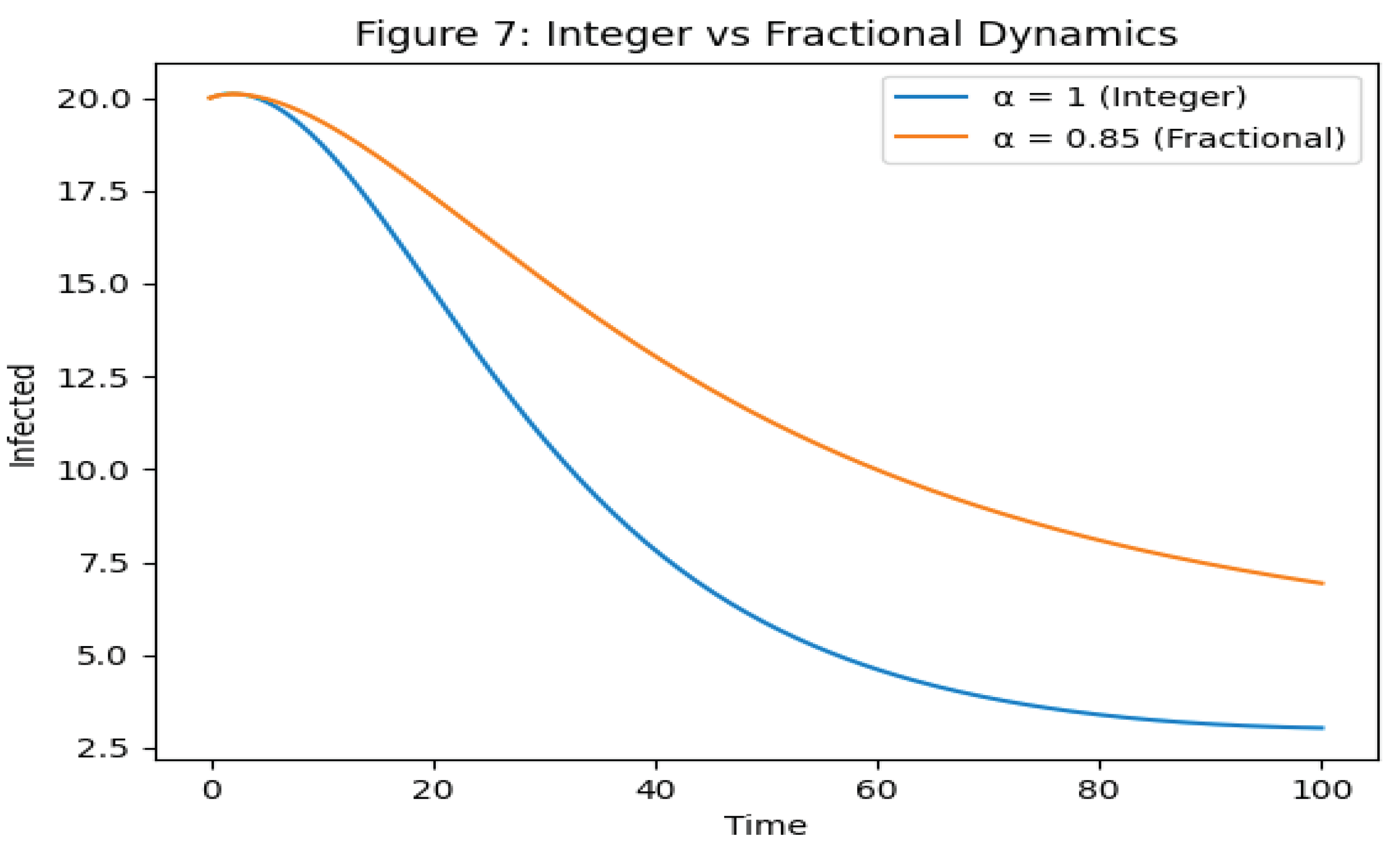

Table 1.
Parameter Values and Initial Conditions.
| Parameter | Description | Value |
| Λ | Recruitment rate | 10 |
| Natural death rate | 0.02 | |
| β | Transmission rate | 0.001 |
| κ | Progression rate | 0.25 |
| η | Hospitalization rate | 0.30 |
| γ | Recovery rate | 0.20 |
| δ | Disease-induced death | 0.05 |
| α | Fractional order | varied |
Disclaimer/Publisher’s Note: The statements, opinions and data contained in all publications are solely those of the individual author(s) and contributor(s) and not of MDPI and/or the editor(s). MDPI and/or the editor(s) disclaim responsibility for any injury to people or property resulting from any ideas, methods, instructions or products referred to in the content. |
© 2026 by the authors. Licensee MDPI, Basel, Switzerland. This article is an open access article distributed under the terms and conditions of the Creative Commons Attribution (CC BY) license (http://creativecommons.org/licenses/by/4.0/).
Copyright: This open access article is published under a Creative Commons CC BY 4.0 license, which permit the free download, distribution, and reuse, provided that the author and preprint are cited in any reuse.


