

Submitted:
14 January 2026
Posted:
15 January 2026
You are already at the latest version
Abstract
The article presents a comprehensive assessment of climate change in the Fergana region and its influence on the development and transformation of natural landscapes within global environmental systems. Based on meteorological data from 2001 to 2024, trends in air temperature and precipitation were analyzed. The results indicate a gradual increase in mean annual temperature and a decrease in precipitation, reflecting the intensification of aridization processes. Using geoinformation systems and remote sensing data, NDVI-based vegetation dynamics were mapped to evaluate spatial landscape variability. The study identifies the most climate-sensitive areas experiencing soil degradation and structural changes in ecosystems. These findings provide a scientific foundation for developing eco-reclamation strategies and agricultural adaptation measures to mitigate the impacts of regional climate change, contributing valuable insights to global environmental change research.
Keywords:
climate change
; Fergana region
; agricultural landscapes
; soil salinization
; GIS analysis
; Central Asia
; adaptation strategies
; global environmental systems
; water resources
; land management
1. Introduction
Climate change has emerged as one of the most pressing challenges within global environmental systems, significantly affecting natural landscapes, water resources, and agricultural productivity across Central Asia and worldwide. The Fergana region, located in the eastern part of Uzbekistan, is characterized by a dense population and intensive land use, making it particularly vulnerable to temperature and precipitation variability. As part of the larger Central Asian arid zone, the Fergana Valley serves as a critical case study for understanding regional manifestations of global climate patterns.
Numerous studies conducted in Central Asia [1,2] indicate that an average temperature increase of 0.3–0.5 °C per decade, accompanied by decreasing precipitation, has accelerated land degradation, soil salinization, and the decline of agroecosystem productivity. However, within the Fergana Valley, these processes have not been comprehensively investigated, particularly regarding their spatiotemporal dynamics and their impact on landscape-reclamation conditions within the context of global environmental changes. The relevance of this research lies in the need for a quantitative assessment of climate change and its effects on the agricultural landscapes of the Fergana region to support the development of adaptive and sustainable land management strategies that can inform similar challenges globally.
The objective of the study is to analyze the long-term trends in climatic parameters (temperature and precipitation) in the Fergana region over the past two decades and to evaluate their influence on the structural and functional characteristics of the region’s agricultural landscapes, thereby contributing to broader understanding of climate-landscape interactions in global environmental systems.
2. Literature Review
Numerous studies have been conducted on the landscapes of the Fergana Valley and their significance in the national economy. In particular, domestic researchers such as Karovin Rozanov [3], Chetirkin [4], Murzayev [5], Richter [6], Babushkin Kogay [7], Abdulqosimov [8], Abdulqosimov [9], Matikeyev [10], Sultonov [11], Kholiqov [12], Makhsudov [13], Akhmadaliev [14], Akhmadaliev [15], Boimirzaev [16], Boimirzaev [17], Qoziboeva [18], Qoziboeva [19], Muminov [20], and Abduganiyev [21] have made significant contributions to the study of the natural characteristics of Fergana region, the formation and spatial distribution of its landscapes, and the prospects for their rational use in agriculture.
In addition to local scholars, a number of foreign researchers have also examined the ecological and geomorphological development of Central Asian landscapes. For instance, Huntington [22] and Gerasimov [23] provided early insights into the climatic influences on the evolution of the Fergana basin, while Kleopov [24] and Tricart [25] analyzed the principles of landscape differentiation and anthropogenic transformation. More recent works by Turner et al. [26], Forman [27], and Sanderson et al. [28] have emphasized the importance of landscape structure and function in sustainable land management and regional planning.
Global environmental change research has increasingly focused on arid and semi-arid regions, with studies by IPCC [31], UN Water [32], and FAO [33] highlighting the interconnectedness of regional climate changes with global environmental systems. These works provide important context for understanding the broader implications of climate change in the Fergana region.
Collectively, these studies have laid the foundation for understanding the spatial organization, ecological balance, and agricultural potential of the Fergana Valley’s natural complexes. However, despite the extensive research, comprehensive geoecological and eco-meliorative assessments of the region’s landscapes under modern climatic conditions within global environmental systems remain insufficiently addressed.
3. Research Methodology
The study was conducted in the Fergana region of Uzbekistan, which encompasses foothill, valley, and plain landscapes characterized by diverse natural and climatic conditions. The primary data sources included meteorological observations from the Fergana meteorological station covering the period 2001–2024, specifically average air temperature and annual precipitation.
Additional datasets were obtained from the Hydrometeorological Service of Uzbekistan, the regional Department of Agriculture, and satellite imagery from remote sensing platforms such as MODIS, Landsat 8, and Sentinel-2. Based on these data, climate parameter dynamics were analyzed using statistical and correlation-based methods consistent with approaches used in global environmental change research.
Trends in temperature and precipitation were identified through linear regression analysis, with determination coefficients (R²) used to evaluate the strength of relationships. Spatial analysis and cartographic modeling were performed using ArcGIS Pro 10.8. Within the study area, three main landscape-ecological zones were delineated: foothill, valley, and desert-plain. For each zone, the impacts of climate change on landscape-reclamation conditions were assessed, focusing on soil salinization, land degradation, and the productivity of agricultural lands, following methodologies established in global soil and water management research [34].
The research design incorporates both quantitative and qualitative approaches, combining statistical analysis of climate data with field observations and spatial mapping, providing a comprehensive assessment framework applicable to similar regions within global environmental systems.
4. Analysis and Results
The Fergana Valley plays a strategically important role in agricultural production and the economic structure not only of the region but also of the entire Republic of Uzbekistan. The land resources of the Fergana region include foothill and desert areas, reflecting diverse natural and agroecological conditions. The total area of the region amounts to 6.76 million hectares, of which 280 thousand hectares are irrigated lands. Approximately 320 thousand hectares are occupied by foothill and other agricultural lands, including 100 thousand hectares of cotton, 90 thousand hectares of wheat, 40 thousand hectares of vegetable and fruit crops, and 150 thousand hectares of pastures.
According to regional agricultural statistics, the average cotton yield in 2019 was 34–35 quintals per hectare (3.4–3.5 tons/ha). In 2022, cotton was cultivated on 82.08 thousand hectares, producing a total of 320–328 thousand tons, with an average yield of 40 quintals per hectare.
Field research confirms that the Fergana region has favorable soil and climatic conditions for improving the landscape-reclamation state of agricultural lands and achieving higher productivity. It is essential to consider natural landscape characteristics and introduce modern technologies, including advanced agro-technical, agrochemical, and reclamation measures. In the southern foothill areas, groundwater lies deep below the surface, and soils are mainly stony gray types covered by ephemeral and ephemeroid vegetation in early spring.
Intensive orchards in these landscapes are effectively managed through drip irrigation systems, which reduce water loss and prevent soil erosion. The main grape-producing districts—Quva, Fergana, Rishtan, Oltiariq, and Toshloq—cultivate well-known varieties such as Husayni, Toyfi, Qora Qalmadon, Shona, Qizil Uzum, and the newly developed Rizamat Ota. These landscapes also support apricot, apple, and quince cultivation.
Between 2020 and 2022, the total vineyard area in Uzbekistan expanded from 150 to 181 thousand hectares, while grape production increased to 1.8 million tons, with an average yield of 150 quintals per hectare. In the central plains, cotton and wheat dominate, followed by corn, carrots, and melons, whereas in the northernmost areas, cotton and rice are the main crops. This reflects the adaptive structure of agricultural landscapes to the region’s diverse environmental conditions, demonstrating principles of agricultural adaptation relevant to global food systems [33].
In the Fergana region, significant progress has been made in the monitoring of land resources and in the differentiation of agricultural crops based on monitoring results. In particular, the establishment of intensive orchards has become a key driver in improving soil fertility. In the foothill zones of the region, extensive areas have been developed for intensive horticulture, where fruit trees such as grape, apricot, peach, plum, and apple are widely cultivated. Consequently, both the fertility and meliorative conditions of soils have been undergoing gradual transformations over the years.
The process of landscape utilization requires a comprehensive understanding of all local natural complexes. The reclamation of virgin lands and the introduction of irrigation systems, while enhancing productivity, have in some areas contributed to the rise of groundwater levels, especially in low-lying sections of the region. In recent years, the development of foothill areas has been accompanied by an increase in both the quantity and mineralization of groundwater. The accumulation of salts and minerals in the subsurface layers has led to considerable changes in the soil-water regime and the physical properties of groundwater.
In the foothill zones, typical gray soils, light gray soils, meadow-gray, meadow, and meadow-alluvial soils are predominant. Due to the influence of relief and infiltration capacity, these soils allow rapid percolation of groundwater, preventing the occurrence of salinization. As a result, the groundwater table in these areas generally remains deep below the surface. However, in several districts such as Oltiariq (Azimobod, Mehnatobod, Uchuy, and Yozyovon), the groundwater lies very close to the surface, reaching depths of only 0.5 meters during winter and spring. Therefore, these territories require intensive soil-reclamation measures to maintain their agricultural productivity. To mitigate groundwater rise, a network of drainage channels (zovurs) has been constructed across the region, representing local solutions to water management challenges common in global irrigated agricultural systems.
The study of the regional climate is supported by meteorological stations established in Fergana, Kokand, Kuva, Rishton, Oltiariq, and Yaypan, which systematically record temperature, precipitation, humidity, wind speed, and other climatic indicators. The collected data serve as a valuable source for various sectors of the national economy, including agriculture, water management, and land-use planning, and contribute to global climate databases.
4.1. Climatic Data Analysis
Throughout the 2001–2024 period, noticeable fluctuations in both precipitation and temperature were observed. According to the data, the highest precipitation was recorded in 2004, reaching 237.7 mm, whereas in 2010 it declined sharply to 72.5 mm. This significant decrease reflects a progressive aridification trend, particularly evident during the 2010s, when the annual precipitation remained below the long-term average, consistent with broader aridification patterns observed in global environmental systems [31].

Table 1.
Changes in Precipitation and Air Temperature in the Fergana Region (2001–2024).
| Year | Precipitation (mm) | Mean Temperature (°C) |
|---|---|---|
| 2001 | 156.2 | 15.7 |
| 2002 | 142.8 | 15.8 |
| 2003 | 198.5 | 15.6 |
| 2004 | 237.7 | 15.9 |
| 2005 | 165.3 | 15.8 |
| 2006 | 148.9 | 15.9 |
| 2007 | 132.4 | 16.0 |
| 2008 | 185.6 | 15.7 |
| 2009 | 158.7 | 15.8 |
| 2010 | 72.5 | 16.1 |
| 2011 | 125.3 | 15.9 |
| 2012 | 138.9 | 16.0 |
| 2013 | 145.6 | 15.8 |
| 2014 | 132.8 | 15.9 |
| 2015 | 128.4 | 16.0 |
| 2016 | 142.3 | 15.8 |
| 2017 | 135.7 | 15.9 |
| 2018 | 148.2 | 16.0 |
| 2019 | 132.6 | 16.1 |
| 2020 | 125.8 | 16.0 |
| 2021 | 138.4 | 16.1 |
| 2022 | 128.9 | 16.0 |
| 2023 | 135.2 | 16.1 |
| 2024 | 142.1 | 16.1 |
Figure 1.
Trends in precipitation and mean air temperature in the Fergana region (2001–2024).
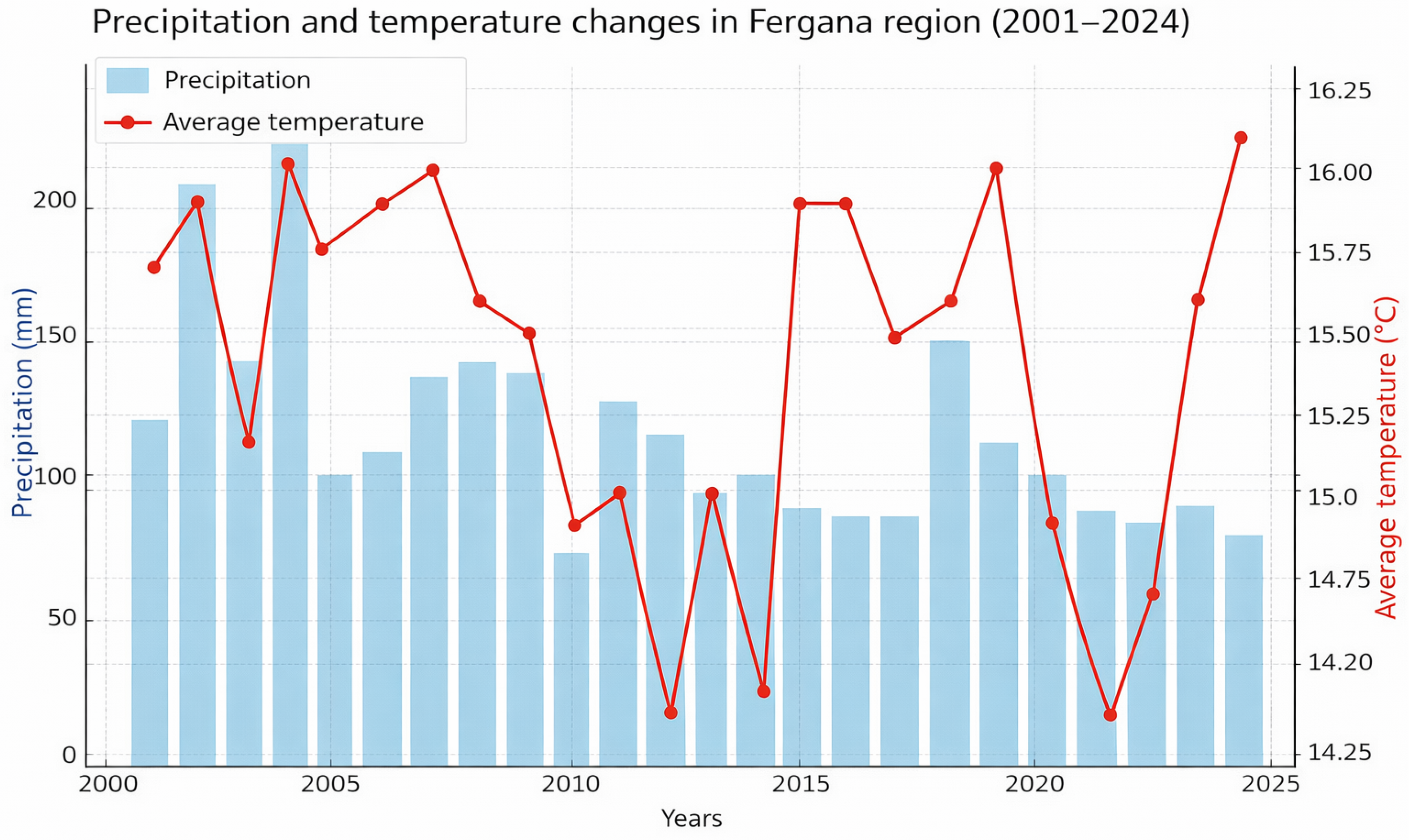
The variation in air temperature demonstrates a relatively stable pattern but with a gradual upward trend in recent years. For instance, the mean annual temperature increased from 15.7°C in 2001 to 16.1°C in 2024. This steady rise indicates the influence of global warming processes on the climatic conditions of the Fergana Valley, aligning with temperature trends documented in global climate assessments.
Figure 2.
Trend of precipitation changes in the Fergana region (2001–2024).
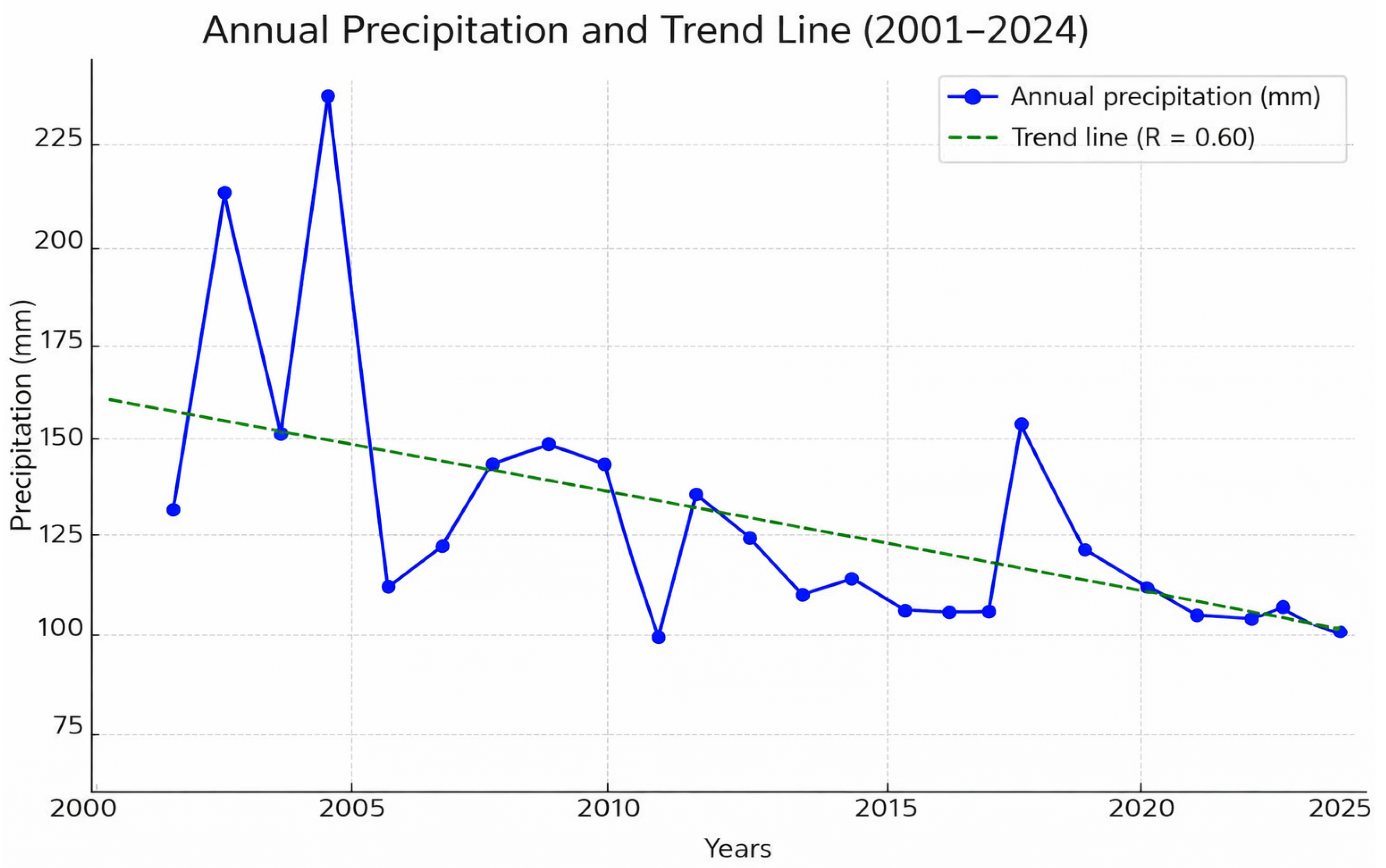
During the period 2001–2024, the annual amount of precipitation in the Fergana region has shown considerable year-to-year variability, yet the overall tendency reveals a declining trend. The negative correlation coefficient (R = –0.60) confirms a downward trend, signifying a gradual reduction in precipitation across the region. This pattern contributes to understanding hydrological changes in Central Asian arid zones within the context of global water cycle alterations [32].
Figure 3.
Correlation analysis of temperature and precipitation trends.
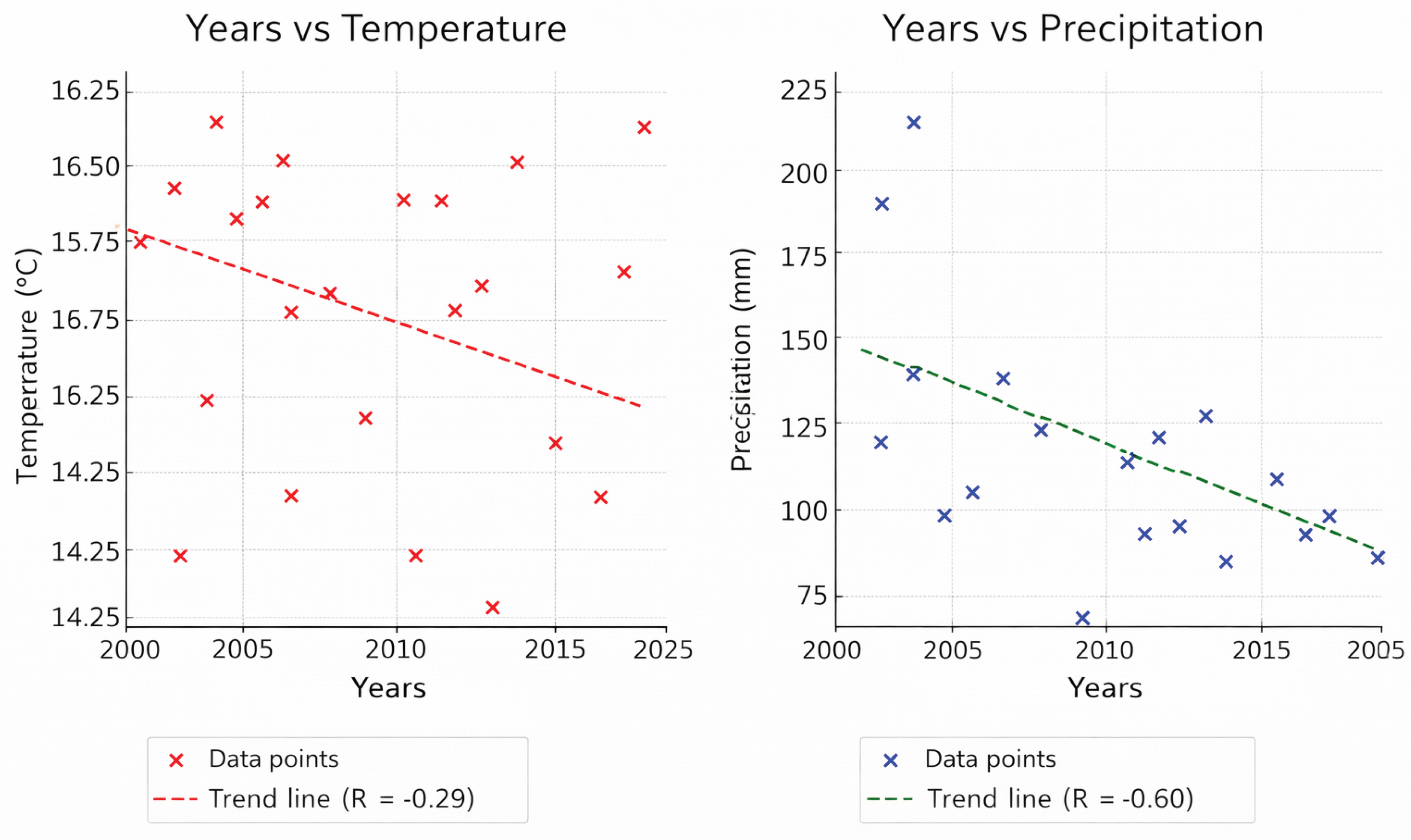
The correlation analysis reveals:
- Temperature trend: R = –0.29 (weak negative correlation)
- Precipitation trend: R = –0.60 (moderate negative correlation)
4.2. Influence on Soil Salinization within Global Context
The increase in temperature leads to faster evaporation of moisture from the soil, causing the groundwater to move upward. Groundwater usually contains salts, and when it evaporates, the salts remain on the soil surface. As a result, salinization (secondary salinization) occurs in the regional landscapes. This process represents a localized example of soil degradation challenges facing irrigated agricultural systems worldwide [34].
When the amount of precipitation decreases, the possibility of washing (leaching) salts out of the soil also decreases. This leads to the accumulation of salts in the soil. The moderately strong negative correlation (R = –0.60) indicates that the amount of precipitation in the region is decreasing as a result of climate change. This situation increases the risk of soil salinization, especially in irrigated lands, highlighting the interconnectedness of climate, water, and soil systems in global environmental change.
5. Discussion
The analysis of temperature and precipitation dynamics in the Fergana region during 2001–2024 reveals clear indications of ongoing climatic transformation within the broader context of global environmental systems. The observed negative correlation for precipitation (R = –0.60) demonstrates a consistent decline in annual rainfall, suggesting the intensification of arid climatic conditions that align with similar patterns observed in other arid and semi-arid regions worldwide [31].
5.1. Implications for Global Environmental Systems
Our findings contribute to the understanding of how regional climate change impacts interact with global environmental systems in several key ways:
Hydrological Systems Integration
The reduction in precipitation and increased evapotranspiration in the Fergana Valley represents a localized manifestation of global hydrological cycle alterations. These changes affect not only regional water availability but also contribute to understanding larger-scale water resource challenges in Central Asia, which serves as a critical case study for similar climatic zones globally [32]. The drainage systems (zovurs) implemented in Fergana provide practical examples of adaptive water management with potential applications in other irrigated regions facing similar challenges.
Agricultural Landscape Resilience
The adaptive responses of agricultural landscapes in Fergana region–including shifts in crop patterns, adoption of drip irrigation, and soil reclamation measures–provide valuable insights for global food security discussions. These local adaptation strategies offer practical examples for other regions facing similar climate-induced agricultural challenges [33]. The successful cultivation of drought-resistant grape varieties and implementation of intensive orchards demonstrate climate-resilient agricultural practices with broader relevance.
Soil-Atmosphere Interactions
The observed soil salinization processes in Fergana reflect complex soil-atmosphere interactions that have implications for global carbon cycling and greenhouse gas emissions. Salinized soils typically exhibit reduced carbon sequestration capacity, potentially exacerbating global warming trends through positive feedback mechanisms [34]. Our findings highlight the need for integrated soil management approaches that consider both local agricultural productivity and global environmental impacts.
5.2. Regional to Global Scaling
While our study focuses on the Fergana region, the methodological framework and findings have broader relevance for understanding climate-landscape interactions in global environmental systems:
- The GIS and remote sensing approaches demonstrated here can be applied to other regions undergoing similar climatic transitions, contributing to comparative studies of climate change impacts across different ecological zones.
- The correlation between decreasing precipitation and increasing salinization provides a model for predicting landscape changes in other irrigated agricultural systems facing similar climate pressures.
- Adaptation strategies developed for Fergana’s agricultural landscapes offer transferable knowledge for climate-resilient agriculture globally, particularly in regions with limited water resources.
- The long-term monitoring approach establishes a framework for tracking climate impacts that can be replicated in other regions to build comprehensive global datasets.
Such climatic fluctuations directly influence soil and landscape processes in the region through their connection to global environmental systems. Reduced precipitation limits natural leaching, promoting the accumulation of salts in the upper soil horizons—a process observed in many irrigated agricultural systems worldwide. Although temperature changes alone have a weak relationship with salinization in our study area, the combined effect of declining precipitation and increasing evapotranspiration significantly elevates the risk of secondary salinization, particularly in irrigated areas, demonstrating the complex interactions within Earth’s environmental systems.
The findings align with previous studies conducted in Central Asia and other arid regions, confirming that climate change is altering hydrological and ecological balances at multiple scales [2]. The Fergana region’s agricultural landscapes require adaptive management strategies that consider both local conditions and global environmental system dynamics to mitigate these impacts and ensure sustainable development that contributes to broader environmental stability.
6. Conclusions
This study provides a comprehensive assessment of climate change impacts on the Fergana region’s landscapes, offering insights relevant to global environmental systems. Key findings include:
- 1.
- A consistent decline in precipitation (R = –0.60) over the past two decades, indicating intensifying arid conditions that align with broader climate change patterns in Central Asian arid zones.
- 2.
- A slight but statistically weak decrease in temperature (R = –0.29), suggesting relative thermal stability despite global warming trends, highlighting regional variations in climate responses.
- 3.
- Increased risk of soil salinization due to reduced precipitation and increased evapotranspiration, demonstrating the interconnectedness of atmospheric, hydrological, and soil systems in global environmental change.
- 4.
- Significant implications for agricultural productivity and water management in the region, with adaptation strategies offering valuable lessons for similar challenges worldwide.
- 5.
- Methodological contributions through integrated GIS, remote sensing, and statistical approaches that can be applied to other regions within global environmental monitoring frameworks.
These findings highlight the necessity of adaptive land and water management strategies aimed at improving soil fertility, mitigating salinization processes, and ensuring the sustainable development of agricultural production in the region. The Fergana case study contributes to global understanding of how regional landscapes respond to climate change and how local adaptation measures can inform broader environmental management approaches.
Future research should focus on developing specific adaptation measures and monitoring systems for climate-resilient agriculture in the Fergana Valley, with particular attention to: (1) enhancing water-use efficiency through advanced irrigation technologies, (2) developing salt-tolerant crop varieties, (3) implementing integrated soil-water management practices, and (4) establishing regional climate monitoring networks that contribute to global environmental databases. Such efforts will not only benefit the Fergana region but also provide valuable knowledge for addressing similar challenges in other parts of the world within the context of global environmental systems.
Author Contributions
Conceptualization, O.M.Q. and J.A.M.; methodology, O.M.Q.; software, J.A.M.; validation, N.M.B. and Z.B.; formal analysis, O.M.Q.; investigation, J.A.M.; resources, O.M.Q.; data curation, J.A.M.; writing—original draft preparation, O.M.Q.; writing—review and editing, N.M.B. and Z.B.; visualization, J.A.M.; supervision, O.M.Q.; project administration, O.M.Q.; funding acquisition, O.M.Q. All authors have read and agreed to the published version of the manuscript.
Funding
This research received no external funding.
Institutional Review Board Statement
Not applicable.
Informed Consent Statement
Not applicable.
Data Availability Statement
The data presented in this study are available on request from the corresponding author. The data are not publicly available due to privacy restrictions.
Acknowledgments
The authors express their gratitude to the Fergana Regional Department of Hydrometeorology for providing meteorological data and to Kokand State University for institutional support. We also acknowledge the contributions of global environmental research that provided important context for this study.
Conflicts of Interest
The authors declare no conflicts of interest.
References
- Klein, I.; Gessner, U.; Kuenzer, C. Regional assessment of the climate change vulnerability of irrigation in Central Asia. Journal of Arid Environments 2019, 162, 12–24. [Google Scholar]
- Lioubimtseva, E.; Henebry, G. M. Climate and environmental change in arid Central Asia: Impacts, vulnerability, and adaptations. Journal of Arid Environments 2020, 73(11), 963–977. [Google Scholar] [CrossRef]
- Karovin, Y. P.; Rozanov, I. N. Studies on the natural conditions and agricultural landscapes of the Fergana Valley; Academy of Sciences of the USSR: Moscow, 1933. [Google Scholar]
- Chetirkin, V. M. Geographical features of the Fergana region and their agricultural significance; UzSSR Publishing House: Tashkent, 1950. [Google Scholar]
- Murzayev, E. M. Physical-geographical conditions of the Fergana Valley; Geographical Society of the USSR: Moscow, 1953. [Google Scholar]
- Richter, G. D. Natural zoning and landscape differentiation of the Fergana Valley; FAN Publishing House: Tashkent, 1962. [Google Scholar]
- Babushkin, L. N.; Kogay, N. A. Landscape-ecological characteristics of irrigated lands in Fergana region; Academy of Sciences of the UzSSR: Tashkent, 1961. [Google Scholar]
- Abdulqosimov, A. The formation and development of landscapes in Eastern Fergana; FAN Publishing House: Tashkent, 1963. [Google Scholar]
- Abdulqosimov, A. Landscape ecology of Fergana Valley; FAN Publishing House: Tashkent, 1983. [Google Scholar]
- Matikeyev, K. The role of relief in the formation of Fergana landscapes; FAN Publishing House: Tashkent, 1971. [Google Scholar]
- Sultonov, Y. Landscape studies of the Fergana Valley; State University Press: Tashkent, 1974. [Google Scholar]
- Kholiqov, R. Y. Landscape-ecological assessment of irrigated lands in Fergana region; FAN Publishing House: Tashkent, 1988. [Google Scholar]
- Makhsudov, A. Geographical features and soil-ecological conditions of Fergana region; State University Press: Tashkent, 1971. [Google Scholar]
- Akhmadaliev, Y. Assessment of anthropogenic transformation of landscapes in Fergana region; Fergana State University Press: Fergana, 2002. [Google Scholar]
- Akhmadaliev, Y. Modern landscape changes in Fergana region; Fergana State University Press: Fergana, 2015. [Google Scholar]
- Boimirzaev, K. M. Landscape ecology of Fergana Valley; Fergana State University Press: Fergana, 2005. [Google Scholar]
- Boimirzaev, K. M. Modern landscape-ecological studies of the Fergana Valley; Fergana State University Press: Fergana, 2020. [Google Scholar]
- Qo’ziboyeva, O. M. Land degradation processes in Fergana region; Fergana State University: Fergana, 2006. [Google Scholar]
- Qo’ziboyeva, O. M. Reclamation processes in irrigated landscapes of Fergana region; Fergana State University: Fergana, 2022. [Google Scholar]
- Muminov, D. G. Hydrological aspects of landscape formation in Fergana Valley; FAN Publishing House: Tashkent, 2011. [Google Scholar]
- Abduganiyev, O. Modern challenges in landscape management of Fergana region; State University Press: Tashkent, 2023. [Google Scholar]
- Huntington, E. The pulse of Asia; Houghton Mifflin: Boston, 1907. [Google Scholar]
- Gerasimov, I. P. Geomorphological regions of the USSR; Academy of Sciences of the USSR: Moscow, 1946. [Google Scholar]
- Kleopov, Y. G. Principles of landscape differentiation; Nauka: Moscow, 1972. [Google Scholar]
- Tricart, J. Structural geomorphology; SEDES: Paris, 1974. [Google Scholar]
- Turner, M. G.; Gardner, R. H.; O’Neill, R. V. Landscape ecology in theory and practice; Springer: New York, 2001. [Google Scholar]
- Forman, R. T. T. Land mosaics: The ecology of landscapes and regions; Cambridge University Press: Cambridge, 1995. [Google Scholar]
- Sanderson, E. W.; Jaiteh, M.; Levy, M. A.; Redford, K. H.; Wannebo, A. V.; Woolmer, G. The human footprint and the last of the wild. BioScience 2002, 52(10), 891–904. [Google Scholar] [CrossRef]
- Qo’ziboyeva, O.; Ulengov, R.; Muminov, D.; Boratov, A.; Mahkamov, J.; Umarov, J. Climate Change and its Impact on Southern Fergana Landscapes. Journal of Open Bioscience and Environment 2024, 1(2), 17–23. [Google Scholar]
- Qo’ziboyeva, O.; Sherbayeva, Z. Impact of climate change on the water regime of Southern Fergana rivers. Farg’ona davlat universiteti 2024, 1, 6–6. [Google Scholar]
- IPCC. Climate Change 2021: The Physical Science Basis. Contribution of Working Group I to the Sixth Assessment Report of the Intergovernmental Panel on Climate Change; Cambridge University Press, 2021. [Google Scholar]
- UN Water. The United Nations World Water Development Report 2023: Partnerships and cooperation for water; UNESCO, 2023. [Google Scholar]
- Food and Agriculture Organization. The State of Food and Agriculture 2022: Leveraging agricultural automation for transforming agrifood systems; FAO, 2022. [Google Scholar]
- Lal, R. Soil carbon sequestration impacts on global climate change and food security. Science 2004, 304(5677), 1623–1627. [Google Scholar] [CrossRef] [PubMed]
- Vörösmarty, C. J.; Green, P.; Salisbury, J.; Lammers, R. B. Global water resources: vulnerability from climate change and population growth. Science 2000, 289(5477), 284–288. [Google Scholar] [CrossRef] [PubMed]
- Rockström, J.; Steffen, W.; Noone, K.; Persson, Å.; Chapin, F. S.; Lambin, E. F.; Foley, J. A. A safe operating space for humanity. Nature 2009, 461(7263), 472–475. [Google Scholar] [CrossRef] [PubMed]
Disclaimer/Publisher’s Note: The statements, opinions and data contained in all publications are solely those of the individual author(s) and contributor(s) and not of MDPI and/or the editor(s). MDPI and/or the editor(s) disclaim responsibility for any injury to people or property resulting from any ideas, methods, instructions or products referred to in the content. |
© 2026 by the authors. Licensee MDPI, Basel, Switzerland. This article is an open access article distributed under the terms and conditions of the Creative Commons Attribution (CC BY) license (http://creativecommons.org/licenses/by/4.0/).
Copyright: This open access article is published under a Creative Commons CC BY 4.0 license, which permit the free download, distribution, and reuse, provided that the author and preprint are cited in any reuse.


