Preprint
Article

This version is not peer-reviewed.

Comparative Phenotypic and Genomic Analysis of Virulence-Associated Factors of Burkholderia glumae and B. gladioli Causing Bacterial Panicle Blight in Rice in Bangladesh

Submitted:

14 January 2026

Posted:

15 January 2026

You are already at the latest version

Abstract

Bacterial panicle blight (BPB) of rice, a disease caused by Burkholderia glumae and B. gladioli, threatens global rice yields and has recently emerged in Bangladesh. We analyzed 300 BPB-infected samples from 20 Bangladesh districts using S-PG medium and gyrB PCR amplification, identifying 46 B. gladioli and 5 B. glumae isolates. Twenty of these isolates were chosen for in-depth characterization. Pathogenicity tests identified B. glumae BD_21g as the most virulent strain, followed by B. gladioli BDBgla132A. Disease severity on rice strongly correlated with onion bulb assays, validating the assay as a rapid virulence-screening tool. Phenotypic characterization of the 20 isolates revealed substantial variation in toxoflavin production, lipase activity, polygalacturonase activity, motility, and type III secretion system. Comparative genomic analysis of virulence-associated genes between BDBgla132A and BD_21g showed high protein sequence identity, particularly in toxoflavin biosynthesis and transport genes, while genes encoding lipase (lipA/lipB), polygalacturonase (pehA/pehB), and those involved in motility, displayed moderate to high identity. Both strains retained virulence-related genes that are homologous to those of B. cepacia but displayed distinct pathogenic mechanisms. Real time RT-qPCR revealed significantly higher expression of toxoflavin and lipase-encoding genes in BD_21g compared with BDBgla132A, consistent with its elevated enzymatic activities. Conversely, BD_21g showed reduced expression of pectinolytic and flagellar genes over BDBgla132A, consistent with the enhanced pectinolytic activity and motility observed in BDBgla132A. These findings reveal that B. glumae BD_21g and B. gladioli BDBgla132A employ distinct virulence strategies to infect rice, providing critical insights for developing targeted BPB management approaches in Bangladesh.

Keywords: 
;  ;  ;  ;  ;  

1. Introduction

Bacterial panicle blight (BPB) of rice has become a critical global threat, severely impacting rice production in many major rice-growing regions [1]. The incidence and economic losses due to BPB are expected to rise with climate change and increasing temperatures [2]. The disease can be caused by two bacteria, Burkholderia gladioli and Burkholderia glumae [3]. The version of the disease caused by B. glumae is one of the most devastating seed-borne bacterial diseases affecting rice production worldwide [4]. In contrast, B. gladioli are typically less virulent and not as commonly found as B. glumae [3]. B. glumae was first identified in Japan in 1956 as the causal agent of rice grain rot and seedling blight [5]. BPB has been subsequently recorded worldwide in all areas that cultivate rice, including Asia, Africa, and Central and South America [2,4,6]. Recent studies in Bangladesh confirmed that B. gladioli and B. glumae are responsible for significant BPB outbreaks, with B. gladioli being the dominant species [1,7]. The disease produces several forms of damage, with grain spotting, rot, and panicle blight being the most significant, and can cause yield losses of up to 75% [3,6]. BPB is characterized by upright, straw-colored panicles with florets displaying a darker base and a distinctive reddish-brown marginal line separating necrotic and healthy tissue. Se verely affected panicles undergo grain abortion before kernel filling, resulting in complete loss of grain development. The upright posture of affected panicles, caused by the absence of grain fill, is a key diagnostic feature distinguishing BPB from other rice diseases [3].
Several biochemical, physiological, and pathological techniques have historically been used to identify and characterize plant-pathogenic Burkholderia species [8]. Molecular methods, ranging from conventional Polymerase Chain Reaction (PCR) for the detection of Burkholderia species in seed lots and infected tissues to real-time quantitative PCR for sensitive pathogen identification and DNA quantification both in culture and in planta, represent the most accurate and sensitive approaches for diagnosing BPB pathogens [9,10,11]. Real-time reverse transcription quantitative PCR (RT-qPCR) is a highly sensitive and effective technique for quantifying bacterial gene expression, and it has been extensively used to investigate the regulation of virulence genes [12].
A variety of virulence factors influence the pathogenicity of B. glumae and B. gladioli. Toxoflavin, lipase (which is encoded by genes lipA and lipB), polygalacturonase (encoded by genes pehA and pehB), flagellar motility, and the Hrp-type III secretion system (T3SS) are essential for virulence [13,14]. B. glumae generates the phytotoxin toxoflavin [1,6-dimethylpyrimido[5,4-e]-1,2,4-triazine-5,7(1H,6H)-dione], a yellow pigment that plays a vital role in pathogenicity [15,16]. Toxoflavin biosynthesis in B. glumae initiates at temperatures above 30 °C and peaks at 37 °C [17]. The tox operons, toxABCDE and toxFGHI, are implicated in toxoflavin biosynthesis and transport, respectively [15]. Toxoflavin biosynthesis is controlled by quorum sensing and N-octanoyl homoserine lactone C8-HSL, which is produced by TofI and detected by the receiver TofR, which facilitates the recruitment of the transcriptional activators ToxJ and ToxR to the relevant promoters of toxoflavin biosynthesis genes [18]. In B. glumae, lipase also contributes to pathogenicity. LipA is the primary extracellular lipase and a key virulence factor [19]. LipA stability is supported by the activity of a second gene, lipB, which is involved in lipA expression and is necessary for LipA stability because it protects it from proteolytic degradation [19,20]. Flagella-mediated motility is a key virulence trait in pathogenic bacteria, as it allows them to move toward their target within the host, giving them an advantage during the initial colonization stages [21]. Furthermore, global regulators like H-NS and the cAMP–CAP complex, as well as environmental cues including temperature, osmotic pressure, pH, and quorum-sensing signals, precisely regulate flagellar activity [22,23]. The pathogenicity of soft-rot bacteria is mainly attributed to pectinolytic enzymes such as PehA, which break down plant cell wall components [24,25]. PehA strongly promotes the breakdown of onion tissue by Burkholderia species, resulting in maceration [26]. Despite the identification and characterization of the type III-secreted effectors PehA and PehB in B. glumae, it is still unknown how precisely they contribute to disease, possibly because of their comparable activities [13]. Finally, the Hrp (hypersensitive response and pathogenicity) type III secretion system is essential for the pathogenicity of numerous plant pathogenic bacteria [27]. In specific plant pathogenic bacteria, hrp genes play a crucial role in inducing disease in susceptible plants while triggering a hypersensitive response in resistant plants [28].
We still lack a comprehensive understanding of toxoflavin biosynthesis, lipase and polygalacturonase enzymatic activities, and flagellar virulence gene regulation in B. glumae and B. gladioli. Comparative analysis of homologous gene clusters across both species can enhance our understanding of their pathogenic strategies. In addition, our current understanding of the prevalence of the BPB disease caused by B. glumae and B. gladioli in rice in Bangladesh is scanty, and ongoing environmental changes are facilitating the spread of the disease throughout the country, highlighting the need for focused research. In this study, we characterized 19 B. gladioli and a single B. glumae isolates across 20 districts, including 4 major rice-growing districts of Bangladesh, by integrating phenotypic assays and genomic comparisons. Phenotypic characterization included quantification of toxoflavin, lipase and polygalacturonase activities, and motility, while genomic analyses encompassed BLASTp comparisons and phylogenetic analyses of orthologous regions for toxin biosynthesis (toxA–R), lipase (lipA/lipB), polygalacturonase (pehA/pehB), motility-related gene clusters (cheA, cheB, cheD, cheR, cheW, cheY, cheY1, cheZ, flhA, flhB, flhC, flhD, flhG, fliA, fliC, fliD, tsr, motA, motB). Moreover, we quantified the expression levels of 17 key virulence-linked genes, including toxA–R, lipA/lipB, pehA/pehB, and flhC/flhF, by real-time RT-qPCR in two representative highly virulent isolates: B. glumae BD_21g and B. gladioli BDBgla132A. By correlating phenotypic variation with genomic diversity, we provide novel insights into BPB pathogenicity and lay the groundwork for targeted management strategies in Bangladesh.

2. Materials and Methods

2.1. Sample Collection, Isolation and Molecular Identification of Burkholderia Strains

Rice fields cultivating different varieties (HYV, hybrid, local) across three seasons (Aus, Aman, Boro) in 20 districts of Bangladesh were surveyed from mid-October 2022 to November 2023 (Table S1) [29,30]. A total of 300 fields (three locations per district, five fields per location) were sampled, and panicles exhibiting typical BPB symptoms were collected [1]. Typical field symptoms of BPB from seedling to panicle stages include long grayish sheath lesions with dark brown to reddish-brown margins (Figure 1A), erect straw-colored panicles with darkened florets (Figure 1B,C), and grain abortion resulting in empty panicles (Figure 1D) [3]. From each sample, 1 g of symptomatic rice grains was surface-sterilized by immersion in 70% ethanol for 15 seconds and 3% sodium hypochlorite for 1 minute, and then ground in a mortar [31]. During grinding with a mortar and pestle, 5 ml of water were added [1], and 20 µl of the resulting suspension were streaked onto the selective medium (S-PG) [32]. Isolates were purified by serial dilution and re-plating, and purple colonies were streaked onto King’s B agar (KBA) plate [8] for visual assessment of toxoflavin production. Isolates producing a yellow pigment on KBA were selected and further purified as putative B. gladioli and B. glumae. Pure cultures were stored in King’s B broth (KBB) with 30% glycerol at −70 °C, and fresh cultures were prepared as needed on KBA plates. For molecular identification, all isolates were grown in nutrient broth at 28 °C for 24 hours and harvested by centrifugation, and genomic DNA was extracted using the Promega Genomic DNA Purification Kit (Promega, USA) according to the manufacturer’s protocol. The 16S rDNA gene was amplified from B. gladioli and B. glumae isolates using the universal primers 16SF (5′-AGAGTTTGATCCTGGCTCAG-3′) and 16SR (5′-GGCTACCTTGTTACGACTT-3′), as described in ref. [29,30]. Gel electrophoresis (1% agarose) confirmed the presence of PCR products with approximate lengths of 1400 bp and 1494 bp, respectively. The gyrB gene was amplified using PCR using species-specific primers [9]: the primers glu-FW (5′-GAAGTGTCGCCGATGGAG-3′) and glu-RV (5′-CCTTCACCGACAGCACGCAT-3′) were employed to identify B. glumae, while the primers gla-FW (5′-CTGCGCCTGGTGGTGAAG-3′) and gla-RV (5′-CCGTCCCGCTGCGGAATA-3′) were used to identify B. gladioli. PCR reactions (25 μL) included one μL of genomic DNA (150–200 ng), 12.5 μL of 2× Promega master mix, one μL of each primer (5 pmol), and 9.5 μL of nuclease-free water, with thermocycling conditions as follows: initial denaturation at 94 °C for 2 minutes; 35 cycles of 94 °C for 1 minute, 63 °C for 1 minute, and 72 °C for 1 minute; and a final extension at 72 °C for 8 minutes. PCR products (9 μL) were analyzed by electrophoresis on 1.5% agarose gels stained with ethidium bromide, with amplicon sizes of 529 bp and 479 bp confirming the presence of B. glumae and B. gladioli, respectively, based on expected gyrB gene fragment sizes. For the five samples that tested positive for B. glumae, we conducted Sanger sequencing on the PCR products and the obtained sequences were used for species identification via BLAST searches [29].

2.2. Pathogenicity Tests

Nineteen B. gladioli isolates and one B. glumae isolate were selected for in-depth characterization based on our ability to successfully sequence and assemble their whole genomes, as described in refs. [29,30]. Pathogenicity assays were conducted at two different growth stages, the seedling and heading phases, on a susceptible rice variety (Oryza sativa L. cv. Horidhan) to determine the virulence of the selected isolates. The assays were conducted following the protocol described in ref. [3] with a few modifications. Given the predisposition of BPB to develop at elevated temperatures, all pathogenicity tests were conducted under controlled conditions maintained at a diurnal temperature range of 37–41 °C and a relative humidity (RH) of 75–95%. Bacterial isolates were cultured on King’s B agar at 30 °C for 24 hours. A loopful of bacterial growth was suspended in 9 mL of sterile distilled water, and the cell density was adjusted to an optical density (OD₆₀₀) of 0.3, corresponding to approximately 10⁷–10⁸ CFU/mL, using a spectrophotometer. For seedling inoculation, 35 rice plants were selected, and the third leaf sheath was injected with 0.5 mL of the bacterial suspension using sterile 1 mL syringes equipped with BD 23G1 needles. For heading stage inoculation, panicles were sprayed with the same bacterial suspension when approximately 2030% of the panicle had emerged from the boot. Sterile distilled water was used as a negative control for both inoculation methods. Disease symptoms on leaf sheath and panicle were evaluated 2- and 4-weeks post inoculation, respectively. Lesions on sheaths and panicles were scored using a four-point categorical disease scale. Disease severity was assessed 7 and 14 days after inoculation. The disease severity was calculated using a 0 to 9 scale as reported in ref. [33], where the scale indicates 0 = no symptoms; 1 = 0.1–10.0% of the panicle affected; 3 = 11–20% of the panicle affected; 5 = 21–30% of the panicle affected; 7 = 31–60% of the panicle affected; 9 = >61% of the panicle affected. This information was used to calculate the disease severity according to the equation:
D i s e a s e   s e v e r i t y = n 0 × 0 + n 1 × 1 + n 3 × 3 + n 5 × 5 + n 7 × 7 + n 9 × 9 T o t a l   o f   p a n i c l e s   e v a l u a t e d ,
where ni indicates the number of panicles with each degree of damage (0 to 9). After disease scoring, bacterial strains were reisolated from diseased plants to complete Koch’s postulate.

2.3. Onion Assay for Pathogenicity Testing

Onion bulbs were obtained from a local store and utilized as a host model to assess pathogenicity. The virulence of B. gladioli and B. glumae strains was assessed on onion bulb scales following a modified protocol based on ref. [34]. A 5 μL aliquot of bacterial suspension (approximately 5 × 10⁵ CFU in 10 mM MgCl₂) was applied to a ~2 mm incision made on the inner surface of each onion bulb scale using a micropipette tip. The inoculated onion scales were incubated in a humid chamber at 30 °C. After 48 hours, virulence was evaluated by measuring the area of tissue maceration at the inoculation site.

2.4. Hypersensitive Response (HR) Assay

Hypersensitive response assays were conducted following the method described in ref. [35] with minor modifications. Tobacco plants (Nicotiana tabacum L.) were grown in plastic pots filled with sterile soil under controlled greenhouse conditions with natural daylight and a temperature range of 25–28 °C. Bacterial isolates were cultured on potato semi-synthetic agar (PSA) medium prepared with 5 g of peptone, 15 g of sucrose, 2 g of Na2HPO4·12H2O, 0.5 g of Ca(NO₃)₂·4H₂O, and 15 g of agar per liter of potato decoction (obtained by boiling 300 g of potatoes in 1 L of distilled water and filtering). The pH was adjusted to 7.0 before autoclaving. Cultures were incubated at 30 °C for 48 hours. For infiltration, a loopful of bacterial growth was suspended in 9 mL of sterile distilled water, and the cell suspension was adjusted to an optical density of OD₆₀₀ = 0.3, corresponding to approximately 10⁷–10⁸ CFU/mL. Using a 1mL hypodermic syringe without a needle, 0.5 mL of the suspension was infiltrated into the intercellular spaces of the fully expanded third and fourth leaves of each plant at the 8th–9th leaf stage. Control plants were infiltrated with sterile distilled water. A small pinprick was made at each infiltration site to ensure uniformity, and one leaf with five infiltration points was used per bacterial strain. Plants were kept in controlled conditions at 3741 °C with a relative humidity of 75–90% during the day, and hypersensitivity was observed post-infiltration after 24, 48 and 72 hours.

2.5. Determination of Toxoflavin Production and Quantitative Analysis

Toxoflavin synthesis was evaluated to compare virulence levels among B. gladioli and B. glumae strains. Bacterial cells were cultured on King’s B (KB) agar plates [8] and incubated at 37 °C for 48 h to assess toxoflavin production. Sterile King’s B (KB) agar plates without bacterial inoculation were used as the negative control for the toxoflavin production assay. The presence of toxoflavin was determined by the appearance of a bright yellow pigment diffusing from the bacterial colonies into the surrounding agar, which was absent in the sterile control [8].For a quantitative measurement of the production of toxoflavin, cells were gently removed, and the remaining agar slabs containing diffused toxoflavin were excised with a sterile razor blade into small,~5×5×5 mm fragments. The chopped agar was mixed with chloroform in a 1:1 (w/v) ratio, vortexed for 5 minutes, incubated at room temperature for 30 minutes for toxoflavin extraction, and the chloroform fraction was filtered through filter paper and collected in a new microtube. Chloroform was evaporated, and the culture filtrate residue was dissolved in 80% methanol as previously described [15]. The absorbance of each sample was measured at 393 nm to determine toxoflavin concentrations [36].

2.6. Assessment and Quantitative Evaluation of Lipase Activity

To screen for lipolytic bacteria, isolated colonies were inoculated onto agar plates enriched with 1% v/v Tween 20 (Peptone 10 g/L, NaCl 5 g/L, CaCl₂·2H₂O 0.1 g/L, agar 15 g/L, pH 7.4), alongside sterile uninoculated Tween 20 agar plates as negative controls, and incubated at 30 °C for 24 hours. The presence of opaque halos surrounding the colonies, which were absent in sterile controls, indicated lipase activity [37]. Lipase activity was quantified using the method described in ref. [38], modified as follows. Overnight cultures grown at optimal temperature (37 °C) in LB broth with shaking (200 rpm) were centrifuged at 13,000 rpm for 10 minutes. A substrate solution was prepared by dissolving 75 mg of p-nitrophenyl palmitate in 10 mL of isopropanol and dissolving it in 90 mL of 0.05 M Sorensen’s phosphate buffer, pH 8.0, containing 207 mg of sodium deoxycholate, 50 mg of gum Arabic, and pre-warming solution. For the assays, 0.1 mL of cell-free supernatant was incubated at 37 °C for 15 minutes with 2.4 mL of pre-warmed substrate alongside substrate-only blanks as negative controls. Lipase activity was detected as a bright yellow color, produced by p-nitrophenol, and the absorbance at 410 nm was measured using a spectrophotometer.

2.7. Qualitative and Quantitative Analysis of Polygalacturonase Activity

Polygalacturonase activity was observed in the semi-solid pectate-yeast extract agar (PEC-YA) medium [39] prepared with slight modifications. Polygalacturonase activity was observed in the semi-solid pectate-yeast extract agar (PEC-YA) medium prepared with slight modifications, alongside sterile uninoculated PEC-YA plates as negative controls. The medium was prepared in a 1 L Erlenmeyer flask containing 6.4 × 10⁻⁴ N NaOH, 1.5 g agar, 100 mL cold distilled water, 1 g yeast extract powder (Difco), 1 mL bromothymol blue, and 1 g polygalacturonic acid. This medium was rapidly stirred and heated until complete dissolution. After dissolving, the pH was adjusted to ~7.3 (checked with bromothymol blue and pH paper), and was sterilized in an autoclave for 15 min at 121 °C. After cooling the broth to 50 °C, it was poured into sterile Petri dishes. Bacterial cultures were spotted onto the plates and incubated at 30 °C. A halo of clear color was visible around the colonies when the plate was flooded with 2N HCl, indicating that polygalacturonase degraded polygalacturonic acid; the halo, however, was absent in the negative control. For quantitative analysis, bacterial isolates were grown in M9 minimal medium [40] supplemented with 0.3% of citric acid and 0.2% of PGA at pH 5.2 and 30 °C for 48 h with shaking at 180 rpm. The supernatant caused by centrifugation (10,000 × g, 10 min) of the culture was incubated with a mixture of 0.5% of PGA and 50 mM sodium acetate buffer, pH 3.5, at 37 °C for 30 min. The reaction was stopped by adding 500 µL of Bernfeld reagent [41] (1% 3,5-dinitrosalicylic acid, 5.3 M potassium sodium tartrate, 2 M NaOH). The mixture was then boiled for 10 min, cooled, and the absorbance was measured at 530 nm.

2.8. Bacterial Swarming Motility Assay

This experiment was conducted utilizing LB broth in agar at a concentration of 0.5% (w/v). Each strain was incubated at 30 °C for 12 to 14 hours in 2 mL of LB liquid medium. Subsequently, 1 mL of cultivated cells was pelleted by centrifugation at 900 × g for 2 minutes. The collected cells were rinsed with 1 mL of new LB liquid media, and the centrifugation process was repeated. The washed pellet was resuspended in 100 μL of distilled water, and one μL of the solution was spotted onto the center of a swarming agar plate. The assay plate was incubated at 30 °C for 24 hours [42]. Sterile uninoculated LB agar plates were prepared and incubated under identical conditions as negative control. Each strain was tested in five biological replicates, and the experiment was independently repeated three times to confirm reproducibility.

2.9. Transcript Level Determination

Total RNA was extracted from Burkholderia strains using the SV Total RNA Isolation System (Promega, Madison, WI, USA). Overnight cultures were prepared by growing bacteria in 5 mL of King’s B medium at 32 °C with shaking at 180 rpm. These were diluted 1:50 into fresh King’s B medium, and 10 mL were subcultured until reaching the late exponential to early stationary phase (OD₆₀₀ ≈ 1.5). A 1 mL aliquot was harvested by centrifugation, and total RNA was isolated according to the manufacturer’s instructions. Residual genomic DNA was removed by RNase-free DNase I treatment, and DNA contamination was excluded by PCR using gene-specific primers on RNA samples without reverse transcriptase. Complementary DNA (cDNA) was synthesized using 250 ng of RNA per reaction with the GoScript Reverse Transcription System (Promega), following the manufacturer’s protocol. For quality control, parallel reactions omitting reverse transcriptase were included to confirm the absence of DNA. Quantitative real-time PCR (qPCR) was conducted using the Bio-Rad Real-Time PCR system with Power SYBR® Green PCR Master Mix (Promega, USA). Amplification conditions included an initial denaturation at 95 °C for 3 minutes, followed by 40 cycles of 95 °C for 1 minute and 55 °C for 1 minute. Melting curve analysis was performed by heating to 65 °C for 30 seconds. Transcript levels of virulence-associated genes, including toxA–R, lipA/lipB, pehA/pehB, flhC, and flhF, were quantified using the ΔΔCT method [43] with 16S rRNA serving as the internal reference. Primers were designed using BLAST searches against the B. glumae reference genome BGR1 (GCF_000022645.2) and are shown in Table S2. ΔCT values were determined by subtracting the CT of the 16S rRNA housekeeping gene from the CT of the target gene, allowing for normalization of gene expression data. Comparative expression (ΔΔCT) was calculated as the difference between the ΔCT values of the test and reference strains. All statistical analyses were conducted using the R v4.4.1 software, and transcript changes were considered significant at P < 0.05.

2.10. Genomic and Evolutionary Analysis of Gene Sequences

The amino acid sequences of virulence-associated genes, including toxin-producing genes (toxA–R), lipase-encoding genes (lipA/lipB), pectinase-encoding genes (pehA/pehB), and genes responsible for chemotaxis and flagellar function (che, flh, fli, tsr, and mot), were selected for comparative genomic analysis. Virulence factor genes of the isolate B. gladioli BDBgla132A were compared using BLASTp against the B. glumae BD_21g proteome [29]. Also, virulence factor genes of the BDBgla132A and BD_21g isolates were compared against all publicly available B. cepacia proteomes using BLASTp. Percent identities were calculated as protein sequence identity over the full protein length.
To investigate the evolutionary history and distribution of virulence-related genes across the two Burkholderia species, the nucleotide sequences of virulence-linked genes, including toxoflavin biosynthesis genes (toxA–R), lipase-endocing genes (lipA/lipB), polygalacturonase-endoding genes (pehA/pehB), and chemotaxis/flagellar genes (che, flh, fli, tsr, mot) were retrieved from 28 bacterial strains representing the diversity of B. glumae and B. gladioli. These sequences were subsequently used to construct phylogenetic trees, enabling comparative analyses of virulence factor distribution and evolutionary divergence among isolates. The complete genome sequences for B. glumae strain BGR1 (GCF_000022645.2) and B. gladioli strains ABIP2048 (GCF_914484755.1), GSRB05 (GCF_019400155.1), UPMBG7 (GCF_027620325.1), UPMBG8 (GCF_027620475.1), BSR3 (GCF_000194745.1), KACC 18962 (GCF_036837415.1) and KACC 18963 (GCF_036839165.1) were retrieved from the GenBank database. Additionally, the genomes of B. gladioli and B. glumae strains BDBgla117A, BDBgla119A, BDBgla120A, BDBgla122A, BDBgla130A, BDBgla132A, BDBgla135A, BDBgla136A, BDBgla140A, BDBgla150A, BDBgla151A, BDBgla162A, BDBgla38A, BDBgla41A, BDBgla59A, BDBgla78A, BDBgla79A, BDBgla81A, BDBgla83A and BD_21g (i.e., the 20 strains characterized in this study), were previously sequenced by us [29,30]. The MEGA software version 12 [44] was used to conduct phylogenetic analyses. For each gene cluster, nucleotide sequences were aligned using the ClustalW algorithm, as implemented in MEGA. Phylogenetic trees were constructed using the Maximum Likelihood method, and the Tamura–Nei model [45] of nucleotide substitutions was chosen by MEGA’s model testing heuristic. The reliability of tree topologies was evaluated by conducting bootstrap analyses with 1,000 replicates, and clans with bootstrap values greater than 80% were considered reliable.

3. Results

3.1. Isolation and Molecular Identification of Burkholderia Strains from Rice Panicles

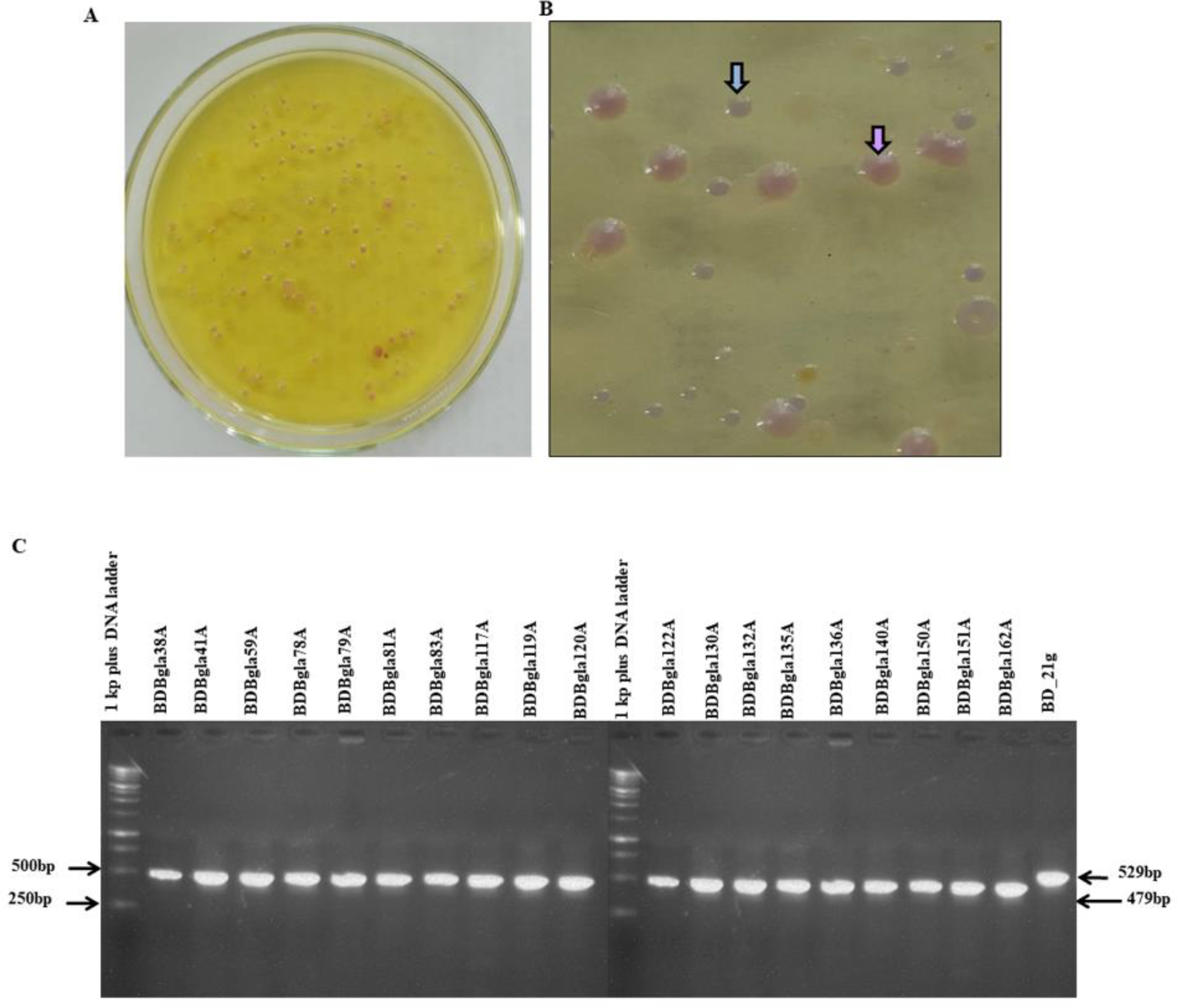
A total of 300 bacterial isolates were obtained from the 300 BPB-infected rice panicle samples collected from 20 districts across Bangladesh during the 2022–2023 crop growing seasons [29,30]. The colony characteristics of these strains were compared with those of ATCC strains of several Burkholderia species. Most rice-infecting strains were similar in colony characteristics on S-PG medium, exhibiting circular, smooth, opalescent, and convex colonies with a purple center, as previously described [32]. The colonies were nonfluorescent under UV light and produced a yellow pigment on KBA. Bacterial colonies showing purple color on S-PG medium were selected and purified as candidate pathogens. Two types of colonies were observed: type A colonies (round colonies with smooth edges and reddish-brown discoloration), and type B colonies (round colonies with purple reflectors in the center of the magenta background (Figure 2A,B), as in ref. [46]. PCR assays targeting 16S rDNA and gyrB genes were used to detect B. gladioli and B. glumae in symptomatic rice panicles using species-specific primers, resulting in 479 bp (B. gladioli) and 529 bp (B. glumae) amplicons for gyrB (Figure 2C); and 1400 bp (B. gladioli) and 1494 bp (B. glumae) amplicons for 16S rDNA [29,30]. Out of the 300 isolates, 46 were preliminarily identified as B. gladioli, and 5 as B. glumae based on their characteristic colony morphology on S-PG medium, production of the yellow pigment toxoflavin on King’s B agar, 16S rDNA and gyrB PCR amplification [29,30]. However, after sequencing the PCR products from both genes of the strains initially identified as B. glumae, only one was confirmed as B. glumae. Finally, one B. glumae and 19 B. gladioli isolates were selected for in-depth characterization based on our ability to successfully sequence and assemble their whole genomes, as described in refs. [29,30].

3.2. Pathogenicity Assessment on Rice Plants

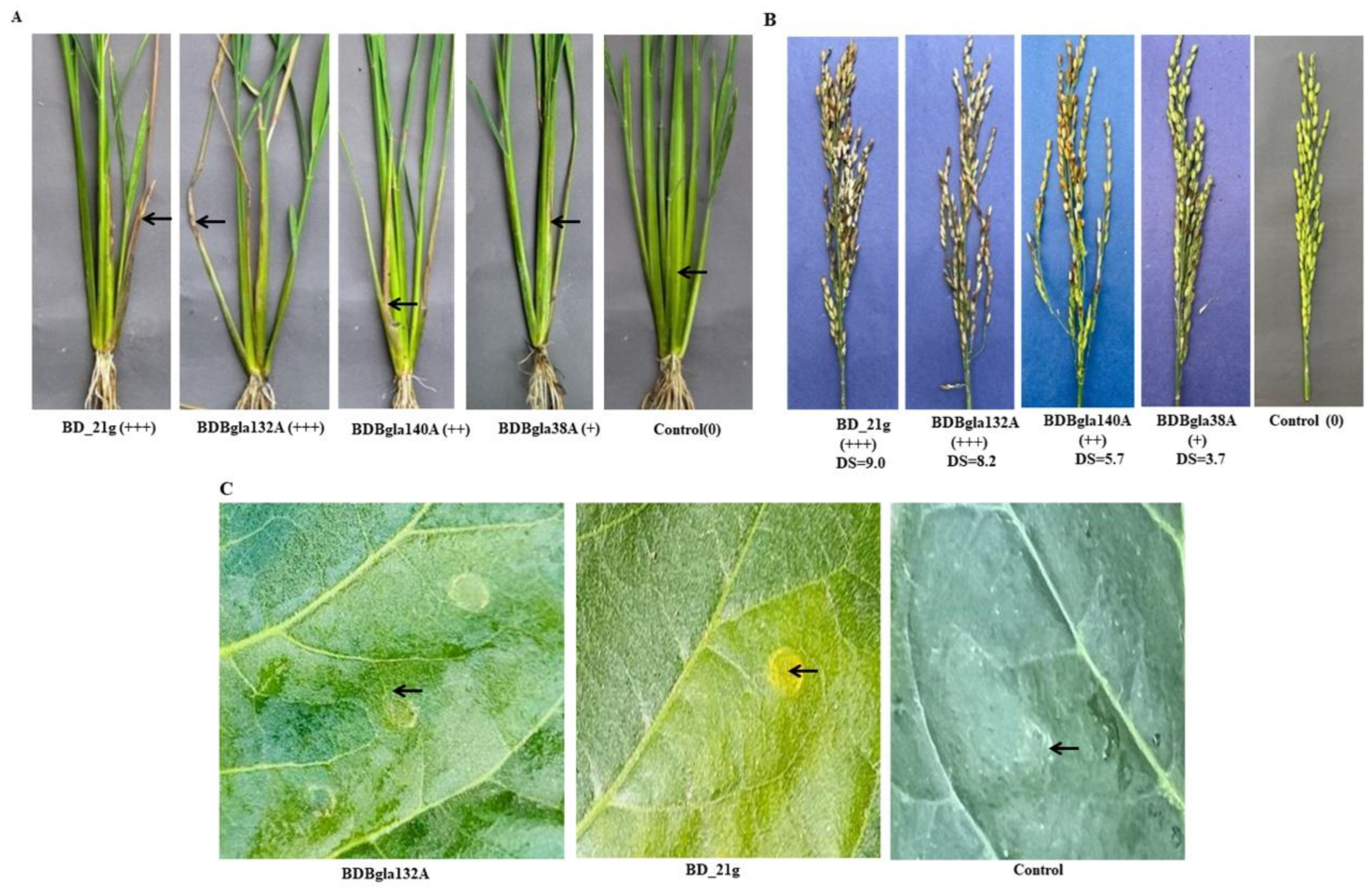
All 20 isolates tested exhibited pathogenicity on both rice panicles and seedlings. Of these, 17 isolates (85%) induced typical panicle blight symptoms and were classified as virulent, producing characteristic symptoms on both seedlings and panicles (Table 1). Notably, nine isolates (53%) caused severe disease symptoms, while eight (47%) induced moderate symptoms on both tissues. In contrast, three isolates (15%) produced only mild symptoms, limited to the panicles, and sterile water used as a negative control did not cause any symptoms (Figure 3A,B). Disease severity was assessed based on symptoms using a 0–9 rating scale, as described in ref. [33]. The symptoms induced by the two species were phenotypically indistinguishable. Koch’s postulates were fulfilled by reisolating pathogens from representative infected samples.

3.3. Hypersensitive Response Elicitation

To evaluate the functionality of the Type III secretion system (T3SS) in Burkholderia strains, we tested their capacity to elicit a hypersensitive response (HR) on Nicotiana tabacum leaves. Bacterial suspensions (~5 × 10⁷ CFU/mL) from toxoflavin-producing isolates were infiltrated into fully expanded tobacco leaves, and necrotic lesions, which are hallmarks of HR, were assessed at 24, 48, and 72 hours post-infiltration [41]. Lesions were visible in all isolates. By 48 h, strains BDBgla132A and BD_21g displayed unique lesion phenotypes (Figure 3C). Conversely, sterile water-infiltrated leaves did not exhibit a HR.

3.4. Onion Assays for Virulence Testing

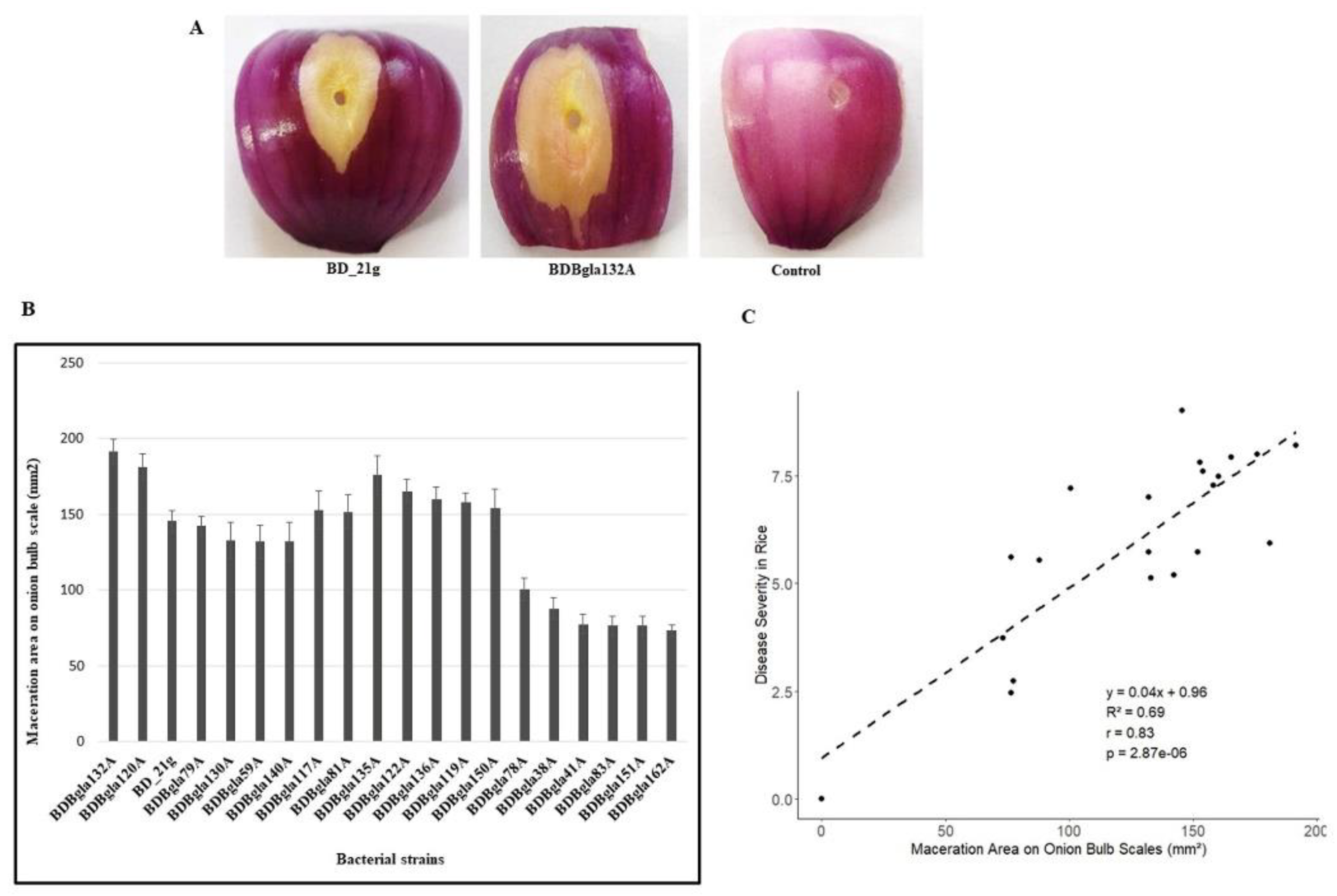
The virulence of Burkholderia strains was evaluated by onion bulb scale assays. All virulent isolates of B. glumae and B. gladioli consistently caused significant maceration of onion bulb scales. The virulence potential of individual strains was determined by the ability to induce tissue maceration overlaying onion bulb scales. Bacterial suspensions with ~5 × 10⁵ CFU/mL were inoculated and incubated at 30 °C for 48 hours [34], revealing substantial variation in the macerated area among isolates (Figure 4A). The highly virulent strains BDBgla132A, BDBgla120A, BDBgla135A, BDBgla122A, BDBgla136A, and BD_21g showed extensive bulb maceration. Conversely, the strains BDBgla41A, BDBgla162A, BDBgla151A, BDBgla38A, and BDBgla83A exhibited considerably less tissue degradation. The negative control showed negligible maceration specificity to pathogen action (Figure 4B). The severity of maceration of onion bulbs showed a strong positive correlation with disease severity on rice panicles (r = 0.83, P = 2.9 × 10⁻⁶; Figure 4C), reinforcing the reliability of onion assays as a surrogate model for assessing rice pathogenicity.

3.5. Toxoflavin Production and Quantification

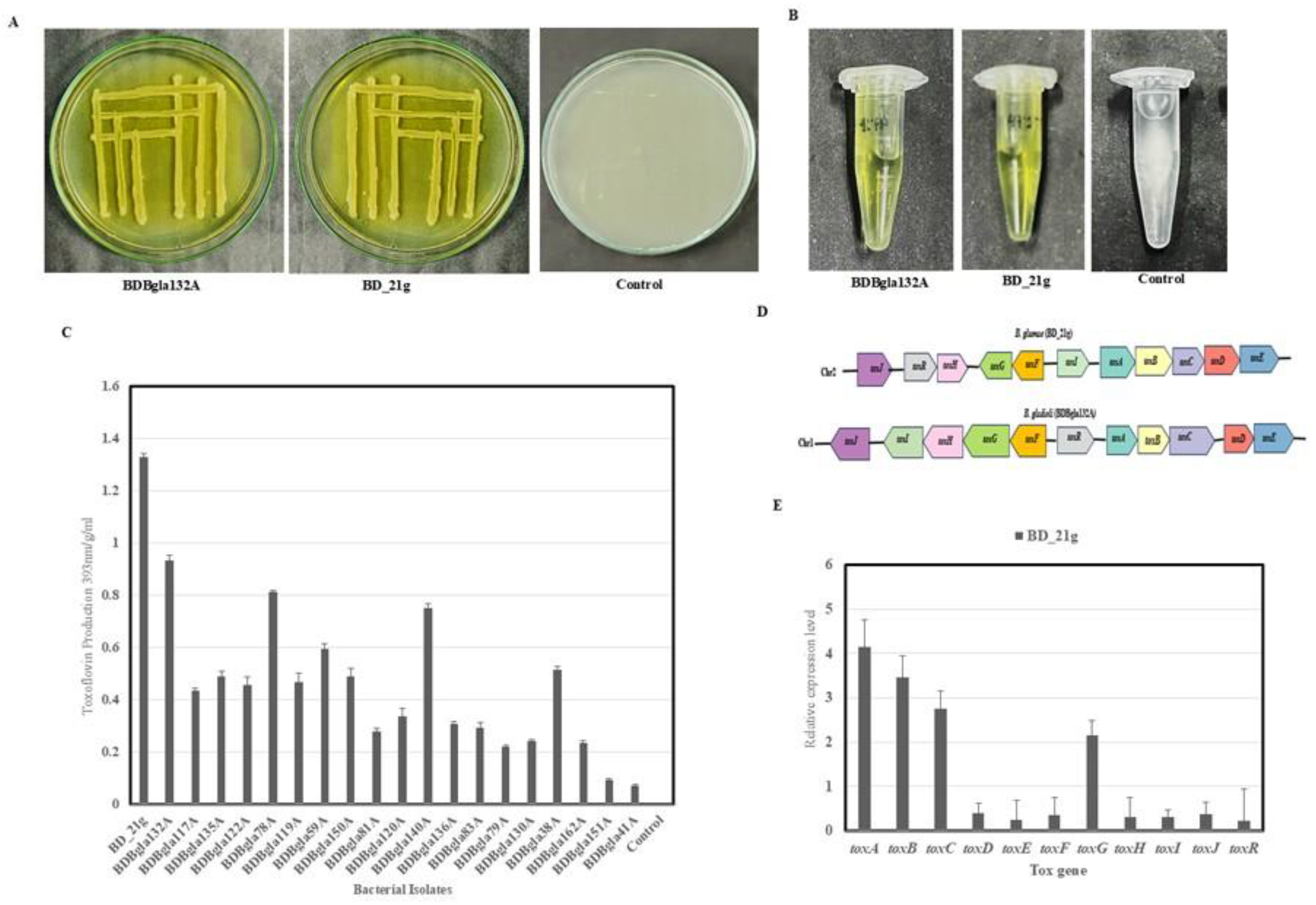
Phenotypic characterization of the 20 bacterial isolates revealed that all strains produced toxoflavin, as evidenced by the appearance of bright yellow pigment on King’s B (KB) agar plates following 48 hours of incubation at 37 °C, while the negative control did not. However, the intensity of the pigment, which correlates with toxoflavin production levels, significantly varied among the strains. Importantly, the B. glumae BD_21g strain produced a brighter yellow pigment than the B. gladioli BDBgla132A strain–indicative of a higher production of toxoflavin by BD_21g (Figure 5A). Following bacterial cell removal, toxoflavin was extracted using chloroform (1:1 w/v) and visualized as a bright yellow solution (Figure 5B). The extracted toxoflavin was quantified using a spectrophotometer at 393 nm (Figure 5C). Quantitative results indicated strong toxoflavin production in all isolates, although the concentrations varied. The BD_21g strain produced the highest concentration of toxoflavin, consistent with our phenotypic observations, and the concentration was significantly higher than that produced by BDBgla132A and other strains.

3.6. Lipase Activity Assessment and Quantification

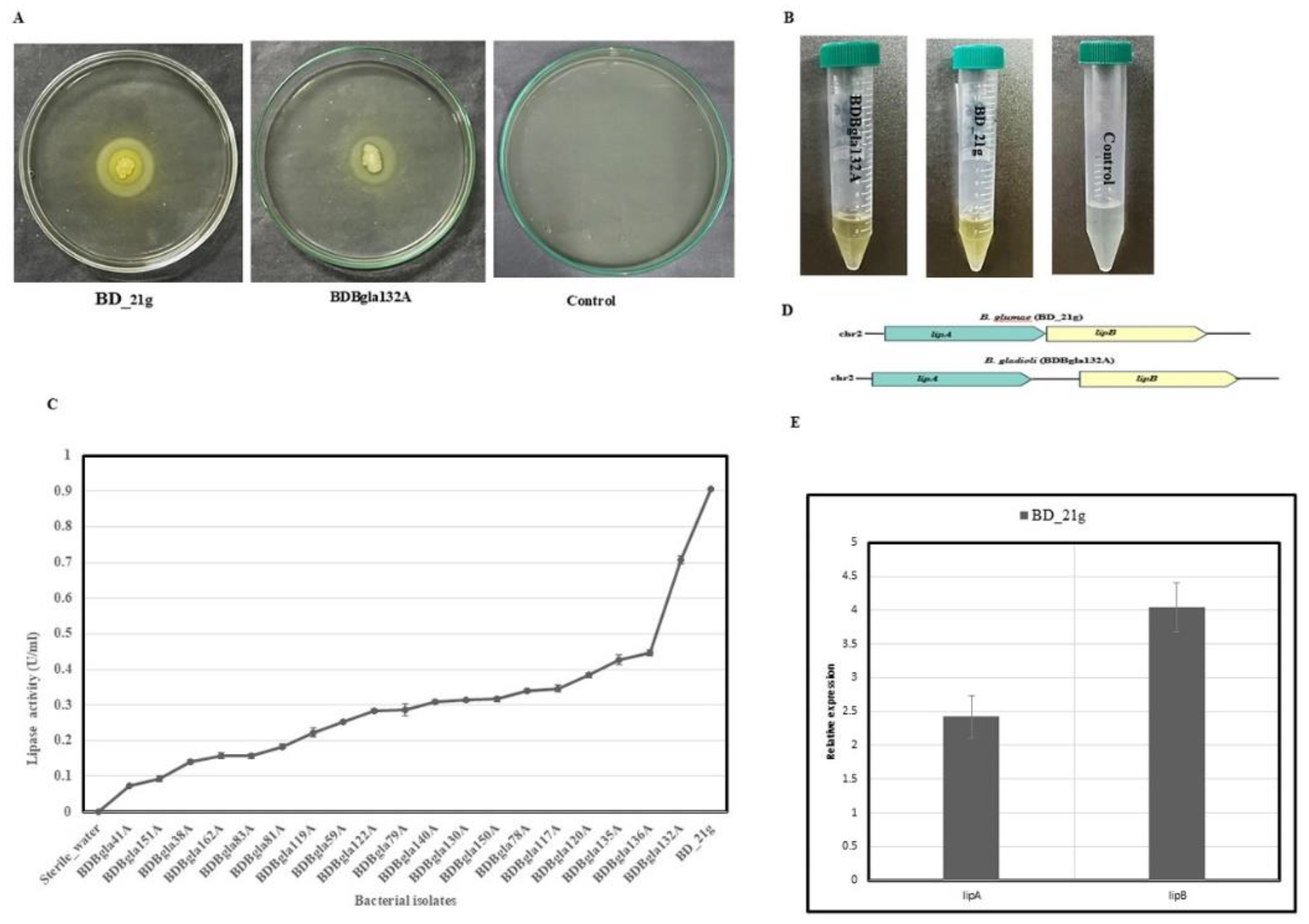
Lipase activity in Burkholderia strains was determined by combining phenotypic screening with quantitative enzyme assays. The qualitative plate assays on LB agar supplemented with 5% Tween 20 revealed high levels of lipase activity, as evidenced by opaque halos formed around the isolates [37], which were not present in the negative control. While all tested isolates produced lipase, the most virulent strains, BD_21g and BDBgla132A, exhibited distinctly prominent opaque halos, indicating robust extracellular lipase secretion and confirming the specificity of the lipase-induced phenotype (Figure 6A). A chromogenic substrate assay using p-nitrophenyl palmitate confirmed lipase production in all strains, as evidenced by the distinct yellow color resulting from p-nitrophenol release, whereas the control showed no color change (Figure 6B). Quantitative spectrophotometric measurement at 410 nm demonstrated that BD_21g isolates displayed the highest lipase activity, followed by BDBgla132A, while the other isolates exhibited significantly lower activity (Figure 6C). No lipase activity was detected in the control.

3.7. Qualitative and Quantitative Evaluation of Polygalacturonase Activity

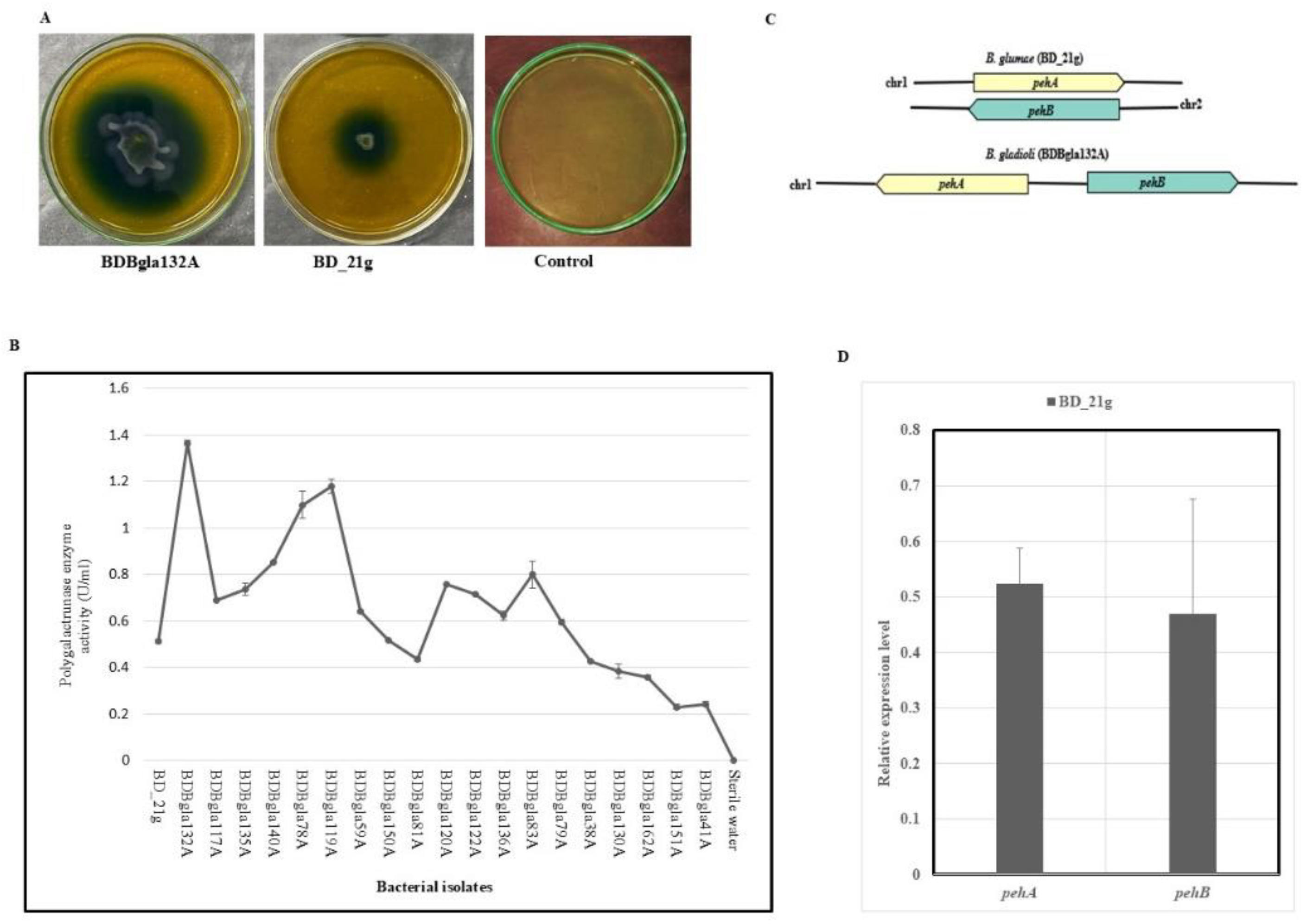
The activity of polygalacturonase (PG) in Burkholderia isolates was investigated through a combination of phenotypic and quantitative enzyme assays. Isolates were grown on semi-solid pectate-yeast agar (PEC-YA) media for phenotypic expression [39]. Each strain induced clear halo zones around the colonies, indicating significant pectinolytic activity consistent with polygalacturonate degradation. This was particularly evident in the B. gladioli isolate BDBgla132A and the B. glumae isolate BD_21g (Figure 7A). No halos were observed in the control. Next, all 20 isolates were cultured in M9 minimal medium [40] supplemented with polygalacturonic acid to induce polygalacturonase expression. Culture supernatants were collected after 48 h of incubation at 30 °C and assayed for enzymatic activity using a modified Bernfeld method [41]. This colorimetric assay was applied to measure the amount of galacturonic acid released from PGA by spectrophotometry at 530 nm. All isolates exhibited readily detectable polygalacturonase activity when grown in PGA-supplemented medium, whereas none of them exhibited detectable activity in the control medium lacking the substrate (Figure 7B). Among the tested strains, B. gladioli BDBgla132A and BDBgla136A consistently exhibited the highest enzymatic activities (Figure 7C). Interestingly, most of the B. gladioli isolates showed higher polygalacturonase activity than the B. glumae isolate BD_21g, which may contribute to their increased virulence and ability to degrade plant cell walls more effectively.

3.8. Swarming Motility Assessment

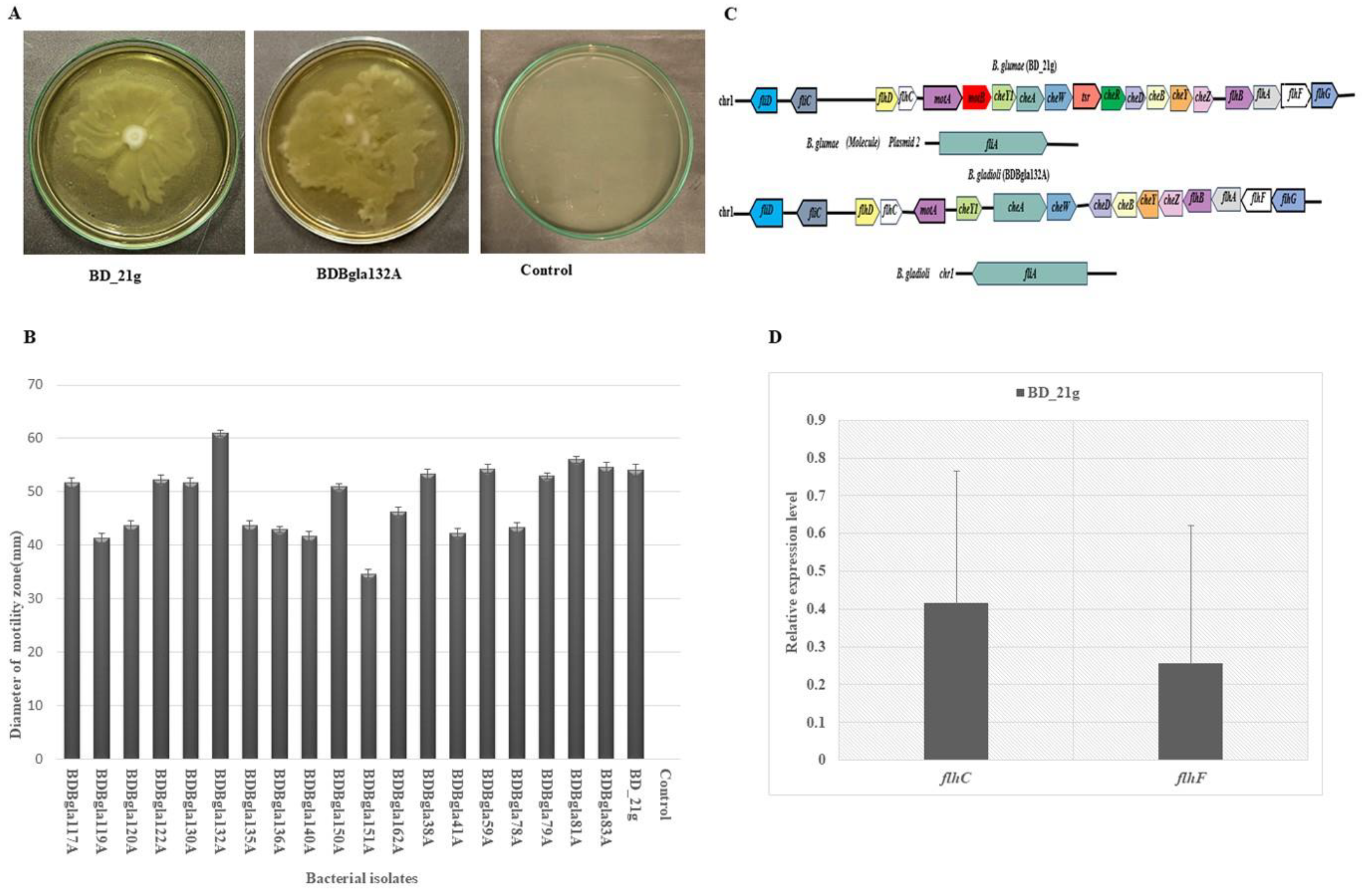
We analyzed the rapid motility of our B. glumae and B. gladioli isolates. Swarming motility assays (Figure 8A) showed dendritic bacterial spreading patterns, with BDBgla132A exhibiting the best motility, followed by BD_21g. Sterile standard LB agar (1.5% agar) without the low-agar modification served as the negative control and showed no spreading, confirming that the reduced agar concentration was essential for swarming motility. We determined the diameter of the motility zones, and B. gladioli isolate BDBgla132A exhibited the largest motility zone diameter, followed by strains BDBgla136A, BDBgla162A, BDBgla83A, BDBgla81A, and BD_21g (Figure 8B).

3.9. Differential Expression of Virulence-Associated Genes

Gene expression levels were quantified using the ΔΔCt method with real-time quantitative PCR (qPCR), normalized against the constitutive housekeeping gene 16S rRNA. Three biological replicates were performed for each of the two most virulent strains, with B. gladioli BDBgla132A serving as the reference (calibrator) and B. glumae BD_21g as the test strain. BD_21g exhibited significantly higher expression of key tox genes compared to BDBgla132A (Figure 5E). Specifically, toxA expression increased 4.15-fold, while toxB, toxC, and toxG showed increases of 3.5-fold, 2.8-fold, and 2-fold, respectively. The toxin gene expression pattern observed in BD_21g, which is consistent with its increased toxoflavin production, supports its association with increased virulence. However, toxD, toxE, toxF, toxH, toxJ, and toxR showed minimal expression differences between the two isolates, indicating a limited contribution to strain-specific differences in virulence. The expression levels of lipase-encoding genes lipA and lipB were 2.4- and 4-fold higher in BD_21g than in BDBgla132A, respectively, which correlates with BD_21g’s higher lipolytic activity. However, BD_21g showed 1.9-fold and 2-fold lower pehA and pehB transcript levels, respectively, than BDBgla132A (Figure 7D), suggesting other mechanisms of differential regulation of polygalacturonase-encoding genes. The same pattern was observed for flagellar regulatory genes: the expression levels of flhC and flhF were 2.4- and 3.8-fold lower for BD_21g than for BDBgla132A, respectively (Figure 8D). The observed differences in expression patterns suggest that BDBgla132A relies primarily on pectinolytic enzymes and motility for virulence, while BD_21g employs lipase and toxoflavin as its main virulence determinants.

3.10. Comparative Genomic and Evolutionary Analysis of Virulence-Associated Gene Clusters

Table 2 presents a comparative genomic analysis of virulence-associated genes between B. gladioli BDBgla132A and B. glumae BD_21g based on amino acid sequence identity. This analysis encompasses 35 virulence genes associated with five major virulence factors: toxoflavin, lipase, polygalacturonase, flagella, and chemotaxis regulators. The comparison uncovers considerable sequence identity and shared virulence factors between the two isolates. Toxoflavin operons demonstrated high sequence identity between the two species. Toxoflavin biosynthesis-related genes (toxABCDE) exhibited the highest identity between the two strains, with toxB showing the highest identity at 98.11% followed by toxC at 97.51%. Transport-related genes (toxFGHI) maintained high sequence identity, particularly toxH at 97.48%. However, toxI exhibited substantially lower identity at 44.35%, indicating significant genetic divergence in this gene between the two strains. Transcriptional regulators showed variable identity: toxJ demonstrated moderate identity at 77.5%, while toxR retained high identity at 96.01%. Sequence identity analysis of the lipase gene family revealed differential similarity between the two species: lipA showed substantial identity (88.55%), while lipB exhibited lower identity (80.71%). Polygalacturonase-encoding genes (pehA and pehB) maintained moderate-to-high identity, with pehA at 84.53% and pehB at 87.35%. The core chemotaxis-related genes (cheA, cheB, cheD, cheW, cheY, cheY1, cheZ) maintained high identity (80.80–97.22%). Notably, cheR was present in B. glumae BD_21g but absent in B. gladioli BDBgla132. This lineage-specific absence may reflect divergent chemotaxis regulation mechanisms between the two species.​ The flagellum-related biosynthesis genes (flhA–fliD) showed highly variable identity, ranging from 66.92% to 96.72% Among these, flhC showed the highest identity at 96.72%, while fliD displayed substantially lower identity at 66.92%. The motA gene retained strong sequence identity at 96.5% reflecting its importance in driving flagellar rotation via a chemiosmotic gradient. Conversely, motB and tsr, which encode a component of the flagellar motor and a chemotactic receptor, respectively, were present in B. glumae BD_21g but absent in B. gladioli BDBgla132A, suggesting species-specific retention of flagellar genes.
When compared with B. cepacia, the virulence-related proteins of both strains showed significant amino acid identity yet important differences in their virulence genes (Table S3), revealing distinct pathogenic strategies and evolutionary insights. The toxoflavin biosynthetic operons exhibited strong sequence identity across all three species, with core biosynthetic genes (toxABCDE) sharing 73.76–95.55% amino acid identity with B. cepacia, especially toxB (93.33–94.44%) and toxC (95.20–95.55%), while transport genes (toxF, toxG) showed markedly lower identity (57.14–73.62%). However, BD_21g exhibits marginally higher identity in toxI (88.8% vs. 62.56%) and toxH (95.91% vs. 78.58%), suggesting an enhanced toxin production potential. Lipase-encoding genes (lipA/lipB) are similarly conserved with moderate to high identity (59–80%), maintaining comparable nutrient acquisition capabilities. Both strains retain a pehA gene with high identity (83–94%), indicating capacity for plant cell wall degradation, yet both completely lack pehB, reflecting parallel loss of this supplementary pectin-degrading enzyme relative to B. cepacia. Chemotaxis and flagellar gene families exhibited the most complex evolutionary patterns. Core chemotaxis proteins (cheA, cheB, cheD, cheW, cheY, cheZ) shared high identity (82.06–100%) with their B. cepacia homologs, with cheY and cheZ showing perfect identity (100%) in BDBgla132A. Notably, cheY1 exhibited substantially reduced identity (67.50–68.29%), indicating divergent selection in this chemotaxis-related protein. BD_21g possesses a cheR gene (81.85% identity), while the gene is completely absent from BDBgla132A. Flagellar biosynthesis genes varied substantially in their levels of conservation: flhC maintained particularly high identity (92.4–97.33%), flhF showed intermediate identity (69.79–83.5%), and flhD and fliD displayed markedly reduced identity (56.92–62.86%). Motor-encoding genes also varied in their levels of conservation, with motA showing high identity (93.36–94.41%), but with motB being absent in BDBgla132A, yet present in BD_21g (84.39%). Similarly, the chemotactic receptor tsr was absent in BDBgla132A but present in BD_21g (70.15%). Our results indicate that both strains share a common ancestral virulence scaffold relative to B. cepacia but followed somewhat divergent evolutionary paths: BDBgla132A selectively lost chemotactic sensing genes (cheR, tsr) and flagellar motor function genes (motB), whereas BD_21g retained the ancestral motile, chemotactically-responsive strategy. These patterns suggest that both rice panicle blight pathogens specialized from an ancestral Burkholderia lineage through selective retention or loss of virulence-associated genes while maintaining core pathogenic functions.
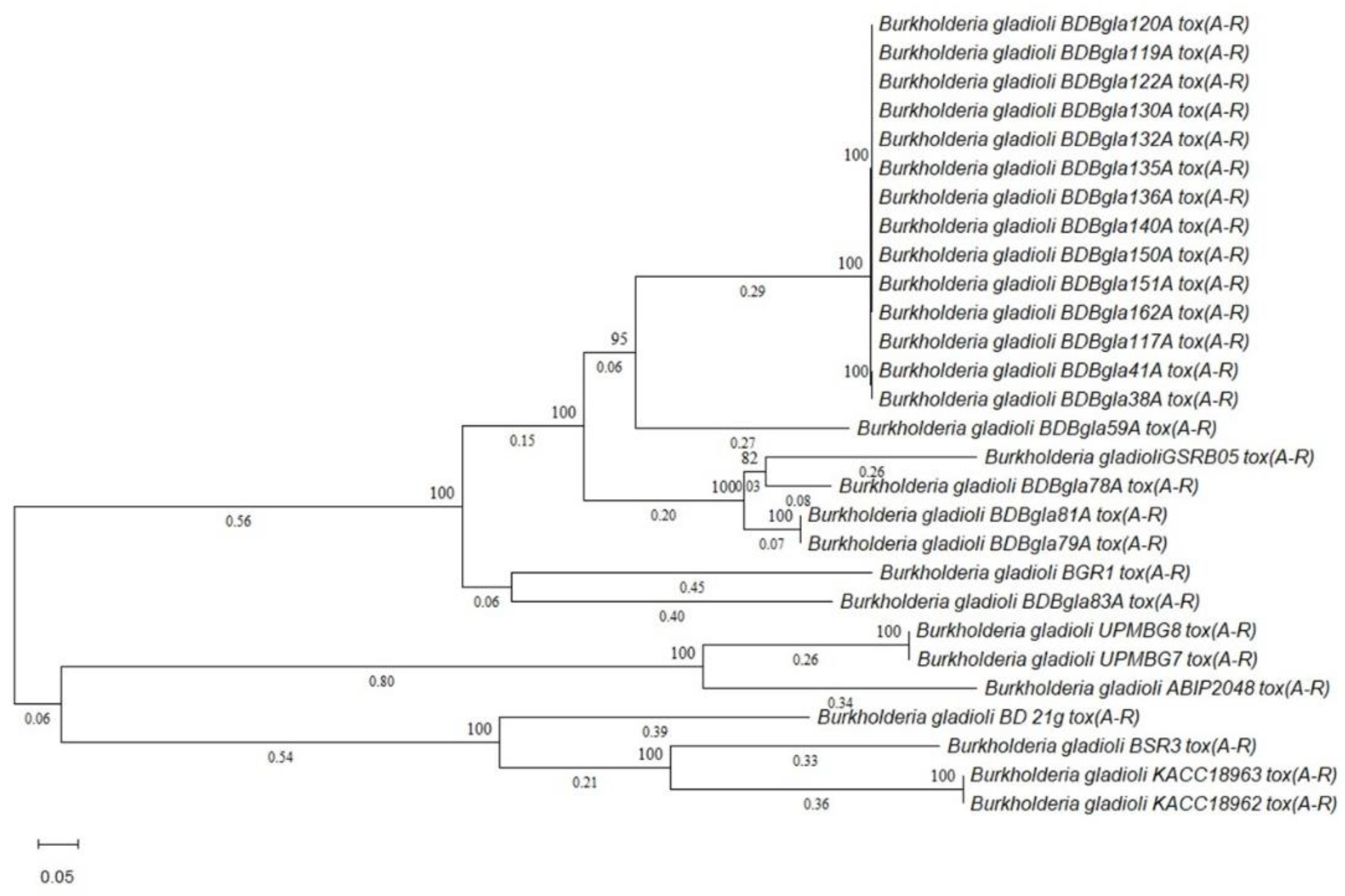
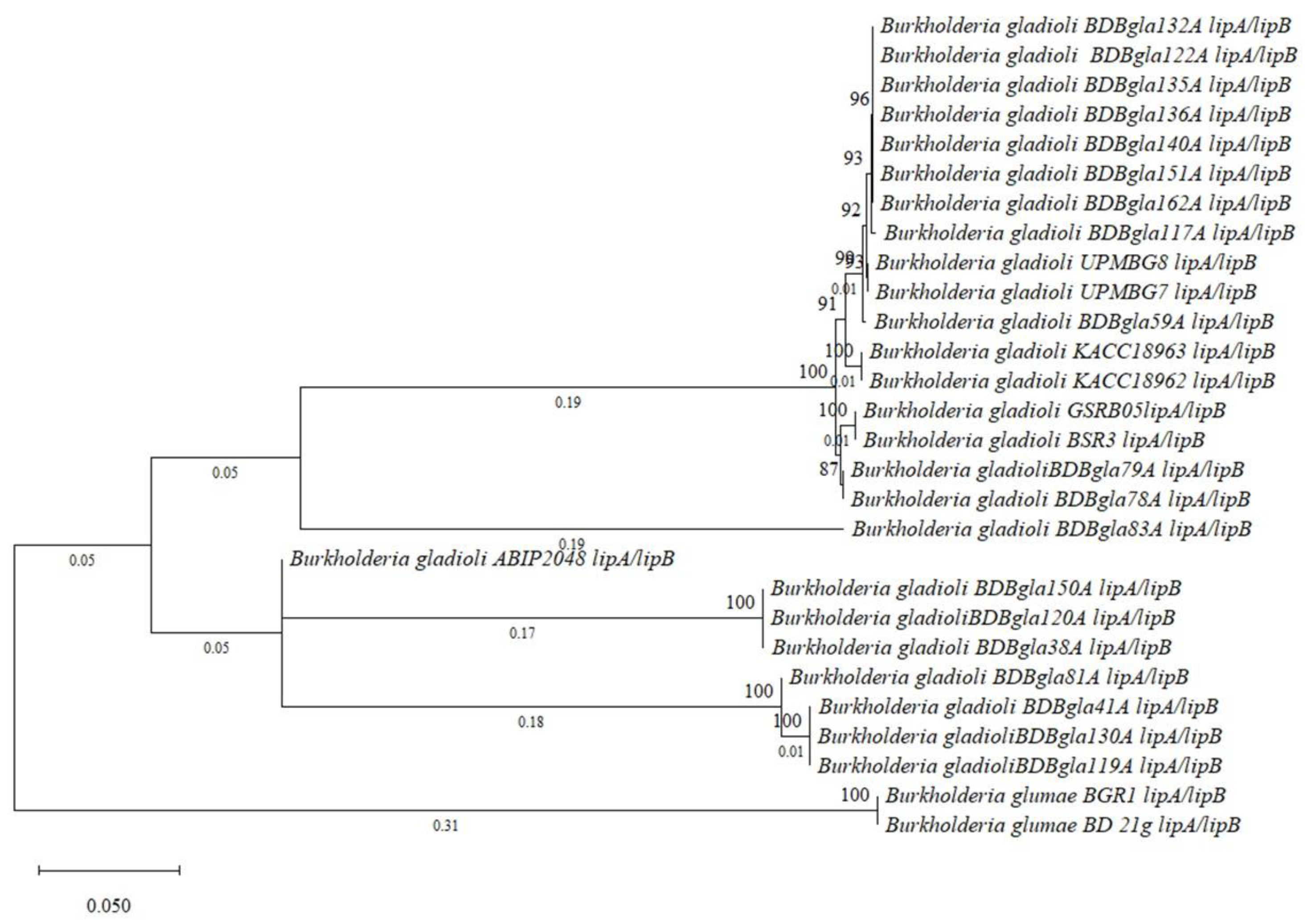
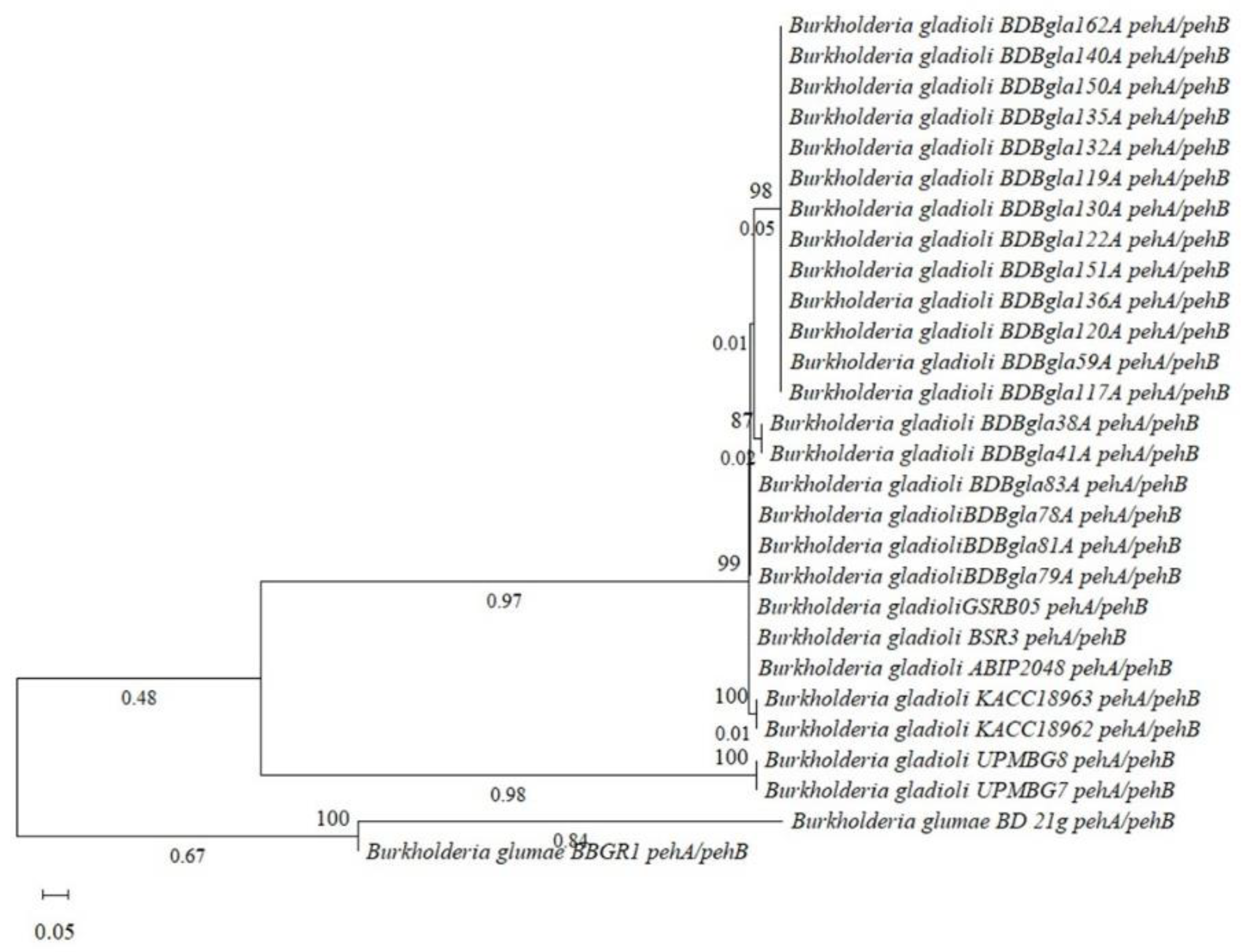
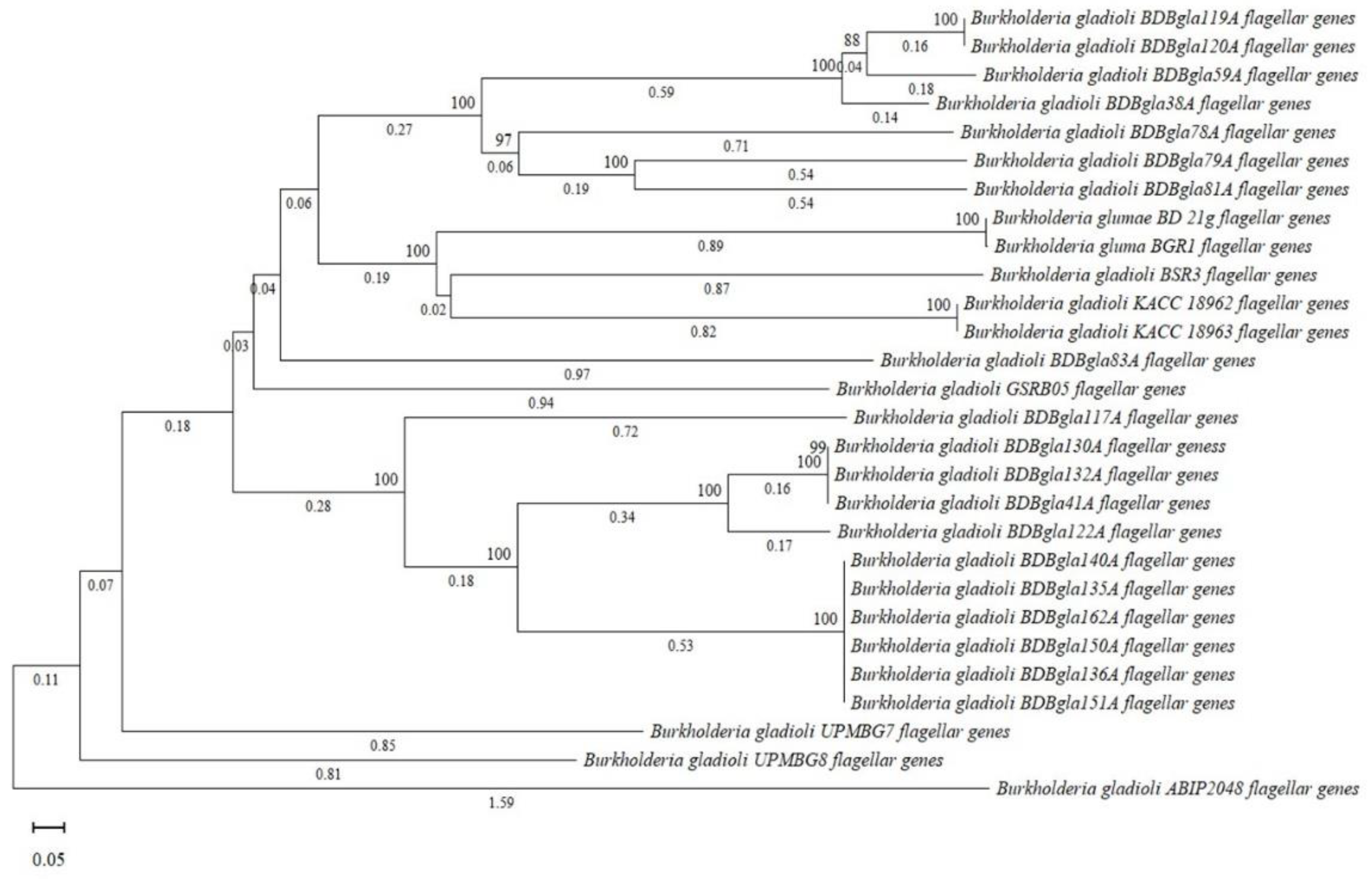
Phylogenetic analyses of the four systems (toxoflavin, lipase, polygalacturonase, and flagellum-related genes) were conducted in MEGA 12 [45] using the Maximum Likelihood method [44] with 1,000 bootstrap replicates. For each system, concatenated nucleotide alignments of the respective gene sets from 26 B. gladioli and 2 B. glumae strains were used to construct the trees. Phylogenetic trees (Figure 9, Figure 10, Figure 11 and Figure 12) show that the 11 tox-operon genes, two lipase genes, two polygalacturonase genes, and 20 flagellar genes from each isolate cluster closely with homologs from other strains, indicating no significant divergence among the examined strains. This clustering pattern suggests that these virulence factors have been conserved across the B. gladioli and B. glumae strains examined.

4. Discussion

A comprehensive investigation of Burkholderia species in association with bacterial panicle blight (BPB) of rice in Bangladesh is presented. A total of 51 bacterial strains were isolated from eight rice varieties collected across 20 districts during the 2022–2023 cropping season. S-PG and KBA media were suitable for preliminary screening, based on colony morphology and pigment formation, as described in ref. [8]. Two distinct colony types were observed: Type A, which formed reddish-brown colonies, and Type B, which showed a purple hue (Figure 2A,B). These characteristics were consistent with those previously described in ref. [46], reinforcing the importance of these visual traits in the early stages of identification. Further molecular identification using the PCR designed to amplify the gyrB gene [9] enabled accurate species determination, producing amplicons of 479 and 529 bp for B. gladioli and B. glumae, respectively (Figure 2C). PCR-based methods are standard procedures to distinguish between closely related phytopathogens [9], and newer techniques, including real-time PCR and real-time RT-qPCR, provide greater diagnostic sensitivity [9,10,11,12]. PCR-based detection of species revealed a marked predominance of B. gladioli (46/51) isolates with only 5 representing B. glumae. This dominance of B. gladioli is in accord with recent patterns found across South and Southeast Asia, where B. gladioli is becoming the most common BPB-causing pathogen, in contrast with previous reports in Japan and the Americas, where B. glumae was the primary causative agent [2,3]. B. gladioli has also been found in asymptomatic rice seeds in China [47] and is associated with diseases in other crops, such as tomato, eggplant, pepper, and sunflower in Korea. The relatively low occurrence of B. glumae detected in our survey may be due to agroecological differences or variation in host cultivars in Bangladesh. Overall, the evidence presented here supports the emerging importance of B. gladioli as a significant component of the BPB disease complex and highlights the need for reassessing the prevalence of the pathogen in other rice-growing endemic areas.
Pathogenicity tests confirmed that all studied Burkholderia strains produced BPB symptoms in both rice seedlings and panicles (Figure 3A,B), and that the B. glumae isolate was more virulent than the B. gladioli isolates on both rice tissues, as shown in Table 1. These findings are consistent with previous studies from Japan and Taiwan, which have found that rice plants grown in kernels at the boot or heading stages are more susceptible than seedlings at the four-leaf stage [48,49]. Our onion assay tests demonstrated that all virulent isolates caused substantial tissue maceration (Figure 4A,B), with their ability to cause onion maceration being highly correlated with rice panicle disease severity (R² = 0.69; Figure 4C), suggesting the surrogate value of the assay for rice pathogenicity. This result is in agreement with those of previous studies on Burkholderia cepacia complex (Bcc) members, such as Burkholderia cepacia and Burkholderia cenocepacia, which cause soft rot symptoms in onion bulbs [50,51]. Similarly, Karki et al. [52] found a strong correlation between the virulence of B. glumae on onion bulbs and its virulence on rice panicles, supporting the importance of this assay for strain pathotyping. Given its simplicity, ease of replication, and potential expandability, the onion bulb scale assay has emerged as a novel method for Burkholderia pathogenicity testing.
B. glumae synthesizes two main isomeric toxins, namely toxoflavin and fervenulin [15]. As a phytopathogen, B. glumae secretes toxoflavin, which impedes the development of rice seedlings and affects the growth of both roots and shoots. Moreover, in the grain-rot phase, it contributes to the emergence of chlorosis primarily on the panicles [53,54]. The production of toxoflavin is significantly temperature-dependent, beginning at 30 °C and reaching its maximum at 37 °C [17]. The inability of certain B. glumae strains to produce toxoflavin prevents them from causing chlorosis, demonstrating the toxin’s critical role in symptom development [16]. Our phenotypic investigation of 20 isolates showed significant inter-strain variation in toxoflavin production, pigment patterns, and toxin quantification for the virulent isolates that we tested (Figure 5A–C). This discrepancy could stem from differences in susceptibility to environmental signals among biosynthetic complexes, or from substantial differential regulation of quorum-sensing circuits such as TofR and TofI [22]. The distinction in virulence strategies between the B. glumae BD_21g and B. gladioli BDBgla132A strains is further highlighted by comparative gene expression. In BD_21g, toxoflavin biosynthesis genes exhibit higher levels of expression than in BDBgla132A (Figure 5E). Among these, toxA exhibited the highest overall overexpression (4.15-fold), suggesting that a ToxA-type virulence strategy is present in that strain (Figure 5E). In B. glumae, the toxABCDE operon encodes the enzymatic machinery for toxoflavin biosynthesis, while the toxFGHI operon encodes transporters that facilitate toxoflavin secretion [15,53,54]. Quorum sensing regulates the biosynthesis of toxoflavin in B. glumae through N-octanoyl homoserine lactone, which is synthesized by the TofI enzyme and recognized by the TofR receptor. Quorum sensing regulates toxoflavin production in B. glumae through N-octanoyl homoserine lactone, which is synthesized by the TofI enzyme and recognized by the TofR receptor C8-HSL TofR activation leads to the expression of the toxoflavin production-associated transcriptional regulators ToxJ and ToxR [23]. Notably, minimal differences in the expression of toxJ and toxR among strains, despite high toxA expression in BD_21g, suggest that this strain may employ non-canonical regulatory mechanisms beyond the classical TofI/TofR quorum-sensing pathway. A recent study has revealed that B. glumae possesses multiple alternative regulatory circuits for toxoflavin biosynthesis, including the regulatory gene tofM and quorum sensing-independent modulation pathways controlled by QsmR as well as pH-dependent regulation mediated by the membrane protein DbcA [55,56]. These results suggest that BD_21g may employ multiple regulatory mechanisms (such as temperature-dependent, QsmR-mediated, and pH-dependent regulation) to produce toxoflavin in a manner that is distinct from other virulent B. glumae strains, which are mainly mediated by the canonical quorum sensing system for pathogenesis. To further investigate the diversity of toxin biosynthetic gene expression in Burkholderia species, we evaluated the presence and sequence identity of the tox operons between the genomes of B. glumae BD_21g and B. gladioli BDBgla132A (Table 2). The biosynthetic genes (toxABCDE) showed particularly high identity: toxB exhibited the highest identity at 98.11%, followed by toxC at 97.51%. The transport genes (toxFGHI) maintained high sequence identity, with toxH reaching 97.48%. This elevated sequence identity indicates that the core toxoflavin biosynthetic and transport machinery remains functionally equivalent between B. gladioli and B. glumae, supporting the critical role of this toxin in plant pathogenesis [15,52].
According to our lipase activity assays, all studied Burkholderia strains produced lipase, with B. glumae BD_21g and B. gladioli BDBgla132A exhibiting significantly higher activity (Figure 6A–C). Real time RT-qPCR analyses revealed that BD_21g exhibits increased expression of lipase-encoding genes over B. gladioli BDBgla132A. The expression of lipA and lipB genes was elevated by 2.4- and 4-fold, respectively, indicating an active lipid-hydrolysis process that breaks down host membranes to release nutrients [55]. These findings are consistent with prior studies that implicated mutations in the lipAB operon promoter region in elevated lipase expression and secretion [57]. Sequence comparison of the lipase-encoding genes (lipA/lipB) between B. gladioli BDBgla132A and B. glumae BD_21g uncovered variable levels of conservation (Table 2): lipA maintained substantial identity at 88.55% while lipB exhibited lower sequence identity at 80.71%. Functional extracellular activity was confirmed by in vitro lipase assays with model substrates, indicating that lipA and lipB encode secreted enzymes capable of hydrolyzing lipid esters and supporting their nutrient acquisition role [58]. Overall, these data support the importance of lipase as a multifaceted virulence factor, with conserved gene sequences and confirmed extracellular enzyme activity, making it a potent therapeutic target for disease control strategies.
All the Burkholderia strains analyzed with a qualitative pectate gel assay were confirmed to secrete polygalacturonase, while quantification using the Bernfeld method showed that polygalacturonic acid induced polygalacturonase activity (Figure 7A–B), consistent with the enzyme’s function of degrading this major structural component of plant cell walls [39,41]. The chromosomal localization of peh genes differed among the individual species. The pehA gene of B. gladioli was found to be plasmid-borne [59], while in B. glumae polygalacturonase-encoding genes localize to the chromosomes [13]. This distinction might reflect different strategies for maintaining virulence factors. RT-qPCR analysis showed that pehA and pehB transcript levels in BD_21g were 1.9-fold and 2.0fold lower than in BDBgla132A (Figure 7D), suggesting differential regulation of polygalacturonase production in response to plant cell wall degradation requirements [26,59]. Comparative sequence analysis of B. glumae BD_21g and B. gladioli BDBgla132A revealed that polygalacturonase-encoding genes (pehA/pehB) shared moderate to high sequence identity between both strains (Table 2): pehA displayed 84.53%, whereas pehB exhibited greater identity (87.35%). Polygalacturonases encoded by pehA/pehB degrade plant cell wall pectin and represent established virulence factors in Burkholderia-mediated host tissue maceration [13]. The similarity of these genes across both species with substantial sequence identity underscores their pivotal role in plant tissue maceration and disease progression. These findings have implications for their virulence system and host specificity. It would be interesting to explore further how environmental conditions, particularly temperature, pH, and pectin concentration, influence pehA and pehB expression in both species. In addition, determining the exact contribution of polygalacturonase activity to virulence across multi-host plants would be key.
All studied Burkholderia strains exhibited swarming motility on 0.5% semi-solid LB medium. However, the motility capacity was strain-dependent, with BDBgla132A displaying the highest motility, followed by BDBgla136A, BDBgla136A, BDBgla138A, and BD_21g (Figure 8A–B). In plant-pathogen interactions, swarming motility is vital for surface colonization and, potentially, systemic dissemination during infection [15,23]. In B. glumae, swarming motility (a flagella-driven social movement of differentiated cells) is regulated by quorum sensing and acyl-homoserine lactone (AHL) signaling molecules and requires the use of rhamnolipid to spread the cells on an agar surface [60]. Quantitative PCR revealed that flagellar regulatory genes flhC and flhF were expressed at 2.4- and 3.8-fold lower levels in BD_21g relative to BDBgla132A, aligning with the enhanced motility phenotype observed in the latter strain. We hypothesize that different regulators affect this phenotype. Chemotaxis and flagellar genes displayed complex sequence identity patterns with functional implications for motility and virulence (Table 2). Core chemotaxis genes (cheA, cheB, cheD, cheW, cheY, cheY1 and cheZ) showed high identity (80.80–97.22%), while the cheR deletion in B. gladioli BDBgla132A suggests divergent regulatory mechanisms. Flagellar biosynthesis genes (flhA–flhG) exhibited high identity (84.39–96.72%), although fliD displayed the lowest identity (66.92%). The absence of motB and the chemotactic receptor (tsr) in BDBgla132A, coupled with the retention of motA (96.5%), indicates species-specific adaptations in flagellar function that may influence tissue colonization strategies. Our results align with a pan-genomic analysis of B. gladioli, which reported considerable functional diversity in motility-associated genes [58]. Motility systems may have evolved to occupy different ecological niches, but the precise role of swarming in BPB-related pathogenesis remains poorly understood. Mutant analyses and in planta colonization studies will be required to determine whether differential flagellar gene organization directly influences virulence during rice infection.
To assess the functionality of the type III secretion system (T3SS), we performed hypersensitivity assays on tobacco leaves (Nicotiana tabacum L.). All Burkholderia isolates induced rapid necrotic lesions within 48 hours (Figure 2A–C). The rapid development of necrotic lesions triggered by strains BDBgla132A (Figure 2A) and BD_21g (Figure 2B) within 48 hours indicates the functionality of an active type III secretion system (T3SS), confirming earlier reports on the critical requirement of hrp-encoded T3SS components for the delivery of effector proteins into host cells [27]. The isolates’ ability to elicit a hypersensitive response (HR) aligns with their dual role in promoting disease in susceptible hosts and in activating plant resistance in resistant hosts, both of which are hallmark functions of intact hrp gene clusters [28].

5. Conclusions

In conclusion, the study characterizes Burkholderia strains responsible for BPB in Bangladesh and conclusively establishes B. gladioli as the predominant pathogen and B. glumae as another cause of the disease. Using phenotypic, molecular, and transcriptomic methodologies, we have identified precise virulence mechanisms in both species. Notably, B. glumae and B. gladioli employ distinct virulence strategies: B. glumae predominantly utilizes toxoflavin and lipase to target rice, whereas B. gladioli rely on pectinolytic enzymes and flagellar systems for pathogenicity. The results of the onion bulb disease model assay, which provides a simple, rapid, and reliable alternative to rice panicle assays, accurately correlate with the severity of rice panicle disease and can be utilized to quickly differentiate between the two pathotypes. Genomic analyses indicate that orthologous virulence genes are preserved within species but have diverged across species. B. glumae and B. gladioli have evolved distinct specialized strategies to promote their exploitation of rice-growing regions in South and Southeast Asia, representing divergent evolutionary solutions to rice pathogenesis. Additional research using environmentally relevant conditions for tropical rice ecosystems, in combination with targeted mutagenesis and in planta colonization studies, will be needed to further advance our understanding of the functional importance of individual virulence factors in the progression of BPB disease.

Supplementary Materials

The following supporting information can be downloaded at the website of this paper posted on Preprints.org. Table S1: List of Burkholderia isolates collected from 20 districts across Bangladesh; Table S2: Primers used for real-time RT- qPCR; Table S3: Sequence identity of virulence-associated genes between B. gladioli BDBgla132A and B. glumae BD_21g compared to B. cepacia.

Author Contributions

MNU was involved in securing funding, conceiving and designing the study, conducting molecular identification, performing statistical analyses, generating visualizations, and drafting the manuscript. DAP contributed to securing funding for whole genome analyses and drafting the manuscript, and designed and supervised whole genome sequencing of B. gladioli. IAP contributed to securing funding for whole genome analyses and assisted in whole genome data analyses. MRI designed and supervised entire study including the field isolate collection, molecular identification, and whole genome sequencing of B. glumae, and also contributed to drafting and editing the manuscript. RA assisted in field survey and in statistical data analysis. FK contributed to statistical and molecular data analysis. MHH, PS, UAM and MS assisted with laboratory work, including DNA extraction and PCR detection. MIH helped with statistical data analysis. MSI and FH participated in field survey and data collection. All authors have read and approved the final version of the manuscript.

Funding

This project was partially supported by a Science and Technology Fellowship Trust from the Ministry of Science and Technology, Government of the People’s Republic of Bangladesh and by a Nevada INBRE Scientific Core Service Award, funded by grant GM103440 from the National Institute of General Medical Sciences.

Institutional Review Board Statement

Not Applicable.

Informed Consent Statement

Not Applicable.

Data Availability Statement

Research data generated in this study are available from the corresponding author upon reasonable request.

Acknowledgments

The authors express their sincere gratitude to the local personnel of the Department of Agricultural Extension, Ministry of Agriculture, Government of the People’s Republic of Bangladesh, for their invaluable support in facilitating field sample collection.

Conflicts of interest

The authors declare that they have no competing interests.:.

Abbreviations

S-PG Sucrose-Peptone-Glutamate
BPB Bacterial Panicle Blight
Bcc Burkholderia cepacia complex
KBA King’s B agar
LB Luria Broth or Luria–Bertani
PGA Polygalacturonic acid
T2SS type II secretion system
T3SS type III secretion system
HR Hyper-sensitive response
BLASTp Basic Local Alignment Search Tool-protein
NCBI National Center for Biotechnology Information

References

  1. Islam, M.R.; Jannat, R.; Protic, I.A.; Happy, M.N.A.; Samin, S.I.; Mita, M.M.; et al. First report of bacterial panicle blight in rice caused by Burkholderia gladioli in Bangladesh. Plant Dis. 2023, 107, 2837. [Google Scholar] [CrossRef]
  2. Ham, J.H.; Melanson, R.A.; Rush, M.C. Burkholderia glumae: next major pathogen of rice? Mol Plant Pathol. 2011, 12, 329–39. [Google Scholar] [CrossRef] [PubMed]
  3. Nandakumar, R.; Shahjahan, A.K.M.; Yuan, X.L.; Dickstein, E.R.; Groth, D.E.; Clark, C.A.; et al. Burkholderia glumae and B. gladioli cause bacterial panicle blight in rice in the southern United States. Plant Dis. 2009, 93, 896–905. [Google Scholar] [CrossRef] [PubMed]
  4. Cui, Z.Q.; Zhu, B.; Xie, G.L.; Li, B.; Huang, S.W. Research status and prospect of Burkholderia glumae, the pathogen causing bacterial panicle blight. Rice Sci. 2016, 23, 111–18. [Google Scholar] [CrossRef]
  5. Goto, K.; Ohata, K. New bacterial disease of rice (brown stripe and grain rot). Ann Phytopathol Soc Jpn. 1956, 21, 46–47. [Google Scholar]
  6. Zhou, X.G. Sustainable strategies for managing bacterial panicle blight of rice. In Protecting Rice Grains in the Post-Genomics Era; Jia, Y., Ed.; InTech Open: London, 2019. [Google Scholar]
  7. Uddin, M.N.; Protic, I.A.; Tushar, A.S.M.; Hasan, M.; Saha, P.; Singha, U.R.; et al. First report of Burkholderia glumae causing bacterial panicle blight in rice in Bangladesh. Plant Dis. 2025, 109, 491. [Google Scholar] [CrossRef]
  8. Schaad, N.W.; Jones, J.B.; Chun, W. Laboratory guide for identification of plant pathogenic bacteria., 3rd ed.; American Phytopathological Society: St. Paul, 2001. [Google Scholar]
  9. Maeda, Y.; Hikichi, Y.; Tsuchiya, K.; Ura, H.; Minami, K. Multiplex PCR method for the simultaneous detection of Burkholderia glumae and B. gladioli. Int J Syst Evol Microbiol. 2006, 56, 1031–5. [Google Scholar] [CrossRef]
  10. Nandakumar, R.; Rush, M.C.; Shahjahan, A.K.M.; O’Reilly, K.M.; Groth, D.E. Bacterial panicle blight of rice in the southern United States caused by Burkholderia glumae and B. gladioli as determined by PCR and pathogenicity tests. Phytopathology. 2005, 95, S73. [Google Scholar]
  11. Shahjahan, A.K.M.; Rush, M.C.; Groth, D.E.; Clark, C.A. Panicle blight. Rice J. 2000, 15, 26–29. [Google Scholar]
  12. Aviv, Y.; Gal-Mor, O. Real-time reverse transcription PCR as a tool to study virulence gene regulation in bacterial pathogens. Curr Protoc Microbiol. 2018, 45, e61. [Google Scholar]
  13. Degrassi, G.; Devescovi, G.; Solis, R.; Steindler, L.; Venturi, V. Functional analysis of the plant beneficial Burkholderia cepacia strain R-25018 reveals the presence of new secretion systems. Planta. 2008, 227, 1201–13. [Google Scholar]
  14. Kang, Y.; Kim, J.; Kim, S.; Kim, H.; Lim, J.Y.; Kim, M.; et al. Proteomic analysis of the proteins regulated by HrpB from the plant pathogenic bacterium Burkholderia glumae BGR1. Proteomics. 2008, 8, 106–21. [Google Scholar] [CrossRef] [PubMed]
  15. Kim, J.; Kim, J.G.; Kang, Y.; Jang, J.Y.; Jog, G.J.; et al. Quorum sensing and the LysR-type transcriptional activator ToxR regulate toxoflavin biosynthesis and transport in Burkholderia glumae. Mol Microbiol. 2004, 54, 921–34. [Google Scholar] [CrossRef] [PubMed]
  16. Suzuki, F.; Sawada, H.; Azegami, K.; Tsuchiya, K. Molecular characterization of the tox operon involved in toxoflavin biosynthesis of Burkholderia glumae. J Gen Plant Pathol. 2004, 70, 97–107. [Google Scholar] [CrossRef]
  17. Matsuda, I.; Sato, Z. Studies on the toxin of Pseudomonas glumae, the causal agent of grain rot disease. Ann Phytopathol Soc Jpn. 1988, 54, 482–8. [Google Scholar]
  18. Kim, J.; Oh, J.; Choi, O.; Kang, Y.; Kim, H.; Goo, E.; Ma, J.; Nagamatsu, T.; Moon, J.S.; Hwang, I. Biochemical evidence for ToxR and ToxJ binding to the tox operons of Burkholderia glumae and mutational analysis of ToxR. J Bacteriol. 2009, 191, 4870–4878. [Google Scholar] [CrossRef]
  19. Frenken, L.G.; de Groot, A.; Tommassen, J.; Verrips, C.T. Role of the lipB gene product in the folding of the secreted lipase of Pseudomonas glumae. Mol Microbiol. 1993, 9, 579–89. [Google Scholar] [CrossRef]
  20. El Khattabi, M.; Van Gelder, P.; Bitter, W.; Tommassen, J. Role of the lipase-specific foldase of Burkholderia glumae as a steric chaperone. J Biol Chem. 2000, 275, 26885–91. [Google Scholar] [CrossRef]
  21. Davey, M.E.; O’Toole, G.A. Microbial biofilms: From ecology to molecular genetics. Microbiol Mol Biol Rev. 2000, 64, 847–867. [Google Scholar] [CrossRef]
  22. Kim, J.; Kang, Y.; Choi, O.; Jeong, Y.; Jeong, J.E.; Lim, J.Y.; et al. Regulation of polar flagellum genes is mediated by quorum sensing and FlhDC in Burkholderia glumae. Mol Microbiol. 2007, 64, 165–79. [Google Scholar] [CrossRef]
  23. Jang, M.S.; Goo, E.; An, J.H.; Kim, J.; Hwang, I. Quorum sensing controls flagellar morphogenesis in Burkholderia glumae. PLoS One. 2014, 9, e84831. [Google Scholar] [CrossRef]
  24. Abbott, D.W.; Boraston, A.B. Structural biology of pectin degradation by Enterobacteriaceae. Microbiol Mol Biol Rev. 2008, 72, 301–16. [Google Scholar] [CrossRef] [PubMed]
  25. Huang, Q.; Allen, C. An exo-poly-alpha-D-galacturonosidase, PehB, is required for wild-type virulence of Ralstonia solanacearum on tomato. J Bacteriol. 1997, 179, 7369–78. [Google Scholar] [CrossRef] [PubMed]
  26. Gonzalez, C.F.; Pettit, E.A.; Valadez, V.A.; Provin, E.M. Mobilization, cloning, and sequence determination of a plasmid-encoded polygalacturonase from a phytopathogenic Burkholderia (Pseudomonas) cepacia. Mol Plant Microbe Interact. 1997, 10, 840–51. [Google Scholar] [CrossRef] [PubMed]
  27. Cornelis, G.R.; Van Gijsegem, F. Assembly and function of type III secretory systems. Annu Rev Microbiol. 2000, 54, 735–74. [Google Scholar] [CrossRef]
  28. Lindgren, P.B. The role of hrp genes during plant-bacterial interactions. Annu Rev Phytopathol. 1997, 35, 129–52. [Google Scholar] [CrossRef]
  29. Protic, I.A.; Uddin, M.N.; Tushar, A.S.M.; Auyon, S.T.; Alvarez-Ponce, D.; Islam, M.R. First complete genome sequence of a bacterial panicle blight-causing pathogen, Burkholderia glumae, isolated from symptomatic rice grains from Bangladesh. BMC Genomic Data. 2024, 25, 73. [Google Scholar] [CrossRef]
  30. Protic, I.A.; Uddin, M.N.; Gorzalski, A.; et al. Comparative genomic analyses shed light on the introduction routes of rice-pathogenic Burkholderia gladioli strains into Bangladesh. BMC Genomics 2026. [Google Scholar] [CrossRef]
  31. Mirghasempour, S.A.; Huang, S.; Xu, W.; et al. First report of Burkholderia gladioli causing rice panicle blight and grain discoloration in China. Plant Dis. 2018, 102, 2635. [Google Scholar] [CrossRef]
  32. Tsushima, S.; Wakimoto, S.; Mogi, S. Selective medium for detecting Pseudomonas glumae Kurita et Tabei, the causal bacterium of grain rot of rice. Ann Phytopathol Soc Jpn. 1986, 52, 253–259. [Google Scholar] [CrossRef]
  33. Echeverri-Rico, J.; Restrepo, S.; Guerra-Sierra, A.; Escobar, C. Understanding the complexity of disease-climate interactions driving bacterial panicle blight of rice caused by Burkholderia glumae in Colombia. PLoS ONE. 2021, 16, e0252061. [Google Scholar] [CrossRef]
  34. Jacobs, J.L.; Fasi, A.C.; Ramette, A.; Smith, J.J.; Hammerschmidt, R.; et al. Identification and onion pathogenicity of Burkholderia cepacia complex isolates from the onion rhizosphere and onion field soil. Appl Environ Microbiol. 2008, 74, 3121–9. [Google Scholar] [CrossRef] [PubMed]
  35. Furuya, N.; Tsushima, S.; Kodama, M.; et al. Virulence variability of Burkholderia glumae isolates assessed by hypersensitive reaction and pathogenicity on rice and tobacco. J Phytopathol. 1997, 145, 121–128. [Google Scholar]
  36. Jung, W.S.; Lee, J.; Kim, M.I.; Ma, J.; Nagamatsu, T.; Goo, E.; et al. Structural and functional analysis of phytotoxin toxoflavin-degrading enzyme. PLoS One. 2011, 6, e22443. [Google Scholar] [CrossRef] [PubMed]
  37. Sierra, G. A simple method for the detection of lipolytic activity of microorganisms and some observations on the influence of the contact between cells and fatty substrates. Antonie Van Leeuwenhoek. 1957, 23, 15–22. [Google Scholar] [CrossRef]
  38. Winkler, U.K.; Stuckmann, M. Glycogen, hyaluronate, and some other polysaccharides greatly enhance the formation of exolipase by Serratia marcescens. J Bacteriol. 1979, 138, 663–70. [Google Scholar] [CrossRef]
  39. Starr, M.P.; Chatterjee, A.K.; Starr, P.B.; Buchanan, G.E. Enzymatic degradation of polygalacturonic acid by Yersinia and Klebsiella species in relation to clinical laboratory procedures. J Clin Microbiol. 1977, 6, 379–86. [Google Scholar] [CrossRef]
  40. Sambrook, J.; Fritsch, E.F.; Maniatis, T. Molecular Cloning: A Laboratory Manual., 2nd ed.; Cold Spring Harbor Laboratory Press, 1989. [Google Scholar]
  41. Bernfeld, P. Amylase β and α. In Methods in Enzymology; Colowick, S.P., Kaplan, N.O., Eds.; Academic Press: New York, 1955; Vol. 1, pp. 149–54. [Google Scholar]
  42. Lee, J.Y.; Park, J.W.; Kim, S.Y.; Park, I.M.; Seo, Y.S. Differential regulation of toxoflavin production and its role in the enhanced virulence of Burkholderia gladioli. Mol Plant Pathol. 2016, 17, 65–76. [Google Scholar] [CrossRef]
  43. Livak, K.J.; Schmittgen, T.D. Analysis of relative gene expression data using real-time quantitative PCR and the 2(-Delta Delta C(T)) method. Methods. 2001, 25, 402–8. [Google Scholar] [CrossRef]
  44. Kumar, S.; Stecher, G.; Suleski, M.; Sanderford, M.; Sharma, S.; Tamura, K. MEGA12: Molecular evolutionary genetic analysis version 12 for adaptive and green computing. Mol Biol Evol. 2024, 41, msae263. [Google Scholar] [CrossRef]
  45. Tamura, K.; Nei, M. Estimation of the number of nucleotide substitutions in the control region of mitochondrial DNA in humans and chimpanzees. Mol Biol Evol. 1993, 10, 512–26. [Google Scholar]
  46. Jungkhun, N.; de Farias, A.; Watcharachaiyakup, J.; Kositcharoenkul, N.; Ham, J.; Patarapuwadol, S. Phylogenetic characterization and genome sequence analysis of Burkholderia glumae strains isolated in Thailand as the causal agent of rice bacterial panicle blight. Pathogens. 2022, 11, 676. [Google Scholar] [CrossRef]
  47. Luo, B.; He, Y.Q.; Xu, Y.C.; Xie, G.L.; Li, B.; Lihui, X.; et al. Detection of Burkholderia glumae in asymptomatic rice seed in China. J Plant Pathol. 2007, 89, 309–312. [Google Scholar]
  48. Chien, C.C.; Chang, P.C. Bacterial panicle blight of rice in Taiwan. Plant Dis. 1987, 71, 938–941. [Google Scholar]
  49. Tsushima, S.; Naito, H.; Koitabashi, M. Population dynamics of Pseudomonas glumae, the causal agent of bacterial grain rot of rice, on leaf sheaths of rice plants in relation to disease development in the field. Ann Phytopathol Soc Jpn. 1996, 62, 108–13. [Google Scholar] [CrossRef]
  50. Burkholder, W.H. Sour skin, a bacterial rot of onion bulbs. Phytopathology. 1950, 40, 115–117. [Google Scholar]
  51. Sotokawa, M.; Takikawa, Y. Soft rot symptoms caused by Burkholderia spp. in onion bulbs. Plant Dis. 2004, 88, 1085–1090. [Google Scholar]
  52. Karki, H.S.; Kim, K.S.; Park, J.H.; et al. Diversities in virulence, antifungal activity, pigmentation, and DNA fingerprints among strains of Burkholderia glumae. Plant Pathol J. 2012, 28, 352–366. [Google Scholar] [CrossRef]
  53. Sato, Y.; Iiyama, K.; Shinjo, F. Phytotoxins produced by Burkholderia species: toxoflavin and tropolone. J Gen Plant Pathol. 1989, 55, 315–322. [Google Scholar]
  54. Iiyama, K.; Matsuda, I.; Tsushima, S.; et al. Toxoflavin production and virulence of Burkholderia glumae. Phytopathology. 1995, 85, 444–449. [Google Scholar]
  55. Chen, Q.; Lee, J.H.; Park, Y.W.; et al. Dissection of quorum-sensing genes in Burkholderia glumae reveals non-canonical regulation and the new regulatory gene tofM for toxoflavin production. PLoS ONE. 2012, 7, e52150. [Google Scholar] [CrossRef]
  56. Lee, J.H.; Paudel, S.; Kim, H.; et al. A membrane protein of the rice pathogen Burkholderia glumae, DbcA, is required for quorum sensing by regulating cellular pH. Mol Plant Pathol. 2023, 24, 1153–1165. [Google Scholar]
  57. Voget, S.; Bolchi, A.; Li, W.; et al. Mutations improving production and secretion of extracellular lipase by Burkholderia glumae PG1. Appl Microbiol Biotechnol. 2016, 100, 1265–1273. [Google Scholar] [CrossRef]
  58. Hwang, I.S.; Hwang, B.K. Characterization of an extracellular lipase and its role in the virulence of Pseudomonas syringae pv. syringae. Mol Plant Microbe Interact. 2011, 24, 767–779. [Google Scholar]
  59. Lee, H.H.; Kim, J.; Park, H.; Kang, J.; Lee, J. Pan-genome analysis reveals host-specific functional diversification in Burkholderia gladioli. Microorganisms. 2021, 9, 1062. [Google Scholar] [CrossRef]
  60. Nickzad, A.; Lépine, F.; Déziel, E. Quorum sensing controls swarming motility of Burkholderia glumae through regulation of rhamnolipids. PLoS ONE. 2015, 10, e0128509. [Google Scholar] [CrossRef]
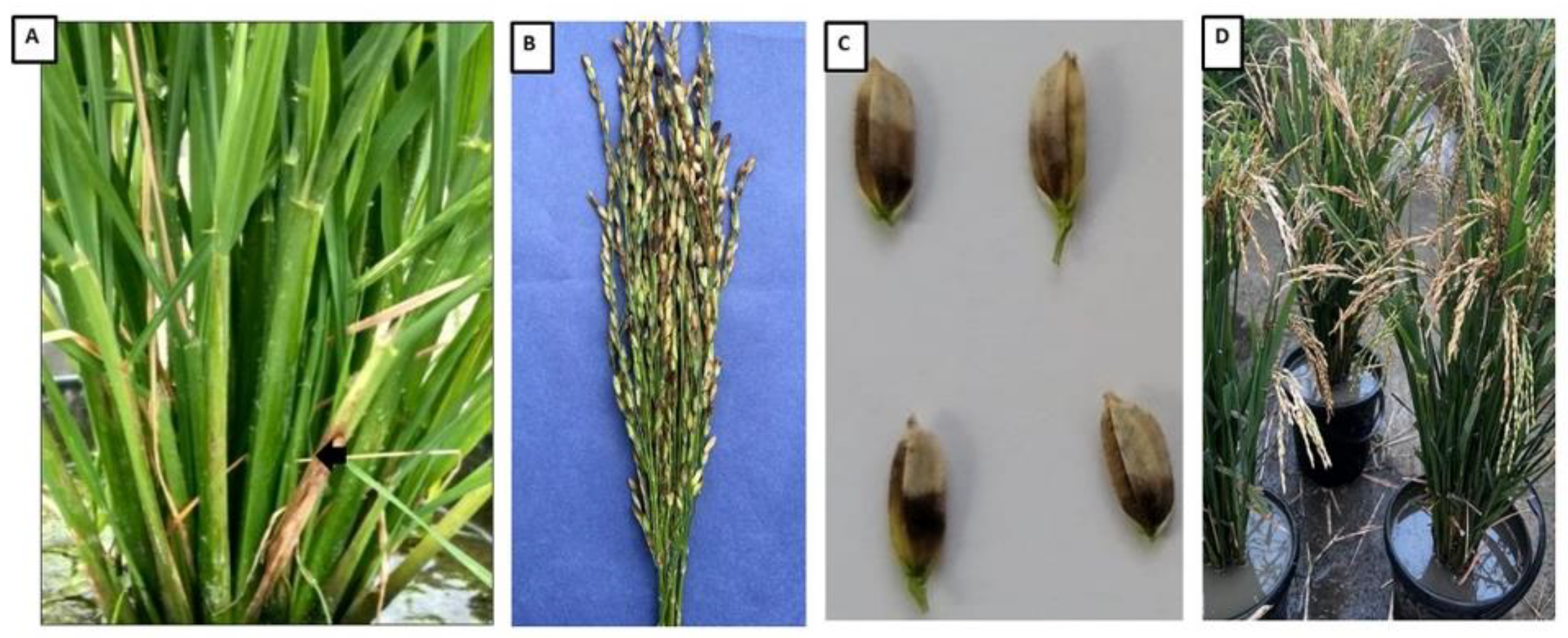
Figure 1. Typical symptoms of bacterial panicle blight (BPB) of rice. (A) Lesion on the sheath, displaying a vertical grayish area with a dark reddish-brown border (arrow). (B, C) Panicle symptoms include straw-colored spikes with florets showing darker basal and reddish-brown marginal lines. (D) Field infections on a susceptible cultivar (Oryza sativa L. cv. Horidhan) showing heavily infected panicles that remain erect due to grain abortion.
Preprints 194311 g001
Figure 2. Morphological and molecular identification of target bacterial isolates. (A) Colonies on S-PG medium showing distinct morphology. (B) Enlarged views of selected colonies indicated by arrows: Type A colonies are round with smooth edges and reddish-brown discoloration, and Type B colonies are round with a central purple reflection on a magenta background. (C) Detection of B. glumae and B. gladioli in infected rice panicles by PCR, with amplification of gyrB gene fragments of 479 bp and 529 bp, respectively.
Preprints 194311 g002
Figure 3. Assessment of pathogenicity and hypersensitive response assays. (A) Virulence evaluation of leaf sheath in rice seedlings (Oryza sativa L. cv. Horidhan) scored as + (weak), ++ (moderate), +++ (severe), or 0 (non-pathogenic) (B) Disease severity (DS) on rice panicles using a 0–9 scale. (C) Hypersensitive response in Nicotiana tabacum leaves 48 h after infiltration with ~10⁸ CFU/mL of toxoflavin-producing strains; sterile water-infiltrated leaves showed no reaction. Arrows mark necrotic spots. .
Preprints 194311 g003
Figure 4. Virulence of B. glumae and B. gladioli strains on onion bulb scales and their correlation to rice panicle disease severity. (A) Onion bulb scales were inoculated with bacterial suspensions (~5 × 10⁵ CFU/mL) and incubated at 30 °C for 48 h post-inoculation; different isolates exhibited varying degrees of tissue maceration compared to sterile water (which was used as control). (B) The area of tissue maceration for each strain was measured. (C) Correlation between onion scale tissue maceration and rice panicle disease severity with a linear regression line. All regression coefficients were statistically significant (P < 0.05). Error bars represent standard errors from three biological replicates. Statistical analyses were performed with R version 4.4.1.
Preprints 194311 g004
Figure 5. Toxoflavin production and molecular features of B. glumae and B. gladioli strains. (A) Toxoflavin phenotypes on King’s B agar after incubation for 48 h at 37 °C; all Burkholderia strains produced pigment while the negative control did not (B) Toxoflavin pigment extraction via chloroform following bacterial cell removal. (C) Spectrophotometric measurement of toxoflavin at 393 nm. (D) Schematic representation of the toxin-producing gene clusters in two bacterial strains, B. glumae (strain BD_21g) and B. gladioli (strain BDBgla132A). In B. glumae (chromosome 2) the tox operon comprises the following genes in sequential order: toxJ, toxR, toxH, toxG, toxF, toxI, toxA, toxB, toxC, toxD, and toxE. In contrast, in B. gladioli (chromosome 1), the same genes are similarly arranged but with toxR relocated downstream of toxF. (E) Relative expression of the toxA–toxR genes was quantified by qPCR, normalizing to 16S rRNA and setting B. gladioli (BDBgla132A) expression to 1 for the control strain, whereas B. glumae (BD_21g) served as the test strain. Error bars represent standard errors from three independent biological replicates. All differences between groups were statistically significant at P < 0.05, as determined by the Duncan’s multiple range test (DMRT) and Student’s t-tests, which we conducted using the R software (version 4.4.1).
Preprints 194311 g005
Figure 6. Phenotypic traits of lipase production in B. glumae and B. gladioli. (A) Extracellular lipase activity on LB agar supplemented with 5% Tween 20, indicated by opaque halos surrounding BD_21g and BDBgla132A colonies; the negative control showed no activity. (B) Chromogenic assay with p-nitrophenyl palmitate, indicating lipase activity by yellow coloration in the test strains but not in the control. (C) Spectrophotometric measurement of lipase activity across multiple bacterial isolates at 410 nm. (D) Comparative genomic organization of the lipase-encoding genes lipA (teal) and lipB (yellow) in B. glumae (strain BD_21g) and B. gladioli (strain BDBgla132A). Both species exhibit tandem co-localization of lipA and lipB on chromosome 2 in the same orientation (lipA upstream of lipB), differing only in intergenic spacing. (E) Relative expression of lipA and lipB transcripts in B. glumae BD_21g compared to B. gladioli BDBgla132A (set to 1). Error bars denote standard errors calculated from three independent biological replicates. All observed differences between groups were statistically significant at the P < 0.05 level, as determined by the Duncan’s multiple range test (DMRT) and Student’s t-tests, which were conducted using the R statistical software (version 4.4.1).
Preprints 194311 g006
Figure 7. Phenotypic and molecular characterization of polygalacturonase activity in B. glumae and B. gladioli. (A) Pectinolytic activity on semi-solid pectate-yeast agar (PEC-YA) showing halo formation around BDBgla132A and BD_21g colonies, unlike the negative control (B) Quantitative spectrophotometric measurement of polygalacturonase activity at 530 nm. (C) Comparative genomic organization of polygalacturonase-encoding genes pehA (yellow) and pehB (teal) in B. glumae (strain BD_21g) and B. gladioli (strain BDBgla132A). In B. glumae, pehA and pehB are located on separate replicons (chromosomes 1 and 2, respectively), whereas in B. gladioli both genes are arranged in tandem on chromosome 1. (D) Relative expression levels of pehA and pehB in BD_21g compared to BDBgla132A (expression normalized to 1). Error bars represent standard errors from three independent biological replicates. All differences were statistically significant at P < 0.05 (DMRT and Student’s t-tests, conducted in R v4.4.1).
Preprints 194311 g007
Figure 8. Phenotypic and molecular features of motility in B. glumae and B. gladioli. (A) Swarming motility assays on 0.5% LB agar, showing the characteristic dendritic spreading for the positive isolates but not for the negative control (B) Quantitative measurement of swarming motility across Burkholderia strains, expressed as the diameter of motility zone on agar plates incubated at 34 °C. (C) Genomic organization of motility and chemotaxis gene clusters in B. glumae and B. gladioli. Chromosomal loci (chromosome 1) from B. glumae BD_21g and B. gladioli BDBgla132A (top and middle) show adjacent genes including fliD, fliC, flhD, flhC, motA, cheY, cheA, cheW, cheD, cheB, cheZ, flhB, flhA, flhF, and flhG. The B. glumae plasmid 2 and B. gladioli chromosome 1 fragments (second and bottom) each contain the fliA gene. Color coding highlights conserved homologous genes between strains. (D) Relative expression of flagellar regulatory genes flhF and flhC in B. glumae strain BD_21g normalized to expression in B. gladioli strain BDBgla132A (set to 1). Error bars represent standard errors from three biological replicates. Statistical analyses were performed using R v4.4.1. All comparisons were considered statistically significant at P < 0.05 using the Duncan’s multiple range test (DMRT) and Student’s t-tests.
Preprints 194311 g008
Figure 9. Phylogenetic tree of concatenated toxoflavin synthesis genes (toxA, toxB, toxC, toxD, toxE, toxF, toxG, toxH, toxI, toxJ, and toxR) from B. gladioli and B. glumae. The tree was constructed using the Maximum Likelihood method with the Tamura–Nei [45] substitution model in MEGA 12 software [44], based on concatenated alignment of 28 nucleotide sequences (21,891 bp total). Bootstrap support values (1,000 replicates, ≥80% threshold) are shown at branch nodes. Branch lengths represent nucleotide substitutions per site.
Preprints 194311 g009
Figure 10. Phylogenomic analysis of concatenated lipase-encoding genes (lipA/lipB) from B. gladioli and B. glumae. The tree was constructed using the Maximum Likelihood method with the Tamura–Nei [45] substitution model in the MEGA 12 software [44], based on concatenated alignment of 28 nucleotide sequences (2,136 bp). Bootstrap support values (based on 1,000 replicates) are shown at branch nodes. Branch lengths represent nucleotide substitutions per site.
Preprints 194311 g010
Figure 11. Molecular phylogeny of pectinase-encoding genes of concatenated pectinase-encoding genes (pehA/pehB) from B. gladioli and B. glumae. Maximum Likelihood phylogeny (Tamura–Nei model [45]) was inferred in MEGA 12 [44] from 28 concatenated nucleotide sequences (4,488 bp). Bootstrap support values (1,000 replicates) are indicated at nodes; branch lengths represent nucleotide substitutions per site.
Preprints 194311 g011
Figure 12. Maximum Likelihood phylogeny of concatenated flagellum-encoding genes (cheA, cheB, cheD, cheR, cheW, cheY, cheY1, cheZ, flhA, flhB, flhC, flhD, flhF, flhG, fliA, fliC, fliD, tsr, motA, and motB) from B. gladioli and B. glumae. The tree was constructed using the Tamura–Nei [45] substitution model in MEGA 12 software [44] based on 19 concatenated genes from 28 nucleotide sequences (24,645 bp). Bootstrap support values (1,000 replicates) are shown at branch nodes. Branch lengths represent nucleotide substitutions per site. Branches with <80% bootstrap support were collapsed.
Preprints 194311 g012
Table 1. Pathogenicity test results of bacterial strains isolated from rice exhibiting bacterial panicle blight symptoms, and categorization based on isolate identity.
Isolate IDa Species Pathogenicity testb Disease severityc
(0-9 scale)
Seedling Panicle
BD_21g B. glumae +++ +++ 9.0 ± 0a***
BDBgla132A B. gladioli +++ +++ 8.2 ± 0.23ab***
BDBgla117A B. gladioli +++ +++ 7.8 ± 0.23ab***
BDBgla135A B. gladioli +++ +++ 8.0 ± 0.31ab***
BDBgla122A B. gladioli +++ +++ 7.9 ± 0.27ab***
BDBgla78A B. gladioli ++ +++ 7.2 ± 0.12ab***
BDBgla119A B. gladioli ++ +++ 7.3 ± 0.18b***
BDBgla136A B. gladioli ++ +++ 7.5 ± 0.58de***
BDBgla59A B. gladioli ++ +++ 7.0 ± 0.12bc***
BDBgla150A B. gladioli + ++ 7.6 ± 0.31bc***
BDBgla81A B. gladioli + ++ 5.7 ± 0.24bcd***
BDBgla120A B. gladioli + ++ 5.9 ± 0.58cde***
BDBgla140A B. gladioli + ++ 5.7 ± 0.29de***
BDBgla83A B. gladioli + ++ 5.6 ± 0.31de***
BDBgla79A B. gladioli + ++ 5.2 ± 0.12e***
BDBgla130A B. gladioli + ++ 5.1 ± 1.16e***
BDBgla38A B. gladioli + ++ 5.5 ± 0.35e***
BDBgla162A B. gladioli 0 + 3.7 ± 0.29f***
BDBgla151A B. gladioli 0 + 2.5 ± 0.73f***
BDBgla41A B. gladioli 0 + 2.7 ± 0.87f***
Control Sterile water 0 0 0.0 ± 0g
a Bacterial strains were isolated from panicle grains across Bangladesh. bPathogenicity reactions were scored as +++ (highly virulent), ++ (moderately virulent), + (weakly virulent), and 0 (non-pathogenic). cDisease severity was scored on a 0–9 scale (0 = no symptoms; 1 = 0.1–10.0% of the panicle affected; 3 = 11–20% of the panicle affected; 5 = 21–30% of the panicle affected; 7 = 31–60% of the panicle affected; 9 = >61% of the panicle affected). Values are presented as means ± standard errors (SE) from three replicates. Lowercase letters (a–g) indicate statistically significant differences among isolates (P < 0.05) according to the Duncan’s multiple range test (DMRT). Isolates sharing the same letter are not significantly different from each other. Asterisks indicate significance relative to the control: ***, P < 0.001.
Table 2. Homology of virulence-associated genes between the B. gladioli BDBgla132A and B. glumae BD_21g genomes.
Virulence factor Gene Gene accession
(BDBgla132A)
Gene accession
(BD_21g)
Protein identity (%)
Toxoflavin toxA WP_047837656.1 WP_230674340.1 96.23
toxB WP_013696509.1 WP_042967738.1 98.11
toxC WP_186032113.1 WP_012733473.1 97.51
toxD WP_186146217.1 WP_012733474.1 96.63
toxE WP_186044336.1 WP_017922993.1 71.07
toxF WP_186146218.1 WP_012733469.1 92.67
toxG WP_186012765.1 WP_012733468.1 92.08
toxH WP_439968039.1 WP_251107611.1 97.48
toxI WP_439967532.1 WP_230674341.1 44.35
toxJ WP_047838500.1 WP_012733464.1 77.50
toxR WP_047837657.1 WP_012733470.1 96.01
Lipase lipA WP_047838330.1 WP_012733585.1 88.55
lipB WP_440015440.1 WP_251107590.1 80.71
Polygalacturonase pehA WP_186012903.1 WP_017922174.1 84.53
pehB WP_439967530.1 WP_017423921.1 87.35
Chemotaxis and flagella cheA WP_440017944.1 WP_251107216.1 97.22
cheB WP_047836241.1 WP_012734288.1 96.06
cheD WP_036029515.1 WP_012734287.1 93.07
cheR Absent - -
cheW WP_043219446.1 WP_012734284.1 92.57
cheY WP_013696282.1 WP_012734289.1 96.18
cheY1 WP_013696275.1 WP_302074279.1 80.80
cheZ WP_047836242.1 WP_012734290.1 84.52
flhA WP_036038249.1 WP_012734295.1 95.86
flhB WP_013696287.1 WP_100556214.1 89.72
flhC WP_013696272.1 WP_012734279.1 96.72
flhD WP_025099997.1 WP_043226645.1 96.23
flhF WP_440017650.1 WP_251107218.1 93.19
flhG WP_013696290.1 WP_012734297.1 84.39
fliA WP_013696291.1 WP_017433111.1 95.67
fliC WP_186011140.1 WP_100556208.1 90.10
fliD WP_047836234.1 WP_012734272.1 66.92
motA WP_013696273.1 WP_012734280.1 96.50
motB Absent - -
tsr Absent - -
Disclaimer/Publisher’s Note: The statements, opinions and data contained in all publications are solely those of the individual author(s) and contributor(s) and not of MDPI and/or the editor(s). MDPI and/or the editor(s) disclaim responsibility for any injury to people or property resulting from any ideas, methods, instructions or products referred to in the content.
Copyright: This open access article is published under a Creative Commons CC BY 4.0 license, which permit the free download, distribution, and reuse, provided that the author and preprint are cited in any reuse.
Prerpints.org logo

Preprints.org is a free preprint server supported by MDPI in Basel, Switzerland.

Subscribe

Disclaimer

Terms of Use

Privacy Policy

Privacy Settings

© 2026 MDPI (Basel, Switzerland) unless otherwise stated