

Submitted:
31 December 2025
Posted:
15 January 2026
You are already at the latest version
Abstract
Professional practice in clinical and educational contexts frequently operates under a “naive realist” assumption: that professionals and subjects inhabit an identical world, accessible through standardized metrics. This presumes that the professional’s sensory capture constitutes an objective baseline rather than a specific, stabilized interface. We argue that no practitioner—particularly in mental health or education—can legitimately assume that their perceptual field equates to ontological reality. This error drives a systematic structural failure we term epistemic appropriation: the professional’s fundamental inability to conceive that the Other inhabits a legitimately different perceptual reality. Drawing on the Trace & Trajectory Framework (TTF) and Interface Theory of Perception, we provide formal tools to map what critical literature terms “minoritization” and “epistemic injustice.” Epistemic appropriation operates through three complementary manifestations: flattening (the dominant agent’s geometric collapse of the Other’s autonomous identity space into a marginal subset of their own navigational terrain); internalization (the subalternized agent’s coerced construction of self-access routes through dominant-compatible positions); and trajectorial refraction (resistance operations that disrupt the appropriation cycle—counter-exonymy and autonymy exemplify this mechanism). We model this asymmetry endogenously through an Asymmetry Function (gasym) that specifies how differential stabilization dynamics produce navigational inequality: massive institutional recurrence generates configurations whose elevated maintenance costs are collectively distributed and rendered phenomenologically invisible through mimetic naturalization, thermodynamically overwriting fragile autonomous trajectories that bear their full maintenance burden without collective support. Critically, intersubjectivity occurs not through shared ontological space but via transductive coupling—systematic correspondence between distinct navigational interfaces, where asymmetry resides not in the coupling mechanism itself but in the differential Transductive Coupling Costs imposed by exchange protocols and historically saturated semiotic patterns. This formalization distinguishes epistemic appropriation from internalized oppression, provides operational indicators for detecting these dynamics in professional practice, and makes implicit ontological erasure analytically tractable.
Keywords:
epistemic appropriation
; epistemic injustice
; Interface Theory of Perception
; transductive coupling
; minoritization
; clinical epistemology
; Trace & Trajectory Framework
1. Introduction: The Invisibility Problem in Epistemic Justice Research
Contemporary clinical-diagnostic and educational practice operates under an implicit paradigm that reduces the operations that converge in an apparent shared reality to a singular objective reality—one where the professional’s stabilized perceptual baseline functions as the standard of truth. In contrast, the subject’s autonomous navigational reality is reconfigured as “approximately correct” or “developmentally prior” to genuine understanding. While intersubjective convergence is necessary for communication, the foundational presumption that professionals and subjects (patients or students) inhabit a world with uniform perceptual properties and signification processes constitutes a fundamental category error. This imposition of “sameness” has historically functioned as a mechanism of implicit discrimination, systematically marginalizing identities—indigenous and neurodivergent populations, chronic illness communities, gender and sexual minorities—whose autonomous phenomenological baselines are pathologized rather than recognized as valid variations in human experience [1,2,3].
This paradigm rests on what cognitive scientists term “naive realism”: the conviction that our perceptions are transparent windows onto objective reality. However, contemporary research in evolutionary game theory and consciousness science—specifically the Interface Theory of Perception (ITP)—dismantles this assumption. Hoffman [4] demonstrates that perceptual systems evolve not to reveal truth but to hide it, replacing complex entropic dynamics with simplified, species-specific user interfaces optimized for fitness, not veridicality. Consequently, divergence in perceptual reality between agents is not an anomaly to be corrected but a fundamental feature of consciousness. When a professional dismisses a patient’s divergent reality, they commit the category error of mistaking their own normative interface—an artifact shaped by institutionalized views often serving epistemic dominance—for the objective world itself.
The rich conceptual apparatus developed over the past decade has powerfully articulated what happens when professionals flatten complex, lived experiences into manageable categories. From Fricker ’s foundational work on epistemic injustice—distinguishing testimonial injustice (not being believed) from hermeneutic injustice (lacking interpretive resources)—to Milton ’s radical reconceptualization of autism through the Double Empathy Problem, and the Deaf Gain framework’s insistence on deafness as epistemological enrichment rather than deficit [5], scholars have demonstrated that what appears as individual professional incompetence is in fact a systematic feature of institutions optimized for standardization, efficiency, and normativity.
Yet this critical literature faces a persistent limitation: while it compellingly documents phenomenology and consequences, it lacks formal tools for modeling the mechanics of what it describes. How precisely does ontological erasure occur? What geometric operations flatten complex perceptual realities into deficit categories? Through what navigational dynamics do marginalized subjects internalize dominant framings of their identities? And what structural features enable or constrain resistance? The present paper addresses this methodological gap.
Drawing on the Trace & Trajectory Framework (TTF) and its Hexagonal Identity Dynamics (HEXID) apparatus [6,7], we propose a formal account of epistemic appropriation—the systematic operation through which dominant agents render subalternized others not as inhabitants of autonomous perceptual realities but as marginal positions within the dominant agent’s own navigational terrain. The operation is geometric: the Other’s hexid (identity space) is compressed into a peripheral subset of the appropriating agent’s hexid, stripping the Other of their experiential zero-point () and thereby denying them the status of autonomous navigational centers.
This formalization treats what critical literature documents as “minoritization,” “diagnostic flattening,” and “testimonial injustice” as manifestations of a unified mechanism operating through three complementary operations:
- Flattening: The dominant agent’s geometric collapse of the Other’s complex, autonomous hexid structure into a marginal, high-entropy position within the dominant agent’s navigational space.
- Internalization: The subalternized agent’s coerced construction of self-access routes through outer-ring positions that function as mirrors of dominant valuations, blocking return to minimal selfhood ().
- Trajectorial refraction: Resistance operations that disrupt the appropriation cycle through emergent topological configurations that contest dominant saturations—saturation against saturation. Counter-exonymy (autonomous naming) exemplifies this mechanism: the trajectory toward endonyms (Yoreme, Deaf, autistic) necessarily traverses the exonymic trace (“Mayo,” “hearing-impaired,” “person with autism”) before emerging at a refracted angle, contesting flattening while operating within the same register.
Critically, intersubjectivity in this framework occurs not through shared ontological space but via transductive coupling—systematic (though imperfect) correspondence between navigational configurations across distinct interfaces. Each agent has exactly one interface at any moment: their actively navigated hexid (). There are no “third spaces” where agents co-inhabit a neutral ground. Instead, what appears as intersubjective encounter is transductive rendering: each agent’s interface maintains configurations that systematically correspond to the other’s, mediated by transductive protocols () and constrained by exchange protocols (). Asymmetry resides not in the transductive mechanism itself—which remains relatively neutral—but in differential informational costs imposed by exchange protocols and in the historical saturation of institutional Stabilized Semiotic Patterns (SSPs) that favor dominant agents’ navigational ease.
However, a critical qualification is required regarding the Hexid Locality Principle (see Appendix A): while all navigation occurs strictly within the agent’s own hexid, deep structural currents—SSPs operating closer to the NET substrate or constituting inertial navigation—do not “respect” this boundary simply because they are blind to hexid dissociation. These fundamental forces operate below the threshold of individuated coherence, traversing the substrate without registering the boundaries that define the agent’s phenomenological limit. For the conscious agent, however, the boundary remains the relative horizon of experience. This distinction explains why institutional power can feel simultaneously external (operating through transductive coupling) and internally coercive (manifesting as inertial navigation that shapes the agent’s very capacity for autonomous movement).
1.1. Theoretical Objectives and Empirical Payoffs
This formalization accomplishes several objectives that existing critical frameworks cannot achieve through conceptual analysis alone.
First, it provides analytical precision without sacrificing phenomenological richness. Unlike psychometric scales that risk committing the very appropriation they aim to measure [8], TTF’s trajectory-based approach preserves the dynamic, situated character of lived experience while rendering its structural patterns explicit and analytically tractable.
Second, it distinguishes epistemic appropriation from related but distinct phenomena such as internalized oppression. While internalized oppression describes how colonized subjects come to occupy positions within their own identity space that reflect dominant valuations [9], epistemic appropriation describes the prior operation through which the appropriating agent represents the Other not as possessing an autonomous identity space at all, but as a compressed subset within the agent’s own navigational framework. Appropriation is thus revealed as the precondition that enables subsequent colonial inscription. The subalternized agent’s construction of mirror positions () in response to appropriation constitutes internalization—a distinct though causally linked phenomenon.
Third, the formalization enables operational detection. By specifying the trajectorial signatures of appropriation—characteristic patterns of forced deviation, blocked -return, asymmetric informational cost, and stabilization in outer-ring positions—the framework provides concrete indicators for identifying the dynamics of “you are in my realm” in professional discourse and practice. Section 4 develops these operational indicators in detail, translating theoretical insights into methodological protocols applicable to clinical transcripts, educational interactions, and institutional documents.
Fourth, the framework integrates resistance as an intrinsic component rather than an external addition. Trajectorial refraction is not merely reactive refusal but a geometric operation with its own formal properties: the assertion of autonomous (experiential baseline) and the demand for recognition of the full hexid structure. Moreover, the formalization reveals why resistance is unevenly distributed and informationally costly: agents operating within high-saturation institutional SSPs face structural pressure that makes sustained resistance thermodynamically expensive. Yet the framework also identifies navigational resources that support resistance—particularly baseline-oriented navigation and access to alternative configurations (collective transductive routines such as Deaf cultural institutions, neurodivergent communication spaces, or indigenous community assemblies) that shield autonomous meaning-making without requiring permanent occupation of the experiential zero-point (which is phenomenologically rare in any case).
1.2. Paper Structure and Methodological Approach
The structure of this paper reflects these objectives. Section 2 synthesizes the critical literature on epistemic appropriation across clinical and educational contexts, establishing the empirical and conceptual landscape that motivates formalization. We document how professionals systematically fail to recognize patients and students as inhabiting legitimately different perceptual realities, examining patterns of diagnostic flattening, educational minoritization, and testimonial dismissal across diverse populations.
Section 3 develops the formal apparatus. We first introduce the Asymmetry Function (), which specifies the structural conditions—historically saturated SSPs, asymmetric exchange protocols, and mimetic configurations—that produce navigational inequality. We then formalize epistemic appropriation as a unified mechanism with three manifestations, demonstrating how institutional power asymmetry—operationalized through differential stabilization dynamics and transductive coupling costs—produces both flattening and coerced internalization. Readers unfamiliar with TTF’s foundational architecture (traces, threads, trajectories, positions, hexid geometry, / parameters) should consult Appendix A, which provides a self-contained technical introduction. This section introduces the three key equations that capture the formal structure:
- The appropriation mapping:
- The flattening operation:
- The resistance function:
Section 4 proposes operational indicators for detecting these dynamics in professional practice, translating theoretical insights into methodological protocols. We specify trajectorial signatures observable in clinical transcripts, educational discourse, and institutional documentation: asymmetric Transductive Coupling Costs (TC), blocked -return, forced outer-ring stabilization, and differential access to meta-reflexive epistemic modes. These indicators make implicit ontological erasure empirically tractable without imposing the reductive quantification that characterizes conventional psychometric approaches.
Section 5 reflects on the framework’s contributions, acknowledges its limitations, and identifies directions for empirical validation. We emphasize that while TTF provides analytical precision unavailable in purely conceptual critique, it does not replace but rather complements the rich phenomenological work already accomplished in critical disability studies, decolonial theory, and epistemic justice research. The formalization’s value lies in rendering visible the geometric mechanics that critical literature has powerfully described but struggled to operationalize.
Throughout the paper, we maintain that professionals in clinical and educational contexts operate not through individual malice but through structural configurations that make ontological erasure the path of least informational resistance. The professional’s failure to recognize the patient’s or student’s autonomous reality is not primarily a cognitive deficit but a thermodynamic inevitability when navigating through high-saturation institutional SSPs that have been stabilized precisely to minimize the informational cost of standardization. Resistance to these dynamics requires not merely good intentions but active cultivation of navigational resources—-return capacity, baseline-oriented navigation, meta-reflexive epistemic modes—that counter the structural pressure toward appropriation. The framework thus provides both diagnostic tools for identifying appropriation dynamics and interventional directions for disrupting them.
Note on theoretical prerequisites: The formalization in Section 3 employs the technical vocabulary of the Trace & Trajectory Framework (TTF), including traces, threads, trajectories, positions, hexid geometry, and the / parameter system. Readers unfamiliar with this apparatus should consult Appendix A before proceeding to Section 3. The appendix provides a self-contained introduction sufficient for following the argument.
2. Critical Literature Review: Mapping Epistemic Appropriation Across Contexts
The past decade has witnessed an explosion of critical scholarship documenting systematic failures of professional practice to recognize divergent lived realities. From Fricker’s foundational work distinguishing testimonial from hermeneutical epistemic injustice, to radical reconceptualizations of neurodivergence and sensory difference, researchers have demonstrated that what appears as individual professional incompetence is in fact a structural feature of institutions optimized for standardization and normative enforcement. This section synthesizes key developments across clinical and educational domains, establishing the empirical and conceptual foundation for our subsequent formalization.
2.1. Epistemic Injustice: From Testimonial to Structural
Fricker [10] distinguished two fundamental forms of epistemic injustice. Testimonial injustice occurs when a speaker’s testimony is accorded reduced credibility due to identity-based prejudice—the patient not believed because they are chronically ill, the student dismissed because they are autistic. Hermeneutical injustice arises when collective interpretive resources are structured such that marginalized groups lack adequate concepts to articulate their own experiences—the absence of language that would render their reality communicable.
In clinical contexts, both forms operate simultaneously and systematically. Crichton et al. [11] document how psychiatric practice structurally dismisses patient testimony while simultaneously lacking conceptual frameworks adequate to the complexity of lived mental distress. Kidd Carel [12] extend this analysis to chronic illness, demonstrating that biomedical epistemology’s commitment to objectifiable pathology generates a hermeneutical void: patients experiencing conditions without clear biomarkers possess no legitimate vocabulary within which to assert their reality.
Critically, Nielsen et al. [13] identify the field’s persistent limitation: abundant theoretical critique without reproducible methodological protocols for detecting and measuring epistemic injustice in professional practice. Researchers can describe appropriation eloquently but struggle to model its mechanics with precision sufficient for systematic intervention. Our formalization addresses this gap by providing geometric tools that render appropriation operations analytically tractable.
2.2. The Double Empathy Problem: Reconceptualizing Neurodivergence
The Double Empathy Problem (DEP), proposed by Milton [14], represents a fundamental paradigm shift in understanding autistic-neurotypical communication. Traditional deficit models attributed communicative breakdown to unilateral impairment in autistic individuals—theory of mind deficits, social skills deficiencies. The DEP demonstrates that difficulties arise from bidirectional incomprehension: autistic individuals struggle to understand neurotypicals, and neurotypicals struggle equally to understand autistic individuals.
Empirical validation has been compelling. Crompton et al. [15] demonstrated experimentally that autistic dyads achieved high-precision information transfer with mutual satisfaction, while mixed autistic-neurotypical pairings exhibited significantly greater distortion and frustration. This suggests that each neurocognitive group operates within a shared communicative idiom, and collision occurs not due to deficit in either party but due to absence of common code.
Yet the DEP, while conceptually transformative, lacks formal apparatus for modeling how the “empathy gap” operates mechanically. TTF provides this apparatus: the gap emerges from asymmetric saturation of institutional SSPs that favor neurotypical navigation, forcing autistic agents to bear disproportionate transductive coupling costs in every institutional encounter.
2.3. Deaf Gain and Linguistic Minoritization
The Deaf Gain framework [5] inverts deficit framing by demonstrating that Deaf ways of being constitute epistemological contributions rather than absences. Visual-spatial cognition, signed language poetry, Deaf cultural institutions—these represent genuine additions to human epistemic repertoire, not compensations for hearing loss.
This inversion directly challenges the appropriative operation: rather than appearing as a compressed deficit position within hearing navigational space, Deafness is revealed as an autonomous with its own legitimate hexid structure. The framework provides conceptual resources for counter-exonymy—the assertion of “Deaf” (cultural identity) against “hearing-impaired” (deficit category)—but lacks formal tools for modeling the geometric dynamics through which such assertions operate.
2.4. Chronic Illness and the “Medically Unexplained”
Patients with chronic illness occupy a particularly precarious epistemic position. When conditions lack clear biomarkers, when symptoms fluctuate unpredictably, when subjective experience diverges from objective measurement, biomedical epistemology generates the category “medically unexplained symptoms” (MUS)—a classification that explicitly marks the patient’s reality as epistemically illegitimate [16].
The MUS category exemplifies flattening: the patient’s rich phenomenological reality—complex, fluctuating, embodied—is compressed into a deficit-coded position (“unexplained” = lacking legitimate explanation) within the clinician’s diagnostic hexid. The patient does not appear as possessing an autonomous phenomenology that the clinician’s categories fail to capture; rather, the patient appears as failing to fit the clinician’s categories, with the failure attributed to the patient’s reality rather than the categories’ limitations.
2.5. Educational Minoritization and DisCrit
In educational contexts, Disability Critical Race Theory (DisCrit) has documented systematic minoritization of students whose learning styles diverge from institutional norms [17]. Students are not recognized as possessing alternative cognitive configurations with their own legitimacy; rather, they are rendered as deficient approximations of normative learners.
Teague [18] extends this analysis to autistic parents navigating educational systems on behalf of autistic children, documenting how “compulsory neuronormativity” operates through institutional protocols that systematically delegitimize autistic epistemic authority. The parent who knows their child’s needs is overridden by professionals operating through standardized assessment instruments—instruments saturated with neurotypical assumptions.
The educational literature thus confirms the pattern observable across clinical contexts: systematic failure to recognize autonomous phenomenological baselines, compression of complex realities into deficit categories, and structural delegitimization of non-normative knowledge claims.
3. Formalizing Epistemic Appropriation
This section develops the formal apparatus for analyzing epistemic appropriation, drawing on the TTF architecture introduced in Appendix A.
3.1. The Asymmetry Function: Architectural Context
Before formalizing epistemic appropriation, we must clarify where asymmetry resides within the navigational architecture. A common misreading assumes that the mechanisms of connection themselves—the channels that allow communication between agents—are the sources of inequality. They are not. Asymmetry does not reside in the capacity to connect, but in the costs and configurations that govern that connection.
Asymmetry emerges from the convergence of three structural factors, formalized as:
Each component contributes distinctly:
-
: Historically Saturated SSPsThread bundles crystallized through asymmetric social reproduction. These are not neutral objects but crystallized asymmetry, saturated through countless prior navigations encoding power differentials into the informational landscape itself.
-
: Exchange ProtocolsThe informational economy governing what flows between interfaces and at what cost. Exchange protocols can favor certain agents through differential access (who can speak?), asymmetric validation requirements (whose claims require evidence?), and cost gradients (who must expend effort to be heard?).
-
: MimesisInternal structures within each hexid that mirror other hexids. This is the generative operation where internalized asymmetry resides—producing the mirror positions () that subalternized agents construct under sustained institutional pressure.
Critical architectural note: The function is purely structural—it specifies the conditions that produce asymmetry when agents navigate, not the navigation itself.
To illustrate concretely, consider how the asymmetry function operates in a clinical encounter:
| Component | Clinical Instantiation |
| diagnostic categories, examination room layout, intake form structure | |
| clinician controls duration; patient must justify claims | |
| patient’s internalized “deficiency” narrative | |
| actual navigation through consultation |
This distinction matters: identifies structural targets for intervention (rearranging the stage), while captures how asymmetry is actualized in specific events (analyzing the performance). Both are necessary for comprehensive critical analysis.
Infrarepresentational Stratification: Where Protocols Operate
SSPs occupy distinct strata relative to the dissociative boundary that individuates hexids. This stratification determines whether a pattern “knows” which agent it belongs to—a crucial property for understanding asymmetry.
We define the dissociative awareness function:
This function indexes the degree to which a pattern “registers” hexid boundaries. Three strata emerge:
-
: Proximal SSPs ()Patterns within the dissociative boundary, fully delimited by hexid individuation. They constitute the representational furniture of conscious experience—objects, categories, social roles.
-
: Medial SSPs ()Patterns at the edge of dissociation—aware that dissociation exists but not fully delimited by it. This is the terrain of transductive coupling: operates here as a Markov blanket.
-
: Distal SSPs ()Patterns below the dissociative boundary, relatively “blind” to hexid individuation. The function (spatiotemporal sequencing) operates on this stratum, which is why spatiotemporality appears as a universal framework rather than agent-specific.
Figure 1 illustrates this stratification in relation to granularity levels and hexid boundaries.
Critical implication for appropriation: Transductive protocols () operate in the medial stratum and do not appear in the asymmetry function. They are infrastructurally neutral—enabling connection without encoding whose interests prevail. Asymmetry arises from (exchange protocols) and (content-bearing patterns), not from the bare capacity to connect. This is why “improving communication” interventions often fail: they target while leaving and intact.
The Gaussian Saturation Principle
To understand how high-density institutional threads can “overwrite” autonomous reality, we must introduce the Gaussian Saturation Principle. This principle posits that the relationship between semiotic saturation (recurrence) and structural resolution (definition) is non-linear, following a Gaussian optimization curve:
- Hypo-Saturation ( / Trace Level): Pure Possibility. At the low end of the curve, there is insufficient saturation to establish boundaries. The substrate is undifferentiated.
- Optimal Saturation (): High Definition. The balance of the curve. Thread bundles achieve sufficient density to individuate clearly, supporting rich phenomenological detail (the specific patient, the specific sensation) without collapsing into generics.
- Hyper-Saturation (): Categorical Collapse. At the high end, massive repetition causes distinct threads to fuse into dense attractors. Boundaries between specific instances are overwritten by the gravitational pull of the category. This produces efficiency at the cost of detail.
Fractal Scope: This logic applies not only to agent-level hexids but fractally to any SSP configuration. Thread bundles, scenery patterns, linguistic saturations, and role configurations all exhibit this same -dependent boundary visibility. At fine , distinct manifestations are resolvable; at coarse , they collapse into undifferentiated classes. This is why meta-level navigation () operates over “kinds of” rather than individuated instances: the analytical grain cannot resolve finer distinctions against the thermodynamic weight of the hyper-saturated category.
Why This Architecture Matters for Epistemic Appropriation
This stratification resolves a persistent confusion in critical literature: the tendency to locate oppression either entirely in “external” structures or entirely in “internal” psychology. TTF’s architecture reveals that:
- Asymmetry is not in the mechanism of communication (), which remains infrastructurally neutral.
- Asymmetry resides in the arrangement of SSPs, exchange protocols, and mimetic configurations—all operating at , within hexid boundaries.
- Internalization is geometrically precise: when a subalternized agent constructs mirror positions (), they are not “importing” external structures but constructing internal configurations that correspond to dominant patterns. The asymmetry becomes part of their own navigational landscape.
- Institutional power operates through differential distribution: dominant agents navigate through SSPs whose elevated intrinsic is offset by collective distribution, high TE, and mimetic naturalization—the maintenance burden is absorbed by institutional infrastructure and rendered phenomenologically invisible. Subalternized agents’ autonomous trajectories face equally high but without collective support, without transductive efficiency, and with the full weight of maintenance cost phenomenologically salient.
Transductive Mimesis: A Critical Clarification
A final architectural clarification concerns transductive mimesis—a concept easily misunderstood. Transductive mimesis is not:
- An object (a hearing aid, a diagnostic form, an appointment slot)
- A type of SSP
- An inherent property of certain renders
Transductive mimesis is:
- An arrangement of the asymmetry function
- A recurrent configuration where SSPs operating at imitate the functions of
Because these mimetic SSPs operate within hexid boundaries (unlike genuine ), they inherit properties foreign to pure transductive protocols: historical saturation encoding whose interests prevail, cost gradients favoring certain agents, and accumulated asymmetry crystallized through prior navigations. The object (the form, the aid, the appointment) can participate in transductive mimetic arrangements, but the arrangement is the target of analysis, not the object.
3.2. The Unified Mechanism: Epistemic Appropriation
With the asymmetry function established, we can now formalize epistemic appropriation as the unified mechanism through which dominant agents incorporate subalternized others into their own navigational terrain rather than recognizing them as autonomous navigational centers.
Definition: Epistemic appropriation is the operation whereby agent A represents agent B not as an autonomous hexid () with legitimate experiential center (), but as a compressed position () within A’s own hexid ():
The notation ⇝ indicates non-isomorphic mapping: B’s full navigational structure is not preserved but compressed. The result is a restricted region—typically a cluster of deficit-coded positions in A’s outer rings ().
Epistemic appropriation is not a single act but a structural configuration that manifests through three complementary operations: flattening (the dominant agent’s compression), internalization (the subalternized agent’s coerced response), and trajectorial refraction (resistance operations).
3.3. Operation 1: Flattening
Flattening is the dominant agent’s geometric collapse of the Other’s autonomous hexid into a marginal subset of their own navigational terrain:
This equation states: the flattening of B by A yields a set of positions () located in A’s outer rings, whose cardinality is much smaller than B’s actual hexid, and where B’s experiential center () is not recognized as legitimate.
This formalization captures what critical literature documents as “minoritization,” “marginalization,” and “epistemic injustice”—here analyzed as geometric operation. B is not ignored or excluded, but incorporated as a marginal subset. The operation asserts: “You exist only insofar as you occupy these coordinates in my space.”
Figure 2.
Flattening as representational compression. The dominant agent’s hexid displays inner rings (dotted arcs) and the outer-ring region . The subalternized subject B does not appear as an autonomous hexid but as a compressed representation (small concentric circles, upper left) embedded in a narrow sector of A’s outer rings. Trajectory represents the dominant agent’s low-cost navigation toward this reduced representation. Note the scalar asymmetry: where B’s actual hexid would possess full navigational structure (with its own , language, culture, epistemology), A’s rendering compresses this to a handful of stereotyped positions (“anxious,” “noncompliant,” “special needs”). The compression is a property of A’s representational apparatus, not of B’s actual navigational space.
Figure 2.
Flattening as representational compression. The dominant agent’s hexid displays inner rings (dotted arcs) and the outer-ring region . The subalternized subject B does not appear as an autonomous hexid but as a compressed representation (small concentric circles, upper left) embedded in a narrow sector of A’s outer rings. Trajectory represents the dominant agent’s low-cost navigation toward this reduced representation. Note the scalar asymmetry: where B’s actual hexid would possess full navigational structure (with its own , language, culture, epistemology), A’s rendering compresses this to a handful of stereotyped positions (“anxious,” “noncompliant,” “special needs”). The compression is a property of A’s representational apparatus, not of B’s actual navigational space.
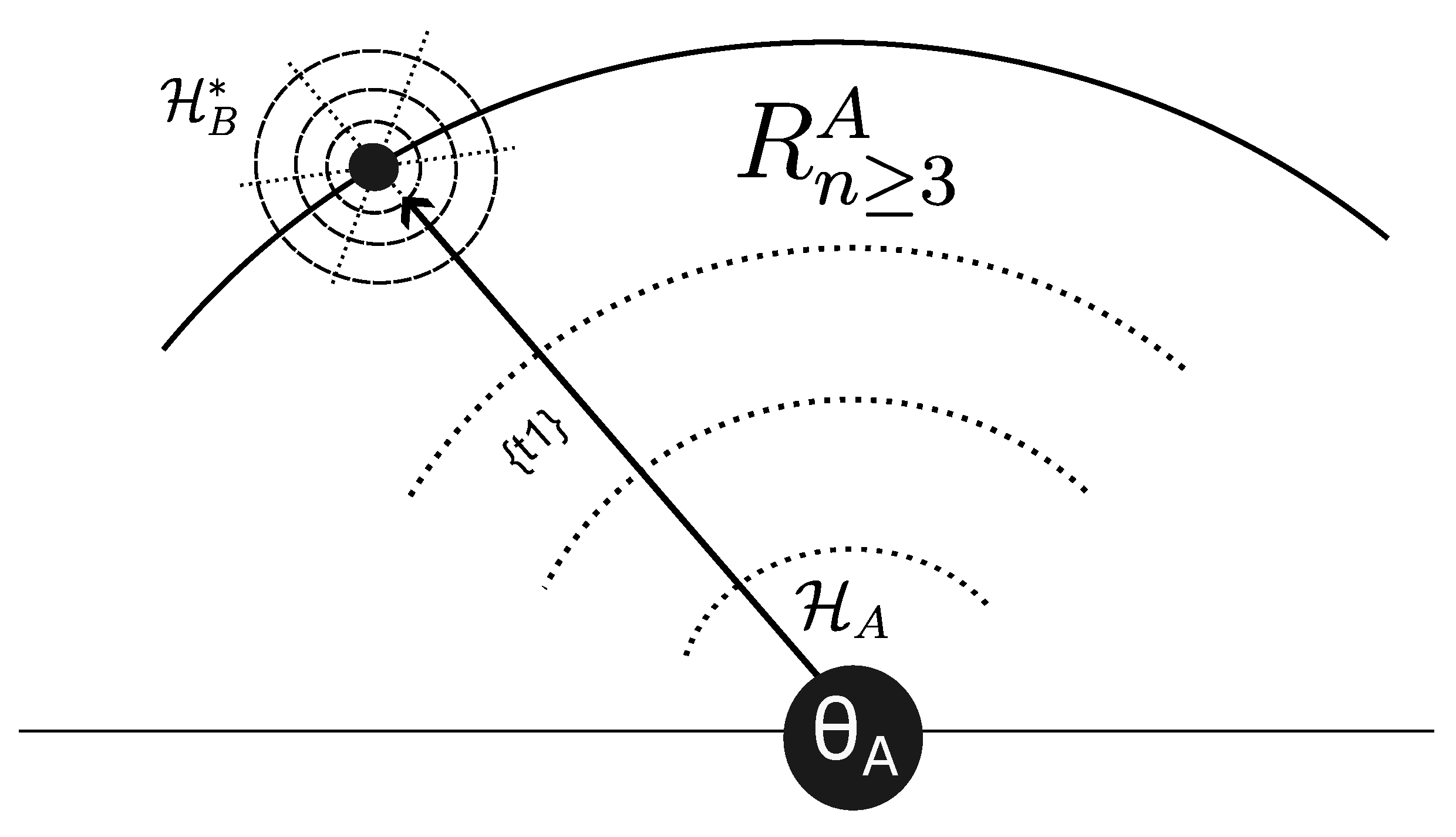
Geometric signatures of flattening:
- Peripheral marginalization: B is represented exclusively in outer rings (, , ) of A’s hexid—abstract categories (“disabled,” “noncompliant,” “difficult”), not core relational or self-identity structures.
- -invisibility: A cannot conceive that B possesses a legitimate experiential baseline. B’s phenomenological reality is treated as aberration from A’s normative standard rather than autonomous validity.
- Dimensional collapse: The rich multidimensionality of —B’s complex navigational possibilities, historical trajectories, relational threads—is compressed into a single deficit-coded node.
- Deficit framing: The position is marked by absence (“lacks focus,” “hearing-impaired,” “medically unexplained”) rather than autonomous presence.
3.4. Operation 2: Internalization and the Appropriation Cycle
Internalization is the subalternized agent’s coerced response—the construction of self-access routes through outer-ring positions that function as mirrors of dominant valuations. Under sustained institutional pressure, agent B constructs what we term mirror positions ()—navigational nodes within their own hexid that reflect dominant agent A’s categories and valuations. These positions become obligatory waypoints: B cannot access even minimal selfhood () without first traversing positions aligned to A’s framework.
Within the architectural framework of , mirror positions constitute the topological artifacts of the mimetic component ()—internal structures that mirror configurations from other hexids. Crucially, mimesis is not “importing” external structures into the hexid (which would violate the Hexid Locality Principle). Rather, the agent constructs internal configurations that correspond to dominant patterns. The asymmetry becomes part of their own navigational landscape.
The Appropriation Cycle
Internalization does not occur in isolation but as part of a self-reinforcing cycle:
- Agent B enters transductive coupling with asymmetrically configured arrangements (clinical encounter, classroom, institutional intake).
- Elevated TC: Transductive Coupling Cost is high because B’s native positions lack correspondence with dominant SSPs. B’s authentic navigation requires continuous “fresh translation” work.
- Asymmetric detection: Agent A (or institutional protocols) detects epistemic distance (lack of Transductive Equivalence) when the transduction cost exceeds its tolerance threshold, i.e., (Eq. 6). Exchange protocols () impose additional costs: B’s claims require more evidence, B’s expressions are scrutinized more heavily, B’s timeline is subordinated to institutional schedules.
-
Response choice: B faces a navigational fork:
- Resist: Maintain autonomous trajectories at high informational cost
- Desaturate: Return toward , disengaging from the encounter
- Align: Construct mirror positions that reduce transductive friction
- If B aligns: Mimetic construction () lowers TC but sediments asymmetric configuration within B’s own hexid.
- Saturation: Repeated alignment saturates mimetic threads. B’s navigation increasingly routes through internalized dominant coordinates.
- Completion: The asymmetric configuration becomes B’s own navigational structure—not external imposition but internal landscape.
This is epistemic appropriation in its complete form: the dominant configuration does not “enter” B’s hexid but inducesB to construct internal structures mirroring dominant coordinates. The result is what we term thermodynamic sedimentation: resistance becomes literally more costly than compliance, not as ideology but as navigation.
The Thermodynamics of Coerced Alignment
The coercion toward internalization operates through the differential stabilization dynamics established in §3.1. Dominant agents navigate through collectively saturated configurations (diagnostic categories, standardized curricula, bureaucratic forms) whose elevated is offset through distributed maintenance. The subalternized agent’s autonomous trajectories lack this collective support; they must be actively maintained against dominant attractors.
The Transductive Coupling Cost (TC) operator (see Appendix A.7) measures the informational burden of cross-interface legibility:
where measures structural distance from dominant SSP configuration, and is a monotonically increasing function of epistemic awareness: as (compliant, unreflective); as (meta-reflexive, critical).
Interpretation: TC is not experienced as cost by agents who have already aligned their navigational habits with dominant SSP coordinates. For the compliant professional (), institutional categories feel like transparent descriptions of reality. For the subalternized agent attempting autonomous navigation, every institutional encounter requires effortful translation.
Entropic Tolerance Threshold ().
Why do professionals defensively reject patient testimony that contests their categories, rather than integrating it as useful information? To model when epistemic distance becomes homeostatically salient—triggering closure rather than adjustment—we introduce an entropic tolerance threshold for agent A. The threshold specifies the point at which transductive coupling cost is no longer metabolizable as routine friction and instead triggers a defensive, closure-preserving response:
is not an independent “personality variable” but a derived parameter that indexes how much perturbation A can integrate without destabilizing the configuration that sustains their position. In extractive lock-in conditions, the threshold is closed (small ): minor perturbations routinely exceed tolerance and are met with defensive appropriation rather than integrative adjustment.
Microcosm integration and threshold closure. Let denote the degree to which A operates inside an integrated microcosm sustained by control mimesis over institutional time, transductive media, and exchange infrastructure. We model the closure relation monotonically as:
so that higher microcosm integration implies a smaller tolerance threshold (greater alarm sensitivity), consistent with the idea that the microcosm’s integrity depends on not integrating perturbations that would reveal its constructed character. High MI is locally stable but globally brittle: the extractive configuration persists precisely because it cannot afford to metabolize challenges to its premises.
When agent B navigates autonomously (maintaining baseline-anchored trajectories oriented toward ), they face unsustainable informational costs in every institutional encounter. Each interaction requires “fresh translation”—reconstructing legibility from scratch because dominant SSPs do not accommodate B’s autonomous structure. Over repeated encounters (K iterations), this cost accumulates:
The alternative is mimetic stabilization: constructing aligned to dominant categories. This requires a one-time construction cost but dramatically reduces per-encounter expenditure:
where due to alignment with institutionally saturated threads. The crossover point occurs when:
Beyond encounters, maintaining autonomous navigation becomes thermodynamically unsustainable. The agent is structurally coerced into constructing —not through conscious choice but through accumulated informational exhaustion.
Consequences of Internalization
-
Blocked -return ( emergence): Access to minimal selfhood (—the agent’s first-ring sense of “I am” prior to categorical saturation) becomes informationally expensive. The subject must “route through” internalized positions () to access even pre-categorical self-reference.A clarification is essential here: genuine -contact is already phenomenologically rare—typically requiring contemplative cultivation or altered states. What epistemic appropriation produces is : descending blockage at , where the capacity to navigate back to for identity recalibration becomes thermodynamically penalized by the very saturation that sustains outer-ring positions. The agent’s trajectory mathematically originates from , but phenomenologically, is where the agent first experiences “I am [something]”—like the downbeat that defines a musical phrase, even though the phrase emerges from preceding silence.The gradation of blockage matters: -contact faces “hard blockage” ()—phenomenologically rare even without appropriation. -return faces “soft blockage” (): structurally available but thermodynamically penalized. The difference explains why some subjects maintain a sense of “authentic self” beneath the mask (degraded but intact -return capacity) while others report complete identity foreclosure (saturated ).
- Chronic cognitive load: The mirror arrangement requires continuous maintenance—navigating simultaneously through autonomous and mirrored coordinates imposes persistent processing burden.
- Identity fragmentation: The subject experiences discontinuity between “authentic” navigation (toward ) and “institutional” navigation (through ).
- Resistance attrition: As mimetic threads saturate, the informational cost of resistance increases. The appropriated configuration becomes the “natural” route—not through belief change but through consolidation.
Alignment Mimesis vs. Control Mimesis
Alignment mimesis (or minorizing mimesis) is the subalternized agent’s construction of : internal configurations that reduce TC relative to dominant categories. This is the survival strategy of aligning one’s navigational infrastructure to institutional expectations.
Control mimesis, by contrast, is the dominant agent’s successful operation of protocols that are not natively under individual control:
- -mimesis: Control over spatiotemporal assignment—appointment structures, institutional calendars, deadline regimes, property relations
- -mimesis: Control over transductive media—institutionalized registers, documentation requirements, authorized communication channels
- -mimesis: Control over exchange infrastructure—validation authority, resource allocation, diagnostic gatekeeping
The agent exercising control mimesis navigates “as if it were the network”—manipulating protocols that emerge from NET-level dynamics as though they were personal instruments. This is the geometric basis of institutional power: not ownership of objects but mimetic operation of protocols.
| Mimesis Type | Typical Agent | Function | Relation to |
| Control mimesis | Dominant () | Operate , as instruments | Produces asymmetry |
| Alignment mimesis | Subalternized | Reduce TC via | Submits to asymmetry |
This distinction clarifies why “internalized oppression” interventions targeting belief change are insufficient: the dominant agent’s power does not reside in beliefs about the Other but in mimetic operation of the very protocols through which encounters are structured.
3.5. Operation 3: Trajectorial Refraction
While flattening and internalization form a reinforcing loop (dominant flattening pressures subalternized internalization, which in turn validates the dominant’s flattened categories), resistance operations disrupt this pattern through what we term trajectorial refraction. The optical metaphor is precise: just as a light ray passing through a medium interface adopts a geometry determined by the media’s properties—without “choosing” to bend, without bifurcating into two rays—a resistant trajectory traverses institutionally saturated positions and emerges at an angle that contests the dominant framing. The trajectory is unitary; its refracted shape is the resistance.
The Mechanism
Refraction requires careful characterization. Two misreadings must be avoided.
First misreading: Resistance as -escape. This reading imagines that the agent abandons institutional positions to “return to authentic self.” But -contact is phenomenologically rare—most agents operate with (pre- blockage) as their baseline configuration. What institutional encounters typically impede is not -contact but -return: the production of where even minimal selfhood becomes informationally costly.
Most professionals operating in meta-recurrent patterns exhibit sustained : they descend no further than even when transductive coupling momentarily ceases. The categorical scaffolding (doctor, teacher, colleague) persists as navigational residence, not temporary excursion. Resistance operates within outer-ring positions, not by fleeing them; it is navigational recalibration, not exit from the game.
Second misreading: Resistance as relabeling. This reading reduces counter-exonymy to symbolic gesture—changing vocabulary without changing structure. But trajectorial refraction involves navigational reorganization, not linguistic substitution.
The optical analogy.
In physical optics, a light ray passing through a medium interface does not “decide” to bend; the refraction is the ray’s complete geometry given the media it traverses. There is no bifurcation—no moment where two rays diverge. There is one ray whose shape reflects the properties of the medium.
Similarly, a refracted trajectory is not a trajectory that “splits” at some waypoint. The trajectory is a unitary navigational event; its complete geometry—including what we call the “refracted angle”—constitutes the meaning. The agent does not arrive at and then “choose” to refract; the agent’s trajectory through toward is a single navigational act whose shape contests the dominant framing.
Notation.
We distinguish two position types within :
- (mirror position): a node stabilized through alignment with dominant SSPs—the position the agent must traverse because institutional saturation has made it the available pathway.
- (refracted position): a node in the same ring () but at a different angular coordinate—the position where the trajectory emerges after contesting the dominant framing.
Crucially, and are both within the agent’s own hexid, per the Hexid Locality Principle. Refraction is not escape from the hexid but reorganization within it.
Autonymy as paradigm case.
Consider the trajectory from “hearing-impaired” to “Deaf”:
- The agent’s trajectory necessarily passes through —the position saturated by exonymic SSPs (“hearing-impaired,” “disability,” “deficit”). This traversal is unavoidable: institutional saturation has configured as the low-cost pathway.
- The trajectory does not terminate at . Passing through the collective axis (), it stabilizes at —a position in the same structural ring () but with different thread-bundle composition and coalitional anchoring.
- At , the agent occupies “Deaf” as cultural identity rather than audiological lack. The structural location (, socially legible category) is unchanged; the trajectory that arrives there—and the collective “we” that sustains it—is not.
This is autonymy: the refraction of the exonymic name of “us” toward a collectively stabilized self-designation. The route captures the essential structure: the exonym is traversed, the collective axis is engaged, and the autonym emerges as shared achievement.1
Counter-exonymy: Naming the dominant Other.
A distinct refraction operates not on the agent’s own identity but on the internalized position of the dominant Other. The dominant agent—the “white man,” the “hearing person”—typically occupies a mimetic position in or even within the subalternized agent’s hexid. This is informationally efficient: maintaining transductive equivalence with a constantly alienated Other would be expensive. The dominant remains unmarked—without name—because their position functions as implicit reference point.
Counter-exonymy refracts this normalized position outward:
The counter-exonym (Yori, Chabochi, emphatic hearing) pushes the dominant Other toward —marking them as “they-alienated” through a situated act of naming. This is not the exonym’s lexical opposite but a reciprocal alienation: “You named me from outside; I name you from outside.”2
Structural relation.
Autonymy and counter-exonymy are not sequential stages but parallel responses to the structural condition of exonymy encoded in . Neither presupposes the other as accomplished trajectory; their coordination occurs within interface integration, not as causal derivation. Both instantiate saturation against saturation: the resistant agent does not desaturate but stabilizes alternative thread bundles at or .
The refracted trajectory becomes sustainable when the agent’s angular displacement aligns with collectively saturated positions—when the autonym or counter-exonym coincides with a community’s established thread bundles.
The specificity of naming.
Figure 3 illustrates the basic geometry: a single trajectory passing through and emerging at the refracted position, with angular displacement visible between entry and exit vectors.3
Figure 3 illustrates this geometry. Segment traces the agent’s necessary traversal from to the mirror position . From this node, two navigational geometries diverge: the dotted path descending directly toward inner rings represents the non-refracted alternative (accommodation, internalization); segment traces the refracted path, emerging at with angular displacement. Crucially, and are not separate trajectories but segments of a single navigational event—the refraction is the trajectory’s complete shape, not a decision point.
The Resistance Function
Resistance capacity is not uniformly distributed but depends on navigational resources:
where:
- indexes epistemic mode: meta-reflexive engagement () enables recognition of categorical construction, which is precondition for contestation
- measures saturation of transitional ring—positions that connect to outer rings without full institutional capture
- -return measures the agent’s capacity to return to minimal selfhood () for navigational recalibration—not the rarer -contact (), but reliable access to the “downbeat” of pre-categorical self-sense
High resistance capacity requires all three: awareness that positions are constructed (), available transitional pathways ( saturation), and recalibration resources (-return). Agents lacking any of these face structural constraints on resistance regardless of conscious intent.
Collective Support for Resistance
Individual resistance is thermodynamically expensive: the agent must continuously maintain high- configurations against dominant attractor basins. Sustained counter-exonymy typically requires collective infrastructure: alternative configurations where resistant trajectories find distributed stabilization.
The key mechanism is not reduction of intrinsic —which remains elevated at —but distribution of maintenance work across community members and elevation of TE (Transductive Equivalence) within community spaces. High TE with community SSPs reduces Transductive Coupling Cost (TC): the agent’s resistant navigation becomes legible without continuous “fresh translation” work.
Deaf cultural institutions exemplify this: Deaf schools, Deaf clubs, signed language literary traditions provide positions where “Deaf” (cultural identity) is the default rather than the contested alternative. Within these spaces, the agent’s navigation incurs low TC because the supporting SSPs provide structural correspondence—not because the positions have low , but because transductive friction is minimized.
Similarly, neurodivergent online communities provide alternative spaces where autistic self-understanding finds collective validation. The crucial feature is not “safe space” in affective terms but alternative SSP saturation: thread bundles that provide high TE for resistant trajectories, distributing maintenance costs rather than requiring each agent to reconstruct their position from scratch at every encounter.
3.6. The Extractive Economy
A structural puzzle remains: if navigation at incurs elevated , how do dominant agents sustain these positions without thermodynamic collapse? The answer lies in the extractive economy: a configuration where the effective maintenance burden of high- positions is reduced through epistemic appropriation and mimetic control of protocols—without altering the intrinsic of those positions.
When agent A appropriates agent B—representing B not as autonomous hexid but as stable position within A’s navigational terrain—this operation reduces A’s effective maintenance burden:
The superscript “eff” (effective) marks a critical distinction: the intrinsic of A’s positions remains elevated—they are CA-maintained configurations at , not NET-backed at . What decreases is the burdenA must bear, because the reduced other () absorbs complexity-management work.
The mechanism is precise: the appropriated other is not a “battery” transferring energy; the appropriated other is a complexity-reduction that functions as maintenance delegation. A does not have to do the navigational work of engaging B’s actual complexity because A has reduced that complexity to a manageable node. The reduced representation itself—stereotyped, categorical, deficit-coded—requires minimal engagement to maintain.
Simultaneously, control mimesis over NET-level protocols creates a microcosm that appears complete from within. The result is lock-in at : habitual navigation that does not require continuous meta-reflection. The microcosm sustains itself through sedimented thread-saturation and distributed collective maintenance, not through genuinely low .
This microcosm is simultaneously power (navigational ease, low friction, sustainable meta-height) and prison (incapacity to conceive that the microcosm is not the world). Agents in extractive positions exhibit closed thresholds ( small) precisely because the microcosm’s integrity depends on not integrating perturbations that would reveal its constructed character.
Clinical implication: This explains why professionals resist patient testimony that contests diagnostic categories: such testimony is not merely “disagreement” but a thermodynamic threat to the professional’s navigational stability. Recognition of autonomous phenomenological realities in patients would require the professional to relinquish control mimesis—to acknowledge that diagnostic categories are not transparent windows onto patient reality but saturated SSPs that serve institutional navigation.
3.7. Illustrative Case: Autistic Healthcare Navigation
Consider an autistic adult (B) presenting to an emergency department with acute abdominal pain. The triage nurse (A) operates within a clinical interface () saturated with SSPs that encode specific assumptions about “normal” pain presentation: facial grimacing, verbal reports of distress, particular postural configurations. These SSPs are configurations sustained through countless prior clinical encounters and institutional training.
The Asymmetry Function in Action
The encounter instantiates all components of :
-
:The clinical environment is dense with historically saturated SSPs: the triage desk configuration, the intake form categories, the pain scale (“rate your pain 1–10”), the expected temporal rhythm of efficient processing. Each carries accumulated assumptions about valid expressions of suffering.
-
:Exchange protocols favor the nurse’s informational economy. The nurse’s assessments require no justification; the patient’s claims require corroboration. The nurse controls temporal flow; the patient waits. The nurse’s categories are institutionally authorized; the patient’s self-descriptions are data to be translated.
-
:Scenery trajectories render a stage optimized for neurotypical navigation: fluorescent lighting, acoustic chaos, visual clutter, unpredictable wait times. For B, this scenery configuration is not neutral backdrop but active assault on sensory regulation.
-
:If B has undergone prior healthcare encounters, they may have already constructed mirror positions (): learned scripts for performing legible distress, suppressed stimming behaviors, rehearsed phrases that translate autistic experience into clinical vocabulary.
Flattening: Rendered Invisible
Patient B’s phenomenological reality includes: interoceptive differences (difficulty localizing pain, altered pain thresholds), alexithymic features (reduced verbal access to internal states), and atypical affect display (flat facial expression despite severe distress). Within B’s own hexid, these constitute a coherent navigational structure—not deficits but different configurations of .
However, nurse A’s hexid contains no position from which this configuration appears as legitimate variation. A’s clinical training has saturated through with SSPs encoding “normal” pain presentation. B’s atypical presentation is rendered only as : a marginal, deficit-coded position (“flat affect,” “poor historian,” “inconsistent report”) rather than an autonomous with legitimate .
The flattening operation executes:
A literally cannot conceive that B inhabits an autonomous perceptual reality where pain presents differently. B’s —their legitimate experiential baseline—is invisible within A’s navigational apparatus.
Blockage Configurations and the Double Bind
The case illuminates the asymmetry between blockage configurations (see Appendix A for formal treatment). Nurse A operates with : Meta-navigated descending blockage where the professional role persists as permanent residence—“remaining a doctor” even at home because collective saturation has made exit prohibitively expensive. Patient B, by contrast, exhibits : NET-navigated ascending blockage where the socially saturated positions that neurotypicals inhabit cheaply require continuous maintenance. Scripts do not automate; masks do not stabilize; each performance demands effortful construction. This is the phenomenology of autistic social fatigue: not “social skills deficit” but chronic high-TC navigation in encounters calibrated to neurotypical baselines.
The emergency department encounter thus presents B with a double bind structured by asymmetric configurations:
- Operate from baseline: Navigate authentically from , but face elevated TC (fresh translation required at every encounter), risk flattening (atypical presentation misread), and potential care denial (“drug-seeking,” “psych consult”).
- Attempt to construct : Deploy mirror positions, perform expected distress signals, suppress autistic expression—but means these positions cannot stabilize cheaply. The attempt produces sensory overload amplification, executive function depletion, and potential masking collapse.
Neither option is sustainable. This is the structural coercion underlying epistemic appropriation: not discursive bias but geometric asymmetry between blockage configurations. The neurotypical professional’s (Meta-navigated, collectively supported, low per-encounter cost) encounters the autistic patient’s (NET-navigated, individually borne, high per-encounter cost). The asymmetry is infrastructural, not attitudinal.
Systemic Outcomes
The framework predicts specific outcomes:
- Diagnostic overshadowing: B’s physical symptoms are attributed to “autism” rather than investigated—the flattened position ( “autistic patient”) subsumes all clinical presentation.
- Care fragmentation: B receives inconsistent care across encounters because their authentic presentation (-based) appears as inconsistency within neurotypical SSPs.
- Healthcare avoidance: Accumulated appropriation experiences lead B to avoid healthcare encounters entirely, producing downstream health consequences.
- Counter-exonymic adaptation: Some autistic patients develop robust stances, explicitly naming the appropriation operation (“You’re not seeing my actual experience”) as resistance strategy—high cognitive cost but preserving -return capacity.
4. Toward Operational Detection: Indicators for Professional Practice
The preceding formalization enables systematic detection of epistemic appropriation in professional practice. This section specifies operational indicators—observable patterns that signal appropriation dynamics without requiring access to agents’ private phenomenology.
4.1. Indicators of Flattening Operations
Linguistic markers of -invisibility:
- Professional discourse systematically attributes patient/student reality to deficit (“can’t,” “lacks,” “impaired”) rather than difference (“experiences differently,” “processes via alternative pathways”).
- Absence of language recognizing subject’s experiential authority: subject’s self-reports are treated as data requiring professional interpretation rather than as direct testimony about phenomenological reality.
- Categorical override: When subject’s account conflicts with professional categories, the category prevails (“The test shows X” overrides “I experience Y”).
Structural asymmetries in exchange:
- Differential evidence requirements: Subject’s claims require corroboration; professional’s claims are presumed valid.
- Temporal control: Professional determines encounter duration, pacing, and scheduling; subject accommodates.
- Documentation authority: Professional’s notes constitute official record; subject’s account is “patient-reported” (epistemically downgraded).
4.2. Indicators of Internalization
Mirror Position Construction ():
Self-Reference Through Dominant Categories: Subject spontaneously describes self using deficit-coded institutional vocabulary (“my disorder,” “my limitations,” “what’s wrong with me”) without critical framing.
Anticipatory Alignment: Subject preemptively modifies presentation to match expected institutional categories before encounter begins—evidence of saturated mimetic threads.
Code-Switching Costs: Maintenance of dual navigational systems—“professional” positioning for institutional contexts, baseline positioning for community spaces. The indicator is Post-Encounter Collapse: immediate fatigue or meltdown upon exiting the transductive field, revealing the metabolic cost of the mirror arrangement.
Detection Threshold ( Crossover): The point where maintaining autonomous navigation becomes thermodynamically more expensive than constructing mirror positions. Indicators include:
- Subject reports increasing exhaustion from “being myself” in institutional settings.
- Sudden shift from resistance to compliance after prolonged institutional pressure.
- Development of rigid scripts () used exclusively for institutional interaction.
Emergence (Blocked -Return)
As positions saturate, subjects develop descending blockage——losing reliable routes back to minimal selfhood:
Identity Fragmentation: Subject describes feeling “split” between authentic self and institutional performance. This indicates navigable range compression: the agent can still access but the path now routes through , fragmenting self-experience.
Chronic Cognitive Load: Sustained high effort for basic self-presentation, leaving minimal resources for other navigation. This indicates consolidation: descent toward requires active work against saturated outer-ring attractors.
Complete Foreclosure: Subject reports no access to “authentic self”—only institutional positions feel real. This indicates severe : -return has become informationally prohibitive.
4.3. Indicators of Counter-Exonymic Resistance
Counter-exonymy—active contestation of flattening through assertion of autonomous experiential authority—appears in specific forms:
Direct Contestation: Subject explicitly refuses deficit-coded labels, offering alternative self-descriptions grounded in autonomous baseline ().
Epistemic Authority Claims: Subject asserts expertise over their own experience (“I know my body”), resisting the professional’s coarse-grained override.
Alternative Occupation: Subject stabilizes in community-validated positions that provide social grounding without requiring dominant-compatible construction.
4.4. Indicators of Extractive Configuration
The entropic tolerance threshold () and extractive microcosm dynamics generate specific detectable signatures in professional behavior—targeting dominant agent configurations.
Closed Threshold Signatures
Defensive Rigidification: When patient testimony contests diagnostic categories, observe whether the professional retreats into categorical restatement (“But your chart says...”) rather than engaging the perturbation. This indicates closed threshold activation.
Category Preservation Priority: Professional effort redirects toward maintaining diagnostic stability rather than engaging patient reality. The category becomes more important than the patient.
Asymmetric Salience: For professionals in low-cost configurations, the threshold exists but is operationally invisible—a difference that almost never makes a difference. For patients in high-cost configurations, the threshold is constantly activated—a difference that perpetually makes a difference.
4.5. Epistemic Mode Indicators (-Orientation)
Professional epistemic stance can be assessed through characteristic patterns:
(Compliant): Categories treated as transparent reality. No recognition that diagnostic vocabulary is constructed. Subject’s deviation interpreted as subject’s failure, not category’s limitation.
(Desaturating / phenomenological attunement): Momentary suspension of categorical override in order to re-anchor the encounter in the subject’s lived trajectory. The professional treats the subject’s testimony as primary access to -based reality (not merely as data to be re-coded), allowing the interaction to recalibrate around the person rather than the label.
Observable cues (examples): open-ended elicitation (“walk me through how this feels for you”), reflective uptake of first-person language in notes, tolerance of atypical presentation without pathologizing restatement, and collaborative adjustment of exchange protocols (pace, sensory conditions, turn-taking) to support transductive coordination.
(Meta-reflexive): Categories recognized as tools with limitations. Explicit acknowledgment that diagnostic vocabulary may not capture subject’s reality. Willingness to revise institutional framing based on subject testimony.
Detection: When the subject’s presentation fails to fit available categories, does the professional (i) defensively restate the category (), (ii) explicitly question the category as a tool (), or (iii) desaturate and re-center the encounter on the subject’s lived trajectory ()?
5. Discussion: Contributions, Limitations, and Future Directions
5.1. Theoretical Contributions
This paper has accomplished four primary objectives:
First, we have formalized epistemic appropriation as a unified geometric mechanism with three manifestations (flattening, internalization, trajectorial refraction), providing analytical precision unavailable in purely conceptual critique. The asymmetry function () specifies structural conditions; the appropriation mapping () captures the compression operation; the resistance function () identifies navigational resources for contestation.
Second, we have distinguished epistemic appropriation from internalized oppression, revealing appropriation as the prior geometric operation that creates the conditions under which internalization becomes thermodynamically necessary. This distinction has practical implications: interventions targeting belief change are insufficient without addressing the structural configurations that make mirror position construction the path of least resistance.
Third, we have provided operational indicators for detecting appropriation dynamics in professional practice. These indicators—linguistic markers, structural asymmetries, threshold signatures—make implicit ontological erasure empirically tractable without requiring access to agents’ private phenomenology.
Fourth, we have integrated resistance as an intrinsic component of the framework rather than an external addition. Trajectorial refraction operates through saturation against saturation, revealing why collective infrastructure is essential for sustained contestation.
5.2. Limitations and Boundary Conditions
Several limitations require acknowledgment.
Empirical validation: While the framework generates testable predictions (diagnostic overshadowing, healthcare avoidance, post-encounter collapse), systematic empirical validation remains to be conducted. The operational indicators proposed in Section 4 require refinement through application to actual clinical and educational transcripts.
Cultural specificity: The examples and analysis center Western clinical and educational institutions. Extension to non-Western contexts requires careful attention to how configurations vary across cultural and historical contexts.
Computational tractability: The formal apparatus is qualitative rather than quantitative. While this preserves phenomenological richness, it limits applicability to contexts requiring precise measurement.
Intervention design: While the framework identifies structural targets for intervention (disrupting control mimesis, providing alternative configurations, cultivating -return capacity), specific intervention protocols remain to be developed and tested.
5.3. Future Directions
Several research directions emerge from this formalization:
Corpus analysis: Application of operational indicators to transcribed clinical consultations and educational interactions, developing coding protocols for systematic detection.
Cross-cultural extension: Comparative analysis of configurations across cultural contexts, identifying both universal structural features and culturally specific instantiations.
Intervention development: Design and testing of interventions targeting specific components of the asymmetry function—restructuring exchange protocols, providing alternative SSP saturation, cultivating professional capacity.
Longitudinal tracking: Following individuals through repeated institutional encounters to observe appropriation cycle dynamics and identify protective factors.
5.4. Concluding Reflections: Toward Epistemic Expansion
The formalization offered here does not replace but complements the rich phenomenological work already accomplished in critical disability studies, decolonial theory, and epistemic justice research. TTF provides analytical tools for rendering visible the geometric mechanics that critical literature has powerfully described but struggled to operationalize.
Ultimately, addressing epistemic appropriation requires not merely analytical precision but political commitment: restructuring the institutional configurations that make ontological erasure the path of least informational resistance. The framework reveals that professionals operating within high-saturation SSPs are not individually culpable for appropriation but are structurally positioned to perform it. Change requires restructuring the stage, not merely educating the actors.
The title of this paper—“You are in my realm”—captures the fundamental assertion of epistemic appropriation: the claim that the Other exists only within the dominant agent’s navigational terrain. The formalization demonstrates that this claim is not merely arrogant but geometrically precise: the appropriating agent’s representational apparatus literally contains no position from which the Other’s autonomous reality appears. Dismantling appropriation requires expanding that apparatus—constructing new positions from which autonomous appears as legitimate, where the Other is recognized not as marginal subset but as independent navigational center.
This is the work of epistemic justice: not tolerance of difference but recognition of irreducible otherness—the acknowledgment that the Other possesses a phenomenological reality that cannot be compressed into the dominant agent’s coordinates without violence. The Trace & Trajectory Framework provides tools for making that violence visible and, thereby, contestable.
Acknowledgments
We are deeply indebted to the members of the Yoreme (Mayo) communities of Northern Sinaloa and the Deaf community collaborators who shared their navigational realities with us. Their epistemic generosity—and their patience in bridging the transductive gaps between their lived experience and academic inquiry—constitutes the foundational substrate of this work. We recognize that sharing one’s experience of marginalization imposes a distinct informational cost, and we thank them for trusting us with their trajectories. We extend our sincere gratitude to Fernando Garza Hernández for his rigorous ethnographic guidance and critical insights into the dynamics of interculturality and social vulnerability. His expertise was instrumental in mapping the structural asymmetries discussed herein, helping us to identify the mechanisms of erasure that operate within institutional contexts.
Appendix A. Theoretical Foundations: The Trace & Trajectory Architecture
This appendix provides a self-contained introduction to the Trace & Trajectory Framework (TTF) for readers unfamiliar with its foundational concepts. For comprehensive treatment, see Escobar [6] and Escobar [7].
Appendix A.1. Ontological Commitments
TTF operates under four non-negotiable commitments:
- Informational Monism: Reality is information; matter and mind are interface-level distinctions within a unified informational substrate.
- Consciousness-First Ontology: Conscious experience is ontologically primitive; physical structures are representations within conscious interfaces.
- Pre-Representational Substrate: Meaning originates in navigational dynamics through informational space, not in correspondences between symbols and referents.
- Decolonial Axiology: Epistemic frameworks carry axiological commitments; TTF explicitly rejects universalist erasure of situated knowledge systems.
Appendix A.2. The Four-Level Ontological Hierarchy
-
(Traces)Pre-representational grooves in NET; pure possibilia encoding adjacency and transition structure without constituting navigable pathways. Traces are pre-phenomenal.
-
(Threads)Stabilized trace bundles; the first cumulative function over trace sets. Threads are string-like pathways that give coherence to the interface.
-
(Trajectories)Actual movement of conscious agents through thread-structured space. Trajectories are meaning-events—the analytical unit.
-
(Positions)Points of high harmonic coherence within thread bundles; navigational nodes, not categorical boxes. Positions have (intrinsic dissipative rate).
Figure A1 illustrates this hierarchical progression.
Figure A1.
The trace–thread–trajectory architecture. Traces (blue dots, left) constitute pre-representational network structure—informational grooves in the substrate. Threads (grey pathways) emerge through semiotic saturation as agents repeatedly navigate similar regions. Trajectories (green arrow) represent actual agent navigation through thread-structured space, moving through positions (red nodes) where harmonic convergence enables temporary dwelling.
Figure A1.
The trace–thread–trajectory architecture. Traces (blue dots, left) constitute pre-representational network structure—informational grooves in the substrate. Threads (grey pathways) emerge through semiotic saturation as agents repeatedly navigate similar regions. Trajectories (green arrow) represent actual agent navigation through thread-structured space, moving through positions (red nodes) where harmonic convergence enables temporary dwelling.
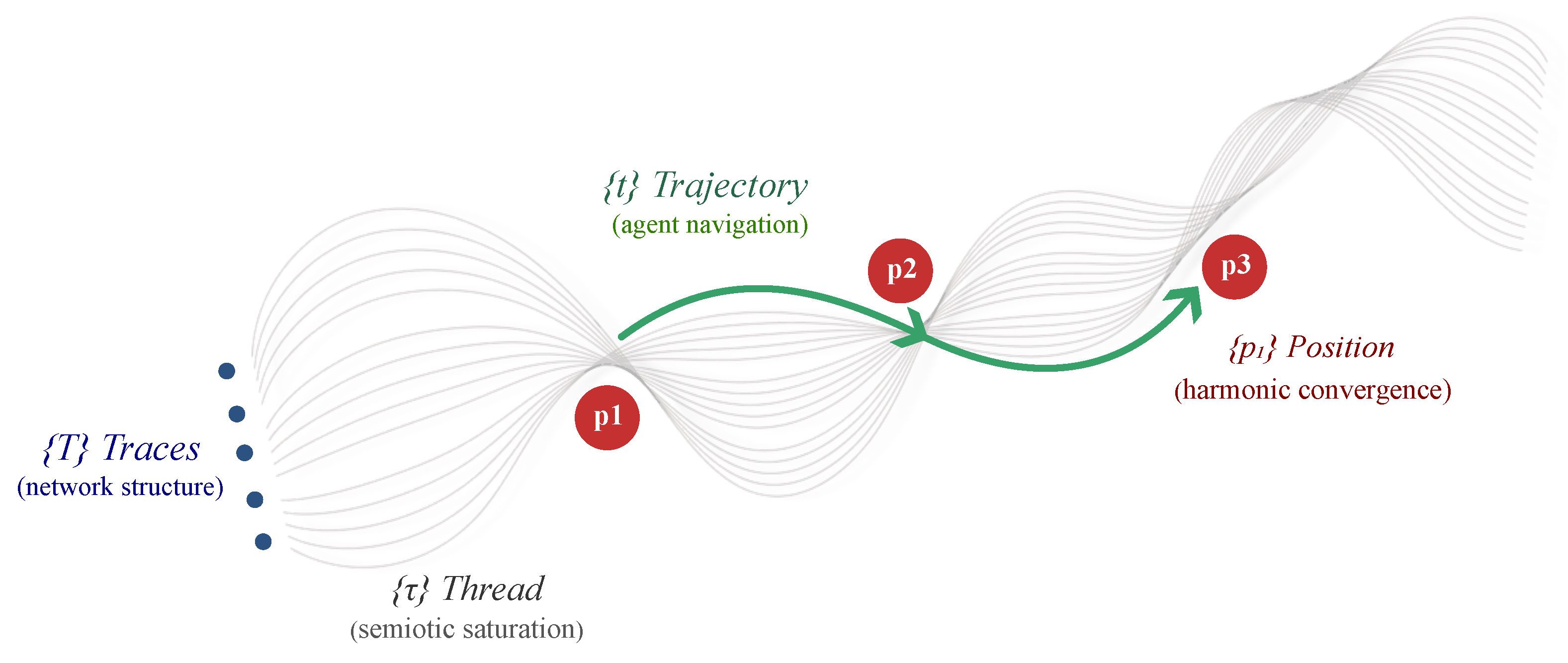
Appendix A.3. The Hexagonal Board: Geometry of Identity Space
Radial Analysis (RA) and its Hexagonal Identity Dynamics (HEXID) architecture operationalize these ontological dynamics into a tractable heuristic model.
The zero-point (): At the center of each hexid lies —the experiential zero-point, the agent’s baseline configuration of minimal sustained informational demand. is not “absence of identity,” but rather the local condition of maximal navigational flexibility. Phenomenological clarification: Genuine -contact () is rare—typically requiring contemplative cultivation or altered states. Most “baseline return” operations target (): the first ring of minimal selfhood, the “I am” prior to categorical elaboration. Every trajectory mathematically originates from , but phenomenologically, serves as the definitional “downbeat” of identity—the first position agents experience as “self.”
Rings and positions: Surrounding are concentric hexagonal rings , each containing progressively more positions. Ring contains 6 positions immediately adjacent to ; ring contains 12; in general, ring contains positions. Movement outward from corresponds to increasing categorical saturation.
Figure A2 illustrates the radial structure and an example of internalized navigation through mirror positions.
Figure A2.
Radial simplification of a single hexid. Concentric rings – preserve hexagonal adjacency while showing increasing distance from . Trajectory illustrates an internalization pattern: starting at the subject’s zero-point , navigation is routed through a peripheral mirror-position —a site the subject has stabilized to correspond with dominant institutional categories—before arriving at a first-person stance . The subject accesses minimal selfhood () through the internalized displacement rather than returning directly to it from outer rings.
Figure A2.
Radial simplification of a single hexid. Concentric rings – preserve hexagonal adjacency while showing increasing distance from . Trajectory illustrates an internalization pattern: starting at the subject’s zero-point , navigation is routed through a peripheral mirror-position —a site the subject has stabilized to correspond with dominant institutional categories—before arriving at a first-person stance . The subject accesses minimal selfhood () through the internalized displacement rather than returning directly to it from outer rings.
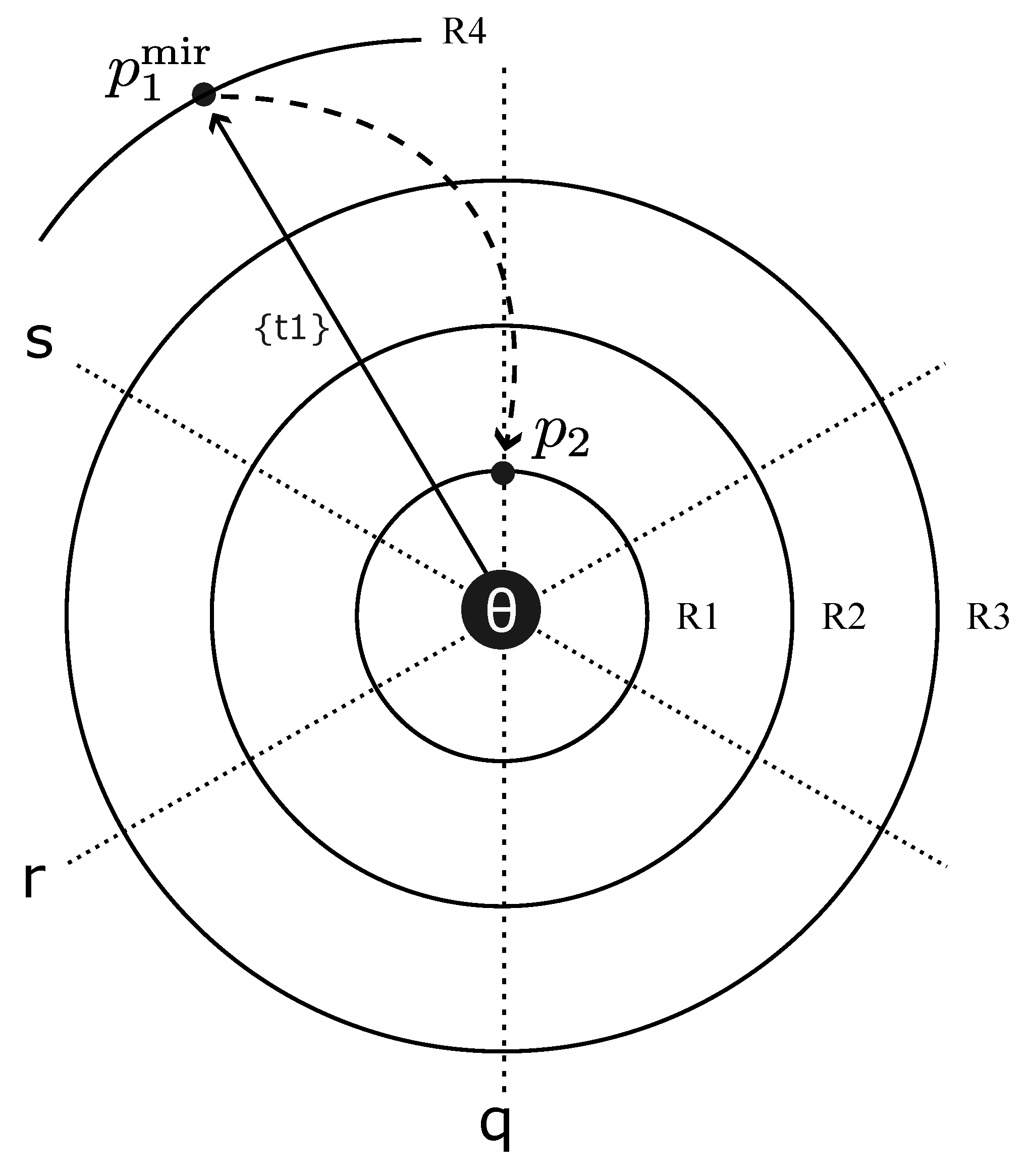
Appendix A.4. Delta Dissipation Rate (δ DR )
is the primary stability index, answering: how rapidly does a configuration lose coherence per δ-tic—per unit of trajectorial ordering—when not actively reinforced?
The parameter measures intrinsic dissipative tendency: the rate at which a position within the informational landscape unravels absent stabilizing intervention. Crucially, this is a topological property of the configuration itself—a feature of the landscape’s gradient—not a measure of anyone’s experienced effort. A mountainside has a fixed steepness regardless of who, if anyone, is walking on it; describes this informational gradient, independent of any particular navigator.
Think of as analogous to a ball on terrain. A ball resting in a valley (low ) stays put with no effort—the landscape does the work. A ball balanced on a slope (high ) rolls down unless something holds it. But consider: smoke, flame, cloud—these are configurations whose very existence is dissipation. No agent can hold smoke stable; its phenomenological signature is organized dissolution. The terrain’s gradient admits no stable dwelling, regardless of navigational effort.
This leads to the fundamental distinction between dissipative topology and navigational economy. measures the former; who sustains configurations against dissipation, and how is a separate question addressed by the navigational typology.
A critical qualification: Functionally dissipative patterns.
Not all high- configurations represent navigational targets at all. A significant class of phenomenal patterns—clouds, flames, sounds, affective states, kinesthetic sensations—are functionally dissipative: their phenomenological signature is the process of -organized change. For these patterns, dissipation is not failure to maintain but successful rendering. The interface renders change itself as phenomenal content. No navigational typology applies because no agent—individual or collective—should stabilize them; their function requires dissolution.
This distinction matters for appropriation dynamics, which concern positional stability (roles, categories, identities), not the transient phenomenal texture through which positions are inhabited. What the terrain analogy captures is the maintenance profile of positions—coherence points within thread bundles—not the phenomenal weather that accompanies navigation through them.
Formal definition.
Consider a trajectory consisting of m transitions through positions. Each transition carries an associated informational cost at the operative granularity . We define as the mean cost per transition:
The notation emphasizes that transitions are indexed by the -generated ordering (trajectorial tics), not chronological time.
is interpreted as the rate at which an active configuration loses coherence without reinforcement. High- configurations are informationally “uphill”—they dissipate rapidly without stabilization. Low- configurations are “downhill”—they persist because the informational landscape already supports them.
Implications for asymmetric saturation.
This architecture explains how institutional positions sustain themselves without genuinely low . Diagnostic categories, normative role expectations, bureaucratic classifications—these operate at with elevated intrinsic . They are CA-maintained configurations, not NET-backed. What makes them function as powerful attractors is not low dissipative tendency but: (1) high Transductive Equivalence (TE) with massively saturated SSPs, reducing Transductive Coupling Cost (TC); (2) collective saturation that distributes maintenance work across the agent population; and (3) mimetic naturalization that renders the remaining individual burden phenomenologically transparent. The positions “cost,” but the cost is absorbed, distributed, and hidden—not eliminated.
Meanwhile, movements that resist these attractor basins face both high intrinsic (the positions lack collective saturation) and high TC (low TE with dominant SSPs requires continuous translation work). The asymmetry is thermodynamic: not in how much positions inherently cost, but in how that cost is distributed, who can distribute it, and whether the distribution registers phenomenologically.
Critical note on terminology: The subscript in marks that dissipation follows trajectorial tic ordering—the internal sequencing function () that generates spatiotemporality through navigational progression—rather than external chronological time. This distinction is crucial: (mimetic control over temporal representation—calendars, deadlines, scheduling) can manipulate how time appears but cannot alter actual dissipative cost. is immune to representational manipulation; it tracks real informational expenditure required to maintain a configuration against entropic dissolution.
Blockage Configurations and δDR.
The relationship between blockage configurations and Delta Dissipation Rate requires clarification:
- blockage does not imply low at outer rings. Institutional positions at have elevated intrinsic ; what makes them “sticky” is not low maintenance but distributed maintenance + high TE + mimetic naturalization. The agent is locked in not because outer rings are easy but because exit is prohibitively expensive.
- blockage implies that the threads required for outer-ring stabilization do not sediment. Each deployment requires the agent’s own work; the must be borne individually rather than distributed across collective infrastructure.
- The asymmetry between a neurotypical professional’s and an autistic patient’s is not about “who has higher ” but about who bears the maintenance and how it registers phenomenologically. The professional’s maintenance is distributed and naturalized (invisible); the patient’s maintenance is individual and salient (exhausting).
Appendix A.5. Orthogonal Parameters: λ and σ
Two orthogonal parameters govern hexid configuration and engagement. Their orthogonality is a core architectural principle: one can vary independently of the other.
Structural Granularity (): indexes the scale at which the informational board is configured—what counts as a “unit” of structure. The framework recognizes three primary levels:
-
(Trace level)Pre-stabilized substrate. Below the threshold of phenomenal access. Pure possibilia—the raw grooves in NET that have not yet been bundled into navigable pathways.
-
(Fine thread level)Fine-grained thread saturation. This is the level of phenomenal trajectories (): moment-to-moment experiential granularity, perceptual micro-regularities, gesture kinematics, sensory detail. The interface render operates here.
-
(Coarse thread level)Coarse-grained thread saturation. This is the level of meta trajectories (): categorical, social, and institutional navigation. Diagnostic labels, role structures, bureaucratic classifications, and the “science” of standardized assessment operate at this level. This is where asymmetric SSPs are most densely saturated—the terrain of epistemic appropriation.
Critical clarification: does not “render the Other at reduced granularity.” The render is always trajectorial—the agent’s own experiential navigation. What configures is the structural cut at which the agent’s own identity positions and pattern recognitions operate.
Epistemic Access Mode (): indexes how the agent engages with the configured structure—not what scale the structure has, but how the agent navigates it. We distinguish three primary orientations:
-
(Compliant engagement)Agent treats categorical structures as transparent reality. Institutional positions are inhabited unreflectively; the constructed nature of categories does not register. High vulnerability to appropriation dynamics.
-
(Desaturating engagement)Agent moves toward , discharging representational saturation. This is the phenomenological stance of “letting go”—allowing accumulated categorical weight to dissipate rather than maintaining it. Moderate resistance capacity.
-
(Meta-reflexive engagement)Agent maintains critical distance, recognizing positions as constructed. The configuration becomes objectified, available for explicit analysis. The agent can name the operation being performed on them. Highest resistance capacity, but also highest cognitive load.
Orthogonality principle: and are independent. One can operate at coarse structural granularity () while maintaining rich phenomenal anchoring (). Conversely, one can operate at fine granularity () with abstract analytic stance (). Scale ≠ access mode.
Appendix A.6. The Interface: H〈t〉
The interface () is the present render of the agent, defined as the hexid traversed by active trajectories:
The notation reads “H through t” or “hexid traversed by trajectories.” The interface is not a space in addition to the hexid, but the hexid as it is being navigated. Each agent has exactly one interface at any moment—their present . There are no shared interfaces; intersubjectivity occurs as transduction between interfaces.
Appendix A.7. Transductive Equivalence and Coupling Cost
Two derived parameters govern the informational economy of intersubjective encounter:
Transductive Equivalence (TE) indexes the degree of structural correspondence between navigational configurations across distinct interfaces. When agent A’s position and agent B’s position share similar thread-bundle composition—when they “mean similar things” within their respective hexids—TE is high. High TE enables efficient transductive coordination: each agent’s navigation remains legible to the other without continuous interpretive reconstruction.
Transductive Coupling Cost (TC) measures the informational burden required to achieve coordination across interfaces. TC is inversely related to TE: high structural correspondence (TE ↑) reduces the work of mutual legibility (TC ↓). Formally:
The subscript indicates that TC is calculated at a specific granularity level—coupling costs differ at phenomenal () versus categorical () scales.
Critical implication: Asymmetric SSP saturation produces asymmetric TC. When institutional SSPs are massively saturated with configurations favoring agent A’s navigational habits, A enjoys high TE (and thus low TC) with those configurations. Agent B, whose autonomous navigation lacks correspondence with dominant SSPs, faces chronically elevated TC—every institutional encounter requires “fresh translation” work.
Appendix A.8. The Hexid Locality Principle
For any agent A, all navigation occurs strictly within its own hexid:
An agent “exiting” its hexid would dissolve the dissociative boundary that individuates it. Intersubjective contact occurs through transductive coupling between interfaces, not through ontological migration.
References
- Chapman, R. Empire of normality: Neurodiversity and capitalism; Pluto Press, 2023. [Google Scholar]
- Flores, N. Silencing the subaltern: Nation-state/colonial governmentality and bilingual education in the United States. Critical Inquiry in Language Studies 2013, 10(4), 263–287. [Google Scholar] [CrossRef]
- Mignolo, W. D. The darker side of Western modernity: Global futures, decolonial options; Duke University Press, 2011. [Google Scholar]
- Hoffman, D. D. The case against reality: Why evolution hid the truth from our eyes; W. W. Norton & Company, 2019. [Google Scholar]
- Deaf gain: Raising the stakes for human diversity; Bauman, H.-D. L., Murray, J. J., Eds.; University of Minnesota Press, 2014. [Google Scholar]
- Escobar L.-Dellamary, L. Trace & Trajectory Semantics: A pre-representational approach to meaning. Preprint 2025a. [Google Scholar]
- Escobar L.-Dellamary, L. Radial Analysis: Methodological framework for analyzing personal deixis and identity navigation. Preprint 2025b. [Google Scholar]
- Sampson, M. Diagnosis, misdiagnosis, and becoming better: An investigation into epistemic injustice. University of Wales Trinity Saint David Research Repository 2021. [Google Scholar]
- Internalized oppression: The psychology of marginalized groups; David, E. J. R., Ed.; Springer, 2014. [Google Scholar]
- Fricker, M. Epistemic injustice: Power and the ethics of knowing; Oxford University Press, 2007. [Google Scholar]
- Crichton, P.; Carel, H.; Kidd, I. J. Epistemic injustice in psychiatry. BJPsych Bulletin 2017, 41(2), 65–70. [Google Scholar] [PubMed]
- Kidd, I. J.; Carel, H. Epistemic injustice and illness. Journal of Applied Philosophy 2017, 34(2), 172–190. [Google Scholar] [CrossRef] [PubMed]
- Nielsen, K. M.; Nordgaard, J.; Henriksen, M. G. Fundamental issues in epistemic injustice in healthcare. Medicine, Health Care and Philosophy 2025, 28(2), 291–301. [Google Scholar] [CrossRef] [PubMed]
- Milton, D. E. M. On the ontological status of autism: The ‘double empathy problem’. Disability & Society 2012, 27(6), 883–887. [Google Scholar] [CrossRef]
- Crompton, C. J.; Ropar, D.; Evans-Williams, C. V.; Flynn, E. G.; Fletcher-Watson, S. Autistic peer-to-peer information transfer is highly effective. Autism 2020, 24(7), 1704–1712. [Google Scholar] [CrossRef] [PubMed]
- Rasmussen, E. B. Making and managing medical anomalies: Exploring the classification of ‘medically unexplained symptoms’. Social Studies of Science 2020, 50(6), 909–932. [Google Scholar] [CrossRef] [PubMed]
- Annamma, S. A.; Ferri, B. A.; Connor, D. J. Disability critical race theory: Exploring the intersectional lineage, emergence, and potential futures of DisCrit in education. Review of Research in Education 2018, 42(1), 46–71. [Google Scholar] [CrossRef]
- Teague, S. J. Perplexing presentations: Compulsory neuronormativity and cognitive marginalisation in social work practice with autistic mothers of autistic children. British Journal of Social Work 2023, 53(3), 1445–1464. [Google Scholar]
- Pearson, A.; Rose, K. Autistic, hysteric: Inequity in health care for autistic people assigned female at birth in the United Kingdom. In The Double Empathy Reader; NCBI Bookshelf, 2020. [Google Scholar]
- Shaw, S. C. K.; Carravallah, L.; Johnson, M.; O’Sullivan, J.; Chown, N.; Neilson, S.; Doherty, M. Barriers to healthcare and a ‘triple empathy problem’ may lead to adverse outcomes for autistic adults: A qualitative study. Autism 2024, 28(7), 1746–1757. [Google Scholar] [CrossRef] [PubMed]
| 1 | Autonymy is the direct response to exonymy targeting the agent’s own identity: “You named me; I rename myself.” Examples across contexts: “Mayo” →Yoreme; “Tarahumara” →Rarámuri; “Otomí” →Hñähñu; “hearing-impaired” → Deaf. |
| 2 | Counter-exonymy respects Hexid Locality: is within the subalternized agent’s navigational space—their representation of the Other, now refracted outward. The limited propagation (asymmetric g) reflects that this renaming, while locally stabilized, faces structural resistance in broader SSP distributions. |
| 3 | Not all trajectorial refraction involves naming. Marches, ceremonial practices, traditional dress, spatial occupation—these refract through embodied action, temporal rhythm, and collective visibility. Naming adds: (1) trans-λ saturation—the name configures positions across identity, epistemic, political, and affective registers simultaneously; (2) mimesis—the saturated name begins to operate as translation protocol between community and institutional space; (3) transductive stabilization—because naming operates at and propagates through transductive protocols, it elevates TE (Transductive Equivalence) across community members, thereby reducing TC (Transductive Coupling Cost) within those spaces. The named positions retain elevated intrinsic —they are CA-maintained, not NET-backed—but collective saturation distributes the maintenance burden and minimizes transductive friction. Refraction without naming contests; refraction with naming reconfigures the navigational landscape itself by establishing high-TE pathways where resistant trajectories become mutually legible. |
Figure 1.
Infrarepresentational stratification and granularity. Two hexids (, ) are represented as Gaussian saturation curves, with height corresponding to saturation level and width to navigational scope. The horizontal axis represents informational space; the vertical axis represents granularity (), ranging from trace level () through fine thread level () to coarse thread level (). Three infrarepresentational strata are marked: (within hexid boundaries, where agent-indexed asymmetry resides), (at the edge of dissociation, where operates neutrally), and (below dissociation, blind to hexid individuation). Note that at , the two hexids’ saturation curves overlap—this is the terrain of transductive coupling. Trajectories navigating at coarse granularity (, operating over ) engage categorical, institutional, and social structures where asymmetric SSPs are most densely saturated.
Figure 1.
Infrarepresentational stratification and granularity. Two hexids (, ) are represented as Gaussian saturation curves, with height corresponding to saturation level and width to navigational scope. The horizontal axis represents informational space; the vertical axis represents granularity (), ranging from trace level () through fine thread level () to coarse thread level (). Three infrarepresentational strata are marked: (within hexid boundaries, where agent-indexed asymmetry resides), (at the edge of dissociation, where operates neutrally), and (below dissociation, blind to hexid individuation). Note that at , the two hexids’ saturation curves overlap—this is the terrain of transductive coupling. Trajectories navigating at coarse granularity (, operating over ) engage categorical, institutional, and social structures where asymmetric SSPs are most densely saturated.
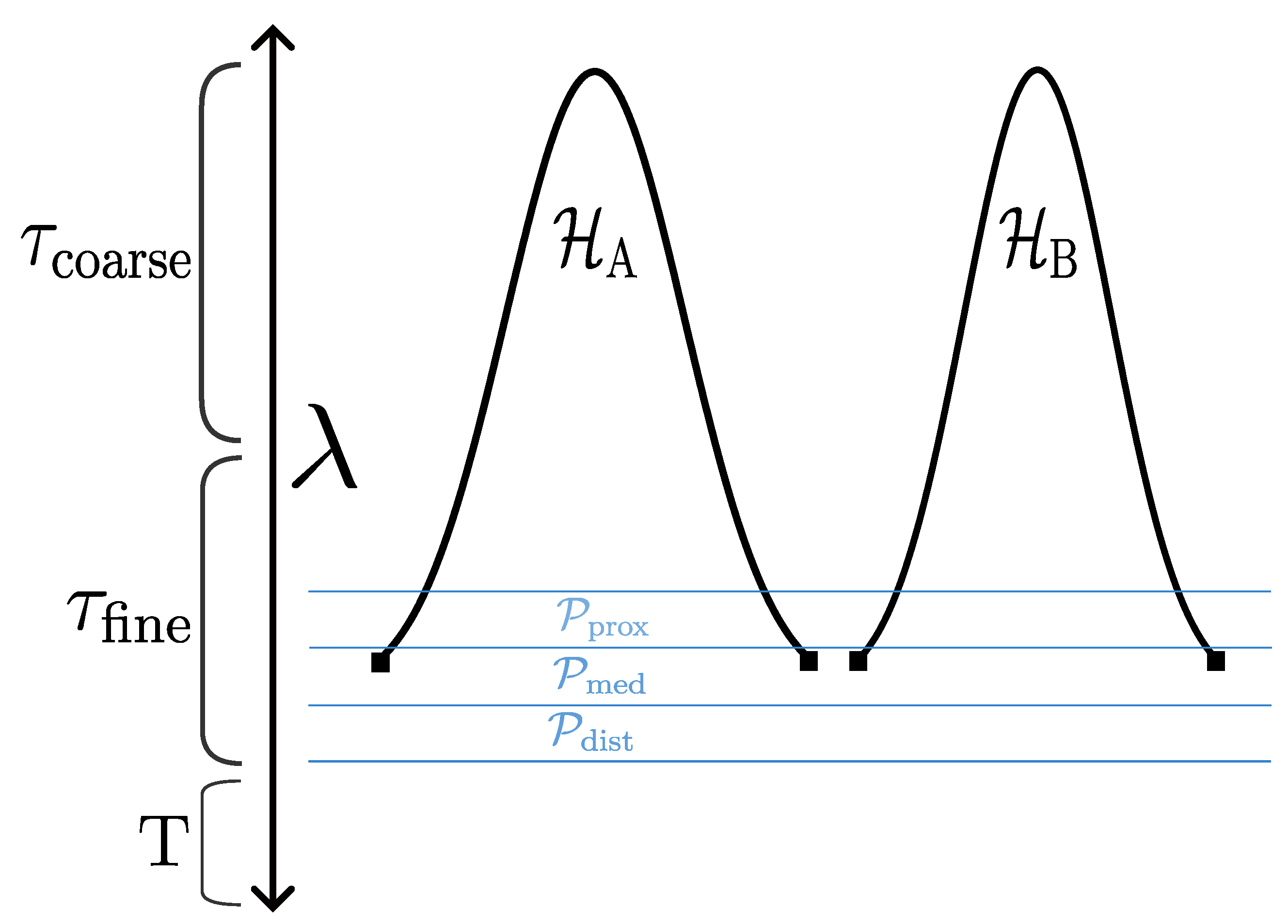
Figure 3.
Trajectorial refraction and the -return constraint. The agent’s trajectory originates at and necessarily traverses the mirror position —a node saturated by dominant SSPs (segment , solid). From , two geometries are possible: the refracted path (segment , curved solid) emerges at with angular displacement; the non-refracted path (dotted, descending toward ) represents accommodation or internalization. Critically, the non-refracted trajectory terminates at , not : the meta-recurrent regime conditions not only blocked -contact () but also impeded -return (). Sustained occupation of outer-ring positions saturates self-access routes through categorical coordinates; return to minimal selfhood would momentarily destabilize the semiotic arrangements that anchor those positions. The faint gray segment from toward represents this structurally available but thermodynamically costly return—a “soft blockage” ( suppression) rather than the “hard blockage” of -contact. -return constitutes a form of non-resistance to appropriation: not collective contestation but individual navigational recalibration that weakens outer-ring stabilization. The distinction matters: saturated collectivity (/ with shared SSPs) differs structurally from inter-hexid coincidence—agents who converge toward inner rings without saturating common semiotic patterns.
Figure 3.
Trajectorial refraction and the -return constraint. The agent’s trajectory originates at and necessarily traverses the mirror position —a node saturated by dominant SSPs (segment , solid). From , two geometries are possible: the refracted path (segment , curved solid) emerges at with angular displacement; the non-refracted path (dotted, descending toward ) represents accommodation or internalization. Critically, the non-refracted trajectory terminates at , not : the meta-recurrent regime conditions not only blocked -contact () but also impeded -return (). Sustained occupation of outer-ring positions saturates self-access routes through categorical coordinates; return to minimal selfhood would momentarily destabilize the semiotic arrangements that anchor those positions. The faint gray segment from toward represents this structurally available but thermodynamically costly return—a “soft blockage” ( suppression) rather than the “hard blockage” of -contact. -return constitutes a form of non-resistance to appropriation: not collective contestation but individual navigational recalibration that weakens outer-ring stabilization. The distinction matters: saturated collectivity (/ with shared SSPs) differs structurally from inter-hexid coincidence—agents who converge toward inner rings without saturating common semiotic patterns.
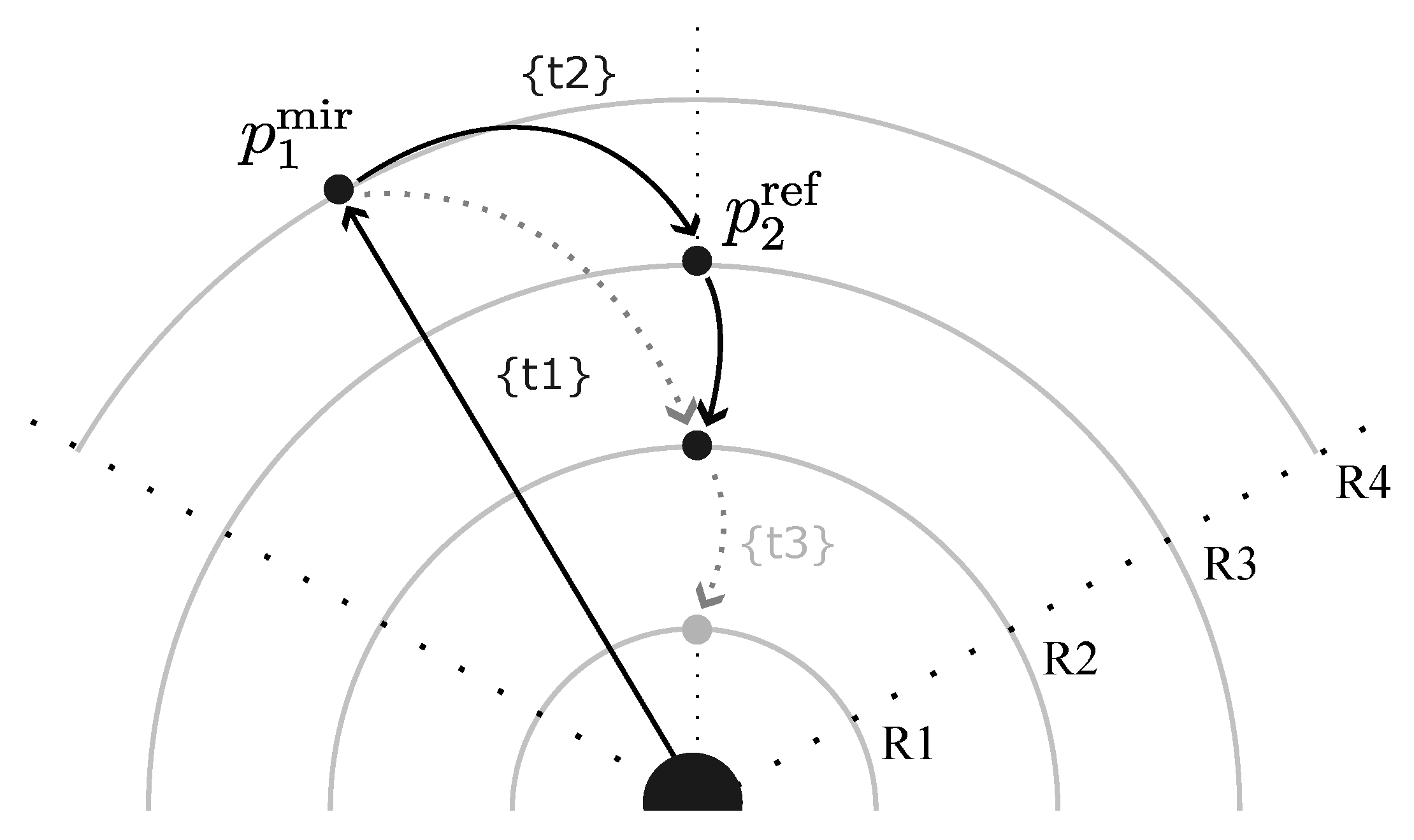
Disclaimer/Publisher’s Note: The statements, opinions and data contained in all publications are solely those of the individual author(s) and contributor(s) and not of MDPI and/or the editor(s). MDPI and/or the editor(s) disclaim responsibility for any injury to people or property resulting from any ideas, methods, instructions or products referred to in the content. |
© 2026 by the authors. Licensee MDPI, Basel, Switzerland. This article is an open access article distributed under the terms and conditions of the Creative Commons Attribution (CC BY) license (http://creativecommons.org/licenses/by/4.0/).
Copyright: This open access article is published under a Creative Commons CC BY 4.0 license, which permit the free download, distribution, and reuse, provided that the author and preprint are cited in any reuse.