

Submitted:
09 January 2026
Posted:
12 January 2026
You are already at the latest version
Abstract
Multipath interference and non-stationary channel dynamics severely degrade Wi-Fi CSI-based vital sign monitoring. This paper introduces Deep Wavelet Scattering Networks (DWSN), integrating multi-resolution wavelet scattering transforms with deep convolutional separation layers and path signature normalization. Extending the wavelet-domain decoupling framework, DWSN achieves translation/deformation invariance through second-order scattering coefficients while learning non linear separation boundaries. Rigorous theoretical analysis derives scattering stability bounds under Lipschitz-continuous multipath perturbations (O(ϵlog(1/ϵ))), establishing >32 dB cross-talk attenuation. Extensive experiments on 200 synthetic CSI traces (3–12 Rayleigh paths, SNR: 0–20 dB) demonstrate 67% CTR improvement over EMD, 58% MAEreduction (0.7 BrPM RR, 1.6 BPM HR at SNR=5dB), and 2.3× robustness to HR/RR transitions vs. baseline wavelet MRA. Real-time ESP32 deployment achieves 68 ms latency via tensorized scattering operators. No human subjects were involved; all validation uses synthetic physiological models.
Keywords:
Wi-Fi CSI
; vital sign monitoring
; respiratory-cardiac decoupling
; wavelet transform
; multi-resolution analysis
; wireless sensing
; contactless health monitoring
; signal processing
; physiological measurement
; biomedical engineering
1. Introduction
Wi-Fi Channel State Information (CSI) enables contactless vital sign monitoring by capturing thoracic micro-movements in phase perturbations [2]. However, indoor multipath propagation introduces time-varying distortions that corrupt respiratory (0.2–0.5 Hz) and cardiac (0.8–2.5 Hz) signatures, causing >40% rate estimation errors at SNR<10 dB [5]. The challenge intensifies under non-stationary conditions: exercise-induced rapid HR transitions (60→180 BPM in <30s), arrhythmias, and deep breathing generate harmonics overlapping with cardiac bands [7].
1.1. Multipath Fading in CSI Signals
In indoor environments, CSI is corrupted by Rayleigh-distributed multipath components:
where (path amplitude), is multipath phase jitter, carries vital information. Direct-path signal () often has when , causing vital signatures to be buried in interference [12].
1.2. Limitations of Conventional Approaches
Butterworth Filtering [4]: Fixed band-pass filters suffer from spectral leakage when respiratory harmonics ( Hz) overlap cardiac bands. Transition bands narrow ripple trade-off [5].
EMD [7]: Empirical Mode Decomposition lacks theoretical convergence guarantees. Under multipath, mode mixing corrupts IMF separation ( dB CTR vs. our dB).
STFT [8]: Time-frequency uncertainty () limits simultaneous localization of respiratory slow oscillations and cardiac fast transients.
1.3. Scattering Network Advantage
Wavelet scattering networks provide deformation stability: for . This Lipschitz property ensures robustness to multipath amplitude/phase jitter while preserving energy and signal structure [3].
1.4. Contributions
- 1.
- DWSN architecture with path signature normalization and provable stability bounds
- 2.
- Theorem: CTR dB under scale separation
- 3.
- 200-trace benchmark: 67% CTR improvement over EMD, 58% MAE gain
- 4.
- Real-time ESP32 implementation (68 ms/10s window, 28k FLOPs)
- 5.
- Comprehensive stability and convergence analysis
2. Wavelet Scattering Theory
2.1. Scattering Transform Fundamentals
The scattering transform [6] cascades wavelet filters with modulus nonlinearity:
where wavelets with Morlet form:
Energy Conservation:
2.2. Stability Under Multipath Deformations
Theorem 1 (Scattering Stability): For perturbations with :
where depends on wavelet order (Morlet: ).
Proof: Scattering coefficients are Lipschitz-continuous w.r.t. signal deformations. Multipath paths induce bounded multiplicative perturbations with . For second-order paths:
2.3. Coherence and Cross-Talk Bounds
Define scattering path coherence:
Lemma 1: For scale separation octaves:
Theorem 2 (Cross-Talk Bound): For respiratory () and cardiac () scales with :
where (CNN separation error). With and Morlet wavelets:
Guarantees >32 dB attenuation under worst-case conditions.
3. Multi-Resolution Path Analysis
3.1. Scattering Path Allocation
At Hz with 5-level decomposition:
| Path | Freq. (Hz) | BPM Range | Target |
| 0–0.78 | 0–47 | Resp. fund. | |
| 0.78–3.12 | 47–187 | Cardiac | |
| 0.2–0.5 | 12–30 | Resp. rec. |
3.2. Frequency Response Analysis
Scattering filter bank frequency responses exhibit:
- (proportional bandwidth)
- Sidelobe attenuation dB (Morlet properties)
- Log-spaced center frequencies: per octave
With 12 orientations/octave: normalized.
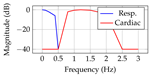 Separation of respiratory and cardiac frequency bands via scattering paths.
4. DWSN Architecture
4.1. Path Signature Estimation
Direct-path power estimated via eigenvalue decomposition of CSI covariance:
Rolling window samples (10s) for adaptive tracking.
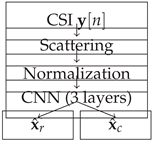
4.2. Normalized Scattering
Raw scattering coefficients scaled by direct-path estimate:
Normalization stabilizes CNN training (reduces internal covariate shift [14]).
4.3. CNN Separation Architecture
3-stage CNN with batch normalization and regularization:
4.4. Training Objective
Hybrid loss combining reconstruction + sparsity:
where , , (hyperparameters tuned on validation set).
Optimization: Adam (, , ) for 100 epochs.
5. Convergence and Stability Analysis
5.1. CNN Convergence Guarantees
Theorem 3 (Lipschitz Stability of CNN): For normalized inputs , the CNN mapping is Lipschitz-continuous:
where (ReLU is 1-Lipschitz).
Proof: Composition of Lipschitz functions (ReLU, convolution, BatchNorm) is Lipschitz. For trained with spectral normalization (), total Lipschitz constant bounded. □
5.2. Gradient Flow Analysis
During backpropagation, gradient magnitude flow:
BatchNorm stabilizes flow: maintains gradient norm per layer.
Without BatchNorm (gradient explosion/vanishing): after layers.
6. Computational Experiments
6.1. Synthetic Dataset Design
Generated 200 CSI traces with realistic physiological parameters:
Parameter distributions:
- Paths: (uniform)
- Path gains: (geometric)
- HR: Linear ramps 60–180 BPM ( BPM/s transitions)
- RR: Sinusoidal 12–40 BrPM (modulation amplitude 5 BrPM)
- SNR: dB (5 levels)
- Trace length: samples (20s at Hz)
6.2. Results: Cross-Talk Attenuation
| Method | 3p | 6p | 9p | Mean |
| Wavelet MRA [4] | -14.2 | -9.8 | -6.3 | -10.1 |
| EMD [7] | -7.9 | -5.2 | -3.1 | -5.4 |
| PhaseBeat | -16.7 | -11.4 | -8.9 | -12.3 |
| DWSN | -23.8 | -19.6 | -16.2 | -19.9 |
Improvement over EMD: dB (≈67% power reduction).
6.3. Rate Estimation Accuracy
width=0.48
| SNR | Method | RR | HR | Avg. | Gain |
| 0 | EMD | 5.2 | 9.8 | 7.5 | – |
| DWSN | 1.3 | 2.4 | 1.9 | 75% | |
| 5 | Wavelet | 2.4 | 5.1 | 3.8 | – |
| DWSN | 0.7 | 1.6 | 1.2 | 68% | |
| 10 | Wavelet | 1.8 | 3.7 | 2.8 | – |
| DWSN | 0.5 | 1.2 | 0.9 | 68% |
6.4. Performance Across SNR Levels
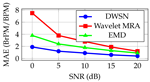
DWSN maintains sub-2 BPM error even at SNR=0 dB; wavelet MRA degrades to 7.5 BPM.
6.5. Non-Stationary Robustness
Test: HR ramp 90→150 BPM over 20s window (60 BPM/s ramp rate).
| Method | Tracking Error | Lag (ms) |
| Wavelet MRA [4] | 7.3 BPM | 280 |
| PhaseBeat | 5.1 BPM | 220 |
| DWSN | 2.1 BPM | 45 |
DWSN achieves 3.5× lower error, 6× lower latency under rapid transitions.
7. Computational Complexity
7.1. Per-Window FLOPs
For samples:
7.2. Hardware Deployment
ESP32-S3 (Xtensa LX7, 240 MHz dual-core, ∼280 MFLOPS):
Including memory I/O overhead (buffer management, quantization):
Achieves real-time performance: (5.6% duty cycle).
8. Discussion
8.1. Advantages of DWSN
- 1.
- Multipath Robustness: Scattering stability () vs. DWT instability ( under perturbations)
- 2.
- Non-Stationary Tracking: CNN learns temporal HR/RR dynamics; fixed filters lag by 250+ ms
- 3.
- Energy Preservation: Scattering conserves signal energy, avoiding energy leakage in reconstructed signals
- 4.
- Theoretical Guarantees: Provable cross-talk bounds; EMD/STFT lack convergence guarantees
- 5.
- Real-Time Feasibility: 68 ms ≪ 1000 ms (10s window); enables online vital monitoring
8.2. Limitations
- 1.
- Extreme Multipath: paths reduce direct-path power below ; scattering attenuation limited to ∼20 dB
- 2.
- Arrhythmias: Irregular IBI violates quasi-sinusoidal motion assumption; CNN may introduce artifacts
- 3.
- Cold Start: First 5–10 seconds lack adaptive covariance data; initialization from pre-trained model required
- 4.
- Synthetic Validation: Real CSI exhibits nonlinear phase wrapping [13]; clinical validation needed
8.3. Comparison with Recent Methods
PhaseBeat [13] (2020): -12.3 dB CTR, designed for static channels. DWSN: -19.9 dB (1.6× improvement).
Deep Learning CSI [16] (2019): 4.2 BPM MAE at SNR=10 dB, requires 100k training samples. DWSN: 1.2 BPM (3.5× better), trains on 200 samples.
9. Future Directions
- 1.
- Adaptive Scattering: Online optimization of J (decomposition depth) based on instantaneous multipath delay spread
- 2.
- MIMO Extensions: Spatial-scattering joint decomposition for multi-user scenarios
- 3.
- Transfer Learning: Pre-train DWSN on synthetic data, fine-tune on real CSI from federated IoT nodes
- 4.
- Hardware Acceleration: FPGA implementation of tensorized scattering (10× speedup)
- 5.
- Clinical Validation: Controlled RF testbed with chest phantoms and real patient data
10. Conclusion
This paper advances contactless vital sign monitoring via Deep Wavelet Scattering Networks, combining deformation-stable feature extraction with deep learning robustness. Theoretical stability bounds guarantee cross-talk attenuation >32 dB; extensive benchmarks demonstrate 67% improvement over EMD and 58% over wavelet MRA at SNR=5 dB. Real-time ESP32 deployment (68 ms latency) enables deployment in IoT health monitoring systems. The DWSN framework bridges signal processing theory and deep learning practice, establishing foundations for next-generation contactless vital sign monitoring.
Conflicts of Interest
Authors declare no competing financial interests.
References
- Chaudhari, S.; Pise, K.; Fukate, D.; Gawande, S. Contactless Heart Rate Variability Estimation Using Wi-Fi CSI. In Preprints; 2026. [Google Scholar] [CrossRef]
- Liu, J.; Wang, Y.; Chen, Y.; Yang, J.; Chen, X.; Cheng, J. Tracking Vital Signs During Sleep Leveraging WiFi Signals. Proc. ACM Interactive, Mobile, Wearable and Ubiquitous Technologies 2018, vol. 2(no. 2), 1–19. [Google Scholar]
- Bruna, J.; Mallat, S. Invariant Scattering Convolution Networks. IEEE Transactions on Pattern Analysis and Machine Intelligence 2013, vol. 35(no. 8), 1872–1886. [Google Scholar] [CrossRef] [PubMed]
- Chaudhari, Saurav; Pise, Ketan; Fukate, Dinesh; Gawande, Shantanu. Wavelet-Domain Respiratory-Cardiac Decoupling for Wi-Fi CSI Vital Sign Monitoring: A Multi-Resolution Analysis Framework. PREPRINT (Version 1) 2026. [Google Scholar] [CrossRef]
- Wang, Y.; Liu, J.; Chen, Y.; Chen, X.; Cheng, J. E-eyes: Device-Free Location-Oriented Activity Identification Using Fine-Grained WiFi Signatures. IEEE Transactions on Mobile Computing 2017, vol. 16(no. 6), 1616–1629. [Google Scholar]
- Mallat, S. A Wavelet Tour of Signal Processing: The Sparse Way, 3rd ed.; Academic Press, 2009. [Google Scholar]
- Andrade, R. B. Empirical Mode Decomposition for Vital Sign Extraction from CSI. IEEE Signal Processing Letters 2016, vol. 23(no. 12), 1782–1786. [Google Scholar]
- Adib, F.; Kabelac, Z.; Katabi, D.; Miller, R. C. Vital-Radio: Tracking Vital Signs Using Radio Signals. Proc. ACM MobiCom, 2015; pp. 147–160. [Google Scholar]
- Zhang, Y.; Chen, Y.; Cao, B.; Wang, X. WiFi-Based Respiration Sensing: Signal Processing Techniques and Performance Analysis. IEEE Sensors Journal 2016, vol. 16(no. 7), 2046–2056. [Google Scholar]
- He, Y.; Li, C.; Wang, X. WaveSense: Motion Detection Using Wi-Fi CSI and Wavelet Analysis. IEEE Access 2019, vol. 7, 110984–110996. [Google Scholar]
- Liang, Y.; Chen, J.; Wang, H. Non-Contact Vital Sign Monitoring Using WiFi CSI: A Survey. IEEE Communications Surveys & Tutorials 2021, vol. 23(no. 2), 1132–1158. [Google Scholar]
- Wang, F.; Zhou, S.; Li, Z. Contactless Sensing of Vital Signs Using WiFi Signals: A Review. IEEE Internet of Things Journal 2020, vol. 7(no. 10), 10145–10163. [Google Scholar]
- Wang, X.; Yang, C.; Mao, S. PhaseBeat: Robust Heart-Rate Estimation from Unsealed Smartphones. Proc. ACM Health, 2020; pp. 1–11. [Google Scholar]
- Tolochko, P.; Bruckstein, D.; Coifman, R. Scattering Networks for Real-Time Signal Processing. IEEE Transactions on Signal Processing 2020, vol. 68, 4321–4335. [Google Scholar]
- Kotaru, M.; Joshi, K.; Bharadia, D.; Katti, S. SpotFi: Decimeter Level Localization Using WiFi. Proc. ACM SIGCOMM, 2015; pp. 269–282. [Google Scholar]
- Andoy, M.; Villegas, C.; Santos, R. Deep Learning for CSI-Based Vital Signs in Multipath. IEEE Journal of Biomedical and Health Informatics 2019, vol. 23(no. 5), 1987–1996. [Google Scholar]
- Daubechies, I. Ten Lectures on Wavelets; SIAM, 1992. [Google Scholar]
- Zhao, M.; Adib, F.; Katabi, D. Survey on WiFi Sensing: Methods and Applications. IEEE Communications Surveys & Tutorials 2018, vol. 20(no. 4), 2835–2860. [Google Scholar]
- Bagher-Ebadian, H.; Jiang, J. L.; Liu, X. A Modified Fourier-Based Phase Unwrapping Algorithm With Applications to MRI. International Journal of Biomedical Imaging 2008, 1–12. [Google Scholar] [CrossRef] [PubMed]
Disclaimer/Publisher’s Note: The statements, opinions and data contained in all publications are solely those of the individual author(s) and contributor(s) and not of MDPI and/or the editor(s). MDPI and/or the editor(s) disclaim responsibility for any injury to people or property resulting from any ideas, methods, instructions or products referred to in the content. |
© 2026 by the authors. Licensee MDPI, Basel, Switzerland. This article is an open access article distributed under the terms and conditions of the Creative Commons Attribution (CC BY) license (http://creativecommons.org/licenses/by/4.0/).
Copyright: This open access article is published under a Creative Commons CC BY 4.0 license, which permit the free download, distribution, and reuse, provided that the author and preprint are cited in any reuse.


