

Submitted:
09 January 2026
Posted:
12 January 2026
You are already at the latest version
Abstract
Motivation: Molecular maps are graphical representations of the molecular mechanisms underlying biological systems. They are a valuable tool for curating, exchanging, and understanding biological knowledge, and may serve as a backbone for data analysis and modelling. Molecular maps are supported by a rich software ecosystem. However, there are currently no tools that support advanced programmatic analysis and processing of maps, in particular the extraction of the biological concepts they represent or their comparison. Results: We introduce momapy, a generic Python library to work with molecular maps efficiently. At its core, momapy allows users to extract and separate the data model of a map from its graphical representation, and perform a variety of base operations on them, including their manipulation and comparison. momapy currently supports the SBGN and CellDesigner formats, two of the main standards to represent molecular maps graphically, and can be easily extended to support additional formats and functionalities.
Keywords:
molecular map
; sbgn
; celldesigner
; biological network
; systems biology
1. Introduction
Molecular maps are graphical representations of the molecular mechanisms underlying biological systems. They are detailed, curated, and exchangeable graphical knowledge bases that help to understand the mechanisms driving phenotypes of interest (e.g., diseases [1], induced cellular responses [2,3]). They may also support a variety of analyses, including analysis of omics data and dynamical modeling [4].
Molecular maps are supported by a rich software ecosystem. The available tools allow users to edit (CellDesigner™ [5], SBGN-ED [6], Newt [7]), visualise (MINERVA [8]), render (Newt, MINERVA, SBMLDiagrams [9]), format and convert (libSBGN [10], MINERVA, cd2sbgnml [11]), query (STONPy [12]) or model (SBGN2AN [13], CasQ [14]) maps. However, operations required for advanced programmatic analysis and processing are not supported by any of these tools. For example, it is currently not possible to extract the biological concepts represented by a map or to compare two maps automatically.
Here we introduce momapy, a generic Python library for working with molecular maps efficiently. At its core, momapy separates the model of a map from its layout: while the model of a map describes what biological concepts it represents, its layout describes how they are represented graphically. This distinction is borrowed from the Systems Biology Markup Language (SBML) [15], where a model defines a set of reactions and their associated mathematical equations, but may be augmented with a graphical layout using the layout and render packages [16,17]. momapy generalises this distinction and applies it to the Systems Biology Graphical Notation (SBGN) [18] and CellDesigner™ [5], two of the main standard languages to represent maps graphically.
2. A momapy Map: A Model, a Layout, and a Layout-Model Mapping
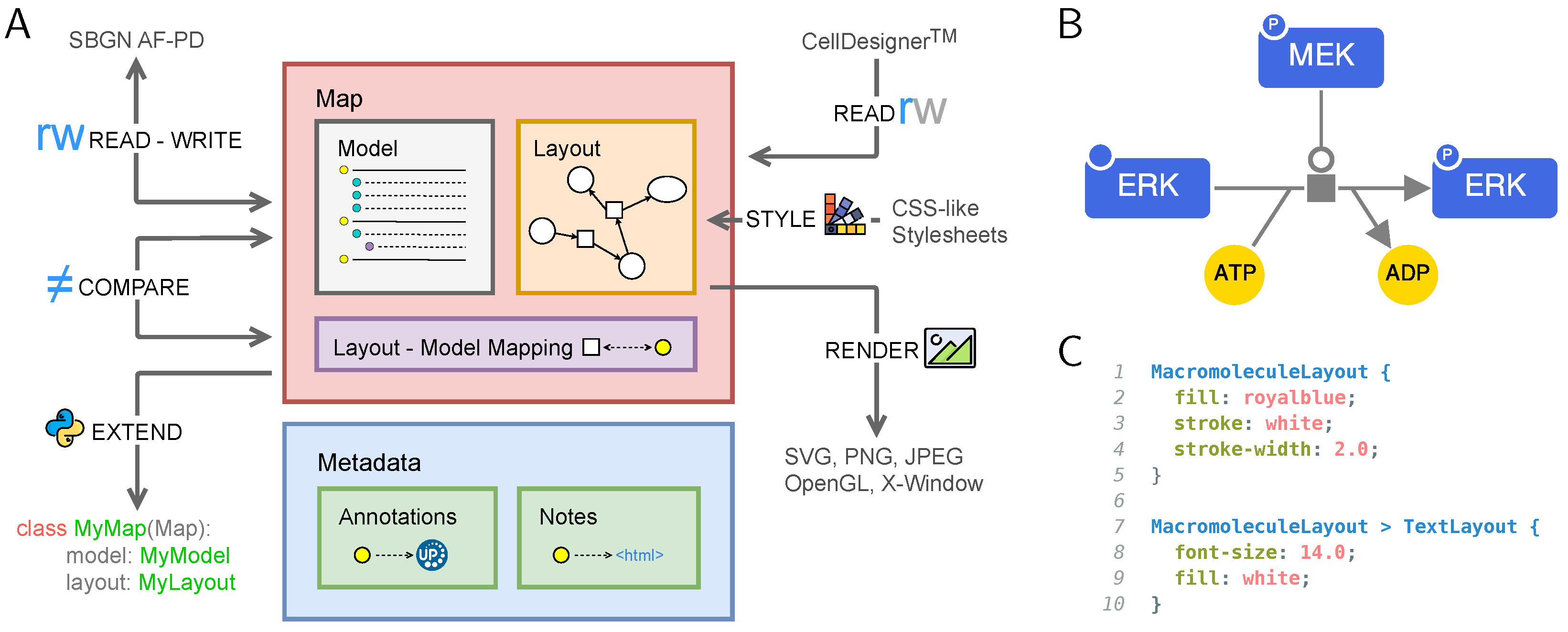
In momapy, a map is made up of three distinct elements: a model; a layout; and a layout-model mapping. The model of a map is a structured collection of model elements that encode the biological concepts represented in the map. momapy defines a hierarchical data model for each type of map it supports (SBGN PD [19], SBGN AF [20], and CellDesigner™ [5], see Section 3.1 for more details), formed of class and subclass relations encoding the biological concepts based on the map type and their hierarchy in the Systems Biology Ontology [21]. The encoded biological concepts include entity pools, processes and modulations for process description types of maps (SBGN PD, CellDesigner™), or activities and modulations for activity types (SBGN AF). The layout of a map is a structured collection of layout elements encoding the glyphs (graphical symbols) of the map. Each layout element encodes a specific shape (e.g., a circle, a rectangle with rounded corners) whose attributes define how it may be rendered (e.g., its position, dimensions, fill color). A layout element may itself contain other layout elements, giving a tree-like structure to the layout, similar to DOM-based documents such as HTML or SVG. Finally, the layout-model mapping associates each layout element of the map with the model element it represents.
3. momapy’s Features
At its core, momapy allows users to extract a map’s model and layout, and work with them programmatically through a variety of features. These are summarised in Figure 1A, and detailed below.
3.1. Supported Map Formats
momapy currently supports SBGN (PD and AF) and CellDesigner™, two of the main languages used to draw molecular maps. SBGN maps may be read and written from/to SBGN-ML, and CellDesigner™ maps read from the CellDesigner™ exchange format (based on SBML).
3.2. Exploring and Manipulating Maps
momapy elements (maps, models, layouts, and their sub-elements) are made readily available as Python objects, that can be easily explored and manipulated programmatically. Notes and annotations (as defined by SBML) are made accessible outside of the map they describe, complying with the FAIR principles on the separation of metadata from data [22].
3.3. Comparing Maps
momapy elements are implemented in a way they can be easily compared programmatically. This implementation also allows users to check whether a momapy element belongs to a given set of objects efficiently, which is crucial for some applications where one needs to compare large sets of maps (e.g., sets of SBGN bricks instances [23]).
3.4. Styling and Style Sheets
Using momapy, the graphical style of layout elements may be extensively customised. momapy supports the modification of common presentation attributes such as stroke and fill colors or line width, but also the application of advanced graphical effects such as shadows. These custom styles may be applied directly to the individual layout element objects, or using user-defined CSS-like style sheets (see Figure 1B, C). momapy also includes a set of predefined style sheets, that mimic the graphical style of several common map editors such as Newt [7], SBGN-ED [6], or CellDesigner™ [5].
3.5. Rendering of Maps
momapy may be used to render layouts of maps to images (e.g., SVG, PNG, JPEG, PDF files) or directly to the screen (e.g., OpenGL windows). The rendering is done offline using different alternative common backends (SVG-native, Skia (https://skia.org/), Cairo (https://www.cairographics.org/)), enabling the embedding of momapy in other applications on all platforms. Rendering with momapy supports all the aforementioned styles, including advanced graphical effects (depending on the backend).
3.6. Extending momapy with New Formats and Functionalities
momapy offers a set of abstract and concrete classes that may be easily extended for the fast development of new data models and glyphs. An example of such an extension is momapy-bel (available at https://github.com/adrienrougny/momapy_bel), which adds support for BEL models [24] to momapy. Since momapy is built as a library, it can be freely used by third-party tools to work with molecular maps. Examples of such tools include momapy-kb (available at https://github.com/adrienrougny/momapy_kb), which allows users to integrate molecular maps into a graph database, and momapy-draw (available at https://github.com/adrienrougny/momapy_draw), a tool based on momapy’s rendering capabilities to draw SBGN and CellDesigner™ maps programmatically.
4. Software Implementation and Availability
momapy is implemented in Python (RRID:SCR_008394). Its code is freely available from https://github.com/adrienrougny/momapy under a GPLv3 license. Complete documentation and a user manual are available at https://adrienrougny.github.io/momapy.
Author Contributions
Conceptualisation: A.R, M.O, V.S. Software: A.R. Writing - original draft: A.R. Writing - review & editing: M.O., V.S. Project administration: M.O., V.S. Funding acquisition: M.O., V.S. All authors have read and agreed to the final version of the manuscript.
Funding
This work was supported by the COMMUTE project, funded by the European Union under the grant agreement number 101136957.
Acknowledgments
This work was supported by the COMMUTE project. The COMMUTE project is funded by the European Union under the grant agreement number 101136957. Views and opinions expressed are however those of the authors only and do not necessarily reflect those of the European Union or the European Health and Digital Executive Agency (HADEA). Neither the European Union nor the granting authority can be held responsible for them. The authors would also like to thank the coaches of the PPC team at LCSB for checking the manuscript before submission.
Conflicts of Interest
The authors declare no conflicts of interest.
Abbreviations
The following abbreviations are used in this manuscript:
| SBGN | Systems Biology Graphical Notation |
| SBML | Systems Biology Markup Language |
| BEL | Biological Expression Language |
References
- Ostaszewski, M.; Gebel, S.; Kuperstein, I.; Mazein, A.; Zinovyev, A.; Dogrusoz, U.; Hasenauer, J.; Fleming, R.M.T.; Le Novère, N.; Gawron, P.; et al. Community-driven roadmap for integrated disease maps. Briefings in Bioinformatics 2019, 20, 659–670. [CrossRef]
- Oda, K.; Matsuoka, Y.; Funahashi, A.; Kitano, H. A comprehensive pathway map of epidermal growth factor receptor signaling. Molecular Systems Biology 2005, 1, 2005.0010. Publisher: John Wiley & Sons, Ltd. [CrossRef]
- Calzone, L.; Gelay, A.; Zinovyev, A.; Radvanyi, F.; Barillot, E. A comprehensive modular map of molecular interactions in RB/E2F pathway. Molecular Systems Biology 2008, 4. Publisher: EMBO Press.
- Niarakis, A.; Ostaszewski, M.; Mazein, A.; Kuperstein, I.; Kutmon, M.; Gillespie, M.E.; Funahashi, A.; Acencio, M.L.; Hemedan, A.; Aichem, M.; et al. Drug-target identification in COVID-19 disease mechanisms using computational systems biology approaches. Frontiers in Immunology 2024, 14. Publisher: Frontiers. [CrossRef]
- Funahashi, A.; Matsuoka, Y.; Jouraku, A.; Morohashi, M.; Kikuchi, N.; Kitano, H. CellDesigner 3.5: a versatile modeling tool for biochemical networks. Proceedings of the IEEE 2008, 96, 1254–1265. Publisher: IEEE.
- Czauderna, T.; Klukas, C.; Schreiber, F. Editing, validating and translating of SBGN maps. Bioinformatics 2010, 26, 2340–2341. [CrossRef]
- Balci, H.; Siper, M.C.; Saleh, N.; Safarli, I.; Roy, L.; Kilicarslan, M.; Ozaydin, R.; Mazein, A.; Auffray, C.; Babur, Ã.; et al. Newt: a comprehensive web-based tool for viewing, constructing and analyzing biological maps. Bioinformatics 2021, 37, 1475–1477. [CrossRef]
- Gawron, P.; Ostaszewski, M.; Satagopam, V.; Gebel, S.; Mazein, A.; Kuzma, M.; Zorzan, S.; McGee, F.; Otjacques, B.; Balling, R.; et al. MINERVA: a platform for visualization and curation of molecular interaction networks. npj Systems Biology and Applications 2016, 2, 16020. Publisher: Nature Publishing Group. [CrossRef]
- Xu, J.; Jiang, J.; Sauro, H.M. SBMLDiagrams: a python package to process and visualize SBML layout and render. Bioinformatics 2023, 39, btac730. [CrossRef]
- van Iersel, M.P.; Villéger, A.C.; Czauderna, T.; Boyd, S.E.; Bergmann, F.T.; Luna, A.; Demir, E.; Sorokin, A.; Dogrusoz, U.; Matsuoka, Y.; et al. Software support for SBGN maps: SBGN-ML and LibSBGN. Bioinformatics 2012, 28, 2016–2021. [CrossRef]
- Balaur, I.; Roy, L.; Mazein, A.; Karaca, S.G.; Dogrusoz, U.; Barillot, E.; Zinovyev, A. cd2sbgnml: bidirectional conversion between CellDesigner and SBGN formats. Bioinformatics 2020, 36, 2620–2622. Publisher: Oxford University Press.
- Rougny, A.; Balaur, I.; Luna, A.; Mazein, A. StonPy: a tool to parse and query collections of SBGN maps in a graph database. Bioinformatics 2023, 39, btad100. [CrossRef]
- Rougny, A.; Froidevaux, C.; Calzone, L.; Paulevé, L. Qualitative dynamics semantics for SBGN process description. BMC Systems Biology 2016, 10, 42. [CrossRef]
- Aghamiri, S.S.; Singh, V.; Naldi, A.; Helikar, T.; Soliman, S.; Niarakis, A. Automated inference of Boolean models from molecular interaction maps using CaSQ. Bioinformatics 2020, 36, 4473–4482. Publisher: Oxford University Press (OUP). [CrossRef]
- Hucka, M.; Finney, A.; Sauro, H.M.; Bolouri, H.; Doyle, J.C.; Kitano, H.; Arkin, A.P.; Bornstein, B.J.; Bray, D.; Cornish-Bowden, A.; et al. The systems biology markup language (SBML): a medium for representation and exchange of biochemical network models. Bioinformatics 2003, 19, 524–531. Publisher: Oxford Univ Press.
- Gauges, R.; Rost, U.; Sahle, S.; Wengler, K.; Bergmann, F.T. The Systems Biology Markup Language (SBML) Level 3 Package: Layout, Version 1 Core. Journal of Integrative Bioinformatics 2015, 12, 550–602. Publisher: De Gruyter. [CrossRef]
- Bergmann, F.T.; Keating, S.M.; Gauges, R.; Sahle, S.; Wengler, K. SBML Level 3 package: Render, Version 1, Release 1. Journal of Integrative Bioinformatics 2018, 15. Publisher: De Gruyter. [CrossRef]
- Le Novère, N.; Hucka, M.; Mi, H.; Moodie, S.; Schreiber, F.; Sorokin, A.; Demir, E.; Wegner, K.; Aladjem, M.I.; Wimalaratne, S.M.; et al. The systems biology graphical notation. Nature Biotechnology 2009, 27, 735–741. Publisher: Nature Publishing Group.
- Rougny, A.; Touré, V.; Moodie, S.; Balaur, I.; Czauderna, T.; Borlinghaus, H.; Dogrusoz, U.; Mazein, A.; Dräger, A.; Blinov, M.L.; et al. Systems Biology Graphical Notation: Process Description language Level 1 Version 2.0. Journal of Integrative Bioinformatics 2019, 16. Publisher: De Gruyter. [CrossRef]
- Mi, H.; Schreiber, F.; Moodie, S.; Czauderna, T.; Demir, E.; Haw, R.; Luna, A.; Le Novère, N.; Sorokin, A.; Villéger, A. Systems biology graphical notation: activity flow language level 1 version 1.2. Journal of integrative bioinformatics 2015, 12, 340–381. Publisher: De Gruyter.
- Juty, N.; le Novère, N. Systems biology ontology. Encyclopedia of Systems Biology 2013, pp. 2063–2063. Publisher: Springer.
- Balaur, I.; Welter, D.; Rougny, A.; Inau, E.T.; Mazein, A.; Ghosh, S.; Schneider, R.; Waltemath, D.; Ostaszewski, M.; Satagopam, V. FAIR assessment of Disease Maps fosters open science and scientific crowdsourcing in systems biomedicine. Scientific Data 2025, 12, 851. Publisher: Nature Publishing Group. [CrossRef]
- Rougny, A.; Touré, V.; Albanese, J.; Waltemath, D.; Shirshov, D.; Sorokin, A.; Bader, G.D.; Blinov, M.L.; Mazein, A. SBGN Bricks Ontology as a tool to describe recurring concepts in molecular networks. Briefings in Bioinformatics 2021, 22, bbab049. [CrossRef]
- Hoyt, C.T.; Domingo-Fernández, D.; Hofmann-Apitius, M. BEL Commons: an environment for exploration and analysis of networks encoded in Biological Expression Language. Database 2018, 2018, bay126. [CrossRef]
Figure 1.
Overview of momapy’s features. A. A graphical summary of momapy’s features, showing how a map is formed of a model, a layout, and a layout-model mapping. B. An example of an SBGN PD map styled and rendered using momapy. C. An excerpt of the CSS-like style sheet used to style the map represented in B.
Figure 1.
Overview of momapy’s features. A. A graphical summary of momapy’s features, showing how a map is formed of a model, a layout, and a layout-model mapping. B. An example of an SBGN PD map styled and rendered using momapy. C. An excerpt of the CSS-like style sheet used to style the map represented in B.
Disclaimer/Publisher’s Note: The statements, opinions and data contained in all publications are solely those of the individual author(s) and contributor(s) and not of MDPI and/or the editor(s). MDPI and/or the editor(s) disclaim responsibility for any injury to people or property resulting from any ideas, methods, instructions or products referred to in the content. |
© 2026 by the authors. Licensee MDPI, Basel, Switzerland. This article is an open access article distributed under the terms and conditions of the Creative Commons Attribution (CC BY) license (http://creativecommons.org/licenses/by/4.0/).
Copyright: This open access article is published under a Creative Commons CC BY 4.0 license, which permit the free download, distribution, and reuse, provided that the author and preprint are cited in any reuse.


