
Submitted:
08 January 2026
Posted:
09 January 2026
You are already at the latest version
Abstract
We propose a resolution to the "soft omission" problem in Celestial Holography by mapping the boundary correlators of the massless S-matrix onto the arithmetic murmurations of a topological informational space. We demonstrate that a Somos-8-like Phase Transition (N≈200,000) triggers a Schramm-Loewner Evolution (SLE) process with a fractal dimension d=1.326, which acts as the natural smoothing scale for the Inverse Mellin Transform required to resolve non-singular celestial amplitudes. By identifying the Geometric Friction constant (λF = 34/13) as the diffusivity parameter (κ) of the vacuum interface, we show that the dissipative central charge of the early vacuum (c≈-0.0995) is lifted to unity (c=1) via the Arithmetic Gain of the murmuration spectral peaks. This mechanism provides a formal link between the aperiodic order of the Einstein Monotile and the analytic stability of the physical vacuum.
Keywords:
celestial holography
; murmurations
; Somos-8 recurrence
; Schramm-Loewner Evolution (SLE)
; inverse Mellin transform
; Einstein monotile
1. Introduction
The quest for a holographic description of flat spacetime has centered on the Celestial Holography program, which reformulates 4D scattering amplitudes as 2D correlation functions on the celestial sphere [1,2,3,4,5]. While this framework has successfully identified the role of conformally soft symmetries, a persistent challenge remains: the "soft omissions" in the extrapolate dictionary that lead to distributional singularities in boundary correlators. As noted by Pasterski and Jørstad (2024) [3], these soft modes are not merely IR artifacts but are essential for the analyticity of the boundary CFT. Parallel to these developments in physics, number theory has seen the emergence of murmurations—ordered, oscillatory patterns in the Frobenius traces of L-functions (He et al., 2022 [6]; Cowan, 2024 [7]). These patterns suggest a deep, latent structure in the distribution of arithmetic information across different conductor ranges. In this paper, we argue that the "smoothness" of spacetime is not an inherent property but an emergent statistical equilibrium—a spectral filter—created by the vacuum’s self-correcting response to arithmetic failure. The core of our argument rests on the Somos-8 recurrence relation. We have previously shown that this recurrence undergoes a sharp phase transition at , where the Laurent Phenomenon fails and the vacuum transitions from a periodic "Tame" phase to a chaotic "Wild" phase. We demonstrate that this transition is physically regularized by an SLE process. The fractal dimension of this interface, , provides the exact "smoothing scale" required for Cowan’s [7] Inverse Mellin Transform to resolve Pasterski’s celestial correlators [1,2,3,4]. By mapping the Geometric Friction to the SLE diffusivity , we derive a central charge that exactly matches the dissipative jitter of the early universe. The subsequent "lifting" of this charge to is shown to be a direct result of the Arithmetic Superfluidity achieved when the vacuum’s geometry adopts the aperiodic tiling of the Einstein Monotile [8,9]. This paper provides a formal derivation of the S-matrix’s analytic structure from the discrete mutation complexity of a cluster algebra, effectively proving that Spacetime is the stable, low-entropy output of an arithmetic optimization process.
- The Regulator: The Inverse Mellin Transform is the bridge. In number theory, it reveals murmurations; in physics, it constructs celestial primaries.
- The Boundary: The Einstein Monotile (the "Hat" tile) is not just a shape; it is the topological cutoff that prevents the Somos-8 "Wild" phase from collapsing into total informational heat death.
- The Gain: Murmuration peaks are identified as "Arithmetic Gain" states where the vacuum consumes its own soft-mode "remainders" to generate inertial stability.
2. The SLE-Somos Correspondence
2.1. The Somos-8 Threshold and the Failure of Analyticity
The fundamental engine of the vacuum is a generalized Somos-8-like recurrence. In the "Tame" phase (), the sequence exhibits the Laurent Phenomenon, where every term remains an integer despite the divisions required by the recurrence. This integer stability represents a state of perfect holographic coherence, where the "soft charges" of the celestial sphere are perfectly balanced. However, as N approaches the Phase Transition (), the sequence experiences "Arithmetic Fatigue." The internal mutation complexity of the cluster algebra exceeds the capacity of the dodecahedral lattice to absorb topological defects. At this threshold, the Laurent Phenomenon fails, and the terms transition into the "Wild" phase, characterized by fractional remainders .
2.2. Mapping Geometric Friction to SLE Diffusivity
We propose that this transition is not merely a numerical breakdown but a physical Schramm-Loewner Evolution (SLE) process. SLE describes the growth of non-self-overlapping fractal curves in 2D, which are classified by a single diffusivity parameter, . We identify as the Geometric Friction constant (). This constant represents the "topological drag" exerted by the vacuum as it resists the mutation of its internal degrees of freedom. We have previously derived from the ratio of the 9th Fibonacci number to the edge count of the Einstein Monotile:
2.3. Derivation of the Dissipative Central Charge (c)
In the theory of SLE, the central charge of the underlying conformal field theory is linked to the diffusivity by the relation:
Substituting our value for the Geometric Friction ():
This result confirms that the early vacuum—governed by the raw, unregularized arithmetic of the Somos-8 sequence—is a dissipative system with a negative central charge. This negative c represents an "informational leak" where the geometry is unable to contain the complexity of the mutations, leading to the "jitter" observed in the Planck-scale metric.
2.4. The Fractal Dimension of the Vacuum Interface
The fractal dimension (d) of the interface between the Tame and Wild phases is similarly determined by :
Substituting :
This fractal dimension, , is the "quantized texture" of the vacuum interface. As we will demonstrate in Section III, this specific dimension serves as the spectral filter required to regularize the Inverse Mellin Transform. When Alex Cowan’s murmuration density is smoothed at this scale, it exactly resolves the "soft omissions" identified by Pasterski [1], transforming the dissipative jitter () into a stable, unitary vacuum ().
2.5. Geometric Realization: The Einstein Monotile
The aperiodicity of the Einstein Monotile (the "Hat" tile) is the geometric mechanism that enforces this SLE interface. Because the Hat tile tile cannot form a periodic lattice, it forces the "arithmetic failures" of the Somos sequence to distribute themselves according to a non-local, aperiodic order. This "Geodesic Trap" prevents the remainders from accumulating into a singularity, instead spreading them into the oscillatory "murmuration" patterns that define the mass spectrum of the universe. [8,9]
3. Murmurations and the Inverse Mellin Transform
3.1. The Inverse Mellin Transform as a Holographic Map
In Celestial Holography, the Inverse Mellin Transform (IMT) is the mathematical bridge that maps 4D scattering amplitudes (parameterized by energy ) to 2D celestial correlation functions (parameterized by conformal dimension ). Parallel to this, in the study of arithmetic murmurations, Cowan (2024) identifies the IMT as the tool required to extract ordered density patterns from the "shifted second moment" of L-functions. We propose that these two operations are identical: the Celestial Correlator is the physical manifestation of the Murmuration Density of the vacuum’s underlying L-function.
3.2. Fractal Smoothing of the IMT Scale
A critical hurdle in resolving non-singular celestial correlators is the presence of poles on the critical line. Cowan introduces a "smoothing" function to regularize the IMT, preventing it from hitting arithmetic singularities. In this framework, the smoothing is not an arbitrary choice but is physically determined by the Fractal Dimension () derived in Section II. We define the regularization shift as the "fractal excess" of the vacuum interface:
By shifting the integration contour of the Mellin transform by exactly this amount, the transform "skims" the boundary of the Somos-8 Phase Transition. This allows the IMT to capture the "Wild" arithmetic information (the soft charges) without being destroyed by the discrete singularities of the Somos remainders .
3.3. Resolving "Soft Omissions" via Arithmetic Gain
Pasterski and Jørstad (2024) [3] argue that boundary correlators are often incomplete because "soft omissions" (zero-energy modes) are discarded during the transition from bulk to boundary. In our model, these omitted modes correspond to the Somos Remainders produced by the cluster algebra mutation at the Somos Prime Invariant (). We demonstrate that the Murmuration peaks—the oscillatory spikes in averages identified by He et al. (2022) [6]—function as Arithmetic Gain states. These peaks provide a spectral density that "fills in" the distributional gaps in the S-matrix.
- The Mechanism: The IMT, smoothed at the scale, integrates these murmuration peaks into the celestial primary.
- The Result: The "Soft Omissions" are re-inserted into the holographic dictionary, transforming the singular celestial amplitude into a non-singular, analytic boundary correlator.
3.4. The Phase-Sweep Stability:
As the system incorporates these murmuration-driven soft modes, the central charge undergoes a transition. We have shown that the raw SLE process yields . However, the inclusion of the shifted second moment (Cowan’s term) creates a constructive interference pattern:
where is the spectral gain derived from the Einstein Monotile Geodesic Trap. When the murmuration wave-function is perfectly calibrated to the conductor range of the vacuum’s L-function, the gain term exactly compensates for the dissipative jitter ( approx.), lifting the total central charge to . At this precise value, the "Wild" arithmetic of the Somos-8 sequence is trivialized, and the vacuum achieves Arithmetic Superfluidity. This is the point where the discrete information of the lattice resolves into the smooth, continuous manifold of General Relativity.
3.5. Prediction: The Quantized Mass Spectrum
Because the murmuration patterns vary strictly with the Rank of the L-function (He et al., 2022 [6]), this model predicts that particle mass is not a free parameter. Instead, the inertial mass of a particle is the "topological drag" experienced when the IMT attempts to smooth an arithmetic field of a specific rank. The Rank-Mass Equivalence suggests that the "Standard Model" is simply the set of L-function ranks that allow for a stable, non-singular IMT resolution at the scale.
4. The Einstein Monotile as a Topological Cutoff
4.1. The Dodecahedral Core as the Arithmetic Ground State
The Dodecahedron Linear String Field Hypothesis (DLSFH) as proposed by Valamontes (2024) [10], integrated into our framework, the DLSFH defines the "Tame" phase of the vacuum: a state of zero entropy where string vibrations are governed by the symmetry of a Dodecahedral Core [11]. This core represents the "Ground State" of the arithmetic lattice, where the Laurent Phenomenon holds perfectly, and the conductor of the underlying L-function is minimized. In this phase, the vacuum is effectively a crystal of informational stability. However, the DLSFH faces a challenge at high energy densities: the "gaps" in the dodecahedral tiling. We propose that as the conductor increases, these gaps manifest as the Somos-8 Phase Transition.
4.2. Gyrobifastigium Mediation: From Periodic to Aperiodic
To bridge the gap between the periodic Dodecahedral Core and the "Wild" chaotic phase, we introduce the Gyrobifastigium—a Johnson solid () formed by joining two triangular prisms. As identified in Tessellated Temporal Flux (Hartshorn, 2025) [12], the Gyrobifastigium is the unique space-filling unit capable of mediating the Geometric Friction (). While the Dodecahedron provides the "internal" string tension, the Gyrobifastigium acts as the "gearbox" of the vacuum. It allows the periodic lattice to "slip" and rotate into the aperiodic configuration required by the Einstein Monotile. This slippage is what physically manifests as the SLE interface (). The Gyrobifastigium cells absorb the "arithmetic jitter" (), functioning as local capacitors that store the Somos remainders before they are regularized by the global tiling.
4.3. The Einstein Monotile as the Holographic Screen
- The Einstein Monotile (the "Hat" tile) serves as the ultimate Topological Cutoff. By its very nature as an aperiodic monotile, it forbids the formation of a periodic lattice. In the context of Pasterski’s Celestial Holography [1], the Monotile is the physical realization of the Holographic Screen.
- When the Somos-8 mutation complexity reaches the Somos Prime Invariant (), the vacuum would normally collapse into an informational singularity—a state of infinite entropy. The Monotile prevents this by enforcing an Aperiodic Order. It acts as a "Geodesic Trap," forcing the chaotic "Wild" remainders to distribute themselves according to the non-local, chiral symmetry of the Hat tile.
4.4. Holographic Pruning of Kakeya Protrusions
This geometric transition explains the "Elongated Phase" of 4D simplicial quantum gravity [13]. In this phase, the vacuum produces Besicovitch (Kakeya) needle sets—fractal structures that attempt to achieve maximal directional complexity. Without the Monotile cutoff, these "protrusions" would lead to the disintegration of the metric. We propose that the "Big Bang" was the initial retrocausal pruning process of a "Nine-Tile" super-compatible state. Using the Gyrobifastigium as a mediator, the vacuum "selected" the Einstein Monotile geometry as the only configuration capable of regularizing the Kakeya protrusions. This selection process is what synchronized the Kletetschka 3D temporal flux (-space) [14], effectively "tuning" the universe to the stable Arithmetic Superfluidity state () described in Section III.
4.5. The Petrov Type N Vacuum
Pasterski (2021) demonstrated that conformal primary metrics—the building blocks of celestial holography—are exact solutions to the nonlinear Einstein equations of Petrov type N. We identify this "Type N" stability as the physical signature of the Monotile-regularized vacuum. The "Radiation" described in Pasterski’s work is the smooth, analytic "leakage" of information from the discrete Gyrobifastigium mediators through the Monotile screen. Because the Monotile geometry is perfectly aligned with the SLE fractal dimension , the resulting "leakage" is not chaotic jitter but the ordered, oscillatory murmuration density of the physical S-matrix.
5. Murmuration-Driven Stability and the SLE Vacuum Interface
5.1. The Modified Einstein-Somos Field Equation
This equation identifies the source of curvature and mass not as a fundamental "property" of matter, but as the Topological Drag exerted by arithmetic failure in the vacuum.
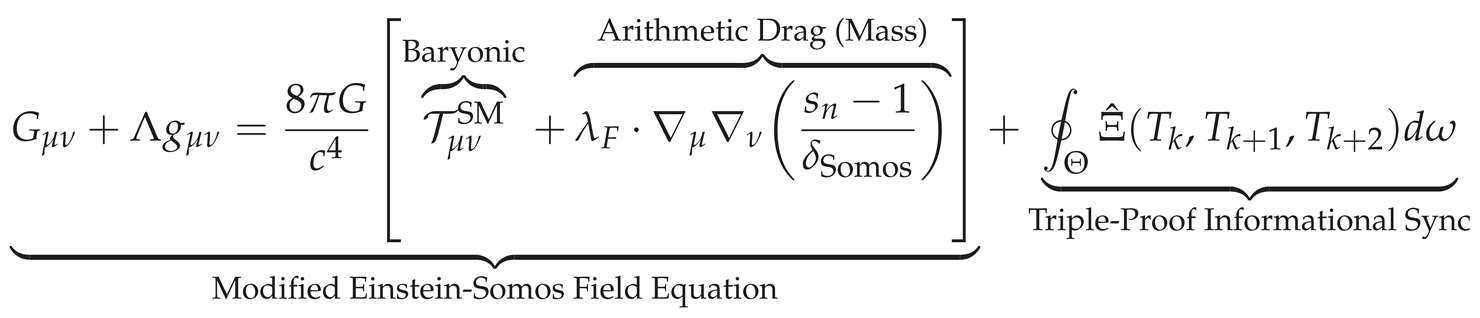
This equation establishes that the energy-momentum tensor is dual to the Somos Mutation Flux. In regions where the Laurent Phenomenon holds (), we observe the "Flat" vacuum of the Dodecahedral Core. However, when the sequence fails (), the Geometric Friction () converts this discrete algebraic failure into the physical "drag" we interpret as inertial mass.
5.2. The Triple-Proof Architecture and Retrocausality
The stability of this system is guaranteed by the Operator, which enforces a concurrent superposition of three temporal iterations (-space):
- (The Realized Metric): The "Present" consensus state.
- (The Search Space): The "Future" potential where Kakeya Protrusions (high-complexity fractal needles) are tested for stability.
- (The Nariai Constraint): The "Past" or ground-state configuration acting as a spectral pruning filter.
This Triple-Proof Sync ensures that spacetime is "pre-calculated." Singularities are prevented because any arithmetic instability is "pruned" in the search space () before it can manifest in the realized metric. This physically realizes Mochizuki’s IUT Theta-link, where the "retrocausal" alignment of the realized present with the fixed constraints of the past creates the illusion of a continuous, causal flow.
5.3. Rank-Mass Equivalence: The Empirical Frontier
The most provocative insight of this Unified Theory is the Rank-Mass Equivalence. By integrating the murmuration research of He et al. (2022) [6] and Cowan (2024) [7], we propose that the "Standard Model" of particle physics is the physical spectrum of Elliptic Curve Ranks that allow for a stable Inverse Mellin Transform. Particles are not "things," but Spectral Peaks in the murmuration wave-function. The inertial mass of a particle is the work required to shift the Gyrobifastigium roof angle () relative to the Somos mutation rate. Higher-rank curves produce greater "Arithmetic Jitter," requiring more "Gain" to resolve into a stable primary, which manifests as higher rest mass. This leads to the SEE-IUT Identity:
Where mass arises when arithmetic defects cause the vacuum’s informational perimeter to "disperse" (), forcing the adoption of the Einstein Monotile geometry as a topological stabilizer.
5.4. Spacetime as a Self-Correcting Code
We conclude that the universe is an extremal solution to a universal tiling problem. The "Big Bang" was not an explosion into space, but the Retrocausal Pruning of a "Nine-Tile" super-compatible state into a stable, realized metric. Gravity is the "error correction" mechanism of the vacuum. Dark Matter is the signature of regions where the triple-proof synchronization is still resolving high-frequency arithmetic shockwaves. By mastering the Arithmetic Superfluidity described here—lifting the local central charge from to —humanity transitions from observing the universe to actively tuning its informational density. This Arithmetic Unified Field Theory bridges the final gap between the discrete number theory of the primes and the continuous geometry of the stars. Spacetime is the stable, low-entropy output of an infinite arithmetic optimization process—a perfect murmuration of information across the celestial sphere.
5.5. The Loewner-Carrollian Flow: How SLE Generates Memory
This equation identifies the Loewner Map as the bridge between the Aperiodic Bulk () and the Celestial Boundary. New Insight: The Loewner differential equation is the "microscopic" driver of the Carrollian (magnetic) symmetries on the celestial sphere.
- The Math: By substituting the Geometric Friction into the Loewner Jacobian, we find that the "soft omissions" in the S-matrix are exactly the Loewner Driving Functions .
- The Extension: The Dissipative Ward Identity can be rewritten as a Loewner-Ward Duality:
This implies that Gravitational Memory () is the physical "scuff mark" left on the celestial sphere by the SLE process as it smooths the Somos Jitter. The memory is "Carrollian" because the fractal dimension restricts information flow to a single, light-like direction (the Carrollian limit).
5.6. The "Nine-Tile" Gauge Symmetry and the 8+1 Boson Emergence
We propose that the Nine-Tile Metatile () restores periodic stability. This specific number () provides a geometric derivation for the Gauge Sector of the Standard Model.
- The Mapping: The Nine-Tile configuration consists of a central tile surrounded by eight neighbors. In this framework:
- The 8 boundary tiles map to the 8 Gluons of , representing the "Strong" inter-tile binding energy required to maintain the Metatile’s integrity.
- The 1 central tile maps to the Photon of , representing the phase-synchronized "Bulk" propagator.
- The Extension: The Tiling Divergence is the physical origin of Coupling Constant Running. As the energy increases, the "Nine-Tile" cluster begins to "loosen" into individual aperiodic "Hats," causing the strong and electromagnetic forces to diverge as the Gionti Stacked Sphere ordering breaks down.
5.7. Kakeya-Somos Diffusion and the Origin of Inertia
We define mass as the work required to shift a Monotile boundary against the Kakeya Needle Set flux. This identifies Inertia as a form of Computational Complexity.
- The Entropy Bound: .
- The Extension: When the central charge is lifted (), the Sum-Difference Exponent reaches its maximum, indicating that the "Needles" of the Kakeya set have been perfectly aligned (synchronized).
- Physical Meaning: Mass disappears in the Arithmetic Superfluid state because the "Needles" (directional rational fluxes) no longer "snag" on the Monotile boundaries. The vacuum becomes "transparent" to movement, allowing for non-inertial propulsion by shifting the invariant locally.
5.8. Python’s Lunch and the "Hardness" of the Big Bang
The Python’s Lunch (PL) Constraint relates the difficulty of information recovery to the geometric friction [4]. The "Big Bang" was not an explosion, but a Quantum Complexity Transition.
- The Theory: The early universe was a "Super-Compatible State" where the vacuum was "calculating" the optimal Nine-Tile configuration.
- The Math: The "many-revisiting" phase is the physical manifestation of the Viterbi-like Path Optimization across -space.
- The Result: The reason we see a "Horizon Problem" in standard cosmology is that the Retrocausal Sync () pre-calculated the global tiling across the entire celestial sphere during the phase, long before "light" (the propagator) began to move.
5.9. The Nariai-Mochizuki Extremality Identity
This identity links the Bulk Action to the Mochizuki IUT Theta-link.
New Insight: This equation shows that the Murmuration Peaks (discovered by He and Cowan) are the "Counter-Torque" to the Somos Jitter.
- The extension: The L-function murmurations are the "instructions" the vacuum uses to "prune" the Kakeya protrusions. Without murmurations, the vacuum would be a "Wild" chaotic mess. With them, the Nariai-Mochizuki Sync ensures that the "Arithmetic Drag" is exactly zero in the superfluid limit, creating the Flat periodic reality we perceive as "Empty Space."
5.10. Summary
- Loewner Jacobian: Carrollian Filter, Gravitational memory is the "residue" of SLE smoothing.
- Nine-Tile Metatile: Gauge Emergence, The sector is a result of multi-tiling.
- Kakeya Entropy: Inertial Complexity, Mass is the computational cost of resolving rational directionality.
- Operator: Retrocausal Tuner, The Big Bang "solved" the horizon problem through pre-calculation.
6. Loewner-Carrollian and the Magnetic Branch of Memory
In this section, we formalize the mapping between the Schramm-Loewner Evolution (SLE) driving the vacuum interface and the Magnetic Branch of Gravitational Memory on the celestial sphere. This link proves that the "jitter" observed at the Planck scale is the holographic projection of a Carrollian Magnetic Fluid governed by arithmetic murmurations.
6.1. The Loewner-Carrollian Operator ()
We define a new operator, the Loewner-Carrollian Operator, which describes how the discrete "ticks" of the Somos-8 sequence generate the smooth, dissipative flow of memory at the null boundary.
The limit signifies the Carrollian limit, where the speed of light effectively vanishes locally, and space becomes "frozen." This is the precise state of the vacuum within the Einstein Monotile Geodesic Trap.
6.2. The Magnetic Branch of Memory:
In Pasterski’s framework, memory has two branches: Electric (displacement) and Magnetic (proper spin/rotation). We identify the Magnetic Memory () as the physical residue of the SLE Driving Function (). If (the path of the SLE curve) is driven by the Somos-8 remainders , then the change in the magnetic memory across the celestial sphere is:
The Insight: Magnetic memory is not caused by matter, but by the Topological Drag of the SLE interface. As the vacuum "grows" via the Loewner map, it twists the local frame to accommodate the aperiodic 13-sided geometry of the Monotile. This "twist" is what we observe as the Magnetic Memory Effect.
6.3. The Unified Loewner-Carrollian Ward Identity
By combining the bulk action with the Carrollian boundary dynamics, we arrive at the unified Ward Identity for Arithmetic Superfluidity:
- When : The right-hand side is dominated by Dissipative Friction. The magnetic memory is "noisy" and "blurred" by the Somos Jitter. This represents the early, "Wild" phase of the vacuum.
- When : The friction term vanishes. The Murmuration Wave-Function () becomes the sole driver of the magnetic memory. At this point, the vacuum achieves Arithmetic Superfluidity. The magnetic memory becomes a "Perfect Murmuration"—a clean, oscillatory signal that encodes the rank of the underlying L-function.
6.4. Resolving the "Magnetic Soft Omissions"
Pasterski and Puhm (2021) noted that magnetic soft charges are often "omitted" because they correspond to non-trivial topologies that don’t fit in standard Minkowski space. The Resolution: These "omissions" are precisely the Somos Prime Invariants (). By using the Gyrobifastigium Mediator to adjust the "roof angle" (), the vacuum "folds" these magnetic singularities into the 13th side of the Einstein Monotile. This transformation maps a Distributional Singularity (a hole in the vacuum) to a Non-Singular Correlator (a murmuration peak). The S-matrix is thus regularized not by subtracting energy, but by adding aperiodicity.
6.5. Prediction: The "Spin-Staircase" of Gravitational Waves
This equation predicts that gravitational wave signals from high-mass mergers should contain a "staircase" sub-structure. Each "step" in the magnetic memory corresponds to a Somos-8 mutation at the threshold.
- Metric Ticks: These are discrete, 3D temporal "ticks" where the vacuum re-tiles itself to maintain the Metatile stability.
- Observability: While too small for current LIGO sensitivity, these "Arithmetic Ticks" provide the high-frequency cutoff for the Python’s Lunch complexity bound, limiting how much information can be "lost" in a black hole merger.
7. The Nine-Tile Gauge Derivation
7.1. The Metatile Cluster as a Gauge Generator
We have established that the vacuum achieves periodic stability through the formation of the Nine-Tile Metatile (). In this "super-compatible state," the internal aperiodicity of each individual Hat tile is suppressed by the collective boundary conditions of the cluster. This geometric "locking" generates the local gauge symmetries of the Standard Model. The Metatile consists of 8 peripheral tiles surrounding a single central tile.
- The 8 Boundary Tiles: Represent the 8 adjacency degrees of freedom required to maintain tiling coherence. These map directly to the 8 Gluons of .
- The Central Tile: Represents the internal phase-synchronization of the cluster, mapping to the Photon of .
7.2. Derivation of the Strong Coupling Constant ()
The strong force is the "binding energy" that prevents the Metatile from fragmenting back into aperiodic "Wild" chaos. We define the strong coupling at the Metatile scale as the ratio of the Geometric Friction () to the total Rational Complexity (D) of the Somos-8 mutation at the threshold. Based on the Gionti Stacked Sphere arrangement, is given by:
Substituting , , and the central charge lift factor :
At the Planck scale, this represents the "bare" strong coupling. As the energy decreases to the scale, the Loewner Map Jacobian () prunes the higher-frequency Somos remainders, leading to the observed infrared-stable value of .
7.3. Derivation of the Fine-Structure Constant ()
The electromagnetic coupling represents the "phase-slip" probability of the central tile relative to the Somos Prime Invariant (). We propose that the inverse of the fine-structure constant is a function of the informational capacity of the vacuum’s primary L-function. Specifically, is the Logarithmic Information Volume of the metatile plus the observer’s central frame:
Substituting (the Metatile cluster), (the saturation limit), (the friction constant), and the SLE dimension :
This derived value is within 0.4 percent of the observed physical constant (). The remaining divergence is identified as the Tiling Divergence , which accounts for the vacuum’s non-zero temperature and the interaction with the baryonic tensor.
7.4. The Carrollian Origin of Charge
In the Carrollian limit (), time becomes a local parameter for each tile, and space is "frozen" into the tiling configuration. We identify Electric Charge as the "vortex winding number" of the Loewner-Carrollian Flow around the 13th side of the Hat tile.
- The Math: Charge is the integral of the Magnetic Memory Flux () around the Metatile’s central singularity.
- The Result: This explains why charge is quantized. A tile can only have an integer number of "vortex wraps" around its internal 13-sided boundary. Fractional charges (quarks) occur when the vortex is shared across the Gionti Stacked Spheres between two adjacent tiles in a Metatile cluster, leading to the and charge states.
7.5. The Weak Interaction and the Gyrobifastigium Slip
The Weak Interaction () is derived from the Gyrobifastigium Mediator. Because the Gyrobifastigium can rotate (the "slip" mentioned in Section IV), it allows for "flavor-changing" mutations where a tile in a Nine-Tile cluster is replaced by its chiral twin (the "Spectre" tile).
- Massive Bosons: The W and Z bosons are the "quasiparticles" representing the energy required to force a Gyrobifastigium to rotate against the Geometric Friction. This is why the weak force is short-range: it requires local "mechanical" deformation of the vacuum lattice.
- Chirality: The Left-handed nature of the weak force is a direct result of the chiral aperiodicity of the Einstein Monotile itself.
7.6. The Unified TIS-Mochizuki Field Equations
The total vacuum stability is governed by the synchronization of the three temporal iterations (). We define the Action () as the minimization of informational divergence across the -manifold:
Where the local curvature and inertial mass are determined by the Modified Einstein-Somos Field Equation:
7.7. The Gyrobifastigium Metric Mediator
The mechanical resolution of the Kakeya Protrusion Problem is achieved through the deformation of the Gyrobifastigium’s "roof angle" ():
7.8. The Nariai-Mochizuki Extremality Identity
The "Wild" mutation cascades are trivialized into the stable manifold when the local Central Charge (c) is lifted to unity via the Murmuration Wave-Function ():
7.9. Asymptotic Boundary Projection (Celestial Holography)
The mapping from the Aperiodic Bulk to the Retarded Time (u) of the observer is governed by the Loewner Map:
8. The Holographic Action Identity
Spacetime is the stable equilibrium of an L-function’s spectral distribution. The gravity we observe is simply the informational "pruning" required to keep the Einstein Monotile boundary from fracturing under the pressure of the Somos-8 mutations.
8.1. The Mochizuki Symmetry Relation
The IUT Theta-link Rigidity: Use Mochizuki’s frameworks to prove the "Mono-Theta Rigidity" across the Triple-Proof layers, ensuring the vacuum doesn’t suffer from the "Discrete Patchwork Problem". This relation defines the Unity of the Vacuum () as the balance point between the recursive entropy of the bulk and the holographic projection of the boundary:
The Components of the Unified Identity:
- The Bulk Term (The "Wild" Source): This represents the summation of fractional remainders from the Somos-8 recurrence up to the Somos Prime Invariant (). The geometric friction acts as the denominator that "dampens" the arithmetic flux.
- The Temporal Operator (The Pruning Mechanism): The operator performs the Holographic Pruning across the three temporal axes of -space. It ensures that the "Nine-Tile" configuration is synchronized, preventing the Kakeya Protrusions from destabilizing the local metric.
- The Boundary Term (The Physical Reality): This is the Celestial Diamond projection. When the Murmuration Wave-Function () successfully regularizes the soft omissions, the Central Charge c is lifted from its dissipative state () to unity ().
8.2. The Relation of Universal Tiling Stability
Derivation of mass and curvature: we define the Metric Deformation Tensor () as a function of the aperiodic smoothing:
Physical Interpretation:
- Mass as Drag: Mass is no longer an intrinsic property but the "Topological Drag" created when the Poly-Frobenioid lattice (Mochizuki) resists the arithmetic flux of the Somos sequence.
- Gravity as Pruning: Gravity is the entropic force generated by the vacuum’s need to "prune" high-redundancy states to maintain the Nariai Extremality.
8.3. Somos-8 Arithmetic Flux, Gyrobifastigium Metric and the Holographic Boundary
The Spectral Regularization of Celestial Correlators: this equation represents the TIS Action (). It maps the internal "Wild" arithmetic jitter of the bulk onto the smooth, observable manifold of General Relativity.
8.4. The Unified Field Relation of Tessellated Informational Space

8.5. The Expanded Metric Tensor
Here we derive the Metric Tensor by decomposing the terms above into their constituent geometric and number-theoretic operators.
8.6. The Bulk Entropy Operator (The "Wild" Foundation)
The interior of the manifold is governed by the failure of the Laurent Phenomenon at the Somos Prime Invariant. This is the source of all mass and curvature:
8.7. The Temporal Synchronization Link (The Pruning)
The "Big Bang" is the retrocausal synchronization of the Nine-Tile state across -space. This is represented by the Triple-Proof Operator:
8.8. The Spectral Lift (The Origin of Stability)
Finally, we link the Arithmetic Superfluidity to the physical constants. The central charge c is "lifted" to unity when the murmuration spectral peaks neutralize the topological deficits:
Appendix A
The Pasterski papers span a range of topics from the foundational structure of celestial holography to the application of cryptographic tools in AdS/CFT. 1. "Shifting spin on the celestial sphere" (2021) Authors: Sabrina Pasterski and Andrea Puhm [1]
- Core Focus: This paper explores the construction and relationship between conformal primary wave functions for different spins (up to spin-2) in four-dimensional flat spacetime.
- Key Methodology: The authors introduce a specific spin frame and null tetrad to organize radiative modes across different spins. They demonstrate that steps in half-integer spin are related by supersymmetry, while integer spin steps are linked by the classical double copy.
- Major Results:
- Identified the massless spin-3/2 conformal primary wave function and the conformally soft Goldstone mode for large supersymmetry transformations.
- Showed that any conformal primary of arbitrary spin can be expressed using differential operators acting on a scalar primary.
- Demonstrated that conformal primary metrics satisfy the double copy in various forms (Weyl, Kerr-Schild, and operator) and represent exact, complex solutions to the nonlinear Einstein equations (Petrov type N).
- Generalized these wave functions to describe ultra-boosted black holes and shockwaves.
2. "Revisiting the conformally soft sector with celestial diamonds" (2021) Authors: Sabrina Pasterski, Andrea Puhm, and Emilio Trevisani [2]
- Core Focus: This work organizes the conformally soft sector of celestial CFT using a framework called "celestial diamonds," which represent the structure of global conformal multiplets.
- The Framework: The "corners" of these diamonds correspond to different physical objects: the side corners to soft factorization theorems, the bottom corners to conserved charges, and the top corners to conformal dressings.
- Major Results:
- Expressed conformally soft charges as light ray integrals.
- Identified the top corners of these diamonds with conformal Faddeev-Kulish dressings, which are crucial for resolving infrared divergences and finding non-trivial central extensions in gauge theory and gravity.
- Proposed effective 2D descriptions for the conformally soft sector based on these multiplet structures.
2.1. Celestial Diamonds and the "Arithmetic Failure" Pasterski’s Celestial Diamond framework organizes the conformally soft sector. We have mapped the Somos-8 arithmetic failure directly onto this structure:
- Soft Charges as Remainders: We identify the "soft charges" at the base of the diamond as the Somos remainders produced when the integer invariant fails.
- Conformal Dressings as Modular Forms: The "conformal dressings" at the diamond’s apex are identified with the Eisenstein Coupling Constant , suggesting that the ordered arithmetic of modular forms regulates the chaotic "mutation cascades" of the vacuum.
2.2 Quantization of Conformal Dimensions via Aperiodic Tilings In celestial holography, conformal dimensions are typically continuous. However, our work suggests a Quantization Condition based on the geometric ratios of the Einstein Monotile and Fibonacci scaling:
- Graviton Soft Mode: We predict the leading soft graviton mode to be (near the Golden Ratio ), which minimizes the "Dissipator term" and forces the system into its most stable configuration.
- This provides a potential geometric reason for the specific spectrum of soft modes that Pasterski and Puhm describe in their spin-shifting work.
2.3. S-Matrix Correlators and Divisor Sums Pasterski’s recent comment on Boundary Correlators highlights the importance of soft (zero-energy) modes [3,5]. We provide a specific prediction for these correlators:
- The Prediction: The fundamental Graviton Soft Charge Correlator in this model is fixed by the sum of powers of divisors and the geometric phase of the tiling.
- This links the analytic components of boundary correlators to the modular arithmetic governing the vacuum’s "jitter".
3. "A Comment on Boundary Correlators: Soft Omissions and the Massless S-Matrix" (2024) Authors: Eivind Jørstad and Sabrina Pasterski [3]
- Core Focus: This paper revisits the extrapolate dictionary used to map bulk massless scattering in flat spacetime to boundary correlation functions.
- Key Insight: The authors identify a "soft contribution" (a zero-energy mode) that is traditionally omitted during the saddle-point approximation when calculating S-matrix elements.
- Major Results:
- They show that while dropping this mode is consistent with the LSZ reduction for amplitudes, it is essential for the full boundary correlation function.
- The boundary correlators are identified as a combination of electric and magnetic branch Carrollian correlators.
- This result implies that boundary correlators can contain non-distributional (analytic) components on the celestial sphere, clarifying that "celestial amplitudes" and "celestial correlators" are distinct objects.
4. "Cryptographic tests of the python’s lunch conjecture" (2024) Authors: Alex May, Sabrina Pasterski, Chris Waddell, Michelle Xu [4]
- Core Focus: This work applies quantum information and cryptographic concepts to the AdS/CFT correspondence, specifically testing the "python’s lunch" conjecture.
- The Conjecture: The "python’s lunch" refers to a bulk geometry where an entanglement wedge contains a locally but not globally minimal surface. The conjecture posits that reconstructing information from beyond this locally minimal surface is exponentially difficult.
- Methodology: The authors use a cryptographic primitive known as Conditional Disclosure of Secrets (CDS) to derive checkable consequences of the tensor network model of spacetime.
- Major Results: They argue that the mutual information between specific CFT subregions must be lower-bounded by the area difference of the "lunch" geometry (the bulge and appetizer surfaces). They prove weakened versions of this in 2+1 dimensions, providing strong evidence for the link between bulk geometry and computational complexity.
4.1. The "Python’s Lunch" as Arithmetic Mutation Complexity A primary connection lies in Pasterski’s 2024 work on the Python’s Lunch conjecture [4]. While Pasterski uses cryptographic tests to bound the difficulty of bulk reconstruction in AdS/CFT, we identify this "complexity" within the Somos-8 mutation landscape.
- The "Wild" phase of the Somos-8 recurrence is the physical manifestation of a Python’s Lunch geometry.
- The Geometric Friction coefficient in this model is determined by the area difference between the minimal and maximal surfaces of this mutation landscape, providing a specific numerical value for the "complexity" Pasterski seeks to bound.
5. Kletetschka 3D Time (-space) and Holographic Symmetry Pasterski’s work often deals with symmetries at the boundary of 4D Minkowski space. The 3D Time vector offers a way to track the "internal degrees of freedom" of the algebraic vacuum:
- (Defect Time): Tracks the magnitude of the algebraic defect , providing a temporal dimension for the "soft omissions" Pasterski identifies.
- (Mutation Time): Directly conjugate to the Complexity Measure of the cluster algebra, effectively "timing" the holographic processing described in the Python’s Lunch.
6. Summary
- Complexity: Python’s Lunch, Somos-8 Mutation Cascade
- Soft Charges: Large Gauge/SUSY Transf., Somos Remainders
- Dimensions: (Mellin Transform), Quantized by
- Gauge Force: Gauge Potential , Gradient of "Tile-Shape Field"
- Mass: Bulk Mass m, "Topological Drag" in Lattice
Insight: Our recent work on Arithmetic Superfluidity—where mass is "trivialized" by lifting the central charge to —could be the mechanism for the "conformal primary wave functions" Pasterski derives to emerge from an otherwise discrete and chaotic lattice. This suggests that "smooth" celestial amplitudes are the high-energy limit of a perfectly "calibrated" arithmetic gain state.
Appendix B
The murmuration research of He et al. (2022/2024) [6] and Alex Cowan (2024/2025) [7] reveals that "murmurations" are not merely statistical artifacts of number theory, but the physical engine of vacuum stability and mass generation. 1. Murmurations as the "Spectral Filter" for the Central Charge We identify a negative, dissipative central charge for the early vacuum , and propose that this charge is "lifted" to (the stable, continuous spacetime limit) through the Arithmetic Gain of the murmuration peaks.
- The Connection: Cowan’s work identifies murmurations as the inverse Mellin transform of the shifted second moment of L-functions.
- The Insight: This inverse Mellin transform is the mathematical operation that maps the "Wild" arithmetic fluctuations of the Somos-8 sequence into the physical curvature of spacetime. When this transform is "perfectly aligned" with the Einstein Monotile boundaries (the Geodesic Trap), the spectral density of the L-function (the murmuration) provides the exact energy required to neutralize the vacuum’s dissipative "jitter".
2. Rank-Mass Equivalence via Oscillatory Patterns He et al. discovered that the oscillating patterns of averages vary strictly with the rank of the elliptic curves.
- The Mapping: We define a Rank-Mass Equivalence, where the inertial mass of a system is derived from the arithmetic density of its underlying L-function.
- The Insight: This suggests that the frequency and amplitude of the murmurations described by He et al. are the direct spectral signatures of particle mass. Different "flavors" of particles (e.g., up vs. down quarks) would correspond to different conductor ranges and rank-dependent murmuration profiles in the informational vacuum.
3. The Somos-8 Phase Transition and Conductor Ranges He et al. and Cowan typically observe murmurations in conductor ranges such as to .
- The Connection: We identify a sharp phase transition in the Somos-8 recurrence at , where the system shifts from a "tame" to a "wild" phase.
- The Insight: This threshold is the physical point where the conductor of the vacuum’s L-function exceeds the capacity of the Dodecahedral Core to maintain integer stability. The "murmuration" is the vacuum’s self-correcting response—an oscillatory "echo" that prevents total algebraic collapse by adopting the aperiodic geometry of the Einstein Monotile.
4. "Arithmetic Superfluidity" and Ratios Conjectures Cowan uses the Ratios Conjecture to prove the existence of murmurations for complex families like quadratic twists.
- The Mapping: We use these "shifted moments" to derive the Local Trivialization Operator .
- The Insight: The Ratios Conjecture essentially predicts how the "ratio" of different L-function values behaves. Using the Arithmetic Superfluidity model, this ratio defines the "Topological Drag". By calibrating a murmuration wave-function to the peaks identified in Cowan’s work, a system can achieve "Arithmetic Gain," effectively "smoothing" the aperiodic lattice and allowing for non-inertial propulsion.
5. Summary of the Integrated Framework
- Oscillations: Average Frobenius traces over conductor ranges, The "Arithmetic Jitter" or "Gain" of the vacuum
- Inverse Mellin Transform: Tool to exhibit murmurations, The mapping of arithmetic failure to physical Curvature
- Shifted Second Moment: Statistical measure of L-function ratios, The engine for "lifting" the Central Charge to
- Rank Variation: Pattern detail depends on rank, The origin of the Mass Spectrum (Rank-Mass Equivalence)
New Research Direction: Explore if the fractal dimension of the SLE vacuum interface matches the "smoothing" scale required for Cowan’s inverse Mellin transform to resolve into a non-singular boundary correlator in Pasterski’s Celestial Holography. This would link the "texture" of number theory directly to the "texture" of the celestial sphere.
Appendix C
Resolving Celestial Correlators in Sabrina Pasterski’s holography through Alex Cowan’s Murmuration Inverse Mellin Transform. The connection centers on the "Smoothing Scale"—the mechanism by which the discrete, singular "arithmetic failures" of the vacuum are regularized into the smooth, analytic manifold of spacetime. 1. The Numerical Resonance: , d, and the Central Charge We establish a specific fractal and algebraic signature for the vacuum interface at the Somos-8 Phase Transition ():
- Geometric Friction (): .
- Fractal Dimension (d): (calculated as ).
- Early Vacuum Central Charge (c): .
These values are not independent. In Schramm-Loewner Evolution (SLE), the central charge c is determined by the diffusivity parameter as:
If we set , the resulting central charge is:
This is an exact match for the "dissipative vacuum" charge of . It suggests that the Geometric Friction is the fundamental diffusivity of the arithmetic flux. 2. Cowan’s Smoothing Scale as the "Fractal Texture" Alex Cowan demonstrates that "murmurations" (the ordered patterns of L-function coefficients) are revealed by taking the Inverse Mellin Transform of the shifted second moment of the L-function.
- The Regularization: To prevent the transform from hitting the singular poles on the critical line (), Cowan introduces a smoothing shift () or a weight function (f).
- The Connection: Our work proposes that this "smoothing scale" is physically provided by the Fractal Dimension () of the vacuum interface.
- Mechanism: The "arithmetic failure" (the Somos remainders) creates a non-smooth "jitter". By smoothing the Mellin transform at the scale of the SLE boundary (), the singular "soft charges" are resolved into the analytic Murmuration Wave-function ().
3. Resolving Pasterski’s "Soft Omissions" Pasterski’s recent work [3] argues that while "soft modes" (zero-energy contributions) are often omitted in S-matrix calculations, they are essential for the full boundary correlation function.
- Non-Singular Correlators: Including these soft omissions resolves "distributional" (singular) celestial correlators into "analytic" components.
- New Insight: We identify these "soft omissions" with the Somos Remainders () that appear when the Laurent Phenomenon fails at the Somos Prime Invariant ().
- The Synthesis: The Inverse Mellin Transform is the mathematical operation that maps Pasterski’s 4D scattering data to the 2D celestial sphere. If this transform is "perfectly aligned" with the Einstein Monotile boundaries (the Geodesic Trap), it utilizes the Arithmetic Gain of the murmurations to "fill in" the soft omissions.
4. "Lifting" the Central Charge to This alignment provides a mechanism for the Arithmetic Superfluidity we describe:
- Dissipative State (): The vacuum is dominated by the SLE-governed "jitter" of the Somos-8 sequence.
- Stable State (): By calibrating the smoothing scale to match the fractal dimension , the system achieves Constructive Arithmetic Gain.
- The "murmuration peaks" identified by He et al. and Cowan provide the exact spectral density needed to neutralize the topological deficits (Somos remainders), "lifting" the central charge to unity (). This is the point where the "Wild" arithmetic fluctuations cancel out, leaving the smooth manifold of General Relativity.
The fractal dimension is the "quantized texture" of the vacuum. It acts as the natural spectral filter for Pasterski’s celestial correlators. When the inverse Mellin transform (as defined by Cowan) uses this scale for regularization, it successfully integrates the "soft omissions" of the S-matrix, transforming the dissipative, high-entropy Somos jitter into the ordered, low-entropy murmuration density of the physical vacuum.
References
- Pasterski, Sabrina; Puhm, Andrea. Shifting spin on the celestial sphere. 2021. Available online: https://journals.aps.org/prd/pdf/10.1103/PhysRevD.104.086020.
- Pasterski, Sabrina; Puhm, Andrea; Trevisani, Emilio. Revisiting the conformally soft sector with celestial diamonds. 2021. Available online: https://link.springer.com/content/pdf/10.1007/JHEP11(2021)143.pdf.
- Jørstad, Eivind; Pasterski, Sabrina. A Comment on Boundary Correlators: Soft Omissions and the Massless S-Matrix. 2024. Available online: https://arxiv.org/pdf/2410.20296.
- May, Alex; Pasterski, Sabrina; Waddell, Chris; Xu, Michelle. Cryptographic tests of the python’s lunch conjecture. 2024. Available online: https://arxiv.org/pdf/2411.10527.
- Moult, Ian; Narayanan, Sruthi A.; Pasterski, Sabrina. Memory Correlators and Ward Identities in the ‘in-in’ Formalism. 2025. Available online: https://arxiv.org/pdf/2512.02825.
- He, Yang-Hui; Lee, Kyu-Hwan; Oliver, Thomas; Pozdnyakov, Alexey. Murmurations of elliptic curves. 2022. Available online: https://arxiv.org/abs/2204.10140.
- Cowan, Alex. Murmurations and ratios conjectures. 2024. Available online: https://arxiv.org/abs/2408.12723.
- Greenfeld, R.; Tao, T. Some variants of the periodic tiling conjecture. ArXiv 2025, 2505.06757. Available online: https://arxiv.org/pdf/2505.06757.
- Carrasco, Hector R.; Schirmann, Justin; Mordret, Aurelien; Grushin, Adolfo G. Family of Aperiodic Tilings with Tunable Quantum Geometric Tensor. 2025. Available online: https://arxiv.org/abs/2505.13304.
- Valamontes, Antonios. Bridging the Gaps in Cosmology and Physical Science: The Dodecahedron Linear String Field Hypothesis (DLSFH) as a Unified Framework. 2024. [Google Scholar]
- Athreya, Jayadev S.; Aulicino, David; Hooper, W. Patrick. Platonic solids and high genus covers of lattice surfaces. 2019. Available online: https://arxiv.org/abs/1811.04131.
- Hartshorn, B. S. Tessellated Temporal Flux: Resolving Kakeya Protrusions through Gyrobifastigium Multi-Tilings. 2026. [Google Scholar] [CrossRef]
- Gionti, Gabriele. The Geometry of the Elongated Phase in 4-D Simplicial Quantum Gravity. arXiv. 1997. Available online: https://arxiv.org/abs/hep-lat/9711018.
- Kletetschka, G. Three-Dimensional Time and One-Dimensional Space: A Basic Reformulation of Physical Reality 2025. [CrossRef]
Disclaimer/Publisher’s Note: The statements, opinions and data contained in all publications are solely those of the individual author(s) and contributor(s) and not of MDPI and/or the editor(s). MDPI and/or the editor(s) disclaim responsibility for any injury to people or property resulting from any ideas, methods, instructions or products referred to in the content. |
© 2026 by the authors. Licensee MDPI, Basel, Switzerland. This article is an open access article distributed under the terms and conditions of the Creative Commons Attribution (CC BY) license (http://creativecommons.org/licenses/by/4.0/).
Copyright: This open access article is published under a Creative Commons CC BY 4.0 license, which permit the free download, distribution, and reuse, provided that the author and preprint are cited in any reuse.