

Submitted:
08 January 2026
Posted:
08 January 2026
You are already at the latest version
Abstract
Structural vibration is a significant problem created by industrial machinery (i.e., compressors, motors, and generators) that can negatively affect the performance of equipment as well as the overall integrity of buildings or structures. Although various vibration isolation technologies are available for reducing the structural vibrations produced by machinery, most of these methods have inherent limitations because of a lack of sufficient damping at lower frequencies relative to that observed higher frequency ranges. The purpose of this paper is to evaluate the use of advanced vibration isolation technologies using re-entrant auxetic structures that are characterized by their negative Poisson ratios. Through a comprehensive evaluation of 92 published articles within the areas of auxetic unit cell design and topology optimization, the mechanics of materials related to negative Poisson ratios, energy absorption mechanisms, vibration reduction in sandwich structures, and dynamic analyses of frame and plate systems, this review presents the current state-of-the-art re-entrant auxetic structures that can be employed as vibration isolation technologies for machine foundations. The analysis reveals that compared with standard structures, re-entrant geometry-based structures exhibit high levels of energy absorption (up to a 767% increase over the standard designs), along with superior vibration isolation characteristics. A hybrid approach utilizing combinations of geometric modification, multimaterial fabrication, and foam filling is identified as the most promising method for optimizing the relationship between stiffness and damping capacity. Additionally, advancements in additive manufacturing have made it possible to fabricate complex auxetic geometries that were previously unfeasible via traditional processes. In addition to identifying significant research gaps, such as scaling up to large macroscale steel implementations, this paper presents general design guidelines for future vibration isolation systems for industrial machinery.
Keywords:
re-entrant structures
; auxetic metamaterials
; negative Poisson ratio
; vibration damping
; energy absorption
1. Introduction
The use of high-speed machines has made it increasingly difficult to manage the structural vibrations associated with the high-speed rotating equipment that is used throughout modern industrial facilities. High-speed rotating equipment such as turbines, generators, compressors, and precision manufacturing equipment is subjected to high dynamic forces during their operations, which travel through the foundation system into the rest of the building and other structures. Uncontrolled vibrations induced by rotating equipment can lead to many undesirable outcomes, including increased rates of fatigue failure for mechanical parts, the loosening of critical bolts and studs, decreased life expectancy for bearings, decreased accuracy for manufactured products, and diminished structural integrity in the supporting structures and surrounding buildings [1,2]. In addition to the cost of damaged or destroyed equipment, the impact of uncontrolled vibrations extends to the areas of increased maintenance, lost production due to unplanned shutdowns, and reduced production efficiency.
Historically, attempts to isolate the vibrations generated by rotating equipment have utilized passive methods consisting of rubber isolators, viscous dampers, and/or heavy reinforced concrete foundations. Although passive methods have been successful in some cases at controlling the vibrations of rotating equipment within specific frequency ranges, they have significant limitations. The primary limitation of passive methods is their inability to simultaneously optimize both the static stiffness and the dynamic damping of a structural member over the entire range of possible operating frequencies, especially the lower frequencies that are common to larger rotating equipment [3]. Rubber mounts are effective at isolating high-frequency vibrations; however, they have poor low-frequency damping capabilities and suffer from creep, age hardening, and thermal sensitivity. Concrete foundations also have significant limitations; while they can provide superior static support to structures, they do not inherently have sufficient damping properties and thus transfer vibrational energy to the surrounding soil and structure. Owing to the inherent limitations of passive methods in terms of effectively isolating vibrations from rotating equipment, researchers have developed new structural concepts that provide superior static load-carrying capacities while increasing the ability to dissipate vibrational energy during dynamic operations.
1.1. Auxetic Materials and the Re-Entrant Paradigm
Re-entrant honeycombs are a type of auxetic material that demonstrates a key characteristic—a negative Poisson ratio (NPR)—when subjected to forces, such as expansion in the plane parallel to the direction of the applied force and contraction in the perpendicular direction to the applied force. These materials do not demonstrate this unique behavior because of any specific property of the base material but rather because of the specific geometric arrangement of their structural components at the unit cell level. In recent years, many studies have reported on a wide variety of auxetic topologies, including chiral systems, rotating rigid systems, and perforated systems, with emphasis placed on the re-entrant honeycomb system (primarily for structural engineering applications) due to its relative simplicity and scalability, along with very robust auxetic responses over a wide range of strain levels [4,5].
The re-entrant geometry of the re-entrant honeycomb system provides an auxetic effect based on a coordinated hinging mechanism. A bowtie- or butterfly-shaped unit cell is produced because of inward-pointing vertices. Under compressive forces, the struts within the system rotate inward, which causes the structure to contract in the plane parallel to the direction of the applied compressive force. In contrast with the normal honeycomb, where the struts push outward when the honeycomb is subjected to a compressive force, the inward rotation of the struts causes the structure to become denser, creating a self-reinforcing effect in terms of stiffness. This is a highly desirable feature for impact protection applications, as the stiffness of the target material increases as the load increases, which is a process referred to as strain stiffening [6,7]. Additionally, the lateral contraction induced under compressive forces causes the material to be concentrated in the area of loading, resulting in enhanced indentation resistance that is localized in the loaded region; this effect has been referred to as the “indentation resistance effect”, which is a result of the auxetic nature of the material and is different from the behavior of conventional honeycombs [8]. Finally, the complex internal deformation modes associated with the auxetic behavior of the material enhance the energy dissipation effect by increasing the internal friction, microstructural hysteresis, and wave scattering mechanisms of the material, making it ideal for vibration control applications.
1.2. Current Research Landscape and Identified Gaps
The last ten years have seen an explosive increase in the amount of research being conducted on auxetic materials, including within the areas of mechanics, manufacturing processes, and structure optimization methods for specific applications. Theoretical studies were the first to develop analytical models for predicting the effective properties of re-entrant lattices [9,10]. Experimental efforts have validated the results of these models and revealed new properties of auxetic materials, such as size effects [11] and strain rate sensitivity [12].
There are many ways in which the geometric design space of auxetic materials can be modified. Researchers have demonstrated that the addition of curved struts [13], hierarchical arrangements [14], star-shaped inclusions [15], and elliptical annular elements [16] can significantly improve certain properties of these materials without compromising their ability to exhibit auxetic responses.
Advances in manufacturing techniques have also had major impacts. Techniques such as selective laser sintering, fused filament fabrication, and electron beam melting have allowed for the development of 3D lattices with complex geometries and precise control over their microarchitectures [17,18]. Furthermore, the ability to create structures using multiple materials [19] allows researchers to strategically place stiff and compliant materials throughout these structures to obtain optimized combinations of strength, stiffness, and damping.
Although there have been many advances in auxetic material-related research, one area that is still underdeveloped is the transition from small-scale laboratory demonstrations to large-scale industrial implementations. While most of the previous studies concerning auxetic materials have focused on the development of polymer-based auxetic structures at the millimeter or centimeter scale, the mechanical characterization of these structures has been limited to quasistatic loading conditions [20]. In addition, research on the development of re-entrant geometries into structural-scale metallic systems (such as steel frames for machine foundations) has received little attention. Additionally, very few previous studies have performed experiments under the actual operating conditions of machines and equipment, which leaves a great deal of uncertainty about the practical performance of these novel structural concepts.
1.3. Scope and Objectives of This Review
This comprehensive literature review examines the recent publications on re-entrant auxetic structures that are relevant to vibration damping systems, drawing upon 92 peer-reviewed articles published between 2017 and 2025. While the primary focus is on vibration isolation applications, the surveyed literature necessarily encompasses related domains—including unit cell designs and topology optimizations, energy absorption mechanisms, and mechanical property characterizations—as they fundamentally inform the development of effective vibration control systems. This review aims to (i) develop a taxonomy of the geometrically modified unit cells that are used in auxetics and identify configurations with potential for large-scale steel implementations; (ii) elucidate how a negative Poisson ratio influences mechanical properties, including their stiffness, strength, and damping capacity; (iii) assess the energy absorption performance achieved under loading conditions that are relevant to machinery operations; (iv) examine the vibration damping behaviors exhibited by sandwich structures and foundation systems; (v) analyze the dynamic characteristics of auxetic frame and plate configurations; and (vi) survey diverse application domains where auxetic structures have demonstrated practical utility.
The review is structured around six thematic sections following this introduction, each of which addresses a distinct facet of auxetic structure science and engineering. The first section examines unit cell topologies and geometric modification strategies that have been demonstrated to provide enhanced mechanical performance. The second section reviews the dynamic behaviors of frame and plate structures and discusses these behaviors in relation to machine foundation designs. The third section addresses the vibration damping behaviors observed in sandwich configurations, including soil–structure interaction considerations. The fourth section provides a detailed examination of energy absorption mechanisms and impact response characteristics. The fifth section reviews the relationships between negative Poisson ratios and various mechanical properties. The sixth section surveys practical applications of auxetic structures across multiple engineering disciplines. A concluding section synthesizes the key findings, identifies the remaining research challenges, and proposes directions for future investigations toward the development of re-entrant steel frame systems that can be used in industrial vibration control applications.
2. Auxetic Structures and Unit Cell Designs
Auxetic materials, which are defined as materials with negative Poisson ratios, possess superior mechanical properties to those of other materials, particularly in terms of impact damping, vibration isolation, and load-carrying capacity. These properties give auxetic materials advantages over conventional materials. Three main approaches are available for improving the performance of auxetic materials, particularly in terms of their strength and vibration damping effects: changing the unit cell topology, modifying geometric properties, and implementing manufacturing-oriented designs and applications as seen in Figure 1.
2.1. Changing the Unit Cell Topology
The unit cell topology is among the key factors that determine the performance of auxetic materials. The most commonly used unit cell configuration is the recessed honeycomb structure. Recent research has indicated that unit cell architectures are being modified or completely redesigned to improve their performance.
By combining the traditional recessed honeycomb (RH) structure with square unit cells, Ma et al. [14] proposed a new structure called the square recessed honeycomb (SRH), as illustrated in Figure 2. Their findings revealed that SRH configurations outperform RH configurations in terms of vibration reduction and energy absorption effects. SRH configurations can withstand higher plateau stresses and provide higher specific energy absorption rates. Furthermore, replacing circular elements with square unit cells improves noise levels and vibration damping conditions over a wider frequency range, especially in the low-frequency region.
Bagewadi et al. [21] investigated the out-of-plane mechanical responses of auxetic and hybrid auxetic structures subjected to transverse loading. In indented configurations, the stress concentration regions that are dominant under in-plane loading can be reduced in two ways: (i) by rounding the cell corners and (ii) by smoothly varying the cross-sectional area of the supports. In their study, a hybrid auxetic structure was proposed by combining a conventional hexagonal honeycomb and an indented honeycomb to improve the mechanical properties of the system. The results revealed that the gradient in the material distribution significantly affects the improvement in the specific energy absorption performance of the target structure. At almost the same relative density, compared with that of the re-entrant auxetic structure (AS 13 J/g), the specific energy absorption of the hybrid structure (HASr 21 J/g) increased by 61%. This improvement was largely attributed to the rounded corners of the unit cells.
Zhu et al. [22] studied a new configuration called an elliptical annular re-entered honeycomb (EARE). This architecture was achieved by incorporating an elliptical annular element into a conventional re-entered (RE) honeycomb unit cell, as shown in Figure 3. The resulting design was aimed at simultaneously improving the auxetic behavior, energy absorption capacity, and stiffness of the structure without restricting lateral deformation. The EARE structure exhibited a stronger auxetic response despite a 5.19% decrease in its auxetic effect in terms of Poisson’s ratio. It also showed a 171.63% increase in the average plateau stress and a 28.03% increase in the specific energy absorption effect. As a result of these improvements, significant increases in both the energy absorption capacity and stiffness of the structure were observed.
Széles et al. [23] developed a new bidirectional re-entrant honeycomb architecture to overcome the limitations observed in the traditional auxetic honeycomb configurations. Samples were fabricated by vat photopolymerization using two geometric parameters, offset and deg, and then subjected to compression tests, as illustrated in Figure 4. The experimental results revealed that the updated configuration outperformed the conventional design, primarily because of its improved geometric layout. As the offset and deg parameters increased, significant increases in the energy absorption capacity (up to 767%) and maximum compressive load (up to 17 times) were observed. The study also revealed that the appropriate selection of these parameters effectively eliminated buckling and ensured consistent auxetic behavior.
Chen et al. [24] reported that compared with the original design, a new auxetic honeycomb configuration created by adding a self-similar inner layer to a conventional re-entrant hexagonal structure resulted in greater auxeticity and increased stiffness as shown in Figure 5. A significant increase in stiffness was observed in the stress‒strain response of the new structure, which proportionally affected the change in the plateau stress. The results also revealed that the specific energy absorption capacity of the new auxetic configuration was approximately ten times greater than that of the reference structure and exhibited a more consistent negative Poisson ratio effect.
2.2. Modifying Geometric Properties
The mechanical and dynamic effects of auxetic structures vary according to various parameters, the most important of which are the support thickness and insertion angle.
Xiao et al. [25] were the first to investigate the quasistatic compressive behaviors of graded metallic auxetic re-entrant honeycombs. In their study, unidirectional auxetic honeycombs (UGAHs) and bidirectional auxetic honeycombs (BGAHs) with equal masses were fabricated and subjected to compression tests, as illustrated in Figure 6. Their study revealed that SRH configurations outperform RH configurations in terms of both vibration damping and energy absorption. In addition, SRH designs withstand higher plateau stresses and exhibit greater specific energy absorption rates. Their investigation revealed that before the densification of the graded layer with the maximum cell wall thickness, the energy dissipation capacity of the UGAHs was lower than that of the BGAHs.
Choi and Park [12] reported that changes in the re-entry angle significantly altered the deformation behaviors of these auxetic structures, as seen in Figure 7. Instead of deforming rigidly or uniformly, the structures exhibited different stress responses as the angle changed, changing their overall flexibility and leading to significantly different mechanical performances under loading. The experimental results revealed that the Poisson ratio increased as the re-entry angle increased and that the auxetic effect was preserved only as long as the re-entry cell maintained a concave configuration. Compared with the experimental data, the 2D FEA yielded similar results in both the concave and the convex deformation regimes, whereas the 1D FEA provided reliable predictions only in the concave regime.
2.3. Manufacturing-Oriented Designs and Applications
To translate auxetic structures from theory to practical use, it is essential to choose a production method that is compatible with architectural designs and enables easy, fast, and cost-effective production processes.
Shen et al. [26] studied the design of a novel Ti-6Al-4V three-dimensional re-entrant lattice auxetic structure fabricated using an electron beam melting (EBM) process. The two-dimensional structural elements were assembled into a three-dimensional re-entrant auxetic lattice architecture via a specifically designed connection and a topological scheme, as detailed in Figure 8. Under uniaxial loading, all 2D components exhibited negative Poisson ratios while carrying the load. Compared with the conventional re-entrant cage, the improved 3D re-entrant cage exhibited superior mechanical performance, a higher energy absorption capacity and much wider design flexibility.
Zhang and Lu [11] investigated the dynamic tensile behavior of a honeycomb-type auxetic structure with a re-entrant topology. In their study, tensile tests were carried out using MTS and Instron VHS 8800 hydraulic testing machines. The re-entrant samples were fabricated from AlSi12 powder by means of the selective laser melting (SLM) process. An examination of the deformation behaviors of the samples and the corresponding force–displacement curves revealed good agreement between the numerical results and the experimental data.
Kayacan et al. [18] developed a new hybrid manufacturing method for lattice structures by integrating a modal vibration analysis with Charpy impact testing; the overall experimental workflow is outlined in Figure 9. The aim of their study was to investigate the Charpy impact behaviors and vibration damping performances of 316L, MS1, and 316L + 2% Cu alloys and lattice samples produced from these materials. Charpy impact tests revealed that the energy absorption capacity of the closed hexagonal lattice structure produced from 316L + 2% Cu was 33 J. The dynamic responses were evaluated via a modal vibration analysis, and potential weak points were identified. The closed hexagonal lattice made from MS1 was found to have a damping ratio of 0.7, indicating that this configuration is advantageous for vibration damping applications.
Günaydın et al. [17] studied the effect of using multiple materials in hexagonal and re-entrant (auxetic) cellular structures. Three different material combinations were used for each configuration: nylon, carbon fiber-reinforced nylon, and glass fiber-reinforced nylon. The samples were fabricated using the fused filament fabrication (FFF) technique. Strong agreement was observed between the experimental results and the numerical analysis results; the corresponding FEM models and reinforcement locations are presented in Figure 10. Compared with the single-material nylon structure, the multimaterial approach increased the specific energy absorption rate, compressive strength, and elastic modulus of the re-entrant cellular structures by 60%, 104%, and 201%, respectively. The same amounts of hexagonal cellular structures resulted in smaller improvements of 15%, 60%, and 127%, respectively.
Liu and Chen [27] addressed the free vibration behavior of carbon fiber-reinforced sandwich open circular cylindrical shells containing three-dimensional re-entrant auxetic cores (3D RSOCCS). All 3D RSOCCS samples were fabricated as composite structures using hot-press molding followed by interlocking assembly. The modal properties obtained from the modal analysis were in good agreement with the corresponding experimental results.
Zhou et al. [28] studied the properties and impact damping performance of a novel hybrid metamaterial (HMM). The HMM was fabricated using 3D printing based on selective laser sintering (SLS) technology. The HMM was constructed by integrating periodic mass inclusions into a conventional re-entrant frame, simultaneously achieving a local resonance mechanism and a negative Poisson ratio. Impact tests revealed that under the same impact energy, compared with the conventional re-entrant structure, the HMM provided approximately 22.6% better impact damping performance. Consequently, the proposed hybrid metamaterial was found to be advantageous for impact attenuation and noise control applications.
3. Dynamic Analysis of Frame and Plate Structures
The studies in this group are grouped under three headings on the basis of their content and methodology similarities. The first subgroup includes studies conducted on the dynamic behaviors of frame systems and machine foundations; the second subgroup investigated the modal properties and wave propagation of stiffened plates. The third subgroup focused on the vibration and vibroacoustic responses of auxetic/metamaterial-based plate and shell systems.
3.1. Dynamic Behaviors of Frame Systems and Machine Foundations
Zhao et al. [29] emphasized that increasing the amount of urban transportation increases the vertical vibrations transmitted to neighboring buildings in steel frame structures, but the underlying deformation mechanisms have not been fully elucidated. They investigated the vertical vibration exhibited by a typical steel frame under road traffic using field measurements and a finite-element analysis; Figure 11 provides an overview of the tested frame and the measurement-point arrangement. They proposed a new modal updating method based on horizontal components that improves the accuracy of the utilized numerical model. By distinguishing between global modes, where beam-plate bending causes axial deformations in columns, and local modes, where architectural irregularities dominate, their method explained the increased vibrations that were observed, particularly on upper floors and in irregular areas. This study provides a basis for identifying risk zones and locating control elements.
Ahmed et al. [30] looked closely at how shape affects the vibration behaviors of frame-style supports used under turbogenerators. Instead of using standard setups, they built a 3D model—with a base slab, an upper slab, and vertical columns— with the finite-element model setups for the two configurations shown in Figure 12, and ran modal and harmonic tests in Ansys Workbench, adjusting the slab thickness, column size, and height in succession. The findings suggest that cutting the column height or increasing the column thickness sharply increases the natural frequency and decreases the amount of movement that occurs during operations, whereas changing the slab thickness has little effect. They offered a hands-on approach for sizing such foundations, pointing out that despite their different shapes, their responses line up along one unified scaled graph.
3.2. Dynamic Analysis of Stiffened Plates
Lin and Zhang [31] analytically investigated the free and forced vibration responses of free-edge ribbed plates and demonstrated the effect of a stiffened rib on the mode shapes in detail. Utilizing solutions based on the double cosine integral transform, the vibration modes of the ribbed plate were divided into four main groups on the basis of their symmetry properties, and it was shown that despite the addition of ribs, most of the modes could be traced back to the original modes of the flat, unstiffened plate. The researchers emphasized that the modal frequencies of the plate decreased when the rib mass was dominant and increased when the stiffness was dominant, clearly demonstrating how the stiffener reshaped the modal properties through the mass‒stiffness balance.
Gu et al. [32] tested this approach on stiffened composite panels, combining an energy-based assembly with an advanced Fourier transform technique to examine how the panels vibrated when left alone or under force, which are essential characteristics for lightweight ship designs. They conducted convergence tests to verify the effectiveness of their method, and the results demonstrated its robustness and accuracy in terms of analyzing such structures relative to laboratory data derived from previous studies,. The results indicated that factors such as the rib shape, panel thickness, and structure of the materials, particularly the wrinkle pattern, strongly affect the resonant tones and vibration intensity. According to Gu and his team, increasing the thickness and stiffness helps reduce vibration levels, whereas correctly arranging the layers improves the low-end vibration control effect. The number and sizes of the ribs significantly influence the dynamic responses of these composite panels.
3.3. Auxetic and Metamaterial-Based Plate/Shell Systems
Li et al. [33] designed a new honeycomb core that combines a conventional honeycomb core with a recessed geometry and proposed a novel auxetic honeycomb sandwich panel (NAHSP) with polyurethane-metal laminated face plates; Figure 13 summarizes the NAHSP geometry and the four configurations considered. Vibration and acoustic responses were investigated in four different configurations using an ABAQUS-based numerical model; the results showed that both the PML face plates and the auxetic honeycomb geometry were highly effective at providing vibration suppression and noise reduction. The research showed that the even PML-A layout blocked more noise than the uneven setup did—the performance decreased sharply at approximately 6 mm of polyurethane, whereas the total sound reduction increased by 9.4%. The honeycomb geometry with a 45° inclination angle stood out as the configuration that provided the best vibroacoustic performance.
Liu and Chen [27] pushed this idea into CFRP sandwich-based open circular shells featuring 3D inward-pulling cores, zeroing in on how light materials with special internal structures behave when vibrating freely. Instead of standard methods, their work used a setup blending Rayleigh–Ritz math and Reddy’s advanced bending theory and then checked the obtained results through computer simulations based on finite elements. To test real samples, fully composite 3D folded-core units were constructed via heat compression followed by quick-connect building techniques, while the actual vibration speeds came from tap testing setups; the experimental setup is depicted in Figure 14; these findings closely aligned with digital forecasts. Much of the research focused on how fiber alignments and structural dimensions affect resonance levels, offering hands-on tips for adjusting thin-walled negative-Poisson-ratio components to better block vibrations.
Zhu et al. [34] analyzed the vibration frequencies and energy contents of auxetic honeycomb sandwich plates with negative Poisson ratios using a framework based on Reddy’s third-order plate theory, von Kármán-type geometric nonlinearity, and Hamilton’s principle. By comparing the behavior observed under damping and in-plane forces as well as free vibration, they showed how the mode frequencies and potential energy varied with the plate parameters. They emphasized that, in particular, the results obtained with the Hamiltonian energy method for lateral free vibrations were fully consistent with the previously presented free vibration solutions in terms of their trends, but the natural frequency and energy values were higher.
4. Machine Foundations and Vibration Damping in Sandwich Structures
4.1. Introduction: The Need for Metamaterial-Based Isolation
The performance of rotating machinery, such as fast turbines, depends heavily on the solidity of their base structures. In modern industry, this remains a key challenge. Despite the common use of heavy concrete or basic rubber supports in most standard bases, such methods often fail to combine static stiffness with dynamic damping, especially at low vibration frequencies. These limitations were closely studied by Feng et al. [2]. They highlighted the fact that although passive devices reduce the degree of transmissibility to some extent, adjusting to excitation frequency changes is difficult. Beyond this limit, semiactive systems or novel structural geometries clearly become necessary.
Recent research has indicated that machine foundations may use auxetic geometries, combined material fabrication techniques, or embedded damping features. New frameworks [35,36] enable more accurate predictions of re-entrant responses to be obtained. However, deeper advances require such designs to be linked to soil–structure systems [1] while also integrating actual onsite improvements [37]. This work addressed this gap by using re-entrant steel frame units—metal structures that offer high rigidity but enable efficient energy dissipation in machinery setups.
4.2. Theoretical Modeling and Geometric Improvements of Re-Entrant Structures
Modeling re-entrant sandwich structures is mathematically challenging because of their anisotropic cellular geometries. To avoid the high cost of full-scale 3D simulations, recent studies have turned to homogenization techniques. Xiao et al. [36] studied honeycomb sandwich panels through VAM, illustrating the effects of core stiffness on overall vibrations by reducing a 3D case to a 2D model setup, using computational efficiency to highlight dynamic behavior shifts.
Researchers have changed basic shapes to achieve enhanced efficiency. For instance, Li et al. [13] proposed a model featuring curved ridges in standard inward-bending modules. Models have suggested that such changes could significantly improve the resistance to impacts—by lowering Poisson’s value to -1.12—through altered structural behaviors under stress. As a result, tailored stiffness, which is useful in manufacturing systems, can emerge from simple shape modifications.
A similar energy-based 2D model designed for rib-reinforced panels was introduced by Lai et al. [38]; the corresponding core-cell configurations are provided in Figure 15. They reported that increasing the fundamental frequency helps ribs suppress resonance while maintaining useful negative Poisson ratio traits under constant loading.
Pan et al. [35] developed a model for symmetric re-entrant structures using Lagrange equations for complex ship bases. They reported that compared with conventional grid arrangements, these bases have broader vibration absorption bands. Earlier, Pan et al. [39] investigated the transient responses of these systems, confirming that the NPR effect reduces the steady-state vibration amplitude of the machinery.
4.3. Enhanced Damping via Hybrid Materials and Manufacturing
While shaping can reduce vibrations, how well a material absorbs them matters just as much. Because metals often do not absorb energy efficiently, scientists have looked into mixed methods instead. Jiang et al. [40] studied sandwich panels with a negative Poisson ratio; here, polyurea-filled cavities and soft damping sheets were applied on the outer faces, with the corresponding fabrication steps provided in Figure 16. A modal strain energy analysis revealed that these infilled hybrids cut the vibration levels by approximately 40%, unlike hollow versions.
Jiang et al. [40] studied sandwich setups with inner zones filled with polyurea and negative Poisson ratios; the external parts applied pliable damping substances instead. Utilizing modal strain energy methods, they reported that compared with empty designs, filled designs reduced vibrations by approximately 40%, with the numerical FEM setup and reinforcement layout given in Figure 17. In addition to the main treatment, the results were better than those of basic models lacking filler. This finding shows that fiber-based auxetic structures offer good static rigidity along with strong vibration control for machinery bases.
At the nanoscale, Rahmani et al. [41] demonstrated through an analysis that incorporating carbon nanotubes (CNTs) into polymer face sheets enhances the dynamic responses induced during free vibration.
4.4. Topology Optimization and Structural Design
The vibration response of a machine foundation is often decreased by adjusting certain parameters. In a 2018 paper, Ramakrishna et al. conducted topology optimization on a support frame for marine engines. They began with a conventional design based on laser-scanned information and then progressively removed material that was not needed. Because of the new shape, the natural frequencies shifted farther from the working speeds. In related work, Yong et al. [42] proposed a combined approach in which critical sizes were selected to lessen the deformation induced when loaded; at the same time, they expanded the frequency span that suppressed oscillations.
4.5. Soil–Structure Interactions and Geotechnical Improvement Methods
The behavior of a foundation relies heavily on the ground below—not only its structure. Various soil layers, along with water content, affect how waves move through the Earth. Research into flexible foundations on layered saturated soils has shown that permeability and stiffness control dynamic responses [43]. Similarly, Abdulrasool et al. [44] reported that higher moisture levels—rising from 60% to complete saturation—led to lower shaking intensities in clay despite greater pressure. These results imply that engineers should account for soil characteristics that are tied to water when creating re-entrant steel structures because environmental conditions influence performance, especially underground.
Geotechnical changes can also improve damping. Venkateswarlu et al. [45] tested geogrids and geocells under model foundations. Field trials revealed that geocell-strengthened ground cuts the vibration peaks by nearly 60%. As noted by Amiri et al. [37], stacking multiple geocell levels increases the energy dissipation effect, blocking the spread of waves early. Tafreshi et al. [46] tested placing rubber sheets beneath foundations and reported an approximately 40% reduction in the vibration amplitudes induced with a 12–24-mm rubber layer. Additionally, Kavand and Khadangi [47] achieved a 20–30% reduction in ground vibrations (25–40 Hz range) using EPS geofoam barriers, with the test layout and geophone locations described in Figure 18.
Validating these systems requires solid empirical methods. An approach called “Dynamic Substructuring,” introduced by Martini et al. [48], separates the analyses of the rotor and the foundation. Instead of combining them, it treats each part on its own. Gaygol and Wani [49] used setups such as a Chladni plate to display clear nodal patterns; their method made structures easy to see. Despite the use of basic equipment, their results were strong, showing how hands-on work can track emerging forms. These visuals also support computer-modeled vibrations.
5. Energy Absorption and Impact Behavior of Re-Entrant Structures
Recent studies on the cellular materials used in machine frames, shields, or impact dampers have shown that they absorb energy better than solid materials do. For instance, Thomas and Tiwari [4], along with Wang [5], highlighted the fact that new honeycomb designs are increasingly vital for maximizing safety during collisions because their strength can be tuned. Among them, re-entrant forms stand out—these forms have negative Poisson ratios, acting like auxetic substances. When compressed, these structures shrink sideways instead of expanding, pushing material into the stressed area while increasing its compactness. Greater density improves the crack resistance of a material due to the use of a tighter structure. Studies indicate that such configurations typically enhance the average compression performance relative to that of conventional honeycomb patterns; at the same time, they exhibit smoother breakdown behaviors under stress.
5.1. Energy Absorption Mechanisms and Theoretical Modeling
Energy absorption is quantified by the area under the force‒displacement curve. The primary advantages of re-entrant structures lie in their “indentation resistance” and densification behaviors. Zhou et al. [8] analyzed the plastic collapse mechanisms of these structures and developed a theoretical model. The results showed that increasing the wall thickness increases the mean crushing force (MCF), but re-entrant structures still absorb more energy than conventional lattices with equal weights do.
The direction of loading also plays a crucial role; Zhang and Lu [50] reported that these geometries undergo far more plastic deformation under tension than under compression. However, in practical service environments, their compressive behavior remains the primary performance criterion. As shown by Farshbaf et al. [6,7], these configurations maintain structural integrity even at high strain levels while also expanding the zone of consistent load responses, which reduces the risk of abrupt failure.
5.2. Geometric Modifications and Multistage Damping
Drawing inspiration from nature, researchers swapped simple shapes for layered patterns to improve concave structures. As these adjustments permit slow decomposition processes, the power level increases in a step-by-step manner.
Machine frames need to resist ongoing shaking or sudden impacts. Utilizing collapsible designs, Shi et al. [15] and Wei et al. [51] created combined systems featuring ring-like or spreading layouts, with the corresponding SRC core concept provided in Figure 19. Their work revealed that a clear “double-peak” behavior occurred during compression–load resistance occurred first in one phase and then again later.
In past experiments, Lian et al. [52] reported that transforming flat shapes into “double-arrow” structures tripled the pressure resistance when the structure was repressed; adding more levels increased the durability level even further. Alam et al. [53] reported better impact protection in slender tubes once honeycomb structures were introduced, especially when they were exposed to heavy loads or small tremors. Lu et al. [54,55] reported comparable outcomes, with controlled shaping reducing both strong shocks and slight oscillations.
Sensitive devices may fail upon initial impact; therefore, gradual transitions help lower sharp load spikes. For this reason, even patterns perform well when structures with softly shifting cell dimensions are considered. In 2025, Zhang et al. [56] studied GRH1 structures with shrinking cells, and the results indicated that they initially exhibited lower stiffness levels. On top of that, when pressed slowly, the energy absorption rate jumped by more than a third because of the layered design. Wang et al. [57] reported better outcomes when the tweaking thickness and forces moved like ripples, which lessened the amount of focused damage. While thicker areas redirected stress, thinner zones enabled flexibility, which together lowered the peak strain. As the distribution became more uniform, the number of failure points decreased significantly across the samples.
5.3. Balancing Stiffness and Auxetic Behavior: Hybrid Strategies
A key drawback of re-entrant architectures is their reduced rigidity, which is linked to high void content, since they are highly porous. New combination layouts are aimed at adjusting this balance while keeping the squeeze-expand action: using slight structure or timing shifts. Some approaches rely on altered spacing instead of shape changes, whereas others shift the weight distribution gradually across movements.
Recent modifications have focused on implementing geometric tailoring to achieve enhanced performance. Zhang et al. [58] adjusted edge setups to increase the crash performance attained in triple-layer grids. In parallel, Wang et al. [59] integrated curved reinforcement struts into the deformation zones of the CRRAH model, achieving a twofold increase in energy absorption capacity. In terms of tensile behavior, Xu et al. [60] utilized discontinuous multiarc segments rather than continuous curves, effectively mitigating excessive stretching. Furthermore, Chen et al. [61] integrated re-entrant geometries with chiral topologies, yielding anisotropic lattice structures with direction-dependent stiffness, Figure 20 compiles representative fabrication steps and unit-cell schematics for these designs.
The achieved performance also depends on the material distribution. Peng et al. [19] used multimaterial fabrication to integrate stiff plastics (PLA) alongside elastic materials (TPU) within one lattice structure. This approach balances forces more effectively than single-material setups do—flexible zones take up bending stress, whereas rigid areas handle stretching loads.
5.4. Synergistic Effect of Foam Filling
A different material, such as foam, placed inside a honeycomb structure improves the resulting performance much more than merely adding its individual effects does; because the parts work together, the result is stronger than what each could achieve alone. In polyurethane foam-filled inverted honeycombs, Lan et al. [62] observed a rare reaction: when compressed, the structure pulled inward instead of expanding outward; this motion pressed the inner foam from two directions at once. In addition to this limit, the degree of opposition to deformation increased quickly.
Under heavy loading, Xu et al. [63] reported that re-entrant structures filled with aluminum foam behave much stiffer than those filled with polymers do, leading to more pronounced buckling in the cell walls; Figure 21 depicts the FE models and the loading setup used for this comparison. Although both filler types influence the overall performance, the metal-based filler enhances the resistance of a structure more significantly because it alters the way deformation develops.
5.5. Dynamic Loads, Blasts, and Sandwich Structures
If issues occur, equipment may suffer significant damage. Studies published by Qi et al. [64] and Wang et al. [65] revealed a critical speed threshold in 3D folded structures; beyond this point, materials with negative Poisson’ ratios behave better than conventional materials do when hit.
The recent studies offer a clearer picture of how different core designs behave under dynamic loading. Yan et al. [66] reported that using auxetic cores in sandwich panels can noticeably limit the mid-span deflection produced by blast waves. Xu et al. [67] further reported that these cores resist indentations particularly well, which helps keep the facial sheets from separating when the panel bends. In parallel, Tao et al. [68] showed that bioinspired honeycomb patterns are especially good at dissipating impact energy and perform strongly in low-velocity impact scenarios. Similarly, Liu et al. [69] observed that materials with negative Poisson ratios demonstrate enhanced resistance against underwater shock waves without failures.
6. Negative Poisson Ratios and Mechanical Structures
Materials, metamaterials, or structures exhibiting negative Poisson ratios (NPRs) are called auxetic systems. These are systems that laterally expand in at least one transverse plane when uniaxial stress (tension) is applied, meaning that they open outward instead of contracting inward, unlike ordinary materials do. This unique property is essential in various applications, such as pressure garments for hypertrophic scar treatments, shock absorbers for automobiles, wing fillings for aircraft, strain sensors, and biomedical devices.
6.1. Structural Designs Achieving Negative Poisson Ratios (NPRs)
The NPR property typically originates from the distinctive geometrical configurations of cellular units, such as re-entrant structures, rather than from the utilized material itself. Nugroho et al. [20] reported that re-entrant shapes act differently—these setups have negative Poisson ratios when pulled or squashed, all because of how they are built.
Researchers such as Qi et al. [70] have noted that honeycomb structures are exceptionally valuable in engineering cases. This is primarily because of the way in which their unit cells are arranged, which makes them incredibly light while still having outstanding mechanical strength—a rare and powerful combination. However, when looking at traditional lattices—especially those designed to have negative Poisson ratios (NPRs), where the material becomes wider when pulled on —they generally run into a problem: low stiffness. This means that while they might have unique properties, they tend to bend or deform easily under loads.
In simpler terms, honeycombs provide the best of both worlds: light weights and high strength levels. However, traditional materials that exhibit NPR behaviors are usually too flimsy to be structurally reliable for use in high-load applications. The coupled auxetic (NPR) property is frequently sacrificed in most current designs to achieve increased stiffness. The challenge, as we know, is that those unique NPR (auxetic) materials are often too flimsy. To address this problem, researchers are constantly developing smarter, new designs that can significantly increase the strength of a material without eliminating its special NPR behavior. Several creative approaches are available.
6.1.1. Balancing Curving and Zigzags
Zhu et al. [71] suggested a clever fix for the common re-entrant honeycomb structure. Instead of straight sides, they proposed using zigzag curved “ligaments” (the beams that make up the cell). The goal of this new design, which they call a metamaterial, is to increase the stiffness level while carefully preserving the auxetic (NPR) property.
6.1.2. The Power of Reinforcement
Chen et al. [72] demonstrated a simpler but highly effective method: merely adding a perpendicular reinforcing rib to the NPR lattice. This small tweak turned out to be great, increasing the stiffness of the material—as measured by the Young’s modulus—by approximately 200%. Most importantly, the large increase in strength was not strongly associated with its negative Poisson ratio behavior.
6.1.3. Functions of Geometrical Parameters
Khoshgoftar and Barkhordari [9] checked how shape factors change the stiffness and Poisson ratio in flat grid-like designs. The results of SOBEL sensitivity tests revealed that the tilt angle was most important for both the stiffness and the ratio. Moreover, Plewa et al. [73] reported that the ratio shifts on the basis of the cell form and stretch level.
Gao et al. [10] reported how a 3D double-V honeycomb holds up when it is crossed by a flat double-V shape that shrinks sideways when it is stretched; Figure 22 defines the underlying DVH geometry. The mix changes how it bends and reacts under pressure. Unlike typical materials, this material behaves in the opposite way—pulling inward when extended. The layout plays a large role in the strength and response of a structure. Design twists affect the stiffness along different directions. Unlike common patterns, this setup uses geometry to control movement. Each part influences the way in which force travels through the form. Analyses revealed that the constraint of adjacent cells did not affect the NPR but did significantly increase Young’s modulus.
6.2. Effects of NPR on Mechanical Properties
The main advantages of structures exhibiting negative Poisson ratios (NPRs) are their provision of superior energy absorption, vibration isolation, and deformation stability effects.
6.2.1. Energy Absorption Capacity and an NPR
The NPR effect significantly enhances the energy absorption capacity of a structure. Wang et al. [74] investigated the effects of a negative Poisson ratio (NPR) on the compressive stress‒strain relationship under axial compression. This study revealed a distinct stiffening process along with extraordinary lateral material contraction (the NPR effect) under axial compression.
Etemadi et al. [75] noted that REC-type auxetic structures draw attention because they soak up more energy while creating less stress, unlike standard re-entrant setups do. This study revealed that the REC-Flower structure had the highest specific energy absorption (SEA) value. According to Zhou et al. [76], a 3D hollow re-entrant auxetic (HRA) lattice was suggested to improve the energy absorption effect, and it was successful in terms of raising the specific energy absorption rate by 27.43%.
6.2.2. Isolation of Vibrations and Dynamic Behaviors
Vibration isolation foundations are designed using the special tensile behaviors of NPR materials.
Pan et al. [35] tested re-entrant cells that shrink sideways when stretched, building a honeycomb base from them. Simulations showed that the wall thickness was closely related to performance: thicker walls changed how well the structure blocked up-and-down shaking. The more negative Poisson’s ratio was, the better it handled vibration suppression under outside forces. Therefore, tuning these features increased the degree of isolation in vertical motion.
Yong et al. [42] created a foundation with dynamic vibration damping using a re-entrant structure with a negative Poisson ratio. The effectiveness of the structure in terms of reducing vibrations was confirmed through an experimental analysis; Figure 23 and Figure 24 present the corresponding test setups and measurement system.
Researchers are continuing to unlock the unique mechanical benefits of auxetic materials—those characterized by negative Poisson ratios (NPRs). A Massive Leap in Bending Strength: Chikkanna et al. [77] highlighted what makes these auxetic metamaterials special: they expand under tension and contract under compression. Their study made a powerful case by showing that when a “re-entrant diamond” auxetic core material was used inside a sandwich structure, it delivered massive 14-fold bending performance and energy absorption improvement over the core material used on its own.
A Design That Stops Buckling: Another critical advance came from Chen et al. [24]. Chen successfully demonstrated a new cell design that eliminates the tendency for buckling—the sudden, catastrophic bending or collapse of a structure under load. Although the structure lost its NPR property, it exhibited enhanced deformation stability and increased the compressive strength and energy absorption capacity by nearly four times. This suggests that for some applications, deformation stability may be more critical than an NPR.
6.3. Manufacturing and Modeling Techniques
The successful fabrication of complex NPR geometries is dependent on additive manufacturing (AM) techniques.
The Role of Additive Manufacturing: Nugroho et al. [20] reported that the traditional techniques cannot be used for the production of complex RE structures, but this problem has been solved with additive manufacturing (AM), which enables the creation of RE structures from various polymer and metal materials. Oel et al. [78] also emphasized the fact that additive manufacturing offers significant potential for producing high-performance parts because of the design freedom that is inherent in its process-related nature. Analytical Model and Validation: Bora et al. [79] developed an analytical model for a 2D periodic negative honeycomb-based thick-beam re-entrant lattice structure and a modified honeycomb structure with rounded corners that exhibited a negative Poisson ratio. This model was derived via Castigliano’s second theorem while using the Timoshenko beam theory, which accounts for the bending, axial extension, and shear deformations of each beam.
7. Various Applications of Auxetic Materials
Auxetic metamaterials, which have negative Poisson ratios (NPRs), exhibit the unusual property of expanding laterally when stretched in one direction and contracting when compressed, contrasting with the standard materials. These odd behaviors occur because the materials have negative Poisson ratios hidden inside them. Instead of bouncing back normally, they soak up energy like a sponge under sudden hits. Because of this trick, they handle shocks much better than regular materials do. They also reduce vibrations and sound more effectively over time. Additionally, their firmness can be adjusted depending on what job they need to do.
7.1. Impact and Energy Absorption Applications
One of the most critical application areas for auxetic structures involves their superior energy absorption capabilities under impacts and blast loads. This feature makes them indispensable for protective engineering scenarios and lightweight structural components.• Blast Protection Systems: Auxetic structures are highly important in coating systems developed for the protection of critical infrastructure. Kalubadanage et al. [80] performed field blast tests; Figure 25 compares the final deformation observed in the experiments and the numerical simulations. The tests showed that the new auxetic coating spread out the blast force while reducing the harm suffered by the steel layer below.
Ballistic Performance of Sandwich Panels: Panels with auxetic honeycomb cores handle impacts better than standard designs do. Guo et al. [81] investigated how well a new star-like inward honeycomb structure could resist bullets. Their tests revealed that this type of material was 17.4% stronger than regular star-shaped materials and 7.1% stronger than re-entrant types, even when both were equally light.
New shapes help increase how much energy these materials soak up—different patterns make a difference because they change the way in which forces spread through them. Chen et al. [24] reported that a new honeycomb created by adding a self-similar inclusion to a conventional re-entrant honeycomb exhibited a specific energy absorption capacity that was approximately 10 times greater than that of the original structure. Additionally, compared with the original auxetic honeycomb, double re-entrant geometry designs eliminate buckling and increase the energy absorption effect by up to 767%. Nam et al. [82] investigated how design changes affect energy absorption capabilities in a 3D re-entrant lattice. They checked parameters such as the wall thickness (t), angle θ, and h/l ratio. Better results were obtained when t was 1.6 mm than when thinner or thicker options were used. For the angle θ, the performance peaked at approximately 65°. The h/l ratio worked best near 1.8 (higher or lower hurting efficiency). Under a 5-joule hit, this combination yielded the top SEA result. Therefore, shape truly shapes performance here.
Tessellation Boosts Performance: ZainElabdeen et al. [83] tweaked re-entrant honeycombs with vertical tessellation, which increased the energy absorption effect by 90% in one axis but by half as much in the perpendicular direction. This jump came from waking up extra support elements, spreading the force more evenly, and cutting down on large-scale bending failures.
7.2. Vibration and Acoustic Damping Applications
Auxetic metamaterials offer significant advantages in the fields of vibration and acoustic damping, particularly in terms of controlling low-frequency vibrations.
Li et al. [84] investigated how well regular and layered auxetic double-arrowhead honeycomb cores block sound. These structures handle vibrations more effectively when they have stronger negative Poisson ratios. Panels with gradually increasing ratios reduced the amount of noise by 6.52 dB in one test and improved the effect of blocking by 2.52 dB in another setup compared with those of standard six-sided designs. Bandgap Design: Hou et al. [85] introduced a new kind of beam, which was made by fitting inward-folded hexagons into a straight beam setup, and then used it to construct a flat grid layout. Simulations revealed that more vibrations were blocked in both setups once those special hexagons were added; in the flat grid, the gap coverage jumped by more than one-third compared with that of regular designs. These inverted shapes increased the resulting performance most when addressing lower pitch waves.
Vibration Isolation Foundations: Honeycomb bases use expanding auxetic re-entrant shapes to block outside shaking. These bases handle vibrations better when the walls are thicker; their performance also depends on how much they stretch sideways under loads. Instead of merely stacking parts, their designs shift shapes smartly; that change helps cancel out movement caused by impacts. The wall density matters because stiffer walls resist bending to a greater extent. Moreover, the way in which a material contracts or expands affects its energy –absorption effect—this behavior is closely linked to Poisson’s number. By tuning this value along with the thickness, the degree of control over shaking improves sharply.
Packaging and S hipping: Xing et al. [86] tested a honeycomb paperboard mixed with EPE foam to help protect goods during transit. They reported that the F30/E30 mix blocked vibrations best while soaking up the most shock energy. When the damping power F30/E30 was 2816.7% above F60, it also increased to 133.3% past the E60 level.
7.3. Aerospace Applications
The need for light yet versatile parts in planes is increasing the amount of interest in special materials that shrink sideways when stretched. These unusual substances could change how aircraft are built by offering better performance without extra weight.
Wang et al. [87,88] looked at the light, 3D star-like frames used in aircraft tech—these setups adjust to show shrinking, no stretching, or sideway expansion when pulled, depending on how they are built. This capability gives them high potential for use in various aerospace components, such as shock absorbers, aircraft wings, fuselage panels, landing gears, and engine mounts.
7.3.1. Flexible Morphing Wings
Flexible outer surfaces are critical for the ability of aircraft wings to change their shapes (morphing wings). Wang et al. [88] introduced a special honeycomb layout called a GRH instead of using standard patterns. Compared with the older CRH models, the new setup decreased the vertical stiffness by 23.0% but increased the horizontal strength by up to 66.7%. Because the GRH resists sideways bending but remains bendy from top to bottom and slightly shrinks or expands when pushed, it works well for wings that change their shapes.
7.4. Biomedical and Vehicle System Applications
The way in which auxetic structures bend on purpose makes them useful in medicine or car –tire scenarios—not just one or the other.
In addition to improving biomedical stents, ZainElabedin et al. [83] tested a honeycomb layout using re-entrant chiral elements combined through mixed deformation modes. While one direction showed negative expansion up to −10 or lower, the opposite side barely changed—its response remained close to neutral instead.
This property enables the design of tubular stents that remain stable under radial compression, which are intended to solve problems such as cardiovascular, esophageal, or airway blockages.
7.4.1. High-Stiffness Airless Tires
Tao et al. [68] developed a fresh design using a P-TPMS layout for tire spokes. Instead of normal designs, they used a special shape that hardened under pressure. During tests, the spinning kind—named RPAS—performed better than typical honeycombs did. It took hits without crumpling oddly in certain areas; Lekesiz et al.’s [89] study reported that ultrathin metal sheets made from 316L steel can work well in medicine. These structures are very light, barely 25–50 microns thick, yet tough enough to use inside the body where breakdown over time helps with healing.
7.5. Structural Performance and Mechanical Behavior Analysis
The shift from auxetic designs to real-world use requires the precise simulation of their intricate movement and structural responses.
7.5.1. Dynamic Responses Plus Model Checks
When testing how stiffened double-layer plates vibrate, computer predictions closely matched real-world tests—the frequency gaps for the first four patterns remained under 5%. Method Boosts and Speed Gains: The use of homogenization to guess the traits of auxetic lattice setups saves considerable computing time. The work conducted by Gunaydin et al. [90] revealed that this approach hits natural frequency marks within 6.5% of those provided by detailed models and works fine even with mixed-material inward-pulling lattices.
With heat effects included, how hot conditions change basic vibrations was investigated. Zhu et al. [91] introduced a fresh kind of base material using an EMWM that helps quiet down shaking inside subs when it is truly warm; Figure 26 presents the arrangement of the proposed composite foundation. The findings revealed that when the temperature was increased to 300 °C, the insertion loss increased at low frequencies and became independent of the driving point.
8. Conclusions and Future Perspectives
8.1. Summary of the Key Findings
A thorough review has assessed the potential for using re-entrant auxetic structures to dampen the vibrations of machine foundations. Synthesizing more than 200 studies demonstrated that modifying the fundamental design of a re-entrant structure significantly enhances its overall performance. Arrangements of hierarchical units [14], circular annuli with elliptical inclusions [16], and self-similar subunits within a re-entrant unit [24] have been shown to increase the amount of energy absorbed by the auxetic structure by more than tenfold relative to the corresponding unmodified re-entrant structure while maintaining auxetic characteristics. The optimal design parameters of the re-entrant unit are the re-entrant angle (the best being between 60° and 70°), the thickness of the struts, and the radius of the rounded corners of the individual units [12,21]. In addition, Széles et al. [23] reported a doubly re-entrant configuration with an energy absorption increase of as much as 767% through the use of optimized design parameters.
The mechanical properties of the re-entrant units were evaluated, and it was determined that these units provide a plateau stress region upon the application of a quasistatic compressive load. This plateau region allows for the effective dissipation of energy during the compressive process [6,7,50]. Testing under dynamic loading conditions indicated that the auxetic units exhibited rate-sensitive deformation, and generally, the deformation rate increased with increasing loading rate, which is related to the high rate of loading that is associated with impulsive machinery loads [64,65].
Hybrid strategies that combine different types of materials or utilize different geometric patterns have been developed to provide both high static stiffness values and high dynamic damping capabilities. These hybrid approaches include the use of foams, gradient thickness distributions, etc.
Studies on vibration isolation have indicated that auxetic configurations are able to effectively attenuate vibrations, especially at lower frequencies where standard vibration isolators do not perform well [35,40,42]. An example of how vibration can be reduced by an auxetic structure includes reducing the vibration amplitude by as much as 40% relative to the reduction in vibration derived from an empty auxetic structure [40]. Additionally, studies utilizing homogenization techniques [38,92] have made the development of optimized parametric models for sandwich panels with auxetic cores possible. Studies involving site-specific soils and structures have also shown that site-specific soil and structural interactions are related to the optimal designs of re-entrant frames [37,45].
8.2. Critical Assessment and Remaining Challenges
Although there has been substantial advancement toward incorporating re-entrant structures into an industrial setting, numerous issues still exist in relation to converting these structures into an industrial format.
First, as indicated previously, the conversion of a laboratory-scale re-entrant prototype made of polymers into an equivalent structure using steel for employment in structural applications is largely unproven. In addition to the aforementioned challenges with respect to manufacturing, when re-entrant structures with welded steel frames are created, residual stresses can be generated such that they affect the overall behavior of the frame. In contrast with thin sheet metallic auxetics [73,89], all the research concerning re-entrant structures made of metals has focused almost exclusively on similar samples and not on load-bearing frames.
Second, because real-world machines produce different types of vibrations than those used in laboratory testing scenarios (i.e., both harmonic and broadband vibrations), experimental verifications of these systems under practical operating conditions are nonexistent. Furthermore, long-term fatigue performance and performance degradation remain two of the greatest unknown quantities regarding the use of re-entrant structures in industrial settings.
Third, very few, if any, integrated design frameworks exist that include static capacity, dynamic isolation, and manufacturing constraints for the design of re-entrant structures. Therefore, one of the most important requirements that must be satisfied prior to the widespread acceptance of re-entrant structures by the industry is the development of validated engineering design guidelines.
8.3. Future Research Directions
Future research should prioritize the execution of a systematic series of experimental campaigns on steel re-entrant frames for the development of an established performance database. The experiments can be performed using both laboratory-based modal analyses and field tests when the equipment is operational. There are additional opportunities for developing hybrid structural designs that combine constrained layer damping or magnetorheological fluids with auxiliary frame structures that may outperform either technique individually. Furthermore, the validation and development of manufacturing technologies at the building scale for steel components, such as robotic welding or modular assembly, is necessary. Computational tools that enable multiphysics optimizations of structural dynamics, soil–structure interactions, and acoustics will be critical for accelerating the evolution of auxetic foundation systems.
8.4. Concluding Remarks
The combined evidence suggests that re-entrant auxetic structures have significant potential for improving the vibration control technology utilized in machine foundations. The properties of re-entrant auxetic structures—an enhanced ability to absorb energy (energy absorption), strain stiffening and wide-band damping—address all the fundamental shortcomings of traditional isolators. However, to realize this potential, a transition is needed from an academic focus on research to an industry-focused application approach to bridge the gap from polymer prototype-based research to steel structure-based designs and to validate the performance of the designed systems under real-world conditions.
Funding
This research received no external funding.
Conflicts of Interest
The authors declare no conflict of interest.
References
- Dunaj, P.; Archenti, A. Modeling the dynamic interaction between machine tools and their foundations. Precis. Eng. 2024, 89, 451–472. [Google Scholar] [CrossRef]
- Feng, X.; Yan, L.; Chun, W. Review on vibration isolation technology. J. Phys. Conf. Ser. 2021, 1820, 012009. [Google Scholar] [CrossRef]
- Ramakrishna, V.; Krishna, S.R.; Kumar, P.V.S.G. Experimental and numerical investigation of engine foundation for vibration reduction. Def. Sci. J. 2018, 68, 604–609. [Google Scholar] [CrossRef]
- Thomas, T.; Tiwari, G. Crushing behavior of honeycomb structure: a review. Int. J. Crashworthiness 2019, 24, 555–579. [Google Scholar] [CrossRef]
- Wang, Z. Recent advances in novel metallic honeycomb structure. Compos. B Eng. 2019, 166, 731–741. [Google Scholar] [CrossRef]
- Farshbaf, S.; Dialami, N.; Cervera, M. Large deformation and collapse analysis of re-entrant auxetic and hexagonal honeycomb lattice structures subjected to tension and compression. Mech. Mater. 2025, 210, 105457. [Google Scholar] [CrossRef]
- Farshbaf, S.; Dialami, N.; Cervera, M.; Bakhshan, H.; Chakherlou, T.N. Enhancing the mechanical performance of additively manufactured auxetic structures through design modifications: experimental and numerical analysis. Prog. Addit. Manuf. 2025, 10, 4143–4164. [Google Scholar] [CrossRef]
- Zhou, Z.; Zhou, J.; Fan, H. Plastic analyses of thin-walled steel honeycombs with re-entrant deformation style. Mater. Sci. Eng. A 2017, 688, 123–133. [Google Scholar] [CrossRef]
- Khoshgoftar, M.J.; Barkhordari, A. Sensitivity analysis and study of parameters affecting auxetic cells with reentrant cell structure. Mater. Today Commun. 2022, 31, 103786. [Google Scholar] [CrossRef]
- Gao, Q.; Wang, L.; Zhou, Z.; Ma, Z.D.; Wang, C.; Wang, Y. Theoretical, numerical and experimental analysis of three-dimensional double-V honeycomb. Mater. Des. 2018, 139, 380–391. [Google Scholar] [CrossRef]
- Zhang, J.; Lu, G. Dynamic tensile behaviour of re-entrant honeycombs. Int. J. Impact Eng. 2020, 139, 103497. [Google Scholar] [CrossRef]
- Choi, H.-G.; Park, K. Deformation behavior of re-entrant auxetic metamaterials considering shape transformation effects. J. Mech. Sci. Technol. 2023, 37, 6143–6151. [Google Scholar] [CrossRef]
- Li, D.; Yin, J.; Dong, L.; Lakes, R.S. Strong re-entrant cellular structures with negative Poisson’s ratio. J. Mater. Sci. 2018, 53, 3493–3499. [Google Scholar] [CrossRef]
- Ma, N.; Han, Q.; Han, S.; Li, C. Hierarchical re-entrant honeycomb metamaterial for energy absorption and vibration insulation. Int. J. Mech. Sci. 2023, 250, 108307. [Google Scholar] [CrossRef]
- Shi, D.; Wang, Z.; Li, Y.; Huo, R.; Zhang, J.; Cai, J. A novel re-entrant circular star-shaped auxetic honeycomb with enhanced energy absorption and anisotropic Poisson’s ratio. Mater. Des. 2025, 257, 114465. [Google Scholar] [CrossRef]
- Zhu, D.; Wei, Y.; Shen, X.; Yan, K.; Yuan, M.; Qi, S. A novel elliptical annular re-entrant auxetic honeycomb with enhanced stiffness. Int. J. Mech. Sci. 2024, 262, 108732. [Google Scholar] [CrossRef]
- Günaydın, K.; Rea, C.; Kazancı, Z. Energy absorption enhancement of additively manufactured hexagonal and re-entrant (auxetic) lattice structures by using multi-material reinforcements. Addit. Manuf. 2022, 59, 103076. [Google Scholar] [CrossRef]
- Kayacan, M.Y.; Yılmaz, M.S.; Alshihabi, M. Impact and modal characteristics of steels manufactured by a novel hybrid selective laser melting method. J. Vib. Eng. Technol. 2024, 12, 1907–1928. [Google Scholar] [CrossRef]
- Peng, X.; Zhou, K.; Han, Y.; Jia, W.; Li, J.; Jiang, S. Compression performance analysis of hexagonal and re-entrant hybrid honeycomb structures. Polym. Test. 2025, 145, 108745. [Google Scholar] [CrossRef]
- Nugroho, W.T.; Dong, Y.; Pramanik, A.; Selvan, M.C.P.; Zhang, Z.; Ramakrishna, S. Additive manufacturing of re-entrant structures: well-tailored structures, unique properties, modelling approaches and real applications. Addit. Manuf. 2023, 78, 103829. [Google Scholar] [CrossRef]
- Bagewadi, S.S.; Bhagchandani, R.K.; Manivannan, S.; Sinha, M.K.; Chandrasekhar, U. A study on the out-of-plane behavior of auxetic and hybrid auxetic structures. Prog. Addit. Manuf. 2025, 10, 6935–6946. [Google Scholar] [CrossRef]
- Zhu, D.; Wei, Y.; Shen, X.; Yan, K.; Yuan, M.; Qi, S. A novel elliptical annular re-entrant auxetic honeycomb with enhanced stiffness. International Journal of Mechanical Sciences 2024, 262, 108732. [Google Scholar] [CrossRef]
- Széles, L.; Horváth, R.; Cveticanin, L. Analysis of mechanical properties and parameter dependency of novel, doubly re-entrant auxetic honeycomb structures. Polymers 2024, 16, 2524. [Google Scholar] [CrossRef]
- Chen, Z.; Li, J.; Wu, B.; Chen, X.; Xie, Y.M. Enhanced mechanical properties of re-entrant auxetic honeycomb with self-similar inclusion. Compos. Struct. 2024, 331, 117921. [Google Scholar] [CrossRef]
- Xiao, D.; Dong, Z.; Li, Y.; Wu, W.; Fang, D. Compression behavior of the graded metallic auxetic reentrant honeycomb: experiment and finite element analysis. Mater. Sci. Eng. A 2019, 758, 163–171. [Google Scholar] [CrossRef]
- Shen, J.; Liu, K.; Zeng, Q.; Ge, J.; Dong, Z.; Liang, J. Design and mechanical property studies of 3D re-entrant lattice auxetic structure. Aerosp. Sci. Technol. 2021, 118, 106998. [Google Scholar] [CrossRef]
- Liu, S.-C.; Chen, Y.-L. Free vibration behavior of CFRP composite sandwich open circular cylindrical shells with 3D reentrant negative Poisson’s ratio core. Polymers 2025, 17, 2276. [Google Scholar] [CrossRef]
- Zhou, Y.; Ye, L.; Chen, W. Impact mitigation performance of hybrid metamaterial with a low frequency bandgap. Int. J. Mech. Sci. 2021, 213, 106863. [Google Scholar] [CrossRef]
- Zhao, J.; Sun, F.; Yang, S.; Yin, W.; Xu, Z.; He, S. Modal characteristics of vertical vibration in typical steel frame structures under road traffic loads: actual measurements and finite element model update. J. Build. Eng. 2025, 111, 113346. [Google Scholar] [CrossRef]
- Ahmed, A.A.; Fattah, M.Y.; Mohsen, M.K. Effect of frame foundation geometry on the dynamic response of high-speed turbo machine foundations. Heliyon 2024, 11, e41050. [Google Scholar] [CrossRef] [PubMed]
- Lin, T.R.; Zhang, K. An analytical study of the free and forced vibration response of a ribbed plate with free boundary conditions. J. Sound Vib. 2018, 422, 15–33. [Google Scholar] [CrossRef]
- Gu, X.; Wang, X.; Wu, W.; Sun, J.; Lin, Y.; Fang, Y. Free and forced vibration characteristics of a composite stiffened plate based on energy method. J. Mar. Sci. Eng. 2024, 12, 875. [Google Scholar] [CrossRef]
- Li, C.; Zhu, J.; Guo, J.; He, Q. Vibration and acoustic characteristics of novel auxetic honeycomb sandwich panels with polyurea-metal laminate face sheets. J. Sandw. Struct. Mater. 2025, 27, 1040–1062. [Google Scholar] [CrossRef]
- Zhu, X.; Zhang, J.; Zhang, W.; Chen, J. Vibration frequencies and energies of an auxetic honeycomb sandwich plate. Mech. Adv. Mater. Struct. 2018, 26, 1951–1957. [Google Scholar] [CrossRef]
- Pan, K.; Zhang, W.; Ding, J. Negative Poisson’s ratio re-entrant base modeling and vibration isolation performance analysis. Symmetry 2022, 14, 1356. [Google Scholar] [CrossRef]
- Peng, X.; Zhong, Y.; Shi, J.; Shi, Z. Free flexural vibration analysis of composite sandwich plate with reentrant honeycomb cores using homogenized plate model. J. Sound Vib. 2022, 529, 116955. [Google Scholar] [CrossRef]
- Amiri, A.; Tafreshi, S.N.M.; Dawson, A.R. Vibration response of machine foundations protected by use of adjacent multi-layer geocells. Geotext. Geomembr. 2023, 51, 15–35. [Google Scholar] [CrossRef]
- Lai, X.; Zhong, Y.; Liu, R.; Zhu, Y.; Evrard, I.A. Static and modal analysis of sandwich panels with rib-reinforced re-entrant honeycomb. Int. J. Mech. Sci. 2024, 275, 109323. [Google Scholar] [CrossRef]
- Pan, K.; Ding, J.; Zhang, W.; Zhao, S. The negative Poisson’s ratio ship base design and vibration isolation performance analysis. Appl. Sci. 2021, 11, 11167. [Google Scholar] [CrossRef]
- Jiang, W.; Luo, X.; Liu, J.; Huang, W. Investigation on vibration characteristics of composite auxetic honeycomb sandwich plates with damping enhancement. Compos. Struct. 2025, 354, 118760. [Google Scholar] [CrossRef]
- Rahmani, S.; Seidi, H.; Kakavand, F.; Soltani, E. Free vibration analysis of a cantilever trapezoidal sandwich plate with an auxetic reentrant honeycomb core and laminated nanocomposite polymer/CNT/fiber face sheets. Mech. Based Des. Struct. Mach. 2024, 52, 7180–7210. [Google Scholar] [CrossRef]
- Yong, J.; Dong, Y.; Wan, Z.; Li, W.; Chen, Y. Collaborative design of static and vibration properties of a novel re-entrant honeycomb metamaterial. Appl. Sci. 2024, 14, 1497. [Google Scholar] [CrossRef]
- Senjuntichai, T.; Phulsawat, B.; Keawsawasvong, S.; Rajapakse, R.K.N.D. Vertical vibration of an embedded flexible foundation in multi-layered transversely isotropic saturated soil. Comput. Geotech. 2024, 172, 106399. [Google Scholar] [CrossRef]
- Abdulrasool, A.S.; Fattah, M.Y.; Salim, N.M. Displacements and stresses induced by vibrations of machine foundation on clay soil of different degrees of saturation. Case Stud. Constr. Mater. 2022, 17, e01327. [Google Scholar] [CrossRef]
- Venkateswarlu, H.; Ujjawal, K.N.; Hegde, A. Laboratory and numerical investigation of machine foundations reinforced with geogrids and geocells. Geotext. Geomembr. 2018, 46, 882–896. [Google Scholar] [CrossRef]
- Tafreshi, S.N.M.; Zakeri, R.; Dawson, A.R. Vibration response of closely spaced footings protected by use of rubber sheet: an in-situ investigation. Geotext. Geomembr. 2025, 53, 1–20. [Google Scholar] [CrossRef]
- Kavand, A.; Khadangi, A. Field testing on active isolation of vibrating foundations in middle-frequency range. Constr. Build. Mater. 2023, 374, 130893. [Google Scholar] [CrossRef]
- Martini, V.M.; Okabe, E.; Cavalca, K.L. On the experimental dynamic substructuring of rotating machine foundations. Mech. Syst. Signal Process. 2024, 206, 110921. [Google Scholar] [CrossRef]
- Gaygol, S.; Wani, K. Modal analysis of plate to analyze the effect of mass stiffeners using the Chladni plate approach. Mater. Today Proc. 2023, 72, 1314–1321. [Google Scholar] [CrossRef]
- Zhang, J.; Lu, G. Energy absorption of re-entrant honeycombs in tension and compression. Eng. Struct. 2023, 288, 116237. [Google Scholar] [CrossRef]
- Wei, L.; Zhu, G.; He, J.; Xu, S.; Zhao, X.; Zhao, X. A novel star-shaped re-entrant circular auxetic honeycomb to enhance in-plane crushing mechanical properties. Eng. Struct. 2025, 337, 120565. [Google Scholar] [CrossRef]
- Lian, J.; Xu, L.; Wu, D.; Wang, Z. Study on re-entrant hierarchical honeycombs in-plane impact. Sci. Rep. 2023, 13, 21423. [Google Scholar] [CrossRef] [PubMed]
- Alam, S.; Uddin, M.; Hall, C. Deformation and energy absorption characteristics of metallic thin-walled tube with hierarchical honeycomb lattice infills for crashworthiness application. Metals 2025, 15, 629. [Google Scholar] [CrossRef]
- Lu, P.; Zhou, J.; Liu, H.; Liu, C.; Li, H.; Xing, Y.; Liang, X.; Guan, Z.; Cantwell, W.J. A novel 3D printed self-similar hierarchical re-entrant honeycomb with enhanced energy absorption and shape recoverability. Eng. Struct. 2025, 336, 120386. [Google Scholar] [CrossRef]
- Lu, Y.; Li, H.; Shen, C.; Zhou, Y.; Yao, Y.; Sun, G. Novel subcell-augmented re-entrant honeycomb with simultaneous stiffness and auxeticity enhancement. Thin-Walled Struct. 2025, 215, 113517. [Google Scholar] [CrossRef]
- Zhang, Z.; Gu, Y.; Wu, H.; Chen, Q. Investigation on the energy absorption characteristics of novel graded auxetic re-entrant honeycombs. Compos. Struct. 2025, 352, 118633. [Google Scholar] [CrossRef]
- Wang, T.; Hu, J.; Wang, W. In-plane dynamic crushing of re-entrant triangular honeycomb with gradient thickness. Mater. Today Commun. 2023, 34, 105430. [Google Scholar] [CrossRef]
- Zhang, J.; Shi, B.-Q.; Wang, B.; Yu, G.-Q. Crushing response and optimization of a modified 3D re-entrant honeycomb. Materials 2024, 17, 2083. [Google Scholar] [CrossRef]
- Wang, S.; Liu, Y.; Bao, H.; Huang, Z. Energy absorption and indentation resistance of re-entrant arched honeycomb reinforced by circular ribs. Lat. Am. J. Solids Struct. 2025, 22, e8489. [Google Scholar] [CrossRef]
- Xu, H.; Liu, H.-T.; Li, G.-F. In-plane characteristics of a multi-arc re-entrant auxetic honeycomb with enhanced negative Poisson’s ratio effect and energy absorption. Eur. J. Mech. A Solids 2025, 109, 105473. [Google Scholar] [CrossRef]
- Chen, M.; Zhong, R.; Wang, Y.; Wu, H.; Fu, M. Mechanical properties of re-entrant chiral anisotropic honeycomb. Eng. Struct. 2023, 291, 116431. [Google Scholar] [CrossRef]
- Lan, X.; Wu, G.; Huang, G. In-plane compression response of foam filled re-entrant auxetic structure. Appl. Compos. Mater. 2022, 29, 2245–2263. [Google Scholar] [CrossRef]
- Xu, H.H.; Luo, H.C.; Zhang, X.G.; Jiang, W.; Teng, X.C.; Chen, W.Q.; Yang, J.; Xie, Y.M.; Ren, X. Mechanical properties of aluminum foam filled re-entrant honeycomb with uniform and gradient designs. Int. J. Mech. Sci. 2023, 244, 108075. [Google Scholar] [CrossRef]
- Qi, C.; Pei, L.-Z.; Remennikov, A.; Yang, S.; Jiang, F. Numerical and theoretical analysis of crushing strength of 3D re-entrant honeycomb. Thin-Walled Struct. 2023, 182, 110140. [Google Scholar] [CrossRef]
- Wang, H.; Lu, Z.; Yang, Z.; Li, X. A novel re-entrant auxetic honeycomb with enhanced in-plane impact resistance. Compos. Struct. 2019, 208, 758–770. [Google Scholar] [CrossRef]
- Yan, Z.; Liu, Y.; Yan, J.; Wu, W.; Bai, F.; Huang, F. Blast performance of 3D-printed auxetic honeycomb sandwich beams. Thin-Walled Struct. 2023, 193, 111257. [Google Scholar] [CrossRef]
- Xu, H.H.; Zhang, X.G.; Han, D.; Jiang, W.; Zhang, Y.; Luo, Y.M.; Ni, X.H.; Teng, X.C.; Xie, Y.M.; Ren, X. Mechanical characteristics of auxetic composite honeycomb sandwich structure under bending. AI Civ. Eng. 2024, 3, 8. [Google Scholar] [CrossRef]
- Tao, T.; Li, L.; He, Q.; Wang, Y.; Guo, J. Mechanical behavior of bio-inspired honeycomb–core composite sandwich structures to low-velocity dynamic loading. Materials 2024, 17, 1191. [Google Scholar] [CrossRef]
- Liu, Z.; Luo, X.; He, X.; Liu, J.; Yu, S.; Huang, W. The dynamic response of composite auxetic re-entrant honeycomb structure subjected to underwater impulsive loading. Int. J. Impact Eng. 2024, 191, 104999. [Google Scholar] [CrossRef]
- Qi, C.; Jiang, F.; Yang, S. Advanced honeycomb designs for improving mechanical properties: a review. Compos. B Eng. 2021, 227, 109393. [Google Scholar] [CrossRef]
- Zhu, Y.; Luo, Y.; Gao, D.; Yu, C.; Ren, X.; Zhang, C. In-plane elastic properties of a novel re-entrant auxetic honeycomb with zigzag inclined ligaments. Eng. Struct. 2022, 268, 114788. [Google Scholar] [CrossRef]
- Chen, Z.; Wu, X.; Xie, Y.M.; Wang, Z.; Zhou, S. Re-entrant auxetic lattices with enhanced stiffness: a numerical study. Int. J. Mech. Sci. 2020, 178, 105619. [Google Scholar] [CrossRef]
- Plewa, J.; Płońska, M.; Feliksik, K.; Junak, G. Experimental study of auxetic structures made of re-entrant (“bow-tie”) cells. Materials 2024, 17, 3061. [Google Scholar] [CrossRef]
- Wang, S.; Deng, C.; Ojo, O.; Akinrinlola, B.; Kozub, J.; Wu, N. Design and modeling of a novel three dimensional auxetic reentrant honeycomb structure for energy absorption. Compos. Struct. 2022, 280, 114882. [Google Scholar] [CrossRef]
- Etemadi, E.; Hosseinabadi, M.; Taghizadeh, M.; Scarpa, F.; Hu, H. Enhancing the energy absorption capability of auxetic metamaterials through auxetic cells within re-entrant circular units. Eng. Struct. 2024, 315, 118379. [Google Scholar] [CrossRef]
- Zhou, S.; Liu, H.; Ma, J.; Yang, X.; Yang, J. Deformation behaviors and energy absorption characteristics of a hollow re-entrant auxetic lattice metamaterial. Aerosp. Sci. Technol. 2023, 142, 108583. [Google Scholar] [CrossRef]
- Chikkanna, N.; Krishnapillai, S.; Ramachandran, V. Investigation on the bending performance of sandwich beams with re-entrant diamond auxetic core. Adv. Mater. Process. Technol. 2025, 11, 1458–1474. [Google Scholar] [CrossRef]
- Oel, M.; Kleyman, G.; Jonkeren, M.; Tatzko, S.; Ehlers, T. Mode selective damping behavior of additively manufactured beam structures. Prog. Addit. Manuf. 2025, 10, 3739–3750. [Google Scholar] [CrossRef]
- Bora, K.M.; Varshney, S.K.; Kumar, C.S. Rounded corner thicken strut re-entrant auxetic honeycomb: analytical and numerical modeling. Mech. Res. Commun. 2024, 136, 104246. [Google Scholar] [CrossRef]
- Kalubadanage, D.; Remennikov, A.; Ngo, T.; Qi, C. Close-in blast resistance of large-scale auxetic re-entrant honeycomb sandwich panels. J. Sandw. Struct. Mater. 2021, 23, 4016–4053. [Google Scholar] [CrossRef]
- Guo, J.; He, Q.; Li, L.; Zhu, J.; Yan, D. Ballistic resistance of a novel re-entrant auxetic honeycomb under in-plane high-velocity impact. J. Compos. Mater. 2024, 58, 1031–1049. [Google Scholar] [CrossRef]
- Nam, R.; Nam, D.; Naguib, H.E. Additive manufactured 3D re-entrant auxetic structures for enhanced impact resistance. Smart Mater. Struct. 2024, 33, 125021. [Google Scholar] [CrossRef]
- ZainElabdeen, I.H.; Abdelmageed, M.; Umer, R.; Cantwell, W.; Khan, K.A. Tessellated multilayer re-entrant honeycombs: unlocking superior in-plane strength via experiments and simulations. Mech. Adv. Mater. Struct. 2025, 1–20. [Google Scholar] [CrossRef]
- Li, Q.; Yang, D. Vibration and Sound Transmission Performance of Sandwich Panels with Uniform and Gradient Auxetic Double Arrowhead Honeycomb Cores. Shock and Vibration 2019, 2019(1). [Google Scholar] [CrossRef]
- Hou, J.; Li, D.; Zhang, Z.; Ruan, H.; Liu, H. Bandgap enhancement of two-dimensional lattice metamaterial via re-entrant hierarchy. Smart Mater. Struct. 2022, 31, 095012. [Google Scholar] [CrossRef]
- Xing, Y.; Sun, D.; Deng, Z. An analysis of the vibration transmission properties of assemblies using honeycomb paperboard and expanded polyethylene. Materials 2023, 16, 6554. [Google Scholar] [CrossRef]
- Wang, Y.; Alsaleh, N.A.; Djuansjah, J.; Hassanin, H.; El-Sayed, M.A.; Essa, K. Tailoring 3D star-shaped auxetic structures for enhanced mechanical performance. Aerospace 2024, 11, 428. [Google Scholar] [CrossRef]
- Wang, Y.; Stone, D.S.; Lakes, R.S. Poisson’s ratio of convex and re-entrant cubic lattices based on tetrakaidecahedron cells. Phys. Status Solidi (B) 2024, 261, 2300410. [Google Scholar] [CrossRef]
- Lekesiz, H.; Bhullar, S.K.; Karaca, A.A.; Jun, M.B.G. Mechanical characterization of auxetic stainless steel thin sheets with reentrant structure. Smart Mater. Struct. 2017, 26, 085022. [Google Scholar] [CrossRef]
- Gunaydin, K.; Gülcan, O.; Tamer, A. Application of homogenization method in free vibration of multi-material auxetic metamaterials. Vibration 2025, 8, 2. [Google Scholar] [CrossRef]
- Zhu, Y.; Wu, Y.; Bai, H.; Ding, Z.; Shao, Y. Research on vibration reduction design of foundation with entangled metallic wire material under high temperature. Shock Vib. 2019, 2019, 7297392. [Google Scholar] [CrossRef]
- Xiao, P.; Zhong, Y.; Shi, J.; Shi, Z. Free flexural vibration analysis of composite sandwich plate with reentrant honeycomb cores using homogenized plate model. Journal of Sound and Vibration 2022, 529, 116955. [Google Scholar] [CrossRef]
Figure 1.
Geometric parameters of the proposed unit cell [21].
Figure 1.
Geometric parameters of the proposed unit cell [21].
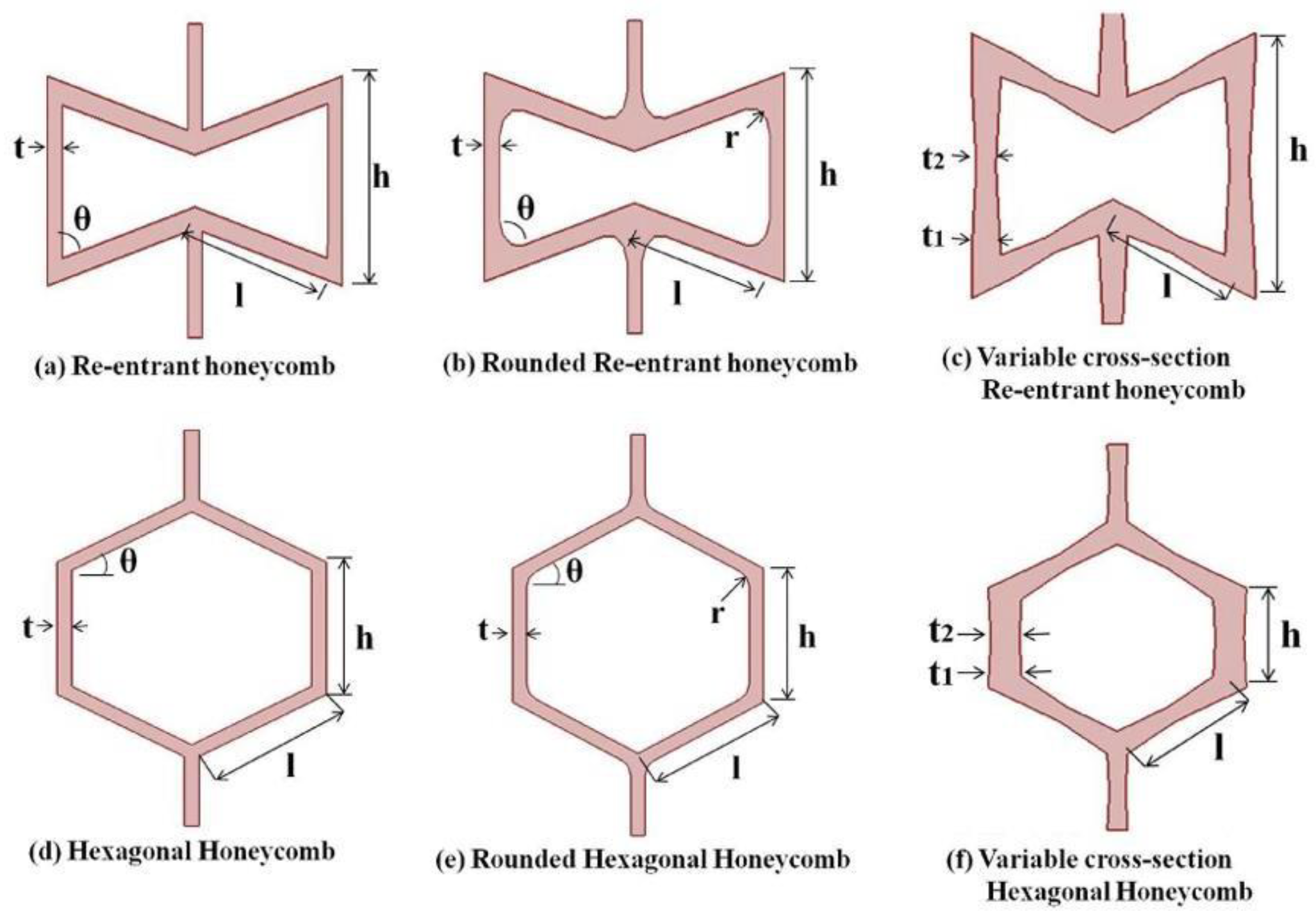
Figure 2.
Geometric configurations and parameters of honeycomb structures: (a) RH and (b) SRH [14].
Figure 2.
Geometric configurations and parameters of honeycomb structures: (a) RH and (b) SRH [14].
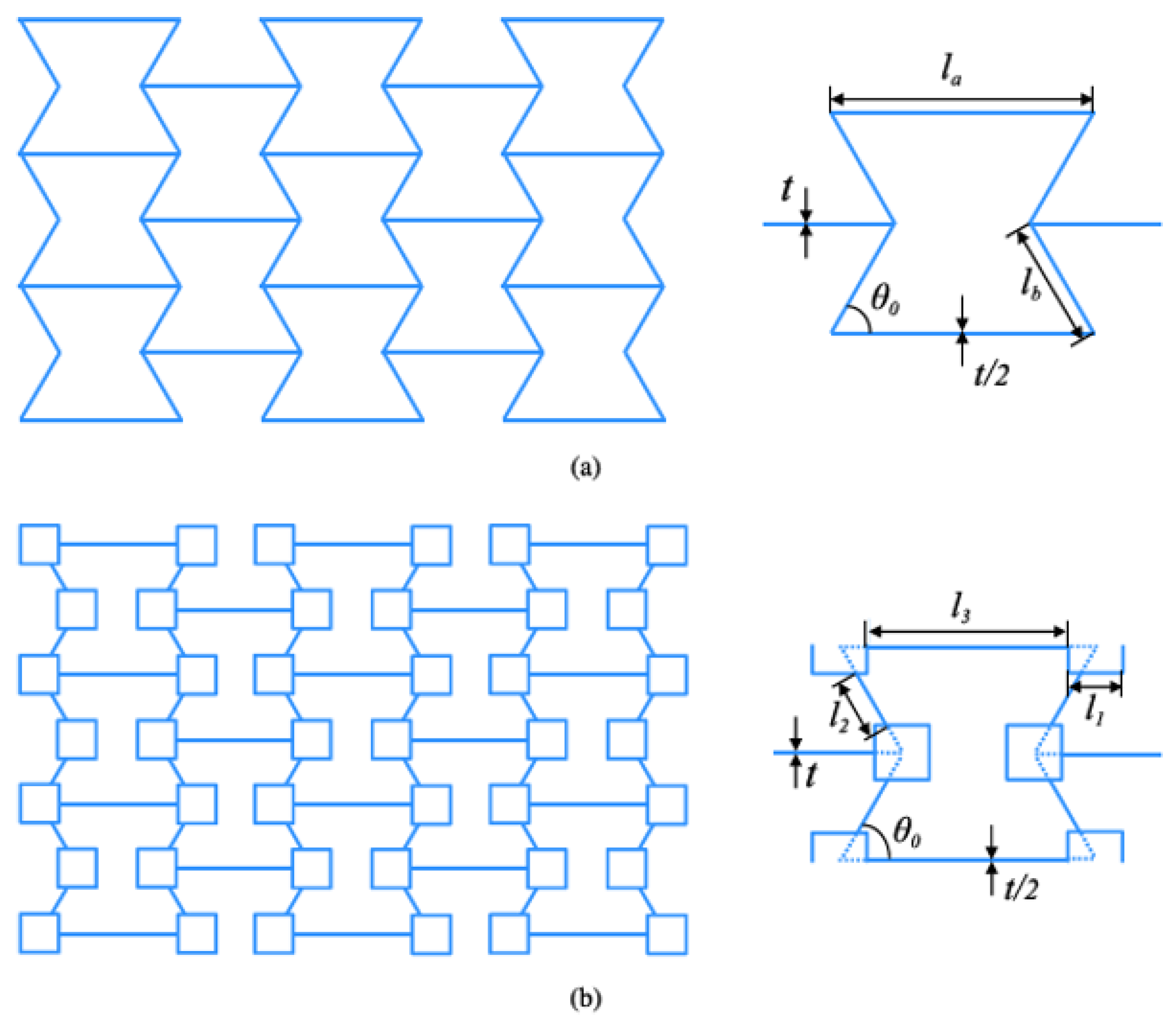
Figure 3.
Geometric design and samples of the baseline EARE honeycomb. (a) A conventional re-entrant honeycomb (RE) unit cell; (b) Planar geometric design of the novel baseline elliptical annular re-entrant (EARE) honeycomb unit cell, characterized by 8 design parameters; (c) A 3D schematic of the baseline EARE honeycomb, obtained by stretching a 2D honeycomb along the z-axis; (d) A 3D-printed sample of the baseline EARE honeycomb, fabricated from 316 L stainless steel and maintaining the dimensions depicted in the three-dimensional schematic [22].
Figure 3.
Geometric design and samples of the baseline EARE honeycomb. (a) A conventional re-entrant honeycomb (RE) unit cell; (b) Planar geometric design of the novel baseline elliptical annular re-entrant (EARE) honeycomb unit cell, characterized by 8 design parameters; (c) A 3D schematic of the baseline EARE honeycomb, obtained by stretching a 2D honeycomb along the z-axis; (d) A 3D-printed sample of the baseline EARE honeycomb, fabricated from 316 L stainless steel and maintaining the dimensions depicted in the three-dimensional schematic [22].
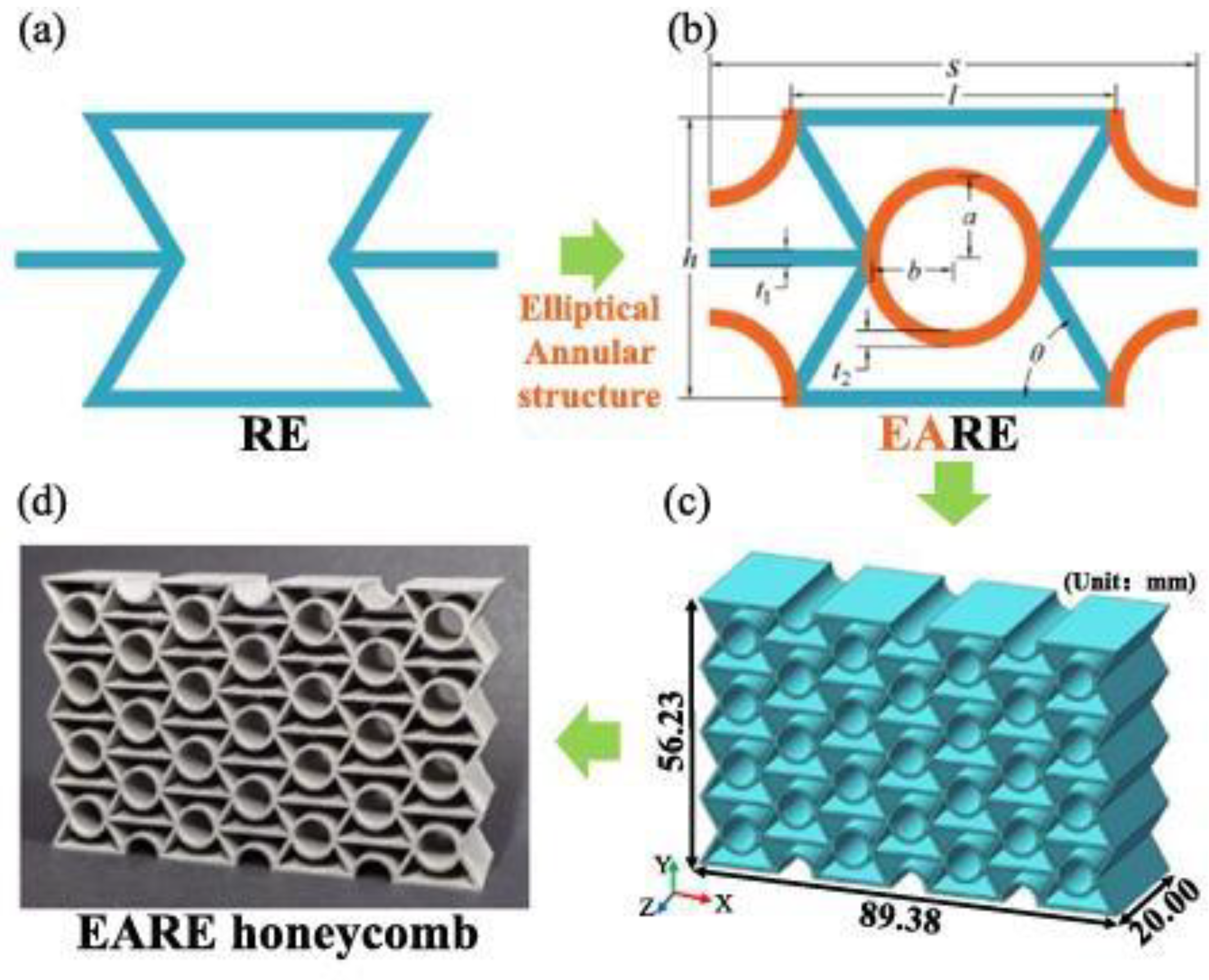
Figure 4.
Deformation of the unit cell and its main dimensions (the changing dimensions are indexed, where the index ‘0’ refers to the initial stage and the index ‘1’ refers to a representative deformed stage). Deformation is induced by a compressive vertical force, as shown in this figure [23].
Figure 4.
Deformation of the unit cell and its main dimensions (the changing dimensions are indexed, where the index ‘0’ refers to the initial stage and the index ‘1’ refers to a representative deformed stage). Deformation is induced by a compressive vertical force, as shown in this figure [23].
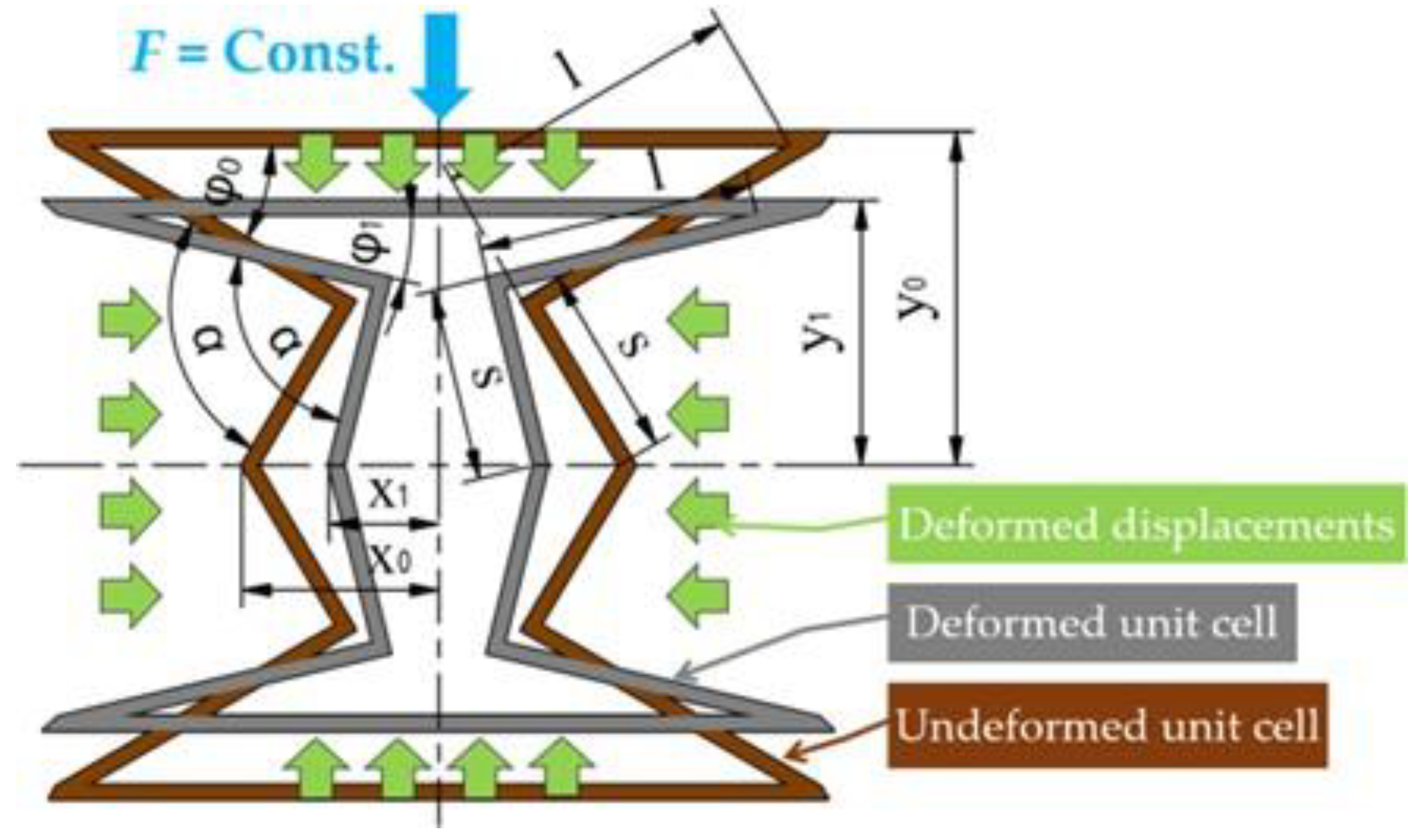
Figure 5.
Design parameters of the auxetic unit cell: (a) the original re-entrant hexagonal structure and (b) its enhanced version with inclusion [24].
Figure 5.
Design parameters of the auxetic unit cell: (a) the original re-entrant hexagonal structure and (b) its enhanced version with inclusion [24].
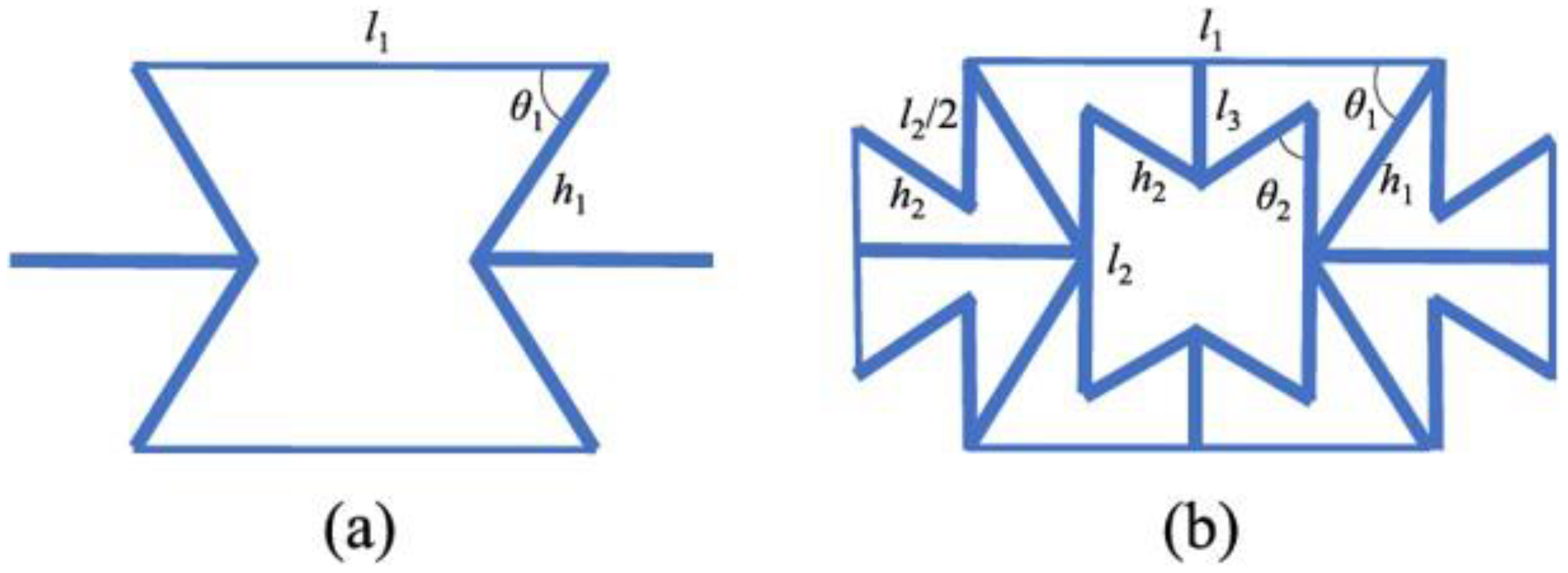
Figure 6.
Configurations of graded auxetic re-entrant honeycombs: (a) an UGAH; (b) a BGAH, and (c) a re-entrant honeycomb cell [25].
Figure 6.
Configurations of graded auxetic re-entrant honeycombs: (a) an UGAH; (b) a BGAH, and (c) a re-entrant honeycomb cell [25].
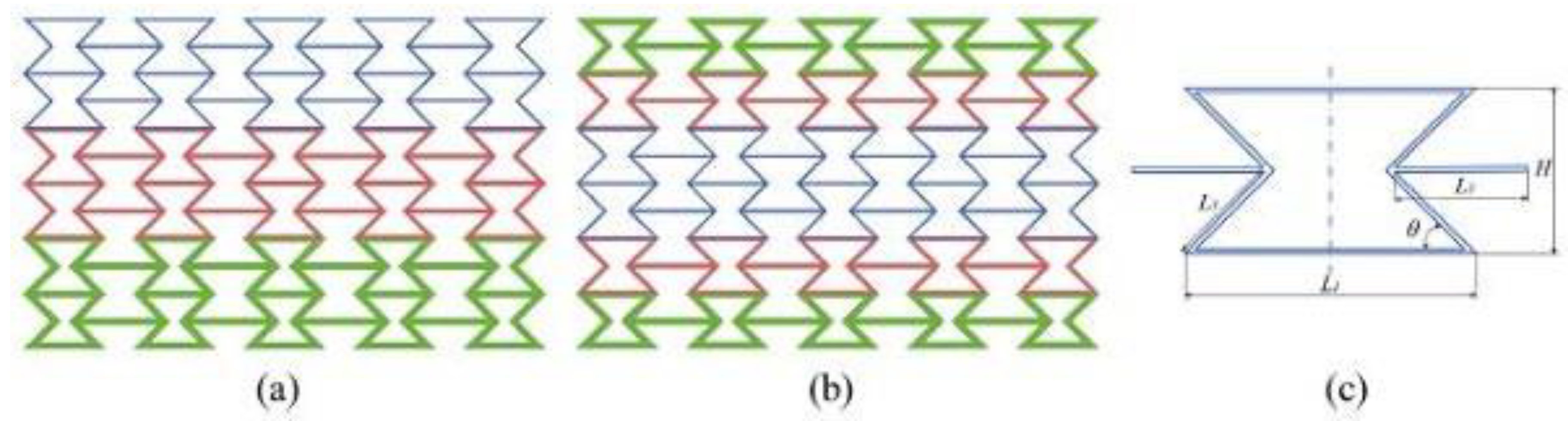
Figure 7.
Definition of a re-entrant auxetic structure: (a) deformation behavior of a re-entrant structure; (b) a unit cell with design parameters; (c) unit cells with different re-entrant angles; and (d) the design of a tensile sample (θ = 20°) [12].
Figure 7.
Definition of a re-entrant auxetic structure: (a) deformation behavior of a re-entrant structure; (b) a unit cell with design parameters; (c) unit cells with different re-entrant angles; and (d) the design of a tensile sample (θ = 20°) [12].
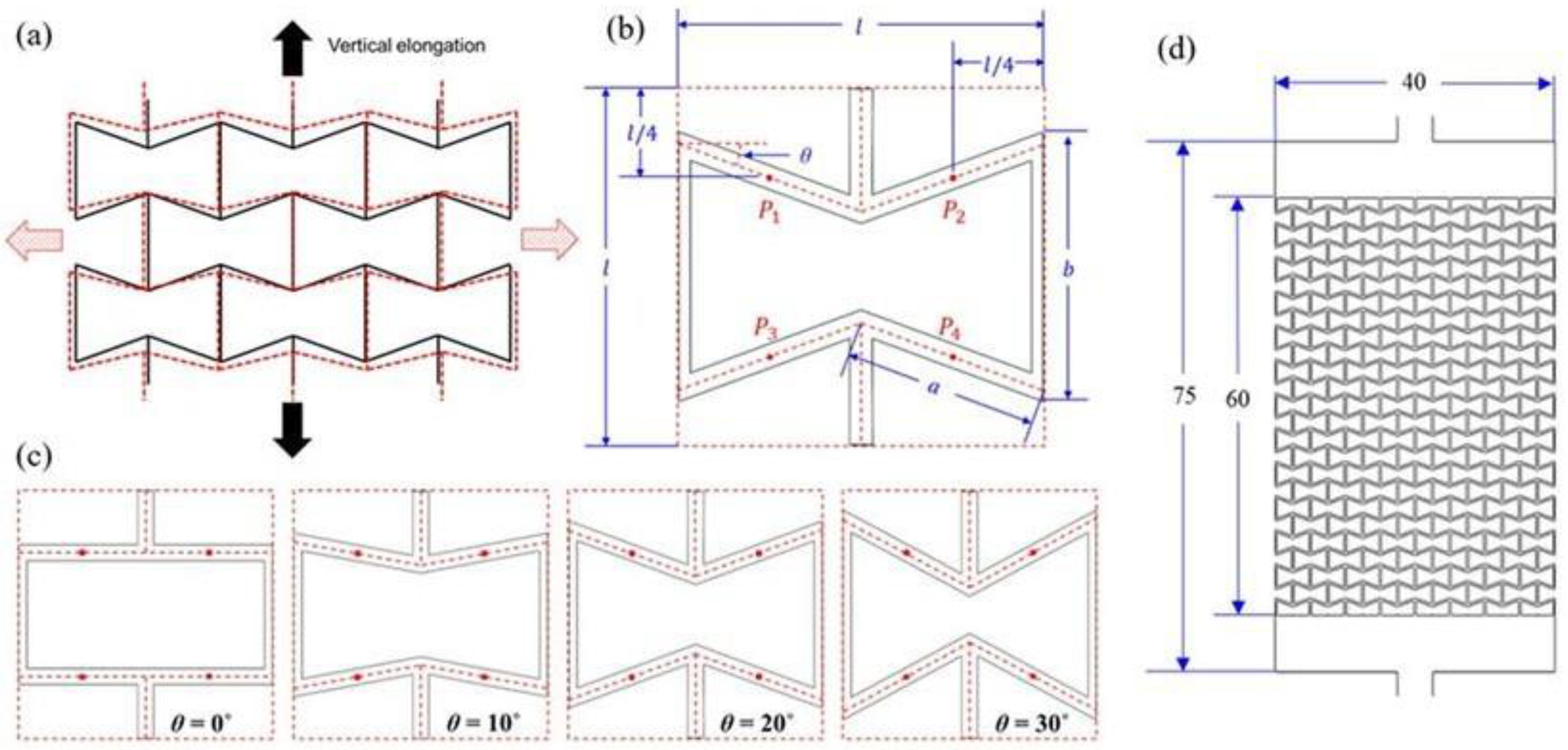
Figure 8.
Configuration of the new 3D reentrant lattice structure: (a) 2D structural components; (b) unit cell; and (c) 3D structure loading process in the X direction [26].
Figure 8.
Configuration of the new 3D reentrant lattice structure: (a) 2D structural components; (b) unit cell; and (c) 3D structure loading process in the X direction [26].
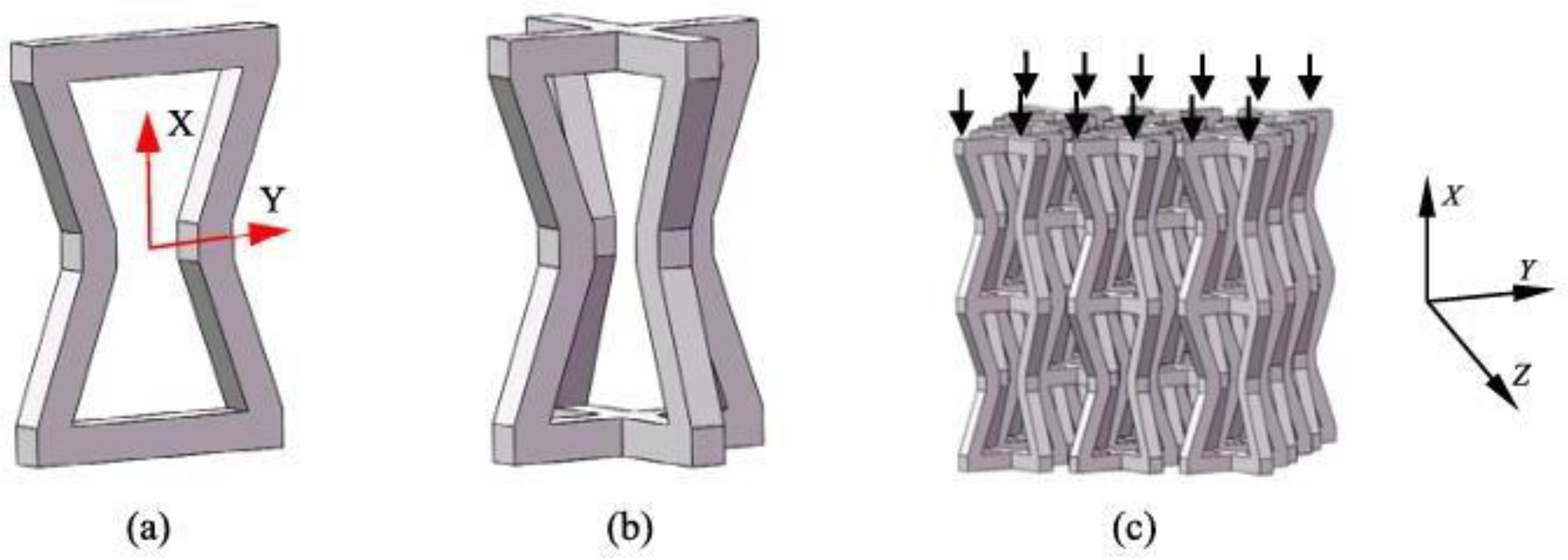
Figure 9.
Workflow of the steps employed in this research [18].
Figure 9.
Workflow of the steps employed in this research [18].
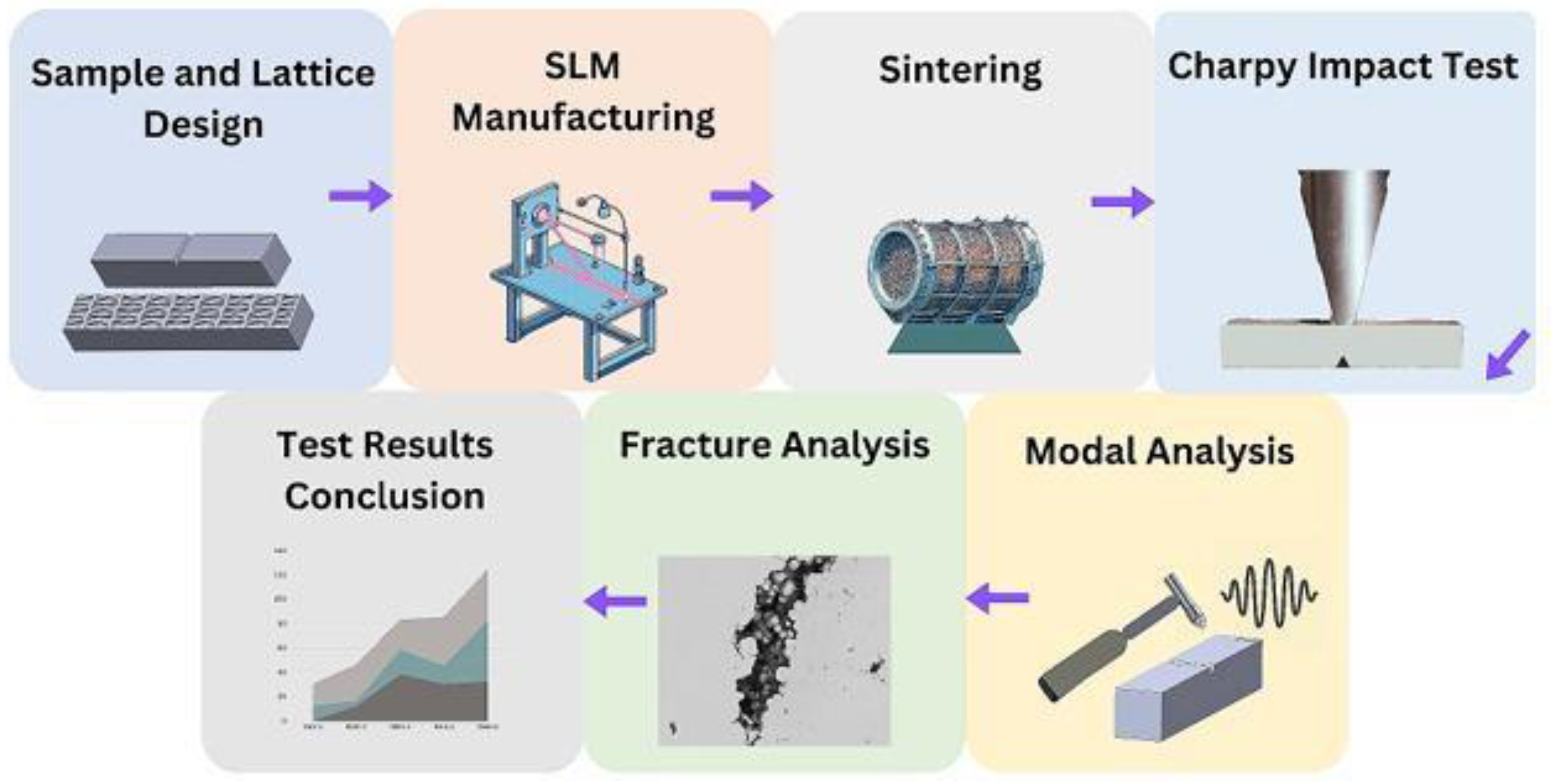
Figure 10.
FEM models of re-entrant and hexagonal cellular structures and their reinforcement locations (green - reinforcement, gray - nylon) [17].
Figure 10.
FEM models of re-entrant and hexagonal cellular structures and their reinforcement locations (green - reinforcement, gray - nylon) [17].
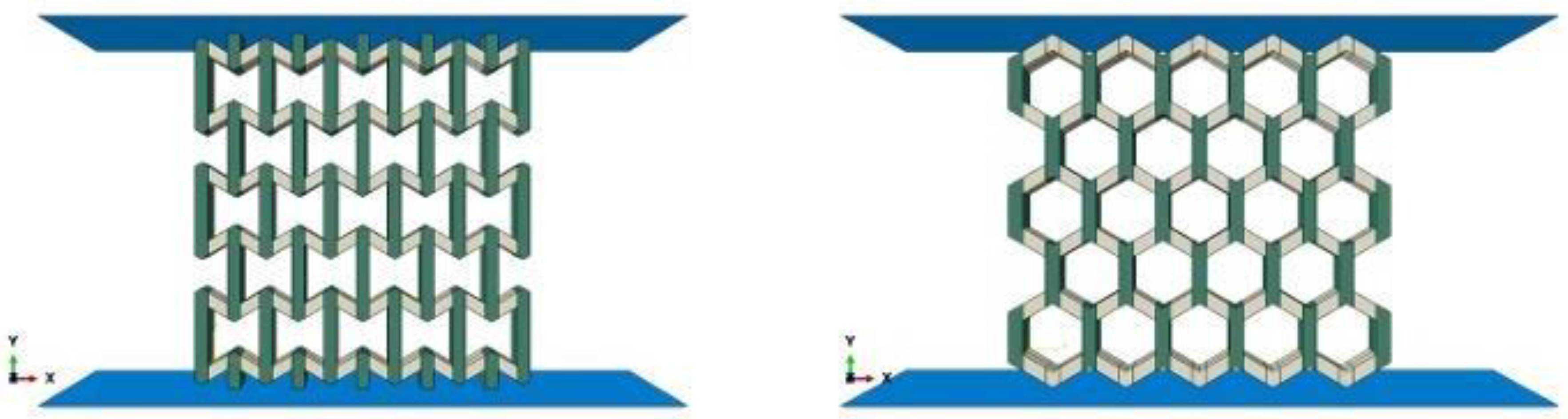
Figure 11.
Typical components and measurement point arrangement of the tested steel frame structure [29].
Figure 11.
Typical components and measurement point arrangement of the tested steel frame structure [29].
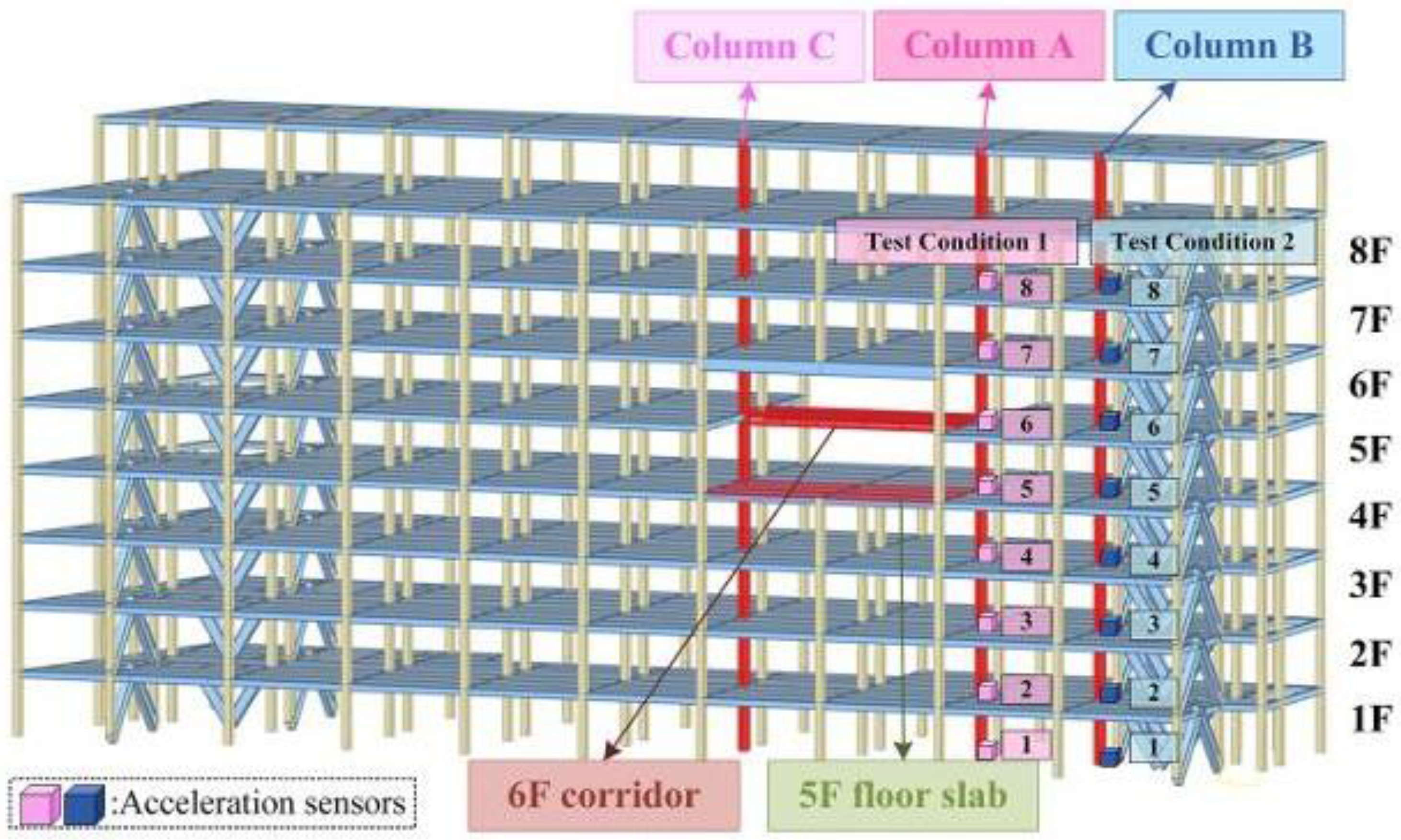
Figure 12.
Finite-element meshing of a) type 1 and b) type 2 frame foundations [30].
Figure 12.
Finite-element meshing of a) type 1 and b) type 2 frame foundations [30].
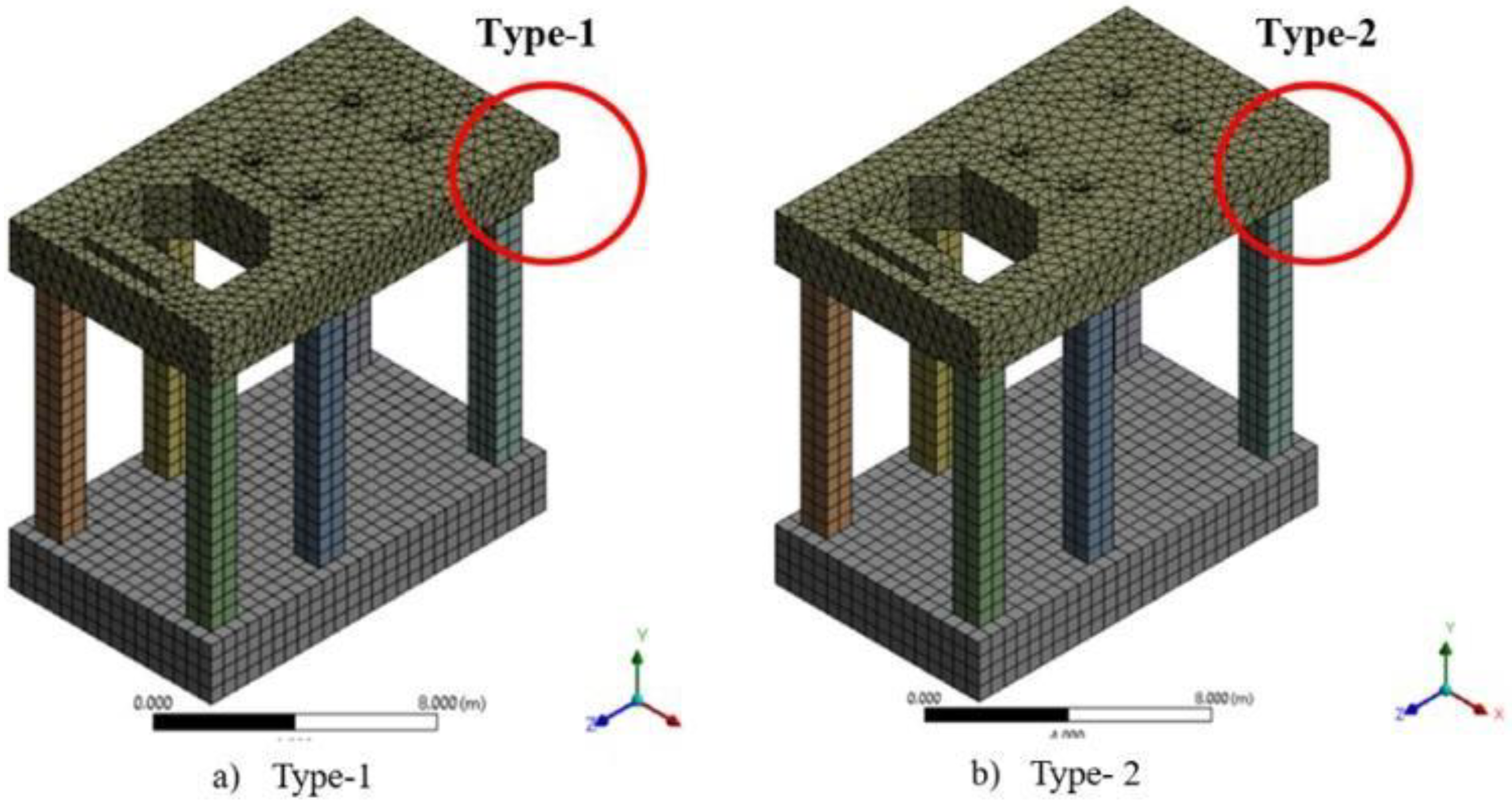
Figure 13.
Geometric illustration of NAHSPs (a) without a polyurea coating; (b) with a single PML-A faceplate; (c) with a single PML-B faceplate; and (d) with double PML-A faceplates [33].
Figure 13.
Geometric illustration of NAHSPs (a) without a polyurea coating; (b) with a single PML-A faceplate; (c) with a single PML-B faceplate; and (d) with double PML-A faceplates [33].
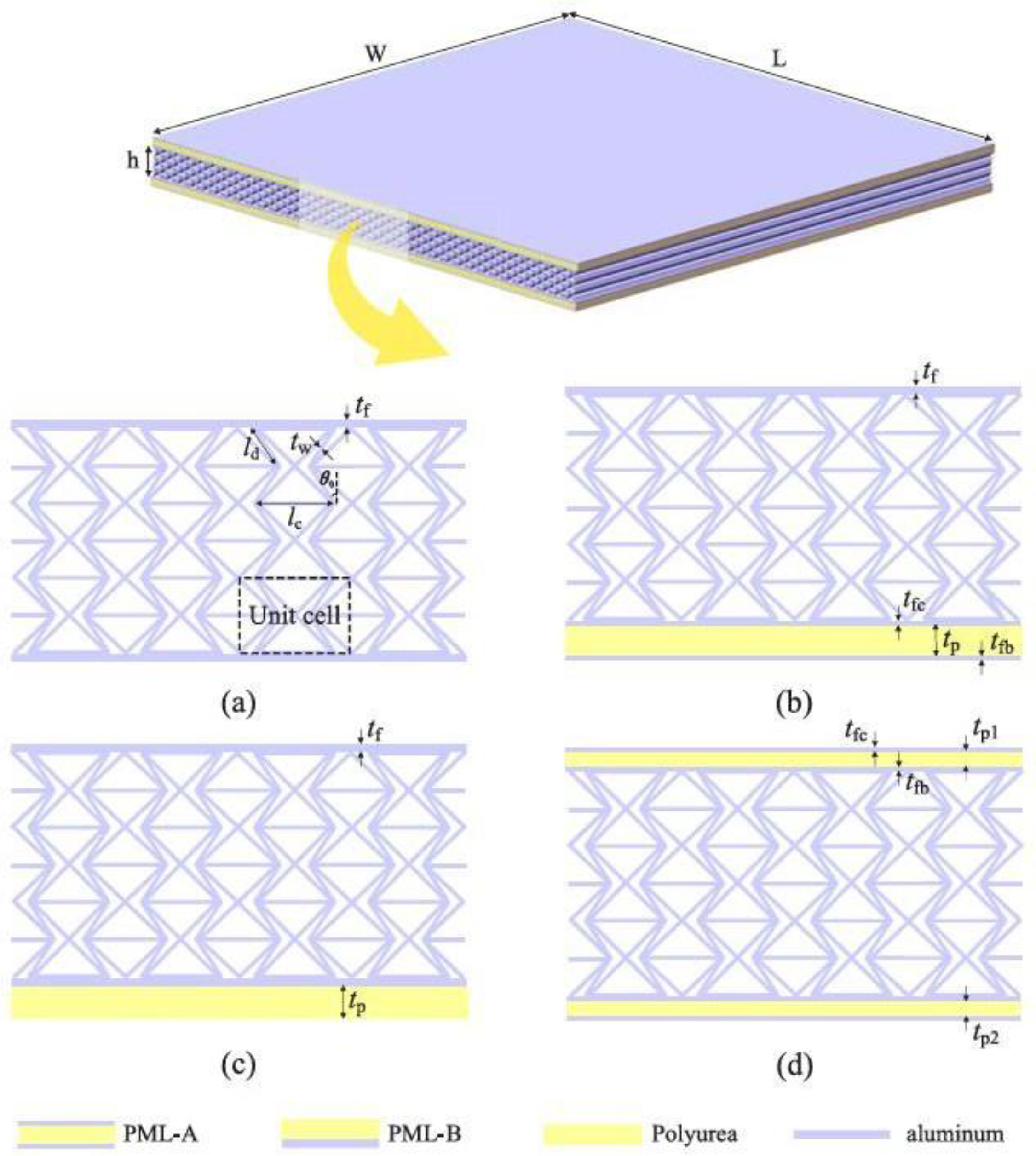
Figure 14.
(a) Testing apparatus for the modal hammer test and (b) signal measurement points in the actual sample [27].
Figure 14.
(a) Testing apparatus for the modal hammer test and (b) signal measurement points in the actual sample [27].
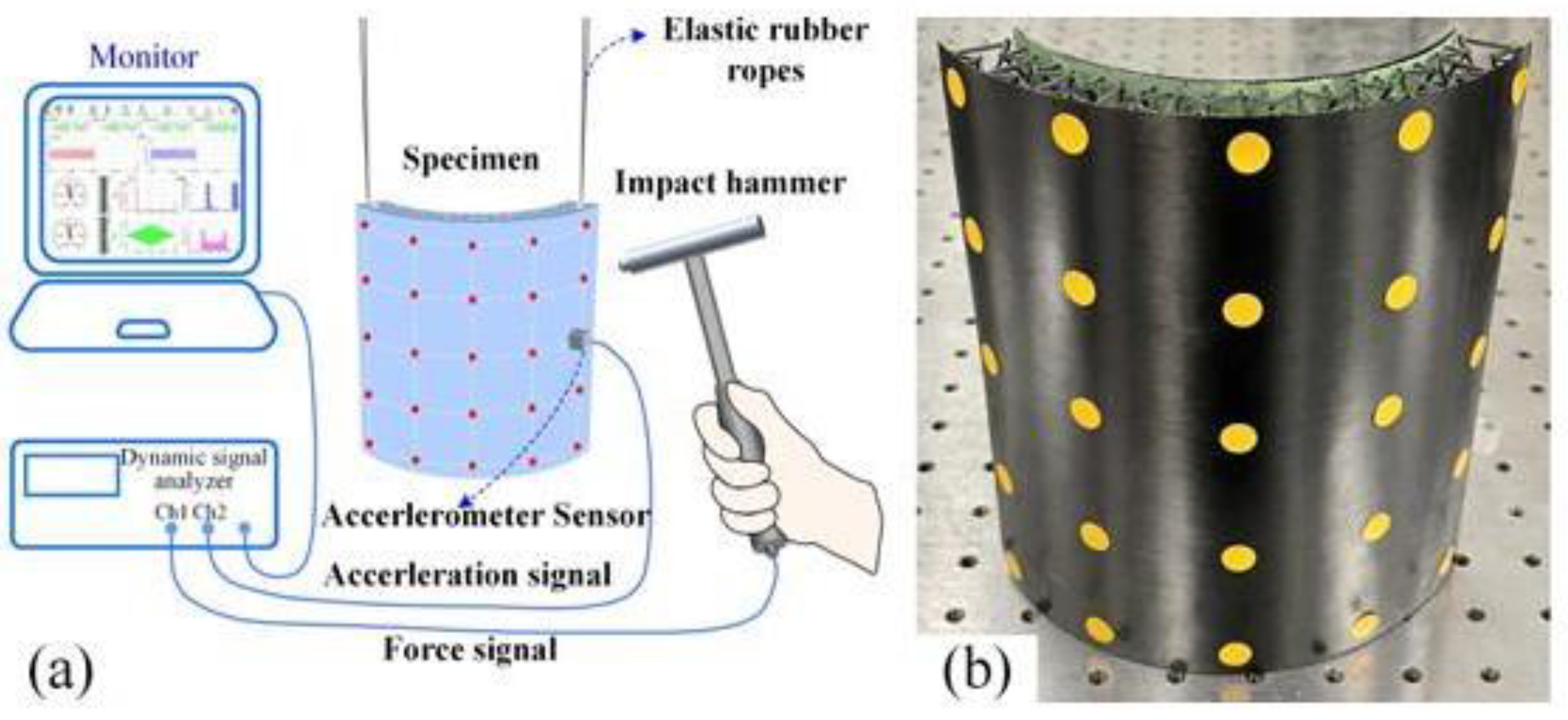
Figure 15.
Geometric configurations of different core cells: (a) a conventional re-entrant honeycomb (CRH); (b) a diamond-reinforced re-entrant honeycomb (DRH); and (c) a rib-reinforced [38].
Figure 15.
Geometric configurations of different core cells: (a) a conventional re-entrant honeycomb (CRH); (b) a diamond-reinforced re-entrant honeycomb (DRH); and (c) a rib-reinforced [38].
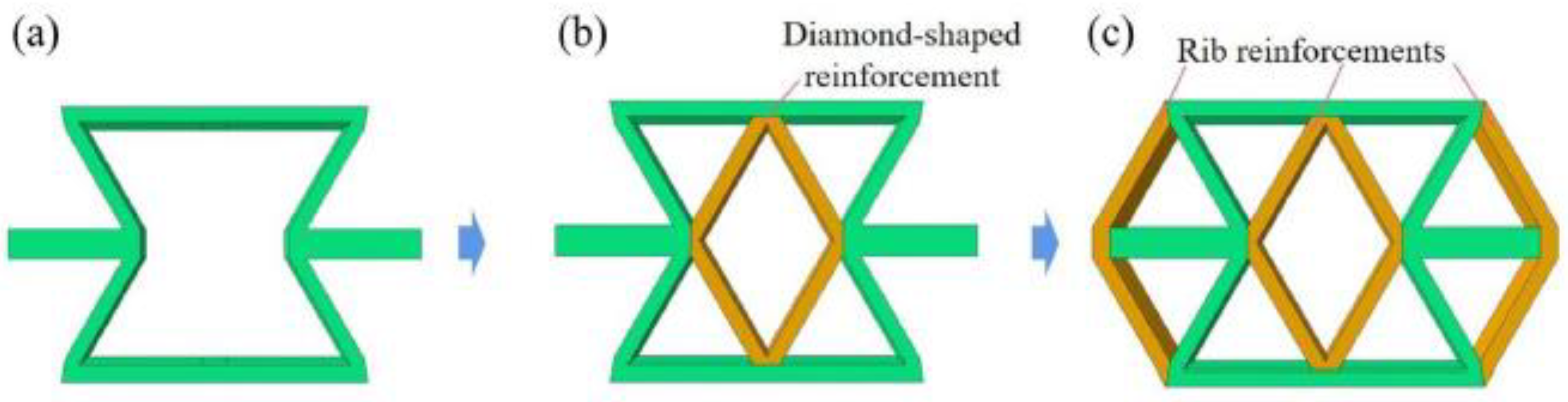
Figure 16.
Fabrication processes of auxetic sandwich plates with damping enhancement: (a) damping layers inserted into the face sheets; (b) foam filled into the core [40].
Figure 16.
Fabrication processes of auxetic sandwich plates with damping enhancement: (a) damping layers inserted into the face sheets; (b) foam filled into the core [40].
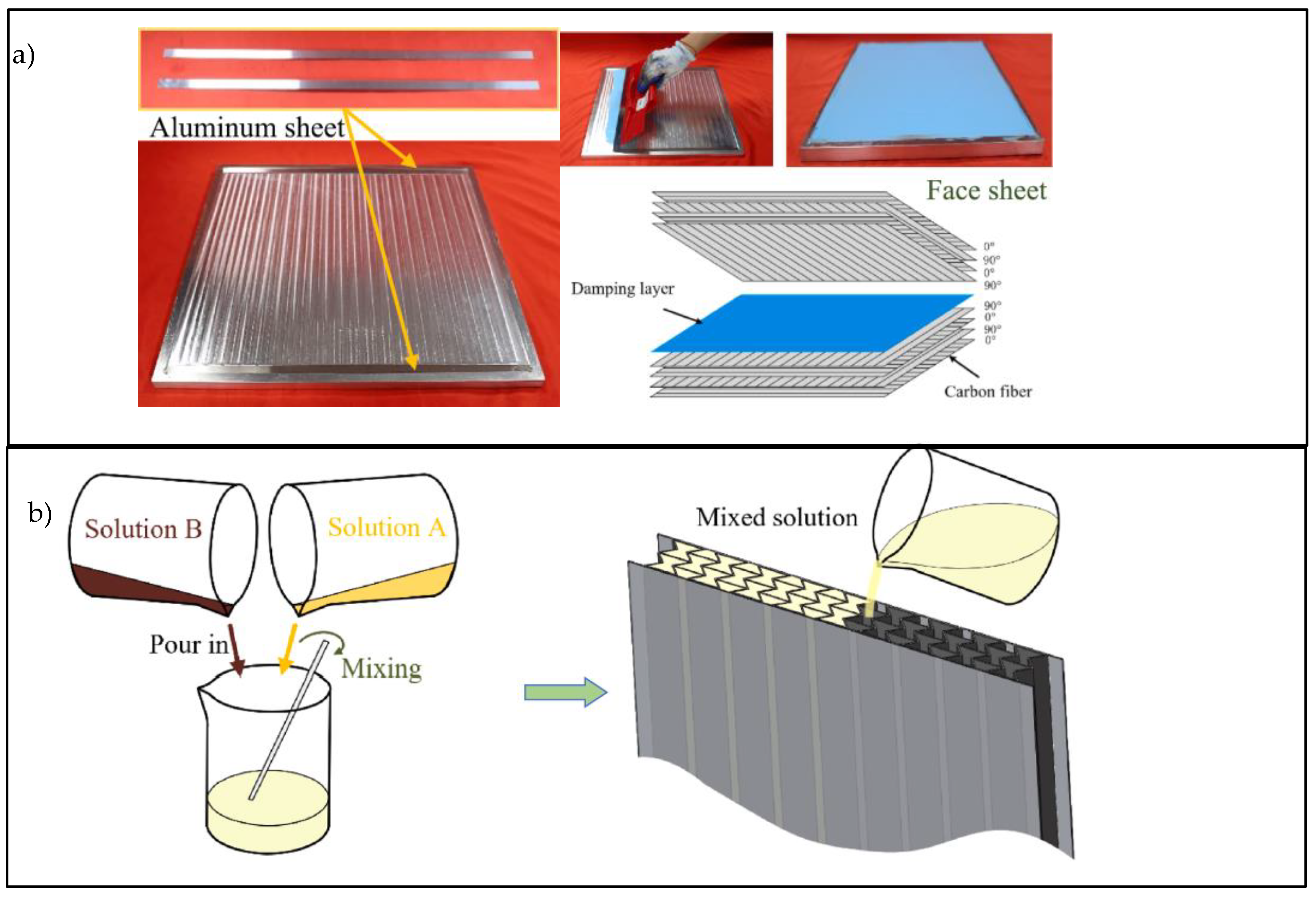
Figure 17.
FEM models of re-entrant and hexagonal cellular structures and their reinforcement locations (green - reinforcement, gray - nylon) [17].
Figure 17.
FEM models of re-entrant and hexagonal cellular structures and their reinforcement locations (green - reinforcement, gray - nylon) [17].
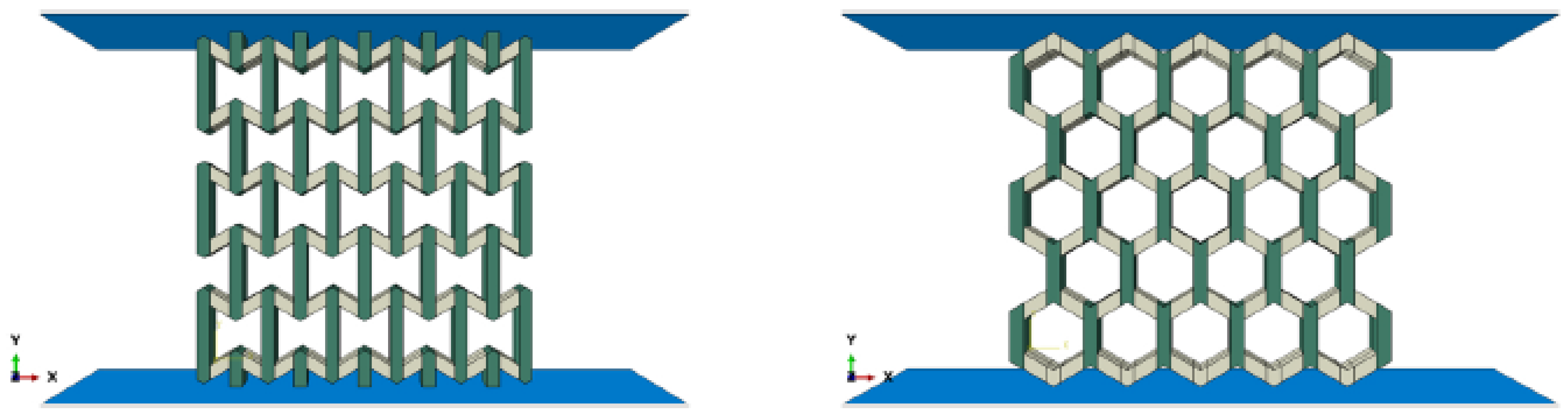
Figure 18.
Schematic plan view and cross section of the vibration source, the vibration-absorbing elements, and the locations of the geophones [47].
Figure 18.
Schematic plan view and cross section of the vibration source, the vibration-absorbing elements, and the locations of the geophones [47].
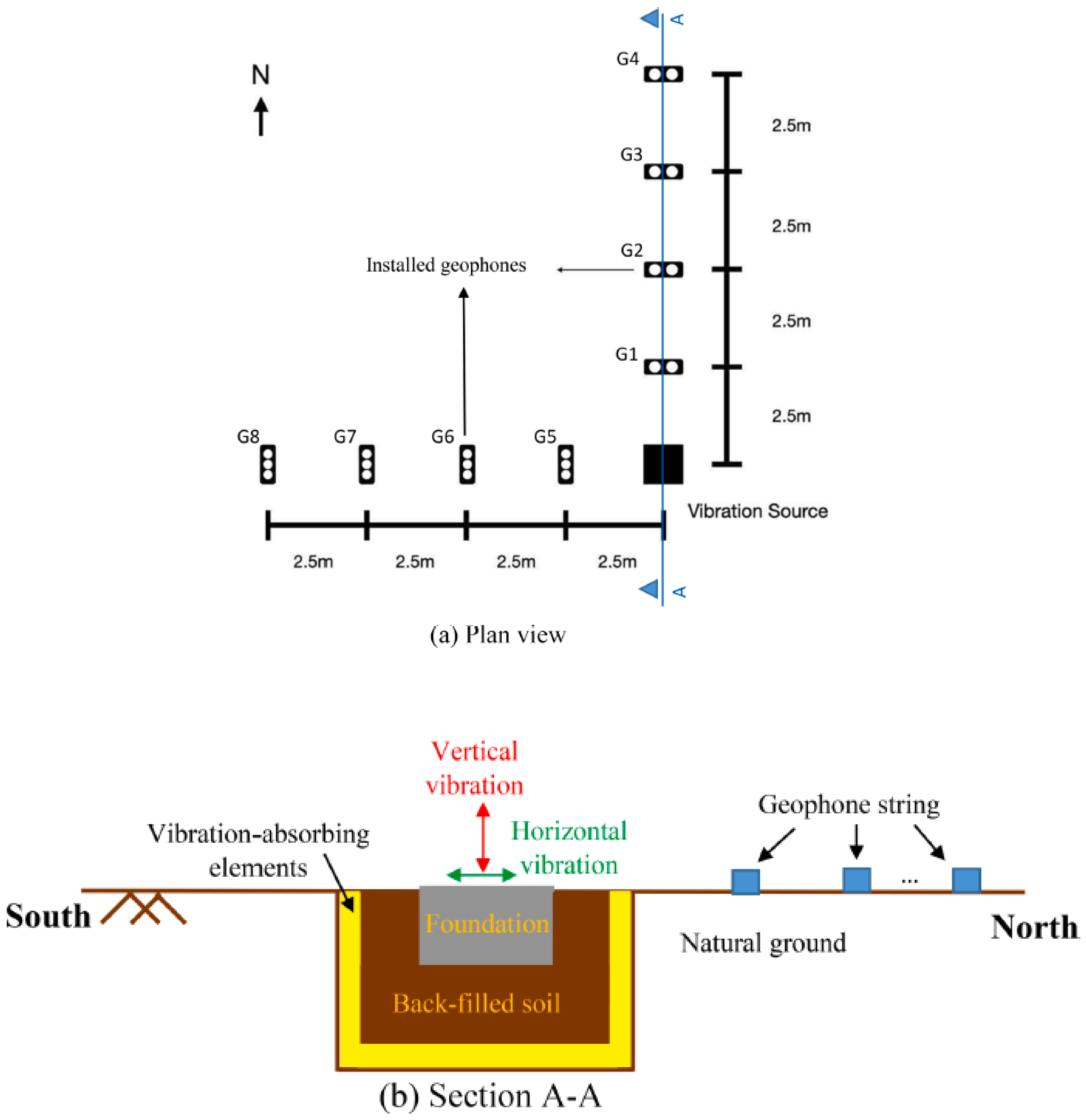
Figure 19.
The novel SRC honeycomb. (a) A star-shaped structure; (b) A re-entrant and circular structure; (c) A novel SRC structure; (d) The SRC honeycomb; (e) SRC [51].
Figure 19.
The novel SRC honeycomb. (a) A star-shaped structure; (b) A re-entrant and circular structure; (c) A novel SRC structure; (d) The SRC honeycomb; (e) SRC [51].
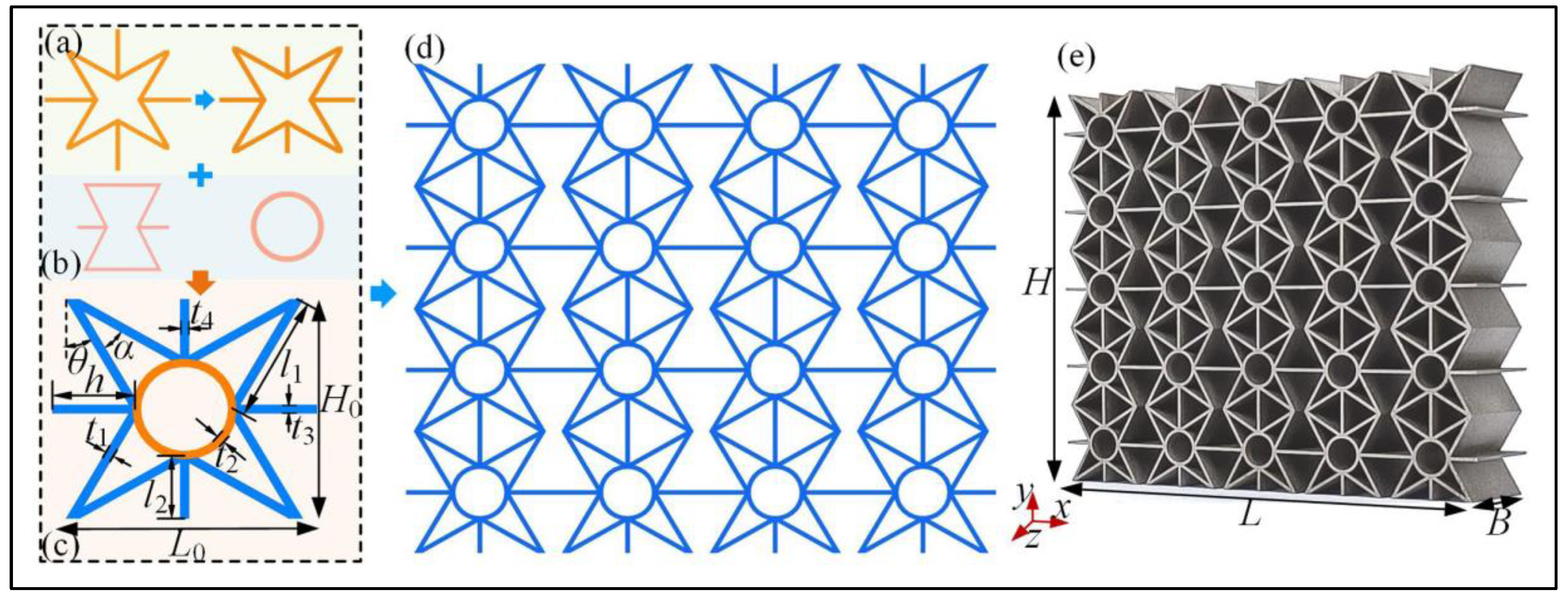
Figure 20.
3D printing process for fabricating honeycombs: (a) the printed CRRAH; (b) the chiral unit cell; (c) the geometric schematic diagram for the RCH structure; (d) and the multiarc unit cell (e).
Figure 20.
3D printing process for fabricating honeycombs: (a) the printed CRRAH; (b) the chiral unit cell; (c) the geometric schematic diagram for the RCH structure; (d) and the multiarc unit cell (e).
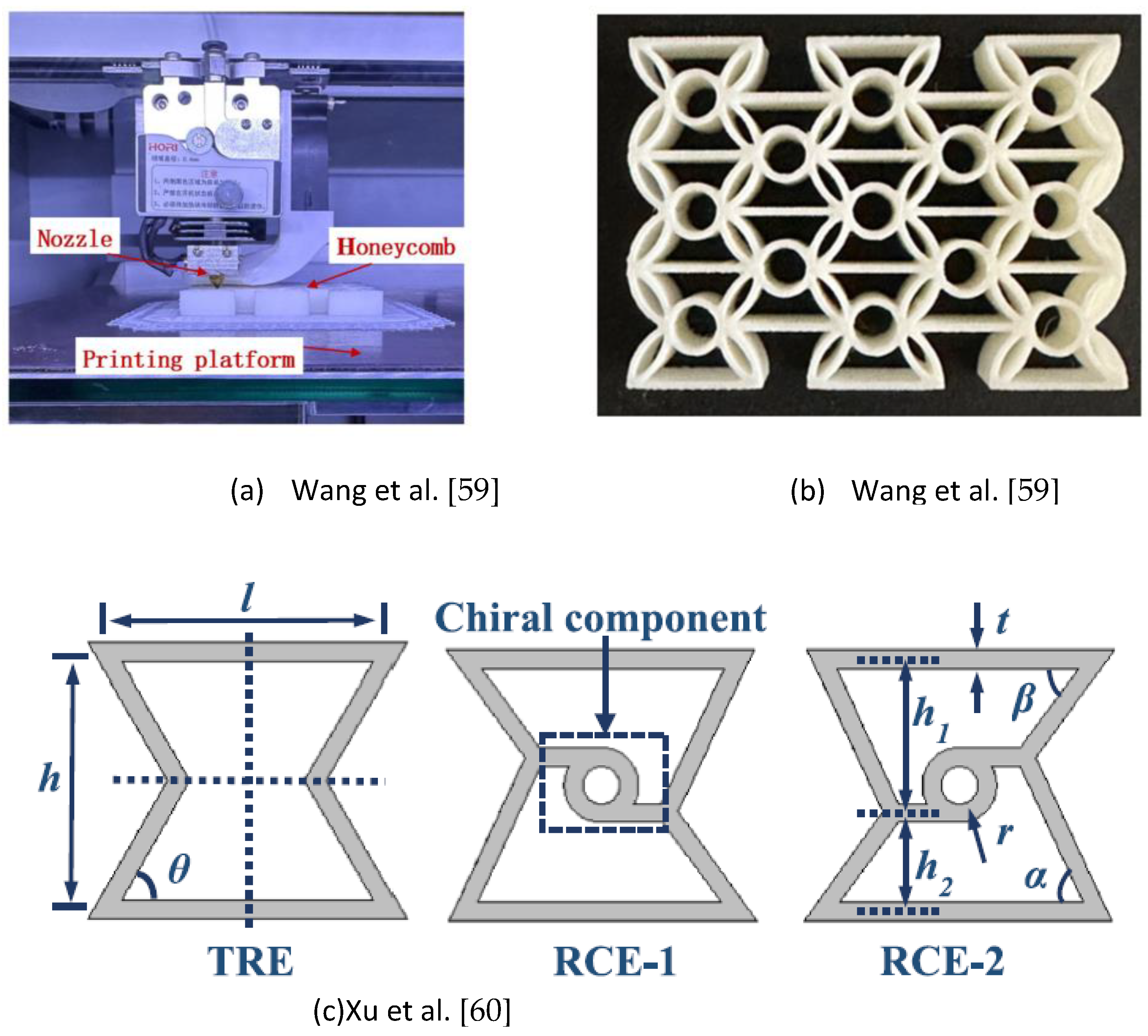
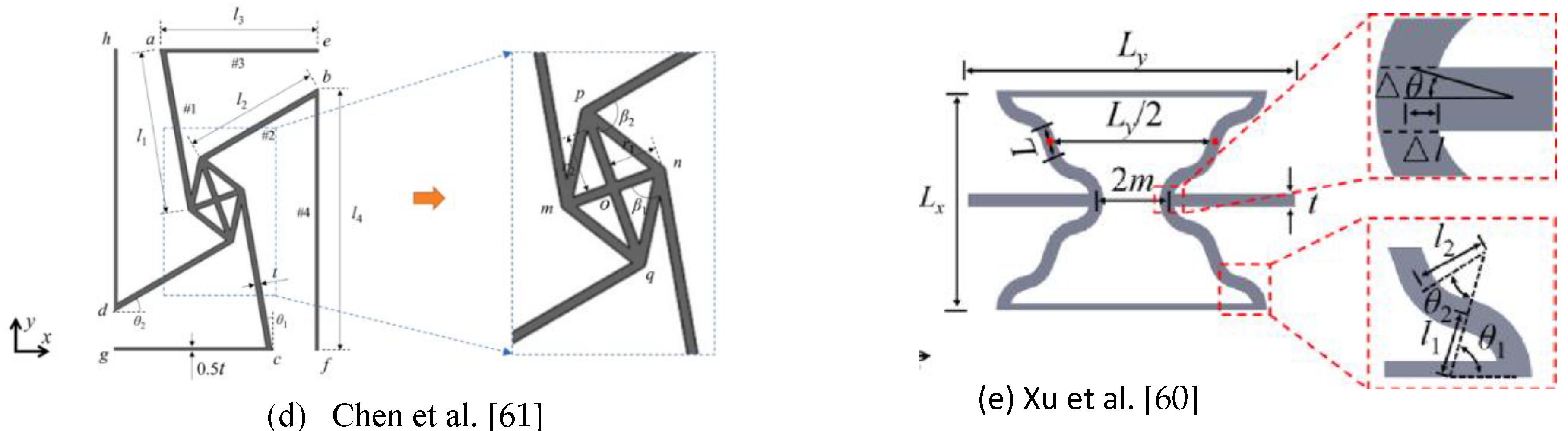
Figure 21.
FE models of (a) RAH and (b) aluminum foam and (c) the FE setup of FRAH [63].
Figure 21.
FE models of (a) RAH and (b) aluminum foam and (c) the FE setup of FRAH [63].
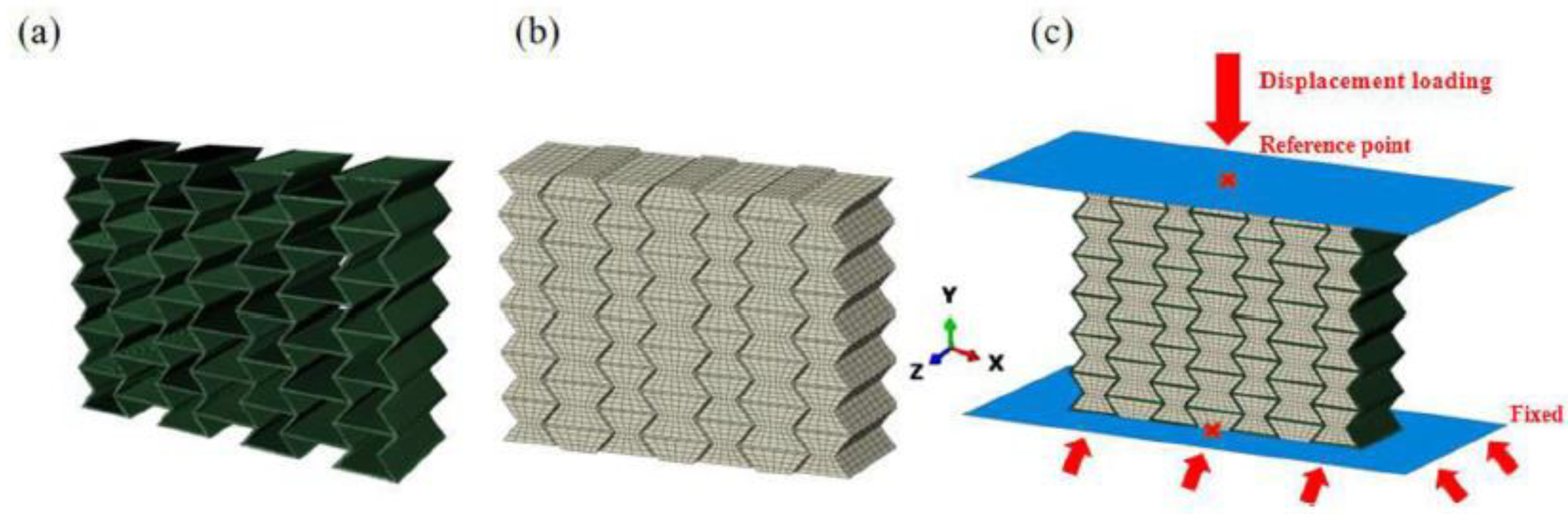
Figure 22.
2D DVH material.[10].
Figure 22.
2D DVH material.[10].
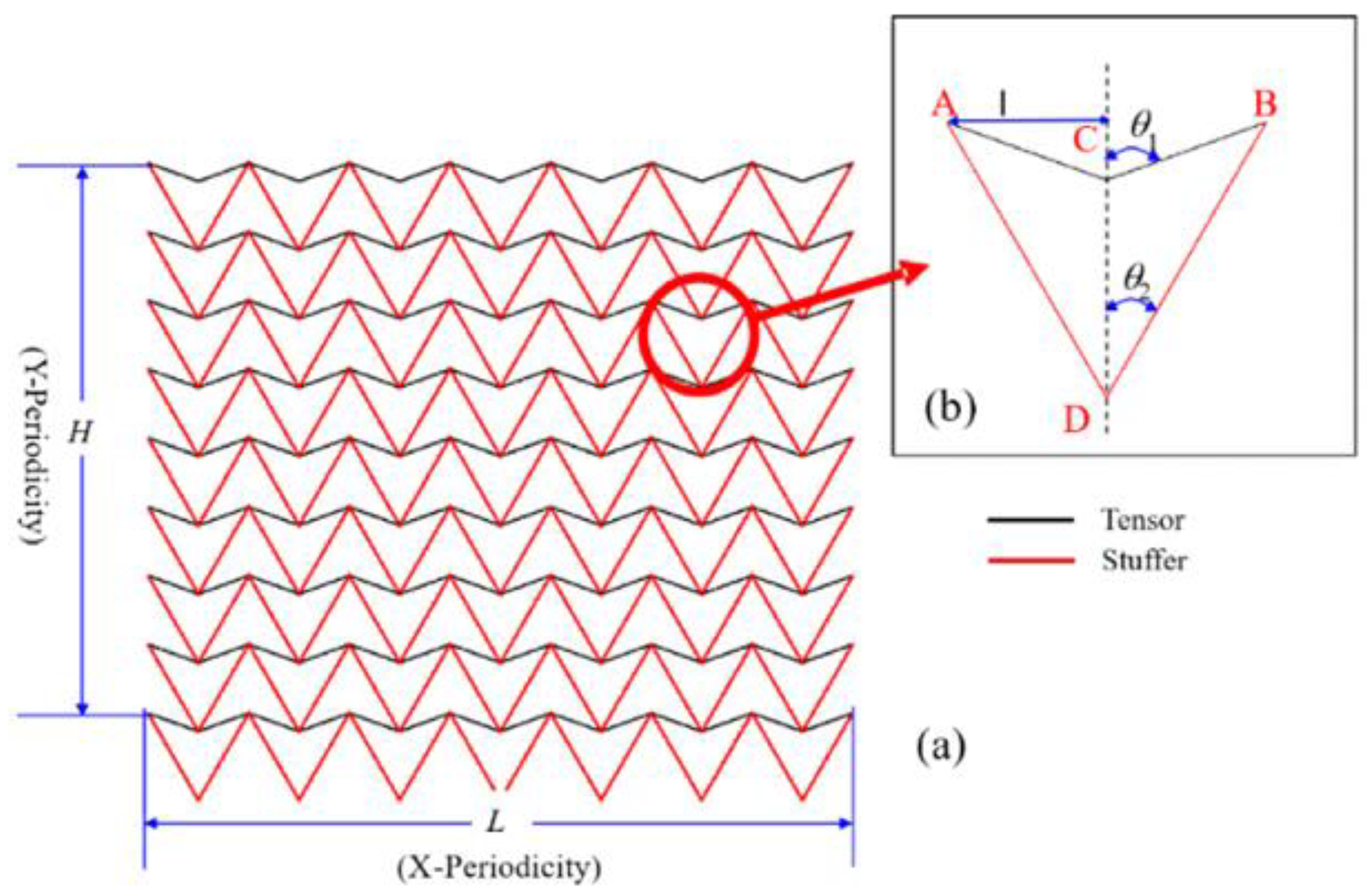
Figure 23.
Experimental setup of Yong et al. [42].
Figure 23.
Experimental setup of Yong et al. [42].
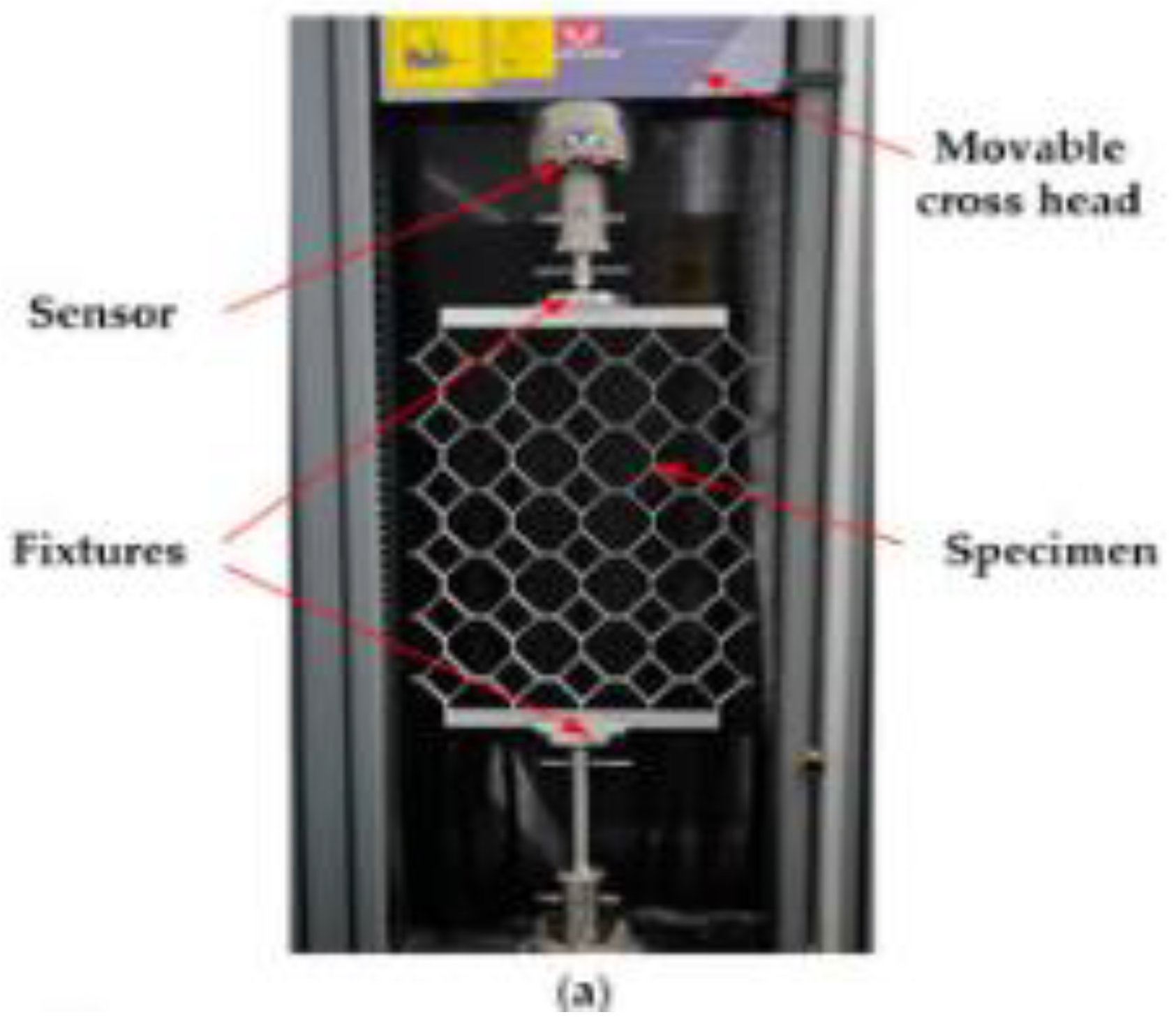
Figure 24.
The experimental system used by Yong et al. [42] for vibration transmission losses.
Figure 24.
The experimental system used by Yong et al. [42] for vibration transmission losses.
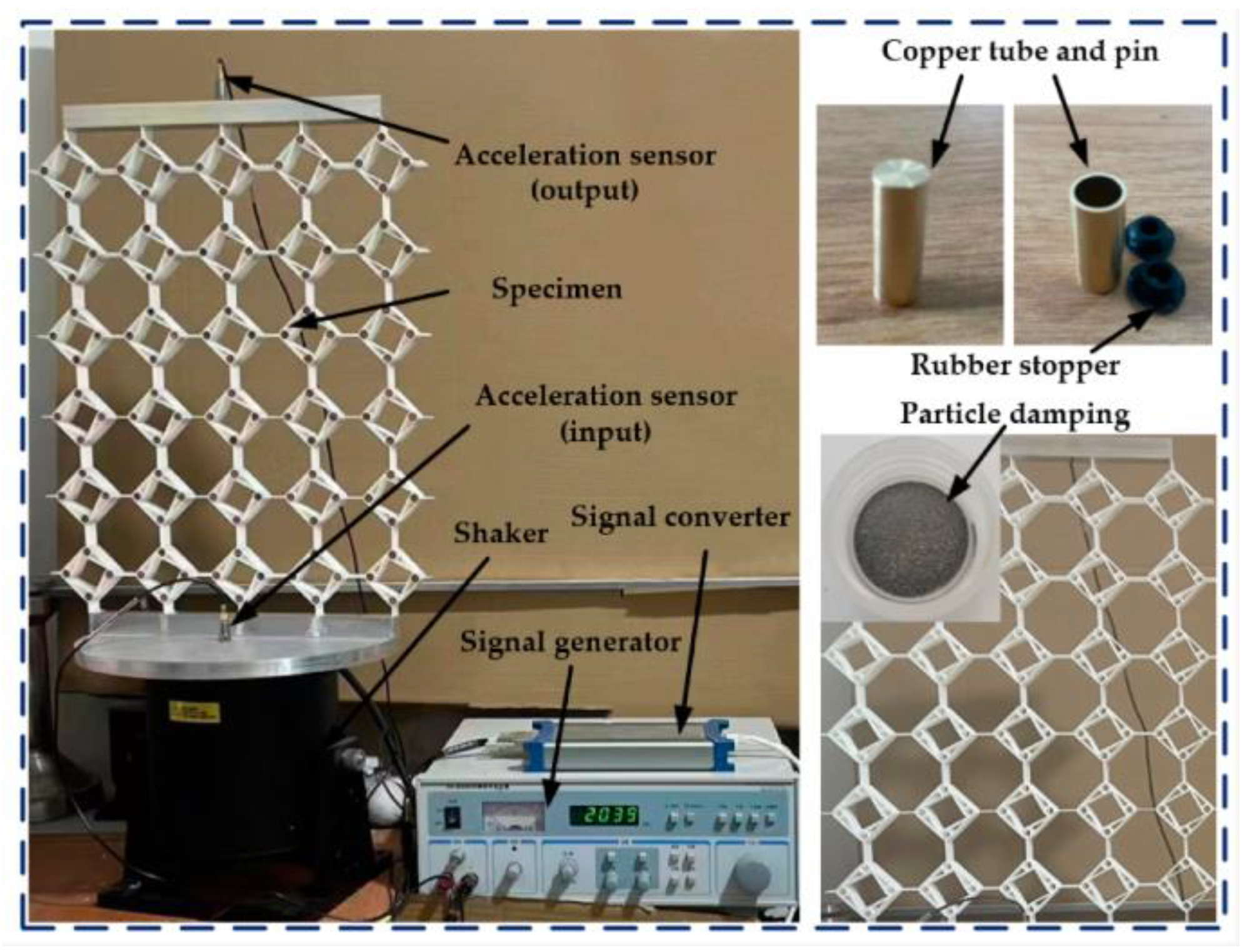
Figure 25.
Comparison between the final deformations of RHS-A in of experimental and numerical simulation scenarios: (a) isometric view and (b) side view [80].
Figure 25.
Comparison between the final deformations of RHS-A in of experimental and numerical simulation scenarios: (a) isometric view and (b) side view [80].
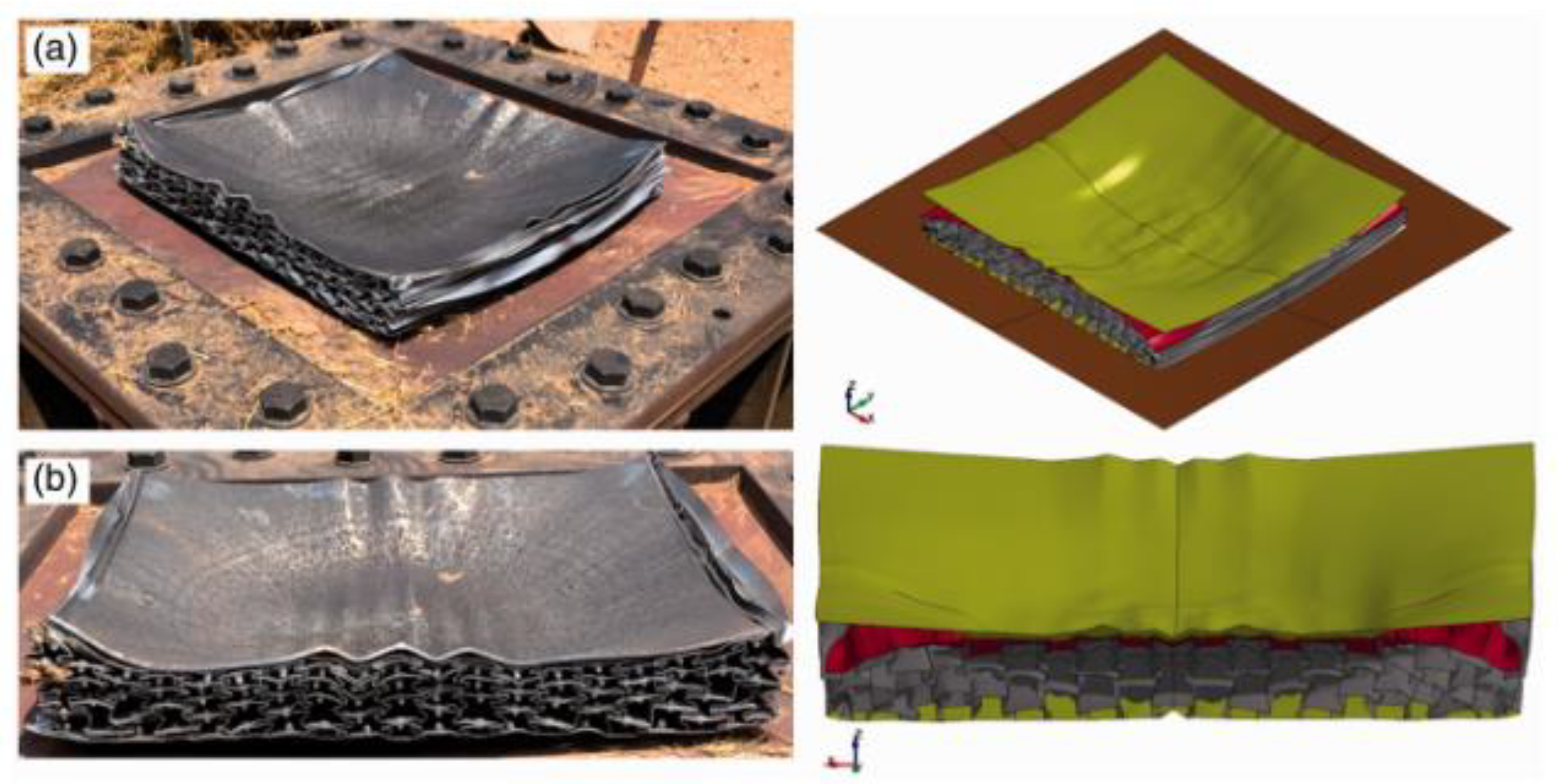
Figure 26.
Arrangement scheme of the composite foundation [91].
Figure 26.
Arrangement scheme of the composite foundation [91].
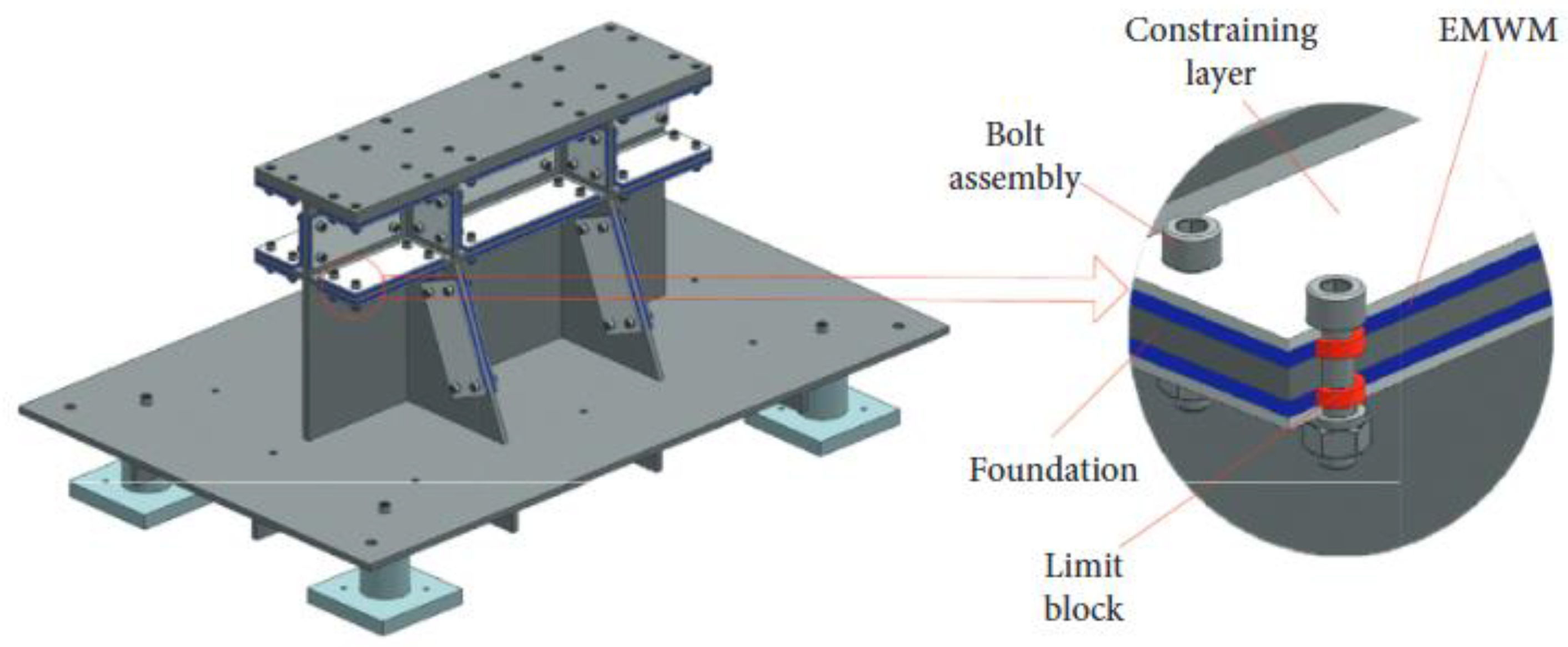
Disclaimer/Publisher’s Note: The statements, opinions and data contained in all publications are solely those of the individual author(s) and contributor(s) and not of MDPI and/or the editor(s). MDPI and/or the editor(s) disclaim responsibility for any injury to people or property resulting from any ideas, methods, instructions or products referred to in the content. |
© 2026 by the authors. Licensee MDPI, Basel, Switzerland. This article is an open access article distributed under the terms and conditions of the Creative Commons Attribution (CC BY) license (http://creativecommons.org/licenses/by/4.0/).
Copyright: This open access article is published under a Creative Commons CC BY 4.0 license, which permit the free download, distribution, and reuse, provided that the author and preprint are cited in any reuse.


