

Submitted:
07 January 2026
Posted:
08 January 2026
You are already at the latest version
Abstract
Wine is widely consumed across cultures and is often perceived as a benign or even beneficial alcoholic beverage, particularly when consumed in moderation and within the context of healthy dietary patterns. At the same time, alcohol is one of the most commonly used substances to self-manage sleep problems. This short narrative review critically examines evidence published over the past decade (2015–2025) on the impact of wine and alcohol more broadly on sleep health in community-dwelling adults. Priority was given to systematic reviews and meta-analyses, followed by high-quality observational and experimental studies. Across study designs, evidence consistently demonstrates that although alcohol may reduce sleep onset latency, it disrupts sleep architecture, suppresses rapid eye movement sleep, increases sleep fragmentation, and impairs breathing during sleep, particularly during the second half of the night. Habitual alcohol consumption is associated with poorer subjective sleep quality, insomnia symptoms, and increased risk of sleep-disordered breathing. Mechanistic pathways include effects on neurotransmission, sleep homeostasis, circadian regulation, thermoregulation, and alcohol metabolism during sleep. A short section also examines the reciprocal relationship, highlighting evidence that circadian disruption, shift work, and evening chronotype are associated with higher alcohol consumption. Although wine contains bioactive compounds such as melatonin and polyphenols, current evidence does not support a clinically meaningful protective effect of wine on sleep. Overall, wine should not be considered a sleep aid, and public health messaging should emphasize dose, timing, and regularity of alcohol consumption in relation to sleep health.
Keywords:
wine
; alcohol
; sleep health
; insomnia
; circadian rhythms
; nutrition
1. Introduction
Sleep is a core pillar of health and is essential for cardiometabolic regulation, immune function, mental health, and cognitive performance. Inadequate or disrupted sleep is associated with increased risks of cardiovascular disease, type 2 diabetes, depression, and premature mortality. In parallel, alcohol consumption remains deeply embedded in social and cultural practices worldwide, with wine often occupying a unique position as a symbol of moderation, conviviality, and potential health benefit.
Within this context, many adults report using alcohol, including wine, to facilitate relaxation or sleep initiation. Population surveys indicate that alcohol is among the most commonly used non-prescription sleep aids [1,2]. This practice is reinforced by the acute sedative properties of ethanol and by cultural narratives that portray a glass of wine in the evening as conducive to good sleep.
Despite these perceptions, alcohol is increasingly recognized as a substance that disrupts normal sleep physiology. Acute effects differ markedly from chronic patterns of use, and short-term benefits may mask longer-term adverse consequences. Although the effects of alcohol on sleep have been studied for decades, renewed interest has emerged due to advances in objective sleep measurement, growing emphasis on sleep regularity and circadian health, and evolving public health guidance on alcohol consumption.
Wine warrants particular consideration for several reasons. First, it is commonly consumed with evening meals, placing ingestion close to bedtime. Second, wine contains non-ethanolic components such as polyphenols and small amounts of melatonin, which have prompted speculation about potential sleep-related benefits. Third, wine is often perceived as healthier than other alcoholic beverages, which may influence both consumption patterns and risk perception.
This short narrative review synthesizes evidence from the past 10 years on the impact of wine and alcohol on sleep in community-dwelling adults. The primary objective is to examine effects on sleep initiation, architecture, continuity, and sleep-disordered breathing. A secondary objective is to briefly review evidence on how sleep patterns, particularly circadian disruption, shift work, and chronotype, may influence alcohol consumption. By integrating mechanistic, experimental, and population-level evidence, this short review of recent evidence aims to inform research, clinical practice, and public health policy, with particular relevance to nutrition-focused audiences.
2. Materials and Methods
This narrative review was informed by searches of MEDLINE, EMBASE, and PsycINFO conducted in December 2025. Eligible studies were published in English between January 2015 and December 2025 and focused on human, community-dwelling adults aged 18 years and older. Search terms included combinations of alcohol, wine, sleep, sleep quality, insomnia, sleep architecture, circadian, chronotype, and shift work.
Priority was given to systematic reviews and meta-analyses, followed by observational studies, including cross-sectional and longitudinal designs, and randomized controlled trials. Only peer-reviewed articles were included. Studies conducted exclusively in clinical populations, such as individuals with alcohol use disorder or diagnosed sleep disorders, were excluded unless findings were clearly generalizable. Conference abstracts, editorials, commentaries, book chapters, dissertations, protocols, and preprints were excluded.
3. Acute Effects of Alcohol and Wine on Sleep
3.1. Sleep Initiation
Alcohol reliably reduces sleep onset latency, reflecting its acute sedative effects mediated primarily through enhanced gamma-aminobutyric acid signaling and increased adenosinergic sleep pressure [3,4,5,6,7,8]. Laboratory studies and systematic reviews consistently show that this effect is dose dependent and most pronounced during the first half of the night [2,4]. These findings likely underpin the widespread belief that alcohol, including wine, is an effective sleep aid.
3.2. Sleep Continuity and Fragmentation
As alcohol is metabolized during sleep, its sedative effects diminish and are replaced by sympathetic activation, increased arousability, and sleep fragmentation [2,4,7,12]. Meta-analytic evidence shows increased wake after sleep onset and reduced sleep efficiency, particularly during the second half of the night [4]. These effects are observed even at low-to-moderate doses and are more pronounced when alcohol is consumed closer to bedtime [13,14].
3.3. Sleep Architecture
Alcohol produces characteristic alterations in sleep architecture. Acute intake increases slow-wave sleep and suppresses rapid eye movement (REM) sleep early in the night, followed by REM rebound later [4,15,16,17,18]. Rapid eye movement suppression has implications for emotional regulation, learning, and memory consolidation. Available evidence indicates that wine does not differ meaningfully from other alcoholic beverages in its effects on sleep architecture when ethanol dose is matched [2].
3.4. Key Recent Evidence on Alcohol and Sleep in Adults
As summarized in Table 1, evidence from recent systematic reviews, meta-analyses, and narrative reviews consistently shows that alcohol consumption—including wine—has a net negative effect on sleep health in adults. Although acute alcohol intake reliably reduces sleep onset latency, this short-term sedative effect is followed by increased wake after sleep onset, reduced sleep efficiency, suppression of REM sleep with later rebound, and greater sleep fragmentation. Habitual alcohol consumption is associated with a higher risk of developing sleep disorders over time, including insomnia symptoms and poorer subjective sleep quality. Alcohol also exacerbates snoring and sleep-disordered breathing by increasing apnea–hypopnea index, oxygen desaturation, and respiratory event duration. Importantly, subjective perceptions of improved sleep often conflict with objective sleep measures, and women appear to experience greater sleep disruption at lower doses. Finally, despite interest in wine-specific components such as melatonin and polyphenols, available evidence indicates that their concentrations are insufficient to confer meaningful sleep or circadian benefits.
4. Alcohol, Wine, and Sleep-Disordered Breathing
Alcohol has well-documented effects on respiratory physiology during sleep. By relaxing upper airway musculature and blunting ventilatory responses to hypoxia and hypercapnia, alcohol increases snoring and exacerbates obstructive sleep apnea [19,20,21,22,23].
Systematic reviews and meta-analyses demonstrate increases in apnea–hypopnea index, oxygen desaturation, and respiratory event duration following evening alcohol consumption [9,13,14,15]. These effects are clinically relevant given the high prevalence of undiagnosed sleep-disordered breathing in the general population and the common practice of consuming wine in the evening, often with dinner.
5. Chronic Alcohol Consumption, Insomnia, and Sleep Quality
Epidemiological studies consistently link habitual alcohol consumption with poorer subjective sleep quality, shorter sleep duration, and greater insomnia symptomatology [2,24,25,26,27,28,29]. Prospective cohort studies suggest that regular alcohol use increases the risk of incident sleep problems over time, rather than serving as an effective long-term coping strategy for sleep complaints [30,31,32,33].
Sex-specific differences have been observed, with women experiencing greater sleep disruption at lower doses of alcohol, potentially due to differences in body composition, alcohol metabolism, and hormonal influences [2,8,22]. Age-related changes in sleep architecture and alcohol metabolism may further amplify alcohol-related sleep disruption in older adults [7,13,16,34,35,36].
6. Mechanisms Linking Alcohol to Sleep Disruption
Alcohol disrupts sleep through multiple interacting biological pathways. These include interference with sleep homeostasis, circadian phase shifting, thermoregulation, nocturnal autonomic balance, and neurotransmitter systems [37,38,39,40,41,42,43]. Experimental evidence indicates that alcohol alters the buildup and dissipation of sleep pressure and impairs the normal nocturnal decline in core body temperature [42,43].
Neurobiological models describe feed-forward interactions in which sleep disruption promotes alcohol use as a coping strategy, which in turn further degrades sleep quality [10,44,45,46]. These reciprocal effects may contribute to the persistence of both poor sleep and regular alcohol consumption in some individuals.
Figure 1 depicts the conceptual pathways linking evening alcohol consumption, including wine, to sleep disruption. Alcohol intake in the evening acutely reduces sleep onset latency via sedative mechanisms but subsequently disrupts sleep continuity, architecture, and breathing through effects on neurotransmission, circadian timing, autonomic balance, thermoregulation, and upper airway physiology. Chronic exposure and circadian misalignment may reinforce bidirectional pathways between poor sleep and alcohol use.
7. Wine-Specific Considerations Within a Nutritional Context
Wine is often consumed as part of evening meals and dietary patterns such as the Mediterranean diet. While moderate wine consumption has been associated with certain cardiometabolic benefits, these associations do not extend to sleep health [2,12]. The timing of wine intake, particularly in the evening, places alcohol ingestion close to the biological night, when sleep and circadian systems are most vulnerable [19,41,47,48].
7.1. Melatonin and Polyphenols
Wine contains small quantities of melatonin and a variety of polyphenolic compounds with antioxidant and anti-inflammatory properties. Although melatonin plays a key role in circadian regulation, the amounts present in wine are several orders of magnitude lower than doses shown to influence sleep or circadian timing [12,49]. No randomized controlled trials demonstrate clinically meaningful improvements in sleep attributable to melatonin or polyphenols delivered through wine consumption.
8. Effects of Sleep Patterns on Alcohol Consumption
A growing body of evidence supports a bidirectional relationship between sleep and alcohol use. Systematic reviews indicate that circadian disruption, shift work, and evening chronotype are associated with higher alcohol consumption and a greater likelihood of hazardous drinking patterns [5,6,11].
Shift workers often experience chronic sleep restriction and circadian misalignment, which may increase vulnerability to alcohol use through altered reward processing, impaired impulse control, and increased stress [11,26,45]. Evening chronotype has been consistently associated with later drinking times, higher consumption, and poorer sleep outcomes [5,47,48].
9. Public Health and Clinical Implications
The perception of wine as a sleep aid remains widespread, yet evidence consistently contradicts this belief. From a public health perspective, messaging should emphasize that any short-term sedative effects of alcohol are outweighed by later-night sleep disruption, reduced sleep quality, and impaired breathing during sleep.
Clinicians should routinely assess alcohol quantity and timing when evaluating sleep complaints and should discourage the use of alcohol as a sleep aid. From a nutritional standpoint, guidance should highlight that potential cardiometabolic benefits of moderate wine consumption do not extend to sleep health and that earlier timing and lower frequency may reduce sleep-related harm [2,50].
10. Future Research Directions
Future research should disentangle beverage-specific effects from ethanol dose, examine interactions with sleep regularity and chronotype, and evaluate whether earlier timing of wine consumption mitigates adverse sleep effects. Greater use of objective sleep measures in free-living populations, including repeated-night assessments, is needed. Research integrating sleep, nutrition, and circadian health may be particularly valuable for informing holistic lifestyle recommendations.
11. Conclusions
Despite cultural narratives suggesting that wine may facilitate sleep, evidence from the past decade consistently demonstrates that alcohol produces short-term reductions in sleep onset latency followed by clinically meaningful impairments in sleep architecture, continuity, and breathing. Wine’s non-ethanolic components do not meaningfully counteract these effects. Wine should not be considered a sleep aid, and addressing alcohol use and sleep health together is essential for improving population-level sleep outcomes.
Author Contributions
Conceptualization, J-PC; methodology, J-PC; writing—original draft preparation, J-PC.; writing—review and editing, J-PC. .
Funding
This research received no external funding.
Institutional Review Board Statement
Not applicable.
Informed Consent Statement
Not applicable.
Data Availability Statement
Data sharing is not applicable to this article.
Acknowledgments
J-PC is supported by the CHEO Research Institute and the Canadian Institutes of Health Research. During the preparation of this manuscript, the author used ChatGPT in order to edit the English for clarity but not for generating content. The author has reviewed and edited the output and takes full responsibility for the content of this publication.
Conflicts of Interest
The author declares no conflicts of interest. The author was invited to present at the 2nd Lifestyle, Diet, Wine and Health Congress that was held in Rome in 2025 on the topic of sleep and healthy aging.
Abbreviations
The following abbreviation is used in this manuscript:
| REM | Rapid eye movement |
References
- Bolling, C.; Cardoni, M.E.; Arnedt, J.T. Sleep and Substance Use: Exploring Reciprocal Impacts and Therapeutic Approaches. Curr. Psychiatry Rep. 2025, 27, 199–205. [Google Scholar] [CrossRef]
- Gardiner, C.; Weakley, J.; Burke, L.M.; Roach, G.D.; Sargent, C.; Maniar, N.; Huynh, M.; Miller, D.J.; Townshend, A.; Halson, S.L. The effect of alcohol on subsequent sleep in healthy adults: A systematic review and meta-analysis. Sleep Med. Rev. 2025, 80, 102030. [Google Scholar] [CrossRef]
- Webber, H.E.; Badawi, J.C.; Schmitz, J.M.; Yoon, J.H.; Calvillo, D.J.; Becker, C.I.; Lane, S.D. Objective and subjective measurement of sleep in people who use substances: Emerging evidence and recommendations from a systematic review. J. Sleep Res. 2025, 34, e14330. [Google Scholar] [CrossRef]
- Meneo, D.; Bacaro, V.; Curati, S.; Russo, P.M.; Martoni, M.; Gelfo, F.; Baglioni, C. A systematic review and meta-analysis of the association between young adults’ sleep habits and substance use, with a focus on self-medication behaviours. Sleep Med. Rev. 2023, 70, 101792. [Google Scholar] [CrossRef] [PubMed]
- Sirtoli, R.; Mata, G.D.G.; Rodrigues, R.; Martinez-Vizcaíno, V.; López-Gil, J.F.; Guidoni, C.M.; Mesas, A.E. Is evening chronotype associated with higher alcohol consumption? A systematic review and meta-analysis. Chronobiol. Int. 2023, 40, 1467–1479. [Google Scholar] [CrossRef]
- Nelson, M.J.; Soliman, P.S.; Rhew, R.; Cassidy, R.N.; Haass-Koffler, C.L. Disruption of circadian rhythms promotes alcohol use: a systematic review. Alcohol Alcohol. 2024, 59, agad083. [Google Scholar] [CrossRef] [PubMed]
- Hu, N.; Ma, Y.; He, J.; Zhu, L.; Cao, S. Alcohol consumption and incidence of sleep disorder: A systematic review and meta-analysis of cohort studies. Drug Alcohol. Depend. 2020, 217, 108259. [Google Scholar] [CrossRef] [PubMed]
- Inkelis, S.M.; Hasler, B.P.; Baker, F.C. Sleep and Alcohol Use in Women. Alcohol Res. 2020, 40, 13. [Google Scholar] [CrossRef]
- Burgos-Sanchez, C.; Jones, N.N.; Avillion, M.; Gibson, S.J.; Patel, J.A.; Neighbors, J.; Zaghi, S.; Camacho, M. Impact of Alcohol Consumption on Snoring and Sleep Apnea: A Systematic Review and Meta-analysis. Otolaryngol. Head Neck Surg. 2020, 163, 1078–1086. [Google Scholar] [CrossRef]
- Koob, G.F.; Colrain, I.M. Alcohol use disorder and sleep disturbances: a feed-forward allostatic framework. Neuropsychopharmacology 2020, 45, 141–165. [Google Scholar] [CrossRef]
- Richter, K.; Peter, L.; Rodenbeck, A.; Weess, H.G.; Riedel-Heller, S.G.; Hillemacher, T. Shiftwork and Alcohol Consumption: A Systematic Review of the Literature. Eur. Addict. Res. 2021, 27, 9–15. [Google Scholar] [CrossRef]
- Marhuenda, J.; Villaño, D.; Arcusa, R.; Zafrilla, P. Melatonin in Wine and Beer: Beneficial Effects. Molecules 2021, 26, 343. [Google Scholar] [CrossRef] [PubMed]
- He, S.; Hasler, B.P.; Chakravorty, S. Alcohol and sleep-related problems. Curr. Opin. Psychol. 2019, 30, 117–122. [Google Scholar] [CrossRef] [PubMed]
- Kolla, B.P.; Foroughi, M.; Saeidifard, F.; Chakravorty, S.; Wang, Z.; Mansukhani, M.P. The impact of alcohol on breathing parameters during sleep: A systematic review and meta-analysis. Sleep Med. Rev. 2018, 42, 59–67. [Google Scholar] [CrossRef]
- Simou, E.; Britton, J.; Leonardi-Bee, J. Alcohol and the risk of sleep apnoea: a systematic review and meta-analysis. Sleep Med. 2018, 42, 38–46. [Google Scholar] [CrossRef]
- Thakkar, M.M.; Sharma, R.; Sahota, P. Alcohol disrupts sleep homeostasis. Alcohol. 2015, 49, 299–310. [Google Scholar] [CrossRef] [PubMed]
- Chakravorty, S.; Chaudhary, N.S.; Brower, K.J. Alcohol Dependence and Its Relationship With Insomnia and Other Sleep Disorders. Alcohol Clin. Exp. Res. 2016, 40, 2271–2282. [Google Scholar] [CrossRef]
- Colrain, I.M.; Nicholas, C.L.; Baker, F.C. Alcohol and the sleeping brain. Handb. Clin. Neurol. 2014, 125, 415–431. [Google Scholar] [CrossRef]
- Roehrs, T.; Zwyghuizen-Doorenbos, A.; Knox, M.; Moskowitz, H.; Roth, T. Sedating effects of ethanol and time of drinking. Alcohol Clin. Exp. Res. 1992, 16, 553–557. [Google Scholar] [CrossRef]
- Ebrahim, I.O.; Shapiro, C.M.; Williams, A.J.; Fenwick, P.B. Alcohol and sleep I: effects on normal sleep. Alcohol Clin. Exp. Res. 2013, 37, 539–549. [Google Scholar] [CrossRef]
- Brower, K.J.; Hoffmann, R.; Conroy, D.A.; Arnedt, J.T.; Armitage, R. Sleep homeostasis in alcohol-dependent, depressed and healthy control men. Eur. Arch. Psychiatry Clin. Neurosci. 2011, 261, 559–566. [Google Scholar] [CrossRef]
- Arnedt, J.T.; Rohsenow, D.J.; Almeida, A.B.; Hunt, S.K.; Gokhale, M.; Gottlieb, D.J.; Howland, J. Sleep following alcohol intoxication in healthy, young adults: effects of sex and family history of alcoholism. Alcohol Clin. Exp. Res. 2011, 35, 870–878. [Google Scholar] [CrossRef] [PubMed]
- Hasler, B.P.; Pedersen, S.L. Sleep and circadian risk factors for alcohol problems: a brief overview and proposed mechanisms. Curr. Opin. Psychol. 2020, 34, 57–62. [Google Scholar] [CrossRef] [PubMed]
- Hartwell, E.E.; Bujarski, S.; Glasner-Edwards, S.; Ray, L.A. The Association of Alcohol Severity and Sleep Quality in Problem Drinkers. Alcohol Alcohol. 2015, 50, 536–541. [Google Scholar] [CrossRef]
- Zheng, J.W.; Ai, S.Z.; Chang, S.H.; Meng, S.Q.; Shi, L.; Deng, J.H.; Di, T.Q.; Liu, W.Y.; Chang, X.W.; Yue, J.L.; Yang, X.Q.; Zeng, N.; Bao, Y.P.; Sun, Y.; Lu, L.; Shi, J. Association between alcohol consumption and sleep traits: observational and mendelian randomization studies in the UK biobank. Mol. Psychiatry. 2024, 29, 838–846. [Google Scholar] [CrossRef] [PubMed]
- Tucker, P.; Härmä, M.; Ojajärvi, A.; Kivimäki, M.; Leineweber, C.; Oksanen, T.; Salo, P.; Vahtera, J. Association of rotating shift work schedules and the use of prescribed sleep medication: A prospective cohort study. J. Sleep Res. 2021, 30, e13349. [Google Scholar] [CrossRef]
- Erol, A; Karpyak, V.M. Sex and gender-related differences in alcohol use and its consequences: Contemporary knowledge and future research considerations. Drug Alcohol. Depend. 2015, 156, 1–13. [Google Scholar] [CrossRef]
- Landolt, H.P. Sleep homeostasis: a role for adenosine in humans? Biochem. Pharmacol. 2008, 75, 2070–2079. [Google Scholar] [CrossRef]
- Liu, Y.; Zhang, L.; Yao, M.; Li, Y.; Cao, K.; Deng, Y. Association of alcohol consumption with sleep disturbance among adolescents in China: a cross-sectional analysis. Front. Public Health. 2025, 13, 1564292. [Google Scholar] [CrossRef]
- Hasler, B.P.; Schulz, C.T.; Pedersen, S.L. Sleep-Related Predictors of Risk for Alcohol Use and Related Problems in Adolescents and Young Adults. Alcohol Res. 2024, 44, 02. [Google Scholar] [CrossRef]
- Drazdowski, T.K.; Kelly, L.; Livingston, N.R.; Sheidow, A.J.; McCart, M.R. Within-Person Bidirectional Relations Between Sleep Problems and Alcohol, Cannabis, and Co-Use Problems in a Representative U.S. Sample. Subst. Use Misuse. 2025, 60, 1923–1932. [Google Scholar] [CrossRef] [PubMed]
- Helaakoski, V.; Zellers, S.; Hublin, C.; Ollila, H.M.; Latvala, A. Associations between sleep medication use and alcohol consumption over 36 years in Finnish twins. Alcohol. 2025, 124, 79–88. [Google Scholar] [CrossRef] [PubMed]
- Hussain, J.; Ling, L.; Alonzo, R.T.; Rodrigues, R.; Nicholson, K.; Stranges, S.; Anderson, K.K. Associations between sleep patterns, smoking, and alcohol use among older adults in Canada: Insights from the Canadian Longitudinal Study on Aging (CLSA). Addict. Behav. 2022, 132, 107345. [Google Scholar] [CrossRef]
- Block, A.J.; Hellard, D.W.; Slayton, P.C. Minimal effect of alcohol ingestion on breathing during the sleep of postmenopausal women. Chest. 1985, 88, 181–184. [Google Scholar] [CrossRef]
- Strüven, A.; Schlichtiger, J.; Hoppe, J.M.; Thiessen, I.; Brunner, S.; Stremmel, C. The Impact of Alcohol on Sleep Physiology: A Prospective Observational Study on Nocturnal Resting Heart Rate Using Smartwatch Technology. Nutrients 2025, 17, 1470. [Google Scholar] [CrossRef]
- Smith, C.; Smith, D. Ingestion of ethanol just prior to sleep onset impairs memory for procedural but not declarative tasks. Sleep 2003, 26, 185–191. [Google Scholar] [CrossRef]
- Feige, B.; Gann, H.; Brueck, R.; Hornyak, M.; Litsch, S.; Hohagen, F.; Riemann, D. Effects of alcohol on polysomnographically recorded sleep in healthy subjects. Alcohol Clin. Exp. Res. 2006, 30, 1527–1537. [Google Scholar] [CrossRef]
- Conroy, D.A.; Arnedt, J.T. Sleep and substance use disorders: an update. Curr. Psychiatry Rep. 2014, 16, 487. [Google Scholar] [CrossRef] [PubMed]
- Geoffroy, P.A.; Lejoyeux, M.; Rolland, B. Management of insomnia in alcohol use disorder. Expert Opin. Pharmacother. 2020, 21, 297–306. [Google Scholar] [CrossRef]
- Chan, J.K.; Trinder, J.; Andrewes, H.E.; Colrain, I.M.; Nicholas, C.L. The acute effects of alcohol on sleep architecture in late adolescence. Alcohol Clin. Exp. Res. 2013, 37, 1720–1728. [Google Scholar] [CrossRef]
- McCullar, K.S.; Barker, D.H.; McGeary, J.E.; Saletin, J.M.; Gredvig-Ardito, C.; Swift, R.M.; Carskadon, M.A. Altered sleep architecture following consecutive nights of presleep alcohol. Sleep 2024, 47, zsae003. [Google Scholar] [CrossRef]
- Pabon, E.; Greenlund, I.M.; Carter, J.R.; de Wit, H. Effects of alcohol on sleep and nocturnal heart rate: Relationships to intoxication and morning-after effects. Alcohol Clin. Exp. Res. 2022, 46, 1875–1887. [Google Scholar] [CrossRef]
- Payseur, D.K.; Belhumeur, J.R.; Curtin, L.A.; Moody, A.M.; Collier, S.R. The effect of acute alcohol ingestion on systemic hemodynamics and sleep architecture in young, healthy men. J. Am. Coll. Health 2022, 70, 509–516. [Google Scholar] [CrossRef]
- McCool, M.W.; Martinez, C.E.; Wong, M.M.; Pearson, M.R.; Protective Strategies Study Team. Sleep disturbances relate to problematic alcohol use via effortful control and negative emotionality. Alcohol Clin. Exp. Res. (Hoboken) 2025, 49, 1554–1563. [Google Scholar] [CrossRef] [PubMed]
- Dorrian, J.; Heath, G.; Sargent, C.; Banks, S.; Coates, A. Alcohol use in shiftworkers. Accid. Anal. Prev. 2017, 99, 395–400. [Google Scholar] [CrossRef] [PubMed]
- Roehrs, T.; Papineau, K.; Rosenthal, L.; Roth, T. Ethanol as a hypnotic in insomniacs: self administration and effects on sleep and mood. Neuropsychopharmacology 1999, 20, 279–286. [Google Scholar] [CrossRef]
- Burgess, H.J.; Troost, J.P.; Rizvydeen, M.; Kikyo, F.; Kebbeh, N.; Tan, M.; Roecklein, K.A.; King, A.C.; Hasler, B.P. Do sleep and circadian characteristics predict alcohol use in adult drinkers? Alcohol Clin. Exp. Res. (Hoboken) 2024, 48, 680–691. [Google Scholar] [CrossRef]
- Hasler, B.P.; Clark, D.B. Circadian misalignment, reward-related brain function, and adolescent alcohol involvement. Alcohol Clin. Exp. Res. 2013, 37, 558–565. [Google Scholar] [CrossRef]
- Grao-Cruces, E.; Calvo, J.R.; Maldonado-Aibar, M.D.; Millan-Linares, M.D.C.; Montserrat-de la Paz, S. Mediterranean Diet and Melatonin: A Systematic Review. Antioxidants (Basel) 2023, 12, 264. [Google Scholar] [CrossRef] [PubMed]
- Barbería-Latasa, M.; Martínez-González, M.A. The Mediterranean diet and cardiovascular disease. Cardiovasc. Res. 2025, 121, 2465–2475. [Google Scholar] [CrossRef]
Figure 1.
Conceptual pathways linking evening alcohol (including wine) consumption to sleep disruption. .
Figure 1.
Conceptual pathways linking evening alcohol (including wine) consumption to sleep disruption. .
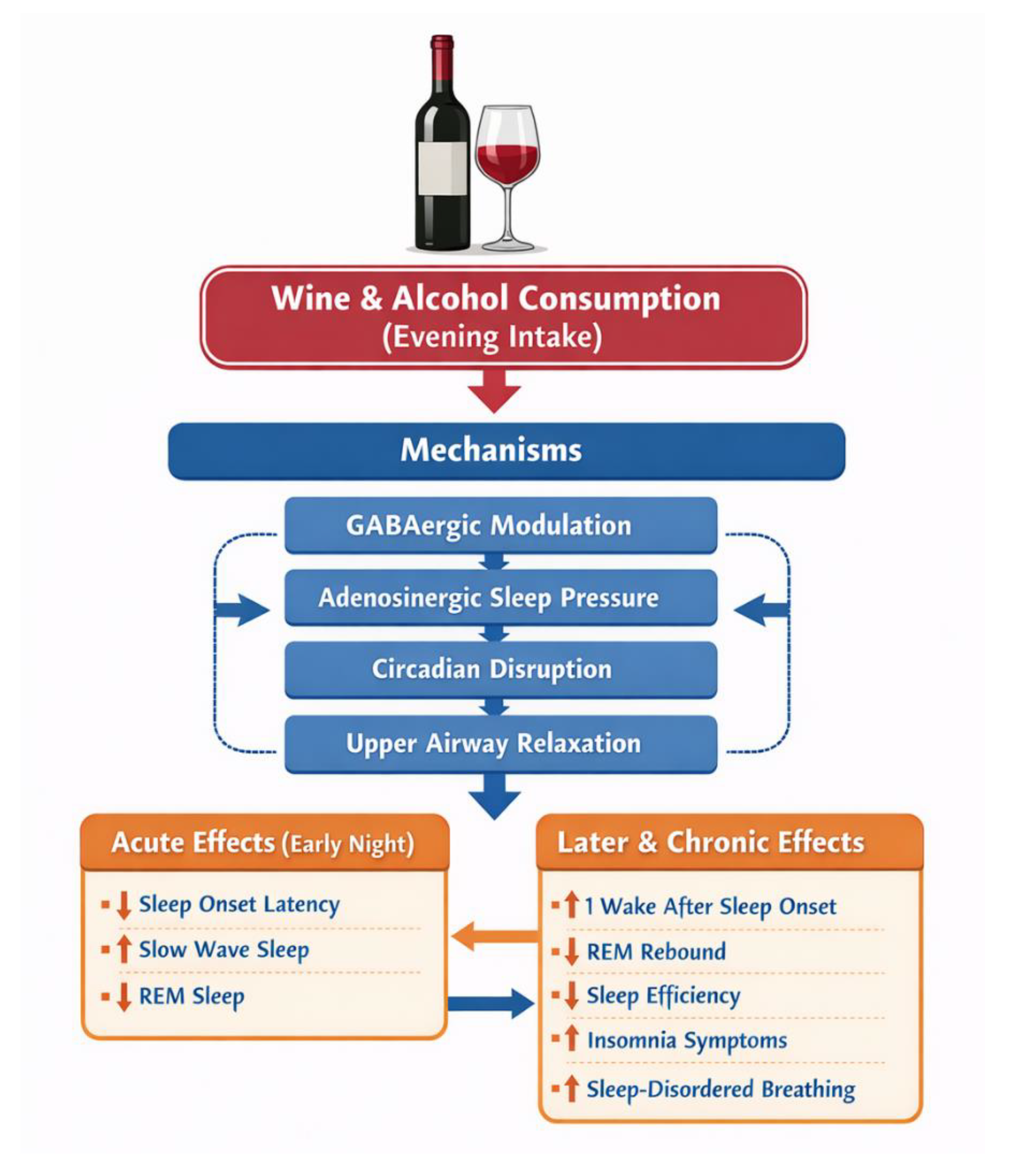

Table 1.
Key recent evidence on alcohol (including wine) and sleep in community-dwelling adults.
| Study (Year) | Design | Population | Exposure | Sleep Outcomes Assessed | Main Findings |
|---|---|---|---|---|---|
| Gardiner et al. (2025) [2] | Systematic review and meta-analysis | Healthy adults | Acute alcohol intake | Sleep onset latency, wake after sleep onset, sleep efficiency, REM sleep, slow-wave sleep | Alcohol reduced sleep onset latency but increased wake after sleep onset and reduced sleep efficiency; REM sleep was suppressed early with rebound later in the night |
| Webber et al. (2025) [3] | Systematic review | Adults | Alcohol use | Objective and subjective sleep measures | Subjective sleep improvements often conflicted with objective measures; alcohol was consistently associated with sleep fragmentation |
| Meneo et al. (2023) [4] | Systematic review and meta-analysis | Young and middle-aged adults | Sleep habits and substance use | Sleep disturbances (insomnia symptoms, sleep quality), sleep health dimensions (duration, satisfaction, efficiency, timing, daytime alertness), and circadian characteristics (chronotype) | Poor sleep habits were associated with greater alcohol use, supporting self-medication and bidirectional pathways |
| Hu et al. (2020) [7] | Systematic review and meta-analysis of cohort studies | General adult population | Habitual alcohol consumption | Incident sleep disorders | Regular alcohol consumption was associated with increased risk of developing sleep disorders over time |
| Burgos-Sanchez et al. (2020) [9] | Systematic review and meta-analysis | Adults | Alcohol consumption | Snoring, sleep architecture, apnea–hypopnea index | Alcohol consumption significantly increased snoring and obstructive sleep apnea severity |
| Kolla et al. (2018) [14] | Systematic review and meta-analysis | Adults | Alcohol consumption | Breathing parameters during sleep | Alcohol worsened nocturnal oxygen desaturation and increased respiratory event duration |
| Simou et al. (2018) [15] | Systematic review and meta-analysis | Adults | Alcohol consumption | Sleep apnea risk | Alcohol consumption was associated with an increased risk of sleep apnea |
| Bolling et al. (2025) [1] | Narrative review | Adults | Alcohol use | Sleep quality, insomnia symptoms | Alcohol and sleep disruption showed reciprocal effects; short-term sedative effects masked longer-term impairment |
| Inkelis et al. (2020) [8] | Narrative review | Adult women | Alcohol use | Insomnia symptoms, sleep quality | Women experienced greater sleep disruption at lower alcohol doses than men |
| Marhuenda et al. (2021) [12] | Narrative review | Adults | Wine (melatonin and polyphenols) | Sleep and circadian regulation | Melatonin and polyphenol content in wine was far below doses required to influence sleep; no evidence of meaningful sleep benefit |
Studies are ordered by level of evidence, with systematic reviews and meta-analyses presented first, followed by narrative reviews. REM: rapid eye movement.
Disclaimer/Publisher’s Note: The statements, opinions and data contained in all publications are solely those of the individual author(s) and contributor(s) and not of MDPI and/or the editor(s). MDPI and/or the editor(s) disclaim responsibility for any injury to people or property resulting from any ideas, methods, instructions or products referred to in the content. |
© 2026 by the authors. Licensee MDPI, Basel, Switzerland. This article is an open access article distributed under the terms and conditions of the Creative Commons Attribution (CC BY) license (http://creativecommons.org/licenses/by/4.0/).
Copyright: This open access article is published under a Creative Commons CC BY 4.0 license, which permit the free download, distribution, and reuse, provided that the author and preprint are cited in any reuse.


