Preprint
Article

This version is not peer-reviewed.

Clinical Characteristics and Risk Factors for Nontuberculous Mycobacterial Pulmonary Disease with Chronic Pulmonary Aspergillosis in Patients

Submitted:

04 January 2026

Posted:

07 January 2026

You are already at the latest version

Abstract

Background: The incidence of patients with nontuberculous mycobacterial pulmonary disease (NTM-PD) complicated by chronic pulmonary aspergillosis (CPA) has been increasing. CPA is known to be associated with complex treatment regimens and a poor prognosis. However, data from mainland China remain scarce. Objective: This single-center retrospective study aimed to evaluate the clinical characteristics, risk factors, and prognoses of patients with NTM-PD who were coinfected with CPA. Methods: We conducted a retrospective review of the medical records of 248 patients diagnosed with NTM-PD. Risk factors for CPA were analyzed via multiple logistic regression, followed by survival analysis. Results: Among the 248 patients with NTM-PD, 66 (26.6%) were diagnosed with CPA. Independent risk factors for NTM-PD and CPA coinfection included male sex(OR 2.13, 95% CI:1.03-4.47), dyspnea(OR 27.9, 95% CI:4.24-570), cavity(OR 5.95, 95% CI:2.76-13.9), use of oral corticosteroids(OR 4.28, 95% CI:1.13-16.6), and interstitial lung disease(OR 15.5, 95% CI:1.89-361). The Kaplan-Meier survival curves indicated a significant divergence between the NTM-PD group and the NTM-PD with CPA group (log-rank test, p = 0.00039; HR 2.01, 95% CI:0.66-6.12). Conclusion: In patients with NTM-PD, the presence of concurrent CPA is associated with a marked increase in mortality. Clinicians should maintain a high index of suspicion for CPA to ensure prompt diagnosis and treatment, particularly in high-risk individuals.

Keywords: 
;  ;  ;  ;  

1. Introduction

Nontuberculous mycobacterial pulmonary disease (NTM-PD) is a chronic respiratory infection whose prevalence has sharply increased worldwide, affecting both high- and low-income settings.[1] In China, the Mycobacterium avium complex (MAC) and Mycobacterium abscessus complex (MABC) dominate the epidemiological landscape, col lectively accounting for approximately 84% of all culture-positive cases (MAC≈61% vs MABC≈23%).[2] NTM-PD caused by MABC and MAC is notoriously challenging to treat, with cure rates of only 36.1%-56.1% and 68.1%, respectively.[3,4,5] Therefore, identifying risk factors associated with treatment outcomes is essential to enhance the success rates of NTM-PD.
Chronic pulmonary aspergillosis (CPA) is a slowly progressive infection caused by As- pergillus species. Previous studies have explored CPA as a complication of NTM-PD. [6] It is also one of the most common complications following the treatment of pulmonary tuberculosis.[7] Recent years have seen an increase in the incidence of NTM-PD accompanied by CPA. CPA is associated with disease progression, elevated mortality rates, and increased therapeutic complexity. [8,9,10,11]
However, the majority of published data originate from Japan,[12] where MAC ac- counts for the overwhelming majority of NTM-PD isolates. Data from other regions, which exhibit different distributions of NTM species, are limited. Thus, we performed a retrospective analysis of NTM-PD patients in China, a setting in which MAC remains common but MABC comprises a substantially larger proportion of cases.

2. Materials and Methods

2.1. Ethical Approval

This study was approved by the ethics committee of Beijing Chest Hospital, Capital Medical University (YJS-2025-16).

2.2. Patients

This study reviewed the medical records of adult patients (≥18 years) diagnosed with NTM-PD at Beijing Chest Hospital from January 2022 to December 2024. All the patients met the diagnostic criteria for NTM-PD, based on the guidelines by the ATS/ERS/ESCMID/IDSA.[13] We excluded patients who: (1) did not receive antibiotic treatment; (2) underwent no testing for fungal pathogens; (3) were diagnosed with CPA prior to NTM-PD; or (4) received subsequent treatment at another facility. [Figure 1].

2.3. Study Design

This was a retrospective cohort study. Clinical data including age, sex, smoking history, drinking history, body mass index (BMI), complications, symptoms, use of steroid, laboratory data, isolated mycobacterial species, radiographic features, and treatment history were collected from the patients’ medical records. Patient follow-up was conducted until September 30, 2025. We defined overall survival as the duration from the diagnosis of NTM-PD until death or censoring. Use of steroids was defined as a daily dose of more than 10 mg or a cumulative dose of more than 700 mg of oral prednisolone or a long-term inhaled steroid [14,15].

2.4. Diagnosis of Chronic Pulmonary Aspergillosis (CPA)

The diagnostic criteria for Chronic Pulmonary Aspergillosis encompass the following components:
1) Clinical Symptoms: The presence of respiratory symptoms, including unexplained cough, sputum production, or hemoptysis, persisting for three months or longer.
2) Radiological Features (Chest imaging revealing one or more of the following): (I)Progressive enlargement of a cavity (II)An intracavitary fungal ball (aspergilloma) (III)Pleural thickening, fibrosis, or infiltrates surrounding the cavity
3) Microbiological or Serological Evidence (Laboratory confirmation of Aspergillus infection, demonstrated by at least one of the following):
(I) A positive test for Aspergillus-specific IgG antibodies (II) Direct microscopy of a respiratory tract specimen showing hyphae consistent with Aspergillus (III) A positive culture for Aspergillus from respiratory specimens on at least two separate occasions (IV) Histopathological examination of lung tissue indicating Aspergillus infection. [16,17]

2.5. Statistical Analysis

All data are presented as median [interquartile range (IQR)] for continuous variables and as number (percentage) for categorical variables. The data were compared using the Mann-Whitney U test for continuous variables, and the Fisher’s exact test for categorical variables. Multiple logistic regression was performed to identify independent risk factors, which were pre-specified based on clinical relevance as well as findings from prior studies. Results are presented as adjusted odds ratios with 95% confidence intervals (CIs). A p-value < 0.05 was considered statistically significant. Survival analysis was performed using the Kaplan-Meier method, with groups compared by the log-rank test. The Cox proportional hazards model was also utilized for further analysis. Statistical analyses were conducted using R (version 4.4.2; The R Foundation for Statistical Computing, Vienna, Austria).

3. Results

3.1. Patient Characteristics

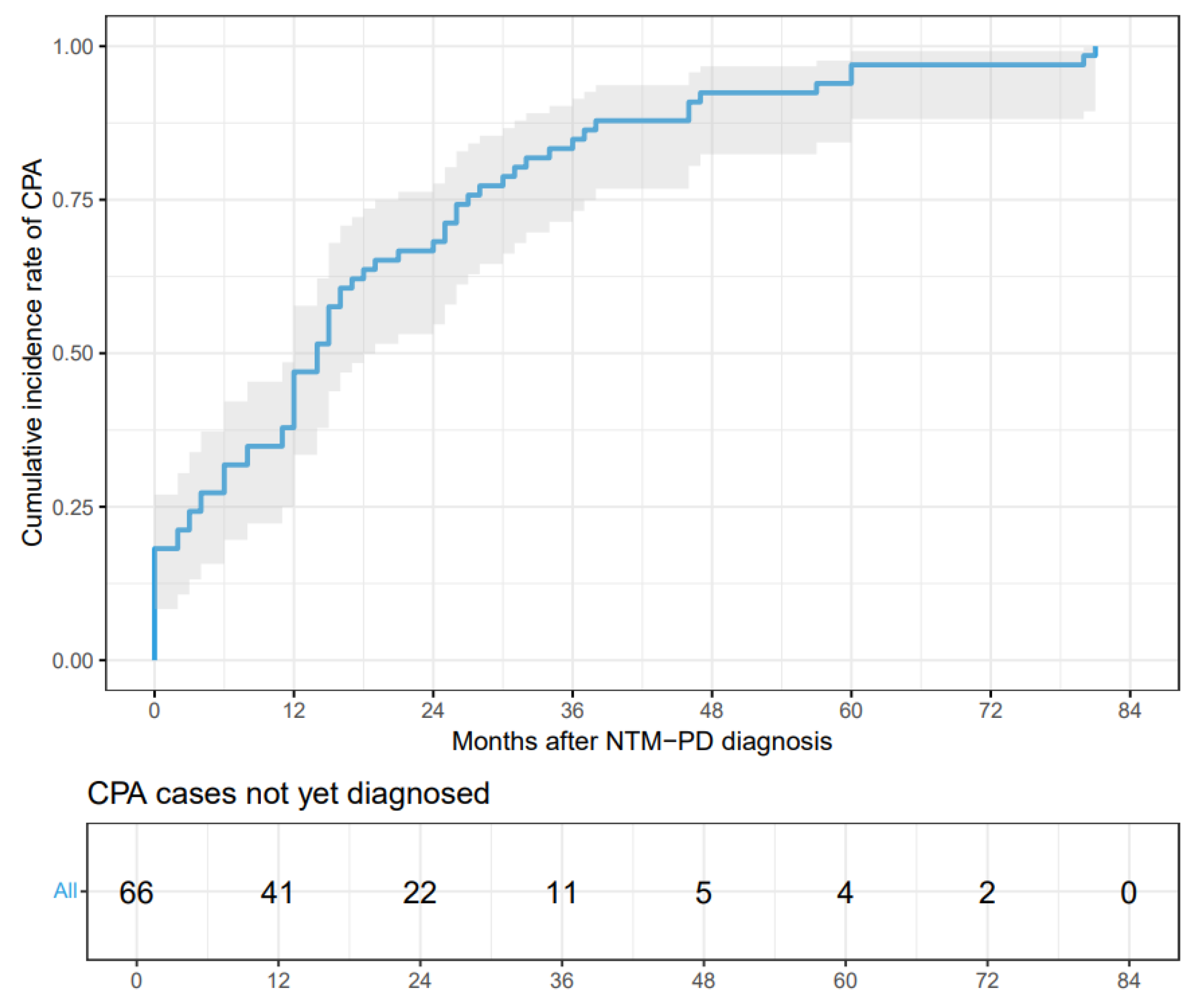
A total of 248 patients with NTM-PD were included in the study (Figure 1). The me dian observation period was 30 months (interquartile range [IQR]: 20.75-42 months). Among these patients, 66 were diagnosed with CPA during the observation period. This group included 12 cases diagnosed concurrently with NTM-PD and 54 cases diagnosed subsequently. The median time from NTM-PD to CPA diagnosis was 14 months (IQR: 4-26.75) (Figure 2). During the observation period, 59 out of the 66 patients diagnosed with CPA underwent antifungal therapy.
Regarding the distribution of NTM species, MAC accounted for 64.5% of the cases, while MABC represented 27.8%. One patient with CPA was co-infected with both MAC and MABC, and one patient without CPA was co-infected with M. xenopi and M. chelonae. These two cases were categorized into a mixed infection group. Other identified species included M. xenopi (n=7, with 3 developing CPA), M. kansasii (n=8, with 3 developing CPA), M.gordonae (n=1, with CPA), and M.scrofulaceum (n=1, with 1 case of CPA).
Compared with the non-CPA group, the CPA group demonstrated significant differ ences (P < 0.05) in age, sex, BMI, smoking history, interstitial lung disease (ILD), chronic obstructive pulmonary disease (COPD), corticosteroid use, NTM species, radiographic cavitation, dyspnea, fever and laboratory tests. The baseline clinical characteristics of the both groups are presented in Table 1.

3.2. Risk Factors for Aspergillus Coinfection

To determine the risk factors for NTM-PD with CPA coinfection, we compared the baseline data of 182 patients diagnosed NTM-PD without CPA and 66 patients with CPA. The univariate logistic regression analysis showed that Age>60, Male, BMI<18.5 kg/m^2, smoking, drinking, COPD, ILD, dyspnea, fever, cavity, diabetes, inhaled corticosteroids, oral corticosteroids, lower albumin and hemoglobin levels and elevated ESR and CRP levels were associated with the condition. In the multivariate analysis, male sex(p=0.041), dyspnea(p<0.001), cavity(p<0.001), oral corticosteroids(p=0.032), ILD(p=0.008) were identified as independent risk factors. [Table 2]

3.3. Survival Analysis for All-Cause Mortality

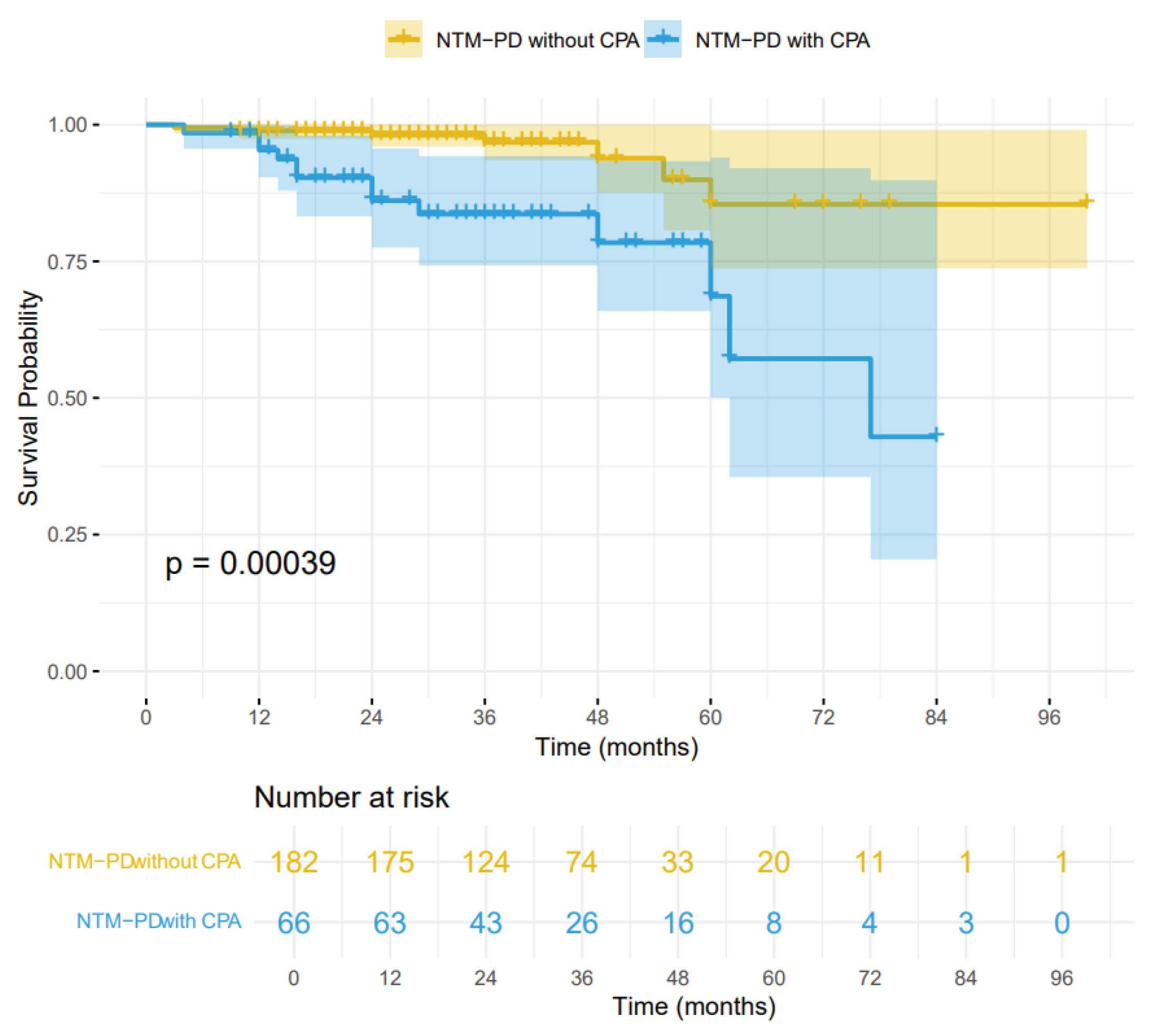
During the follow-up period, 20 patients (8.1%) died. Mortality was significantly higher in the NTM-CPA group compared to the NTM group (19.7% [13/66] vs. 3.8% [7/182]). Kaplan-Meier analysis revealed a statistically significant difference in survival between the two groups (log-rank test, p=0.00039). [Figure 3] Univariate Cox regression analysis demonstrated a significant association between CPA and higher mortality in NTM-PD patients (hazard ratio[HR] 4.63, 95% CI:1.83-11.71, p=0.001). However, this association was not statistically significant after adjustment for potential confounders (HR 2.01, 95% CI:0.66-6.12, p=0.217).[Table S1]

4. Discussion

In this single-centered retrospective study, we aimed to assess the clinical characteristics, risk factors and prognosis of NTM-PD coinfected CPA in China. The incidence of CPA was 26.6% (66/248). We identified male sex, ILD, the symptom of dyspnea, cavity on imaging, and oral corticosteroids as independent risk factors for CPA in NTM-PD patients. These findings hold significant clinical value for identifying high-risk populations and facilitating early diagnosis and intervention.
In our study, the observed comorbidity rate of CPA was 26.6%, which was substantially higher than that previously reported (2.3%-16.0%). [8,9,10,11,12,18,19,20] This discrepancy may be attributed to regional variations and inclusion standards. Our study included patients diagnosed with both NTM-PD and CPA simultaneously. As a large tuberculosis specialty hospital, Beijing Chest Hospital typically admits patients with more severe or refractory NTM-PD. Previous studies have reported cavity as a significant factor contributing to CPA. In our cohort, the prevalence of cavity (50%) was notably higher compared to rates documented in prior research (18.6%-33.6%).[8,9,10,11,20] This likely serves as the primary reason for the elevated prevalence of CPA in our cohort. Furthermore, the transfer of patients to local institutions for follow-up treatment could introduce bias, potentially contributing to the higher observed rate of CPA in our study.
Previous studies have identified several risk factors for CPA in patients with NTM-PD, including male sex, the use of systemic corticosteroids, cavity, chronic respiratory failure, and interstitial pneumonia. Corticosteroids suppress the activity and function of immune cells, thereby compromising the host’s ability to resist fungal infections. With prolonged or high-dose administration, the immune system’s capacity to recognize and eliminate fungi is diminished, allowing commensal or environmental fungi to initiate an active infection. In NTM-PD, the presence of cavities not only serves as a marker of disease severity but also creates a favorable niche for Aspergillus colonization and the subsequent formation of aspergillomas.[21] ILD is a well-established independent risk factor for CPA.[22] ILD causes extensive architectural distortion and pulmonary fibrosis, often accompanied by traction bronchiectasis. ILD provides the structural groundwork, while NTM infection may further exacerbate local inflammation and epithelial damage, with both processes acting in concert to promote the development of CPA. Dyspnea may reflect poorer baseline pulmonary function, broader disease extent, or greater structural damage in these patients. These findings suggest that these patients likely represent a subgroup with more severe NTM-PD, thereby exhibiting increased susceptibility to opportunistic infections such as CPA. Male sex emerged as a risk factor in our cohort, aligning with prior data; this may be attributable to factors such as sex hormones, a higher burden of smoking-related lung disease, and specific ILD subtypes in men. The exact pathophysiology requires further elucidation.
While several studies have identified COPD/emphysema, and MABC pulmonary disease as significant risk factors for CPA in NTM-PD patients, our analysis did not establish them as independent predictors in our cohort. [8,10,11] This discrepancy may be attributed to the broad diagnostic spectrum of emphysema as a heterogeneous entity, suggesting that our cohort may have included patients with relatively milder disease. Different types of underlying lung disease possess distinct predisposing potentials for CPA, and in our cohort, other factors may have outweighed the contribution of COPD and emphysema. Regarding mycobacterial species, there are two main points to consider. Firstly, the previous study only assessed the type of bacteria at the onset of treatment. Given that NTM-PD treatment is lengthy, the prolonged treatment itself may have altered the condition of the lungs and even the predominant mycobacterial species. [8] Secondly, our study had a relatively small sample size. Therefore, larger, meticulously designed studies that control for established strong confounders are necessary to definitively ascertain the independent role of specific NTM species.
In China, coinfection with NTM-PD and CPA has rarely been reported. This can be partly attributed to the fact that the Aspergillus IgG antibody test has only become widely available in many hospitals in recent years. The Aspergillus IgG antibody test demonstrated high sensitivity and specificity for diagnosing CPA.[23] In this study, the Aspergillus IgG antibody test was available for 212 patients (85.5%) out of a total cohort of 248.
Consistent with prior studies, our findings also indicate that patients with concurrent NTM-PD and CPA experience worse outcomes.[8,9,10,11,19] Therefore, early identification and treatment are particularly important. The therapeutic management of CPA includes antifungal therapy, surgical intervention, and interventional procedures such as intracavitary instillation and bronchial artery embolization. A course of voriconazole or itraconazole lasting six months or longer is recommended to control infection, delay pulmonary fibrosis, prevent hemoptysis, and improve quality of life.[17] In patients with tuberculosis and CPA, studies have reported that a six-month course of voriconazole is associated with superior efficacy and a lower one-year relapse rate. [24] Furthermore, the combination of antifungal therapy and surgery has achieved a cure rate as high as 93.02%, which is significantly higher than that in the nonsurgical group, along with a lower recurrence rate.
Our study has several limitations. Firstly, the retrospective, single-center design may introduce potential biases. Secondly, the follow-up period was relatively short. Given that both NTM-PD and CPA are chronic diseases, it is possible that some patients may develop CPA in the future. Thirdly, we excluded some patients with mild symptoms or those who did not undergo fungal testing—individuals who are generally less likely to develop CPA—which may have led to an overestimation of the infection rate. Finaly, due to the limited number of cases, we did not investigate the relationships among CPA subtypes, treatment regimens and patient prognosis. Future studies could focus on the aforementioned aspects.

5. Conclusions

In conclusion, our study revealed that male sex, dyspnea, cavity, oral corticosteroids and interstitial lung disease are independent risk factors for CPA coinfection in patients with NTM- PD. Additionally, concurrent CPA is associated with a significant increase in mortality. Clinicians should maintain a high index of suspicion for CPA to ensure early diagnosis and treatment, particularly in high-risk individuals.

Supplementary Materials

The following supporting information can be downloaded at: Preprints.org, Table S1: Univariate and multivariate analyses of risk factors for All-cause mortality.

Author Contributions

methodology, H.D. and H.H.; software, M.W.; validation, M.W.; formal analysis, M.W.; investigation, M.W.; writing—original draft preparation, M.W.; writing—review and editing, X.Y.; supervision, H.D. and H.H.; funding acquisition, H.D. All authors have read and agreed to the published version of the manuscript.

Funding

This study was supported by the National Key Research and Development Program of China (2024YFC2311202) and the Beijing High-Level Public Health Talent Program (G2023-2-002).

Institutional Review Board Statement

The study was conducted in accordance with the Declaration of Helsinki, and approved by the Ethics Committee of Beijing Chest Hospital, Capital Medical University (YJS-2025-16) on 23 October 2025.

Informed Consent Statement

Informed consent was obtained from all subjects involved in the study.

Data Availability Statement

The data presented in this study are available on request from the corresponding author due to ethical requirements.

Acknowledgments

During the preparation of this study, the authors used DeepSeek-V3.2 for the purposes of data analysis. The authors have reviewed and edited the output and take full responsibility for the content of this publication.

Conflicts of Interest

The authors declare no conflicts of interest.

References

  1. Xu, N.; Li, L.; Wu, S. Epidemiology and laboratory detection of non-tuberculous mycobacteria. Heliyon 2024, 10, e35311. [Google Scholar] [CrossRef]
  2. Tan, Y.; Deng, Y.; Yan, X.; Liu, F.; Tan, Y.; Wang, Q.; Bao, X.; Pan, J.; Luo, X.; Yu, Y.; et al. Nontuberculous mycobacterial pulmonary disease and associated risk factors in China: A prospective surveillance study. J Infect 2021, 83, 46–53. [Google Scholar] [CrossRef] [PubMed]
  3. Nasiri, M.J.; Ebrahimi, G.; Arefzadeh, S.; Zamani, S.; Nikpor, Z.; Mirsaeidi, M. Antibiotic therapy success rate in pulmonary Mycobacterium avium complex: a systematic review and meta-analysis. Expert Rev Anti Infect Ther 2020, 18, 263–273. [Google Scholar] [CrossRef]
  4. Cheng, L.P.; Chen, S.H.; Lou, H.; Gui, X.W.; Shen, X.N.; Cao, J.; Sha, W.; Sun, Q. Factors Associated with Treatment Outcome in Patients with Nontuberculous Mycobacterial Pulmonary Disease: A Large Population-Based Retrospective Cohort Study in Shanghai. Trop Med Infect Dis 2022, 7. [Google Scholar] [CrossRef] [PubMed]
  5. Cheng, L.P.; Zhang, Q.; Lou, H.; Shen, X.N.; Qu, Q.R.; Cao, J.; Wei, W.; Sha, W.; Sun, Q. Effectiveness and safety of regimens containing linezolid for treatment of Mycobacterium abscessus pulmonary Disease. Ann Clin Microbiol Antimicrob 2023, 22, 106. [Google Scholar] [CrossRef]
  6. Phoompoung, P.; Chayakulkeeree, M. Chronic Pulmonary Aspergillosis Following Nontuberculous Mycobacterial Infections: An Emerging Disease. J Fungi (Basel) 2020, 6. [Google Scholar] [CrossRef]
  7. Bongomin, F. Post-tuberculosis chronic pulmonary aspergillosis: An emerging public health concern. PLoS Pathog 2020, 16, e1008742. [Google Scholar] [CrossRef]
  8. Jhun, B.W.; Jung, W.J.; Hwang, N.Y.; Park, H.Y.; Jeon, K.; Kang, E.S.; Koh, W.J. Risk factors for the development of chronic pulmonary aspergillosis in patients with nontuberculous mycobacterial lung disease. PLoS One 2017, 12, e0188716. [Google Scholar] [CrossRef]
  9. Takeda, K.; Imamura, Y.; Takazono, T.; Yoshida, M.; Ide, S.; Hirano, K.; Tashiro, M.; Saijo, T.; Kosai, K.; Morinaga, Y.; et al. The risk factors for developing of chronic pulmonary aspergillosis in nontuberculous mycobacteria patients and clinical characteristics and outcomes in chronic pulmonary aspergillosis patients coinfected with nontuberculous mycobacteria. Med Mycol 2016, 54, 120–127. [Google Scholar] [CrossRef] [PubMed]
  10. Furuuchi, K.; Ito, A.; Hashimoto, T.; Kumagai, S.; Ishida, T. Risk stratification for the development of chronic pulmonary aspergillosis in patients with Mycobacterium avium complex lung disease. J Infect Chemother 2018, 24, 654–659. [Google Scholar] [CrossRef]
  11. Tanaka, Y.; Ide, S.; Takazono, T.; Takeda, K.; Iwanaga, N.; Yoshida, M.; Hosogaya, N.; Tsukamoto, Y.; Irifune, S.; Suyama, T.; et al. Risk Factors and Long-Term Prognosis for Coinfection of Nontuberculous Mycobacterial Pulmonary Disease and Chronic Pulmonary Aspergillosis: A Multicentre Observational Study in Japan. Mycoses 2025, 68, e70083. [Google Scholar] [CrossRef]
  12. Sehgal, I.S.; Soundappan, K.; Agarwal, R.; Muthu, V.; Dhooria, S.; Prasad, K.T.; Salzer, H.J.F.; Cornely, O.A.; Aggarwal, A.N.; Chakrabarti, A. Prevalence of Chronic Pulmonary Aspergillosis in Patients With Mycobacterial and Non-Mycobacterial Tuberculosis Infection of the Lung: A Systematic Review and Meta-Analysis. Mycoses 2025, 68, e70060. [Google Scholar] [CrossRef] [PubMed]
  13. Daley, C.L.; Iaccarino, J.M.; Lange, C.; Cambau, E.; Wallace, R.J., Jr.; Andrejak, C.; Böttger, E.C.; Brozek, J.; Griffith, D.E.; Guglielmetti, L.; et al. Treatment of nontuberculous mycobacterial pulmonary disease: an official ATS/ERS/ESCMID/IDSA clinical practice guideline. Eur Respir J 2020, 56. [Google Scholar] [CrossRef]
  14. Stuck, A.E.; Minder, C.E.; Frey, F.J. Risk of infectious complications in patients taking glucocorticosteroids. Rev Infect Dis 1989, 11, 954–963. [Google Scholar] [CrossRef] [PubMed]
  15. Noni, M.; Katelari, A.; Dimopoulos, G.; Kourlaba, G.; Spoulou, V.; Alexandrou-Athanassoulis, H.; Doudounakis, S.E.; Tzoumaka-Bakoula, C. Inhaled corticosteroids and Aspergillus fumigatus isolation in cystic fibrosis. Med Mycol 2014, 52, 715–722. [Google Scholar] [CrossRef]
  16. Denning, D.W.; Page, I.D.; Chakaya, J.; Jabeen, K.; Jude, C.M.; Cornet, M.; Alastruey-Izquierdo, A.; Bongomin, F.; Bowyer, P.; Chakrabarti, A.; et al. Case Definition of Chronic Pulmonary Aspergillosis in Resource-Constrained Settings. Emerg Infect Dis 2018, 24. [Google Scholar] [CrossRef] [PubMed]
  17. Denning, D.W.; Cadranel, J.; Beigelman-Aubry, C.; Ader, F.; Chakrabarti, A.; Blot, S.; Ullmann, A.J.; Dimopoulos, G.; Lange, C. Chronic pulmonary aspergillosis: rationale and clinical guidelines for diagnosis and management. Eur Respir J 2016, 47, 45–68. [Google Scholar] [CrossRef]
  18. Naito, M.; Kurahara, Y.; Yoshida, S.; Ikegami, N.; Kobayashi, T.; Minomo, S.; Tachibana, K.; Tsuyuguchi, K.; Hayashi, S.; Suzuki, K. Prognosis of chronic pulmonary aspergillosis in patients with pulmonary non-tuberculous mycobacterial disease. Respir Investig 2018, 56, 326–331. [Google Scholar] [CrossRef]
  19. Takazono, T.; Ide, S.; Adomi, M.; Ogata, Y.; Saito, Y.; Yoshida, M.; Takeda, K.; Iwanaga, N.; Hosogaya, N.; Sakamoto, N.; et al. Risk Factors and Prognostic Effects of Aspergillosis as a Complication of Nontuberculous Mycobacterial Pulmonary Disease: A Nested Case-Control Study. Mycoses 2025, 68, e70022. [Google Scholar] [CrossRef]
  20. Shirai, T.; Furuuchi, K.; Fujiwara, K.; Nakamoto, K.; Tanaka, Y.; Ishii, H.; Yoshiyama, T.; Yoshimori, K.; Takizawa, H.; Sasaki, Y.; et al. Impact of Aspergillus precipitating antibody test results on clinical outcomes of patients with Mycobacterium avium complex lung disease. Respir Med 2020, 166, 105955. [Google Scholar] [CrossRef]
  21. Pathak, K.; Hart, S.; Lande, L. Nontuberculous Mycobacteria Lung Disease (NTM-LD): Current Recommendations on Diagnosis, Treatment, and Patient Management. Int J Gen Med 2022, 15, 7619–7629. [Google Scholar] [CrossRef] [PubMed]
  22. Kurosaki, F.; Bando, M.; Nakayama, M.; Mato, N.; Nakaya, T.; Yamasawa, H.; Yoshimoto, T.; Fukushima, N.; Sugiyama, Y. Clinical features of pulmonary aspergillosis associated with interstitial pneumonia. Intern Med 2014, 53, 1299–1306. [Google Scholar] [CrossRef] [PubMed]
  23. Salzer, H.J.F.; Reimann, M.; Oertel, C.; Davidsen, J.R.; Laursen, C.B.; Van Braeckel, E.; Agarwal, R.; Avsar, K.; Munteanu, O.; Irfan, M.; et al. Aspergillus-specific IgG antibodies for diagnosing chronic pulmonary aspergillosis compared to the reference standard. Clin Microbiol Infect 2023, 29, 1605.e1601–1605.e1604. [Google Scholar] [CrossRef]
  24. Yang, C.Z.; Chen, S.F.; Mei, C.L.; Cao, T.Z.; Feng, W.; Liu, X.P.; Xu, W.J.; Du, R.H. Clinical characteristics of 220 patients with pulmonary tuberculosis complicated with chronic pulmonary aspergillosis. Chin J Antituberc. 2024, 46(7), 770–777. [Google Scholar]
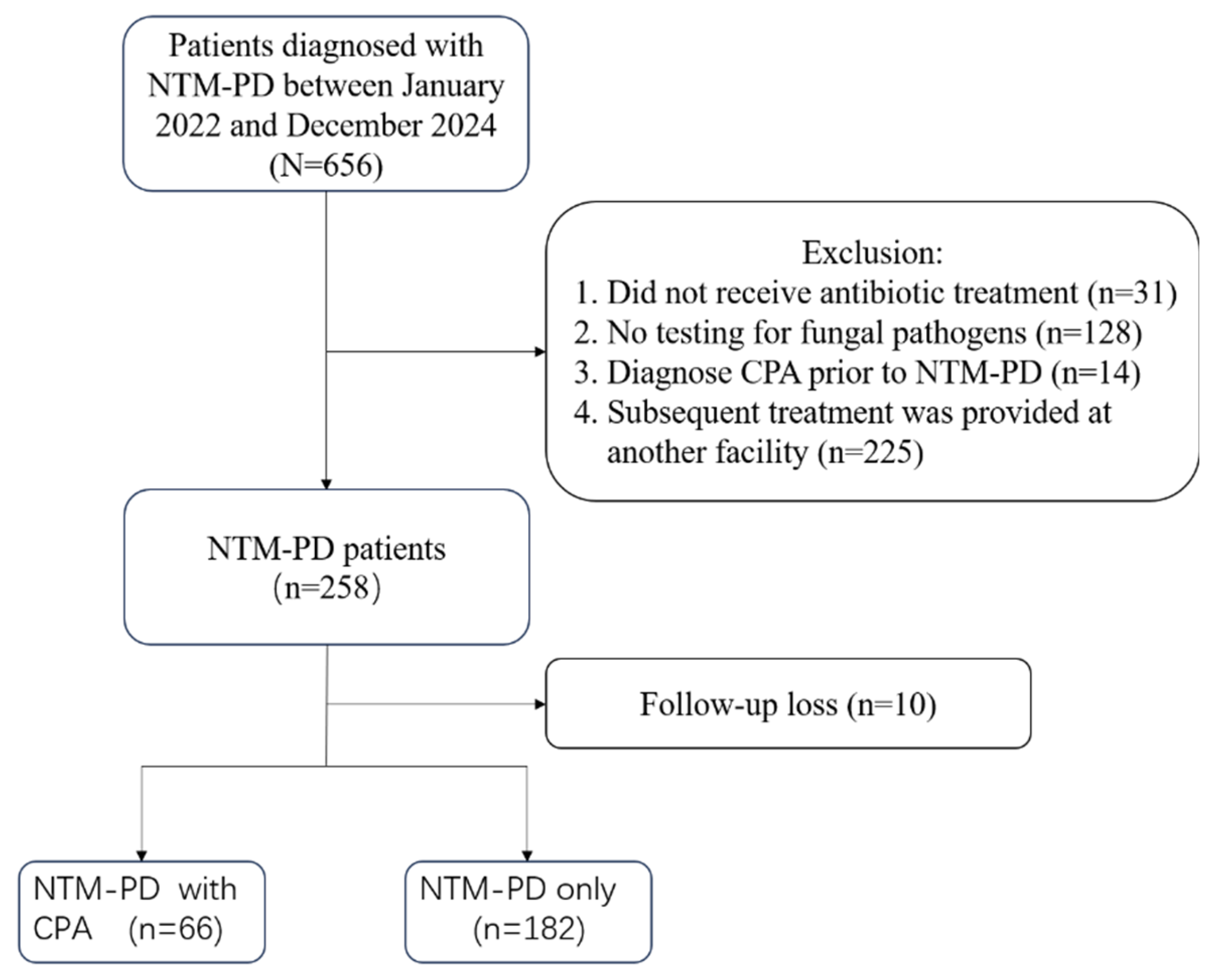
Figure 1. Flowchart of study patients.
Preprints 192788 g001
Figure 2. Cumulative incidence of CPA in the NTM-PD with CPA group.
Preprints 192788 g002
Figure 3. Kaplan–Meier analysis for patients with NTM-PD with or without CPA.
Preprints 192788 g003
Table 1. Characteristics of the study patients.
Characteristics Total
(N=248)
NTM-CPA group
(n=66)
NTM group
(n=182)
P value
Age(years)
>60
60 (51.25,69)
118 (47.6%)
63 (57,71)
39 (59.1%)
58 (51,68)
79 (43.4%)
0.0078
0.0317
Sex(male) 103 (41.5%) 44 (66.7%) 59 (32.4%) <0.001
BMI(kg/m^2)
<18.5 n=243
19.83 (17.11,21.97)
89 (36.6%)
18.87(16.22,22.03)
31 (49.2%)
20.02(17.58,21.91)
58 (32.2%)
0.0537
0.0439
Smoking 57 (23.0%) 28 (42.4%) 29 (15.9%) <0.0001
Drinking 25 (10.1%) 11 (16.7%) 14 (7.7%) 0.0541
Pulmonary comorbidities
Tuberculosis 76 (30.6%) 24 (36.4%) 52 (28.6%) 0.2758
COPD 45 (18.1%) 18 (27.3%) 27 (14.8%) 0.0389
Asthma 3 (1.2%) 2 (3.0%) 1 (0.5%) 0.1737
Lung tumor 9 (3.6%) 2 (3.0%) 7 (3.8%) 1
Interstitial Lung Disease 7 (2.8%) 6 (9.1%) 1 (0.5%) 0.0016
Pneumoconiosis 7 (2.8%) 2 (3.0%) 5 (2.7%) 1
Extrapulmonary comorbidities
Diabetes mellitus 22 (8.9%) 10 (15.2%) 12 (6.6%) 0.0446
Cardiovascular disease 43 (17.3%) 15 (22.7%) 28 (15.4%) 0.213
Endocrine system disease 11 (4.4%) 1 (1.5%) 10 (5.5%) 0.191
Digestive system disease 20 (8.1%) 9 (13.6%) 11 (6.0%) 0.076
Rheumatic disease 21 (8.5%) 7 (10.6%) 14 (7.7%) 0.493
Kidney disease 4 (1.6%) 1 (1.5%) 3 (1.6%) 1.000
Nervous system disease 7 (2.8%) 1 (1.5%) 6 (3.3%) 0.681
Other tumors 16 (6.5%) 6 (9.1%) 10 (5.5%) 0.239
Inhaled corticosteroids 6 (2.4%) 4 (6.06%) 2 (1.1%) 0.0447
Oral corticosteroids 13 (5.2%) 7 (10.61%) 6 (3.30%) 0.046
NTM species 0.0042
M.avium complex 160 (64.5%) 43 (65.1%) 117 (64.3%)
M.abscessus complex 69 (27.8%) 12 (18.2%) 57 (31.3%)
Mixed infection 2 (0.8%) 1 (1.5%) 1 (0.5%)
Others 17 (6.9%) 10 (15.2%) 7 (3.8%)
Radiological features
Cavity 124 (50%) 55 (83.3%) 69 (37.9%) <0.0001
Bronchiectasis 177 (71.4%) 44 (66.7%) 133 (73.1%) 0.3427
Nodule 224 (90.3%) 57 (86.4%) 167 (91.8%) 0.2266
Symptom
Cough 213 (85.9%) 61 (92.4%) 152 (83.5%) 0.0979
Dyspnea 10 (4.0%) 9 (13.6%) 1 (0.5%) <0.0001
Hemoptysis 57 (23.0%) 20 (30.3%) 37 (20.3%) 0.1238
Fever 50 (20.2%) 23 (34.8%) 27 (14.8%) 0.0011
Weight loss 51 (20.6%) 18 (27.3%) 33 (18.1%) 0.154
Laboratory Test
ALB (g/L) 38.5(34.9,41.7) 35.45(32.00,40.10) 39.35(36.20,41.90) <0.0001
HB (g/L) (n=247) 119(108,129) 115 (100,125) 121 (111,130) 0.0059
ESR(mm/h)(n=200) 23(7.25,52.50) 47 (27,70) 15 (7,34) <0.0001
CRP(mg/L)(n=247) 5.62(1.12,28.96) 33.43 (8.71,62.64) 3.41 (0.88,12.27) <0.0001
Follow-up Time(m) 30(20.25,42.00) 30(18,47) 30(21,42) 0.9289
Death 20 (8.1%) 13 (19.7%) 7 (3.8%) 0.0002
1 Data are presented as median (interquartile range) or number (%). NTM, nontuberculous mycobacteria; CPA, chronic pulmonary aspergillosis; BMI, body mass index; COPD, chronic obstructive pulmonary disease; ALB, Albumin; HB, Hemoglobin; ESR, Erythrocyte Sedimentation Rate; CRP, C-Reactive Protein.
Table 2. Univariate and multivariate analyses of risk factors for CPA coinfection.
Univariate OR (95% CI) P-value Multivariate OR (95% CI) P-value
Age>60 1.88 (1.07-3.36) 0.03 1.07 (0.53-2.14) 0.9
Male 4.17 (2.32-7.7) <0.001 2.13 (1.03-4.47) 0.041
BMI<18.5 kg/m^2 1.95 (1.08-3.53) 0.038
Smoking 3.89 (2.08-7.33) <0.001
Drinking 2.40 (1.01-5.59) 0.047
COPD 2.15 (1.08-4.23) 0.03 0.97 (0.39-2.27) >0.9
Tuberculosis 1.43 (0.78-2.58) 0.2
Asthma 5.66 (0.53-123) 0.14
ILD 18.1 (3.01-345) <0.001 15.5 (1.89-361) 0.008
Pneumoconiosis 1.11 (0.16-5.27) >0.9
Lung cancer 0.78 (0.11-3.33) 0.8
Cough 2.41 (0.97-7.32) 0.060
Dyspnea 28.6 (5.21-533) <0.001 27.9 (4.24-570) <0.001
Hemoptysis 1.70 (0.89-3.20) 0.11
Fever 3.07 (1.60-5.90) <0.001
Weight loss 1.69 (0.86-3.25) 0.12
Bronchiectasis 0.74 (0.40-1.37) 0.3
Cavity 8.19 (4.15-17.5) <0.001 5.95 (2.76-13.9) <0.001
Nodule 0.57 (0.24-1.42) 0.2
Diabetes 2.53 (1.02-6.18) 0.046
Inhaled corticosteroids 5.81 (1.11-42.6) 0.038
Oral corticosteroids 3.48 (1.11-11.2) 0.032 4.28 (1.13-16.6) 0.032
ALB 0.88 (0.83-0.94) <0.001
HB 0.98 (0.96-0.99) 0.004
ESR 1.03 (1.02-1.04) <0.001
CRP 1.02 (1.01-1.03) <0.001
NTM species 0.4
M.avium complex Reference
M.abscessus complex 0.57 (0.27-1.14)
Mixed 2.72 (0.11-69.8)
Others 1.17 (0.24-4.40)
* BMI, body mass index; COPD, chronic obstructive pulmonary disease; ILD, Interstitial Lung Dis ease; ALB, Albumin; HB, Hemoglobin; ESR, Erythrocyte Sedimentation Rate; CRP, C-Reactive Protein; NTM, nontuberculous mycobacteria; CPA, chronic pulmonary aspergillosis; OR, odds ratio; CI, confidence interval.
Disclaimer/Publisher’s Note: The statements, opinions and data contained in all publications are solely those of the individual author(s) and contributor(s) and not of MDPI and/or the editor(s). MDPI and/or the editor(s) disclaim responsibility for any injury to people or property resulting from any ideas, methods, instructions or products referred to in the content.
Copyright: This open access article is published under a Creative Commons CC BY 4.0 license, which permit the free download, distribution, and reuse, provided that the author and preprint are cited in any reuse.
Prerpints.org logo

Preprints.org is a free preprint server supported by MDPI in Basel, Switzerland.

Subscribe

Disclaimer

Terms of Use

Privacy Policy

Privacy Settings

© 2026 MDPI (Basel, Switzerland) unless otherwise stated