

Submitted:
04 January 2026
Posted:
07 January 2026
You are already at the latest version
Abstract
Anthropogenic activities represent indirect drivers that generate harmful direct factors, hindering wastewater management (WWM) and causing environmental damage. We analyze this as a process composed of causal relationships where indirect drivers (intangible harmful factors) generate tangible harmful factors. We model this multifactorial process with semantic networks, where the nodes represent intangible or tangible harmful factors, and the interactions between them with causal relationships represented by directed-arcs. We propose an approach that supports decision-making for improving WWM through semantic pathways that describe processes from intangible to tangible harmful factors. A significant advantage of these semantic pathways is their flexibility to modify their structure by adding and removing nodes and arcs, thus allowing for the updating of environmental knowledge. This method facilitates decision-making by providing viable and sustainable solutions to improve WWM performance in coastal tourist municipalities characterized by constant population growth that generates uncontrolled urban sprawl. We applied this approach to the case of the municipality of Acapulco, located on the Mexican Pacific coast. Viable solutions include the restoration of wastewater treatment plants, changes in agricultural practices, mangrove reforestation, and the development of sound urban plans. This methodology can be applied to coastal tourist areas with similar characteristics.
Keywords:
wastewater management
; environment
; semantic networks
; sustainability
; decision-making
1. Introduction
In general, a waste management system aims to reduce the negative impact of waste on the environment by implementing strategies such as reducing, reusing, preventing, and disposing of waste in a responsible manner [1,2,3,4,5,6,7]. The reduction of hazards to public health and the environment, as well as the achievement of an economy based on the efficiency of the use of resources, are roles associated with waste management systems [8]. Improperly managed waste can lead to pollution of air, water, and soil, as well as the spread of disease and other health risks.
An important role of the decision-making processes is to support waste management in the selection of effective pro-environmental alternatives (PEAs) to protect both the environment and public health. In particular, wastewater management systems (WWMs) are designed to collect, treat, and dispose of wastewater from homes, businesses, and industries. Wastewater management generates social, environmental, and economic benefits, thus representing essential actions towards achieving the 2030 Agenda for Sustainable Development [9].
1.1. Wastewater Management Challenges
Low water quality due to poor performance of wastewater treatment plants (WWTPs), built decades ago, are in need of repair or replacement. This can lead to leaks, overflows, and other issues that can harm the environment and public health [10,11,12,13], such as wastewater containing high levels of nutrients, which can cause harmful algal blooms and other water quality problems [14,15,16]. Adequate infrastructure should be adapted as population and urbanization increase, which is not the case in most of the developing countries [17]. In addition, agricultural runoff introduces pesticide residues that pollute waterbodies such as rivers, lakes, lagoons, and also groundwater [18,19].
It has been proved that as populations grow, consumption increases around the world [20,21,22], thus increasing the demand for resources, including water, food, energy, and raw materials [23,24,25]. This increased demand can lead to higher levels of consumption and production, thus causing environmental impacts, wastewater increase, and water scarcity, among other important issues [26,27,28]. Good governance is one of the most important challenges to be addressed by wastewater management for achieving sustainable conditions [29,30,31]. Derived from the concept of general good governance, the concept of water governance also embraces all social, political, economic and administrative organizations and institutions, as well as their relationship to water resource development and management [32]. Legitimacy, transparency, and accountability are among the most important key factors of the good governance concept. Therefore, the decision-making processes related to the WWM should rely on sociopolitical factors, such as a good governance, aimed at ensuring a coherent institutional integrity in order to build strategies for the legitimation of actions and to combat acts of corruption [33,34,35].
Overall, WWM is critical for maintaining a healthy and sustainable environment. However, the effectiveness of these systems is often influenced by a range of anthropogenic activities (indirect drivers), including population increase, socioeconomic and sociopolitical factors, technological skills, and cultural factors [36,37,38,39]. Usually, indirect drivers give rise to the generation of direct drivers, such as nutrients and other harmful factors that damage waterbodies [40,41].
1.2. WWM: A Multifactorial and Multidisciplinary Perspective
The multiple interactions between various indirect and direct drivers involved in the problem under study complicate its understanding and analysis. Consequently, decision-making processes are not considered reliable criteria for selecting appropriate pro-environmental alternatives. Furthermore, this problem is exacerbated when reliable data relating on a real-world situation is lacking, as is often the case in developing countries. However, decision-making processes must adopt approaches that compensate for these shortcomings.
To effectively address wastewater management and reduce pollution, it is necessary to consider the interactions between these factors, involving decision-makers and stakeholders from different sectors. Due to this complexity, decision-making processes supporting wastewater management must be addressed from a multifactorial and multidisciplinary perspective.
This approach allows decision-makers to consider multiple criteria, such as environmental, social, and economic factors, and to weigh the relative importance of each criterion [42].
In the multidisciplinary context, the inclusion of a group of multidisciplinary experts and stakeholders in the decision-making processes appears as a useful and mandatory strategy, because their experience in addressing real problems aimed at reducing water pollution can improve the decision-making process and provide better support for wastewater management, related to the lack of reliable data.
1.3. Semantic Networks
In short, a semantic network represents knowledge, where nodes represent concepts and the relationships between them by directed-arcs. Semantic networks are an important topic of the domain of artificial intelligence. There are different models of semantic networks. In this work, we address the following models:
- Definitional Networks. They represent hierarchical relationships ranging from general to specific knowledge. In this work, we define different levels of abstraction to represent the effects of drivers on an objective through cause-effect relationships. For example, the most general relationships between indirect and direct factors and the objective or recipient of the effects are represented by single level of abstraction, where a set of indirect drivers cause effects on the environmental. However, we recognize that complex systems, such as the one addressed in this work, require more specific knowledge to improve the understanding and analysis of the problem under study. Therefore, this more specific knowledge must be represented by its corresponding specific levels.
- Learning Networks, where the system learns new information by updating relationships and nodes based on new data and experiences, thus improving the understanding of the complex system under study.
- Hybrid Networks, where the combination of two or more models allows for more complex and dynamic knowledge representations.
1.3.. Proposal
The main objective of this work is to improve the decision-making processes that support sustainable management of wastewater in costal tourist municipalities through the appropriate selection of pro-environmental alternatives to reduce factors that negatively impact the environment.
We argue that multifactorial interactions between anthropogenic activities (indirect drivers) and direct drivers result in a limited understanding of the system’s dynamic, leading to
unreliable decision-making processes for WWM and the selection of appropriate pro-environmental alternatives.
We introduce a process-based approach to analyze and model the multifactorial interactions between indirect drivers that lead to direct harmful factors (direct drivers) damaging the environmental state, encompassing waterbodies, ecosystem services, and vulnerable urban areas in numerous coastal tourist municipalities. Therefore, developing approaches that facilitate understanding these dynamics is essential for identifying harmful factors and designing alternative solutions.
Conceptual frameworks must consider the interactions between drivers and pressures. However, conceptual frameworks applied to environmental systems often overlook or only superficially address the complexities of multifactorial dynamics that generate harmful factors due to anthropogenic activities.
To address these dynamics, we propose to build a multifactorial network composed of semantic pathways, which are composed by sequences of concepts (indirect and direct drivers) represented by nodes linked by causal relationships between them. which are represented by directed arcs.
Qualitative assessments supported by this network will help identify harmful factors for selecting pro-environmental alternatives. Quantitative assessment depends heavily on data availability, including trends in the relationships between factors over time, among other important aspects. However, the lack of reliable data, common in developing countries, hinders decision-making processes municipal wastewater management when selecting of pro-environmental alternatives, especially when studying the dynamics of the anthropogenic activities and their environmental impacts.
Engaging multidisciplinary experts within multi-criteria decision-making frameworks is crucial to address these challenges and ensure informed decisions. Expert involvement should be based on specific criteria, including contextual understanding, multidisciplinary expertise spanning relevant fields such as biodiversity, ecosystem services, sociopolitical and socioeconomic aspects, demographic issues, agricultural practices, cultural activities like tourism, industrial regulations and consumption patterns, and anthropological considerations.
As previously mentioned, we proposed a process-based approach to build semantic pathways that begin with indirect drivers and end with direct drivers, also known as pressure factors, to understand, analyze, identify, and prioritize them, thereby improving wastewater management.
Our proposed decision-making approach operates within a multidisciplinary context, where experts from different disciplines evaluate semantic pathways based on environmental, social, economic, and technological factors, as sustainability criteria to support decision-making processes and select appropriate pro-environmental alternatives aimed at improving, wastewater management.
This study involved ten experts from different disciplines: environmental management systems, socioecological systems, biodiversity and conservation, urban engineering, wastewater management, agriculture, environmental modeling, regional development, and social anthropology.
This study can be replicated in coastal tourist municipalities, addressing anthropogenic activities that generate harmful impacts on waterbodies, ecosystem services, and vulnerable urban areas.
2. Materials and Methods
2.1. Materials
In this paper, we address the wastewater problem in the municipality of Acapulco located on the Pacific Coast of Mexico in the state of Guerrero. We examine two important aspects that contribute to the inefficiency of WWM in this municipality: 1) tourism, considered the most important economic activity; and 2) population growth, which leads to the expansion of urban areas with both formal and informal settlements. Both factors contribute significantly to the increase in solid and liquid waste generation, hindering the efficiency of the WWM.
However, these studies should also consider sociopolitical, socioeconomic, technological, and cultural factors.
2.1.1. Tourism Data: The Most Important Economic Activity in Acapulco
A study covering data related to tourist visitors, hotel occupancy, and the economic impact in Acapulco shows significant changes in these variables (see Table 1) during the period 2018-2023, which include the events of COVID-19 and Hurricane OTIS [43].
A state of emergency was declared due to COVID-19, on January 30, 2020. The COVID-19 pandemic ended on May 5, 2023. Meanwhile, hurricane OTIS struck the area (from October 22 to 25, 2023). The values of the variables shown in Table 1 decreased during the COVID-19 and OTIS events. Subsequently, Hurricane John struck the area in September 2024. Despite these three events occurring sequentially, Acapulco achieved a 65% tourism recovery by the end of 2024 (forbes.com.mx/acapulco-cierra-2024-con-recuperacion-turistica-de-65-tras-huracanes/). Finally, hotel occupancy during a recent long week end (November 14-17, 2025) was 78.5%, with 61,112 visitors, based on data provided by the government of the state of Guerrero, where the municipality of Acapulco is located (https://www.guerrero.gob.mx/2025/11/guerrero-y-acapulco-superan-expectativas-con-exitoso-ultimo-puente-turistico-2025/).
2.1.2. Key Data: Years vs Population Growth & Years vs Expansion of the Urban Areas
Figure 1 shows a table with three key data points: the period from 1930 to 2020 (in the first column), population growth (in the second column), and the expansion of urban areas (in the third column). The “Years versus Population-Growth” graph shows a clear upward trend in population between 1970 and 2010. However, population decreased by 158,105 inhabitants between 2010 and 2020. Among the possible causes of this decrease are insecurity caused by criminal groups, the search for other destinations, and the return to their places of origin. In contrast, the expansion of urban areas continued to increase significantly.
The subsequent population growth during the 1970s and 1980s was due to the national and international reputation of this tourist destination. At that time, Acapulco was considered Mexico’s premier coastal resort, where tourists from Mexico City spent weekends, summers, Easter and New Year’s holidays. As a result, this flourishing tourist destination became an attractive source of employment for a significant number of people seeking jobs unavailable in their hometowns. This led to what is known as internal migration.
It is clear that this constant internal migration has led to a search for housing, whether in formal or informal settlements. As a result, basic needs such as housing, sanitation, drainage, garbage collection, transportation, and clean water have increased in tandem with population growth and the expansion of urban areas. Despite these complex problems, the expected urban planning has been lacking, and this is one of the most important concerns that must be addressed.
Figure 2 shows a map illustrating the expansion of different zones (in various colors) within the municipality of Acapulco during the period from 1930 to 2014. The area with the most recent expansion is shown in gray and comprises the newer low-income neighborhoods (most of them are part of internal migration) and the Zona Diamante (Diamond Zone). The latter is a luxury residential area for residents of Mexico City, located at three-hours away by car. It can be observed that the gray area has extended into an significant mangrove area surrounding the Tres Palos coastal lagoon. In addition to the damage caused to these areas, a significant impact is on the extension of urban areas on Veladero National Park, because these areas are located in the foothills, where the main hazards are landslides and flooding during the rainy season and hurricanes.
2.2. Methods
2.2.1. Semantic Networks of Multifactorial Interactions That Impact the Environment
The network in Figure 3 attempts to represent how the interrelationships between indirect drivers (which in this work are anthropogenic activities) cause damage to the environment encompassing waterbodies, ecosystem services, and urban areas of the municipality under study.
However, at this level of abstraction, the “cause-effect” relationships are not sufficiently convincing to demonstrate that these indirect drivers cause damage to the aforementioned components of the environmental state. In conclusion, deeper and more specific knowledge is required to establish the validity of these “cause-effect” relationships.
Figure 4 shows more levels of representation by adding one level of indirect drivers and two levels of direct drivers that aim to increase the specification, from which we can identify clearer cause-effect relationships, thus enriching the knowledge to facilitate analysis and interpretation seen as a process where indirect drivers (intangible harmful factors) generate direct drivers (tangible harmful factors).
As an example, we can describe the following sequence of concepts (nodes) linked by directed arcs represented by relationships such as “due to”, “cause-effect”, “giving rise to”, “leads to” to construct a semantic description like the following: Population growth due to the internal migration leads tohuman settlements along the river, around the lagoon, and in urban areas, which in turn leads to the overexploitation of mangroves and an increase in waste generation (solid waste and wastewater). Ultimately, the overexploitation of mangroves causes damage to ecosystem services and waterbodies. Meanwhile, the inoperative WWTPs cause damage to waterbodies, ecosystem services, and vulnerable urban areas.
Another important aspect is the flexibility to add or remove factors from the semantic network, as well as the variety of relationships that link concepts. In this article we can include: X “cause-effects on” Y; X “generates” Y; X “belongs to” Y; X “gives rise to” Y, and so on.
Figure 5 shows an example where we add the level-3 of indirect drivers with new concepts and their relationships between two adjacent levels (level-2 of indirect drivers and level-1 of direct drivers), thus enriching the semantic meaning to improve the understanding, analysis, and interpretation of the processes that generate tangible harmful factors (direct drivers) from intangible harmful factors (indirect drivers).
Below are some examples of concepts and their relationships that could be incorporated into the semantic network to strengthen knowledge:
- Specific formal and informal settlements (along the river, around the lagoon and in urban areas), where sources of harmful elements have been identified;
- Extensions of urban areas through which the Sabana River flows, dragging and carrying solid waste and wastewater;
- Specific tourist activities that may generate harmful elements;
- Specific deficient urban services that contribute to the generation of harmful elements.
One advantage: we were able to easily verify that adding levels enriches the description of semantic meaning, thus improving the understanding, analysis, and interpretation of the processes that give rise to the harmful factors derived from level 1 of the indirect drivers.
In conclusion: this approach semantically enriches the understanding of ongoing processes by improving our knowledge and, consequently, the mechanism for identifying harmful pathways and their corresponding components.
The relationships between the elements belonging to the level 1 of indirect drivers (anthropogenic activities) and those of level 2 indirect drivers (see Figure 4) show that, as internal migration increases human settlements, and uncontrolled urban sprawl also increase, contributing significantly to waste generation (solid waste and wastewater) and jeopardizing the effectiveness of waste management. Furthermore, constant tourism also plays a key role in waste generation.
However, based on the relationships between concepts of these indirect drivers (level 1 and level 2), it is not easy to deduce that the interactions between these two levels cause damage to waterbodies, ecosystem services, and mangrove resources. Therefore, more specific information (concepts and their relationships) is needed regarding formal and informal settlements, tourism activities, and the current state of urban planning to better understand the context and formulate a more precise conclusion.
The lack of urban planning is one of the most significant factors hindering the fulfillment of municipal responsibilities, where the wastewater management system plays a crucial role [46,47]. On the one hand, irregular or informal settlements are a major concern due to the lack of access to adequate drainage services, suitable housing, potable water, and functional transportation systems [48,49]. Four tangible harmful factors represented at level 2-direct drivers (see Figure 4), have been identified that cause damage to waterbodies, ecosystem services, and mangrove resources. Among the harmful factors related to the level 2 of direct drivers, it is worth noting that wastewater treatment plants operate inefficiently, both currently and in the past. Furthermore, they generate waste.
2.3. Building Harmful Semantic Pathways
Based on the semantic network shown in Figure 5, we have constructed four pathways, each associated with a harmful factor belonging to the level 2-direct drivers. These harmful pathways are as follows: pathway of bad agricultural practices; pathway of loss of mangrove resources; pathway of inoperative WWTPs; pathway of inefficient urban planning. To explain the function of a semantic pathway, Figure 6 shows the pathway corresponding to the node representing the concept of “Inoperative WWTPs”.
Figure 6 shows that the number of arcs converging at the input of the node representing the concept of “Inoperative WWTPs” is 6, four of them with a solid arc and two with two dashed arcs. This condition can be interpreted as follows: It is the main harmful factor, since almost all of the outputs of the previous concepts have a direct or indirect relationship with wastewater treatment plants. A similar situation occurs with the concept of “Inefficient Urban Planning”. These two harmful factors must be addressed before the others to improve WWM.
The Analysis and Discussion section provides a more detailed analysis to argue and justify why these two pathways (WWTPs and Urban Planning) are considered the main harmful factors deteriorating the environment. Therefore, these two harmful pathways represent the highest priority that must be addressed.
One of the advantages of semantic networks is that they simplify the analysis of complex systems. For example, at first glance, we can confirm that more factors converge on the pathway related to the inoperative WWTPs. If we perform a backward analysis of the network representing a semantic pathway, we can verify which factors from the level 1 of direct drivers converge on the input of the node representing the concept of “Inoperative WWTPs”. However, the concepts of the level 1 of direct drivers have their own inputs, each of which comes from the outputs of the level 2 of the concepts of indirect drivers, which in turn have inputs from the outputs of the level 1 of indirect drivers. We can verify that a backward analysis starting at the input of the level 2 of direct drivers could result in a useful mechanism for identifying the causes of the resulting effects.
However, each semantic pathway can be broken down into sub-pathways. For example, the pathway of inoperative WWTPs can be divided into the following four pathways (see Figure 6, level-1 of direct drivers): bad agricultural practices, sewage-sludge production, increased waste generation, and inadequate urban planning. This method further simplifies the analysis, as it allows for more specific categorization of harmful factors according to their severity.
Figure 7 shows the pathway of inefficient urban planning. As we can see, it also has a key harmful role that damage the environment. This pathway can also be broken down into sub-pathways to facilitate its analysis and interpretation.
3. Analysis and Discussion
The municipality of Acapulco became a disordered city due to its tourism boom from the 1970’s and 1980’s. This development attracted internal migration in search of employment leading to informal settlements and to meet urban needs such as housing and healthcare [50,51,52]. As a result, the growing urban sprawl also generates a greater demand for basic necessities such as housing, drainage, garbage collection, transportation, and availability of potable water, among others.
The municipality is divided into two zones: the beach area, where hotels, resorts and luxury settlements are located, and the city, where most of the low-income residents, including migrants, reside, highlighting inadequate urban planning and service provision [53].
The wastewater management system in Acapulco reflects broader issues in Mexico, with many
facilities inoperative or abandoned due to high costs and policy deficiencies. Groundwater is frequently used instead of treated wastewater for various purposes, revealing governance challenges [54,55].
This study focuses on the multifactorial interactions between anthropogenic activities or indirect drivers that generate harmful factors, hindering the proper functioning of the wastewater management system and causing serious damage to the environmental including waterbodies, ecosystem services and vulnerable urban areas. This problem is contextualized as a complex dynamic system due to its holistic-multifactorial nature, which complicates the understanding, analysis, and interpretation of the processes that cause environmental damage as a result of the inefficient operation of the wastewater management system.
We have proposed semantic networks involving multifactorial interactions, which facilitate the understanding, analysis and interpretation of the harmful processes. From this networks, we can identify specific concepts and their relationships that cause damage to the environment.
Furthermore, we propose improving the understanding of overall semantic network by constructing the following harmful pathways: pathway of poor agricultural practices; pathway of mangrove resource loss; pathway of inoperative wastewater treatment plants; and pathway of inefficient urban planning.
In this section, the analysis and discussion are focused on the pathway of inoperative WWTPs and the pathway of inefficient urban planning because we consider them to be the main harmful pathways in this study.
3.1. The Pathway of the Inoperative Wastewater Treatment Plants
Figure 8 displays important numerical and visual data related to wastewater generation. Discharge points are represented by red dots (21 sites) and wastewater treatment plants (WWTPs) by orange dots (18 WWTPs), both distributed throughout the municipality of Acapulco. The problem of waste discharges into the river does not only damage the coastal lagoon but also tourist areas such as beaches, hotels, and restaurants, as well as the urban population and ecosystem services associated with the lagoon.
As an example of the prevailing lawlessness in this municipality, we can see that 7 out of 21 discharge points distributed along Acapulco Bay, where most tourist activity is concentrated, are located here. The wastewater comes from hotels, restaurants, shops, and homes in the area. It should be noted that, during weekends and holydays, the pollution of this waterbody threatens the health of tourists due to the contaminated beach water, air pollution, and unbearable, infectious odors.
There are 18 WWTPs in the Acapulco municipality. However, their efficiency is questionable. In short, wastewater arrives at treatment plants for processing. However, because the WWTPs are not operating efficiently enough, they discharge untreated wastewater into the Savana River, which flows through urban areas from north to south and feeds the coastal lagoon. We can confirm that not only waterbodies are at risk due to the harmful factors described in direct drivers-level 2, but also the ecosystem services associated with the lagoon, as well as the mangrove resources. Obviously human wellbeing is at stake.
One clear conclusion is that a significant portion of the problem of the wastewater generation stems from the fact that a large number of WWTPS are no longer operational due to inadequate operation and maintenance of the WWTPs, as well as the theft of resources necessary for their operation and maintenance. It’s absurd: the wastewater arrives at the treatment plants for processing. however, because WWTPs are not operating efficiently enough, they discharge untreated wastewater into the Savana River, which runs through the municipality from north to south, where important, densely populated urban areas are located, and feeds the Tres Palos lagoon with water.
3.2. The Pathway of Inefficient Urban Planning
The growing internal migration to coastal tourist municipalities in developing countries poses challenges to wastewater and environmental management systems, particularly as they work to meet growing needs for water supply, housing, and garbage collection, as well as other basic services.
Proper wastewater management aims to meet the needs of water scarcity caused by constant internal migration to flourishing coastal tourist municipalities, which in turn leads to a steady increase in population.
Acapulco experiences significant internal migration due to shortage of jobs in neighboring towns, leading to irregular settlements that put pressure on urban needs [57,58,59,60,61].
In this municipality as in other with similar characteristics worldwide, poor urban planning and inefficient provision of basic services are observed. In these municipalities groundwater is often used instead of using treated wastewater for various purposes, which poses challenges for governments [62,63]. The use of technology is considered a reliable option for wastewater recycling, which can be used for agricultural purposes, land irrigation, toilet flushing, car washing, industrial purposes, garden irrigation, etc., instead of using water resources provided by nature.
Based on the above arguments, we can affirm that urban planning together with wastewater treatment technology plays a relevant role, to a large extent, in supporting wastewater management to meet the water demand in the municipality.
3.2.1. The Inefficient Development of Urban Planning
The Urban Development Plan (UDP) for the city of Acapulco (a key sociopolitical factor associated with the governance activities) was approved in 2001, but this important task has not been fully completed. Between 2013 to 2021, the corresponding administrations updated it, but without following-up. Furthermore, updating the UDPs requires citizen participation, including from vulnerable groups and government entities, to support the concept of democratic governance in the public policy formulation processes.
However, the participation of vulnerable groups has been virtually nonexistent. Furthermore, the development and updating of UDPs require public consultation, mandated by law, at both the state and municipal levels. However, vulnerable groups do not attend the working meetings that address the planning processes. Instead, specific groups, along with government groups, are overrepresented, acting as representatives of social groups [64]. As a result, the absence of the vulnerable population from UDP tasks may be due to their lack of interest or government’s inability to integrate these vulnerable groups and their demands, resulting in a lack of ownership. Instead, it should be implemented to raise public awareness about improving environmental health and respecting technology.
As we can see the urgency of developing an urban planning is a clear challenge that must be addressed combining population growth, socioeconomic, sociopolitical, technological, and culture factors.
The Sabana River suffers from at least four sources of pollution: 1) wastewater discharges; 2) malfunctioning of the WWTPs; 3) lack of basic services such as drainage and a garbage collection; 4) waste dumped by the urban population itself as well as the tourist infrastructure, such as hotels, restaurants, service shops and consumer products.
Despite the relevance of consumption patterns as a significant factor contributing to waste generation (both solid and liquid) and hindering its management, this factor has not been considered in this study, due to the lack of viable actions that would yield positive results. The experience of European countries is an illustrative example of the anticipated failures. In Europe, the change in consumption patterns between 2010 and 2020 has been reduced to around 4%, representing a moderate decrease [65]. To address this harmful factor, it is essential to consider both production and consumption, requiring complex and integrated strategies that address both consumer products and the industries that produce them. However, the lack of transparency (as opposed to corruption) in combating vested interests associated with many industries is a significant obstacle to overcome in developing countries, compared to developed countries. Therefore, we risk investing excessive effort and financial resources to achieve only modest results, meaning that addressing this harmful factor is not a viable alternative from a practical perspective.
Figure 9 shows the course of the Sabana River through important neighboring urban areas, such as Llano Largo and Ciudad Renacimiento, and other significant urban areas with formal and informal human settlements. These informal settlements result from a lack of planning, leading to a lack of services, which in turn causes significant human discharges of liquid and solid waste directly into the river or through its tributaries. Furthermore, along the river, from its source to the lagoon, industries discharge wastewater into the Sabana River.
The thick blue lines represent the main course of the Sabana River. The thin blue lines represent its tributaries. It can be easily inferred that the combination of the Sabana River’s and its tributaries, the transport of debris during its flow, the distribution of inoperative WWTPs and discharge points, and the expansion of urban areas due to inefficient urban planning (see also Figure 2) interact to generate waste, hindering proper wastewater management, and consequently damages the environment.
3.3. Interactions Between Drivers and Pressure Factors Using the DPSIR Framework
DPSIR has been applied to the following studies related to WWM: water planning and multi-criteria decision-making for two lake watersheds [67]; tourism intensifies wastewater issues due to seasonal infrastructure capacities in Croatia, where a DPSIR-based monitoring system tracks progress in sustainable tourism management [68]; a degradation of Vietnamese beaches due to tourism, urbanization, and sea reclamation, causing destruction and pollution pressures [69]; in decision-making processes to define integrated management recommendations for four European coastal places situated in Portugal, Spain, Ukraine and Poland/Russia. This last study was focused on lagoons and primarily on seasonal tourism [70].
In most of the applications of the DPSIR, such as those described above, the relationships between driving and pressure factors are usually not represented at several levels of abstraction, lacking sufficient detail to draw conclusions that help to understand the complex dynamics caused by their multifactorial interactions, thus weakening the decision-making processes. Furthermore, an important number of applications using the DPSIR do not consider holistic approaches to address problems whose nature is multifactorial, where anthropogenic activities (human factors) give rise to pressure factors and whose effects harm environmental, social, and economic aspects.
It is worth mentioning that understanding the dynamics that lead to water pollution problems is a key issue to address and support decision-making processes that, in turn, will improve wastewater management, as in the European study covering four countries, which is geared towards seasonal tourism that occurs from June to August.
Key differences between the European approach and our approach:
- The European study focused on lagoons and primarily on tourism. In contrast, our study considered waterbodies, ecosystem services, and urban areas with limited basic services;
- The coastal lagoons selected in the four European countries are seasonal tourist areas. However, our study considers all weekends of the year, in addition to traditional holyday periods, which exacerbates the problem, as damage to waterbodies, ecosystem services, and vulnerable urban areas increases considerably.
- The interactions between the driving and pressures factors represented at different levels of abstraction are not explicitly considered in the European Study. This is necessary to improve our understanding of these dynamics, which remains a significant challenge.
- We emphasize that a poor understanding of these dynamics leads to unreliable assessments of the environmental state. Therefore, a lack of understanding and assessment results in inadequate foundation decision-making processes.
Based on the above arguments, it should be noted that we are committed to developing methods and/or approaches that support essential processes, such as: a) understanding the complex dynamics inherent in these systems. b) identifying harmful factors that cause damage to the environmental state; c) building a friendly context that facilitates communication between decision-makers and stakeholders.
3.4. Semantic Harmful Pathways
The following definition of a pathway serves as reference for the analysis of a harmful pathways carried-out in this work. A pathway is a partially ordered sequence of concepts linked by relationships to reach a goal (final state) from an initial state, through intermediate concepts and its corresponding relationships.
In this work, the initial state is represented by indirect drivers (anthropogenic activities that represent intangible harmful factors) and the final state by the environmental state encompassing waterbodies, ecosystem services, and urban areas. Intermediate states are composed of concepts belonging to indirect drivers (or intangible harmful factors) and those belonging to direct drivers (or tangible harmful factors).
We constructed a global semantic network; from which we defined four semantic pathways representing harmful factors. These pathways represent a process associated with intangible harmful concepts (initial state) that lead to tangible harmful factors damaging the environment in the municipality under study. However, we focused our work on two harmful pathways related to the inoperative wastewater treatment plants and an inefficient urban planning. These two harmful pathways were considered the main pathways causing environmental damage.
We describe a set of important advantages derived from the application of the semantic network, and its harmful semantic pathways, according to the purposes and scope of this work:
- i)
- Facilitate the understanding, analysis, and interpretation of the complex dynamics derived from multifactorial interactions, without providing complicated formulas.
- ii)
- They represent significant knowledge that supports the decision-making process to improve the management of wastewater by identifying more specific causes that lead to harmful factors.
- iii)
- Flexibility, where we can remove or add relationships to improve knowledge, which in turn strengthens the decision-making process. We can aggregate and integrate data from multiple heterogeneous sources into a unified and coherent knowledge base, providing a holistic view of the multifactorial process.
- iv)
- They are a useful option when a lack or absence of data hinders the construction of relationships. In such cases, experts can contribute to building understandable and interpretable relationships based on their experience with the real world.
- v)
- Improving communication in multidisciplinary contexts where decision-makers and stakeholders have diverse experience that contribute to the collaborative analysis of complex processes.
- vi)
- The explicit definition and representation of diverse relationships is a key advantage in building meaningful pathways to improve the understanding of the dynamics inherent in the complex process under study.
- vii)
- Reasoning and inference using semantic networks. For example, IF population growth “leads to” the expansion of urban areas and IF the expansion of urban areas “generates” more solid and liquid waste, Then pop-growth is an indirect harmful factor according to the law of transitivity.
- viii)
- Through the semantic networks, we can identify how various factors influence each other across multiple levels.
Warning: On the one hand, it’s important to know that representations with high levels of abstraction risk falling into a state of overgeneralization, where understanding the dynamics of a complex system is hard to understand, analyze, and interpret. On the other hand, we must be careful not to fall into levels of over-specification, where excessive detail does not contribute to improving our understanding of the problem under study. To avoid this, it is necessary to establish limits from a practical standpoint.
4. Conclusions
This study aims to identify the processes and causes by which inefficient wastewater management damages the environment in the coastal tourist municipality of Acapulco, located on the Pacific coast of Mexico. In this work, we argue that the study of this problem is situated within a multifactorial context where, due to the multiple interactions between factors, a complex and challenging dynamics arises that is difficult to understand and analyze in order to identify harmful situations and propose alternative solutions.
In this municipality, the growing internal migration and constant year-round tourism, contribute significantly to an uncontrolled expansion of urban areas, thus increasing the problem of satisfying social needs, such as drinking and/or treated water, drainage, garbage collection, transportation, and housing, among other important services. This situation complicates wastewater management (WWM), thereby causing environmental damage. In this work, we deal with the environmental damages affecting waterbodies, ecosystem services, and vulnerable urban areas.
Uncontrolled urban sprawl and increased migration demand urban planning that involves experts, key stakeholders, government, and local communities. Community participation fosters a sense of ownership, improving compliance to maintenance programs and operational standards. Furthermore, long-term urban planning is especially crucial in cities like Acapulco, where vulnerable areas face extreme events such as floods, hurricanes and earthquakes.
From the situation described above, we could deduce, a priori, that urban planning is urgent and must be based on approaches that consider the modeling and analysis of the multifactorial interactions associated with anthropogenic activities, such as population growth, socioeconomic, sociopolitical, technology, culture factors.
However, the multifactorial interactions that occur in wastewater management within the context of this study make it difficult to understand the complex dynamics inherent in these management systems. A poor understanding of these complex dynamics hinders proper analysis and, consequently, leads to unreliable or inadequate results that do not support decision-making.
In this work we have built semantic networks to contribute to two key issues:
- This approach aims to represent a process where indirect drivers (anthropogenic factors) are considered intangible harmful factors that give rise to tangible harmful factors (direct drivers) affecting the efficiency of wastewater management, which in turn causes environmental damage. The environment state in this work encompasses waterbodies, ecosystem services and vulnerable urban areas.
- This approach also aims to facilitate understanding, analysis, and interpretation to identify the main harmful factors present in sematic pathways, constructed from a global semantic network. Four harmful semantic pathways have been defined to support decision-making in the selection of pro-environmental alternatives that improve the efficiency of wastewater management. The pathways labeled “Inoperative WWTP’s” and “Inefficient Urban Planning” were identified as the most harmful.
Finally, the advantages of the semantic network approach can be applied in municipalities with characteristics similar to those of Acapulco. It is worth noting that our approach can be replicated in socio-ecological systems where anthropogenic activities act as indirect drivers that generate direct drivers or harmful factors that damage natural resources.
Author Contributions
Fernando Ramos-Quintana (FRQ); Edgar Dantán González (EDG); Efraín Tovar-Sánchez (ETS) Conceptualization: FRQ Methodology: FRQ Software: N/A Validation: FRQ, EDG, ETS; Formal Analysis: FRQ, EDG, ETS; Investigation: FRQ; Resources: N/A; Data curation: N/A; Writing-original draft preparation: FRQ; Writing-review and editing: FRQ-EDS-ETS; Visualization: N/A; Supervision: FRQ; Project administration: FRQ; Funding acquisition: N/A. All authors have read and agreed to the published version of the manuscript.
Data Availability Statement
The original contributions presented in this study are included in the article. Further inquiries can be directed to the corresponding author.
Acknowledgments
During the preparation of this manuscript the authors used ChatGPT-5 for the purposes of improving the quality of the written English. The authors have reviewed and edited the output and take full responsibility for the content of this publication.
Conflicts of Interest
The authors declare no conflicts of interest.
References
- Vélez, S.L.P.; Vélez, A.R. Recycling alternatives to treating plastic waste, environmental, social and economic effects: a literature review. J. Solid Waste Technol. Manag. 2017, 43, 122–136. [Google Scholar] [CrossRef]
- Adewumi, J.R.; Ilemobade, A.A.; Van Zyl, J. E. Treated wastewater reuse in South Africa: Overview, potential and challenges. Resour. Conserv. Recycl. 2010, 55, 221–231. [Google Scholar] [CrossRef]
- Meneses, M.; Pasqualino, J.C.; Castells, F. Environmental assessment of urban wastewater reuse: Treatment alternatives and applications. Chemosphere 2010, 81, 266–272. [Google Scholar] [CrossRef] [PubMed]
- Kabirifar, K.; Mojtahedi, M.; Wang, C.; Tam, V.W.Y. Construction and demolition waste management contributing factors coupled with reduce, reuse, and recycle strategies for effective waste management: A review. J. Clean. Prod. 2020, 263, 121265. [Google Scholar] [CrossRef]
- Bui, T.D.; Tseng, J.W.; Tseng, M.L.; Lim, M. K. Opportunities and challenges for solid waste reuse and recycling in emerging economies: a hybrid analysis. Resour. Conserv. Recycl. 2022, 177, 105968. [Google Scholar] [CrossRef]
- Demirbas, A. Waste management, waste resource facilities and waste conversion processes. Energy Convers. Manage 2011, 52, 1280–1287. [Google Scholar] [CrossRef]
- Jang, Y.C.; Lee, C.; Yoon, O.S.; Kim, H. Medical waste management in Korea. J. Environ. Manage. 2006, 80, 107–115. [Google Scholar] [CrossRef]
- Magrini, C.; Dal Pozzo, A.; Bonoli, A. Assessing the externalities of a waste management system via life cycle costing: The case study of the Emilia-Romagna Region (Italy). Waste Manage. 2022, 138, 285–297. [Google Scholar] [CrossRef]
- WWAP (UNESCO World Water Assessment Programme). The United Nations World Water Development Report 2017. Wastewater: The Untapped Resource; UNESCO: Paris, 2017; Available online: http://unesdoc.unesco.org/ark:/48223/pf0000247153.
- Heino, O.A.; Takala, A.J.; Katko, T.S. Challenges to Finnish water and wastewater services in the next 20–30 years. E-Water 2011, 1, 1–20. Available online: https://www.ircwash.org/sites/default/files/Heino-2011-Challenges.pdf.
- Spellman, F.R. Water & wastewater infrastructure: Energy efficiency and sustainability; CRC Press: New York, 2013; ISBN 13:978-1-4665-1786-8. [Google Scholar]
- Mema, V. Impact of poorly maintained wastewater sewage treatment plants-lessons from South Africa: Wastewater management. ReSource 2010, 12, 60–65. Available online: https://hdl.handle.net/10520/EJC90239.
- Hernández-Chover, V.; Castellet-Viciano, L.; Hernández-Sancho, F. Cost analysis of the facilities deterioration in wastewater treatment plants: a dynamic approach. Sustain. Cities Soc. 2019, 49, 101613. [Google Scholar] [CrossRef]
- Perera, M.K.; Englehardt, J.D.; Dvorak, A.C. Technologies for recovering nutrients from wastewater: a critical review. Environ. Eng. Sci. 2019, 36, 511–529. [Google Scholar] [CrossRef]
- Preisner, M.; Neverova-Dziopak, E.; Kowalewski, Z. An analytical review of different approaches to wastewater discharge standards with particular emphasis on nutrients. Environ. Manage. 2020, 66, 694–708. [Google Scholar] [CrossRef]
- Siciliano, A.; Limonti, C.; Curcio, G.M.; Molinari, R. Advances in struvite precipitation technologies for nutrients removal and recovery from aqueous waste and wastewater. Sustainability 2020, 12, 7538. [Google Scholar] [CrossRef]
- Khajuria, A. Application on Reuse of Wastewater to Enhance Irrigation Purposes. Univer. J. Environ. Res. Technol. 2015, 5, 72–78. Available online: http://www.environmentaljournal.org/5-2/ujert-5-2-1.pdf.
- Castellanos-Estupiñan, Miguel A.; Carrillo-Botello, Astrid M.; Rozo-Granados, Linell S.; Becerra-Moreno, Dorance; García-Martínez, Janet B.; Urbina-Suarez, Néstor A.; López-Barrera, Germán L.; Barajas-Solano, Andrés F.; Bryan, Samantha J.; Zuorro, Antonio. Removal of nutrients and pesticides from agricultural runoff using microalgae and cyanobacteria. Water 2022, 14(no. 4), 558. [Google Scholar] [CrossRef]
- Xia, Yinfeng; Zhang, Ming; Tsang, Daniel CW; Geng, Nan; Lu, Debao; Zhu, Lifang; Igalavithana, Avanthi Deshani; et al. Recent advances in control technologies for non-point source pollution with nitrogen and phosphorous from agricultural runoff: current practices and future prospects. Applied Biological Chemistry 2020, 63, 1–13. [Google Scholar] [CrossRef]
- Schneider, U.A.; Havlík, P.; Schmid, E.; et al. Impacts of population growth, economic development, and technical change on global food production and consumption. Agric. Syst. 2011, 104, 204–215. [Google Scholar] [CrossRef]
- Ganivet, E. Growth in human population and consumption both need to be addressed to reach an ecologically sustainable future. Environ. Dev. Sustain. 2020, 22, 4979–4998. [Google Scholar] [CrossRef]
- Hubacek, K.; Guan, D.; Barua, A. Changing lifestyles and consumption patterns in developing countries: A scenario analysis for China and India. Futures 2007, 39, 1084–1096. [Google Scholar] [CrossRef]
- Niva, V.; Cai, J.; Taka, M.; Kummu, M.; Varis, O. China’s sustainable water-energy-food nexus by 2030: Impacts of urbanization on sectoral water demand. J. Clean. Prod. 2020, 251, 119755. [Google Scholar] [CrossRef]
- Müller, A.; Schmidhuber, J.; Hoogeveen, J.; Steduto, P. Some insights in the effect of growing bio-energy demand on global food security and natural resources. Water Policy 2008, 10, 83–94. [Google Scholar] [CrossRef]
- D’Odorico, P.; Davis, K.F.; Rosa, L.; et al. The global food-energy-water nexus. Rev. Geophys. 2018, 56, 456–531. [Google Scholar] [CrossRef]
- Begum, R.A.; Sohag, K.; Abdullah, S.M.S.; Jaafar, M. CO2 emissions, energy consumption, economic and population growth in Malaysia. Renew. Sust. Energ. Rev. 2015, 41, 594–601. [Google Scholar] [CrossRef]
- Chakravarty, S.; Ghosh, S.K.; Suresh, C.P.; Dey, A.N.; Shukla, G. Deforestation: causes, effects and control strategies. Global Perspect. Sustain. For. Manag. 2012, 1, 1–26. Available online: http://www.intechopen.com/books/globalperspectives-on-sustainable-forest-management/deforestation-causes-effects-and-control-strategies.
- Maja, M.M.; Ayano, S.F. The impact of population growth on natural resources and farmers’ capacity to adapt to climate change in low-income countries. Earth Syst. Environ. 2021, 5, 271–283. [Google Scholar] [CrossRef]
- Glass, L. M.; Newig, J. Governance for achieving the Sustainable Development Goals: How important are participation, policy coherence, reflexivity, adaptation and democratic institutions? Earth Syst. Gov. 2019, 2, 100031. [Google Scholar] [CrossRef]
- Pahl-Wostl, C.; Palmer, M.; Richards, K. Enhancing water security for the benefits of humans and nature—the role of governance. Curr. Opin. Environ. Sustain. 2013, 5, 676–684. [Google Scholar] [CrossRef]
- Hope, S.R. Toward good governance and sustainable development: The African peer review mechanism. Governance 2055, 18, 283–311. [Google Scholar] [CrossRef]
- Tortajada, C. Water governance: some critical issues. Int. J. Water Resource. Dev. 2010, 26, 297–307. [Google Scholar] [CrossRef]
- Gurzawska, A.; Brey, P. Principles and approaches in ethics assessment. Institutional Integrity, University of Twente. Project stakeholders acting together on the ethical impact assessment of research and innovation (SATORI). 2015. Available online: https://www.4tu.nl/ethics/downloads/default/files/annex1.a-ethical-impact-assessmt-cia.pdf.
- James, M. Institutional Integrity. an essential building block of sustainable reform. 2018. Available online: https://effectivecooperation.org/system/files/2019-04/41.pdf.
- OECD. OECD/LEGAL/0381; Recommendation of the council on policy coherence for sustainable development.
- Hellström, D.; Jeppsson, U.; Kärrman, E. A framework for systems analysis of sustainable urban water management. Environ. Impact Assess. Rev. 2000, 20, 311–321. [Google Scholar] [CrossRef]
- Elbakidze, M.; Hahn, T.; Zimmermann, N.E.; et al. Direct and indirect drivers of change in biodiversity and nature’s contributions to people. In IPBES (2018): The IPBES regional assessment report on biodiversity and ecosystem services for Europe and Central Asia;Secretariat of the Intergovernmental Science-Policy Platform on Biodiversity and Ecosystem Services;Intergovernmental Science-Policy Platform on Biodiversity and Ecosystem Services (IPBES); Rounsevell, M., Fischer, M., Rando, Torre-Marin, Mader, A.A., Eds.; Bonn, Germany, 2018; pp. 385–568. Available online: https://hdl.handle.net/11568/1055836.
- Gideon, I.K.; Onyema, M.; Daniel, K.S. Assessment of indirect drivers of mangrove destruction in the Niger Delta, Nigeria. Sustain. Prod. Consump. For. Prod. 2023, 64–71. [Google Scholar]
- Balvanera, P.; Pfaff, A.; Viña, A.; et al. Status and trends – drivers of change. In Global assessment report of the intergovernmental science-policy platform on biodiversity and ecosystem services; Brondízio, E.S., Settele, J., Díaz, S., Ngo, H.T., Eds.; IPBES secretariat: Bonn, Germany, 2019; p. 152 p. [Google Scholar] [CrossRef]
- Khan, M.; Mohammad, F. Eutrophication: challenges and solutions. In Eutrophication: causes, consequences and control; Ansari, A., Gill, S., Eds.; Springer: Dordrecht, 2014. [Google Scholar] [CrossRef]
- Ramos-Quintana, et al. Feasibility Analysis of the Sustainability of the Tres Palos Coastal Lagoon: A Multifactorial Approach. Sustainability 2021, 13(no. 2), 537. [Google Scholar] [CrossRef]
- Kheireldin, K.; Fahmy, H. Multi-criteria approach for evaluating long term water strategies. Water Int. 2001, 26:4, 527–535. [Google Scholar] [CrossRef]
- CRUZ VICENTE, Miguel Ángel; MONTESILLO CEDILLO, José Luis; ORTEGA RAMÍREZ, Guadalupe Olivia. Disminución y Recuperación de la Actividad Turística en Acapulco. De la pandemia por Covid-19 al huracán Otis. 2024. Available online: https://ru.iiec.unam.mx/6544/1/16-%20045-Cruz-Montesillo-Ortega.pdf.
- CASTILLO, Edder Agustín Barrera; ALARCÓN, Iliana Villerías. Análisis espacio–temporal de la transformación urbana de Acapulco 1930-2020. Ciencias Espaciales 2025, vol. 16(no 1), 25–46. [Google Scholar] [CrossRef]
- DORANTES, Elizabeth Espinosa; HERNÁNDEZ, Jesús Flores. Cartografía en áreas urbanas costeras. Acapulco y el huracán Otis. DECUMANUS. REVISTA INTERDISCIPLINARIA SOBRE ESTUDIOS URBANOS. 2023, vol. 12, no 12. [Google Scholar] [CrossRef]
- Cárdenas Gómez, E.P. Crecimiento y planeación urbana en Acapulco, Cancún y Puerto Vallarta (México). 2016. [Google Scholar] [CrossRef]
- Juárez, L.; Rodríguez, C.; Castro, M.; Aparicio, J. L.; Marmolejo, C.V. Prospectiva Ambiental para la Laguna de Tres Palos, Municipio de Acapulco, Guerrero, México. XIII CTV 2019 Proceedings: XIII International Conference on Virtual City and Territory: “Challenges and paradigms of the contemporary city”: UPC, Barcelona, October 2-4, 2019; CPSV: Barcelona, 2019; p. 8610, ISSN 2604-6512. [Google Scholar] [CrossRef]
- Tovilla, C.; Pérez, J.C.; Arce, A.M. Gestión litoral y política pública en México: un diagnóstico. In manejo costero integrado y política pública en Iberoamérica: un diagnóstico. Necesidad de Cambio. In Red IBERMAR (CYTED); Muñoz, Barragán, J.M., Eds.; Cádiz, 2010; pp. 15–40. [Google Scholar]
- Niva, V.; Taka, M.; Varis, O. Rural-urban migration and the growth of informal settlements: A socio-ecological system conceptualization with insights through a “water lens. Sustainability 2019, 11, 3487. [Google Scholar] [CrossRef]
- Niva, V.; Taka, M.; Varis, O. Rural-urban migration and the growth of informal settlements: A socio-ecological system conceptualization with insights through a “water lens”. Sustainability 2019, 11, 3487. [Google Scholar] [CrossRef]
- Nassar, D.M.; Elsayed, H.G. From informal settlements to sustainable communities. Alex. Eng. J. 2018, 57, 2367–2376. [Google Scholar] [CrossRef]
- Sandoval, V.; Sarmiento, J.P. A neglected issue: Informal settlements, urban development, and disaster risk reduction in Latin America and the Caribbean. Disaster Prev. Manag. 2020, 29, 731–745. [Google Scholar] [CrossRef]
- Molinos-Senante, M.; Hernández-Sancho, F.; Sala-Garrido, R. Economic feasibility study for wastewater treatment: A cost–benefit analysis. Sci. Total Environ. 2010, 408, 4396–4402. [Google Scholar] [CrossRef] [PubMed]
- de Anda, J.; Shear, H. Sustainable wastewater management to reduce freshwater contamination and water depletion in Mexico. Water 2021, 13, 2307. [Google Scholar] [CrossRef]
- Cáñez-Cota, A. Plantas de tratamiento de aguas residuales municipales en México: diagnóstico y desafíos de política pública. Tecnol. y Cienc. del Agua 2022, 13, 184–245. [Google Scholar] [CrossRef]
- WWTPs and wastewater discharged sites. Available online: https://www.google.com/maps/d/viewer?mid=1ngTpVhASoxx_ObXMQQ9qNVhZU-g&ll=16.87793907500828%2C-99.86284195000002&z=12.
- Rodríguez, Fernández; Gustavo, Anastacio; de la Fuente, Mariana Figueroa; Alonso, Ariel Ramón Medina; Cocom, Mirna Yasmin Pacheco. Migración interna y dinámicas laborales en la industria turística de la Riviera Maya, Quintana Roo, México. Revista ABRA 2020, 40(no. 60), 68–89. [Google Scholar] [CrossRef]
- Carte, Lindsey; McWatters, Mason; Daley, Erin; Torres, Rebecca. Experiencing agricultural failure: Internal migration, tourism and local perceptions of regional change in the Yucatan. Geoforum 2010, 41(no. 5), 700–710. [Google Scholar] [CrossRef]
- Niva, V.; Taka, M.; Varis, O. Rural-urban migration and the growth of informal settlements: A socio-ecological system conceptualization with insights through a “water lens”. Sustainability 2019, 11, 3487. [Google Scholar] [CrossRef]
- Nassar, D.M.; Elsayed, H.G. From informal settlements to sustainable communities. Alex. Eng. J. 2018, 57, 2367–2376. [Google Scholar] [CrossRef]
- Sandoval, V.; Sarmiento, J.P. A neglected issue: Informal settlements, urban development, and disaster risk reduction in Latin America and the Caribbean. Disaster Prev. Manag. 2020, 29, 731–745. [Google Scholar] [CrossRef]
- de Anda, J.; Shear, H. Sustainable wastewater management to reduce freshwater contamination and water depletion in Mexico. Water 2021, 13, 2307. [Google Scholar] [CrossRef]
- Cáñez-Cota, A. Plantas de tratamiento de aguas residuales municipales en México: diagnóstico y desafíos de política pública. Tecnol. y Cienc. del Agua 2022, 13, 184–245. [Google Scholar] [CrossRef]
- Melgar; Covarrubias, Felipe; Herrera, América Libertad Rodríguez; Castro, Erick Alfonso Galán; Vargas, Manuel I. Ruz; Umaña, Maximino Reyes. La participación y gobernanza en la planeación urbana de Acapulco. Regions and Cohesion 2022, 12(no. 3), 110–133. [Google Scholar] [CrossRef]
- European Environment Agency. Production and Consumption. 2023. Available online: https://www.eea.europa.eu/en/topics/in-depth/production-and-consumption?activeTab=07e50b68-8bf2-4641-ba6b-eda1afd544be&activeAccordion=4268d9b2-6e3b-409b-8b2a-b624c120090d.
- Herrera, Rodriguez; Libertad, America; Salomé, Branly Olivier; Velasco, Rocío López; Mendoza, María del Carmen Barragán; Villareal, Roberto Cañedo; Pérez, Miguel Ángel Valera. La contaminación y riesgo sanitario en zonas urbanas de la subcuenca del río de la Sabana, ciudad de Acapulco. In Gestión y Ambiente; 2013; ISSN 0124-177X. [Google Scholar]
- Romanelli, Asunción; Lima, María Lourdes; Ondarza, Paola Mariana; Esquius, Karina Soledad; Massone, Héctor Enrique. A decision support tool for water pollution and eutrophication prevention in groundwater-dependent Shallow lakes from Periurban areas based on the DPSIR framework. Environmental Management 2021, 68(no. 3), 393–410. [Google Scholar] [CrossRef]
- Zovko, M.; Melkić, S.; Marković Vukadin, I. Application of the DPSIR framework to assess environmental issues with an emphasis on waste management driven by stationary tourism in Adriatic Croatia. Geoadria 2021, 26, 83–106. [Google Scholar] [CrossRef]
- Huong, Do Thi Thu; Ha, Nguyen Thi Thu; Do Khanh, Gia; Van Thanh, Nguyen; Hens, Luc. Sustainability assessment of coastal ecosystems: DPSIR analysis for beaches at the Northeast Coast of Vietnam. Environment, Development and Sustainability 2022, 24(no. 4), 5032–5051. [Google Scholar] [CrossRef]
- Dolbeth, M.; Lillebø, A. I.; Stålnacke, P.; Gooch, G. D.; Sousa, L. P.; Alves, F. L.; Soares, J.; et al. The DPSIR framework applied to the society vision for tourism in 2030 in European coastal lagoons. coastal lagoons in Europe 2015, 203. [Google Scholar] [CrossRef]
Figure 1.
Years vs Population Growth and Years vs Expansion of the Urban Areas, period 1930-2020 [44].
Figure 1.
Years vs Population Growth and Years vs Expansion of the Urban Areas, period 1930-2020 [44].
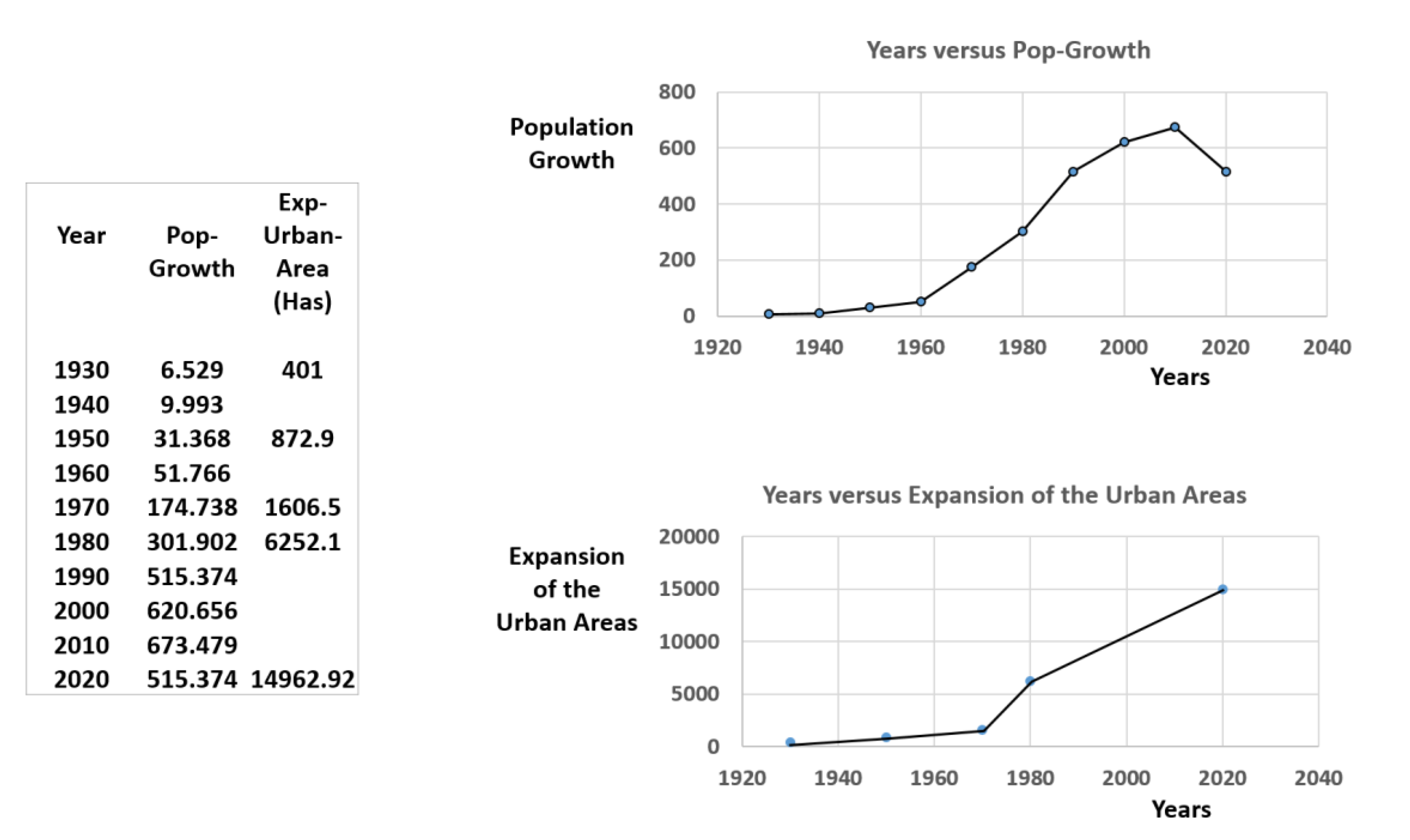
Figure 2.
Expansion of the urban areas from 1930 to 2014 [45].
Figure 2.
Expansion of the urban areas from 1930 to 2014 [45].
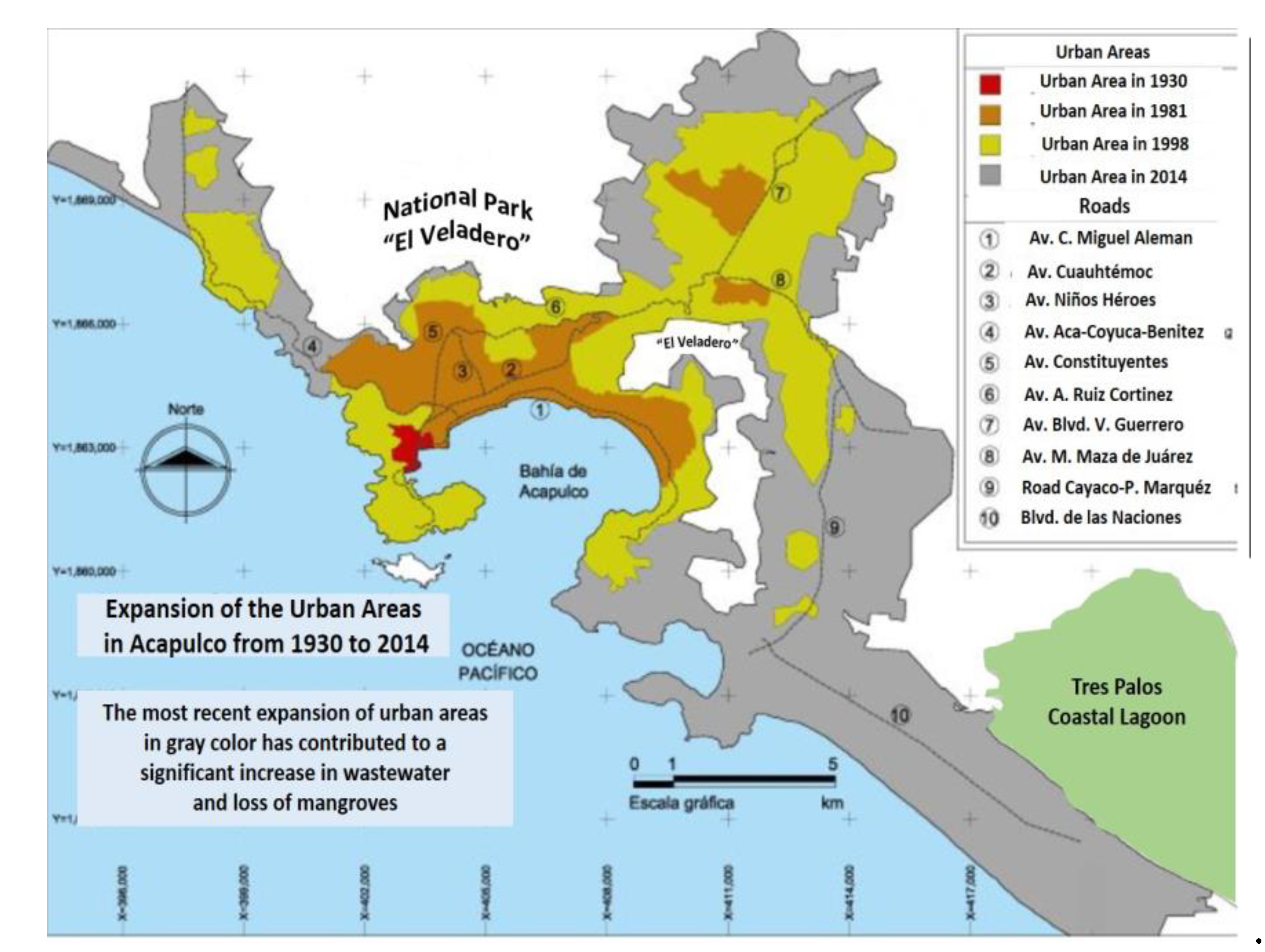
Figure 3.
A network representing interactions between indirect drivers that cause damage to the environment.
Figure 3.
A network representing interactions between indirect drivers that cause damage to the environment.
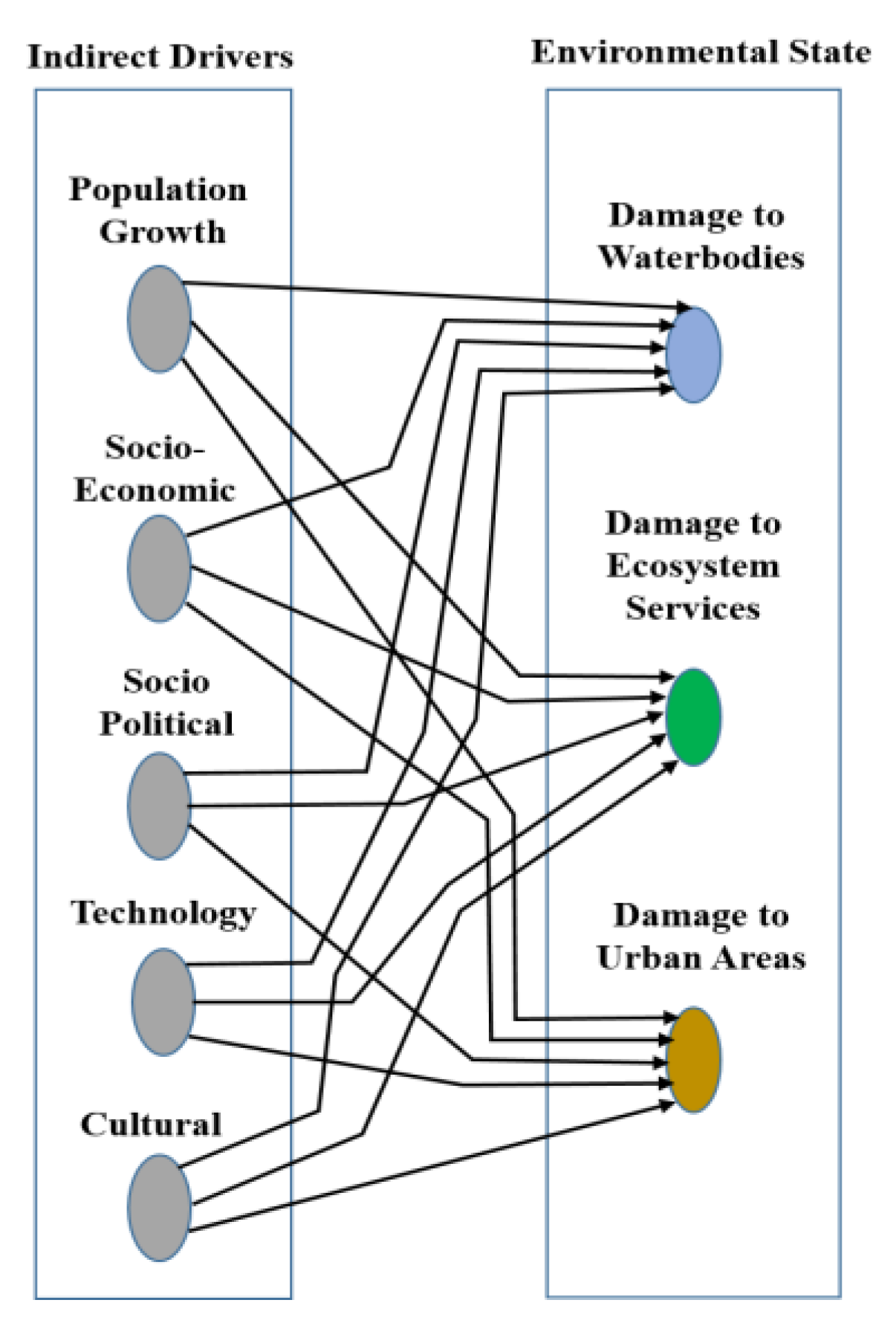
Figure 4.
Three additional levels have been incorporated to introduce more specific concepts, thus enriching the knowledge to infer that indirect drivers generate harmful factors that damage the environment. .
Figure 4.
Three additional levels have been incorporated to introduce more specific concepts, thus enriching the knowledge to infer that indirect drivers generate harmful factors that damage the environment. .
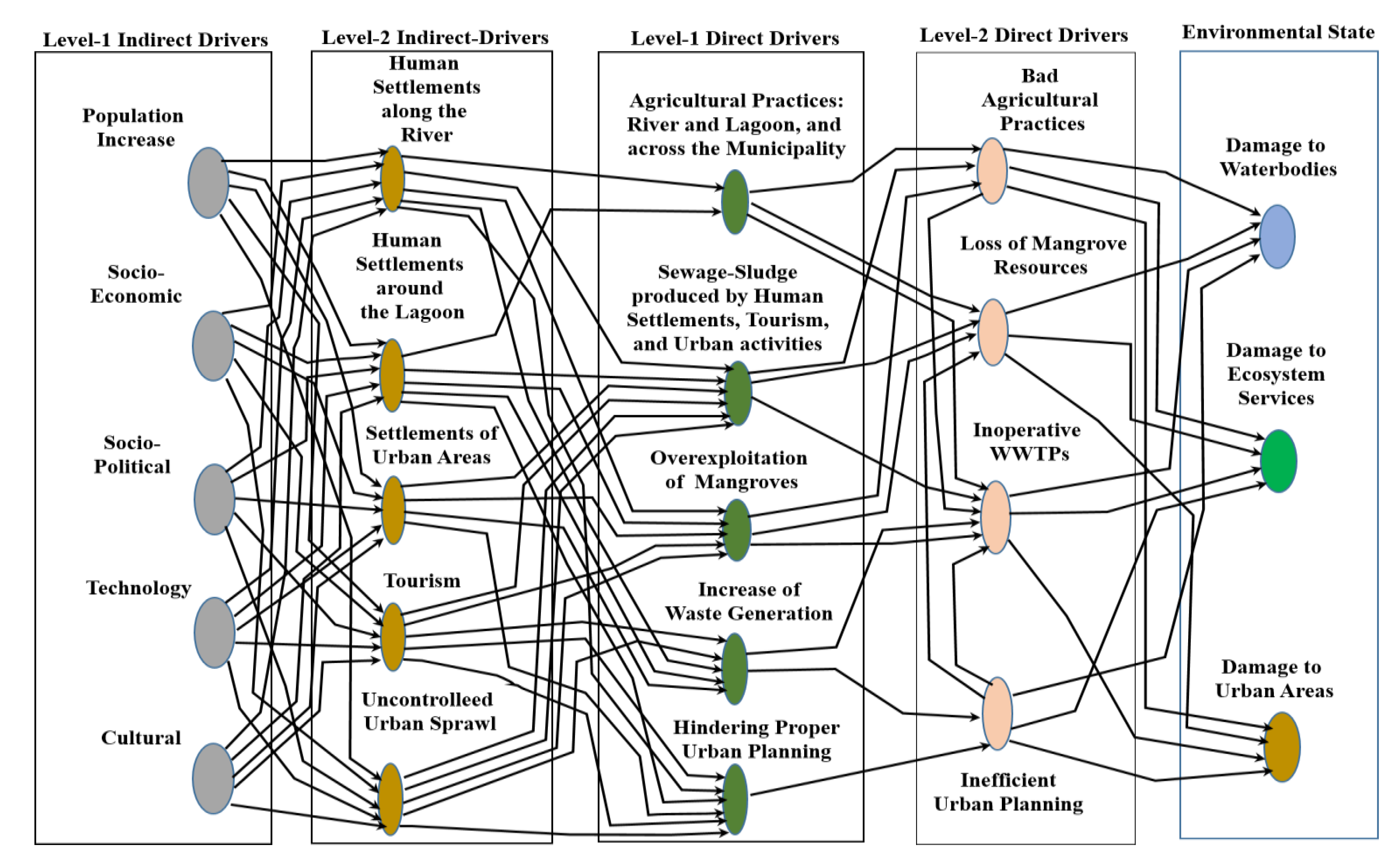
Figure 5.
Level-3 of Indirect Drivers has been added with new specific concepts and their relationships to reinforce the knowledge regarding the process that generates tangible harmful factors from intangible harmful factors.
Figure 5.
Level-3 of Indirect Drivers has been added with new specific concepts and their relationships to reinforce the knowledge regarding the process that generates tangible harmful factors from intangible harmful factors.
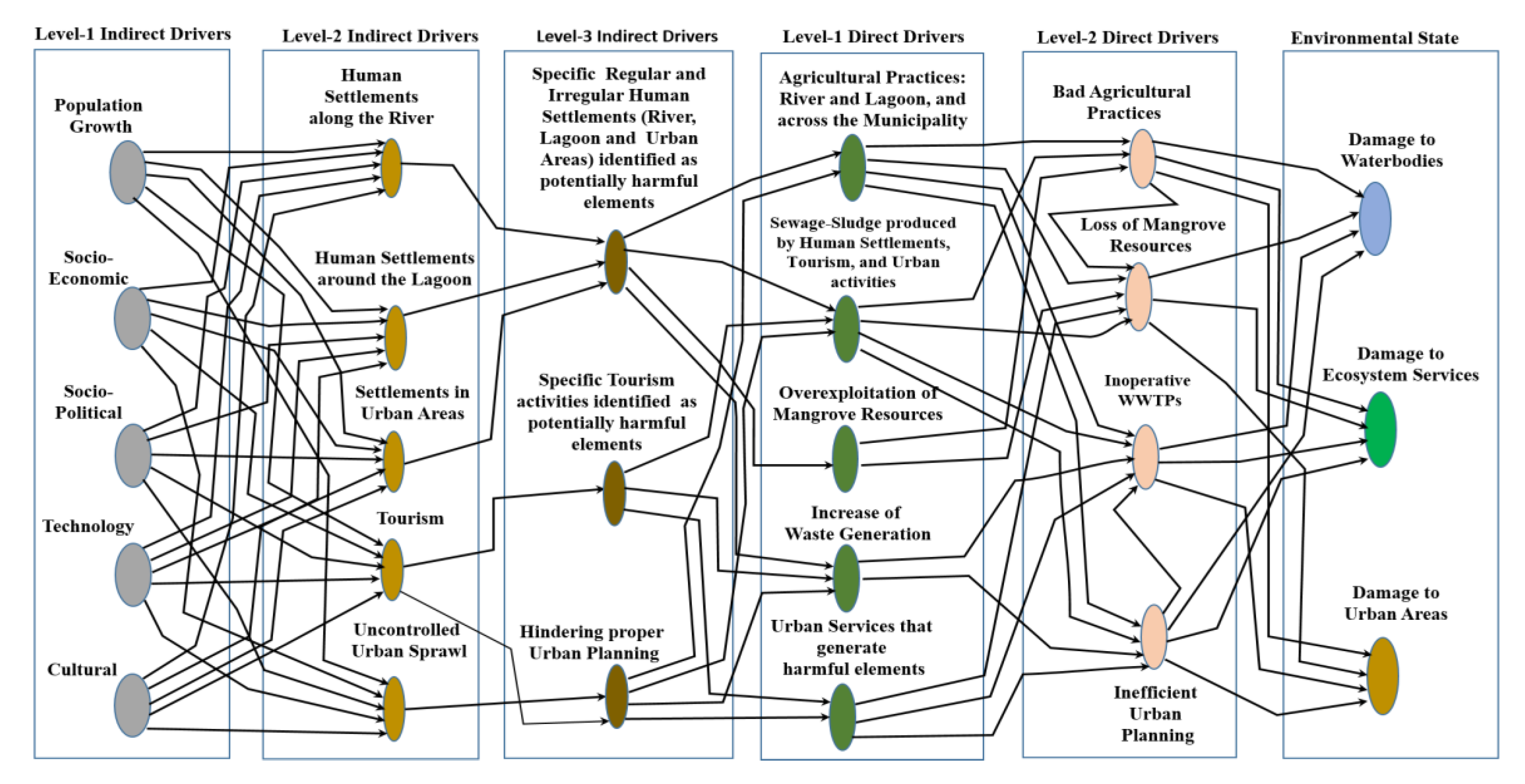
Figure 6.
Semantic Pathway of “Inoperative WWTPs”. Arcs with dotted lines represent less weight in a relationship than arcs with solid lines, which represent more weight.
Figure 6.
Semantic Pathway of “Inoperative WWTPs”. Arcs with dotted lines represent less weight in a relationship than arcs with solid lines, which represent more weight.
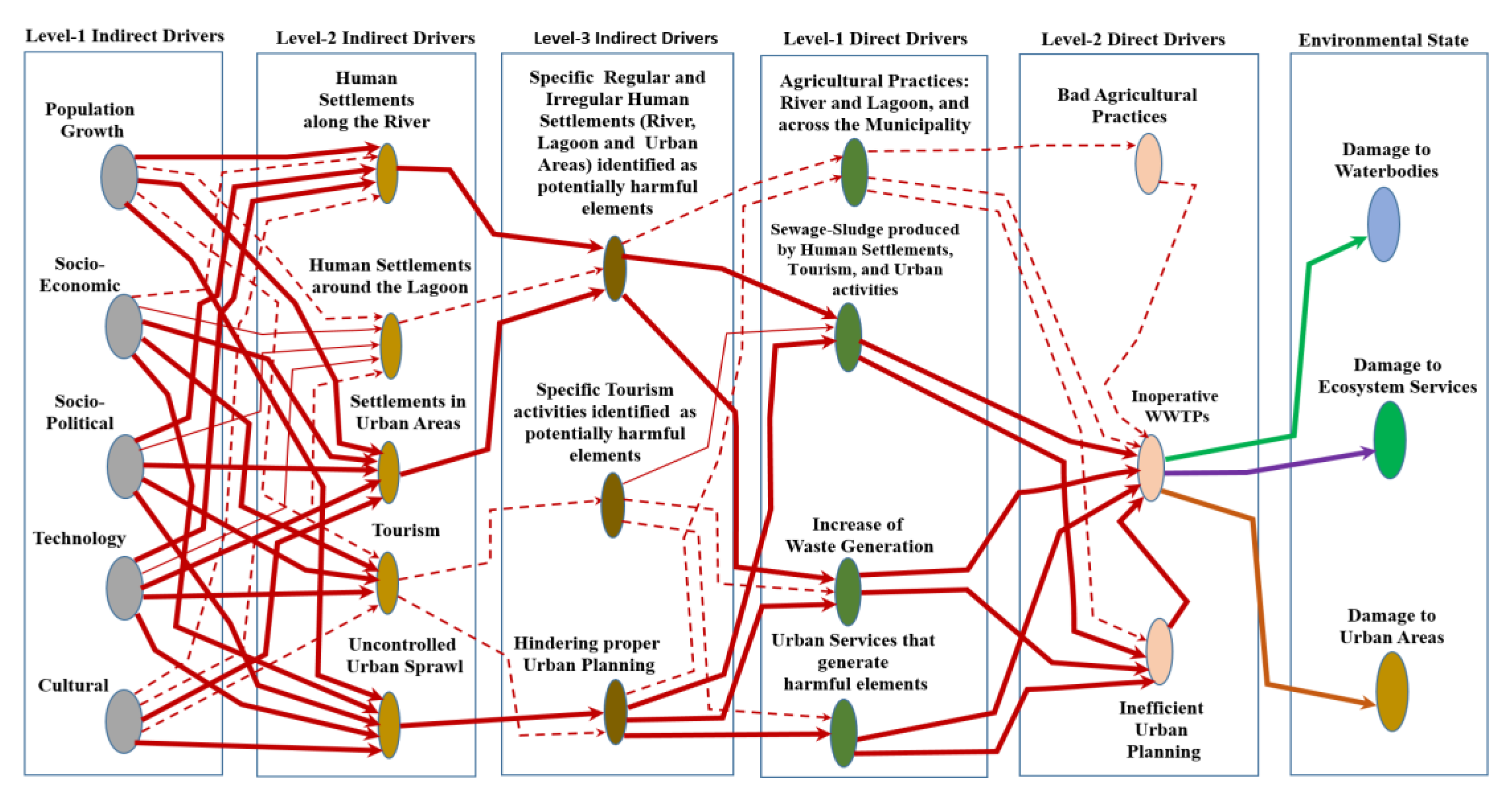
Figure 7.
The pathway of Inefficient Urban Planning.
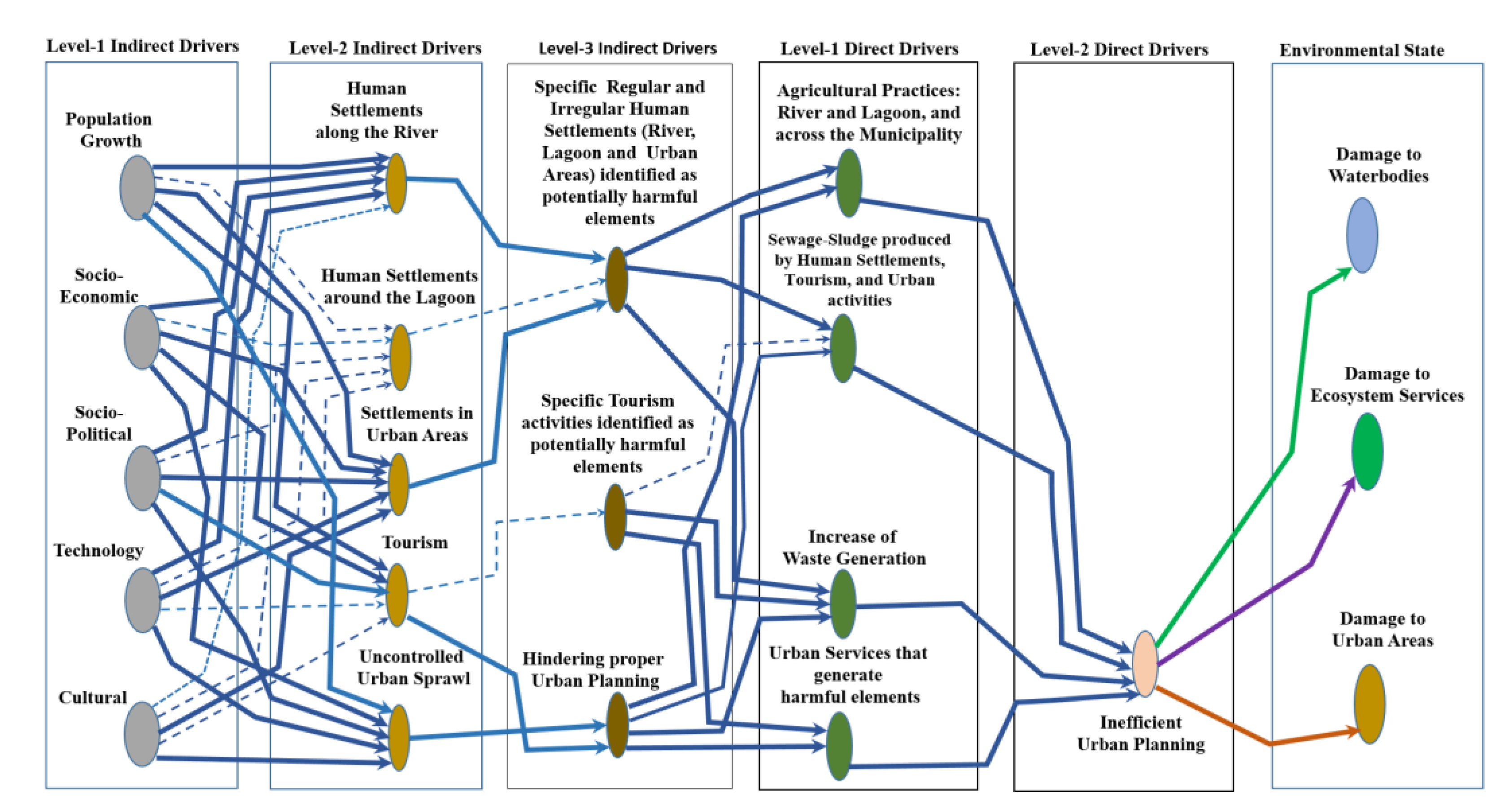
Figure 8.
WWTPs (orange dots) and discharge points (red dots) distributed throughout the Acapulco Municipality [56].
Figure 8.
WWTPs (orange dots) and discharge points (red dots) distributed throughout the Acapulco Municipality [56].
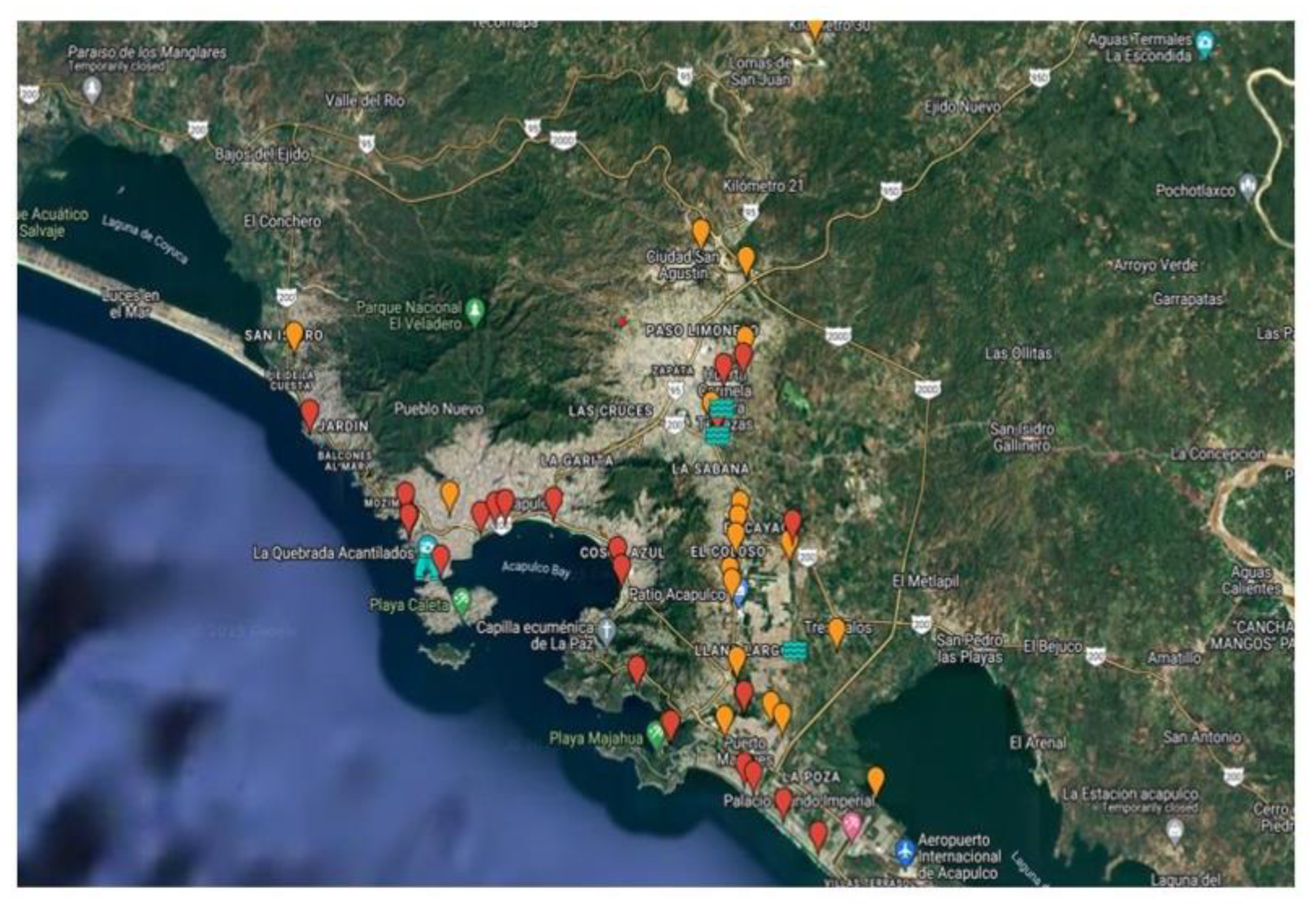
Figure 9.
The course of the Sabana River through important neighboring urban areas, such as Llano Largo and Ciudad Renacimiento [66].
Figure 9.
The course of the Sabana River through important neighboring urban areas, such as Llano Largo and Ciudad Renacimiento [66].
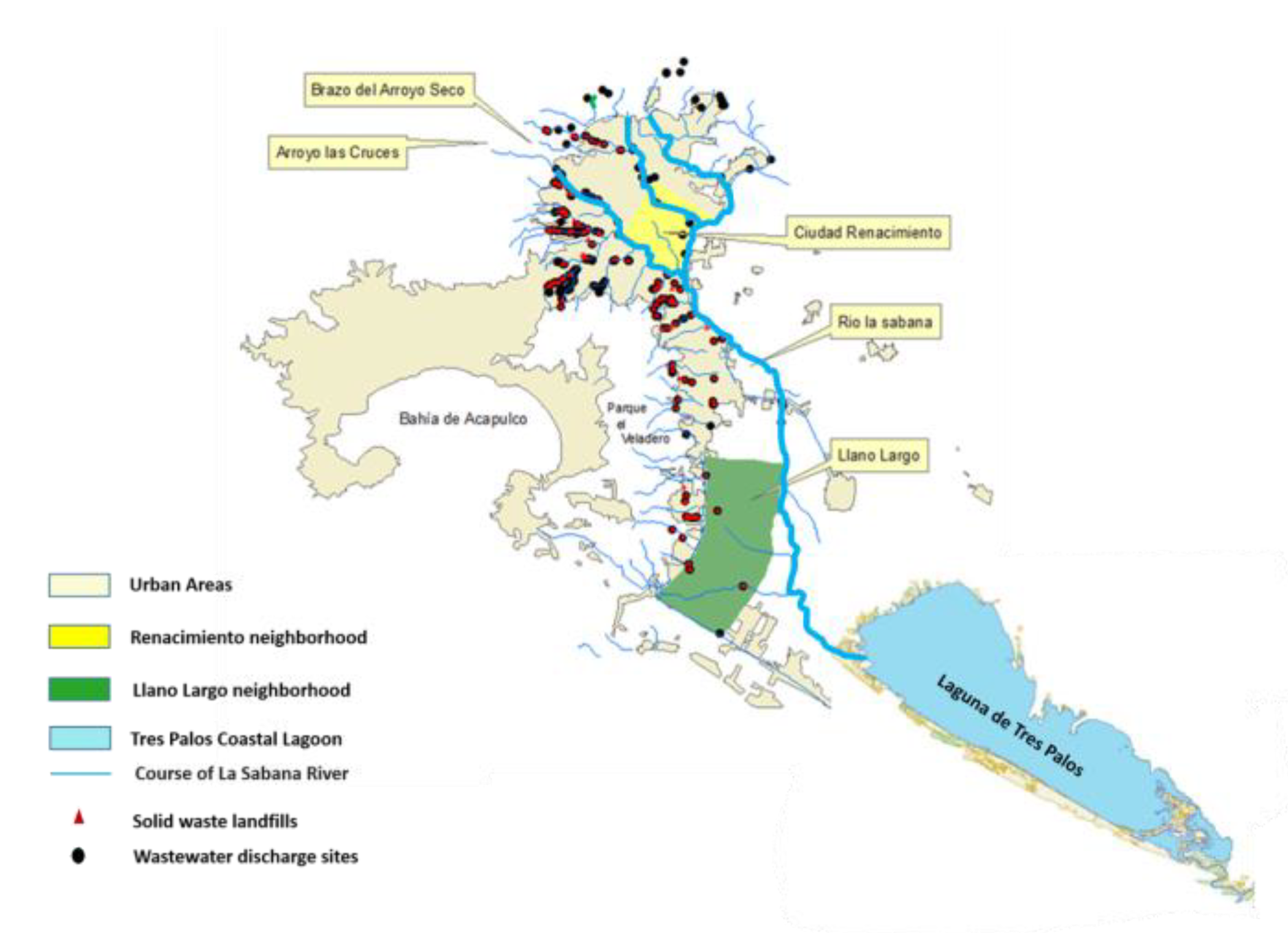

Table 1.
Effects of COVID-19 and Hurricane OTIS on tourism related to the number of tourists, hotel occupancy and the impact on the economy due to these events.
Table 1.
Effects of COVID-19 and Hurricane OTIS on tourism related to the number of tourists, hotel occupancy and the impact on the economy due to these events.
|
Year |
Number of Tourists |
Hotel Occupancy |
Economic Impact (millions of Mexican pesos) Current exchange: 1 usd = 18.23 mp) |
| 2018 | 9,891,776 | 49.3% | 34,275.0 mp |
| 2019 | 10,228,539 | 51.7% | 35,441.9 mp |
| 2020 | 6,192,520 | 31.3% | 21,456.5 mp |
| 2021 | 6,405,048 | 34.4% | 28,822.7 mp |
| 2022 | 8,172,730 | 47.6% | 62,656.2 mp |
| 2023 | 6,198,391 | 53.5% | 47,520.0 mp |
Disclaimer/Publisher’s Note: The statements, opinions and data contained in all publications are solely those of the individual author(s) and contributor(s) and not of MDPI and/or the editor(s). MDPI and/or the editor(s) disclaim responsibility for any injury to people or property resulting from any ideas, methods, instructions or products referred to in the content. |
© 2026 by the authors. Licensee MDPI, Basel, Switzerland. This article is an open access article distributed under the terms and conditions of the Creative Commons Attribution (CC BY) license (http://creativecommons.org/licenses/by/4.0/).
Copyright: This open access article is published under a Creative Commons CC BY 4.0 license, which permit the free download, distribution, and reuse, provided that the author and preprint are cited in any reuse.


