
Submitted:
13 June 2025
Posted:
16 June 2025
You are already at the latest version
Abstract
This article analyses climate change impacts for 32 million inhabitants in the Megalopolis of Central Mexico, threatened by chaotic urbanization, land-use changes, Water Forest logging, organized crime, unsustainable agriculture, and biodiversity loss. An expensive hydraulic water management system produces water scarcity, leading to the overexploitation of aquifers by mixing toxic industrial, domestic, and rainwater sewage, and pumping it out of the endorheic basin. This increases subsidence, damages urban infrastructure, and floods marginal neighborhoods with toxic sewage. A dissipative, self-regulating, open system, combined with a participatory research methodology, explores potential tipping points in water management. Sixteen interrelated alternatives explore water security threatened by climate change risks through integrated water resource management; safe drinking water; separation of rainfall from domestic and industrial sewage and its infiltration into groundwater; recycling toxic wastewater inside industries; treating 64,184m3/s domestic wastewater with aquifer recharge; repairing broken drainage and limiting toxic wastewater floods; greening urban areas; adaptation to climate risk; recognition of unpaid female water activities and Indigenous protection of Water Forest with involvement of three state authorities. A digital platform for water security; urban planning; citizen audit against water authorities’ corruption; and aquifer recharge from protected area of SAMBA are improving the livelihood for 32 million inhabitants with greater equity in marginal neighborhoods.
Keywords:
Megacity of Central Mexico (MCM)
; water security
; Integrated Water Resource Management (IWRM)
; participatory research
; digital platform for citizens from analyzed data
; water reduction
; reuse
; and recycling
; forest recovery by indigenous people
; female water saving techniques
; greening city
; livelihood with wellbeing
1. Introduction
The World Resource Institute [1] indicated that the Megalopolis of Central Mexico (MCM) with more than 32 million inhabitants could be out of clean water in 2028, so the study proposes an open, self-regulating and dissipative systemic model in which an interdisciplinary study group got involved [2]. It integrates a participative research process with citizens and governmental participation including women and indigenous communities to strengthen their organizational capacities [3]. This procedure may allow a collective development of sustainable socio-environmental alternatives for a long-term hydrological supply capturing rainfall from the Water Forest surrounding the volcanos around the MCM. The article criticizes the past hydraulic policies based on water extraction from neighbor states and overexploitation of aquifers, including mixing sewage from industries, domestic use, and rainfall, which is expelled to a deserted region in the Hidalgo State. During the monsoon 2024, this toxic wastewater inundated marginal colonies, such as the 32-day flood to almost half a million inhabitants in Chalco, located in the eastern part of México State [4].
The research project also explores alternative hydrological approaches guaranteeing in the long-term water supply to the MCM with an integrated water resources management (IWRM), the recovery of protected natural areas (PNA), and the rescue of the Water Forest [5], called also SANBA. It includes urban planning, the protection of areas with high rainfall infiltration and a culture of saving, the reuse of gray water, the infiltration of sanitized wastewater in situ to the endorheic basin of the megalopolis, where multiple eco-technologies exist to rescue the overexploited aquifers and reduce the growing subsidence in the city [6]. Climatic risks and increasing droughts oblige authorities and committed citizens to restore lost wetlands and rivers through sustainable management of the water forest [7]. Women are suffering seriously from periodic water shortages and supply interruptions. They have developed a culture of saving, reusing, and recycling water in their homes with rainwater collection and sanitation of domestic wastewater. Indigenous communities have for thousands of years protected the water forest in the mountains surrounding the MCM [8].
The article includes a participative research methodology [9] and the elaboration of a digital platform among water users and indigenous communities with a flow chart indicating potential tipping points [10]. It explores natural-based mechanisms [11] to mitigate water shortages and sewage in the megalopolis. It combines “high-tech with no-tech for achieving climate and sustainability objectives and improving the livability of cities in hot and arid regions” [12]. The digital platform is elaborated with the participating communities and based on surveys and collective working groups, integrating a dynamic self-organizing and open system [13]. This platform is reinforced by free available satellite data and indicates the upcoming risks to climate change [1], where higher temperatures affects the development of forests [14]. Threats are also related to the clandestine logging of trees and other illegal activities by the organized crime [15].
The objective of the research is to collaborate with communities caring about the Water Forest using participative methodologies. The research group develops a digital platform, where Indigenous communities and organized women are involved and managing their own data. The collective research consolidates the MCM water security with sustainable management and a culture that provides a clean water supply and integrated sewage in the long term for the entire population in the megalopolis [2]. The policies developed are discussed with authorities from the three states, business communities, organized citizens, the legislative, where independent citizens’ auditing group analyses the access in equal conditions to safe water and improved sewage. The project focus on the endorheic basin of the megalopolis in the center of Mexico (MCM), where increasing droughts [16] and floods must be mitigated as a result of climate change impacts [17].
2. Materials and Methods
2.1. Evolution of the MCM
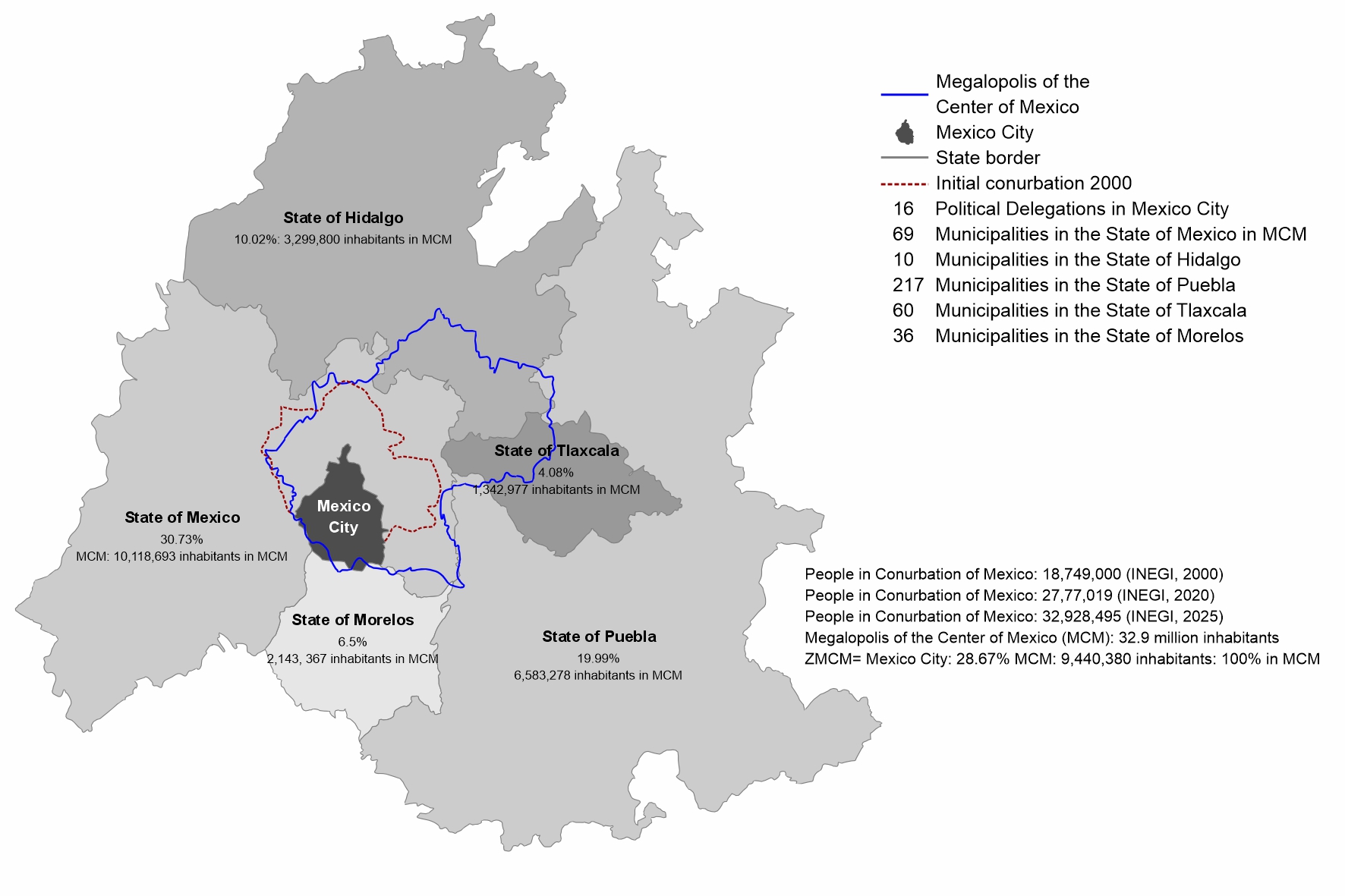
The megalopolis is the most populated region in Mexico with 32,928,495 inhabitants in 2025 [18]. This extensive urban sprawl of the MCM encompasses (Figure 1) the 16 municipalities of Mexico City, representing 28.67% or 9,440,380 inhabitants [19]. It includes also 56 of the fastest-growing municipalities of the State of Mexico, corresponding to 30.73% of the population in the whole state with 3,299,800 people [20]. The marginal colonies of the MCM are highly affected by periodic sewage floods, expelled to the ten municipalities in Hidalgo [21]. Morelos State and Mexico City get their rainfall from the volcanic chain called Ajusco-Chichinautzin, the largest natural protected area in the Water Forest [5]. Morelos 2,143, 495 inhabitants (6.5%) and gets also in the eastern part some rainfall from the Sierra Nevada. During the last decade, MCM has grown outside Mexico City, due to the availability of land and lower land prices [21]. Tlaxcala is the smallest State and represents 4.08% or 1,342,977 of the population in the MCM with 60 very small municipalities [19]. It gets its water, together with the fast growing industrialized part of Pueblo State [18,19,20], from the Sierra Nevada of Popocatepetl and Iztaccíhuatl, a crucial natural protected area. There exists also a smaller volcano for water supply, called Malinche [25]. Part of the 217 municipalities of Puebla (19.99%) with 6,583,278 inhabitants have established in its western part an important industrial development, competing with Mexico City and the eastern part of Mexico State. All this three industrialized regions have an intensive population growth [18,19,20,23,24,27,28].
The National Institute of Statistics and Geographic Information [18] estimates a population of 32.9 million inhabitants in 2025. The urban growth of the MCM during the last 20 years is calculated by 79%, especially in the eastern part of the state of Mexico [18,19,20,23,24,27]. The areas of high population growth are related to the costs and the availability of lands, although they have established marginal colonies, frequently without basic urban infrastructure and services. This population dynamic in the Mexico State has produced certain stagnation in the former population growth of the capital and some gentrification in its center [28]. Although, Mexico City houses multinational enterprises, federal authorities, and national ministries. During the past six years of the former government, the intent of decentralization of federal authorities was not very successful [29].
Spanish conquest started with drying out lakes in Mexico City, for obtaining land for real estate. The conquerors opened in 1607 the Tajo de Nochitstongo and pressured by cholera epidemics constructed in the east the open sewage drainage, drying out also wetlands and lakes [30]. They eliminated partial floods in the former indigenous Tenochtitlan, called now Mexico City [31]. These practices stimulated urban development in the city, whenever massive immigration from rural areas related to better services and employment started from 1950 on [27]. The expansion of the chaotic urban sprawl, missing urban planning, and lack of governmental support for agricultural development accelerated immigration from the rural areas and expanded the MCM into the neighboring states [26].
The transformation of rivers into avenues with millions of cars driving in the XXI century has changed the MCM ecosystem and polluted seriously the air [32]. Urban heatwaves transformed the climate into more arid [33], and the elimination of lakes in the plain, densely populated by marginal neighborhoods are frequently flooding millions of people during weeks. Extreme rainfall mixed up with domestic and toxic industrial wastewater is expelled through the broken eastern sewers of Mexico City. The mixture of industrial, and domestic wastewater, rainfall, and solid waste thrown into the drainage, increased the damages of floods and complicated its remediation [34].
The present study area in the central part of MCM covers an area of 7,180 km2, of which 2,884 km2 are urbanized and another 4,296 km2 is used for agriculture, grassland, forests. There exist multiple protected natural areas with 807,060 hectares of Water Forest (WF), studied directly in the present research by an interdisciplinary group and supported by a digital platform [2,35]. It is surrounded by recently formed volcanoes, facilitating the infiltration of rainfall to the aquifers in the plains on both sides of the mountainous chains. The volcanoes are covered by exceptionally biodiverse forests in the states of México, Morelos, Tlaxcala, Puebla, Hidalgo, and Mexico City giving birth to six rivers and 32 smaller basins. Moctezuma rivers represent 43% of the WF area, Amacuzac 34.25% (Balsas Basin), and the Lerma-Santiago Basin with 22.44%. River Atoyac 0.28% originates in Tlaxcala y Puebla and disembarks in the Balsas Basin to the Pacific Ocean. River Cutzamala covers 0.12% and is completely originated in the WF, covering the north of the state of Mexico, Hidalgo, Querétaro, San Luis Potosí, Veracruz, and integrates in the Panuco Basin, discharging its water into the Atlantic Ocean [5]. In the past different areas were protected to maintain the infiltration of the rainfall into the aquifers (Figure 2).
The mountains surrounding the region are the result of recent volcanic eruptions, which are integrated into the Sierra Madre del Sur Chain. In the past, they were covered by high-altitude forests, mainly pines and oaks [36]. These ecosystems surround the MCM and constitute the so-called Water Forest (WF), which traditionally supplied the vital liquid to the inhabited areas in the plain of Mexico City. In the past, multiple lakes, bodies of water, and wetlands were formed, fed by rivers and smaller tributaries [37]. They represent a high biodiversity with an estimated 47 types of vegetation, whenever the land use change is important. Jaramillo [5] calculated a reduction between 1992 and 2018 in primary vegetation from 47.31% to 32.58%, an increase in secondary vegetation from 8.87% to 19.66%, water bodies from 1.24% to 1.07%, human settlements from 0.03% to 2.66% and an increase of rainfed agriculture from 41.54% to 44.03%. The empirically studied region represent 807,060.713 hectares and includes the industrial zones of Mexico City, Toluca in the State of Mexico, and CIVAC in Morelos. This land use transformation indicates the threats to the WF in the study region, where agriculture, induced pasture, and human settlements occupy the largest proportion of the study area. The territory of the WF is further fragmented into 1,378 plots of vegetation with different land use, especially induced pasture.
From 1992 to 2018, 14.73% of original forest, jungles, scrublands, and grasslands got lost, with an increase of 10% of secondary vegetation, 3% of agriculture, and the urban areas located within the Water Forest polygon cover an area of 95,022 hectares, equivalent to 11.77% [38]. Therefore, the conservation of the Natural Protected Areas (Figure 2) represents 402,565.7 hectares, where 39.69% are located inside the study area. The Sierra Nevada of both volcanoes Popocatepetl and Iztaccihuatl in the eastern part of Figure 2, includes 12,070 ha or 9.79% of the WF belonging to the study areas. The protected area embodies 123,331.3 ha and the NPA Ajusco-Chichinautzin has 126,396.2 ha, where 99.72% belong to the WF and recharge the aquifers in Mexico City and Morelos. It is also the origin of the Balsas River, which discharges into the Pacific. The Nevado of Toluca in Mexico State represents 13.96% or 21,252.5 ha of the total of the 152,478.9 ha of WF. The rainfall and the melting of the snow are crucial for the urban and productive development in the Toluca Valley. It is also the origin of the basin of the Lerma-Santiago, which is discharging into the Pánuco Basin and the Atlantic [39].
2.2. Research Methods
This research is based on two crucial methodologies. It has developed a dynamic self-regulating, open, and dissipative system [61] with four subsystems: environment, including hydrology, National Protected Areas, territory, and quality of soils. The urban-productive subsystem analyses the dynamic of the whole MCM, population growth, institutions, and political organization, while the socioeconomic-cultural subsystem reviews the economic activities, investments in the hydraulic infrastructure, especially the L-C, and the expulsion of sewage from the MCM. The cultural part searches about the impact of water scarcity, compensated by daily unpaid caring work of women and the long-term protection of indigenous communities of the Water Forest. Climate change impacts are assessed with the model of IPCC (2024) for short (2030), middle (2050), and long-term (2099) threats in the MCM, focusing on precipitation, temperature, evaporation, and greenhouse gases [33].
The second approach relates to a participative research methodology. Gautier [3] inspired a participatory 3D modelling conservation practices and enabling epistemic justice to the involved participants. This reseach is based on surveys developed and responded by organized women and Indigenous communities, including periodically Zoom meetings. Changes in the forest areas (bushfire, plagues, logging) are discussed by involved people with a priority given to the protection against organized crime of exposed participants. The research team and CENTROGEO [35] have developed an initial digital platform with systematized global and empirical data. Different historical phases explain graphically the transformation of the megalopolis, the expansion of the urban sprawl on protected areas and the WF. The crucial areas of rain infiltration into the aquifers are defined, and Indigenous people are providing environmental services in the forests. The conservation of soils also protects people against floods in the MCM plain.
This platform documents the loss of water bodies, rivers, forests, biodiversity, and natural resources humans, and climate impacts, which are crucial for the economy and the survival of the Indigenous communities in the mountains and the conservation of their cosmogony and care [8]. Gautier [3] recognized that her Participatory 3-dimensional Modeling promoted a knowledge system for marginalized people. It establishes a bridge between women and Indigenous to overcome the existing inequality in traditional environmental knowledge by understanding the negative impacts on their life quality [62].
The platform is dynamic and includes the results of the analysis of the interdisciplinary discussed data from the physical environment, including sets on water availability, conditions of soils, biodiversity, and climate projections with data provided by 32 open-access satellites. The productive subsystem interrelates with the evolution of the territory, the land use change, the quality of the forest, the potential of bushfires and the upcoming plagues related to climate change. Agricultural production and the ecosystem services grant the survival of the people living in the mountains, which are offered generally for free to the people in the basin of the MCM. The socio-cultural subsystem includes population data, policy developed by federal, state, and municipal authorities, cultural elements for social cohesion, governance, and existing or emerging social conflicts in the communities or subregions.
The fourth subsystem interrelates the urbanization process with the existing infrastructure. It analyzes also the quality of public services and the missing ones. Ecosystem services are quantified and industrial activities assessed [9]. In the mountain areas drinking water supply is missing due to the high costs of pumping water from the basin to the highlands. These mountainous regions over 3,000 m get a greater rainfall and this rainwater can be stored and purified with special filters for human consumption. Bio-digesters or other cheap eco-techniques can supply the lack of sewage facilities, allowing the reuse in productive activities.
These four subsystems interrelate permanently and are transformed by changing global surrounding conditions coming from the international, national, state, and municipal levels, including also criminal activities, which include illegal logging of trees, kidnapping of local leaders, extortion, and the forced recruitment of young people for their criminal activities [15]. The IPCC Atmosphere-Ocean General Circulation Models is developed in relation to the hydrological balance [47]. Water availability was projected for short (2030), medium (2050), and long-term (2099) socioeconomic scenarios for the Ajusco-Chichinautzin area providing water directly to the area of Mexico City and the state of Morelos. The initial data indicate in the most populated regions greater drought due to higher temperatures, increasing water demand, alteration of the monsoon season, more extreme weather events with floods, and more frequent and extensive bushfires, destroying crucial natural areas [33].
2.3. Concepts: Water Security
Population growth increased the demand for clean water supply and the cholera epidemics or gastrointestinal diseases obliged first the colonial, and later the Mexican authorities to promote sewage facilities in the metropolis. The industrialization process in the capital, the Valley of Toluca, Morelos, and Puebla created employment for the growing population but introduced highly toxic products, often not allowed in developed countries. These toxics are mixed up with domestic wastewater and during the monsoon with rainfall. These wastewaters have flooded periodically the marginal eastern colonies built on former dried-out lake. They have limited a human-centered water security for everybody.
Water security is based on an expanded vision of the traditional security understanding [40] and goes beyond the military realist conceptualization [41]. This understanding of water management starts from a broadening and deepening conceptualization of human, gender, and environmental security: a HUGE Security [9]. It includes life quality and happiness for everybody in the MCM, beyond the survival of a determined amount of water/capita, defined by former neoliberal authorities. This amount was never respected in the marginal colonies.
Water security orients the supply to permanent, sufficient, and clean water, capable of overcoming the present unjust temporary limits of water availability (called tandeos), imposed on almost all colonies in the MCM and also to multiple municipalities of the country. This limited supply of water is further distributed in old systems with millions of micro-perforations and damages by the multiple earthquakes. When the hydraulic pressure inside the pipe is changed with the pressure of water, it facilitates the entry of harmful microorganisms, often even sewage, producing murky water quality. Therefore, water security should include a deepening understanding from the individual, mostly women with unpaid domestic work, up to families, colonies, and the megacity, providing permanent and safe drinking water. It includes a widening process [42], where economic, environmental, societal, and technological interests are involved in the water supply, including an improved treatment of served wastewater (ODS 6) and a safe disposal of solid waste. The toxic industrial sewage can´t be mixed up with domestic wastewater and must be recycled inside the factory or treated with physical-chemical processes.
This deepening and widening conceptualization of water security [9], is oriented to human consumption, productive processes, and environmental conservation that should guarantee everybody a dignified life quality, independent of their socioeconomic level. It should preserve human and natural health, within a biodiverse environment and provide wellbeing and health [40]. It allows an adequate food [43], and public and private investments value the water in economic terms, allowing the necessary investment in reparation and new system of water distribution and sewage facilities [44]. Thus, tariffs on water consumption are facilitating investments in water infrastructure, enabling the daily tasks of cleaning and caring, generally in the hands of women [45]. It reduces the risks of diseases related to contaminated water [46] and limits extreme weather events produced by climate change impacts [47].
The World Resource Institute [1] reported that the MCM is one of the ten megacities in the world that could run out of water during this decade. This alert requires collective work for alternative investments and governance in the water management between the public administration and the citizens [48]. Today, the available resources are fairly shared among poor neighborhoods, and policies must be developed to provide equitable use of water for natural, human, food, and productive activities. Water security should grant the access to sufficient and safe water for everybody, respecting their human rights and promoting policies of reduction, recycling, reuse and saving of this vital liquid [49].
Water security questions the present solutions of supply and drainage in the MCM, based on expensive engineering water supply, developed in the past five decades with the Lerma-Cutzamala (C-L) system [50], the overexploitation of aquifers with 907 deep wells [51], and the fracking and subsidence of up to 40 cm per year in a lacustrine subsoil that is deteriorating the urban infrastructure in the MCM [52]. These expensive and destructive processes have not complied with the Sustainable Development Goals developed by the United Nations General Assembly in 2015, which interlink SDG 6 (clean water and sanitation) with SDG 5 (gender equality) and SDG 13 (climate action), leaving no one behind [53].
The Global Risk Report [54] also indicates in 2024 that Mexico is considered the 4th most exposed country to climate change and the second in terms of socio-environmental vulnerability [55], due to the complexity of its territory, the geo-hydrological differences in the country, the existing socio-environmental conditions among mountains, deserts, agricultural, and coastal ecosystems. Climate change has further exacerbated more prolonged droughts and the population density in megacities has increased urban heatwaves producing growing water scarcity [56] and limited the sustainable development goals [57].
The differences of acute poverty in rural and indigenous areas with higher temperatures have also created additional insecurities for people who are losing their rainfed plots for corn and bean production [58,59]. The conjunction of these processes describes the conditions, where multiple conflicts, gender discrimination, extreme climate events with forced migration, public insecurity by organized crime [9], and diverse socio-environmental vulnerabilities [55] are increasing the threats not only to water security but inclusive to the survival of needed people. In this interacting and complex context, only novel and nonviolent mechanisms of conflict conciliation [60] and sustainability [7] with gender perspective may allow a desirable and sustainable future for the MCM and the entire country. Before analyzing the irrational water supply and sewage developed in the MCM, the chapter reviews first the research methods and later analyses the chaotic management of water security [40].
2.4. Irrational History of Unsustainable Water Supply and Sewage in the MCM
New immigration with land invasions in popular colonies were often promoted for political reasons. They have created a chaotic urban sprawl over crucial natural areas increasing the scarcity of water supply. The existing engineering alternatives were unable to grant safe water to a growing megacity, increasingly more affected by climate change [43]. MCM inherited a second problem from the Spaniards, who started to expelled the sewage from an endorheic basin to the Hidalgo State. Before exploring natural and citizen participation alternatives, this subchapter analyzes the existing water supply created by engineers and its interrelation with a failed sewage management in the MCM, affecting especially poor colonies in the suburban part of dried lakes.
Population growth, new hygienic habits, and industrialization in the MCM have increased the demand for clean water and more efficient sewage. Since the 1950s, farmers in the Lerma Valley in Mexico State have been deprived of water for agricultural activities [63]. Up to 13,700L/s of the vital liquid was delivered to the metropolitan area in the 1960s. Farmers protested and new demands for clean water forced the National Water Authority (Conagua 2005) to develop an expensive, unsustainable, and corrupt water supply system to the MCM, called Lerma-Cutzamala (L-C). Through 72.5 km of canals, 44 km of tunnels, and six siphons, water was extracted from the neighboring states of Michoacán and Mexico and pumped up 1,100m to the elevation of Mexico City (2350m) and Toluca (2660m), where also two mountains were perforated (the San José Tunnel and the Atarasquillo Dos Ríos) ([50], p.16).
The L-C system provided 20% of the water to the MCM, reduced during the last decade due to climate drought and the lack of water in dams and lakes in the neighboring states. The remaining 80% was pumped from 970 wells of over 400m. This overexploitation of aquifers in a former lacustrine subsoil is producing up to 40 cm per year of subsidence and microseism [65], which are deteriorating the urban infrastructure, the metro, the drainage, and the water pipe system [52]. Toluca extracted the missing water from deep wells of the Lerma aquifer. However, increasing droughts in the central part of the country, expensive pumping costs from aquifers and the reduction of supply from the L-C system are pressuring the newly elected authorities in 2025 to create an alternative water management. Additionally, there exist also a deterioration of air quality, due to growing emissions of greenhouse gases in two densely populated regions with complex atmospheric conditions [32].
The second problem related to the destructive water management in the MCM is the discharge of sewage (SDG 6.2) through the open-air Great Drainage Canal of the Valley of Mexico in the Orient, built initially by the Spaniards and modernized later by Mexican authorities. To avoid unpleasant odors in Mexico City, two additional subway collectors were constructed: the Occidental Interceptor and the Central Emitter, which take advantage of the El Salto River, the Requeña dam, the Endhó dam, where both join the River Tula and the Salado River (Figure 3) [21]. The three emitters expel the sewage from the endorheic basin. They discharge between 35 to 50m3/s of wastewater out of the MCM basin and mixed up toxic industrial and domestic wastewater with rainfall. This sewage is cleaned up in the largest treatment plant in Latin America in Atotonilco, Hidalgo, and the sanitized water is irrigating an arid region in Ixmiquilpan, Mezquital in the Hidalgo State.
Water supply and sewage indicate an unsustainable management of hydraulic engineering, which is further polluting the Tula River, flooding marginal colonies in the former dried likes during the monsoon, collapsing the subsoil, and overexploiting the aquifers in the MCM. Pumping water from the subsoil and neighboring states and discharging the sewage is enormously costly [65], polluting the air with greenhouse gases and deteriorating drinking water quality to citizens, when extracted from deep aquifers with dissolved minerals [66]. Santos et al. ([67], p. 12) established a hydraulic balance of water in the MCM. Urban demand is 67,746 m3/s with a reuse of 4,184 m3/s; industries use 4.060 m3/s and recycle only 1,000 m3/s, while agriculture employs 23.804 m3/s with a recharge of 0.528 m3/s, resulting in a consumptive use of 89.906 m3/s. The requirement is not always covered by the 58,322 m3/s extracted from groundwater and the 19,884 m3/s by the Lerma-Cutzamala system. Additional water is entering the system from precipitation of 53,322 m3/s. By improving the quality of the WF, rainfall could recharge the abated groundwater level, when directly infiltrated inside the endorheic basin. The evaporation is estimated in the MCM by 166,69 m3/s.
The key question is: how long will it take to change the expelling of 32,107 m3/s of mixed industrial, domestic sewage, and rainwater from the endorheic basin, which is increased by suburbs to 50,376 m3/s, measured in the River Tula (Figure 3)? Waste-water tracking is crucial to avoid pandemics and chronic diseases. The use of toxic inputs in industries in Mexico City, Toluca, and Morelos, often banned in countries of the Global North, are highly toxic and affects the health of people and nature. The industries should recycle their toxic waters or treat it inside the industries. The mixture of toxic industrial sewages with domestic wastewater and rainfall make the biological treatment impossible. Only a separation of rain and it direct infiltration into the aquifer could reduce the existing subsidence. Domestic sewage could be treated by cheap bio-digesters with aquatic plants in residential complexes, which allows the reuse in gardens or the slow infiltration into the aquifers. The first step is avoiding that rainwater gets converted into hazardous, the second to clean domestic sewage independent from the industrial one inside the same MCM basin. The third is obliging industries to treat their toxic waters. An additional problem is the lack of water management in recently established suburbs, where local authorities are unable to grant their legal obligation due to a lack of investment and low tariffs charged for drinking water and sewage, enabling to offer safe water and sewage (SDG 6) for everybody.
3. Results and Alternative Proposals
Wang et al. [68] documented that the crucial resource for people's lives, plants, animals, and humidity in the air is water. They insisted on an increasing loss of safe water in 2050, both in quantity and quality of water, charged with multiple pollution, especially nitrogen from agricultural activities. As explained in the methodological subchapter, the complex, open, dissipative, and self-regulating system implies sustainable water management, where the present engineering technologies of water supply and sewage in the MCM are unsustainable and costly for nature and people. This policy was taken for granted for decades among citizens and the three levels of government. It included corruption among water authorities, disadvantageous privatization processes [69] in illegal concessions, and missing transparency for alternative sustainable water management. Continuing with this historical water supply and sewage may create threats for the 32 million inhabitants in the MCM by a growing lack of drinking water, sewage pollution, excessive cost, and air contamination by pumping water from depths aquifers and neighboring states. The end-result is lack of safe water and sustainable sewage.
A dissipative, self-regulating, and open system approach revises the negative and unsustainable hydraulic system processes by exploring feasible, nature-based alternatives by reducing progressively the costs. In a sustainable water security, the whole society of the MCM with the government must be involved. It includes at least 16 interrelated processes, which should be developed simultaneously.
3.1. Integrated Water Resource Management (IWRM)
Provides a safe water supply with a sustainable reuse of treating wastewater. The rapid urbanization produced the transformation of rivers and canals into avenues such as Río Churubusco or Canal de Miramontes, impossible to be restored. However, the remaining rivers, ravines, multiple small lakes, dams, and wetlands can be recuperated, urban areas reforested and Water Forests restored. The government alone can´t control the complexity of the urban expansion and only with citizen participation, especially women and Indigenous, and a strict application of existing laws the remaining natural resources can be conserved.
3.2. Rainfal Infiltration
Inside the MCM basin is crucial to grant clean water to all citizens, avoiding its expulsion to the Hidalgo State. The first step is to eliminate the mixture of domestic and industrial toxic sewage with rainwater. The Water Forest provides most of the rain in the MCM basin. Using this rainwater directly in the infiltration to the groundwater with drainage systems such as ditches, infiltration wells, and infiltration areas, as well as the implementation of urban management measures such as green roofs and bio-filters. To limit extreme floods, the forest and the soils covering the volcanoes must be restored and protected (see numbers 11 & 12). Healthy forestry and soils facilitate a slower infiltration from the mountains surrounding the MCM, where the highest rainfall occurs. Both also limit catastrophic flooding in the plains, mostly former dried-out lakes and today densely populated. Rainwater recharge into the aquifers, instead of expulsing this resource outside the endorheic basin, is an urgent priority, defined by the newly elected government in December 2024. This sustainable policy still faces opposition from beneficiaries of the unsustainable engineering system, including inside the National Water Commission. Especially private illegal concessions granted in the past on overexploited aquifers [48] and the presence of organized crime logging the most crucial trees for infiltration, not only limits recharge but also threatens the Indigenous communities and organized women's groups who have opposed this depredation at the local level. Improving rainwater capture in the entire MCM during the wet season is crucial to restoring the overexploited aquifers and reducing the growing subsidence.
3.3. Granting Clean Water to Ewverybody
Prigogine [13] proposed an integrated system approach, where the solutions are far away from the existing equilibrium of the present engineering solutions. They include the dissipative complexity of urban factors, socioeconomic variables, productive activities, and sustainable water culture, obliging to overcome the destructions produced by the longtime and recent neoliberal Patriacene [70] instead of the undefined Anthropos in the conceptualization of the Anthropocene [71]. Reducing the expulsion of sewage from an endorheic basin improves the management of increasing extreme climate change events. The greater infiltration of rainfall reduces also the growing subsidence. The L-C system originally managed a supply of 25.5%, which represents for the long-term an unstable alternative and greater water supply insecurity to the MCM. The government was obliged during the last decade to reduce for months this additional supply from the L-C, because the storage capacity of dams and lakes was only 37.9% in February 2024 [51], before the hotter months started. The eradication of excessive pumping of 66.3% of water from 53% of overexploited aquifers produces subsidence and microseisms. Besides high electricity costs due to the elevation of 1,100m over the mountains [50: 16] by the L-C system and from the 970 deep wells, the pumping pollutes the air, while water extraction from neighboring states is also destroying their ecosystems.
3.4. Domestic Sewage
Should never be mixed with industrial toxic wastewater. Both sewages must be progressively treated. The industrial wastewater should be recycled inside the enterprise or cleaned up by the business. Expulsing a mixed toxic drainage from an endorheic basin to a desert region in the Mezquital, Hidalgo, deprives the megalopolis of a crucial resource for recharging its aquifers. The NOM-001-SEMARNAT-2021 establishes the maximum permissible limits for pollutants. By separating, recycling, and sanitizing industrial water inside the enterprises and treating domestic wastewater independently, precipitation can be infiltrated directly into the aquifers, and special tools for infiltration may limit periodic dangerous floods. Domestic sewage could be treated directly in housing complexes and colonies with aquatic plants in bio-digesters, enhancing the urban image, improving air humidity, and reused in gardens or parks, and recharged slowly into the aquifers. Official data indicate that only 4,164m3/s of domestic wastewater are recycled inside the basin [50: 32]. This domestic infiltration could gradually increase up to 64,184 m3/s, today pumped outside from the endorheic basin. When safely sewage, it can be slowly recharged into the MCM aquifers. This requires an alternative governmental-citizen policy, clear legal applications with new laws in building complexes, houses, and colonies, some subsidies, and new investments in marginal suburbs for increasing missing water and sewage services.
However, domestic sewage could also contain some toxins from medicines and personal cleaning products, called emergent pollutants, which could not be treated by the proposed biological means [72]. Industrial voracity often uses toxic substances not officially permitted in Mexico. They are very dangerous for natural and human health, forbidden for years in all developed countries and still used in our country. This toxic contamination is not regulated in Mexico by the existing norms and there does not exist any restoration for these dangerous products, with high health care costs for chronic diseases.
3.5. Industrial Sewage
Is highly complex and the lack of governmental norms and a lax application of environmental laws facilitated irresponsible businessmen to use toxic components forbidden in developed countries. There are missing lists of allowed and not hazardous industrial components. The present situation requires deep changes in the toxicological management. Today, the industrial and domestic sewage is mixed up with rain and expelled out of the endorheic basis of the MCM. Separating first rainfall, sewing domestic wastewater locally, and infiltrating both into the ground reduces the management of toxic sewage. Industries recycle only 1,000 m2/s of their officially monitored 4000 m2/s, while Conagua did not register all the industrial discharges [73] and does not know the complex toxic components. The Australian Government proposed in the year 2000 the application of multiple barriers for reusing sewed industrial water, a similar principle is also applied for drinking water. Their principle is prevention and more efficient barriers minimize the risks of unknown toxic components, improving the quality of safe water. Milquez & Montagut [72] recommend recycling industrial wastewater inside the enterprises by limiting the pollution of unknown emergent pollutants in the water, avoiding harm to health of people and nature.
The MCM signed with a private enterprise a concession for the next two decades, limiting the reuse of rain and sewed water into the aquifer of the endorheic basin. The firm built the greatest treatment plants in Latin America in Atotonilco, Hidalgo, with one drain for physical-chemical industrial pollution and two drains for biological domestic wastewater and rainfall. All treated waters irrigate crops in the deserted region of the Mezquital in the same state. By developing new drainage systems in the growing neighborhoods in Mexico State and outside the basin, this sewage water may compensate for the signed water sewage amount by contract. Conflicts with farmers could also be resolved by irrigation efficiency, where enough water is given for producing vegetables and other products, whenever the emergent pollutants in industrial waters could produce harm in the crops. In the past, the raw sewage was directly used in the irrigation in the Mezquital before the treatment plant was constructed and has polluted the aquifers of people depending on this water with catastrophic effects [74].
3.6. Overexploitation of Aquifers
The overexploitation of aquifer is creating up to 40 cm per year of subsidence in the lacustrine subsoils, while climate change is increasing drought, obliging to provide more water and overexploiting the aquifers. More extraction of the subsoils also worsens the water quality due to dissolved minerals [66]. The progressive collapse in the subsoil is affecting public services, avenues, and urban infrastructure, such as Terminal 2 of the international airport or the frequent interruptions of the metro [52]. Especially damaged are the distributing pipes for drinking water and the drainage systems, which can pollute water supply with sewage [51]. Earthquakes are frequent in the region and the subsidence is also producing microseism in the densely populated part of the valley, especially the colonies built on former lakes. Recharging aquifers with the capture of rainfall prevents the deterioration of the entire infrastructure in the endorheic basin.
3.7. Flood-Prone Plain of MCM
Before the Spaniard conquest, Tenochtitlán was covered by multiple lakes and managed by Indigenous engineers. Today, these lakes are dried-out and densely populated colonies are frequently flooded during extreme weather events related to climate change. The existing Eastern Gran Canal, initially built by the Spaniards, emits noxious odors and is broken in different parts. Lack of maintenance, subsidence, frequent earthquakes, and unplanned growth of neighborhoods built on dried-out lakes and the increase of climate events, threatens these colonies. During the rainy season, great risks are coming especially from this drainage system, which expels the toxic sewage out of the endorheic basin. Recycling separated rainwater and treated domestic wastewater infiltrated could simultaneously resolve several problems. It reduces the overexploitation of groundwater, the electric pumping costs from deep aquifers, air pollution from GHG, and the increasing subsidence that is destroying the entire urban infrastructure, buildings, and the metro, built-up in the former unstable lacustrine subsoil [52]. It would avoid also the periodic floods by the existing collapsed drainage systems with unhealthy wastewater, where unconscious people also dump their solid waste inside this open sewage. This generates garbage blockages by solid waste, toxic sewage, and sludge, where inundations are affecting the health of dozens of thousands of inhabitants in the poor suburbs [6].
Especially sewage-flood prone is the eastern region on dried-out lakes, such as Chalco, which was flooded for 34 days in 2024 with toxic wastewater, impeding any economic, social, and public activities. The sewage flood came from the destroyed eastern drainage system and the local blockages of solid waste trashed by citizens. These marginal colonies also miss safe water supply and mostly an efficient sewage treatment. Several committed groups are cleaning with citizens during the dry season the potential accumulation of solid waste, protecting marginal neighborhoods from toxic wastewater floods. These activities create also among affected people an alternative environmental culture [75], where solid waste can be recycled and drainage cleaned inside the home by cheap eco-techniques.
3.8. Urban Greening
[11] includes the recovery of aquifers, the elimination of subsidence, the reuse of rainfall, and the mixture of toxic sewage. Women and concerned citizens have been actively involved in reducing water scarcity during the dry months by storing rainfall in their houses. Greening urban areas, including the recovery of small lakes, dams, and wetlands, and the collective restoration of rivers and ravines, today mostly converted into garbage dumps, implies alternative customs. Changing cultural habits of throwing away garbage requires social involvement with a reeducation of past unsustainable behaviors together and the application against infractions based on existing laws. The revegetation in urban areas also reduces heat spots, where new trees could stabilize the temperature during the hot months inside the houses. Green gardens on roofs or walls, bio-digesters with aquatic plants, and treated domestic sewage reused in parks, gardens, and medians between avenues create more atmospheric humidity. Planting green areas or parks in new colonies and massive reforestation of trees limits heat inside buildings or offices and improves air quality during the whole year. The collective restoration of forests, rivers, and ravines, often converted into garbage dumps or sewage, improves clean rainfall infiltration.
Local bio-digesters for domestic drainage, urban greening, rainwater collection, and water-saving practices are mostly promoted by women. They improve life quality in the poorest neighborhoods. Among citizens, rainwater storage, green roofs, and recycling facilities inside the households also reduce the demand for drinking water. Committed women and environmentalists have also explored additional natural solutions for saving water and improving life quality. In most of these participative processes, unpaid female domestic labor is given for free, mitigating the present water scarcity and providing hygienic conditions to their families by granting water to everybody.
3.9. Climate Change Mitigation and Adaptation
Climate conditions are deteriorating in the MCM and historical droughts in the megalopolis have occurred during the past millennia, producing important socioeconomic and political changes and conflicts among affected people. Graeber & Wengrow [76] explain the disintegration and abandonment of a thriving cultural consolidation in Teotihuacán. Hunger and epidemics related to extreme weather events, unsustainable food production with hunger, and growing social nonconformity occurred before the Spaniard's conquest. Escobar [30] insisted that the lack of food and epidemics pressured social unrest after 1900. Florescano [31] documented that a long drought with increasing poverty and hunger was crucial to ally the urban bourgeoisie with the peasantry for achieving the Independence of Mexico from Spain.
3.10. Increasing Droughts
Climate change impacts have produced increasing droughts in the center of Mexico, related to higher temperatures, irregular precipitation patterns, and extreme weather events. Dams and lakes providing water to the MCM were drying out during the last years and extreme weather events have flooded entire suburbs in the densely populated plains. National Water Commission reported on September 30, 2024, that drought prevails with 51.3% extreme, 33.9% moderate, and 14.7% exceptional drought in the MCM. The year 2024 became also the warmest year on record, with an average temperature anomaly in Mexico of 2.14 ºC, concerning 1900-1930, surpassing 2017 by almost 0.4 ºC. Climate change mitigation [47] implied a reduction of water supply by the government and drought adaptation was assumed by unpaid female domestic labor with savings, reuse, recycling, and water storage to provide well-being for their families.
3.11. Policy Activities and Citizen Participation
Policy activities and citizen participation are crucial to achieve sustainable water security, especially with the participation of organized women. In January 2025, the three key authorities from Mexico City, State of Mexico, and Morelos signed collectively a commitment to protect the Water Forest surrounding the mountains of the megalopolis. Indigenous communities are caring for these mostly oak and pine forests, grassland, and rain-fed agricultural plots, which are used for subsistence crops. The National Protected Areas (NPA), established on the surrounding volcanoes, represent the crucial natural resources and grant especially the water supply to the MCM. Jaramillo [5] called these 807,060 hectares SANBA (System of Natural Protected Areas, Biological and Hydrological Corridors), while people name it Water Forest. Logging trees between 2009 (white area) and the remaining SANBA in 2024 (Figure 4), designed in red, indicate the fragility of this forest, where human activities, bushfires, plagues, urban expansion, and illegal logging have reduced the primary forest area by 14.3% during the last 26 years.
This SANBA still contains 19 biological and hydrological corridors, establishing functional connectivity between the declared 65 National Protected Areas. The main corridor accounts for more than 300 hectares and smaller corridors are integrated in several polygons. Several smaller and fragmented polygons are also composed by ecosystems of grassland, agriculture, and indigenous villages in the mountain region. These areas are crucial for rainfall infiltration into the aquifers and the protection of the urban areas against floods during more extreme climate events.
The largest corridor of the SANBA, called PNA Ajusco-Chichinautzin, is one of the most important zones for infiltration with high permeability in the subsoil. It is crucial for the supply of aquifers in Mexico City and the eastern part of the state of Morelos. The two important indigenous areas in this SANBA (Cuentepec and San Juan Atzingo) are integrated by a system of ravines in the northwest of Morelos [36], which links its western border with Mexico State. Several additional forest areas in the north are connected with the NPA of the SANBA [5]. Therefore, the sustainable management of the SANBA, together with the protection of the National Park Sierra Nevada (Popocatépetl and Iztaccíhuatl volcanoes) in the eastern part is crucial for long-term water infiltration into groundwater [25] and flood protection in the MCM.
3.12. Indigenous People
Indigenous people in the world represent only 5% of the global population, and they care about 80% of the remaining biodiversity [77]. For millennia, these Indigenous people have also cared for the Water Forest surrounding the MCM, offering free water supply and flood protection to all urban citizens in the basin. Alternative water management (1, 2, 3, 4) and greater protection of the Water Forest may avoid the threatening prognostic water shortage in the MCM in 2028 [1]. Training farmers who are living with small subsistence plots of land in the highlands, also requires organic fertilizers, training for sustainable management of agrochemicals, eliminating any toxic compounds, and restoring affected forest areas, which provides an integral management of the SANBA area. Water security is limited for these Indigenous people who protect the Water Forest, because it is costly to deliver safe water to these communities. These regions obtain the highest regional rainfall and rainwater capture with filters for water purification grant them a safe vital liquid. Domestic sewage could be treated with small bio-digesters and aquatic plants adapted to the different altitudes. These communities are also exposed to organized crime, where the government is obliged to improve their security, control the logging of the Water Forest, the kidnapping of family members, and the forced recruitment of youth for illegal activities [15].
3.13. Participative Research
The participative research includes different social groups caring about the Water Forest. FUNBA (Biological Foundation of the Anahuac) organized during the last 12 years Indigenous communities, women, and farmers who are protecting the natural resources for all citizens in the plain of the MCM and alternative project of management are developed together with collaborative participants. To improve the protection of threatened people a small research group [2] with CENTROGEO [35] established a dynamic digital platform, where trained people from the forest integrate their locally recollected data into the platform. Free available satellites give additional support to understand the dynamic of the natural and social processes going on in the Water Forest. They detect initial bushfires, illegal logging, and invasion of protected areas. Within this participative research process, the last year several participants were assassinated, obliging to substitute the face-to-face meetings with collective and sometimes individual Zoom meetings. The participants also detected the involvement of some municipal or communal authorities with groups of the organized crime. These problems obliged the research project to reduce the access of sensible data on the platform only for committed participants, who got a special code for reviewing confidential data.
3.14. Corruption
Corruption inside the National Commission of Water (Conagua) was denounced by multiple organized groups, especially by independent citizen audit, who have worked for years in a democratic water management and have pressured the Congress to public the General Water Law. This Law should grant human rights to everybody and is an obligation after the constitutional change in Art. 4 in 2012, which granted equal access to all Mexicans to water and sewage. However, the elaboration of this Law was blocked for 13 years by the so-called hydrocracy, who got in the meantime unsustainable water concessions for bottled water or real estate on overexploited aquifers [48]. García [78] informed about the hacking of the central computer of Conagua in Mexico City together with all the network of the 13 administrative-hydrological regions, which limited access to crucial data for nearly a month, affecting 13,000 workers. He also denounced a fire outbreak on the floor, where multiple illegal water concessions were set on protected areas and overexploited groundwater. During the government of Lopez Obrador (2018-2024), Conagua could not prove their excessive amounts in public works executed during the former presidential administrations. Confronted with this lack of transparency, the government dismissed some employees and is trying to improve transparency. The independent citizen water audit board continue to detect concessions facilitated to purification and real estate firms on overexploited aquifers. There is also a predominance of hydraulic engineers in executive jobs in Conagua, without a sustainability understanding. They continue promoting river transfers, dams, and costly public works that affect the population in rural communities by destroying their ecosystem services capable of providing for them the necessary water [49].
3.15. Ministry of Urban Development and Housing (SEDUVI)
The Ministry of Urban Development and Housing (SEDUVI) integrated the three directly involved states into the MCM, gave a collective administration with a budget, and promoted a rigorous urban planning [79]. The key concern is avoiding immigration in national protected areas [80 into water infiltration areas and the destruction of biodiversity. This implies interrelated activities by limiting the expansion of the MCM on natural areas and forests able to recharge the groundwater. SEDUVI orients new immigrants to suburbs with infrastructure and public services by controlling new settlements in risky areas or NPA. The size of the MCM has promoted social inequity in economic development, especially in the suburbs. Agreements among the involved states have promoted legal and regulatory instruments for metropolitan governance and decentralized instruments, where cost-benefit evaluations are developed for high-impact projects. However, there is always a lack of funding and the mechanisms for innovative financing for metropolitan development are still incipient, especially in industrial, service, tourism, housing, and urban recycling projects. Universities and international foundations have supported specific projects, whenever in all these activities a tension exists between the capital and Mexico State, both with important industrial centers and new service demands. Mexico State is not only the most populated entity but also the fastest-growing region in the MCM with high rural-urban immigration.
The rigorous urban planning in water and sewage (ODS 6) [57] is underfinanced in all involved states. The expansion of the MCM to natural areas is avoiding the natural recharge of groundwater (Figure 4). SEDUVI is confronted with a costly water supply and a broken sewage system (Figure 2) limiting safe water infiltration from rainfall to the endorheic basin. The cultural aspect promotes policies of urban greening [11], where bio-digesters in housing complexes and neighborhoods are able to clean up grey and domestic sewage for reuse in gardens, parks, and infiltration to the subsoil [81. This aspect is still underestimated by the mentality of engineering planning, promoting expensive and unsustainable public works. This mentality exists also in multiple ministries at federal and state levels, limiting efficient mitigation and adaptation to climate change threats.
3.16. Systemic, Complex and Interrelated Activities
These systemic, complex, and interrelated activities of climate risks, care of forests, safe water supply, and infiltration of rainwater and treated domestic sewage into overexploited aquifers of the MCM could improve the livelihood and well-being of the 32 million inhabitants. They are also creating greater equity among marginal neighborhoods and poor colonies. All governments are still hesitant to involve social participation in the planning and integrated urban development, especially in the fast-growing marginal colonies. Mexico City started in 2023 with a 3% participative budget for every municipality and an equal amount for all colonies, with the proposal to increase it to 4% [82]. This participative budget is too limited, does not distinguish among the number in each municipality and colony, and limits therefore local unleashing of innovative planning processes.
The process of democratization is advancing slowly and often the municipal government is limiting the involvement of their citizens due to interests of involved political parties, the existing insecurity, and how to proceed with rising demands with a limited budget. Precisely, in the water and forest sectors, the active participative involvement of citizens is the sole way to promote housing complexes and colonies to capture rainfall or building a safe personal drainage system with aquatic plants. These activities not only clean the domestic sewage locally but promote a greener environment. In the forest areas, the integrated management of the SANBA together with the payment of ecosystem services for the involved Indigenous groups may save the highly exposed Water Forest. Responsible security ministries must combat organized crime and impede the involvement of communities, interested people, and local authorities in illegal activities.
4. Discussion
Water security is at stake [40] with intertwined problems where only complex solutions can overcome the historical destruction of natural resources and the failed engineering technologies, producing polluted water, and air, with uncertainty for safe water supply the next decade [1] and improved sewage (ODS 6.2). All these processes are interrelated with other SDG [53]. The megalopolis is the second most populated urban area behind Tokyo [22]. An open, dissipative, and self-organizing system [61], integrating the four interrelated subsystems (socio-cultural, urban-productive, environmental, and climate change), explores sixteen integrated solutions with the participation of different stakeholders and the government at the three levels [66]. The proposal includes natural-based solutions [38] with the protection of the remaining 807,000 ha of the Water Forest [5] surrounding the megacity, recycling solid waste, separating rainfall from sewage, and recovering aquifers. By recycling toxic industrial sewage inside their enterprises, infiltrating rainwater and treated domestic sewage into groundwater, the subsidence can get reduced inside the endorheic basin. At the individual level, rainfall is recollected in buildings and offices, greywater is reused in gardens and parks, greening urban areas reduces the temperature increase, promoting an integrated management of all water resources inside the endorheic basin of the MCM [48]. Only this sustainable use and water treatment can improve the human rights with equity in the water distribution, guaranteed in Art. 4 of the Constitution in February 2012, where Congress never elaborated the General Law on Water Rights.
Continuing with the unsustainable, excessively costly, and polluting water and sewage model [83], the lack of clean water and floods with toxic sewage among marginal colonies may produce growing threats with the increase of temperature, greater droughts, and hydrometeorological disasters [84]. Conflicts have emerged in the whole MCM, and women were sexually harassed in 2024 by water pipe distributors of free drinking water, when the supply in poor colonies was missing [85] , while women only were caring about the wellbeing of their families.
The proposal implies a radical change away from the present costly, corrupt, and polluting engineered system, serving limited economic interests [86]. On the contrary, the exposed model starts by understanding the entire water cycle. Water security includes the existing pressures related to the use of safe water, the overexploitation of aquifers, the chaotic urbanization, and missing financial resources for reparation and combatting extreme hydrometeorological events. This approach understands the limits of the existing resources coming from precipitation, aquifers, lakes, dams, wetlands, rivers, forests, soils, and treated sewage. It forces the coordination among the threatened states in the MCM, where the three female governors of Mexico City, the State of Mexico, and Morelos signed a political agreement on water forest protection in January 2025. These leaders promote a peaceful and equal water distribution for ecosystem conservation, domestic, service, agricultural, industrial, energy, transportation, and recreational uses [87].
This complexity is permanently challenged by climate threats and new demands for life quality improvement., It includes social aspirations, reduction of poverty, health reasons, well-being, security, income, work, and leisure. Society, government, and business communities are obliged to establish a negotiated fragile and dynamic equilibrium among the interrelated requirements for safe water and improved sewage, including the environment, people, urbanization, food, health, hygiene, economy, investments, tariffs, technology, and climate risks [43]. The past expensive and unsustainable technological solutions have produced greater inequity in water access, destroyed urban infrastructure, increased disasters in dried-out lakes, severe health problems, and human-induced disasters by expulsing untreated sewage out of an endorheic basin in the MCM. An integrated system approach indicates that the megalopolis is approaching dangerous tipping points [10], where only drastic changes and integrated solutions include the protection of the SANBA. The separation and recollection of rain, when infiltrated into groundwater, may provide long-term safe water to the populated megacity also threatened by climate change impacts. The treatment and recycling of domestic sewage inside the MCM with slow recharge may help to recover the overexploited aquifers. Past engineering understanding of water supply and expulsion of sewage are related to powerful economic interests in the water sector and further delays may collapse the damaged system. Therefore, organized women, Indigenous communities, and concerned citizens with academic support [34] are offering natural [38], technological [4], and financially sustainable solutions [88] to the government to provide long-term safe water supply by infiltrating rainfall and recycling treated domestic sewage inside the MCM by recovering the overexploited aquifers [89].
Multiple obstacles exist for this drastic change in the sewage policy and the Water Forest option. The entire water system in Mexico and not only in the MCM, suffered for decades by inefficient management, lack of transparency in public work, and missing tariffs that stimulate water-saving practices and recycling practices. Multiple social stakeholders, economic interests, organized women, and also Indigenous communities in the forest have lost confidence in the former authorities, due to deceptions produced by the past five decades of corrupt governments, without legal control of the irrational expansion of the megacity often on the destruction of the Water Forest. They understood the catastrophic water management, promoted as the sole feasible solution. New authorities have to recover this lost confidence [90].
Growing pressure among more than 32 million water users obliges government and consolidated interests to forget the history of the failed 4 centuries of colonial and neoliberal hydraulic water policy [91], creating an expensive-destructive water policy [49], corruption in Conagua [92], and interested financial sectors to maintain the broken unsustainable system in the Patriacene [70] by eliminating women from the decision-making processes [93]. However, climate change threats with growing droughts and empty reservoirs pressure to develop a radical change in the long-delayed alternatives and promoting an integrated water cycle management [94]. They include multiple interrelated processes proposed in the sixteen integrated-sustainable water proposals, whenever the lack of trust, low citizen participation, limited public budgets, and complex dilemmas inside the MCM [90] have delayed a policy for a long-term safe water supply. This water management includes locally treated sewage, recovery of aquifers, harvesting rainwater, and Water Forest management. The SANBA approach promotes a sustainable use of the forests surrounding the MCM [38] and an integrated water cycle management with forest protection in the megacity [95].
Priorities are linked to water security [40] for everybody, safe drinking water [96], supply standards of drinking water and sewage [4], maintenance of natural flows [97], greening urban areas [11], sustainable wastewater management with safe reuse [98], conservation and recovery of aquifers [81], legal changes towards water supply and sewage. It promotes equal human rights for everybody, women as key actors for saving, reusing and recycling water [9], Indigenous community protecting the Water Forest [77], right to safe water, especially for women [99], citizen participation in water management [83], creation of suitable infrastructure [56], cost optimization [88], limitation of subsidence [6], elimination of illegal water concession [91], safe food production [59], climate change mitigation and adaptation [100], sustainable water management of the megacity [22], and transparency with citizen audit to control water authorities [92].
Time is pressuring and policy must orient towards sustainable water management with human rights, granting long-term stable and healthy water and integrated sewage management (ODS 16) for a numerous and growing population [79].
Author Contributions
Conceptualization UOS; methodology; FJM SANBA research; software CENTROGEO; research UOS, FJM & participative team; writing—original draft preparation UOS; writing—review and editing UOS & FJM; Both authors have read and agreed to the published version of the manuscript.
Funding
This research was funded by the Mexican Secretary of Science, Technology and Innovation (SECIHTI) with the project CBF2023-2024-2543: Climate Change, Drought and Water in the Megalopolis of Mexico, and got the logistic and social support of the participants of groups of women and indigenous communities organized by FUNBA.
Data Availability Statement
The datasets generated and/or analyzed during the current study are not publicly available.
Conflicts of Interest
“The authors declare no conflict of interest.” Authors Úrsula Oswald-Spring is employed at the National Autonomous University of Mexico (CRIM-UNAM) and Fernando Jaramillo-Monroy was a postdoctorate fellow at the same academic Institution. The authors declare that the research was conducted in the absence of any commercial or financial relationships that could be construed as potential conflicts of interest.
References
- WRI [World Resource Institute], Water Security. Addressing the security threats countries, cities and companies face from increasing, intensifying water risks, 2022. https://www.wri.org/freshwater/water-security.
- Oswald-Spring, Ú.; Jaramillo, F. & Estrada, A. Cambio climático, sequía y agua en la Megalópolis del Centro de México, Project CBF2023-2024-2543, Ciencia Básica y de Frontera, 2023-2025, Mexico City: Conacyt & SECIHTI.
- Gautier, M. Operationalizing epistemic justice: Participatory 3D Modelling in conservation practice, 2024, Academia Environmental Science & Sustainability. [CrossRef]
- Barreda Marín, A. Gestación y definición de las Regiones de Emergencia Sanitaria y Ambiental. Ciencia y Humanidades 9, Special Issue, 10-23, 2023.
- Jaramillo, F., Diseño del Sistema de ANP, Corredores Biológicos e Hidrológicos del Bosque de Agua para Superar la Sequía. Exposición de Postdoctorado 27 de agosto, 2024, Cuernavaca: CRIM-UNAM.
- Atlas Nacional de Riesgos. Fracturamiento y Hundimiento en la CDMX, 2024.
- Mori, K. & Aris, Ch., Review of Sustainability Indices and Indicators: Towards a New City Sustainability Index (CSI). Environmental Impact Assessment Review, 2012, 32: 94-106.
- Martínez Ruiz, JL. & Murillo Licea, D. (Eds.), Agua en la Cosmovisión Indígena de México, 2016, Mexico City: Semarnat-IMTA.
- Oswald-Spring, Ú. Reconceptualizar la seguridad y la paz. Una Antología de estudios sobre género, seguridad, paz, agua, alimentos, cambio climático y alternativas, 2021, Cuernavaca: CRIM-UNAM.
- Zeeuw, A., Climate change, tipping points, and economics, Journal of Behavioral and Experimental Economics (formerly The Journal of Socio-Economics), 2024. Elsevier, vol. 109(C). [CrossRef]
- Tang, KHD, Urban solutions to climate change: an overview of the latest progress. Academia Environmental Sciences and Sustainability, 2024: 1. [CrossRef]
- Earthna Summit, Summary, 22-23 April, 2025, Doha: Earthna Summit. https://enb.iisd.org/earthna-summit-2025#:~:text=The%20Summit%20showcased%20indigenous%2C%20sustainable,from%2022%2D23%20April%202025.
- Prigogine, I. La evolución de la complejidad y las leyes de la naturaleza, In: Una exploración del caos al orden, 1983, Tusquets Eds.: 221-304.
- Munday, J; Jones, CD; Steinert, EJ et al. Risks of unavoidable impacts on forests at 1.5 °C with and without overshoot. Nat. Clim. Chang., 2025. [CrossRef]
- Carpio Domínguez, JL. Crimen organizado (narcotráfico) y conservación ambiental: el tema pendiente de la seguridad pública en México. Universidad Icsesi, 2022, no. 33: 237-274.
- Klein, R.; Schipper, E. L. & Dessai, S., Integrating mitigation and adaptation into climate and development policy: Three research questions, Environmental Science and Policy, 2005, 8: 579–588. [CrossRef]
- Conagua, Monitor de Sequía de México (30 de abril 2024), 2024. https://smn.conagua.gob.mx/tools/DATA/Climatolog%C3%ADa/Sequ%C3%ADa/Monitor%20de%20sequ%C3%ADa%20en%20M%C3%A9xico/Seguimiento%20de%20Sequ%C3%ADa/MSM20240430.pdf.
- INEGI, Encuesta intercensal 2025, 2025, Aguascalientes: INEGI.
- INEGI, Censo de población y vivienda 2020, 2020, Aguascalientes: INEGI.
- INEGI, Censo de población y vivienda 2010, 2010, Aguascalientes: INEGI.
- Hernández-Espinosa, AK.; Otazo-Sánchez, EM.; Román-Gutiérrez, AD. & Romo-Gómez, C., El Sistema de drenaje de la Ciudad de México, Pädi Boletín Científico de Ciencias Básicas e Ingenierías del ICBI, 2021, 9(17): 24-30-.
- De Las Heras Gutiérrez, D.; Adame Martínez, S; Cadena Vargas, EG & Campos Alanís, J. Sustentabilidad del desarrollo urbano en la Megalópolis de México: perspectiva desde el análisis espacial, 2020, Economía, sociedad y territorio 20(62). [CrossRef]
- Censo de población y vivienda 2000, 2000, Aguascalientes: INEGI.
- Censo de población y vivienda 1990, 1990, Aguascalientes: INEGI.
- CENTROGEO, Determinación de sitios potenciales de recarga artificial de agua subterránea en los acuíferos que conforman la Subregión Valle de México. CDMX: Centro de investigación en ciencias de información geoespacial-CONACyT, 2020.
- INEGI, Octavo Censo General de Población 1960, 1960, Mexico City: INEGI.
- INEGI, Séptimo Censo General de Población 1950, 1950, Mexico City: INEGI.
- Hernández Cordero, J. Gentrificación en ciudades mexicana. 2022, Rev. cienc. soc. humanid 43(93). [CrossRef]
- Escobar, D. Descentralización de las dependencias, uno de los pendientes del sexenio: AMLO, 2025, Proceso 18-05-2025.
- Escobar-Ohmstede, A. Las sequías y sus impactos en las sociedades del México decimonónico, 1856-1900, In: Historia y desastres en América Latina, Vol. II, IN: García-Acosta, V. (ed.). México City: DF, Estudios Sociales en Prevención de Desastres en América Latina, 1997.
- Florescano, E., La visión del cosmos de los indígenas actuales. 2000, Desacatos 5: 15-29. ISSN 2448-5144.
- Departamento de Monitoreo del Aire, Calidad del Aire, 2025. https://www.aire.cdmx.gob.mx/ultima-hora-reporte.php.
- González-Zurita, J. & Oswald-Spring, Ú. Modelling water availability under climate stress, 2024, Front. Water 6: 1466380. [CrossRef]
- UAGQLABS, Reutilización del agua en México. Desafíos y Oportunidad, 2025. https://agqlabs.mx/2025/02/19/reutilizacion-del-agua-en-mexico/.
- CENTROGEO, La alianza entre el Bosque de Agua y la Tecnología Geoespacial para la gestión académica y comunitaria en la preservación del recurso hídrico, Mexico City: CENTROGEO, 2024.
- Jaramillo, F.; González, J. & Flores, V. H. Plan para el Manejo Integral del Sistema de Barrancas del Norponiente de Morelos, 2018, Cuernavaca: El Colegio de Morelos.
- Padilla Martínez, B. & Jaramillo Monroy, F. Iniciativa Bosque de Agua, In Ávila Akerberg, V. & González Martínez, T. (Eds.). Científicos y Sociedad en Acción por la Biodiversidad y la Sustentabilidad del Bosque de Agua de la Megalópolis de México. 2022, Toluca: UAEMEX: 9-15.
- Jaramillo, F. et al. Sistema de áreas naturales protegidas, corredores biológicos e hidrológicos del Bosque de Agua. Economía, Sociedad y Territorio, 2025, El Colegio Mexiquense (in press).
- Semarnat, Compendio del Agua, Región Hidrológico-Administrativa XIII. Lo que se debe saber del Organismo de Cuenca Aguas del Valle de México, 2010, Mexico City: Semarnat-Conagua.
- Pahl-Wostl, C. Transitions towards adaptive management of water facing climate and global change. Water Resources Management, 2007, 21(1): 49–62.
- Brauch, H.G. et al. Facing Global Environmental Change: Environmental, Human, Energy, Food, Health and Water Security Concepts. Heidelberg: Springer Verlag, 2009.
- Waever, O. Concepts pf Security, 1997, Copenhague: Department of of Political Science.
- Wang, J., Li,Y., Huang, J., Yan, T. & Sun, T. Growing water scarcity, food security, and governmental response in China. Glob. Food Security, 2017, 14: 9-17.
- UNESCO, UN World Water Development Report 2021, 2021, Paris: UNESCO.
- Rosas Vargas, R. (Ed). Los Derechos de Mujeres. Camino de Libertad, 2021, Guadalajara: Altres Costa-Amic Editores.
- Babuji, P.; Thirumalaisamy, S.; Duraisamy, K. & Periyasamy, G. 2023. Human Health Risks due to Exposure to Water Pollution: A Review. Water 15(14): 2532. [CrossRef]
- IPCC, The Intergovernmental Panel on Climate Change, 2024, Geneva: WMO.
- García Barrios, JR & Mozka Estrada, S. Problemas del agua en México: ¿Cómo abordarlos? 2023, Mexico City: Fondo de Cultura Económica.
- Moctezuma Barragán, P., El Agua en nuestras manos, 2023, Mexico City: FCE- CONAHCYT.
- Conagua, Sistema Cutzamala. Agua para millones de mexicanos. Mexico City: Conagua, 2005.
- Sacmex, Situación del Sistema Cutzamala y las Acciones Integrales Para el Abasto Equitativo, 2024, CDMX: SACMEX. https://www.sacmex.cdmx.gob.mx/storage/app/media/comunicacion/Cutzamala%202024/situacion-del-sistema-cutzamala-y-las-acciones-integrales-para-el-abasto-equitativo-sacmex-130124pptx.pdf.
- Simon, M. La forma en que el metro de la Ciudad de México se está hundiendo es realmente peligrosa. Seguridad, 2024, 18 April. https://es.wired.com/articulos/forma-en-que-metro-de-cdmx-se-esta-hundiendo-es-realmente-peligrosa.
- Nilsson, M.; Griggs, D. & Visbeck, M. Map the interactions between sustainable development goals. Nature, 2016: 534.
- Global Risk Report, The Global Risk Report 2024, 2024, Geneva: World Economic Forum.
- Oswald-Spring, Ú. Dual vulnerability among female household heads. Acta Colombiana de Psicología, 2014, 16(2): 19-30.
- Escolero, O., Kralisch, S., Martínez, S. y Perevochtchikova, M. 2016. Diagnóstico y análisis de los factores que influyen en la vulnerabilidad de las fuentes de abastecimiento de agua potable a la Ciudad de México, México. Bol. Soc. Geol. Mex 68(3), 409-427.
- Pradhan, P.; Costa, L.; Rybski, D.; Lucht, W. & Kropp, JP. A systematic study of sustainable development goals (SDG) interactions, Earth Fut., 2017, 5: 1169-1179.
- Estrada, F.; Mendoza Ponce, A. & Calderón-Bustamante, O. Impacts and economic costs of climate change in Mexican agriculture. Regional Environmental Change, 2022, Springer 22(126), 1-16, doi.org/10.1007/s10113-022-01986-0.
- Estrada, F.; Mendoza, A.; Murray, G.; Calderón-Bustamante, O.; Botzen, W.; De León Escobedo, T. & Velasco, JA. Model emulators for the assessment of regional impacts and risks of climate change: A case study of rainfed maize production in Mexico, 2023, Front. Environ. Sci. (11), 1027545. [CrossRef]
- Gandhi, M., The Story of my Expriments with Trouth, 1948, Guajarati: Public Affairs Press.
- Prigogine, I. La evolución de la complejidad y las leyes de la naturaleza, In: Una exploración del caos al orden, 1983, Tusquets Eds.: 221-304.
- Oxfam, Inequality Inc. 2024, London: Oxfam.
- Torres Bernardino, L. Sistema Lerma. Una Visión Política en la Gestión Pública del Agua. ¿Solución Estatal o Federal? 2014, Toluca: Instituto de Administración Pública del Estado de México, A.C.
- Jaime, AP; Alcocer, G.; Barrera, J. & Sanabria JS. Análisis de Asentamientos súbitos por sismos y subsidencia en la Ciudad de México, por medio de imágenes satelitales. Revista de Ingeniería Sísmica, 2022, 108: 23-52.
- Forbes, Conagua ya no quiere pagar 3,000 mdp de luz del Cutzamala a CFE. El consumo de electricidad de las seis plantas de bombeo del Cutzamala equivalen al 23% del gasto corriente anual de Conagua, 2021, Forbes 26-05-2021. https://www.forbes.com.mx/conagua-ya-no-quiere-pagar-3-mil-mdp-de-luz-del-cutzamala-a-cfe/#google_vignette: 1-11.
- Oswald-Spring, Ú. (Ed.), El recurso agua en el Alto Balsas, 2003, Cuernavaca: CRIM-UNAM.
- Santos, R.U., Medina, R. & Rodríguez, J.M. Vulnerabilidad del Cutzamala. Perspectivas IMTA, 2021, no. 18, DOI: doi.org/10.24850/b-imta-perspectivas-2021-18.
- Wang, M., Bodirsky, BL, Rijneveld, R, Beier, F. et al., A triple increase in global river basins with water scarcity due to future pollution. Nature communications, 2023, 13(730) https: doi.org/10.1038/s41467-024-44947-3.
- Ramírez Martínez, B. La privatización del agua, Revistas Jurídicas, 2022. https://revistas.juridicas.unam.mx/index.php/hechos-y-derechos/article/view/17082/17622.
- Oswald-Spring, Ú. Crisis Hídrológica y Perspectiva de Género en la Megalópolis del Centro de México: Un Análisis desde el Patriaceno, 2025, Tlaxcala: Coltlax (In press).
- Crutzen, PJ. Geology of Mankind, Nature, 2002, 415(6,867): 23.
- Milquez Sanabria & Montagut, JL. Impacto de los contaminantes emergentes en el entorno acuático y los tratamientos para el control y remoción en los cuerpos hídricos. Revisión literaria, 2023. https://www.redalyc.org/journal/2913/291377795027/. [CrossRef]
- Soto García, S., Conagua. El Universal, 2023, 08-05-2023. https://agua.org.mx/mexico-el-desastre-en-conagua-incendios-hackeos-y-corrupcion-el-universal/.
- Cortés Muñoz, JE & Calderón Molgora, CG, Potable Water Use from Aquifers Connected to Irrigation of Residual Water. In Oswald, Ú. (ed.). Water Resources in Mexico. Scarcity, Degradation, Stress, Conflicts, Managmenet, and Policy. 2011, Heidelberg: Springer: 189-200.
- Liu, J.; Liu, Q. & Yang, H., Assesing water scarcity by simultaneously considering environmental flow requirements, water quantity, and water quality, Ecol. Indic, 2016, 60: 434-441.
- Graeber, D. & Wengrow, D, El Amanecer de Todo [The Dawn of Everthing: A New History of Humanity], 2022, Barcelona: Plantea.
- Raygorodetsky, G. Indigenous peoples defend Earth's biodiversity—but they're in danger, National Geographic, 2018, 16-11-2018. https://www.nationalgeographic.com/environment/2018/11/can-indigenous-land-stewardship-protect-biodiversity-/.
- García Soto, D. El desastre en Conagua: incendios, hackeos y corrupción, 2023, El Universal 08-05-2023. https://www.eluniversal.com.mx/opinion/salvador-garcia-soto/el-desastre-en-conagua-incendios-hackeos-y-corrupcion/.
- Clavija, MJ & Barja, MG. Problemas urbanos en la Ciudad de México y su advertencia para la planificación urbana en Bolivia, Revista Compás Empresarial 11(28): 6-13, 2019. [CrossRef]
- Comisión Nacional de Áreas Naturales Protegidas, Agua y Bosques. Elementos de vida, 2021. https://www.gob.mx/conanp/articulos/agua-y-bosques-elementos-de-vida?idiom=es.
- Hall, Jade, The Impacts of Urbanization on Aquifer Recharge, 2023. Kraken Sense. https://krakensense.com/blog/the-impacts-of-urbanization-on-aquifer-recharge.
- IECDM, Presupuesto participativo, 2023, Mexico City: Instituto Electoral de la Ciudad de México. https://www.iecm.mx/participacionciudadana/presupuesto-participativo/.
- Ibero-CDMX, Medidas dentro del Programa de ahorro de agua en la Ibero (2017-2021), 2021, Mexico City: CDMX. https://sustentable.ibero.mx/assets/documentos/sma/actualizacion-programa-ahorro-agua-potable-ibero-cdmx-2021.pdf.
- Pico-Granados, Y. & Mendoza-Cantú, A. Superación de la brecha en la gestión de las sustancias químicas. Ciencia y Humanidades, 2023, 9, Special Issue: 46-57. https://secihti.mx/wp/content/uploads/publicaciones_conacyt/ciencias_y_humanidades/09E_CyH_web_links.pdf.
- UNAM, 600 women inhabitants of both municipalities, 5 percent experienced sexual extortion, i.e. exchanging sex for access to water, 2024. https://www.youtube.com/watch?v=fCdtamyUvBU.
- Vargas Sánchez, G. & Rodríguez Peralta, C. Oligopolio y estrategias de competencia en el mercado de minoristas en México. Economía Informa, 2016, 400 (Sept.-Oct.). [CrossRef]
- Bárcenas, Alicia. Minister of Environment proposed Foros de Consulta Ciudadana para la elaboración del Promarnat. 2025. Mexico City: Semarnat, 12th of May.
- IMCO, Informe Anual 2023. https://imco.org.mx/wp-content/uploads/2024/03/IMCO-informe-anual-2023-1.pdf, 2023.
- Ávila Akerberg & González Martínez T. (Eds.). Científicos y Sociedad en Acción por la Biodiversidad y la Sustentabilidad del Bosque de Agua de la Megalópolis de México. 2022. Toluca: UAEMEX.
- Penco, W. Integridad de los procesos electorales y de la legitimidad de las autoridades electas, Derecho Electoral 2023, 1(35). [CrossRef]
- Reis, N., Coyotes, Concessions and Construction Companies: Illegal Water Markets and Legally Constructed Water Scarcity in Central Mexico, Water Alternatives. 2014, 7(3): 542-560.
- Mesa Villegas, J., Cambios en la CONAGUA. Entre la corrupción y la incertidumbre. 2023. https://www.academia.edu/45603298/Cambios_en_la_CONAGUA_Entre_la_corrupcion_y_la_incertidumbre.
- Rosas Vargas, R. (Ed). Los Derechos de Mujeres. Camino de Libertad, 2021, Guadalajara: Altres Costa-Amic Editores.
- Coombes, PJ. Transitioning Drainage into Urban Water Cycle Management, 2015. https://urbanwatercyclesolutions.com/wp-content/uploads/2015/11/Coombes-P-J-Transitioning-Drainage-into-Urban-Water-Cycle-Management-WSUD-ISBN-978-1-922107-67-1.pdf.
- Munday, J; Jones, CD; Steinert, EJ et al. Risks of unavoidable impacts on forests at 1.5 °C with and without overshoot. Nat. Clim. Chang., 2025. [CrossRef]
- WHO, Drinking Water, 2023, Geneva: WHO. https://www.who.int/news-room/fact-sheets/detail/drinking-water.
- UNEP, Annual Report 2024, 2024, Nairobi: UNEP.
- Pico-Granados, Y. & Mendoza-Cantú, A. Superación de la brecha en la gestión de las sustancias químicas. Ciencia y Humanidades, 2023, 9, Special Issue: 46-57. https://secihti.mx/wp/content/uploads/publicaciones_conacyt/ciencias_y_humanidades/09E_CyH_web_links.pdf.
- Aliaga, C.; Fuentes, N.; Rojas Becerra, AN; Vega, S. & Vázquez, E. Luchas de mujeres defensoras contra el extractivismo minero en el Abya Yala. 2021.Abancay: El Chaski eds.
- Gobierno de la Ciudad de México. Programa de Acción Climática de la Ciudad de México 2021-2030, 2021. https://biblioteca.semarnat.gob.mx/janium/Documentos/Ciga/Libros2013/CD007019.pdf.
Figure 1.
Megalopolis with state limits. Own elaboration.
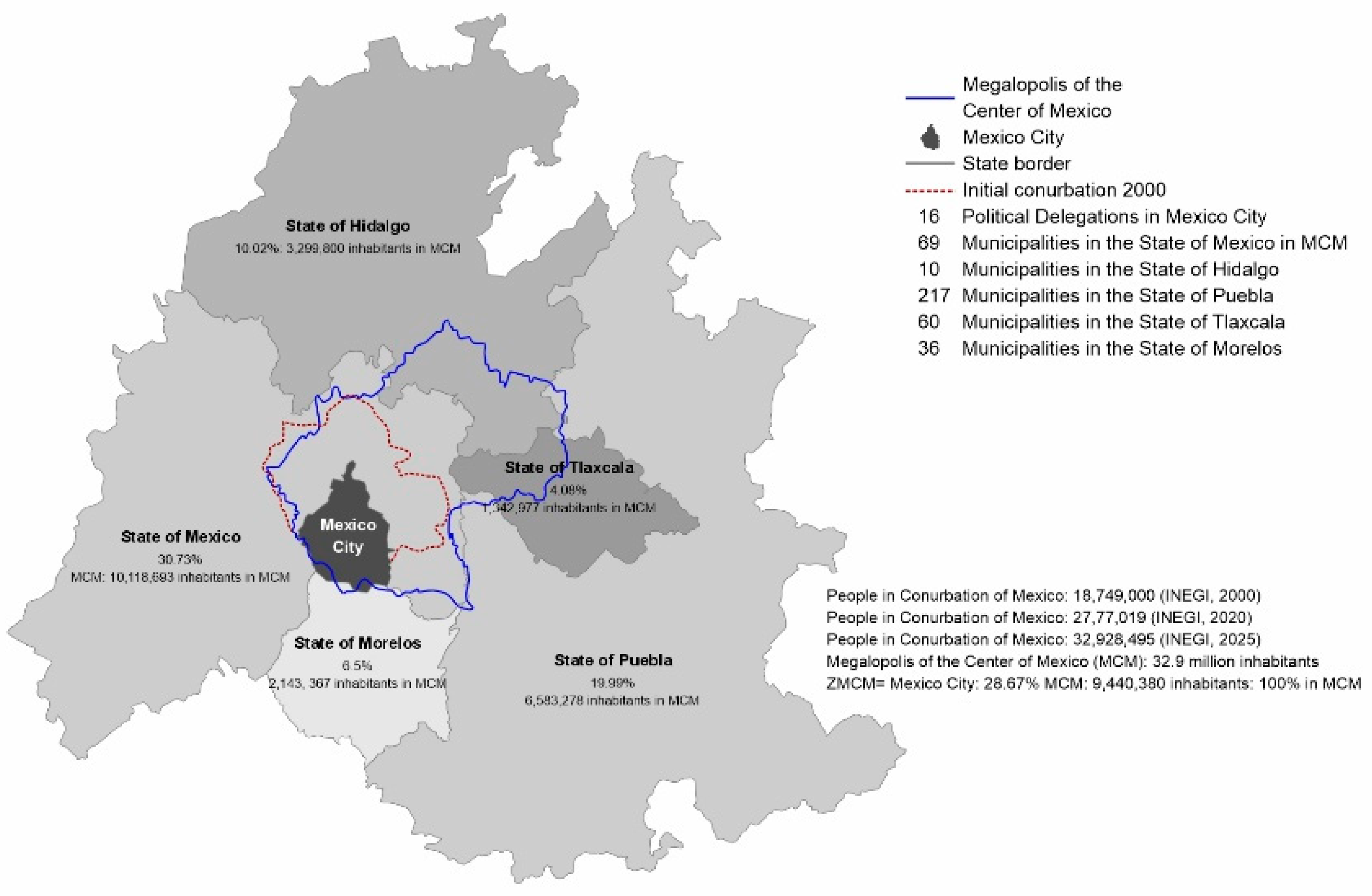
Figure 2.
Natural Protected Area in the Study Region. Source [5].
Figure 2.
Natural Protected Area in the Study Region. Source [5].
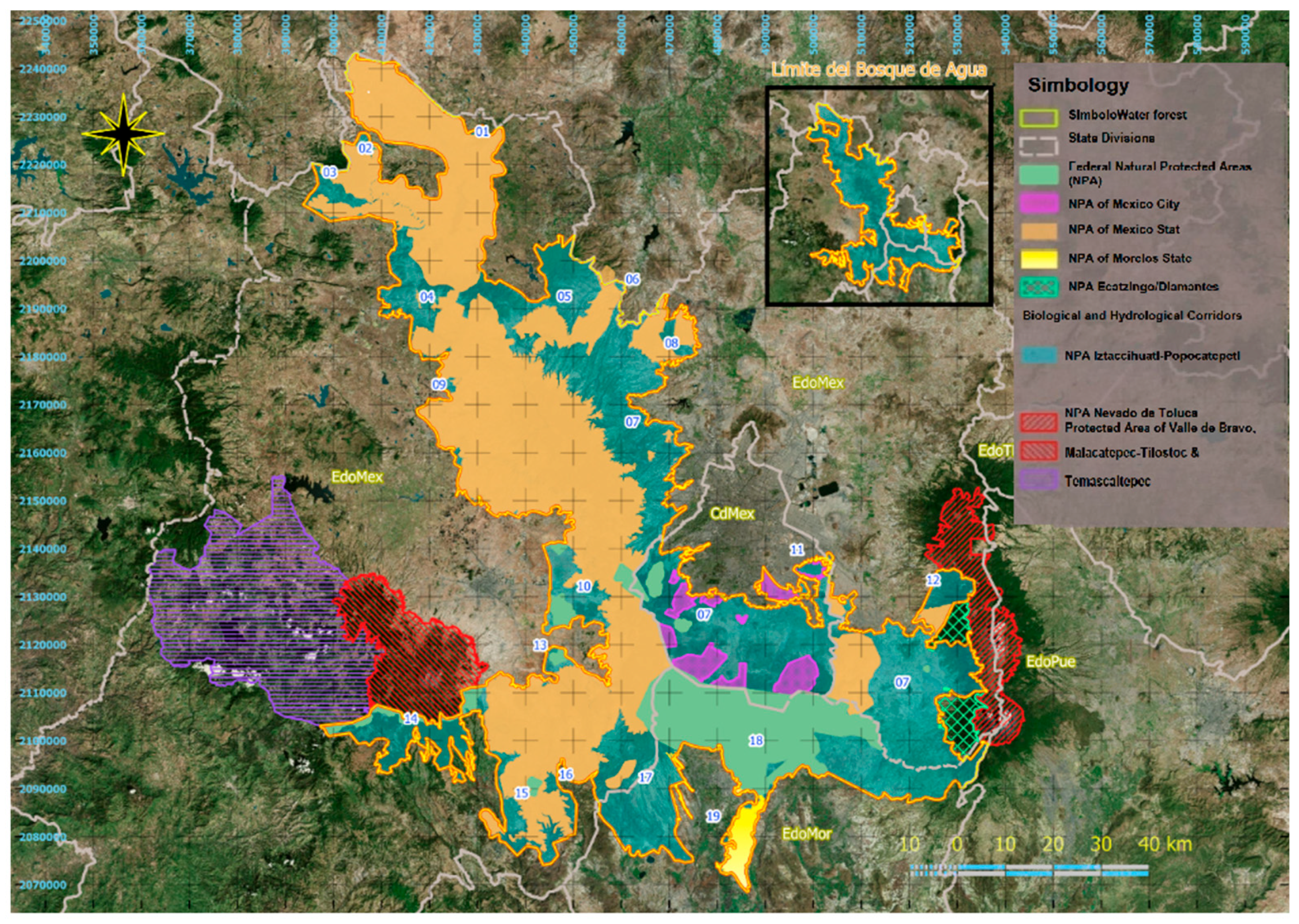
Figure 3.
Drainage system in the MCM. Source: [21], p. 28.
Figure 3.
Drainage system in the MCM. Source: [21], p. 28.
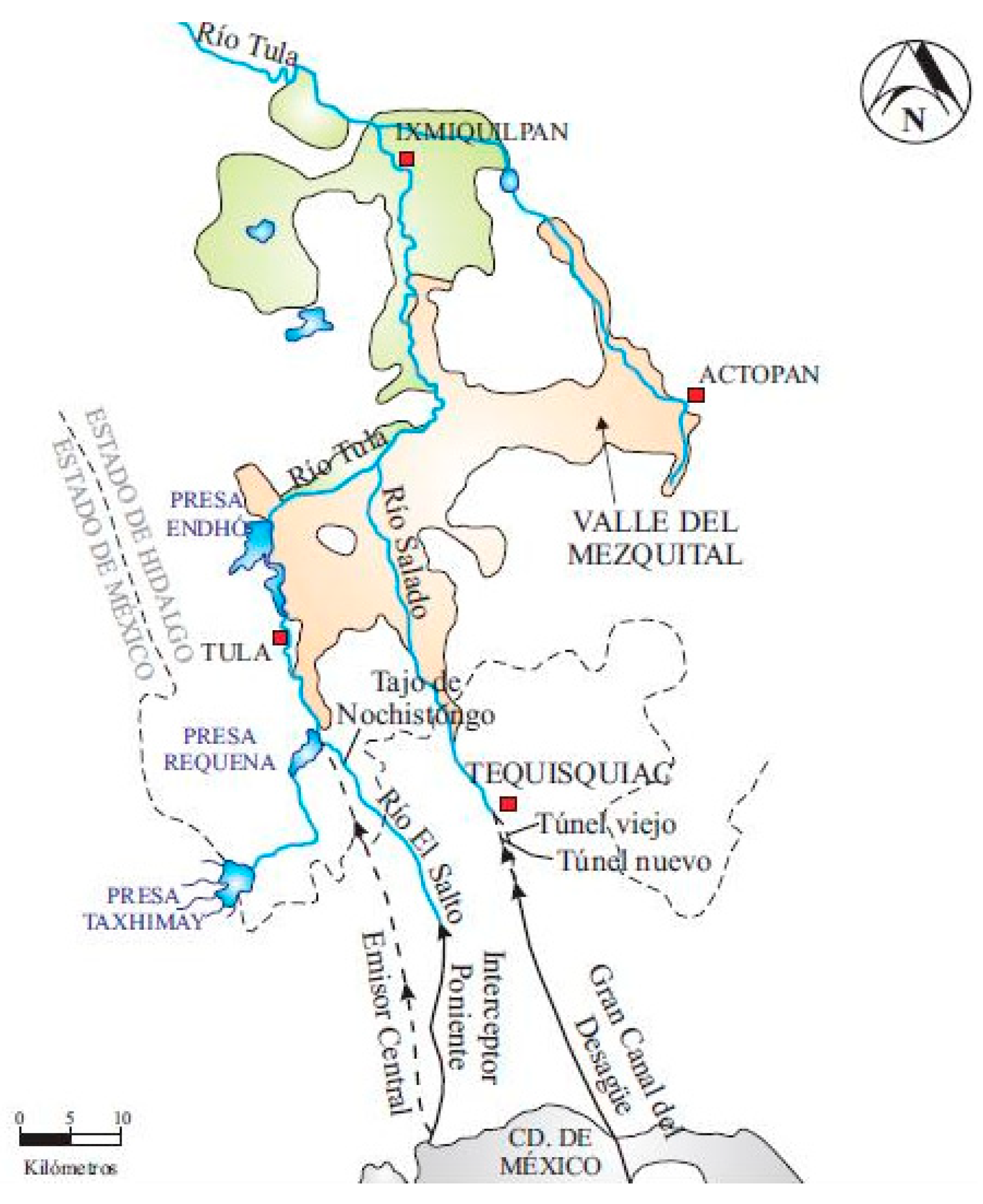
Figure 4.
Water Forest Polygon of the MCM and its transformation from 2009 to 2024. Source: [5].
Figure 4.
Water Forest Polygon of the MCM and its transformation from 2009 to 2024. Source: [5].
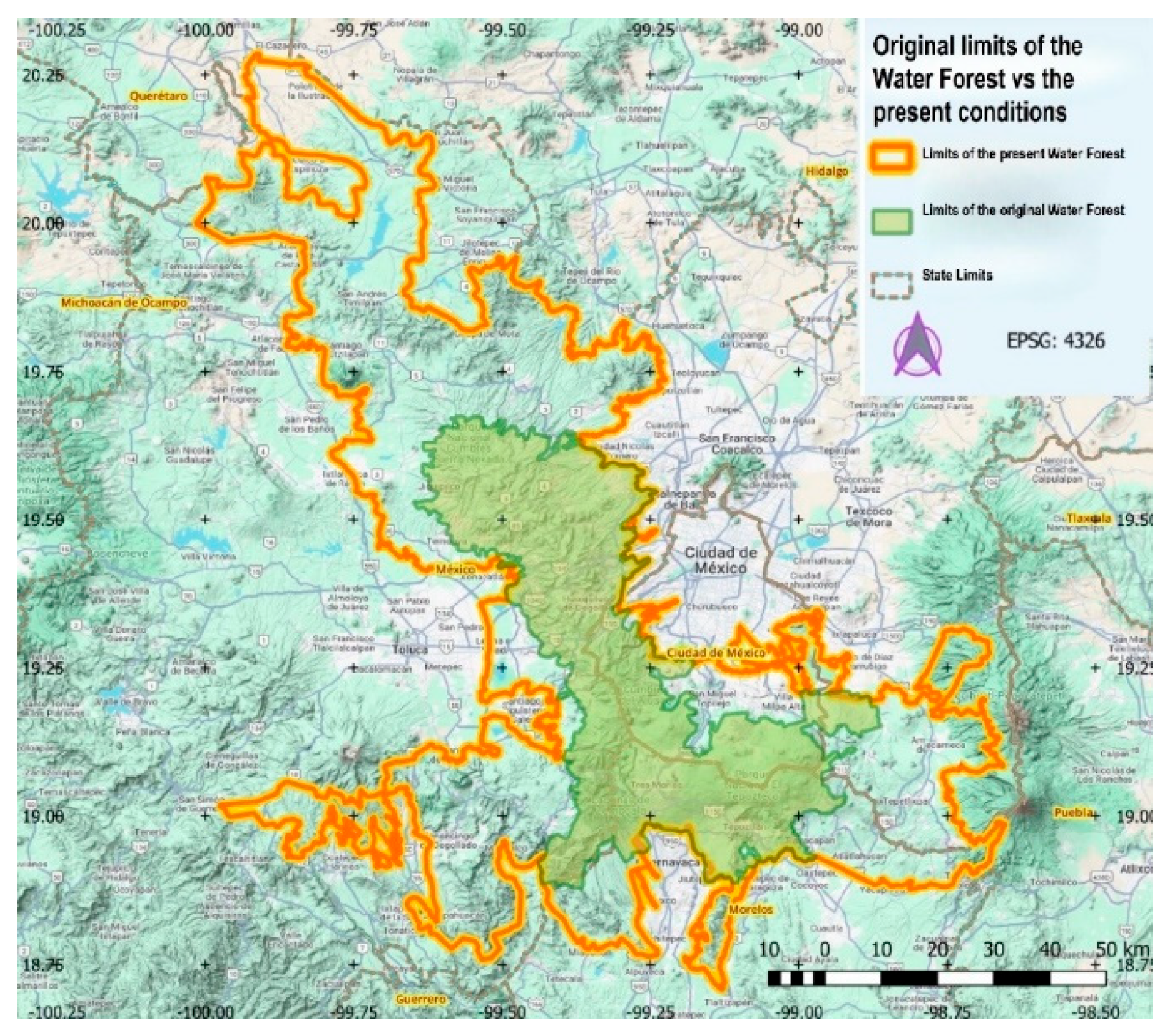
Disclaimer/Publisher’s Note: The statements, opinions and data contained in all publications are solely those of the individual author(s) and contributor(s) and not of MDPI and/or the editor(s). MDPI and/or the editor(s) disclaim responsibility for any injury to people or property resulting from any ideas, methods, instructions or products referred to in the content. |
© 2025 by the authors. Licensee MDPI, Basel, Switzerland. This article is an open access article distributed under the terms and conditions of the Creative Commons Attribution (CC BY) license (http://creativecommons.org/licenses/by/4.0/).
Copyright: This open access article is published under a Creative Commons CC BY 4.0 license, which permit the free download, distribution, and reuse, provided that the author and preprint are cited in any reuse.


