Submitted:
28 March 2026
Posted:
31 March 2026
You are already at the latest version
Abstract
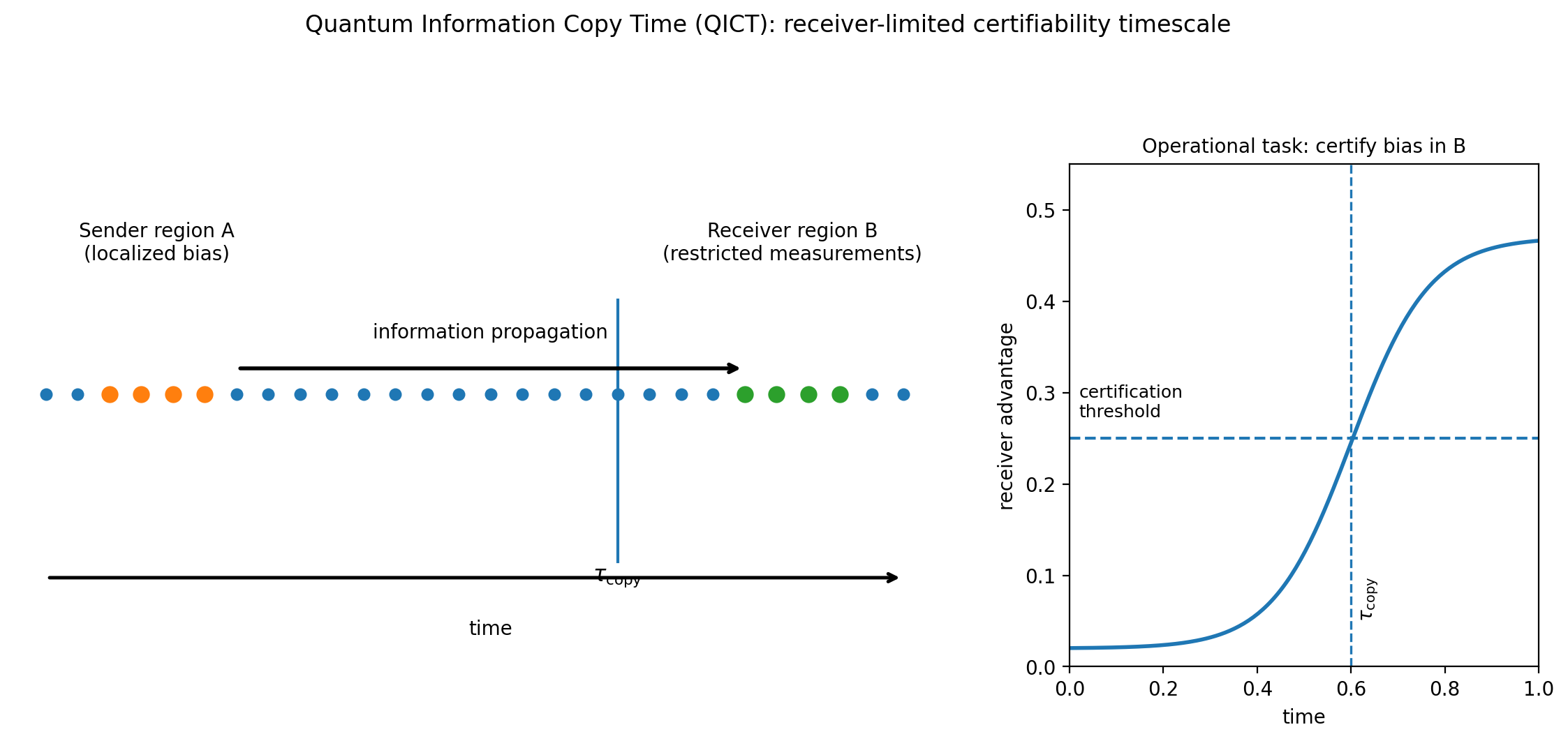
We introduce an operational transport latency, quantum information copy time: the earliesttime at which a receiver confined to a region B can certify, with prescribed advantage, whichof two global hypotheses was prepared by local operations in a distant sender region A. The benchmark quantity is information-theoretic—the Helstrom advantage on B, namely the tracedistance between the reduced states—and it also admits receiver-restricted refinements that makemeasurement constraints explicit, including few-body and moment-channel receivers. We derivethe corresponding kinematic locality constraints for Hamiltonian and Lindbladian dynamicswith Lieb–Robinson tails, as well as for circuits and quantum cellular automata with strictlight cones. We then establish the theorem-level anchor of the manuscript in the quantumsymmetric simple exclusion process (Q-SSEP): for locally prepared charge-biased hypotheses,the Helstrom copy time obeys an unconditional diffusion-limited lower bound expressed in termsof the diffusion constant D and the static susceptibility χ. For closed Hamiltonian systems,we formulate a projection-based reduction in which the operational scaling statement is made conditional on explicit, diagnostically checkable hypotheses, thereby separating what is provedmicroscopically from what is inferred in a controlled hydrodynamic window. We complement the analytical framework with exact-diagonalization diagnostics in the XXZ chain and with abundled TEBD/MPS reference protocol plus validation suite (Supplementary S2 and Code SC1),explicitly cross-validated against exact evolution at small sizes. In the strengthened submissionwe add three robustness layers beyond the original ED figures: an eight-size common-windowtransport sweep for the nonintegrable XXZ structure-factor diagnostic, an extractor-robustness check comparing first-crossing and sustained-crossing copy-time rules on the same Helstrom dataset, and a receiver-side validation dataset showing when a simple block-charge measurement saturates the Helstrom advantage in a controlled conserving reference model. Finally, we comparecopy time with scrambling diagnostics based on out-of-time-ordered correlators and show how conservation laws can delay certifiability well beyond the ballistic operator-growth front without any contradiction with locality.