

Submitted:
05 January 2026
Posted:
06 January 2026
You are already at the latest version
Abstract
Mediterranean greenhouses are characterized by the use of passive climate control techniques, thus avoiding energy inputs that would make crop production more expensive. This study was carried out in Almería (Spain), in a greenhouse divided in two sectors. (West sector: with double roof with a pink spectrum converter film combined with an increased ventilation surface, ratio of vent surface/greenhouse surface SV/SC = 26.0%; East sector: acted as a control with only standard ventilation surface, SV/SC = 16.6%). This study analysed the effect of a double roof and an increased ventilation surface on the main fungal diseases in different crops (Solanum lycopersicum L., Capsicum annuum L., and Cucumis sativus L.). Different diseases were found that develop naturally, powdery mildew (Leveillula taurica) in both the tomato and the pepper crop, and early blight (Alternaria linariae) only in the tomato crop. In the case of cucumber crop, three diseases that developed naturally were found, (i) downy mildew (Pseudoperonospora cubensis), (ii) powdery mildew (Podosphaera xanthii) and (iii) gummy stem blight (Stagonosporopsis spp). The sector that combined the double roof and the increased ventilation surface had lower disease levels compared to the control sector, with statistically significant differences.
Keywords:
greenhouse
; double roof
; crop protection
; powdery mildew
; downy mildew
1. Introduction
The Mediterranean coastal area has ideal climatic conditions for the development of early horticultural crops due to the mild winters [1]. Specifically, the province of Almería, with one of the most important greenhouse concentrations worldwide, reached 32,554 ha of greenhouses in 2020 [2]. Greenhouses in Almería, due to the privileged climate of the south-eastern Spanish, need less energy inputs to obtain optimal climatic conditions, which in turn generates less carbon footprint in tomato production [3]. These greenhouses achieve high efficiency in the use of surface resources due to technological development in crop production processes [4]. Passive climate control systems are commonly used in greenhouses in Almería, which do not require energy inputs to achieve their objectives, thus reducing the cost of crop production [5].
Among the most used passive climate control techniques in greenhouses in Almería is the use of natural ventilation, by opening or closing greenhouse vents to control climatic parameters such as temperature and humidity [6,7]. The use of double roofs in greenhouses is a passive climate control technique normally used for the development of crops in cold periods [8]. The use of double roof structures on crops produces an increase in the minimum night-time temperature, reduces temperature oscillations and relative humidity, if it is combined with adequate ventilation management during the day [9]. Double roof greenhouses provide better insulation from external climatic conditions [10], which results in energy savings for greenhouse heating of 40% to 50% in active climate systems but affects the transmissivity of light reaching the crop. The double roof reduces heat losses in greenhouses by 35-40% [11] and reduces energy inputs to greenhouses to maintain the temperature [12]. The use of double roofs increases average summer and winter temperatures around the crop [13]. The use of plastic roofing can have an impact on crop quality. Previous studies have associated increased lycopene levels with tomatoes cultivated under plastic coverings [14], and the use of double roofs in greenhouses improves the production and quality of tomato crops [15].
In recent years, different types of agricultural films have appeared on the market, developed to alter the spectrum of radiation entering the greenhouse. Light quality is one of the main factors affecting plant growth, influencing photosynthetic activity, photomorphogenesis, seed germination, and even stomatal movements [16,17,18,19,20,21]. The spectrum converter films amplify the green wavelength in the red wavelength range, where photosynthetic activity is highest [22]. The spectrum convert films modifies the solar spectrum reaching crops by modifying plant photosynthesis and the microclimate around crops [23]. These films transform the visible-wave solar green-yellow to the red-light range which is useful for the process of crop photosynthesis [24]. Spectrum converter film can transform blue-green light (450-550 nm) into red light (600-700 nm) or ultraviolet (UV)-violet light (350-450 nm) into the blue-green light range influencing crop development [25]. The spectrum converter film can enhance the photosynthetic activity of crop leaves by 15% [23]. Crop yield and quality have been substantially improved by sunlight spectrum photoconverter film [26]. The combination of the passive climate control techniques described above, the use of double roofs with sunlight spectrum photoconverter film, could be an interesting tool for crop health management.
The use of double roofs in greenhouses can increase environmental humidity inside growing areas, which usually leads to an increase in the presence of various fungal diseases [27], so the use of ventilation to control this factor is essential. In the case of greenhouses in Almería, the use of operable vents is a key factor in humidity control in the greenhouse [28], helping to improve the positive effects of the use of double roofs. Fungal diseases find highly favourable conditions for their development inside greenhouses, as the environmental factors present are often optimal for the growth of the pathogens. In particular, the development of downy mildew (Pseudoperonospora cubensis) and gummy stem blight is strongly influenced by the requirement for high ambient humidity [29,30,31]. Relative humidities levels above 90% and the presence of free water on the leaves favour the germination and dispersal of Pseudoperonospora cubensis spores [31]. Moreover, the initial attack by downy mildew can increase plant transpiration, which further increases humidity inside the greenhouse, creating a positive feedback loop that promotes the disease’s development [31]. Similarly, gummy stem blight also requires very high relative humidity (above 90%) and mild temperatures for its spread and development [32]. This pattern is also seen in other fungal diseases, such as gummy stem blight, which likewise thrives under conditions of moderate temperatures and high humidity [33]. Therefore, appropriate management of climatic conditions within the greenhouse can be a key tool in reducing the incidence of these diseases [34]. The use of double roofs has been shown to influence the development of some tomato diseases such as grey mold caused by Botrytis cinerea [35].
Downy mildew and powdery mildew are two of the most common fungal diseases associated with greenhouse cucumber crops in the Almería area. Powdery mildew is one of the most widespread diseases worldwide [36] and causes severe damage to cucumber crops, reducing yields [37]. Symptoms of the disease show growth of the mycelium on the surface of the leaves similar to a white powder; sometimes with an aggressive attack, symptoms may be observed in other parts of the plant such as the stem or fruit. These diseases cause leaf defoliation, resulting in loss of yield quality. Powdery cucurbit mildew can develop in any state of the crop and colonise plant tissues very quickly [38]. On greenhouse cucumber plants, powdery mildew is usually associated with the fungus Podosphaera xanthii [39,40]. Downy mildew in cucumber caused by the fungus Pseudoperonospora cubensis is one of the pathogens that causes the most yield losses worldwide, both in outdoors and protected cucumber crops [41,42]. Downy mildew develops geometric chlorotic lesions on the leaf surface, bounded by leaf veins, which can lead to necrotic damage and leaf loss, thus affecting crop yield [43].
Gummy stem blight in cucumbers is caused by three fungal species in Stagonosporopsis spp [44], which causes symptoms in stems, leaves and black rot on fruit [45]. Black rot in fruits causes a lot of damage during storage, which increases yield loss [46]. Gummy stem blight affects all aerial parts of the plant, causing circular water-soaked foliar lesions and cankers on the crowns and stems; the water-soaked lesions dry out and necrotise, severely damaging the plant [47].
Powdery mildew (Leveillula taurica) is one of the most common diseases on pepper that can be found both in greenhouses and outdoors in temperate zones around the world, causing significant crop losses [48]. The importance of powdery mildew is reflected in the fact that it is the disease that causes the most losses in pepper and tomato crops in greenhouses and has been the disease with the highest fungicide expenditure in Europe [59]. At more advanced stages of infection, conidiophores develop, starting on the underside of the leaf, showing the characteristic white powder that defines the disease, to later cause abscission of the infected leaf, causing defoliations that can be very severe [50].
Early blight is one of the most important diseases in tomato (Solanum lycopersicum L.), which can result in crop losses of a tomato crop of 35 and 78% [51]. Early tomato blight is mostly caused by the pathogen Alternaria linariae [52]. This disease occurs in places with warm temperatures (24-29 °C) and abundant rainfall [53], although it can also occur in semi-arid climates with frequent wet nights, causing plant dew [54]. Early blight symptoms can be observed in any plant structure, although they appear initially on the leaves. It is characterised by the appearance of necrotic spots with concentric rings and a yellow halo around necrosis [55].
Interrupting the development of the pathogen cycle is a key element in any integrated pest management (IPM) strategy. One way to influence the environmental conditions inside greenhouses is by modifying the spectral properties of the plastic film covering them, which in turn can affect the development of certain plant pathogens [56].
Light plays an important role in conidial formation in some fungi; exposure of mycelium to ultraviolet or blue light can alter fungal development [57]. It has been shown that greenhouse coating films that block or reduce ultraviolet radiation can inhibit sporulation of several plant pathogenic fungi [58,59].
The aim of this work is to analyse the effect of passive climate management techniques, increased ventilation area and double roof, on the development of fungal diseases of cucumber, tomato and pepper in a Mediterranean greenhouse.
2. Materials and Methods
2.1. Experimental Setup
The experimental trials were carried out in a multi-span greenhouse located in the Centre for Innovation and Technology Transfer UAL-ANECOOP Foundation “Catedrático Eduardo Fernandez” of the University of Almería (36º 51’ N, 2º 16’ W and 87 MAMSL) (Figure 1). The side walls of the rigid polycarbonate greenhouse are made of corrugated strips. The roof was made of three-layer thermal film 200 μm thick (Politiv Ltd., Kibbutz Einat, Israel; characteristics: colorless diffuse; 85% transmission of photosynthetically active radiation; 55% diffusion on light; 24% transmission of ultraviolet light; 85% thermal efficiency). The greenhouse was divided transversely by a polyethylene sheet, creating two isolated sectors with similar characteristics (Table 1).
In the West sector was located a double roof with experimental spectrum conversion film, two side vents with a maximum opening of 3 m and three roof vents (maximum opening of 0.9 m). However, in the East sector, there are two standard side vents (maximum opening of 1 m), three roof vents (maximum opening of 0.9 m) and no double roof (Figure 1 and Figure 2). Ventilation was controlled by Synopta Software 5.4.2.3931422 (Ridder Growing Solutions B.V., Maasdijk, The Netherlands), a centralised climate control and data logging system with a weather station.
The film used as a double roof integrating the technology “LIGHT CASCADE®”—LC® was developed by the French company CASCADE (Clamart, France), using optically active additives incorporated in the polymer that modifies and adapts the sunlight spectrum closer to plant needs; its spectrum converter character showed a pronounced increase in the red zone (600-700 nm) of the visible spectrum.
To analyse the possible effect of the double roof on deficit irrigation stress, two different irrigation doses were applied: (i) in the north zone of the greenhouse a standard irrigation (drippers of 3 L/h and a maximum irrigation of 50 min/day); (ii) in the south zone 20% less irrigation was used than in the north sector.
The study was carried out in two autumn-winter cucumber crop cycles (Cucumis sativus L.), a spring-summer tomato crop cycle (Solanum lycopersicum L.) and a spring-summer pepper crop cycle (Capsicum annuum L.) (Table 2). The transplants were carried out on a coconut fibre substrate with a plant density of 1 plant/m2 and all commercial varieties sourced from Rijk Zwaan Ibérica, S.A. (Almería, Spain).
Crop management tasks (such as cleaning, trellising, pruning, and harvesting) were carried out simultaneously in both sectors. Similarly, throughout the four crop season, different fungicides (Table 3) were applied, but always in both experimental sectors.
2.2. Microclimate Measurement Equipment
In the center of each sector, at 2 m height, there was an aspirated radiation shield box EKTRON II-C (Ridder Growing Solutions B.V.) within which there were a Pt1000 IEC 751 class B temperature sensor (Vaisala Oyj, Helsinki, Finland) with a measurement range of -10 to 60 °C and an accuracy of ±0.6 °C, a capacitive humidity sensor HUMICAP 180R (Vaisala Oyj, Helsinki, Finland) with a measurement range of 0-100% and an accuracy of ±3% and a CO2 Probe EE871 (Elektronik Ges M.b.h. Engerwitzdorf, Austria) with a measurement range of 0-2000 ppm and accuracy of ±2% from the measured value (m.v.). Outside climatic conditions were recorded by a meteorological station at a height of 9 m equipped with a BUTRON II (Ridder Growing Solutions B.V.) measurement box with similar temperature and humidity sensors to the inside measurement box.
2.3. Measurement of Infection Level in Plants
The design of the trial and the evaluation of the standards of the diseases followed the European and Mediterranean Plant Protection Organisation (EPPO) standards. For downy mildew and powdery mildew diseases, EPPO Standard PP 1/181 (Conduct and reporting of Efficacy Evaluation Trials), EPPO Standard PP 1/152 (Design and Analysis of Efficacy Evaluation Trials), EPPO PP 1/57 (Powdery mildews in cucurbits) are applicable and EPPO PP 1/65 (Downy mildew of lettuce and other vegetables, PSPECU) EPPO PP 1/263 (Alternaria solani and Alternaria alternata in potato and tomato), PP 1/135 (Phytotoxicity assessment), PP 1/121 (Leafspots of vegetables).
The percentage of affected leaf area was assessed on the upper and lower surfaces of at least eight even-aged leaves of each plant. In the greenhouse, in each experimental sector, four assessment plots were established in the northern zone and four assessment plots in the southern zone. In each plot, 6 plants were evaluated (Figure 3). For each plant, a minimum of 8 evenly distributed leaves were evaluated. In total, for each treatment, 200 leaves were tested in the northern sector and 200 leaves in the southern sector.
Identification of disease-causing fungi (pathogens Podosphaera xanthii, Pseudoperonospora cubensis and Stagonosporopsis spp for cucumbers and Leveillula taurica and Alternaria linariae for solanaceae) was carried out by direct observation and microscopic observation of mycelia, spores and conidia [55,60,61,62,63]. Analysis of each of the diseases was obtained using the percentage damage per leaf, for each disease. Diseases were evaluated every 7 days from the observation of the first symptoms, obtaining the evolution of the development of damage produced by each disease during the two crop cycles.
3.4. Statistical Analysis
The data presented are an average of the results obtained in the independent trials with a randomised block design with four replicates for each experimental sector. Statistical analysis of the data was performed with Statgraphics Centurion v.19 (Manugistics Inc., Rockville, MD, USA) using a variance analysis (considered significant if the p-value is ≤ 0.05), comparing the mean values with Fisher’s minimum significant difference procedure (LSD). Bartlett, Cochran and Hartley tests were used to determine whether a sector had a similar variation. For parameters with different variance, we performed a nonparametric analysis with the Friedman test, with each row representing a block (the evaluation date), using averages graphs.
Multiple sample comparisons were used to compare the data. The F-test in the ANOVA table tests whether there are any significant differences amongst the means. The method used to discriminate among the means was Fisher’s least significant difference (LSD) procedure.
3. Results
The comparison between the standard ventilation (East sector) and the alternative treatment, consisting in the use of increased lateral ventilation and a double roof with a spectrum converter film (West sector) has been carried out by analysing the indoor microclimate within the two sectors and the development of fungal diseases.
3.1. Microclimatic Parameters Inside the Greenhouse
3.1.1. Autumn-Winter Crop Season
In the 2020/21 cucumber growing season (Figure 4), a higher temporal variability in air temperature was observed inside the greenhouse, with pronounced maximum temperature peaks, particularly in the East sector equipped with a single roof and standard ventilation. In contrast, the West sector, combining a double roof and increased lateral ventilation, showed a more moderated thermal behaviour. During the 2021/22 growing season (Figure 5), temperature conditions were overall milder and more stable, and the differences between the East and West sectors were less marked than in the previous season.
Regarding humidity conditions, absolute humidity levels during the 2020/21 season were clearly higher in both greenhouse sectors, with consistently greater values in the East sector (Figure 4b), compared to those recorded during the 2021/22 season (Figure 5b). In the second cucumber cycle, absolute humidity remained lower and more stable throughout the season, particularly in the West sector. These results indicate that the combination of a double roof and increased lateral ventilation in the West sector generated more favourable microclimatic conditions for cucumber cultivation, mainly due to the reduction and stabilisation of absolute humidity.
3.1.2. Spring-Summer Crop Season
During the spring–summer crop cycles, clear differences in the greenhouse microclimate were also observed between sectors (Figure 6 and Figure 7). In the tomato growing season of 2021 (Figure 6), the East sector, with a single roof and standard ventilation, exhibited higher temperature values and more pronounced maximum peaks compared to the West sector. The presence of the double roof combined with increased lateral ventilation in the West sector contributed to moderating air temperature, reducing extreme values and resulting in a more stable thermal environment throughout the crop cycle.
A similar pattern was observed during the pepper crop cycle in 2022 (Figure 7), although temperature conditions were more extreme overall. In this case, the East sector showed the highest temperature peaks, while the West sector maintained lower and more buffered temperatures. Regarding absolute humidity, both crops showed higher humidity levels in the East sector, whereas the West sector consistently presented lower and more stable absolute humidity values (Figure 6b and Figure 7b). These differences were particularly evident in the pepper cycle, suggesting that the combination of double roof and increased ventilation was especially effective in mitigating excess heat and humidity under more demanding climatic conditions, thereby creating more favourable microclimatic conditions for crop development.
3.2. Fungal Diseases
During the development of the study, different species of pathogenic fungi were observed attacking the different crops in the different crop cycles tested. The crop cycles carried out during the autumn–winter period involved cucurbit crops, specifically cucumber. The results from these cucurbit cycles showed the development of the three diseases evaluated in two cucumber crops planted on similar dates in two different years. All three diseases appeared naturally in the crops, as is common in this region when conditions are favourable for disease development, since these diseases are endemic to the area. The three fungal diseases observed were powdery mildew, caused by the pathogen Podosphaera xantii; downy mildew, caused by Pseudoperonospora cubensis; and gummy stem blight, caused by Stagonosporopsis spp (Figure 8).
The other two crop cycles were carried out in the spring-summer season, one of tomato and one of pepper. Two fungal diseases attacked the solanaceous crops during this work. Powdery mildew caused by the pathogen Leveillula taurica, which developed during the two crop cycles in both pepper and tomato. Early blight caused by the pathogen Alternaria solani was the second fungal disease to develop, in this case in tomato cultivation, with a level of development that concerned the grower if the crop would develop normally.
The most important disease in all cycles was powdery mildew, reaching infection rates above 30% in all cycles and even 60% infection rates in some plots and for some crop cycles. This level of disease was a particularly important problem that caused the premature end of the crop and had an impact on yield.
The values of the other diseases evaluated did not reach such high values but showed interesting data for the analysis of the different variables studied in this work. Statistical differences were observed for the different fungal diseases evaluated in these trials, with a lower incidence of the disease in all sectors where there was a double roof.
3.2.1. Powdery Mildew
3.2.1.1. Powdery Mildew in Cucurbitaceae
The first symptoms of powdery mildew were observed in both cycles in October, and the evaluations began when the level of spots due to the disease was around 0.1% in all the plots (20 November in the first cycle and 21 October in the second). Disease monitoring was carried out until 24 December 2020 and until 11 December 2021, near the end of the crop. At this point in the trial, some evaluated plots reached infection rates above 30% and even 60% in one case.3
Plants grown under the influence of the double roof and the increased ventilation surface showed less disease development with statistically significant differences at some points of evaluation (Figure 9).
During the 2021 cucumber growing season, a higher incidence of powdery mildew was observed in areas where standard irrigation was applied (north-west zone), compared to areas with deficit irrigation (southern zone). This difference was particularly evident in the final assessment of the trial, as shown in Figure 9 and Figure 10.
Figure 10, which represents the second cucumber cycle studied in 2021, shows the same trend observed in the first crop cycle, but in this case more pronounced, since higher disease levels were reached in the single roof treatment.
In the second cucumber crop season, during full winter 2021, larger differences were observed between areas with single roof and those with a double roof. In no case was the disease arrested, but the development of the disease in areas with single roof was faster, causing more damage to the crop than in areas covered by the double roof with the sunlight spectrum photoconverter film combined with a higher ventilation surface (Figure 10).
In the second cycle, higher levels of powdery mildew infection were observed in the standard irrigated areas than in the deficit irrigated areas. The double roof used delayed powdery mildew development (Figure 9 and Figure 10), the highest value of disease intensity was found in the sector with single roof and a ratio of natural ventilation SV/SC ratio equal to 16.6%, compared to the sector with a double roof with sunlight spectrum photoconverter film and a ratio of natural ventilation SV/SC ratio equal to 26%.
Powdery Mildew in Solanacea
The first symptoms of powdery mildew in tomato crop (pathogen Leveilula taurica) were observed at the beginning of April 2021; the assessments began when the level of spots due to the disease was high enough to be representative in all plots. The disease was monitored until 10 July 2021, close to the end of the crop. At that time, some of the evaluated plots reached infection rates around 60% in the in the most heavily attacked plots.
Figure 11 shows the development of powdery mildew throughout the tomato crop cycle. From the onset of the disease, it was observed that there was always a higher development of powdery mildew in areas that were not covered with the double roof with sunlight spectrum photoconverter film. Thus, it is clear that the effect of the double roof and the increased ventilation surface reduced the ability of the disease to attack the crop.
The disease developed steadily from the onset of the first symptoms, with the steepest curve, or the most rapid disease development, occurring during the week of 5 June and 3 July 2021, when environmental conditions and plant susceptibility must have been very favourable for the development of powdery mildew (Figure 11).
In the southern area with deficit irrigated areas, the plots also showed lower percentages of powdery mildew disease in the double-roofed area with sunlight spectrum photoconverter film and increased ventilation surface, but lower levels of infection than in the standard irrigated areas. The deficit irrigated areas showed almost half the disease severity of the standard irrigated areas. The appearance of powdery mildew in areas covered with a double roof with sunlight spectrum photoconverter film and with deficit irrigation was almost negligible.
In tomato and pepper, the pathogen responsible for the appearance of powdery mildew was the same, Leveillula taurica, in the pepper cycle the first symptoms of the disease were observed in April 2022. Assessments started in May 2022, at which point it was possible to assess the disease in all the surveyed plots. As in the tomato cycle, high infection rates of more than 50% were reached in the plots most affected by the disease, although the frequency of affected leaves was much higher.
In the western sector, which is equipped with a double roof with spectrum converter film and enhanced side vents, a reduction in the incidence of diseases in the pepper crop has been observed. Powdery mildew developed more aggressively in areas that were not covered by the double roof with the sunlight spectrum photoconverter film. The two study areas showed statistically significant differences at all evaluation times, with a trend similar to that observed in the tomato cycle. Disease development in this pepper cycle was faster than in the tomato cycle, requiring fewer days to reach a similar level of infection. From 4 to 18 June there was a very rapid development of the disease, as well as in the week of 2 July, times when powdery mildew must have been favoured by climatic conditions or by a greater host sensitivity of the host to the attack of the disease (Figure 12).
As in the tomato cycle, southern areas that were irrigated 20% less reached lower percentage infection levels than areas irrigated with standard irrigation. Areas protected by the double roof with sunlight spectrum photoconverter film and more ventilation surface showed a lower percentage of powdery mildew infection (statistically significant differences), as observed throughout the trial. The disease peaks occurred during the weeks of 11-18 June and 25 June-2 July (Figure 12).
3.2.2. Downey Mildew
In these four seasons, downy mildew appeared only in Cucurbitaceae cycles (cucumber). Downy mildew appeared naturally, in the specific case of this study. The incidence of downy mildew in the greenhouse was lower than in the case of powdery mildew; however, during the first cycle in 2020 it reached infection rates of over 10%. These levels of disease would be of concern in a commercial greenhouse, enough to make a foliar spray application with some fungicide.
The combination of double roof with sunlight spectrum photoconverter film with increased natural ventilation produced a significant reduction in downy mildew development, showing values below 1% in all cases (Figure 13 and Figure 14).
In the second cucumber season 2021, the incidence of downy mildew was lower than in 2020. It did not exceed the incidence of 3% crop damage, which would not be dangerous to development and yield. However, the trend that showed disease development was similar to the previous year, as shown in Figure 13.
The presence of the disease in the areas with single roof and standard ventilation area was less than 3% while in the areas under the double roof and increased ventilation surface it was almost non-existent and the damage in the plots did not reach 0.5% leaf infection.
In the case of downy mildew, in the first cycle the areas with the highest severity of the disease also coincided with the northern areas (Figure 13), which were those with standard irrigation supply compared to the south, which had a deficit of 20%. This trend was not observed in the level of the second cycle, as the disease was very low (Figure 14).
Regarding the relationship of disease with ventilation, in the two cycles 2020 and 2021 for downy mildew (Figure 13 and Figure 14), a higher level of ventilation was found to be related to a lower level of damage to the crop. The combination of the two passive techniques of climate control, natural ventilation and the use of a double roof, significantly reduced downy mildew damage to the crop, fully controlling the disease with these two greenhouse climate management techniques.
3.2.3. Gummy Stem Blight
The gummy stem blight appeared in the cucumber cycles in the zone where a double roof was not used. It was the disease evaluated that had the lowest incidence in the cucumber crop, the main reason why this disease was evaluated was due to the possibility of postharvest damage.
In both the first and second cycles, the disease appeared three weeks before the last assessment and the disease evolution was slow, so it did not reach high levels of crop damage.
Evaluations of gummy stem blight showed that the use of a double roof with sunlight spectrum photoconverter film combined with increased lateral ventilation also delays disease development, even at low disease levels. Figure 15 and Figure 16 show how disease incidence was always higher in areas with single roof in all cases, in both cycles and in both standard and deficit irrigated areas.
In the second growing season, a higher level of infection was observed than in the first cucumber growing season. In this case, in the northern areas the incidence was higher than in the southern areas due to the difference in irrigation (Figure 16). This difference was not observed in the first cycle, probably due to the low level of disease developed.
3.2.4. Early Blight in Tomato
In our case, early blight appeared in May and June 2021, which for this area is a little late. The climatic conditions of 2021 and the rainfall in those months favoured the development of the disease.
The early blight reached lower infection levels than powdery mildew, clearly being a secondary disease in tomato cultivation. However, it reached infection levels around 10%, which for a tomato grower would be a concern and sufficient to carry out treatments or control work for this disease. The necrosis that early blight could produce reduces the photosynthetic activity of the plant and the possibility of spots appearing on the fruit that affect quality.
Between 15 May 2021 and 19 June 2021, there were 8 days of rain, which considerably increased the humid environment that facilitated the appearance of early blight. The first spots of early blight were observed in the crop at the beginning of May, but by 20 May 2021, the level reached by early blight in the plots analysed in the trial was interesting enough to perform an analysis of this disease. From the beginning of the evaluations until the end of the crop, the disease had a constant development without any aggressive explosion on the crop, but reached worrying infection levels, exceeding 10% infection in most of the plots analysed.
Figure 17 shows the evolution of early blight throughout the trial. In this case, no differences were observed between the areas that used double roof with sunlight spectrum photoconverter film and those that did not with standard irrigation. In the northern areas, no statistically significant differences were found in the evolution of early blight; only at one point in the assessment was a difference observed, but in the opposite direction to that obtained for powdery mildew.
Early blight under the influence of the double roof with sunlight spectrum photoconverter film and increased natural ventilation followed the same trend as powdery mildew, with the disease developing more aggressively in northern areas that did not have an irrigation deficit (Figure 17). In the case of the crop that was not protected with the double roof, the early blight showed a different trend, showing no significant differences in the initial moments of evaluation and finding a higher level of disease development in the south than in the north in the last four evaluations (statistical differences). Thus, the effect of irrigation on early blight was not so clear (Figure 17).
4. Discussion
The influence of the use of double roofs in the greenhouse, combined with natural ventilation, had a very important effect on the development of the diseases studied in two cucurbits crops (cucumber) and two Solanaceae crops (tomato and pepper). Particularly affected was the development of powdery mildew based on the use of the passive climate control techniques studied. Powdery mildew was the main disease that attacked crops and caused significant damage to plants and their yield.
To better understand the differences observed in disease development between sectors, the microclimatic conditions generated by the different greenhouse configurations must be considered. The microclimatic differences observed between sectors in terms of temperature and absolute humidity (Figure 4, Figure 5, Figure 6 and Figure 7) were closely related to the development of fungal diseases during the different crop cycles. The East sector, characterised by a single roof and a lower ventilation surface, showed higher temperature peaks and consistently higher absolute humidity, particularly during the autumn–winter cucumber seasons and under the more demanding spring–summer conditions of the tomato and pepper crops. These microclimatic conditions are known to favour the development of several fungal pathogens, especially those requiring high humidity or free water on leaf surfaces, such as downy mildew (Pseudoperonospora cubensis) and gummy stem blight (Stagonosporopsis spp.) [29,31,33,64]. In addition, elevated humidity combined with limited ventilation can accelerate the progression of powdery mildew under greenhouse conditions [36,65].
In contrast, the West sector, combining a double roof with increased lateral ventilation, exhibited reduced temperature extremes and lower and more stable absolute humidity throughout all crop cycles. These conditions are less favourable for pathogen establishment and spread, as prolonged periods of high humidity and leaf wetness are limited [6,34]. Consequently, a clear delay and reduction in the development of fungal diseases, particularly powdery mildew and downy mildew, was observed in this sector. This effect was especially evident during periods with higher climatic pressure, such as the 2020/21 cucumber cycle and the 2022 pepper cycle.
The double roof better insulates the crop from external climatic conditions [10], increasing the temperature in winter [13], which was beneficial for plant development. Radiation reaching the crop after passing the double roof with the sunlight spectrum photoconverter film also had an influence [65], generating a different microclimate that would affect plant development, as well as photosynthetic yield [66] and the effect that possible pathogens could have on the crop.
The use of double roofs in the greenhouse can sometimes lead to an increase in relative humidity [9], which in our case could have increased the presence of fungal pathogens in the crop, but the area covered with double roof had higher levels of opening in the lateral ventilation, as seen in Figure 1. Passive ventilation helped to reduce the possible excess humidity due to the double roof; passive ventilation is a common technique in any greenhouse to control humidity in crops [6].
The disease with the highest level of infection was powdery mildew, which is endemic in the area. But this was probably also due to the design of the trial, as the ventilation surfaces and the structure of the greenhouse allowed for good natural ventilation under the right climatic conditions. The production and dispersal of powdery mildew spores are favoured by a dry environment, although they need a certain level of humidity for these spores to infect the tissues they reach in plants [67]. During winter, one of the most important effects that growers in the Almería area obtain from natural ventilation in greenhouses is to reduce excess humidity [6], which also favours the dispersion of powdery mildew spores.
In the greenhouse under study, the double-roofed areas were the most ventilated areas, so perhaps the lower level of fungal disease development could also be related to the higher level of ventilation in the greenhouse.
Powdery mildew caused serious damage that affected qualitative and quantitative yields in cucumber, pepper and tomato crops. Powdery mildew is a disease endemic to the area, usually appearing in horticultural crops in the area and causes significant losses if not properly treated. For the control of this pest, spray treatments are used mainly, with either synthetic chemical products or biological fungicides. These treatments involve additional costs in terms of labour and inputs for the grower, which have a significant impact on the cost of the crop.
During the development of this trial, it was observed that powdery mildew develops faster when a crop is grown with single roof and less ventilation surface. In this trial, the film used was a sunlight spectrum photoconverter double roof, increasing the amount of useful radiation for the crop. The quality of light reaching a cucumber crop is known to influence the development of powdery mildew [68,69]. Powdery mildew develops best under shaded conditions, as its conidia are sensitive to direct radiation and ultraviolet radiation [65,70,71,72,73,74]). However, the effects of double roof could also be influenced by temperature and maintaining higher relative humidity. Therefore, the use of a double roof combined with an increased ventilation surface delays the development of powdery mildew in this trial. Despite the fact that the areas covered by the double roof were in the most ventilated areas, as dry environments are known to stimulate the sporulation and dispersal of powdery mildew spores in cucurbits [67].
In this trial, higher levels of disease development were observed in areas with standard irrigation than in areas with deficit irrigation. The deficit irrigation areas that provided 20% less irrigation than the standard also provided less fertiliser; due to the use of fertigation in this trial, this influences the quality of irrigation, which would cause stress in the crop. Furthermore, the increase in nitrogen fertilisation in standard irrigation could have favoured the development of diseases in the crop, as is known from other studies [75,76]. Furthermore, standard irrigation, by staying longer, could increase the humidity of the irrigated area, thus favouring germination and infection of powdery mildew spores [65,77]. After this high humidity that occurs at night and at times of irrigation, natural ventilation during the day allows for the drop in ambient humidity [6], favoured the sporulation and dispersion of powdery mildew spores [78].
The use of a double roof with sunlight spectrum photoconverter film combined with increased natural ventilation reduced the presence and damage caused by downy mildew in the crop. One of the main reasons for this reduction could be the fact that the use of a double roof prevented the main greenhouse roof from dripping on the crop. The double roof had a slope and included additives that prevent condensation water droplets under the greenhouse roof from falling on the crop, as humidity above 90% and free water on the leaves of the plants favor the development of Pseudonospora cubensis spores [65,79]. Free water in crops also favors the spread of the disease, which is caused by zoospores that need aqueous medium [64] (Oerke et al., 2006).
It is common in greenhouses in Almeria that during the winter the vents remain closed for as long as possible to try to increase the temperature with respect to the external climatic conditions [6]. Especially in cucurbit crops, which generate an increase in humidity inside the greenhouses that benefits the pathogen Pseudonospora cubensis. Thus, increased ventilation in the areas covered by the double roof also favoured a less development of downy mildew. We know that prolonged low ambient humidity impairs the viability of Pseudonospora cubensis spore reproduction and dispersal [65,80]. In previous studies, the viability of Pseudonospora cubensis spores was related to the solar radiation they received [81]. In this trial, the sunlight spectrum photoconverter film used as a double roof might have had some effect on downy mildew.
In these trials, gummy stem blight was the disease that had the least presence in the crop, but due to the losses that it could cause in cucumber crops, which can normally range between 15 and 30% of the production [82], it was evaluated during the two cucurbit cycles. The conditions for the development of gummy stem blight in greenhouse crops are very similar to those of downy mildew, it needs high ambient humidity and mild temperatures [3]. The reduction in humidity due to ventilation [6] in the areas covered by the double roof was a differential fact for the reduction in its development in these areas. It was observed that disease reduction was not as great as for downy mildew possibly due to the fact that the double canopy increases the temperature over the crop in winter [13], which favoured the development of Stagonosporopsis cucurbitacearum. However, a very important reduction in the development of the disease was observed between areas with a double roof and those with single roof.
Differences in severity of gummy stem blight disease between the northern and southern areas, due to different irrigation supplies, were observed in the second cucurbit cropping cycle. During the second cucurbit cycle, a reduction in disease development was observed in the less irrigated areas (20%), the reduction in irrigation also indicates a reduction in nitrogen fertilisation, which in previous studies is related to increased fungal disease development [75]. Additionally, increased irrigation over time should also induce a higher degree of environmental humidity that would favour the development of gummy stem blight.
The early blight appeared in the tomato crop in a period that is not usually observed in this growing area. It needs humidity and high temperatures for proper development [82] and is a common disease in areas with high rainfall. These conditions were present during the trial due to the rainfall that occurred between May and June, with eight days of rain in which more than 6 exceeded 10 mm, something unusual in an arid area such as the province of Almería. Early blight appeared during the trial in only one of the cycles (tomato crop) and did not show a as clear a tendency to be affected by the use of double roofs inside the greenhouse, such as powdery mildew. However, in some trial plots it showed a similar tendency to powdery mildew, as can be seen in Figure 12b. Powdery mildew colonised the tomato crop before the early blight, so at the time of infection, the pathogen Alternaria solani had a smaller leaf area to develop. This competition between pathogens may have been clearer in the northern areas of the trial, with single roof, where the development of powdery mildew was very high. Perhaps this was the reason why the analysis of the northern areas with single roof showed a less early blight development than that of the southern areas.
Analysing the south areas of the trial, a lower development of early blight was observed in the areas protected by the double roof, possibly due to the greater ventilation surface in these areas that would decrease the environmental humidity [6] to a greater extent than in areas with single roof with less ventilation. The better isolation of areas with double roofs [10], with respect to external conditions would also favour a lower development of the disease in this case, as rainfall during the trial was a key factor in the onset of this disease.
5. Conclusions
The following conclusions can be drawn from the results obtained with the combination of a double cover with sunlight spectrum photoconverter film and an increase in the ventilation surface, both passive climate control techniques, on the development and proliferation of fungal diseases in the main greenhouse crops in southern Spain.
- -
- The use of double roofs with sunlight spectrum photoconverter film combined with increased natural ventilation in the greenhouse reduced the development of downy mildew (Pseudoperonospora cubensis and Leveillula taurica), powdery mildew (Shaerotheca fuliginea), gummy stem blight (Stagonosporopsis cucurbitacearum) and early blight (Alternaria solani) fungal diseases in cucumber, tomato and pepper crops.
- -
- The double roof combined with increased natural ventilation significantly decreased the free water in the crop, significantly reduced the infection rate and the development of downy mildew (Pseudoperonospora cubensis).
- -
- The double roof combined with increased natural ventilation does not appear to have a significant effect on early blight, although it is not possible to reach a clear conclusion, as this disease appeared due to a climatic anomaly in the area and could only be studied during one growing season.
- -
- Deficit irrigation (20% less than standard irrigation) reduced the infection rate of downy mildew, powdery mildew and gummy stem blight, but not early blight.
- -
- Passive climate control techniques in greenhouses could help to control or reduce the levels of fungal diseases (downy mildew, powdery mildew, gummy stem blight and early blight), avoiding the emergence of resistance to the lower number of active substances allowed for fungal disease control in European horticultural crops.
Author Contributions
Conceptualization, D.L.V-M, F.D.M.-A. and A.L.-M.; methodology, D.L.V-M, F.D.M.-A., A.L.-M. and E.Á.-S.; validation, F.D.M.-A., A.L.-M. and E.Á.-S.; formal analysis, E.Á.-S., M.Á.M.-T. and A.L.-M. investigation, E.Á.-S., M.Á.M.-T. and A.L.-M.; writing—original draft preparation, E.Á.-S. and M.Á.M.-T.; writing—review and editing D.L.V-M, F.D.M.-A., A.L.-M. and F.B; supervision, D.L.V-M, F.D.M.-A. and A.L.-M.; project administration, D.L.V.-M.; funding acquisition, D.L.V-M, F.D.M.-A., A.L.-M., K.P. and F.P. All authors have read and agreed to the published version of the manuscript.
Funding
This research was funded by the Spanish Ministry of Science, Innovation and Universities by the National R+D+i Plan Project PID2019-111293RB-I00, and as the Andalusian Research, Development and Innovation Plan (PAIDI—Junta de Andalucia) postdoctoral fundings. Additional support was provided by the research project UAL2020-AGR-A1916 within the operational program FEDER-Andalucía 2014–2020.
Data Availability Statement
The original contributions presented in this study are included in the article. Further inquiries can be directed to the corresponding author.
Acknowledgments
The authors would like to thank CASCADE, the University of Almería-ANECOOP Foundation for their collaboration and assistance during the development of this study and the CIAIMBITAL Research Centre.
Conflicts of Interest
The authors declare no conflicts of interest.
References
- Hernández, J.; Bonachela, S.; Granados, M.R.; López, J.C.; Magán, J.J.; Montero, J.I. Microclimate and agronomical effects of internal impermeable screens in an unheated Mediterranean greenhouse. Biosyst. Eng. 2017, 163, 66–77. [Google Scholar] [CrossRef]
- Castillo-Díaz, F.J.; Belmonte-Ureña, L.J.; Camacho-Ferre, F.; Tello-Marquina, J.C. The management of agriculture plastic waste in the framework of circular economy: The case of the Almería greenhouse (Spain). Int. J. Environ. Res. Public Health 2021, 18, 12042. [Google Scholar] [CrossRef]
- Pérez-Neira, D.; Soler-Montiel, M.; Delgado-Cabeza, M.; Reigada, A. Energy use and carbon footprint of tomato production in heated multi-tunnel greenhouses in Almería within an exporting agri-food system context. Sci. Total Environ. 2018, 628–629, 1627–1636. [Google Scholar] [CrossRef]
- Baudoin, W.; Nersisyan, A.; Shamilov, A.; Hodder, A.; Gutierrez, D.; De Pascale, S.; Nicola, S.; Gruda, N.; Urban, L. Good Agricultural Practices for Greenhouse Vegetable Production in South East European Countries; FAO: Rome, Italy, 2017; pp. 1–449. [Google Scholar]
- Valera, D.L.; Belmonte, L.J.; Molina-Aiz, F.D.; López, A. Greenhouse Agriculture in Almería: A Comprehensive Techno-Economic Analysis; Cajamar Caja Rural: Almería, Spain, 2016; 408pp. [Google Scholar]
- Molina-Aiz, F.D.; Valera, D.L.; Álvarez, A.J. Measurement and simulation of climate inside Almería-type greenhouses using computational fluid dynamics. Agric. For. Meteorol. 2004, 125, 33–51. [Google Scholar] [CrossRef]
- Moreno-Teruel, M.A.; Molina-Aiz, F.D.; López-Martínez, A.; Marín-Membrive, P.; Peña-Fernández, A.; Valera-Martínez, D.L. Influence of different cooling systems on the microclimate, photosynthetic activity and yield of tomato crops in Mediterranean greenhouses. Agronomy 2022, 12, 524. [Google Scholar] [CrossRef]
- Cemek, B.; Demir, Y.; Uzun, S.; Ceyhan, V. Effects of different greenhouse covering materials on energy requirement, growth and yield of aubergine. Energy 2006, 31, 1780–1788. [Google Scholar] [CrossRef]
- Salvador, F. Sistemas pasivos de climatización en periodos fríos. Dobles techos [In Spanish]. In Documentos Técnicos de Cajamar; Cajamar Caja Rural: Almería, Spain, 2015; pp. 10–13. Available online: https://publicacionescajamar.es/wp-content/uploads/2023/03/sistemas-pasivos-de-climatizacion.pdf.
- Papadakis, G.; Briassoulis, D.; Scarascia-Mugnozza, G.; Vox, G.; Feuilloley, P.; Stoffers, J.A. Radiometric and thermal properties of greenhouse covering materials. J. Agric. Eng. Res. 2000, 77, 7–38. [Google Scholar] [CrossRef]
- Landgren, B. Aging tests with covering materials for greenhouses. Acta Hortic. 1985, 170, 119–126. [Google Scholar] [CrossRef]
- Ahamed, M.S.; Guo, H.; Tanino, K. Energy-saving techniques for reducing the heating cost of conventional greenhouses. Biosyst. Eng. 2019, 178, 9–33. [Google Scholar] [CrossRef]
- Ward, M.J.; Bomford, M.K. Row covers moderate diurnal temperature flux in high tunnels. Acta Hortic. 2013, 987, 59–66. [Google Scholar] [CrossRef]
- Moreno-Teruel, M.Á.; Molina-Aiz, F.D.; Peña-Fernández, A.; López-Martínez, A.; Valera-Martínez, D.L. Effect of diffuse film covers on microclimate, growth and production of tomato in a Mediterranean greenhouse. Agronomy 2021, 11, 860. [Google Scholar] [CrossRef]
- Abak, K.; Basçetinçelik, A.; Baytorun, N.; Altuntaş, Ö.; Öztürk, H.H. Influence of double plastic cover and thermal screen on greenhouse temperature, yield and quality of tomato. Acta Hortic. 1994, 366, 149–154. [Google Scholar] [CrossRef]
- Inada, K. Action spectra for photosynthesis in higher plants. Plant Cell Physiol. 1976, 17, 355–365. [Google Scholar] [CrossRef]
- Morgan, D.; Smith, H. Linear relationship between phytochrome photoequilibrium and growth in plants under simulated natural radiation. Nature 1976, 262, 210–212. [Google Scholar] [CrossRef]
- Frank, M.M.; Bakx, E.J. Growth and flower development in roses as affected by light. Acta Hortic. 1997, 418, 127–134. [Google Scholar] [CrossRef]
- Islam, M.O.; Matsui, S.; Ichihashi, S. Effects of light quality on seed germination and seedling growth of Cattleya orchids in vitro. J. Jpn. Soc. Hortic. Sci. 1999, 68, 1132–1138. [Google Scholar] [CrossRef]
- Hanyu, H.; Shoji, K. Combined effects of blue light and supplemental far-red light and increasing red light with constant far-red light on growth of kidney bean under narrow-band light sources. Environ. Control Biol. 2000, 38, 13–24. [Google Scholar] [CrossRef]
- Smith, H. Phytochromes and light signal perception by plants: An emerging synthesis. Nature 2000, 407, 585–591. [Google Scholar] [CrossRef]
- Nishimura, Y.; Wada, E.; Fukumoto, Y.; Aruga, H.; Shimoi, Y. Effect of spectrum conversion covering film on cucumber grown in soilless culture. Acta Hortic. 2012, 956, 481–487. [Google Scholar] [CrossRef]
- Yoon, H.I.; Kim, J.H.; Park, K.S.; Namgoong, J.W.; Hwang, T.G.; Kim, J.P.; Son, J.E. Quantitative evaluation of spectrum conversion films and plant responses under simulated solar conditions. Hortic. Environ. Biotechnol. 2020, 61, 999–1009. [Google Scholar] [CrossRef]
- El-Bashir, S.M.; Al-Harbi, F.F.; Elburaih, H.; Al-Faifi, F.; Yahia, I.S. Red photoluminescent PMMA nanohybrid films for modifying solar radiation inside greenhouses. Renew. Energy 2016, 85, 928–938. [Google Scholar] [CrossRef]
- Hidaka, K.; Yoshida, K.; Shimasaki, K.; Murakami, K.; Yasutake, D.; Kitano, M. Spectrum conversion film for regulation of plant growth. J. Fac. Agric. 2008, 53, 549–552. [Google Scholar] [CrossRef]
- Lemarié, S.; Guérin, V.; Jouault, A.; Proost, K.; Cordier, S.; Guignard, G.; Demotes-Mainard, S.; Bertheloot, J.; Sakr, S.; Peilleron, F. Productivity of melon and potato crops under optically active greenhouse films. Acta Hortic. 2020, 1296, 517–526. [Google Scholar] [CrossRef]
- Castilla, N.; Montero, J.I. Environmental control and crop production in Mediterranean greenhouses. Acta Hortic. 2008, 797, 25–36. [Google Scholar] [CrossRef]
- Molina-Aiz, F.D.; Valera, D.L.; Peña, A.A.; Gil, J.A.; López, A. A study of natural ventilation in an Almería-type greenhouse with insect screens by means of tri-sonic anemometry. Biosyst. Eng. 2009, 104, 224–242. [Google Scholar] [CrossRef]
- Cohen, Y. Combined effects of temperature, leaf wetness and inoculum concentration on cucumber infection by Pseudoperonospora cubensis. Can. J. Bot. 1977, 55, 1478–1487. [Google Scholar] [CrossRef]
- Pharis, V.L.; Kemp, T.R.; Knavel, D.E. Host plant-emitted volatiles and susceptibility of Cucumis and Cucurbita spp. to Mycosphaerella melonis. Sci. Hortic. 1982, 17, 311–317. [Google Scholar] [CrossRef]
- Shetty, N.V.; Wehner, T.C.; Thomas, C.E.; Doruchowski, R.W.; Shetty, V.K.P. Evidence for downy mildew races in cucumber tested in Asia, Europe and North America. Sci. Hortic. 2002, 94, 231–239. [Google Scholar] [CrossRef]
- Virtuoso, M.C.S.; Valente, T.S.; Costa-Silva, E.H.; Trevisan Braz, L.; de Cassia Panizzi, R.; Forlan-Vargas, P. Implications of inoculation method and environment in selecting melon genotypes resistant to Didymella bryoniae. Sci. Hortic. 2022, 300, 111066. [Google Scholar] [CrossRef]
- Bhat, Z.A.; Bhat, M.A.; Ahangar, Z.A.; Badri, G.; Mir, H.; Mohi-u-Din, F. Survival of Stagonosporopsis cucurbitacearum under temperate conditions. Int. J. Curr. Microbiol. Appl. Sci. 2018, 7, 2632–2638. [Google Scholar] [CrossRef]
- Baptista, F.J.; Bailey, B.J.; Meneses, J.F. Effect of nocturnal ventilation on the occurrence of Botrytis cinerea in Mediterranean unheated tomato greenhouses. Crop Prot. 2012, 32, 144–149. [Google Scholar] [CrossRef]
- Vargues, A.C.; Campo, J.L.; Monteiro, A. Effect of greenhouse double roof on tomato growth and yield. Acta Hortic. 1994, 357, 317–324. [Google Scholar] [CrossRef]
- Hückelhoven, R. Powdery mildew susceptibility and biotrophic infection strategies. FEMS Microbiol. Lett. 2005, 245, 9–17. [Google Scholar] [CrossRef] [PubMed]
- Pérez-García, A.; Romero, D.; Fernández-Ortuño, D.; López-Ruiz, F.; de Vicente, A.; Torés, J.A. Podosphaera xanthii, a constant threat to cucurbits. Mol. Plant Pathol. 2009, 10, 153–160. [Google Scholar] [CrossRef] [PubMed]
- Lebeda, A.; Krístková, E.; Sedláková, B.; McCreight, J.D.; Coffey, M.D. Cucurbit powdery mildews: Methodology for race determination. Eur. J. Plant Pathol. 2016, 144, 399–410. [Google Scholar] [CrossRef]
- Jarvis, W.R. Managing Diseases in Greenhouse Crops; APS Press: St. Paul, MN, USA, 1992. [Google Scholar]
- Fernández-Ortuño, D.; Torés, J.A.; de Vicente, A.; Pérez-García, A. Field resistance to QoI fungicides in Podosphaera xanthii. Pest Manag. Sci. 2008, 64, 694–702. [Google Scholar] [CrossRef]
- Lebeda, A.; Cohen, Y. Cucurbit downy mildew: Biology, epidemiology and control. Eur. J. Plant Pathol. 2011, 129, 157–192. [Google Scholar] [CrossRef]
- Cohen, Y.; Van den Langenberg, K.M.; Wehner, T.C.; Ojiambo, P.S.; Hausbeck, M.K.; Quesada-Ocampo, L.M. Resurgence of Pseudoperonospora cubensis. Phytopathology 2015, 105, 998–1012. [Google Scholar] [CrossRef]
- Savory, E.A.; Granke, L.L.; Quesada-Ocampo, L.M.; Varbanova, M.; Hausbeck, M.K.; Day, B. The cucurbit downy mildew pathogen Pseudoperonospora cubensis. Mol. Plant Pathol. 2011, 12, 217–226. [Google Scholar] [CrossRef]
- Stewart, J.E.; Turner, A.N.; Brewer, M.T. Evolutionary history and host range variation of Stagonosporopsis species. Fungal Biol. 2015, 119, 370–382. [Google Scholar] [CrossRef]
- Zhang, J.; Bruton, B.D.; Biles, C.L. Cell wall-degrading enzymes of Stagonosporopsis cucurbitacearum related to fungal growth and virulence. Eur. J. Plant Pathol. 2014, 139, 749–761. [Google Scholar] [CrossRef]
- Gusmini, G.; Song, R.; Wehner, T.C. Inheritance of resistance to gummy stem blight in watermelon. HortScience 2017, 52, 1477–1482. [Google Scholar] [CrossRef]
- Rennberger, G.; Turechek, W.W.; Keinath, A.P. Dynamics of ascospore dispersal of Stagonosporopsis citrulli. Plant Pathol. 2021, 70, 1908–1919. [Google Scholar] [CrossRef]
- Parisi, M.; Alioto, D.; Tripodi, P. Biotic stresses in pepper (Capsicum spp.): Genetic resistance and breeding. Int. J. Mol. Sci. 2020, 21, 2587. [Google Scholar] [CrossRef] [PubMed]
- Zheng, Z.; Nonomura, T.; Appiano, M.; Pavan, S.; Matsuda, Y.; Toyoda, H.; Wolters, A.M.A.; Visser, R.G.F.; Bai, Y.; Vinatzer, B.A. Loss of function in Mlo orthologs reduces powdery mildew susceptibility in pepper and tomato. PLoS ONE 2013, 8, e70723. [Google Scholar] [CrossRef]
- Guigón López, C.; Muñoz Castellanos, L.N.; Flores Ortiz, N.A.; González, J.A. Control of powdery mildew (Leveillula taurica) in pepper using biological agents. BioControl 2019, 64, 77–89. [Google Scholar] [CrossRef]
- Jindo, K.; Evenhuis, A.; Kempenaar, C.; Pombo Sué, C.; Zhan, X.; Teklu, M.G.; Kessel, G. Holistic pest management against early blight disease: A review. Pest Manag. Sci. 2021, 77, 3871–3880. [Google Scholar] [CrossRef]
- Peralta, I.E.; Knapp, S.; Spooner, D.M. New species of wild tomatoes from northern Peru. Syst. Bot. 2005, 30, 424–434. [Google Scholar] [CrossRef]
- Akhtar, K.P.; Ullah, N.; Saleem, M.Y.; Iqbal, Q.; Asghar, M.; Khan, A.R. Evaluation of tomato genotypes for resistance to early blight caused by Alternaria solani. J. Plant Pathol. 2019, 101, 1159–1170. [Google Scholar] [CrossRef]
- Rotem, J.; Reichert, I. Dew as a principal moisture factor enabling early blight epidemics. Plant Dis. Rep. 1964, 48, 211–215. [Google Scholar]
- Meena, M.; Zehra, A.; Dubey, M.K.; Aamir, M.; Gupta, V.K.; Upadhyay, R.S. Biochemical changes in tomato infected by Alternaria alternata. Front. Plant Sci. 2016, 7, 1408. [Google Scholar] [CrossRef] [PubMed]
- Raviv, M.; Reuveni, R. Fungal photomorphogenesis and disease control using photoselective greenhouse covers. HortScience 1998, 33, 925–929. [Google Scholar] [CrossRef]
- Xu, L.L.; Li, F.; Xie, H.Y.; Liu, X.Z. Induction of sporulation in plant pathogenic fungi. World J. Microbiol. Biotechnol. 2009, 25, 1989–1994. [Google Scholar] [CrossRef]
- Suthaparan, A.; Solhaug, K.A.; Bjugstad, N.; Gislerød, H.R.; Gadoury, D.M.; Stensvand, A. Suppression of powdery mildews by UV-B radiation. Plant Dis. 2016, 100, 1643–1650. [Google Scholar] [CrossRef]
- Su, Y.Y.; Qi, Y.L.; Cai, L. Induction of sporulation in plant pathogenic fungi. Mycology 2012, 3, 195–200. [Google Scholar] [CrossRef]
- Agrios, G.N. Plant Pathology, 5th ed.; Elsevier: London, UK, 2005. [Google Scholar]
- Zheng, Z.; Nonomura, T.; Bóka, K.; Matsuda, Y.; Visser, R.G.F.; Toyoda, H.; Kiss, L.; Bai, Y. Detection and quantification of Leveillula taurica growth in pepper leaves. Phytopathology 2013, 103, 623–632. [Google Scholar] [CrossRef]
- Parvatha Reddy, P. Sustainable Crop Protection under Protected Cultivation; Springer: Singapore, 2016. [Google Scholar] [CrossRef]
- Zhang, N.; Wu, H.; Zhu, H.; Deng, Y.; Han, X. Tomato disease classification using multimodal deep learning. Agriculture 2022, 12, 2014. [Google Scholar] [CrossRef]
- Oerke, E.C.; Steiner, U.; Dehne, H.W.; Lindenthal, M. Thermal imaging of cucumber leaves affected by downy mildew. J. Exp. Bot. 2006, 57, 2121–2132. [Google Scholar] [CrossRef] [PubMed]
- Elad, Y.; Messika, Y.; Brand, M.; David, D.R.; Sztejnberg, A. Effect of colored shade nets on pepper powdery mildew. Phytoparasitica 2007, 35, 285–299. [Google Scholar] [CrossRef]
- Moreno-Teruel, M.Á.; Molina-Aiz, F.D.; Peña-Fernández, A.; López-Martínez, A.; Valera-Martínez, D.L. Effect of diffuse film covers on tomato growth and production. Agronomy 2021, 11, 860. [Google Scholar] [CrossRef]
- Ávalos-Sánchez, E.; Moreno-Teruel, M.Á.; López-Martínez, A.; Molina-Aiz, F.D.; Baptista, F.; Marín-Membrive, P.; Valera-Martínez, D.L. Effect of greenhouse film cover on fungal diseases in tomato and pepper. Agronomy 2023, 13, 526. [Google Scholar] [CrossRef]
- Buckland, K.R.; Ocamb, C.M.; Rasmussen, A.L.; Nackley, L.L. Reducing powdery mildew in high-tunnel tomato production in Oregon with ultraviolet-C lighting. HortTechnology 2023, 33, 149–151. [Google Scholar] [CrossRef]
- Suthaparan, A.; Stensvand, A.; Solhaug, K.A.; Torre, S.; Mortensen, L.M.; Gadoury, D.M.; Seem, R.C.; Gislerød, H.R. Suppression of powdery mildew (Podosphaera pannosa) in greenhouse roses by brief exposure to supplemental UV-B radiation. Plant Dis. 2012, 96, 1653–1660. [Google Scholar] [CrossRef]
- Suthaparan, A.; Stensvand, A.; Solhaug, K.A.; Torre, S.; Telfer, K.H.; Ruud, A.K.; Mortensen, L.M.; Gadoury, D.M.; Seem, R.C.; Gislerød, H.R. Suppression of cucumber powdery mildew by supplemental UV-B radiation in greenhouses is influenced by background radiation quality. Plant Dis. 2014, 98, 1349–1357. [Google Scholar] [CrossRef]
- Suthaparan, A.; Solhaug, K.A.; Stensvand, A.; Gislerød, H.R. Daily light integral and daylight quality: Potentials and pitfalls of nighttime UV treatments on cucumber powdery mildew. J. Photochem. Photobiol. B 2017, 175, 141–148. [Google Scholar] [CrossRef] [PubMed]
- Suthaparan, A.; Pathak, R.; Solhaug, K.A.; Gislerød, H.R. Wavelength-dependent recovery of UV-mediated damage: Implications for optical-based powdery mildew management. J. Photochem. Photobiol. B 2018, 178, 631–640. [Google Scholar] [CrossRef]
- Pathak, R.; Ergon, Å.; Stensvand, A.; Gislerød, H.R.; Solhaug, K.A.; Cadle-Davidson, L.; Suthaparan, A. Functional characterization of Pseudoidium neolycopersici photolyase reveals mechanisms underlying the efficacy of nighttime UV treatments on powdery mildew suppression. Front. Microbiol. 2020, 11, 1091. [Google Scholar] [CrossRef] [PubMed]
- Fondevilla, S.; Rubiales, D. Powdery mildew control in pea: A review. Agron. Sustain. Dev. 2012, 32, 401–409. [Google Scholar] [CrossRef]
- Simón, R.; Fleitas, M.C.; Castro, A.C.; Schierenbeck, M. How foliar fungal diseases affect nitrogen dynamics, milling, and end-use quality of wheat. Front. Plant Sci. 2020, 11, 569401. [Google Scholar] [CrossRef]
- Te Beest, D.E.; Paveley, N.D.; Shaw, M.W.; van den Bosch, F. Disease–weather relationships for powdery mildew and yellow rust on winter wheat. Phytopathology 2008, 98, 609–617. [Google Scholar] [CrossRef] [PubMed]
- Lage, D.A.C.; Marouelli, W.A.; Café-Filho, A.C. Management of powdery mildew and behavior of late blight under different irrigation configurations in organic tomato. Crop Prot. 2019, 125, 104886. [Google Scholar] [CrossRef]
- Rotem, J.; Cohen, Y.; Bashi, E. Host and environmental influences on sporulation in vivo. Annu. Rev. Phytopathol. 1978, 16, 83–101. [Google Scholar] [CrossRef]
- Mohamed, A.; Hamza, A.; Derbalah, A. Recent approaches for controlling downy mildew of cucumber under greenhouse conditions. Plant Prot. Sci. 2016, 52, 1–9. [Google Scholar] [CrossRef]
- Kanetis, L.; Holmes, G.J.; Ojiambo, P.S. Survival of Pseudoperonospora cubensis sporangia exposed to solar radiation. Plant Pathol. 2010, 59, 313–323. [Google Scholar] [CrossRef]
- Wehner, T.C.; Shetty, N.V. Screening the cucumber germplasm collection for resistance to gummy stem blight in North Carolina field tests. HortScience 2000, 35, 1132–1140. [Google Scholar] [CrossRef]
- Abuley, I.K.; Nielsen, B.J.; Labouriau, R. Resistance status of cultivated potatoes to early blight (Alternaria solani) in Denmark. Plant Pathol. 2017. [Google Scholar] [CrossRef]
Figure 1.
Dimensions of the experimental greenhouse, vents sizes and configuration of the double roof.
Figure 1.
Dimensions of the experimental greenhouse, vents sizes and configuration of the double roof.
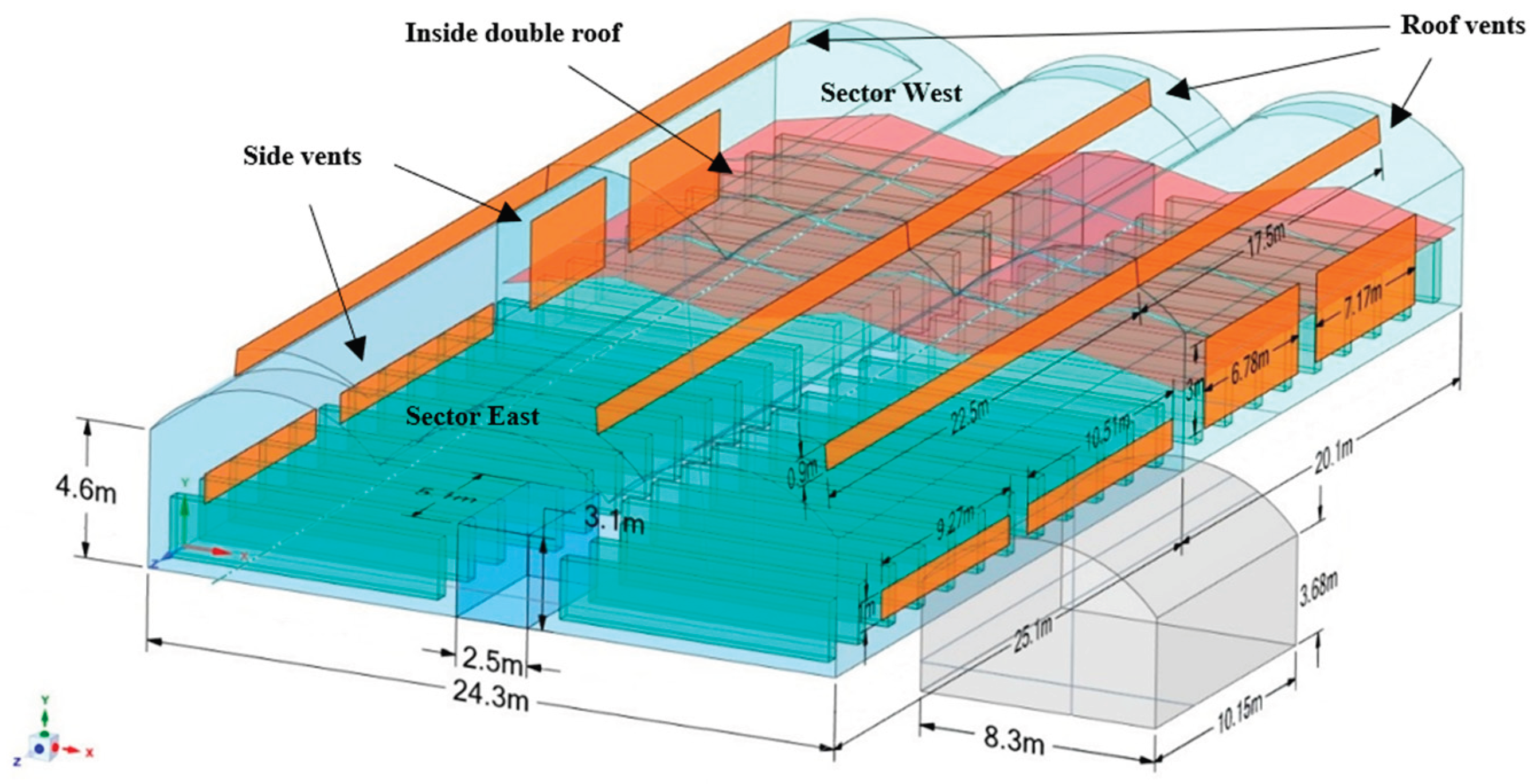
Figure 2.
Crops in the West sector with double roof with sunlight spectrum photoconverter film (a) and 3 m high side vents (b). East sector with single roof (c) and with 1 m high side vents (d).
Figure 2.
Crops in the West sector with double roof with sunlight spectrum photoconverter film (a) and 3 m high side vents (b). East sector with single roof (c) and with 1 m high side vents (d).
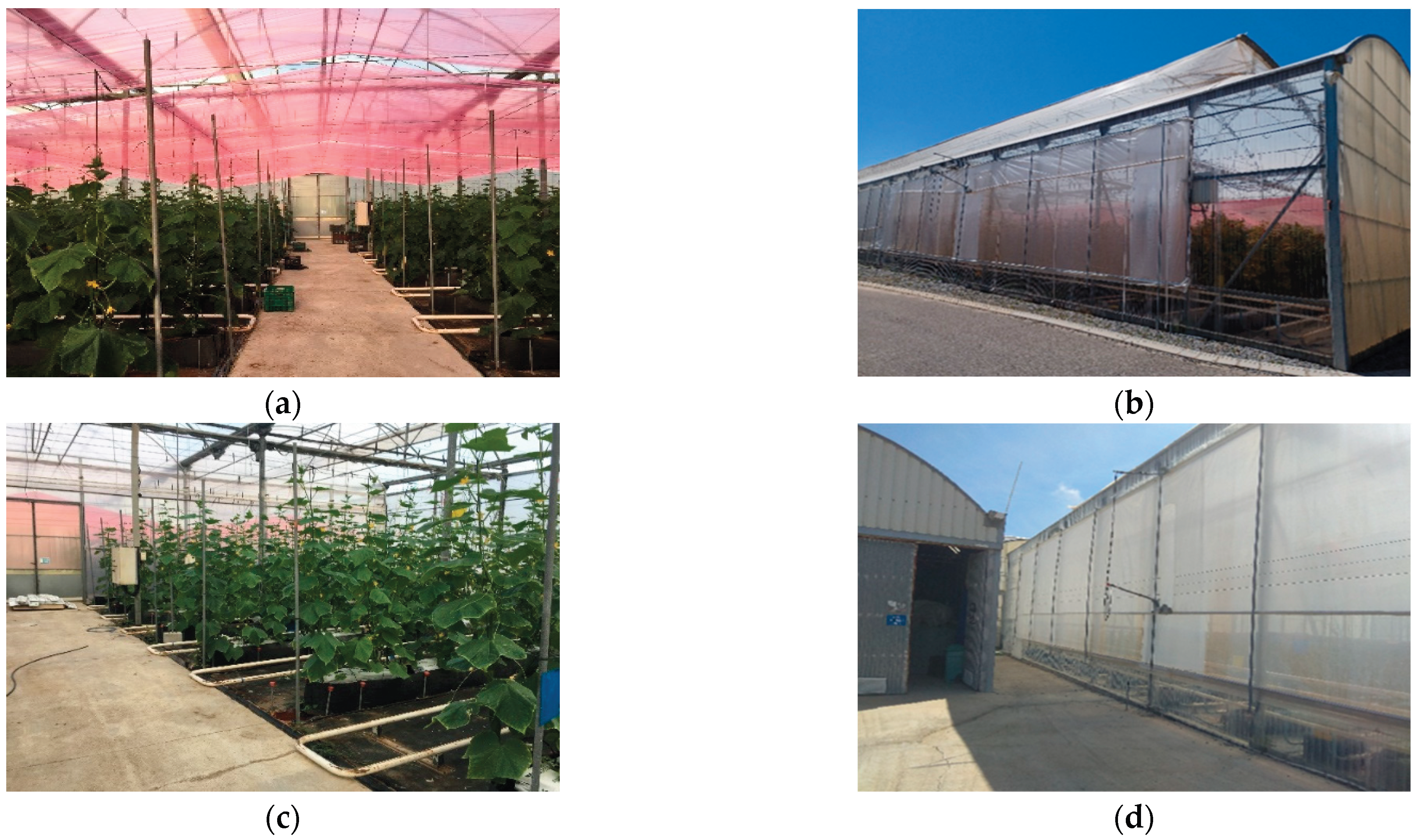
Figure 3.
Locations of the plant plot used to measure the percentage of fungal diseases.
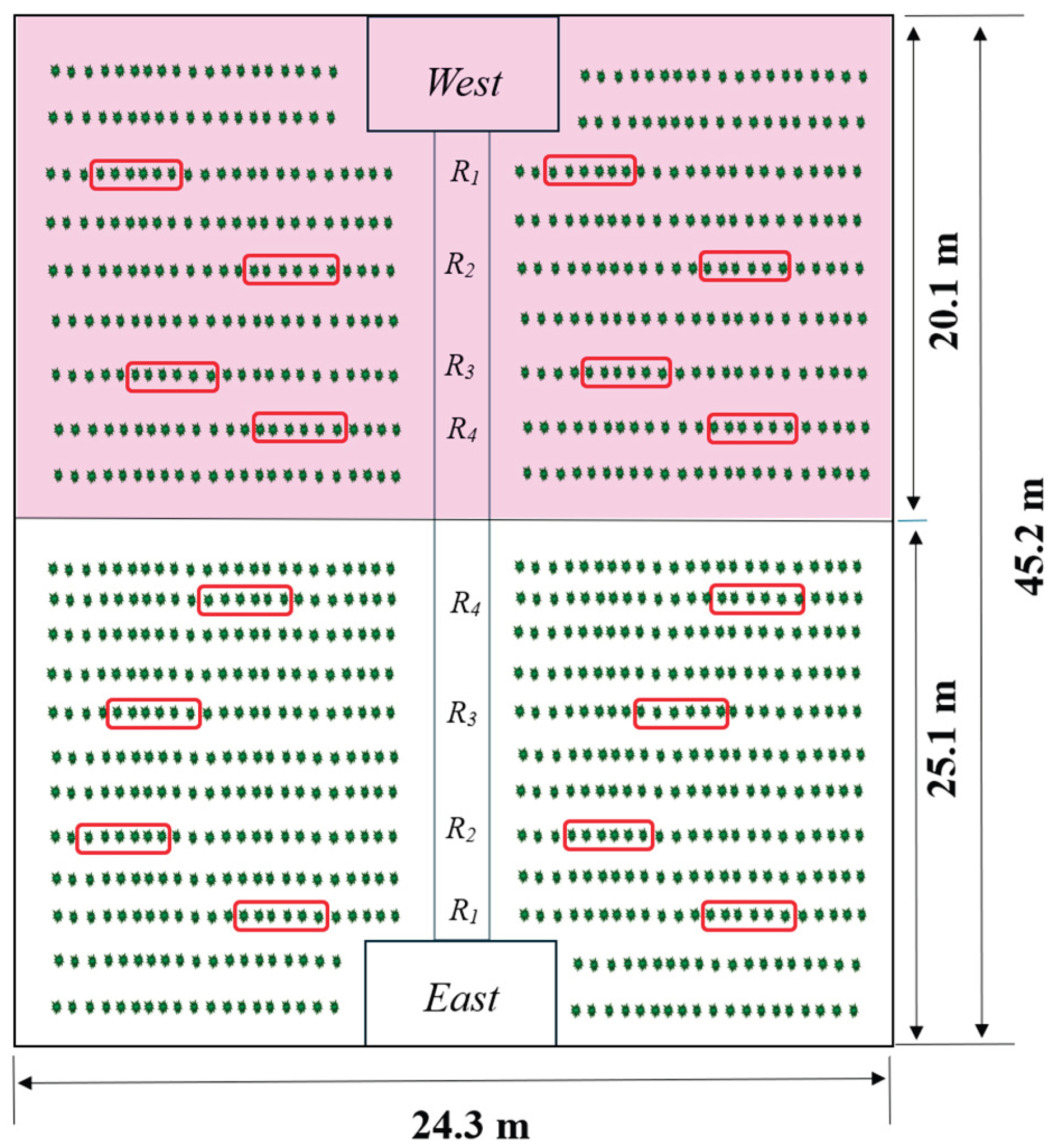
Figure 4.
Evolution of values of temperature (a) and absolute humidity (b) outside the greenhouse (–––) and average (-—-), maximum (-—-) and minimum (-—-) inside of the West sector with double roof and increased side vents and average (–––), maximum (–––) and minimum (–––) inside the East sector with single roof and standard side vents. Cucumber season 2020/21.
Figure 4.
Evolution of values of temperature (a) and absolute humidity (b) outside the greenhouse (–––) and average (-—-), maximum (-—-) and minimum (-—-) inside of the West sector with double roof and increased side vents and average (–––), maximum (–––) and minimum (–––) inside the East sector with single roof and standard side vents. Cucumber season 2020/21.
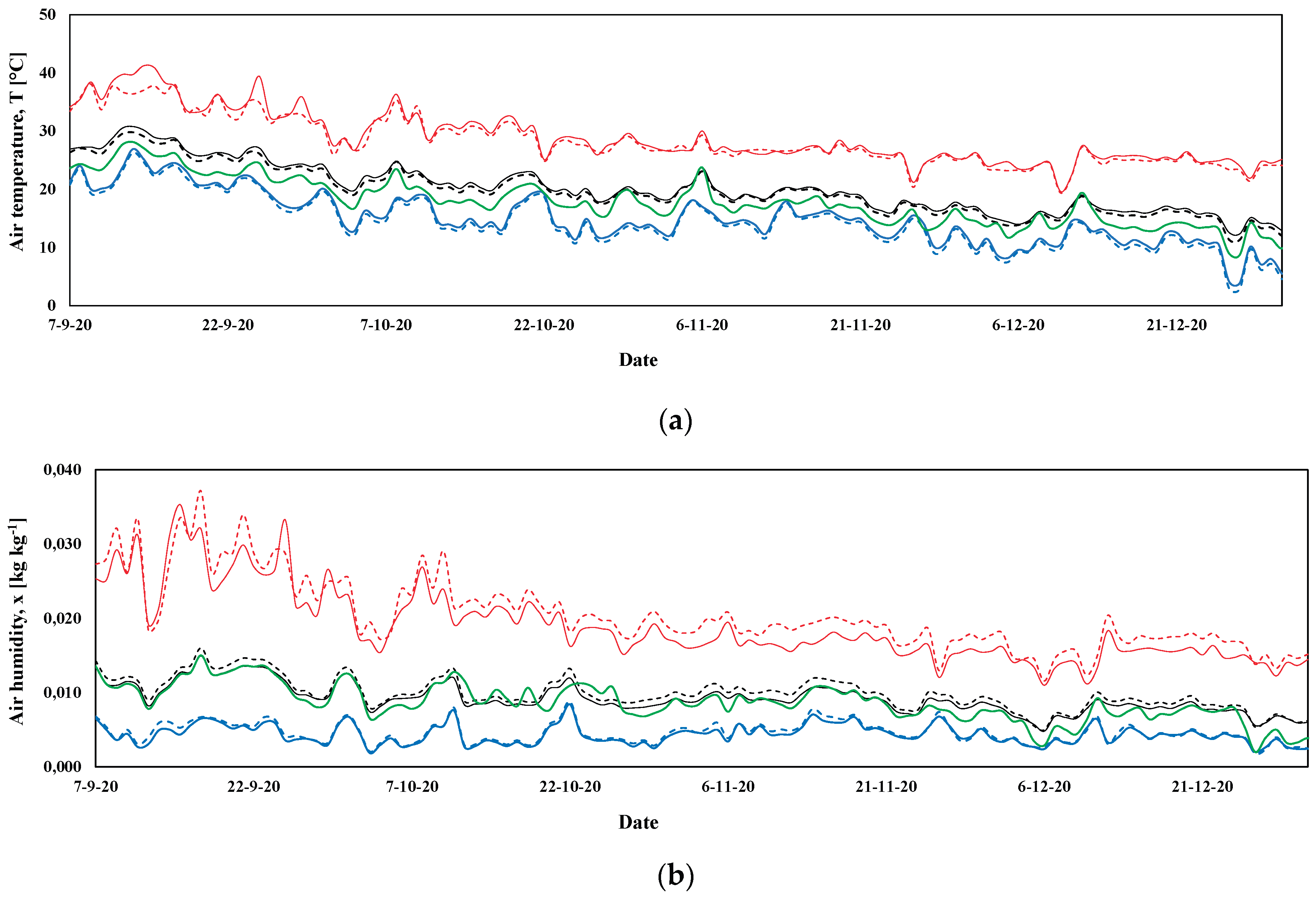
Figure 5.
Evolution of values of temperature (a) and absolute humidity (b) outside the greenhouse (–––) and average (- - -), maximum (- - -) and minimum (- - -) inside of the West sector with double roof and increased side vents and average (–––), maximum (–––) and minimum (–––) inside the East sector with single roof and standard side vents. Cucumber season 2021/22.
Figure 5.
Evolution of values of temperature (a) and absolute humidity (b) outside the greenhouse (–––) and average (- - -), maximum (- - -) and minimum (- - -) inside of the West sector with double roof and increased side vents and average (–––), maximum (–––) and minimum (–––) inside the East sector with single roof and standard side vents. Cucumber season 2021/22.
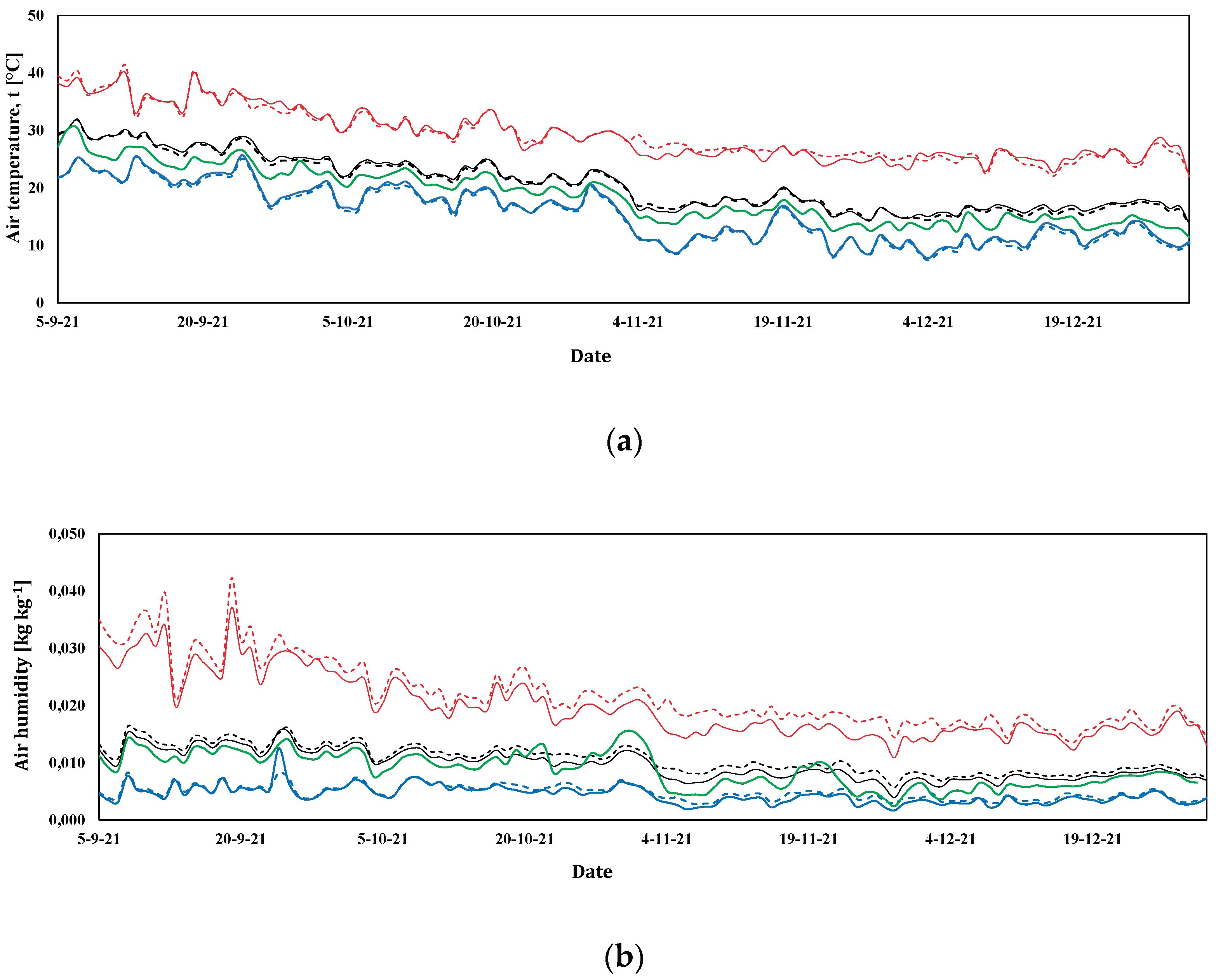
Figure 6.
Evolution of values of temperature (a) and absolute humidity (b) outside the greenhouse (–––) and average (- - -), maximum (- - -) and minimum (- - -) inside of the West sector with double roof and increased side vents and average (–––), maximum (–––) and minimum (–––) inside the East sector with single roof and standard side vents. Tomato season 2021.
Figure 6.
Evolution of values of temperature (a) and absolute humidity (b) outside the greenhouse (–––) and average (- - -), maximum (- - -) and minimum (- - -) inside of the West sector with double roof and increased side vents and average (–––), maximum (–––) and minimum (–––) inside the East sector with single roof and standard side vents. Tomato season 2021.
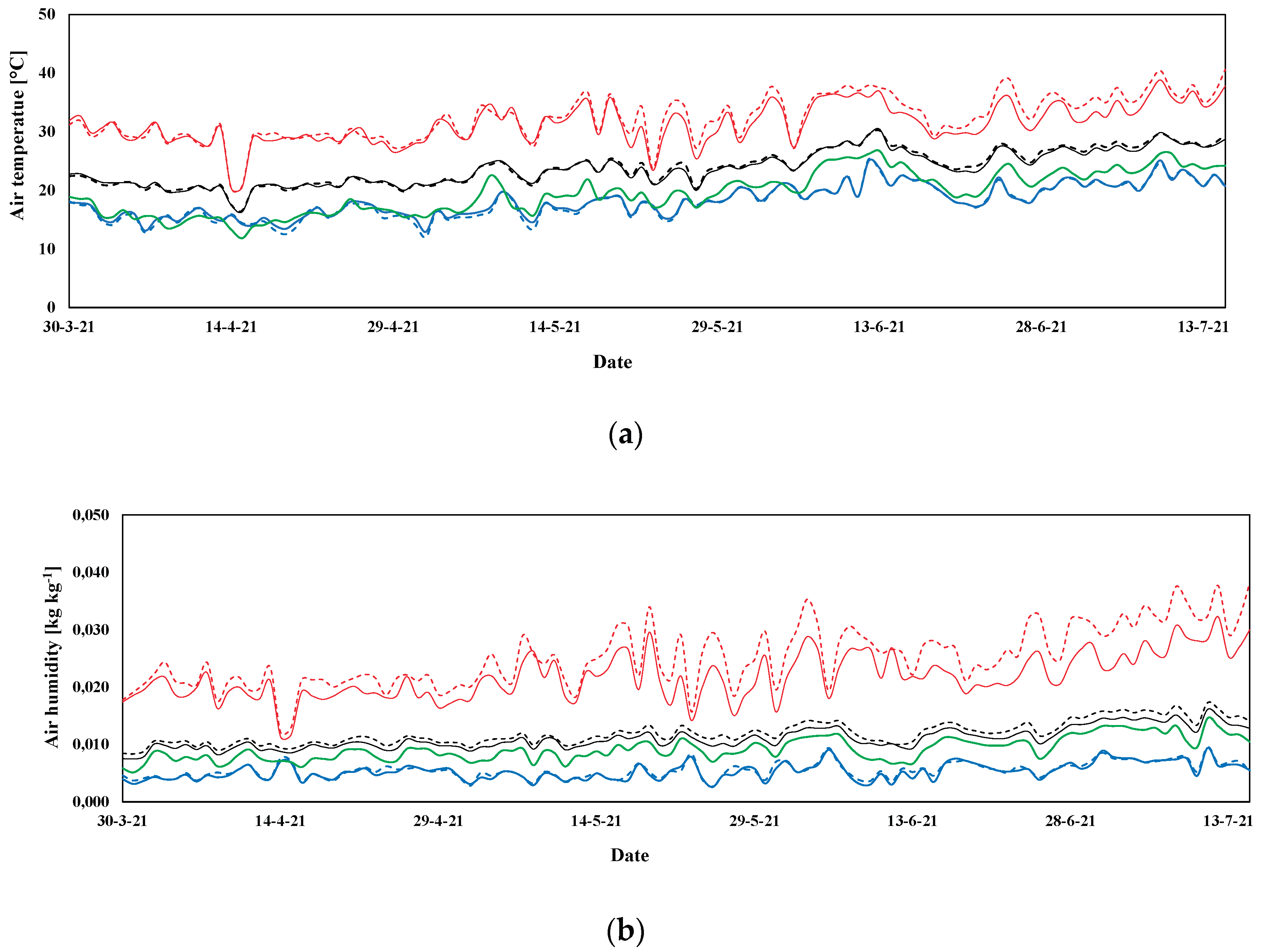
Figure 7.
Evolution of values of temperature (a) and absolute humidity (b) outside the greenhouse (–––) and average (- - -), maximum (- - -) and minimum (- - -) inside of the West sector with double roof and increased side vents and average (–––), maximum (–––) and minimum (–––) inside the East sector with single roof and standard side vents. Pepper season 2022.
Figure 7.
Evolution of values of temperature (a) and absolute humidity (b) outside the greenhouse (–––) and average (- - -), maximum (- - -) and minimum (- - -) inside of the West sector with double roof and increased side vents and average (–––), maximum (–––) and minimum (–––) inside the East sector with single roof and standard side vents. Pepper season 2022.
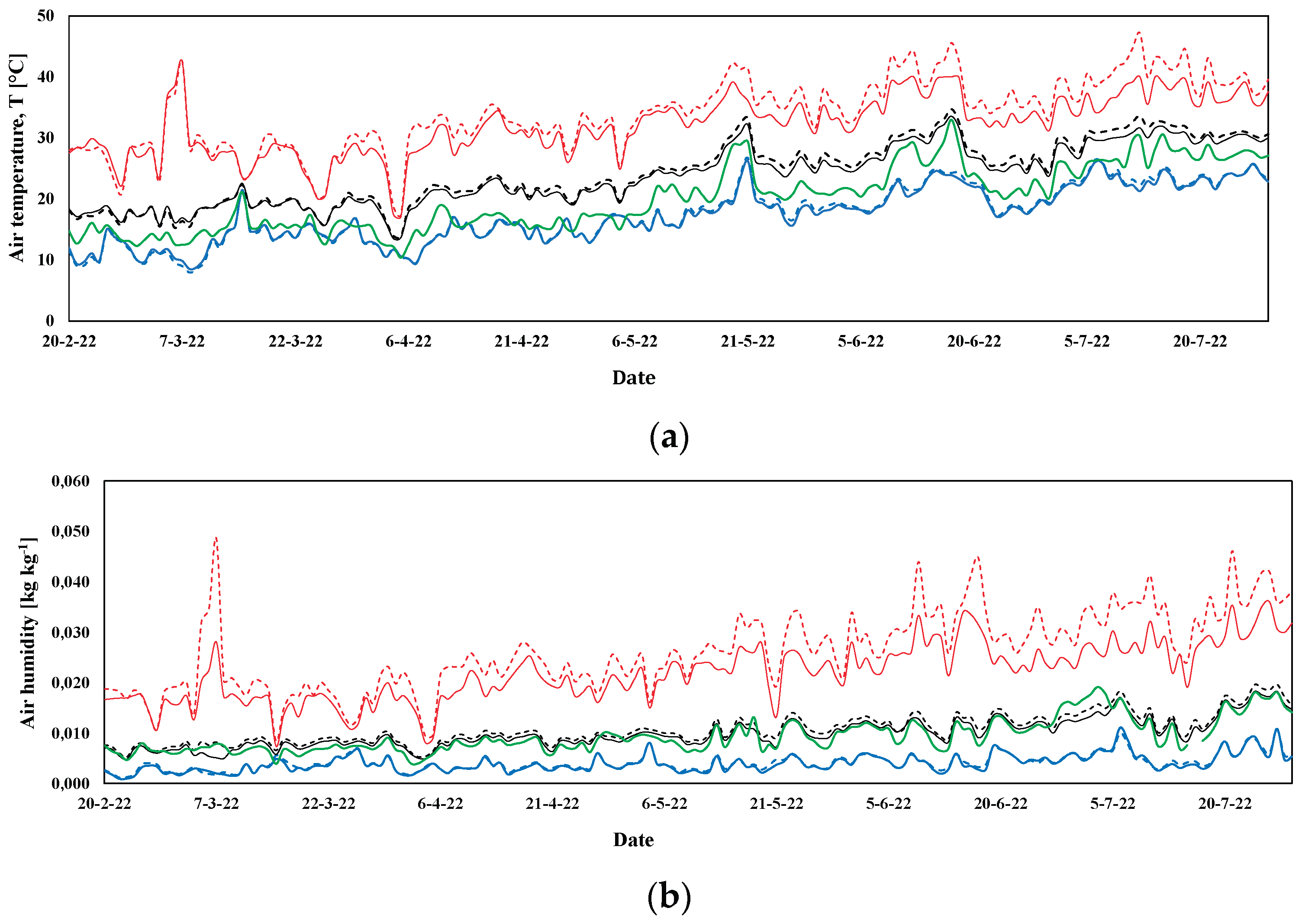
Figure 8.
Powdery mildew in tomato (a) and pepper (b); heavy powdery mildew attack in tomato with single roof area (c); heavy powdery mildew in pepper, with defoliation, in single roof area (d).
Figure 8.
Powdery mildew in tomato (a) and pepper (b); heavy powdery mildew attack in tomato with single roof area (c); heavy powdery mildew in pepper, with defoliation, in single roof area (d).
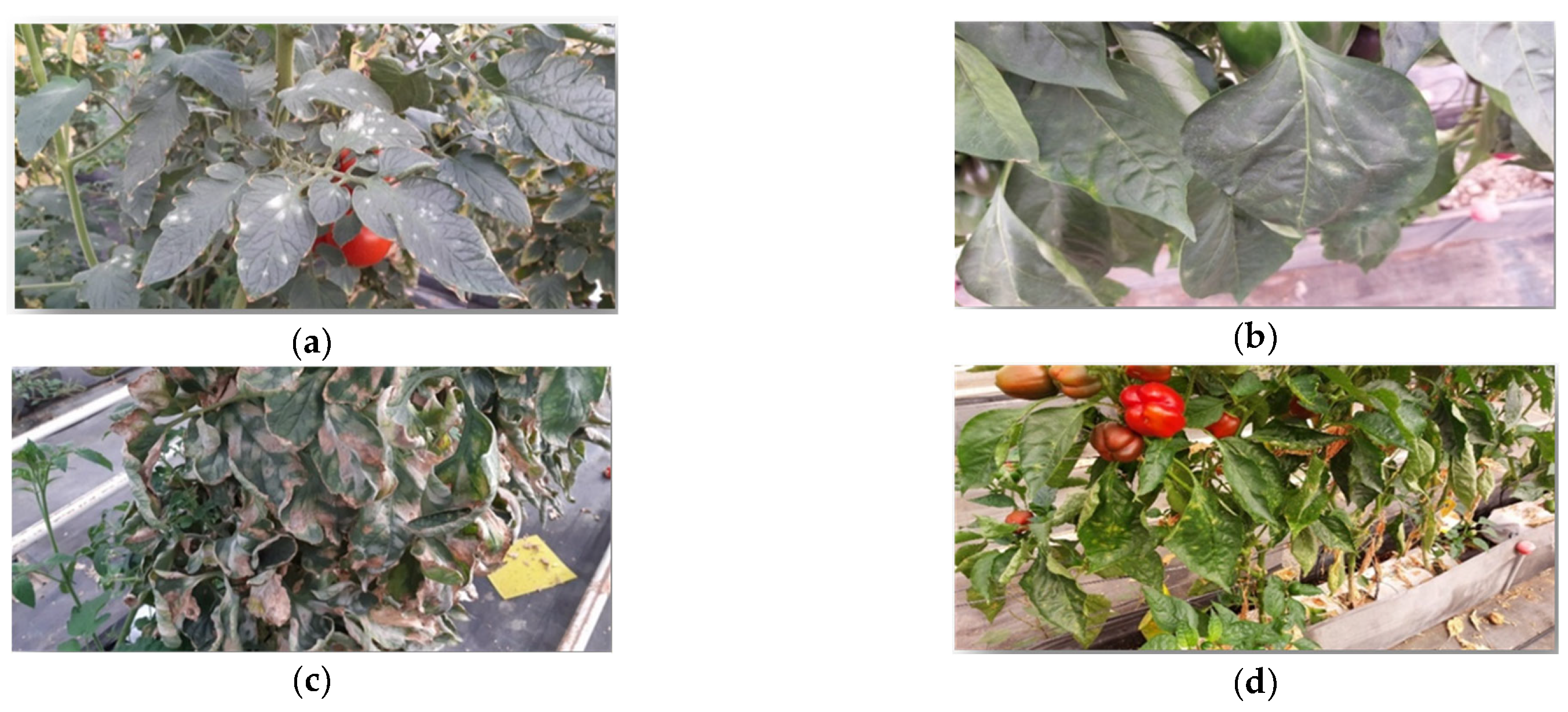
Figure 9.
Development of the percentage of powdery mildew infection (Podosphaera xanthii) over time first crop cycle of cucumber 2020: Standard irrigation (a) and deficit irrigation (b). Sector with double roof with sunlight spectrum photoconverter film and increased lateral vents (□); Sector with single roof and standard lateral vents (○). Different letters indicate a statistically significant difference (p-value = 0.95).
Figure 9.
Development of the percentage of powdery mildew infection (Podosphaera xanthii) over time first crop cycle of cucumber 2020: Standard irrigation (a) and deficit irrigation (b). Sector with double roof with sunlight spectrum photoconverter film and increased lateral vents (□); Sector with single roof and standard lateral vents (○). Different letters indicate a statistically significant difference (p-value = 0.95).
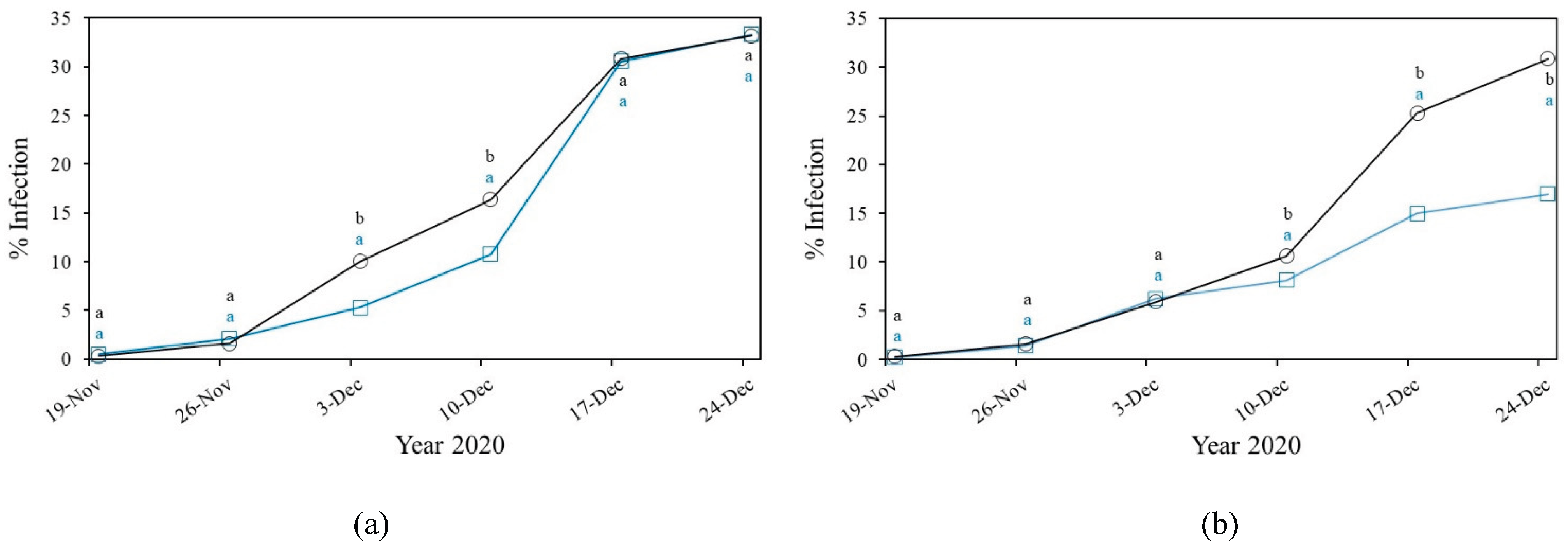
Figure 10.
Development of the percentage of powdery mildew infection (Podosphaera xanthii) over time of the second crop cycle 2021: Standard irrigation (a) and deficit irrigation (b). Sector with double roof with sunlight spectrum photoconverter film and increased lateral vents (□); Sector with single roof and standard lateral vents (○). Different letters indicate a statistically significant difference (p-value = 0.95).
Figure 10.
Development of the percentage of powdery mildew infection (Podosphaera xanthii) over time of the second crop cycle 2021: Standard irrigation (a) and deficit irrigation (b). Sector with double roof with sunlight spectrum photoconverter film and increased lateral vents (□); Sector with single roof and standard lateral vents (○). Different letters indicate a statistically significant difference (p-value = 0.95).
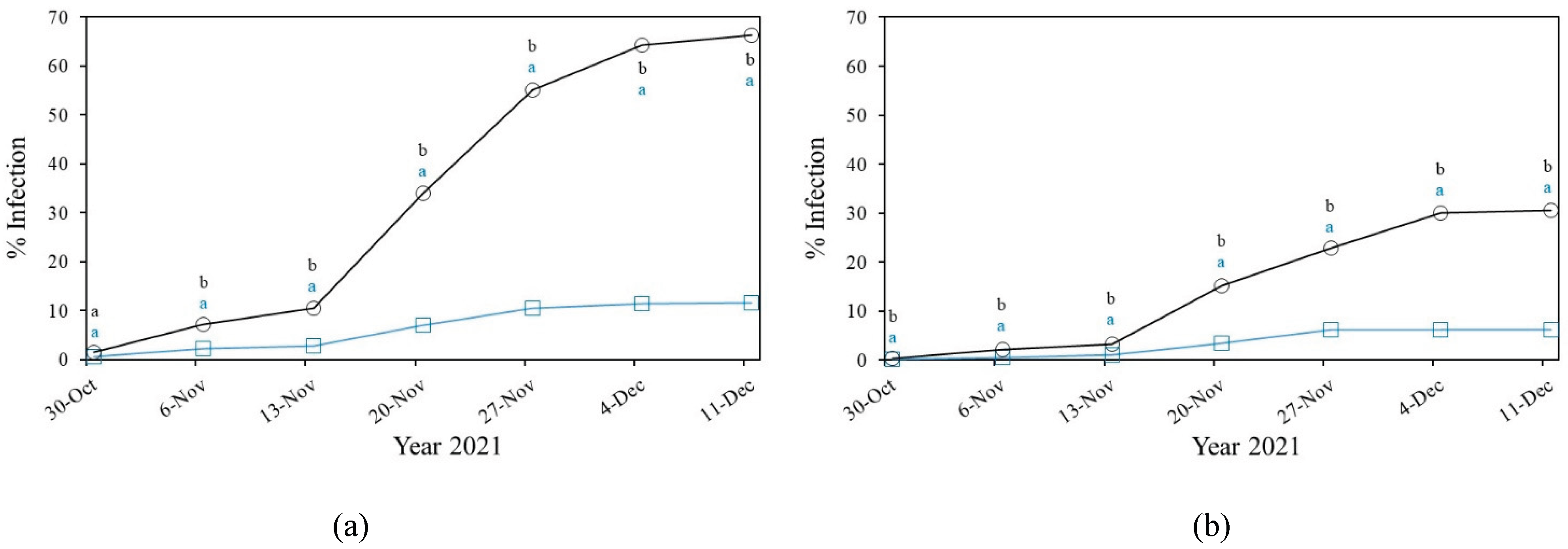
Figure 11.
Development of the percentage of powdery mildew infection (Leveillula taurica) over time in the tomato crop cycle 2021: Standard irrigation (a) and deficit irrigation (b). Sector with double roof with sunlight spectrum photoconverter film and increased lateral vents (□); Sector with single roof and standard lateral vents (○). Different letters indicate a statistically significant difference (p-value = 0.95).
Figure 11.
Development of the percentage of powdery mildew infection (Leveillula taurica) over time in the tomato crop cycle 2021: Standard irrigation (a) and deficit irrigation (b). Sector with double roof with sunlight spectrum photoconverter film and increased lateral vents (□); Sector with single roof and standard lateral vents (○). Different letters indicate a statistically significant difference (p-value = 0.95).
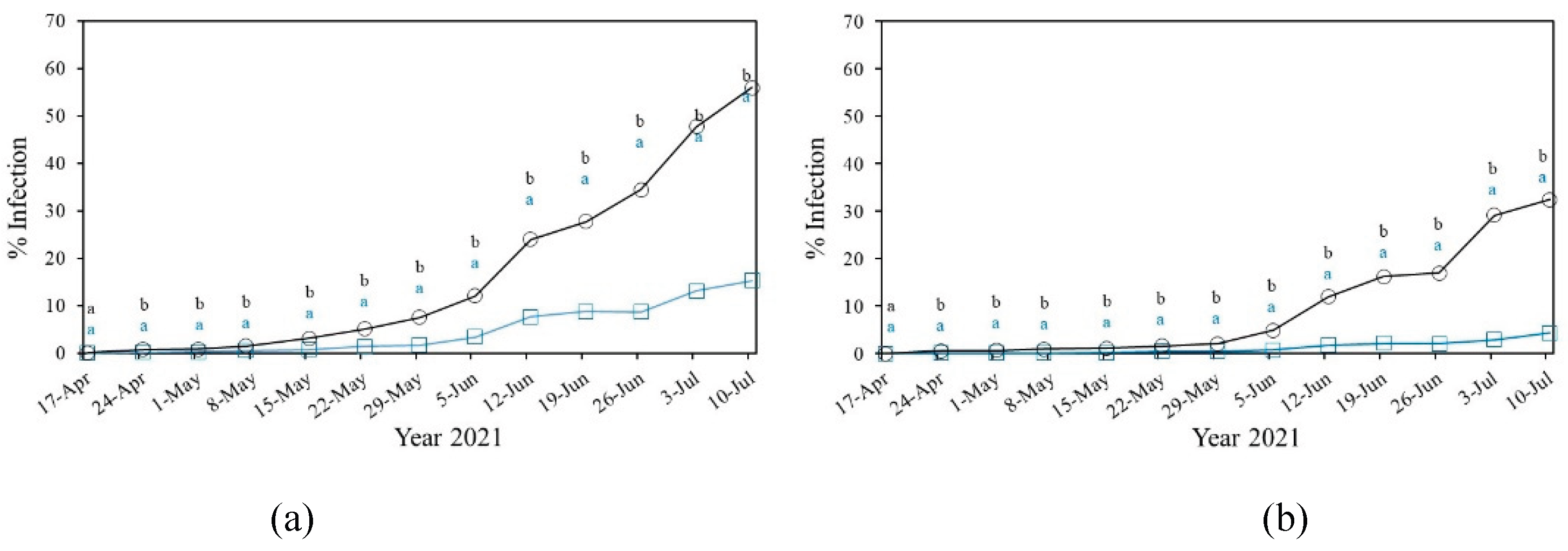
Figure 12.
Development of the percentage of powdery mildew (Leveillula taurica) infection over time in the pepper crop cycle 2022: Standard irrigation (a) and deficit irrigation (b). Sector with double roof with sunlight spectrum photoconverter film and increased lateral vents (□); Sector with single roof and standard lateral vents (○). Different letters indicate a statistically significant difference (p-value = 0.95).
Figure 12.
Development of the percentage of powdery mildew (Leveillula taurica) infection over time in the pepper crop cycle 2022: Standard irrigation (a) and deficit irrigation (b). Sector with double roof with sunlight spectrum photoconverter film and increased lateral vents (□); Sector with single roof and standard lateral vents (○). Different letters indicate a statistically significant difference (p-value = 0.95).
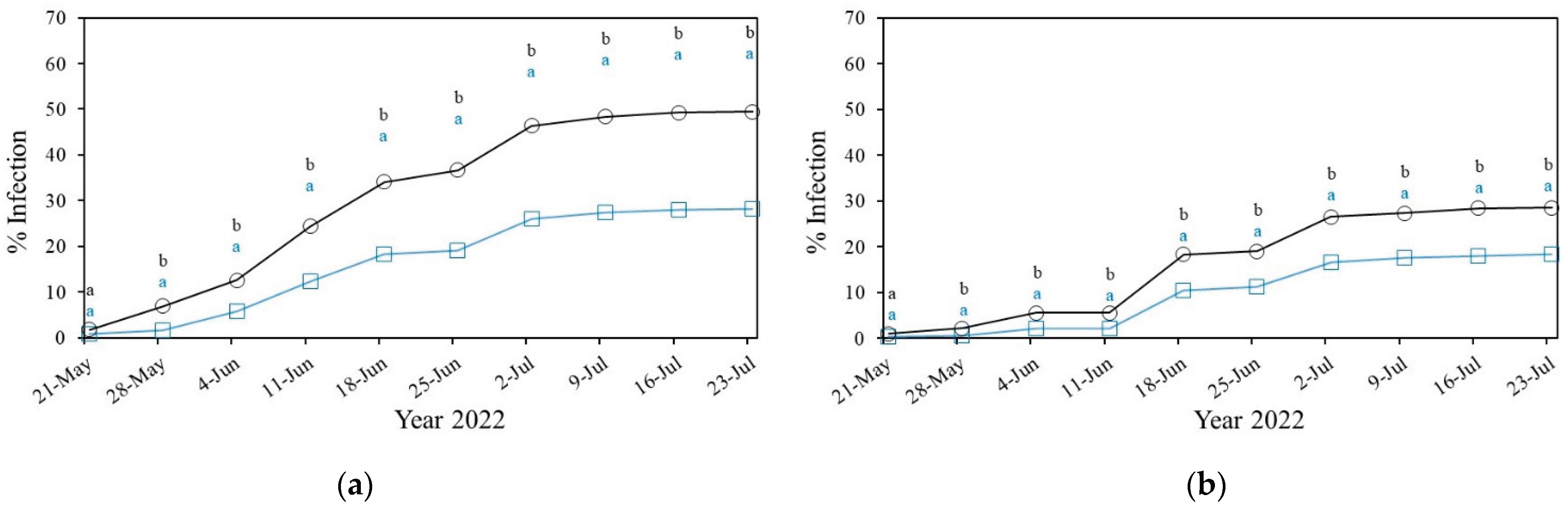
Figure 13.
Development of the percentage of downy mildew (Pseudoperonospora cubensis) infection over time first cucumber crop 2020: Standard irrigation (a) and deficit irrigation (b). Sector with double roof with sunlight spectrum photoconverter film and increased lateral vents (□); Sector with single roof and standard lateral vents (○). Different letters indicate a statistically significant difference (p-value = 0.95).
Figure 13.
Development of the percentage of downy mildew (Pseudoperonospora cubensis) infection over time first cucumber crop 2020: Standard irrigation (a) and deficit irrigation (b). Sector with double roof with sunlight spectrum photoconverter film and increased lateral vents (□); Sector with single roof and standard lateral vents (○). Different letters indicate a statistically significant difference (p-value = 0.95).
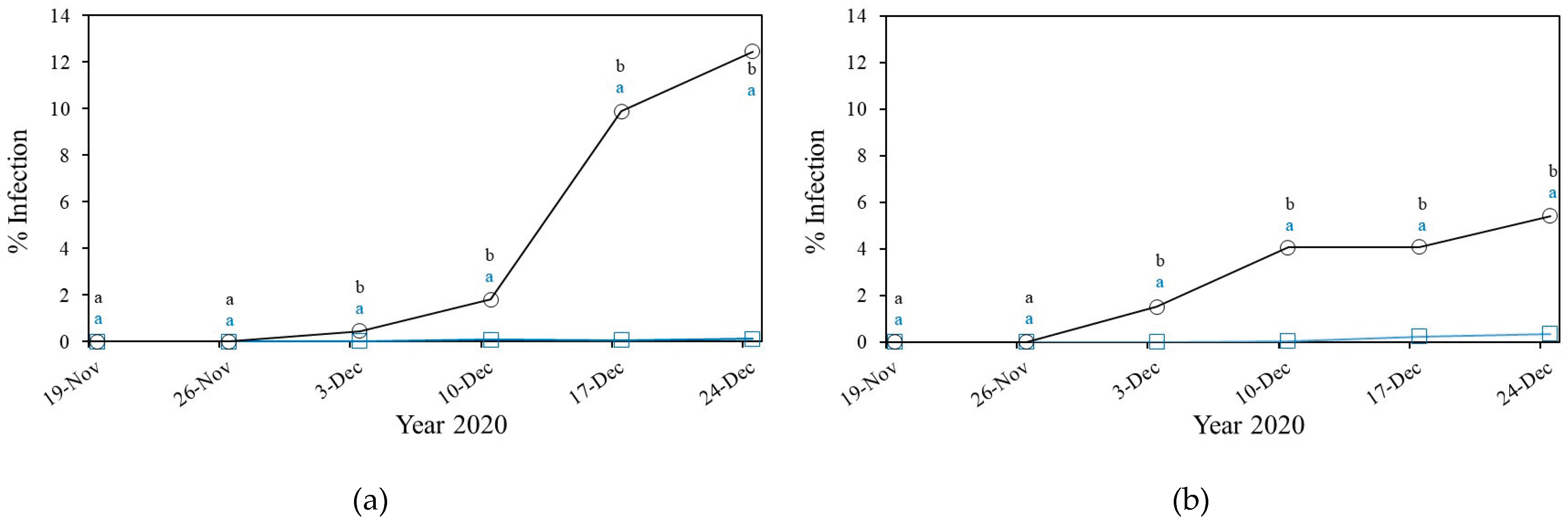
Figure 14.
Development of the percentage of downy mildew (Pseudoperonospora cubensis) infection over time in the second cucumber crop cycle 2021: Standard irrigation (a) and deficit irrigation (b). Sector with double roof with sunlight spectrum photoconverter film and increased lateral vents (□); Sector with single roof and standard lateral vents (○). Different letters indicate a statistically significant difference (p-value = 0.95).
Figure 14.
Development of the percentage of downy mildew (Pseudoperonospora cubensis) infection over time in the second cucumber crop cycle 2021: Standard irrigation (a) and deficit irrigation (b). Sector with double roof with sunlight spectrum photoconverter film and increased lateral vents (□); Sector with single roof and standard lateral vents (○). Different letters indicate a statistically significant difference (p-value = 0.95).
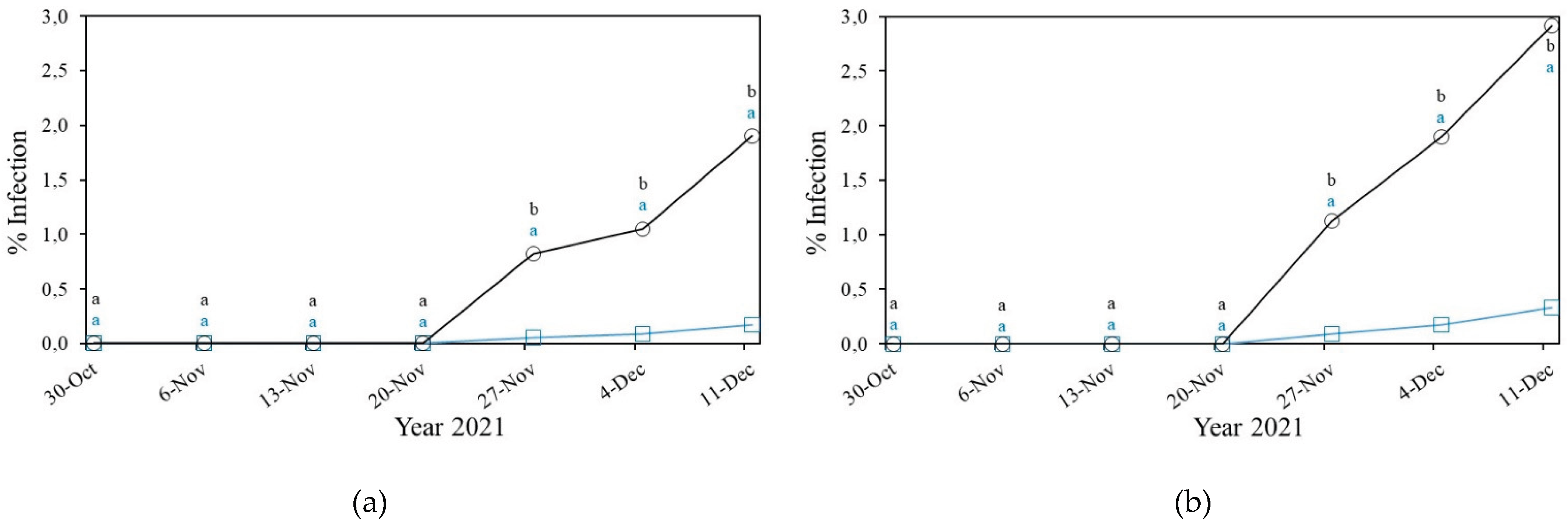
Figure 15.
Development of the percentage of gummy stem blight (Stagonosporopsis cucurbitacearum) infection over time first cucumber crop cycle 2020: Standard (a) and deficit irrigation (b). Sector with double roof with sunlight spectrum photoconverter film and increased lateral vents (□); Sector with single roof and standard lateral vents (○). Different letters indicate a statistically significant difference (p-value = 0.95).
Figure 15.
Development of the percentage of gummy stem blight (Stagonosporopsis cucurbitacearum) infection over time first cucumber crop cycle 2020: Standard (a) and deficit irrigation (b). Sector with double roof with sunlight spectrum photoconverter film and increased lateral vents (□); Sector with single roof and standard lateral vents (○). Different letters indicate a statistically significant difference (p-value = 0.95).
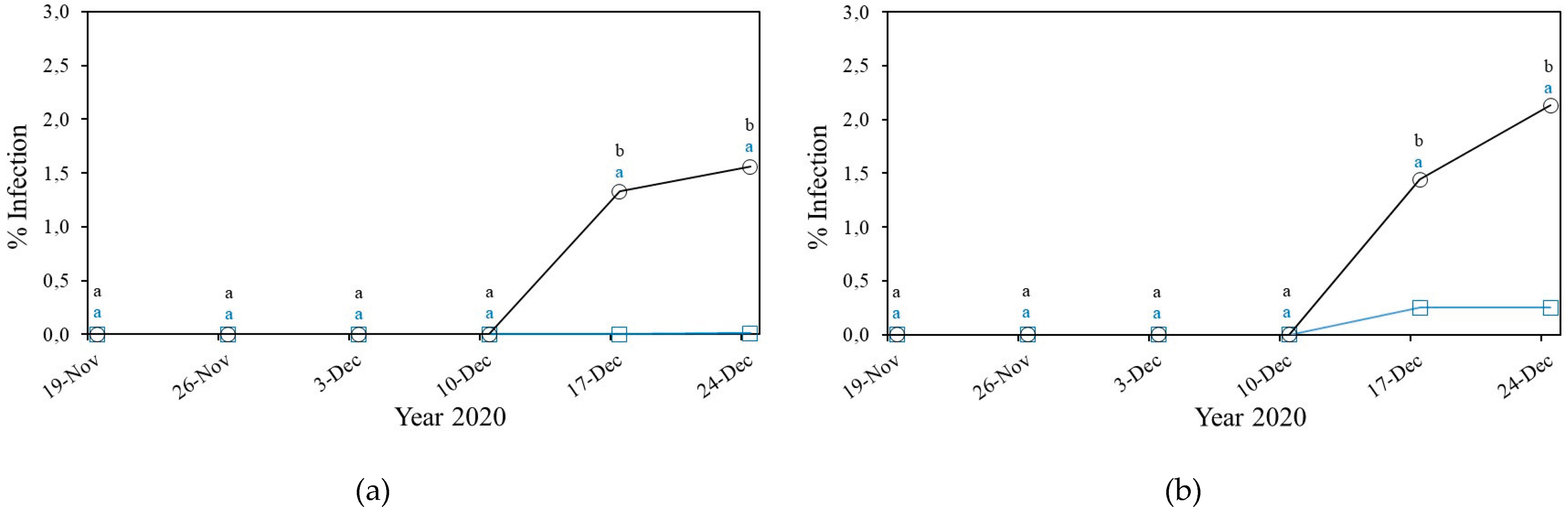
Figure 16.
Development of the percentage of gummy stem blight (Stagonosporopsis cucurbitacearum) infection over time second cucumber crop cycle 2021: Standard (a) and deficit irrigation (b). Sector with double roof with sunlight spectrum photoconverter film and increased lateral vents (□); Sector with single roof and standard lateral vents (○). Different letters indicate a statistically significant difference (p-value = 0.95).
Figure 16.
Development of the percentage of gummy stem blight (Stagonosporopsis cucurbitacearum) infection over time second cucumber crop cycle 2021: Standard (a) and deficit irrigation (b). Sector with double roof with sunlight spectrum photoconverter film and increased lateral vents (□); Sector with single roof and standard lateral vents (○). Different letters indicate a statistically significant difference (p-value = 0.95).
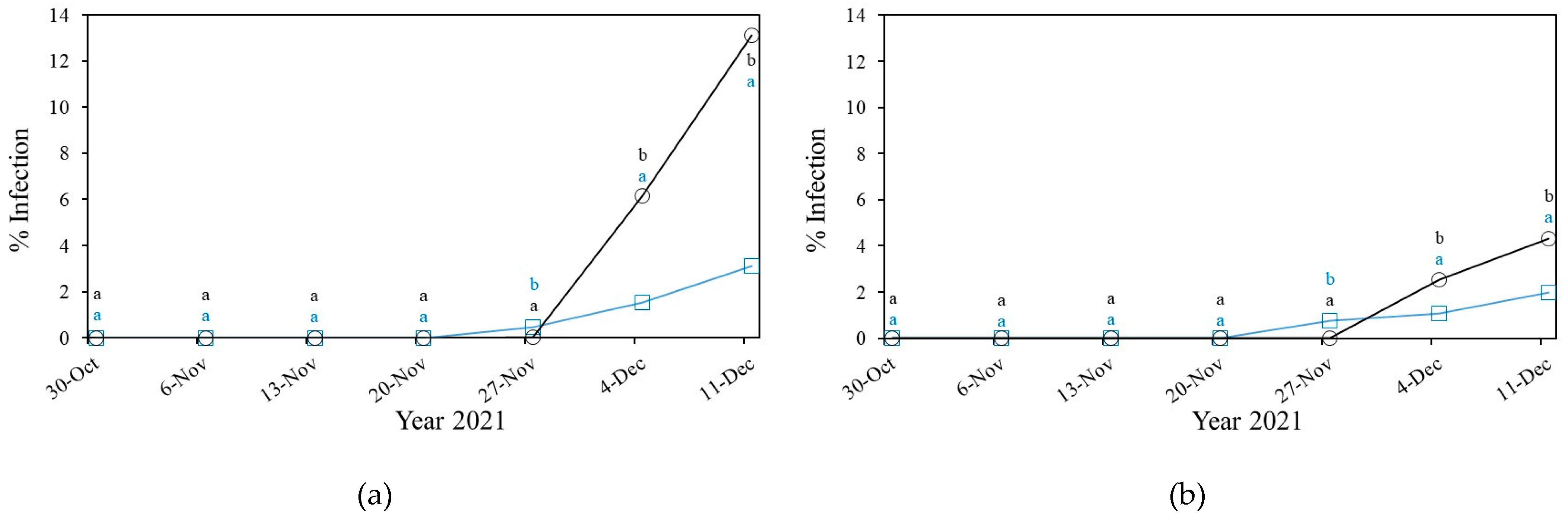
Figure 17.
Development of the percentage of early blight in tomato (Alternaria solani) infection over time second tomato crop cycle 2021: Standard irrigation (a) and deficit irrigation (b Sector with double roof with sunlight spectrum photoconverter film and increased lateral vents (□); Sector with single roof and standard lateral vents (○). Different letters indicate a statistically significant difference (p-value = 0.95).
Figure 17.
Development of the percentage of early blight in tomato (Alternaria solani) infection over time second tomato crop cycle 2021: Standard irrigation (a) and deficit irrigation (b Sector with double roof with sunlight spectrum photoconverter film and increased lateral vents (□); Sector with single roof and standard lateral vents (○). Different letters indicate a statistically significant difference (p-value = 0.95).
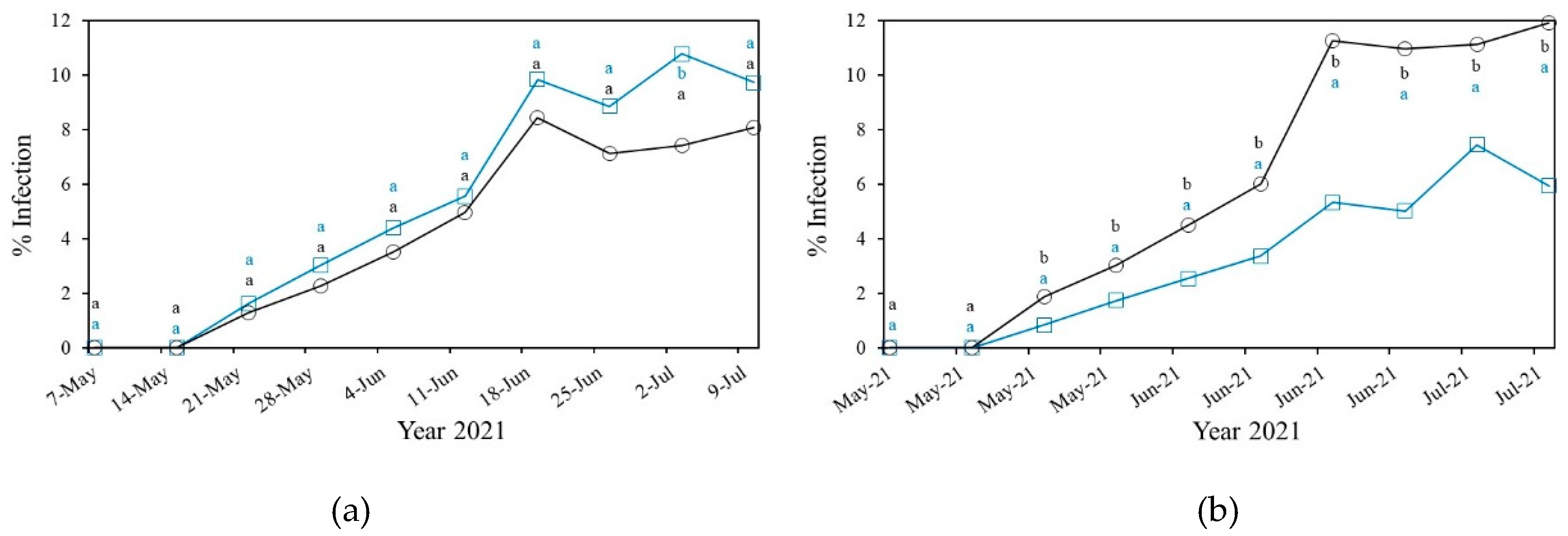

Table 1.
Characteristics of the two sectors of the experimental greenhouse. Greenhouse surface, SC [m2]; side ventilation surface, SVS [m2]; roof ventilation surface, SVR [m2]; ratio of ventilation surface/greenhouse surface SV/SC [%].
Table 1.
Characteristics of the two sectors of the experimental greenhouse. Greenhouse surface, SC [m2]; side ventilation surface, SVS [m2]; roof ventilation surface, SVR [m2]; ratio of ventilation surface/greenhouse surface SV/SC [%].
| Sector | Double roof type | Dimensions | SC | SVS | SVR | SV/SC |
|---|---|---|---|---|---|---|
| West | Spectrum conversion film | 24.3 m × 20.1 m | 480 | 77.49 | 47.25 | 26.0 |
| East | Without double roof | 24.3 m × 25.1 m | 600 | 38.90 | 60.75 | 16.6 |
Table 2.
Description of the experimental crops, varieties and key dates.
| Crop | Commercial Variety | Data of Transplant | Double Roof Installation | Final Crop Data |
|---|---|---|---|---|
| Cucumber (Cucumis sativus L) | Insula RZ F1 | 07/09/2020 | 12/10/2020 | 02/01/2021 |
| Tomato (Solanum lycopersicum L) | Ramyle RZ F1 | 07/02/2021 | 28/01/2021 | 15/07/2021 |
| Cucumber (Cucumis sativus L) | Insula RZ F1 | 05/09/2021 | 20/10/2021 | 02/01/2022 |
| Pepper (Capsicum annuum L.) | Bemol RZ F1 | 20/02/2022 | 19/02/2022 | 29/07/2022 |
Table 3.
Fungicide applications carried out over the four crop seasons.
| Crop | Active substance | Application data | Applied dose | Application method |
|---|---|---|---|---|
| Cucumber 2020-21 | Azoxistrobin | 09/10/2020 | 45cc/100L | Aerial |
| Azoxistrobin | 05/11/2020 | 75cc/100L | Aerial | |
| Ciflufenamida | 17/11/2020 | 20cc/100L | Aerial | |
| Azoxistrobin | 25/11/2020 | 75cc/100L | Aerial | |
| Sulphur | 01/12/2020 | 300cc/100L | Aerial | |
| Metrafenona | 01/12/2020 | 30cc/100L | Aerial | |
| Tomato 2021 | Sulphur | 17/04/2021 | 150cc/100L | Aerial |
| Cucumber 202-22 | Azoxistrobin | 01/11/2021 | 20cc/100L | Aerial |
| Azoxistrobin | 04/11/2021 | 70cc/100L | Aerial | |
| Azoxistrobin | 23/11/2021 | 80cc/100L | Aerial | |
| Pepper 2022 | Azoxistrobin | 08/06/2022 | 80cc/100L | Aerial |
| Azoxistrobin | 17/06/2022 | 80cc/100L | Aerial | |
| Metrafenona | 24/02/2022 | 30cc/100L | Aerial |
Disclaimer/Publisher’s Note: The statements, opinions and data contained in all publications are solely those of the individual author(s) and contributor(s) and not of MDPI and/or the editor(s). MDPI and/or the editor(s) disclaim responsibility for any injury to people or property resulting from any ideas, methods, instructions or products referred to in the content. |
© 2026 by the authors. Licensee MDPI, Basel, Switzerland. This article is an open access article distributed under the terms and conditions of the Creative Commons Attribution (CC BY) license (http://creativecommons.org/licenses/by/4.0/).
Copyright: This open access article is published under a Creative Commons CC BY 4.0 license, which permit the free download, distribution, and reuse, provided that the author and preprint are cited in any reuse.


