

Submitted:
02 January 2026
Posted:
05 January 2026
You are already at the latest version
Abstract
The conservation of culturally stratified heritage structures requires a holistic approach that balances the protection of historical integrity with the integration of contemporary functions. This study focuses on the Aya Payana Church, a late Ottoman rural ecclesiastical structure located in Isparta, Türkiye, as a case study to explore sustainable conservation and adaptive reuse strategies. Although the building retains much of its original physical fabric, its evolving uses—from sacred space to military storage and eventual abandonment—reflect a layered cultural narrative. In line with international conservation charters, intervention strategies were developed based on principles of minimal intervention, reversibility, and respect for historical authenticity. The adaptive reuse strategy involved transforming the site into a sensory-focused cultural facility, featuring a “Kokuhane” (scent museum) and a botanical garden cultivating local aromatic plants. This integration promotes active visitor engagement through laboratory workshops and enhances cultural continuity by linking traditional knowledge with contemporary experience. A transparent cafeteria structure was added with minimal visual impact, ensuring the preservation of the historical silhouette while improving visitor services. The proposed model demonstrates that sustainable conservation of culturally layered sites can be achieved through adaptive reuse strategies that prioritize historical integrity, cultural sustainability, and community engagement. The findings offer a replicable framework for future conservation projects aiming to revitalize underused rural heritage buildings while maintaining their cultural significance.
Keywords:
1. Introduction
2. Methodology
2.1. Documentation Process
2.2. Material Analyses
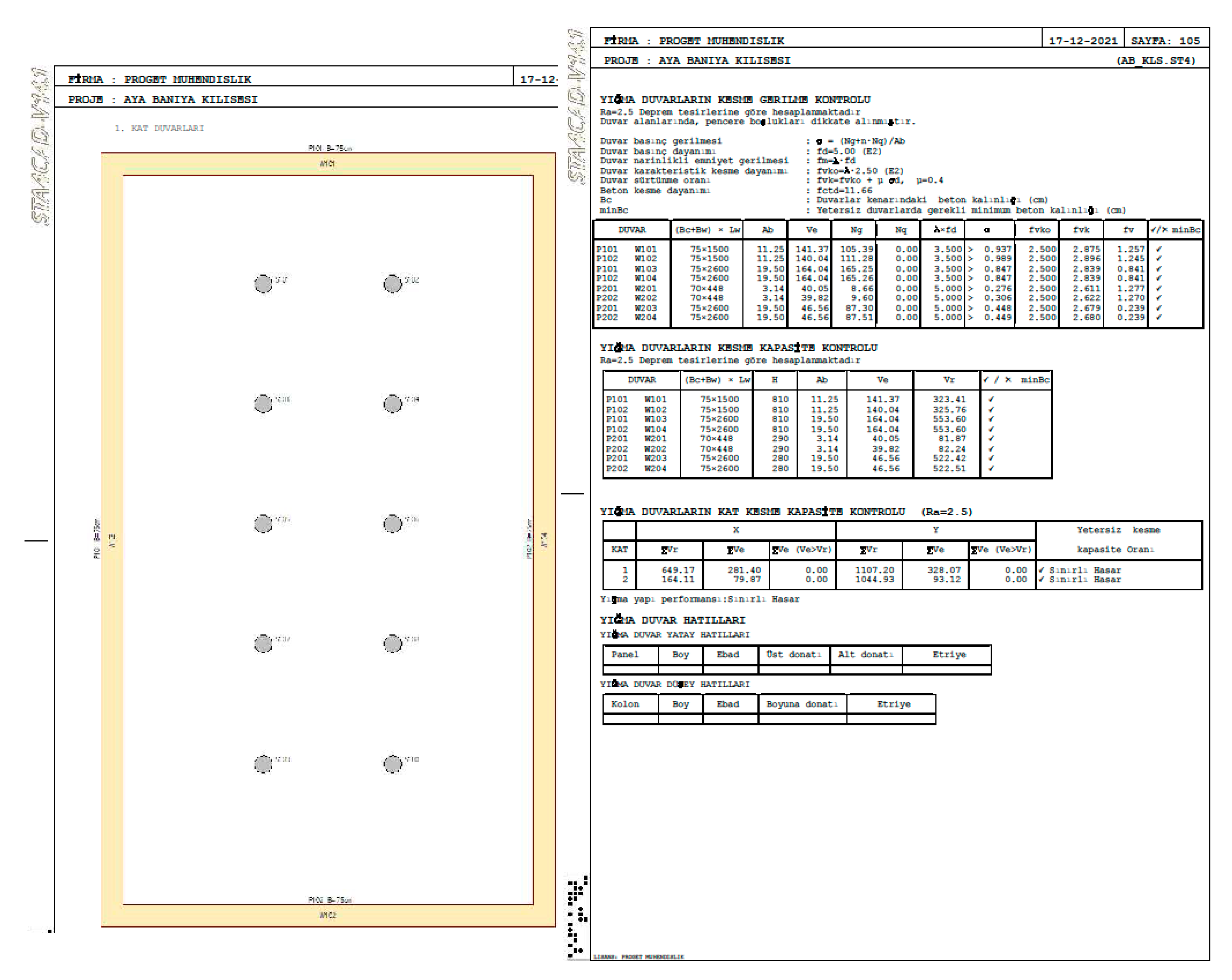
2.3. Structural System and Static Analysis
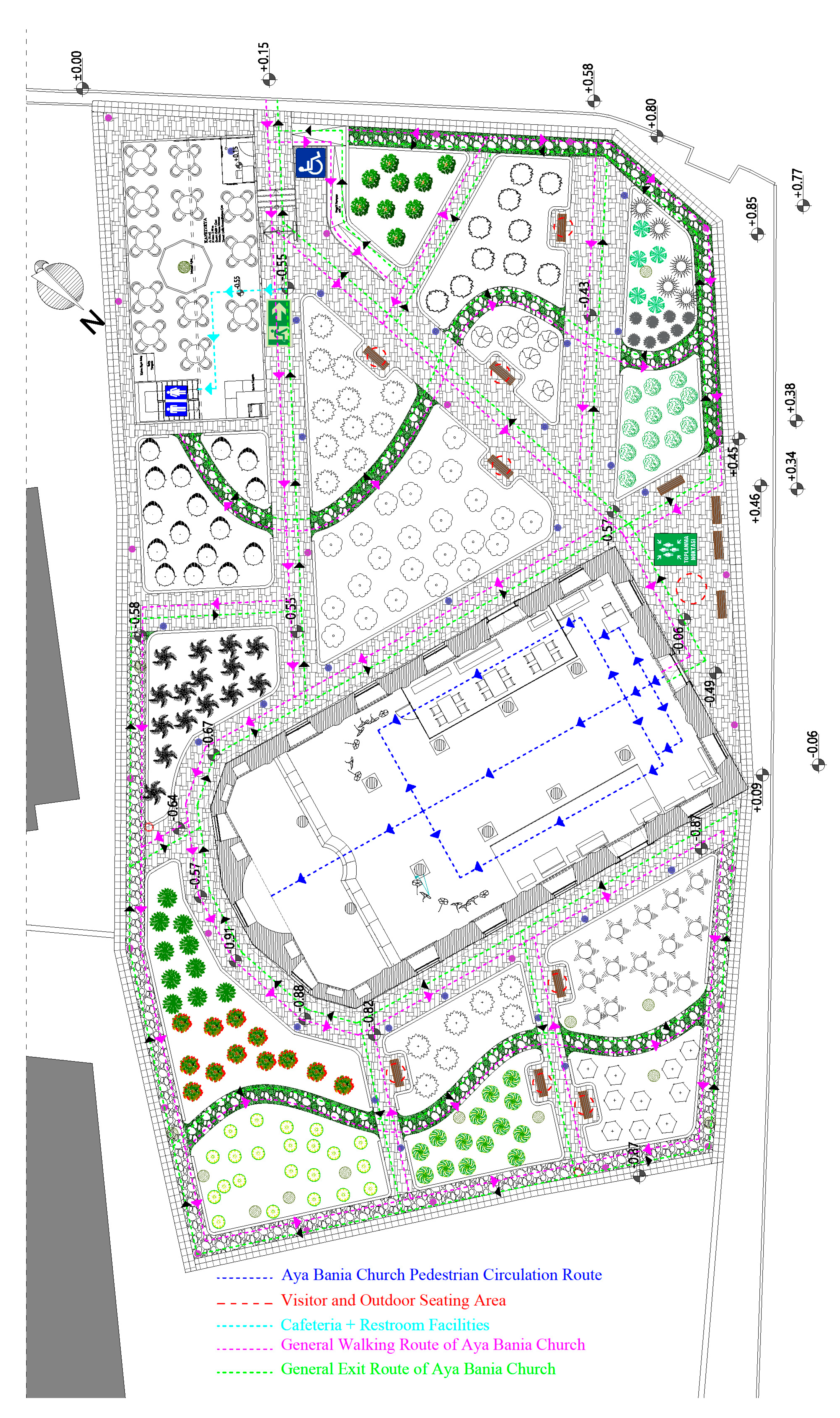
2.4. Adaptive Reuse Design Process
3. Documented Historical Layers and Current Condition Analysis
3.1. Characteristics of the Original Construction Period
3.2. Interventions and Alterations Over Time
- -
- Throughout its period of use, the Aya Payana Church was subjected to a series of minor-scale interventions. These include:
- -
- The narrowing of door and window openings,
- -
- Partial renewal of sections of the timber roof structure,
- -
- Replacement or partial modification of interior plaster coatings (Rodwell, 2008).
- -
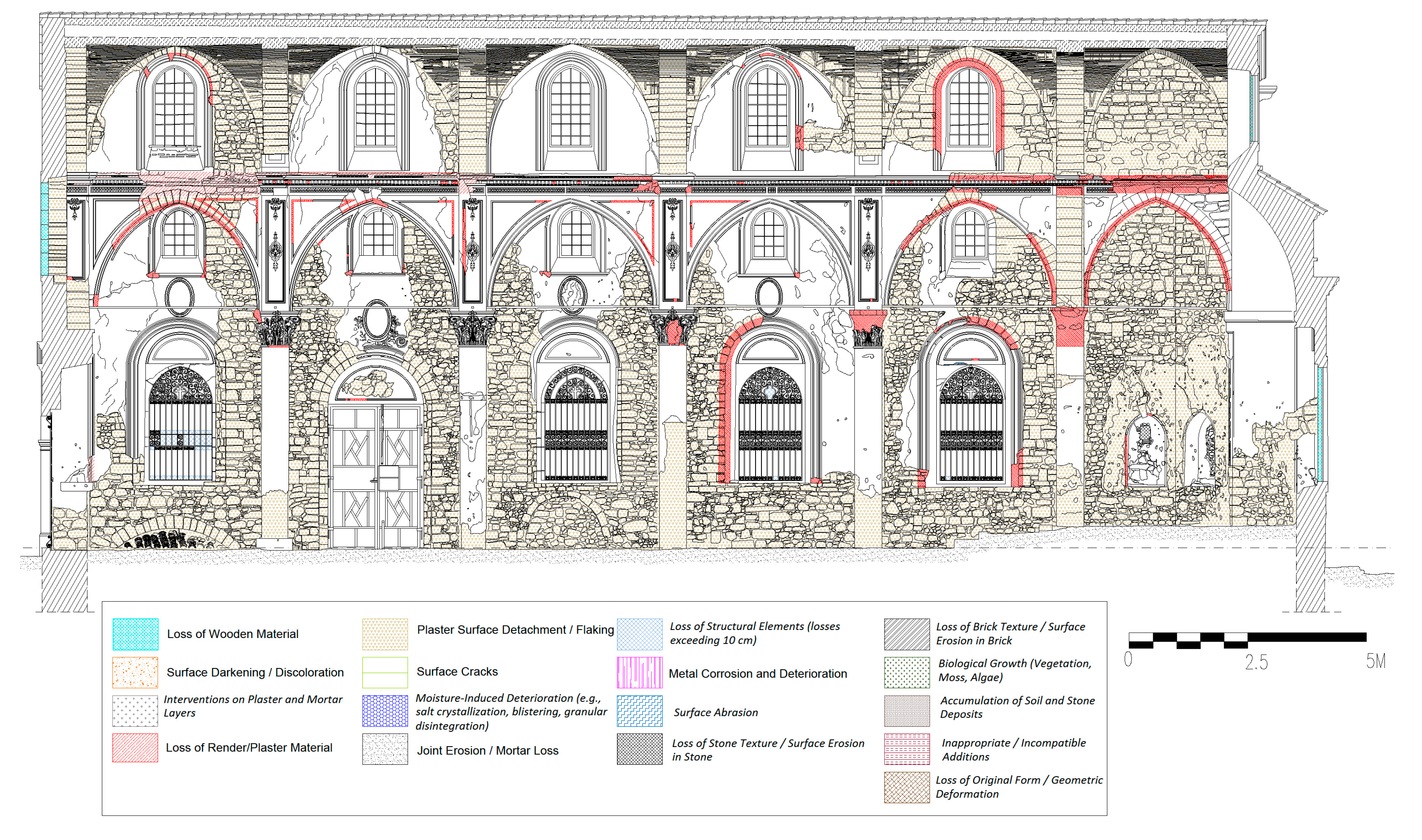
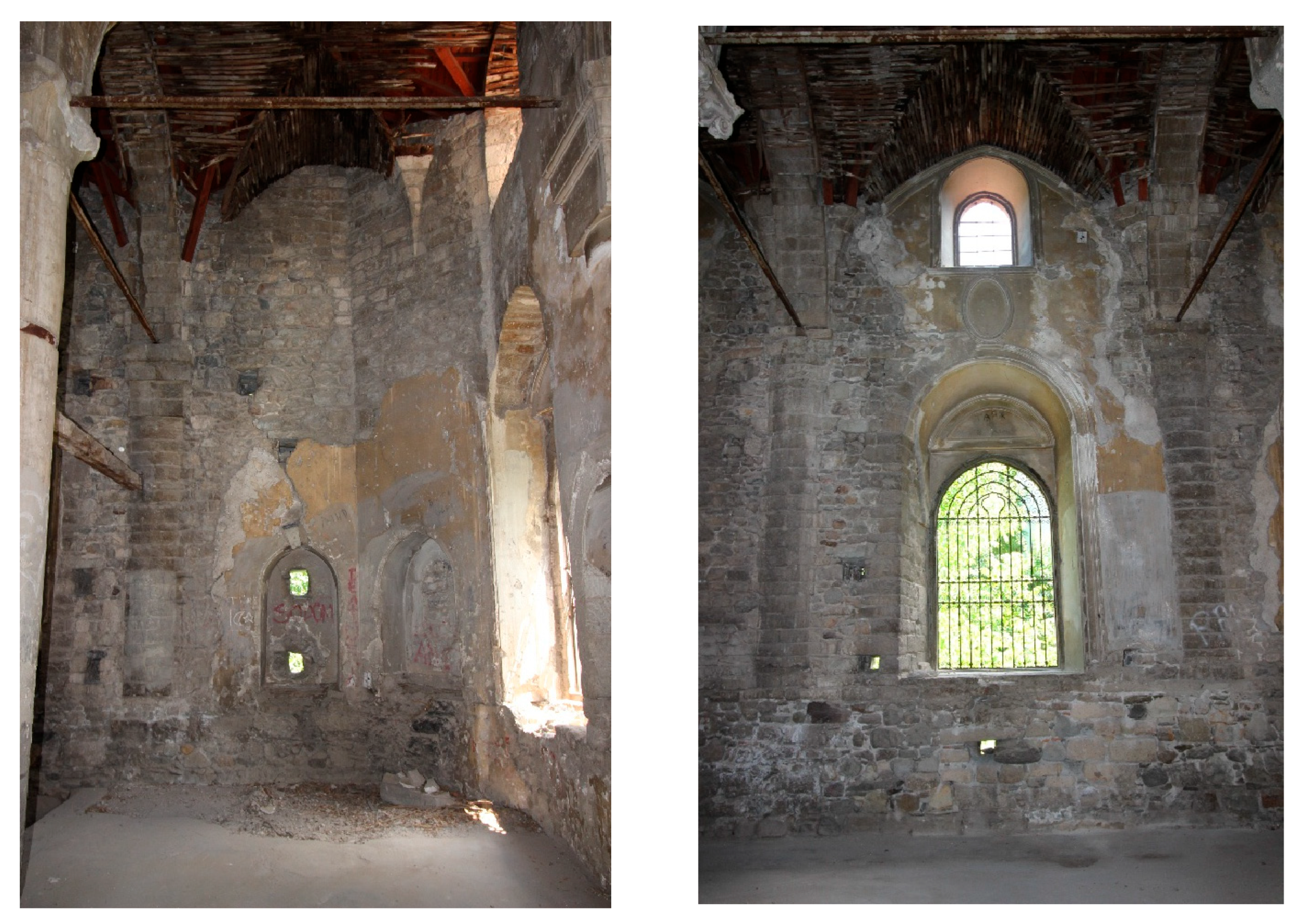
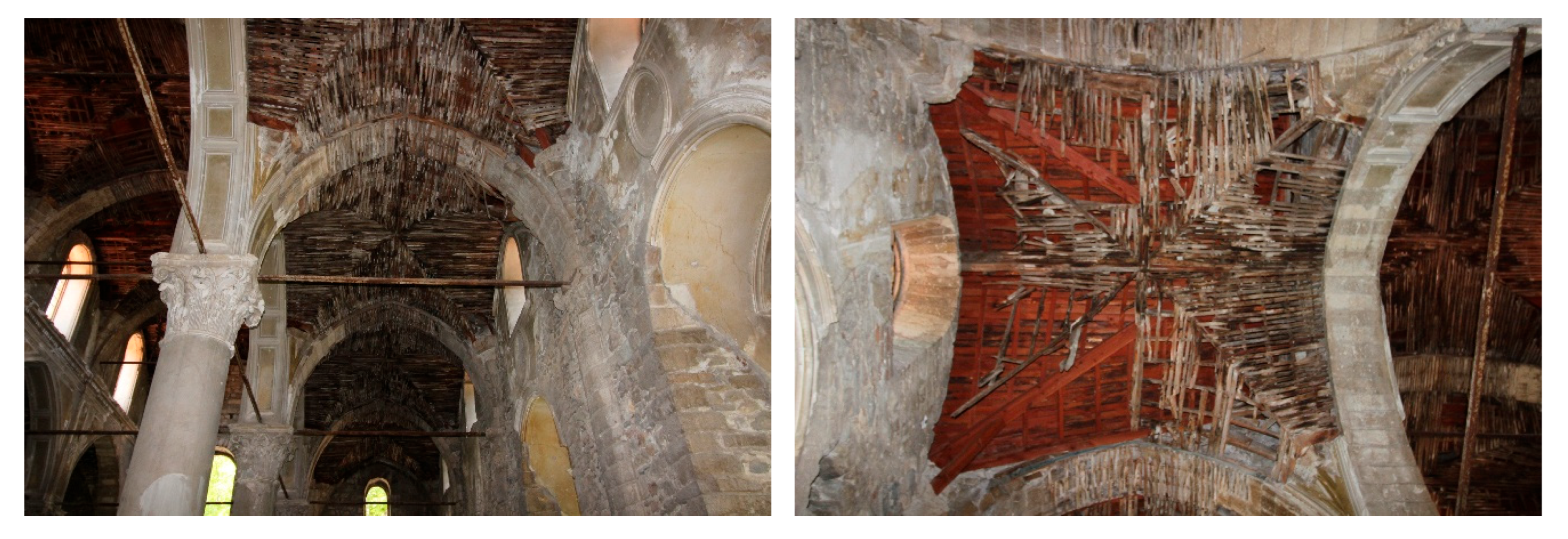
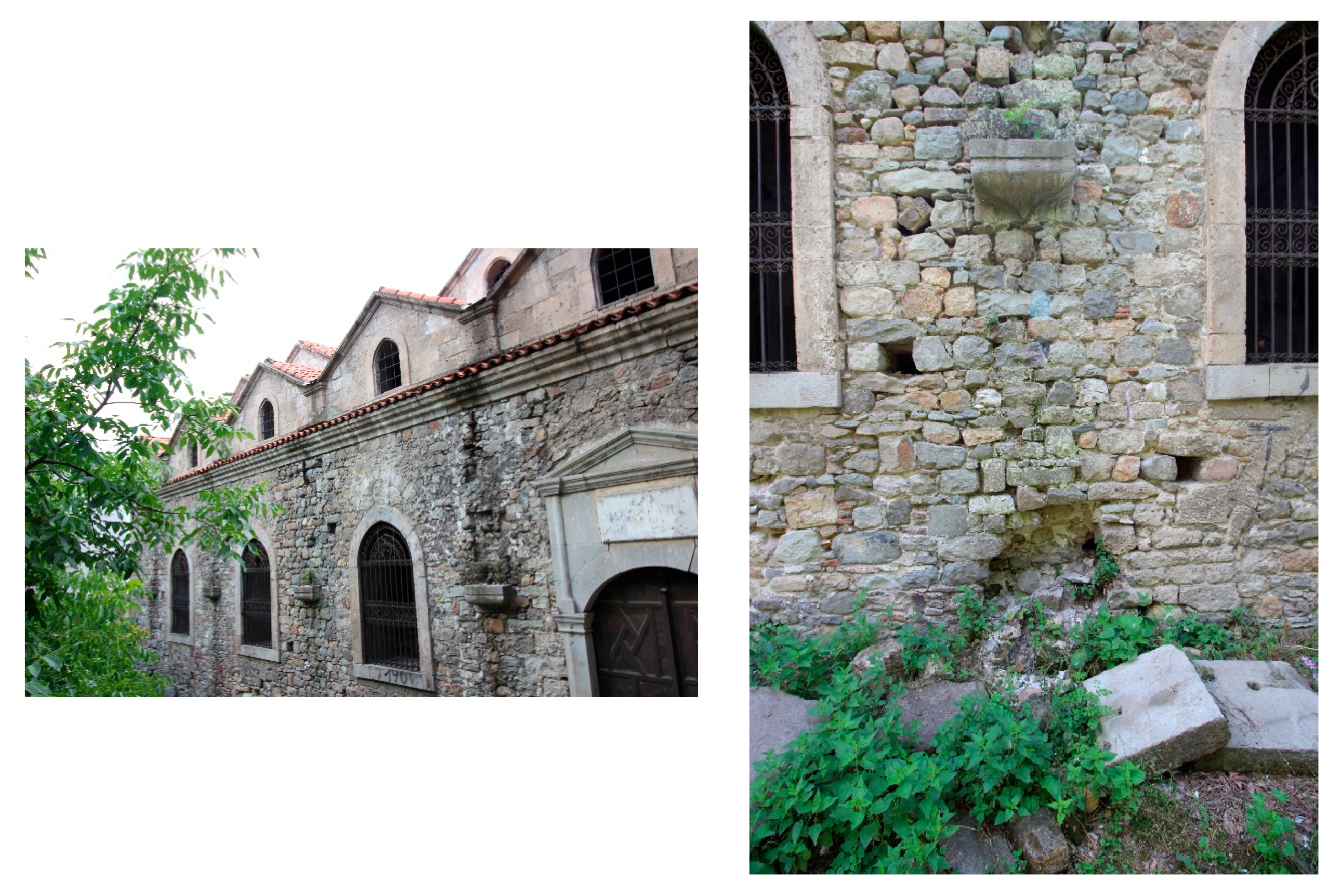
- By the mid-20th century, the church lost its religious function and was subsequently abandoned. As a result, the unprotected building materials suffered significant deterioration. In particular, the collapse of the roof covering exposed the structural system to prolonged moisture ingress, which began to compromise the integrity of the load-bearing components (Figure 8).
3.3. Analysis of Structural Elements in the Current Condition
3.4. Material Stratigraphy of the Structure
3.5. General Typology of Deterioration
- Formation of cracks and structural deformations,
- Carbonation and flaking of surface stones,
- Loss of mortar in stone joints,
- Biological deterioration in timber elements,
- Salt efflorescence, blistering, and detachment on plaster surfaces (Ashurst, 2007).
4. Intervention Strategies and Conservation Approach
4.1. Principles of Intervention
- Minimum Intervention: All interventions were executed only to the extent strictly necessary (Feilden, 2007).
- Reversibility: New additions were designed to be removable without damaging the original structure (Matero, 2003).
- Documentation: Each intervention was preceded and followed by comprehensive photographic and graphic documentation (Letellier et al., 2007).
- Preservation of Authenticity and Identity: The original materials, form, and structural configuration of the building were preserved (Jokilehto, 2017).
4.2. Structural Strengthening Interventions
4.2.1. Wall Systems
4.2.2. Roof Structure
4.3. Material Repair Interventions
4.3.1. Stone Surface Repairs
4.3.2. Plaster and Joint Repairs
4.4. Evaluation of the Conservation Philosophy and Intervention Approach
5. Adaptive Reuse Strategies and Cultural Sustainability
5.1. Adaptive Reuse Approach and the Case of Aya Payana
5.2. Scent Museum Concept (Kokuhane) Design: Spatial Organization of the Scent Museum
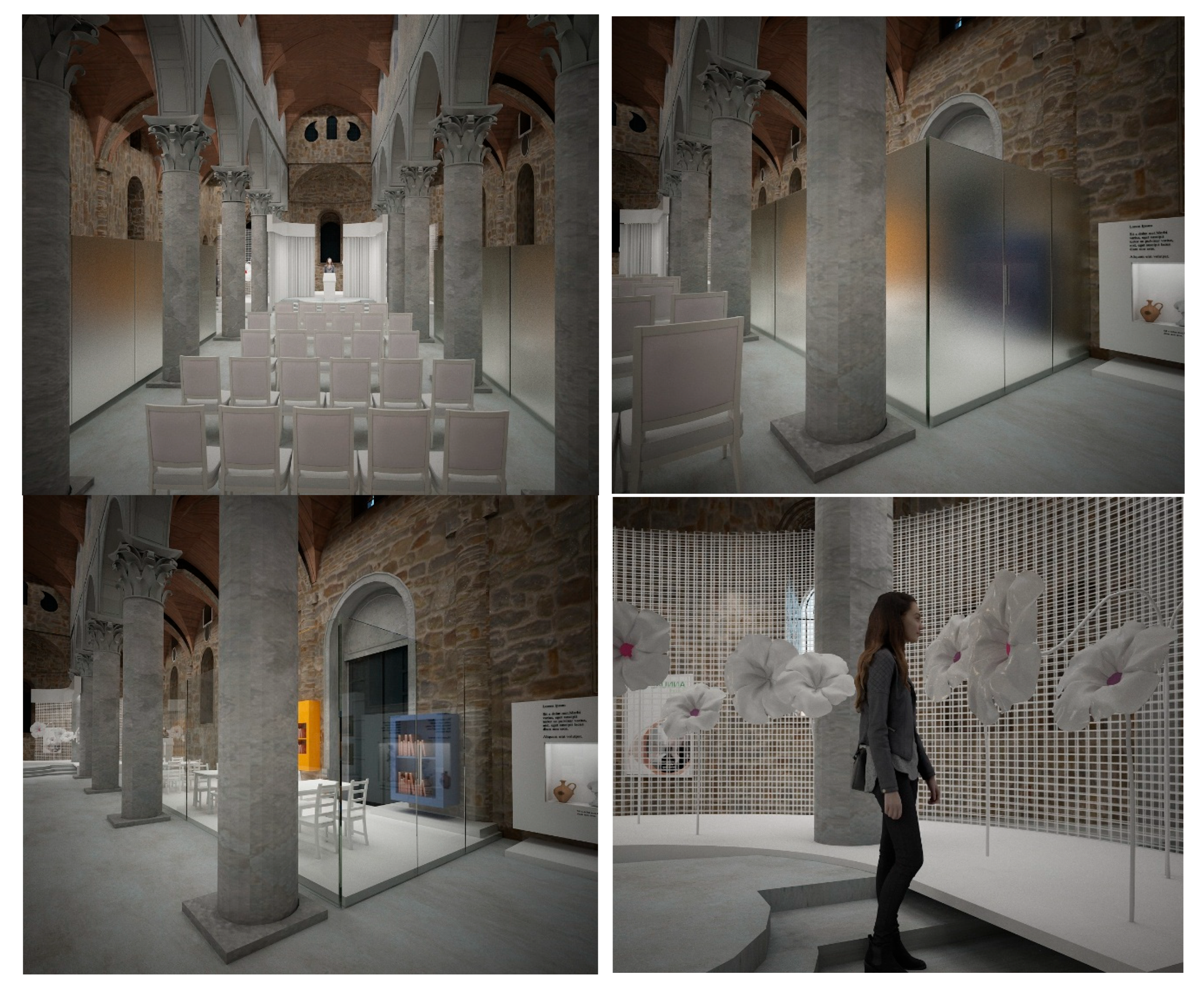
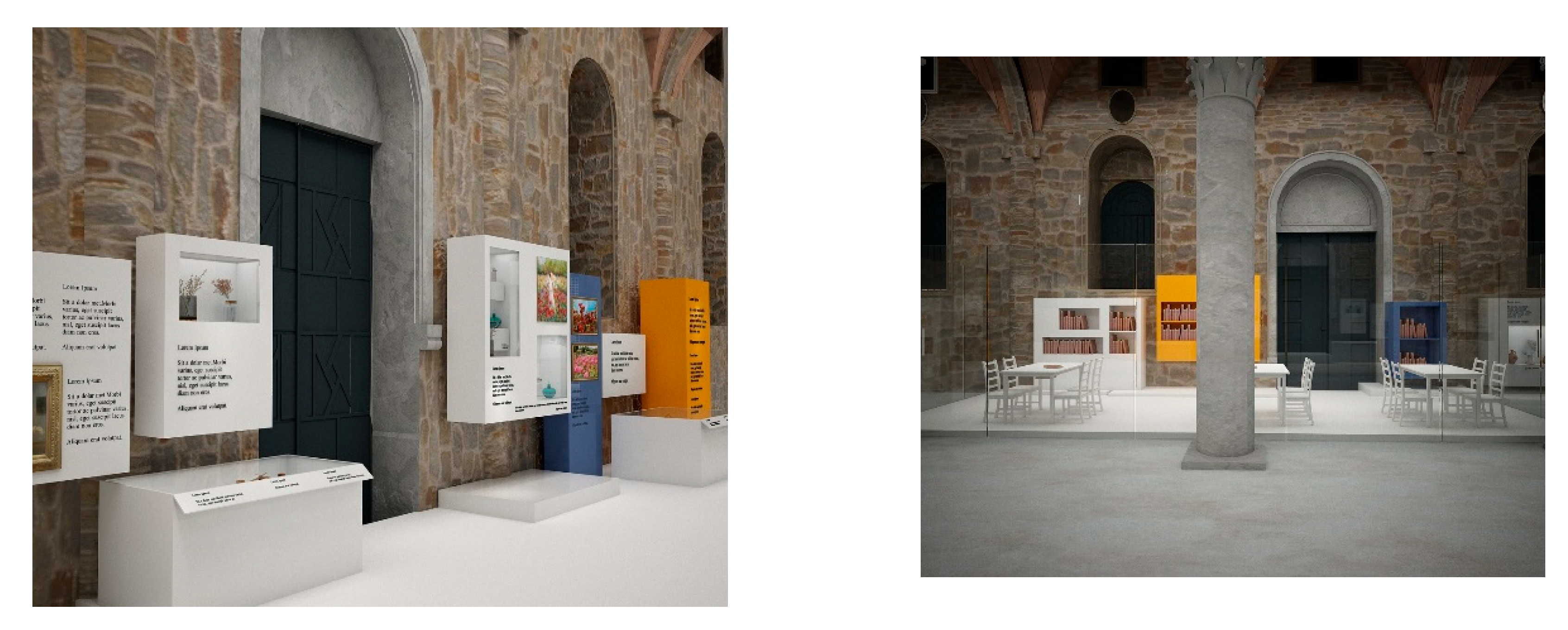
- Entrance Foyer: An introductory area where visitors are prepared for the museum experience and informed about the relationship between scent and memory (see Figure 13: Entrance Foyer Design Diagram).
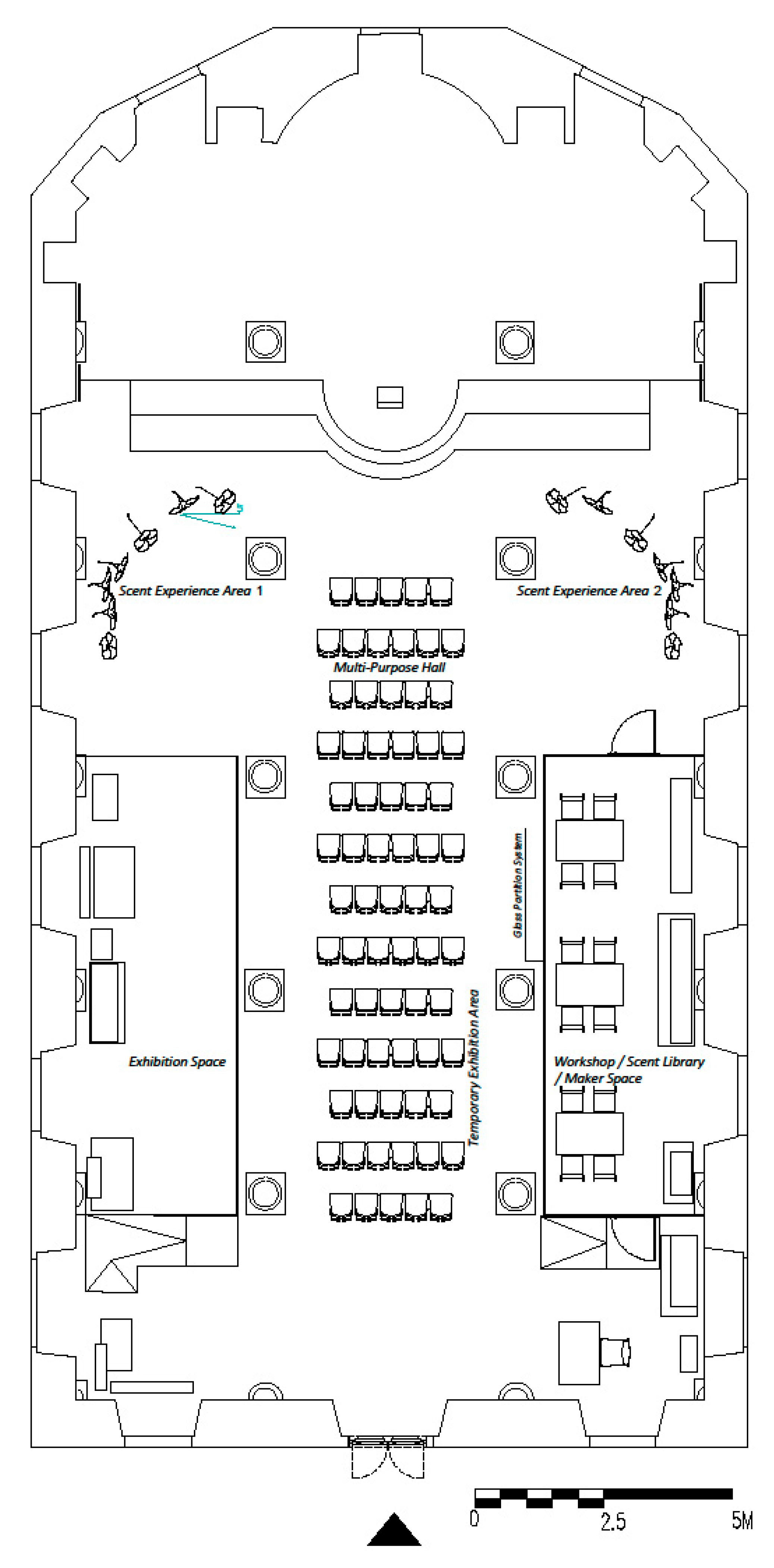
- Main Exhibition Area (Naos): An interactive exhibition zone featuring modules for experiencing various plant-based scents.
- Laboratory Area: A small-scale production and educational space where essences extracted from aromatic plants grown in the garden are processed.
- Workshop and Education Area: Flexible spaces designed for visitor engagement in the process of natural essence production through participatory workshops (Figure 12).
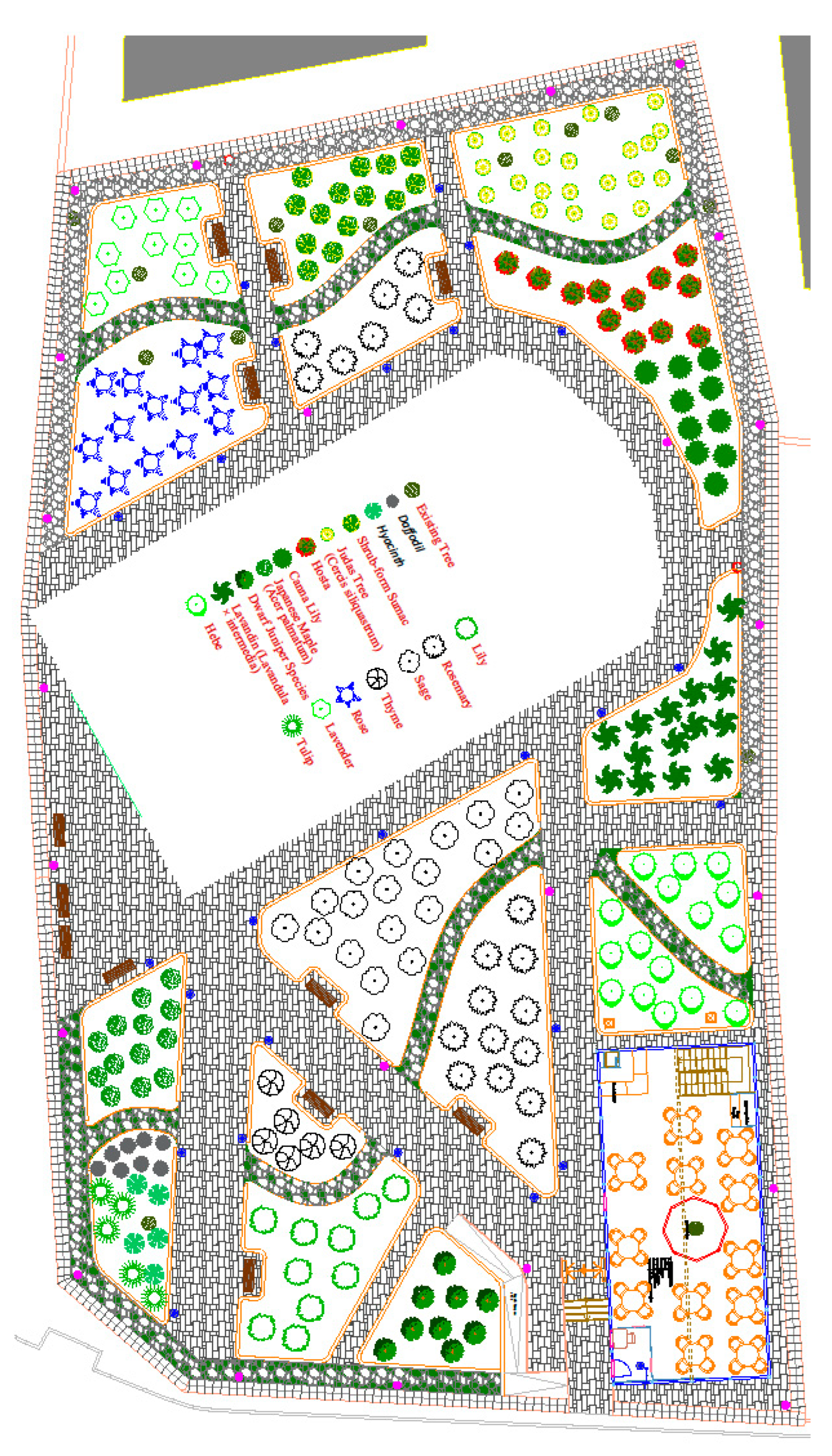
5.3. Botanical Garden and Scent Production Strategy
5.3.1. Selection of Local Plant Species
5.3.2. Scent Production and Laboratory Integration
5.3.3. Ecological Balance in Garden Design
5.4. Transparent Cafeteria Design: A Respectful Architectural Addition
5.4.1. The Role of Transparency in Conservation Practice
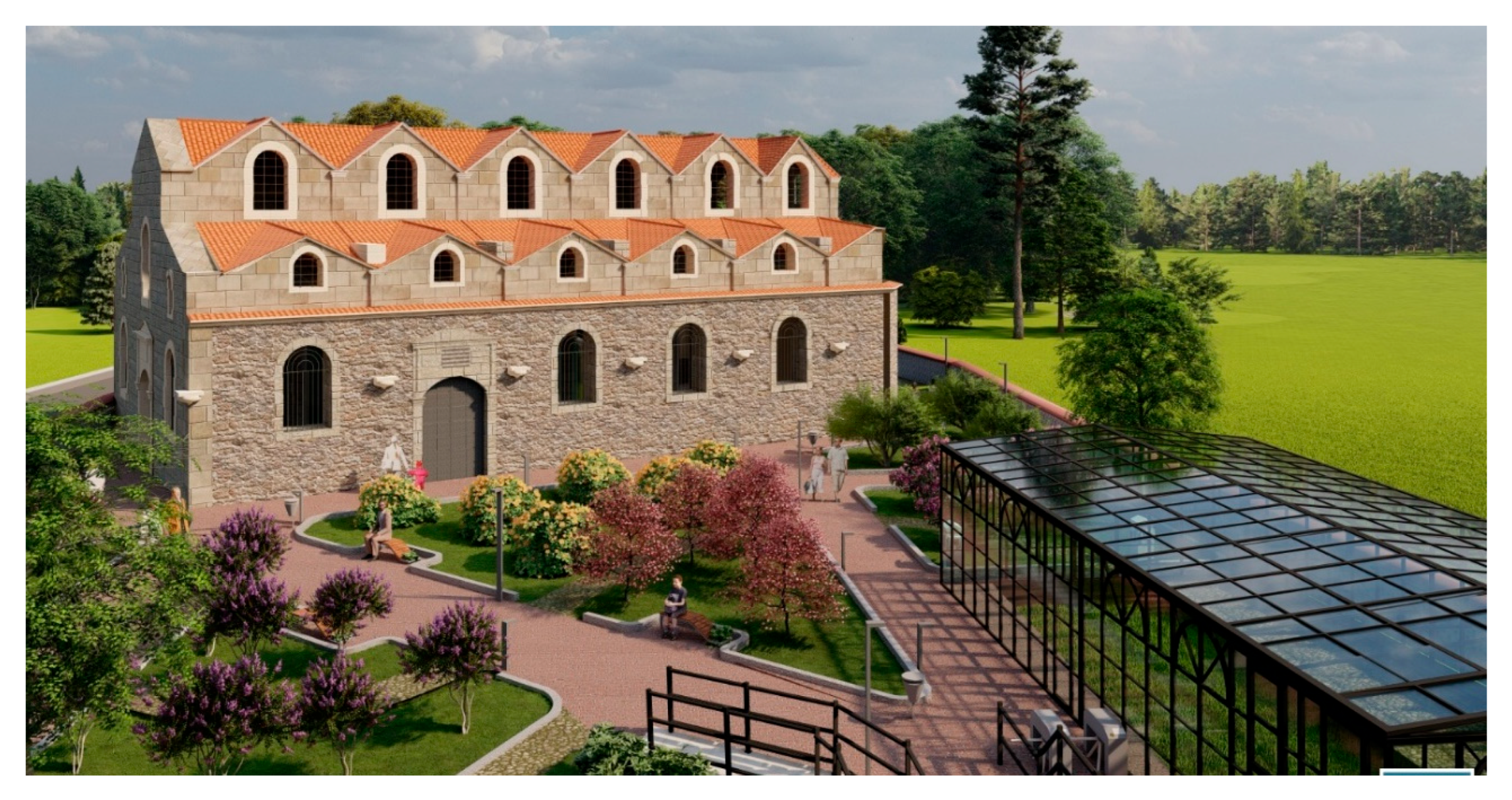
- The silhouette, façade articulation, and volumetric impact of the historical building remain uninterrupted;
- Visitors’ attention is guided toward the heritage structure;
- The distinction between historical and contemporary interventions is made clearly legible (Rodwell, 2008) (Figure 16).
5.4.2. Enhancing the Visitor Experience
- Visitors can continue to experience the surrounding natural landscape and the historical structure,
- They can rest and socialize without disconnecting from the heritage building (Douglas, 2006).
5.4.3. Contribution to Economic and Social Sustainability
- Visitor spending will support the site’s economic sustainability,
- A platform will be created for local producers to showcase and sell their goods,
- A social connection will be fostered between the heritage site and the local community (Veldpaus, Pereira Roders & Colenbrander, 2013).
5.5. Cultural Sustainability Assessment
5.5.1. Collective Memory and Cultural Identity
5.5.2. Education and Community Engagement
- Visitors can engage with natural scent production techniques and connect directly with traditional knowledge,
- Educational programs can foster cultural heritage awareness among younger generations (Plevoets & Van Cleempoel, 2011).
5.5.3. Economic and Social Sustainability
- Create a platform for local producers to present their products to visitors,
- Support the site’s operational costs,
- Establish an organic relationship between the local economy and cultural heritage (Veldpaus, Pereira Roders & Colenbrander, 2013).
5.5.4. Environmental Sustainability
6. Discussion
6.1. Balancing Restitution and Adaptive Reuse in the Conservation of Multi-Layered Structures
6.2. The Role of the Scent Museum (Kokuhane) in Cultural Continuity
6.3. The Transparent Cafeteria Approach and Its Alignment with Conservation Theory
6.4. The Botanical Garden as a Model for Environmental Sustainability
6.5. Assessment of Scientific Contribution and Originality
- Assigning new functions without disrupting historical continuity,
- Integrating cultural, economic, and environmental sustainability principles,
- Developing a museum concept centered on sensory experience,
- Designing nature-based production processes integrated with local flora.
7. Conclusion
References
- Ashurst, J. Conservation of Ruins. Routledge. 2007. [Google Scholar]
- Australia ICOMOS. The Burra Charter: The Australia ICOMOS Charter for Places of Cultural Significance. Australia ICOMOS Incorporated. 2013. [Google Scholar]
- Binda, L.; Maierhofer, C. (2006, July). Strategies for the assessment of historic masonry structures. In In-situ evaluation of historic wood and masonry structures (NSF/RILEM Workshop), Prague (pp. 37–56).
- Bosiljkov, V.; Uranjek, M.; Žarnić, R.; Bokan-Bosiljkov, V. An integrated diagnostic approach for the assessment of historic masonry structures. Journal of Cultural Heritage 2010, 11(3), 239–249. [Google Scholar] [CrossRef]
- Bryan, P.; Andrews, D.; Blake, B. Metric survey specifications for cultural heritage. 2013. [Google Scholar]
- Bullen, P. A.; Love, P. E. Adaptive reuse of heritage buildings. Structural Survey 2011, 29(5), 411–421. [Google Scholar] [CrossRef]
- Demirören News Agency (DHA). 2025. Available online: https://www.dha.com.tr/foto-galeri/aya-baniya-kilisesi-restore-edilerek-koku-atolyesine-donusturulecek-2043723/1 (accessed on 22 June 2025).
- Douglas, J. Building adaptation. Routledge. 2006. [Google Scholar]
- Feilden, B. Conservation of historic buildings. Routledge. 2007. [Google Scholar]
- Harita.gov.tr. Available online: https://www.harita.gov.tr/urun/turkiye-mulk-idare-bolumleri-haritasi/189 (accessed on 30 April 2025).
- Herz, R. A Naturalistic Analysis of Autobiographical Memories Triggered by Olfactory Visual and Auditory Stimuli. Chemical Senses 2004, 29(3), 217–224. [Google Scholar] [CrossRef] [PubMed]
- Historic England. Practical building conservation: Stone, 1st ed.; Routledge for English Heritage, 2012. [Google Scholar]
- ICOMOS. International Charter for the Conservation and Restoration of Monuments and Sites (The Venice Charter). 1964. [Google Scholar]
- Jokilehto, J. A history of architectural conservation; Routledge, 2017. [Google Scholar]
- Letellier, R.; Schmid, W.; LeBlanc, F. (2007). Guiding Principles Recording, Documentation, and Information Management for the Conservation of Heritage Places. Paul Getty Trust, Getty Conservation Institute: Los Angeles, USA, 36–38.
- Matero, F. G. Managing Change: The Role of Documentation and Condition Survey at Mesaverde National Park. Journal of the American Institute for Conservation 2003, 42(1), 39–58. [Google Scholar] [CrossRef]
- Orbaşlı, A. Architectural conservation: Principlesorba and practice; Wiley-Blackwell, 2007. [Google Scholar]
- Plevoets, B.; Van Cleempoel, K. Adaptive reuse as a strategy towards conservation of cultural heritage: A literature review. WIT Transactions on The Built Environment 2011, 118, 155–164. [Google Scholar]
- Price, C. A., & Doehne, E. (2011). Stone conservation: an overview of current research.
- Ripp, M., & Rodwell, D. (2015). The geography of urban heritage. The Historic Environment: Policy & Practice, 6(3), 240–276.
- Roca, P.; Cervera, M.; Gariup, G.; Pela’, L. Structural analysis of masonry historical constructions. Classical and advanced approaches. Archives of Computational Methods in Engineering 2010, 17(3), 299–325. [Google Scholar] [CrossRef]
- Rodwell, D. (2008). Conservation and sustainability in historic cities. John Wiley & Sons.
- Smith, B. J., & Turkington, A. (Eds.). (2016). Stone decay: its causes and controls. Routledge.
- Stubbs, J. H. (2009). Time Honored: A Global View of Architectural Conservation. Wiley.
- TBDY – Turkish Building Earthquake Code. (2018). Resmi Gazete, (30364), 18 Mart 2018.
- Veldpaus, L.; Pereira Roders, A.; Colenbrander, B. J. F. (2013). Urban Heritage: Putting the Past into the Future. The Historic Environment: Policy & Practice, 4(1), 3–18.
- Watt, D. S. (2025). Building pathology: Principles and practice. John Wiley & Sons.
- Young, D. (2008). Salt attack and rising damp: A guide to salt damp in historic and older buildings. Heritage Council of NSW; Heritage Victoria; South Australian Department for Environment and Heritage; Adelaide City Council.
Disclaimer/Publisher’s Note: The statements, opinions and data contained in all publications are solely those of the individual author(s) and contributor(s) and not of MDPI and/or the editor(s). MDPI and/or the editor(s) disclaim responsibility for any injury to people or property resulting from any ideas, methods, instructions or products referred to in the content. |
© 2026 by the authors. Licensee MDPI, Basel, Switzerland. This article is an open access article distributed under the terms and conditions of the Creative Commons Attribution (CC BY) license (http://creativecommons.org/licenses/by/4.0/).