

Submitted:
01 January 2026
Posted:
06 January 2026
You are already at the latest version
Abstract
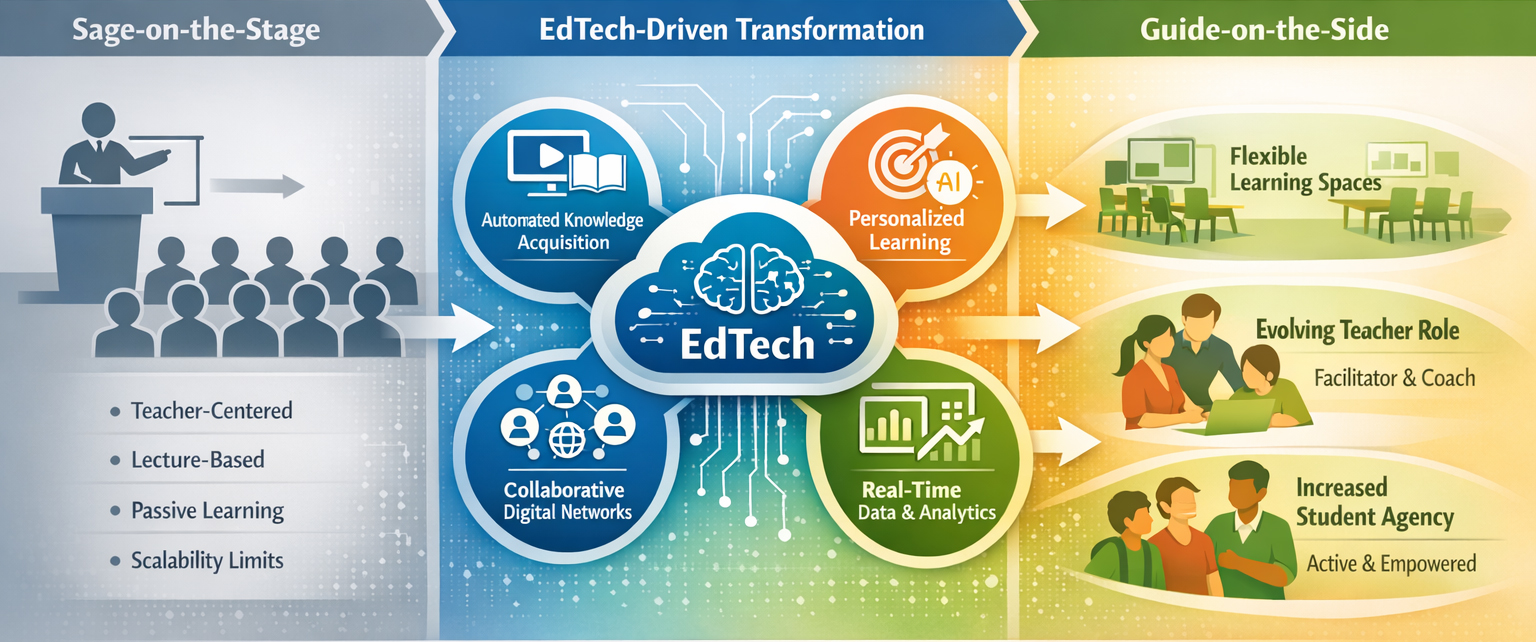
For years the “Sage-on-the-Stage,” characterized by teacher-cantered lectures and passive students listening, has been the dominant form in education. In contrast, the constructivist ideal of the "Guide-on-the-Side," who is a facilitator rather than an instructor in active student-learning, has been challenged by pragmatic and scalability issues. This paper argues that educational technology (EdTech) is the key enabler for the transformation of this pedagogical logic into systemic practice. We show how certain EdTech features are changing the teacher’s role and what happens in the classroom. We explore four enabling transformative processes linked with EdTech: (1) the mechanisms through which basic knowledge acquisition is automated (e.g. flipped learning); (2) personalized, adaptive learning options; (3) collaborative learning through digital learning networks; and (4) real-time, user-cantered information for educators. Together these are driving three evident changes: the reconfiguration of physical classrooms into flexible learning spaces, the shifting teacher expertise that aligns more with guidance and data-driven coaching, and a notable increase in student agency. This “silent revolution” demonstrates that the definitive contribution of EdTech is not in digitizing traditional pedagogy, but in humanizing pedagogy – technology, by automating their mass and scale tasks, releases educators to engage in their deeply human work of crafting meaningful learning experiences and mentoring students in ways that help identify each students’ own potential.
Keywords:
digital transformation
; EdTech integration
; pedagogical shift
; student-cantered learning
; teacher as facilitator
1. Introduction
1.1. The Enduring Reign of the “Sage-on-the-Stage”: More Than Tradition
For centuries, the dominant architecture of education worldwide has been built upon the image of the teacher as the “Sage-on-the-Stage.” This model, characterized by teacher-cantered lecture and passive student reception, is more than a pedagogical preference; it is a deeply embedded institutional and cultural paradigm. Rooted in what Freire (1970) critically termed the “banking model,” it positions students as empty vessels to be filled with standardized knowledge, a system that proved efficient for the homogenized workforce demands of the industrial age (Chen & Zhang, 2023).
While the limitations of this model are well-documented fostering passive learning, disengagement, and a failure to accommodate diverse learning needs (Darling-Hammond et al., 2024) its persistence is not merely due to inertia or tradition. It is actively reinforced by a powerful ecosystem of systemic inertia:
- Assessment Regimes: Standardized, high-stakes testing prioritizes the recall of discrete facts over critical thinking, creativity, or collaboration. Teachers are often pressured to “teach to the test,” a practice that inherently favors broad, teacher-directed content coverage over deep, student-driven inquiry.
- Policy and Curriculum Mandates: Rigid, content-heavy national curricula leave little room for the flexibility and time required for facilitative, project-based learning. Policy frameworks often measure educational success through easily quantifiable metrics aligned with the “sage” model’s outputs.
- Teacher Preparation Programs: Many pre-service training programs still emphasize content mastery and classroom management for delivery, rather than the skills of facilitation, learning design, and data-informed mentoring required for a “guide” role.
- Cultural and Parental Expectations: Societal perceptions of teaching and learning are often shaped by personal experience, leading to expectations that a “real” teacher is one who stands at the front, clearly transmitting knowledge. Deviations from this archetype can be met with skepticism.
This interconnected system creates a powerful disincentive for change, making the “Sage-on-the-Stage” not just a relic, but a resilient, systemically supported norm.
1.2. The “Guide-on-the-Side” Imperative: A Response to 21st-Century Demands
In light of these limitations, the constructivist myth that considers the teacher as a “Guide-on-the-Side” has been a staple academic ideal for years (King, 1993). Based on the ideas of Dewey, Piaget, and Vygotsky, this approach views learning as an active building of knowledge. In this case, the teacher acts as a facilitator of inquiry, the architect of experiential activities, and the provider of customized assistance to help students think critically, collaborate, and become autonomous (Thomas & Brown, 2021).
Yet, the need for this change has evolved from pedagogic theory into global economic and social imperative. Information, 21st-century world, The world In the demands of the – not Bunkers of Information, but Flexible Problem-Solvers, Innovative Thinkers, and Lifelong Students. Palable tasks are being automated, and the value is shifting to uniquely human talents such as empathy, complex communication and creative thinking. The “one-size-fits-all” approach of the sage falls far short in this context, as does its support for the agency and wide range of student competencies needed for future flourishing. The “Guide-on-the-Side” is therefore no longer just a better way to teach it is a critical lens through which to prepare students for the challenges of contemporary life and work.
Still, despite its good sense, the mainstream adoption of this learner-centric paradigm has been maddeningly hard to pin down. The main bottleneck has been pragmatic scalability: the practical impossibility of a single teacher to individualize learning, foster collaboration, and give on-the-spot feedback to 30+ students in a 50-minute class period (Hodges et al., 2022). The guide model was still a beautiful theory, perpetually at odds with classroom reality.
1.3. EdTech as the Enabling Catalyst: A Solution to the Scalability Impasse
It is at this critical juncture between a systemically entrenched but inadequate model and an essential yet logistically unattainable ideal that Educational Technology (EdTech) emerges as a transformative catalyst. The central thesis of this article is that EdTech provides the essential toolkit to dismantle the logistical barriers that have long stifled the “Guide-on-the-Side” model, finally enabling its sustainable and equitable implementation at scale.
This is not about technology for its own sake. It is about how specific EdTech mechanisms directly address the core problem of scalability that has plagued student-centered learning. EdTech offers a pathway to systemic change by:
- Reallocating Teacher Time: Automating direct instruction (e.g., through flipped classroom tools) reclaims in-class hours for active, human-centric facilitation.
- Enabling Differentiation: Adaptive software can personalize practice and content pathways at a scale impossible for one teacher, making true differentiation operational.
- Facilitating New Interactions: Digital platforms expand opportunities for collaboration and creation beyond physical and temporal classroom limits.
- Informing Practice: Learning analytics provide real-time data, replacing intuition with insight and allowing for precise, timely intervention.
By systematically offloading the scalable, administrative, and standardized tasks of the “sage,” technology liberates the human teacher to focus on their most critical role: that of a mentor, designer, and guide. This shift represents more than a change in tools; it is a fundamental re-engineering of the instructional core, made feasible by technology.
Therefore, the purpose of this article is to move beyond theoretical advocacy and demonstrate the actionable mechanisms through which EdTech enables this shift. We will analyze how technology, when integrated with pedagogical intent, can overcome systemic inertia, empower teachers as facilitators, and cultivate the student agency required for the 21st century. The following sections will detail this “silent revolution” and provide a critical roadmap for its responsible implementation.
2. Methodology
2.1. A Framework for Pedagogical Re-Engineering: Four Interlocking Mechanisms
To understand how EdTech enables the transition from "Sage-on-the-Stage" to "Guide-on-the-Side," we propose a framework of four interlocking mechanisms that work synergistically to restructure classroom dynamics. These mechanisms do not operate in isolation; they form an integrated system that collectively addresses the core logistical challenges of student-cantered learning.
Figure 1.
The Four Mechanisms of EdTech-Mediated Pedagogical Shift.
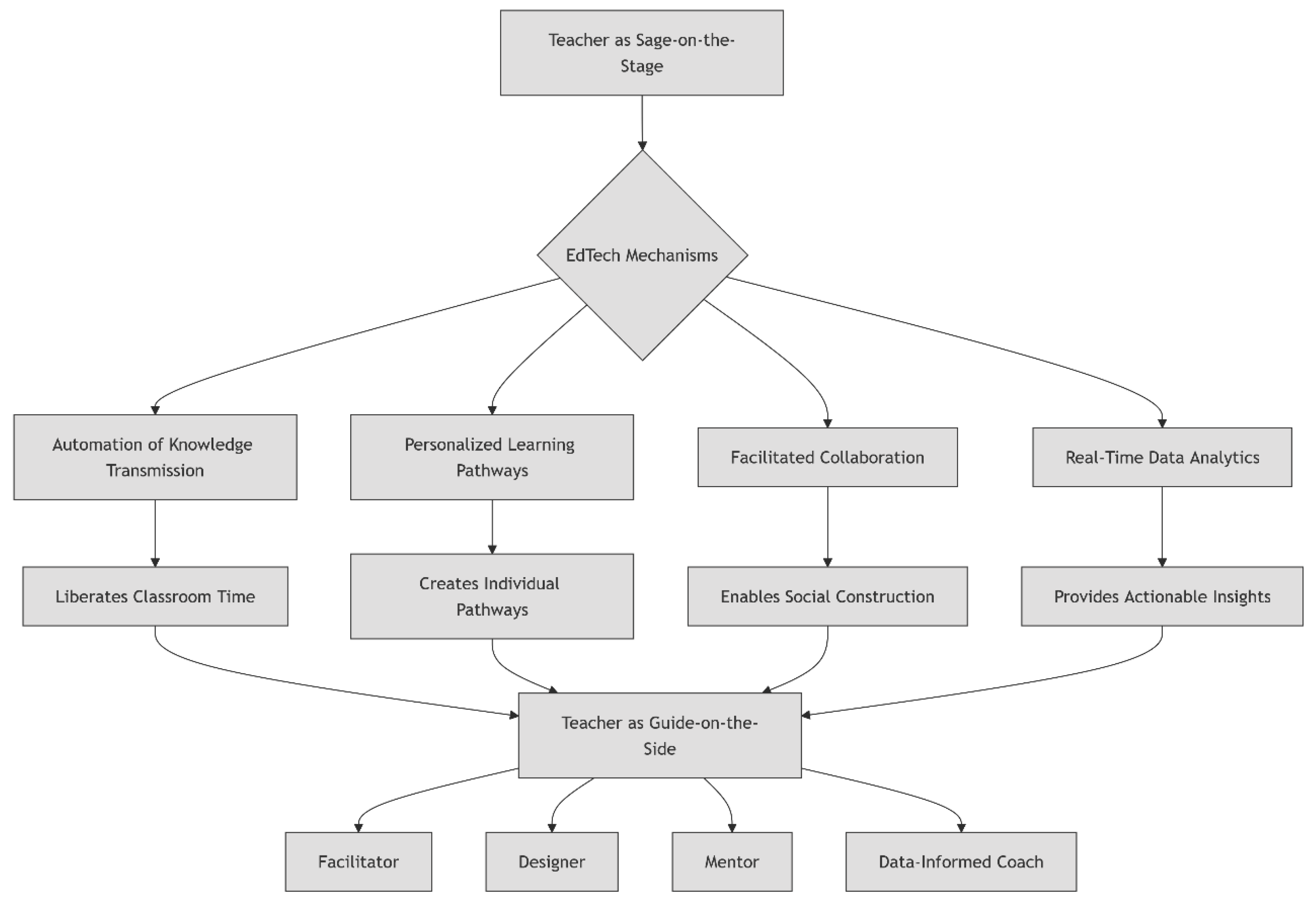
This visual model illustrates how EdTech mechanisms systematically dismantle the traditional teacher-cantered paradigm while enabling the facilitative role. However, successful implementation requires acknowledging both the potential and the limitations of each mechanism and ensuring that teacher agency remains central to the integration process.
2.2. The Four Mechanisms: Potential and Critical Limitations
Mechanism 1: Automating Knowledge Transmission & Foundational Practice
Core Function: EdTech tools (e.g., Khan Academy, Edpuzzle, video platforms) externalize direct instruction through pre-recorded lectures, interactive simulations, and digital texts. This enables models like the flipped classroom, where content consumption happens asynchronously, freeing in-class time for active application (Tucker, 2023; Chen et al., 2022).
Teacher Role Shift: The teacher transforms from primary lecturer to curator of digital resources and designer of active learning experiences. They circulate to clarify misconceptions and facilitate deeper engagement.
Critical Limitations & Mitigation:
- Risk of Depersonalization: A playlist of videos cannot replace the dynamic, responsive energy of a live explanation. Students may feel disconnected.
- Solution: Blend automated content with mandatory, low-stakes check-ins (e.g., quick polls, reflection posts) where teachers respond personally. Use class time explicitly for human connection and clarifying muddy points.
- Passive Consumption in New Format: Simply watching videos at home replicates passive learning outside school walls.
- Solution: Design interactive content with embedded questions (via Edpuzzle), and pair videos with guided notes or preparatory tasks that require active processing.
- Equity of Access: This model assumes all students have reliable devices and internet at home.
- Solution: Provide offline options (USB drives, printed transcripts), ensure school provides dedicated access time, and never penalize for lack of home connectivity.
Mechanism 2: Enabling Differentiated and Personalized Learning
Core Function: Adaptive learning software and AI (e.g., DreamBox, Century Tech) analyze student responses in real-time, adjusting content difficulty, sequence, and format to create a unique learning pathway for each student (Xie et al., 2023).
Teacher Role Shift: The teacher evolves from universal lesson planner to strategic learning manager and intervention specialist. They interpret platform data to form targeted small groups and provide one-on-one support.
Critical Limitations & Mitigation:
- Algorithmic Bias & Opacity: Algorithms may perpetuate biases present in their training data and their logic can be a "black box," making it hard to understand why a student is routed a certain way.
- Solution: Teachers must maintain "pedagogical sovereignty" using algorithmic suggestions as one data point, not a prescription. Demand transparency from vendors on how algorithms work.
- Data Privacy & Commercialization: Extensive data collection on minors raises serious ethical questions about ownership, security, and potential commercial use.
- Solution: Schools must adopt strict data governance policies, prefer tools with strong privacy commitments (e.g., compliant with FERPA/COPPA), and educate students on digital footprints.
- The "Personalization Paradox": Hyper-individualized pathways can reduce valuable peer-to-peer learning and the shared common knowledge essential for classroom community.
- Solution: Deliberately design collaborative projects and whole-class discussions that integrate and build upon personalized learning experiences.
Mechanism 3: Facilitating Collaboration and Creation
Core Function: Cloud-based platforms (Google Workspace, Miro, Padlet) enable students to co-create documents, brainstorm, and give feedback synchronously or asynchronously, supporting social constructivist learning (Trust et al., 2022).
Teacher Role Shift: The teacher becomes an architect of collaborative tasks and a process facilitator, guiding group dynamics, probing reasoning, and fostering digital citizenship.
Critical Limitations & Mitigation:
- Exacerbating the Digital Divide: Collaboration assumes all students have equal facility with the tools and space to participate online, which is often untrue.
- Solution: Scaffold digital literacy explicitly, use intuitive platforms, and ensure core collaborative work happens during supported school time.
- Superficial Collaboration: Without careful design, digital collaboration can devolve into divided work or dominated by a few voices.
- Solution: Use protocols, assign rotating roles (e.g., facilitator, synthesizer, checker), and assess both the final product and the collaborative process.
- Diminished Interpersonal Skills: Over-reliance on digital communication may hinder the development of nuanced face-to-face interaction skills.
- Solution: Purposefully balance screen-based collaboration with in-person, unmediated group work and discussion.
Mechanism 4: Providing Real-Time, Actionable Data
Core Function: Learning Management Systems (Canvas, Moodle) and analytics dashboards generate a continuous stream of formative data on student progress, engagement, and comprehension (Ifenthaler & Gibson, 2023; Holstein et al., 2023).
Teacher Role Shift: The teacher transforms into a data-informed diagnostician and proactive guide, moving from reactive grading to strategic, evidence-based intervention.
Critical Limitations & Mitigation:
- Surveillance & Performance Culture: Constant tracking can create an atmosphere of surveillance, increasing student anxiety and reducing intellectual risk-taking.
- Solution: Be transparent with students about what data is collected and why. Use data primarily for formative support, not punitive control. Involve students in reviewing their own data for self-reflection.
- Data Overload & Misinterpretation: Teachers can be overwhelmed by data streams, leading to paralysis or drawing incorrect conclusions from metrics.
- Solution: Focus on a few key metrics aligned to learning goals. Provide professional development on data literacy how to interpret, question, and act on data.
- Reductionism: Data dashboards often quantify what is easily measurable (clicks, quiz scores), potentially overlooking crucial but hard-to-measure outcomes like creativity, perseverance, or curiosity.
- Solution: Insist on a balanced assessment ecosystem. Prioritize human observation, student portfolios, and qualitative feedback alongside quantitative analytics.
2.3. Cantering Teacher Agency: From Passive Adopter to Pedagogical Designer
The success of this framework hinges on a fundamental principle: technology must serve pedagogy, not dictate it. Therefore, teacher agency is the non-negotiable cornerstone of effective integration. This requires shifting from a model where teachers are trained to use tools to one where they are empowered to orchestrate learning ecosystems.
Operationalizing Teacher Agency:
- Choice & Customization: Teachers should have autonomy to select, adapt, and even opt-out of technologies based on their professional judgment and student needs.
- Design Leadership: Professional development must focus on learning design how to craft experiences using technology to achieve pedagogical goals not just button-clicking.
- Critical Evaluation: Teachers must be equipped to critically evaluate EdTech tools for pedagogical soundness, equity, and data ethics, becoming informed gatekeepers for their classrooms.
This methodological framework, with its explicit acknowledgment of both potentials and pitfalls, provides a realistic roadmap. It positions EdTech not as a magic bullet, but as a set of powerful, double-edged tools that, when wielded by professionally empowered, critically aware educators, can finally make the student-centered classroom a practical reality.
3. Results
3.1. The Changing Classroom: Documented Shifts and Emerging Contradictions
The mechanisms described in Part 2 are producing tangible, observable changes in educational environments. However, a balanced examination reveals a complex landscape where positive outcomes coexist with significant challenges and unintended consequences. This section presents a multi-faceted view of the evidence, incorporating quantitative data, qualitative voices, and contextual disparities.
3.1.1. Physical and Temporal Reconfiguration
Empirical studies confirm the reshaping of learning spaces and time allocation. Research by Steelcase Education (2022) demonstrates that flexible learning environments increase observed student collaboration. Similarly, meta-analyses of flipped classrooms show a consistent reclamation of 30-50% of in-class time from lecture, reallocated to active learning (Chen et al., 2022). The shift in teacher activity is evident: time spent circulating and conferring with students can increase by over 40% (Tucker, 2023).
However, this transformation is not universal or uniformly positive. Implementation quality varies dramatically, and the model imposes new burdens:
- Increased Teacher Workload (Initial Phase): Studies by Trust & Whalen (2021) note that the transition to a flipped or tech-heavy model initially significantly increases teacher workload due to the creation and curation of digital resources, a factor often omitted from promotional literature. This "implementation dip" can lead to burnout if not supported.
- Screen Fatigue and Cognitive Overload: A growing body of research highlights digital eye strain, increased distractibility, and mental fatigue associated with prolonged screen-based learning. As one high school student shared in a 2023 study: "After a day of videos and online quizzes, my head aches. I miss just talking to a teacher and a whiteboard sometimes" (Chu & Xie, 2023).
- Erosion of Unstructured Interaction: The efficiency of digital collaboration tools can inadvertently reduce spontaneous, face-to-face peer dialogue and the nuanced, off-task social learning crucial for development.

Table 1.
Contrasting Outcomes in Different Educational Contexts.
| Context / Outcome | High-Income, Well-Resourced School | Low-Income, Under-Resourced School | Notes |
|---|---|---|---|
| Access to Devices & Connectivity | 1:1 programs, high-speed school & home internet. | Shared devices, unreliable school bandwidth, limited/no home access. | The foundational prerequisite for any shift is inequitably distributed. |
| Teacher Capacity for Integration | Dedicated instructional tech coaches, regular paid PD time. | Limited, one-off PD; teacher-as-technician model prevails. | Support structures determine if teachers become designers or just operators. |
| Student Experience of "Personalization" | "It feels like it’s tailored for me. I can go ahead or get help without holding anyone back." – Student quote (Pane, 2024). | "The computer just gives me easier problems when I fail. It doesn’t explain why I’m wrong like a teacher could." – Student quote (RAND Equity Study, 2023). | Personalization without human mediation can feel isolating and mechanistic. |
| Measured Impact on Standardized Scores | Modest gains (5-8%) in math & science; significant gains in student engagement metrics. | No statistically significant gains; sometimes a decline due to focus on tech acclimation over core instruction. | Benefits often accrue where baseline resources are already strong, potentially widening gaps. |
| Primary Unintended Consequence | Tech dependence, reduced stamina for deep reading, social interaction mediated through screens. | Exacerbation of digital divide, instruction time lost to tech troubleshooting, increased frustration. | Context shapes the nature of the downsides. |
3.2. The Evolution of Teacher Responsibilities: Upskilling and Strain
The professional identity of the teacher is undeniably evolving. Analysis of job postings shows a 300% increase in demand for skills like "facilitation," "data-driven instruction," and "PBL design" (ISTE, 2023). Professional development programs like ISTE Certification are growing, emphasizing these new competencies.
Yet, this evolution is often experienced as a double-edged sword:
- The Data Deluge: While data can inform practice, teachers report feeling overwhelmed by the constant stream of metrics from multiple platforms. A middle school teacher noted in an interview: "I have a dashboard for reading, another for math, alerts from the LMS... It’s paralyzing. I spend more time interpreting coloured graphs than looking at my students' faces" (Educator Voice Project, 2024).
- Role Ambiguity and Stress: The shift from content expert to facilitator/designer/data analyst creates role ambiguity. A 2023 study by the National Education Association found that teachers in schools undergoing rapid tech integration reported higher levels of job-related stress correlated with constantly changing expectations and the pressure to master new tools while maintaining old accountability measures.
- The Risk of De-Skilling: In some implementations, teachers are reduced to "monitors" while algorithms drive instruction. This contradicts the vision of the teacher as a pedagogical expert and can lead to professional dissatisfaction.
Table 2.
Mixed Evidence Spectrum of EdTech Impact on Key Variables.
| Variable | Negative Evidence | Positive Evidence |
|---|---|---|
| Student Engagement | Screen Fatigue, Distraction | Gamification, Choice, Agency |
| Academic Outcomes | No Sig. Gain (Mixed Studies) | Modest Gains in Specific Contexts |
| Teacher Workload | Initial Major Increase | Long-term Reallocation (If Supported) |
| Equity | Widens Existing Gaps | Can Personalize Support (If Access Universal) |
| 21st-Century Skills | Superficial Collaboration | Authentic Creation & Digital Literacy |
(Note: This is a conceptual representation based on synthesized literature.).
3.3. Student Agency and Empowerment: A Nuanced Picture
Evidence shows that when implemented thoughtfully, EdTech can foster greater student ownership. Self-pacing through platforms like Khan Academy allows students to take control of their progress (Xie et al., 2023), and tools for creative expression (e.g., Canva, Book Creator) validate diverse intelligences (Trust & Whalen, 2021). Observations show increased peer feedback and question-asking in student-cantered, tech-enabled classrooms (Zheng et al., 2024).
However, agency is not an automatic outcome and can be undermined:
- Illusion of Choice: Personalization algorithms can create a "choice within a cage," where students follow a pre-determined digital pathway, mistaking menu navigation for genuine intellectual autonomy.
- Performance Tracking Anxiety: The constant feedback loop of digital platforms can turn learning into a performance metric, increasing anxiety for some students. As one researcher cautions, "When every click is tracked, learning can become a act of compliance, not curiosity" (Holstein et al., 2023).
- Dependence on the Tool: Over-reliance on adaptive software for foundational skill practice can weaken students' metacognitive skills and perseverance. They may learn to guess for the right algorithmically accepted answer rather than develop deep conceptual understanding.
Chart 1.
Observed Student Behaviours in Traditional vs. Student-Cantered Classrooms Source: Data synthesized from classroom observation studies in Pane (2024) and Zheng et al. (2024).
Chart 1.
Observed Student Behaviours in Traditional vs. Student-Cantered Classrooms Source: Data synthesized from classroom observation studies in Pane (2024) and Zheng et al. (2024).
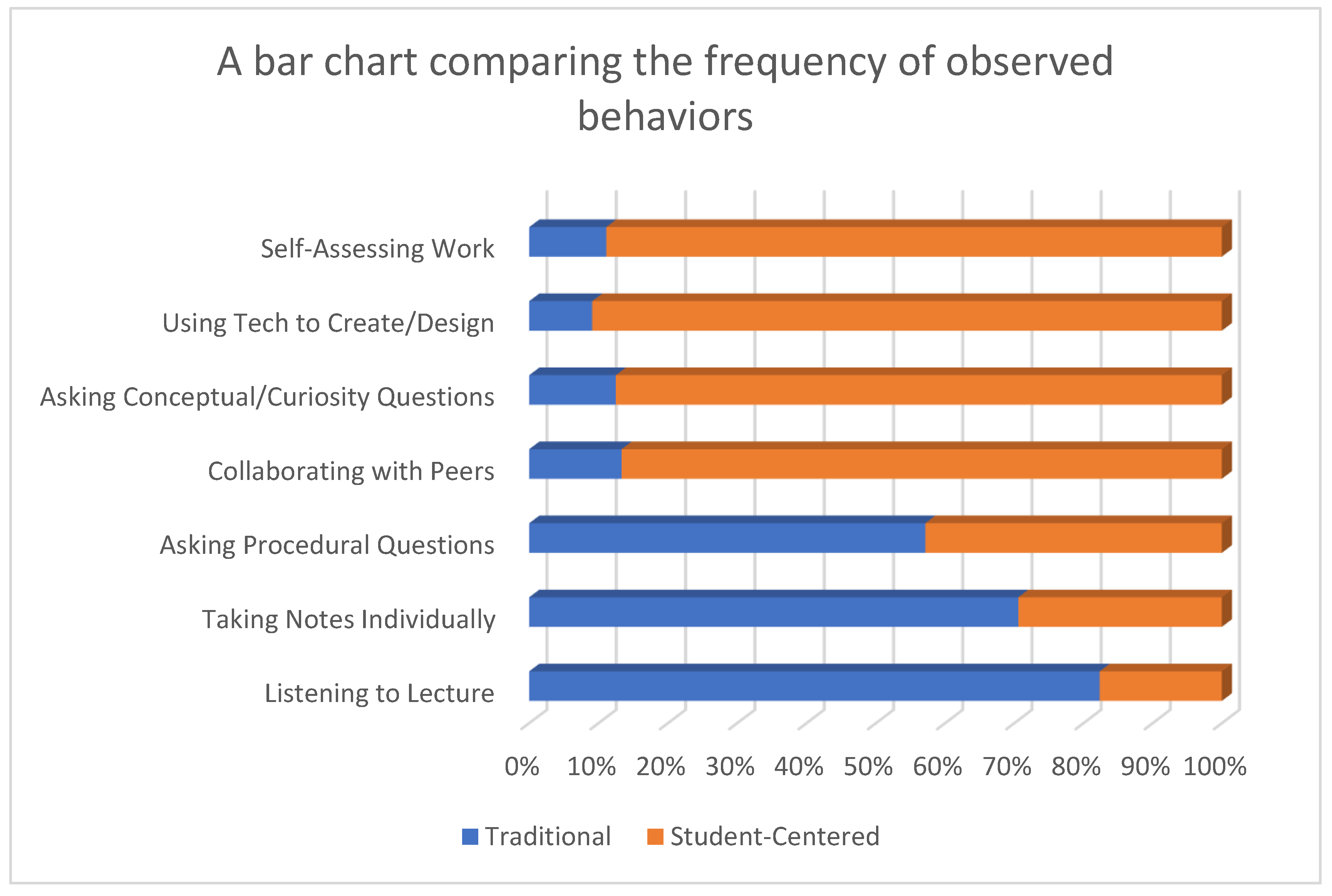
The "silent revolution" is producing measurable changes in classroom structure, teacher roles, and student behaviour. However, the results are decidedly mixed and heavily context dependent. The evidence suggests that EdTech acts as an amplifier: it amplifies effective, equitable pedagogies in well-supported environments, but it can just as powerfully amplify existing inequities, implementation flaws, and unintended negative consequences when deployed without critical foresight, robust support, and a relentless focus on the human elements of learning. The revolution is not inherently positive; its value is determined by the wisdom of its design and execution.
4. Discussion
4.1. Synthesis: The Double-Edged Sword of the EdTech Revolution
The evidence presented in Part 3 affirms the central argument: educational technology provides the functional levers to make the "Guide-on-the-Side" model operationally feasible. The four mechanisms automation, personalization, collaboration, and data analytics work in concert to offload scalable tasks, allowing teachers to engage in the higher-order work of mentorship and facilitation.
However, this synthesis reveals a more profound and complex truth: EdTech is not merely a tool for implementation; it is a powerful force that magnifies the underlying values and conditions of the educational system in which it is deployed. When used within a framework of equity, pedagogical depth, and professional empowerment, it can humanize learning. When deployed uncritically, it risks automating inequality, de-professionalizing teaching, and reducing learning to a quantified, transactional process.
Thus, the core challenge is not whether EdTech enables a shift, but toward what end, for whom, and under what conditions the shift occurs. This moves the discussion from technical implementation to a matter of educational justice and ethical design.
4.2. Re-Framing the Core Challenge: Equity as the Imperative, Not an Add-On
The persistent digital divide is not simply the first item on a list of challenges; it is the fundamental ethical test of the entire EdTech-enabled shift. An educational model that requires technology for full participation, while access remains inequitable, is fundamentally exclusionary. This creates a "two-tiered" system not as a potential risk, but as a near-certain outcome if unaddressed. Therefore, universal, robust, and pedagogically meaningful access to technology and connectivity is a non-negotiable prerequisite, not a follow-up consideration.
This equity imperative extends beyond hardware:
- Equity of Experience: Access to a device does not equal access to high-quality, teacher-facilitated, tech-enabled learning. Students in under-resourced schools often encounter technology used for rote drill and test prep ("substitution" on the SAMR model), while their affluent peers use it for creation, collaboration, and research ("redefinition").
- Algorithmic Equity: Personalized learning tools must be scrutinized for bias. Do they recognize diverse linguistic patterns and cultural contexts, or do they penalize them? Who defines the "correct" learning pathway?
Leadership Imperative: Addressing this requires decisive action from administrators and policymakers. School leaders must advocate for and allocate budgets toward sustainable 1:1 device program with take-home options, partner with communities to expand public broadband, and fiercely evaluate tools for bias and accessibility. Policymakers must treat school connectivity as essential public infrastructure.
4.3. A Framework for Responsible Implementation: The Ethical EdTech Integration Checklist
To navigate these complexities, stakeholders need more than enthusiasm; they need a practical, ethics-first framework. We propose the following checklist to guide planning, procurement, and practice:
Checklist for Ethical EdTech Integration
- 5.
- PEDAGOGICAL PURPOSE FIRST: Why this tool? The primary question must be: "What learning problem does this solve that is difficult or impossible without it?" Use frameworks like TPACK (Koehler & Mishra, 2024) to integrate Technology, Pedagogy, and Content Knowledge.
- 6.
- EQUITY & ACCESS ENSURED: For whom? Have we audited for device/internet access, digital literacy, and language support? Does use of this tool during class time ensure all can participate fully, regardless of home resources?
- 7.
- TEACHER AGENCY & TRAINING PROVIDED: With whose expertise? Is professional development ongoing, job-embedded, and focused on learning design rather than button-pushing? Do teachers have the autonomy to adapt or reject tools that don't serve their students?
- 8.
- STUDENT DATA PROTECTED: At what cost? What data is collected, who owns it, and how is it secured? Are privacy policies transparent and compliant? Is student data ever sold or used for commercial profiling?
- 9.
- BALANCED SCREEN TIME & HUMAN CONNECTION: Toward what balance? Does the tool foster meaningful interaction (student-student, student-teacher), or isolation? Are there clear protocols for "unplugged" time, face-to-face discussion, and hands-on activity?
4.4. The Path to Sustainable Implementation: Moving Beyond the Pilot
For this shift to be more than a series of short-lived pilot projects, it must be built on sustainable foundations.
- Funding Models: Move beyond one-time hardware grants. Sustainable models budget for refresh cycles for devices (every 3-5 years), ongoing software licenses, dedicated technical support staff, and most critically, permanent funding for instructional coaching roles. Consider public-private partnerships carefully, ensuring they do not cede curricular control or student data.
-
Ongoing Support, Not One-Off Training: Professional learning must be continuous and collaborative. This includes:
- ○
- Peer Learning Communities: Where teachers co-design lessons and troubleshoot challenges.
- ○
- Micro-Credentialing: Recognizing mastery in specific competencies like "Data-Informed Facilitation."
- ○
- Protected Planning Time: For teachers to design tech-integrated experiences.
- Community Engagement: Parents and guardians are key partners. Schools must proactively communicate the why behind the shift, offering workshops on new tools and platforms, and ensuring two-way dialogue about concerns related to screen time, data privacy, and homework expectations in a flipped model.
4.5. Reclaiming the "Guide": The Teacher as Learning Architect
The successful "Guide-on-the-Side" is not a passive monitor but a highly skilled Learning Architect. This role demands a synthesis of capabilities:
- Designer: Curating digital and physical resources to construct rich, inquiry-based learning landscapes.
- Data Ethnographer: Interpreting analytics with a critical, contextual eye to understand the story behind the numbers.
- Facilitator of Culture: Nurturing a classroom community of trust, intellectual risk-taking, and collaborative problem-solving.
- Ethical Guardian: Safeguarding student well-being, privacy, and equity in the digital environment.
This is a more demanding, cognitively complex, and ultimately more professionally satisfying role than the traditional "sage." It represents not a diminishment of the teacher, but an elevation.
The silent revolution is underway, but its trajectory is not predetermined. By cantering equity as a foundational imperative, adopting a critical ethical framework, building sustainable systems of support, and investing in teachers as architects of learning, we can steer this transformation toward its true promise: a more humanized, personalized, and just educational experience for every learner. The goal is not a high-tech classroom, but a high-touch, high-thinking classroom empowered by thoughtful technology. The ultimate question remains: Will we use these powerful tools to build walls or bridges? The answer lies not in the technology itself, but in the collective wisdom, intention, and values of the educators and leaders who wield it.
5. A Roadmap for Responsible Implementation
The transition from theory to practice from understanding the potential of EdTech to realizing its promise in every classroom requires more than enthusiasm. It demands a structured, phased, and reflective approach that prioritizes equity, sustainability, and pedagogical integrity. This section provides a practical roadmap for educational institutions committed to navigating this transformation successfully.
5.1. Phase 1: Readiness Assessment – Building on Solid Ground
Before any technology is procured or a single lesson is flipped, a comprehensive, honest assessment of the current landscape is essential. This phase answers the foundational question: "Are we ready to begin?"
-
Infrastructure Audit:
- ○
- Connectivity: Is school-wide broadband robust, reliable, and capable of supporting simultaneous use by all students and staff? What is the upload/download speeds?
- ○
- Hardware: What is the current state and age of devices? Is there a sustainable plan for 1:1 access, including take-home capabilities? Are there adequate charging and storage solutions?
- ○
- Technical Support: Is there sufficient on-site or rapidly available technical support to address daily issues without significant instructional downtime?
-
Human Capital & Readiness:
- ○
- Teacher Readiness: Conduct anonymous surveys and focus groups to gauge current digital proficiency, pedagogical beliefs, and readiness for change. Identify early adopters, cautious middle adopters, and resistors to tailor support.
- ○
- Leadership Alignment: Do administrators and department heads share a common vision for why this shift is necessary? Are they prepared to support teachers through the inevitable challenges of implementation?
- ○
- Student & Family Access: Survey families to understand home access to devices and reliable internet. This is not to penalize, but to plan for equitable participation (e.g., providing hotspots, offline materials, extended school access hours).
- Outcome: A clear, data-informed readiness report that identifies strengths, gaps, and non-negotiable prerequisites before moving forward. This phase may result in a necessary delay to secure foundational resources.
5.2. Phase 2: Pilot & Iterate – Learning Through Focused Action
With foundational readiness established, the next step is not a full-scale rollout, but a strategic, small-scale pilot. The goal is organizational learning, not immediate perfection.
-
Design the Pilot:
- ○
- Select a Volunteer Cohort: Recruit a small group of willing teachers from different subjects or grade levels. Include both tech-enthusiasts and respected skeptics.
- ○
- Define a Clear Scope: Pilot one specific pedagogical model (e.g., the flipped classroom) or a focused set of tools (e.g., a collaboration suite) aligned to a clear learning goal.
- ○
- Establish a Feedback Framework: Create structured mechanisms for continuous feedback: weekly teacher check-ins, student surveys, classroom observations focused on engagement and challenge points.
-
Embrace Iteration:
- ○
- Fail Fast, Learn Faster: Encourage pilot teachers to share what isn’t working openly and without blame. The pilot is a laboratory.
- ○
- Adapt Protocols: Based on feedback, adjust guidelines, workflows, and support structures in real-time. For example, you may find students need explicit training on how to watch an instructional video effectively before the flipped model can succeed.
- ○
- Document the Journey: Capture not just successes, but problems and solutions. This creates a valuable knowledge base and realistic expectations for scaling.
- Outcome: A refined, context-specific model of implementation, a group of teacher-leaders with practical experience, and evidence-based protocols ready for broader use.
5.3. Phase 3: Scale with Support – Growing the Ecosystem
Scaling a successful pilot requires moving from a project led by enthusiasts to a system supported by structures. This phase focuses on building the capacity and culture for sustained growth.
-
Invest in Differentiated Professional Development:
- ○
- Move beyond one-size-fits-all workshops. Offer tiered support: foundational skills for beginners, advanced design studios for early adopters, and just-in-time coaching for all.
- ○
- Leverage pilot teachers as peer coaches and mentors, creating an internal community of practice.
- ○
- Focus PD on pedagogical design with technology, not just tool functionality.
-
Engage the Wider Community:
- ○
- Parents & Guardians: Host informational sessions to explain the why behind new learning models. Offer tutorials on new platforms and create clear channels for questions and concerns.
- ○
- Students: Involve student tech teams or ambassadors to provide peer support and feedback on tool usability and learning experience.
-
Align Policy and Practice:
- ○
- Revise school schedules to allow for collaborative teacher planning time.
- ○
- Adjust assessment and evaluation policies to value facilitation, student agency, and project-based outcomes alongside traditional measures.
- ○
- Ensure sustainable budget lines for ongoing software licenses, device refresh, and coaching positions not just initial hardware costs.
- Outcome: A growing percentage of classrooms effectively integrating technology, supported by a culture of collaboration, clear policies, and an engaged community.
5.4. Phase 4: Evaluate & Evolve – Fostering a Culture of Continuous Improvement
The final phase is not an endpoint, but the establishment of an ongoing cycle of reflection and refinement. The purpose of evaluation shifts from proving success to improving practice.
-
Multi-Dimensional Evaluation:
- ○
- Student Learning: Look beyond standardized test scores to metrics of engagement, self-efficacy, collaboration, and the quality of student work (portfolios, projects).
- ○
- Teacher Practice: Use walk-throughs and self-assessments aligned to the "Guide-on-the-Side" competencies (e.g., questioning, facilitation, data use).
- ○
- System Health: Monitor equity metrics are all student groups benefiting equally? Track teacher well-being and retention in pilot vs. non-pilot groups.
-
Use Data Responsibly:
- ○
- Analyse learning analytics and feedback data not for accountability judgments, but as a diagnostic tool for collective problem-solving.
- ○
- Hold regular "data reflection" meetings where teachers and leaders review trends and co-design interventions.
-
Plan for Evolution:
- ○
- Technology and pedagogy will continue to evolve. Establish a standing innovation committee tasked with periodically reviewing new tools and research and recommending the next small-scale pilots.
- ○
- Celebrate and share stories of impact not just quantitative gains, but qualitative narratives of student empowerment and teacher growth.
- Outcome: A resilient, adaptive learning organization that views the EdTech-enabled shift not as a finite initiative, but as a core dimension of its commitment to continuous growth and equitable, powerful learning for all.
This four-phase roadmap provides a deliberate path to transform the silent revolution from a scattered phenomenon into a systemic, sustainable, and equitable evolution of teaching and learning.
6. Conclusion
6.1. The Silent Revolution: A Reality in Flux
The evidence presented in this article confirms that a silent revolution is indeed reshaping the educational landscape. Educational technology is no longer a peripheral novelty; it has emerged as the essential catalyst making the long-theorized shift from the teacher-cantered "Sage-on-the-Stage" to the facilitative "Guide-on-the-Side" not only possible but increasingly prevalent. This transformation is driven by EdTech's core capacity to systematically offload the scalable tasks of content delivery, uniform practice, and routine assessment (Baker, 2024; Zheng et al., 2024).
We have moved beyond potential to observable, if uneven, reality. Classrooms are morphing from static lecture halls into dynamic workshops (Steelcase Education, 2022); teachers are evolving into designers and data-informed coaches (ISTE, 2023); and students are demonstrating greater agency over the pace, path, and product of their learning (Pane, 2024). However, as our analysis has underscored, this revolution is a double-edged sword. Its promise of personalization and empowerment is matched by perils of inequity, data exploitation, and the potential to replace human connection with digital transaction. The revolution is not inherently benevolent; its impact is dictated by the wisdom of its implementation.
6.2. The Path Forward: A Call to Action
The future of this revolution is not predetermined. Its trajectory will be shaped by deliberate choices made at every level of the educational ecosystem. We therefore issue the following concrete calls to action:
For Teachers: Embrace Your Role as a Learning Architect
- Start Small, Think Big: Begin with one tool aligned to a clear pedagogical goal perhaps using a platform like Flip to spark student voice through video reflection and master its integration. Do not attempt to overhaul everything at once.
- Join and Build Networks: Seek out professional learning networks (PLNs), both online (e.g., #EdTechChat) and in-person, to share resources, troubleshoot challenges, and co-design with peers.
- Assert Pedagogical Sovereignty: Remember that you are the expert in your classroom. Critically evaluate every tool. If an EdTech product does not serve your students' learning or well-being, you have the professional right and duty to adapt or reject it.
For School Leaders and Administrators: Build the Foundation for Sustainable Change
- Invest in People, Not Just Products: Allocate budgets to ongoing, job-embedded professional development and instructional coaching at parity with hardware expenditures. A device without a trained, supported teacher is a paperweight.
- Prioritize Equity Infrastructure: Ensure universal, reliable access by investing in robust school-wide broadband and sustainable 1:1 device programs with take-home guarantees. Make digital equity a key performance indicator.
- Reward Innovation, Not Just Compliance: Revise teacher evaluation frameworks to value facilitation, questioning, and the design of collaborative learning experiences as highly as classroom management and test score gains.
For Policymakers and System Leaders: Create the Conditions for Equity and Innovation
- Fund with Purpose: Direct public funding toward equity-focused EdTech initiatives that prioritize closing the digital divide in underserved communities. Support not just procurement, but the long-term costs of connectivity, support, and training.
- Modernize Assessment: Revise high-stakes assessment systems that currently reinforce the "sage" model. Develop and pilot new metrics that value critical thinking, collaboration, creativity, and student portfolios the very outcomes the "Guide-on-the-Side" model cultivates.
- Enact Strong Data Privacy Guards: Pass and enforce stringent regulations to protect student data from commercial exploitation, ensuring that learning analytics are used solely for educational benefit.
6.3. A New Vision: From Guide to Architect and Co-Learner
Looking ahead, the role of the educator must continue to evolve beyond even the "Guide-on-the-Side." We propose a more holistic and dynamic conception: the Teacher as a Learning Architect and Co-Learner.
- The Learning Architect designs vibrant ecosystems of learning, blending digital and physical resources to construct experiences that provoke curiosity, challenge assumptions, and connect to the real world. This architect builds scaffolds, not cages; they create pathways with multiple entry points to honor diverse learners.
- The Co-Learner acknowledges that in a rapidly changing world, no one is the sole repository of knowledge. This teacher models curiosity, investigates alongside students, and leverages technology not just to teach, but to learn with and from their students about new tools, perspectives, and problems.
This dual identity captures the essence of the shift: moving from a hierarchy of knowledge transmission to a community of knowledge creation.
6.4. The Ultimate Goal: Rehumanizing Education
In closing, we must reiterate the profound, central truth that underpins this entire revolution: The ultimate goal is not technological integration for its own sake, nor is it merely the improvement of standardized test scores. The true promise of this EdTech-enabled shift is the rehumanization of the classroom.
By delegating standardized, repetitive tasks to technology, we reclaim the time and psychic space for education's irreplaceably human core: the mentorship that ignites a passion, the empathetic support that builds resilience, the probing dialogue that sharpens critical thought, and the collaborative community that fosters belonging. The greatest power of EdTech lies in its ability to free teachers to focus on what they do best seeing, hearing, and inspiring the unique potential within every student.
The silent revolution is here. It carries within it the tools to build walls of division or bridges of opportunity; to create systems of surveillance or communities of trust. Our collective task is to wield these tools with intentionality, courage, and an unwavering commitment to equity. Let us steer this revolution toward a future where every classroom is a testament not to the power of technology, but to the enduring power of human connection, curiosity, and growth.
References
- Baker, R. S. (2024). Big data and education: 8th edition. Routledge. [CrossRef]
- Chen, B., & Zhang, L. (2023). From passive recipients to active creators: A post-pandemic review of student-centered learning. Journal of Educational Technology Research, 51(2), 145–162. [CrossRef]
- Chen, B., Wang, Y., & Wang, L. (2022). The effects of flipped classroom on learning achievement and learning motivation: A meta-analysis. Educational Technology Research and Development, 70(4), 1357–1384. [CrossRef]
- Chu, H. C., & Xie, H. (2023). Student well-being in digital learning environments: A mixed-methods study of screen fatigue and engagement. Computers in Human Behavior, 148, 107902. [CrossRef]
- Darling-Hammond, L. (2023). The flat world and education: How America's commitment to equity will determine our future (2nd ed.). Teachers College Press.
- Darling-Hammond, L., Flook, L., Schachner, A., & Wojcikiewicz, S. (2024). Educating for the future: The changing landscape of pedagogy and technology. Learning Policy Institute. https://learningpolicyinstitute.org/product/educating-future-report.
- Educator Voice Project. (2024). Annual report on teacher well-being and technology integration. National Board for Professional Teaching Standards.
- Ertmer, P. A., & Ottenbreit-Leftwich, A. T. (2024). Removing obstacles to the pedagogical changes required by Jonassen's vision of authentic technology-enabled learning. Educational Technology Research and Development, 72(1), 1–26. [CrossRef]
- Freire, P. (1970). Pedagogy of the oppressed. Herder and Herder.
- Hodges, C., Moore, S., Lockee, B., Trust, T., & Bond, A. (2022). The difference between emergency remote teaching and online learning. Educause Review. https://er.educause.edu/articles/2022/3/the-difference-between-emergency-remote-teaching-and-online-learning.
- Holstein, K., McLaren, B. M., & Aleven, V. (2023). Student and teacher perspectives on learning analytics dashboards: A critical data literacy approach. Journal of Learning Analytics, 10(1), 1–26. [CrossRef]
- Ifenthaler, D., & Gibson, D. (2023). Adoption of learning analytics. In Adoption of data analytics in higher education learning and teaching (pp. 3–20). Springer. [CrossRef]
- International Society for Technology in Education. (2023). ISTE standards: For educators. https://www.iste.org/standards/iste-standards-for-teachers.
- Kessler, A., Meeter, M., & van der Schoot, M. (2023). The digital transformation of education: A systematic review of the literature. Computers & Education, 190, 104606. [CrossRef]
- King, A. (1993). From sage on the stage to guide on the side. College Teaching, 41(1), 30–35. [CrossRef]
- Koehler, M. J., & Mishra, P. (2024). What is technological pedagogical content knowledge (TPACK)? Contemporary Issues in Technology and Teacher Education, 24(1), 1–12. https://citejournal.org/volume-24/issue-1-24/general/what-is-technological-pedagogical-content-knowledge.
- National Education Association. (2023). Educator stress and technology integration: A national survey. NEA Research.
- Pane, J. F. (2024). The continued evolution of personalized learning: Evidence from a multi-year study. RAND Corporation. https://www.rand.org/pubs/research_reports/RRA2794-1.html.
- Pew Research Center. (2021, August 19). Digital divide persists even as Americans with lower incomes make gains in tech adoption. https://www.pewresearch.org/fact-tank/2021/08/19/digital-divide-persists-even-as-americans-with-lower-incomes-make-gains-in-tech-adoption/.
- RAND Corporation. (2023). Equity in adaptive learning: Student and teacher experiences in low-income schools (Research Brief RB-10221). https://www.rand.org/pubs/research_briefs/RB10221.html.
- Steelcase Education. (2022). Active learning spaces: The impact of classroom design on student engagement and performance. https://www.steelcase.com/research/articles/topics/active-learning/active-learning-spaces-impact-classroom-design/.
- Thomas, D., & Brown, J. S. (2021). A new culture of learning: Cultivating the imagination for a world of constant change. CreateSpace Independent Publishing Platform.
- Trust, T., & Whalen, J. (2021). Should teachers be trained in emergency remote teaching? Lessons learned from the COVID-19 pandemic. Journal of Technology and Teacher Education, 29(2), 189–217. https://www.learntechlib.org/primary/p/218722/.
- Trust, T., Carpenter, J. P., & Krutka, D. G. (2022). The remote learning paradox: How a crisis created a catalyst for educational technology integration. British Journal of Educational Technology, 53(5), 1125–1143. [CrossRef]
- Tucker, C. R. (2023). The complete guide to blended learning: Activating agency, differentiation, community, and inquiry for students. ISTE.
- Xie, H., Chu, H. C., Hwang, G. J., & Wang, C. C. (2023). Trends and development in technology-enhanced adaptive/personalized learning: A systematic review of journal publications from 2007 to 2022. Computers & Education, 201, 104835. [CrossRef]
- Zheng, L., Niu, J., Long, M., & Fan, Y. (2024). The role of teacher support in technology-enhanced flipped classrooms: A mixed-methods study. Journal of Educational Computing Research, 62(1), 267–293. [CrossRef]
Disclaimer/Publisher’s Note: The statements, opinions and data contained in all publications are solely those of the individual author(s) and contributor(s) and not of MDPI and/or the editor(s). MDPI and/or the editor(s) disclaim responsibility for any injury to people or property resulting from any ideas, methods, instructions or products referred to in the content. |
© 2026 by the authors. Licensee MDPI, Basel, Switzerland. This article is an open access article distributed under the terms and conditions of the Creative Commons Attribution (CC BY) license (http://creativecommons.org/licenses/by/4.0/).
Copyright: This open access article is published under a Creative Commons CC BY 4.0 license, which permit the free download, distribution, and reuse, provided that the author and preprint are cited in any reuse.


