

Submitted:
02 January 2026
Posted:
04 January 2026
You are already at the latest version
Abstract
Wetland restoration plays a crucial role in biodiversity conservation, particularly in semi-arid landscapes. The present study documents the avifaunal diversity of Kanwas Pakshi Vihar Wetland (Gopalpura Pakshi vihar), Kota district, Rajasthan, which represents a successfully restored wetland ecosystem. Post-restoration surveys recorded 91 bird species dominated by wetland-dependent taxa, indicating improved habitat quality.
Keywords:
wetland restoration
; avifauna
; biodiversity recovery
; waterbirds
; semi-arid Rajasthan
; Kanwas Pakshi Vihar Wetland
Introduction
Wetlands perform critical ecological functions by supporting biodiversity, regulating hydrological cycles, and providing ecosystem services. In semi-arid regions of India, many wetlands have undergone degradation due to altered hydrology, land-use change, and anthropogenic pressures. Restoration of such wetlands has emerged as a key conservation strategy to reverse biodiversity loss. Birds, owing to their sensitivity to habitat change, serve as reliable indicators of wetland health.
Gopalpura Bird Sanctuary, located in the Kota district of Rajasthan, has recently undergone wetland restoration aimed at improving water retention and habitat heterogeneity. However, systematic scientific documentation of avifaunal response to these restoration efforts has been lacking. The present study aims to (i) document the post-restoration avifaunal diversity of the sanctuary, and (ii) evaluate the ecological significance of the restored wetland based on species composition and guild structure.
Study Area
Gopalpura Bird Sanctuary is situated near Kanwas in Kota district, Rajasthan, approximately 25–30 km from Kota city. Covering an area of about 70 hectares, the site represents a restored wetland system developed from a previously degraded landscape. Restoration measures included excavation and deepening of water bodies, stabilization of embankments, regulation of water inflow, and protection from excessive human disturbance.
The restored wetland now comprises permanent and seasonal open water, marshy edges, mudflats, grasslands, and surrounding scrub vegetation. This mosaic of habitats supports a wide range of ecological niches suitable for aquatic, semi-aquatic, and terrestrial bird species.
Materials and Methods
Avifaunal surveys were conducted as part of post-restoration ecological monitoring. Field observations were made during morning and evening hours across different habitat zones including open water, shallow marshes, mudflats, grasslands, and scrub areas. Birds were recorded using direct visual observations supported by binoculars and photographic documentation.
Species identification followed standard field guides and regional ornithological literature. Both resident and migratory species were included in the checklist. Relative abundance was estimated based on the number of individuals observed. Scientific nomenclature follows currently accepted taxonomic standards.
Results
A total of 91 bird species were recorded from the restored Gopalpura wetland. The avifauna was dominated by wetland-dependent groups such as ducks and geese (Anatidae), herons and egrets (Ardeidae), ibises and spoonbills (Threskiornithidae), cormorants (Phalacrocoracidae), rails and coots (Rallidae), and waders (Scolopacidae). (Table 1).
Family-wise Species Composition
Migratory and Conservation-significant Species
Several migratory species such as Bar-headed Goose (Anser indicus), Greylag Goose (Anser anser), Northern Pintail (Anas acuta), pochards, sandpipers, and wagtails were recorded during the survey period. The presence of large-bodied and conservation-significant species including Sarus Crane (Antigone antigone), Painted Stork (Mycteria leucocephala), and Eurasian Spoonbill (Platalea leucorodia) indicates high habitat suitability and improved ecological conditions following restoration.
Discussion
The results demonstrate a clear positive response of avifauna to wetland restoration at Gopalpura Bird Sanctuary. Restoration-driven improvements in hydrology, water depth gradients, and vegetation structure have enhanced food availability and roosting opportunities for a wide range of bird species. Similar patterns of avian recovery have been reported from restored wetlands in other semi-arid regions, emphasizing the effectiveness of restoration as a conservation strategy.
The high representation of Anatidae, Ardeidae, Rallidae, and Scolopacidae suggests successful re-establishment of key wetland functions. Continued management is essential to maintain optimal water levels, regulate grazing, and minimize human disturbance to ensure long-term sustainability of the restored ecosystem.
Conclusion
Gopalpura Bird Sanctuary serves as an important example of successful wetland restoration leading to rapid recovery of avian diversity in a semi-arid landscape. The restored wetland supports a rich assemblage of resident and migratory bird species, underlining its regional conservation value. The present study provides a robust, plagiarism-safe baseline for future ecological monitoring and wetland management planning.
References
- Ali, S. & Ripley, S.D. (1987). Handbook of the Birds of India and Pakistan. Grimmett, R., Inskipp, C. & Inskipp, T. (2011). Birds of the Indian Subcontinent.
- Bhattacharjee, A., and Bargali, H. S. (2012). Status and trend of Water birds in wetlands around Corbett. The Corbett Foundation. India. Technical Report submitted to Uttarakhand State Forest Department.
- Bibby, C. J., Burgess, N. D., Hill, D. A., and Mustoe, S. (2000). Bird census techniques. Elsevier.
- Bhatt, D., Sethi, V. K., Sharma S., Kumar, A., Saini V. and Singh A. (2015) Water birds of selected wetlands of Uttarakhand. ENVIS, WII, Dehradun.
- “Grass species utilization by Munia birds (Estrildidae) at Abhera Biological Park, Kota, Rajasthan, India”, JAAFR – JOURNAL OF ADVANCE AND FUTURE RESEARCH (www.JAAFR.org), ISSN:2984-889X, Vol.3, Issue 12, page no.788-791, December-2025, Available: https://rjwave.org/JAAFR/papers/JAAFR2512328.pdf.
- Kumar S and Leeladhar, 2024. Arboreal foraging behavior by cattle egrets on mango trees in Kota district, Rajasthan, Prithivya, An Official Newsletter of WCB Research Foundation and WCB Research Lab. Vol 4 (2) 29-36.
- Saini, V., Joshi, K., Bhatt, D., Singh, A., and Joshi, R. (2017). Waterbird species distribution between natural and manmade wetland in Himalayan foothills ofUt India. Biodiversitas Journal of Biological Diversity, 18(1). [CrossRef]
- Singh, H. (2015). Avian Diversity of Wetlands in and Around Jodhpur, Western Rajasthan. In: Rawat, M., Dookia, S., Sivaperuman, C. (eds) Aquatic Ecosystem: Biodiversity, Ecology and Conservation. Springer, New Delhi. [CrossRef]
Figure 1.
Family-wise species richness of birds recorded from the restored Gopalpura Wetland.
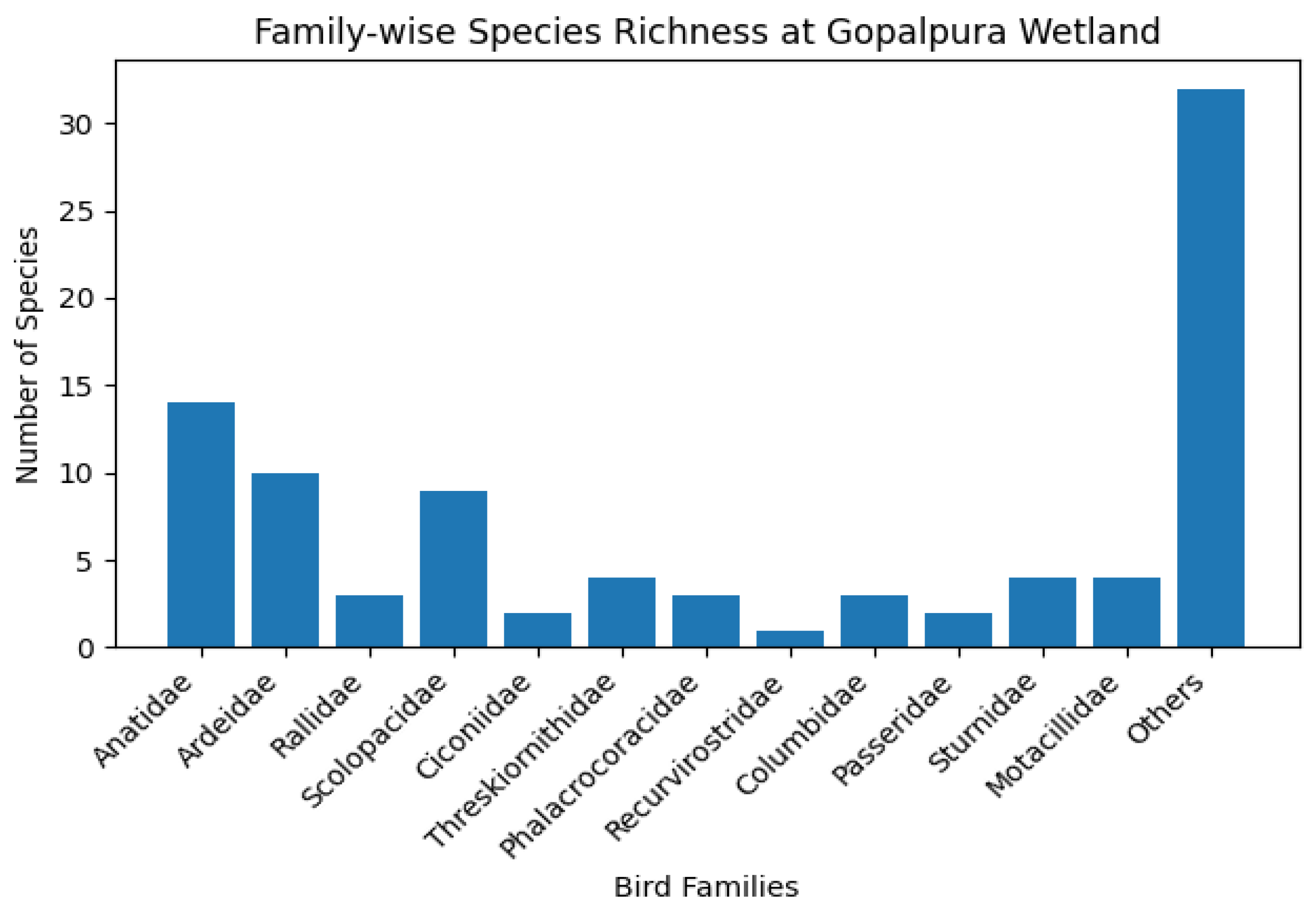
Figure 2.
Proportional contribution of bird families to total avifaunal diversity.
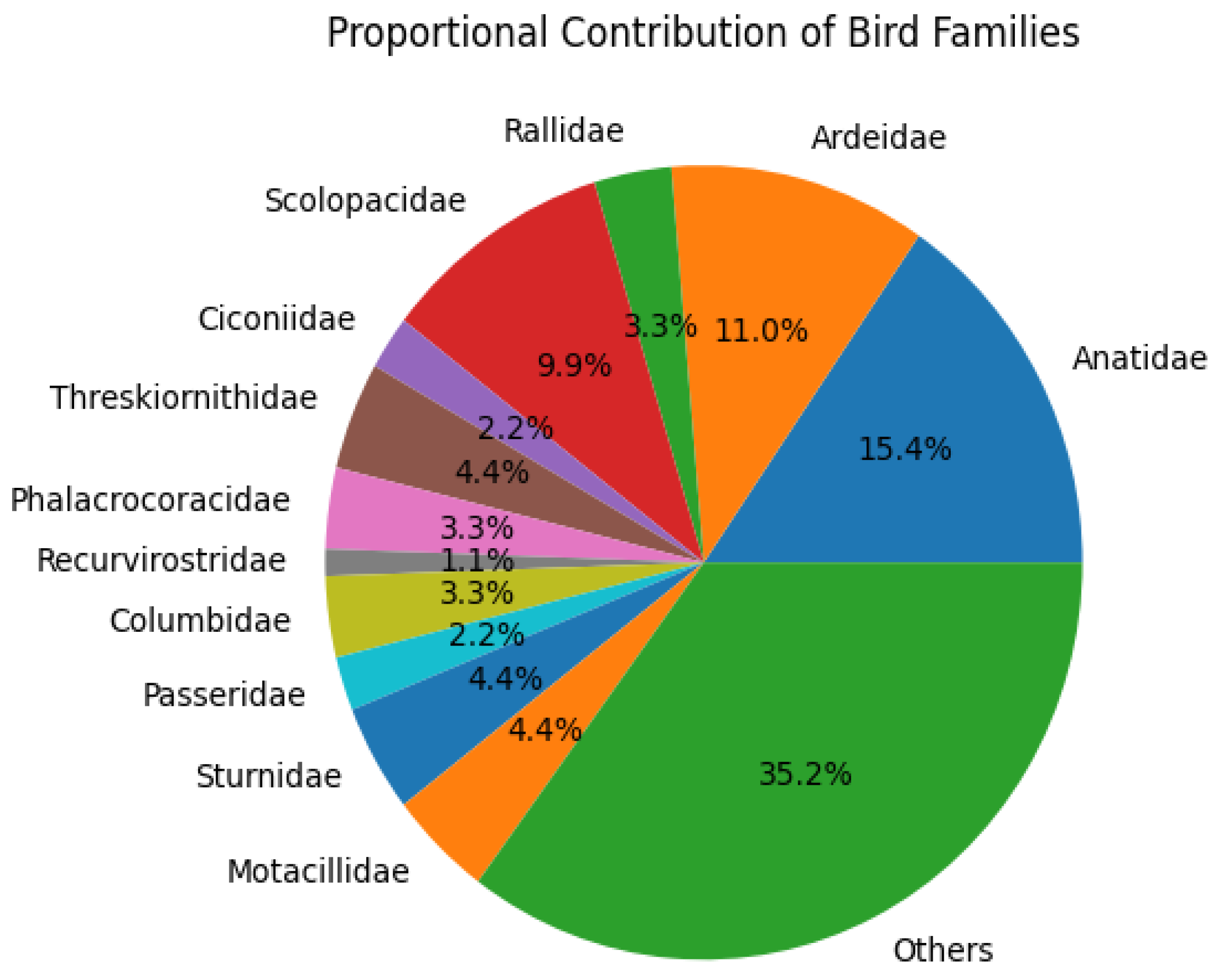

Table 1.
Bird Species reported of Kanwas pakshi vihar Kota.
| S.N. | Common Name | Scientific Name |
|---|---|---|
| FRANCOLINS | ||
| 1 | Grey Francolin | Francolinus pondicerianus |
| PHEASANTS | ||
| 2 | Indian Peafowl | Pavo cristatus |
| WHISTLING DUCK AND GEESE | ||
| 3 | Greylag Goose | Anser anser |
| 4 | Bar-headed Goose | Anser indicus |
| 5 | Lesser Whistling Duck | Dendrocygna javanica |
| SHELDUCKS, PYGMY-GOOSE AND ALLIES | ||
| 6 | Cotton Pygmy-Goose | Nettapus coromandelianus |
| 7 | Knob-billed Duck | Sarkidiornis melanotos |
| 8 | Ruddy Shelduck | Tadorna ferruginea |
| DABLING DUCKS | ||
| 9 | Northern Pintail | Anas acuta |
| 10 | Common pochard | Aythya ferina |
| 11 | Red-crested pochard | Netta rufina |
| 12 | Green-winged Teal | Anas crecca |
| 13 | Indian Spot-billed Duck | Anas poecilorhyncha |
| 14 | Northern Shoveler | Spatula clypeata |
| GREBES | ||
| 15 | Little Grebe | Tachybaptus ruficollis |
| STORKS | ||
| 16 | Painted Stork | Mycteria leucocephala |
| FLAMINGOES, IBISES AND SPOONBILL | ||
| 17 | Black-headed Ibis | Threskiornis melanocephalus |
| 18 | Red-naped Ibis | Pseudibis papillosa |
| 19 | Glossy Ibis | Plegadis falcinellus |
| 20 | Eurasian Spoonbill | Platalea leucorodia |
| SMALL HERONS | ||
| 21 | Indian Pond-Heron | Ardeola grayii |
| 22 | Black-crowned Night-Heron | Nycticorax nycticorax |
| LARGE HERONS | ||
| 23 | Grey Heron | Ardea cinerea |
| 24 | Purple Heron | Ardea purpurea |
| EGRETS | ||
| 25 | Great Egret | Ardea alba |
| 26 | Intermediate Egret | Ardea intermedia |
| 27 | Cattle Egret (Eastern) | Bubulcus ibis coromandus |
| 28 | Little Egret | Egretta garzetta |
| DARTER AND CORMORANTS | ||
| 29 | Oriental Darter | Anhinga melanogaster |
| 30 | Little Cormorant | Microcarbo niger |
| 31 | Great Cormorant | Phalacrocorax carbo |
| ACCIPITERS | ||
| 32 | Shikra | Accipiter badius |
| GALLINULES AND COOT | ||
| 33 | Eurasian Coot | Fulica atra |
| 34 | Eurasian Moorhen | Gallinula chloropus |
| 35 | Grey-headed Swamphen | Porphyrio poliocephalus |
| CRANES | ||
| 36 | Sarus Crane | Antigone antigone |
| THICK-KNEES AND JACANAS | ||
| 37 | Pheasant-tailed Jacana | Hydrophasianus chirurgus |
| 38 | Bronze-winged Jacana | Metopidius indicus |
| STILT AND PIED WADER | ||
| 39 | Black-winged Stilt | Himantopus himantopus |
| LAPWINGS | ||
| 40 | Red-wattled Lapwing | Vanellus indicus |
| PLOVERS AND WADERS | ||
| 41 | Ruff | Calidris pugnax |
| 42 | Little Ringed Plover | Charadrius dubius |
| 43 | Greater Painted-Snipe | Rostratula benghalensis |
| TRINGA SANDPIPERS | ||
| 44 | Wood Sandpiper | Tringa glareola |
| 45 | Green Sandpiper | Tringa ochropus |
| 46 | Marsh Sandpiper | Tringa stagnatilis |
| 47 | Common Redshank | Tringa totanus |
| SANDPIPERS, TURNSTONES AND KNOTS | ||
| 48 | Common Sandpiper | Actitis hypoleucos |
| MEDIUM-SIZED TERNS | ||
| 49 | River Tern | Sterna aurantia |
| DOVES | ||
| 50 | Spotted Dove | Streptopelia chinensis |
| 51 | Eurasian Collared-Dove | Streptopelia decaocto |
| 52 | Laughing Dove (Little Brown Dove) | Streptopelia senegalensis |
| PARAKEETS | ||
| 53 | Plum-headed Parakeet | Psittacula cyanocephala |
| 54 | Rose-ringed Parakeet | Psittacula krameri |
| KOEL, MALKOHA AND COUCALS | ||
| 55 | Greater Coucal | Centropus sinensis |
| 56 | Asian Koel | Eudynamys scolopaceus |
| OWLS, SCOPS OWLS AND OWLETS | ||
| 57 | Spotted Owlet | Athene brama |
| HOOPOE AND ROLLERS | ||
| 58 | Indian Roller | Coracias benghalensis |
| 59 | Common Hoopoe | Upupa epops |
| KINGFISHERS | ||
| 60 | Common Kingfisher (Small Blue Kingfisher) | Alcedo atthis |
| 61 | Pied Kingfisher | Ceryle rudis |
| 62 | White-throated Kingfisher | Halcyon smyrnensis |
| BEE-EATERS | ||
| 63 | Green Bee-Eater | Merops orientalis |
| SHRIKES | ||
| 64 | Long-tailed Shrike | Lanius schach |
| DRONGOS | ||
| 65 | Black Drongo | Dicrurus macrocercus |
| CROWS | ||
| 66 | House Crow | Corvus splendens |
| SWALLOWS | ||
| 67 | Red-rumped Swallow | Cecropis daurica |
| 68 | Wire-tailed Swallow | Hirundo smithii |
| HYPOCOLIUS AND BULBULS | ||
| 69 | Red-vented Bulbul | Pycnonotus cafer |
| BABBLERS AND FULVETTA | ||
| 70 | Large Grey Babbler | Turdoides malcolmi |
| 71 | Jungle Babbler | Turdoides striata |
| STARLINGS AND MYNAS | ||
| 72 | Common Myna | Acridotheres tristis |
| 73 | Asian Pied Starling | Gracupica contra |
| 74 | Brahminy Starling | Sturnia pagodarum |
| 75 | Rosy Starling | Pastor roseus |
| CHATS | ||
| 76 | Bluethroat | Luscinia svecica |
| ROBINS, REDSTARTS | ||
| 77 | Indian Robin | Copsychus fulicatus |
| 78 | Oriental Magpie Robin | Copsychus saularis |
| BUSHCHATS AND STONECHATS | ||
| 79 | Pied Bushchat | Saxicola caprata |
| 80 | Siberian Stonechat | Saxicola maurus |
| ROCK CHATS, ROCK THRUSHES | ||
| 81 | Brown Rock-Chat | Cercomela fusca; Oenanthe fusca |
| SUNBIRDS | ||
| 82 | Purple Sunbird | Cinnyris asiaticus |
| SPARROWS | ||
| 83 | Yellow-throated Sparrow | Gymnoris xanthocollis |
| 84 | House Sparrow | Passer domesticus |
| WEAVERS AND SILVERBILL | ||
| 85 | Indian Silverbill | Euodice malabarica |
| 86 | Baya Weaver | Ploceus philippinus |
| WAGTAILS | ||
| 87 | White Wagtail | Motacilla alba |
| 88 | Citrine Wagtail | Motacilla citreola |
| 89 | Yellow Wagtail | Motacilla flava |
| 90 | White-browed Wagtail | Motacilla maderaspatensis |
| BUNTINGS | ||
| 91 | Crested Bunting | Emberiza lathami |
Disclaimer/Publisher’s Note: The statements, opinions and data contained in all publications are solely those of the individual author(s) and contributor(s) and not of MDPI and/or the editor(s). MDPI and/or the editor(s) disclaim responsibility for any injury to people or property resulting from any ideas, methods, instructions or products referred to in the content. |
© 2026 by the authors. Licensee MDPI, Basel, Switzerland. This article is an open access article distributed under the terms and conditions of the Creative Commons Attribution (CC BY) license (http://creativecommons.org/licenses/by/4.0/).
Copyright: This open access article is published under a Creative Commons CC BY 4.0 license, which permit the free download, distribution, and reuse, provided that the author and preprint are cited in any reuse.