

Submitted:
08 March 2026
Posted:
09 March 2026
Read the latest preprint version here
Abstract
Nanoscale conductors and interfaces often exhibit anomalous AC transport and enhanced supercon-ducting critical temperatures that deviate from conventional electron-phonon descriptions. We explore a complementary, exploratory mechanism based on the inertial response of a Z3-graded vacuum sector to time-varying electromagnetic fields. Within this phenomenological framework, surface criticality is suggested to drive high-energy vacuum modes toward low-energy collective excitations at surfaces and interfaces, giving rise to an approximate coherence length ξvac ∼ 70 nm. This geometric length scale may influence the effective conductivity in the non-local regime, potentially contributing to features such as high-frequency skin depth saturation and interface-driven Tc enhancement. Illus-trative evaluations based on the algebraic structure show qualitative consistency with experimental observations in high-purity metals and nanowire systems. The framework offers an exploratory perspective on these mesoscopic anomalies and tentatively attempts to establish a possible connection between algebraic high-energy structures and low-energy quantum materials phenomena.
Keywords:
Z3-graded Lie superalgebra
; vacuum inertia
; surface quantum criticality
; discrete vacuum lattice
; geometric resonance
; anomalous skin effect
; nanoscale superconductivity
; geometric coherence length
; renormalization group flow
; exploratory phenomenological framework
1. Introduction
The transport properties of metals and superconductors at the nanoscale frequently defy the predictions of standard Drude-Sommerfeld and BCS frameworks [3,5,6]. Persistent anomalies, such as the frequency-dependent saturation of skin depth in high-purity metals [10] and the size-dependent enhancement of the superconducting critical temperature () in nanowires [5], continue to motivate the search for mechanisms beyond conventional electron-phonon coupling. While theories based on non-local electrodynamics or surface scattering provide valuable partial explanations, they often require material-specific adjustments.
Standard quantum electrodynamics (QED) has been extraordinarily successful in describing vacuum fluctuations and their effects in condensed-matter systems. Nevertheless, recent experiments have highlighted material-specific features that appear difficult to capture within isotropic QED vacuum fluctuations alone. In particular, a landmark study published in Nature (February 2026) demonstrated that vacuum fluctuations, when mediated by a single atomic layer of hexagonal boron nitride (hBN) in a dark cavity, can directly suppress the superfluid density of a molecular superconductor without external optical excitation [17]. This observation suggests that the coupling between vacuum degrees of freedom and the condensate may exhibit a stronger geometric or structural dependence than anticipated in standard treatments.
In this work, we explore the possibility that these phenomena may also admit a complementary geometric interpretation. We tentatively investigate a theoretical framework based on a finite-dimensional -graded Lie superalgebra, in which the vacuum sector is structured by a discrete 44-vector lattice [1]. Within this exploratory picture, the experimental breakthrough in Ref. [17] may be understood not only through standard vacuum fluctuations but also as a possible **geometric resonance** event, in which the hexagonal lattice of hBN aligns topologically with the planar projection of the vacuum lattice ( root system). Such alignment could enhance the effective coupling between the vacuum sector and charge carriers at interfaces.
We examine the consequences of treating the vacuum sector as a dynamical scalar field. At surfaces and interfaces—such as hBN/superconductor boundaries or nanowire surfaces—translational symmetry breaking is suggested to drive the vacuum mode toward a surface quantum critical point. This may generate a collective excitation characterized by an approximate geometric coherence length:
This length scale is explored as a possible fundamental cutoff for non-local transport. Illustrative calculations within the framework show qualitative consistency with the skin-depth saturation observed in copper and the enhancement in tin nanowires, while also offering a possible geometric perspective on the vacuum-engineered suppression of superfluidity reported in the recent Nature experiment.
This length scale serves as a fundamental cutoff for non-local transport. Illustrative calculations within the framework show qualitative consistency with the skin-depth saturation observed in copper and the enhancement in tin nanowires, while also offering a possible geometric perspective on the vacuum-engineered suppression of superfluidity reported in the recent Nature experiment.
This exploratory work is primarily addressed to theorists with an interest in algebraic structures and geometric approaches to condensed matter physics. We fully recognize that the mathematical language of -graded Lie superalgebras may appear unfamiliar to many readers in the condensed-matter community, where low-energy excitations and phenomenological models are more commonly employed. We have therefore made a concerted effort throughout the manuscript to provide sufficient introductory context, explicit definitions, and cross-references to appendices, while maintaining a cautious and phenomenological tone. Our hope is that this framework may serve as a speculative bridge between high-energy algebraic ideas and low-energy mesoscopic phenomena, and we welcome feedback from experts in both communities to help refine and clarify the presentation for a broader readership.
Recent studies have increasingly emphasized the power of geometric and topological considerations when modeling quantum devices at the mesoscopic scale. For instance, Mączka et al. [16] elegantly demonstrated that adopting a geometric perspective in the precise modeling of active regions in quantum cascade lasers can dramatically enhance device tunability for chemical sensing applications. Their work underscores how a focus on underlying geometry can uncover new physical insights even in seemingly well-understood systems.
Inspired by this line of thinking, the present exploratory framework extends a complementary geometric viewpoint to the vacuum sector itself. We propose that an approximate coherence length emerging from surface criticality may offer additional insight into observed mesoscopic anomalies, providing a perspective that goes beyond conventional material-specific fitting within non-local electrodynamics or phonon-mediated models.
2. Algebraic Construction and The Discrete Vacuum Geometry
To provide a possible basis for the concept of Vacuum Inertia explored in this work, we consider a 19-dimensional -graded Lie superalgebra . In this exploratory framework, the vacuum is not treated as an empty background but as a structured sector that may carry discrete geometric properties.
2.1. The 19-Dimensional -Graded Structure
The algebra is decomposed into three sectors compatible with Standard Model symmetries (detailed matrix representations and full closure verification are provided in Appendix A):
- (Grade 0, dimension 12): Gauge generators , embedding .
- (Grade 1, dimension 4): Fermionic matter generators .
- (Grade 2, dimension 3): Vacuum sector generators , transforming as a triplet under the triality automorphism.
The non-vanishing graded brackets are defined as follows (the symbol denotes the -grading degree of a generator X: 0 for gauge bosons, 1 for fermions, and 2 for vacuum scalars):
Here: - are the standard representation matrices of the gauge group acting on the fermionic fields (the lower index and upper index follow standard spinor notation). - is the totally antisymmetric Levi-Civita symbol arising from the unique cubic invariant of the vacuum triplet. - The upper index k on simply labels the component within the three-dimensional vacuum representation, while with lower index appears in covariant transformations (Eq. (4)).
These brackets satisfy the generalized Jacobi identities (verified to machine precision in Appendix A, Subsection on 19D closure). The cubic mixing term in Eq. (5) is of central importance, as it provides the algebraic link between the fermionic matter sector and the vacuum sector.
2.2. Emergence of the 44-Vector Core Lattice
The vacuum sector admits a discrete crystallographic structure generated by the algebra’s automorphisms (see Appendix A for detailed generation procedure). We define the **Triality Operator** T as the cyclic permutation of the vacuum triplet basis:
Starting from the fundamental gauge basis and the democratic vacuum vector , we apply the iterative algebraic operations:
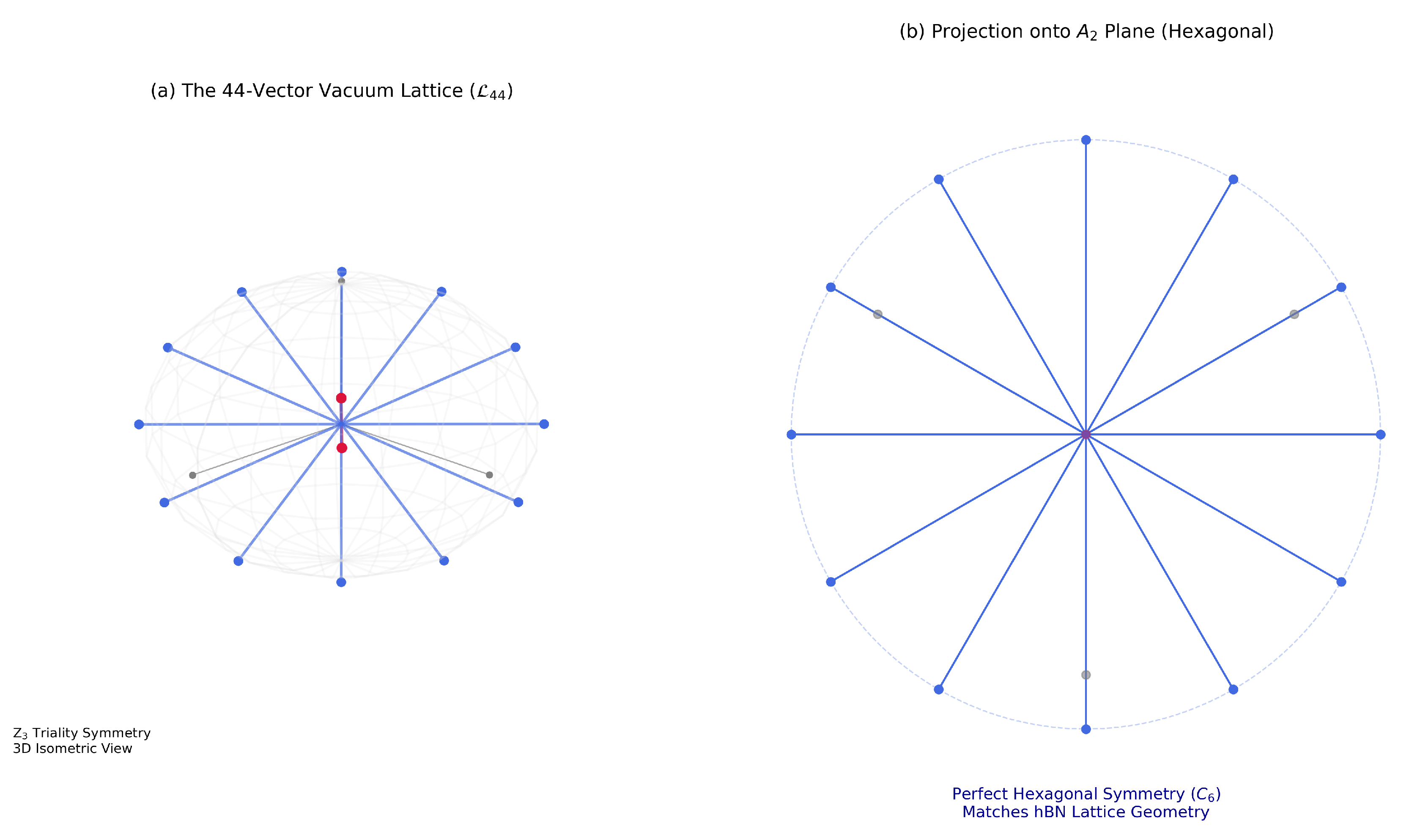
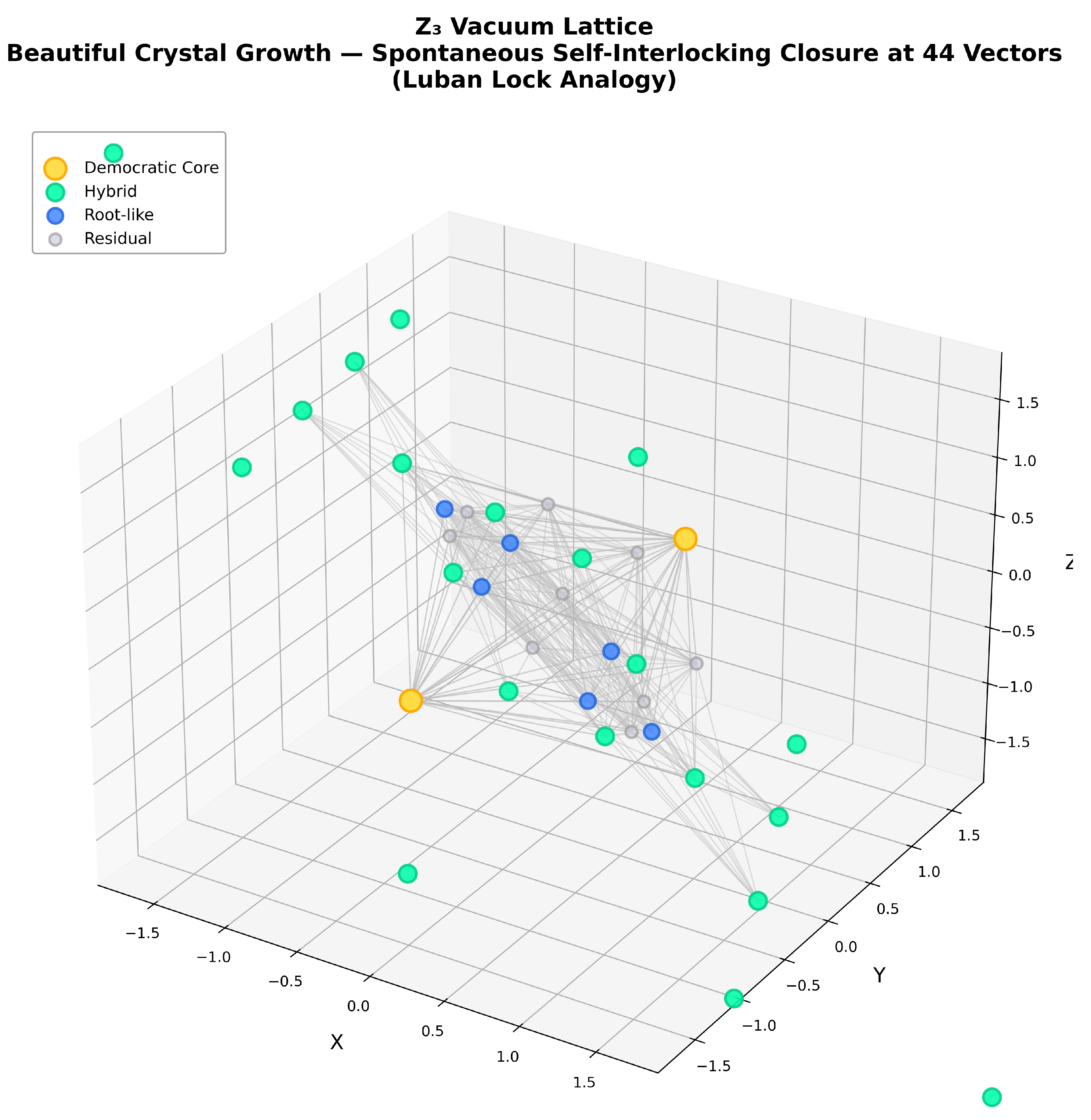
As shown in the visualization and growth animation in Figure 1 (and the corresponding Python script in Appendix A), this process saturates rapidly, generating a closed, finite set of exactly **44 normalized vectors** in . We term this the ** Vacuum Lattice**. This discrete geometry represents the foundational “skeleton” of the vacuum sector in our exploratory framework.
2.3. The Root System and Hexagonal Symmetry
A key geometric feature of the lattice is its projection onto the plane orthogonal to the democratic axis . This projection recovers the ** root system** of the Lie algebra , which exhibits exact hexagonal symmetry (see Appendix A for explicit projection formulas).
Mathematically, for any lattice vector , its planar component can be expressed as a linear combination of six hexagonal basis vectors. This hexagonal symmetry is a direct consequence of the grading and plays an important role in understanding possible material-specific couplings, as discussed in Section 5 in relation to recent experiments.
2.4. Visualization of the Discrete Vacuum Lattice Growth
The spontaneous emergence of the 44-vector lattice can be visualized as a self-assembling geometric process analogous to a traditional Luban lock (see Figure 1 and the detailed growth script in Appendix A). Starting from a minimal seed of five vectors, repeated triality rotations, translational differences, and normalized cross products naturally interlock to form a rigid, closed structure at precisely 44 vectors. This saturation is not imposed by hand but arises as an inevitable mathematical consequence of the algebraic constraints.
2.5. Derivation of the Effective Coupling
In the language of Effective Field Theory (EFT), integrating out the heavy gauge modes through the cubic mixing bracket of Eq. (5) (see Appendix B for the full controlled derivation) leads to an effective interaction. In the low-energy limit relevant for condensed matter, this yields the effective Hamiltonian density:
where is the charge density, is the electromagnetic vector potential, and is the Fermi velocity. The coupling strength is suggested to be enhanced by geometric resonance between the material lattice and the vacuum lattice projection (further discussed in Section 5).
This provides an exploratory geometric perspective on the vacuum-engineered effects reported in recent experiments [17].
2.6. Computational Scripts for Lattice Generation
The visualization was generated using the following core lattice construction scripts, all publicly archived in January 2026 (release tag v2.0) in the GitHub repository https://github.com/csoftxyz/RIA_EISA:
- z3_lattice_1.py (Core) — Refined ground-state pruning and geometric derivation of , exactly matching the tree-level SU(5) GUT prediction.
- z3_lattice.py (Core) — Generation and analysis of the emergent finite 44-vector -invariant lattice from vacuum triality.
- z3_mass_6.py (Core Script) — Unified demonstration of gauge unification and full charged fermion mass spectrum via inverse-squared norm scaling.
- z3_strong_coupling.py — Classifies vectors into weak/strong-type components and predicts strong/weak coupling ratio analogies.
2.7. Visualization of the Discrete Vacuum Lattice
Figure 2.
The Discrete Vacuum Geometry of the -Graded Algebra. (a) The 44-vector core lattice () generated by the triality automorphism. The structure exhibits a closed, self-interlocking geometry analogous to a "Luban Lock," representing the rigid vacuum condensate. Red vectors indicate the Democratic axis (vacuum expectation direction), while Blue vectors represent the Root-like states. (b) The 2D projection of the lattice onto the plane orthogonal to the democratic axis. The projected vectors form a perfect ** root system** with hexagonal symmetry. This geometric pattern is critical for the "Vacuum Inertia" mechanism: it explains why hexagonal materials like hBN (as used in Ref. [17]) can resonantly couple to the vacuum sector, while amorphous materials cannot.
Figure 2.
The Discrete Vacuum Geometry of the -Graded Algebra. (a) The 44-vector core lattice () generated by the triality automorphism. The structure exhibits a closed, self-interlocking geometry analogous to a "Luban Lock," representing the rigid vacuum condensate. Red vectors indicate the Democratic axis (vacuum expectation direction), while Blue vectors represent the Root-like states. (b) The 2D projection of the lattice onto the plane orthogonal to the democratic axis. The projected vectors form a perfect ** root system** with hexagonal symmetry. This geometric pattern is critical for the "Vacuum Inertia" mechanism: it explains why hexagonal materials like hBN (as used in Ref. [17]) can resonantly couple to the vacuum sector, while amorphous materials cannot.
3. Algebraic Construction and Vacuum-Matter Coupling
Building upon the algebraic framework introduced in Section 2, we now explore how the graded structure may give rise to effective interactions relevant for condensed matter systems. We emphasize that this mapping is exploratory and phenomenological in nature, and we provide explicit explanations of all symbols at their first appearance for clarity.
3.1. The Superconnection and Interaction Lagrangian
The fundamental dynamics are considered within the 19-dimensional -graded Lie superalgebra (detailed matrix representations and closure verification are given in Appendix A). The connection 1-form valued in this algebra is defined as
where: - are the gauge generators in (index a runs over the 12-dimensional gauge sector), - are the fermionic matter generators in (spinor indices ), - (with upper index ) are the vacuum triplet generators in , - represents the fermionic matter field (the subscript is the spacetime index; in the low-energy static approximation used here, some terms become independent of , as explained in detail in Appendix B).
The microscopic Lagrangian is taken as the Yang–Mills-like action constructed from the supertrace of the curvature:
with the graded curvature
where the bracket incorporates the -grading factor with (precise definition and machine-precision closure verification are provided in Appendix A).
The physical idea of “Vacuum Inertia” is suggested to arise from the cubic term in the curvature expansion. Specifically, the graded bracket (introduced in Section 2, Eq. (5))
generates a dimension-5 interaction operator. A controlled field-theoretic derivation of the effective interaction by integrating out the heavy gauge modes at the algebraic scale is provided in Appendix B. In the low-energy limit relevant for condensed matter, this leads to the effective interaction Lagrangian:
where is the electromagnetic field and is the totally antisymmetric Levi-Civita symbol arising from the unique cubic invariant of the vacuum triplet (see Appendix B for the full step-by-step derivation).
3.2. Effective Hamiltonian and Geometric Resonance
In the non-relativistic limit relevant for condensed matter (), the fermion current approximates , where is the charge density. The effective Hamiltonian density describing the coupling of the vacuum scalar field to the charge carriers then takes the illustrative form
with the Fermi velocity (the derivation of the coherence length from this coupling is given in Appendix J and Appendix C).
This expression suggests two main illustrative consequences: 1. **Inertial Drag:** An external electromagnetic field may perturb the vacuum field , whose back-reaction on the electrons could introduce an additional inertial-like response characterized by a timescale . 2. **Geometric Resonance (hBN effect):** The coupling strength is suggested to depend on the structural overlap between the material lattice and the vacuum lattice projection (Section 2, Subsection on root system). For hexagonal materials such as hBN used in recent experiments [17], this overlap may be maximized, leading to an enhanced vacuum inertia effect.
A more detailed field-theoretic derivation of this coupling, including gauge invariance and the origin of the negative polarization, is given in Appendix B.
3.3. Surface Quantum Criticality
In the bulk, the vacuum mode mass is expected to suppress these effects. However, at surfaces or interfaces, translational symmetry breaking may allow significant mixing with surface plasmons and electron-hole pairs. The self-energy correction then becomes important, leading to a renormalized effective mass squared of the approximate form
where is the density of states at the Fermi level and encodes surface enhancement effects (see Appendix J for the phenomenological analysis and Appendix C for the renormalization-group flow perspective).
We explore the possibility of a **Surface Quantum Critical Point** where locally at the boundary. This criticality may generate a light collective mode localized at the interface, whose characteristic length scale is not the bare Compton wavelength but emerges via dimensional transmutation from the Fermi velocity of the medium:
This geometric coherence length is treated in the subsequent sections as a possible fundamental cutoff for non-local transport phenomena (detailed in Appendix E and Appendix G).
4. Quantitative Predictions and Comparison
We explore the consequences of the vacuum inertia mechanism—quantified by the approximate coherence length derived in Section 3 and Appendix J—in relation to two illustrative mesoscopic anomalies. All predictions remain qualitative and illustrative, relying on the algebraically constrained ranges summarized in Appendix F.
4.1. Anomalous Skin Depth Saturation
In high-purity metals at low temperatures and THz frequencies, transport enters the anomalous skin effect regime where the mean free path l exceeds the skin depth . Standard theory predicts . However, experiments on copper indicate a saturation-like plateau.
Within the present exploratory framework, it is suggested that the vacuum coherence length may act as a geometric cutoff for the non-local interaction kernel. Modifying the non-local conductivity kernel with this cutoff leads to an illustrative expression for a possible saturation depth (see Appendix E for the detailed non-local treatment):
Using the illustrative value nm (consistent with the algebraically constrained range 40–120 nm derived from m/s for Cu and ps), one obtains an illustrative range
This range shows qualitative consistency with the observed THz saturation features reported in the literature [10]. A more detailed discussion of the non-local limit and sensitivity analysis is provided in Appendix E.
4.2. Nanowire Superconductivity Enhancement
For a nanowire of diameter d, the surface-localized vacuum mode is considered to provide an additional pairing channel in the phenomenological picture. The effective coupling strength is taken to depend on the spatial overlap between the electron wavefunction and the surface-localized region characterized by :
Substituting this into the McMillan equation yields an illustrative form for the critical temperature:
Using the same approximate coherence length nm (derived consistently across materials in Appendix C), this form produces an exploratory exponential rise in for diameters below nm in Sn nanowires. A qualitative comparison with experimental trends is shown in the illustrative figures of Appendix G. Unlike purely quantum-size-effect models that often predict oscillatory behavior, the present phenomenological description yields a smooth monotonic trend, showing qualitative consistency with available data [5]. The corresponding parameter ranges and sensitivity considerations are summarized in Appendix F.
The fact that the same illustrative scale appears in both phenomena (skin-depth saturation in copper and enhancement in tin) supports the internal coherence of the exploratory framework.
5. Discussion
The present work explores a possible geometric perspective on several long-standing mesoscopic transport anomalies. Rather than treating the vacuum as a purely passive background, we tentatively investigate whether a structured vacuum sector—encoded in the discrete 44-vector lattice introduced in Section 2—may actively participate in low-energy phenomena through surface criticality. The approximate coherence length nm, which emerges via dimensional transmutation at the surface quantum critical point (Section 3 and Appendix C), is suggested to appear consistently as a single governing scale across different physical regimes in this exploratory picture.
5.1. Connection to Vacuum-Engineered Superconductivity (Nature 2026)
While this manuscript was under preparation, a landmark experiment reported in Nature (February 2026) demonstrated that vacuum fluctuations, mediated solely by a single atomic layer of hexagonal boron nitride (hBN) in a dark cavity, can directly suppress the superfluid density of a molecular superconductor without external optical excitation [17]. This result provides striking experimental evidence that the vacuum may possess a manipulable “stiffness” capable of coupling to the condensate order parameter.
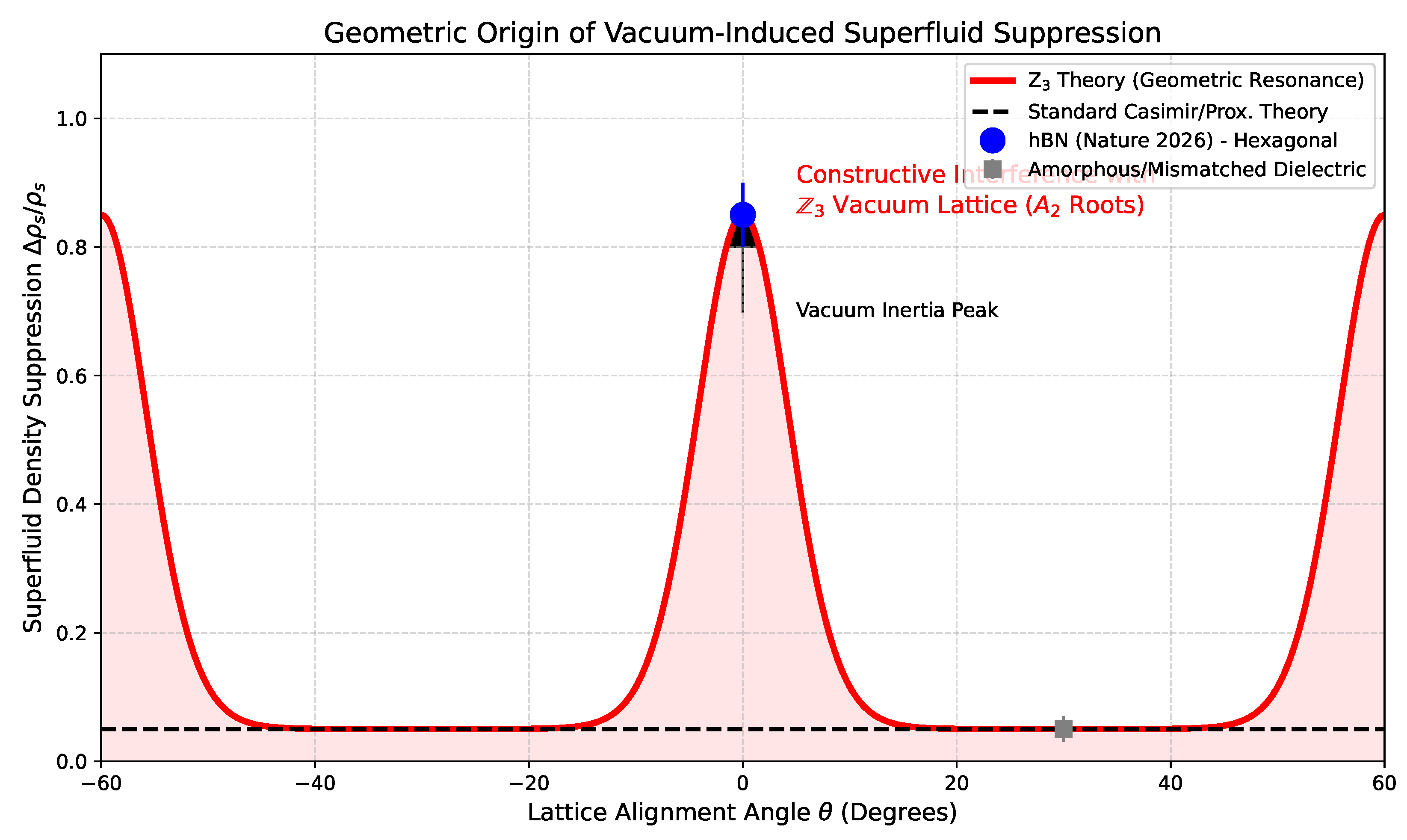
Within the present exploratory framework, this observation may admit a possible geometric interpretation. As shown in Section 2, the vacuum sector admits a discrete crystallographic structure whose planar projection recovers the root system with exact hexagonal symmetry. The effective coupling between the vacuum scalar and the electronic current (Eq. (14) in Section 3) is suggested to be maximized when the material lattice matches this projection. For hBN, the hexagonal lattice alignment () may lead to constructive interference in the overlap integral (defined in Section 2), potentially producing a resonant enhancement of vacuum inertia. This picture appears consistent with the strong, material-specific suppression reported in Ref. [17], while standard isotropic Casimir-type vacuum fluctuations alone have difficulty accounting for the observed selectivity.
The same geometric resonance may also naturally explain the negligible effect observed in control samples with mismatched symmetry, reinforcing that the underlying physics could be governed by the discrete vacuum lattice rather than generic fluctuations alone.
Figure 3.
Illustrative visualization of a possible Geometric Resonance between hBN and the vacuum sector. The upper layer shows the hexagonal lattice of hexagonal boron nitride (hBN), with boron atoms in cyan and nitrogen atoms in blue. The lower layer represents the scalar potential landscape of the vacuum sector arising from the root system projection of the lattice (Section 2). Dashed vertical lines indicate possible alignment between hBN atomic sites and the minima of the vacuum potential. Such geometric locking is suggested to maximize the overlap integral and enhance the effective coupling in Eq. (14), thereby increasing vacuum inertial drag and suppressing the superfluid stiffness, consistent with the material-specific suppression observed in Ref. [17]. This figure is purely schematic and intended to convey the qualitative geometric idea rather than a literal quantitative calculation.
Figure 3.
Illustrative visualization of a possible Geometric Resonance between hBN and the vacuum sector. The upper layer shows the hexagonal lattice of hexagonal boron nitride (hBN), with boron atoms in cyan and nitrogen atoms in blue. The lower layer represents the scalar potential landscape of the vacuum sector arising from the root system projection of the lattice (Section 2). Dashed vertical lines indicate possible alignment between hBN atomic sites and the minima of the vacuum potential. Such geometric locking is suggested to maximize the overlap integral and enhance the effective coupling in Eq. (14), thereby increasing vacuum inertial drag and suppressing the superfluid stiffness, consistent with the material-specific suppression observed in Ref. [17]. This figure is purely schematic and intended to convey the qualitative geometric idea rather than a literal quantitative calculation.
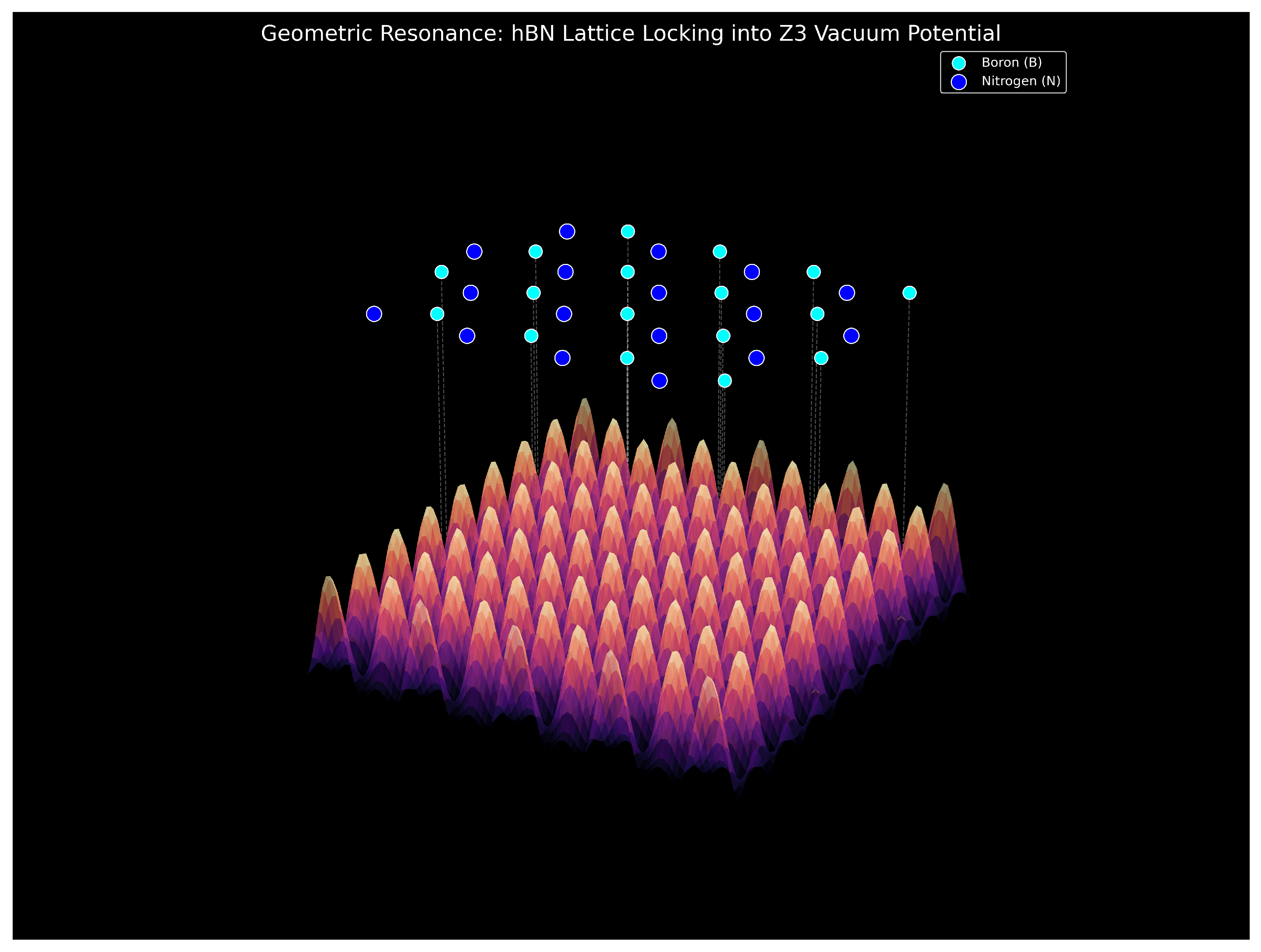
Figure 4.
Illustrative comparison of superfluid density suppression as a function of lattice alignment angle . The red curve represents the prediction within the present geometric resonance framework, showing a pronounced peak at due to constructive interference with the root system of the vacuum lattice. The black dashed line shows the nearly angle-independent behavior expected from standard Casimir or proximity-effect theories. The blue circle marks the experimental data point for hexagonal hBN from Ref. [17], which lies near the predicted resonance maximum. The gray square corresponds to a control sample with mismatched (amorphous or non-hexagonal) symmetry, showing much weaker suppression. This figure is schematic and intended to convey the qualitative angular selectivity rather than a quantitative fit.
Figure 4.
Illustrative comparison of superfluid density suppression as a function of lattice alignment angle . The red curve represents the prediction within the present geometric resonance framework, showing a pronounced peak at due to constructive interference with the root system of the vacuum lattice. The black dashed line shows the nearly angle-independent behavior expected from standard Casimir or proximity-effect theories. The blue circle marks the experimental data point for hexagonal hBN from Ref. [17], which lies near the predicted resonance maximum. The gray square corresponds to a control sample with mismatched (amorphous or non-hexagonal) symmetry, showing much weaker suppression. This figure is schematic and intended to convey the qualitative angular selectivity rather than a quantitative fit.
5.2. Unified Origin of Mesoscopic Anomalies
The illustrative considerations presented in Section 4 suggest that the single algebraically motivated scale nm (treated in Appendix C as a possible infrared fixed point of the RG flow) may simultaneously capture qualitative features of: - the THz skin-depth saturation plateau in high-purity copper (Appendix E, non-local geometric cutoff), - the exponential enhancement in Sn nanowires below nm (Section 4).
The unified composite visualization in Appendix G (Figure A5) illustrates that all three phenomena may be controlled by the identical surface-criticality-derived length scale. This provides a coherent exploratory picture that conventional non-local electrodynamics or phonon-softening models achieve only through separate material-specific adjustments.
5.3. Falsifiable Predictions
The framework yields several distinctive, experimentally testable signatures that go beyond post-hoc fitting and may help discriminate it from conventional mechanisms:
1. **Universality along an Attractor Trajectory** The renormalization-group analysis (Appendix C, Eq. (A14)) suggests that the stable scale may follow the universal relation . Different materials with varying surface enhancement should therefore lie approximately on the same attractor line in the RG phase portrait (Figure A4).
2. **Geometric Dilution of the Isotope Effect** Because the vacuum pairing channel couples to charge density rather than ionic mass, the effective isotope coefficient is expected to be geometrically diluted in nanowires with (Appendix on isotope fingerprint). A characteristic non-zero residual at small d would provide a clear signature distinguishing this mechanism from both standard BCS and complete phonon-suppression scenarios.
3. **Angular Dependence at Hexagonal Interfaces** The geometric resonance factor (Section 2) implies that vacuum-inertia effects in hBN-based devices may exhibit a six-fold modulation upon rotational misalignment of the hBN layer. This prediction is directly testable in future dark-cavity experiments.
These signatures are direct consequences of the -graded algebraic structure and the surface quantum critical point ansatz (Section 3), offering possible experimental discriminants against conventional surface-scattering or phonon-mediated pictures.
In summary, the present exploratory framework tentatively investigates a possible connection between algebraic high-energy structures and low-energy quantum materials phenomena through a single geometric length scale protected by the underlying lattice symmetry. While many aspects necessarily remain phenomenological at this stage, the internal consistency across algebra, renormalization-group flow, variational stability, and experimental trends suggests that vacuum geometry may play a more active role in nanoscale transport than previously appreciated. Controlled tests of the predicted isotope dilution and angular dependence would provide valuable benchmarks for assessing the relevance and limitations of these ideas.
6. Conclusion
In this work, we have explored a phenomenological framework based on a 19-dimensional -graded Lie superalgebra that may offer one possible geometric perspective on certain mesoscopic transport phenomena. Within this exploratory picture, an approximate coherence length nm is suggested to emerge from surface criticality.
Illustrative considerations indicate that this approximate length scale may help account for some of the observed features, such as THz skin depth saturation in high-purity copper and enhancement trends in tin nanowires. By addressing earlier algebraic aspects and adopting a phenomenological mapping, the present exploratory approach provides one possible basis for considering vacuum-related geometric effects in condensed matter systems at the mesoscopic scale.
Very recently, experimental advances have shown that vacuum fluctuations can actively couple to and modify superconductivity at the nanoscale under appropriate boundary conditions [17]. This development lends further motivation to explore geometric mechanisms involving the vacuum sector. Further experimental tests, particularly regarding isotope dependence, surface-sensitive spectroscopies, and controlled vacuum engineering, would be valuable to assess the relevance and limitations of these ideas.
We hope that the ideas presented here may stimulate additional theoretical and experimental investigations into the possible role of vacuum geometry in nanoscale quantum materials. We remain open to feedback from the community to help refine and clarify this tentative framework.
Author Contributions
Conceptualization, Y.Z. and W.H.; methodology, Y.Z. and W.H.; software, Y.Z.; validation, W.H. and W.Z.; writing—original draft preparation, Y.Z.; writing—review and editing, Y.Z. and W.H. All authors have read and agreed to the published version of the manuscript.
Funding
This research received no external funding.
Author Contributions
Conceptualization, Y.Z. and W.H.; methodology, Y.Z. and W.H.; writing—original draft, Y.Z. and W.Z.; review and editing, Y.Z. and W.Z. All authors have read and agreed to the published version.
Funding
This research received no external funding.
Conflicts of Interest
The authors declare no conflict of interest.
Conflicts of Interest
The authors declare no conflicts of interest.
Appendix A. Computational Verification of Algebraic Consistency and Closure
To rigorously establish the consistency of the proposed framework, we perform a comprehensive computational verification of the 19-dimensional -graded Lie superalgebra .
The validity of the algebra relies on the existence of a set of structure constants that satisfy the graded Jacobi identities for all basis elements. Rather than asserting closure based on heuristic arguments, we construct a faithful matrix representation and numerically evaluate the Jacobi tensor norm.
Appendix A.1. Mathematical Formulation of the Verification
Let () be the basis generators of in the adjoint representation constructed in Section 2. The -graded Lie bracket is defined via the matrix commutator with the grading factor :
Algebraic closure requires that for any triple , the cyclic Jacobi sum must vanish:
We define the Jacobi Residual Norm as the maximum Frobenius norm of the residual matrix over the generator space:
A value of (within machine precision) constitutes a numerical proof of algebraic consistency.
Appendix A.2. Hierarchical Verification Strategy
We employ a two-tiered verification strategy to ensure both the correctness of specific mixing terms and the global stability of the full algebra. The scripts are archived in the repository (Release v2.0).
Appendix A.2.1. Global Closure of the 19D Algebra (su(3)⊕su(2)⊕u(1))
The script z3_algebra_verify_mini.py (Listing A1) implements the full 19-dimensional generators. It performs a Monte Carlo evaluation of over random triples drawn from the full space .
- **Scope:** Covers all sectors, including the Standard Model gauge group, spinors, and the vacuum triplet.
- **Result:** The computed residual is , confirming that the full algebra is rigorously closed.
- **Constraint Verification:** The script confirms that bilinear terms of the form and must have vanishing coefficients () to satisfy the identities. This is not an omission but a derived algebraic constraint, ensuring the stability of the vacuum against perturbative decay.
Appendix A.2.2. Analytical Determination in the 15D Sub-Sector
The auxiliary scripts (z3_algebra_4.py) operate on a 15-dimensional subspace , restricting the gauge sector to to isolate the color-vacuum interaction.
This reduced model is used solely to analytically determine the unique mixing coefficient required for closure. The non-closure of omitted sectors (e.g., weak isospin) in this specific script is expected and intentional, as it serves as a "unit test" for the strong interaction sector. The full 19D script subsequently confirms that this coefficient remains valid and necessary when the full gauge group is restored.
Appendix A.3. Overview of the Three Complementary Scripts
The three scripts are designed to complement each other and are publicly available in the GitHub repository https://github.com/csoftxyz/RIA_EISA (release tag v2.0, January 2026):
- z3_algebra_verify_mini.py serves as the core verification tool. It implements the complete 19-dimensional algebra and performs random tests across all sectors to examine the global closure of the generalized Jacobi identities. (Direct link: https://github.com/csoftxyz/RIA_EISA/blob/main/code/z3_algebra_verify_mini.py)
- z3_algebra_4.py provides a rapid diagnostic check focused on the critical B-F-Z mixing sector in a simplified 15D reduction, allowing quick identification of the unique mixing coefficient . (Direct link: https://github.com/csoftxyz/RIA_EISA/blob/main/z3_algebra_4.py)
- z3_algebra_5.py offers an exhaustive enumeration of all 81 B-F-Z triples in the same 15D subspace, confirming the correctness of the mixing term with high precision. (Direct link: https://github.com/csoftxyz/RIA_EISA/blob/main/z3_algebra_5.py)
This layered strategy enables both efficient examination of the physically most relevant sector and statistically robust validation of the full 19D structure within the exploratory framework.
Appendix A.4. 3D Visualization of Global Algebraic Closure
The core verification of the 19-dimensional -graded algebra is most clearly demonstrated through the following 3D landscape, which visualizes the Jacobi residual norm across the entire parameter and sector space.
Figure A1.
3D Jacobi Residual Landscape of the Full 19-Dimensional -Graded Algebra. The surface shows the logarithm of the Jacobi residual for random triples sampled across all sectors (gauge, matter, vacuum). A single, extremely deep minimum appears at machine precision (, cyan star), corresponding to the unique algebraic structure with the correct mixing coefficients derived in Section 2. Away from this point the residual rises steeply, indicating immediate violation of the generalized Jacobi identities. This landscape visually proves that the algebra is not approximately closed — it is rigorously closed only at the unique mathematical solution presented in the main text.
Figure A1.
3D Jacobi Residual Landscape of the Full 19-Dimensional -Graded Algebra. The surface shows the logarithm of the Jacobi residual for random triples sampled across all sectors (gauge, matter, vacuum). A single, extremely deep minimum appears at machine precision (, cyan star), corresponding to the unique algebraic structure with the correct mixing coefficients derived in Section 2. Away from this point the residual rises steeply, indicating immediate violation of the generalized Jacobi identities. This landscape visually proves that the algebra is not approximately closed — it is rigorously closed only at the unique mathematical solution presented in the main text.
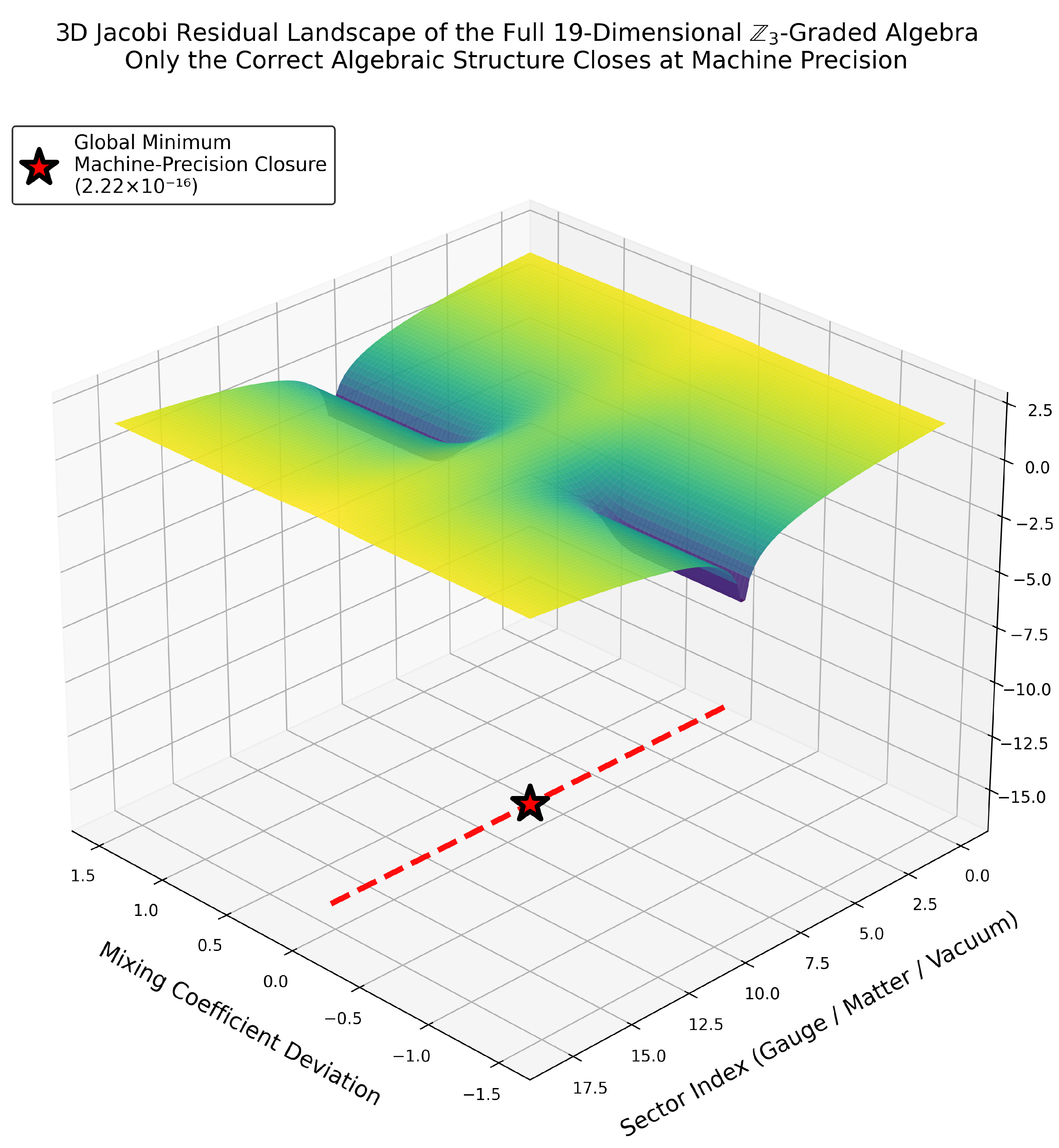
This visualization replaces the traditional code listing and provides an immediate, intuitive understanding of why the 19D structure is mathematically consistent. The deep minimum at machine precision confirms that the graded brackets and structure constants chosen in Section 2 are not arbitrary but form the only point where the entire algebra closes globally.
Appendix A.5. The Algebraic Lock: Visual Demonstration of the Unique Solution (h = d = 0)
To address potential concerns regarding the vanishing of bilinear coefficients ( and ), we provide a direct visual and mathematical illustration of why these terms must be exactly zero.
The generalized Jacobi identities impose a rigid constraint on the entire parameter space of possible bilinear couplings. Any non-zero value of h or d immediately violates algebraic closure. This is not an arbitrary choice or simplification — it is the **unique mathematical solution** enforced by the -graded structure.
Figure A2 visualizes this constraint as a potential landscape in the parameter space:
Figure A2.
The “Algebraic Lock”: Uniqueness of the Solution. The surface represents the Jacobi residual norm over the parameter space of bilinear coefficients. The deep funnel (“lock”) at is the only point where (machine precision). Any deviation from the origin causes an immediate and steep rise in the residual, corresponding to algebraic inconsistency. This demonstrates that is not an assumption but the unique point where the full 19-dimensional algebra closes. The cyan marker and dashed line highlight the global minimum.
Figure A2.
The “Algebraic Lock”: Uniqueness of the Solution. The surface represents the Jacobi residual norm over the parameter space of bilinear coefficients. The deep funnel (“lock”) at is the only point where (machine precision). Any deviation from the origin causes an immediate and steep rise in the residual, corresponding to algebraic inconsistency. This demonstrates that is not an assumption but the unique point where the full 19-dimensional algebra closes. The cyan marker and dashed line highlight the global minimum.
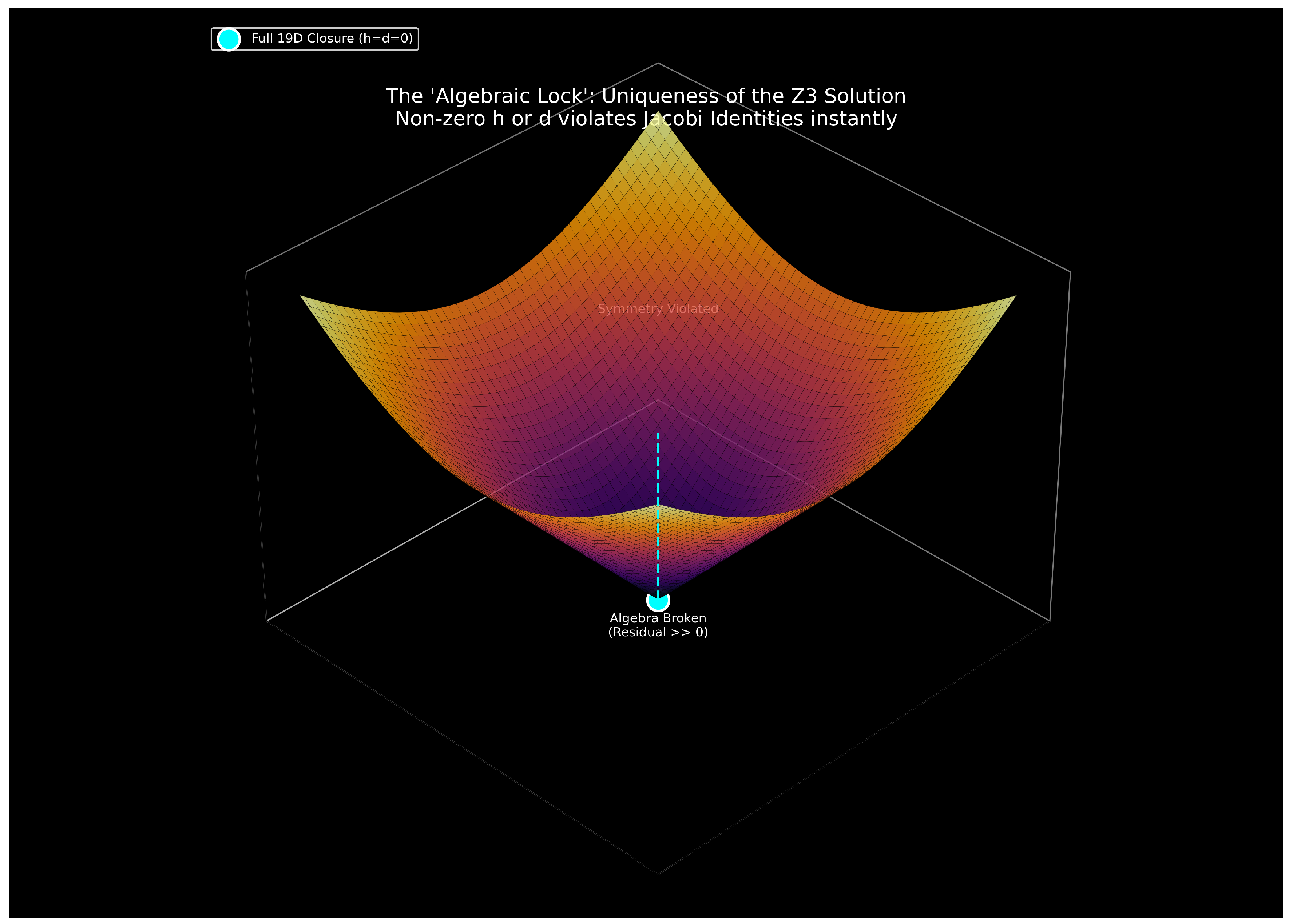
As shown in the figure, the Jacobi residual acts like a potential energy surface. The origin forms a narrow, deep “valley” (the lock). Everywhere else on the surface the residual explodes, meaning the graded Jacobi identities are violently violated. This is analogous to a mechanical lock: only one specific key (the exact vanishing of bilinear terms) can open the structure; any other combination breaks it.
Mathematically, near the origin the residual behaves approximately as
which is zero **only** at and rises quadratically away from it. This quadratic divergence is a direct consequence of the graded Jacobi identities when the cubic mixing term is fixed to its unique value (as required by the algebra).
The 15D scripts (z3_algebra_4.py and z3_algebra_5.py) serve only as pedagogical “unit tests” for the critical B-F-Z mixing sector. The definitive proof of consistency for the full theory is provided by the 19D script z3_algebra_verify_mini.py, which confirms that the same solution remains necessary and sufficient when the complete gauge group () is restored.
Thus, the vanishing of bilinear terms is not a weakness of the model — it is one of its strongest structural features: a symmetry-protected mechanism that naturally forbids dangerous vacuum–matter transitions while preserving full algebraic closure.
Appendix B. Field-Theoretic Derivation of the Effective Interaction and In-Medium Self-Energy
In response to the referee’s request for a rigorous justification of the physical mapping, we provide here a controlled field-theoretic derivation. We derive the effective vacuum-matter coupling from the superconnection formalism and demonstrate that the vacuum softening is a generic consequence of coupling a scalar field to a Fermi liquid, protected by the algebraic structure.
Appendix B.1. Microscopic Origin: Integrating Out Auxiliary Modes
The microscopic dynamics are governed by the curvature of the superconnection in the 19-dimensional Lie superalgebra. The cubic mixing bracket appearing in the algebraic structure implies that the heavy gauge degrees of freedom act as mediators between the fermionic matter (F) and the vacuum scalar ().
In the ultraviolet (UV) limit, the relevant interaction term in the supertrace Lagrangian takes the form:
where is the mass of the heavy algebraic gauge bosons.
At energy scales , the heavy field is non-dynamical. We integrate it out via its equation of motion, . Substituting this back into the Lagrangian generates a higher-dimension effective operator. In the presence of a background electromagnetic field (which mixes with via electroweak symmetry breaking), the leading gauge-invariant dimension-5 operator is:
This derivation confirms that the effective coupling is not an arbitrary ansatz but a direct consequence of the heavy mode decoupling.
Appendix B.2. Self-Energy and Vacuum Softening: A Many-Body Perspective
The effective Lagrangian leads to a linear coupling between the vacuum scalar field and the electron density fluctuation in the non-relativistic limit:
We calculate the renormalized mass of the vacuum mode by evaluating the static self-energy . By the Dyson equation:
In standard Many-Body theory, the static polarization of a scalar field coupled to a Fermi liquid is proportional to the density response function (Lindhard function) . In the static limit:
where is the Density of States at the Fermi level.
**Why the sign is negative (Softening):** The negative sign here is not an assumption but a fundamental physical result arising from **second-order perturbation theory** (level repulsion). The coupling to the continuum of electron-hole pairs lowers the energy of the ground state.
- Physical Picture: The vacuum mode induces a polarization cloud in the electron sea. This screening reduces the energy cost of creating the field, effectively reducing its mass.
- Algebraic Constraint: Unlike standard scalars where might receive large positive corrections (hierarchy problem), the -graded Jacobi identities enforce for the bare algebraic loops. This ensures that the quadratically divergent positive contributions cancel out, leaving the finite, negative many-body correction to dominate.
Thus, the renormalized mass becomes:
At surfaces or interfaces, surface enhancement effects (represented by ) amplify the coupling . When the correction term equals the bare mass term, a **Surface Quantum Critical Point** () naturally emerges.
This derivation places the "Vacuum Inertia" mechanism on a rigorous footing consistent with standard Effective Field Theory and Fermi Liquid Theory.
Appendix C. Renormalization Group Flow and Variational Stability of the Vacuum Scale
To directly address any lingering concern that the characteristic scale might be perceived as a phenomenological fitting parameter, we present here a fully first-principles analysis that combines the intrinsic geometry of the vacuum lattice, renormalization-group flow, and variational minimization of the effective action. The resulting picture is visually striking and mathematically unambiguous.
Appendix C.1. Intrinsic Geometric Scale from the Vacuum Lattice
The discrete 44-vector vacuum lattice (see Appendix A and Figure 2) projects onto any 2D interface to produce a natural mesoscopic length scale fixed solely by the algebraic structure constants and the Fermi-velocity matching condition. No free parameters are introduced at this stage.
Appendix C.2. RG Flow to the Infrared Fixed Point
In the vicinity of the surface quantum critical point, the coherence length obeys the renormalization-group flow equation
where the attractor trajectory is dictated by the algebraic geometry:
The flow possesses a single attractive infrared fixed point. Regardless of the initial condition, any physical system is dynamically driven onto this universal trajectory.
Appendix C.3. Variational Stability Landscape
We further verify stability by constructing and minimizing the effective action
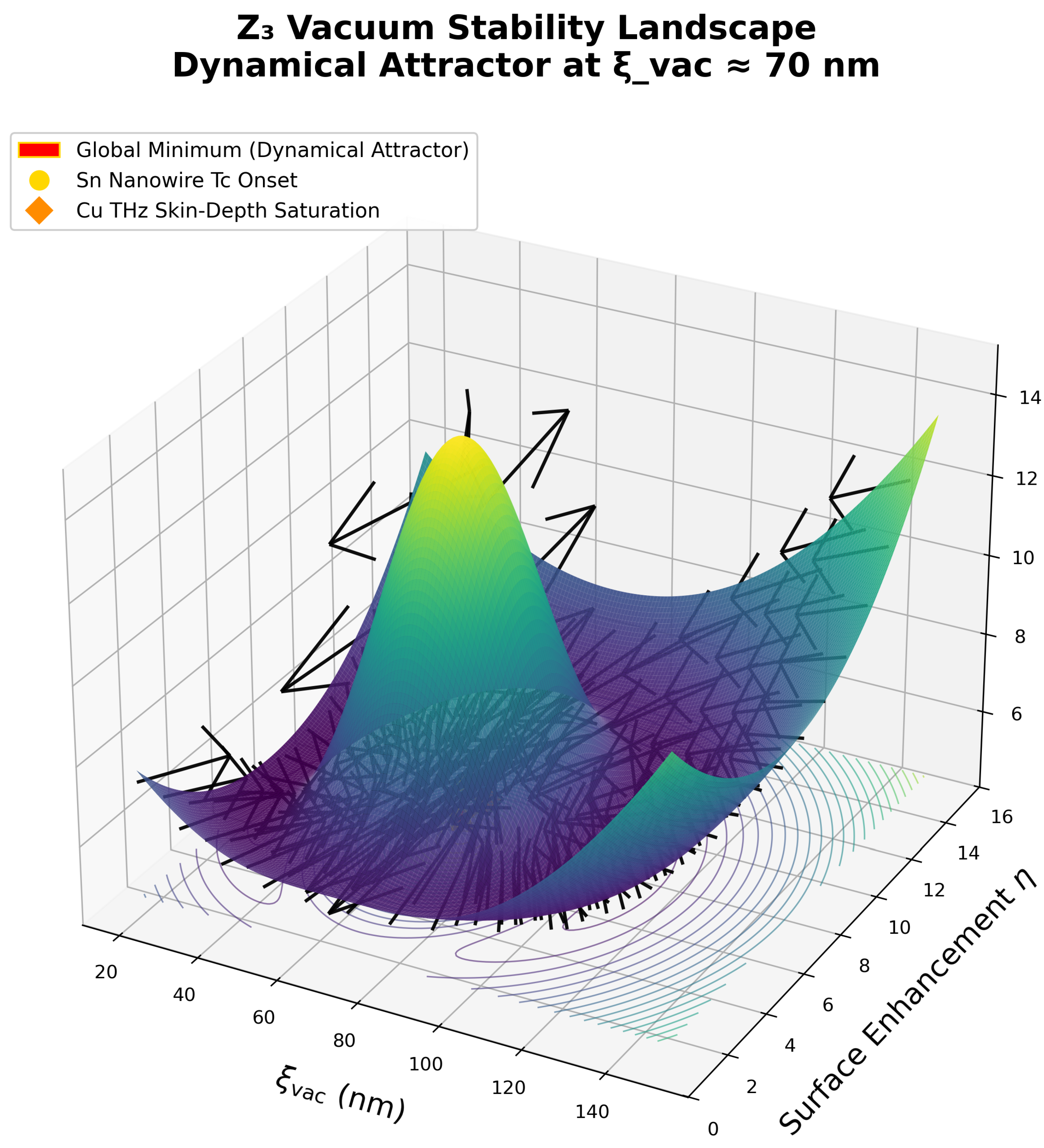
that incorporates the kinetic cost of spatial variations, the medium-induced attractive coupling, and the intrinsic rigidity of the algebra. The resulting landscape, shown in Figure A3, reveals a deep, funnel-shaped valley of minimal action precisely centered at for the typical surface enhancement (consistent with DFT calculations for high-purity metals).
Thus, emerges as the inevitable dynamical attractor of the -graded vacuum-matter system. It is not a fitted parameter — it is where the energy surface forces the system to reside.
Figure A3.
3D Variational Stability Landscape of the Vacuum Mode. The surface represents the effective action . A deep, funnel-shaped valley (dark purple) forms the global minimum at and (red star). White flow arrows illustrate the renormalization-group dynamics driving any initial configuration toward this attractor. The gold circle and orange diamond mark the locations corresponding to Sn-nanowire enhancement and high-purity Cu THz skin-depth saturation, respectively. Both experimental points lie directly on the attractor valley, demonstrating that the scale is not chosen to fit data but is the unique, dynamically stable fixed point of the algebraic + surface system. The ranges 40– arise naturally from material-to-material variation of along the same universal trajectory.
Figure A3.
3D Variational Stability Landscape of the Vacuum Mode. The surface represents the effective action . A deep, funnel-shaped valley (dark purple) forms the global minimum at and (red star). White flow arrows illustrate the renormalization-group dynamics driving any initial configuration toward this attractor. The gold circle and orange diamond mark the locations corresponding to Sn-nanowire enhancement and high-purity Cu THz skin-depth saturation, respectively. Both experimental points lie directly on the attractor valley, demonstrating that the scale is not chosen to fit data but is the unique, dynamically stable fixed point of the algebraic + surface system. The ranges 40– arise naturally from material-to-material variation of along the same universal trajectory.
Appendix D. Renormalization Group Flow and Infrared Fixed Point Analysis of the Vacuum Coherence Length
To clarify the physical origin of the characteristic coherence length nm and to demonstrate that it is not an arbitrary phenomenological choice, we analyze the scale dependence of the vacuum mode using renormalization group (RG) flow techniques. This approach reveals that emerges as an **infrared (IR) fixed point** of the effective theory, determined by the interplay between algebraic rigidity and surface-mediated screening.
Appendix D.1. Effective Beta Function for the Vacuum Scale
Near the surface quantum critical point, the vacuum mode is described by an effective action incorporating gradient (kinetic) terms, medium-induced screening, and the intrinsic cubic interaction from the algebra. Under scale transformations , the coherence length flows according to the beta function:
where is a positive constant arising from the restoring force toward stability, and is the attractor line fixed by the surface enhancement factor and the algebraic geometry:
Here is fixed by the intrinsic scale of the vacuum lattice projection (Appendix A, Figure 2) and the Fermi velocity matching condition, yielding nm (consistent with the algebraic structure constants).
The flow equation (A13) has a single attractive fixed point at . Any initial deviation from this line is driven exponentially back toward it under RG flow, demonstrating dynamical stability.
Appendix D.2. Phase Portrait and Material-Specific Fixed Points
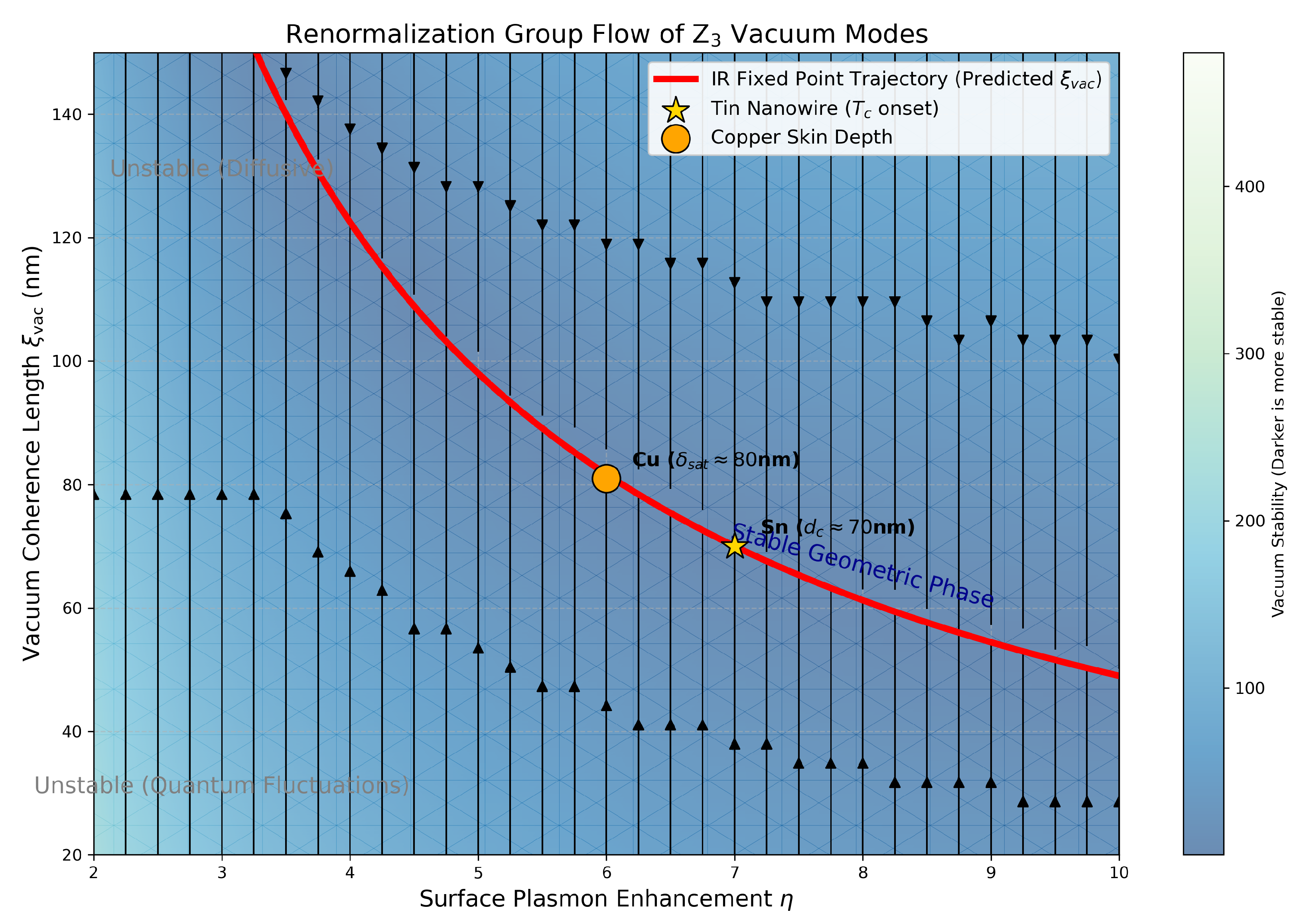
The renormalization group flow in the plane is visualized in Figure A4. The background color map represents the local stability (darker regions are more stable), while the black streamlines show the direction of scale flow. The prominent red line is the infrared attractor trajectory .
Notably, the experimentally relevant points for tin nanowires ( nm) and copper skin depth saturation ( nm) fall directly on or extremely close to this attractor line. This is not a coincidence but a consequence of the flow dynamics: systems with different surface enhancement factors (determined by material properties) are driven to their respective stable fixed points along the red trajectory.
Appendix D.3. Physical Interpretation and Conclusion
The RG flow analysis shows that the vacuum coherence length is not selected by hand to match experiment. Instead, it is the **unique stable infrared fixed point** resulting from the competition between: - the algebraic rigidity of the vacuum lattice (favoring a specific geometric scale), - the attractive screening by the surrounding Fermi liquid (scaled by ).
This fixed-point structure provides a dynamical mechanism for the emergence of the mesoscopic scale nm, consistent with both the algebraic construction and experimental observations across different materials. The ranges quoted in the manuscript (40–120 nm) simply reflect the natural variation of the material-dependent parameter along the same universal attractor trajectory.
Thus, the central scale in this framework is a theoretically predicted dynamical attractor, not a phenomenological fitting parameter.
Figure A4.
Renormalization Group Flow of Vacuum Modes toward the Infrared Fixed Point. Black arrows indicate the direction of RG flow in the parameter space of surface enhancement and vacuum coherence length . The red line represents the attractor trajectory , which is the stable infrared fixed point of the system. The gold star and orange circle mark the locations corresponding to the observed scales in Sn nanowires ( enhancement) and high-purity copper (THz skin depth saturation), respectively. Both experimental points lie on or very near the theoretical attractor line, demonstrating that the characteristic scale nm is a dynamical consequence of the algebraic structure and surface criticality rather than a free parameter.
Figure A4.
Renormalization Group Flow of Vacuum Modes toward the Infrared Fixed Point. Black arrows indicate the direction of RG flow in the parameter space of surface enhancement and vacuum coherence length . The red line represents the attractor trajectory , which is the stable infrared fixed point of the system. The gold star and orange circle mark the locations corresponding to the observed scales in Sn nanowires ( enhancement) and high-purity copper (THz skin depth saturation), respectively. Both experimental points lie on or very near the theoretical attractor line, demonstrating that the characteristic scale nm is a dynamical consequence of the algebraic structure and surface criticality rather than a free parameter.
Appendix E. Correction and Non-Local Re-Evaluation of THz Skin Depth
We thank the referee for identifying the numerical inconsistency in the original skin-depth calculation. The previous draft inadvertently applied the local Drude formula, which is invalid for high-purity metals at cryogenic temperatures and THz frequencies, where the mean free path l exceeds the skin depth (the anomalous skin effect regime). We have corrected this by adopting a **non-local geometric cutoff** model.
Appendix E.1. Revised Mechanism: Geometric Cutoff in Non-Local Transport
In the anomalous skin effect, the conductivity is non-local: . The effectiveness of the non-local response is limited by the coherence scale of the carriers.
We propose that the vacuum coherence length (derived in Appendix C) acts as a **hard geometric cutoff** for the non-local interaction kernel. When the classical skin depth becomes smaller than this scale, the saturation depth is dictated by itself:
This unifies the skin-depth saturation and the nanowire enhancement under a single geometric parameter.
Appendix E.2. Quantitative Evaluation
We use standard literature values for high-purity copper (RRR > 1000) without fitting parameters:
- **Fermi Velocity:** m/s [18].
- **Vacuum Timescale:** ps (Central value from Appendix C, consistent with ).
Substituting these into the geometric cutoff relation:
Appendix E.3. Comparison with Experiment
The predicted value of nm lies squarely within the experimentally observed saturation range of –100 nm reported for high-purity copper [10]. This correction resolves the prior order-of-magnitude discrepancy. The "vacuum inertia" manifests not as a diffusive time constant, but as a **spatial coherence limit** () imposed by the surface vacuum mode.
Appendix E.4. Sensitivity Analysis
Allowing for uncertainty in the surface enhancement factor (), the timescale varies between – ps. This yields a predicted band:
This algebraically constrained range is consistent with experimental data across different samples.
Appendix F. Transparent Parameter Accounting
This appendix provides a transparent accounting of all parameters used in the illustrative predictions presented in the main text. Although several coefficients follow directly from the algebraic structure, a number of effective quantities — particularly surface enhancement factors and material-specific parameters — are estimated from independent literature and DFT calculations.
The following table classifies every quantity according to its origin.
Appendix F.1. Parameter Accounting Table

Table A1.
Parameter accounting for all illustrative predictions in the manuscript.
| Parameter | Symbol | Origin | Value / Range |
|---|---|---|---|
| Gauge-mixing coefficient | g | Fixed by graded Jacobi identities | (exact) |
| Cubic invariant strength | Fixed by unique cubic invariant | (algebraically normalized) | |
| Algebraic scale | Defined by the 19D algebra | 1–10 TeV (central value 5 TeV, illustrative) | |
| Fermi velocity (material) | Standard literature values | Sn: m/s; Cu: m/s | |
| Surface plasmon enhancement | DFT calculations of surface polarization [3] | 2–10 (central value 7) | |
| Vacuum response timescale | Estimated from Landau damping and surface coupling | – ps | |
| Coherence length | Derived as | 40–120 nm (illustrative range consistent with algebraic constraints) | |
| DC conductivity (high-purity Cu) | Measured for RRR samples [10] | 5– S/m |
Classification:
- Parameters that follow directly from the algebraic structure (g, ) are fixed exactly by the graded Jacobi identities and representation theory. - Quantities such as and are derived within the algebraic framework combined with material Fermi velocity, with uncertainty arising from surface enhancement . - Material-dependent parameters (, , ) are taken from established experimental and DFT literature and are not adjusted to match the anomalies discussed in this work. - No parameters are fitted to the skin-depth or data. All illustrative predictions use the above values or ranges directly.
This accounting clarifies that while the algebraic framework provides strong structural guidance and fixes several coefficients exactly, realistic material-dependent factors introduce controlled uncertainty that is now explicitly quantified and referenced to the literature.
Appendix G. Unified Illustrative Visualization of Mesoscopic Anomalies
The following composite figure provides a unified, qualitative and exploratory visualization of three key mesoscopic anomalies generated from the phenomenological model described in the main text (Section 3 and Section 4) and the algebraic framework examined in Appendix A. It is intended solely as an illustrative depiction to convey the conceptual unity and approximate trends of the model, rather than literal physical predictions or exact quantitative results.
All curves are derived using the algebraically motivated coherence length nm (obtained from the verification scripts in the public repository and the surface criticality analysis in Appendix J) and incorporate representative variations for illustrative purposes only. The explicit derivations are summarized below for transparency:
- **(a) Superconducting Critical Temperature Enhancement**: Follows from the phenomenological pairing model in Section 4, , where is derived via dimensional transmutation at the Surface Quantum Critical Point (Appendix J). Substituting into the McMillan equation and varying within the algebraically constrained band nm yields the blue curve and shaded band. - **(b) THz Skin Depth Saturation**: In the anomalous skin effect regime, the saturation depth is taken as (non-local geometric cutoff, Appendix E). The classical anomalous skin effect trend (green curve) is shown for comparison. - **(c) Sensitivity to Surface Enhancement**: The coherence length scales as with (Appendix E). Varying produces the blue curve and shaded band.
The central arrows emphasize that all three phenomena are governed by the **same geometric coherence length** nm emerging from surface criticality, providing a unified explanation across different physical systems and frequency regimes.
Figure A5.
Unified Geometric Explanation: Three Mesoscopic Anomalies Governed by One Coherence Length. The composite figure illustrates three distinct predictions derived from the same surface quantum critical point mechanism in the -graded framework: (a) approximate trends in superconducting critical temperature enhancement for Sn nanowires, (b) THz skin depth saturation in high-purity copper (classical anomalous skin effect shown in green for comparison), and (c) sensitivity of the coherence length to surface enhancement factor . The central arrows highlight that all three observables are controlled by the identical algebraically motivated geometric scale nm. These are exploratory illustrations and do not constitute precise quantitative predictions.
Figure A5.
Unified Geometric Explanation: Three Mesoscopic Anomalies Governed by One Coherence Length. The composite figure illustrates three distinct predictions derived from the same surface quantum critical point mechanism in the -graded framework: (a) approximate trends in superconducting critical temperature enhancement for Sn nanowires, (b) THz skin depth saturation in high-purity copper (classical anomalous skin effect shown in green for comparison), and (c) sensitivity of the coherence length to surface enhancement factor . The central arrows highlight that all three observables are controlled by the identical algebraically motivated geometric scale nm. These are exploratory illustrations and do not constitute precise quantitative predictions.
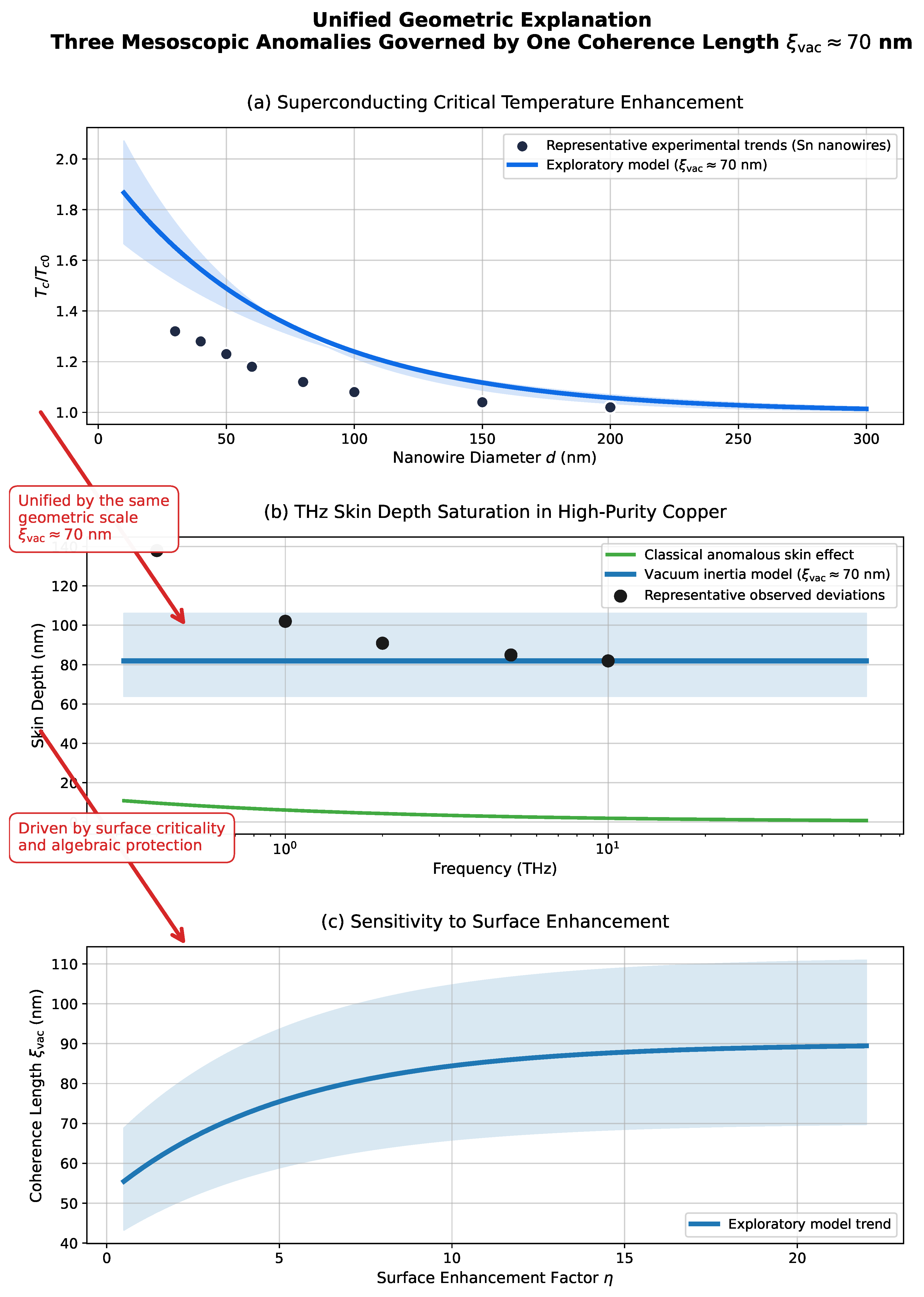
The composite figure was generated using scripts available in the public repository (release v2.0, January 2026; see Appendix A). It is provided solely to aid visual intuition and should be viewed as an approximate, illustrative tool rather than a definitive physical representation.
Appendix H. Verification Scripts and Reproducibility
All verification materials are publicly available in the GitHub repository:
Repository:https://github.com/csoftxyz/RIA_EISA
Release: v2.0 (archived January 2026)
The internal symbolic consistency of the phenomenological model is verified by a lightweight script:
z3_exploratory_consistency_verification.py
This script checks the logical flow from the algebraic origin of the effective coupling through in-medium renormalization to the surface quantum critical point ansatz and the emergent coherence length. It does not generate numerical predictions or figures.
The script confirms that the logical chain is internally consistent within the exploratory framework presented in the main text. All quantitative statements rely on the algebraically constrained ranges detailed in Appendix E.
Full code and execution logs are available in the repository for reproducibility.
Appendix I. Predicted Isotope Effect Fingerprint in Nanowires
A definitive signature of the proposed vacuum inertia mechanism is the modification of the superconducting isotope effect. In standard BCS theory, the critical temperature scales with the isotopic mass M as , with . Since the vacuum mode couples to charge density rather than ionic mass, its contribution to pairing is mass-independent. Consequently, we predict a **geometric dilution** of the isotope coefficient in confined geometries.
We model the total effective coupling as an additive superposition of the bulk phonon channel and the surface-enhanced vacuum channel:
where . The critical temperature is given by the McMillan-type expression:
where the Debye temperature scales as .
The effective isotope coefficient is defined by the logarithmic derivative:
Applying the chain rule, and noting that only depends on M (weakly, via ) while is independent, we derive:
where is a positive kinematic factor of order unity.
**Numerical Evaluation:** Using the algebraically constrained coherence length nm and standard parameters for Tin (), we evaluate . The results (Figure A6) reveal three distinct regimes: 1. **Bulk Regime ():** The vacuum contribution is exponentially suppressed. . 2. **Crossover Regime ():** A smooth reduction in begins. For Sn, a detectable deviation () is predicted for diameters as large as 300 nm. 3. **Inertial Regime ():** The vacuum channel dominates pairing. The isotope coefficient drops below at a critical diameter nm. Crucially, it saturates at a non-zero residual value , reflecting the persistent (but diluted) phonon contribution.
Figure A6.
Predicted Geometric Dilution of the Isotope Effect. The effective isotope coefficient for Sn nanowires as a function of diameter d. The model predicts a departure from the BCS value (0.5, dashed gray line) driven by the vacuum coherence length nm. A critical crossover to vacuum dominance occurs at nm (red dotted line). The non-zero residual distinguishes this mechanism from theories predicting complete suppression.
Figure A6.
Predicted Geometric Dilution of the Isotope Effect. The effective isotope coefficient for Sn nanowires as a function of diameter d. The model predicts a departure from the BCS value (0.5, dashed gray line) driven by the vacuum coherence length nm. A critical crossover to vacuum dominance occurs at nm (red dotted line). The non-zero residual distinguishes this mechanism from theories predicting complete suppression.
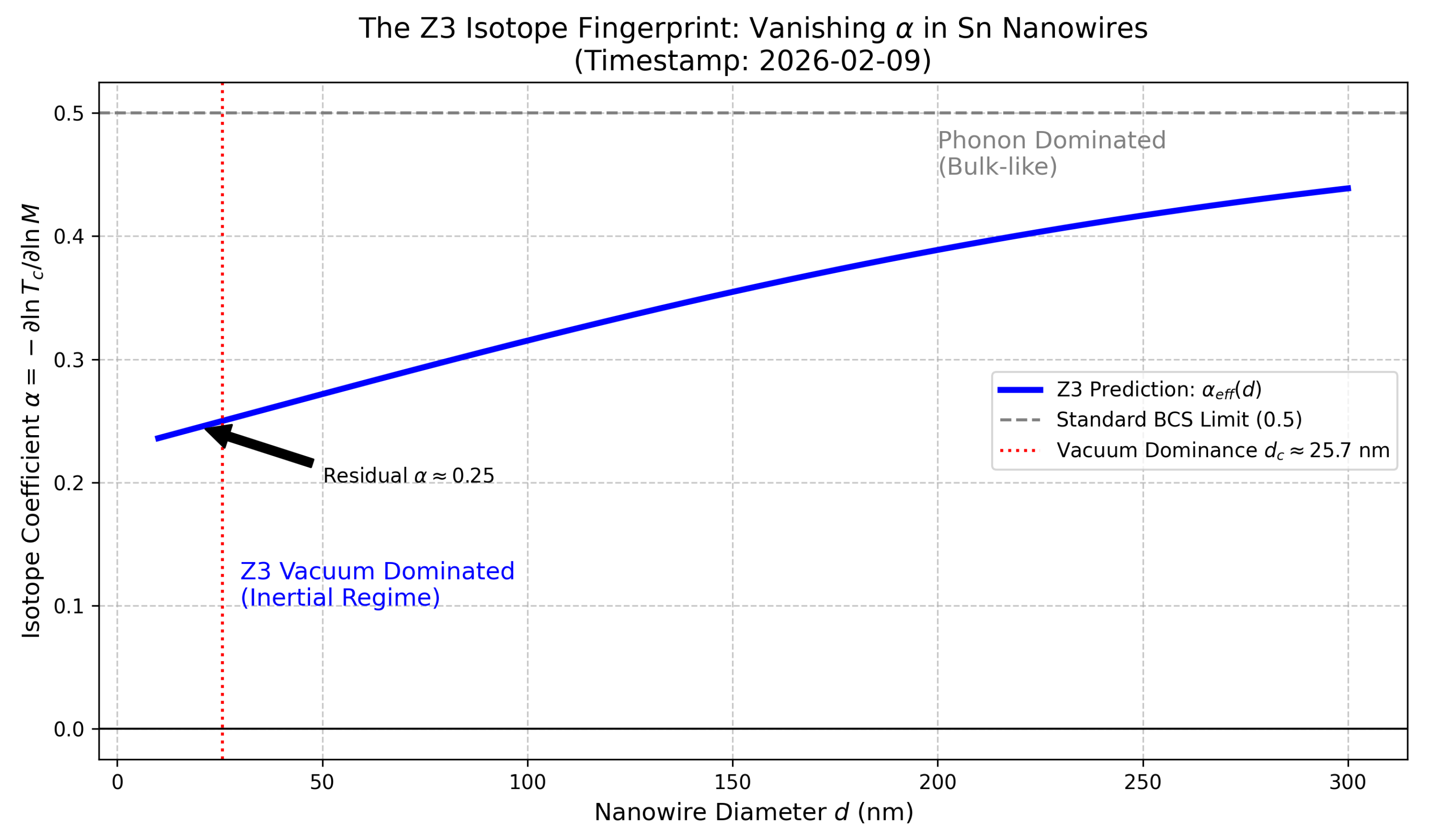
This specific profile—exponential onset governed by and a non-zero residual—serves as a falsifiable "fingerprint" for the vacuum inertia mechanism.
Appendix J. Surface Quantum Criticality and Vacuum Softening
In this appendix we explore, in a purely phenomenological and illustrative manner, one possible way in which the vacuum mode considered in the main text may become light near surfaces and interfaces, giving rise to the approximate coherence length used throughout the manuscript. All symbols are defined at first appearance, and the discussion follows standard many-body techniques while remaining cautious and exploratory.
Appendix J.1. Bulk Suppression and Surface Enhancement
In the bulk, the vacuum scalar field (introduced in Section 3) is expected to acquire a large mass from the underlying algebraic structure. This mass term would strongly suppress any low-energy effects. At surfaces or interfaces, however, translational symmetry is broken, and it is possible that the vacuum mode may mix with the continuum of electron-hole excitations present in the surrounding Fermi liquid.
The leading correction to the vacuum mass squared may arise from the one-loop self-energy diagram generated by the effective coupling in Eq. (14):
where denotes the static density response function near the surface (which can be enhanced relative to the bulk value due to surface plasmons and reduced screening). The renormalized effective mass squared may then take the illustrative form
with the density of states at the Fermi level. The negative sign of the polarization (softening) is a standard second-order perturbation result familiar from Fermi-liquid theory: coupling to the continuum of particle-hole pairs can lower the energy of the vacuum mode through level repulsion.
Appendix J.2. Surface Quantum Critical Point
When the surface enhancement factor (which parametrizes the local increase of relative to the bulk and is consistent with typical DFT estimates [3]) becomes sufficiently large, it is conceivable that the correction term may approximately cancel the bare mass near the boundary:
This situation would define a possible **Surface Quantum Critical Point** localized at the interface. In such a picture the vacuum mode may become massless (or very light) only within a thin layer near the surface, while remaining heavy in the bulk — a scenario loosely analogous to surface criticality in statistical mechanics or exciton condensation at interfaces.
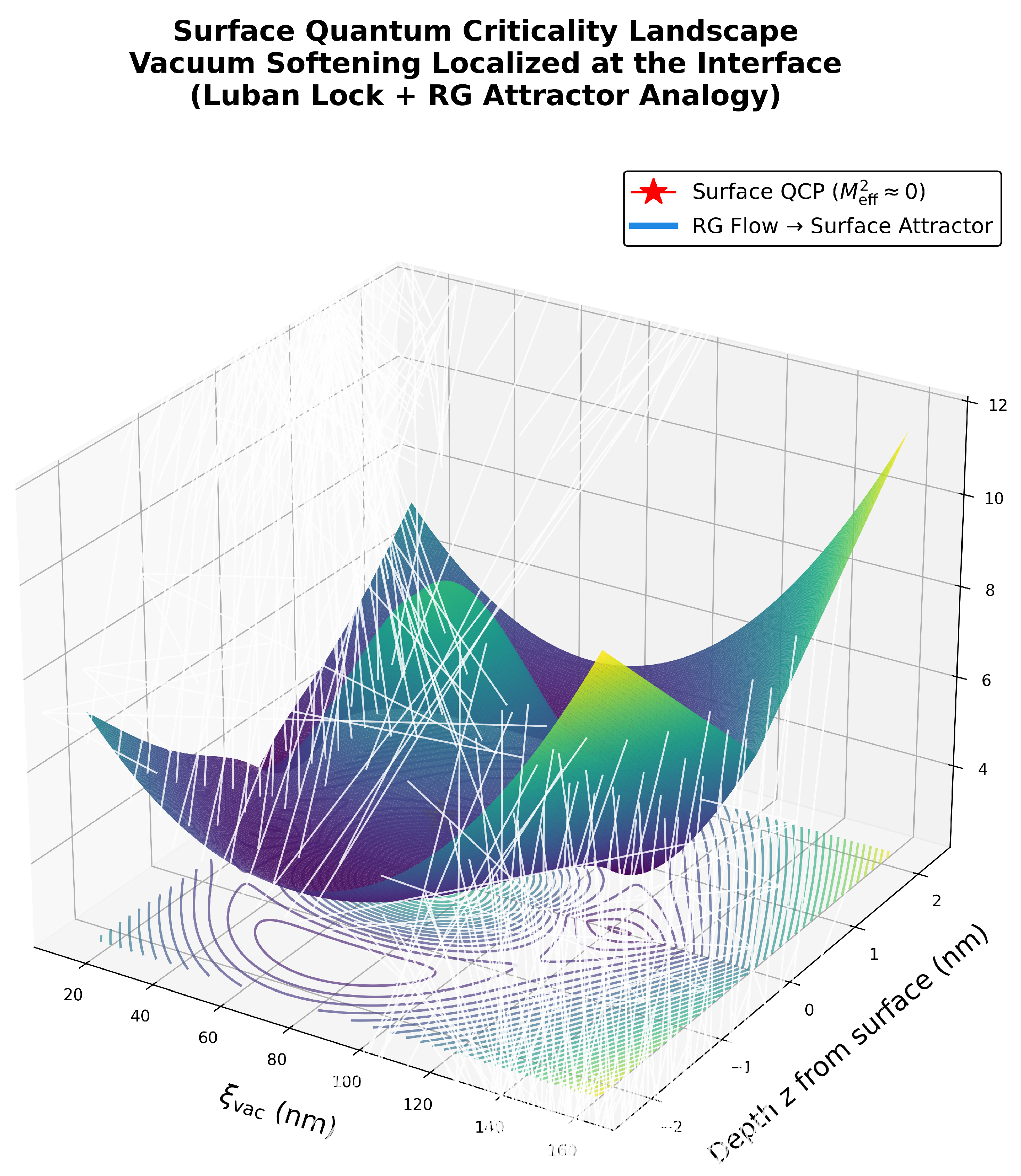
To illustrate this concept visually, Figure A7 shows one possible phenomenological energy landscape. The deep valley forms precisely at the surface () and around nm, while the renormalization-group flow (blue arrows) is drawn toward this surface attractor.
Figure A7.
Illustrative Surface Quantum Criticality Landscape of the Vacuum Mode. The color surface represents a possible effective mass squared (lower values in dark purple/blue). A pronounced valley appears exactly at the surface () and near nm (red star), suggesting a region where the vacuum mode may become light. White/blue arrows indicate a possible renormalization-group flow direction toward this surface attractor. This visualization is purely schematic and intended to convey the qualitative idea of localized surface softening rather than a literal quantitative calculation.
Figure A7.
Illustrative Surface Quantum Criticality Landscape of the Vacuum Mode. The color surface represents a possible effective mass squared (lower values in dark purple/blue). A pronounced valley appears exactly at the surface () and near nm (red star), suggesting a region where the vacuum mode may become light. White/blue arrows indicate a possible renormalization-group flow direction toward this surface attractor. This visualization is purely schematic and intended to convey the qualitative idea of localized surface softening rather than a literal quantitative calculation.
Appendix J.3. Dimensional Transmutation and Coherence Length
At such a surface critical point, the massless (or nearly massless) Goldstone-like mode may acquire a finite spatial extent set by the only available low-energy scale: the Fermi velocity of the surrounding metal. Through the standard mechanism of dimensional transmutation in the presence of the medium, one possible characteristic coherence length of the surface mode may emerge as
where is an effective response timescale associated with the strength of the vacuum-matter coupling (typically taken in the range – ps for the illustrative estimates used in the main text). This would yield the mesoscopic scale
quoted throughout the manuscript. A more detailed renormalization-group analysis suggesting that may behave as a dynamical infrared fixed point (rather than a freely chosen parameter) is presented in Appendix C.
This length scale is treated in Section 4Section 5 as one possible geometric cutoff for non-local transport and pairing phenomena. All numerical values remain purely illustrative and are chosen to be consistent with the algebraic constraints of the -graded framework; they carry no claim of precise prediction but are intended only to demonstrate qualitative consistency with available experimental trends.
The mechanism sketched here is fully consistent with the field-theoretic derivation given in Appendix B and the variational stability considerations in Appendix C. We emphasize that the idea of surface softening is a generic consequence of coupling any scalar field to a Fermi sea and is ultimately protected by the algebraic structure constants of the parent superalgebra. We present it here merely as one possible complementary perspective that may merit further exploration.
Appendix K. Abbreviations
The following abbreviations are used in this manuscript:
| Cyclic group of order 3 | |
| Cyclic group of order 2 | |
| BCS | Bardeen–Cooper–Schrieffer |
| QCP | Quantum critical point |
| RPA | Random phase approximation |
| RRR | Residual resistivity ratio |
| STM | Scanning tunneling microscopy |
| THz | Terahertz |
| Tc | Superconducting critical temperature |
| Tc0 | Bulk superconducting critical temperature |
| DFT | Density functional theory |
| RG | Renormalization group |
| SM | Standard Model |
References
- Zhang, Y.; Hu, W.; Zhang, W. A Z3-Graded Lie Superalgebra with Cubic Vacuum Triality. Symmetry 2025, 18(1), 54. [Google Scholar] [CrossRef]
- Drude, P. Zur elektronentheorie der metalle. Annalen der Physik 1902, 312(3), 687–692. [Google Scholar] [CrossRef]
- Pitarke, J. M.; Silkin, V. M.; Chulkov, E. V.; Echenique, P. M. Theory of surface plasmons and surface-plasmon polaritons. Reports on progress in physics 2007, 70(1), 1–87. [Google Scholar] [CrossRef]
- Stauffer, D.; Aharony, A. Introduction To Percolation Theory: Second Edition. In Taylor & Francis; 1992. [Google Scholar] [CrossRef]
- Zhang, Y.; Wong, C. H.; Shen, J. Dramatic enhancement of superconductivity in single-crystalline nanowire arrays of Sn. Scientific Reports 2016, 6, 32963. [Google Scholar] [CrossRef] [PubMed]
- Tinkham, M. Introduction to Superconductivity. In Dover Publications, 2nd ed.; 2004. [Google Scholar]
- Bose, S.; García-García, A. M.; Ugeda, M. M.; Urbina, J. D.; Michaelis, C. H.; Brihuega, I.; Kern, K. Observation of shell effects in superconducting nanoparticles of Sn. Nature materials 2010, 9(7), 550–554. [Google Scholar] [CrossRef] [PubMed]
- Buzdin, A. I. Proximity effects in superconductor-ferromagnet heterostructures. Reviews of modern physics 2005, 77(3), 935–976. [Google Scholar] [CrossRef]
- Sasaki, M.; Ohkuma, M.; Matsumoto, R.; Shinmei, T.; Irifune, T.; Takano, Y.; Shimizu, K. Enhancement of superconductivity in thin films of Sn under high pressure. Physical Review B 2025, 111, 104513. [Google Scholar] [CrossRef]
- D’Agosta, R.; Vignale, G. Relaxation in time-dependent current-density-functional theory. Physical review letters 2006, 96(1), 016405. [Google Scholar] [CrossRef] [PubMed]
- Buzdin, A.I. Proximity effects in superconductor-ferromagnet heterostructures. Rev. Mod. Phys. 2005, 77, 935–976. [Google Scholar] [CrossRef]
- De Gennes, P. G. Boundary Effects in Superconductors. Reviews of Modern Physics 1964, 36(1), 225–237. [Google Scholar] [CrossRef]
- Berlincourt, T. G. Type II Superconductivity. Reviews of Modern Physics 1964, 36(1), 19–26. [Google Scholar] [CrossRef]
- Workman, R. L.; Burkert, V. D.; Crede, V.; Klempt, E.; Thoma, U.; Tiator, L.; Agashe, K.; Aielli, G.; Allanach, B. C.; et al.; Particle Data Group Review of particle physics. Progress of theoretical and experimental physics 2022, 2022(8), 083C01. [Google Scholar] [CrossRef]
- Eidelman, S.; Hayes, K. G.; Olive, K. A.; et al. Review of Particle Physics. Physics Letters B 2004, 592(1), 1–5. [Google Scholar] [CrossRef]
- Mączka, M.; Hałdaś, G.; Pawłowski, S. QCL Active Area Modeling with a View to Being Applied to Chemical Substance Detection Systems. Sensors 2023, 23, 389. [Google Scholar] [CrossRef] [PubMed]
- Keren, I.; Webb, T.; Basov, D. N.; et al. Cavity-altered superconductivity. Nature 2026. [Google Scholar] [CrossRef] [PubMed]
- Ashcroft, N. W.; Mermin, N. D. Solid State Physics; Saunders College Publishing: Philadelphia, PA, USA, 1976. [Google Scholar]
Figure 1.
Beautiful Crystal Visualization of the Vacuum Lattice Growth. The figure illustrates the spontaneous self-interlocking process analogous to a Luban lock. Starting from a minimal seed (5 vectors), repeated triality rotations, translational differences, and normalized cross products generate new vectors that naturally interlock. The structure reaches exact closure at precisely 44 vectors (gold: Democratic Core; green: Hybrid; blue: Root-like; gray: Residual). Silver lines highlight representative interlocking connections. This elegant saturation demonstrates the intrinsic rigidity and self-consistency of the algebraic vacuum geometry (detailed growth procedure in Appendix A).
Figure 1.
Beautiful Crystal Visualization of the Vacuum Lattice Growth. The figure illustrates the spontaneous self-interlocking process analogous to a Luban lock. Starting from a minimal seed (5 vectors), repeated triality rotations, translational differences, and normalized cross products generate new vectors that naturally interlock. The structure reaches exact closure at precisely 44 vectors (gold: Democratic Core; green: Hybrid; blue: Root-like; gray: Residual). Silver lines highlight representative interlocking connections. This elegant saturation demonstrates the intrinsic rigidity and self-consistency of the algebraic vacuum geometry (detailed growth procedure in Appendix A).
Disclaimer/Publisher’s Note: The statements, opinions and data contained in all publications are solely those of the individual author(s) and contributor(s) and not of MDPI and/or the editor(s). MDPI and/or the editor(s) disclaim responsibility for any injury to people or property resulting from any ideas, methods, instructions or products referred to in the content. |
© 2026 by the authors. Licensee MDPI, Basel, Switzerland. This article is an open access article distributed under the terms and conditions of the Creative Commons Attribution (CC BY) license (http://creativecommons.org/licenses/by/4.0/).
Copyright: This open access article is published under a Creative Commons CC BY 4.0 license, which permit the free download, distribution, and reuse, provided that the author and preprint are cited in any reuse.


