

Submitted:
26 December 2025
Posted:
02 January 2026
You are already at the latest version
Abstract
The global acceleration in electric vehicle (EV) adoption is projected to result in a substantial volume of spent traction motors reaching end of life EoL), especially in emerging economies. Addressing this challenge, the present study develops a comprehensive evaluation and decision-making framework to support the remanufacturing of EoL traction motors within Ghana’s circular economy context. The methodology integrates RUL prediction algorithms, a Multi-Stage Testing Protocol (MSTP), remanufacturability scoring using hybrid Multi-Criteria Decision Analysis (MCDA), and safe dismantling procedures aligned with Ghana’s EPA Act 917 and LI 2250. Tools such as vision-based screw detection, robotic disassembly path modelling, and non-destructive magnet removal are incorporated to ensure technical feasibility and operator safety. Results demonstrate the effectiveness of predictive models in estimating degradation patterns and confirm the technical viability of semi-automated disassembly workflows. The developed remanufacturing feasibility scoring tool enables objective selection of candidate motors for reuse, factoring performance, and environmental impact. This work offers a replicable, data-driven framework that strengthens local remanufacturing infrastructure, reduces reliance on critical raw materials, and advances sustainable motor lifecycle management in low and middle-income countries.
Keywords:
electric traction motor
; rare earth elements (REEs)
; end of life (EoL)
; remaining useful life (RUL)
1. Introduction
The urgency of the transition to alternative modes of transport is reinforced by global challenges such as climate change, the depletion of fossil fuels and increasing urban air pollution. In response, several countries have adopted legislation to phase out ICE vehicles, speeding up the global shift to electric transport [1,2]. These measures have opened the way for widespread use of EVs which offer considerable potential for decarbonising the transport sector. But, while much attention has been focused on battery innovations to overcome the range constraints, traction motors are the basic electromechanical components.
Globally, EV adoption is accelerating further, with projections showing that by 2030 more than 220 million EVs will be on the road [2]. As a result, millions of EoL traction motors will be produced in the next few decades, creating new environmental and economic problems. EoL vehicles already generate 7-8 million tonnes of waste per year, a large proportion of which must be managed in a sustainable way to avoid en-vironmental degradation [3]. Traction motors contain high value and critical materials such as copper, aluminium and REEs such as neodymium and dysprosium, which are both economically and geopolitically sensitive [1].
Remanufacturing has therefore emerged as a key strategy within the CE para-digm. It offers significant advantages over traditional recycling in terms of product functionality and embodied energy. Studies show that reprocessing can reduce pro-duction costs by 45-65 percent, save 75-80 percent of energy and preserve up to 85 percent of the original value of the product, compared to only around 7.5 percent from conventional recycling [3,4]. Moreover, remanufactured parts are usually 50-75 per-cent cheaper than new parts, which provides a strong economic case for their ac-ceptance [5].
Despite these advantages, the remanufacturing of EV traction motors remains technically complex. PMSMs, the most common type used in EVs, pose major problems for dismantling due to strong magnetic forces, adhesive bonds and different motor ar-chitectures [6]. Manual dismantling remains labour-intensive, inconsistent and poten-tially dangerous, whereas robotic disassembly and screw detection systems with visual inspection, although promising, are still in the early experimental phase [7]. The lack of an integrated framework for assessing the feasibility of remanufacturing, combining technical condition assessment, economic viability and environmental sustainability is also an obstacle to widespread implementation [8].
In Ghana, these problems are compounded by informal recycling practices, lim-ited infrastructure and low public awareness of the benefits of remanufacturing. Alt-hough Ghana has put in place regulatory instruments such as the Hazardous and Electronic Waste Control and Management Act (Act 917) and LI 2250, enforcement remains weak (U4E 2020). Informal recyclers often use unsafe and environmentally harmful methods, which result in material losses and pollution. Therefore, there is an urgent need to develop context-specific, standardised and cost-effective frameworks to guide the safe dismantling, testing and remanufacturing of traction motors in Ghana. This research aims to bridge these gaps by evaluating and developing a comprehensive decision-making framework for the remanufacturing of spent EV traction motors.
2. Materials and Methods
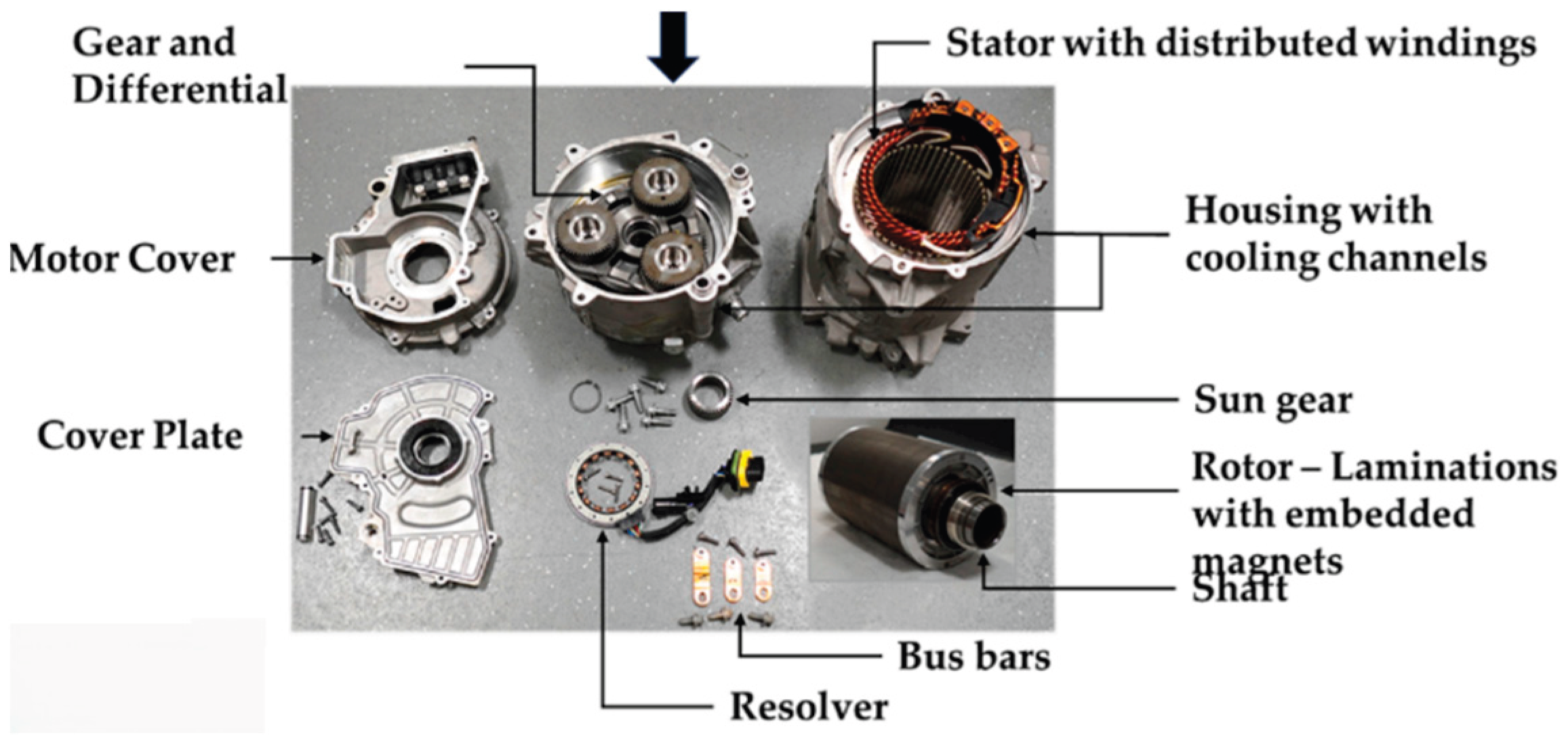
A typical electric vehicle traction motor weighs approximately 53 kg and primarily consists of steel (around 30–35 kg), aluminium (6–10 kg), copper (5–8 kg), and smaller quantities of winding insulation and rare earth elements such as neodymium and dysprosium. Its main structural elements include the housing, a stator with windings, a rotor embedded with permanent magnets, and a drive shaft. Permanent Magnet Synchronous Motors (PMSMs) generally fall into two key types: surface-mounted (SPM), where magnets are positioned on the rotor’s surface, and interior permanent magnet (IPM) designs, where the magnets are placed within the rotor core. IPMs are generally favoured for traction motor applications due to advantages such as efficient variable speed control, higher energy efficiency, reduced heat output, and minimal acoustic noise [9]. Like other traction motors, IPMs consist primarily of two functional parts: the rotor and the stator.
Figure 1.
The Rotor and the Stator[10] .
Figure 1.
The Rotor and the Stator[10] .
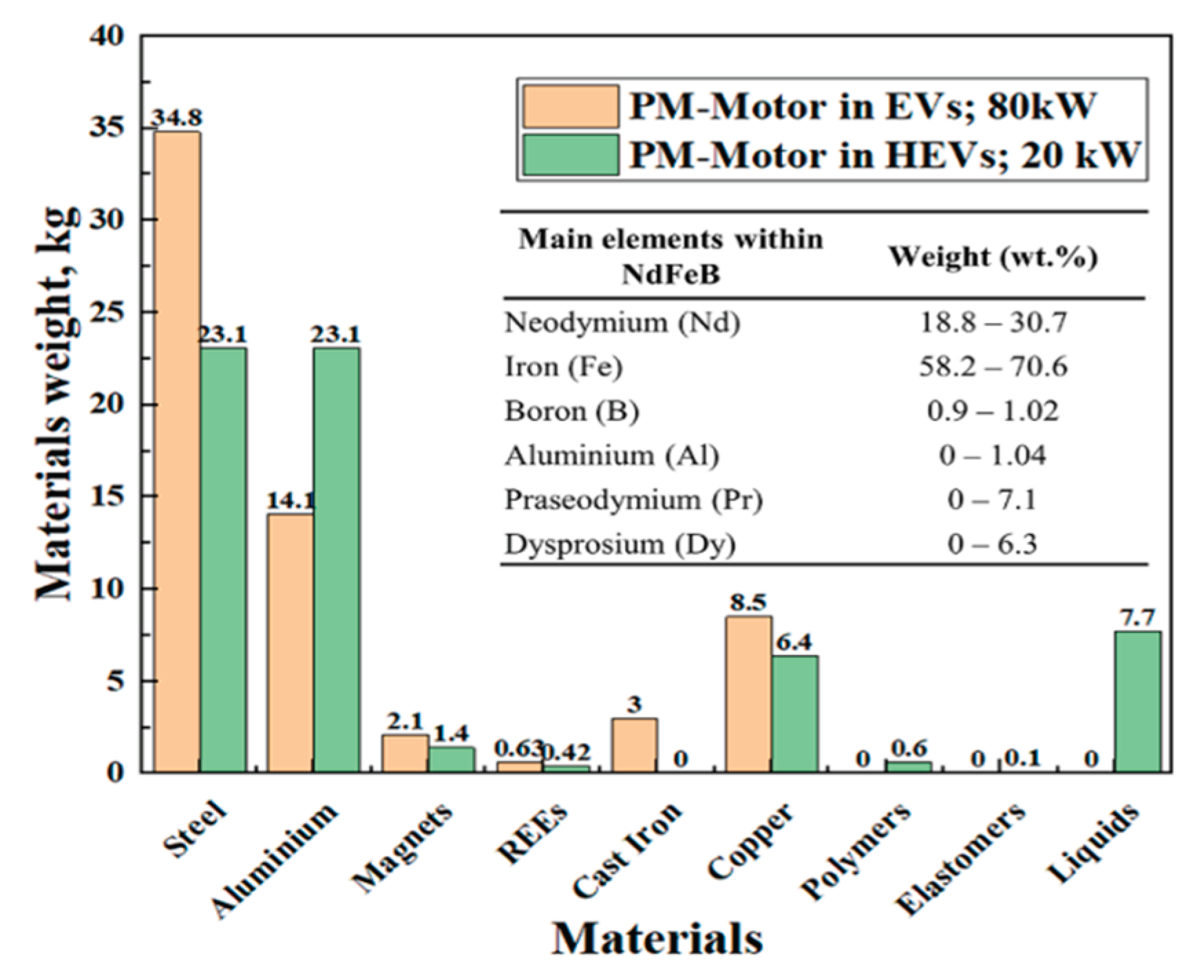
EVs alone are estimated to produce around 69,600 tonnes of steel, 17,000 tonnes of copper, 28,200 tonnes of aluminium and 4,200 tonnes of permanent magnets by 2040 [11]. Among these, the REEs used in permanent magnets are of particular concern. Although EVs contain less REE than batteries, they rarely contain large quantities of REE that can be easily extracted. They are also more expensive to produce than nickel, cobalt and lithium, which are all of these metals. This is evident in current market valuations: nickel, cobalt, and lithium carbonate are priced at USD 16.97, USD 29.13, and USD 13.70 per kilogram, respectively, whereas neodymium and dysprosium command significantly higher prices of USD 115.60 and USD 583.20 per kilogram, respectively [12].
Figure 2.
Material Composition of typical 20 and 80-kW PM Motors in EVs.
3. Sustainability of EV Traction Motors
The EV traction motors depend heavily on the electricity source used. While EVs are considered eco-friendly, their actual carbon footprint varies by region, especially where coal is still the dominant power source. A life-cycle assessment by the Union of Concerned Scientists on the Nissan Leaf shows that significant emission reductions are possible when cleaner energy sources like renewables, hydropower, or nuclear are used. The study supports transitioning away from petroleum-based engines to reduce global warming [13].
Environmental, Social, Economic, Technical & Waste Aspects
The sustainability of permanent magnet traction motors must be assessed holistically, covering their entire lifecycle from raw material extraction to EoL management. Although EVs are often viewed as environmentally beneficial, their actual ecological impact depends heavily on the type of energy used and the materials embedded in their design. Rare earth elements (REEs), primarily used in rotor magnets, are derived from limited fossil-based minerals like bastnäsite and monazite, with heavy REEs (HREEs) causing more environmental harm than lighter variants. Socially, the mining of REEs raises serious concerns due to poor labor conditions, exposure to toxic substances, and even radiation risks, particularly in unregulated operations. Conflict minerals such as cobalt, used in earlier motor designs, also present ethical challenges [14]. Economically, REE price volatility and the concentration of supply among few global producers create supply instability, while attempts to substitute these elements can trigger new material shortages [15]. Technical alternatives like samarium-cobalt or ferrite magnets offer sustainability trade-offs, while induction motors provide greater recyclability at the cost of efficiency. Recycling REEs from spent traction motors remains financially and technologically complex, especially given the high motor count per vehicle and material variation [16]. Moreover, inconsistent waste management practices in REE processing regions have led to environmental contamination, particularly from radioactive by-products. The lack of transparent lifecycle data and proper waste treatment standards further complicates accurate environmental impact assessment [17].
3.1. Production of Key Components for EV Traction Motors
Generally, an electric motor comprises four key elements: the stator, rotor, housing, and bearings. The production process of a recycled magnet motor is described as follows. Stator: The stator manufacturing process involves slicing electrical steel into laminations, stacking them, and wrapping them with magnet wire. Once wound, the coil is insulated using a combination of epoxy resin, varnish, and a polyamide coating. Rotor: Rotors are manufactured from either forged or laminated steel, incorporating permanent magnets positioned within the slots of the stainless-steel rotor core. This assembly also includes the shaft and bearings, enclosed by two cover plates made from magnesium alloy. Casing: The casings are mainly aluminium, made by low pressure die casting, and are finished with two stainless steel cover plates for the motor enclosure [18].
3.2. Types, Classification, Construction and Characteristics of Traction Motors
Figure 3.
Traction Motors [19].
Figure 3.
Traction Motors [19].
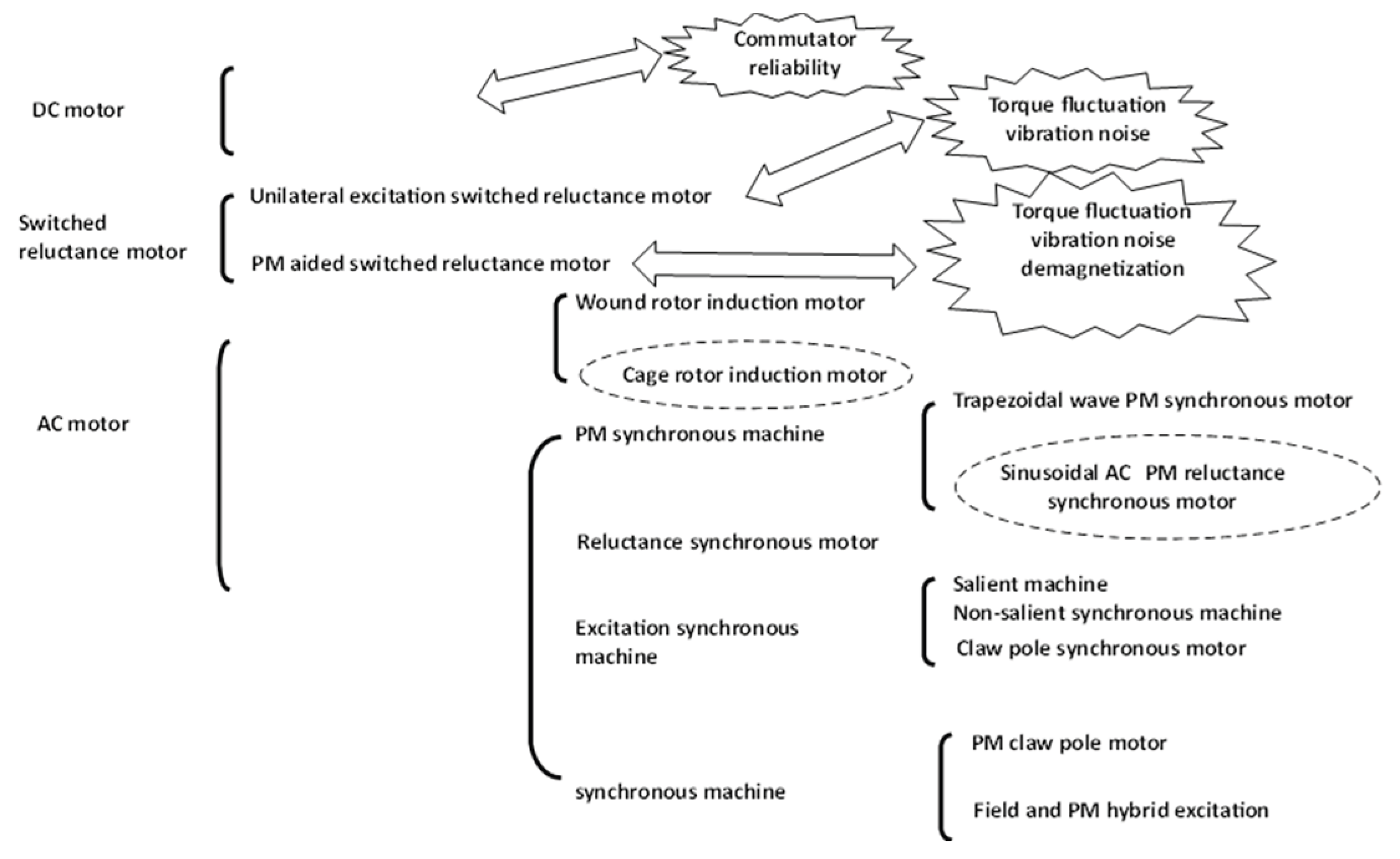
The choice of traction motor in EVs varies based on the vehicle configuration and drive system. Common options include direct current motors (DCMs), induction motors (IMs) [20,21], permanent magnet synchronous motors (PMSMs), permanent magnet motors (PMMs), wound-field synchronous motors (WSMs), and switched reluctance motors (SRMs) [22,23], which may or may not incorporate magnet assistance [1]. Within the PMM category, configurations include permanent magnet direct current motors (PM-DCMs), permanent magnet brushless DC motors (PM-BLDCMs), and permanent magnet hybrid excitation motors (PM-HEMs). In an effort to minimize reliance on rare-earth permanent magnet materials, onboard excitation synchronous motors have also been adopted [9]. Recently, there has been a notable shift toward induction motors and wound-field synchronous motors, primarily to reduce dependence on magnetized components.
Figure 4.
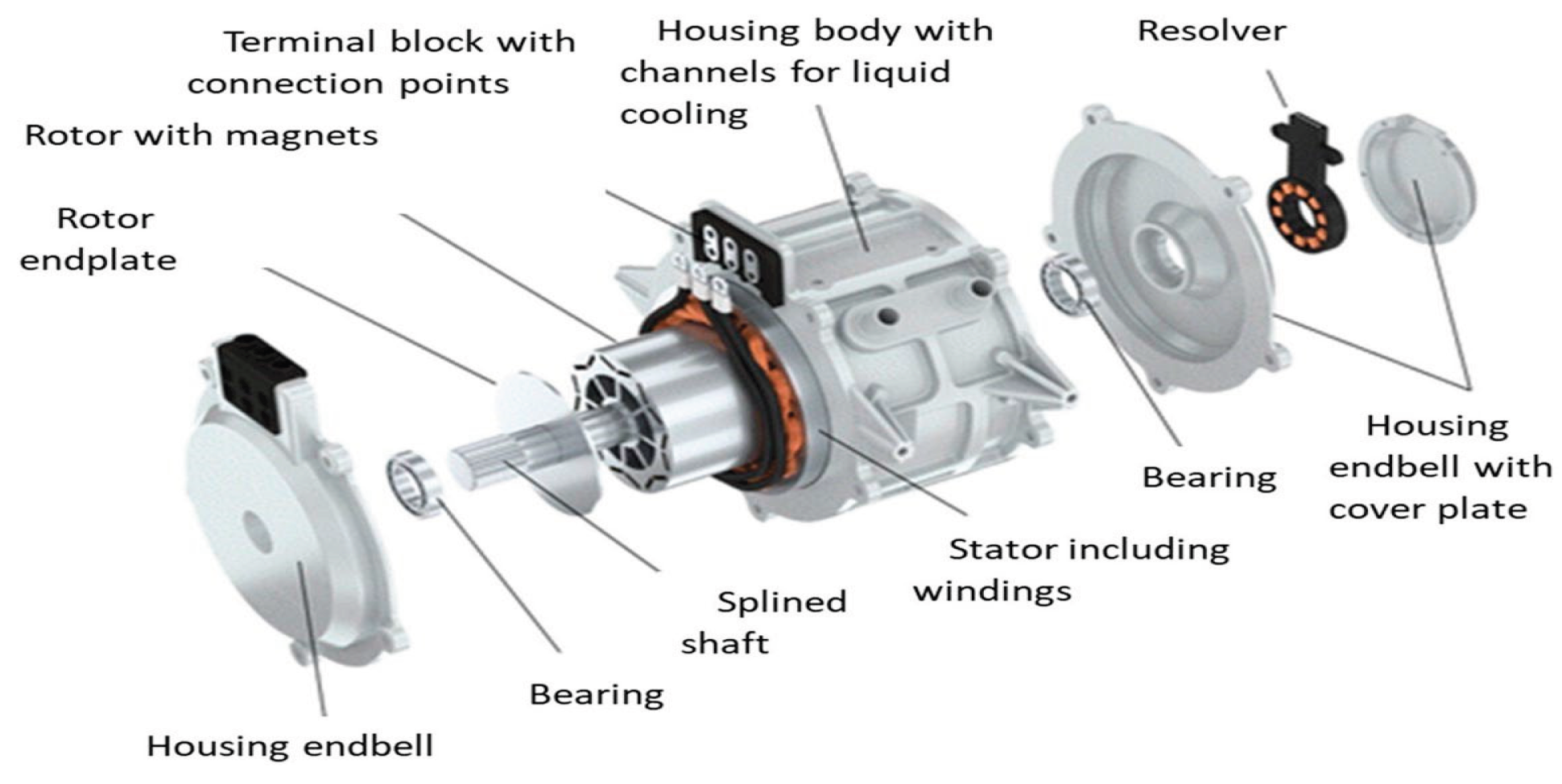
Exploded View Diagram of a PMSM [24].
Figure 4.
Exploded View Diagram of a PMSM [24].
3.2.1. Types
Direct Current Motor (DCM)
Direct current motors (DCMs) have served as traction motors in electric vehicles since the late 1800s, largely due to their straightforward speed regulation capabilities. However, their drawbacks including relatively low efficiency, bulky structure, and limited reliability stemming from mechanical wear in brushes and commutators make them less ideal for high-speed applications. As a result, DCMs are typically found in low-speed EVs, such as shuttle buses used for recreational or short-distance transit.
Switched Reluctance Motor (SRM)
Switched Reluctance Motors (SRMs) utilize silicon-steel laminations for both their stator and rotor, featuring a salient pole design on each. The rotor is devoid of slip rings and permanent magnets, while the stator houses simple concentrated windings. This rotor configuration contributes to SRMs being structurally simple, cost-effective, highly reliable, and capable of operating at high speeds. Additionally, the robust inverter topology used with SRMs resists short-circuit failures [22, (Widmer et al., 2015)].
Permanent Magnet Motor
Permanent Magnet Direct Current Motor
Substituting the field windings and magnetic poles of traditional DCMs with permanent magnets results in a permanent magnet direct current motor (PM-DCM). While PM-DCMs offer improved power density and efficiency, they still suffer from maintenance challenges and reduced lifespan, primarily due to the continued reliance on a commutator and brush system factors that limit their suitability for long-term use in electric vehicles.
Permanent Magnet Synchronous Motor
In Permanent Magnet Synchronous Motors (PMSMs), the three-phase stator is structurally like that of induction or traditional synchronous motors, with the key distinction being the use of permanent magnets in place of rotor windings. Based on the placement of these magnets, PMSMs are categorized as either surface-mounted (SPM) or interior-mounted (IPM). Among these, IPMs are preferred for traction applications due to their high pull-out torque, superior efficiency, minimal energy and thermal losses, compact design, and low operational noise [24].
Permanent Magnet Brushless DC Motor
The Permanent Magnet Brushless DC Motor (PM-BLDCM) is structurally and theoretically a variant of the PMSM, but it features concentrated windings and a trapezoidal stator current waveform, distinguishing it from the sinusoidal waveform found in SPMs. Unlike traditional motors, it eliminates the need for a commutator-brush system. However, it is prone to torque ripples and acoustic noise during electronic commutation, and it typically struggles to achieve speeds exceedingly twice its base speed.
Permanent Magnet Hybrid Excitation Motor
Incorporating excitation windings into a Permanent Magnet Synchronous Motor (PMSM) results in a hybrid excitation motor (PM–HEM), which combines the benefits of both permanent magnets and excitation windings. This configuration enhances performance by reducing flux leakage, increasing air gap flux density, and delivering superior power density and torque characteristics [9].
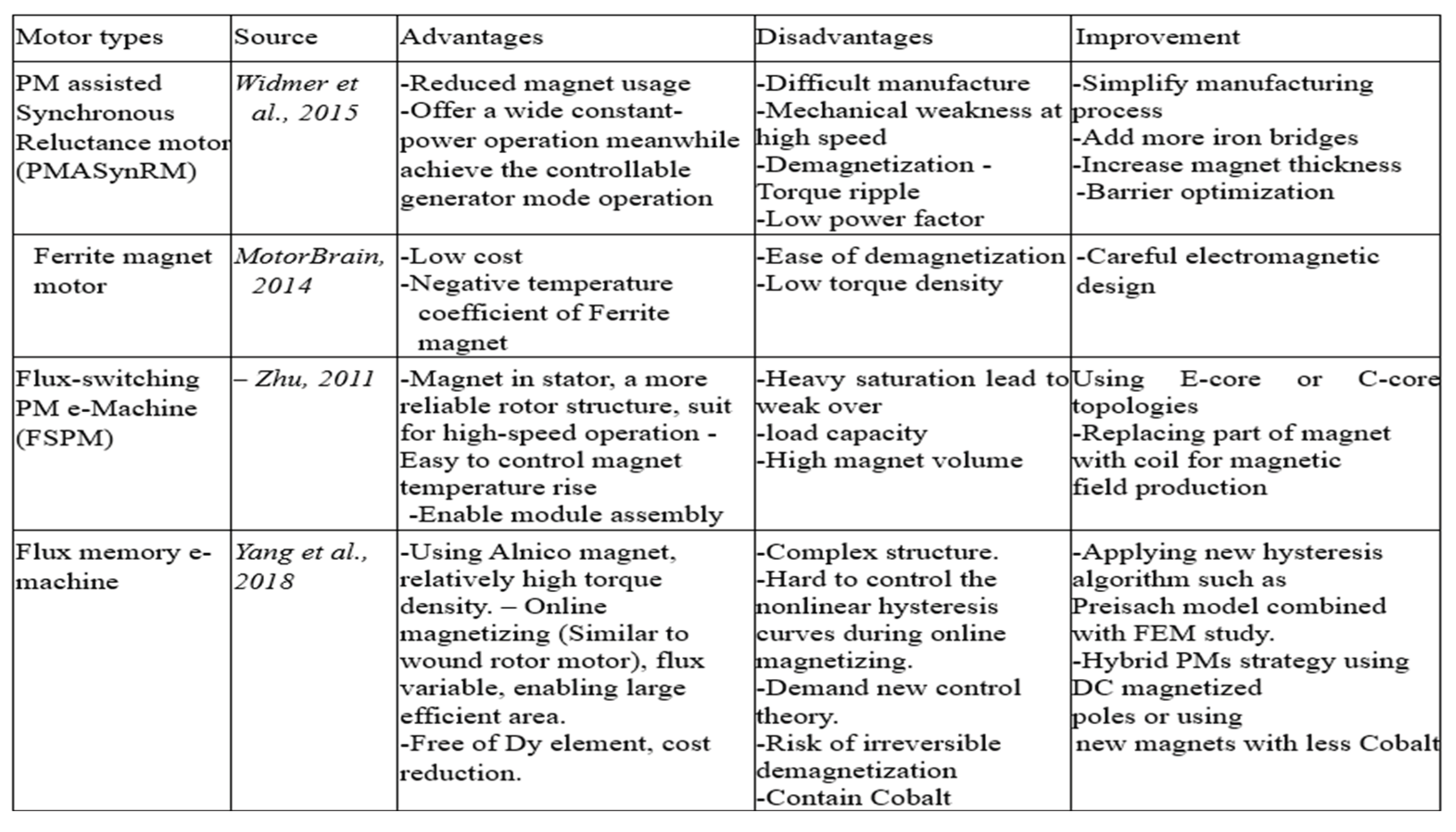
Table 1 presents a performance comparison of the previously discussed motor types, using a rating system where ●, ●●, and ●●● represent low, medium, and high performance, respectively. Based on this assessment, the Permanent Magnet Synchronous Motor particularly the Interior Permanent Magnet (IPM) variant emerges as the most suitable option for electric vehicle traction due to its balanced high efficiency, torque density, and reliability. In addition, Table 2 shifts focus to magnet-free motor options, comparing their characteristics to evaluate potential alternatives that reduce dependency on rare earth elements. Furthermore, Table 3 compares alternative magnet traction motors.
3.3. Methodology for Motor Selection for Electric Vehicle Application:
Five major electric motor types are commonly evaluated based on criteria such as efficiency, reliability, fault tolerance, torque output, cost-effectiveness, and dynamic response. These assessments increasingly reflect modern innovations like advanced thermal control, energy-dense materials, and improved motor control techniques. According to Lucchini et al. (2024), essential performance requirements for EV traction motors include high power density, strong low-speed torque for acceleration and gradient climbing, and consistent output across a wide speed range [25]. Rapid torque response, high energy efficiency under variable conditions, and effective regenerative braking are also crucial. Design factors such as low torque ripple, minimal acoustic noise, and strong operational reliability are vital for user satisfaction. In addition, economic factors, especially manufacturing feasibility and cost significantly affect commercial uptake, which in turn shapes component availability and affordability [26].
3.4. Disassembly of End of Life of Traction Motors:
Recycling rates for permanent magnets, particularly Nd-Fe-B types, remain low due to technical difficulties such as their brittleness, magnetic adherence, and complex integration within products [27]. However, life-cycle analyses show that recycling neodymium from products like hard drives consumes over 60% less energy and produces 80% less toxicity compared to processing raw materials [28]. When dismantling traction motors at end-of-life, decoupling strategies are classified as either destructive or non-destructive [29]. Destructive methods, such as cutting or drilling, often damage components, while non-destructive approaches aim to retain parts for reuse but may still cause minor wear [30]. Although non-destructive dismantling is preferred for sustainability, its effectiveness is limited by design complexity and reliance on manual labor. Simplified motor structures with fewer interconnections greatly facilitate this process [31]. In some cases, only selective component removal such as copper windings or bearings is needed, requiring multiple labor-intensive steps [32]. Despite its advantages, non-destructive disassembly is costlier and slower than destructive methods like shredding. The integration of digital tools, robotics, and design-for-disassembly principles can significantly enhance future dismantling efficiency.
3.5. Reuse, Remanufacture and Recycle of Traction Motors:
Reuse/Repair
As illustrated in Figure 5, reuse refers to employing a functional product or its components again for the same purpose without undergoing substantial alterations [15]. It involves extending the life of a product by utilizing it in its original form after its initial service life concludes [33].
Direct Traction Motor Reuse
Direct reuse involves utilizing previously used magnets for their original function without significant reprocessing, provided they remain in good condition and maintain sufficient magnetic strength [11]. However, this approach is rarely feasible when magnets exhibit corrosion, demagnetization, or physical damage. In traction motors, where magnets are firmly attached using strong adhesives, extraction during dismantling becomes challenging. As a result, these magnets are generally more appropriate for remanufacturing or recycling rather than reuse [34].
Remanufacturing
Remanufacturing involves restoring a used product to meet or exceed its original performance standards, accompanied by a warranty comparable to or better than that of a new item. This process typically encompasses the sorting, disassembly, cleaning, inspection, repair, and replacement of components that cannot be returned to their initial condition, culminating in a fully remanufactured product [33]. Key obstacles in remanufacturing include assessing environmental and economic impacts, managing marketing strategies, securing used components (cores), and planning production workflows. While some jurisdictions enforce remanufacturing through regulations like the WEEE Directive, certain firms voluntarily adopt such practices Bosch, for example, integrates Industry 4.0 sensor technologies to optimize remanufacturing design and operations [35].
Main Components of a Traction Motor and their Remanufacturing Processes
Like other energy recovery processes, the remanufacturing of traction motors involves a structured sequence of operations. These steps encompass the retrieval of returned units, preliminary evaluations, component disassembly, fault diagnostics, repair or part replacement, functional testing, reassembly, and eco-friendly disposal of irreparable elements [36].
Collection: Returned motors are retrieved from service points. Statistically, around 3% of electric devices fail and are returned for servicing. Preliminary Inspection: This phase involves assessing visible damage and performing mechanical or electrical diagnostics, such as resistance or insulation tests, to detect faults. Disassembly: The extent of disassembly depends on the motor’s current condition and past repairs. Some elements like rotors may be retained, whereas parts like bearings and windings usually need full refurbishment. Components such as the cooling impeller, shaft, end cover, and brake system are removed either manually or with mechanical tools. Component Examination: Shafts are inspected for surface flaws. Bearings, responsible for 51% of failures, are commonly replaced. Windings are tested for insulation or electrical issues. Faulty windings are carefully removed and rewound at controlled temperatures. Core and Winding Tests: Both rotor and stator cores undergo efficiency tests. Winding inspections help identify problems that might necessitate rewinding, second only to bearing replacements in frequency. Classification and Restoration: Components are sorted into three categories namely: reusable, repairable, and non-reusable. Reusable and repairable parts are cleaned, diagnosed, and fixed; unrepairable parts are safely discarded. Reassembly and Final Testing: Once all checks and repairs are complete, the motor is reassembled. Final performance tests confirm operational readiness before it is redeployed [32].
Developing a Multi-Stage Testing Protocol
The literature on remanufacturing emphasises the need for thorough checking before re-use or recycling decisions are made. Errington et al. (2013) have modelled the inspection processes in remanufacturing and reinforced the need for a multi-stage approach to good decision making. Recent study by Saiz et al. (2021) even explored the use of ensemble learning in the inspection of automotive components and suggested that the recording of detailed test data (as in the 7th phase) could allow machine learning to predict the classification of components in the future [37,38].
Recycle
Recycling involves processes where waste is either processed to extract materials for reuse or utilized as fuel in energy recovery systems [33]. Integrating recycling strategies with mindful design and manufacturing practices can greatly reduce dependency on virgin raw materials and energy. Rare earth magnets vital for high-performance electric motors are a central focus of recycling research, appearing in roughly half of all related studies [39]. The recovery of materials like steel, aluminium, copper, and rare earth magnets typically occurs after complete motor dismantling or shredding. Recycling requires intricate mechanical and chemical processing, as well as coordinated collaboration across the supply chain and its components. Figure 6 illustrates a complete framework for the circularity of traction motors
Upgrade
A form of remanufacturing where performance is improved by redesigning or replacing parts with more efficient components. Although promising, this remains mainly a research focus and has not yet been taken up by industry in large-scale [24].
3.6. Outcomes and Insights from Machine Learning Models for RUL Prediction
Both academic studies and industry reports provide systematic insight into how inspection, AI-based decision making and automated dismantling can guide traction motors towards reuse, repair or recycling of spent EV motors shown in Figure 7 below:
Visual inspection of traction motors often confirms common failure patterns, with bearing failures accounting for 50-70% of failures, followed by insulation failures (16%) and less cases of rotors and shaft failures. These statistics show that many end-of-life motors can be repaired by changing bearings or rewinding windings, which makes inspections a valuable first step in the process of re-manufacturing [32].
Tiwari et al. (2021), again demonstrating that effective inspection and sorting can allow up to 97% of motors or parts to be recovered, with only a small fraction of them not recoverable [32]. The Fraunhofer REASSERT project (2024) shows how inspection, artificial intelligence-driven decision making and automated dismantling can direct motors towards reuse, repair or recycling, thus increasing yields. Li et al., (2024) and Ngu et al. (2020), developed standardised criteria for the control of wear and tear, improving the success rate of decision making and remanufacturing [1,40].
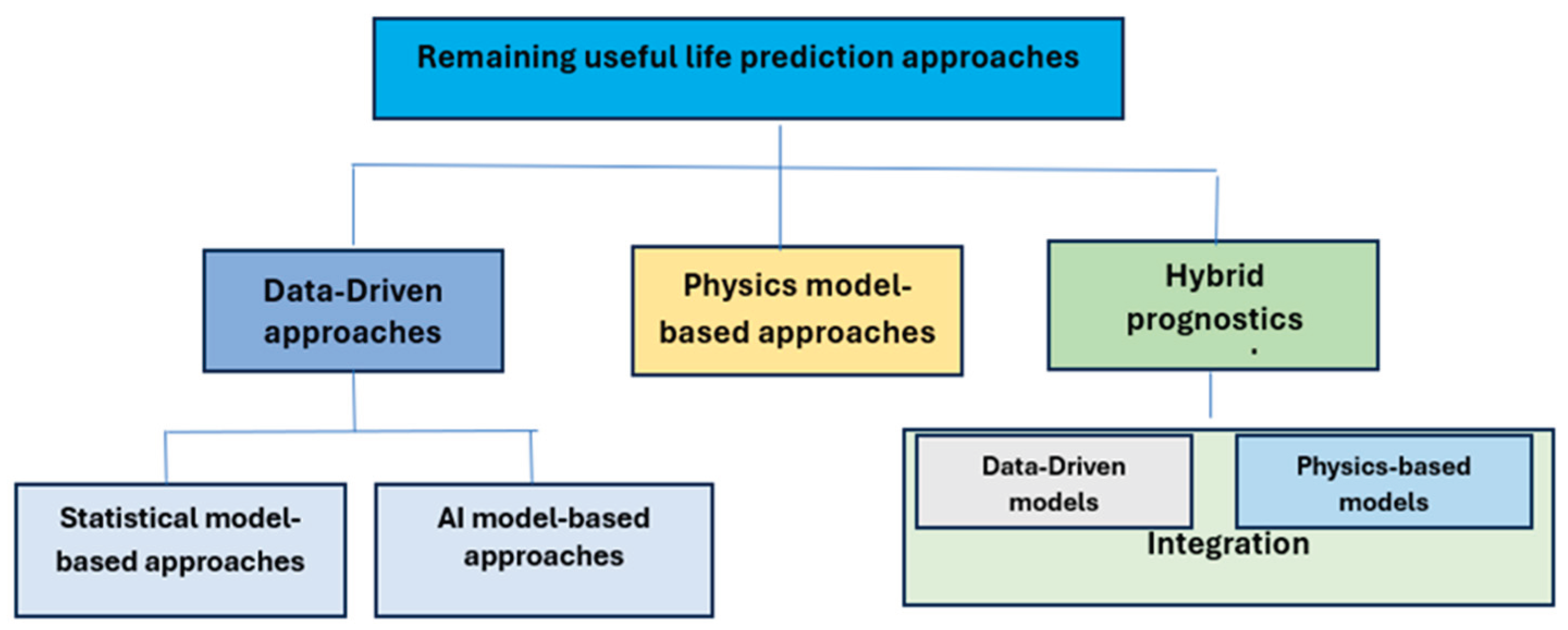
RUL prediction approaches include statistical, artificial intelligence (AI), physical based and hybrid methods. It also outlines future directions, including the digital twins and the fusion of physics and artificial intelligence for better prognostics and health management (PHM) strategies [41].
3.6.1. Classification of RULP Approaches
Statistical model-based approaches.
Artificial Intelligence model-based approaches.
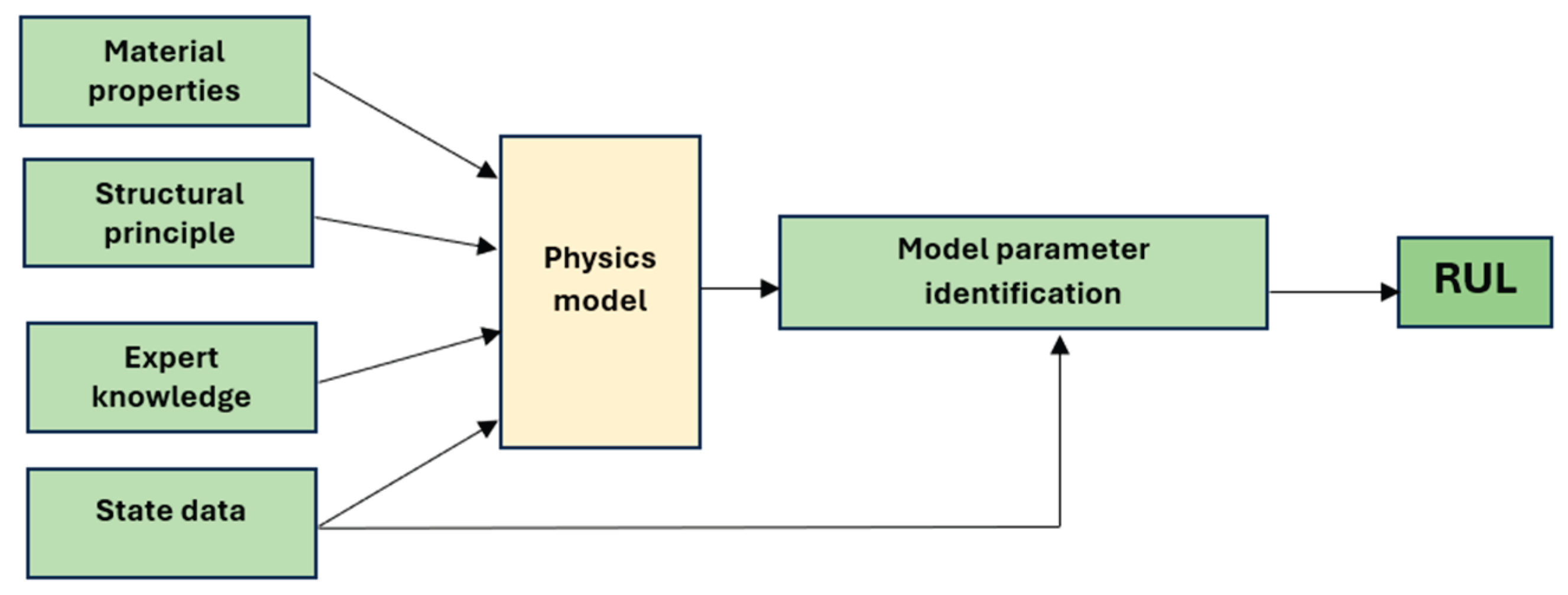
Physics model-based
Figure 8.
Classification of RULP Approaches.
3.6.1.1. Statistical Model-Based
Figure 9.
Statistical Model-Based Approaches.
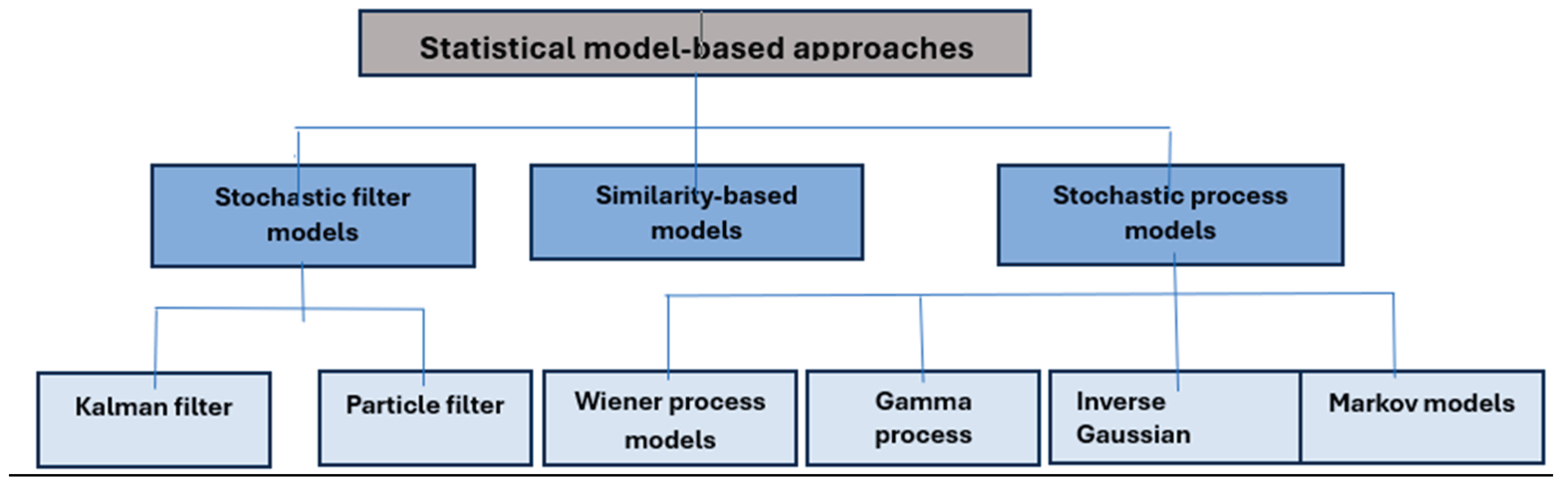
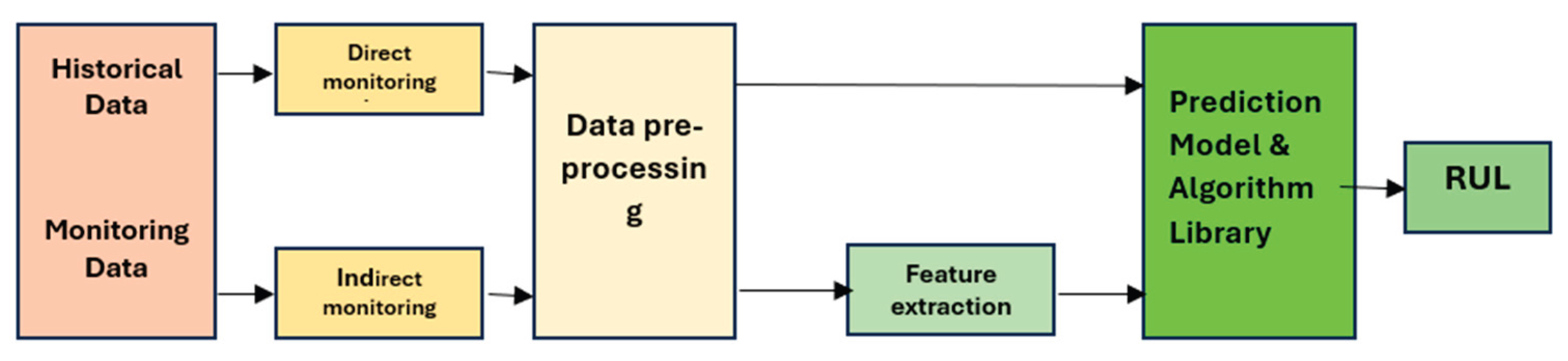
Figure 10.
General Process of Statistical Model-Based Approaches.
3.6.1.2. Artificial Intelligence
Figure 11.
AI Approaches.
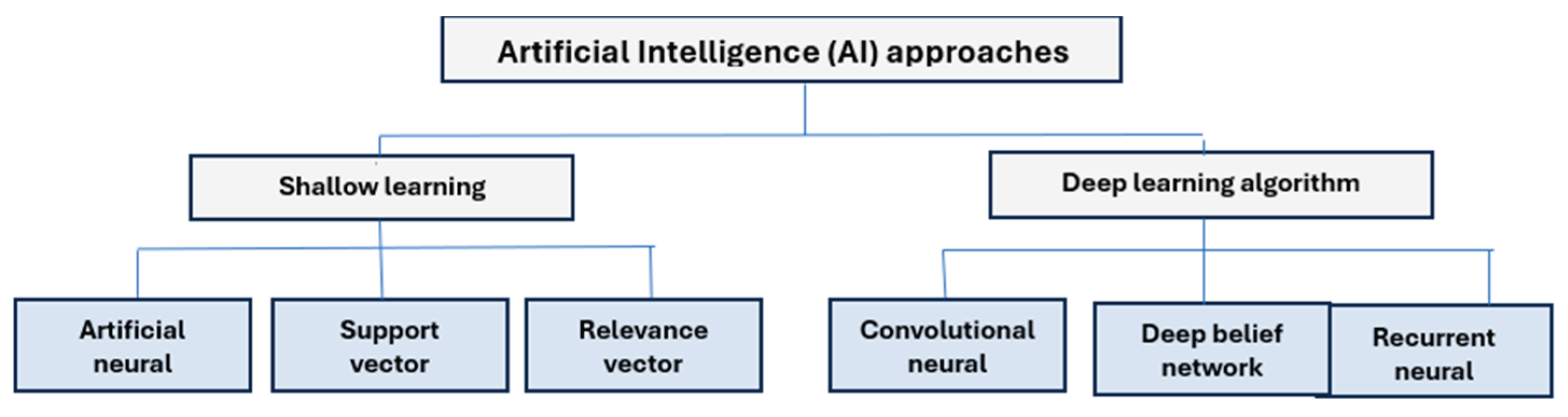
Figure 12.
General Process of AI Approaches.
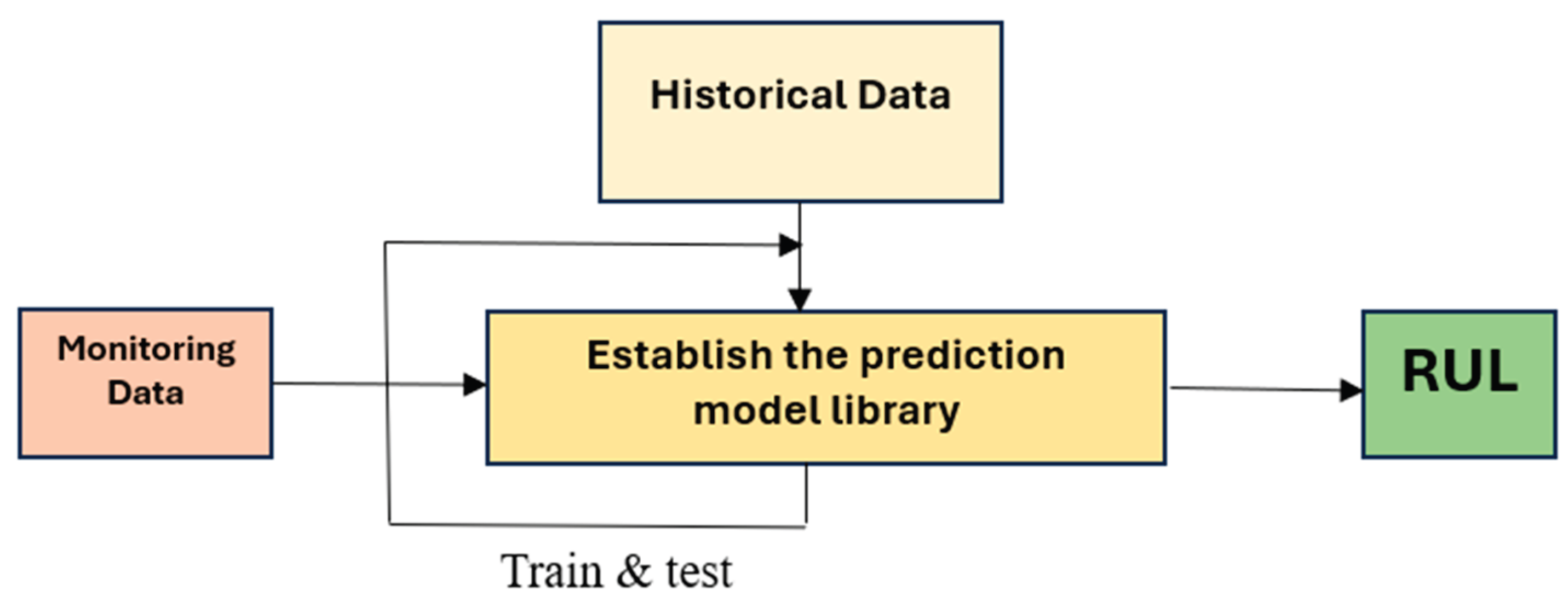
3.6.1.3. Physics Model-Based
Figure 13.
General Process of Physics Model-Based Approaches.
3.6.2. Model Development and Training Procedure
Various prognostic modelling approaches are utilized to predict the Remaining Useful Life (RUL), ranging from conventional machine learning algorithms like support vector regression, random forest, and gradient boosting, to sophisticated deep learning models such as long short-term memory (LSTM) networks, modified LSTM variants, convolutional neural networks (CNNs), and integrated CNN-LSTM hybrid systems.
Model training uses the training split, and predictions are then generated for the test set for performance evaluation.
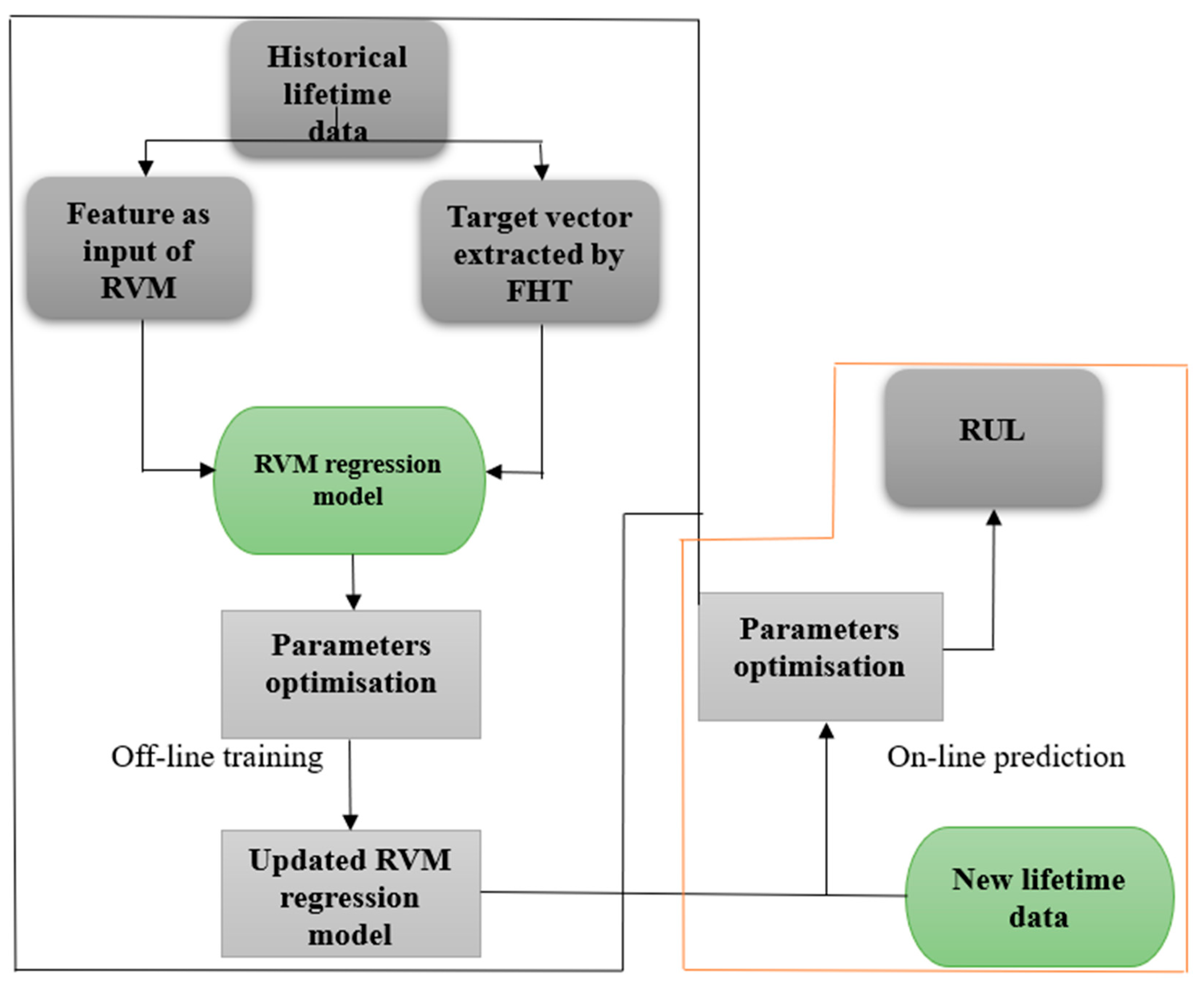
3.6.2.1. RVM-Based RUL Prediction Method
This method proposes an appropriate RUL prediction method based on a relevant vector machine (RVM) for high-speed train traction systems under uncertain conditions. The authors used first hitting time (FHT) to define the RUL and applied Bayesian learning to model the uncertainty. The traction motor algorithm improves the reliability of the predictions, and two real-world examples demonstrate the efficiency of the model under real-time operating conditions and noise [42].
Figure 14.
Relevant Vector Machine (RVM)-Based RUL Prediction Method.
3.6.2.2. Stage Data-Driven Pipeline for Milling Tool RUL Prediction
Sayyad et al., (2023) employed a multi-stage data-driven pipeline for milling tool RUL prediction [43].
Figure 15.
Methodology for tool RUL prediction using different time frequency domain (TFD) feature extraction methods and Long Short-Term Memory (LSTM) variants.
Figure 15.
Methodology for tool RUL prediction using different time frequency domain (TFD) feature extraction methods and Long Short-Term Memory (LSTM) variants.
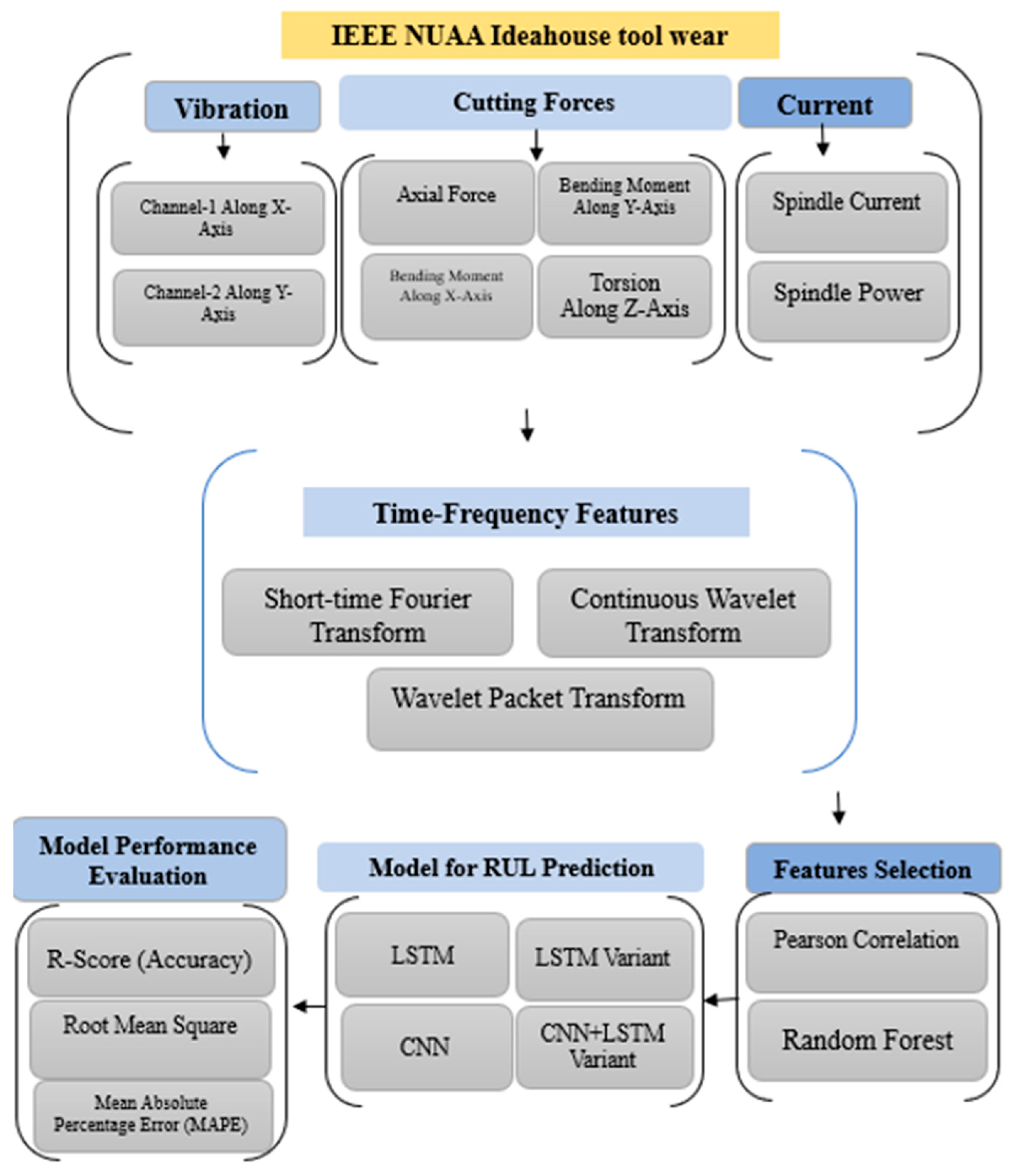
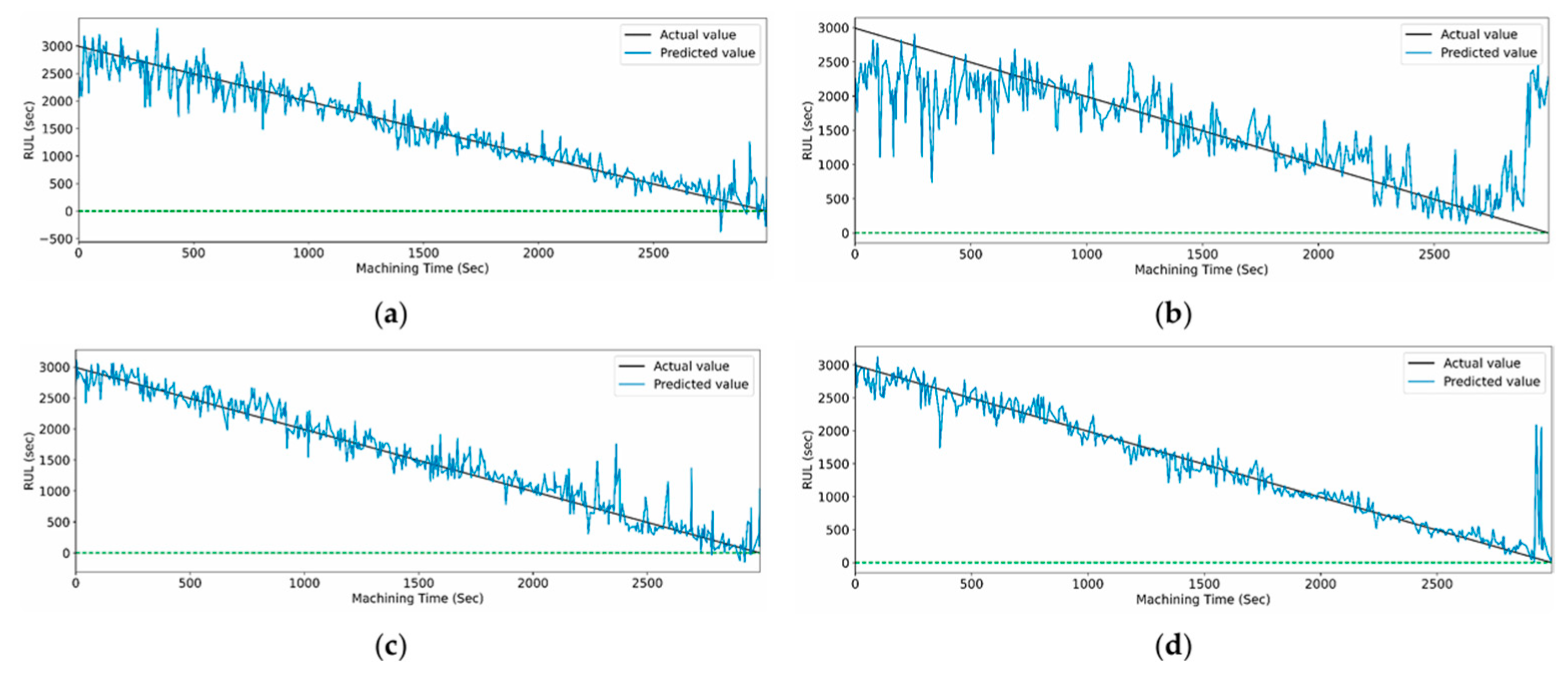
Figure 16.
illustrates the comparison between actual and predicted Remaining Useful Life (RUL) against machining time, using features derived from Wavelet Packet Transform (WPT) and selected via a Random Forest Regressor (RFR). Four different models were evaluated: (a) CNN, (b) CNN-LSTM, (c) CNN-Bidirectional LSTM, and (d) CNN-Stacked LSTM.
Figure 16.
illustrates the comparison between actual and predicted Remaining Useful Life (RUL) against machining time, using features derived from Wavelet Packet Transform (WPT) and selected via a Random Forest Regressor (RFR). Four different models were evaluated: (a) CNN, (b) CNN-LSTM, (c) CNN-Bidirectional LSTM, and (d) CNN-Stacked LSTM.
3.6.2.3. Long Short-Term Memory (LSTM) Evidence from Literature
Multi-sensor machines (generic): Preliminary work has shown that LSTMs outperform classical RNNs and MLPs in long-range anomaly and RUL sequencing [44].
Turbofan (NASA C-MAPSS): LSTM and Seq2Seq variants reliably outperform SVR and many tree models [45,46].
3.6.2.4. Strengths
It learns time dynamics directly from the raw and multiple modal flows (current, torque, temperature, vibration).
It handles nonlinear, nonstationary degradation without the use of explicit physical models.
Works well for sequences of varying length and missing (masking).
3.6.2.5. Limits
It needs sufficient sequences; with very small run-to-failure sets, tree models or SVR can compete.
Instability or overloading of training without proper regularisation; performance sensitive to windowing and scaling.
Transformers and TCNs can match or outperform LSTM on longer sequences with better parallelism, but LSTM remains powerful on shorter sequences with limited data.
3.6.3. Other Models Include
3.7. Challenges and Solutions in CE for EMs Using Industry 4.0 Technologies.
Although numerous studies have explored circular economy (CE) challenges within manufacturing, this section specifically examines electric motors and how Industry 4.0 technologies can be leveraged to address major obstacles [68].
Lack of Information on the Motor Condition Returned.
Manual and Costly Disassembly.
Recycling Complex Components.
No Clear End-of-Life Decision Method.
Unclear Return on Investment.
3.8. Challenges Associated with Traction Motors
From an economic standpoint, dismantling is frequently viewed as a low-value activity [31]. However, growing environmental regulations and the scarcity of critical materials (CMs) have elevated the importance of systematic decommissioning. Dismantling enables the recovery of valuable components and materials, prompting industries to seek alternative sources of CMs. This helps reduce reliance on the volatile and monopolized rare earth element (REE) market, which supplies materials used in permanent magnets for electric motors (EMs) in electric vehicles [69]. Compounding this challenge, modern product designers are increasingly required to simplify component designs and geometries to make dismantling easier, while still accommodating evolving performance demands from consumers and manufacturers. This is especially critical in EV motors, where embedding sustainable design strategies is often complex [70].
Dismantling-related research generally falls into two key areas:
Process Planning: Identifying the most efficient dismantling approach, including decisions on the extent of disassembly down to component level.
Sequence Planning: Defining the ideal order of disassembly tasks based on product architecture and information flow.
Various mathematical models are employed to plan to dismantle processes, depending on the product’s design, structure, and disassembly requirements [1].
3.9. Future Trends, Existing Gaps, and Research Guidelines
This section outlines the primary forward-looking strategies shaping electric motor sustainability in the circular economy context, based on prior evaluations. These projected trends aim to drive improvements in sustainability, efficiency, and waste reduction within the automotive sector over the coming 5 to 10 years:
Design for Disassembly, Reuse, Recycling, and Durability (DRR&D) [71].
Integrated Manufacturing and Remanufacturing Systems [72].
Material Strategy in (Re)Manufacturing [73].
Advances in Winding Techniques [74]
Modular Component Architecture [75].
3D Printing to Promote Repairability and Circularity [76].
3.10. SWOT matrix of the recycling PM motors [2].
Strengths (S)
S1: Lower Dependence on Virgin Materials. S2: Minimized Ecological Burden. S3: Advancement of Circular Economy. S4: Economic Efficiency. S5: Response to Eco-Conscious Market Trends. S6: Enhanced Supply Chain Resilience.
Weaknesses (W)
W1: Recycling Complexity. W2: Retrieval Difficulties. W3: Purity Constraints. W4: Infrastructure Gaps. W5: Market and Cost Uncertainty. W6: Inconsistent Quality. W7: Technology Dependence. W8: Financial Burden of Recycling.
Opportunities (O)
O1: Expanding Electric Vehicle Industry. O2: Strategic Collaborations. O3: Innovations in Recycling Technologies. O4: Proactive Regulatory Alignment. O5: Securing Material Supply Chains. O6: Rising Eco-Conscious Consumer Demand. O7: Access to Government Support Programs.
Threats (T)
T1: Competitive Pressure in the Market. T2: Variability in Material Performance. T3: Financial Viability. T4: Consumer Trust and Market Reception. T5: Impact of Energy Expenses. T6: Limited Public Awareness.
References
- Alex, G., Navdeep, J., & Abdel-rahman, M. (2013). 2013 IEEE Workshop on Automatic Speech Recognition and Understanding.
- Al-Refaie, A., Al-atrash, M., & Lepkova, N. (2025). Prediction of the remaining useful life of a milling machine using machine learning. MethodsX, 14. [CrossRef]
- APRA. (2012, April 3). Remanufacturing Terminology. Https://Www.Apraeurope.Org/Remanufacturing.
- Ballo, F., Gobbi, M., Mastinu, G., & Palazzetti, R. (2023). Noise and Vibration of Permanent Magnet Synchronous Electric Motors: A Simplified Analytical Model. IEEE Transactions on Transportation Electrification, 9(2), 2486–2496. [CrossRef]
- Bdiwi, M., Rashid, A., & Putz, M. (2016). Autonomous disassembly of electric vehicle motors based on robot cognition. 2016 IEEE International Conference on Robotics and Automation (ICRA).
- Cai, W., Wu, X., Zhou, M., Liang, Y., & Wang, Y. (2021a). Review and Development of Electric Motor Systems and Electric Powertrains for New Energy Vehicles. Automotive Innovation, 4(1), 3–22. [CrossRef]
- Cai, W., Wu, X., Zhou, M., Liang, Y., & Wang, Y. (2021b). Review and Development of Electric Motor Systems and Electric Powertrains for New Energy Vehicles. Automotive Innovation, 4(1), 3–22. [CrossRef]
- Casper, R., & Sundin, E. (2021). Electrification in the automotive industry: effects in remanufacturing. Journal of Remanufacturing, 11(2), 121–136. [CrossRef]
- Chang, M. M. L., Ong, S. K., & Nee, A. Y. C. (2017). Approaches and Challenges in Product Disassembly Planning for Sustainability. Procedia CIRP, 60, 506–511. [CrossRef]
- De Almeida, A. T., Ferreira, F. J. T. E., & Baoming, G. (2014). Beyond induction motors - technology trends to move up efficiency. IEEE Trans Ind Appl 50(3):2103–2114. . Https:// Doi. Org/ 10. 1109/ TIA. 2013. 22884 25.
- De Fazio, F., Bakker, C., Flipsen, B., & Balkenende, R. (2021). The disassembly map: a new method to enhance design for product repairability. J Clean Prod 320:128552. https:// doi. org/ 10. 1016/j. jclep ro. 2021. 128552.
- Deng, Y., Liu, Y., Zhang, D., & Cao, Z. (2025). A hybrid gradient boosting model for predicting longitudinal dispersion coefficient in natural rivers. Water Resources Management, 1–21.
- Dholu, N., Nagel, J. R., Cohrs, D., & Rajamani, R. K. (2017). Eddy Current Separation of Nonferrous Metals Using a Variable-Frequency Electromagnet. KONA Powder and Particle Journal, 34(0), 2017012. [CrossRef]
- Di Gerlando, A., Gobbi, M., Magnanini, M. C., Mastinu, G., Palazzetti, R., Sattar, A., & Tolio, T. (2024a). Circularity potential of electric motors in e - mobility : methods , technologies , challenges. In Journal of Remanufacturing (Issue 0123456789). Springer Netherlands. [CrossRef]
- Di Gerlando, A., Gobbi, M., Magnanini, M. C., Mastinu, G., Palazzetti, R., Sattar, A., & Tolio, T. (2024b). Circularity potential of electric motors in e-mobility: methods, technologies, challenges. In Journal of Remanufacturing (Vol. 14, Issue 2, pp. 315–357). Springer Science and Business Media B.V. [CrossRef]
- Ehsani, M., Gao, Y., & Emadi, A. (2017). Modern Electric, Hybrid Electric, and Fuel Cell Vehicles (M. Ehsani, Y. Gao, & A. Emadi, Eds.). CRC Press. [CrossRef]
- Elwert, T., Goldmann, D., Römer, F., Buchert, M., Merz, C., Schueler, D., & Sutter, J. (2016). Current developments and challenges in the recycling of key components of (Hybrid) electric vehicles. In Recycling (Vol. 1, Issue 1, pp. 25–60). MDPI AG. [CrossRef]
- Elwert, T., Goldmann, D., Romer, F., Buchert, M., Merz, C., Schueler, D., & Sutter, J. (2016). Current developments and challenges in the recycling of key components of (hybrid) electric vehicles. .
- Errington, M., & Childe, S. J. (2013). A business process model of inspection in remanufacturing. Journal of Remanufacturing, 3(1). [CrossRef]
- European-Commision. (2020). Communication from the commission to the European parliament, the council, the European economic and social committee and the committee of the regions. Critical Raw Materials Resilience: Charting a Path towards greater Security and Sustainability.
- Features in Histogram Gradient Boosting Trees Preparing the data. (n.d.).
- Fiagbe, Y. (2014). Potential of remanufacturing industry in ghana. Research Gate, June, 15.
- Ford Motor Company. (2017). Ford Sustainability Report. Https://Corporate.Ford.Com/Content/Dam/Corporate/En/Company/2014-15-SustainabilityReport.Pdf.
- Guo, Y., Ba, X., Liu, L., Lu, H., Lei, G., Yin, W., & Zhu, J. (2023). A Review of Electric Motors with Soft Magnetic Composite Cores for Electric Drives. Energies, 16(4). [CrossRef]
- Hernández-Millán, R., & Pacheco-Pimentel, J. R. (2017a). Recycling rotating electrical machines. Revista Facultad de Ingenieria, 2017(83), 50–56. [CrossRef]
- Hernández-Millán, R., & Pacheco-Pimentel, J. R. (2017b). Recycling rotating electrical machines. Revista Facultad de Ingenieria, 2017(83), 50–56. [CrossRef]
- Hogberg, S., Pedersen, T. S., Jensen, B. B., Mijatovic, N., & Holboll, J. (2016). Direct Reuse of Rare Earth Permanent Magnets. . Wind Turbine Generator Case Study, ICEM.
- Jha, A. K., Garbuio, L., Kedous-Lebouc, A., Yonnet, J. P., & Dubus, J. M. (2017). Design and comparison of outer rotor bonded magnets Halbach motor with different topologies. . In Electrical Machines, Drives and Power Systems” ELMA, 15th International Conference on (Pp. 6-10). IEEE.
- Jin, H., Afiuny, P., McIntyre, T., Yih, Y., & Sutherland, J. W. (2016). Comparative Life Cycle Assessment of NdFeB Magnets: Virgin Production versus Magnet-to-Magnet Recycling. Procedia CIRP, 48, 45–50. [CrossRef]
- Katona, M., Bányai, D. G., Németh, Z., Kuczmann, M., & Orosz, T. (2024). Remanufacturing a Synchronous Reluctance Machine with Aluminum Winding: An Open Benchmark Problem for FEM Analysis. Electronics (Switzerland), 13(4). [CrossRef]
- Klier, T., Risch, F., & Franke, J. (2013). Disassembly strategies for recovering valuable magnet material of electric drives. 2013 3rd International Electric Drives Production Conference (EDPC), 1–3. [CrossRef]
- Krishnamoorthy, S., & Panikkar, P. P. K. (2024). A comprehensive review of different electric motors for electric vehicles application. International Journal of Power Electronics and Drive Systems, 15(1), 74–90. [CrossRef]
- Kumar, R., Gupta, M., & Singh, U. (2023). Precision Agriculture Crop Recommendation System Using KNN Algorithm. 2023 International Conference on IoT, Communication and Automation Technology, ICICAT 2023. [CrossRef]
- Kumar, V., Sezersan, I., Garza-Reyes, J. A., Gonzalez, E. D., & Moh’d Anwer, A. S. (2019). Circular economy in the manufacturing sector: Benefits, Opportunities and Barriers. Manag. Decis. 57, 1067–1084.
- Li, B., Li, R., Sun, T., Gong, A., Tian, F., Khan, M. Y. A., & Ni, G. (2023). Improving LSTM hydrological modeling with spatiotemporal deep learning and multi-task learning: A case study of three mountainous areas on the Tibetan Plateau. Journal of Hydrology, 620. [CrossRef]
- Li, C., Xu, D., & Wang, G. (2017). High efficiency remanufacturing of induction motors with interior permanent-magnet rotors and synchronous-reluctance rotors. 2017 IEEE Transportation Electrification Conference and Expo, Asia-Pacific, ITEC Asia-Pacific 2017, 4–9. [CrossRef]
- Li, Z., Hamidi, A. S., Yan, Z., Sattar, A., Hazra, S., Soulard, J., Guest, C., Ahmed, S. H., & Tailor, F. (2024a). A circular economy approach for recycling Electric Motors in the end-of-life Vehicles: A literature review. Resources, Conservation and Recycling, 205(June), 1–41. [CrossRef]
- Li, Z., Hamidi, A. S., Yan, Z., Sattar, A., Hazra, S., Soulard, J., Guest, C., Ahmed, S. H., & Tailor, F. (2024b). A circular economy approach for recycling Electric Motors in the end-of-life Vehicles: A literature review. Resources, Conservation and Recycling, 205(February), 107582. [CrossRef]
- Lindkvist, Haziri, L., & Sundin, E. (2020). Supporting design for remanufacturing. A framework for implementing information feedback from remanufacturing to product design. Journal of Remanufacturing 10(1):57–76. Https:// Doi. Org/ 10. 1007/ S13243- 019- 00074-7.
- Liu, H., Xiao, Q., Jin, Y., Mu, Y., Meng, J., Zhang, T., Jia, H., & Teodorescu, R. (2022). Improved LightGBM-Based Framework for Electric Vehicle Lithium-Ion Battery Remaining Useful Life Prediction Using Multi Health Indicators. Symmetry, 14(8). [CrossRef]
- Liu, L., Wang, L., & Yu, Z. (2021). Remaining Useful Life Estimation of Aircraft Engines Based on Deep Convolution Neural Network and LightGBM Combination Model. International Journal of Computational Intelligence Systems, 14(1). [CrossRef]
- Lucchini, F., Torchio, R., & Bianchi, N. (2024). A Survey on the Sustainability of Traditional and Emerging Materials for Next-Generation EV Motors. Energies, 17(23), 1–19. [CrossRef]
- Malhotra, P., Ramakrishnan, A., Anand, G., Vig, L., Agarwal, P., & Shroff, G. (2016). LSTM-based Encoder-Decoder for Multi-sensor Anomaly Detection. http://arxiv.org/abs/1607.00148.
- Mangold, S., Steiner, C., Friedmann, M., & Fleischer, J. (2022). Vision-Based Screw Head Detection for Automated Disassembly for Remanufacturing. Procedia CIRP, 105, 1–6. [CrossRef]
- Mayer, D., Hausmann, L., Maul N., Reinschmidt, L., Hofmann, J., & Fleischer, J. (2019). Systematic investigation of the grooving process and its influence on slot insulation of stators with hairpin technology. 9th International Electric Drives Production Conference (EDPC). IEEE. Https:// Doi. Org/ 10. 1109/ EDPC4 8408. 2019. 90119 35, 1–7.
- Meng, X., Cai, C., Wang, Y., Wang, Q., & Tan, L. (2022). Remaining useful life prediction of lithium-ion batteries using CEEMDAN and WOA-SVR model. Frontiers in Energy Research, 10. [CrossRef]
- Mulcahy, K. R., Kilpatrick, A. F. R., Harper, G. D. J., Walton, A., & Abbott, A. P. (2022). Debondable adhesives and their use in recycling. Green Chemistry, 24(1), 36–61. [CrossRef]
- Nachrichten. (2023). idw-Informationsdienst Wissenschaft idw-Informationsdienst Wissenschaft Press release Fraunhofer-Institut für Produktionstechnik und Automatisierung IPA Dr. Karin Röhricht New technologies for the disassembly of electric vehicle batteries and motors. http://idw-online.de/en/news814619.
- Ngu, H. J., Lee, M. D., & Bin Osman, M. S. (2020). Review on current challenges and future opportunities in Malaysia sustainable manufacturing: Remanufacturing industries. In Journal of Cleaner Production (Vol. 273). Elsevier Ltd. [CrossRef]
- Önal, M. A. R. (2017). Recycling of NdFeB magnets for rare earth elements (REE) recovery. KU Leuven, Leuven. Https://Www.Mtm.Kuleuven.Be/Onderzoek/Semper/Hitemp/Publications/Doctoraltheses/Recaional.
- Pell, R., Wall, F., Yan, X., Li, J., & Zeng, X. (2019). Temporally explicit life cycle assessment as an environmental performance decision making tool in rare earth project development. Minerals Engineering, 135, 64–73. [CrossRef]
- Pérez, M., Lieder, M., Jeong, Y., & Asif, F. M. A. (2025). A simulation-based decision support tool for circular manufacturing systems in the automotive industry using electric machines as a remanufacturing case study. International Journal of Production Research. [CrossRef]
- Redlinger, M., Eggert, R., & Woodhouse, M. (2015). Evaluating the availability of gallium, indium, and tellurium from recycled photovoltaic modules. Solar Energy Materials and Solar Cells, 138, 58–71. [CrossRef]
- Saiz, F. A., Alfaro, G., & Barandiaran, I. (2021). An inspection and classification system for automotive component remanufacturing industry based on ensemble learning. Information (Switzerland), 12(12). [CrossRef]
- Sayyad, S., Kumar, S., Bongale, A., Kotecha, K., & Abraham, A. (2023). Remaining Useful-Life Prediction of the Milling Cutting Tool Using Time–Frequency-Based Features and Deep Learning Models. Sensors, 23(12). [CrossRef]
- Sekhar, J. N. C., Domathoti, B., & Santibanez Gonzalez, E. D. R. (2023). Prediction of Battery Remaining Useful Life Using Machine Learning Algorithms. Sustainability (Switzerland), 15(21). [CrossRef]
- Soh, S., Ong, S. K., & Nee, A. Y. C. (2016). Design for assembly and disassembly for remanufacturing. . 12–24. [CrossRef]
- Taheri, F., Sauve, G., & Van Acker, K. (2024). Circular economy strategies for permanent magnet motors in electric vehicles: Application of SWOT. In Procedia CIRP (Vol. 122). Elsevier B.V. [CrossRef]
- Tiwari, D., Miscandlon, J., Tiwari, A., & Jewell, G. W. (2021a). A review of circular economy research for electric motors and the role of industry 4.0 technologies. Sustainability (Switzerland), 13(17). [CrossRef]
- Tiwari, D., Miscandlon, J., Tiwari, A., & Jewell, G. W. (2021b). A review of circular economy research for electric motors and the role of industry 4.0 technologies. Sustainability (Switzerland), 13(17), 1–19. [CrossRef]
- Tolio, T., Bernard, A., Colledani, M., Kara, S., Seliger, G., & Duflou, J. (2017). Design, management and control of demanufacturing and remanufacturing systems. CIRP Ann 66(2):585–609. . Https:// Doi. Org/ 10. 1016/j. Cirp. 2017. 05. 001.
- Toyota Motors Corporation. Vehicle Recycling. . (2014). Retrieved from Toyota City, Japan: Http://Www.Toyota-Global.Com/Sustainability/Report/Vehicle_recycling/Pdf/Vr_all.Pdf.
- Trading Economics. (2023, December 15). Lithium Carbonate. . URL: Htt Ps://Tradingeconomics.Com/Commodity/Lithium.
- Upadhayay, P., Awais, M., Lebouc, A. K., Garbuio, L., Degri, M., Walton, A., Mipo, J. C., & Dubus, J. M. (2018). Applicability of Direct Reuse and Recycled Rare Earth Magnets in Electro-mobility. 7th International IEEE Conference on Renewable Energy Research and Applications, ICRERA 2018, 5, 846–852. [CrossRef]
- Van Loon, P., Diener, D., & Harris, S. (2021). Circular products and business models and environmental impact reductions: current knowledge and knowledge gaps. . J Clean Prod 288:125627. Https:// Doi. Org/ 10. 1016/j. Jclep Ro. 2020. 125627.
- Vimala, M., Toby, T., Vikram, S., B Maheswara, R., & M Goutham, K. (2017). Prediction of Remaining Useful Lifetime (RUL) of Turbofan Engine using Machine Learning.
- Wang, X., Jiang, B., Lu, N., & Cocquempot, V. (2018). Accurate Prediction of RUL under Uncertainty Conditions: Application to the Traction System of a High-speed Train. 51(24), 401–406. [CrossRef]
- Wei, W., Li, X., Liu, J., Zhou, Y., Li, L., & Zhou, J. (2021). Performance evaluation of hybrid woa-svr and hho-svr models with various kernels to predict factor of safety for circular failure slope. Applied Sciences (Switzerland), 11(4), 1–22. [CrossRef]
- Wen, X., & Li, W. (2023). Time Series Prediction Based on LSTM-Attention-LSTM Model. IEEE Access, 11, 48322–48331. [CrossRef]
- Weng, Z. H., Jowitt, S. M., Mudd, G. M., & Haque, N. (2013). Assessing rare earth element mineral deposit types and links to environmental impacts. Applied Earth Science, 122(2), 83–96. [CrossRef]
- Werker, J., Wulf, C., Zapp, P., Schreiber, A., & Marx, J. (2019). Social LCA for rare earth NdFeB permanent magnets. Sustainable Production and Consumption, 19, 257–269. [CrossRef]
- Widmer, J. D., Martin, R., & Kimiabeigi, M. (2015a). Electric vehicle traction motors without rare earth magnets. Sustainable Materials and Technologies, 3, 7–13. [CrossRef]
- Widmer, J. D., Martin, R., & Kimiabeigi, M. (2015b). Electric vehicle traction motors without rare earth magnets. Sustainable Materials and Technologies, 3, 7–13. [CrossRef]
- Wu, M., Goh, K. W., Chaw, K. H., Koh, Y. S., Dares, M., Yeong, C. F., Su, E. L. M., William, H., & Zhang, Y. (2024). An intelligent predictive maintenance system based on random forest for addressing industrial conveyor belt challenges. Frontiers in Mechanical Engineering, 10. [CrossRef]
- Xiao, Y., Tan, L., & Liu, J. (2025). Application of Machine Learning Model in Fraud Identification: A Comparative Study of CatBoost, XGBoost and LightGBM. [CrossRef]
- Yang, Y., Shang, X., Chen, Z., Mei, K., Wang, Z., Dahlgren, R. A., Zhang, M., & Ji, X. (2021). A support vector regression model to predict nitrate-nitrogen isotopic composition using hydro-chemical variables. Journal of Environmental Management, 290. [CrossRef]
- Yang, Y., Walton, A., Sheridan, R., Güth, K., Gauß, R., Gutfleisch, O., Buchert, M., Steenari, B. M., Van Gerven, T., Jones, P. T., & Binnemans, K. (2017). REE Recovery from End-of-Life NdFeB Permanent Magnet Scrap: A Critical Review. Journal of Sustainable Metallurgy, 3(1), 122–149. [CrossRef]
- Zhang, M., Yin, J., & Chen, W. (2023). SOH estimation and RUL prediction of lithium batteries based on multidomain feature fusion and CatBoost model. Energy Science and Engineering, 11(9), 3082–3101. [CrossRef]
- Zhang, Q., Yang, W., Zhao, A., Wang, X., Wang, Z., & Zhang, L. (2024). Short-term forecasting of vegetable prices based on LSTM model—Evidence from Beijing’s vegetable data. PLoS ONE, 19(7 July). [CrossRef]
- Zhang, R., Zeng, Z., Li, Y., Liu, J., & Wang, Z. (2022). Research on Remaining Useful Life Prediction Method of Rolling Bearing Based on Digital Twin. Entropy, 24(11), 1578. [CrossRef]
- Zhang, Y., Fang, L., Qi, Z., & Deng, H. (2023). A Review of Remaining Useful Life Prediction Approaches for Mechanical Equipment. IEEE Sensors Journal, 23(24), 29991–30006. [CrossRef]
- Zhao, J., Huang, F., Lv, J., Duan, Y., Qin, Z., Li, G., & Tian, G. (2020). Do RNN and LSTM have Long Memory?
- Zhao, Q., Qin, X., Zhao, H., & Feng, W. (2018). A novel prediction method based on the support vector regression for the remaining useful life of lithium-ion batteries. Microelectronics Reliability, 85, 99–108. [CrossRef]
- Zhao, Z., Chen, W., Wu, X., Chen, P. C. Y., & Liu, J. (2017). LSTM network: A deep learning approach for Short-term traffic forecast. IET Intelligent Transport Systems, 11(2), 68–75. [CrossRef]
- Zhou, Y., Huang, M., & Pecht, M. (2020). Remaining useful life estimation of lithium-ion cells based on k-nearest neighbor regression with differential evolution optimization. Journal of Cleaner Production, 249, 119409. [CrossRef]
- Zohra, B., & Akar, M. (2019, October 1). Design Trends for Line Start Permanent Magnet Synchronous Motors. 3rd International Symposium on Multidisciplinary Studies and Innovative Technologies, ISMSIT 2019 - Proceedings. [CrossRef]
Figure 5.
Reuse Traction Motor Detailed Process Flowsheet [15].
Figure 5.
Reuse Traction Motor Detailed Process Flowsheet [15].
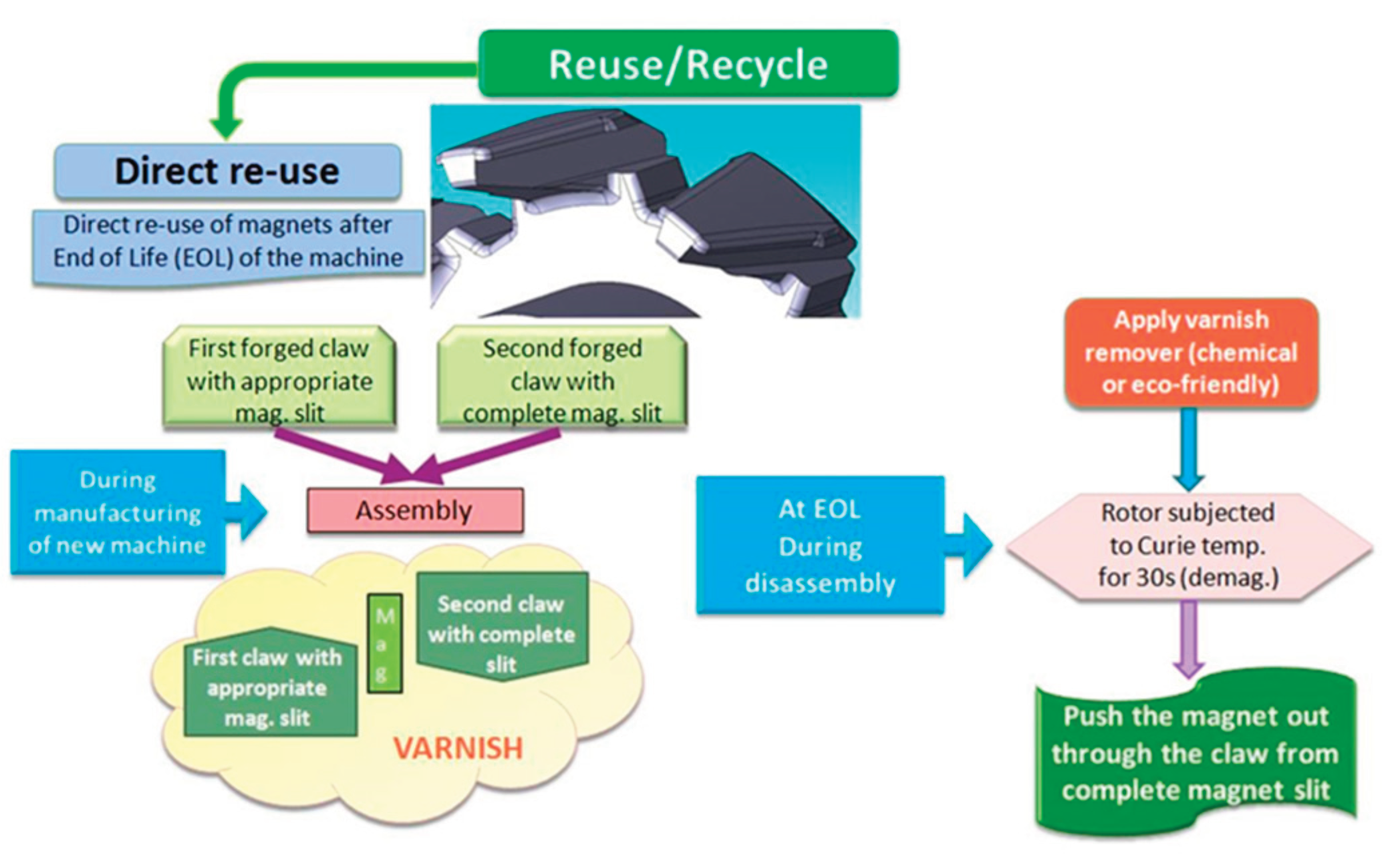
Figure 6.
Framework for the circularity of Traction Motors [24].
Figure 6.
Framework for the circularity of Traction Motors [24].
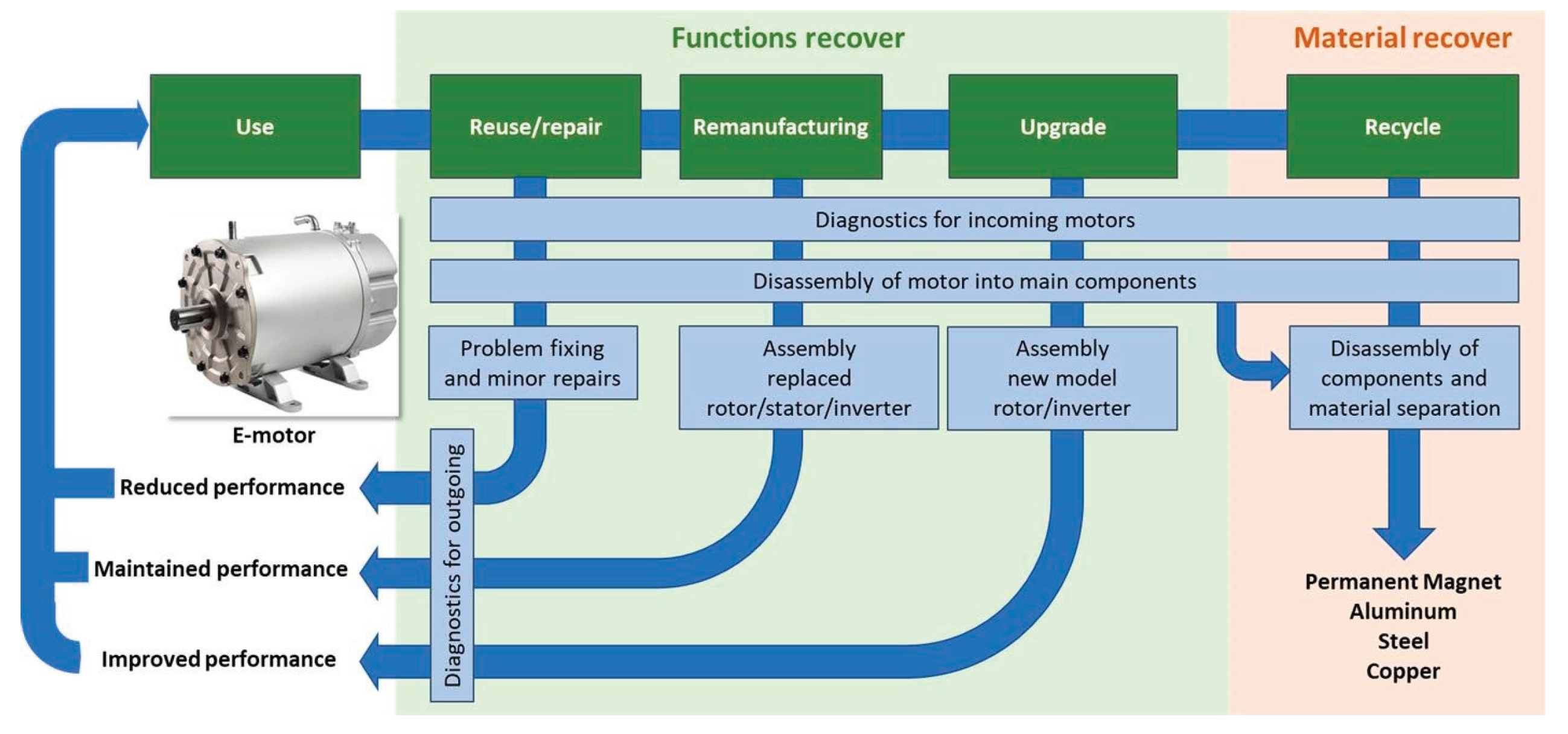
Figure 7.
Vision-Based Screw Detection and Disassembly Workflow Protocol.
Figure 17.
RUL Prediction Based on the Proposed Method.
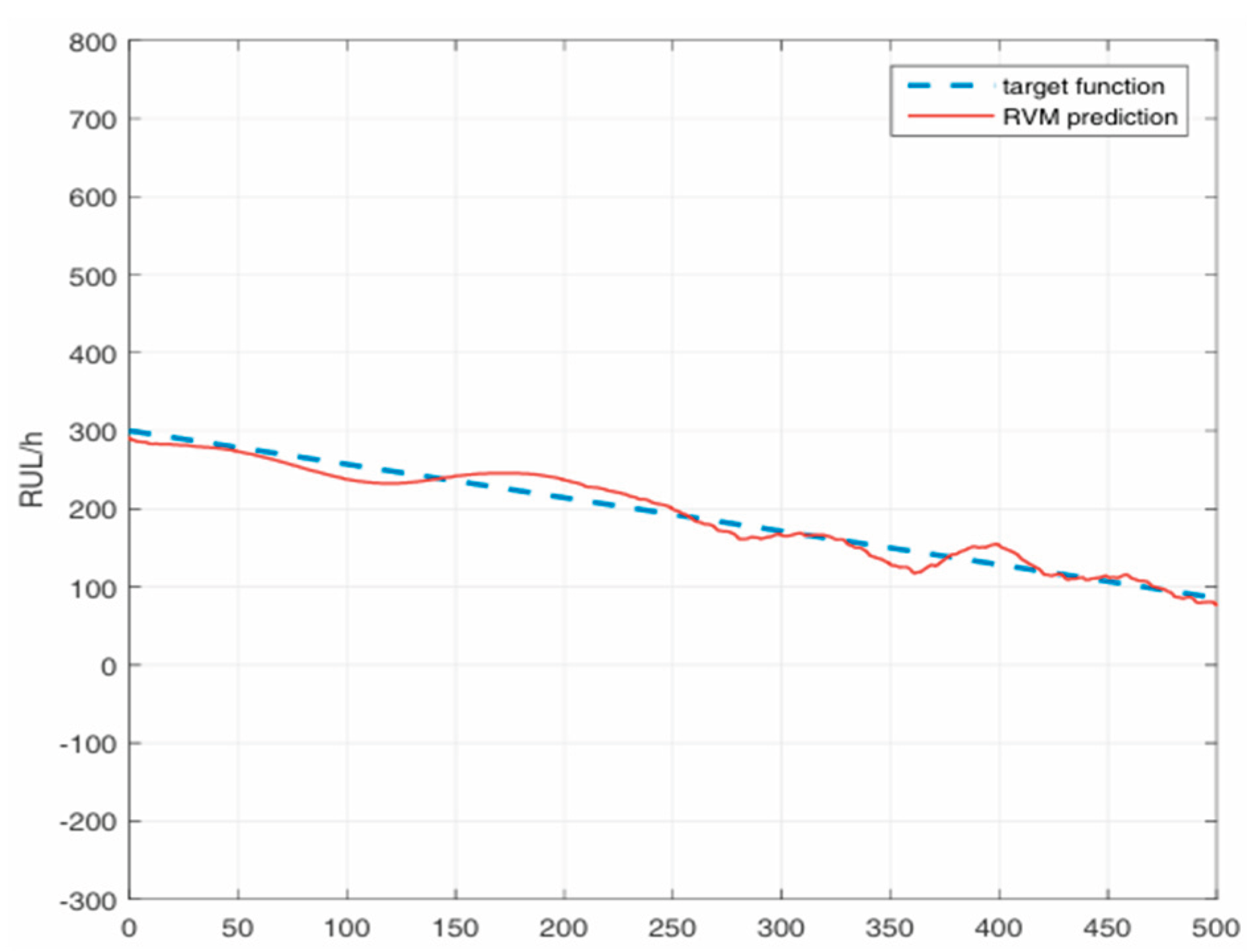

Table 1.
Provides a comparative overview of various electric vehicle traction motors, highlighting differences in structure, performance metrics, and material dependencies.
Table 1.
Provides a comparative overview of various electric vehicle traction motors, highlighting differences in structure, performance metrics, and material dependencies.
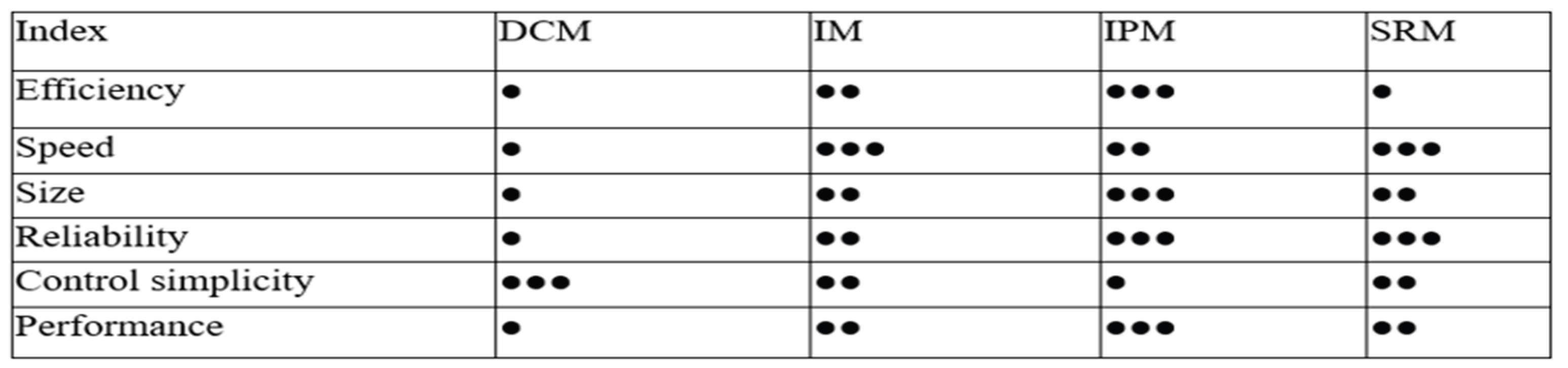 |
Table 2.
Magnet-Free Motor Options.
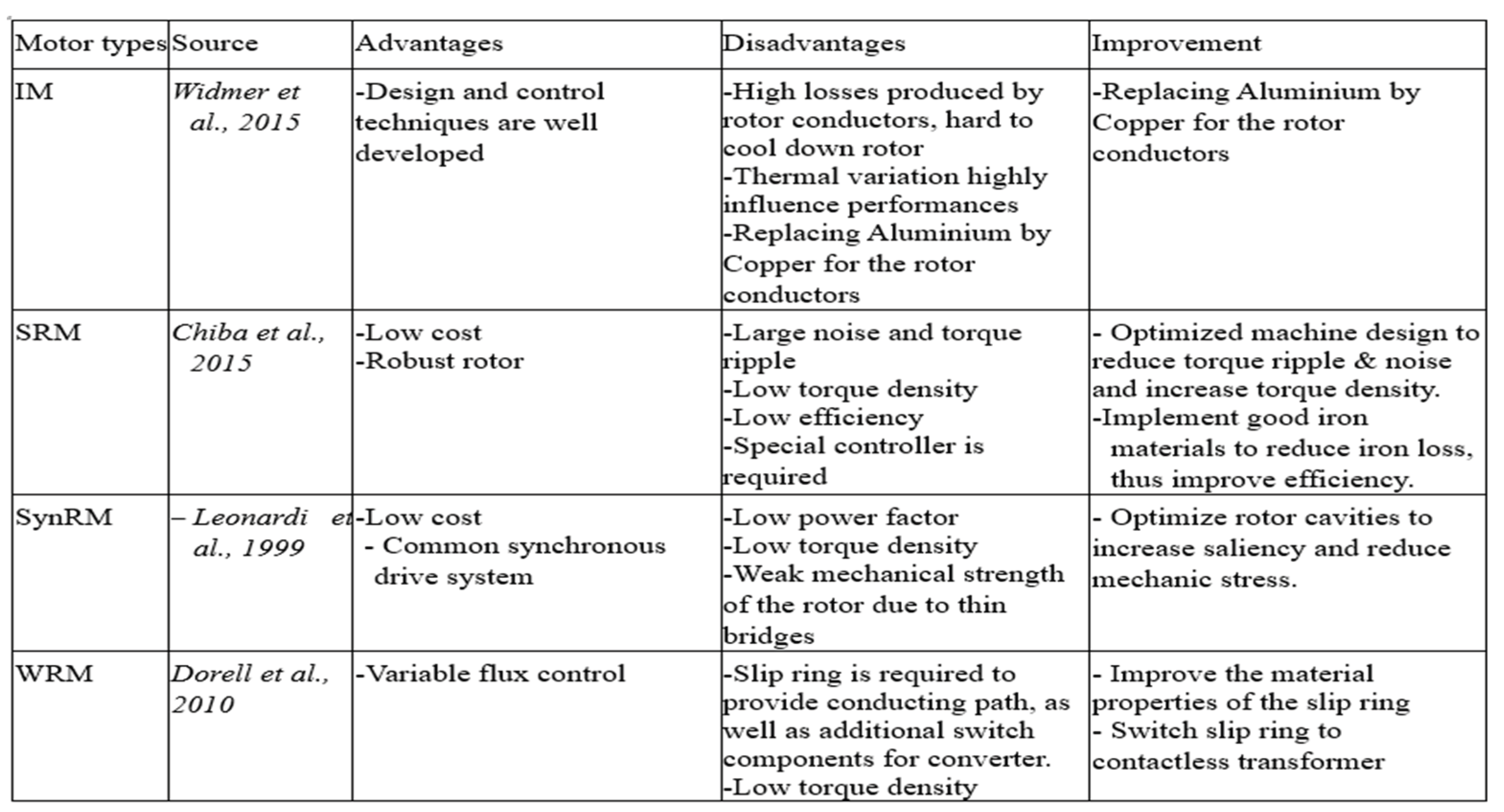 |
Table 3.
Comparison of Alternative Magnet Traction Motors.
 |
Disclaimer/Publisher’s Note: The statements, opinions and data contained in all publications are solely those of the individual author(s) and contributor(s) and not of MDPI and/or the editor(s). MDPI and/or the editor(s) disclaim responsibility for any injury to people or property resulting from any ideas, methods, instructions or products referred to in the content. |
© 2026 by the authors. Licensee MDPI, Basel, Switzerland. This article is an open access article distributed under the terms and conditions of the Creative Commons Attribution (CC BY) license (http://creativecommons.org/licenses/by/4.0/).
Copyright: This open access article is published under a Creative Commons CC BY 4.0 license, which permit the free download, distribution, and reuse, provided that the author and preprint are cited in any reuse.


