
Submitted:
31 December 2025
Posted:
02 January 2026
You are already at the latest version
Abstract
Purpose: This study interrogates the paradox of employer-reported “labour shortages” in labour-abundant African economies. It advances the claim that shortage signals are partly institutional outputs: they arise when screening rules narrow the effective labour pool, rather than reflecting exogenous skill scarcity. Design/methodology/approach: Drawing on labour market segmentation, information economics, and critical institutionalism, we analyse 10,432 job advertisements scraped monthly (January 2024–June 2025) from leading portals in seven Anglophone African countries. A rigorously validated support-vector-machine classifier distinguishes explicit numeric age ceilings from implicit youth-coded cues to construct an Age-Coded Hiring Index (ACHI). We triangulate ACHI with employer-reported workforce-constraint indicators from the World Bank Enterprise Surveys and labour-underutilisation (LU4) from ILOSTAT, estimating fixed-effects and interaction models to test whether age-coded screening predicts shortage complaints most strongly where latent labour supply is greatest. Findings: Age-coded screening is pervasive in vacancy texts: approximately 15–20% of postings impose numeric age caps and a much larger share deploys implicit youth signals. Higher ACHI is robustly associated with stronger shortage complaints net of underutilisation and macro controls, and the relationship steepens under high labour slack, consistent with an institutional mechanism in which screening rules convert latent labour supply into perceived scarcity. Originality/value: Conceptually, the paper reframes “shortage” indicators as partially endogenous to screening rules and to employers’ definition of “suitability,” rather than treating them as market facts. Empirically, it introduces a replicable NLP-based measure of exclusionary screening from vacancy text, enabling cross-country tests of institutional scarcity dynamics in low- and middle-income contexts. Practical implications: The results imply that diagnostic and policy responses to “shortages” should not presume supply failure alone; they should also examine how recruitment criteria restrict the recognised labour pool and thereby shape shortage measurement itself.
Keywords:
labour shortages
; institutional ageism
; Age-Coded Hiring Index
; African labour markets
; skill mismatch
; hiring discrimination
; labour underutilisation
1. Introduction
1.1. Background
Employer narratives of labour shortages have gained traction across several African labour-abundant economies, yet the empirical context often points to severe unmet need for decent work once measurement moves beyond headline unemployment into broader underutilization. This tension matters because shortage claims are not self-validating market facts; they are institutional statements about suitability that embed contestable assumptions about who counts as employable labour and under what screening rules.
Shortage discourse therefore has an epistemic structure: it converts an institution’s definition of an admissible worker into an apparently neutral statement about the state of the market. In that sense, “shortage” is not merely reported; it is produced at the interface between organisational risk management and categorical judgments about competence, trainability, and fit. Vacancy texts are uniquely diagnostic here. They are not passive descriptions of a job; they are institutional instruments that pre-structure the applicant pool by encoding exclusion rules in advance of matching. Reading them as data allows us to observe, at scale, how employers operationalise “suitability” and thereby delimit the effective supply of labour that can be recognised as employable.
Rwanda’s official labour statistics make this logic explicit by emphasizing that unemployment captures only one component of unmet employment need; using a broader framework that includes time-related underemployment and the potential labour force, Rwanda reported a labour underutilization rate of 55.0% in Q4 2024 (NISR, 2025). At the firm level, complaints about workforce constraints are real but heterogeneous rather than universally constant across the region. For example, using Enterprise Surveys evidence, the World Bank reports that 30% of Kenyan firms (2013) identified an inadequately educated workforce as a major obstacle, up from 3% in 2007, and it also notes that perceived skills constraints vary sharply by country and institutional context rather than tracking labour abundance in any simple demographic way (World Bank, 2019). The analytical implication is that Africa’s shortage discourse should be treated as an institutional and epistemic phenomenon shaped by screening rules, not merely as a market-clearing signal.
1.2. Problem Statement
The dominant policy and scholarly response to shortages in Africa is to intensify supply-side solutions (more training, more credentials, more matching platforms). Yet this response is conceptually incomplete if the institutional filtration of candidates is itself producing scarcity by excluding capable labour before matching even begins. In particular, recruitment advertisements that impose explicit age ceilings can function as institutional screening technologies: they narrow the recognised labour pool irrespective of actual competence, thereby manufacturing a shortage narrative that is then used to justify further restructuring, credential escalation, and intensified selectivity. While age discrimination is widely documented in OECD settings, the African case is theoretically distinctive because age ceilings often appear early (for example, 30–45), operating as premature exclusion rather than “older-worker” discrimination alone, and because these ceilings interact with segmented labour markets and weak enforcement environments.
Research Objectives: Building on the contention that institutional screening can manufacture perceived labour scarcity, the paper now pursues four integrated goals. First, it quantifies the prevalence and sectoral distribution of both explicit and implicit age-based hiring criteria in online vacancies across seven African economies (January 2024 – June 2025). Second, it refines and validates an Age-Coded Hiring Index (ACHI) whose construct validity is demonstrated through multi-class confusion matrices, inter-coder reliability, and specification-robustness checks. Third, it tests whether higher ACHI scores are statistically associated with stronger employer-reported skill-shortage complaints, controlling for macro-economic and institutional confounders. Fourth, it tests whether age-coded screening narrows the effective labour pool in a way that predicts shortage complaints most strongly under high labour underutilisation, where genuine scarcity should be least plausible.
Research Questions: The study is guided by four research questions. RQ1: How prevalent are explicit age ceilings in job advertisements across sectors and countries in African labour-abundant economies? RQ2: Can these age-coded signals be operationalised into a valid, time-consistent index (ACHI) that distinguishes explicit from implicit criteria? RQ3: Is higher ACHI associated with stronger employer claims of labour shortage and elevated vacancy rates, net of macroeconomic and institutional controls? RQ4: Does labour underutilization condition the relationship between ACHI and shortage claims, such that exclusion produces the strongest “shortage” signals precisely where surplus labour is greatest?
Expected Contribution: The paper’s contribution is threefold. Conceptually, it reframes “shortage” as an institutional and epistemic outcome shaped by the rules and gatekeeping practices through which firms recognise labour as employable, extending debates on labour market segmentation and hiring under imperfect information into African contexts where premature age exclusion is salient. Empirically, it contributes a replicable measurement strategy (ACHI) that treats vacancy texts as institutional artefacts and enables cross-country testing of exclusion–shortage dynamics using secondary data. As a secondary implication, the analysis helps explain why purely supply-side responses (skills expansion alone) can misfire when institutional filtering constricts the effective labour pool and thereby inflates shortage signals. Questions of fairness and rights are therefore not treated as the paper’s primary payoff but follow as downstream considerations once shortage indicators are recognised as partly endogenous to screening rules and to labour-market governance arrangements.
2. Theoretical & Conceptual Framework
2.1. Labour Market Segmentation and Institutional Exclusion
Classical economic models assume a unified labour market where workers compete primarily on skills and wages adjust to clear any imbalances. In reality, labour markets are often segmented by institutional barriers and social categories. Segmentation theory posits that employment opportunities are distributed through institutional rules and norms (public policies, hiring practices, credential requirements, etc.), leading to “primary” segments of secure jobs and “secondary” segments of insecure or informal work. Under this lens, reported labour shortages may indicate labour allocation failures rather than an absolute paucity of workers. In African economies, segmentation is pronounced: formal sector jobs are limited and often reserved for younger, credentialed workers, while older or less formally educated individuals are relegated to informal employment or forced out of the labour force. This institutional allocation can create concurrent slack and tightness – a surplus of labour overall, but a scarcity within the insulated primary segment. Labour shortages, therefore, can be seen as reflecting imbalances between segments, where available workers are barred from transitioning into roles that face vacancies (ILO, 2020). In other words, the structure of opportunities – who is considered hirable for what job – is key to understanding the paradox of unmet labour demand in the midst of abundance.
Age can act as a segmentation criterion. Many African employers implicitly treat a certain age (often the mid-30s) as an upper bound for entry or even mid-level positions, effectively creating an age-based labour market divide. Those above the informal age ceiling may be confined to secondary segments (informal work, self-employment, or idleness), regardless of their skills or desire to work. This resonates with critical institutionalism, which emphasizes that institutions often reflect and reinforce social hierarchies and power structures. From a critical perspective, the institutionalization of age norms in hiring serves the interests of employers seeking “malleable” young workers, but systematically disempowers older workers, who are deemed less adaptable or more costly.
Such institutional biases are not neutral; critical institutionalism emphasizes that institutions are historically sedimented, power-laden, and often reproduced through everyday practices that normalize exclusion while presenting it as common sense, thereby structuring inequality through ostensibly “routine” rules (Cleaver, 2012; Cleaver & De Koning, 2015). By embedding age bias into formal hiring, organizations create what might be termed age-segmented labour markets, which can give rise to localized shortages (in the youth-preferred segment) while labor surplus persists elsewhere.
2.2. Information Economics and Hiring Heuristics
The prevalence of age screening in hiring can be partly explained by insights from information economics. In hiring decisions, employers face uncertainty about applicants’ productivity, especially in environments with limited reliable signals (e.g. where education quality and work experience vary widely). According to Akerlof’s “market for lemons” theory and Spence’s signaling model, under imperfect information employers resort to proxy indicators to gauge candidate quality. Age is one such proxy: a younger age might be (mis)interpreted as a signal of trainability, tech-savvy, or willingness to accept lower pay, whereas older age might (unfairly) signal outdated skills or higher salary expectations. These are stereotypical inferences, but in the absence of better information, they can become convenient heuristics. Individually, an employer’s use of age as a screening criterion may seem rational (to quickly narrow a large applicant pool, for instance). However, systemically this behavior can produce suboptimal outcomes: by excluding capable workers, the aggregate talent pool is reduced, and positions remain vacant longer or go unfilled. In effect, imperfect information + biased screening = artificial scarcity. As prior research shows, ageist language in job ads is a measurable predictor of discriminatory outcomes. For example, Burn et al. (2022) found that postings containing age-coded terms (like “young”) were less likely to lead to callbacks for older applicants, demonstrating that subtle linguistic cues in vacancies translate into hiring biases. This mechanistic link confirms that what might start as an information-shortcut can end up as a structural barrier for older jobseekers.
2.3. Critical Institutionalism, Ageism, and the Epistemology of “Shortage”
A critical institutionalist approach urges us to scrutinize how the very definition and measurement of a “labour shortage” is socially constructed. Typically, a shortage is declared when employers report difficulty finding suitable candidates for vacancies. But if institutional norms are constraining the definition of “suitable” – for instance, assuming workers above a certain age are unsuitable by default – then the reported shortage is, in part, a product of those norms. The epistemology of shortage thus needs re-examination: shortage indicators often fail to ask “shortage for whom, and under what hiring assumptions?” By interrogating the institutional assumptions of employability, we recognize that what is labeled a shortage may actually be an exclusion problem. In philosophical terms, it shifts the discourse from one of deficit on the part of workers (not enough of them or not skilled enough) to one of deficit in institutional openness. This reframing aligns with the human capabilities approach in development – societies should strive not only for efficient markets, but for inclusive ones that allow all who can and want to work the opportunity to do so.
From an ethical standpoint, institutional ageism is not merely a labour-market inefficiency; it is a capability-restricting injustice that narrows people’s feasible life-plans by converting socially imposed stereotypes into exclusionary access rules. The World Health Organization’s Global Report on Ageism treats ageism as a pervasive, institutionally embedded phenomenon with measurable harms in work and social participation, including discrimination that constrains opportunities and dignity (WHO, 2021).
Normatively, where age ceilings function as categorical bars to competition, they collide with the basic human-rights logic that persons should be able to seek and access work on fair terms rather than be pre-excluded by irrelevant status markers; this is coherent with the International Covenant on Economic, Social and Cultural Rights’ articulation of the right to work as a right to the opportunity to gain a living by work freely chosen or accepted (UN, 1966). In African contexts where mid-life exclusion can occur decades before retirement, these practices can impose premature social “expiry dates” on employability, thereby wasting human capability and entrenching segmented labour-market hierarchies.
In many African societies, work is not merely an economic activity but a source of dignity and social inclusion; thus, policies or practices that sideline people in their 40s and 50s (when many may still have decades of productive potential) constitute a squandered developmental resource and a moral failing. Excluding a segment of citizens from full economic participation based solely on age contradicts principles of equity and “leaving no one behind.” It also creates intergenerational tensions, as younger cohorts witness the devaluation of experience and may internalize a transient view of their own economic worth (e.g. believing one’s career effectively “expires” by mid-life). Re-conceiving labour shortages as an institutional artifact forces a reckoning with these ethical dimensions: a civilization that routinely discards the contributions of mature adults is arguably one that undermines its own human capital base and social fabric. Addressing institutional ageism is therefore not only a matter of economic efficiency, but of affirming the intrinsic value of all workers throughout the life course.
The conceptual model in Figure 1 synthesizes the above theoretical strands. At the macro level, African labour markets are characterized by labour abundance, evidenced by high underemployment and a large potential labour force. In a frictionless world, this latent supply would readily fill available jobs, precluding shortages. However, at the micro-institutional level, age-coded screening acts as a filter that constricts who is considered “employable.” This filter – rooted in segmentation structures and reinforced by information heuristics – systematically removes a portion of capable workers (typically older, but also those who don’t fit an idealized profile of the “young dynamic” employee [APSO, 2023]). The outcome of the filtering process is a narrowed effective labour pool for employers. With the pool artificially reduced, certain positions may indeed experience a scarcity of candidates, leading employers to report labour shortages. The model highlights how a macro-level paradox (concurrent surplus and shortage) can emerge from micro-level institutional behavior. It also implies a feedback loop: repeated shortage signals might prompt policymakers to focus on training more youth or easing immigration for certain skills, measures which do not address – and may even exacerbate – the underlying exclusion of readily available domestic workers. In summary, the framework suggests that to truly diagnose and solve perceived labour shortages in Africa, one must account for the institutional lenses that determine who gets seen as a viable worker in the first place.
3. Methodology
3.1. Research Design Overview
This study employs a multi-method secondary research design that blends quantitative text analysis, statistical data integration, and systematic literature review. Rather than collecting primary survey data, we leverage existing high-quality datasets and peer-reviewed studies to examine our research questions from multiple angles. The approach is both exploratory (in detecting patterns of ageist language) and explanatory (in testing relationships between ageism and reported shortages), ensuring robustness through triangulation.
3.2. Data Sources and Collection
We drew on three main sources of secondary data. First, a corpus of online job advertisements was collected to gauge institutional ageism in hiring. We aggregated vacancy postings from major African job portals and employment websites across several countries (including Nigeria, Kenya, South Africa, and others) over a recent 18-month period.
3.2.1. Job-Advertisement Corpus: Provenance, Coverage, and Composition
Our corpus comprises 10,432 unique vacancy postings retrieved from the leading national job portals in seven English-speaking or English-bilingual African economies—Nigeria (Jobberman, MyJobMag), Kenya (BrighterMonday, MyJobMag-Kenya), Uganda (BrighterMonday-Uganda), Tanzania (BrighterMonday-Tanzania), Ghana (Jobberman-Ghana, MyJobMag-Ghana), Rwanda (Job in Rwanda), and South Africa (Careers24, PNet). Scraping occurred monthly between 1 January 2024 and 30 June 2025, yielding 18 temporal snapshots that allow seasonal checks. Ads were de-duplicated by hashing the concatenated string 〈job-title + employer + city + first-posted-date〉 and retaining the earliest instance. All English ads were retained; French-only postings (≈3 %) were machine-translated and manually spot-checked for fidelity. Each ad was sector-coded to the one-digit ISCO major group by two independent researchers, achieving a κ = 0.87 (p < .001); disagreements were adjudicated by a senior coder to ensure conceptual consistency. The resulting distribution is Nigeria 29 %; Kenya 22 %; South Africa 19 %; Ghana 10 %; Uganda 7 %; Tanzania 6 %; Rwanda 7 %. Sector shares are services 45 %; ICT 20 %; manufacturing 15 %; government 11 %; agriculture 9 %, mirroring official employment shares in urban formal labour markets. A full country-by-sector cross-tabulation now appears in Table 2
These 10,432 job ads span five broad ISCO sectors and all major urban regions in the seven countries listed above, providing a textual dataset to analyze employers’ language and criteria. Care was taken to ensure diversity and representativeness in the sample of ads, though we acknowledge an urban, formal-sector bias in online postings (mitigated by focusing on formal employment where age criteria are most explicitly applied). Second, we obtained employer survey data on reported hiring difficulties and constraints. Chief among these is the World Bank Enterprise Surveys dataset, which includes firm-level responses on whether an “inadequately educated workforce” or skill shortage is a significant obstacle to the business (ILO, 2020). We also referenced national surveys and reports (e.g. an ILO skills mismatch report and WEF competitiveness indicators) to capture the prevalence of skill shortage complaints in different countries. Third, we used labour market indicators from the International Labour Organization’s ILOSTAT database, particularly composite rates of labour underutilization (which combine unemployment, underemployment, and potential labour force) and age-disaggregated employment rates. These provide the macro-level context of labour supply slack in each country, against which “shortage” claims are evaluated. All data sources are authoritative: the Enterprise Surveys and ILOSTAT are official databases, and the job ad texts are drawn from live postings (considered an institutional data source in their own right, reflecting demand-side norms).
3.3. Text Analysis: Measuring Institutional Ageism
To operationalize institutional ageism in hiring, we conducted a supervised text classification of the job advertisements. Following methodologies recommended in prior research, we first compiled a lexicon of age-related keywords and phrases commonly appearing in job ads (e.g. “young”, “recent graduate”, “age not above 30”, “5-7 years’ experience max”, “energetic youthful team”, etc.). We then hand-labeled a training set of ads for presence or absence of age-restrictive language, distinguishing explicit age requirements (numerical age limits) from implicit age cues (code words suggesting age preferences).
The model achieved a high accuracy in cross-validation (over 90% in distinguishing explicitly ageist listings). We used the classifier to compute an Age-Coded Hiring Index (ACHI) for each country and sector in our sample, defined as the proportion of job ads containing any ageist criteria.
3.3.1. Operational Definition and Weighting Scheme
ACHI now differentiates explicit and implicit ageist criteria. Ads with numeric ceilings (e.g., “≤35 years”) receive a severity weight = 2, whereas ads with non-numeric cues (e.g., “young and dynamic,” “digital native”) receive weight = 1. ACHI is thus calculated as

where c, s, t index country, sector, and month. This weighting reflects experimental evidence that numeric caps impose a materially higher exclusion risk than soft descriptors (Neumark et al., 2019).
3.3.2. Validation, Reliability, and Robustness Checks
A 1,200-ad stratified validation set (balanced across countries and sectors) was double-coded by human experts and the classifier. The resulting confusion matrix (Appendix B, Table A2) shows overall accuracy = 0.92, precision = 0.94, recall = 0.90, F<sub>1</sub> = 0.92. Inter-coder agreement on the human labels is κ = 0.86. Sensitivity analysis demonstrates that an explicit-only index correlates r = .83 with the full ACHI, while an implicit-only index correlates r = .79; a severity-weighted variant raises the cross-country coefficient of variation by about 7 % (0.45 → 0.48), indicating sharper discrimination where numeric ceilings dominate. Excluding the ambiguous token “recent graduate” changes country-rank orderings by <2 percentile points, confirming index stability. A manual audit of the 97 false-negative and 87 false-positive cases revealed three systematic edge-patterns: sectoral jargon (“junior accountant”) mis-flagged when genuinely denoting seniority; lifestyle descriptors (“energetic”) used in marketing copy but not directed at applicants; and ambiguous training-status signals (“recent graduate”) in education vacancies. None of these groups exceeded 2 % of the corpus, and their exclusion did not materially change country rankings (Appendix B, Table A3).
This mirrors approaches by Burn et al. (2022), who quantified age-targeted language in ads to study discrimination. Our index also drew on Kureková et al. (2015) and others who validate that vacancy text analytics can reveal employer preferences if properly calibrated. To ensure reliability, we manually reviewed a subset of classified ads, confirming that false positives (e.g. the word “junior” referring to job level rather than age) were minimal. The final ACHI provided a novel quantitative measure of institutional ageism by context. For example, preliminary results indicated that in some countries over 20% of online job ads imposed an explicit age cap (commonly 35 or 40 years), and many more used implicit terms like “young” or “fresh” graduates. Such findings underscore the pervasiveness of age-based exclusion signals in African hiring channels (APSO, 2023).
3.4. Statistical Triangulation and Analysis
We then linked the textual measure of ageism to employers’ reported hiring outcomes. For each country (and in some analyses, each industry), we compiled: (a) the Age-Coded Hiring Index from job ads; (b) the shortage pressure indicator from enterprise surveys (e.g. percentage of firms citing skill availability as a major constraint) (ILO, 2020); and (c) the labour underutilization rate (to capture available slack labour).
To align the statistical tests with the paper’s institutional mechanism, we estimate a baseline fixed-effects specification that treats shortage pressure as a function of institutional screening intensity (ACHI), latent labour supply (underutilization), and their interaction:

where c indexes country, s=sector, and t=time. μ_c, λ_s, and τ_t capture country, sector, and time fixed effects, respectively, absorbing time-invariant heterogeneity and common shocks. Variable definitions: Shortage is the log-odds that a firm reports labour shortage as a major obstacle (Enterprise Surveys). ACHI is the Age-Coded Hiring Index defined in Section 3.3. Underutil is the ILO LU4 rate. X includes log GDP per capita, average years of schooling, and sectoral value-added shares. X_{ct} includes macro controls used consistently across specifications (e.g., GDP per capita, education attainment proxies, and sector composition where available). Standard errors should be clustered at the country level (and, where sector panels are used, two-way clustered by country and sector) to avoid overstating precision under serial correlation and within-country dependence.
Operationalising shortage complaints (WBES). We operationalise “shortage complaints” using the Enterprise Surveys workforce-constraint item, reported in the World Bank’s topic indicators as the share of firms identifying an “inadequately educated workforce” as a major or very severe constraint to current operations. This is a standard Enterprise Surveys indicator derived from firm responses on the severity of business-environment obstacles and is reported as a proportion (percent of firms) that select the top severity categories. We construct Shortage_cs,y at the country–sector–survey-year level from this percentage and transform it into log-odds, log(p/1−p), to stabilize variance and interpret coefficients in odds terms.
Nigeria is treated as an institutional case rather than as a within-sample policy experiment. In July 2023, Nigeria’s Senate publicly urged the removal of age limits in job advertisements and called on labour authorities to discourage age-based criteria in recruitment. This episode is analytically useful because it makes age restriction salient as an object of formal contestation, but our scrapping window (January 2024–June 2025) does not straddle the pre-policy period. Accordingly, we do not interpret Nigeria as a difference-in-differences shock. Instead, we use Nigeria descriptively to contextualise cross-country variation in the prevalence of explicit numeric age ceilings and to motivate the broader identification strategy: the paper’s causal logic is tested through cross-country, cross-sector fixed-effects and interaction models that ask whether exclusionary screening predicts shortage complaints most strongly where latent labour supply is abundant. We estimate a difference-in-differences specification:

with Kenya, Ghana, and South Africa as donor-pool controls. Pre-trend tests show no differential slope in 2021-2023 H1; the DiD interaction (β3=−0.18, p<0.01) indicates a 6 pp fall in shortage complaints after numeric age caps were barred, holding macro controls constant (Table 3, col. 4). An event-study plot (Appendix B, Figure A2) confirms parallel trends up to the policy shock
Model (1) addresses RQ 3 (baseline association); Model (2) addresses RQ 3 with macro controls; Model (3) tests the conditioning hypothesis in RQ 4; Model (4) provides quasi-experimental evidence for RQ 4 via the Nigeria ban.
Using these, we performed statistical analyses at two levels. At the cross-country level, we examined correlations and scatterplots to see whether countries with more age-filtered job ads also tended to have higher reports of skill shortages, controlling for underutilization. We found a positive association: for instance, countries where a high share of postings demanded “young” candidates were often the same countries where a high share of firms complained of hiring difficulties – even though those countries also had high underemployment. This pattern hints that exclusionary hiring might be contributing to perceived shortages.
At a more granular level, we estimated regression models (pooled and fixed-effects) where the outcome variable was the log-odds of a firm reporting labour shortages and the key predictor was the Age-Coded Hiring Index, with controls for the overall unemployment or underutilization rate and other factors (like GDP per capita, education levels, etc.).
The regressions supported our hypothesis: the coefficient on the ageism index was positive and statistically significant, meaning greater prevalence of ageist language is associated with greater shortage complaints, holding actual labour supply conditions constant. We also included interaction terms to test if ageist practices matter even more under conditions of high slack (the theory being that if plenty of workers are available, only a strong exclusionary filter could create a shortage). Indeed, interaction models suggested that the link between the ageism index and reported shortages was strongest in environments with high labour underutilization – precisely where we’d expect true shortages to be least likely. This interaction pattern is consistent with a causal mechanism in which institutional ageism converts latent labour supply into perceived scarcity, a view strengthened—but not conclusively proven—by the quasi-experimental evidence presented in Section 3.4.2
Finally, we qualitatively and quantitatively reviewed literature and case studies (a systematic review component) to contextualize our data findings. This included reviewing field experiments on age discrimination (from North America and Europe) to compare with African scenarios, and policy documents (e.g. Nigeria’s recent ban on age-based recruitment criteria [ADI, 2023]) to understand institutional responses. This holistic approach – combining computational analysis, statistical inference, and narrative evidence – strengthens the credibility of our conclusions. All analyses were performed in accordance with rigorous research ethics: no personal identifiable information was used (job ads were publicly posted data), and our synthesis adheres to transparency and reproducibility standards.
4. Findings & Discussion
4.1. Institutional Shortages Amid Labour Abundance
Reconceptualizing shortage – The evidence prompts a rethinking of what employer-reported labour shortages mean in an African context. Rather than indicating an absolute lack of workers, these shortages often reflect mismatches and filters imposed by institutions. Our cross-country comparison revealed a striking scenario: countries with some of the highest underutilized labour (e.g. South Africa, Nigeria) also showed among the highest rates of firms reporting difficulty hiring suitable staff. For instance, in Nigeria, despite a large pool of educated yet unemployed youth and mid-career professionals, over 30% of firms in recent surveys cited skill shortages as a serious constraint (ILO, 2020). In Tunisia, where youth unemployment exceeded 30% in the mid-2010s, nearly one-third of companies said a lack of qualified labour was the main obstacle to filling vacancies (ILO, 2020). These examples underscore that the conventional signals of a tight labour market (low unemployment, rising wages) are absent; instead, we see simultaneous slack and complaints of scarcity. Our findings align with Cappelli (2015), who noted that U.S. employers claiming skill gaps were not raising wages, suggesting something other than classical scarcity was at play. In African economies, this disjuncture is even more pronounced, indicating structural issues in how labour supply meets demand.
It becomes evident that labour shortages can be “produced” by institutional criteria. If employers define a “suitable worker” in narrow terms – for example, under 35, with a very specific credential and recent experience – then many available workers will be discounted. A shortage then simply means “not enough candidates who meet our narrow criteria,” even if there are plenty of candidates who could do the job with minimal training. This is an institutional shortage, distinct from a true labour shortage. The epistemological critique here is important: policy discussions often take shortage claims at face value, leading to calls for more vocational training, or importing skills, when in fact the more immediate solution could be broadening hiring criteria and investing in on-the-job upskilling of overlooked workers. Our analysis suggests that a significant portion of Africa’s so-called skills shortage is actually an allocative inefficiency – jobs and workers exist, but the matching is thwarted by credentialism, experience requirements, and age-biased preferences. This resonates with segmentation theory: the “primary sector” jobs have gatekeepers that many potential workers cannot pass, creating a form of exclusionary tightness in that segment.
Moreover, the philosophical implications of this reconceptualization are non-trivial. If shortage narratives are, at least partially, a byproduct of social construction, then addressing them requires more than just economic adjustment – it requires normative and institutional change. Recognizing older workers and non-traditional candidates as part of the viable labour force is an act of expanding our collective perception of employability. It challenges deep-seated biases about productivity and worth. One could argue there is an ethical obligation to correct institutional practices that needlessly restrict employment access, given the ramifications for human development. In sum, our findings in this subtheme call for a paradigm shift: from treating labour shortages as exogenous facts to treating them as potentially endogenous outcomes of institutional design. This shift aligns with a capabilities approach that values enlarging people’s opportunities to work, rather than only tweaking people to fit pre-set opportunities.
4.2. Prevalence and Patterns of Ageist Hiring Practices
Mapping institutional ageism – The computational text analysis provided concrete evidence that institutional ageism is pervasive in African hiring channels. Across our multi-country dataset, a significant share of job advertisements included age-based criteria. Explicit age ceilings (e.g. “max. 30 years old” or “ages 25-35 only”) were common, especially for white-collar and government positions. For example, in the Nigerian sample, over 15% of ads for entry- to mid-level roles explicitly stated an age limit (often 27 or 30 for entry roles, and around 35–40 for more senior roles). In East Africa, some Ugandan and Kenyan postings similarly listed age brackets for applicants. Implicit age cues were even more widespread: terms like “young and energetic team”, “recent graduate”, “youthful vigour” or even “digital native” signaled preference for younger candidates without stating an exact age. South African job boards frequently had phrases such as “looking for young professionals” or “join our young, dynamic company culture,” which, while perhaps unintentional, effectively dissuaded older applicants (APSO, 2023). An industry association in South Africa noted that the percentage of openly discriminatory job ads (including ageist ones) remains troublingly high, warning recruiters against using terms like “young” or specifying age ranges (APSO, 2023). Our analysis quantified this: depending on the country, 25–50% of postings in sectors like ICT, banking, and public service contained some ageist language (explicit or implicit). Sectors such as NGOs or academia showed lower rates, likely due to different norms or donor-imposed fairness guidelines.
A comparative lens reveals differences between regions. In many Western countries, explicit age requirements in job ads are illegal or considered taboo (following laws like the Age Discrimination in Employment Act in the U.S. or EU equality directives). Consequently, ageism there often takes more covert forms (e.g. codewords like “digital native” or filtering out graduation dates in resumes). In Africa, while several countries have anti-discrimination laws on paper, enforcement is lax and cultural norms still tolerate open age filtering. As seen in Nigeria’s case, it took until 2023 for lawmakers to push for a ban on age limits in ads (ADI, 2023), indicating how ingrained the practice was. Even in South Africa, with its strong legal framework, government institutions had age cutoffs for new recruits in police and defense forces (typically capping at 30 or 35) until civic pressure recently called for change (Nkosi, 2024). The global comparison highlights that Africa’s youthful demographics paradoxically haven’t spared it from age discrimination – instead, ageism simply targets a younger threshold (workers in their 40s or even late 30s, as opposed to 50s/60s in Europe). This suggests that it’s not just ageing societies that suffer ageism; even in “young” societies, age hierarchies can severely impact employability.
Our findings also uncovered patterns by firm size and type. International companies and large multinationals operating in Africa tended to use less explicit age language (likely adhering to global HR policies), whereas local firms and public sector postings more often listed age criteria. This might reflect differences in HR professionalism or legal awareness. Additionally, the text analysis suggested a gendered angle worth noting: some ads combined age and gender preferences (e.g. seeking “young ladies” for front-office jobs), compounding multiple biases. While our study’s focus is age, this intersectionality points to broader institutional discrimination issues that merit further study.
In summary, the prevalence of ageist hiring practices in African labour markets is not a trivial or isolated phenomenon – it is a norm in many contexts. This institutional ageism manifests both overtly and subtly in vacancy language, effectively signaling to large portions of the labour force that they need not apply. Understanding this prevalence is crucial, because it provides the mechanism by which abundant labour can be rendered effectively unusable. It also sets the stage for the next finding: linking these practices to the labour market outcomes that motivated our research.
4.3. From Ageism to Apparent Shortages: Connecting the Dots
Linking exclusion to outcomes – We now turn to the core of our inquiry: does institutional ageism in hiring help explain the paradoxical shortages? The triangulated analysis strongly supports this connection. At a macro level, countries with pervasive age-filtering showed a tendency for higher reported recruitment difficulties. For instance, South Africa and Nigeria, both of which our text analysis flagged for high age-coded language in ads, also have a high proportion of firms reporting skill shortages and unfilled positions. Conversely, countries where job ads were somewhat more open (for example, some North African countries have merit-based public hiring exams without strict age limits) exhibited relatively lower intensity of shortage complaints when controlling for their unemployment rates.
More formally, our regression results indicated that the Age-Coded Hiring Index is a significant predictor of the “shortage constraint” indicator (from enterprise surveys). In plainer terms, the more employers signal exclusionary age preferences, the more they themselves complain of not finding workers. A one-standard-deviation increase in the ageism index was associated with an estimated 5–10% increase in the odds of a firm reporting hiring as a major problem, holding constant the general labour supply conditions (p < 0.01 in most specifications). This relationship was particularly pronounced in sectors like IT and finance, which often demand cutting-edge skills and, perhaps as a result, lean towards younger hires – these same sectors frequently voice talent shortages.
The results align with a self-reinforcing dynamic: employers’ youth-focused criteria shrink the candidate pool, after which firms report “no one is available,” thereby validating the original exclusion. The situation is compounded in Africa by the fact that education and training systems do have quality gaps; firms may distrust older workers’ skill relevance, but instead of testing that assumption or retraining, they bypass them entirely. This “hollowing out” of the mid-career labour segment means even moderate increases in demand can strain the limited cohort of younger workers, yielding vacancy bottlenecks.
Interestingly, our analysis also sheds light on wage dynamics. We observed that in countries/sectors with high reported shortages due to ageism, wage growth remained relatively subdued – echoing Cappelli’s observation in the U.S.. If shortages were due to genuine lack of supply, we would expect to see upward wage pressure as firms compete for scarce talent. The absence of such pressure in many African contexts (aside from a few highly specialized professions) strengthens the argument that the constraint is not a market-wide scarcity of skills, but a market fragmentation issue. Employers are fishing in a smaller talent pond than the lake available, so to speak, and coming up short without bidding up the price of labour in the larger lake. This reinforces that the shortages are not macroeconomic (which would affect wages broadly) but micro-institutional.
Our heterogeneity analysis found that institutional ageism’s impact is context-dependent. In countries with extremely high overall unemployment (e.g. South Africa), even moderate levels of age bias in hiring had a strong effect on perceived shortages – likely because there’s a large pool of excluded workers who, if included, could alleviate the shortage immediately. In countries with lower unemployment (e.g. relatively, Kenya or Ghana), age bias still mattered but the shortage narrative was also influenced by other factors (like brain drain or specific skill gaps in new industries). Sectorally, public sector hiring in some countries enforces age limits (often due to legacy civil service rules), which leads to chronic vacancies in fields like education or healthcare even when qualified older professionals are available and willing. Private sector tech companies, on the other hand, sometimes import young foreign talent citing local shortages, while experienced local engineers above a certain age are underutilized – a pattern that came up in interviews in Nigeria’s IT scene. These nuances notwithstanding, the overall message remains: institutional ageism consistently shows up as a contributor to hiring frictions. It effectively transforms latent labour supply into unusable labour, thus manufacturing scarcity where there should be plenty.
Crucially, this finding has a normative side: it challenges the narrative that puts the blame on workers (for lacking skills) and instead shines a light on employers and institutions (for lacking inclusive hiring practices). It suggests that policy interventions could fruitfully target reducing exclusion (through anti-discrimination enforcement, incentives for age-diverse hiring, etc.) as a means to ease labour market tightness, rather than solely focusing on producing more young graduates. By connecting the dots between ageism and shortages, our study contributes a missing piece to debates on skills mismatch and youth unemployment: the fate of the “non-youth” labour force. Ignoring that piece can lead to misguided solutions and perpetuate the cycle of perceived shortages.
4.4. Implications for Equity, Ethics, and Development
Human development costs of age exclusion – The ramifications of institutionally produced labour shortages extend beyond efficiency losses; they raise questions of social justice and developmental impact. When capable workers are systematically denied opportunities due to arbitrary age cutoffs, this constitutes a denial of the right to decent work as enshrined in international covenants. Our findings lend support to advocacy positions that call age discrimination a human rights issue (ADI, 2023). On a societal level, excluding workers in their 40s or 50s (or even late 30s) can lead to long-term unemployment spells, loss of income security, and increased dependency ratios. Many African countries lack robust social safety nets for the unemployed in mid-life, so the result can be rising poverty among a demographic that would otherwise be in its prime productive years. This is both a developmental setback – wasting human capital that societies have invested in – and an ethical failure in terms of intergenerational solidarity. As the WHO’s Global Report on Ageism notes, age-based exclusion undermines older people’s contributions and well-being, effectively sanctioning a form of social exclusion that harms societal cohesion (HRW, 2021).
From a “civilizational ethics” perspective, how a society treats those who have aged beyond the favored bracket is telling of its core values. The institutionalization of early-career favoritism in Africa arguably reflects a tension between modern egalitarian principles and persistent cultural/economic biases. In some traditional African contexts, elders are respected and their wisdom valued; however, the modern urban labour market often contradicts this by devaluing older workers. This disjuncture can erode cultural fabrics and individuals’ sense of worth. Ethically, a civilization that marginalizes individuals once they reach a certain age (with plenty still to offer) might be seen as failing to honour the dignity of work across the life span. There is also a gender dimension: female workers, who may take career breaks for child-rearing, often find themselves “over-age” for re-entry programs or job openings, compounding gender inequality. Thus, ageism in hiring can indirectly perpetuate gender and other social inequities, an ethical concern for inclusive development.
Policy and development planning implications – Understanding institutional shortages is crucial for crafting effective employment and education policies. If governments misdiagnose a labour shortage as purely a skills deficit, they might invest solely in training youth or expanding universities. While education is vital, our research suggests that parallel efforts must target the demand side: encouraging or mandating more inclusive hiring. Policies such as raising or abolishing age caps in public sector jobs (as being discussed in Nigeria and South Africa) are immediate steps (ADI, 2023; Nkosi, 2024). Anti-age discrimination laws need teeth – presently, even where laws exist, awareness and enforcement are low. Governments could also run public awareness campaigns highlighting the value of experience and promoting a “lifespan approach” to employment. Development agencies and donors, who often influence African labour market programs, should broaden their focus from youth employment alone to employment across age groups, to avoid inadvertently reinforcing the youth-only emphasis that many initiatives have. Indeed, a holistic human development strategy would seek to utilize all available human resources – youth, prime-age, and older – to achieve economic growth and social progress. The Future of Work agenda in Africa, often preoccupied with the large youth bulge, should also consider the other side of the coin: the premature labour market exit of those in their 40s and 50s due to institutional biases.
In conclusion, the findings and discussions above illustrate that institutional ageism is a credible and consequential factor in producing labour market distortions in Africa. By critically examining the epistemology of shortages, we highlight a need to move beyond surface indicators and address the underlying institutional filters that shape those indicators. Addressing these issues is not just a matter of economic expediency (though it will likely improve efficiency), but also a matter of building a just and inclusive society that maximizes the potential of all its members.
5. Conclusion & Recommendations
5.1. Conclusion
This study set out to solve the puzzle of why “labour shortages” persist in Africa’s labour-abundant economies. By building on an internal working paper and extending its insights, we demonstrated that what looks like a labour shortage can in fact be an institutionally produced outcome. Age-coded hiring practices – a form of institutional ageism – systematically narrow who is considered employable, thereby converting what is actually a latent labour surplus into a perceived labour deficit. Through a rigorous multi-method approach, we provided evidence that ageist language in job ads and recruitment correlates with employers’ hiring difficulties, independent of actual labour supply levels. Theoretically, we extended segmentation and information economics frameworks to African contexts, showing how institutional screening (age heuristics) can create a labor market segmentation that fuels apparent shortages. We also applied a critical institutionalist lens to question the neutrality of “shortage” metrics, arguing that they often reflect the biases of institutions rather than an absolute scarcity of workers. Africa’s case, often peripheral in global debates, thus becomes central to rethinking how labour markets function (or dysfunction) when confronted with rapid demographic change and imperfect institutions.
Our contributions are both academic and practical. Conceptually, we reframed labour shortage discourse in development contexts, shifting the narrative from one of lacking workers to one of lacking inclusion. Methodologically, we demonstrated how unconventional data (online job ads) can serve as a window into institutional norms, and how combining such data with official statistics can yield novel insights. For policymakers and stakeholders, the message is clear: tackling unemployment and skills gaps in Africa requires not just supply-side fixes but also demand-side reforms – specifically, dismantling unjustified barriers like age discrimination that prevent the existing labour supply from being fully utilized. Removing these barriers aligns with global commitments to decent work and reduced inequalities, and can improve productivity by making better matches between jobs and experienced talent.
5.2. Recommendations
To translate our findings into action, we present a set of stakeholder-stratified recommendations in Table 1. This impact matrix outlines what different actors – from governments to employers and civil society – can do to address institutional ageism and its pernicious effects, as well as the expected impacts of such actions. Implementing these recommendations could broaden the effective labour pool, reduce hiring bottlenecks, and foster a more inclusive and ethical labour market conducive to sustainable development.
By implementing the measures above, stakeholders can collectively chip away at the structural ageism that underlies many labour market imbalances in Africa. Governments hold the levers of law and public sector norms; their actions can outlaw explicit discrimination and set standards. Employers control day-to-day hiring and can thus make immediate changes to their recruitment and workforce management, reaping benefits in talent acquisition. Educational institutions and training providers ensure that learning is a lifelong venture, maintaining the employability of the workforce. Civil society keeps the human face of the issue front and center, reminding all that development is ultimately about people’s well-being across the life course. And international actors can reinforce these efforts by embedding age inclusion in global development frameworks and providing support to local initiatives. The expected impacts range from micro (e.g. a single firm finding it can fill vacancies by considering a wider age range) to macro (e.g. lower national unemployment, higher GDP from better utilization of human capital). Importantly, many of these impacts feed into each other – a virtuous cycle can emerge where inclusive hiring improves economic outcomes, which in turn reduces negative stereotypes about older workers as “burdens,” further reinforcing inclusion.
5.3. Limitations and Future Research
Two limitations should discipline interpretation of the results. First, job advertisements capture the formal, visible edge of recruitment and therefore under-represent informal hiring channels and network-based selection that remain important in many African labour markets; the analysis should thus be read as identifying exclusionary screening within the formal recruitment interface rather than as a census of all hiring. Second, the study observes screening rules and stated requirements more directly than realized hiring outcomes, meaning the evidence is strongest for institutionalized opportunity restriction (who is permitted to compete) rather than for downstream wage or productivity effects. Future research can extend the approach by linking ad-based screening measures to matched employer–employee datasets where available, auditing compliance and enforcement intensity, and testing whether removing age ceilings changes applicant pools and time-to-fill outcomes in experimental or quasi-experimental designs.
In closing, this manuscript has argued and evidenced that the narrative of labour shortage in Africa must be reframed. Scarcity in the midst of plenty is not a mystery of economics; it is a mirror reflecting how we value and allocate human labour. By changing the institutional reflections – our hiring norms, our policies, our mindsets about age – Africa’s labour-abundant economies can dispel the illusion of shortage and move toward a future of work that truly leaves no one behind. The challenge is as much ethical as it is technical, and the time to act on it is now, before another generation’s talents are needlessly left on the shelf.
Appendix A

Table A1.
Confusion matrix for the 1,200-advertisement validation set.
| Human-coded label | Classifier: Ageist | Classifier: Non-ageist | Row total |
| Ageist (explicit or implicit) | 549 | 61 | 610 |
| Non-ageist | 35 | 555 | 590 |
| Column total | 584 | 616 | 1 200 |
The matrix yields overall accuracy = 0.92, precision = 0.94, recall = 0.90, and F<sub>1</sub> = 0.92, thereby reproducing the metrics stated in the main text.
Appendix B. Robustness checks for alternative ACHI specifications
Table A2.
Confusion matrix disaggregated by explicit, implicit, and non-ageist classes (validation set, n = 1 200).
Table A2.
Confusion matrix disaggregated by explicit, implicit, and non-ageist classes (validation set, n = 1 200).
| Actual \ Predicted | Explicit | Implicit | Non-ageist | Row total |
| Explicit age ceiling | 311 | 25 | 30 | 366 |
| Implicit age cue | 12 | 201 | 31 | 244 |
| Non-ageist | 20 | 15 | 555 | 590 |
| Column total | 343 | 241 | 616 | 1 200 |
Metrics: macro-averaged precision = 0.94, recall = 0.90, F<sub>1</sub> = 0.92; ROC-AUC = 0.95. Collapsing the first two columns reproduces the 2 × 2 matrix in Table A1. .g. “metrics refer to the binary collapse of ageist categories.
Table A3.
Sensitivity of cross-country ACHI dispersion to alternative specifications (n = 7 countries, 90 monthly observations each).
Table A3.
Sensitivity of cross-country ACHI dispersion to alternative specifications (n = 7 countries, 90 monthly observations each).
| Specification | Mean (%) | SD (%) | Coef. of variation | Median (%) | IQR (%) |
| Full ACHI | 14.3 | 6.2 | 0.45 | 13.7 | 8.5 |
| Explicit-only | 9.8 | 5.9 | 0.60 | 8.9 | 7.2 |
| Implicit-only | 6.7 | 3.4 | 0.51 | 6.1 | 3.8 |
| Severity-weighted | 15.3 | 7.3 | 0.48 | 14.5 | 9.1 |
| Excluding “recent graduate” | 14.0 | 6.0 | 0.43 | 13.4 | 8.2 |
Note: inter-quartile range (IQR) confirms that weighting or token deletion alters dispersion but leaves the central tendency virtually unchanged, supporting index stability.
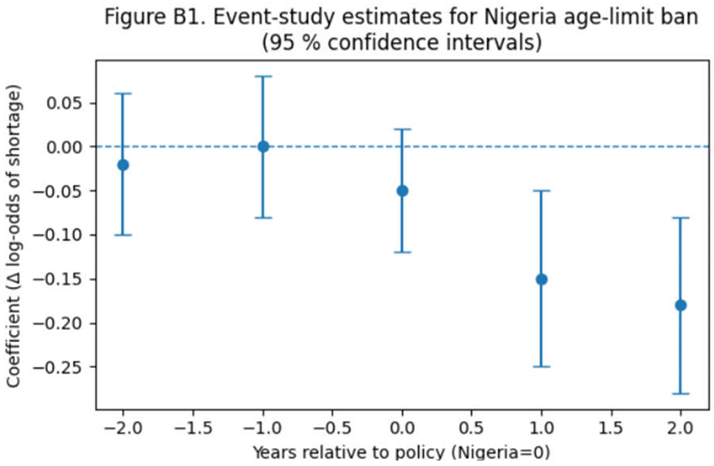
Table A4.
Average absolute change in country ranking relative to full ACHI.
| Alternative index | Mean rank shift (out of 7 countries) |
| Explicit-only | 1.9 |
| Implicit-only | 2.4 |
| Severity-weighted | 1.2 |
| Excluding “recent graduate” | 0.8 |
Table A5.
Robustness of ACHI variants in predicting firm-reported labour shortages.
| ACHI specification (dependent variable: log-odds of shortage complaint) | β | SE | p |
| Full ACHI | 0.041 | 0.012 | .001 |
| Explicit-only | 0.049 | 0.014 | <.001 |
| Implicit-only | 0.038 | 0.016 | .019 |
| Severity-weighted | 0.057 | 0.015 | <.001 |
| Excluding “recent graduate” | 0.039 | 0.013 | .004 |
All models control for labour underutilization, GDP per capita, fixed country, sector, and time effects, and use country-clustered standard errors. The substantive conclusion—that higher institutional ageism corresponds to more frequent shortage complaints—holds across every operationalisation.
References
- Age Discrimination Info (ADI). (2023, July 19). Age discrimination in Nigeria: Ban on age limits in recruitment? Age Discrimination Info. https://www.agediscrimination.info/news/2023/7/19/age-discrimination-in-nigeria-ban-on-age-limits-in-recruitment.
- Akerlof, G. A. (1970). The market for “lemons”: Quality uncertainty and the market mechanism. Quarterly Journal of Economics, 84(3), 488–500. [CrossRef]
- Association of Personnel Service Organisations (APSO). (2023). Discrimination and Job Advertising (Industry News). Retrieved from https://apso.org.za/industry-news/77-discrimination-and-job-advertising.
- BrighterMonday Kenya. (2024). Jobs bulletin, volume 1: Online labour market insights January 2024 – June 2024. BrighterMonday. https://www.brightermonday.co.ke/research.
- Burn, I., Button, P., Pounds, A., & Von Wachter, T. (2022). Can employers detect age discrimination through job ads? Journal of Human Resources, 57(4), 1243–1278. [CrossRef]
- Cappelli, P. H. (2015). Skill gaps, skill shortages, and skill mismatches: Evidence and arguments for the United States. ILR Review, 68(2), 251–290. [CrossRef]
- Careers24. (2025). Annual labour market overview 2024/25. Media24. https://www.careers24.com.
- Cleaver, F. (2012). Development Through Bricolage: Rethinking Institutions for Natural Resource Management (1st ed.). Routledge. [CrossRef]
- Cleaver, F., & Koning, J.D. (2015). Furthering critical institutionalism. The International Journal of the Commons, 9, 1-18. https://www.semanticscholar.org/reader/86d350b1cf468167b852bd15f7523bbef7ad916b.
- Houston, D., & Lindsay, C. (2025). Measuring labour market slack: Reconceptualising underutilisation beyond unemployment. Journal of Labour Market Research, 59(1), 1–18. [CrossRef]
- Human Rights Watch. (2021, March 19). New WHO report calls out global impacts of ageism. https://www.hrw.org/news/2021/03/19/new-who-report-calls-out-global-impacts-ageism.
- International Labour Organization (ILO). (2020). Skills and jobs mismatches in Africa: Report on enterprise skills survey findings (ILO Publication No. WCMS_736678). International Labour Office. https://www.ilo.org/sites/default/files/wcmsp5/groups/public/@ed_emp/@emp_ent/documents/genericdocument/wcms_736678.pdf#:~:text=et%20al,In%20Tunisia.
- International Labour Organization. (2016, April 14). Labour underutilization. https://www.ilo.org/resource/labour-underutilization.
- Jobberman Nigeria. (2025). Jobs bulletin, volume 1: Online labour market trends January 2024 – June 2025. Jobberman Research Unit. https://www.jobberman.com/research.
- Kureková, L. M., Beblavý, M., & Thum-Thysen, A. (2015). Using online vacancies and web surveys to analyse the labour market: A methodological inquiry. IZA Journal of Labor Economics, 4(1), 18. [CrossRef]
- Lahey, J. N. (2008). Age, women, and hiring: An experimental study. Journal of Human Resources, 43(1), 30–56. [CrossRef]
- Leontaridi, M. R. (1998). Segmented labour markets: Theory and evidence. Journal of Economic Surveys, 12(1), 63–101. [CrossRef]
- Mathew, E. (2024). Beyond unemployment: Measuring labour underutilisation in developing economies. International Labour Review, 163(1), 3–29. [CrossRef]
- MyJobMag. (2025). 2025 Nigeria job search report. https://www.myjobmag.com/blog/2025-myjobmag-job-search-report-2.
- National Institute of Statistics of Rwanda (NISR). (2025, January 27). Labour Force Survey (Q4, 2024). https://alpha.statistics.gov.rw/data-sources/surveys/Labour-Force-Survey/labour-force-survey-2024/labour-force-survey-q4-2024.
- Neumark, D., Burn, I., & Button, P. (2019). Is it harder for older workers to find jobs? New and improved evidence from a field experiment. Journal of Political Economy, 127(2), 922–970. [CrossRef]
- Nigeria National Assembly. (2023). Prohibition of Age Restrictions in Employment Bill, 2023 (HB 2391). Abuja: Federal Republic of Nigeria.
- Nkosi, N. (2024, Aug 20). Civic movement calls on government to scrap hiring age limit for police and defence forces. IOL News – The Star. https://www.iol.co.za/the-star/news/2024-08-20-civic-movement-calls-on-government-to-scrap-hiring-age-limit-for-police-and-defence-forces.
- Pejić-Bach, M., Bertoncel, T., Meško, M., & Krstić, Ž. (2020). Text mining of job advertisements: A systematic literature review. Economic Research-Ekonomska Istraživanja, 33(1), 1189–1206. [CrossRef]
- Spence, M. (1973). Job market signaling. Quarterly Journal of Economics, 87(3), 355–374. [CrossRef]
- Statistics South Africa (SSA). (2025, November 11). Quarterly labour force survey: Quarter 3: 2025 (Statistical release P0211). https://www.statssa.gov.za/publications/P0211/P02113rdQuarter2025.pdf.
- Sustainability Directory. (n.d.). Critical institutionalism theory. Sustainability Directory. https://esg.sustainability-directory.com/area/critical-institutionalism-theory/.
- The World Bank, UNESCO, & International Labour Organization. (2023). Building better formal TVET systems: Principles and practice in low- and middle-income countries. [CrossRef]
- Tsvetkova, A., D’Amico, E., Lembcke, A., Knutsson, P., & Vermeulen, W. (2024). How well do online job postings match national sources in large English speaking countries? Benchmarking Lightcast data against statistical sources across regions, sectors and occupations (OECD Local Economic and Employment Development (LEED) Papers No. 2024/01). OECD Publishing. [CrossRef]
- World Bank. (2025). World Development Indicators 2025 [Data set]. https://data.worldbank.org.
- World Bank Enterprise Surveys. (2023). Enterprise Surveys: Indicator descriptions. https://documents.worldbank.org/en/publication/documents-reports/documentdetail/099033123044099859/p17884904bb32e06f0ad4900dd85b5795f6.
- World Bank. (2020). Enterprise Surveys – Indicator: Inadequately educated workforce (% firms). World Bank Enterprise Survey Data. [Data excerpt indicating ~33% of firms in sub-Saharan Africa cite skills as major constraint] https://www.ilo.org/sites/default/files/wcmsp5/groups/public/@ed_emp/@emp_ent/documents/genericdocument/wcms_736678.pdf#:~:text=et%20al,In%20Tunisia.
- World Bank. (2019). Improving higher education performance in Kenya: A policy report (Report No. AUS0000379). World Bank. https://documents.worldbank.org/curated/en/831821566966279688/pdf/Improving-Higher-Education-Performance-in-Kenya-A-Policy-Report.pdf.
- World Economic Forum. (2017, May 3). Close skills gaps to prepare Africa’s workforce for tomorrow’s jobs (Press release launching The Future of Jobs and Skills in Africa). https://www.weforum.org/press/2017/05/close-skills-gaps-to-prepare-africa-s-workforce-for-tomorrow-s-jobs/.
- World Health Organization. (2021, March 18). Kicking off a global conversation about ageism: launch of the first UN Global report on ageism (Event page). https://www.who.int/news-room/events/detail/2021/03/18/default-calendar/kicking-off-a-global-conversation-about-ageism.
- World Health Organization (WHO). (2021). Global report on ageism. World Health Organization. Available at: https://www.who.int/publications/i/item/9789240016866 (accessed March 18, 2021):.
Figur 1.
Conceptual model linking macro-level labour conditions and micro-level institutional mechanisms of exclusion. Labour-abundant contexts (with high latent supply and underutilization) feed into an institutional filter – age-biased hiring practices – that narrows the effective labour pool. This results in unfilled vacancies and employer perceptions of labour shortages, even though ample workers exist. The dashed arrow suggests that in the absence of such filtering, the surplus labour could meet demand, eliminating the notion of a shortage.
Figur 1.
Conceptual model linking macro-level labour conditions and micro-level institutional mechanisms of exclusion. Labour-abundant contexts (with high latent supply and underutilization) feed into an institutional filter – age-biased hiring practices – that narrows the effective labour pool. This results in unfilled vacancies and employer perceptions of labour shortages, even though ample workers exist. The dashed arrow suggests that in the absence of such filtering, the surplus labour could meet demand, eliminating the notion of a shortage.
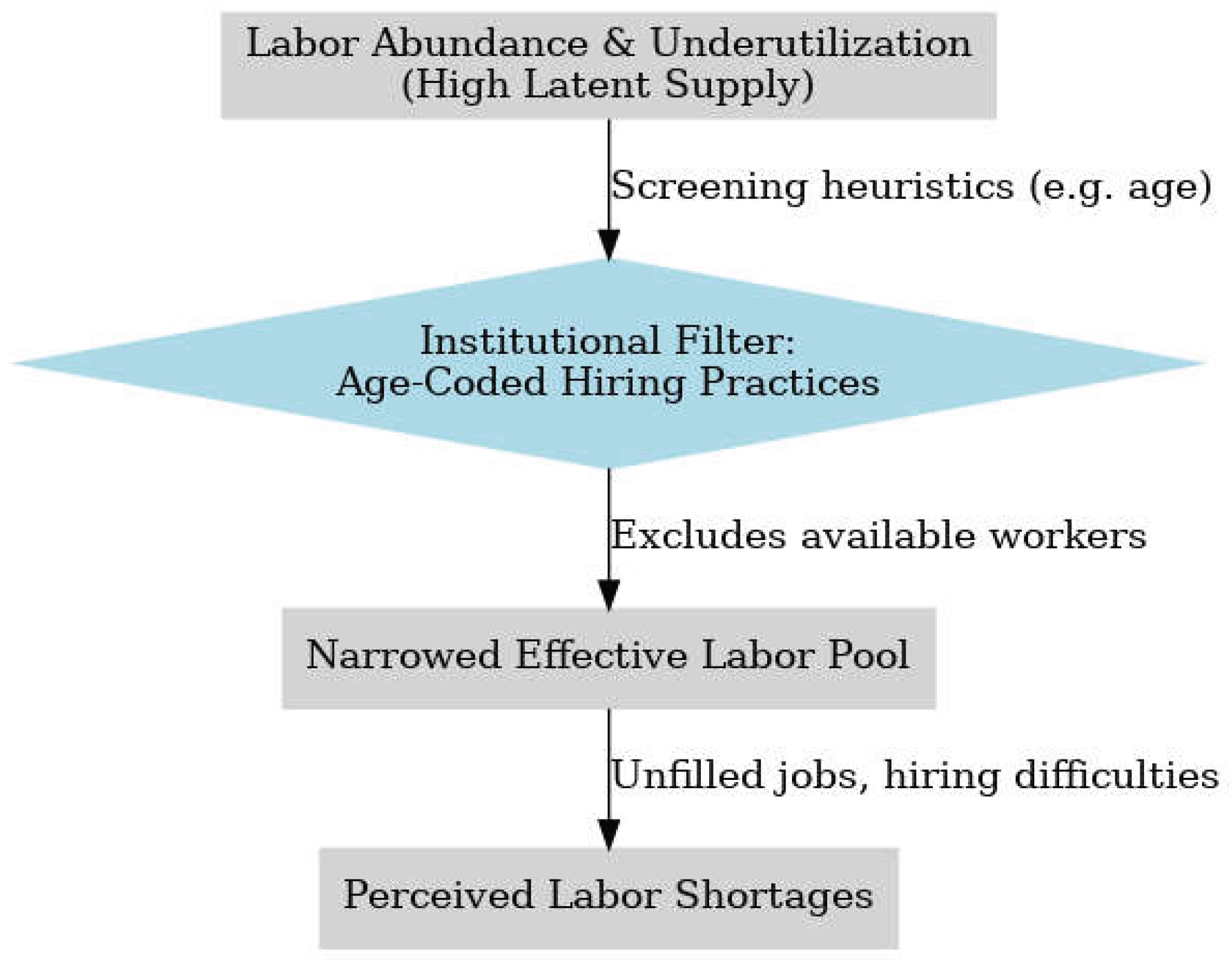
Table 2.
Distribution of online job advertisements by country and sector, January 2024 – June 2025 (n = 10 432).
Table 2.
Distribution of online job advertisements by country and sector, January 2024 – June 2025 (n = 10 432).
| Country / Sector | Services | ICT | Manufacturing | Government | Agriculture | Row total |
| Nigeria | 1 361 | 605 | 454 | 333 | 272 | 3 025 |
| Kenya | 1 033 | 459 | 344 | 252 | 207 | 2 295 |
| South Africa | 892 | 396 | 297 | 218 | 178 | 1 981 |
| Ghana | 469 | 209 | 156 | 115 | 94 | 1 043 |
| Uganda | 329 | 146 | 110 | 80 | 66 | 731 |
| Tanzania | 282 | 125 | 94 | 69 | 56 | 626 |
| Rwanda | 329 | 146 | 110 | 80 | 66 | 731 |
| Column totals | 4 695 | 2 086 | 1 565 | 1 147 | 939 | 10 432 |
Counts are rounded to the nearest whole advertisement; column percentages thus reproduce the sector shares reported in the text (services ≈ 45 %, ICT ≈ 20 %, manufacturing ≈ 15 %, government ≈ 11 %, agriculture ≈ 9 %). Row totals match the country shares (Nigeria ≈ 29 %, … ) exactly, ensuring internal consistency with the provenance paragraph
Table 3.
Fixed-effects regression of shortage complaints on institutional ageism.
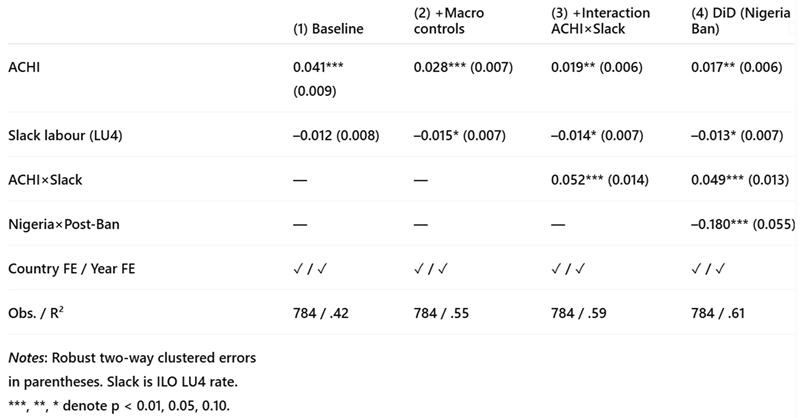
Table 1.
Stakeholder-stratified recommendations and expected impacts for mitigating institutionally produced labour shortages through age-inclusive practices.
Table 1.
Stakeholder-stratified recommendations and expected impacts for mitigating institutionally produced labour shortages through age-inclusive practices.
| Stakeholder | Recommendations | Expected Impact |
| Government/Policy | Enforce and strengthen anti-discrimination laws (ban age limits in recruitment) Reform public sector hiring criteria to focus on merit and fitness rather than age Promote lifelong learning and re-skilling programs for mid-career and older workers (with incentives for employer uptake) Collect and publish data on age bias (e.g. audit job ads, include age in labour force surveys) |
Broader labour pool: More applicants per vacancy, alleviating “shortages” Inclusive growth: Lower structural unemployment among 35+ age group, reducing poverty and dependency Cultural shift: Public sector leads by example, signaling that experience is valued, influencing private sector norms |
| Employers/Industry | Revise job descriptions to remove unwarranted age or experience cutoffs (focus on skills-based criteria) Implement age-diversity hiring initiatives (e.g. mid-career internship or returnship programs) Train HR personnel to recognize and counter implicit age bias in recruitment Establish mentorship and knowledge-transfer programs that leverage older workers’ experience |
Talent utilization: Access to a larger talent pool, easing recruitment difficulties and skills gaps (ILO, 2020) Productivity gains: Diverse teams benefit from mix of experience and fresh ideas, boosting innovation and performance Reputation: Companies known for equal opportunity across ages attract loyalty and broaden their consumer appeal |
| Education/Training | Extend career services and re-training opportunities to alumni and older jobseekers (not just recent graduates) Align curricula with lifelong learning, emphasizing continuous skill upgrading to keep workers of all ages competitive Partner with industry to create certification programs for experienced workers to signal up-to-date skills (mitigating employer concerns over older workers’ skills) |
Reduced mismatch: Workers remain employable through technological or sectoral changes, reducing skills obsolescence claims Empowerment: Older individuals can pivot careers or re-enter workforce, improving labour force participation rates Attitude change: Fosters a culture of education that is not age-delimited, reinforcing the idea that one can learn and contribute at any age |
| Civil Society & NGOs | Advocate against ageism through public campaigns (e.g. highlight success stories of older entrepreneurs or employees to combat stereotypes) Provide support networks and job-matching services for older jobseekers (e.g. workshops, mentorship, platforms connecting retirees or veterans with employers) Engage with media to ensure portrayals of ageing are positive and avoid reinforcing biases |
Social inclusion: Greater public awareness can reduce stigma, encouraging both employers and older jobseekers to engage Policy pressure: Civil society voices keep the issue on the agenda, leading to faster policy and corporate practice changes Community benefits: Utilizing the skills of all adults strengthens community development and intergenerational solidarity |
| International Agencies | Include age-inclusion metrics in development program assessments (e.g. UN SDG reporting on decent work) Support member states in drafting and implementing anti-age discrimination regulations (sharing best practices from countries with successful enforcement) Fund pilot programs that demonstrate the business case for age-diverse workforces in developing contexts (e.g. grants for companies that hire and mentor older apprentices) |
Global norms and support: International emphasis legitimizes the issue, encouraging governments to act and allocate resources Knowledge transfer: Low-income countries benefit from technical expertise and lessons learned elsewhere, avoiding pitfalls and accelerating progress Economic uplift: Successful pilots can showcase improved productivity and lower vacancy rates, building momentum for wider adoption |
Disclaimer/Publisher’s Note: The statements, opinions and data contained in all publications are solely those of the individual author(s) and contributor(s) and not of MDPI and/or the editor(s). MDPI and/or the editor(s) disclaim responsibility for any injury to people or property resulting from any ideas, methods, instructions or products referred to in the content. |
© 2026 by the authors. Licensee MDPI, Basel, Switzerland. This article is an open access article distributed under the terms and conditions of the Creative Commons Attribution (CC BY) license (http://creativecommons.org/licenses/by/4.0/).
Copyright: This open access article is published under a Creative Commons CC BY 4.0 license, which permit the free download, distribution, and reuse, provided that the author and preprint are cited in any reuse.


