

Submitted:
31 December 2025
Posted:
01 January 2026
You are already at the latest version
Abstract
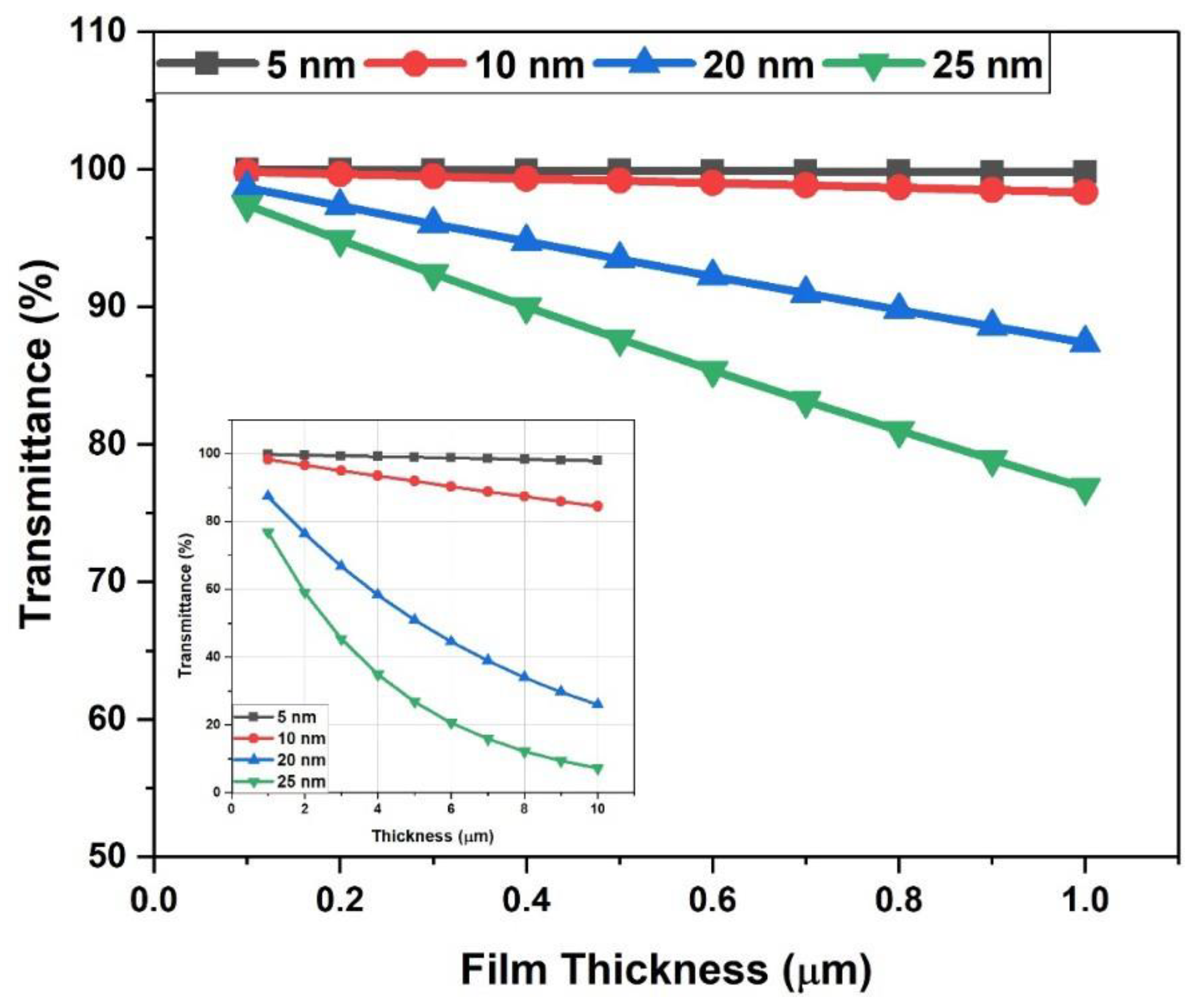
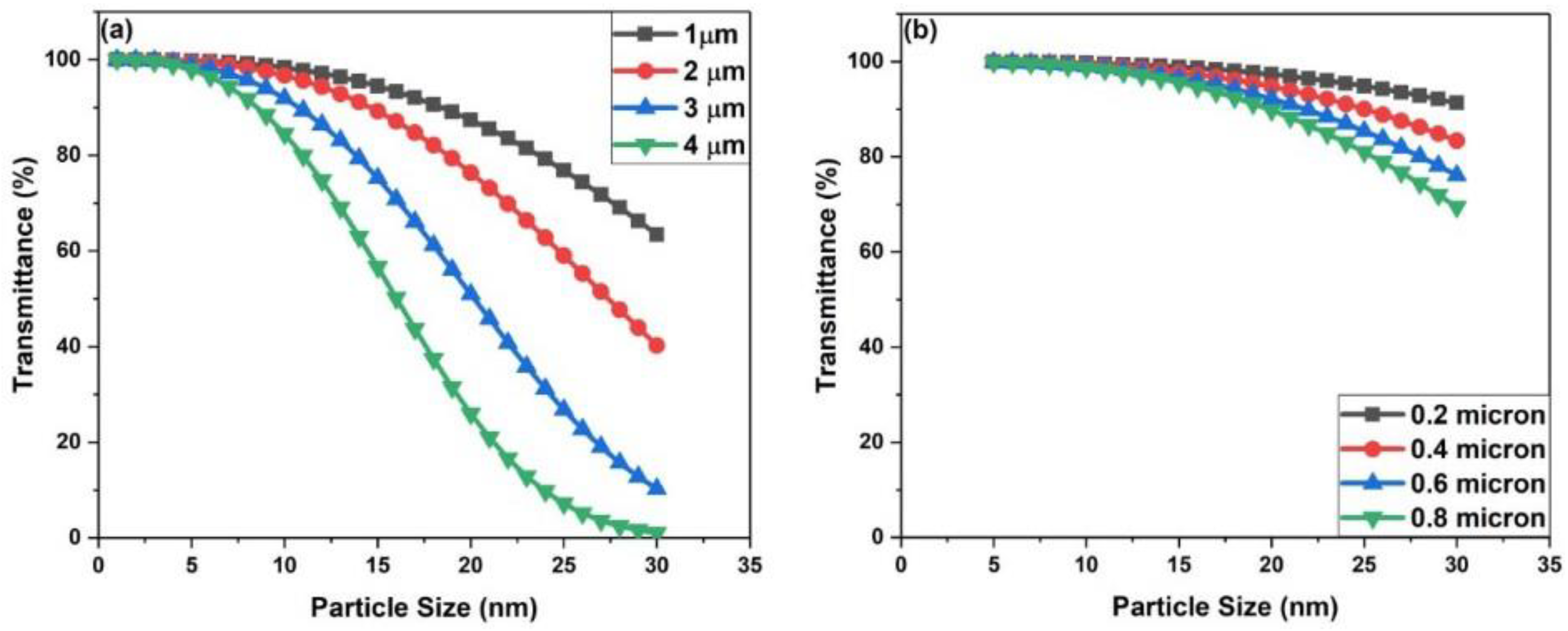
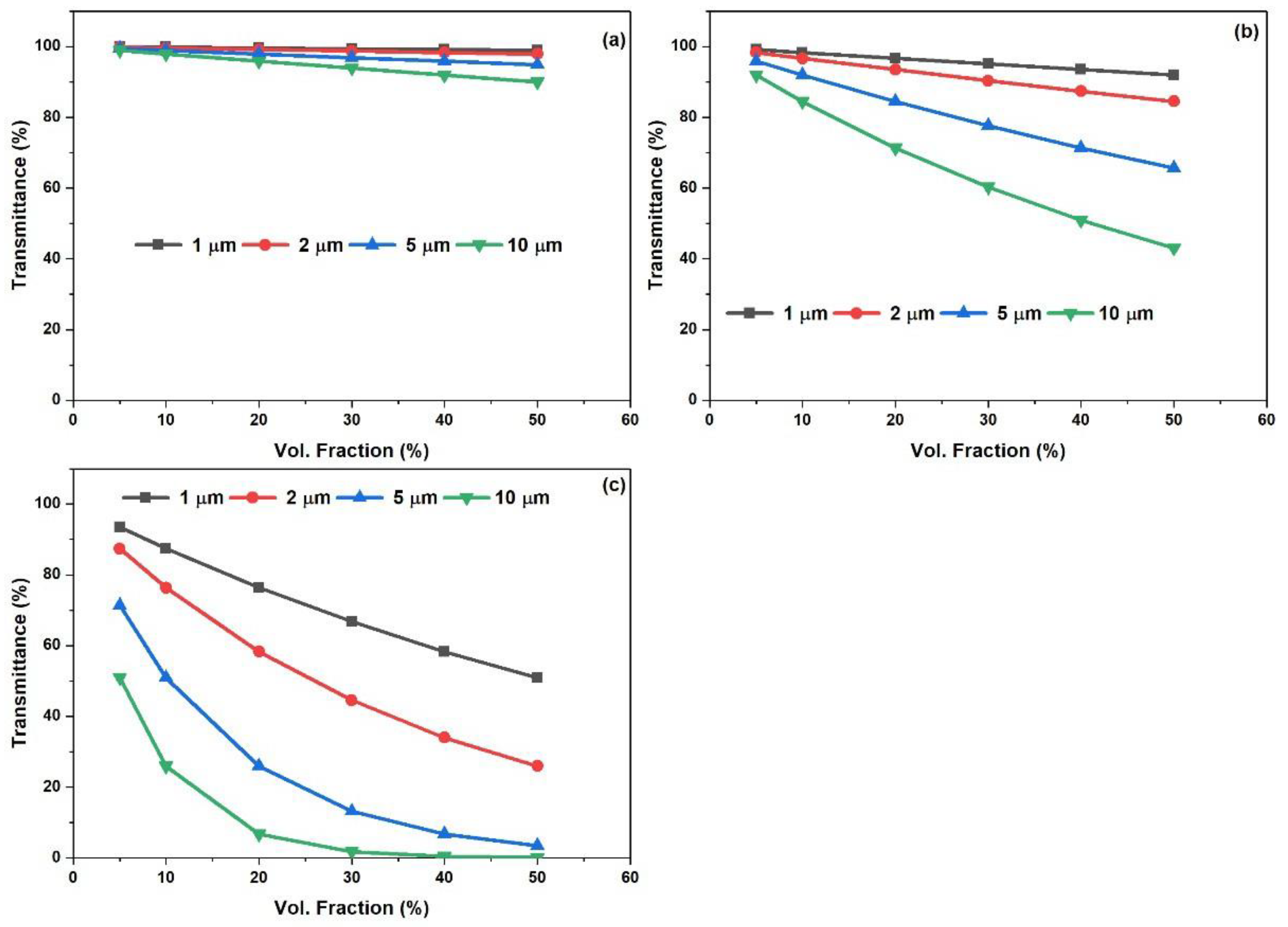
Transparent materials are highly desirable for multiple optical devices, composite armours, smartphone screens and can be used as host materials for solid-state lasers. However, achieving transparency in composite materials is challenging due to the difference in refractive indices between the matrix and the fillers. The authors investigate the impact of various factors, including particle size, film thickness, and volume fraction, on the optical properties of epoxy-based nanocomposites. Using Rayleigh scattering theory, they assess the effect of different materials and manufacturing parameters on the transmittance of nanocomposites. Their findings suggest that a theoretical transmittance of over 90% can be achieved by using particle sizes less than 10 nm and film thicknesses less than 1 µm.
Keywords:
1. Introduction
2. Methods
- The hybrid polymer ceramic composite is optically homogeneous.
- The composite consists of spherical particles of radius r.
- The particles are dispersed in a polymer matrix with refractive index nNP.
- The surrounding medium has refractive index n0.
- The thickness of the composite is l.
- The volume fraction of the particles is ϕ.
Derivation of Equation
3. Results
5. Conclusions
Conflicts of Interest
References
- Meinders, R.; Murphy, D.; Taylor, G.; Chandrashekhara, K.; Schuman, T. Development of fiber-reinforced transparent composites. Polymers and Polymer Composites 2021, 29, S826–S834. [Google Scholar] [CrossRef]
- Zobeiry, N.; Lee, A.; Mobuchon, C. Fabrication of transparent advanced composites. Composites Science and Technology 2020, 197, 108281. [Google Scholar] [CrossRef]
- Caydamli, Y.; Heudorfer, K.; Take, J.; Podjaski, F.; Middendorf, P.; Buchmeiser, M.R. Transparent Fiber-Reinforced Composites Based on a Thermoset Resin Using Liquid Composite Molding (LCM) Techniques. Materials (Basel) 2021, 14, 6087. [Google Scholar] [CrossRef]
- Magrini, T.; Bouville, F.; Lauria, A.; Le Ferrand, H.; Niebel, T.P.; Studart, A.R. Transparent and tough bulk composites inspired by nacre. Nature Communications 2019, 10, 2794. [Google Scholar] [CrossRef]
- Lim, Y.-W.; Jin, J.; Bae, B.-S. Optically Transparent Multiscale Composite Films for Flexible and Wearable Electronics. Advanced Materials 2020, 32, 1907143. [Google Scholar] [CrossRef] [PubMed]
- Xie, J.; Jia, D.; Dirican, M.; Xia, Y.; Li, C.; Liu, Y.; Cui, M.; Yan, C.; Wan, J.; Liu, H.; et al. Highly Foldable, Super-Sensitive, and Transparent Nanocellulose/Ceramic/Polymer Cover Windows for Flexible OLED Displays. ACS Applied Materials & Interfaces 2022, 14, 16658–16668. [Google Scholar] [CrossRef]
- Yu, S.; Liu, X.; Yang, P.; Wu, C.; Li, L. Flexible transparent Ag nanowire/UV-curable resin heaters with ultra-flexibility, high transparency, quick thermal response, and mechanical reliability. Journal of Alloys and Compounds 2022, 908, 164690. [Google Scholar] [CrossRef]
- Cebrian, A.V.S.; Carvalho, R.S.; Barreto, A.R.J.; Maturi, F.E.; Barud, H.S.; Silva, R.R.; Legnani, C.; Cremona, M.; Ribeiro, S.J.L. Development of Conformable Substrates for OLEDs Using Highly Transparent Bacterial Cellulose Modified with Recycled Polystyrene. Advanced Sustainable Systems 2022, 6, 2000258. [Google Scholar] [CrossRef]
- Cai, G.; Wang, J.; Lee, P.S. Next-generation multifunctional electrochromic devices. Accounts of chemical research 2016, 49, 1469–1476. [Google Scholar] [CrossRef]
- Naganuma, T.; Kagawa, Y. Effect of particle size on light transmittance of glass particle dispersed epoxy matrix optical composites. Acta Materialia 1999, 47, 4321–4327. [Google Scholar] [CrossRef]
- Asai, T.; Sakamoto, W.; Yogo, T. In situ synthesis of transparent TiO2 nanoparticle/polymer hybrid. Journal of Materials Science 2013, 48, 7503–7509. [Google Scholar] [CrossRef]
- Cai, B.; Sugihara, O.; Elim, H.I.; Adschiri, T.; Kaino, T. A novel preparation of high-refractive-index and highly transparent polymer nanohybrid composites. Applied physics express 2011, 4, 092601. [Google Scholar] [CrossRef]
- Longhitano, G.A.; Nunes, G.B.; Candido, G.; da Silva, J.V.L. The role of 3D printing during COVID-19 pandemic: a review. Progress in Additive Manufacturing 2021, 6, 19–37. [Google Scholar] [CrossRef]
- Huang, P.; Shi, H.-Q.; Xiao, H.-M.; Li, Y.-Q.; Hu, N.; Fu, S.-Y. High performance surface-modified TiO2/silicone nanocomposite. Scientific reports 2017, 7, 1–7. [Google Scholar] [CrossRef]
- Mudinepalli, V.R.; Feng, L.; Lin, W.-C.; Murty, B. Effect of grain size on dielectric and ferroelectric properties of nanostructured Ba0. 8Sr0. 2TiO3 ceramics. Journal of Advanced Ceramics 2015, 4, 46–53. [Google Scholar] [CrossRef]
- Lukacs, V.; Caruntu, G.; Condurache, O.; Ciomaga, C.; Curecheriu, L.; Padurariu, L.; Ignat, M.; Airimioaei, M.; Stoian, G.; Rotaru, A. Preparation and properties of porous BaTiO3 nanostructured ceramics produced from cuboidal nanocrystals. Ceramics International 2021, 47, 18105–18115. [Google Scholar] [CrossRef]
- Chiang, H.P.; Leung, P.T.; Tse, W.S. Optical properties of composite materials at high temperatures. Solid State Communications 1997, 101, 45–50. [Google Scholar] [CrossRef]
- Chiang, H.-P.; Leung, P.; Tse, W.-S. Optical properties of composite materials at high temperatures. Solid state communications 1997, 101, 45–50. [Google Scholar] [CrossRef]
- Sönmezoğlu, S.; Arslan, A.; Serin, T.; Serin, N. The effects of film thickness on the optical properties of TiO2–SnO2 compound thin films. Physica Scripta 2011, 84, 065602. [Google Scholar] [CrossRef]
- Kobayashi, Y.; Kurosawa, A.; Nagao, D.; Konno, M. Fabrication of barium titanate nanoparticles-epoxy resin composite films and their dielectric properties. Polymer composites 2010, 31, 1179–1183. [Google Scholar] [CrossRef]
- Gharibshahi, E.; Alamaniotis, M. Simulation and Modeling of Optical Properties of U, Th, Pb, and Co Nanoparticles of Interest to Nuclear Security Using Finite Element Analysis. Nanomaterials 2022, 12, 1710. [Google Scholar] [CrossRef] [PubMed]
- Jayoti, D.; Malik, P.; Prasad, S.K. Effect of ZnO nanoparticles on the morphology, dielectric, electro-optic and photo luminescence properties of a confined ferroelectric liquid crystal material. Journal of Molecular Liquids 2018, 250, 381–387. [Google Scholar] [CrossRef]
- Naganuma, T.; Kagawa, Y. Effect of particle size on the optically transparent nano meter-order glass particle-dispersed epoxy matrix composites. Composites Science and Technology 2002, 62, 1187–1189. [Google Scholar] [CrossRef]
Disclaimer/Publisher’s Note: The statements, opinions and data contained in all publications are solely those of the individual author(s) and contributor(s) and not of MDPI and/or the editor(s). MDPI and/or the editor(s) disclaim responsibility for any injury to people or property resulting from any ideas, methods, instructions or products referred to in the content. |
© 2026 by the authors. Licensee MDPI, Basel, Switzerland. This article is an open access article distributed under the terms and conditions of the Creative Commons Attribution (CC BY) license (http://creativecommons.org/licenses/by/4.0/).


