

Submitted:
30 December 2025
Posted:
31 December 2025
You are already at the latest version
Abstract
In response to the rapid evolution of the global marketplace, the proliferation of local hipster coffee shops in Malaysia, including in Kelantan, has intensified competition in attracting and retaining customers, particularly among youth who are highly inclined to explore newly established and trend-driven cafés. Accordingly, this study examines the relationships between location preference, food quality, price, and café atmosphere and youth customer satisfaction at local hipster coffee shops in Kelantan. Data were collected from 384 youth respondents aged 15 to 40 years who had visited local hipster cafés in Kelantan through a self-administered questionnaire distributed via Google Forms. The collected data were analyzed using SPSS version 27.0, employing descriptive statistics, reliability analysis using Cronbach’s alpha, Spearman correlation, and multiple linear regression techniques. Although all measurement items demonstrated satisfactory reliability and validity, the normality test indicated that the data were not normally distributed, justifying the use of non-parametric analysis. The correlation results revealed strong and significant relationships between all studied factors and youth customer satisfaction. However, the multiple regression analysis identified café atmosphere as the most dominant factor influencing youth customer satisfaction, followed by location preference, while food quality and price were found to be statistically insignificant when other variables were considered. These findings offer valuable insights for café operators, business planners, and stakeholders in the coffee industry, enhancing customer experience and competitiveness.
Keywords:
cafe atmosphere
; customer satisfaction
; food quality
; hipster cafe
; location preference
; price
; youth
1. Introduction
The coffee industry has a long history, starting with Kiva Han, the first coffee shop in Constantinople in 1475, and expanding globally during European colonization, when Southeast Asia and South America became leading coffee producers [1]. Hipster cafes, part of the retail industry that sells goods and services directly to consumers, mix traditional and modern concepts, offering unique dining experiences [2]. Their growth reflects changing consumer preferences over time.
Kelantan’s coffee culture is rooted in tradition, particularly through its ‘kopitiam’ (traditional coffee shops), but hipster cafes have added modern elements. Western influences, brought back by Malaysians studying in Melbourne, have changed the coffee scene over the past 30 years [3]. Youth have become the driving force behind this transformation. Many young people now prioritize quality coffee experiences and enjoy trying new flavors, often starting their coffee journeys as early as high school [4]. Kelantan has also produced products, like batik and coffee, that meet international standards and have successfully penetrated global markets. The Israel-Gaza conflict has prompted Malaysians to favor local coffee brands over international chains, contributing to a 28% growth in branded outlets in 2023 [5].
Despite its growth, Kelantan’s hipster coffee shops face challenges. Firstly, location plays a critical role, but findings are inconsistent. While a strategic location helps attract customers, factors like parking, traffic, and security also influence satisfaction [6,7]. Food quality is another key factor, especially after recent cases of food poisoning and hygiene violations in Kelantan [2]. Pricing is also contentious, with some studies showing dissatisfaction over high prices [8], while others find no significant impact [9]. Cafe atmosphere, particularly the creation of “Instagrammable” spaces, is crucial for attracting youth, but there are mixed findings on its effect on satisfaction [10,11,12].
Youth are central to Kelantan’s growing hipster coffee culture, shaping trends and preferences in the industry [13]. This study focuses on factors influencing their satisfaction with local hipster coffee shops, including location, food quality, price, and café atmosphere. By addressing research gaps, this study aims to examine the relationship between these factors and customer satisfaction, as well as to examine what are the dominant factors that influence customer satisfaction, in order to improve the customer experience and help coffee shops succeed in a competitive and youth-driven market.
2. Materials and Methods
2.1. Empirical Review
2.1.1. Customer Satisfaction Among Youth at Local Hipster Coffee Shops
Youth are central to the growing trend of local hipster coffee shops in Malaysia. In this context, youth in Malaysia are individuals aged 15 to 40 years as defined by the National Youth Development Policy, and they are an important customer segment that significantly influences trends, preferences, and expectations in the café industry [14]. These young consumers are drawn to local hipster coffee shops for their creativity, uniqueness, and self-expression, which are essential values within the hipster subculture [15].
Local hipster cafes, which emphasize artistic themes, mismatched furniture, and a combination of modern and traditional styles, provide a platform where youth can socialize, relax, and showcase their individuality [16]. The distinctive atmosphere of these cafes is crucial to their appeal, as they go beyond simply offering food and drinks to create a unique experience that resonates with this demographic [17]. For youth, these cafes are considered "third places" that foster a sense of community, creativity, and relaxation [16].
Customer satisfaction, defined as the contentment or pleasure derived from fulfilling a need, expectation, or goal, plays a crucial role in their decision to return [18]. Satisfied youth customers are more likely to return, share their experiences on social media, and recommend these cafes to others, driving both customer loyalty and the café’s reputation [14]. Understanding what factors contribute to the satisfaction of youth customers in local hipster coffee shops is therefore crucial for businesses in this competitive and youth-driven market.
2.1.2. Location Preferences
Location preference plays a crucial role in shaping customer satisfaction, especially in the context of local hipster coffee shops. It refers to the convenience and attractiveness of a café's location, which significantly impacts customers’ decisions to visit. Key indicators of location preference include accessibility, proximity to transportation hubs, parking availability, and ease of access to public transport. A convenient location reduces time and effort for customers, enhancing their overall satisfaction [19]. Additionally, the psychological connection to a location, known as "place attachment," can also drive satisfaction, particularly if customers have positive experiences associated with the place [20].
Past studies have consistently shown that location is an important factor influencing customer satisfaction. Location had a positive impact on customer satisfaction in Sharia cafes in Indonesia [10]. Location influenced satisfaction among coffee shop customers in Jakarta and Batam, respectively. However, [11] noted that the impact of location was less significant in a different context, highlighting that the relationship between location and customer satisfaction might vary based on other factors. Thus, the relationship between location preference and customer satisfaction is well-supported by prior research, leading to the hypothesis:
H1: There is a significant relationship between location preference and customer satisfaction among youth at local hipster coffee shops in Kelantan.
2.1.3. Food Quality
Food quality is a complex characteristic that determines the value or acceptability of food to consumers (Food and Agriculture Organization of the United Nations [FAO], [21]. In the context of coffee shops, key indicators of food quality include taste, presentation, variety, and freshness. Taste is considered the most significant factor, as it directly influences sensory satisfaction and aligns with consumer expectations [22].
Past studies consistently highlight the relationship between food quality and customer satisfaction in coffee shops. [21,23] found significant links between product quality and customer satisfaction. Similarly, [22,24] identified food quality as a key driver of customer satisfaction and revisit intention. [25] also confirmed this relationship in their study. Based on these findings, the hypothesis is:
H2: There is a significant relationship between food quality and customer satisfaction among youth at local hipster coffee shops in Kelantan.
2.1.4. Price
Price is the amount of money a customer pays for goods or services, reflecting the perceived value of the product or experience [10]. A key factor in customer satisfaction, price aligns with customers’ expectations of quality and experience. If the price meets these expectations, it enhances satisfaction, whereas a mismatch can lead to dissatisfaction [12]. Additionally, hedonic value from the coffee shop experience plays a role in customer satisfaction, as a pleasant environment and enjoyable experience can make the price seem more worthwhile [22]. Pricing strategies, including competitive pricing, promotions, and psychological pricing, further influence customer satisfaction by aligning with consumers' perceptions of fairness and affordability [12].
Several studies have examined the relationship between price and customer satisfaction in coffee shops. [10,12,25] found a positive effect of price on customer satisfaction, showing that competitive pricing can enhance satisfaction and lead to customer loyalty. However, [9] found no significant influence of price on satisfaction. Based on these findings, the hypothesis is:
H3: There is a significant relationship between price and customer satisfaction among youth at local hipster coffee shops in Kelantan.
2.1.4. Cafe Atmosphere
Café atmosphere refers to the sensory elements, including lighting, color, music, fragrance, architecture, layout, and temperature, which collectively influence customer perceptions and emotions. These elements create a pleasant environment that can shape the overall customer experience, enhancing satisfaction. Studies have shown that a well-organized and attractive atmosphere stimulates emotional responses that influence customer behavior and purchasing decisions [10]. An effective café atmosphere fosters positive emotional relationships between customers and the café, which can contribute to repeat visits and loyalty [11].
There are several studies have examined the impact of café atmosphere on customer satisfaction. Research by [10,12,24] found a significant positive relationship, showing that a well-designed atmosphere enhances customer satisfaction and encourages repeat visits. However, [22] noted a negative correlation in premium cafés, suggesting that the importance of atmosphere may vary. Based on these findings, the hypothesis is:
H4: There is a significant relationship between café atmosphere and customer satisfaction among youth at local hipster coffee shops in Kelantan.
2.2. Conceptual Framework
Figure 1 illustrates the conceptual framework of this study. The independent variables comprise location preference, food quality, price, and café atmosphere, which are hypothesised to influence customer satisfaction at local hipster coffee shops. Customer satisfaction is specified as the dependent variable, reflecting customers’ overall evaluation of their consumption experience. The framework proposes direct relationships between each independent variable and customer satisfaction, providing a structured basis for the empirical analysis.
2.3. Research Method
This study employed a quantitative and cross-sectional research design in 2024 to examine factors influencing customer satisfaction at local hipster coffee shops in Kelantan. Data was collected using a questionnaire, which was divided into three parts: Part A for demographic information (using a nominal scale), Part B for measuring customer satisfaction (dependent variable), and Part C for the independent variables (location preference, food quality, price, and café atmosphere) using a 5-point Likert scale (interval scale). The questionnaire was distributed through Google Forms and shared via social media platforms. A purposive sampling technique was used, targeting youth aged 15-40 who have visited local hipster coffee shops more than once. Based on the population of urban residents in Kelantan (790,412), a sample size of 384 was calculated using Krejci and Morgan's formula. A pilot test was conducted with 10% of the sample size (38 respondents) to ensure the clarity of the questions. The data were analyzed using SPSS version 27, with descriptive analysis to summarize the data, reliability testing using Cronbach’s Alpha, Spearman correlation to assess relationships (due to non-normal distribution as indicated by the Kolmogorov-Smirnov and histogram normality tests), and multiple linear regression to evaluate the combined effect of the independent variables on customer satisfaction.
3. Results
3.1. Reliability Analysis
Table 1 shows that all the variables are >0.70, which is interpreted as acceptable and good reliability. Meanwhile, overall variables, which consist of 24 items, show excellent reliability with p = 0.956. In a nutshell, the results of the reliability tests support the adequacy of the tools used through this study, and the concepts tested apply to this study.
3.2. Descriptive Analysis
3.2.1. Respondents' Profile
The descriptive analysis in Table 2 presents the profile of 384 respondents participating in this study. The sample is slightly dominated by female respondents (54.9%), while males constitute 45.1%. The majority of respondents are aged between 19 and 24 years old (57.3%), followed by those aged 25–30 years (31.3%), indicating that the respondents are predominantly young adults. In terms of educational background, most respondents possess a bachelor’s degree (59.9%), while smaller proportions hold a diploma (13.8%), STPM (12.5%), and postgraduate qualifications (8.3%). The respondents mainly come from the retailing (29.7%), banking and finance (11.7%), and commerce (10.7%) fields, with students forming the largest employment group (58.6%). Regarding café visitation patterns, most respondents visit local hipster coffee shops less than once a week (32.6%) or once to twice a week (36.7%), primarily driven by food quality (28.4%), price (28.4%), and café atmosphere (27.6%). The majority of respondents spend between RM11 and RM15 per visit (28.4%), typically visit cafés with friends (52.9%), and overwhelmingly express a high likelihood of recommending the café to others (97.9%), reflecting generally positive customer perceptions and satisfaction.
3.3. Spearman Correlation Analysis
Spearman’s rank-order correlation was employed to examine the relationships between the studied factors and customer satisfaction due to the non-normal distribution of the data identified through the normality test. As presented in Table 3, the results indicate strong and statistically significant positive relationships between customer satisfaction and all independent variables, namely location preference (r = 0.727, p < 0.001), food quality (r = 0.701, p < 0.001), price (r = 0.644, p < 0.001), and café atmosphere (r = 0.736, p < 0.001). These findings suggest that improvements in each of these factors are associated with higher levels of customer satisfaction at local hipster coffee shops.
3.4. Multiple Linear Regression Analysis
Table 4 presents the results of the multiple linear regression analysis. The findings indicate that café atmosphere has a positive and statistically significant effect on customer satisfaction, where a one-unit increase in café atmosphere is associated with a 0.312 increase in customer satisfaction, confirming it as the most dominant factor in the model. Location preference also exhibits a significant positive relationship with customer satisfaction, with a one-unit increase corresponding to a 0.190 rise in satisfaction. In contrast, food quality, although positively related to customer satisfaction (β = 0.113), does not achieve statistical significance (p = 0.064). Similarly, price demonstrates a positive but statistically insignificant effect, with a one-unit increase resulting in a 0.099 increase in customer satisfaction (p = 0.060). These results suggest that, when all factors are considered simultaneously, experiential and locational aspects play a more critical role in shaping youth customer satisfaction at local hipster coffee shops in Kelantan than food quality and price. Equation (1) below shows the final model of the study:
Final model: DV = 1.326 + (0.190*IV1) + (0.113*IV2) + (0.099*IV3) + (0.312*IV4) (1)
4. Discussion
The findings of this study provide updated empirical evidence on the determinants of youth customer satisfaction at local hipster coffee shops in Kelantan. The Spearman correlation results indicate that location preference, food quality, price, and café atmosphere are all positively and significantly associated with customer satisfaction. This supports recent hospitality and foodservice studies suggesting that customer satisfaction is shaped by a combination of functional attributes (such as food quality and price) and experiential attributes (such as atmosphere and location) [1,6,10,11]
Among the examined factors, café atmosphere and location preference exhibit the strongest associations with customer satisfaction. This finding is consistent with recent servicecape literature, which highlights the growing importance of physical and social environments in influencing emotional responses, perceived value, and satisfaction, particularly among younger consumers [10,11,12,24]. In the context of hipster coffee shops, atmosphere-related elements such as interior design, lighting, music, and overall ambience contribute to the creation of a distinctive experience that resonates strongly with youth customers, who often view cafés as social and lifestyle spaces rather than merely consumption venues.
The multiple linear regression results further emphasise the dominant role of café atmosphere in shaping customer satisfaction, followed by location preference. This finding aligns with recent empirical studies demonstrating that experiential factors are stronger predictors of satisfaction and revisit intention than traditional product-related attributes in cafés and casual dining establishments [7,18,20]. Youth customers, in particular, are more likely to value atmospheres that support social interaction, comfort, and aesthetic appeal, which explains the strong influence of café atmosphere observed in this study.
Location preference also emerges as a significant determinant of satisfaction, highlighting the continued relevance of accessibility, convenience, and proximity in café selection. Recent studies suggest that despite the increasing emphasis on experiential consumption, locational convenience remains a critical factor for youth customers who balance time constraints, mobility, and social activities [10,11]. This indicates that experiential appeal and functional convenience jointly shape satisfaction outcomes.
Interestingly, although food quality and price show strong positive correlations with customer satisfaction, their effects become statistically insignificant in the regression model. This suggests that when experiential and locational factors are taken into account, food quality and price may function as threshold or hygiene factors rather than key differentiators. Recent hospitality research supports this explanation, noting that in highly competitive café markets, customers often assume acceptable food quality and reasonable pricing as basic expectations, thereby shifting their satisfaction evaluations toward experiential attributes [12,21,22,24].
Overall, the findings reflect a broader shift in youth consumption behaviour toward experience-oriented service consumption. For local hipster coffee shops, customer satisfaction is driven more by atmosphere and location than by food quality or price alone. These results underscore the strategic importance of investing in café ambience and selecting accessible locations to enhance customer satisfaction and competitiveness in an increasingly saturated café market.
5. Conclusions
This study examined the factors influencing youth customer satisfaction at local hipster coffee shops in Kelantan, focusing on location preference, food quality, price, and café atmosphere. Using a combination of descriptive analysis, Spearman correlation, and multiple linear regression, the study provides empirical evidence on how both functional and experiential attributes shape customer satisfaction in an increasingly competitive café market.
The findings reveal that all examined factors are positively associated with customer satisfaction at the bivariate level, indicating that improvements in location, food quality, price fairness, and café atmosphere contribute to higher satisfaction among youth customers. However, the regression results offer deeper insights by showing that café atmosphere is the most dominant determinant of customer satisfaction, followed by location preference. In contrast, food quality and price, although positively related to satisfaction, do not exhibit statistically significant effects when other factors are considered simultaneously. This suggests that for youth customers, experiential and environmental elements play a more critical role than purely product-related attributes in shaping overall satisfaction.
These results highlight a shift in youth consumption behaviour toward experience-oriented service consumption, where cafés are valued not only as places to consume food and beverages but also as social and lifestyle spaces. From a practical perspective, the findings suggest that café operators should prioritize creating an appealing atmosphere and selecting strategic, accessible locations to enhance customer satisfaction and competitiveness. While maintaining acceptable food quality and reasonable pricing remain essential, these factors alone may be insufficient to differentiate cafés in a saturated market.
Overall, this study contributes to the existing literature by providing evidence from a local context and offering practical insights for café operators and business planners. Future research may extend this study by incorporating additional variables such as service quality, brand image, or digital engagement, as well as by employing longitudinal designs or comparative analyses across different regions to further enrich the understanding of customer satisfaction in the café industry.
Author Contributions
writing- original draft preparation, N.N.N.M.; writing—review and editing, H.H. & K.M.; visualization, N.N.N.M.; supervision, H.H.; project administration, N.N.N.M., K.M., & H.H. All authors have read and agreed to the published version of the manuscript.
Acknowledgments
The authors would like to sincerely thank the final year project students of the Faculty of Entrepreneurship and Business, Universiti Malaysia Kelantan, for their efforts in data collection and preliminary analysis supported the completion of this study.
Conflicts of Interest
The authors declare no conflict of interest.
References
- Abdullah, T.N.H.T.; Hassan, W.M.H.W.; Shukri, S.H.; Mohamad, R.; Rosli, M.I. Factors influencing youngsters’ intention to visit hipster cafés in Malaysia. Futur. Horiz. Adv. Stud.-Led Innov. Res. Sustain. Hosp. Tour. Wellness 2024, 1, 214.
- Talib, K.A.; Gapar, M.H.A.; Ismail, R.; Isa, S.M. Hipster foods and cafés: Framing cohesion and identity. Geografia 2021, 17, 1–13.
- Azman, W.F.A.C.; Halim, N.F.; Taharim, Z. The Ayang Café: From crew to kopitiam owner. Int. J. Entrep. Case Stud. 2025, 4, 1–8. [CrossRef]
- Karabulut, A.N. Comparing young people’s coffee shop perceptions with their senses of taste. Yönetim Ekon. Derg. 2023, 30, 1–19. [CrossRef]
- Sarjono, H.; Khairunnisa, A.S.; Sandy, C.A.N.; Leono, M.; Soeratin, B.S. The effect of the Israeli–Palestinian war boycott on Starbucks finances. J. Ekon. Stat. Indones. 2024, 4, 13–22. [CrossRef]
- Johari, N.A.A.; Zakaria, N.A. Factors influencing customers to revisit hipster cafés in Terengganu. J. Agrobiotechnology 2025, 16.
- Farid, A.M. Food tourism motivation and customer satisfaction at hipster cafés in Johor Bahru, Malaysia. Manag. 2021, 6, 155–162. [CrossRef]
- Sembiring, V.A. Effect of product quality on customer satisfaction at Kopi Gowo Lippo Karawaci, Tangerang Selatan. TRJ Tour. Res. J. 2021, 5, 106–117. [CrossRef]
- Komariyah, K.; Susianto, M.; Atmaji, G.; Widodo, W.E.; Setianto, W.B. Effect of roasting using a spouted bed roaster on physicochemical properties of Robusta and Arabica Temanggung coffee. J. Teknol. Ind. Pertan. 2024, 34, 28–34.
- Mujahideen, M.S. The influence of café atmosphere, price, and location on purchasing decisions at coffee shop scale in Mataram City. In Proc. Int. Conf. Econ. Manag. Bus., 2023; pp. 1536–1545.
- Aulia, M.R.; Rudy, R.; Ismail, A.; Indriyani, S.; Arief, I. The influence of social media, location, service quality, and store atmosphere on purchase decision of coffee café customers. Innov. J. Soc. Sci. Res. 2023, 3, 11111–11118.
- Putri, N.A.; Sulfarid, S.; Mulyono, S. Analysis of café atmosphere, prices, and menu variations on consumer visiting interest. Indones. Interdiscip. J. Sharia Econ. 2024, 7, 5592–5609.
- Mohd Ali, P.N.A.; Mohamed Rani, Z.; Ahmad, K.N.; Abas, S.A.; Ahmad, N.A. Understanding younger generations’ perceived service quality, value, and satisfaction in coffee shops in Kota Bharu, Kelantan. ESTEEM J. Soc. Sci. Humanit. 2024, 8, 13–30.
- Lin, J.N.J.; Yun, C.T. Young adults’ motivation to patronize independent specialist coffee shops in Malaysia. In Reg. Conf. Sci. Technol. Soc. Sci. (RCSTSS 2014); Springer: Singapore, 2016; pp. 249–258.
- Sinniah, S.; Perumal, G.; Seniasamy, R.; Mohamed, R.; Das, P.A.M.; Dhananjaya, O.S. Experiential quality among coffee lovers: An empirical study in Malaysian coffee outlets. J. Soc. Sci. Humanit. 2018, 15, 104–116.
- Sison, R.T.S.; Paison, J.J.C. Service quality and dining atmosphere value on Pangasinan’s local coffee shop customer service and retention. Asian J. Multidiscip. Stud. 2023, 6, 104–114.
- Khan, K.; Riaz, A.; Fatima, Z. Customer experience and satisfaction in coffee consumption: An analytical study of customer behaviour. VFAST Trans. Educ. Soc. Sci. 2025, 13, 14–29.
- Suhaimi, A.A.; Nordin, N.A.M.; Hasan, S.S.; Sayuti, M.I.; Ruqaimi, M. The relationship between factors affecting customer satisfaction towards cafés in Kota Bharu, Kelantan. Futur. Horiz. Adv. Stud.-Led Innov. Res. Sustain. Hosp. Tour. Wellness 2024, 1, 271.
- Krisnamoorthy, M.; Balasubramanian, K. Factors influencing millennials’ satisfaction with café restaurants in Kuala Lumpur, Malaysia. 2019.
- Sharee, A.; Muhammad, N.S. Young adults’ satisfaction towards hipster cafés: The brewing factors. Adv. Bus. Res. Int. J. 2018, 4, 41–52.
- Therok, F.A.; Saerang, D.P.E.; Wangke, S.J.C. Influence of lifestyle, servicescape, and food quality on customer revisit intention. J. EMBA 2021, 9, 1423–1432.
- Rayuwati, R.; Yustisar, M.; Gemasih, H.; Eliyin, E. Influence of price, store atmosphere, and food product quality on buying interest at Tootor Coffee Takengon. Int. J. Sci. Technol. Manag. 2022, 3, 1129–1143. [CrossRef]
- Handayani, P.T.; Kepramareni, P.; Kusuma, I.G.A.E.T. Quality of physical environment, service, and product on revisit intention through customer satisfaction. Eur. J. Bus. Manag. Res. 2022, 7, 115–119. [CrossRef]
- Alessandro, M.J.; Syahbandi, S.; Listiana, E.; Barkah, B.; Rosnani, T. Influence of café atmosphere, food quality, and product variety on revisit intention with customer satisfaction as mediator. J. Manag. Sci. 2024, 7, 257–269.
- Berlianto, M.P. Influencing factors on coffee shop customers’ revisit intention. In Proc. Int. Conf. Islam. Econ. Bus. (ICONIES 2018); Atlantis Press: 2019; pp. 167–173.
Figure 1.
Conceptual Framework.
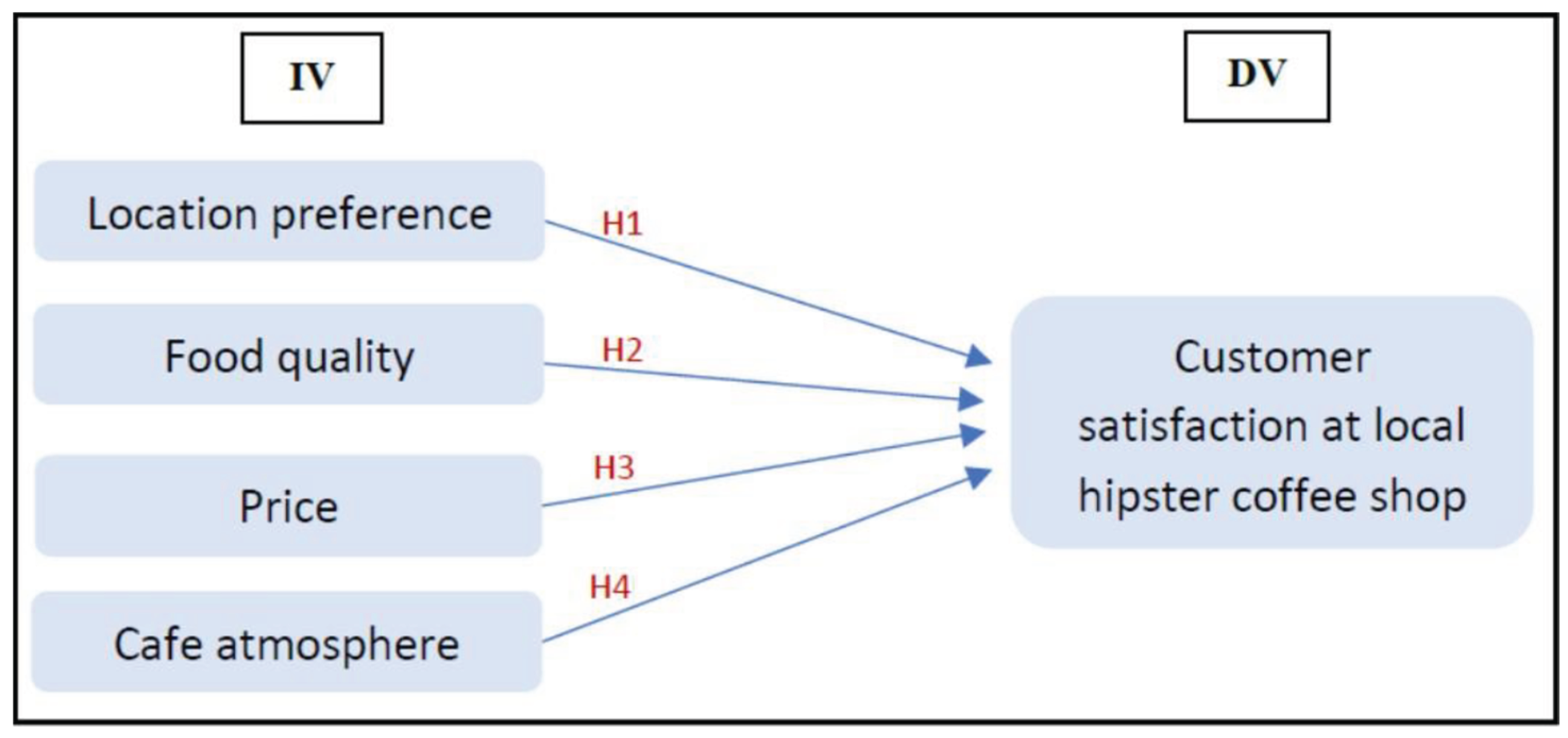

Table 1.
Reliability Analysis.
| Variables | No. of Items | Cronbach’s Alpha | Interpretation | |
| DV | Customer satisfaction | 5 | 0.837 | Good |
| IV1 | Location preference | 5 | 0.824 | Good |
| IV2 | Food quality | 5 | 0.845 | Good |
| IV3 | Price | 4 | 0.792 | Acceptable |
| IV4 | Cafe atmosphere | 5 | 0.849 | Good |
Table 2.
Respondents’ Profile.
| Profiles | Items | Total (N) | Percentage (%) |
| Gender | Female | 211 | 54.9 |
| Male | 173 | 45.1 | |
| Age | 15-18 years old | 12 | 3.1 |
| 19-24 years old | 220 | 57.3 | |
| 25-30 years old | 120 | 31.3 | |
| 31-40 years old | 32 | 8.2 | |
| Highest Education | SPM | 21 | 5.5 |
| STPM | 48 | 12.5 | |
| Diploma | 53 | 13.8 | |
| Bachelor’s degree | 230 | 59.9 | |
| Postgraduate | 32 | 8.3 | |
| Course or Department | Retailing | 114 | 29.7 |
| Banking and Finances | 45 | 11.7 | |
| Commerce | 41 | 10.7 | |
| Hospitality | 27 | 7.0 | |
| Logistics and Distributive Trade | 26 | 6.8 | |
| Accounting | 39 | 10.2 | |
| Tourism | 35 | 9.1 | |
| Wellness | 23 | 6.0 | |
| Employment Status | Employed (Full-time) | 82 | 21.4 |
| Employed (Part-time) | 39 | 10.2 | |
| Self-employed | 33 | 8.6 | |
| Student | 225 | 58.6 | |
| Unemployed | 5 | 1.3 | |
| Visit Frequency | Less than once a week | 125 | 32.6 |
| Once a week | 65 | 16.9 | |
| Twice a week | 76 | 19.8 | |
| Three times a week | 49 | 12.8 | |
| Four times or more | 41 | 10.7 | |
| Everyday | 28 | 7.3 | |
| Visit Reason | Cafe atmosphere | 106 | 27.6 |
| Food quality | 109 | 28.4 | |
| Location preference | 60 | 15.6 | |
| Price | 109 | 28.4 | |
| Spend per visit | Below RM5 | 16 | 4.2 |
| RM5-RM10 | 87 | 22.7 | |
| RM11-RM15 | 109 | 28.4 | |
| RM16-RM20 | 98 | 25.5 | |
| Above RM20 | 74 | 19.3 | |
| Visit Companion | Alone | 81 | 21.1 |
| With colleagues | 35 | 9.1 | |
| With family | 65 | 16.9 | |
| With friends | 203 | 52.9 | |
| Recommendation Possibility |
Yes | 376 | 97.9 |
| No | 8 | 2.1 | |
| Total | 384 | 100 |
Table 3.
Respondents’ Profile.
| Variables | DV | IV1 | IV2 | IV3 | IV4 | |||
| Spearman’s rho | DV | Correlation Coefficient | 1.000 | .727** | .701** | 644** | .736** | |
| Sig. (2-tailed) | .000 | 000 | .000 | .000 | ||||
| IV1 | Correlation Coefficient | .727** | 1.000 | 827** | .728** | .817** | ||
| Sig. (2-tailed) | .000 | .000 | .000 | .000 | .000 | |||
| IV2 | Correlation Coefficient | .701** | 827** | 1.000 | .798** | .832** | ||
| Sig. (2-tailed) | .000 | .000 | .000 | .000 | .000 | |||
| IV3 | Correlation Coefficient | .644** | .728** | .798** | 1.000 | .727** | ||
| Sig. (2-tailed) | .000 | .000 | .000 | .000 | .000 | |||
| IV4 | Correlation Coefficient | .736** | 817** | .832** | .727** | 1.000 | ||
| Sig. (2-tailed) | .000 | .000 | .000 | .000 | .000 |
Table 4.
Multiple Linear Regression Analysis.
| Coefficientsa | |||||
| Model |
Unstandardized Coefficients |
Standard Coefficients |
Sig. | ||
| B | Std. Error | Beta | |||
| 1 | (Constant) | 1.326 | .119 | <.001 | |
| Location preference | .190 | .048 | .233 | <.001 | |
| Food quality | .113 | .061 | 135 | .064 | |
| Price | .099 | .052 | .115 | .060 | |
| Cafe atmosphere | .312 | .053 | .367 | <.001 | |
a. Dependent Variable: Customer satisfaction.
Disclaimer/Publisher’s Note: The statements, opinions and data contained in all publications are solely those of the individual author(s) and contributor(s) and not of MDPI and/or the editor(s). MDPI and/or the editor(s) disclaim responsibility for any injury to people or property resulting from any ideas, methods, instructions or products referred to in the content. |
© 2025 by the authors. Licensee MDPI, Basel, Switzerland. This article is an open access article distributed under the terms and conditions of the Creative Commons Attribution (CC BY) license (http://creativecommons.org/licenses/by/4.0/).
Copyright: This open access article is published under a Creative Commons CC BY 4.0 license, which permit the free download, distribution, and reuse, provided that the author and preprint are cited in any reuse.


