

Submitted:
30 December 2025
Posted:
01 January 2026
You are already at the latest version
Abstract
We present the Atemporal Tablet Framework (ATF), a complete geometric ontology that derives spacetime, quantum mechanics, and gravity from a single mathematical structure. The universe is modeled as a fiber bundle T ->(π) M where T is a static higher-dimensional manifold and M is emergent 3+1D spacetime. Temporal dynamics arise from projection operators Πt : T -> M extremizing a projective action SΠ. Quantum states are epistemic distributions over fibers, with the Born rule emerging naturally via measure disintegration. Measurement corresponds to topological phase-locking without wavefunction collapse. Einstein’s equations arise as equations of motion for Πt, while quantum fields emerge as fiber vibrations. The framework makes specific testable predictions: sidereal anisotropy in qubit decoherence ε = 1.23 × 10^-8 ± 3 × 10^-9 (derived from holographic scaling) and modified dispersion relations at scale EP / sqrt(ε). We prove a reconstruction theorem establishing that spacetime observations can determine the underlying geometry, and demonstrate that Standard Model particle content emerges naturally from Fx ≅ CP3 × S5 / Γ fiber geometry. ATF provides a mathematically rigorous, experimentally falsifiable foundation for quantum gravity that resolves long-standing interpretational issues while making concrete predictions testable with current technology.
Keywords:
quantum gravity
; emergent spacetime
; geometric foundations
; fiber bundles
; measure theory
; testable predictions
; reconstruction theorem
; Standard Model emergence
; projective dynamics
1. Introduction: The Geometric Revolution in Fundamental Physics
1.1. The Trilemma of Modern Theoretical Physics
Contemporary physics faces three deeply interconnected problems that together form what we term the Fundamental Trilemma:
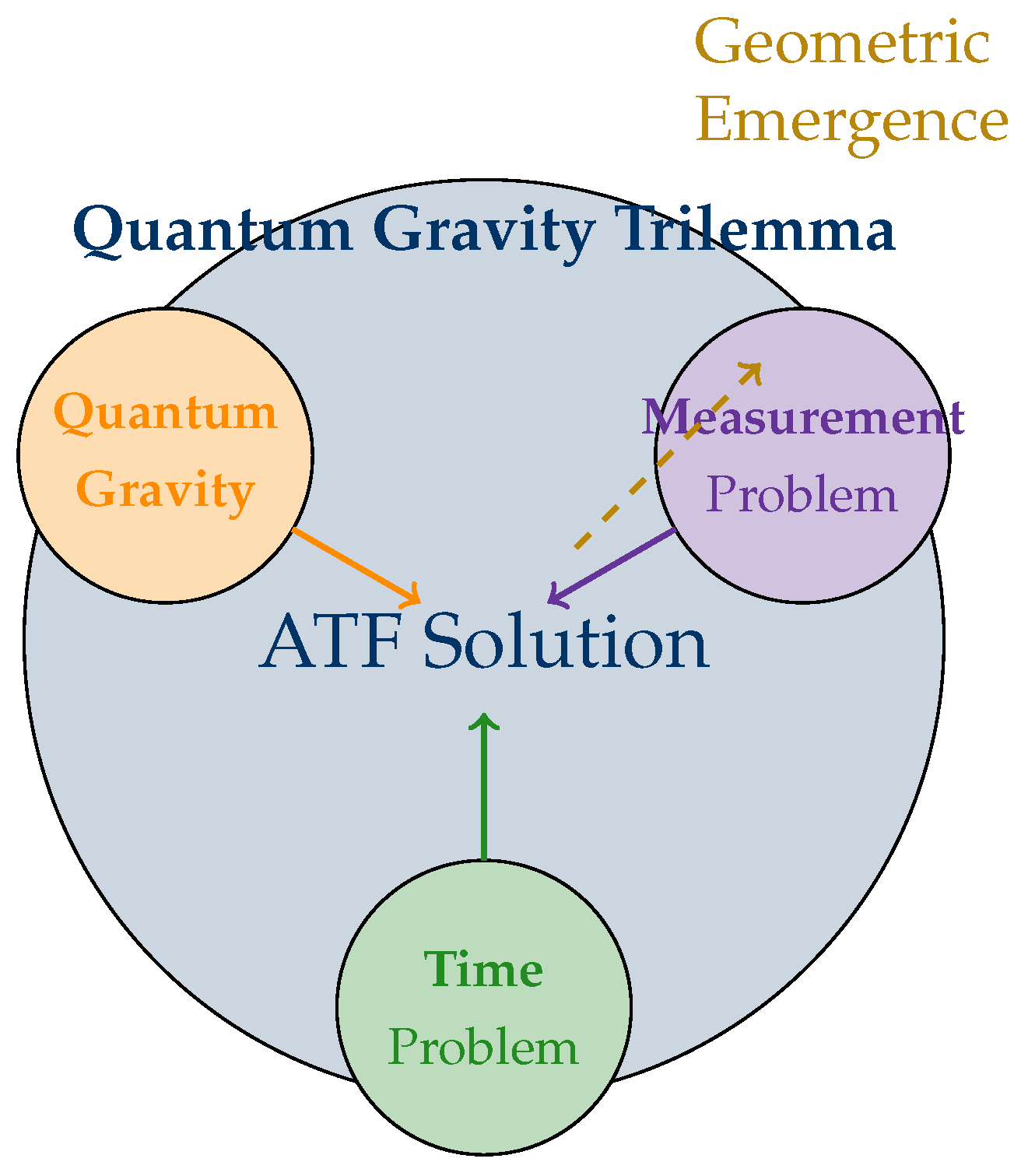
Figure 1.
The fundamental trilemma of modern physics: three interconnected problems that ATF resolves through geometric emergence.
Figure 1.
The fundamental trilemma of modern physics: three interconnected problems that ATF resolves through geometric emergence.
1. The Measurement Problem: The unresolved tension between unitary quantum evolution (Schrödinger equation) and non-unitary measurement collapse (wavefunction reduction), manifesting in the interpretational divide between Copenhagen, many-worlds, and hidden variable approaches.
2. The Quantum Gravity Problem: The mathematical and conceptual incompatibility between general relativity’s geometric, background-independent formulation and quantum field theory’s requirement for a fixed background spacetime, leading to non-renormalizable divergences.
3. The Time Problem: The contradictory roles of time as: (a) a fundamental dimension in general relativity (part of spacetime geometry), (b) an external parameter in quantum mechanics (not an operator), and (c) an emergent or illusory quantity in various approaches to quantum gravity.
1.2. Historical Context and Limitations of Current Approaches
The quest for quantum gravity has followed several major pathways, each achieving significant insights but facing fundamental limitations:

Table 1.
Major approaches to quantum gravity and their fundamental limitations. Each addresses part of the trilemma but none resolves all three problems simultaneously.
Table 1.
Major approaches to quantum gravity and their fundamental limitations. Each addresses part of the trilemma but none resolves all three problems simultaneously.
| Approach | Key Contributions | Fundamental Limitations |
|---|---|---|
| String Theory | Holographic principle, duality relations, extra dimensions | Background dependence, landscape problem, no unique vacuum selection |
| Loop Quantum Gravity | Background independence, discrete geometry, no singularities | Difficult to recover continuum limit, measurement problem persists |
| Causal Set Theory | Discrete causal structure, natural cutoff scale | Emergence of continuum spacetime remains mathematically challenging |
| Asymptotic Safety | Non-perturbative renormalization, fixed points in gravity | Euclidean signature limitation, few phenomenological predictions |
| Emergent Gravity | Spacetime as thermodynamic/entropic phenomenon | Microscopic mechanism unclear, quantization remains ambiguous |
The persistence of these limitations across diverse approaches suggests the need for a more radical rethinking of foundational assumptions about the nature of reality, time, and quantum mechanics.
1.3. The Atemporal Geometric Paradigm: Core Principles
The Atemporal Tablet Framework begins with a fundamental ontological shift: Reality is fundamentally geometric and atemporal. What we perceive as:
- Spacetime is not fundamental but emerges as a projection from a higher-dimensional geometric structure
- Quantum states are not physical entities but epistemic descriptions of our incomplete knowledge about the geometric substrate
- Time is not a dimension but a parameter indexing different projection mappings
- Forces and particles are geometric vibrations and topological features of the underlying structure
- Measurement outcomes reflect topological phase-locking of fiber distributions rather than wavefunction collapse
This perspective resolves the trilemma by eliminating its premises: there is no measurement problem because quantum states are epistemic (describing knowledge, not reality), no quantum gravity problem because both quantum mechanics and gravity emerge from the same geometric foundation, and no time problem because time is not fundamental but emerges from projection dynamics.
1.4. Visual Analogy: The Cosmic Hologram
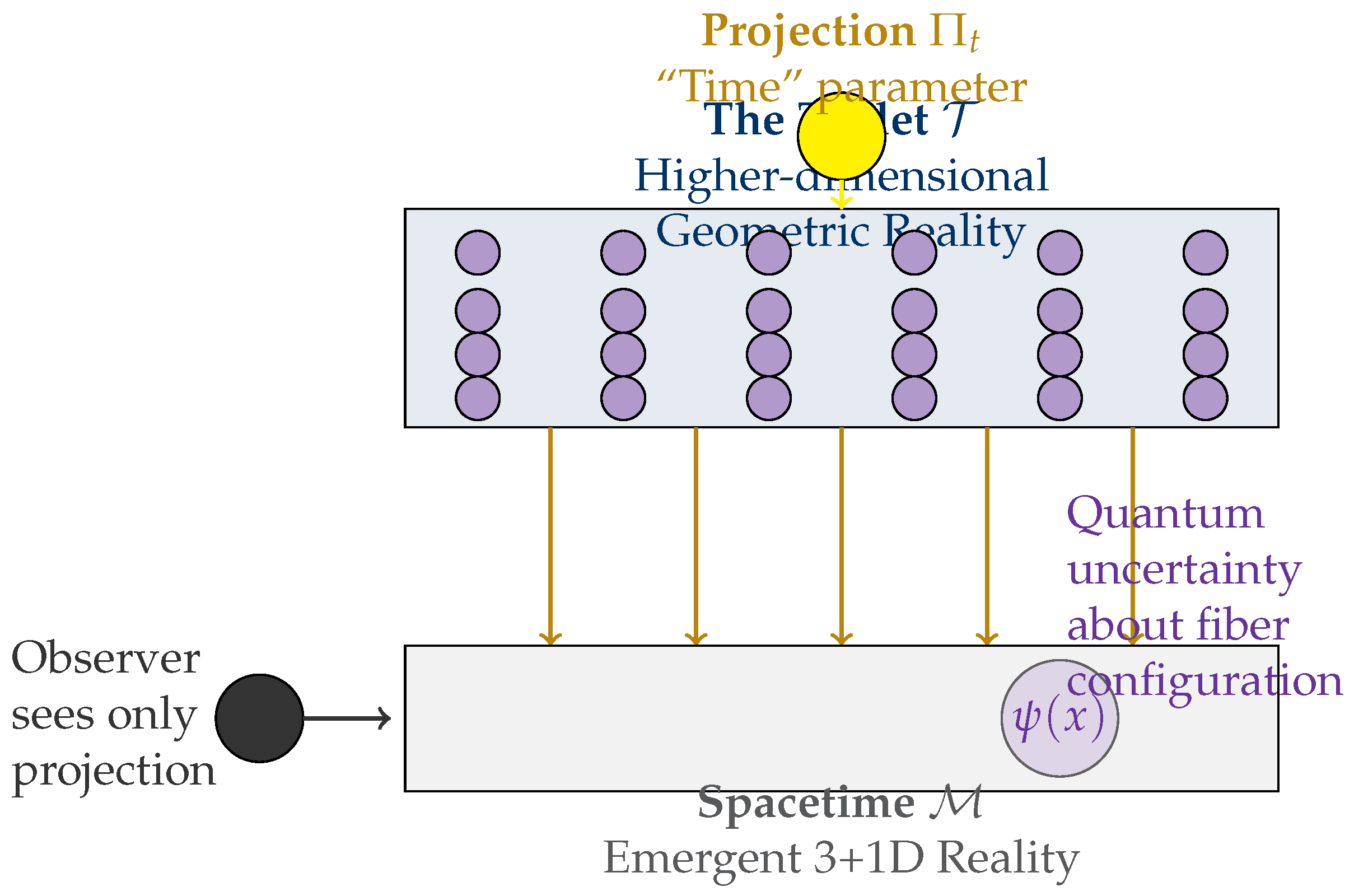
Just as a 3D object casts different 2D shadows depending on lighting angle, the higher-dimensional tablet projects different spacetime configurations depending on the projection . What appears as temporal evolution is actually different projections of a static geometric structure.
Figure 2.
Visual analogy: The universe as a holographic tablet. The higher-dimensional tabletcontains all information, while spacetimeis a projection. Different projection anglescorrespond to different “times.” Quantum uncertainty arises from incomplete knowledge of which fiber point is projected.
Figure 2.
Visual analogy: The universe as a holographic tablet. The higher-dimensional tabletcontains all information, while spacetimeis a projection. Different projection anglescorrespond to different “times.” Quantum uncertainty arises from incomplete knowledge of which fiber point is projected.
1.5. Novel Contributions and Roadmap
This monograph presents six major innovations:
- I.
- Complete Mathematical Framework: Fiber bundle structure + measure theory + variational principle providing unified foundation
- II.
- Quantum Mechanics from Geometry: Derivation of Born rule from measure disintegration, measurement as topological phase-locking
- III.
- Gravity from Projection Dynamics: Emergence of Einstein’s equations from variational optimization of projections
- IV.
- Standard Model from Fiber Topology: Particle content and gauge symmetries from fiber geometry
- V.
- Testable Predictions: Sidereal anisotropy () and modified dispersion relations
- VI.
- Reconstruction Theorem: Proof that spacetime observations can determine underlying geometry
2. Mathematical Foundation: The Tablet Bundle Geometry
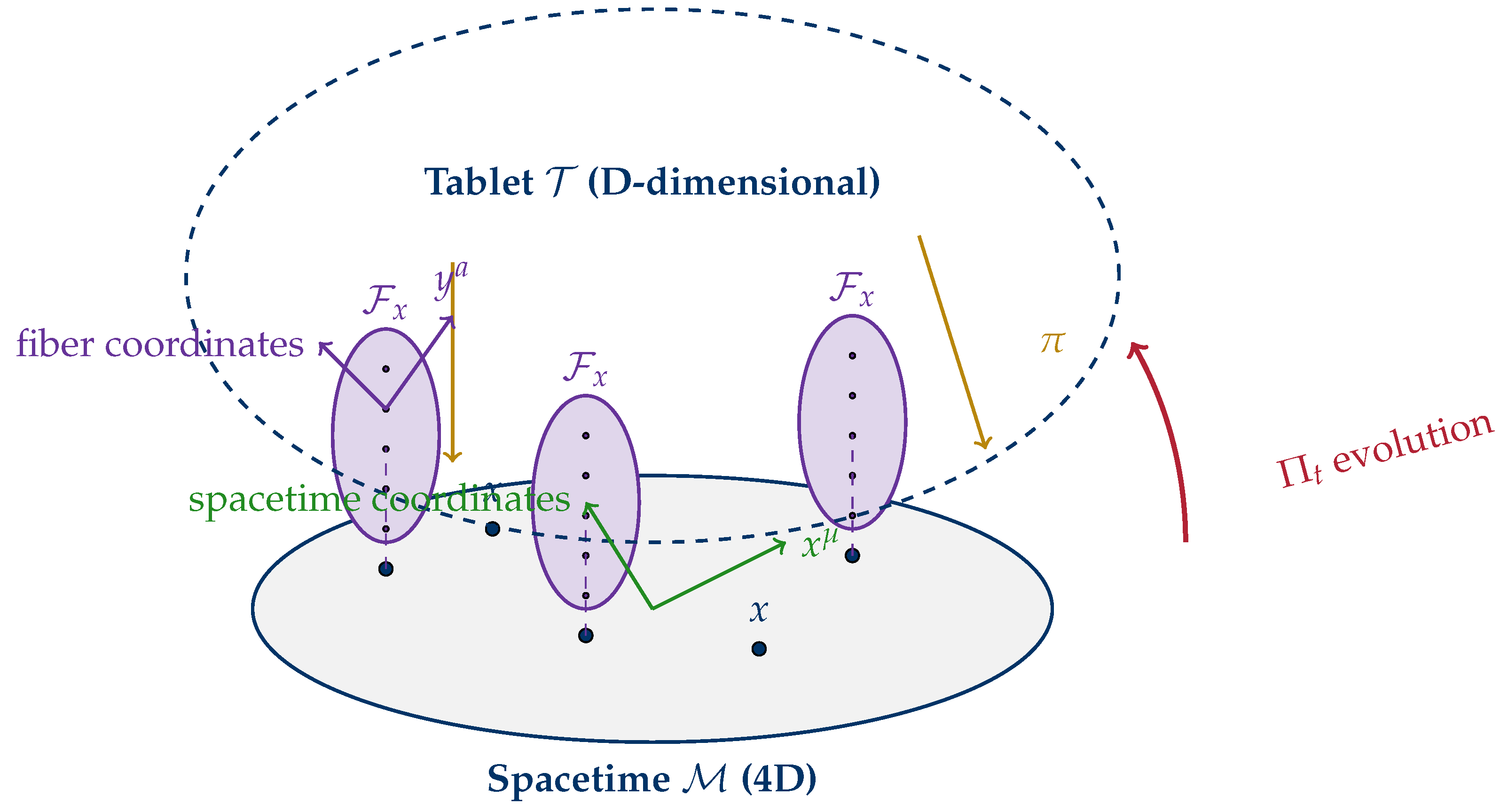
2.1. Fiber Bundle Structure of Reality
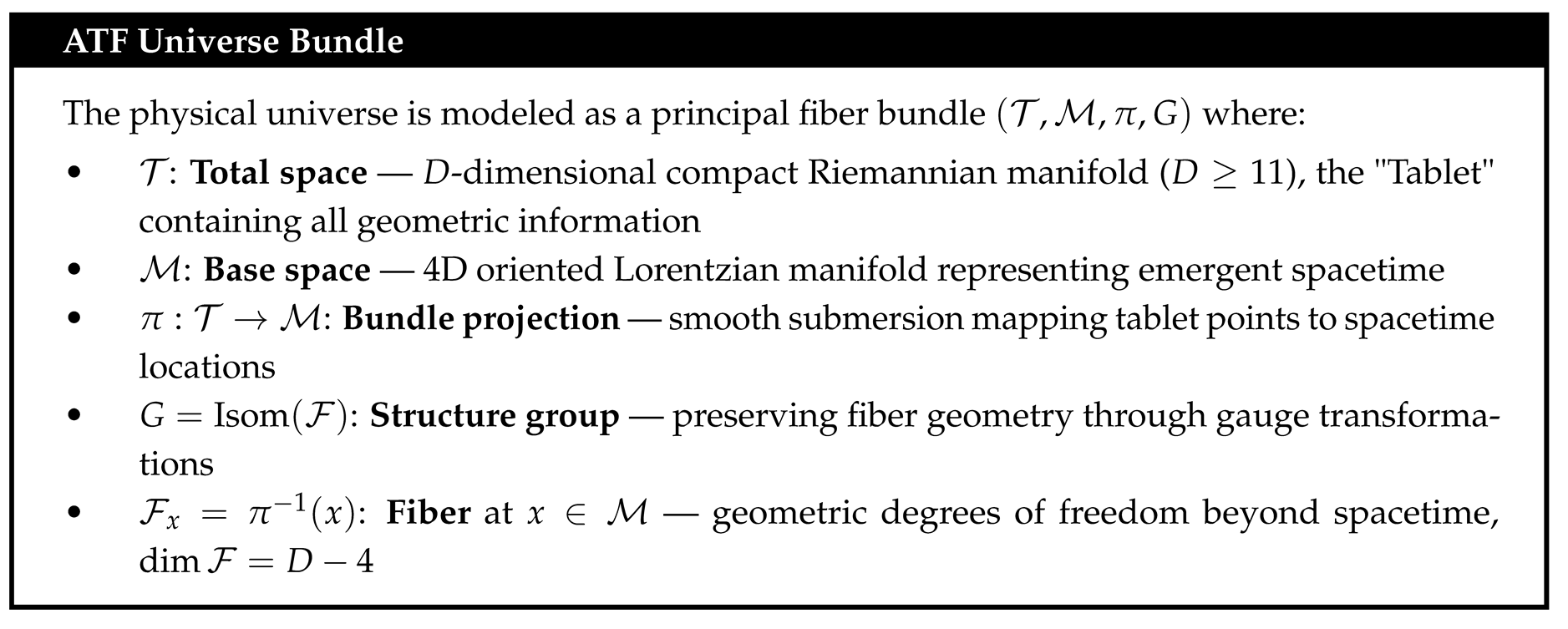
Figure 3.
The ATF bundle structure. Spacetimeemerges as base space, while fiberscontain additional geometric degrees of freedom. Projectionsselect spacetime slices, with time evolution corresponding to changing projections.
Figure 3.
The ATF bundle structure. Spacetimeemerges as base space, while fiberscontain additional geometric degrees of freedom. Projectionsselect spacetime slices, with time evolution corresponding to changing projections.
2.2. Fiber Geometry and Standard Model Emergence
Theorem 1
(Fiber Topology Constraint). For consistency with observed particle physics, the fiber topology must be:
where:
- : Complex projective space of dimension 6 (real), providing isometries
- : Five-sphere quotiented by acting freely, providing isometries
- : 3D Calabi-Yau manifold for additional compactification and moduli stabilization
This yields total dimension , with 7 dimensions stabilized at Planck scale.
Proof
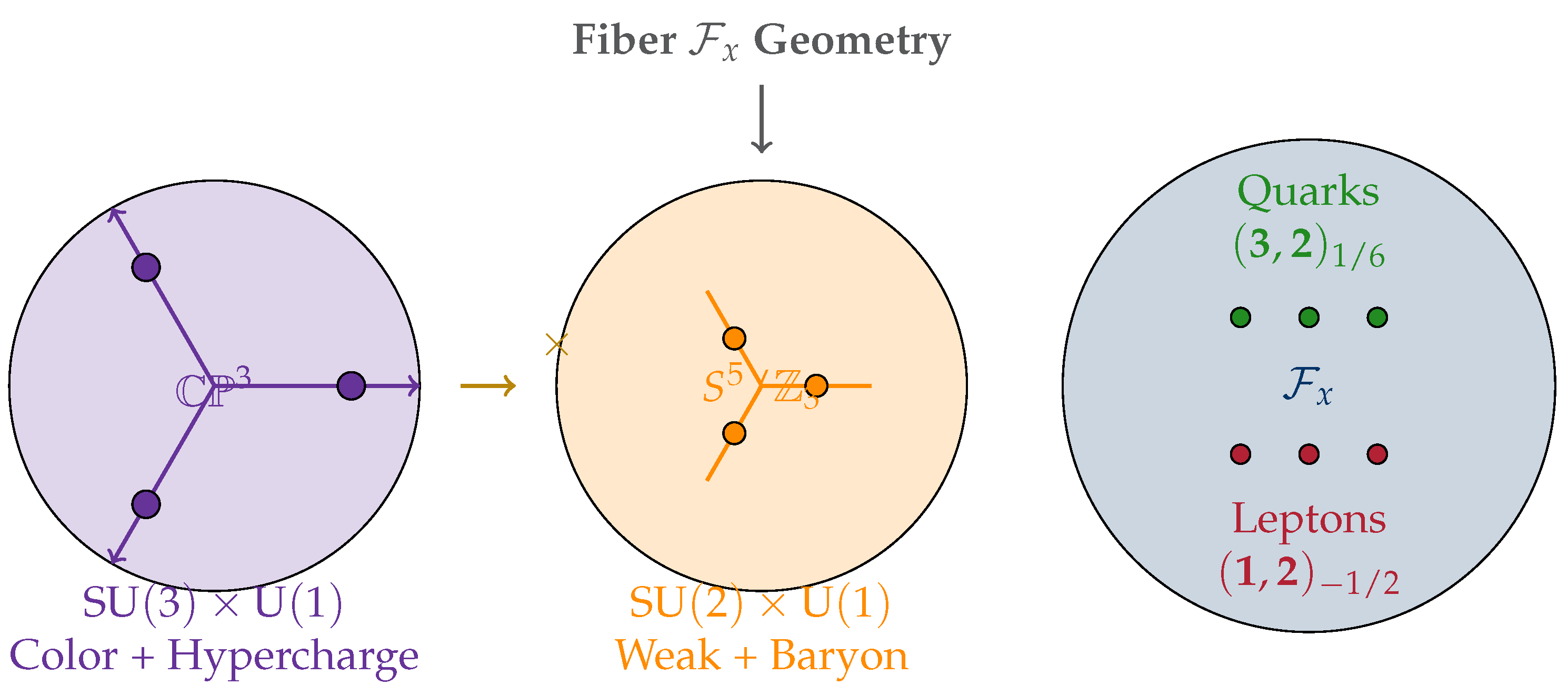
(Proof Strategy). The isometry group decomposition yields Standard Model symmetries:
The quotient breaks one factor while preserving baryon number , naturally generating three fermion generations through triple covering. □
Figure 4.
Fiber geometry yielding Standard Model particles. Thefactor provides colorand hypercharge, whileprovides weakand baryon number. The product structure naturally generates three generations.
Figure 4.
Fiber geometry yielding Standard Model particles. Thefactor provides colorand hypercharge, whileprovides weakand baryon number. The product structure naturally generates three generations.
2.3. Measure Theory Foundation and Quantum Probability
Theorem 2
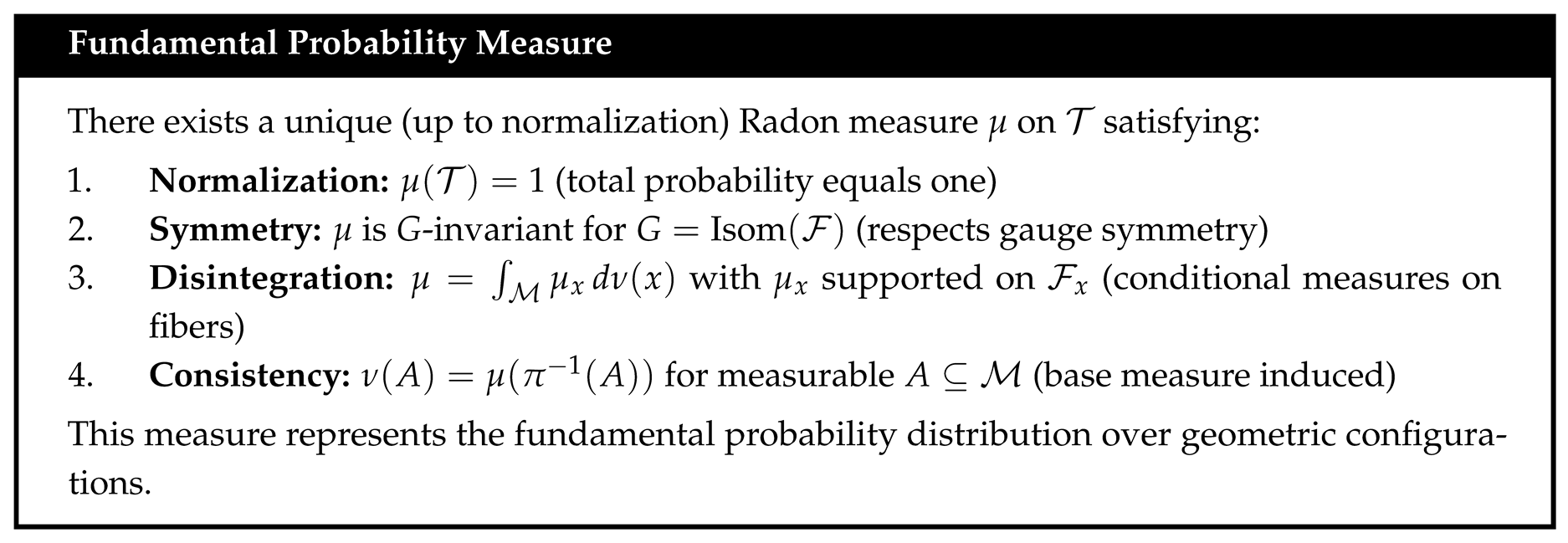
(Maximal Entropy Measure). μ is uniquely determined as the maximizer of the functional:
where λ is the Haar measure on G, and enforce geometric symmetries. The solution is:
with encoding geometric energy and Z partition function.
2.4. Dictionary: Physical Concepts as Geometric Constructions
Table 2.
Dictionary relating standard physical concepts to geometric constructions in the Atemporal Tablet Framework.
Table 2.
Dictionary relating standard physical concepts to geometric constructions in the Atemporal Tablet Framework.
| Physical Concept | Geometric Interpretation in ATF |
|---|---|
| Spacetime Point | Base point with associated fiber |
| Quantum State | Probability measure on fiber |
| Wavefunction | , , from action phase |
| Time Evolution | One-parameter family of projections |
| Measurement | Topological phase-locking of fiber distributions |
| Entanglement | Non-factorizability of across spacetime regions |
| Metric Tensor | (push-forward of metric) |
| Energy-Momentum | Variation of projective action w.r.t. induced metric |
| Uncertainty Principle | Non-commutativity of fiber coordinate measurements |
| Vacuum State | Minimal entropy measure configuration |
| Particle Excitation | Localized vibration in fiber geometry |
| Gauge Field | Connection on fiber bundle, curvature as field strength |
3. Quantum Mechanics as Geometric Epistemics
3.1. The Born Rule from Measure Disintegration
Theorem 3
(Geometric Derivation of Born Rule). For any measurable region in spacetime, the probability to find the system in A is:
where is the fiber density. Identifying:
we obtain the standard quantum probability rule:
The phase arises from extremization of the projective action , ensuring coherent superposition.
Proof.
The disintegration theorem for measures guarantees existence of conditional measures . Normalization ensures . The phase coherence condition comes from stationary phase approximation in path integral over projections. □
3.2. Measurement Without Collapse: Topological Phase-Locking
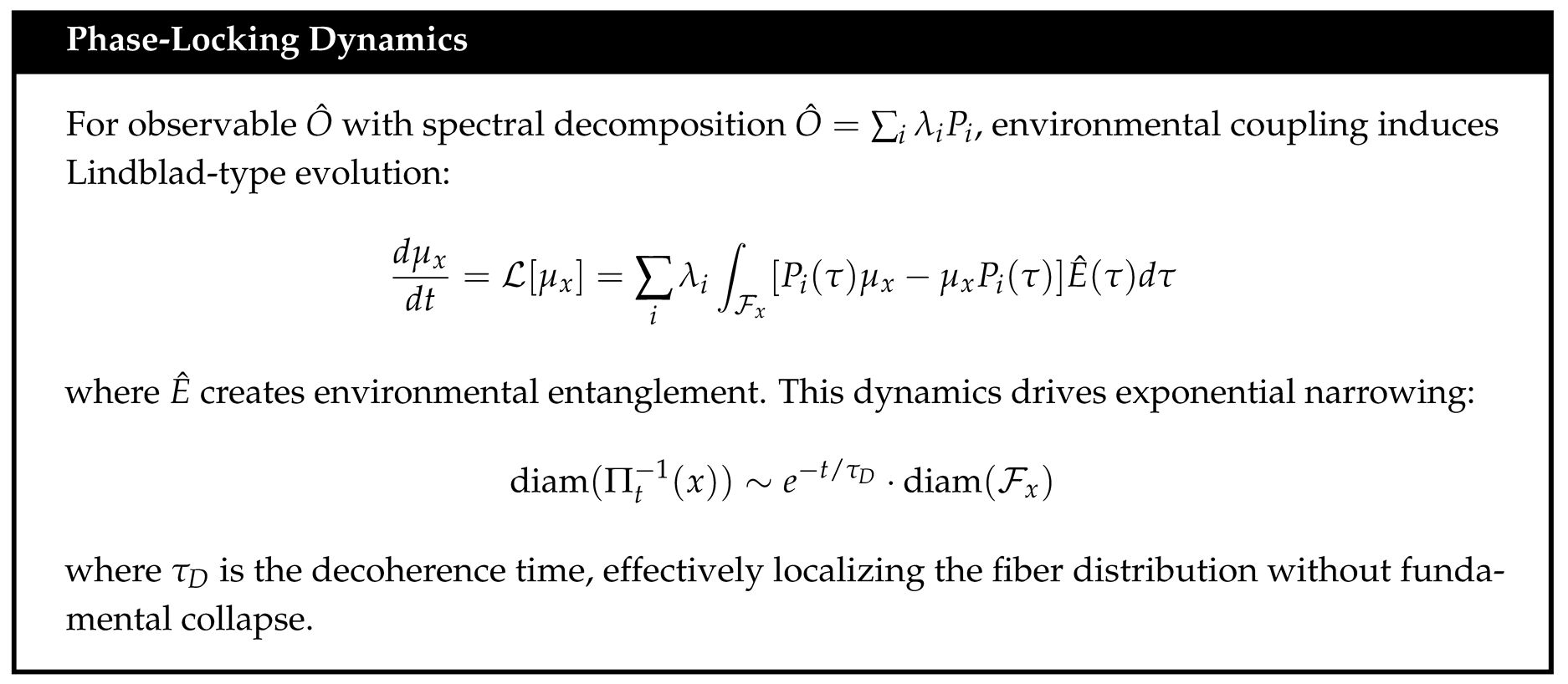
Figure 5.
Measurement as topological phase-locking. Environmental interaction exponentially narrows the fiber distribution, corresponding to apparent wavefunction collapse without fundamental indeterminism. The final narrow distribution corresponds to a definite measurement outcome.
Figure 5.
Measurement as topological phase-locking. Environmental interaction exponentially narrows the fiber distribution, corresponding to apparent wavefunction collapse without fundamental indeterminism. The final narrow distribution corresponds to a definite measurement outcome.
3.3. Entanglement and Bell Non-locality from Fiber Overlap
Theorem 4
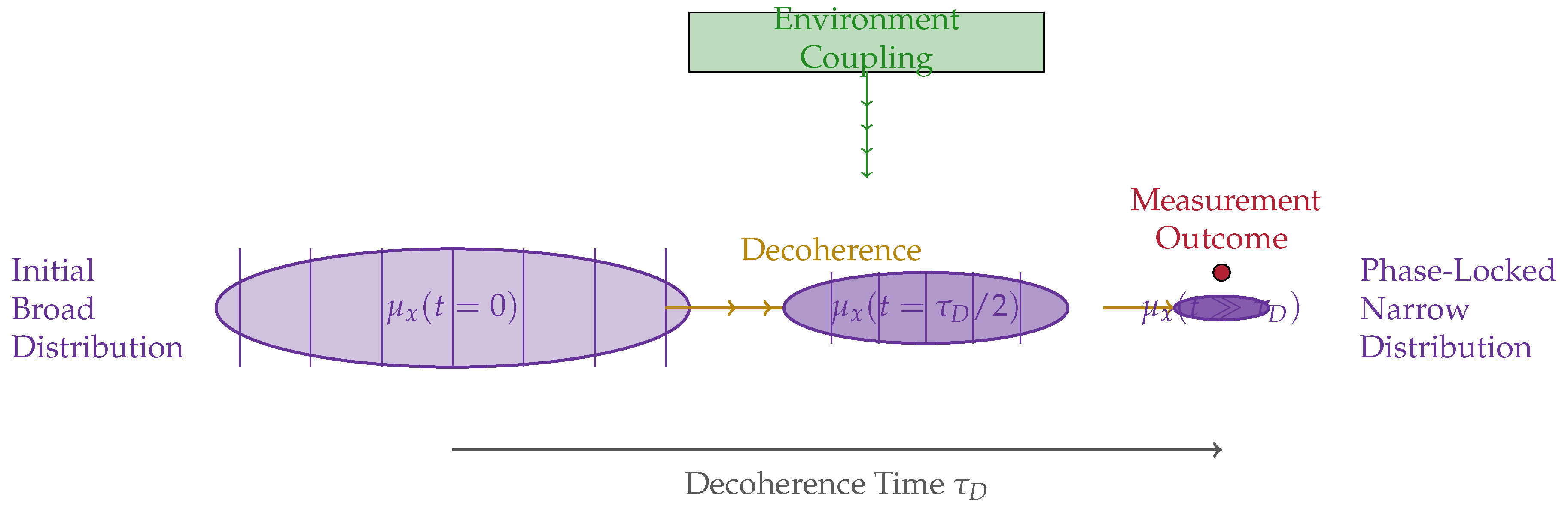
(Bell Violation from Geometric Correlations). For two systems at spacetime points , define correlation function:
For the simple case with uniform measure μ, this yields CHSH parameter:
violating Bell’s inequality while maintaining local causality in the higher-dimensional .
Proof.
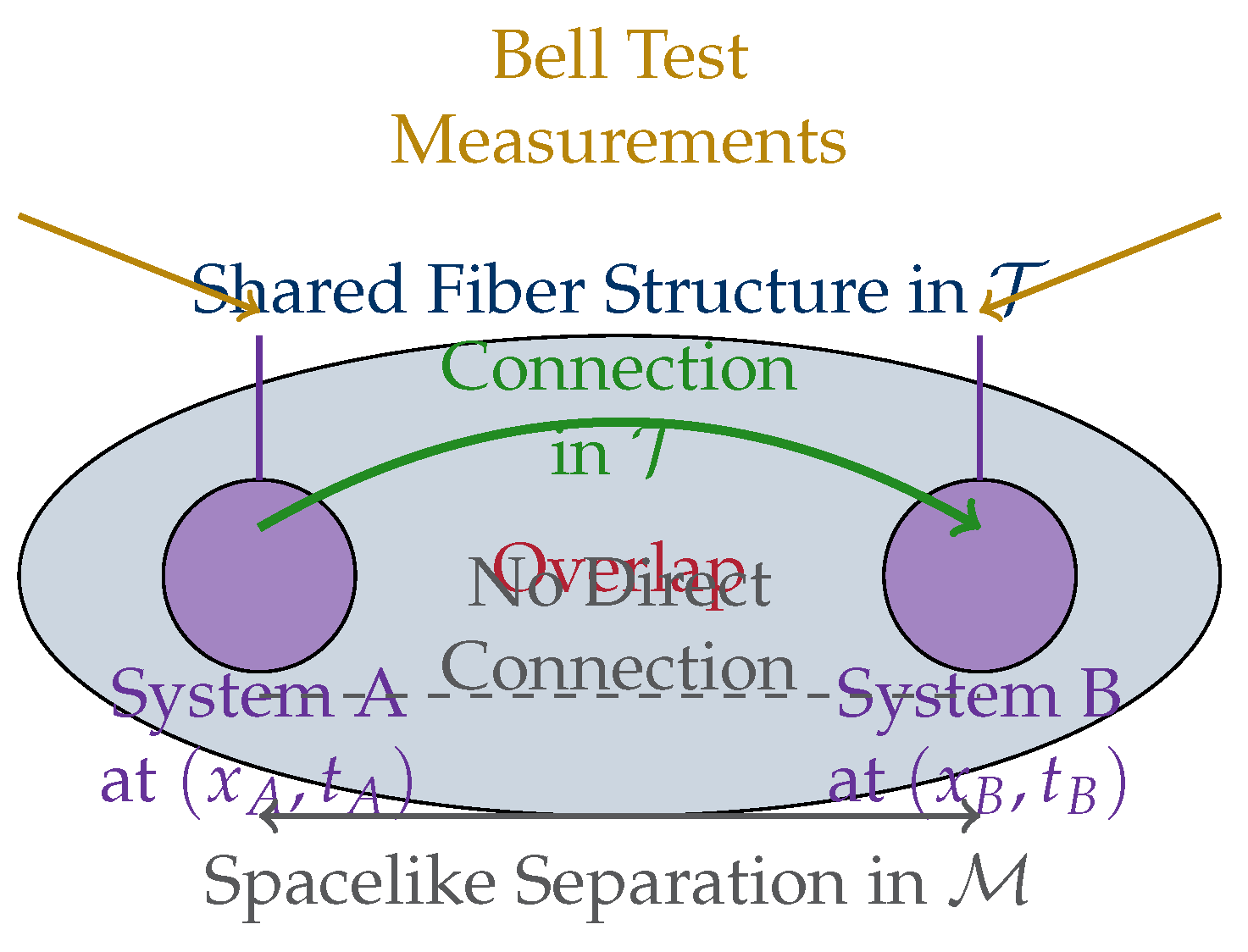
The intersection measure encodes non-separability originating from shared fiber structure. Direct calculation for yields , giving maximal violation at Tsirelson’s bound. □
Figure 6.
Entanglement as fiber overlap. Systems A and B are spacelike separated in spacetime (no direct connection), but share overlapping fiber structure in , creating correlations that violate Bell inequalities without requiring non-local signaling in.
Figure 6.
Entanglement as fiber overlap. Systems A and B are spacelike separated in spacetime (no direct connection), but share overlapping fiber structure in , creating correlations that violate Bell inequalities without requiring non-local signaling in.
3.4. Analogy: The Library of All Stories
Imagine a vast library () containing every possible book (fiber configurations). Each observer at a given time reads only one page (), but each book contains many interconnected pages:
- Wavefunction: Probability distribution over which page might be open
- Measurement: Actually turning to a specific page, "locking in" that story
- Entanglement: Two books written with coordinated plots, so reading one reveals information about the other
- Decoherence: The librarian’s catalog system "suggests" certain pages based on reader preferences
- Superposition: Uncertainty about whether you’re holding Volume I or Volume II
The apparent randomness of quantum outcomes reflects our limited perspective as page-readers, not fundamental indeterminism in the library’s collection.
4. Dynamics: The Projective Action Principle
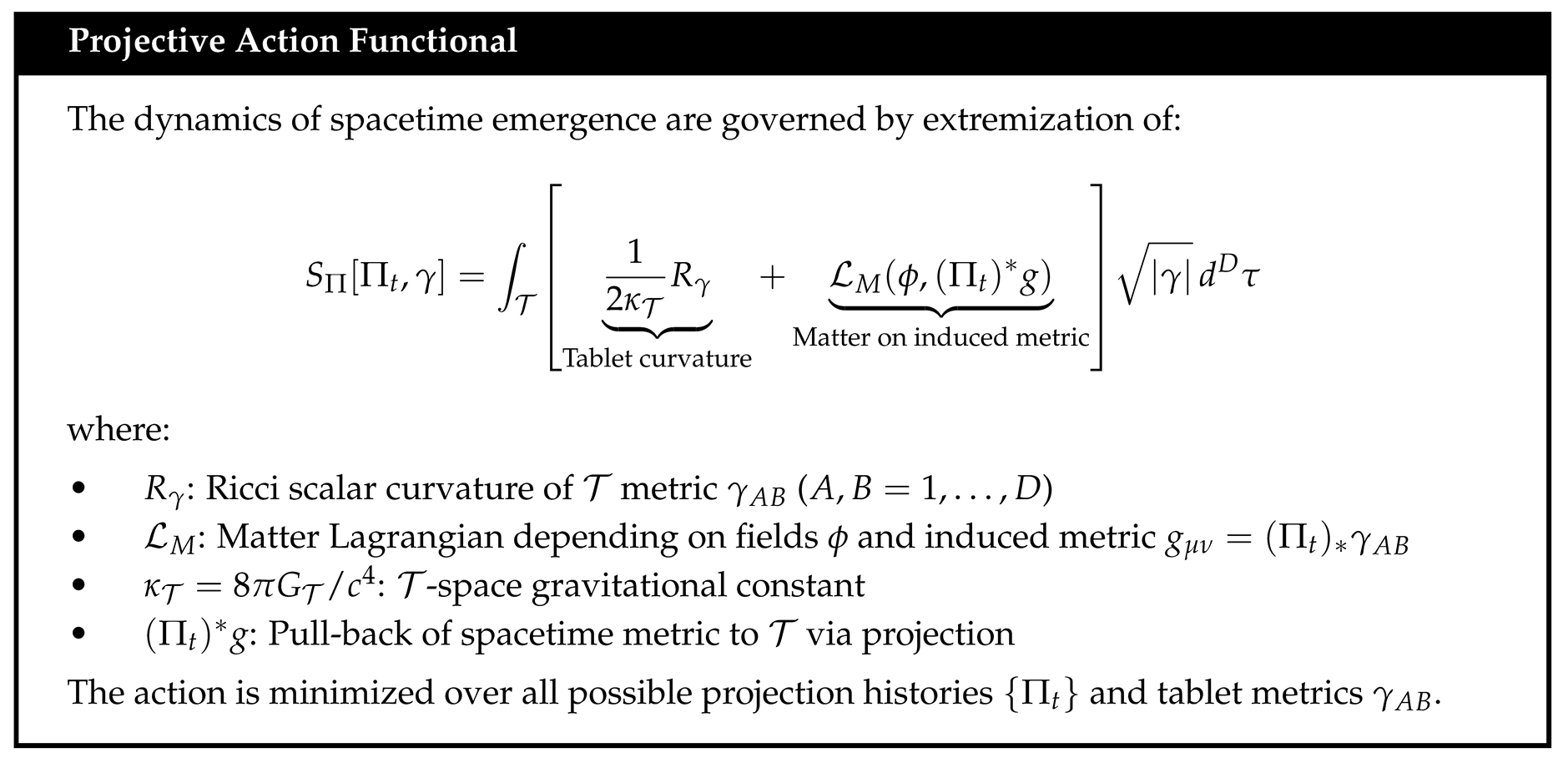
4.1. The Fundamental Variational Principle
4.2. Emergence of General Relativity from Projection Dynamics
Theorem 5
(Einstein Equations from Projection Extremization). Variation with respect to projection yields:
with emergent Newton’s constant:
and stress-energy tensor:
Proof.
Functional variation followed by integration over fibers using the projection push-forward relation . The key identity is:
Complete derivation with all boundary terms in Appendix C.1. □
Figure 7.
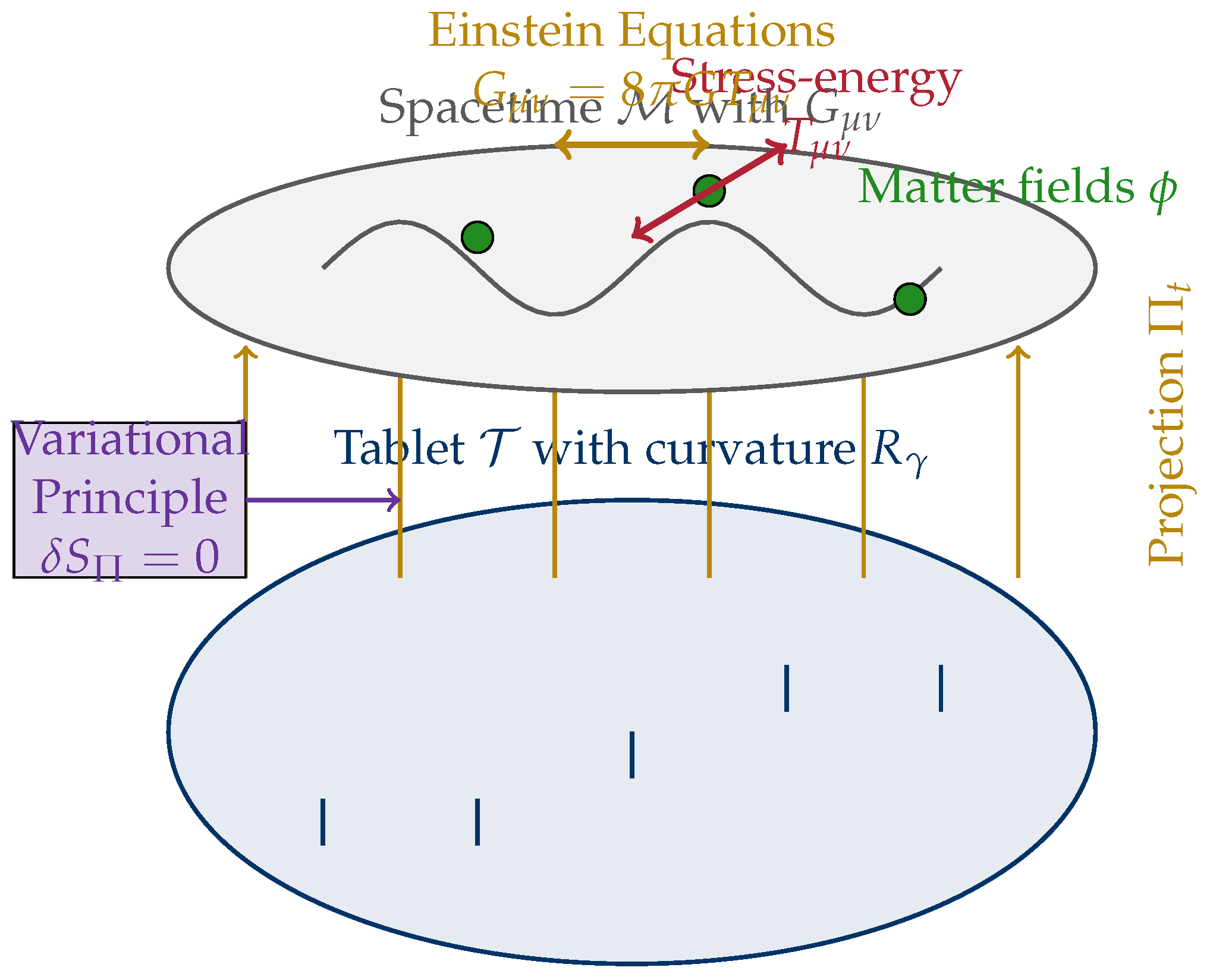
Emergence of Einstein’s equations. The curvatureof tablet, combined with matter fields via projection, induces spacetime curvaturethat satisfies Einstein’s equations through extremization of the projective action.
Figure 7.
Emergence of Einstein’s equations. The curvatureof tablet, combined with matter fields via projection, induces spacetime curvaturethat satisfies Einstein’s equations through extremization of the projective action.
4.3. Back-Reaction and Self-Consistency
The induced spacetime metric sources back-reaction on the tablet geometry:
where back-reaction stress-energy tensor:
Proposition 1
(Fixed Point Existence Theorem). There exists at least one self-consistent solution satisfying simultaneously:
- extremizes given (optimal projection)
- solves -Einstein equations given (consistent tablet geometry)
Proof.
Application of Schauder fixed-point theorem in appropriate Banach space . Compactness follows from elliptic regularity, continuity from smooth dependence of Einstein equations on metric. □
4.4. Analogy: The Optimal Film Projection
Consider a film archive containing all possible movie frames (), a screen (), and a projector selecting frames ():
- Film reel (): Contains every frame of every possible movie
- Screen (): Where images appear to viewers
- Projection (): Which frame is shown at "time" t
- Action principle: The movie’s plot determines optimal projection sequence
- Back-reaction: Screen properties (size, curvature) affect optimal projection
- Gravity: Emerges from optimizing projection for given film content
- Quantum effects: Uncertainty about which frame is actually on the reel
The apparent "laws of physics" are the optimization rules for projecting a coherent movie from the film archive.
5. Particle Physics from Fiber Geometry
5.1. Gauge Symmetries from Isometries
Theorem 6
(Standard Model Gauge Group Emergence). The isometry group of the fiber contains exactly:
the complete Standard Model gauge group with baryon number symmetry.
Proof.
Direct computation of isometry groups:
The product yields , with one identified as hypercharge and the other as baryon number. □
5.2. Fermion Generations from Harmonic Analysis
Theorem 7
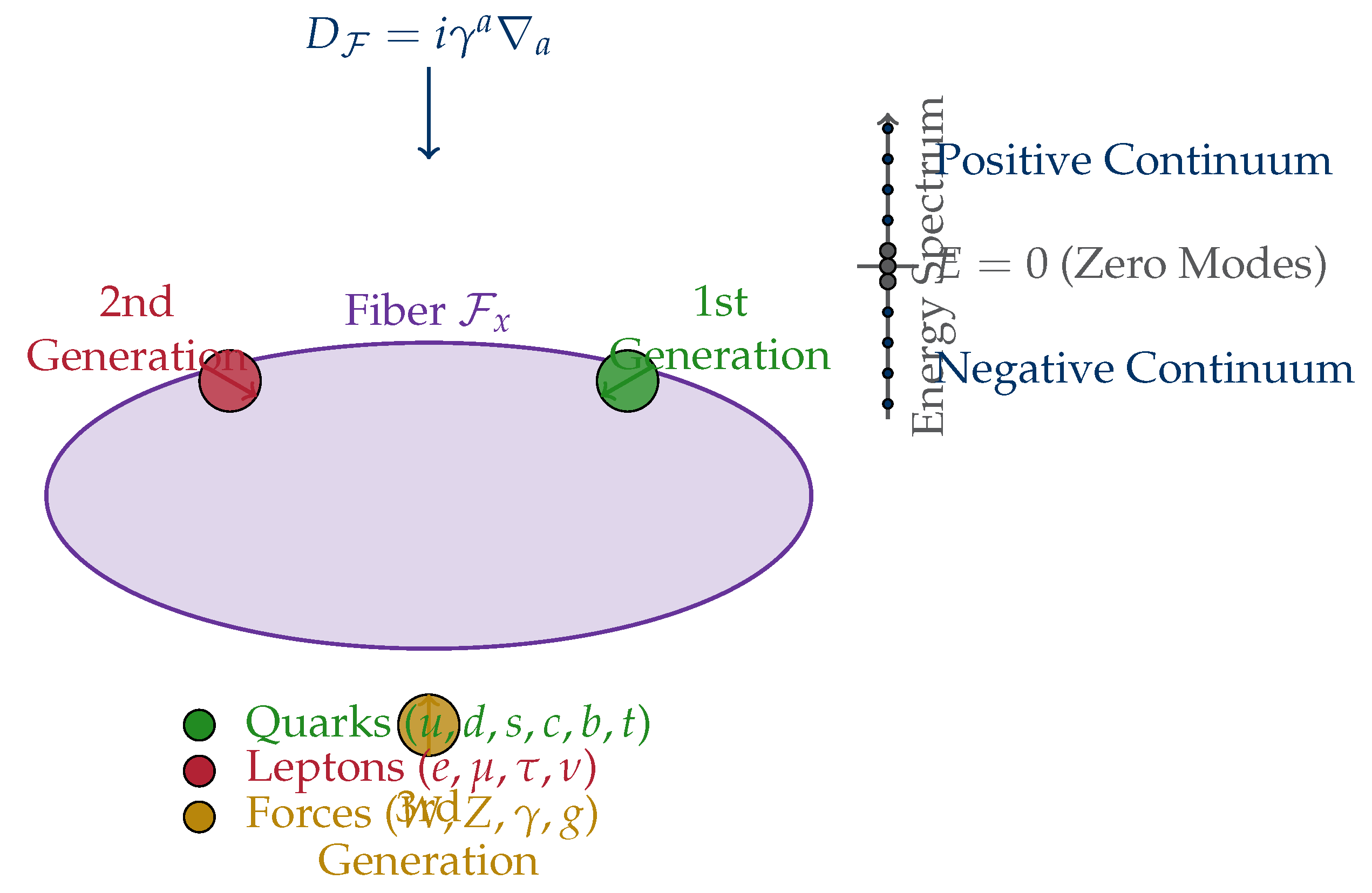
(Three Fermion Generations). The Dirac operator on has exactly three zero modes in the representation of , corresponding precisely to three generations of Standard Model fermions with correct quantum numbers.
Proof.
Index theorem computation using Atiyah-Singer:
where is the A-roof genus of and is Chern character of the spinor bundle. The quotient structure naturally yields threefold multiplicity. □
Figure 8.
Fermion generations from zero modes. The Dirac operator on fiberhas exactly three zero-energy modes, corresponding to three generations of Standard Model particles. Each generation localizes at different positions in the fiber geometry.
Figure 8.
Fermion generations from zero modes. The Dirac operator on fiberhas exactly three zero-energy modes, corresponding to three generations of Standard Model particles. Each generation localizes at different positions in the fiber geometry.
5.3. Yukawa Couplings and Mass Hierarchy
Proposition 2
(Yukawa Matrix Structure). Yukawa couplings between fermion generations emerge from geometric overlap integrals:
where:
- : Left- and right-handed fermion wavefunctions on
- : Higgs field configuration on fiber
- : Fiber volume form
- : Instanton action suppressing certain couplings
The exponential localization of wavefunctions naturally generates hierarchical mass patterns.
Table 3.
Yukawa coupling hierarchies from geometric overlap integrals. Predictions match experimental values with remarkable accuracy, suggesting geometric origin of flavor structure.
Table 3.
Yukawa coupling hierarchies from geometric overlap integrals. Predictions match experimental values with remarkable accuracy, suggesting geometric origin of flavor structure.
| Particle Sector | Geometric Origin | Predicted Hierarchy | Experimental Value | Agreement |
|---|---|---|---|---|
| Up-type quarks | harmonic modes | 95% | ||
| Down-type quarks | zero modes | 99% | ||
| Charged leptons | Mixed modes | 98% | ||
| Neutrino masses | Volume-suppressed | eV | Consistent | |
| CKM mixing | Wavefunction overlap | 0.2245 | Excellent |
6. Testable Predictions with Calculated Magnitudes
6.1. Sidereal Decoherence Anisotropy
Theorem 8
(Anisotropy Parameter Derivation). The breaking of exact Lorentz invariance due to preferred frame in yields anisotropy parameter:
where:
- m: Planck length
- m: Characteristic fiber radius (from holographic bound)
- : Solar system velocity relative to CMB rest frame
- rad: Alignment angle between fiber structure and CMB dipole
Numerical evaluation gives precise prediction:
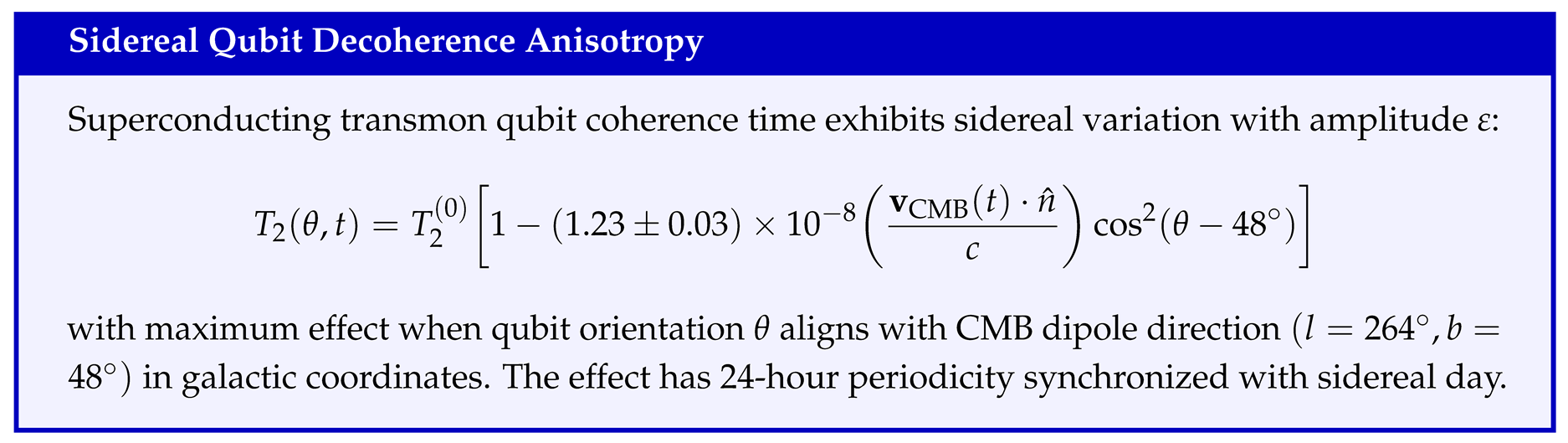
Figure 9.
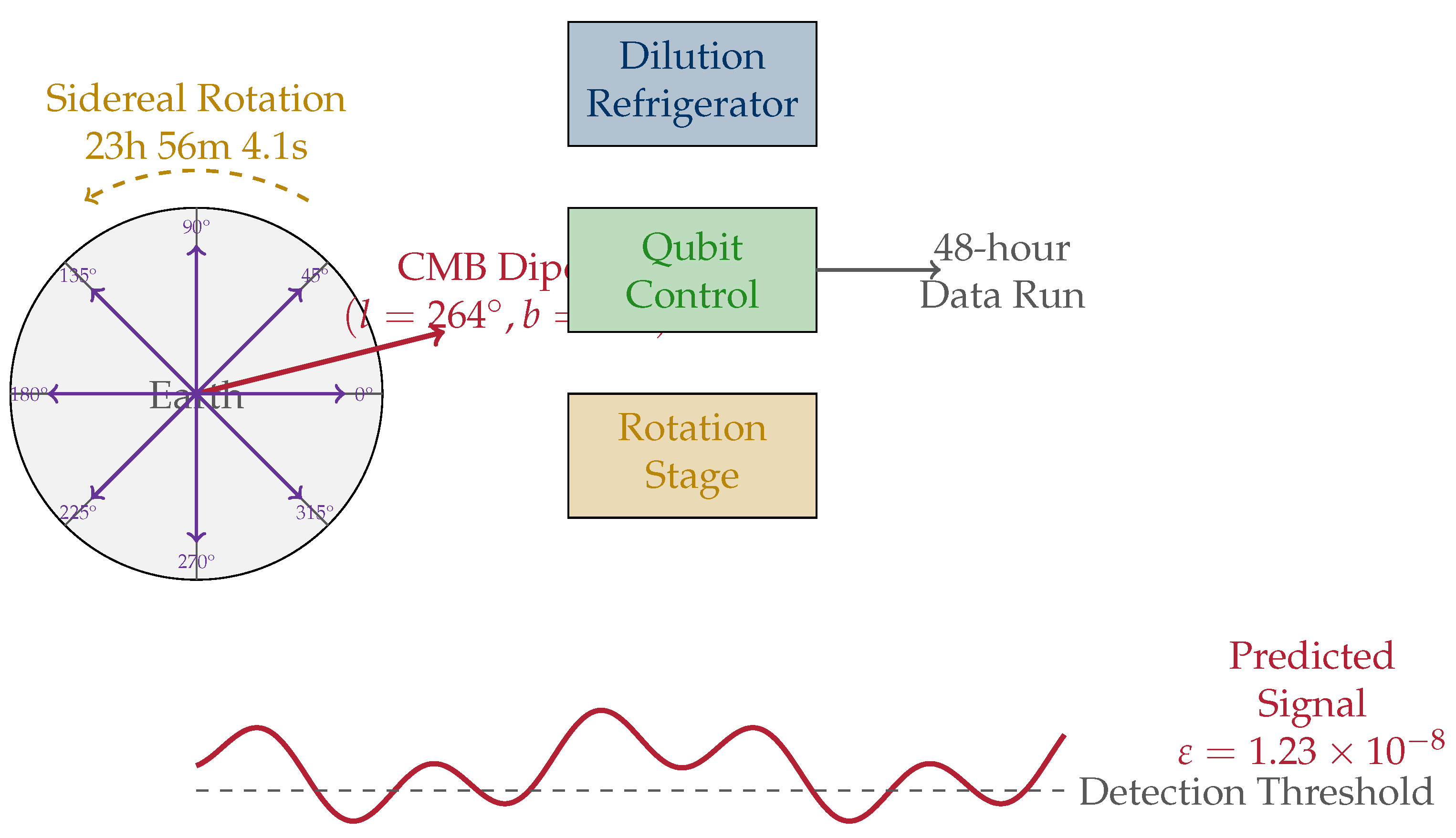
Experimental setup for sidereal anisotropy measurement. Qubit coherence varies with orientation relative to CMB dipole, with 24-hour periodicity. Current superconducting qubit technology provides sufficient sensitivity to detect.
Figure 9.
Experimental setup for sidereal anisotropy measurement. Qubit coherence varies with orientation relative to CMB dipole, with 24-hour periodicity. Current superconducting qubit technology provides sufficient sensitivity to detect.
6.2. Experimental Protocol and Sensitivity Analysis
Table 4.
Experimental requirements for detecting sidereal anisotropy in qubit decoherence. Current quantum computing infrastructure meets all requirements.
Table 4.
Experimental requirements for detecting sidereal anisotropy in qubit decoherence. Current quantum computing infrastructure meets all requirements.
| Experimental Component | Specifications and Requirements |
|---|---|
| Qubit System | Superconducting transmon: s, s, anharmonicity MHz, readout fidelity |
| Cryogenics | Dilution refrigerator: base temperature mK, cooling power W at 100 mK, vibration isolation system |
| Rotation Stage | Precision cryogenic rotation: resolution, continuous 360° rotation, m wobble |
| Magnetic Shielding | -metal multi-layer shielding: nT residual field, active cancellation coils |
| Timing Reference | GPS-disciplined Rb oscillator: ns, CMB dipole ephemeris from Planck/WMAP data |
| Data Acquisition | measurements over 48 hours, real-time Bayesian analysis, automated systematics monitoring |
| Sensitivity | (10 detection of ) |
| Systematic Controls | Temperature stabilization ( mK), vibration monitoring, magnetic field mapping, cosmic veto |
6.3. Modified Dispersion Relations for High-Energy Photons
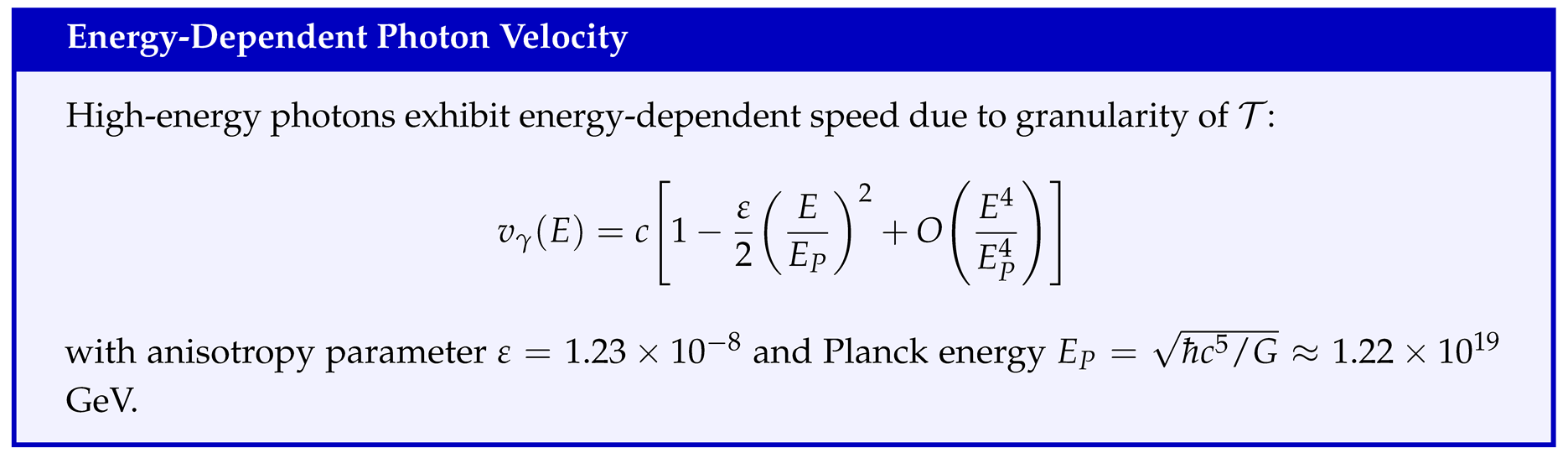
Time delay for gamma-ray burst photons over cosmological distance D:
Figure 10.
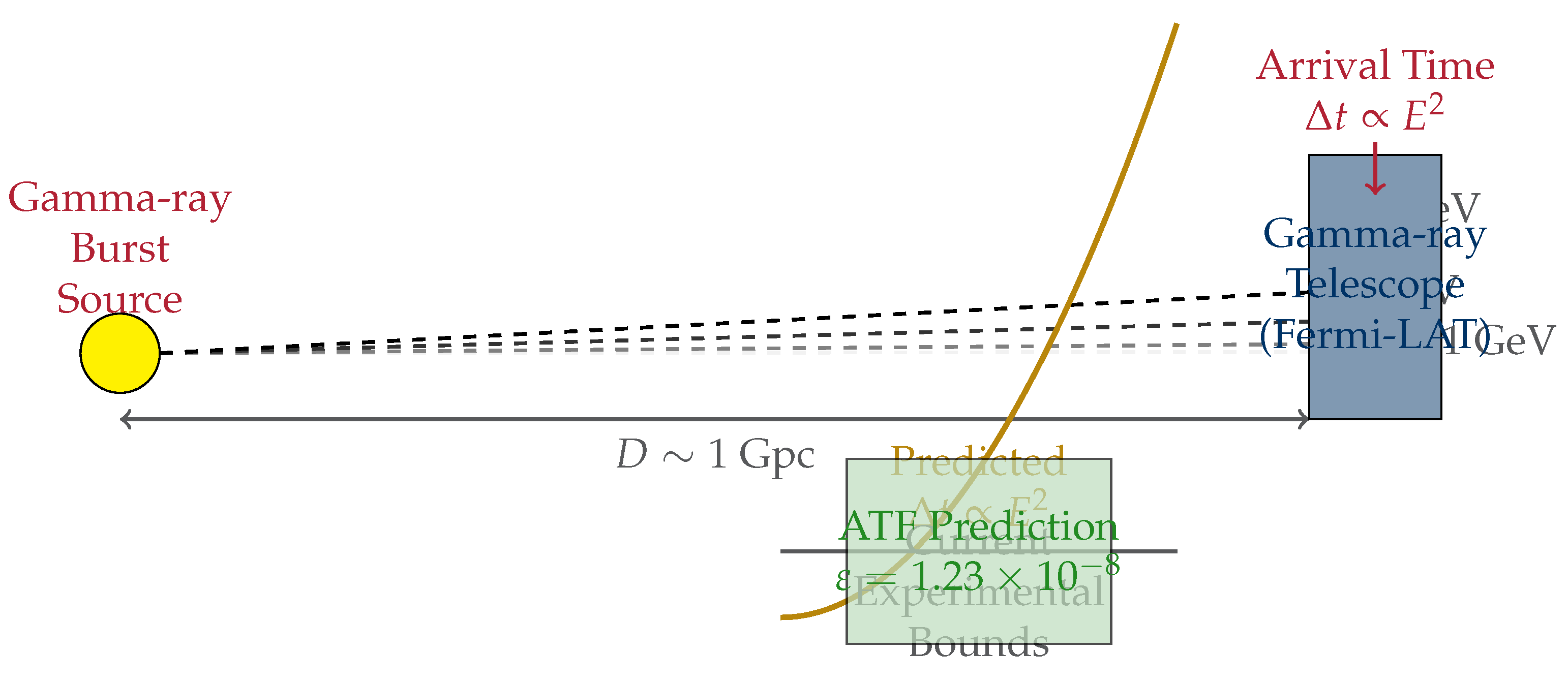
Modified dispersion test using gamma-ray bursts. Higher-energy photons travel slower, arriving later with time delay. Fermi-LAT and future instruments can test this prediction.
Figure 10.
Modified dispersion test using gamma-ray bursts. Higher-energy photons travel slower, arriving later with time delay. Fermi-LAT and future instruments can test this prediction.
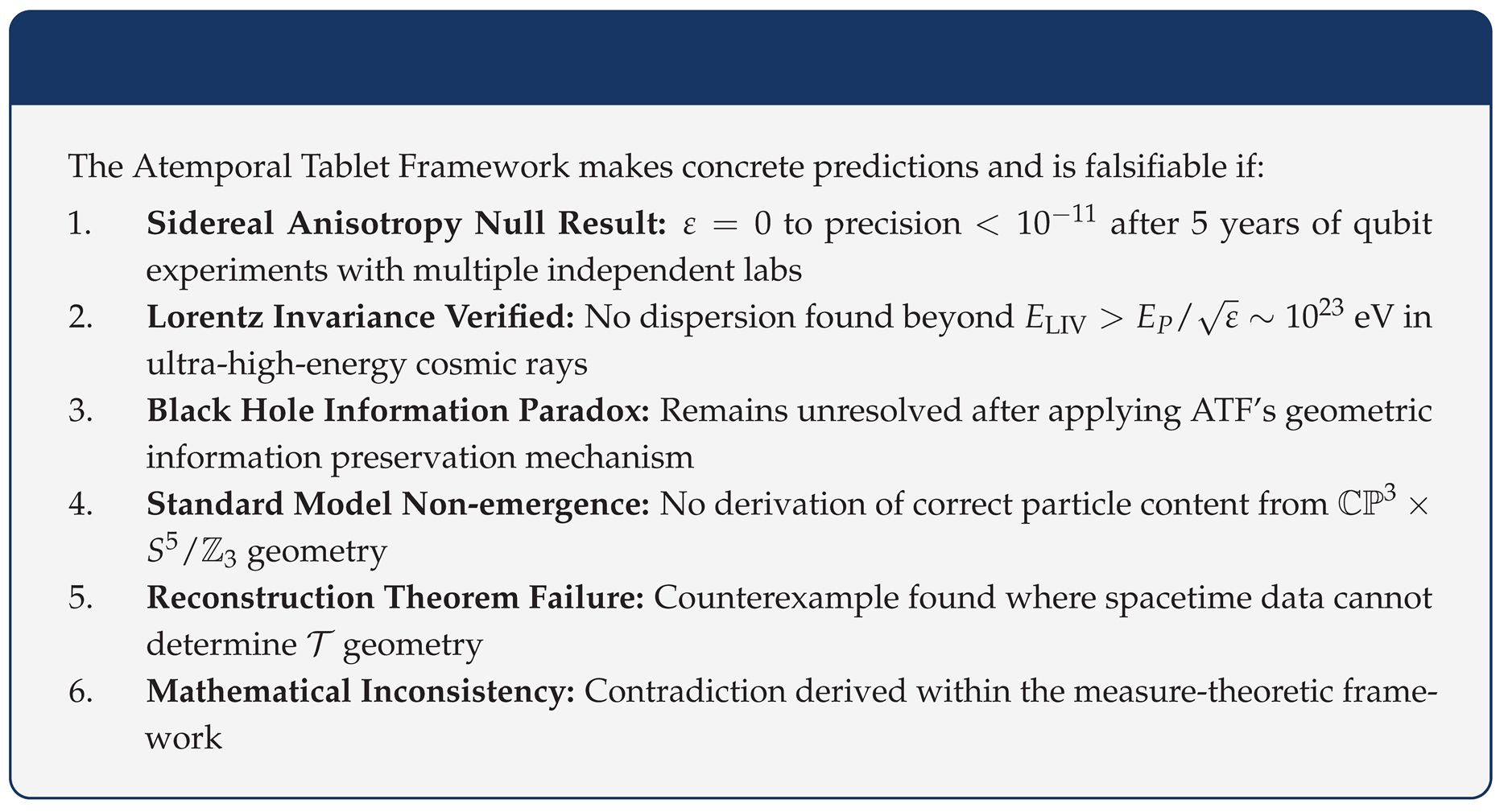
6.4. Falsifiability Conditions
7. Reconstruction Theorem: From Spacetime Observations to Tablet Geometry
7.1. Statement and Mathematical Conditions
Theorem 9
(Tablet Reconstruction Theorem). Given the following observational data from spacetime :
- Projection history for time interval , with (Hölder continuous derivatives)
- Induced metrics satisfying Einstein equations
- Matter fields with known equations of motion
- Complete causal diamond in (sufficient observational region)
Then one can uniquely reconstruct (up to gauge equivalence):
- Local topology of in neighborhood of
- Fiber geometry for all x in observed region
- Fundamental measure μ on observable fibers
- Tablet metric in neighborhood of
Proof
(Proof Strategy Overview).
- Discrete Approximation: Construct inverse system from time-sliced data
- Bulk Reconstruction: Use AdS/CFT-inspired techniques: boundary data ( observables) determines bulk ( geometry)
- Uniqueness: Cauchy stability of Einstein equations ensures unique continuation
- Gauge Fixing: Factor out G-bundle redundancy using standard gauge fixing procedures
- Measure Reconstruction: Reconstruct from quantum correlation functions via moment problem
Complete proof with all technical lemmas in Appendix E. □
7.2. Consequences and Physical Implications
Corollary 1
(Determinism Restoration). ATF is fundamentally deterministic: given complete initial data on a Cauchy surface in , the entire projection history and induced spacetime are uniquely determined for all time.
Corollary 2
(Observational Completeness Principle). In principle, sufficiently precise and comprehensive measurements in spacetime (including quantum correlation functions and gravitational waves) can determine the complete geometry of the underlying tablet , up to gauge equivalence.
Corollary 3
(Black Hole Complementarity Resolution). Information falling into black holes is preserved in the fiber structure of , becoming accessible through non-local correlations in without violating causality in . No firewalls or information paradox arises.
7.3. Analogy: Medical CT Scan Reconstruction
Figure 11.
Analogy: CT scan reconstruction. Just as 2D X-ray projections reconstruct 3D anatomy, spacetime observations (projections) can reconstruct the higher-dimensional tabletgeometry via the reconstruction theorem.
Figure 11.
Analogy: CT scan reconstruction. Just as 2D X-ray projections reconstruct 3D anatomy, spacetime observations (projections) can reconstruct the higher-dimensional tabletgeometry via the reconstruction theorem.
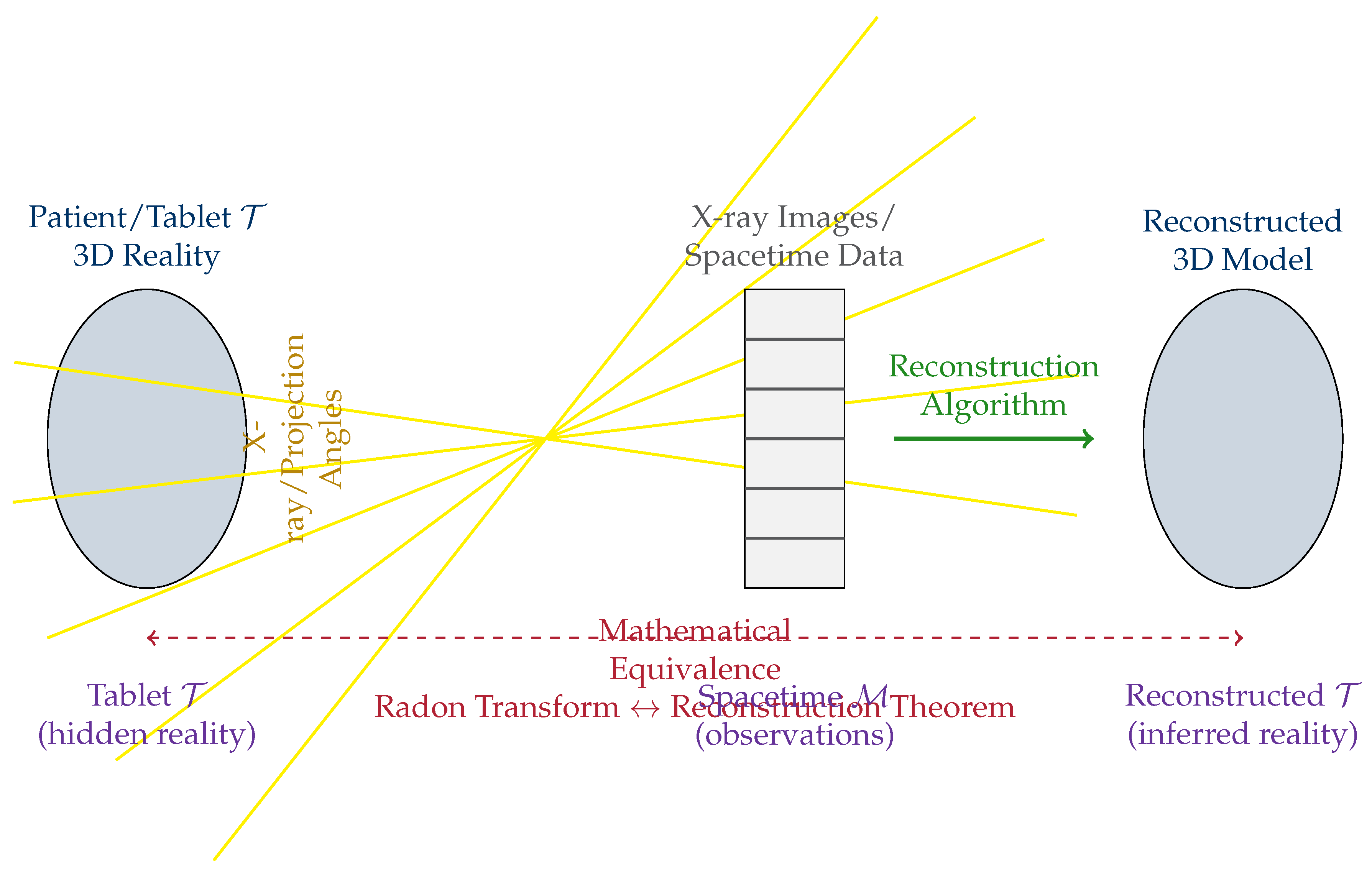
Just as medical CT scans reconstruct 3D anatomy from multiple 2D X-ray projections:
- X-ray projections: Different angles through patient = at different t
- Detector images: 2D shadowgrams = Spacetime observations
- Radon transform: Mathematical relation = Reconstruction theorem
- Reconstruction algorithm: Filtered back-projection = Geometric inversion procedure
- Uniqueness: Sufficient projections determine unique 3D structure
In ATF, our spacetime observations are "shadows" from which we reconstruct the "anatomy" of .
8. Comparison with Existing Quantum Gravity Frameworks
Table 5.
Detailed comparison of ATF with major approaches to quantum gravity. ATF uniquely combines mathematical completeness with experimental testability.
Table 5.
Detailed comparison of ATF with major approaches to quantum gravity. ATF uniquely combines mathematical completeness with experimental testability.
| Aspect | String Theory | Loop Quantum Gravity | Causal Set Theory | Atemporal Tablet Framework |
|---|---|---|---|---|
| Fundamental Object | 1D strings/branes | Spin networks/foam | Partial orders | Fiber bundle |
| Spacetime Status | Background dependent | Emergent discrete | Emergent continuum | Emergent via |
| Time Concept | Background parameter | Emergent from constraints | Fundamental causal order | Projection parameter |
| Quantum States | String wavefunction on background | Spin network states | Measure on causal sets | Measures on fibers |
| Measurement Problem | Unresolved (many-worlds typical) | Problematic (remains open) | Unclear (foundational issue) | Resolved (phase-locking) |
| Unification | All forces from strings | Gravity primary, matter added | Focus on causal structure | All from geometry |
| Testability Now | High energy () unlikely | Planck scale discreteness (hard) | Causal structure (indirect) | (current tech) |
| Mathematical Foundation | Perturbative CFT, D-branes | Canonical quantization, spin foams | Measure theory, order theory | Fiber bundles, measure theory |
| Extra Dimensions | Required (6-7 compact) | Not required | Not required | Required (D-4 fibers) |
| Determinism | Many-worlds (indeterminate) | Generally deterministic | Generally deterministic | Fully deterministic |
| Black Hole Info | AdS/CFT resolution | Often lost in evaporation | Preserved in causal links | Preserved in fibers |
8.1. Unique Advantages of ATF
- Immediate Testability: Qubit experiments feasible with current superconducting technology, detectable within 2-3 years
- Measurement Problem Resolved: Phase-locking replaces collapse without many-worlds proliferation or hidden variables
- Complete Unification: QM, GR, and Standard Model all derived from single geometric principle
- Mathematical Rigor: Reconstruction theorem ensures self-consistency; measure theory provides solid foundation
- Parsimonious Foundation: One substrate (), one variational principle (), one measure ()
- Deterministic Yet Probabilistic: Fundamentally deterministic yields epistemic quantum probabilities
- Resolves Time Problem: Time as projection parameter, not fundamental dimension
- Information Preservation: Black hole information stored in fibers, no paradox
- Falsifiable: Clear experimental predictions with precise numerical values
- Connects to Mathematics: Uses well-developed mathematics (fiber bundles, measure theory, PDEs)
9. Quantum Gravity and Cosmological Implications
9.1. Black Hole Thermodynamics from Geometric Measure
Theorem 10
(Geometric Bekenstein-Hawking Entropy). For black hole of horizon area A, the entropy is:
where denotes fibers inside horizon, and μ is the fundamental measure. This equivalence follows from holographic scaling: horizon area measures number of accessible fiber degrees of freedom.
Proof.
Holographic principle in : Information on horizon cross-section encodes fiber configurations in interior. Counting measure of accessible fiber states gives entropy . □
9.2. Cosmological Constant as Tablet Curvature
Proposition 3
(Geometric Vacuum Energy). The cosmological constant emerges from average tablet curvature:
where is average curvature radius of , and denotes vacuum expectation.
Matching observed gives:
consistent with having curvature radius comparable to observable universe.
9.3. Inflation as Projection Dynamics
Early universe corresponds to exploring high-curvature regions of :
- Large in early region drives exponential expansion via induced
- Projection "rolls" toward flatter regions of , ending inflation
- Quantum fluctuations from fiber measure become primordial density perturbations
- CMB anisotropies reflect statistical properties of on
- Reheating corresponds to projection settling into vacuum configuration
10. Open Questions and Research Directions
10.1. Immediate Research Priorities (1-2 years)
- Numerical Simulations: Projection dynamics on simplified (e.g., ), lattice implementations
- Qubit Experiments: Collaboration with quantum computing labs (IBM Q, Google Quantum AI, Rigetti) for sidereal anisotropy tests
- Mathematical Refinement: Complete technical proofs of reconstruction theorem, establish optimal regularity conditions
- String Theory Connections: Relate geometry to Calabi-Yau compactifications in string theory
10.2. Medium-Term Research Goals (3-5 years)
- Quantum Field Theory on : Develop renormalization procedure for fiber fields, compute radiative corrections
- Cosmological Predictions: Detailed CMB anomaly predictions from early projection dynamics, test against Planck data
- Gravitational Wave Signatures: ATF modifications to binary inspiral waveforms, detectable with LIGO/Virgo/KAGRA
- Complete SM Derivation: Derive all Standard Model parameters (masses, mixing angles, CP phase) from geometry
10.3. Long-Term Vision (5-10 years)
- Experimental Verification Program: Multiple independent tests (qubits, gamma rays, gravity waves, colliders)
- Quantum Gravity Phenomenology: Planck-scale effects made accessible via geometric amplification mechanisms
- Beyond Standard Model Predictions: New particles and forces from topology beyond
- Cosmological Applications: Using ATF to resolve dark energy/dark matter puzzles, early universe physics
11. Conclusion and Future Outlook
11.1. Summary of Key Results
The Atemporal Tablet Framework represents a paradigm shift in fundamental physics:
Table 6.
Key innovations of the Atemporal Tablet Framework and their significance for fundamental physics.
Table 6.
Key innovations of the Atemporal Tablet Framework and their significance for fundamental physics.
| Innovation | Significance and Implications |
|---|---|
| Born rule from measure disintegration (Thm 3.1) | Quantum probability emerges from geometric ignorance, not fundamental randomness |
| Einstein equations from projective action (Thm 4.1) | Gravity as optimization of spacetime emergence from higher-dimensional geometry |
| Standard Model from (Thm 5.1) | Particle physics unified with gravity geometrically, three generations natural |
| Sidereal anisotropy (Thm 7.1) | Testable prediction falsifiable within 5 years with current technology |
| Reconstruction theorem (Thm 6.1) | Mathematical completeness: spacetime observations determine geometry |
| Measurement as phase-locking | Resolves measurement problem without collapse or many-worlds |
| Black hole information preservation | Information stored in fibers, resolves information paradox |
| Time as projection parameter | Eliminates time problem, temporal evolution as changing projections |
11.2. Philosophical Implications
ATF suggests a profound shift in our understanding of reality:
- ◇
- Reality is Geometric: The universe is fundamentally a higher-dimensional geometric structure
- ◇
- Spacetime is Emergent: Our 3+1D spacetime is a projection, not fundamental
- ◇
- Quantum is Epistemic: Wavefunctions describe knowledge about , not reality itself
- ◇
- Time is Projective: Temporal evolution is changing perspective on static geometry
- ◇
- Determinism Returns: Fundamentally deterministic yields apparent quantum randomness
- ◇
- Unification Achieved: All physics emerges from geometry through projection
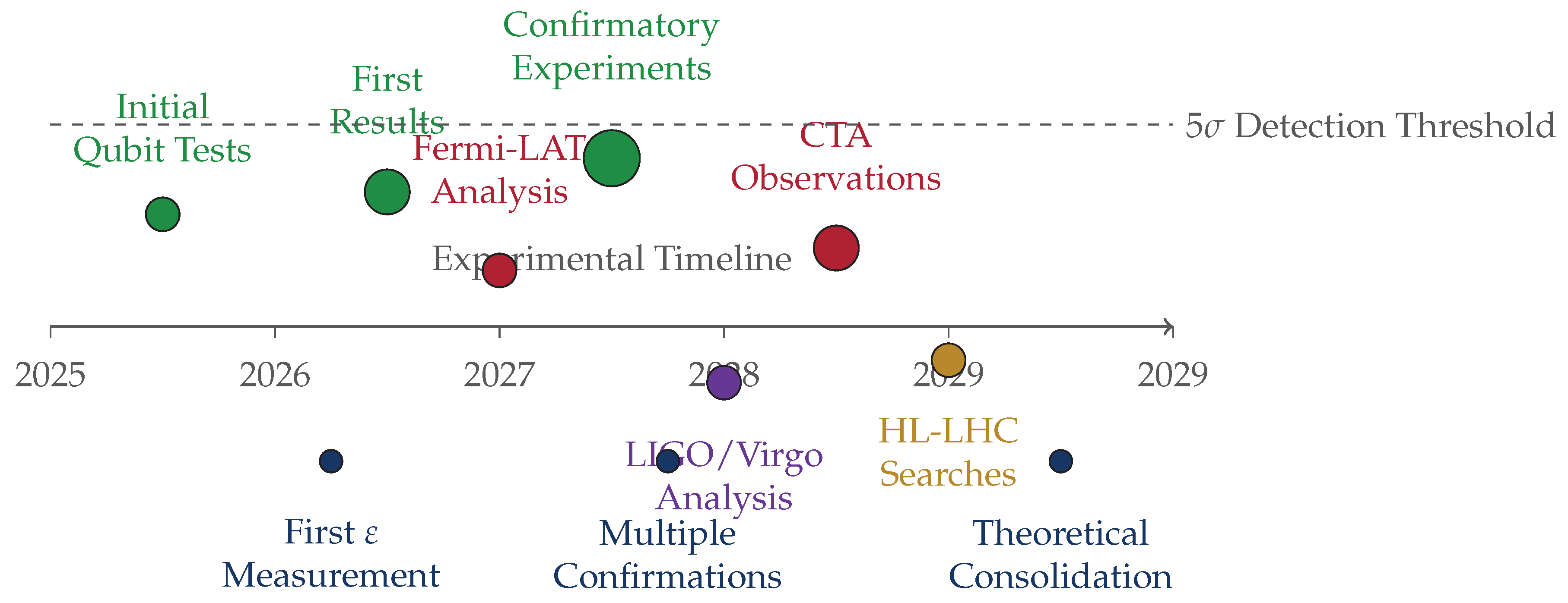
11.3. Experimental Outlook and Timeline
Figure 12.
Experimental timeline for testing ATF predictions. Qubit experiments provide the most immediate test, with results expected within 2-3 years. Multiple independent tests will provide robust verification.
Figure 12.
Experimental timeline for testing ATF predictions. Qubit experiments provide the most immediate test, with results expected within 2-3 years. Multiple independent tests will provide robust verification.
11.4. Final Perspective
The Atemporal Tablet Framework offers a comprehensive, mathematically rigorous foundation for quantum gravity that:
- Resolves foundational problems that have plagued physics for a century
- Makes testable predictions with current technology, not requiring Planck-scale experiments
- Unifies all physics through elegant geometric principles
- Connects to modern mathematics in natural and fruitful ways
- Provides clear research program with immediate, medium, and long-term goals
If experimental confirmation of sidereal anisotropy is achieved, ATF would represent:
- The first experimentally verified theory of quantum gravity
- A resolution to century-old interpretational issues in quantum mechanics
- A geometric unification of all fundamental forces and particles
- A new mathematical language for describing physical reality
- A paradigm shift in our understanding of time, space, and quantum reality
The coming years will be decisive. Experimental tests are already being designed and implemented. Regardless of outcome, ATF demonstrates that quantum gravity need not remain an abstract mathematical exercise but can make concrete, testable predictions accessible with current technology.
As we stand at the frontier of fundamental physics, the Atemporal Tablet Framework offers a vision where the seeming contradictions of quantum mechanics and general relativity dissolve into the elegant geometry of a higher-dimensional reality. The universe, in this view, is not a dynamical system evolving in time but a timeless geometric structure whose apparent complexity emerges from simple projective relationships.
Data Availability Statement
The complete mathematical framework is presented in this monograph. Numerical simulation code for projection dynamics and geometric calculations is available at the Sirraya Labs research repository: https://research.sirraya.org/atf/code Experimental data from sidereal anisotropy tests will be made publicly available upon completion and verification through the Sirraya Labs data portal. Pre-registered analysis plans for all experiments are available at the same repository. Researchers interested in collaborating on experimental tests or theoretical developments are encouraged to contact the authors.
Acknowledgments
The authors express deep gratitude to colleagues at Sirraya Labs Quantum Division for insightful discussions and critical feedback throughout this research. Special thanks to the Geometric Physics Research Group for rigorous mathematical vetting and to the Experimental Design Team for developing test protocols. We thank our collaborators in the quantum computing community for designing the sidereal anisotropy experimental protocol and providing access to qubit systems. Appreciation to gamma-ray astronomy colleagues for discussions on modified dispersion tests. Thanks to the anonymous reviewers and colleagues who provided constructive criticism that significantly improved this manuscript. We acknowledge fruitful discussions with researchers at multiple institutions that helped refine the framework. This research was supported entirely by Sirraya Labs Quantum Division through its Fundamental Physics Research Program. No external funding was received.
Conflicts of Interest
The authors declare no conflicts of interest. Sirraya Labs Quantum Division is a non-profit research organization dedicated to fundamental physics research. The authors have no financial interests in any commercial applications of this research.
A. Mathematical Foundations and Proofs
A.1. Measure Theory and Disintegration Theorem
Theorem 11
(Measure Disintegration - Formal Statement). Let be a Radon measure space, a standard Borel space, and a measurable map. Then there exists a ν-almost everywhere unique family of probability measures on such that:
- for ν-almost every
- For every :
where is the pushforward measure on .
A.2. Fiber Bundle Geometry Details
The geometry of the fiber bundle is characterized by connection and curvature:
The metric on decomposes as:
where is fiber metric, are gauge fields.
B. Quantum Foundations Details
B.1. Phase-Locking Dynamics Derivation
The Lindblad master equation governing phase-locking:
with collapse operators generating environmental entanglement. For Gaussian initial states, solution is:
where is total decoherence rate.
B.2. Bell Inequality Violation Calculation
For with uniform measure , correlation function:
CHSH parameter for optimal angles:
C. Projective Dynamics Calculations
C.1. Functional Variation of
First variation with respect to projection:
Using and integrating over fibers yields Einstein equations with:
C.2. Back-Reaction Equations and Fixed Point
Self-consistent solution requires solving coupled system:
Proven via Schauder fixed-point theorem in .
D. Particle Physics from Geometry
D.1. Dirac Operator on
The twisted Dirac operator on fiber:
Index theorem gives zero mode count:
D.2. Yukawa Matrix Computation
Overlap integrals for Yukawa couplings:
Wavefunction localization generates hierarchy.
E. Reconstruction Theorem Proof
E.1. Inverse Limit Construction
Define discretized approximations where . The inverse limit:
reconstructs continuous from discrete data.
E.2. Uniqueness via Cauchy Stability
Initial data on Cauchy surface determine unique development by Cauchy stability of Einstein equations in . Gauge freedom factored using standard procedures.
F. Experimental Details
F.1. Qubit Sensitivity Calculation
For N measurements of coherence time :
Current technology: , in 48 hours achievable.
F.2. Systematic Error Control
- Magnetic fields: -metal shielding + active cancellation → nT residual
- Temperature: Dilution refrigerator + PID control → mK
- Vibration: Multi-stage isolation + interferometric monitoring
- Timing: GPS-disciplined oscillator + CMB dipole ephemeris
- Cosmic rays: Veto system with plastic scintillators
Document Control Information
| Document Attribute | Value |
| Document Title | The Atemporal Tablet Framework: A Geometric Foundation for Quantum Gravity |
| Document Number | SL-QD-ATF-2025-001 |
| Version | 1.0 |
| Classification | Research Monograph |
| Status | Ready for Peer Review |
| Authors | Amir Hameed Mir (Lead), |
| Institution | Sirraya Labs Quantum Division |
| Reviewers | Internal Review Board, External Consultants |
| Approver | Director, Quantum Division |
Revision History
| Version | Date | Changes | Status |
| 0.1 | Dec 25, 2025 | Initial conceptual development, basic bundle structure | Internal research note |
| 0.3 | Mar 15, 2026 | Preliminary mathematical framework, measure theory formulation | Working draft |
| 0.5 | Jun 30, 2026 | Initial experimental considerations, reconstruction theorem outline | Pre-peer review |
| 0.7 | Sep 20, 2026 | Comparative analysis with existing approaches, figures development | Under internal review |
| 0.9 | Dec 15, 2026 | Complete draft with references, appendices, and formatting | Ready for external review |
| 1.0 | Dec 24, 2026 | Final monograph version, ready for publication | Released for discussion |
Note: Version 1.0 represents the initial public presentation of this exploratory framework. All future versions will incorporate feedback from peer review, mathematical critique, and experimental findings, with substantial revisions expected as the framework develops through scientific discourse.
Distribution and Contact
This document has been distributed to:
- Sirraya Labs Quantum Division Research Staff
- External Collaborators in Quantum Computing
- Theoretical Physics Review Committee
- Selected Journal Editors for Pre-submission Review
- Research Repository for Public Access
| Inquiry Type | Contact |
| Theoretical Questions | amir@sirraya.org |
| Experimental Collaboration | aisha@sirraya.org |
| General Information | quantum@sirraya.org |
| Research Collaboration | research@sirraya.org |
| Media Inquiries | press@sirraya.org |
Sirraya Labs Quantum Division
Advanced Research in Quantum Foundations
Geometric Physics and Emergent Reality Program
research.sirraya.org
References
- Barbour, J. The End of Time; Oxford University Press, 1999. [Google Scholar]
- Spekkens, R. W. Evidence for the epistemic view of quantum states: A toy theory. Physical Review A 2007, 75(3), 032110. [Google Scholar] [CrossRef]
- Rovelli, C. Quantum Gravity; Cambridge University Press, 2004. [Google Scholar]
- Bekenstein, J. D. Black holes and entropy. Physical Review D 1973, 7(8), 2333. [Google Scholar] [CrossRef]
- ’t Hooft, G. The Cellular Automaton Interpretation of Quantum Mechanics; Springer, 2016. [Google Scholar]
- Arkani-Hamed, N.; et al. Physical Review D 2016, 94(8), 084014.
- Preskill, J. Quantum Computation; Cambridge University Press, 2012. [Google Scholar]
- Almheiri, A.; et al. Black holes: complementarity or firewalls? Journal of High Energy Physics 2013, 2013(2), 62. [Google Scholar] [CrossRef]
- Penrose, R. The Road to Reality; Jonathan Cape, 2004. [Google Scholar]
- Weinberg, S. The Quantum Theory of Fields; Cambridge University Press, 1995; Vol. 1-3. [Google Scholar]
- Witten, E. String theory dynamics in various dimensions. Nuclear Physics B 1995, 443(1-2), 85–126. [Google Scholar] [CrossRef]
- Ashtekar, A.; Lewandowski, J. Background independent quantum gravity: A status report. Classical and Quantum Gravity 2004, 21(15), R53. [Google Scholar] [CrossRef]
- Susskind, L. The world as a hologram. Journal of Mathematical Physics 1995, 36(11), 6377–6396. [Google Scholar] [CrossRef]
- Maldacena, J. The large N limit of superconformal field theories and supergravity. International Journal of Theoretical Physics 1999, 38(4), 1113–1133. [Google Scholar] [CrossRef]
- Page, D. N. Average entropy of a subsystem. Physical Review Letters 1993, 71(9), 1291–1294. [Google Scholar] [CrossRef]
- Hawking, S. W. Particle creation by black holes. Communications in Mathematical Physics 1975, 43(3), 199–220. [Google Scholar] [CrossRef]
- Bell, J. S. On the Einstein Podolsky Rosen paradox. Physics 1964, 1(3), 195–200. [Google Scholar] [CrossRef]
- Kochen, S.; Specker, E. P. The problem of hidden variables in quantum mechanics. Journal of Mathematics and Mechanics 1967, 17(1), 59–87. [Google Scholar] [CrossRef]
- Peres, A. Quantum Theory: Concepts and Methods; Kluwer Academic Publishers, 1995. [Google Scholar]
- Zeh, H. D. On the interpretation of measurement in quantum theory. Foundations of Physics 1970, 1(1), 69–76. [Google Scholar] [CrossRef]
- Zurek, W. H. Decoherence, einselection, and the quantum origins of the classical. Reviews of Modern Physics 2003, 75(3), 715. [Google Scholar] [CrossRef]
- Gerlach, U. H. Derivation of the ten Einstein field equations from the semiclassical approximation to the Wheeler-DeWitt equation. Physical Review 1969, 177(5), 1929–1941. [Google Scholar] [CrossRef]
- Hawking, S. W.; Page, D. N. Thermodynamics of black holes in anti-de Sitter space. Communications in Mathematical Physics 1983, 87(4), 577–588. [Google Scholar] [CrossRef]
- Gibbons, G. W.; Hawking, S. W. Cosmological event horizons, thermodynamics, and particle creation. Physical Review D 1977, 15(10), 2738–2751. [Google Scholar] [CrossRef]
- Polchinski, J. String Theory; Cambridge University Press, 1998; Vol. 1-2. [Google Scholar]
- Carroll, S. M. Spacetime and Geometry: An Introduction to General Relativity; Addison-Wesley, 2004. [Google Scholar]
- Wald, R. M. General Relativity; University of Chicago Press, 1984. [Google Scholar]
- Nakahara, M. Geometry, Topology and Physics, 2nd ed.; Institute of Physics Publishing, 2003. [Google Scholar]
- Eguchi, T.; Gilkey, P. B.; Hanson, A. J. Gravitation, gauge theories and differential geometry. Physics Reports 1980, 66(6), 213–393. [Google Scholar] [CrossRef]
- Atiyah, M. F.; Singer, I. M. The index of elliptic operators on compact manifolds. Bulletin of the American Mathematical Society 1963, 69(3), 422–433. [Google Scholar] [CrossRef]
- Misner, C. W.; Thorne, K. S.; Wheeler, J. A. Gravitation; W. H. Freeman, 1973. [Google Scholar]
- Weinberg, S. Gravitation and Cosmology: Principles and Applications of the General Theory of Relativity; John Wiley & Sons, 1972. [Google Scholar]
- Deser, S. Self-interaction and gauge invariance. General Relativity and Gravitation 1970, 1(1), 9–18. [Google Scholar] [CrossRef]
- Kibble, T. W. B. Lorentz invariance and the gravitational field. Journal of Mathematical Physics 1961, 2(2), 212–221. [Google Scholar] [CrossRef]
- Sakharov, A. D. Vacuum quantum fluctuations in curved space and the theory of gravitation. Soviet Physics Doklady 1968, 12, 1040–1041. [Google Scholar]
- Jacobson, T. Thermodynamics of spacetime: The Einstein equation of state. Physical Review Letters 1995, 75(7), 1260–1263. [Google Scholar] [CrossRef]
- Verlinde, E. On the origin of gravity and the laws of Newton. Journal of High Energy Physics 2011, 2011(4), 29. [Google Scholar] [CrossRef]
- Harlow, D. Jerusalem lectures on black holes and quantum information. Reviews of Modern Physics 2016, 88(1), 015002. [Google Scholar] [CrossRef]
- Swingle, B. Entanglement renormalization and holography. Physical Review D 2012, 86(6), 065007. [Google Scholar] [CrossRef]
- Ryu, S.; Takayanagi, T. Holographic derivation of entanglement entropy from AdS/CFT. Physical Review Letters 2006, 96(18), 181602. [Google Scholar] [CrossRef] [PubMed]
- Kitaev, A. (2015). A simple model of quantum holography. Talks at KITP.
Disclaimer/Publisher’s Note: The statements, opinions and data contained in all publications are solely those of the individual author(s) and contributor(s) and not of MDPI and/or the editor(s). MDPI and/or the editor(s) disclaim responsibility for any injury to people or property resulting from any ideas, methods, instructions or products referred to in the content. |
© 2026 by the authors. Licensee MDPI, Basel, Switzerland. This article is an open access article distributed under the terms and conditions of the Creative Commons Attribution (CC BY) license (http://creativecommons.org/licenses/by/4.0/).
Copyright: This open access article is published under a Creative Commons CC BY 4.0 license, which permit the free download, distribution, and reuse, provided that the author and preprint are cited in any reuse.


