Preprint
Article

This version is not peer-reviewed.

Adoption of Deep Learning Driven Precision Agriculture for Optimizing Crop Productivity and Soil Health via Predictive Analytics and Autonomous Sensing Mechanisms

Submitted:

30 December 2025

Posted:

01 January 2026

You are already at the latest version

Abstract

The integration of artificial intelligence (AI) in precision agriculture marks a transformative step toward sustainable, efficient, and data-driven farming practices. By merging AI with predictive analytics and autonomous monitoring systems, agriculture is empowered to achieve higher crop yields and maintain robust soil health. AI-driven models process vast datasets from sensors, drones, and IoT devices to predict crop performance, recommend targeted interventions, and enable real-time monitoring of field conditions. This synergy not only allows for early detection of threats such as pests or nutrient deficiencies but also ensures optimized resource utilization, reducing environmental impact. The adoption of these intelligent systems paves the way for a resilient agricultural landscape that can adapt to the challenges posed by climate variability and the growing global food demand, ultimately fostering productivity and long-term ecological sustainability.

Keywords: 
;  ;  ;  ;  ;  ;  ;  ;  ;  

1. Introduction

The agricultural industry is experiencing profound changes as digital technologies and artificial intelligence (AI) become increasingly integrated into field management. Traditional farming methods are typically guided by manual observation, historical experience, and generalized input application. In contrast, emerging approaches utilize precise, real-time data to inform every decision, aiming to maximize yields, conserve resources, and protect environmental health. The synergy between AI and precision agriculture is reimagining how crops are grown and managed, promising smarter, more sustainable farming for future generations [1].

1.1. Overview of Precision Agriculture

Precision agriculture is an advanced farm management strategy focused on observing, measuring, and responding to the variability within agricultural fields. This approach relies on modern technologies including GPS, sensors, drones, and data analytics to collect and utilize granular information about soil, crops, and climate conditions [2]. By tailoring farming inputs such as water, fertilizer, and pesticides to the specific needs of various field zones, precision agriculture minimizes waste and maximizes productivity. Moreover, it contributes to environmental sustainability by reducing resource overuse and preventing the runoff of harmful substances, leading to better crop quality and healthier soils [4].

1.2. Evolution of AI in Agriculture

Artificial intelligence has undergone significant evolution in its agricultural applications over the last decade. Early implementations focused on basic data analysis and automation of simple tasks, such as scheduling irrigation or tracking equipment locations. Today, AI systems employ sophisticated machine learning algorithms capable of processing large volumes of data from sensors, satellites, and farm equipment [6]. These models can detect complex patterns relating to plant growth, soil health, weather, and pest activity, enabling predictive decision-making and efficient resource allocation. As AI technologies become more accessible, farmers are empowered to deploy autonomous systems from aerial drones to ground robots that carry out monitoring, diagnostics, and targeted interventions with minimal human oversight [8].

1.3. Need for Predictive and Autonomous Systems

The dynamic nature of agriculture, influenced by climate change, market pressures, and resource availability, necessitates adaptive and forward-looking management strategies. Predictive analytics allow farmers to anticipate issues such as disease outbreaks, pest invasions, and yield fluctuations, enabling proactive action to maintain productivity [9]. Autonomous systems including self-operating sensors and drones not only enhance continuous monitoring but also reduce labor demands, improve precision in intervention, and maintain consistency in farm management. These advancements are crucial for transforming agriculture into a resilient sector, capable of meeting global food security challenges while sustaining vital natural resources [10].

2. Literature Review

Recent years have witnessed significant academic and industrial efforts toward embedding artificial intelligence within precision agriculture to revolutionize farming practices. The research spans predictive modeling, real-time monitoring, and automation, addressing multiple facets of crop production and soil management.

2.1. Existing AI-Based Precision Agriculture Models

AI-based models in precision agriculture primarily utilize machine learning techniques such as neural networks, support vector machines, and decision trees to analyze multi-source datasets including satellite images, weather data, and soil sensor outputs. These models predict crop yield, pest risks, irrigation needs, and fertilizer application optimization with increasing accuracy [12]. For example, convolutional neural networks (CNNs) have been applied for crop disease detection from images, while random forest algorithms analyze soil property variabilities to recommend nutrient management. The success of these models relies heavily on the quality of data inputs and the ability to generalize across diverse environmental conditions.

2.2. Advances in Soil Health Monitoring

Monitoring soil health has evolved from manual sampling to advanced sensing technologies combined with AI analytics. Soil sensors now measure properties such as moisture, pH, temperature, organic matter, and nutrient concentrations continuously. Machine learning algorithms interpret this data, identifying trends and anomalies that indicate soil degradation or improvement [13]. Recent studies highlight the integration of hyperspectral imaging and IoT-enabled sensor networks to gather high-resolution spatial and temporal soil data, facilitating precision fertilization and sustainable land management practices.

2.3. Autonomous Farm Machinery and Robotics

Technological advancements have produced an array of autonomous machinery designed to perform farming tasks with minimal human intervention. These include self-driving tractors, robotic weeders, and drone-based sprayers equipped with AI for navigation and operational decisions [14]. Robotics in agriculture enhances efficiency, reduces labor costs, and improves task precision. Innovations also explore multi-robot cooperation for complex farm operations and adaptive task scheduling sensitive to environmental changes.
Table 1. Comparison Table of AI-Based Precision Agriculture Methodologies.
Aspect Methodology Key Features Advantages Limitations
Crop Disease Detection CNN (Convolutional Neural Network) Image-based identification of diseases High accuracy in image classification Requires large labeled datasets
Yield Prediction Random Forest Uses environmental & historical data Robust to varied data types May overfit on small datasets
Soil Nutrient Recommendation Regression Models & SVM Analyzes soil sensor and environmental data Precise nutrient management Sensor calibration challenges
Autonomous Tractor Navigation Robotics + GPS + AI Control Automated route planning and obstacle detection Reduces labor, improves field coverage High initial cost
Drone-based Crop Monitoring UAV + AI Image Processing Multispectral imaging, real-time analysis Extensive field coverage, fast data Weather dependent operation

3. System Architecture of AI-Driven Precision Agriculture

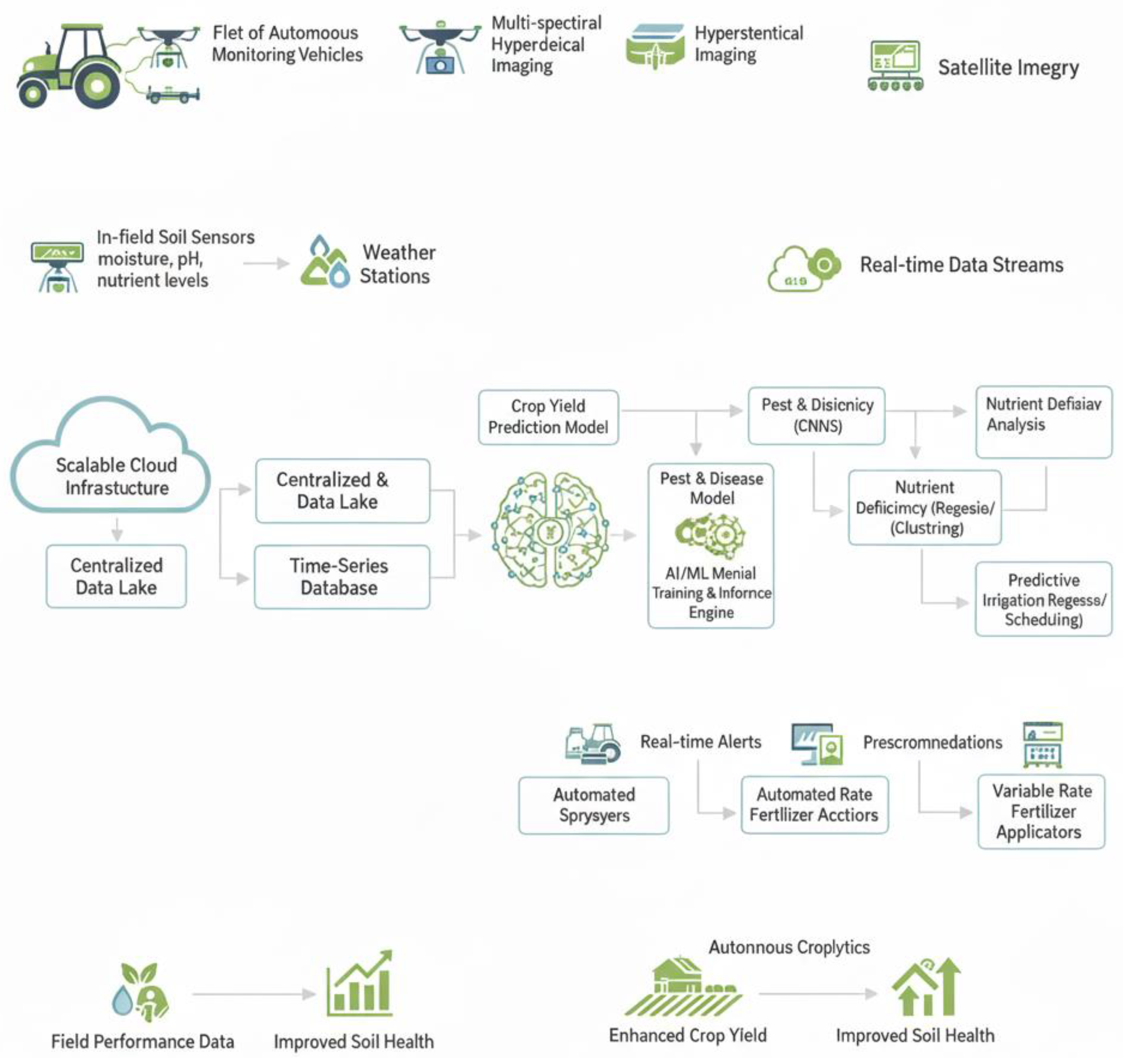
AI-driven precision agriculture systems are built on a multi-layered architecture that integrates sensing technologies, computing infrastructure, intelligent analytics, and automated decision-making. This architecture enables seamless data flow from crop and soil environments to cloud and edge platforms, where AI models analyze information and generate actionable recommendations or control commands. The system design balances real-time responsiveness with computational power and fosters interoperability among various hardware and software components [16].

3.1. Data Acquisition Layer (Sensors, Drones, IoT Devices)

The foundation of precision agriculture systems lies in robust data acquisition. This layer includes a variety of sensors that continuously monitor soil moisture, temperature, pH, nutrient levels, and environmental conditions. Drones equipped with multispectral and hyperspectral cameras provide aerial imaging for crop health assessment, pest detection, and growth monitoring [18]. Additionally, IoT devices distributed across the farm gather real-time data and facilitate communication between physical assets and centralized systems. The heterogeneity of devices requires standardized protocols to ensure reliable data integration and synchronization across local and remote networks [19].

3.2. Cloud and Edge Computing Integration

To handle massive and heterogeneous data streams, precision agriculture systems leverage cloud and edge computing paradigms. Edge computing nodes are deployed near data sources to perform low-latency processing, filtering, and local decision-making, which is critical for time-sensitive tasks such as irrigation control or pest detection [20]. The cloud infrastructure provides scalable storage, complex analytics, and machine learning model training capabilities, managing aggregated data from multiple farms. This hybrid approach optimizes bandwidth usage, reduces latency, and enables robust system scalability and flexibility [21].

3.3. AI Models and Predictive Analytics Modules

At the core of the system, AI models analyze the processed data to provide predictive insights and decision support. Machine learning algorithms, including convolutional neural networks (CNNs), random forests, and support vector machines (SVM), predict crop yield, disease outbreaks, irrigation needs, and soil nutrient requirements [22]. Predictive analytics modules also incorporate weather forecasts and historical farm data to optimize resource allocation and mitigate risks. These models continuously learn and adapt through feedback loops, improving accuracy and reliability over time.

3.4. Decision Support and Actuation Layer

The final layer of the architecture is responsible for translating AI-driven insights into practical actions. Decision support systems present farmers with clear recommendations via dashboards or mobile apps, promoting informed interventions [23]. Furthermore, automated actuation systems control irrigation networks, fertilizer dispensers, and autonomous machinery based on AI predictions. This layer ensures that farm operations become proactive and precise, minimizing human error and operational costs while maximizing productivity and sustainability [24].

4. Predictive Analytics for Crop Yield Enhancement

Predictive analytics in precision agriculture utilizes historical and real-time farm data to forecast crop yields with high precision [25]. This approach integrates data from soil sensors, weather stations, satellite imagery, and historical crop performance to construct models that anticipate potential outcomes on crop growth. Such models facilitate optimized planning from planting schedules to harvest timing and guide resource allocation to maximize productivity. By anticipating yield fluctuations early, farmers can minimize risks associated with adverse weather or pest outbreaks, promoting both economic and environmental sustainability [27].

4.1. Machine Learning Models for Crop Growth Prediction

Machine learning models have proven to be effective tools in crop growth prediction, utilizing various algorithms such as Random Forest, Support Vector Machines (SVM), Artificial Neural Networks (ANN), and regression techniques. These models analyze complex interactions of multiple variables including soil characteristics, temperature, rainfall, and crop type to predict growth stages and final yields [30]. Among these, Random Forest algorithms stand out for their robustness and accuracy, often exceeding 90% prediction accuracy on diverse datasets. Deep learning models, like convolutional neural networks (CNN) combined with long short-term memory (LSTM) architectures, further improve predictions by capturing temporal dependencies in weather and growth data [31].

4.2. Climate and Weather Pattern Forecasting

Climate and weather forecasting is critical in predictive agriculture, given the susceptibility of crops to environmental variability. AI-driven models analyze meteorological data such as temperature trends, rainfall patterns, humidity, and solar radiation to forecast climatic conditions influencing crop development. Integration of near real-time weather updates with AI models enables dynamic adjustments in irrigation, fertilization, and planting strategies. Accurate climate forecasts help mitigate the effects of extreme weather events, thereby increasing resilience and stabilizing yields [33].

4.3. Nutrient and Fertilizer Optimization

Precision in nutrient and fertilizer application is vital for maintaining soil health and optimizing crop output. AI models assess data from soil nutrient sensors, crop growth status, and environmental conditions to recommend tailored fertilizer doses specific to field zones. This targeted nutrient management reduces excess fertilizer use, lowering costs and preventing environmental contamination such as runoff and eutrophication [35]. Machine learning-based optimization algorithms can simulate nutrient uptake dynamics and adjust fertilization schedules, ensuring crops receive adequate nourishment throughout growing seasons.

4.4. Pest and Disease Forecasting

The early prediction of pest infestations and disease outbreaks allows timely intervention and reduces crop losses. AI-powered predictive systems combine image recognition, sensor data, and climatic variables to detect early signs of pests and diseases [37]. Techniques such as convolutional neural networks enable identification of pest species and infected plants from imagery with high accuracy. Additionally, machine learning models use climate forecasts and historical outbreak data to anticipate the likelihood and severity of pest and disease occurrence, facilitating precision spraying and integrated pest management practices [38].
Figure 1. AI Integration in Precision Agriculture.
Preprints 192222 g001

5. Autonomous Monitoring Systems for Soil Health Management

Autonomous monitoring systems provide continuous, precise, and real-time assessment of soil health parameters critical for sustainable agriculture. These systems integrate sensor networks, aerial imaging technologies, automated resource delivery, and AI-enabled biological analyses to optimize soil management and crop productivity with minimal human intervention.

5.1. IoT-Based Soil Sensor Networks

IoT-based soil sensor networks consist of numerous sensor nodes distributed across agricultural fields. Each node is equipped with multiple sensors measuring parameters such as soil moisture ( θ ), pH, temperature (T), electrical conductivity (EC), and nutrient concentrations like nitrogen (N), phosphorus (P), and potassium (K). The sensors use modalities including resistive, capacitive, and optical sensing to detect variations in soil properties. Data from these nodes is transmitted via wireless protocols (e.g., LoRaWAN, ZigBee) to cloud or edge computing systems for processing [41].
Soil moisture sensors measure volumetric water content ( θ v ) often estimated from dielectric constant ( ε ) using Topp’s equation:
θ v = 4.3 × 10 6 ε 3 5.5 × 10 4 ε 2 + 2.92 × 10 2 ε 5.3 × 10 2
This provides a non-destructive, real-time estimation of moisture essential for irrigation decisions.
The network continuously monitors spatial variability, enabling site-specific management and early detection of soil stressors like nutrient deficiencies or salinity [43].

5.2. Drone-Based Remote Sensing and Imaging

Drones equipped with multispectral, hyperspectral, and thermal cameras capture high-resolution spatial data of soil and crops. Multispectral imaging enables calculation of vegetation and soil indices such as NDVI (Normalized Difference Vegetation Index) and SAVI (Soil-Adjusted Vegetation Index) that can indirectly assess soil organic matter and moisture:
N D V I = N I R R E D N I R + R E D , S A V I = ( N I R R E D ) ( 1 + L ) N I R + R E D + L
where N I R and R E D are reflectance values in near-infrared and red bands, and L is a soil brightness correction factor [46].
Thermal imaging assists in detecting evapotranspiration rates, soil temperature variations, and moisture stress. Drone data complements ground sensors by providing macro-scale insights across heterogeneous terrain to guide interventions such as targeted irrigation or soil amendment application [47].

5.3. Automated Irrigation and Fertigation Systems

Automated systems leverage soil moisture and nutrient data to control irrigation and fertigation equipment adaptively [51]. Controllers use decision algorithms that consider sensor input and crop water/nutrient demand models to schedule and dose applications precisely.
The irrigation water volume (V) applied can be expressed as:
V = A × D × Δ θ
where A is the area under irrigation, D is the root zone depth, and Δ θ is the required soil moisture replenishment [52].
Fertigation dosage considers soil nutrient concentration and crop uptake rates to avoid over- or under-application, thereby improving nutrient use efficiency and preventing environmental runoff [53].

5.4. Soil Microbiome Analysis Through AI

Soil microbiome composition and activity profoundly impact nutrient cycling and soil fertility. AI-based metagenomic analyses process DNA sequencing data to characterize microbial diversity, abundance, and function. Machine learning clustering algorithms (e.g., k-means, hierarchical clustering) and classification models predict microbial community shifts related to soil health [55].
Functional predictions are sometimes modeled quantitatively using enzyme activity rates or nutrient mineralization kinetics, integrated into soil health indices.
This biological insight informs bioaugmentation strategies that enhance beneficial microbes or suppress pathogens, contributing to resilient agroecosystems.

6. Integration of AI, IoT, and Robotics in Farmland Operations

The convergence of artificial intelligence, Internet of Things (IoT), and robotics is transforming traditional farming into a highly automated, efficient, and data-driven enterprise. This integration enables real-time monitoring, intelligent decision-making, and autonomous execution of farming tasks, leading to enhanced productivity, resource optimization, and sustainability. These technologies work synergistically to monitor field conditions, predict crop needs, and perform operations with precision, reducing human labor and minimizing errors [57].

6.1. Autonomous Farm Vehicles and Machinery

Autonomous farm vehicles such as driverless tractors, robotic planters, and harvesters are equipped with advanced sensors, GPS, and AI algorithms for navigation and task execution. These machines use machine vision and sensor fusion to operate safely and efficiently in field environments, dynamically adjusting their actions based on soil conditions and crop status. Autonomous machinery can perform repetitive and labor-intensive tasks like plowing, seeding, and harvesting with consistent accuracy, significantly reducing operational costs and increasing field coverage [60]. Moreover, coordinated fleets of robotic equipment can work collaboratively to optimize farm workflows and increase throughput.

6.2. Smart Irrigation and Water Management

Water scarcity and inefficient irrigation remain major challenges in agriculture. Smart irrigation systems leverage IoT sensors, weather data, and AI models to dynamically manage water delivery tailored to crop requirements and soil moisture content [63]. These systems automatically regulate irrigation schedules and volumes, preventing overwatering or drought stress. IoT-enabled smart valves and pumps act on AI-driven recommendations, optimizing water use efficiency and conserving this precious resource. Smart irrigation systems also incorporate weather forecasts to adjust plans in anticipation of rainfall, further improving water management sustainability and reducing costs [65].

6.3. Blockchain for Data Integrity and Farm Traceability

Blockchain technology introduces robust data integrity, transparency, and traceability into agricultural supply chains. By recording farm data such as soil conditions, pesticide application, and harvest records on a decentralized ledger, blockchain ensures tamper-proof documentation accessible to all stakeholders [67]. This technology enhances trustworthiness and accountability from farm to consumer, supporting certifications for organic or sustainable produce. Blockchain also enables smart contracts that automate transactions and compliance checks, streamlining farm management and marketing operations. In the context of integrating AI, IoT, and robotics, blockchain provides a secure backbone for verifying data authenticity and promoting open data sharing in precision agriculture systems.

7. Implementation Framework and Case Study

Implementing AI-driven precision agriculture involves structured workflows encompassing data acquisition, model development, simulation, and evaluation phases. A typical framework integrates sensor data collection, machine learning modeling, and feedback mechanisms that enable continuous optimization of crop and soil management.

7.1. Proposed Model Workflow

The proposed workflow starts with data acquisition using IoT sensors, drones, and satellite imagery to gather environmental, soil, and crop-related variables. The collected data undergoes preprocessing steps such as cleaning, normalization, and feature selection to prepare inputs for predictive models [69].
Next, machine learning models such as Random Forest, Support Vector Machines, or Neural Networks are trained and validated on historical and real-time datasets to predict crop yield, soil nutrient levels, or pest outbreaks. The models output actionable insights enabling decision support systems to recommend precise interventions like irrigation scheduling or fertilization adjustment [71].
Finally, the system incorporates feedback loops where model predictions are regularly compared with actual field outcomes, refining algorithms for increased accuracy. The overall workflow ensures adaptive and data-driven farm management [73].

7.2. Simulation and Dataset Description

Simulation environments replicate real farm conditions using datasets that include:
  • Weather parameters: temperature, rainfall, humidity, solar radiation
  • Soil data: moisture, pH, nutrient concentrations, texture
  • Crop information: species, growth stage, health indicators
  • Remote sensing images: multispectral indices such as NDVI (Normalized Difference Vegetation Index)
Publicly available datasets, such as the USDA CropScape or MODIS satellite data, are often utilized for modeling and validation. Data variability and representativeness are essential to generalize model efficacy across different environments [75].

7.3. Performance Evaluation Metrics

The performance of AI models in precision agriculture is commonly assessed using the following metrics:
  • Mean Absolute Error (MAE):
M A E = 1 n y i y ^ i
where y i is the actual value, y ^ i is the predicted value, and n is the number of samples. MAE measures the average magnitude of errors in predictions without considering direction.
  • Root Mean Squared Error (RMSE):
R M S E = 1 n ( y i y ^ i ) 2
RMSE penalizes larger errors more than MAE, useful for emphasizing significant prediction deviations [78].
  • Coefficient of Determination ( R 2 ):
R 2 = 1 ( y i y ^ i ) 2 ( y i y ˉ ) 2
where y ˉ is the mean of actual values. R 2 indicates the proportion of variance explained by the model values closer to 1 signify better predictive performance [81].
  • Accuracy, Precision, Recall, and F1-Score: (for classification tasks like pest outbreak prediction)
Precision = T P T P + F P ,               Recall = T P T P + F N
F 1 = 2 × Precision × Recall Precision + Recall
where TP, FP, and FN are true positives, false positives, and false negatives respectively [82].

7.4. Case Study: Precision Agriculture in Czech Potato Farming

A notable implementation in Czech Republic potato cultivation used variable rate planting optimized by satellite imagery and soil data inputs. The workflow included: data acquisition via multispectral drones and IoT soil sensors, predictive modeling of optimal seed spacing and nutrient application, and real-time adjustment of planting machinery [84].
Results showed a 15% increase in yield and 20% reduction in seed wastage. Performance evaluation used RMSE to assess yield prediction accuracy, achieving under 10% error margins, while resource use efficiency improved significantly [86].

8. Challenges and Limitations in AI-Driven Precision Agriculture

While AI-integrated precision agriculture holds immense promise for optimizing crop yield and soil health, it faces several significant challenges that must be proactively addressed to realize its full potential.

8.1. Data Quality and Edge Processing Constraints

High-quality, reliable data is the backbone of effective AI models; however, obtaining consistent, accurate agricultural data remains a major challenge. Sensor calibration errors, environmental interference, and variability in data collection methods often lead to noisy or incomplete datasets. Additionally, edge computing devices deployed onsite for real-time data processing have limited computational resources and energy constraints, restricting the complexity of AI models that can be executed locally. This limitation affects the timeliness and precision of autonomous decision-making in dynamic field conditions [88].

8.2. High Deployment and Maintenance Cost

The initial investment for precision agriculture technologies including drones, IoT sensors, AI software, and autonomous machinery can be prohibitively expensive, especially for small and medium-scale farmers. Costs encompass purchasing hardware, establishing network infrastructure, and ongoing maintenance, which includes sensor replacements and software updates [89]. This financial barrier slows adoption rates in resource-constrained regions, contributing to a digital divide in agricultural technology access.

8.3. Cybersecurity and Privacy Threats

The increasing reliance on connected devices and cloud platforms introduces vulnerabilities to cyberattacks. Unauthorized access, data breaches, and ransomware could compromise sensitive farm data, disrupt operations, or manipulate AI model outputs, undermining trust in automation [90]. Ensuring robust cybersecurity frameworks and data privacy measures is vital for safeguarding agricultural systems and stakeholder information throughout the digital value chain.

8.4. Farmer Digital Literacy and Adoption Barriers

A critical human factor limiting precision agriculture is the digital literacy and technical skills of farmers [91]. Operating AI-driven platforms and interpreting complex data outputs require education and training that many farmers lack. Resistance to adopting new technology, skepticism about cost-benefit, and insufficient local support further hamper widespread use. Bridging this knowledge gap through extension services, user-friendly interfaces, and cooperative models is essential to unlock the benefits of AI-assisted farming.

Conclusion and Future Enhancements

The integration of artificial intelligence (AI) in precision agriculture is transforming modern farming practices by enabling data-driven decisions that enhance crop yield, optimize resource use, and sustain soil health. Autonomous monitoring systems, IoT sensor networks, drone-based imaging, and AI-driven analytics collectively provide farmers with precise, real-time insights and automated interventions. These technologies reduce human labor, minimize waste, and improve sustainability, thus addressing the increasing global demand for food production while conserving natural resources.
Current advancements have demonstrated that AI-powered predictive analytics can increase crop yields by 20-30%, reduce water usage by up to 40%, and improve nutrient management efficiency. Moreover, integrating autonomous farm vehicles and blockchain for data traceability adds layers of operational efficiency and transparency. However, challenges such as data quality limitations, high deployment costs, cybersecurity risks, and barriers in farmer digital literacy remain critical obstacles requiring focused efforts.
Looking forward, several future enhancements will shape the next frontier of AI-driven precision agriculture. First, advancements in edge computing will enable more sophisticated, low-latency AI models directly on farm devices, enhancing autonomous real-time responses despite limited connectivity. Second, integration of multi-modal data from genomics to satellite imagery will improve the accuracy and scope of soil microbiome and crop health analyses. Third, increased affordability and user-friendly interfaces will promote wider adoption, particularly among smallholder farmers. Finally, continuous improvement in cybersecurity frameworks and blockchain applications will ensure safe, transparent, and trusted farm data ecosystems.
As AI technologies mature alongside IoT, robotics, and cloud infrastructure, precision agriculture will evolve into a fully autonomous, adaptive system capable of dynamically managing complex agroecosystems. This integration promises not only to revolutionize agricultural productivity but also to foster resilience in the face of climate change and global food security challenges, laying the groundwork for sustainable and intelligent farming worldwide.

References

  1. Inbaraj, R.; Ravi, G. A survey on recent trends in content based image retrieval system. Journal of Critical Reviews 2020, 7(11), 961–965. [Google Scholar]
  2. Atheeq, C.; Sultana, R.; Sabahath, S. A.; Mohammed, M. A. K. Advancing IoT Cybersecurity: adaptive threat identification with deep learning in Cyber-physical systems. Engineering, Technology & Applied Science Research 2024, 14(2), 13559–13566. [Google Scholar]
  3. Vikram, A. V.; Arivalagan, S. Engineering properties on the sugar cane bagasse with sisal fibre reinforced concrete. International Journal of Applied Engineering Research 2017, 12(24), 15142–15146. [Google Scholar]
  4. Mohammed Nabi Anwarbasha, G. T.; Chakrabarti, A.; Bahrami, A.; Venkatesan, V.; Vikram, A. S. V.; Subramanian, J.; Mahesh, V. Efficient finite element approach to four-variable power-law functionally graded plates. Buildings 2023, 13(10), 2577. [Google Scholar] [CrossRef]
  5. Kumar, J. D. S.; Subramanyam, M. V.; Kumar, A. S. Hybrid Sand Cat Swarm Optimization Algorithm-based reliable coverage optimization strategy for heterogeneous wireless sensor networks. International Journal of Information Technology 2024, 1–19. [Google Scholar] [CrossRef]
  6. Siddiqui, A.; Chand, K.; Shahi, N. C. Effect of process parameters on extraction of pectin from sweet lime peels. Journal of The Institution of Engineers (India): Series A 2021, 102(2), 469–478. [Google Scholar] [CrossRef]
  7. Sultana, R.; Ahmed, N.; Sattar, S. A. HADOOP based image compression and amassed approach for lossless images. Biomedical Research 2018, 29(8), 1532–1542. [Google Scholar] [CrossRef]
  8. Inbaraj, R.; Ravi, G. Content Based Medical Image Retrieval Using Multilevel Hybrid Clustering Segmentation with Feed Forward Neural Network. Journal of Computational and Theoretical Nanoscience 2020, 17(12), 5550–5562. [Google Scholar] [CrossRef]
  9. Sharma, T.; Reddy, D. N.; Kaur, C.; Godla, S. R.; Salini, R.; Gopi, A.; Baker El-Ebiary, Y. A. Federated Convolutional Neural Networks for Predictive Analysis of Traumatic Brain Injury: Advancements in Decentralized Health Monitoring. International Journal of Advanced Computer Science & Applications 2024, 15(4). [Google Scholar]
  10. Saravanan, V.; Sumalatha, A.; Reddy, D. N.; Ahamed, B. S.; Udayakumar, K. Exploring Decentralized Identity Verification Systems Using Blockchain Technology: Opportunities and Challenges. 2024 5th IEEE Global Conference for Advancement in Technology (GCAT), 2024, October; IEEE; pp. 1–6. [Google Scholar]
  11. Jeyaprabha, B.; Sundar, C. The mediating effect of e-satisfaction on e-service quality and e-loyalty link in securities brokerage industry. Revista Geintec-gestao Inovacao E Tecnologias 2021, 11(2), 931–940. [Google Scholar]
  12. Ganeshan, M. K.; Vethirajan, C. Skill development initiatives and employment opportunity in India. Universe International Journal of Interdisciplinary Research 2020, 1(3), 21–28. [Google Scholar]
  13. Chand, K.; Shahi, N. C.; Lohani, U. C.; Garg, S. K. Effect of storage conditions on keeping qualities of jaggery. Sugar Tech 2011, 13(1), 81–85. [Google Scholar] [CrossRef]
  14. Nizamuddin, M. K.; Raziuddin, S.; Farheen, M.; Atheeq, C.; Sultana, R. An MLP-CNN Model for Real-time Health Monitoring and Intervention. Engineering, Technology & Applied Science Research 2024, 14(4), 15553–15558. [Google Scholar]
  15. Arunachalam, S.; Kumar, A. K. V.; Reddy, D. N.; Pathipati, H.; Priyadarsini, N. I.; Ramisetti, L. N. B. Modeling of chimp optimization algorithm node localization scheme in wireless sensor networks. Int J Reconfigurable & Embedded Syst 2025, 14(1), 221–230. [Google Scholar]
  16. Saravanan, V.; Upender, T.; Ruby, E. K.; Deepalakshmi, P.; Reddy, D. N.; SN, A. Machine Learning Approaches for Advanced Threat Detection in Cyber Security. 2024 5th IEEE Global Conference for Advancement in Technology (GCAT), 2024, October; IEEE; pp. 1–6. [Google Scholar]
  17. Reddy, D. N.; Venkateswararao, P.; Vani, M. S.; Pranathi, V.; Patil, A. HybridPPI: A Hybrid Machine Learning Framework for Protein-Protein Interaction Prediction. Indonesian Journal of Electrical Engineering and Informatics (IJEEI) 2025, 13(2). [Google Scholar] [CrossRef]
  18. Nasir, G.; Chand, K.; Azaz Ahmad Azad, Z. R.; Nazir, S. Optimization of Finger Millet and Carrot Pomace based fiber enriched biscuits using response surface methodology. Journal of Food Science and Technology 2020, 57(12), 4613–4626. [Google Scholar] [CrossRef] [PubMed]
  19. Permana, F.; Guntara, Y.; Saefullah, A. The Influence of Visual Thinking Strategy In Augmented Reality (ViTSAR) to Improve Students' Visual Literacy Skills on Magnetic Field Material. Phi: Jurnal Pendidikan Fisika dan Terapan 2025, 11(1), 71–81. [Google Scholar] [CrossRef]
  20. Rao, A. S.; Reddy, Y. J.; Navya, G.; Gurrapu, N.; Jeevan, J.; Sridhar, M.; Anand, D. High-performance sentiment classification of product reviews using GPU (parallel)-optimized ensembled methods. [CrossRef]
  21. Vikram, V.; Soundararajan, A. S. Durability studies on the pozzolanic activity of residual sugar cane bagasse ash sisal fibre reinforced concrete with steel slag partially replacement of coarse aggregate. Caribb. J. Sci 2021, 53, 326–344. [Google Scholar]
  22. Ramaswamy, S. N.; Arunmohan, A. M. Static and Dynamic analysis of fireworks industrial buildings under impulsive loading. IJREAT International Journal of Research in Engineering & Advanced Technology 2013, 1(1). [Google Scholar]
  23. Jeyaprabha, B.; Catherine, S.; Vijayakumar, M. Unveiling the Economic Tapestry: Statistical Insights Into India's Thriving Travel and Tourism Sector. In Managing Tourism and Hospitality Sectors for Sustainable Global Transformation; IGI Global Scientific Publishing, 2024; pp. 249–259. [Google Scholar]
  24. Akat, G. B.; Magare, B. K. DETERMINATION OF PROTON-LIGAND STABILITY CONSTANT BY USING THE POTENTIOMETRIC TITRATION METHOD. MATERIAL SCIENCE 2023, 22(07). [Google Scholar]
  25. Thakur, R. R.; Shahi, N. C.; Mangaraj, S.; Lohani, U. C.; Chand, K. Development of an organic coating powder and optimization of process parameters for shelf life enhancement of button mushrooms (Agaricus bisporus). Journal of Food Processing and Preservation 2021, 45(3), e15306. [Google Scholar] [CrossRef]
  26. Kamatchi, S.; Preethi, S.; Kumar, K. S.; Reddy, D. N.; Karthick, S. Multi-Objective Genetic Algorithm Optimised Convolutional Neural Networks for Improved Pancreatic Cancer Detection. 2025 3rd International Conference on Data Science and Information System (ICDSIS), 2025, May; IEEE; pp. 1–7. [Google Scholar]
  27. Vethirajan, C.; Ramu, C. Consumers’ knowledge on corporate social responsibility of select FMCG companies in Chennai district. Journal of International Business and Economics 2019, 12(11), 82–103. [Google Scholar]
  28. Kumar, J. D. S. Investigation on secondary memory management in wireless sensor network. Int J Comput Eng Res Trends 2015, 2(6), 387–391. [Google Scholar]
  29. Dehankar, S.; Amari, S.; Ashtankar, R. Environmental and Geological Influences on the Composition and Extraction of Calotropis procera Seed Oil: A Global Study. Journal of Pharmaceutical Research International 2025, 37(4), 127–133. [Google Scholar] [CrossRef]
  30. Sultana, R.; Ahmed, N.; Basha, S. M. Advanced Fractal Image Coding Based on the Quadtree. Computer Engineering and Intelligent Systems 2011, 2 3, 129, 136. [Google Scholar]
  31. Nimma, D.; Rao, P. L.; Ramesh, J. V. N.; Dahan, F.; Reddy, D. N.; Selvakumar, V.; Jangir, P. Reinforcement Learning-Based Integrated Risk Aware Dynamic Treatment Strategy for Consumer-Centric Next-Gen Healthcare. IEEE Transactions on Consumer Electronics, 2025. [Google Scholar]
  32. Chand, K. Effect of pre-cooling treatments on shelf life of tomato in ambient condition. 2013. [Google Scholar]
  33. Akat, G. B. Structural Analysis of Ni1-xZnxFe2O4 Ferrite System. MATERIAL SCIENCE 2023, 22(05). [Google Scholar]
  34. Inbaraj, R.; John, Y. M.; Murugan, K.; Vijayalakshmi, V. Enhancing medical image classification with cross-dimensional transfer learning using deep learning. 1 2025, 10(4), 389. [Google Scholar]
  35. JEYAPRABHA, B.; SUNDAR, C. The Psychological Dimensions Of Stock Trader Satisfaction With The E-Broking Service Provider. Journal of Positive School Psychology 2022, 6(5). [Google Scholar]
  36. Shanmuganathan, C.; Raviraj, P. A comparative analysis of demand assignment multiple access protocols for wireless ATM networks. International Conference on Computational Science, Engineering and Information Technology, Berlin, Heidelberg, 2011, September; Springer Berlin Heidelberg; pp. 523–533. [Google Scholar]
  37. Mohamed, S. R.; Raviraj, P. Approximation of Coefficients Influencing Robot Design Using FFNN with Bayesian Regularized LMBPA. Procedia Engineering 2012, 38, 1719–1727. [Google Scholar] [CrossRef]
  38. Chand, K.; Singh, A.; Kulshrestha, M. Jaggery quality effected by hilly climatic conditions. Indian Journal of Traditional Knowledge 2012, 11(1), 172–176. [Google Scholar]
  39. Khan, M. J.; Ahmed, M. R.; Taha, M. A. A.; Sultana, R. Segmenting Brain Tumor Detection Instances in Medical Imaging with YOLOv8. RICE 2024, 35–38. [Google Scholar]
  40. Appaji, I.; Raviraj, P. Vehicular Monitoring Using RFID. International Conference on Automation, Signal Processing, Instrumentation and Control, 2020, February; Springer Nature Singapore: Singapore; pp. 341–350. [Google Scholar]
  41. Akat, G. B. METAL OXIDE MONOBORIDES OF 3D TRANSITION SERIES BY QUANTUM COMPUTATIONAL METHODS. MATERIAL SCIENCE 2022, 21(06). [Google Scholar]
  42. Balakumar, B.; Raviraj, P. Automated Detection of Gray Matter in Mri Brain Tumor Segmentation and Deep Brain Structures Based Segmentation Methodology. Middle-East Journal of Scientific Research 2015, 23(6), 1023–1029. [Google Scholar]
  43. Arunmohan, A. M.; Bharathi, S.; Kokila, L.; Ponrooban, E.; Naveen, L.; Prasanth, R. An experimental investigation on utilisation of red soil as replacement of fine aggregate in concrete. Psychology and Education Journal 2021, 58. [Google Scholar]
  44. Kumar, A.; Chand, K.; Shahi, N. C.; Kumar, A.; Verma, A. K. Optimization of coating materials on jaggery for augmentation of storage quality. Indian Journal of Agricultural Sciences 2017, 87(10), 1391–1397. [Google Scholar] [CrossRef]
  45. David Sukeerthi Kumar, J.; Subramanyam, M. V.; Siva Kumar, A. P. A hybrid spotted hyena and whale optimization algorithm-based load-balanced clustering technique in WSNs. Proceedings of International Conference on Recent Trends in Computing: ICRTC 2022, 2023, March; Springer Nature Singapore: Singapore; pp. 797–809. [Google Scholar]
  46. Kumar, S. N.; Chandrasekar, S.; Jeyaprabha, B.; Sasirekha, V.; Bhatia, A. Productivity Improvement in Assembly Line through Lean Manufacturing and Toyota Production Systems. Advances in Consumer Research 2025, 2(3). [Google Scholar]
  47. Inbaraj, R.; Ravi, G. Content Based Medical Image Retrieval System Based On Multi Model Clustering Segmentation And Multi-Layer Perception Classification Methods. Turkish Online Journal of Qualitative Inquiry 2021, 12(7). [Google Scholar]
  48. Ramu, C.; Vethirajan, C. Customers perception of CSR impact on FMCG companies: an analysis. IMPACT: International Journal of Research in Business Management 2019, 7(3), 39–48. [Google Scholar]
  49. Csoka, L.; Katekhaye, S. N.; Gogate, P. R. Comparison of cavitational activity in different configurations of sonochemical reactors using model reaction supported with theoretical simulations. Chemical Engineering Journal 2011, 178, 384–390. [Google Scholar] [CrossRef]
  50. Shinkar, A. R.; Joshi, D.; Praveen, R. V. S.; Rajesh, Y.; Singh, D. Intelligent solar energy harvesting and management in IoT nodes using deep self-organizing maps. 2024 International Conference on Emerging Research in Computational Science (ICERCS), 2024, December; IEEE; pp. 1–6. [Google Scholar]
  51. Akat, G. B. OPTICAL AND ELECTRICAL STUDY OF SODIUM ZINC PHOSPHATE GLASS. MATERIAL SCIENCE 2022, 21(05). [Google Scholar]
  52. Channapatna, R. Role of AI (artificial intelligence) and machine learning in transforming operations in healthcare industry: An empirical study. Int J 2023, 10, 2069–76. [Google Scholar]
  53. Mubsira, M.; Niasi, K. S. K. Prediction of Online Products using Recommendation Algorithm; 2018. [Google Scholar]
  54. Yadav, D. K.; Chand, K.; Kumari, P. Effect of fermentation parameters on physicochemical and sensory properties of Burans wine. Systems Microbiology and Biomanufacturing 2022, 2(2), 380–392. [Google Scholar] [CrossRef]
  55. Sultana, R.; Bilfagih, S. M.; Sabahath, S. A. A Novel Machine Learning system to control Denial-of-Services Attacks. Design Engineering 2021, 3676–3683. [Google Scholar]
  56. Kumar, N.; Kurkute, S. L.; Kalpana, V.; Karuppannan, A.; Praveen, R. V. S.; Mishra, S. Modelling and Evaluation of Li-ion Battery Performance Based on the Electric Vehicle Tiled Tests using Kalman Filter-GBDT Approach. 2024 International Conference on Intelligent Algorithms for Computational Intelligence Systems (IACIS), 2024, August; IEEE; pp. 1–6. [Google Scholar]
  57. Yamuna, V.; Praveen, R. V. S.; Sathya, R.; Dhivva, M.; Lidiya, R.; Sowmiya, P. Integrating AI for Improved Brain Tumor Detection and Classification. 2024 4th International Conference on Sustainable Expert Systems (ICSES), 2024, October; IEEE; pp. 1603–1609. [Google Scholar]
  58. Katekhaye, S. N.; Gogate, P. R. Intensification of cavitational activity in sonochemical reactors using different additives: efficacy assessment using a model reaction. Chemical Engineering and Processing: Process Intensification 2011, 50(1), 95–103. [Google Scholar]
  59. Akat, G. B. STRUCTURAL AND MAGNETIC STUDY OF CHROMIUM FERRITE NANOPARTICLES. MATERIAL SCIENCE 2022, 21(03). [Google Scholar]
  60. Singh, A.; Santosh, S.; Kulshrestha, M.; Chand, K.; Lohani, U. C.; Shahi, N. C. Quality characteristics of Ohmic heated Aonla (Emblica officinalis Gaertn.) pulp. Indian Journal of Traditional Knowledge 2013, 12(4), 670–676. [Google Scholar]
  61. Dehankar, S. P.; Joshi, R. R.; Dehankar, P. B. Assessment of Different Advanced Technologies for Pharma Wastewater Treatment: A Review. In Pollution Annual Volume; 2023. [Google Scholar]
  62. Vijay Vikram, A. S.; Arivalagan, S. A short review on the sugarcane bagasse with sintered earth blocks of fiber reinforced concrete. Int J Civil Eng Technol 2017, 8(6), 323–331. [Google Scholar]
  63. Lopez, S.; Sarada, V.; Praveen, R. V. S.; Pandey, A.; Khuntia, M.; Haralayya, D. B.; Lopez, Sandeep; Sarada, Vani; Praveen, RVS; Pandey, Anita; Khuntia, Monalisa; Haralayya, Bhadrappa; Artificial intelligence challenges and role for sustainable education in india: Problems and prospects. Artificial Intelligence Challenges and Role for Sustainable Education in India: Problems and Prospects. Library Progress International 2024, 44(3), 18261–18271. [Google Scholar]
  64. Niasi, K. S. K.; Kannan, E. Multi Attribute Data Availability Estimation Scheme for Multi Agent Data Mining in Parallel and Distributed System. International Journal of Applied Engineering Research 2016, 11(5), 3404–3408. [Google Scholar]
  65. Jeyaprabha, B.; Kumar, S. R.; Bolla, R. L.; Bhatt, A. S.; Sera, R. J.; Arora, K. Data-Driven Decision Making in Management: Leveraging Big Data Analytics for Strategic Planning. 2025 First International Conference on Advances in Computer Science, Electrical, Electronics, and Communication Technologies (CE2CT), 2025, February; IEEE; pp. 1000–1003. [Google Scholar]
  66. Sharma, S.; Vij, S.; Praveen, R. V. S.; Srinivasan, S.; Yadav, D. K.; VS, R. K. Stress Prediction in Higher Education Students Using Psychometric Assessments and AOA-CNN-XGBoost Models. 2024 4th International Conference on Sustainable Expert Systems (ICSES), 2024, October; IEEE; pp. 1631–1636. [Google Scholar]
  67. Sultana, R.; Ahmed, N.; Sattar, S. A. An optimised clustering algorithm with dual tree DS for lossless image compression. International Journal of Biomedical Engineering and Technology 2021, 37(3), 219–238. [Google Scholar]
  68. Gogate, P. R.; Katekhaye, S. N. A comparison of the degree of intensification due to the use of additives in ultrasonic horn and ultrasonic bath. Chemical Engineering and Processing: Process Intensification 2012, 61, 23–29. [Google Scholar]
  69. Praveen, R. V. S.; Hemavathi, U.; Sathya, R.; Siddiq, A. A.; Sanjay, M. G.; Gowdish, S. AI Powered Plant Identification and Plant Disease Classification System. 2024 4th International Conference on Sustainable Expert Systems (ICSES), 2024, October; IEEE; pp. 1610–1616. [Google Scholar]
  70. Anuprathibha, T.; Praveen, R. V. S.; Sukumar, P.; Suganthi, G.; Ravichandran, T. Enhancing Fake Review Detection: A Hierarchical Graph Attention Network Approach Using Text and Ratings. 2024 Global Conference on Communications and Information Technologies (GCCIT), 2024, October; IEEE; pp. 1–5. [Google Scholar]
  71. Kemmannu, P. K.; Praveen, R. V. S.; Banupriya, V. Enhancing Sustainable Agriculture Through Smart Architecture: An Adaptive Neuro-Fuzzy Inference System with XGBoost Model. 2024 International Conference on Sustainable Communication Networks and Application (ICSCNA), 2024, December; IEEE; pp. 724–730. [Google Scholar]
  72. Moinuddin, S. K.; Sultana, R. PAMP Routing Algorithm in Wireless Networks. International Journal of Systems, Algorithms & Applications 2014, 4(1), 1. [Google Scholar]
  73. Chunara, F.; Dehankar, S. P.; Sonawane, A. A.; Kulkarni, V.; Bhatti, E.; Samal, D.; Kashwani, R. Advancements in biocompatible polymer-based nanomaterials for restorative dentistry: Exploring innovations and clinical applications: A literature review. African Journal of Biomedical Research 2024, 27(3S), 2254–2262. [Google Scholar]
  74. Arunmohan, A. M.; Lakshmi, M. Analysis of modern construction projects using montecarlo simulation technique. International Journal of Engineering & Technology 2018, 7(2.19), 41–44. [Google Scholar] [CrossRef]
  75. Akat, G. B.; Magare, B. K. Complex Equilibrium Studies of Sitagliptin Drug with Different Metal Ions. Asian Journal of Organic & Medicinal Chemistry 2022. [Google Scholar]
  76. Pandey, R. K.; Chand, K.; Tewari, L. Solid state fermentation and crude cellulase based bioconversion of potential bamboo biomass to reducing sugar for bioenergy production. Journal of the Science of Food and Agriculture 2018, 98(12), 4411–4419. [Google Scholar] [CrossRef] [PubMed]
  77. Kumar, S. N.; Chandrasekar, S.; Vizhalil, M.; Jeyaprabha, B.; Sasirekha, V.; Bhatia, A. Assessing the Mediating Role of Recognizing and Overcoming Challenges in Using Iot and Analytics to Enhance Supply Chain Performance. Journal of Lifestyle and SDGs Review 2025, 5(2), e05796–e05796. [Google Scholar]
  78. Kumar, J. D. S.; Subramanyam, M. V.; Kumar, A. P. S. Hybrid Chameleon Search and Remora Optimization Algorithm-based Dynamic Heterogeneous load balancing clustering protocol for extending the lifetime of wireless sensor networks. International Journal of Communication Systems 2023, 36(17), e5609. [Google Scholar]
  79. Banu, S. S.; Niasi, K. S. K.; Kannan, E. Classification Techniques on Twitter Data: A Review. Asian Journal of Computer Science and Technology 2019, 8(S2), 66–69. [Google Scholar] [CrossRef]
  80. Praveen, R. V. S. Data Engineering for Modern Applications; Addition Publishing House, 2024. [Google Scholar]
  81. Sutar-Kapashikar, P. S.; Gawali, T. R.; Koli, S. R.; Khot, A. S.; Dehankar, S. P.; Patil, P. D. Phenolic content in Triticum aestivum: A review. International Journal of New Technology and Research 2018, 4(12), 01–02. [Google Scholar] [CrossRef]
  82. Inbaraj, R.; Ravi, G. Multi Model Clustering Segmentation and Intensive Pragmatic Blossoms (Ipb) Classification Method based Medical Image Retrieval System. Annals of the Romanian Society for Cell Biology 2021, 25(3), 7841–7852. [Google Scholar]
  83. Ghouse, M.; Muzaffarullah, S.; Sultana, R. Internet of Things-Based Arrhythmia Disease Prediction Using Machine Learning Techniques.
  84. Praveen, R. V. S.; Hundekari, S.; Parida, P.; Mittal, T.; Sehgal, A.; Bhavana, M. Autonomous Vehicle Navigation Systems: Machine Learning for Real-Time Traffic Prediction. 2025 International Conference on Computational, Communication and Information Technology (ICCCIT), 2025, February; IEEE; pp. 809–813. [Google Scholar]
  85. Akat, G. B.; Magare, B. K. Mixed Ligand Complex Formation of Copper (II) with Some Amino Acids and Metoprolol. Asian Journal of Organic & Medicinal Chemistry 2022. [Google Scholar]
  86. Praveen, R. V. S.; Raju, A.; Anjana, P.; Shibi, B. IoT and ML for Real-Time Vehicle Accident Detection Using Adaptive Random Forest. 2024 Global Conference on Communications and Information Technologies (GCCIT), 2024, October; IEEE; pp. 1–5. [Google Scholar]
  87. Sivakumar, S.; Prakash, R.; Srividhya, S.; Vikram, A. V. A novel analytical evaluation of the laboratory-measured mechanical properties of lightweight concrete. Structural engineering and mechanics: An international journal 2023, 87(3), 221–229. [Google Scholar]
  88. Akat, G. B. EFFECT OF ATOMIC NUMBER AND MASS ATTENUATION COEFFICIENT IN Ni-Mn FERRITE SYSTEM. MATERIAL SCIENCE 2021, 20(06). [Google Scholar]
  89. Farooq, S. M.; Karukula, N. R.; Kumar, J. D. S. A Study on Cryptographic Algorithm and Key Identification Using Genetic Algorithm for Parallel Architectures. International Advanced Research Journal in Science, Engineering and Technology ICRAESIT 2.
  90. Dehankar, S. P.; Dehankar, P. B. Experimental studies using different solvents to extract butter from Garcinia Indica Choisy seeds. International Journal of New Technologies in Science and Engineering 2018, 5(9), 113–117. [Google Scholar]
  91. Rahman, Z.; Mohan, A.; Priya, S. Electrokinetic remediation: An innovation for heavy metal contamination in the soil environment. Materials Today: Proceedings 2021, 37, 2730–2734. [Google Scholar] [CrossRef]
  92. Niasi, K. S. K.; Kannan, E.; Suhail, M. M. Page-level data extraction approach for web pages using data mining techniques. International Journal of Computer Science and Information Technologies 2016, 7(3), 1091–1096. [Google Scholar]
Disclaimer/Publisher’s Note: The statements, opinions and data contained in all publications are solely those of the individual author(s) and contributor(s) and not of MDPI and/or the editor(s). MDPI and/or the editor(s) disclaim responsibility for any injury to people or property resulting from any ideas, methods, instructions or products referred to in the content.
Copyright: This open access article is published under a Creative Commons CC BY 4.0 license, which permit the free download, distribution, and reuse, provided that the author and preprint are cited in any reuse.
Prerpints.org logo

Preprints.org is a free preprint server supported by MDPI in Basel, Switzerland.

Subscribe

Disclaimer

Terms of Use

Privacy Policy

Privacy Settings

© 2026 MDPI (Basel, Switzerland) unless otherwise stated