
Submitted:
31 December 2025
Posted:
31 December 2025
You are already at the latest version
Abstract
The rapid evolution of technology characteristics has significantly influenced various sectors including fashion in which technology-enabled platforms have increasingly been utilized to enhance personalization and consumer engagement. This study investigates the effect of these characteristics on consumer behavior within fashion curation platforms. Integrating the task-technology fit and the unified theory of acceptance and use of technology models, this study examines key constructs using structural equation modeling. Data were collected via a week-long survey of 300 Korean consumers using fashion curation platforms. The findings reveal that technology characteristics exert a significant influence on task-technology fit and effort expectancy. Additionally, hedonic motivation, social influence, and facilitating conditions were pivotal in shaping behavioral intention. The novelty of this work lies in extending the integrated-model framework to a fashion curation context to offer a more nuanced understanding. Moreover, the findings provide practical insights for optimizing technology-enabled fashion platforms to boost user adoption and engagement.
Keywords:
technology characteristics
; fashion
; consumer engagement
; consumer behavior
; hedonic motivation
; social influence
1. Introduction
Recently, artificial intelligence (AI) has brought significant innovations to the fashion industry. AI has the potential to significantly impact the fashion industry by enhancing productivity, accelerating market entry, and improving customer service [1]. McKinsey estimated that, as of 2024, generative AI could add substantial operating profits to the apparel, fashion, and luxury sectors by improving trend prediction, supply chain optimization, and customer engagement [2]. AI tools can analyze vast amounts of data from social media, fashion blogs, and online retail sites to accurately predict trends. Companies such as IBM and Heuritech are already leveraging AI to assist high-profile brands in anticipating trends and adjusting their production processes accordingly [3]. Thus, the adoption of AI in the fashion industry is expected to grow with more companies integrating AI technologies into their operations. The economic impact of AI on the fashion industry is expected to significantly affect operating profits and overall industry growth. The integration of AI enables fashion companies to operate more efficiently and effectively, leading to increased profitability and market competitive advantage. The AI capabilities have resulted in a major shift in the global fashion industry.
The Korean apparel industry has also shifted dramatically following the surge in online shopping, pushing fashion companies to swiftly adopt digital technologies to enhance consumer experiences in the wake of the COVID-19 pandemic [4]. As modern consumers prioritize convenience, personalized services, and efficiency when shopping [5], more personalized and interactive shopping experiences are needed to enhance customer experience through AI curation platforms. However, most previous studies on AI fashion have only clarified the design and general e-commerce, and there is still a lack of academic research that analyzes the technology utility of the AI curation platform service for fashion from the perspective of consumer acceptance of technology. Recent studies have underscored the transformative role of AI in various facets of the fashion industry. Ramos et al. [6] demonstrated that AI applications in areas such as supply chain management, creative design, sales promotion, waste control, and data analysis can significantly drive sustainability, despite challenges such as extensive data requirements and high implementation costs [7]. In a complementary vein, Singh [8] provided evidence of AI’s expanding applications—virtual try-on technology, personalized recommendations, AI-driven design, and supply chain optimization—and detailed both the benefits and limitations inherent with such technologies [1]. Choi et al. [9] compared AI-based clothing design tools with traditional human design processes and revealed both convergences and disparities with critical implications for integrating domain-specific fashion knowledge to boost efficiency [10].
Shin and Hwang [11] analyzed online perceptions of AI fashion curation services and pointed out that usability, reliability, enjoyment, and personalization are some key factors affecting continued usage. However, previous studies have not robustly integrated these technological and behavioral aspects with digital marketing constructs in the unique setting of the Korean fashion industry. Although the literature has provided extensive insights into the role of AI in design and broader e-commerce contexts [7,12,13], a notable gap remains in the understanding of the technology utility and consumer acceptance of AI-powered fashion curation platforms. Understanding the interplay between technological advancements and consumer experiences is imperative; therefore, it is necessary to clearly identify the factors that influence consumers in terms of the usefulness of AI technologies. To this end, this study seeks to fill this gap by conducting a dual-focus investigation. First, it examines how technology characteristics, such as task-technology fit, performance expectancy, and ease of use, affect consumer acceptance of AI-powered fashion curation platforms. Second, we explore the marketing implications of AI integration by assessing how AI-driven personalization and enhanced user engagement impact brand loyalty and competitive advantage in the Korean market. To structure this inquiry, we addressed the following research questions.
How do specific technology characteristics (e.g., task fit, performance expectancy, and ease of use) influence consumer acceptance of AI-powered fashion curation platforms in Korea?
In what ways does AI-driven personalization enhance the consumer experience, leading to greater brand loyalty and higher repurchase rates?
What are the key marketing implications of integrating AI into fashion curation platforms, and how can these insights inform strategies for strengthening global competitiveness for Korean apparel companies?
For AI-powered fashion curation platforms to succeed, it is critical to analyze how well technological features align with consumer needs. Based on the Task-Technology Fit (TTF) theory and the Unified Theory of Acceptance and Use of Technology (UTAUT), this study examines whether the inherent attributes of AI, such as usability, personalization, and functionality, not only satisfy consumer expectations but also foster continued usage, increased satisfaction, and positive behavioral intentions [11]. Our theoretical framework builds on previous research that has emphasized the transformative role of AI in enhancing personalization in design and user interfaces [7,14].
To address these objectives, we adopt a mixed-methods approach to examine how AI-powered fashion curation platforms align with consumer needs through an integrated lens of the TTF and UTAUT models. First, a survey is administered to Korean consumers to capture their perceptions of performance expectancy, effort expectancy, and overall satisfaction with these platforms. The collected data are then rigorously analyzed using structural equation modeling (SEM) to test the hypothesized relationships among key variables. This methodological framework validates the extended TTF-UTAUT model within the fashion curation context, demonstrating that attributes such as usability, personalization, and real-time responsiveness significantly influence purchase behavior. Our empirical evidence aligns with previous findings on mobile commerce and digital platform adoption [15,16] and underscores the importance of technology fit in enhancing user satisfaction and engagement.
Furthermore, by integrating marketing constructs into the framework, this study offers actionable insights for platform designers and marketers. It emphasizes that effective AI integration can drive personalized experiences, increase consumer loyalty, and ultimately improve market performance in the competitive global fashion industry [16,17]. The dual contribution of this study is that it advances the theoretical understanding and provides a robust foundation for future digital marketing strategies and product development.
2. Literature review
2.1. Understanding Platform in AI-Powered Fashion Curation
While early studies conceptualized fashion platforms as static environments that reduced information asymmetry by aggregation of diverse resources [12], contemporary research has redefined these platforms as dynamic ecosystems. To co-create value and actively shape consumer behavior, modern platforms integrate advanced AI capabilities: machine learning for personalized recommendations, computer vision for visual search and virtual try-on, and natural language processing for enriched consumer interaction [11,14]. For instance, recent studies show that dynamic personalization and real-time interactivity are critical to enhancing user engagement through tailored digital experiences [14].
From this reconceptualized view, an AI-powered fashion platform is not merely a facilitator of transactions, but rather represents an interactive space in which fashion brands, consumers, and data converge to forge innovative brand narratives and drive consumer satisfaction. This streamlined discussion underscores two focal points of this study: distinguishing the contemporary role of AI in reshaping fashion curation from that of traditional static models and analyzing the operational fit between AI technologies and consumer demands.
2.2. Fashion Curation-related Expectations and Demands of Consumers
The proposed AI-powered fashion curation platform harnesses advanced technologies, namely, machine learning, computer vision, natural language processing, and predictive analytics, to optimize a comprehensive four-stage consumer decision-making process. Table 1 presents the four-stage consumer decision-making process in an AI-powered fashion curation platform grounded in established theoretical frameworks (e.g., Engel et al.’s consumer behavior model [18] and Howard and Sheth’s theory of buyer behavior model [19]). The stages comprise: Need Recognition and Planning, Information Search, Evaluation of Alternatives, and Purchase Decision. Each stage incorporates specific AI functionalities to enhance consumer experience.
This detailed mapping is not merely descriptive but serves as a crucial foundation for understanding how technology shapes consumer behavior. For example, in the Need Recognition and Planning phase, features such as personalized notifications and AI-driven lifestyle analysis leverage machine learning and data mining to stimulate latent needs and transition of consumers from passive browsing to active planning. This aligns with the findings of Shin and Hwang [11], who noted that usability and personalization are key factors that drive the continuous use of AI curation services.
Subsequently, the Information Search stage employs recommendation systems, visual search, and conversational agents to expedite discovery. This stage demonstrates the importance of deep learning and natural language processing in tailoring information to consumers’ unique contexts—a trend also highlighted in studies on adaptive user interfaces [14]. As consumers move to the Evaluation of Alternatives phase, immersive technologies such as alternative reality/virtual reality-based try-on and enhanced sentiment analysis empower them to compare products with reduced uncertainty. This stage reflects a dynamic shift toward interactive and context-aware engagement, as argued in recent reviews of AI in fashion e-commerce [20]. Finally, the Purchase Decision phase integrates real-time analytics with personalized incentives—dynamic pricing and social proof—to lower decision friction and boost conversion rates. This stage substantiates the role of predictive analytics and reinforcement learning, and mirrors strategic insights from advanced dynamic pricing research [21].
This detailed analytical framework provides a bridge between descriptive functionality and our research objective: to examine how the fit between technological features and consumer needs—conceptualized through the TTF and UTAUT models—affects overall user satisfaction and purchasing behavior. This integrated framework highlights the need to tailor technological interventions throughout the consumer decision process to create a seamless, personalized, and engaging shopping experience. Moreover, it reinforces the significance of each decision-making stage, and provides actionable insights for practitioners, especially those in fashion retail, who seek to optimize platform design and digital marketing strategies [12,22,23]. Ultimately, this framework serves as both a reference point and roadmap for our empirical analysis, linking theoretical constructs with real-world applications to enhance platform success.
2.3. Extension of Task-Technology Fit and Unified Theory of Acceptance and Use of Technology
The integration of TTF and UTAUT in our study is essential, because neither model fully captures the complexity of consumer interactions with AI-powered fashion curation platforms. The UTAUT explains the broader behavioral intention behind technology adoption by incorporating factors such as performance expectancy, effort expectancy, social influence, facilitating conditions, and hedonic motivation. However, although UTAUT provides a robust, high-level view of user acceptance, it does not directly address the fit of a technology to the specific tasks that consumers perform on a platform. Consequently, TTF becomes crucial, as it emphasizes the alignment of technology capabilities with the actual tasks and requirements of its users, ensuring that the technology performs effectively in its specific context.
In the context of fashion curation, AI functionalities such as personalized recommendations, visual search, and interactive features are designed to support distinct consumer tasks such as style discovery and decision-making. Studies have shown that technology alignment with these tasks leads to increased user satisfaction and improved performance outcomes. For instance, previous studies has demonstrated that task-specific alignment is a significant predictor of continued use and efficiency in digital environments, as illustrated by its successful application in areas such as augmented reality in retail [24] and digital wallet adoption [25]. These studies highlight that a task-oriented perspective (TTF) complements the broader behavioral determinants captured by UTAUT.
Moreover, integrating these models provides a holistic view by combining the motivational and contextual drivers of technology acceptance (UTAUT) with the precision of task-specific functionality (TTF). This integrated framework not only measures consumer perceptions of usability and ease of use, but also directly assesses how well AI functionalities support the tasks required for effective fashion curation. In doing so, the TTF-UTAUT model offers improved explanatory power and predictive validity for complex digital environments, in which technology and task demands converge. Consequently, using both frameworks allows researchers to understand whether consumers are willing to adopt AI features and how the effective matching of these features to consumer tasks drives overall satisfaction and behavioral intention.
This comprehensive approach is particularly significant as it bridges the gap between technology features and consumer needs in fashion curation platforms, a topic that has received limited attention when examined from either perspective alone. Thus, the combined model offers valuable insight into the dual dimensions of technology alignment and user motivation, paving the way for more effective platform designs and strategic digital marketing initiatives.
2.4. Hypothesis Development
Because the TTF and UTAUT theories can be adjusted according to a specific context [26,27], the integrated TTF-UTAUT model has been utilized in research on consumer behavior in various fields related to technology [28,29]. To apply this framework in this study, each variable was defined appropriately for the research context as shown in Table 2, and the consistency of the definition with the main components of the theory was reviewed.
According to Table 2, the chosen variables are derived from the dual theoretical foundations of TTF and UTAUT. The literature increasingly supports an integrated approach, as studies on digital innovation—those examining augmented reality apps and digital wallet adoption—have demonstrated that a single theoretical lens does not capture the complex interplay between task needs and user motivations in tech-rich environments [24,25]. By integrating these variables, our study is well-positioned to explore not only the extent to which AI features align with consumer task demands, but also how motivational and contextual factors influence their adoption behavior. This holistic approach allows us to unravel the multifaceted nature of consumer engagement with AI-powered fashion curation platforms, thereby providing both theoretical insights and practical guidelines for enhancing platform design and digital marketing strategies.
As a central construct, TTF assesses the degree to which AI features meet specific consumer task demands. A robust fit between task requirements and technology capabilities has been shown to significantly enhance user satisfaction and performance outcomes, a finding that has been validated in multiple studies across retail and digital service environments [24,25]. AI technologies are most effective when they cater to specific task needs through tailored features and adaptable interfaces [16,30]. Research has highlighted that the alignment between task characteristics and technology capabilities is pivotal for achieving high TTF. Task characteristics encapsulate specific shopping-related tasks and processes (e.g., style discovery and decision planning) inherent to fashion curation platforms. These characteristics are critical because they determine the essential functions that technology must support to enhance consumer performance. This aligns with earlier TTF research by Goodhue et al., which established that a clear understanding of task demands is a prerequisite for assessing system fit.
This is particularly true in environments where tasks are complex and varied, such as supply chain management and decision support systems. In addition, as task complexity increases, the need for technology to support nuanced and multifaceted processes becomes more pronounced. Studies have indicated that complex tasks benefit from flexible AI systems, designed to allow customization to specific task demands. This feature supports a better fit as users can tailor the technology to their procedural requirements and objectives [31,32]. Therefore, when tasks align with AI capabilities, users perceive a greater fit, which enhances their interactions with the platform.
H1: Task characteristics positively influence TTF.
Technology characteristics reflect the unique capabilities of AI within fashion curation platforms, such as personalized recommendation systems, visual searches, and interactive features. Given the rapid evolution of AI in retail settings, capturing these characteristics is essential for gauging how they transform consumer interactions and drive experiential improvements [11,24]. This alignment is essential for improving satisfaction and adoption levels, as demonstrated by studies across digital commerce and predictive analytics domains [16,30]. AI systems that can process large datasets, provide real-time insights, and adapt to task variations are particularly effective in achieving a high TTF, as they meet specific user needs and support decision-making processes. The AI capability to integrate seamlessly into existing workflows and support task execution significantly boosts user satisfaction and fosters greater technology adoption. Studies have highlighted that well-designed AI platforms that address specific task challenges and streamline processes lead to increased perceived fit and technological efficacy, thereby encouraging a more extensive use and reliance on AI solutions [7,16]. Thus, we hypothesize the following.
H2: Technology characteristics positively influence TTF.
The optimal fit between tasks and technology often leads to positive attitudes toward technology adoption. Studies have demonstrated that in business settings, such as e-commerce and enterprise resource planning, users have greater intention to continue using technology consistently if they perceive it as effectively meeting their task needs [16,30]. In this study, behavioral intention refers to consumers’ intention to continue using an AI-powered fashion curation platform, and consumer satisfaction refers to post-use satisfaction with the platform, intention to repurchase, and willingness to recommend the platform to others. When technology fits the task characteristics well, it results in improved user engagement and task performance. For example, aligning technology capacities with learning or marketing task demands yields a greater perceived fit, driving higher user engagement and satisfaction [33,34]. Thus, when users perceive a high fit between their tasks and the technology, they are more likely to have a strong intention to use it, which is driven by improved task performance and satisfaction.
H3: TTF positively influence behavior intention (BI).
Effort expectancy (EE) reflects the perceived ease of use of a platform. User-friendly interfaces are crucial, particularly for fashion curation platforms where quick and intuitive navigation can significantly impact adoption rates. Research on digital wallets and AI systems has confirmed that a lower effort expectancy correlates with higher user acceptance [11,25]. The relationship between technology characteristics and EE is rooted in the accessibility, usability, and simplicity of AI interfaces. Research in B2B marketing highlights that AI adoption often hinges on overcoming complexities and perceived difficulties to align technology characteristics with user expectations to minimize effort [16,30]. AI’s ability to transform data into actionable insights inherently reduces users’ cognitive load, directly influencing EE [16]. Therefore, users perceive AI technology easier to use if it is well-designed and intuitive, thereby improving their EE.
H4: Technology characteristics positively impact EE.
Performance expectancy (PE), derived from UTAUT, measures the anticipated benefits, such as improved shopping efficiency and enhanced user experience, from using the AI-powered platform. Empirical research has consistently demonstrated that when consumers expect a system to enhance their performance, they are more likely to adopt and continue using it [24,25]. The relationship between TTF and PE can be observed in various fields in which the perceived alignment between tasks and technology significantly affects user expectations. For healthcare IT and financial services, a strong TTF often results in a higher PE because users anticipate greater utility from the technology as it directly meets their task needs [30,31]. The technology's capacity to deliver relevant features enhances users' belief in performance improvements, leading to an elevated PE. Effective task-technology alignment ensures better task outcomes, which, in turn, positively influence PE. In areas such as e-learning and logistics management, technologies that are well-matched to learning objectives or operational tasks improve expected outcomes, thereby increasing PE [35]. With this alignment, users have a clearer expectation of the achievable performance benefits and, thus, more inclined to rely on the technology for task completion. Technologies with good TTF can enhance task efficiency, thereby elevating PE. For instance, in data-driven environments, effective matching between technological functionalities and task demands facilitates more efficient task execution, leading users to perceive greater performance gains [32,36]. This perception strengthens the expectation that the technology will continue to enhance task performance. Therefore, when technology aligns well with task requirements, users expect it to significantly improve their performance, thus reinforcing their perception of technology's value.
H5: TTF positively influences PE.
Research has shown that when users perceive technology as user friendly, their expectations of performance enhancement increase significantly. This is because they can focus on leveraging the functionality of the technology, rather than overcoming usability hurdles. EE has been identified as a primary determinant of PE, suggesting that the simplicity of technology usage enhances perceived performance benefits [37]. For instance, simplified interfaces in mobile and online platforms lead to greater technology usage, thereby raising users’ expectations of achievable performance benefits [34]. Additionally, technologies are designed to intuitively reduce users’ cognitive effort, which, in turn, positively affects PE. Users perceive less cognitive burden, and thus anticipate better performance results [30]. Thus, we hypothesize the following.
H6: EE positively influences PE.
Empirical studies have affirmed that the expectation of enhanced performance is a strong incentive for technology adoption. In e-commerce, technologies that promise increased efficiency and effectiveness correlate with higher user intention to continue using them [24,38]. Users anticipate greater task benefits when they perceive that technology enhances their performance, thereby strengthening their intention to use it [24,38].
H7: PE positively influences behavioral intention (BI).
The ease-of-use of technology minimizes initial resistance and boosts intention, particularly in environments such as mobile applications and online learning platforms [35,39,40]. Thus, technologies perceived as easy-to-use reduce barriers to adoption and increase users' willingness to engage with them [35,40].
H8: EE positively influences BI.
Fashion consumption is inherently social. Studies have shown that social cues play a significant role in shaping attitudes toward new digital technologies in retail settings [24]. Social influence captures the impact of peer opinions and social media interactions on technology adoption decisions. The effect of social influence on BI is evident in both professional and community settings. According to Fedorko et al. [37] and Du and Liang [41], peer and organizational endorsements increase technology usage intentions [39].
H9: Social Influence positively influences BI.
Facilitating conditions evaluate the availability of supportive infrastructure, such as training resources or technical support, which enhances users' confidence in using technology, thereby positively influencing their BIs [30,41]. Facilitating conditions helps us understand the external enablers or barriers that may affect continuous use [25]. Therefore, access to essential resources and support systems enhances the capability to use technology, thereby improving the intention to adopt it [24,30].
H10: Facilitating conditions positively influence BI.
Beyond its functionality, fashion shopping is an emotionally charged activity. Hedonic motivation captures the fun, pleasure, and enjoyment consumers derive from interacting with AI-driven platforms. We extend the traditional UTAUT model, by using hedonic motivation to offer insights into the experiential aspects that drive sustained engagement [11]. In contexts such as gamification and virtual reality training, where entertainment and pleasure are valued [41,43], enjoyment derived from technology use can significantly boost users' intentions to adopt and continue using technology.
H11: Hedonic Motivation positively influences BI.
The final research model reflecting all hypotheses is shown in Figure 1.
3. Methods
3.1. Research Design and Data Sampling
This study was conducted between February 3 and 10, 2025 using an online survey. The data were collected through a professional research institution certified for privacy protection. All procedures were conducted only through online surveys with voluntary participants; therefore, no direct contact occurred. In addition, apart from certain demographic information (e.g., gender, age, region of residence, etc.), no other identifiable data were collected; all data were anonymized at the time of collection. Minors and other potentially vulnerable participants were excluded from the study. As only non-identifiable data with minimal risk were collected, there were no issues related to human subject protection or violations of bioethics [42]. As such, this study adhered to established ethical guidelines that emphasize respect for people, minimizing harm, and maintaining confidentiality in human subject research. This study was approved by the Chung-Ang University Ethics Center (No. 1041078-20250403-HR-106). The study participants provided their informed consent in the online survey form.
The target population comprised Korean male and female consumers with first-hand experience using AI-powered fashion platforms. The screening questions ensured that only respondents with relevant usage history were included, resulting in a final dataset of 300 valid responses. The choice of 300 responses was supported by both theoretical guidelines and empirical precedents. In studies that employ SEM, sample sizes typically range from 200 to 400 to ensure robust parameter estimation and reliable model fit [43]. Moreover, a priori power analyses for SEM and partial least squares SEM commonly indicate that a sample of around 300 provides sufficient statistical power (∼0.80) to detect moderate effects given the model complexity [44,45]. Such guidelines are consistent with recent investigations into technology adoption that have successfully utilized similar sample sizes [25,46]. Accordingly, the 300-response sample in this study is considered adequate for testing the integrated TTF-UTAUT model.
To mitigate the risk of overrepresentation of respondents with particularly strong opinions or experiences, given that survey participation was voluntary, we encouraged honest responses and ensured anonymity and confidentiality. To address the possibility of selection bias, rigorous screening questions were used to confirm that the participants had direct experience with AI-powered fashion platforms, ensuring relevance to the research objectives. Additionally, demographic data were collected to evaluate the representativeness of the sample and adjust for any systematic differences from the selection process [47,48].
3.2. Measurement Items and Analysis
The survey instrument was designed to integrate variables from the TTF and UTAUT models to construct a survey. Drawing from Goodhue and Thompson [49], the following variables, with five items each, were developed for the TTF theory: Task Characteristic (TAC), Technology Characteristic (TEC), and Task-Technology Fit (TTF). Following Venkatesh et al. [50], the following the variables, with five items each, were curated for the UTAUT theory: Performance Expectancy (PE), Effort Expectancy (EE), Social Influence (SI), Facilitating Conditions (FC), Hedonic Motivation (HM), and Behavioral Intention (BI). All measurement items were revised and presented based on prior research to ensure their suitability for this study.
All questions, except for the demographic and screening questions, were presented on a 7-point Likert scale (1 = Not at all, 7 = Very much). The analysis was conducted using IBM SPSS and AMOS, employing statistical methods including descriptive statistics, exploratory factor analysis (EFA), reliability analysis, confirmatory factor analysis (CFA), correlation analysis, and SEM. SEM is a robust technique commonly used to assess the fit of theoretical models and analyze the path relationships between factors [51]. Therefore, SEM was used to test the relationships among the constructs.
3.3. Demographic Characteristics
Table 3 presents frequency analysis of the general characteristics of the study participants. Regarding gender, 76 participants (25.3%) were male and 224 (74.7%) were female. Regarding age groups, 68 participants (22.7%) were in their 20s, 75 (25.0%) were in their 30s, 71 (23.7%) were in their 40s, and 86 (28.7%) were in their 50s.
Examining the types of products searched by the participants, 283 people (49.6%) were found to have searched for clothing, 185 people (32.5%) searched for miscellaneous goods, and 102 people (17.9%) searched for other products. The results for the types of products purchased were almost similar to those for the searched product types, with 54.1% (279) purchasing clothing, 29.3% (151) purchasing miscellaneous goods, and 16.7% (86) purchasing other products.
4. Results
4.1. Factor and Reliability Analyses
Although our survey employed established scales adapted from previous TTF and UTAUT studies, warranting the use of SEM and CFA for hypothesis testing, we conducted an EFA as a critical preliminary step. Given that our research focused on AI-powered fashion curation platforms, a novel context with potentially unique user dynamics, EFA was necessary to determine whether the scales developed for more generic technological or e-commerce settings retained their validity and reliability in the specialized domain of fashion. This step not only reinforces the validity of our measures, but also justifies our use of SEM/CFA for subsequent hypothesis testing, providing a solid foundation for understanding how consumer perceptions and behaviors in this emerging domain are shaped by both task-specific and motivational factors.
Specifically, the integration of AI technologies in fashion may influence constructs such as HM, which represents the enjoyment derived from shopping, in ways not observed in other sectors. Similarly, the alignment between TTF and consumer behavior (e.g., personalized recommendations and visual search features) could behave differently when applied to the dynamic, visually driven context of fashion curation. This approach is supported by prior studies that have integrated TTF and UTAUT in different contexts (e.g., digital wallet usage and AR app adoption) to validate whether established scales perform consistently across domains [24,25]. EFA was used in a related study on library tablet acceptance to ensure that specific task and technology characteristics adequately captured the nuances of user experience [52].
Using a varimax orthogonal rotation, we ensured a clear and distinct factor structure. The Kaiser-Meyer-Olkin (KMO) measures of sampling adequacy were excellent, at .922 for TTF and .944 for UTAUT, indicating that our sample was more than sufficient for the analysis as shown in Table 4. Additionally, Bartlett’s test of sphericity confirmed the suitability of our data (p < .05), ensuring that the correlation matrix was appropriate for factor analysis. Factor analysis revealed that items loaded as anticipated: TTF variables were categorized into distinct factors such as TTF, TAC, and TEC, while UTAUT variables were grouped as PE, EE, SI, HM, FC, and BI. Reliability testing, conducted using Cronbach’s alpha (with acceptable thresholds above 0.6), further confirmed that all constructs demonstrated high internal consistency.
4.2. Descriptive Statistics and Correlation Analysis
Table 5 presents the results of the descriptive statistical analysis of each variable. The normality test included both univariate and multivariate normality checks, and skewness and kurtosis were used to assess normality. According to Kline [53], if the absolute value of skewness is less than 3 and kurtosis is less than 8, the variable is considered to follow a normal distribution. The normality test results for this study indicated no issues with skewness or kurtosis for the univariate normality assumption.
Table 6 presents the results of the Pearson correlation analysis used to examine the correlations between variables. The correlation coefficient in the correlation analysis ranges from -1 to +1, where values closer to 0 indicate no linear relationship between the two variables. All correlations between the variables showed statistically significant positive relationships.
4.3. Structural Equation Modeling Results
Before conducting SEM analysis, CFA was performed to assess whether the observed variables appropriately represented the latent variables. In this study, the model fit was evaluated using established fit indices, including the Comparative Fit Index (CFI), the Tucker-Lewis Index (TLI), and Root Mean Square Error of Approximation (RMSEA). As shown in Table 7, TLI has a value of.9, which meets the threshold criterion. Additionally, CFI showed a value slightly above the threshold of .9. The Standardized Root Mean Square Residual (SRMR) value was within the acceptable range of .1 or lower. RMSEA, an absolute fit index, was below the threshold value of .10. Overall, the model displayed a good fit, indicating that the CFA model is appropriate.
The factor loadings of the observed variables were examined to determine how well they represented the latent variables. The results showed that all path coefficients were significant, indicating that the observed variables effectively reflect the corresponding latent variables. Additionally, the standardized path coefficients (β) were all above .5, satisfying the criterion for construct validity. Construct Reliability (CR) and Average Variance Extracted (AVE) were calculated for each variable to assess convergent validity. As shown in Table 8, both the CR (greater than 0.7) and AVE (greater than 0.5) met the evaluation criteria, indicating high convergent validity. To evaluate discriminant validity, the AVE for each variable was calculated, and the correlation coefficients between the variables were computed. The results indicated that there were no issues with discriminant validity.
Prior to hypothesis testing, the model fit indices were assessed to ensure the appropriateness of the data and measurement model. The CFA results indicated that the model exhibited a good fit, as demonstrated by the following indices: CMIN/DF = 1.759, GFI = .907, AGFI = .904, NFI = .903, RMSEA = .061, CFI = .905, IFI = .906, and TLI = .914. These values indicated that the measurement model fit the data well and was appropriate for hypothesis testing.
To examine the relationships between the variables based on the TTF and UTAUT, a path analysis was conducted. Table 9 presents the results of the path analysis, along with their corresponding statistical values.
The relationship between TAC and TTF was positive and significant (β = .209, p = .001). This supports H1 that the alignment of task characteristics with technology is crucial for achieving a good fit between consumer needs and platform technology. The relationship between TEC and TTF was also significant (β = .737, p = .001), confirming that technology characteristics have a strong impact on TTF. However, the direct effect of TTF on BI was found to be non-significant, suggesting that a good task-technology fit does not directly lead to an increased intention to use the platform. However, TTF significantly influences PE (β = .896, p = .001), which in turn affects BI. This suggests that the practical effectiveness of AI-powered fashion curation is not the sole determinant of user adoption, but rather consumers emphasize the perceived benefits and enjoyment derived from the technology.
TEC positively influences EE (β = .570, p = .001), which suggests that the technological features of the platform help users perceive the platform as easier to use. However, the effect of EE on PE was not significant, suggesting that the ease of use as perceived by users did not directly contribute to performance expectations. This could be attributed to the nature of AI-powered fashion curation platforms in which consumers prioritize outcome effectiveness over usability. Unlike conventional digital platforms, fashion AI users may evaluate a platform’s usefulness based on its ability to provide accurate and personalized recommendations, rather than its ease of interaction.
PE and EE had no significant effect on BI. However, as SI significantly influences BI (β = .196, p = .002), then users’ intentions to use the platform are influenced by the opinions of others around them. FC positively affects BI (β = .224, p = .005), suggesting that external factors, such as support or infrastructure, contribute to the users’ intention to use the platform. HM has a strong positive effect on BI (β = .428, p = .001), indicating that the enjoyment and pleasure users derive from using the platform significantly influence their intention to continue using it. This finding underscores the necessity for AI-driven fashion platforms to enhance not only functional utility, but also experiential satisfaction. Future innovations should incorporate gamification elements, immersive virtual experiences, and emotionally engaging content to strengthen consumer attachment to platforms.
5. Discussion
While our initial discussion outlines the core theoretical contributions and practical implications, a more detailed examination of the underlying findings is critical for understanding the reasoning behind the results.
5.1. Theoretical Contributions
One of the main contributions of this study is the contextual integration of TTF and UTAUT within AI-driven fashion curation. Previous research, such as investigations into augmented reality apps in retail [24] and digital wallet adoption [25], has demonstrated that combining TTF with UTAUT can illuminate the multifaceted nature of technology acceptance. Our findings extend these insights by revealing that although TTF significantly enhances PE, it does not directly predict BI. This suggests that the efficiency gained from a well-fitted task-technology interface are insufficient on their own to drive adoption. Instead, consumers appear to prioritize perceived benefits and positive emotional experiences when forming usage intentions. This nuanced understanding aligns with the notion that AI applications, especially in consumer-centric domains such as fashion, require not only technical alignment but also an emphasis on experiential and affective outcomes.
Moreover, our analysis reveals that EE does not significantly influence PE in this context. In traditional UTAUT applications, ease of use is often a critical determinant of perceived usefulness. However, in the case of AI-powered fashion platforms, the accuracy, personalization, and reliability of recommendations appear to overshadow the significance of ease of use. One possible explanation is that consumers engaged in AI curation systems value the sophistication and precision of the recommendations over the simplicity of the interface. As demonstrated in previous studies on interactive marketing [54] and AI-enabled personalization [17], the appeal of advanced functionality may compensate for any additional complexity, provided that the outputs are highly relevant and trustworthy.
Another notable contribution is the strong influence of HM on BI. The significance of HM underscores the fact that consumer engagement in fashion is not merely a utilitarian process, but rather is inherently intertwined with emotional and entertainment experiences. AI-powered platforms that incorporate gamified elements or immersive virtual try-on features can transform shopping into an enjoyable and entertaining experience. This emphasis on experience-driven adoption is reminiscent of the findings in studies that address interactive and immersive technologies [11], whereby the fun element critically differentiates technology acceptance beyond functional performance. SI emerged as a robust predictor of BI, reinforcing the idea that consumption in the fashion domain is highly social. Peer endorsements, influencer collaborations, and community engagement suggest that consumers rely heavily on social cues when evaluating AI-powered recommendations. Such findings not only validate the integration of UTAUT’s social constructs in our model but also indicate the need for platforms with strategically designed social features that foster trust and credibility.
5.2. Practical Implications
Our findings hold several important implications for the developers and marketers of AI-powered fashion curation platforms. First, the strong linkage between TTF and PE signals that specific AI functionalities, particularly those reliant on hyperpersonalized recommendation systems, are crucial for enhancing consumer perceptions of performance. Therefore, providing transparency in AI decision making is essential. For instance, explanations accompanying recommendations (e.g., “We recommend this product because it matches your past behavior and current fashion trends”) can build trust and allow consumers to better understand the value delivered by the system.
Second, the diminished role of EE in influencing PE suggests that designers should focus resources on improving the accuracy and reliability of AI outputs rather than merely simplifying the user interface. In contexts in which consumers are already familiar with or enthusiastic about technology, characteristic of early adopters of AI-driven services, perceived complexity may be tolerated if the functional outcomes are superior. The pronounced impact of HM and SI on BI indicates that AI-driven fashion platforms should leverage experiential marketing strategies. Platforms that integrate virtual reality try-ons, augmented reality styling suggestions, and interactive chatbots can create a differentiated user experience beyond traditional e-commerce. Furthermore, facilitating peer-to-peer interactions and encouraging social media sharing will harness the power of social influence and spur adoption and loyalty. Features such as AI-generated style-sharing functions enable users to display curated outfits, thereby contributing to a vibrant community environment that enhances both trust and enjoyment.
Finally, this study underscores the importance of addressing consumer trust and ethical considerations. Challenges such as algorithmic bias, data privacy, and transparency have become increasingly critical with the growing prevalence of AI in retail. Ensuring that systems are designed with robust ethical guidelines and offer consumers control over recommendation settings can mitigate potential concerns and foster long-term engagement. In summary, the refined discussion not only deepens our theoretical understanding by clearly delineating the roles of TTF and UTAUT in shaping user behavior on AI-powered fashion platforms but also provides actionable guidance for practitioners. By balancing technical precision with engaging and socially embedded experiences, businesses can better align their technologies with the evolving consumer expectations and competitive market dynamics.
6. Conclusion
6.1. Summary of Findings and Contributions
This study comprehensively examines how AI technology characteristics influence consumer behavioral intentions within fashion curation platforms. By integrating the TTF and UTAUT models, the research confirms that while TTF enhances perceived usefulness, the dominant drivers of adoption are emotional engagement, trust, and SI. The results indicate that TTF significantly enhances PE but does not directly influence BI, suggesting that AI must not only support consumer tasks but also enhance perceived benefits to drive adoption. Furthermore, EE does not significantly impact PE, indicating that consumers prioritize recommendation accuracy and reliability over ease of use. The strong influence of HM suggests that experiential and interactive AI features are crucial in shaping consumer adoption. Finally, the significant impact of social influence emphasizes the need for AI-powered fashion platforms that integrate peer-driven recommendations and community-driven engagement strategies.
In summary, while this study focuses on the alignment between AI technology and consumer behavior, its marketing perspective revealed further emphasizes the necessity for brands to leverage digital innovation as a strategic marketing tool. By enhancing both the functional and experiential aspects of consumer interactions, AI-driven platforms can achieve superior customer engagement and a sustainable competitive edge in the dynamic fashion industry. Future research should investigate the integration of advanced marketing analytics with AI technologies to assess their long-term impact on brand loyalty and market performance.
6.2. Limitations and Future Research Directions
Although this study makes valuable contributions to the AI adoption research, it has several limitations that should be addressed in future research. First, it focuses on Korean consumers, which may limit its generalizability to other regions with different fashion preferences and technology adoption patterns. Future research should compare AI-powered fashion curation adoption across multiple countries to explore the cultural differences in consumer behavior. Second, this study examines behavioral intention as the primary outcome variable; however, future research should investigate long-term AI usage patterns and consumer retention. Longitudinal studies can provide deeper insights into how AI-powered fashion curation platforms sustain user engagement over time. Understanding the factors that drive continued usage beyond the initial adoption can help businesses to develop more effective AI strategies.
Third, this study does not fully address issues related to trust and ethical AI use, which are becoming increasingly important as AI adoption expands [55]. Future research should explore how transparency in AI recommendations and fairness in fashion curation algorithms influence consumer trust. Investigating the roles of perceived risk and AI accountability can further enhance our understanding of consumer attitudes toward AI-powered fashion curation. Finally, expanding the research model by incorporating additional factors such as AI transparency, perceived risk, and consumer trust [56] could provide a more comprehensive understanding of AI adoption in the fashion industry. As AI technology continues to evolve, balancing its functional effectiveness, emotional engagement, and ethical considerations [57] will be crucial for the long-term success of AI-powered fashion curation platforms.
Author Contributions
Dayun Jeong - Data curation, Formal analysis, Funding acquisition, Investigation, Project administration, Resources, Software, Writing – original draft, Writing – review & editing.
Funding
This work was supported by the Ministry of Education of the Republic of Korea and National Research Foundation of Korea, grant number NRF-2023S1A5A8080096.
Institutional Review Board Statement
This study was approved by the Chung-Ang University Ethics Center (No. 1041078-20250403-HR-106).
Informed Consent Statement
The study participants provided their informed consent in the online survey form.
Data Availability Statement
The data presented in this study are available on request from the corresponding author. The data are not publicly available due to ethical restrictions.
Acknowledgments
I would like to thank Editage (www.editage.co.kr) for English language editing
Conflicts of Interest
The author declares no conflicts of interest. The funders had no role in the design of the study; in the collection, analyses, or interpretation of data; in the writing of the manuscript; or in the decision to publish the results.
Abbreviations
The following abbreviations are used in this manuscript:
| AI | Artificial intelligence |
| AVE | Average variance extracted |
| BI | Behavioral intention |
| CFA | Confirmatory factor analysis |
| CFI | Comparative fit index |
| CR | Construct reliability |
| EE | Effort expectancy |
| EFA | Exploratory factor analysis |
| FC | Facilitating conditions |
| HM | Hedonic motivation |
| KMO | Kaiser-Meyer-Olkin |
| PE | Performance expectancy |
| RMSEA | Root mean square error of approximation |
| SEM | Structural equation modeling |
| SI | Social influence |
| SRMR | Standardized root mean square residual |
| TAC | Task characteristic |
| TEC | Technology characteristic |
| TTF | Task-Technology Fit |
| TLI | Tucker-Lewis index |
| UTAUT | Unified Theory of Acceptance and Use of Technology |
References
- Lee, G.; Kim, H.Y. Human vs. AI: The battle for authenticity in fashion design and consumer response. J. Retail. Consum. Serv. 2024, 77, 103690. [Google Scholar] [CrossRef]
- Christou, L. Artificial intelligence in fashion: Reshaping the entire industry. 3DLOOK. 2024. Available online: https://3dlook.ai/content-hub/artificial-intelligence-in-fashion/ (accessed on 2 October 2025).
- Sorbello, S. Heuritech: AI for fashion trends. Digit. Innov. Transform. 2022. Available online: https://d3.harvard.edu/platform-digit/submission/heuritech-ai-for-fashion-trends/ (accessed on 2 October 2025).
- Jeong, D. A study on the effect of the Internet self-efficacy of Generation MZ on use intention of luxury fashion platform—Focusing on the new exogenous mechanism of extended UTAUT. Korean Fash. Text. Res. J. 2022, 24, 577–592. [Google Scholar]
- Jeong, D. A study on the effect of consumer’s perception of digital technology on luxury fashion platform satisfaction and preference. J. Hum. Ecol. 2024, 28, 31–50. [Google Scholar] [CrossRef]
- Ramos, L.; Rivas-Echeverría, F.; Pérez, A.G.; Casas, E. Artificial intelligence and sustainability in the fashion industry: A review from 2010 to 2022. SN Appl. Sci. 2023, 5, 387. [Google Scholar] [CrossRef]
- Yan, H.; Zhang, H.; Liu, L.; Zhou, D.; Xu, X.; Zhang, Z.; Yan, S. Toward intelligent design: An AI-based fashion designer using generative adversarial networks aided by sketch and rendering generators. IEEE Trans. Multimed. 2023, 25, 2323–2338. [Google Scholar] [CrossRef]
- Singh, S. Artificial intelligence in the fashion and apparel industry. Tekstilec 2024, 67, 225–240. [Google Scholar] [CrossRef]
- Choi, W.; Jang, S.; Kim, H.Y.; Lee, Y.; Lee, S.; Park, S. Developing an AI-based automated fashion design system: Reflecting the work process of fashion designers. Fash. Text. 2023, 10, 39. [Google Scholar] [CrossRef]
- Guo, Z.; Zhu, Z.; Li, Y.; Cao, S.; Chen, H.; Wang, G. AI Assisted Fashion Design: A Review. Ieee Access 2023, 11, 88403–88415. [Google Scholar] [CrossRef]
- Shin, E.; Hwang, H.S. Exploring the key factors that lead to intentions to use AI fashion curation services through big data analysis. KSII Trans. Internet Inf. Syst. 2022, 16, 676–691. [Google Scholar] [CrossRef]
- Giri, C.; Jain, S.; Zeng, X.; Bruniaux, P. A detailed review of artificial intelligence applied in the fashion and apparel industry. IEEE Access 2019, 7, 95376–95396. [Google Scholar] [CrossRef]
- Lee, G.; Kim, H. Algorithm fashion designer? Ascribed mind and perceived design expertise of AI versus human. Psychol. Mark. 2024, 42, 255–273. [Google Scholar] [CrossRef]
- Ünlü, S.C. Enhancing user experience through AI-driven personalization in user interfaces. Hum. Comput. Interact. 2024, 8, 1. [Google Scholar] [CrossRef]
- Ko, E.; Kim, E.Y.; Lee, E. Modeling consumer adoption of mobile shopping for fashion products in Korea. Psychol. Mark. 2009, 26, 669–687. [Google Scholar] [CrossRef]
- Paschen, J.; Kietzmann, J.H.; Kietzmann, T.C. Artificial intelligence (AI) and its implications for market knowledge in B2B marketing. J. Bus. Ind. Mark. 2019, 34, 1410–1419. [Google Scholar] [CrossRef]
- Gao, Y.; Liu, H. Artificial intelligence-enabled personalization in interactive marketing: A customer journey perspective. J. Res. Interact. Mark. 2022, 17, 663–680. [Google Scholar] [CrossRef]
- Engel, J.F.; Kollat, D.T.; Blackwell, R.D. Consumer Behavior; Holt, Rinehart, and Winston: New York, NY, USA, 1968. [Google Scholar]
- Howard, J.A.; Sheth, J.N. The Theory of Buyer Behavior; John Wiley: New York, NY, USA, 1969. [Google Scholar]
- Goti, A.; Querejeta-Lomas, L.; Almeida, A.; Puerta, J.G.; López-de-Ipiña, D. Artificial intelligence in business-to-customer fashion retail: A literature review. Mathematics 2023, 11, 2943. [Google Scholar] [CrossRef]
- Lu, W.; Yan, L. Dynamic pricing and inventory strategies for fashion products using stochastic fashion level function. Axioms 2024, 13, 453. [Google Scholar] [CrossRef]
- Sohn, K.; Sung, C.; Koo, G.; Kwon, O. Artificial intelligence in the fashion industry: Consumer responses to generative adversarial network (GAN) technology. Int. J. Retail Distrib. Manag. 2020, 49, 61–80. [Google Scholar] [CrossRef]
- Viñals, C.R.; Pretel-Jiménez, M.; Arriaga, J.L.D.O.; Pérez, A.M. The influence of artificial intelligence on Generation Z's online fashion purchase intention. J. Theor. Appl. Electron. Commer. Res. 2024, 19, 2813–2827. [Google Scholar] [CrossRef]
- Khashan, M.A.; Elsotouhy, M.M.; Alasker, T.H.; Ghonim, M.A. Investigating retailing customers' adoption of augmented reality apps: Integrating the unified theory of acceptance and use of technology (UTAUT2) and task-technology fit (TTF). Mark. Intell. Plan. 2023, 41, 613–629. [Google Scholar] [CrossRef]
- Baxi, C.O.; Patel, K.J.; Patel, K.M.; Patel, V.B.; Acharya, V.A. Consumers' digital wallet adoption: Integration of technology task fit and UTAUT. Int. J. Asian Bus. Inf. Manag. 2023, 15, 1–23. [Google Scholar] [CrossRef]
- Aljarboa, S.; Miah, S.J. An integration of UTAUT and task-technology fit frameworks for assessing the acceptance of clinical decision support systems in the context of a developing country. In Proceedings of the Sixth International Congress on Information and Communication Technology, Singapore, 25–26 February 2021; Yang, X.S., Sherratt, S., Dey, N., Joshi, A., Eds.; Springer: Singapore, 2022; Volume 236, pp. 117–127. [Google Scholar]
- Goodhue, D.L. Development and measurement of validity of a task-technology fit instrument for user evaluations of information systems. Decis. Sci. 1998, 29, 105–138. [Google Scholar] [CrossRef]
- Lee, W.-I.; Kim, C.-J. Delivery apps as new trend: An empirical study of the factors affecting customer continuance intention—Focused on UTAUT, TTF, and ECM. J. Korea Cult. Ind. 2021, 21, 51–63. [Google Scholar] [CrossRef]
- Marikyan, D.; Papagiannidis, S. Task-technology fit: A review. In TheoryHub Book; Papagiannidis, S., Ed.; Newcastle University Open Access: Newcastle, UK, 2023; Available online: http://open.ncl.ac.uk/ISBN:9781739604400 (accessed on 2 October 2025).
- Chen, L.; Jiang, M.; Jia, F.; Liu, G. Artificial intelligence adoption in business-to-business marketing: Toward a conceptual framework. J. Bus. Ind. Mark. 2021, 37, 1025–1044. [Google Scholar] [CrossRef]
- Hua, Y.; Kang, F.; Zhang, S.; Li, J. Impacts of task interdependence and equivocality on ICT adoption in the construction industry: A task-technology fit view. Archit. Eng. Des. Manag. 2021, 19, 92–109. [Google Scholar] [CrossRef]
- Lin, H.; Han, X.; Lyu, T.; Ho, W.; Xu, Y.; Hsieh, T.; Zhu, L.; Zhang, L. Task-technology fit analysis of social media use for marketing in the tourism and hospitality industry: A systematic literature review. Int. J. Contemp. Hosp. Manag. 2020, 32, 2677–2715. [Google Scholar] [CrossRef]
- Al-Maatouk, Q.; Othman, M.; Aldraiweesh, A.; Alturki, U.T.; Al-rahmi, W.; Aljeraiwi, A.A. Task-technology fit and technology acceptance model application to structure and evaluate the adoption of social media in academia. IEEE Access 2020, 8, 78427–78440. [Google Scholar] [CrossRef]
- Vanduhe, V.Z.; Nat, M.; Hasan, H. Continuance intentions to use gamification for training in higher education: Integrating the technology acceptance model (TAM), social motivation, and task technology fit (TTF). IEEE Access 2020, 8, 21473–21484. [Google Scholar] [CrossRef]
- Chao, C.-M. Factors determining the behavioral intention to use mobile learning: an application and extension of the UTAUT model. Front. in Psychol. 2019, 10, 1652. [Google Scholar] [CrossRef]
- Tam, C.; Oliveira, T. Performance impact of mobile banking: Using the task-technology fit (TTF) approach. Int. J. Bank Mark. 2016, 34, 434–457. [Google Scholar] [CrossRef]
- Fedorko, I.; Bačík, R.; Gavurová, B. Effort expectancy and social influence factors as main determinants of performance expectancy using electronic banking. Banks Bank Syst. 2021, 16, 27–37. [Google Scholar] [CrossRef]
- Razak, F.Z.A.; Dom, M.M.; Baharudin, M.H. Impact of performance expectancy on continuance intention to use e-campus: An empirical study from Malaysia. J. Phys. Conf. Ser. 2021, 1793, 012014. [Google Scholar] [CrossRef]
- Liu, C.; Chen, Y.; Kittikowit, S.; Hongsuchon, T.; Chen, Y. Using unified theory of acceptance and use of technology to evaluate the impact of a mobile payment app on the shopping intention and usage behavior of middle-aged customers. Front. Psychol. 2022, 13, 830842. [Google Scholar] [CrossRef] [PubMed]
- Vărzaru, A.; Bocean, C.; Rotea, C.; Budică-Iacob, A. Assessing antecedents of behavioral intention to use mobile technologies in e-commerce. Electronics 2021, 10, 2231. [Google Scholar] [CrossRef]
- Du, W.; Liang, R. Teachers’ continued VR technology usage intention: An application of the UTAUT2 model. SAGE Open 2024, 14, 21582440231220112. [Google Scholar] [CrossRef]
- Lestou, V.S.; Ondrusek, N.; Blajchman, M.A. Research ethics boards: The protection of human subjects. PLoS Med. 2006, 3, e472. [Google Scholar] [CrossRef]
- Wolf, E.; Harrington, K.; Clark, S.; Miller, M.W. Sample size requirements for structural equation models. Educ. Psychol. Meas. 2013, 73, 913–934. [Google Scholar] [CrossRef]
- Wang, Y.A.; Rhemtulla, M. Power analysis for parameter estimation in structural equation modeling: A discussion and tutorial. Adv. Methods Pract. Psychol. Sci. 2020, 4, 2515245920918253. [Google Scholar] [CrossRef]
- Lakens, D. Sample size justification. Collabra Psychol. 2021, 8, 33267. [Google Scholar] [CrossRef]
- Kock, N.; Hadaya, P. Minimum sample size estimation in PLS-SEM: The inverse square root and gamma-exponential methods. Inf. Syst. J. 2018, 28, 227–261. [Google Scholar] [CrossRef]
- Jones, W.H.; Lang, J.R. Sample composition bias and response bias in a mail survey: A comparison of inducement methods. J. Mark. Res. 1980, 17, 69–76. [Google Scholar] [CrossRef]
- Steiner, P.M.; Cook, T.; Shadish, W.; Clark, M.H. The importance of covariate selection in controlling for selection bias in observational studies. Psychol. Methods 2010, 15, 250–267. [Google Scholar] [CrossRef]
- Goodhue, D.L.; Thompson, R.L. Task-technology fit and individual performance. MIS Q. 1995, 19, 213–236. [Google Scholar] [CrossRef]
- Venkatesh, V.; Thong, J.Y.L.; Xu, X. Consumer acceptance and use of information technology: Extending the unified theory of acceptance and use of technology. MIS Q. 2012, 36, 157–178. [Google Scholar] [CrossRef]
- Jain, R.; Garg, N.; Khera, S.N. Adoption of AI-enabled tools in social development organizations in India: An extension of UTAUT model. Front. Psychol. 2022, 13, 893691. [Google Scholar] [CrossRef]
- Vongjaturapat, S.; Chaveesuk, S.; Chotikakamthorn, N.; Tongkhambanchong, S. Analysis of factor influencing the tablet acceptance for library information services: A combination of UTAUT and TTF model. J. Inf. Knowl. Manag. 2015, 14, 1–23. [Google Scholar] [CrossRef]
- Kline, R.B. Principles and Practice of Structural Equation Modeling, 2nd ed.; The Guilford Press: New York, NY, USA, 2005. [Google Scholar]
- Oğuz, A. Consumer behavior in the era of AI-driven marketing. Hum. Comput. Interact. 2024, 18, 1. [Google Scholar] [CrossRef]
- Bach, T.A.; Khan, A.; Hallock, H.P.; Beltrao, G.; Sousa, S. A systematic literature review of user trust in AI-enabled systems: An HCI perspective. Int. J. Hum.-Comput. Interact. 2022, 40, 1251–1266. [Google Scholar] [CrossRef]
- Bedué, P.; Fritzsche, A. Can we trust AI? An empirical investigation of trust requirements and guide to successful AI adoption. J. Enterp. Inf. Manag. 2021, 35, 530–549. [Google Scholar] [CrossRef]
- Schelble, B.G.; Lopez, J.; Textor, C.; Zhang, R.; McNeese, N.J.; Pak, R.; Freeman, G. Towards ethical AI: Empirically investigating dimensions of AI ethics, trust repair, and performance in human-AI teaming. Hum. Factors 2022, 66, 1037–1055. [Google Scholar] [CrossRef] [PubMed]
Figure 1.
Research model
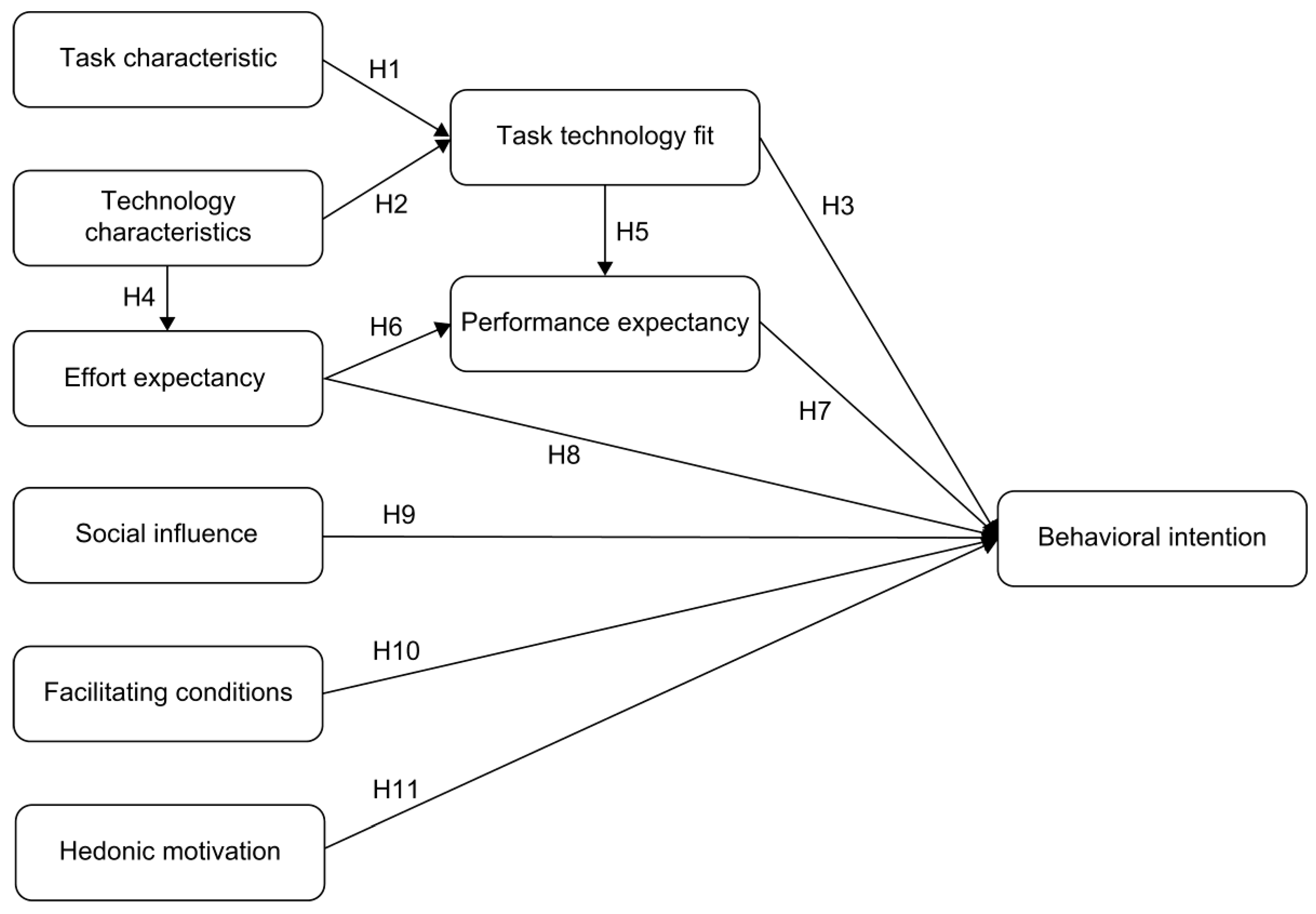

Table 1.
Four-stage consumer decision-making process in an AI-powered fashion curation platform.
| Category | 1. Need Recognition and Planning | 2. Information Search | 3. Evaluation of Alternatives | 4. Purchase Decision |
| Platform Functionality |
|
|
|
|
| AI Integration |
|
|
|
|
| Distinctive Contribution | Transitions consumers from passive browsing to active planning by offering personalized and anticipatory cues, creating a tailored shopping experience | Expedites the discovery process with AI tools that ensure the information is highly personalized and contextually relevant | Utilizes immersive technologies and data analytics to provide a tangible evaluation experience, empowering consumers to make informed comparisons | Uses real-time analytics and personalized incentives to reduce decision friction and increase conversion likelihood |
Table 2.
Operational Description of Each Variable
| Variable | Operational Description |
| Task Characteristics | Shopping characteristics on fashion curation platforms |
| Technology Characteristics | AI technology characteristics of fashion curation platform |
| Task-Technology Fit | How well the AI technology features match consumer needs |
| Performance Expectancy | Expectation that the AI curation platform will improve their shopping experience |
| Effort Expectancy | Ease of use and user-friendliness of the AI-based curation platform |
| Social Influence | Influence of others’ opinions or social media on platform usage |
| Facilitating Condition | Support or resources needed to leverage AI technology |
| Hedonic Motivation | Positive feelings about the overall shopping process |
| Behavioral Intention | Intent to continue using the AI-based curation platform |
Table 3.
Demographic characteristics
| Variable | Category | Frequency | % |
| Gender | Male | 76 | 25.3 |
| Female | 224 | 74.7 | |
| Age Group | 20s | 68 | 22.7 |
| 30s | 75 | 25.0 | |
| 40s | 71 | 23.7 | |
| 50s | 86 | 28.6 | |
| Education | High school or below | 29 | 9.7 |
| In college | 26 | 8.7 | |
| College graduate | 211 | 70.3 | |
| Graduate school graduate | 34 | 11.3 | |
| Occupation | Student | 22 | 7.3 |
| General office worker | 142 | 47.3 | |
| Professional | 37 | 12.3 | |
| Public servant | 16 | 5.3 | |
| Self-employed | 21 | 7.0 | |
| Other | 62 | 20.8 | |
| Search Product Type | Clothing (tops, bottoms, underwear, etc.) | 283 | 49.6 |
| Accessories (shoes, hats, bags, etc.) | 185 | 32.5 | |
| Others (jewelry, beauty products, etc.) | 102 | 17.9 | |
| Purchase Product Type | Clothing | 279 | 54.1 |
| Accessories | 151 | 29.3 | |
| Others | 86 | 16.7 |
Table 4.
Exploratory factor analysis and reliability analysis
| Factor | Item | Factor Loading |
Eigen value |
% of explained variance (Cumulative variance %) |
Cronbach’s α |
| TTF4 | The platform meets my fashion-related needs. | .867 | 3.835 | 27.394 (27.394) |
.916 |
| TTF5 | The platform provides valuable information for my fashion decisions. | .835 | |||
| TTF2 | The platform helps me easily find the fashion information I need. | .745 | |||
| TTF3 | The platform’s features support my fashion selection process. | .727 | |||
| TTF1 | The platform effectively recommends items that match my fashion preferences. | .725 | |||
| TAC2 | Accessing detailed information about fashion items (e.g., material, size, brand) is necessary. | .780 | 3.194 | 22.814 (50.208) |
.835 |
| TAC4 | Suggestions for various outfit combinations are useful. | .752 | |||
| TAC3 | Finding fashion items that match personal preferences is essential. | .749 | |||
| TAC5 | Keeping up with the latest fashion trends is valuable. | .735 | |||
| TAC1 | Receiving recommendations for diverse clothing styles is important when using the fashion curation platform. | .708 | |||
| TEC3 | The platform provides fast response times. | .830 | 2.374 | 16.955 (67.163) |
.791 |
| TEC2 | The AI recommendation feature is accurate and reliable. | .727 | |||
| TEC4 | Personalized recommendations are offered by the platform. | .596 | |||
| TEC1 | The platform’s interface is user-friendly. | .515 | |||
| KMO measure of sampling adequacy = .922, Bartlett's test of sphericity. Chi-square X2=2335.336(df=91, p<.01)** | |||||
| PE4 | The platform increase the diversity of my fashion styles. | .801 | 3.702 | 14.807 (14.807) |
.888 |
| PE5 | The platform provides useful information for coordinating fashion items. | .760 | |||
| PE2 | The platform is effective in improving my sense of fashion style. | .743 | |||
| PE3 | The platform assists in making better fashion-related decisions. | .743 | |||
| PE1 | The platform helps me find the fashion items I want faster. | .687 | |||
| EE2 | Learning how to use the platform is simple. | .792 | 3.689 | 14.755 (29.563) |
.912 |
| EE3 | Understanding the platform’s functionality requires little effort. | .769 | |||
| EE4 | The platform has an intuitive, user-friendly interface. | .765 | |||
| EE1 | Using the platform is easy for me. | .711 | |||
| EE5 | Navigating the platform is straightforward. | .675 | |||
| SI2 | Important individuals want me to use the platform. | .774 | 3.645 | 14.580 (44.143) |
.869 |
| SI3 | Fashion experts support the use of the platform. | .756 | |||
| SI1 | People around me recommend using the platform. | .733 | |||
| SI5 | My family encourages me to use the platform. | .698 | |||
| SI4 | My friends have a positive attitude toward the platform. | .678 | |||
| HM1 | It's fun. | .781 | 3.601 | 14.405 (58.548) |
.924 |
| HM2 | It's enjoyable. | .770 | |||
| HM3 | It's very interesting. | .761 | |||
| HM5 | I feel good. | .736 | |||
| HM4 | It satisfies my needs well. | .651 | |||
| FC2 | Resources to support platform use are readily available. | .781 | 3.242 | 12.968 (71.517) |
.848 |
| FC4 | I own the necessary equipment to use the platform. | .766 | |||
| FC3 | Technical assistance for platform use is accessible. | .741 | |||
| FC5 | I can easily seek help when needed to use the platform. | .684 | |||
| FC1 | I have the knowledge required to use the platform. | .575 | |||
| KMO measure of sampling adequacy = .944, Bartlett's test of sphericity. Chi-square X2=5236.954(df=300, p<.01)** | |||||
| BI1 | I plan to shop through a fashion curation platform in the future. | .894 | 3.153 | 78.823 (78.823) |
.909 |
| BI3 | I will recommend the use of a fashion curation platform to people around me. | .892 | |||
| BI2 | I plan to continue to shop using a fashion curation platform. | .884 | |||
| BI4 | I will talk about the positive aspects of a fashion curation platform to people around me. | .881 | |||
| KMO measure of sampling adequacy = .786, Bartlett's test of sphericity. Chi-square X2=863.634(df=6, p<.01)** | |||||
**p < .01
Table 5.
Descriptive statistics and normality test
| Variables | Mean | SD | Skewness | Kurtosis |
| TAC | 5.59 | .820 | -.603 | .289 |
| TEC | 5.00 | .771 | -.056 | -.290 |
| TTF | 4.99 | .869 | -.425 | .372 |
| PE | 5.08 | .845 | -.401 | .690 |
| EE | 5.35 | .914 | -.370 | -.136 |
| SI | 4.75 | .934 | -.195 | .162 |
| FC | 5.23 | .890 | -.214 | -.142 |
| HM | 5.15 | .943 | -.186 | -.225 |
| BI | 5.32 | .952 | -.263 | -.008 |
Table 6.
Correlation analysis
| TAC | TEC | TTF | PE | EE | SI | FC | HM | BI | |
| TAC | 1 | ||||||||
| TEC | .433** | 1 | |||||||
| TTF | .503** | .739** | 1 | ||||||
| PE | .561** | .629** | .809** | 1 | |||||
| EE | .495** | .669** | .606** | .560** | 1 | ||||
| SI | .358** | .602** | .595** | .571** | .514** | 1 | |||
| FC | .451** | .454** | .429** | .410** | .622** | .460** | 1 | ||
| HM | .444** | .594** | .631** | .619** | .643** | .583** | .570** | 1 | |
| BI | .527** | .553** | .587** | .596** | .647** | .610** | .602** | .737** | 1 |
*p < .05, **p < .01
Table 7.
CFA model fit
| χ2 | df | p | TLI | CFI | RMSEA | SRMR | ||
| Value | Lower Bound |
Upper Bound |
||||||
| 1782.030 | 824 | .000 | .900 | .909 | .062 | .058 | .066 | .060 |
Table 8.
Convergent validity
| TAC | TTF | TEC | PE | EE | SI | FC | HM | BI | |
| CR | .836 | .917 | .797 | .899 | .914 | .874 | .852 | .925 | .910 |
| AVE | .506 | .688 | .500 | .615 | .681 | .582 | .536 | .713 | .717 |
Table 9.
Path analysis result
| Hypothesis and Path | Estimate | S.E. | β | C.R. | p | |||
| H1 | TAC | → | TTF | .231 | .067 | .209 | 3.426 | .001** |
| H2 | TEC | → | TTF | .992 | .106 | .737 | 9.360 | .001** |
| H3 | TTF | → | BI | -.039 | .161 | -.039 | -.244 | .807 |
| H4 | TEC | → | EE | .657 | .074 | .570 | 8.915 | .001** |
| H5 | TTF | → | PE | .782 | .057 | .896 | 13.649 | .001** |
| H6 | EE | → | PE | .042 | .044 | .041 | .952 | .341 |
| H7 | PE | → | BI | .285 | .182 | .249 | 1.565 | .118 |
| H8 | EE | → | BI | .058 | .083 | .050 | .704 | .481 |
| H9 | SI | → | BI | .195 | .064 | .196 | 3.056 | .002** |
| H10 | FC | → | BI | .213 | .075 | .224 | 2.836 | .005** |
| H11 | HM | → | BI | .448 | .075 | .428 | 5.943 | .001** |
*p < .05, **p < .01
Disclaimer/Publisher’s Note: The statements, opinions and data contained in all publications are solely those of the individual author(s) and contributor(s) and not of MDPI and/or the editor(s). MDPI and/or the editor(s) disclaim responsibility for any injury to people or property resulting from any ideas, methods, instructions or products referred to in the content. |
© 2025 by the authors. Licensee MDPI, Basel, Switzerland. This article is an open access article distributed under the terms and conditions of the Creative Commons Attribution (CC BY) license (http://creativecommons.org/licenses/by/4.0/).
Copyright: This open access article is published under a Creative Commons CC BY 4.0 license, which permit the free download, distribution, and reuse, provided that the author and preprint are cited in any reuse.


