

Submitted:
30 December 2025
Posted:
31 December 2025
You are already at the latest version
Abstract
We present an improved algorithm based on the POlarization LIdar PHOtometer Networking (POLIPHON) method to retrieve cloud condensation nuclei (CCN) concentration profiles from spaceborne lidar observations. Our previous paper, which was the first study to demonstrate the feasibility of using measurements from Cloud-Aerosol Lidar and Infrared Pathfinder Satellite Observations (CALIPSO) to retrieve CCN, is revisited. Our results focus on the Evaluation of CALIPSO’s Aerosol Classification scheme over Eastern Mediterranean (ACEMED) research campaign that took place over Thessaloniki, Greece, in September 2011. We compare our results with our earlier retrievals, discussing the critical changes that have been made and the importance of using the proper conversions factors. We also demonstrate the use of conversion factors acquired based on CALIPSO aerosol typing for CCN retrievals. The analysis highlights the strong influence of smoke on CCN concentrations and shows that the assumed aging state of the smoke can significantly alter the retrieval outcome.
Keywords:
CCN
; ACI
; CALIPSO
; improved algorithm
; airborne measurements
; ACEMED
; MODIS
1. Introduction
Today, aerosol–cloud interactions (ACI) are considered the largest source of uncertainty in climate change research. Aerosols can act as cloud condensation nuclei (CCN) for cloud droplets and as ice-nucleating particles (INPs) for ice crystals [1,2,3,4,5], thereby modifying the radiative and microphysical properties of clouds. Global efforts to tackle these uncertainties are underway through international scientific collaborations focused on aerosol–cloud interactions (e.g., AeroCom, ACTRIS, BACCHUS, CERTAINTY) and through broader climate-model intercomparison frameworks such as CMIP6 [6]. For this scope, a combination of in situ measurements, satellite observations, and numerical model simulations is employed to better constrain the processes governing ACI.
Over the years, progress in ACI research has shifted from relying on bulk satellite proxies such as aerosol optical depth (AOD) and aerosol index (AI), now known to be unreliable indicators of CCN [7,8], to adopting more physically based observations. Ground-based polarization lidars and satellite polarimeters have since emerged as more effective tools for constraining CCN/INP concentrations and aerosol–cloud effects [9,10,11,12,13]. Building on this evolution, our previous work provided the first CALIPSO-based CCN estimates and validated them against coincident airborne in situ measurements. This demonstrated the potential of using satellite lidar observations for CCN retrievals based on the POLIPHON methodology [14]. Since then, the concept has been adopted, improved, and extended, leading to the development of two separate algorithms, the Optical Modelling of the CALIPSO Aerosol Microphysics (OMCAM) and POLIPHON [15,16,17], while machine-learning approaches have also been proposed [18]. Recently, [19] developed the first global, satellite-based monthly CCN dataset for the period 2006–2021, based on OMCAM. Such data is highly valuable, as they offer new insight into ACI processes that are still poorly understood or often overlooked. The use of this global OMCAM dataset, [20] showed that dust-influenced and pristine maritime environments particularly limit our current understanding of CCN–cloud droplet relationships.
In this work, we present the progress achieved within the Space-derived aerosol-dependent ClOud PropertiEs (SCOPE) project by applying the POLIPHON algorithm and recent methodological developments. We compare our latest results with our previous retrievals and with in situ aircraft measurements from the Aerosol Classification scheme over Eastern Mediterranean (ACEMED) research campaign. In addition, we apply newly derived SCOPE conversion factors based on CALIPSO aerosol typing and discuss the strong sensitivity of CCN retrievals to the chosen conversion factors, particularly under smoke-rich conditions.
2. Materials and Methods
2.1. Data
CALIPSO, part of the A-Train constellation, operated in a 705-km sun-synchronous orbit from 2006 until its decommissioning in August 2023, crossing the equator near 13:30 LT on a 16-day repeat cycle. Its main instrument, the Cloud-Aerosol Lidar with Orthogonal Polarization (CALIOP), measures backscattered intensity and polarization to retrieve cloud and aerosol profiles in the upper ~30 km of the atmosphere [21,22]. The CALIPSO processing algorithms detect atmospheric layers and assign cloud and aerosol subtypes [23,24,25,26]. Each aerosol subtype is associated with a lidar ratio used to derive extinction. This study uses CALIPSO Version 4.51 (v4.51) Level-2 data, including 532-nm aerosol and cloud backscatter profiles, the Vertical Feature Mask (VFM), the aerosol subtype mask (i.e., marine, dust, polluted continental/smoke, clean continental, polluted dust, elevated smoke, dusty marine for tropospheric aerosols), and auxiliary quality and meteorological parameters (e.g., CAD score, relative humidity). These data serve as input for the CCN calculations.
Within the ACEMED framework, a flight coincident with a CALIPSO overpass over the land–sea area around Thessaloniki, Greece (40.6° N, 22.9° E), was conducted using the FAAM BAe-146 research aircraft on 9 September 2011. Airborne in situ and lidar measurements collected between 00:00 and 02:00 UTC were used to derive dry particle number concentrations (cm⁻³) at different altitude levels [27]. These aircraft measurements are used here for validation.
Finally, to examine the origin of air masses during the measurement period, MODIS/Terra and Aqua day/night C6.1 active-fire data from NASA’s Fire Information for Resource Management System (FIRMS) [28] are combined with 96-h backward trajectories ending over the land and sea area of Thessaloniki, where ACEMED took place. The back-trajectories are computed using the Hybrid Single-Particle Lagrangian Integrated Trajectory (HYSPLIT) model [29].
2.2. CCN Algorithm and Updates
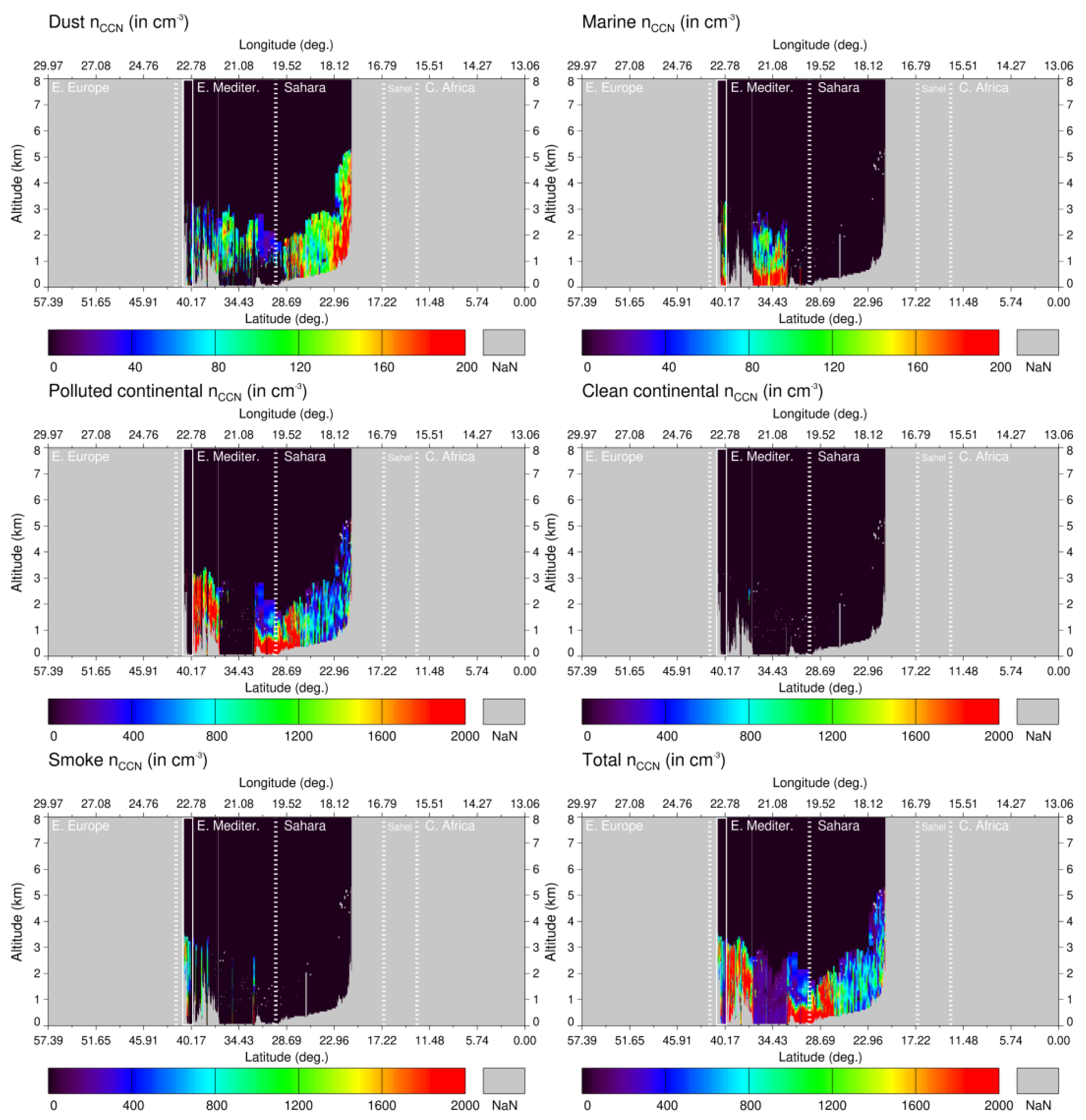
For the scope of this study, the algorithm was applied to a CALIPSO overpass from 9 September 2011, starting at 00:31 UTC. The first distinction relative to our earlier work is the use of Version 4.51 Level-2 data instead of Version 4.1.. A conservative quality-filtering approach was adopted prior to applying the algorithm. Specifically, we followed the methodology described in Proestakis et al. [30] (see their Table 1 and corresponding discussion). Profiles containing cloud features at any height level were excluded. It should be noted that the use of the newer data version and the stricter filtering criteria limits the availability of valid retrievals to the Eastern Mediterranean and part of the Sahara, in contrast to our earlier analysis, which covered the whole Sahara and Sahel areas (See Figure A1).
After quality filtering, we separate dust (d) from non-dust (nd) backscatter coefficients when the CALIPSO aerosol typing identifies dust, polluted dust, or dusty marine aerosols, using the one-step POLIPHON method described in Proestakis et al. [30]. This approach relies on the calculated particle linear depolarization ratio δp(z), the theoretical depolarization ratios of pure dust (δd(z)) and non-dust components (δnd(z)), and the total backscatter βt(z) at 532 nm. We adopt δd=0.31±0.04 and δnd=0.05±0.02.
Pure-dust backscatter coefficients are converted to pure-dust extinction coefficients by multiplying with geographically dependent LRs (see Table 3 and Fig. 3 in Proestakis et al. [30]) unlike Georgoulias et al. [14] where we adopted a single LR value of 55±11 sr following Marinou et al. [31].
The remaining non-dust fraction is attributed to marine aerosols when the CALIPSO algorithm classifies the layer as dusty marine, and to polluted continental aerosols when polluted dust is identified. For marine, polluted continental/smoke (hereafter referred to as polluted continental), clean continental, and elevated smoke (hereafter referred to as smoke), we adopt the standard CALIPSO aerosol typing. Aerosol-type-specific LRs from Kim et al. [23] are then applied to convert backscatter to extinction coefficients.
In this work, CCN concentrations are calculated following the well-established methodology of Mamouri and Ansmann [13], in which dry particle concentrations are obtained (Equation 1) using appropriate conversion factors (cfs):
where ni,j,dry is the concentration of dry particles with radius > i nm for aerosol type j representing the reservoir of favorable CCN-active particles. The parameters cj and xj are the respective cfs and σ is the dry extinction coefficient at height level z. For dust (d) we use i=100 nm, while for marine (m), continental (c), and smoke (s) aerosols we use i=50 nm. The cfs are derived from Aerosol Robotic Network (AERONET) aerosol optical thickness measurements and column-integrated particle size distributions, and since they are obtained under specific aerosol conditions, they differ by aerosol type. In contrast to Georgoulias et al. [14], we do not group polluted continental, clean continental, and smoke aerosols under a single "continental" category. Instead, following more recent studies, we apply separate cfs for each aerosol subtype. Specifically, dust cfs (c100,d, and xd) are taken from Ansmann et al. [9], marine (c100,m and xm) and continental (c60,c and xc) cfs from Mamouri and Ansmann [13], and smoke cfs (c50,s and xs) from Ansmann et al. [32]. For smoke, we test both aged-smoke and fresh-smoke cfs factors depending on the assumed state of the plume. In addition to the "standard" calculations with the cfs described above, for dust, polluted continental aerosols and smoke we also use cfs very recently retrieved within the framework of SCOPE from Karageorgopoulou et al. [33] based on the CALIPSO aerosol typing rather than using Ångström Exponent like previous studies [9,13]. The full list of cfs used in this work is given in Table 1.
As mentioned above, the POLIPHON parameterizations refer to dry aerosol concentrations; therefore, the ambient extinction coefficients cannot be used directly. In Georgoulias et al. [14], dry-to-ambient extinction ratios for different relative humidities (RH) were derived from aerosol microphysical properties retrieved during ACEMED [27]. Here, we adopt a more general approach by using the aerosol-type-specific hygroscopic growth factors from Choudhury et al. [15] (see their Fig. 1). These factors allow us to dry the particles to the RH levels assumed during the derivation of the POLIPHON conversion factors [13]. We assume a typical RH of 80% for marine aerosols and 60% for continental aerosols and smoke. The correction is applied only when the ambient RH exceeds these thresholds. Dust is treated as hydrophobic, and thus no RH correction is applied.
Finally, we derive the CCN number concentrations (nCCNj) for the different aerosol types j from the calculated dry particle concentrations (ni,j,dry) under various supersaturation levels (ss), following Equation 2.
where fss equals 1.0, 1.35, and 1.7 for supersaturations of 0.15%, 0.25%, and 0.40%, respectively [13]. In this study, we report CCN values for a supersaturation level of 0.15%. A schematic overview of the algorithmic workflow is presented in Figure 1.
3. Results
3.1. CALIPSO Vertical Feature Mask and Aerosol Typing During ACEMED
Figure 2 presents the backscatter coefficients at 532 nm, the corresponding vertical feature mask, and the aerosol subtypes in the greater area around Thessaloniki (42.5° N - 37.5° N). Moving from north to south, CALIPSO crossed the land (41.2° N - 40.6° N) and sea (40.6° N - 40.0° N) area of Thessaloniki, where the ACEMED flights took place, at around 00:41 UTC. VFM confirms the existence of tropospheric aerosol layers over the area. The CALIPSO typing algorithm identifies polluted continental/smoke, polluted dust and elevated smoke over the land area and marine, dusty marine and elevated smoke over the sea area. VFM and aerosol types are almost identical with the ones identified with an older version of the CALIPSO data (v4.1) shown in Georgoulias et al. [14].
3.2. CALIPSO CCN Retrievals Using the SCOPE Algorithm During ACEMED
Following Proestakis et al. [30], we separate pure dust from aerosol mixtures and obtain dust, polluted continental, and smoke aerosols over land, and dust, marine, and smoke aerosols over the sea. In Figure 3 we present the CCN concentration (nCCN) cross sections for each individual aerosol type, as well as for all aerosol types combined (total), in cm⁻³. These values are retrieved under a supersaturation of 0.15%, in which case all particles are considered potential CCN; therefore, nCCN is equivalent to the particle number concentration. It is obvious that smoke particles dominate the area. It must be noted that the calculations shown in this figure are based on the "default" SCOPE algorithm conversion factors, i.e., dust cfs from Ansmann et al. [9], marine and polluted/clean continental cfs from Mamouri and Ansmann [13], and smoke cfs from Ansmann et al. [32] assuming aged smoke. The same combination of (denoted as Combination 1 hereafter) cfs was also adopted by Choudhury et al. [15].
The corresponding uncertainties calculated by propagating the error inserted from the use of the CALIPSO optical products, the pure dust separation method, the application of LRs and cfs appear in Figure 4. Specifically for Thessaloniki the average uncertainty across the different atmospheric layers is ~±55% over land and ~±51% over the sea with the overall uncertainty being of the order of a factor of 2 [14,15,17].
3.3. Retrievals with Different Conversion Factors and Comparison with Aircraft Measurements
In addition to Combination 1 (default cfs), we repeat the calculations using our algorithm with four alternative sets of conversion factors. Combination 2 is identical to Combination 1, except that smoke is treated as a mixture of fresh and aged smoke rather than solely aged. Combination 3 uses the same marine and clean-continental cfs as Combination 1 but applies the dust, polluted-continental, and smoke cfs from Karageorgopoulou et al. [33]. These cfs are based on a new approach in which AERONET-derived microphysical properties are combined with CALIPSO aerosol classification. It should be noted, however, that the smoke cfs proposed by Karageorgopoulou et al. [33] were derived from a limited number of smoke cases (13 in total), and therefore may not yet be statistically robust. Because the smoke cfs proposed in the literature differ substantially and the results are highly sensitive to smoke aging, Combinations 4 and 5 retain the dust, marine, and continental cfs from Combination 3 but use aged-smoke and fresh+aged-smoke cfs from Ansmann et al. [32], respectively. The sources of the cfs for all combinations are listed in Table 2.
The resulting CCN profiles for the different aerosol types at a supersaturation of 0.15%, as well as the total CCN profiles, for the land and sea areas around Thessaloniki for all combinations are shown in Figure 5. These profiles are compared with aircraft in situ measurements from ACEMED [27]. The in situ data are available at three altitude levels over land and four over the sea. A detailed comparison is provided in Table 3, where the CALIPSO-derived CCN values are evaluated against the in situ measurements and compared with earlier CALIPSO-based CCN retrievals using the POLIPHON [14] and OMCAM [17] algorithms. The CALIPSO values at the ACEMED flight altitudes were obtained through linear interpolation of the original vertical profiles.
Over land, our retrievals using the default set of conversion factors (Combination 1) overestimate CCN concentrations by an average of 47%, yielding much closer agreement with the aircraft measurements compared to Georgoulias et al. [14] and [17], who overestimated CCN by 128% and 145%, respectively. The use of dust and polluted continental cfs from Karageorgopoulou et al. [33] together with aged-smoke cfs from Ansmann et al. [32] (Combination 4) further improves the agreement with an overestimation of 43%. In the combinations where smoke is assumed to consist of fresh+aged particles (Combinations 2 and 5), CCN concentrations are on average six times higher than the in situ measurements. Combination 3, which uses smoke cfs from Karageorgopoulou et al. (2025), yields CCN values approximately four times higher than the in situ data. Therefore, for land retrievals, Combination 4 provides the best performance. It is also important to note that the 43% overestimation is within the ±61% uncertainty obtained from error propagation and falls within the factor-of-two uncertainty generally expected for these retrievals.
Over the sea area, the default conversion factors (Combination 1) and Combination 4 result in underestimations of −79% and −78%, respectively which are larger discrepancies than the −56% and −44% reported by Georgoulias et al. [14] and Choudhury and Tesche [17]. By contrast, Combinations 2 and 5 yield CCN concentrations that are much closer to the in situ measurements, underestimating by only −17% and −16%, respectively. This behavior is clearly linked to the fresh+aged smoke assumption adopted in these combinations, where the conversion factor cs is 100±50, compared to 17±5 for aged smoke. Overall, over the sea, Combination 5, which combines conversion factors from Karageorgopoulou et al. (2025) with the fresh+aged smoke cfs from Ansmann et al. [32], shows excellent agreement with the in situ measurements, with discrepancies well below the ±64% uncertainty estimated from error propagation and well within the commonly assumed factor-of-two uncertainty for such retrievals.

Table 3.
CCN number concentrations (cm⁻³) at a supersaturation of 0.15% retrieved from CALIPSO using different conversion factor combinations (see Table 2 for details) at the ACEMED flight levels. Our results are compared against aircraft in situ measurements and earlier results from Georgoulias et al., [14] (G2020) with the POLIPHON algorithm and Choudhury and Tesche [17] with the OMCAM algorithm.
Table 3.
CCN number concentrations (cm⁻³) at a supersaturation of 0.15% retrieved from CALIPSO using different conversion factor combinations (see Table 2 for details) at the ACEMED flight levels. Our results are compared against aircraft in situ measurements and earlier results from Georgoulias et al., [14] (G2020) with the POLIPHON algorithm and Choudhury and Tesche [17] with the OMCAM algorithm.
| Area | Alt. | CALIPSO G2020 |
CALIPSO OMCAM |
CALIPSO Comb. 1 |
CALIPSO Comb. 2 |
CALIPSO Comb. 3 |
CALIPSO Comb. 4 |
CALIPSO Comb. 5 |
In situ |
|---|---|---|---|---|---|---|---|---|---|
| Land | 1.8 km | 1504 | 1590 | 813 | 3931 | 2320 | 813 | 3931 | 727 |
| Land | 2.7 km | 2851 | 3171 | 1780 | 7533 | 5436 | 1763 | 7516 | 1318 |
| Land | 3.2 km | 2086 | 2160 | 1565 | 6005 | 4045 | 1475 | 5914 | 779 |
| Sea | 1.3 km | 508 | 826 | 202 | 670 | 452 | 238 | 706 | 1427 |
| Sea | 2.1 km | 1405 | 1476 | 510 | 2069 | 1305 | 537 | 2096 | 1834 |
| Sea | 2.7 km | 912 | 1065 | 460 | 1896 | 1172 | 481 | 1916 | 1501 |
| Sea | 3.2 km | 459 | 841 | 388 | 1669 | 974 | 396 | 1677 | 2814 |
4. Discussion
As shown above, our new CCN retrieval algorithm indicates that over land the aged-smoke assumption yields results that closely match the observations, whereas over the sea the optimal assumption is fresh+aged smoke. It is also shown that, under specific conversion-factor combinations, our retrievals agree much more closely with the in situ measurements than previous POLIPHON- and OMCAM-based estimates. In particular, the choice between aged-smoke and fresh+aged-smoke assumptions is critical and can lead to differences of up to a factor of four, substantially affecting the accuracy of the retrievals.
A natural question that arises is why the aged-smoke assumption performs well over land, while the fresh+aged-smoke assumption is more appropriate over the nearby sea area of Thessaloniki, given that the two regions are separated by only a few tens of kilometers. Could smoke behave differently over sea surfaces? Previous analysis by Georgoulias et al. [14], based on 96-h HYSPLIT backward trajectories and FIRMS fire observations, indicated that smoke from fires burning northwest of Greece during the four days preceding the CALIPSO overpass was transported into the region. Here we repeat that analysis, computing separate back-trajectories ending over the center of the land (40.9° N, 23.0° E) and sea (40.3° N, 22.81° E) areas (Figure 6). Although the two locations are very close, the simulations reveal some differences. In particular, for air masses arriving at 500 m altitude, there appears to be transport (possibly carrying fresh smoke from a fire southwest of Thessaloniki) over the sea area only during the day prior to the CALIPSO overpass. At higher altitudes (>1500 m), where the validation against aircraft data takes place, differences are also present, although the general origin of the air masses is similar. Thus, while we cannot exclude the possibility that fresher smoke reached the sea area, even under identical source conditions smoke may evolve differently over land and sea.
Following the definition of fresh and aged smoke from Ansmann et al. [32], smoke transported for 1–3 days may be considered fresh. However, over land the smoke mixes with a polluted continental boundary layer enriched in pre-existing aerosol and condensable vapors. This promotes chemical aging, condensation of secondary material, and coagulation, producing a size distribution with larger effective particle diameters and therefore lower dry n₅₀ per unit extinction, consistent with the aged smoke extinction-to-number conversion factors of Ansmann et al. [32].
Over the sea, by contrast, the same plume is transported into a much cleaner, less chemically active environment with low background aerosol concentrations. As a result, smoke particles may undergo weaker microphysical processing, retain smaller modal diameters, and maintain a higher dry particle number per unit extinction. In this regime, the fresh-smoke conversion factors reproduce the aircraft-derived dry n₅₀ (and therefore CCN at 0.15% supersaturation) far more accurately.
In addition, the marine boundary layer over the sea is typically very shallow (around 100 m according to ERA5 during the ACEMED flight), producing a stable inversion that inhibits vertical mixing. Smoke transported offshore therefore remains largely confined to an elevated layer, with limited interaction with the clean and chemically less active surface layer. This vertical decoupling further suppresses microphysical aging and helps explain why fresh+aged smoke conversion factors perform better over the sea. This behavior is also evident in the profiles of Figure 5, where the smoke layer over land is deeper and extends down toward the surface, whereas over the sea it appears mostly between ~1 and 3.5 km a.s.l.
Future work should focus on refining smoke-type-specific conversion factors through dedicated observational campaigns and regional analyses. In addition, targeted satellite-based CCN retrievals in regions with persistent smoke outflow and existing aircraft measurements, such as the African biomass-burning corridor sampled during the ORACLES campaign, could help constrain how conversion factors vary with plume age, transport pathway, and boundary-layer structure. Continued development of conversion factors based on CALIPSO aerosol typing, such as the approach introduced by Karageorgopoulou et al. [33], would also be valuable for ensuring consistency across aerosol regimes and improving global applicability. Such efforts would enable a more robust selection of appropriate conversion factors based on where the smoke is observed and its microphysical history.
5. Conclusions
In this study, we revisited CCN retrievals from CALIPSO during the ACEMED campaign using an improved POLIPHON-based algorithm and updated CALIPSO v4.51 optical products. By testing multiple sets of aerosol-type-specific conversion factors, including newly developed SCOPE factors derived from CALIPSO aerosol typing, we demonstrated that the choice of smoke parameterization is the dominant source of variability in CCN retrievals. Over land, assuming aged smoke yields excellent agreement with aircraft in situ data, with CCN overestimations reduced from 128–145% in earlier studies to 43–47% in this work. Over the sea, however, a fresh+aged smoke assumption provides the best performance, reducing biases from −56% to as low as −16% and remaining well within the expected factor-of-two uncertainty. This strong land–sea contrast is linked to differences in boundary-layer structure and microphysical aging processes, as shown using HYSPLIT trajectories, active fire data, and CALIPSO aerosol typing. Our results highlight the critical role of smoke aging state in spaceborne CCN retrievals and underscore the need for regionally constrained conversion factors. Future advances will depend on targeted field campaigns and coordinated satellite–aircraft studies to better characterize smoke evolution and to refine CCN parameterizations for global applications. Continued development of conversion factors based on CALIPSO aerosol typing could provide substantial improvements in the regional and global applicability of CCN retrievals.
Author Contributions
Conceptualization, A.K.G and E.G.; methodology, A.K.G., E.G., A.K., E.P., V.A.; software, A.K.G, A.K., E.P.; validation, A.K.G.; formal analysis, A.K.G., A.K., E.P.; investigation, A.K.G., E.G., A.K., E.P., V.A.; resources, E.G.; data curation, A.K.G., A.K., E.P.; writing—original draft preparation, A.K.G.; writing—review and editing, A.K.G., E.G., A.K., G.T., E.P., V.A..; visualization, A.K.G..; supervision, E.G.; project administration, E.G.; funding acquisition, E.G. All authors have read and agreed to the published version of the manuscript.
Funding
This research was funded by Space derived aerosol-dependent ClOud PropertiEs (SCOPE), Hellenic Foundation for Research and Innovation (HFRI), Sub-action 2. Funding Projects in Leading-Edge Sectors – RRFQ: Basic Research Financing (Horizontal support for all Sciences), implemented within the framework of the National Recovery and Resilience Plan (Greece 2.0) with funding from the European Union – NextGenerationEU (Project Number: 15144).
Data Availability Statement
The CALIPSO v4.51 Level-2 data used for the CCN calculations are publicly available via the Atmospheric Science Data Center at NASA Langley Research Center (https://asdc.larc.nasa.gov/project/CALIPSO). In situ measurements from ACEMED are available in Tsekeri et al. [27]. The MODIS C6.1 fire data used here are available from the NASA Fire Information for Resource Management System (FIRMS) via its data portal (https://firms.modaps.eosdis.nasa.gov). The HYSPLIT transport and dispersion model and associated meteorological data were provided by the NOAA Air Resources Laboratory (ARL). The CALIPSO CCN calculations presented here can de available upon personal communication with Aristeidis K. Georgoulias (ageor@auth.gr) or Elina Giannakaki (elina@phys.uoa.gr).
Acknowledgments
E. Proestakis acknowledges support from the European Space Agency (ESA) – "Ocean Research enhancement through EarthCARE Observations of dust" (OREO) activity - ESA Contract No. 4000147847/25/I/AG.
Conflicts of Interest
The authors declare no conflicts of interest.
Abbreviations
The following abbreviations are used in this manuscript:
| ACI | Aerosol–Cloud Interactions |
| ACEMED | Aerosol Classification scheme over Eastern Mediterranean |
| ACTRIS | Aerosols, Clouds and Trace gases Research InfraStructure |
| AeroCom | Aerosol Comparisons between Observations and Models |
| AERONET | Aerosol Robotic Network |
| AOD | Aerosol Optical Depth |
| AI | Aerosol Index |
| ARL | Air Resources Laboratory |
| BACCHUS | Impact of Biogenic versus Anthropogenic emissions on Clouds and Climate: towards a Holistic Understanding |
| CALIOP | Cloud-Aerosol Lidar with Orthogonal Polarization |
| CALIPSO | Cloud-Aerosol Lidar and Infrared Pathfinder Satellite Observations |
| CCN | Cloud Condensation Nuclei |
| CERTAINTY | [Project full name to be added] |
| CMIP6 | Coupled Model Intercomparison Project Phase 6 |
| ERA5 | ECMWF Reanalysis v5 |
| FAAM | Facility for Airborne Atmospheric Measurements |
| FIRMS | Fire Information for Resource Management System |
| HYSPLIT | Hybrid Single-Particle Lagrangian Integrated Trajectory |
| INP | Ice-Nucleating Particle |
| LR | Lidar Ratio |
| MODIS | Moderate Resolution Imaging Spectroradiometer |
| NASA | National Aeronautics and Space Administration |
| NOAA | National Oceanic and Atmospheric Administration |
| OMCAM | Optical Modelling of the CALIPSO Aerosol Microphysics |
| ORACLES | ObseRvations of Aerosols above CLouds and their intEractionS |
| POLIPHON | POlarization LIdar PHOtometer Networking |
| RH | Relative Humidity |
| SCOPE | Space-derived aerosol-dependent Cloud Properties |
| UTC | Coordinated Universal Time |
| VFM | Vertical Feature Mask |
Appendix A
References
- Bellouin, N.; Quaas, J.; Gryspeerdt, E.; Kinne, S.; Stier, P.; Watson-Parris, D.; Boucher, O.; Carslaw, K.S.; Christensen, M.; Daniau, A. -L.; et al. Bounding Global Aerosol Radiative Forcing of Climate Change. Rev. Geophys. 2020, 58, e2019RG000660. [Google Scholar] [CrossRef]
- Haywood, J.; Boucher, O. Estimates of the Direct and Indirect Radiative Forcing Due to Tropospheric Aerosols: A Review. Rev. Geophys. 2000, 38, 513–543. [Google Scholar] [CrossRef]
- Climate Change 2013 - The Physical Science Basis: Working Group I Contribution to the Fifth Assessment Report of the Intergovernmental Panel on Climate Change; Change, Intergovernmental Panel on Climate, Ed.; Cambridge University Press: Cambridge, 2014; ISBN 978-1-107-41532-4. [Google Scholar]
- Lohmann, U.; Feichter, J. Global Indirect Aerosol Effects: A Review. Atmospheric Chem. Phys. 2005, 5, 715–737. [Google Scholar] [CrossRef]
- Rosenfeld, D.; Andreae, M.O.; Asmi, A.; Chin, M.; De Leeuw, G.; Donovan, D.P.; Kahn, R.; Kinne, S.; Kivekäs, N.; Kulmala, M.; et al. Global Observations of Aerosol-Cloud-Precipitation-Climate Interactions: Aerosol-Cloud-Climate Interactions. Rev. Geophys. 2014, 52, 750–808. [Google Scholar] [CrossRef]
- Eyring, V.; Bony, S.; Meehl, G.A.; Senior, C.A.; Stevens, B.; Stouffer, R.J.; Taylor, K.E. Overview of the Coupled Model Intercomparison Project Phase 6 (CMIP6) Experimental Design and Organization. Geosci. Model Dev. 2016, 9, 1937–1958. [Google Scholar] [CrossRef]
- Shinozuka, Y.; Clarke, A.D.; Nenes, A.; Jefferson, A.; Wood, R.; McNaughton, C.S.; Ström, J.; Tunved, P.; Redemann, J.; Thornhill, K.L.; et al. The Relationship between Cloud Condensation Nuclei (CCN) Concentration and Light Extinction of Dried Particles: Indications of Underlying Aerosol Processes and Implications for Satellite-Based CCN Estimates. Atmospheric Chem. Phys. 2015, 15, 7585–7604. [Google Scholar] [CrossRef]
- Stier, P. Limitations of Passive Remote Sensing to Constrain Global Cloud Condensation Nuclei. Atmospheric Chem. Phys. 2016, 16, 6595–6607. [Google Scholar] [CrossRef]
- Ansmann, A.; Mamouri, R.-E.; Hofer, J.; Baars, H.; Althausen, D.; Abdullaev, S.F. Dust Mass, Cloud Condensation Nuclei, and Ice-Nucleating Particle Profiling with Polarization Lidar: Updated POLIPHON Conversion Factors from Global AERONET Analysis. Atmospheric Meas. Tech. 2019, 12, 4849–4865. [Google Scholar] [CrossRef]
- Genz, C.; Schrödner, R.; Heinold, B.; Henning, S.; Baars, H.; Spindler, G.; Tegen, I. Estimation of Cloud Condensation Nuclei Number Concentrations and Comparison to in Situ and Lidar Observations during the HOPE Experiments. Atmospheric Chem. Phys. 2020, 20, 8787–8806. [Google Scholar] [CrossRef]
- Haarig, M.; Walser, A.; Ansmann, A.; Dollner, M.; Althausen, D.; Sauer, D.; Farrell, D.; Weinzierl, B. Profiles of Cloud Condensation Nuclei, Dust Mass Concentration, and Ice-Nucleating-Particle-Relevant Aerosol Properties in the Saharan Air Layer over Barbados from Polarization Lidar and Airborne in Situ Measurements. Atmospheric Chem. Phys. 2019, 19, 13773–13788. [Google Scholar] [CrossRef]
- Hofer, J.; Ansmann, A.; Althausen, D.; Engelmann, R.; Baars, H.; Abdullaev, S.F.; Makhmudov, A.N. Long-Term Profiling of Aerosol Light Extinction, Particle Mass, Cloud Condensation Nuclei, and Ice-Nucleating Particle Concentration over Dushanbe, Tajikistan, in Central Asia. Atmospheric Chem. Phys. 2020, 20, 4695–4711. [Google Scholar] [CrossRef]
- Mamouri, R.-E.; Ansmann, A. Potential of Polarization Lidar to Provide Profiles of CCN- and INP-Relevant Aerosol Parameters. Atmospheric Chem. Phys. 2016, 16, 5905–5931. [Google Scholar] [CrossRef]
- Georgoulias, A.K.; Marinou, E.; Tsekeri, A.; Proestakis, E.; Akritidis, D.; Alexandri, G.; Zanis, P.; Balis, D.; Marenco, F.; Tesche, M.; et al. A First Case Study of CCN Concentrations from Spaceborne Lidar Observations. Remote Sens. 2020, 12, 1557. [Google Scholar] [CrossRef]
- Choudhury, G.; Ansmann, A.; Tesche, M. Evaluation of Aerosol Number Concentrations from CALIPSO with ATom Airborne in Situ Measurements. Atmospheric Chem. Phys. 2022, 22, 7143–7161. [Google Scholar] [CrossRef]
- Choudhury, G.; Tesche, M. Assessment of CALIOP-Derived CCN Concentrations by In Situ Surface Measurements. Remote Sens. 2022, 14, 3342. [Google Scholar] [CrossRef]
- Choudhury, G.; Tesche, M. Estimating Cloud Condensation Nuclei Concentrations from CALIPSO Lidar Measurements. Atmospheric Meas. Tech. 2022, 15, 639–654. [Google Scholar] [CrossRef]
- Redemann, J.; Gao, L. A Machine Learning Paradigm for Necessary Observations to Reduce Uncertainties in Aerosol Climate Forcing. Nat. Commun. 2024, 15, 8343. [Google Scholar] [CrossRef]
- Choudhury, G.; Tesche, M. A First Global Height-Resolved Cloud Condensation Nuclei Data Set Derived from Spaceborne Lidar Measurements. Earth Syst. Sci. Data 2023, 15, 3747–3760. [Google Scholar] [CrossRef]
- Choudhury, G.; Block, K.; Haghighatnasab, M.; Quaas, J.; Goren, T.; Tesche, M. Pristine Oceans Are a Significant Source of Uncertainty in Quantifying Global Cloud Condensation Nuclei. Atmospheric Chem. Phys. 2025, 25, 3841–3856. [Google Scholar] [CrossRef]
- Hunt, W.H.; Winker, D.M.; Vaughan, M.A.; Powell, K.A.; Lucker, P.L.; Weimer, C. CALIPSO Lidar Description and Performance Assessment. J. Atmospheric Ocean. Technol. 2009, 26, 1214–1228. [Google Scholar] [CrossRef]
- Winker, D.M.; Vaughan, M.A.; Omar, A.; Hu, Y.; Powell, K.A.; Liu, Z.; Hunt, W.H.; Young, S.A. Overview of the CALIPSO Mission and CALIOP Data Processing Algorithms. J. Atmospheric Ocean. Technol. 2009, 26, 2310–2323. [Google Scholar] [CrossRef]
- Kim, M.-H.; Omar, A.H.; Tackett, J.L.; Vaughan, M.A.; Winker, D.M.; Trepte, C.R.; Hu, Y.; Liu, Z.; Poole, L.R.; Pitts, M.C.; et al. The CALIPSO Version 4 Automated Aerosol Classification and Lidar Ratio Selection Algorithm. Atmospheric Meas. Tech. 2018, 11, 6107–6135. [Google Scholar] [CrossRef] [PubMed]
- Omar, A.H.; Winker, D.M.; Vaughan, M.A.; Hu, Y.; Trepte, C.R.; Ferrare, R.A.; Lee, K.-P.; Hostetler, C.A.; Kittaka, C.; Rogers, R.R.; et al. The CALIPSO Automated Aerosol Classification and Lidar Ratio Selection Algorithm. J. Atmospheric Ocean. Technol. 2009, 26, 1994–2014. [Google Scholar] [CrossRef]
- Tackett, J.L.; Kar, J.; Vaughan, M.A.; Getzewich, B.J.; Kim, M.-H.; Vernier, J.-P.; Omar, A.H.; Magill, B.E.; Pitts, M.C.; Winker, D.M. The CALIPSO Version 4.5 Stratospheric Aerosol Subtyping Algorithm. Atmospheric Meas. Tech. 2023, 16, 745–768. [Google Scholar] [CrossRef]
- Vaughan, M.A.; Powell, K.A.; Winker, D.M.; Hostetler, C.A.; Kuehn, R.E.; Hunt, W.H.; Getzewich, B.J.; Young, S.A.; Liu, Z.; McGill, M.J. Fully Automated Detection of Cloud and Aerosol Layers in the CALIPSO Lidar Measurements. J. Atmospheric Ocean. Technol. 2009, 26, 2034–2050. [Google Scholar] [CrossRef]
- Tsekeri, A.; Amiridis, V.; Marenco, F.; Nenes, A.; Marinou, E.; Solomos, S.; Rosenberg, P.; Trembath, J.; Nott, G.J.; Allan, J.; et al. Profiling Aerosol Optical, Microphysical and Hygroscopic Properties in Ambient Conditions by Combining in Situ and Remote Sensing. Atmospheric Meas. Tech. 2017, 10, 83–107. [Google Scholar] [CrossRef]
- Giglio, L.; Schroeder, W.; Justice, C.O. The Collection 6 MODIS Active Fire Detection Algorithm and Fire Products. Remote Sens. Environ. 2016, 178, 31–41. [Google Scholar] [CrossRef]
- Stein, A.F.; Draxler, R.R.; Rolph, G.D.; Stunder, B.J.B.; Cohen, M.D.; Ngan, F. NOAA’s HYSPLIT Atmospheric Transport and Dispersion Modeling System. Bull. Am. Meteorol. Soc. 2015, 96, 2059–2077. [Google Scholar] [CrossRef]
- Proestakis, E.; Gkikas, A.; Georgiou, T.; Kampouri, A.; Drakaki, E.; Ryder, C.L.; Marenco, F.; Marinou, E.; Amiridis, V. A Near-Global Multiyear Climate Data Record of the Fine-Mode and Coarse-Mode Components of Atmospheric Pure Dust. Atmospheric Meas. Tech. 2024, 17, 3625–3667. [Google Scholar] [CrossRef]
- Marinou, E.; Amiridis, V.; Binietoglou, I.; Tsikerdekis, A.; Solomos, S.; Proestakis, E.; Konsta, D.; Papagiannopoulos, N.; Tsekeri, A.; Vlastou, G.; et al. Three-Dimensional Evolution of Saharan Dust Transport towards Europe Based on a 9-Year EARLINET-Optimized CALIPSO Dataset. Atmospheric Chem. Phys. 2017, 17, 5893–5919. [Google Scholar] [CrossRef]
- Ansmann, A.; Ohneiser, K.; Mamouri, R.-E.; Knopf, D.A.; Veselovskii, I.; Baars, H.; Engelmann, R.; Foth, A.; Jimenez, C.; Seifert, P.; et al. Tropospheric and Stratospheric Wildfire Smoke Profiling with Lidar: Mass, Surface Area, CCN, and INP Retrieval. Atmospheric Chem. Phys. 2021, 21, 9779–9807. [Google Scholar] [CrossRef]
- Karageorgopoulou, A.; Amiridis, V.; Georgiou, T.; Marinou, E.; Giannakaki, E. Cloud Condensation Nuclei (CCN) and Ice Nucleating Particles (INP) Conversion Factors Based on Thessaloniki and Leipzig AERONET Stations Using CALIPSO Aerosol Typing. In Proceedings of the COMECAP 2025; MDPI, September 16 2025; p. 33. [Google Scholar]
Figure 1.
SCOPE CALIPSO CCN retrieval scheme.
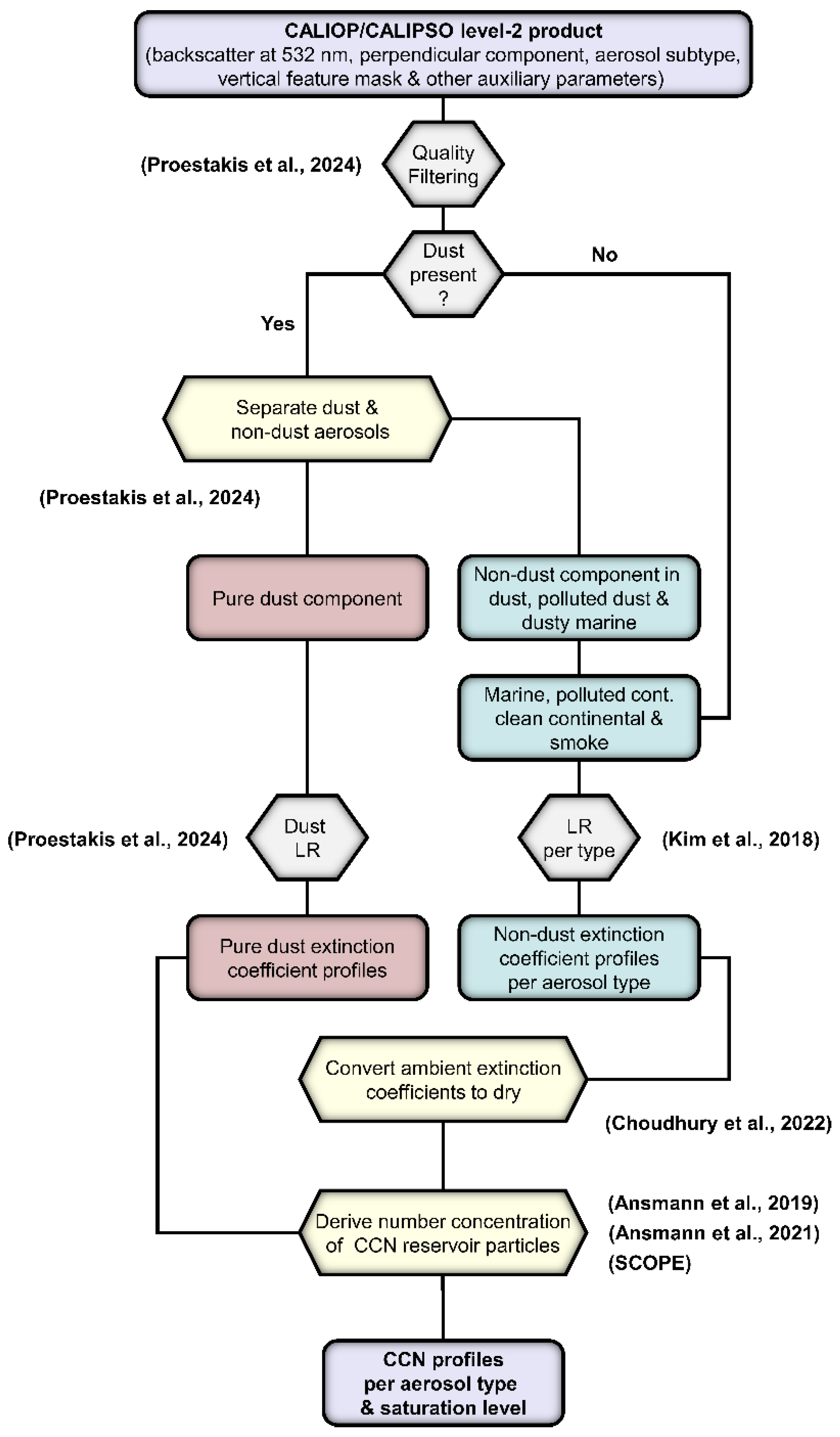
Figure 2.
Vertical cross sections of the 532-nm total backscatter, the vertical feature mask, and the aerosol subtype classification over the Thessaloniki region during ACEMED, produced using the CALIPSO v4.51 dataset. The limits of the area of interest (land and sea) are indicated.
Figure 2.
Vertical cross sections of the 532-nm total backscatter, the vertical feature mask, and the aerosol subtype classification over the Thessaloniki region during ACEMED, produced using the CALIPSO v4.51 dataset. The limits of the area of interest (land and sea) are indicated.
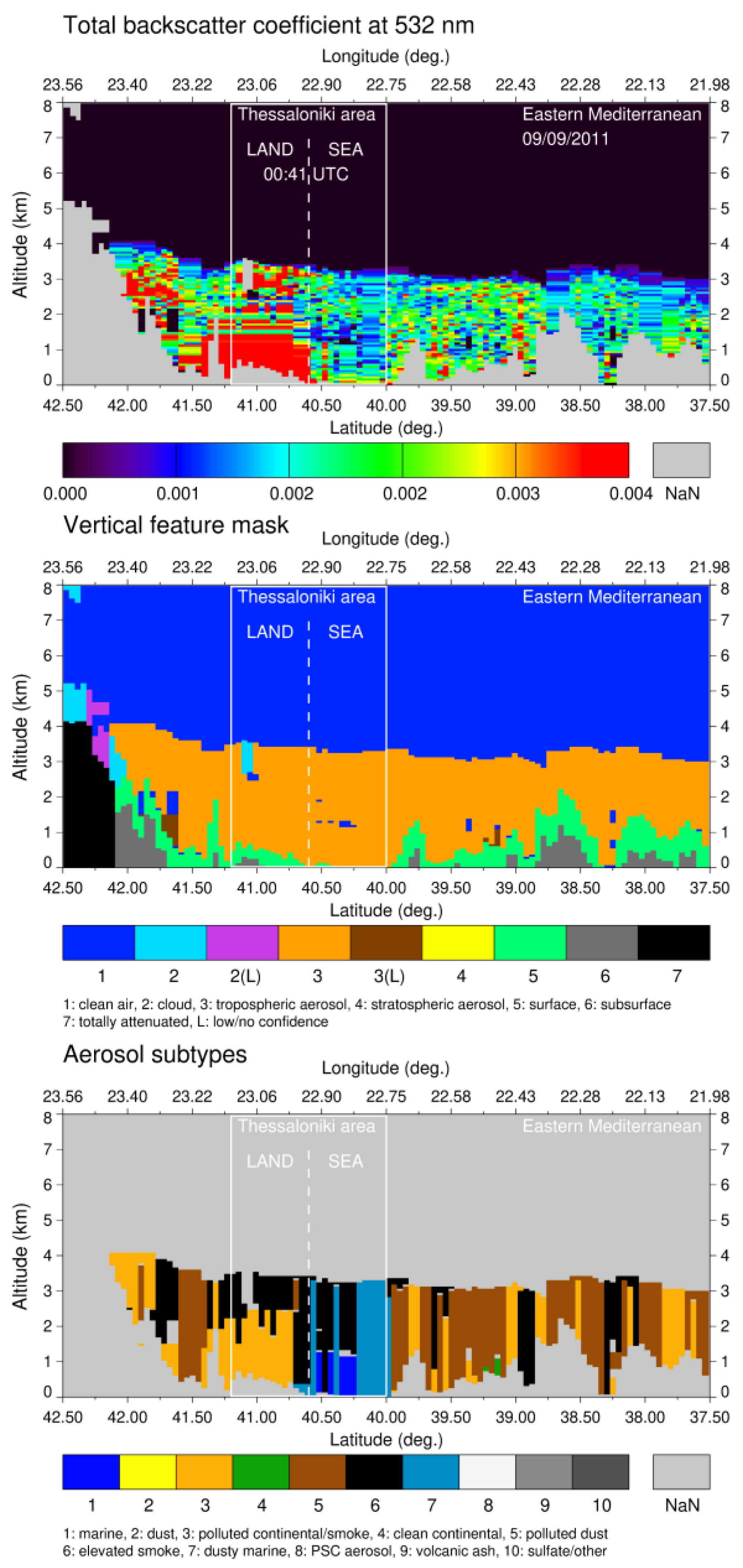
Figure 3.
Vertical transects of CCN concentrations for different aerosol types retrieved from CALIPSO with the SCOPE algorithm for a supersaturation of 0.15%. Note that continental and smoke CCN concentrations reach values up to an order of magnitude higher than those of dust and marine aerosols and therefore are displayed using a separate color scale.
Figure 3.
Vertical transects of CCN concentrations for different aerosol types retrieved from CALIPSO with the SCOPE algorithm for a supersaturation of 0.15%. Note that continental and smoke CCN concentrations reach values up to an order of magnitude higher than those of dust and marine aerosols and therefore are displayed using a separate color scale.
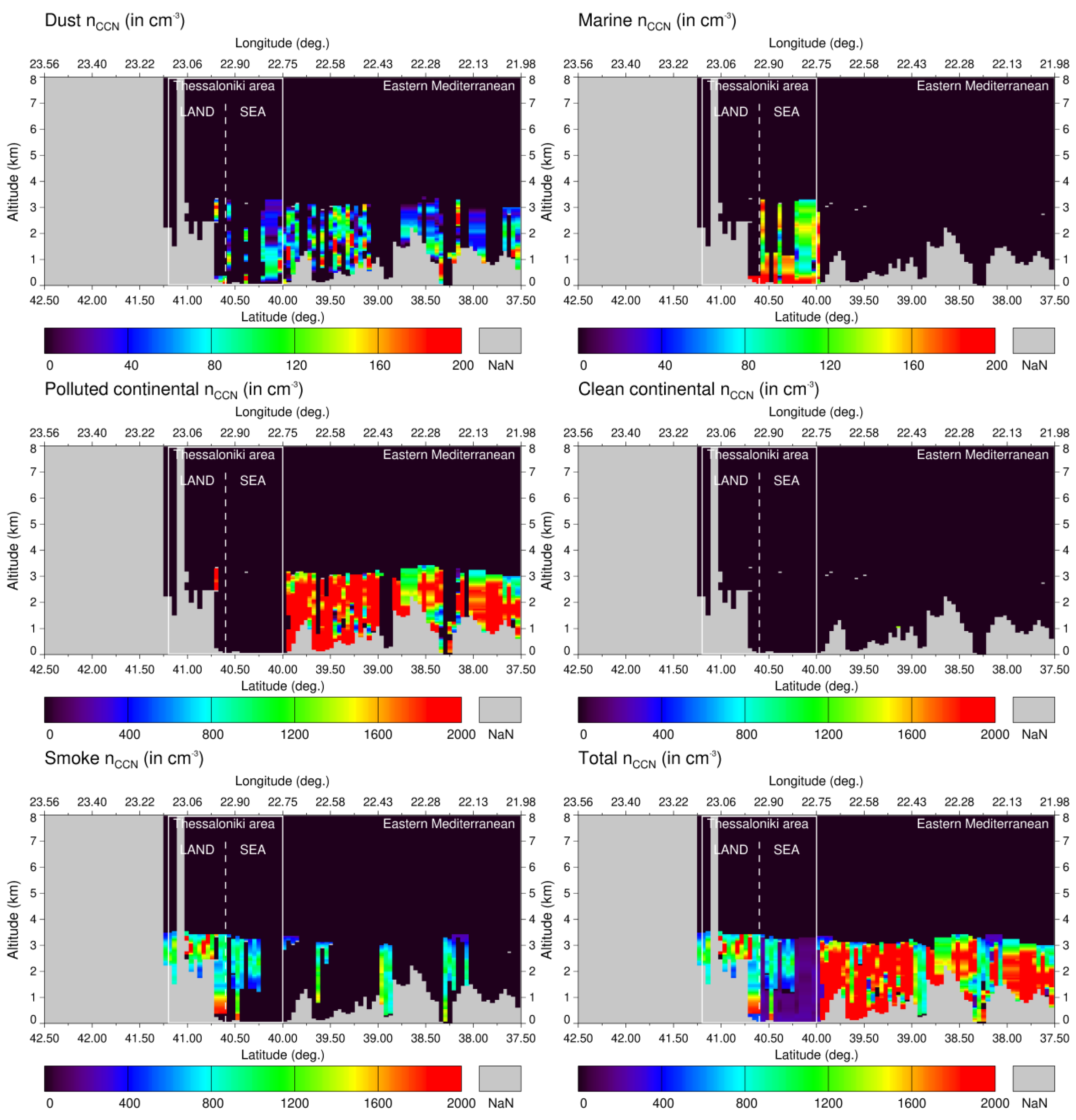
Figure 4.
Same as Figure 3 but showing the associated uncertainties obtained by propagating errors from the CALIPSO optical products, the pure-dust separation procedure, and the applied lidar ratios and conversion factors.
Figure 4.
Same as Figure 3 but showing the associated uncertainties obtained by propagating errors from the CALIPSO optical products, the pure-dust separation procedure, and the applied lidar ratios and conversion factors.
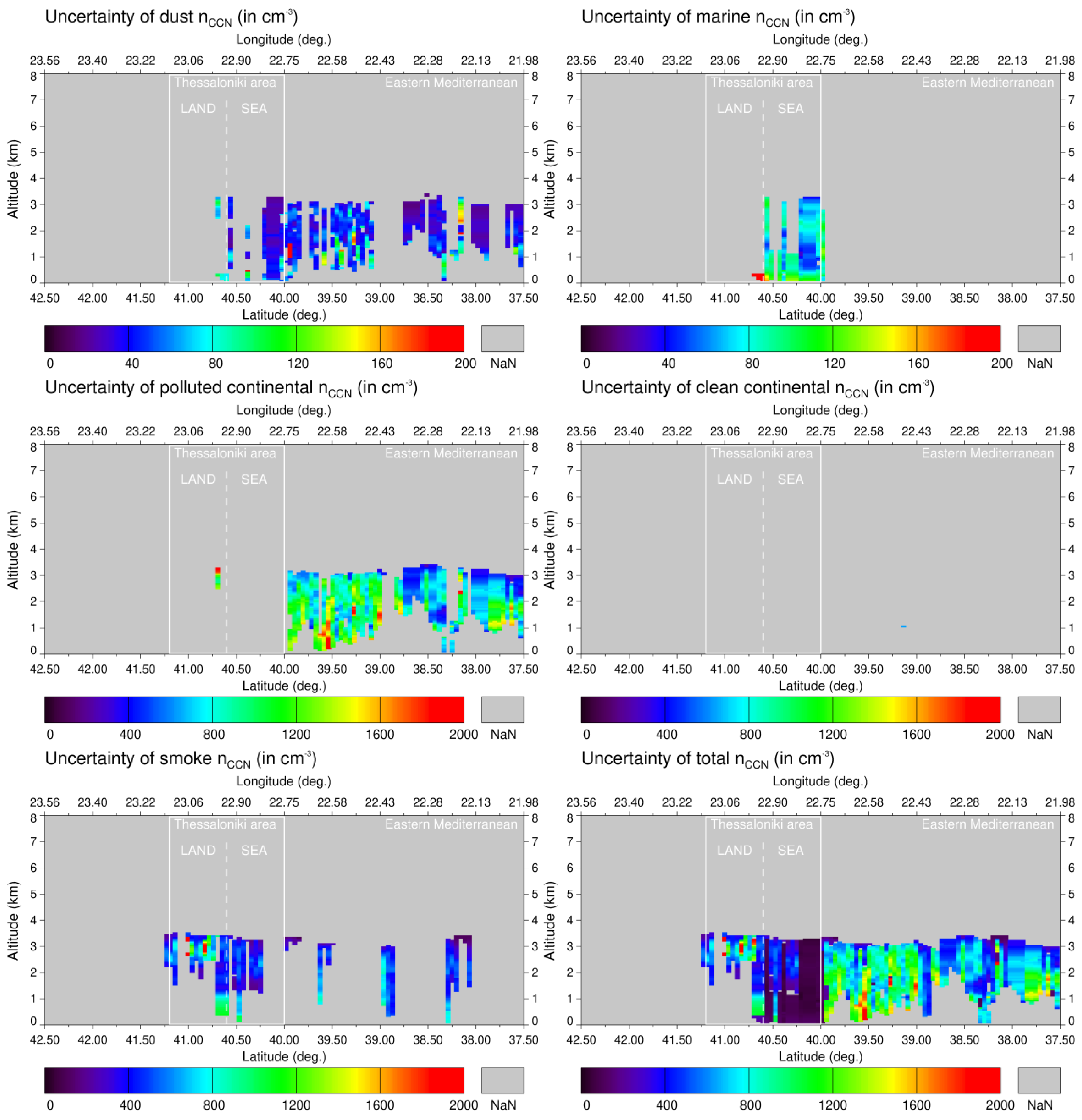
Figure 5.
Profiles of CCN concentrations at a supersaturation of 0.15% over the land and sea areas of Thessaloniki, Greece during ACEMED, for different aerosol types retrieved from CALIPSO using the SCOPE algorithm with different conversion factor combinations (see Table 2 for description of the combinations). Different x-axis limits are used to improve the clarity of the presentation, as some combinations produce substantially higher CCN values.
Figure 5.
Profiles of CCN concentrations at a supersaturation of 0.15% over the land and sea areas of Thessaloniki, Greece during ACEMED, for different aerosol types retrieved from CALIPSO using the SCOPE algorithm with different conversion factor combinations (see Table 2 for description of the combinations). Different x-axis limits are used to improve the clarity of the presentation, as some combinations produce substantially higher CCN values.
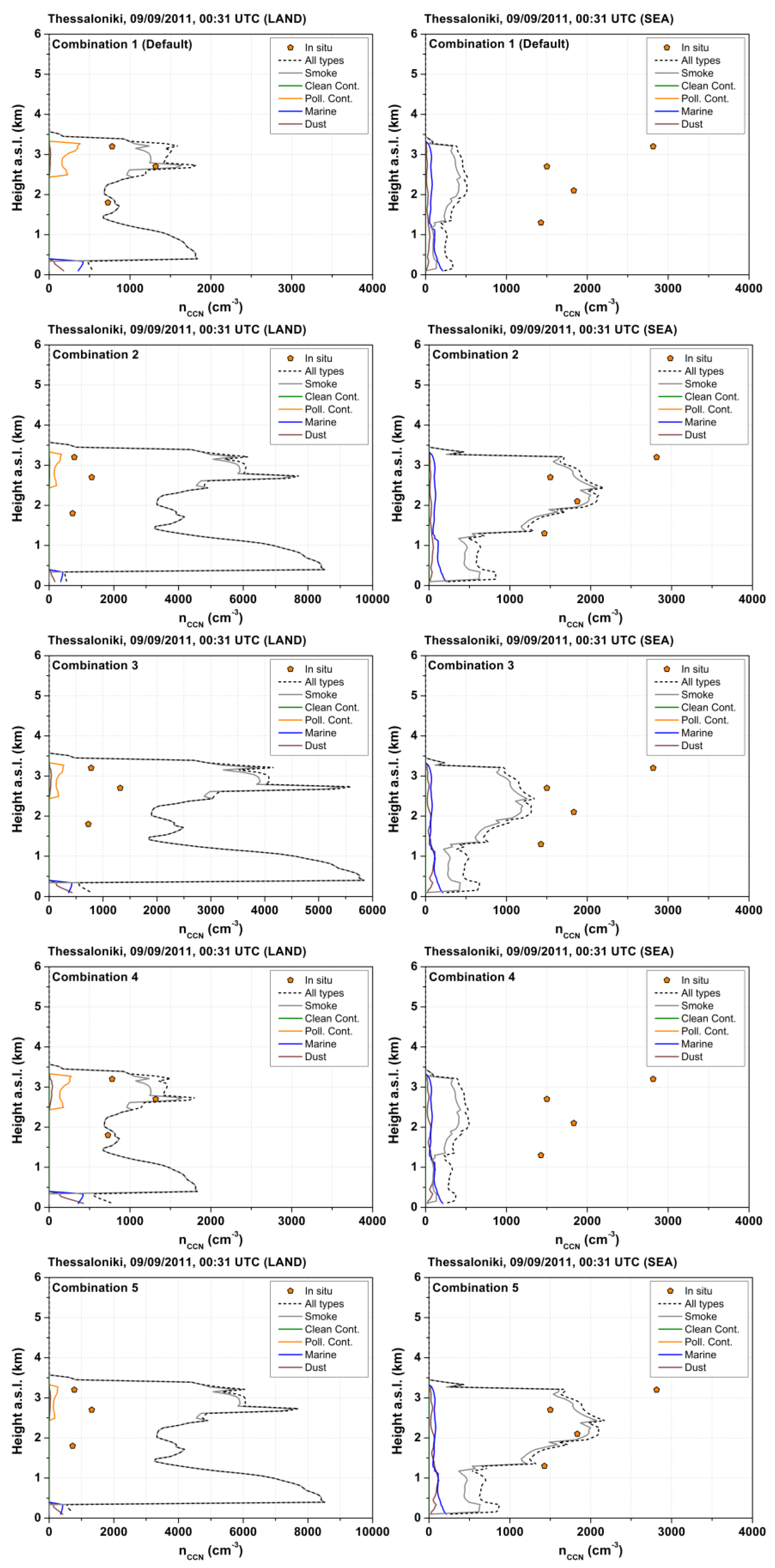
Figure 6.
HYSPLIT 4-day back-trajectories arriving over the land (upper panel) and sea (lower panel) areas of Thessaloniki, Greece, at 00:00 UTC on 09 September 2011. Fire locations detected by the MODIS/Terra and Aqua sensors during the preceding four days are also shown. Orange diamond, triangle, square, and cross symbols denote fires occurring 0, 1, 2, and 3 days prior to the analysis day, respectively.
Figure 6.
HYSPLIT 4-day back-trajectories arriving over the land (upper panel) and sea (lower panel) areas of Thessaloniki, Greece, at 00:00 UTC on 09 September 2011. Fire locations detected by the MODIS/Terra and Aqua sensors during the preceding four days are also shown. Orange diamond, triangle, square, and cross symbols denote fires occurring 0, 1, 2, and 3 days prior to the analysis day, respectively.
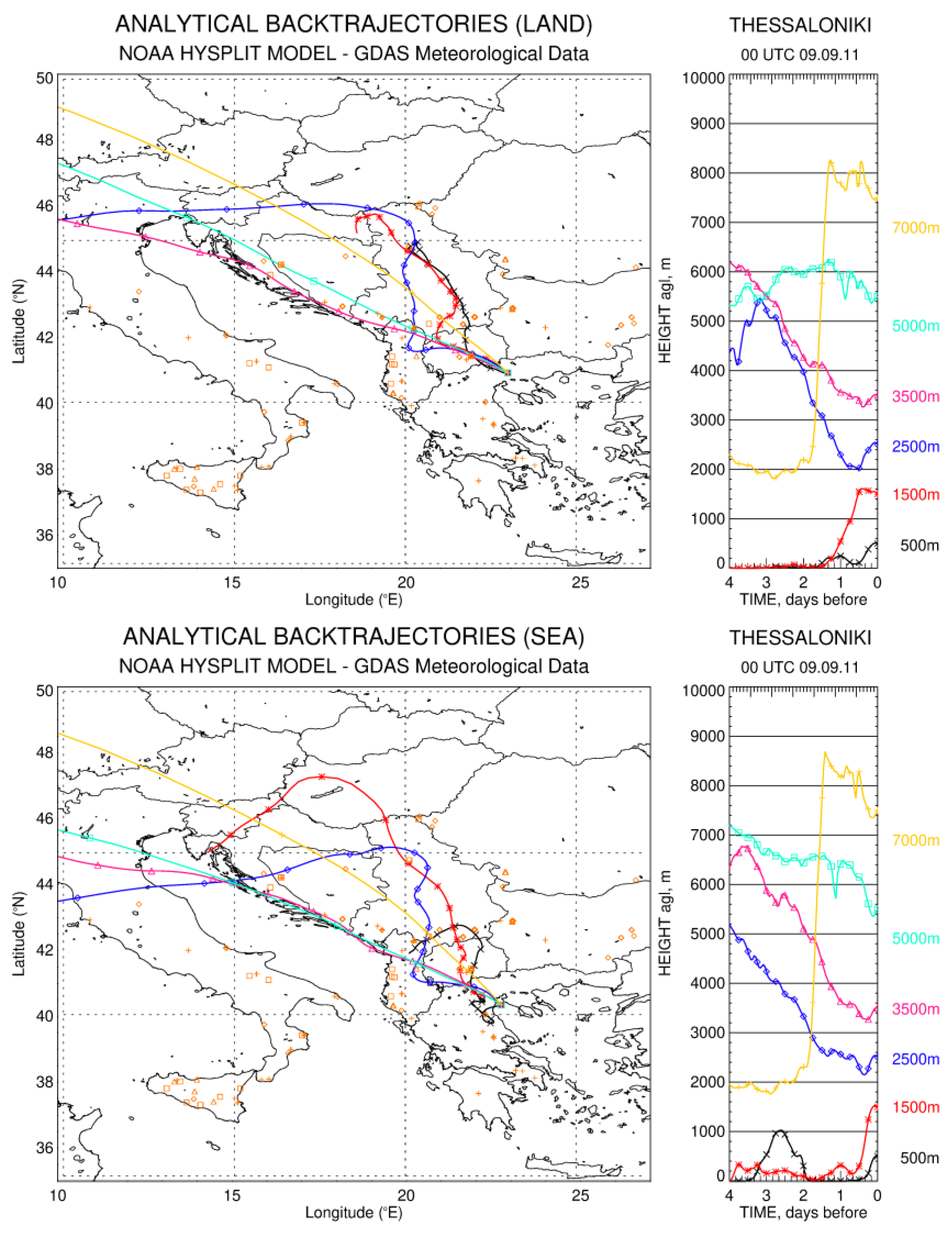
Table 1.
Conversion factors for the different aerosol types j used in the CCN calculations, along with their associated uncertainties (±1σ). The source study and the region from which each factor was derived are also provided.
Table 1.
Conversion factors for the different aerosol types j used in the CCN calculations, along with their associated uncertainties (±1σ). The source study and the region from which each factor was derived are also provided.
| Aerosol type | Study | Area retrieved | cj (Mm cm−3)* | xj |
|---|---|---|---|---|
| Dust | Ansmann et al. [9] | Global mean | 8.9±2.8 | 0.75±0.06 |
| Karageorgopoulou et al. [33] | Thessaloniki, Greece & Leipzig, Germany |
13.6±9.2 | 0.86±0.13 | |
| Marine | Mamouri and Ansmann [13] | Barbados | 7.2±3.7 | 0.85±0.03 |
| Polluted Continental | Mamouri and Ansmann [13] | Leipzig, Germany | 25.3±3.3 | 0.94±0.03 |
| Karageorgopoulou et al. [33] | Thessaloniki, Greece & Leipzig, Germany |
43.4±28.6 | 0.78±0.13 | |
| Clean Continental | Mamouri and Ansmann [13] | Leipzig, Germany | 25.3±3.3 | 0.94±0.03 |
| Smoke (aged) Smoke (fresh+aged) Smoke |
Ansmann et al. [32] | Recommended from global measurements |
17.0±5.0 | 0.79±0.08 |
| Ansmann et al. [32] | Recommended from global measurements |
100.0±50.0 | 0.75±0.08 | |
| Karageorgopoulou et al. [33] | Thessaloniki, Greece & Leipzig, Germany |
28.2±28.7 | 0.90±0.19 |
* cj corresponds to c100d for dust, c100m for marine aerosols, c60c for continental aerosols, and c50s for smoke.
Table 2.
Sources of the conversion factors used for each aerosol type in the five combinations tested in this study. For each combination, the corresponding reference from which the cfs were adopted is provided.
Table 2.
Sources of the conversion factors used for each aerosol type in the five combinations tested in this study. For each combination, the corresponding reference from which the cfs were adopted is provided.
| Aerosol type | Combination 1 | Combination 2 | Combination 3 | Combination 4 | Combination 5 |
|---|---|---|---|---|---|
| Dust | Ansmann et al. [9] | Ansmann et al. [9] | Karageorgoupoulou et al. [33] | Karageorgoupoulou et al. [33] | Karageorgoupoulou et al. [33] |
| Marine | Mamouri and Ansmann [13] | Mamouri and Ansmann [13] | Mamouri and Ansmann [13] | Mamouri and Ansmann [13] | Mamouri and Ansmann [13] |
| Poll. Continental | Mamouri and Ansmann [13] | Mamouri and Ansmann [13] | Karageorgoupoulou et al. [33] | Karageorgoupoulou et al. [33] | Karageorgoupoulou et al. [33] |
| Clean Continental | Mamouri and Ansmann [13] | Mamouri and Ansmann [13] | Mamouri and Ansmann [13] | Mamouri and Ansmann [13] | Mamouri and Ansmann [13] |
| Smoke | Ansmann et al. [32] (aged) | Ansmann et al. [32] (fresh+aged) | Karageorgoupoulou et al. [33] | Ansmann et al. [32] (aged) | Ansmann et al. [32] (fresh+aged) |
Disclaimer/Publisher’s Note: The statements, opinions and data contained in all publications are solely those of the individual author(s) and contributor(s) and not of MDPI and/or the editor(s). MDPI and/or the editor(s) disclaim responsibility for any injury to people or property resulting from any ideas, methods, instructions or products referred to in the content. |
© 2025 by the authors. Licensee MDPI, Basel, Switzerland. This article is an open access article distributed under the terms and conditions of the Creative Commons Attribution (CC BY) license (http://creativecommons.org/licenses/by/4.0/).
Copyright: This open access article is published under a Creative Commons CC BY 4.0 license, which permit the free download, distribution, and reuse, provided that the author and preprint are cited in any reuse.


