

Submitted:
30 December 2025
Posted:
31 December 2025
You are already at the latest version
Abstract
The conventional formulation of quantum mechanics explains the Einstein, Podolsky, and Rosen (EPR) experiments with “spooky action at a distance" and wavefunction collapse. A time-symmetric and retrocausal formulation of quantum mechanics explains the same experiments without spooky action at a distance or wavefunction collapse. An experiment that can distinguish between the conventional and time-symmetric formulations is described.
Keywords:
EPR
; Einstein
; Podolsky
; Rosen
; time-symmetric
; retrocausal
; paradox
1. Introduction
One of the most serious problems facing modern physics is to reconcile special relativity and quantum mechanics [1]. These two foundational theories come into direct conflict in the Einstein, Podolsky, and Rosen (EPR) paradox [2]: “the problem of a genuine Lorentz invariance of our most basic physical theory, namely quantum mechanics, in the face of EPR-Bell experiments is probably the biggest problem that theoretical physics faces today, even though it is not even recognized as such by most theoretical physicists...How does one account for the collapse rule of quantum mechanics in relativistic terms when dealing with entangled states whose parts are spacelike separated? [3]"
There have been many attempts to explain the EPR paradox using time-symmetric theories [4,5,6,7,8,9,10,11,12,13,14,15]. These papers and books attempt to explain how the spin wavefunctions behave to match the quantum predictions and avoid nonlocality, while ignoring the nonlocal collapse of the spatial wavefunctions. To the best of my knowledge, this paper is the first to explain both the evolution of the spin wavefunctions and the evolution of the spatial wavefunctions without invoking collapse.
2. The Gedankenexperiment
Freedman and Clauser carried out the first experimental proof of nonlocal quantum entanglement in 1972 [16]. Many followup experiments were carried out, reproducing their results and eliminating various loopholes. Figure 1 shows a simplified version of their experiment. When the detectors on the left and right sides are separated by a spacelike interval, it is not possible to say which detector went off first, or if they went off simultaneously.
3. The Conventional Formulation (CF) Explanation
The CF assumes that a retarded spatial wavefunction that satisfies the Schrödinger equation and evolves forwards in time from initial conditions until collapsing upon measurement gives the most complete description of a particle that is in principle possible [17]. For example, the retarded traveling gaussian spatial wavefunction in one dimension
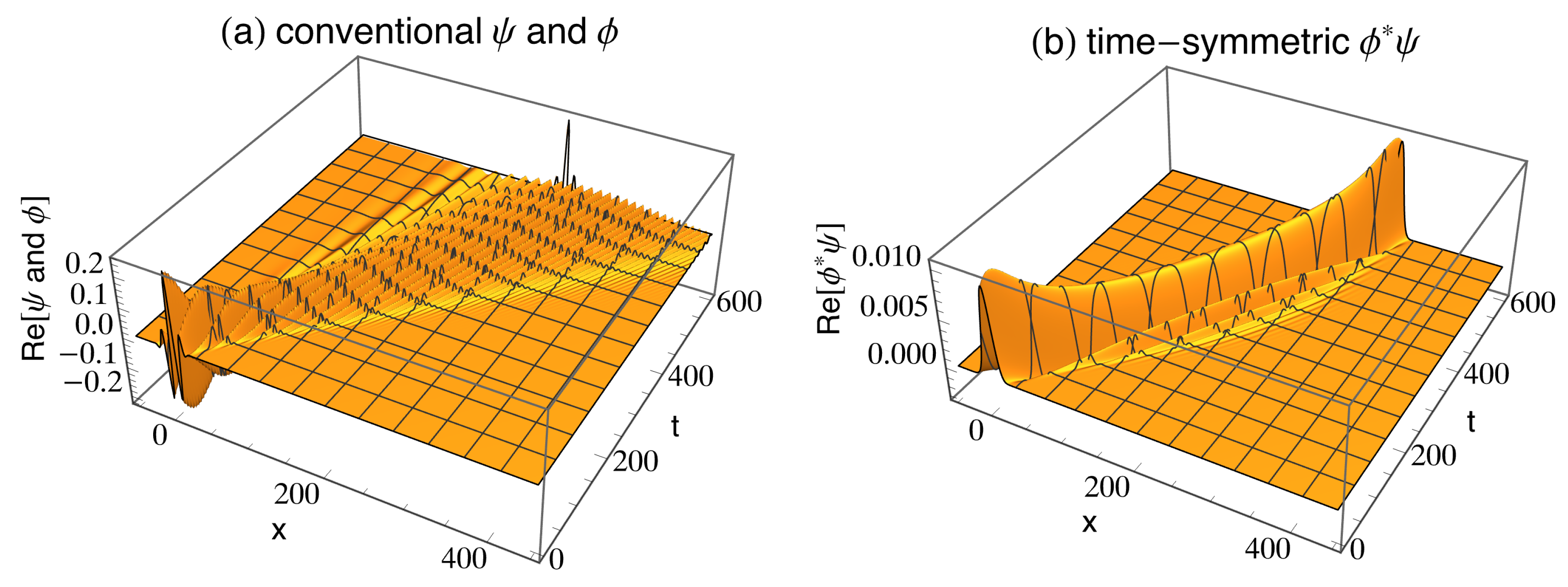
where x is the location of the particle, are the emission location and time, all particle masses are set to 1, the initial gaussian width , the momentum , and natural units are used: . Figure 2(a) shows the evolution of this retarded spatial wavefunction, which collapses upon measurement by a detector to the retarded spatial wavefunction at , where
Now consider the spin part of the retarded wavefunction. The CF assumes the two particles are created with the entangled spin singlet wavefunction
where the red arrows refer to the electron, the blue arrows refer to the positron, and the spatial wavefunction is suppressed for clarity. There are no subscripts specifying axes because this is a rotationally invariant wavefunction. When the two SGA’s -axes are parallel to each other, every run results in the detection of a spin-up particle on one side and a spin-down particle on the other side. When one or the other particle is detected, the CF assumes the spin singlet wavefunction collapses randomly to either or , collapsing the other particle to the opposite sign of spin, even when a spacelike interval separates the two particles. When the two SGA’s -axes are at an angle to each other, the probability of perfect anticorrelation varies as , while the probability of perfect correlation varies as . This agrees with the measured experimental results.
4. The Time-Symmetric Formulation (TSF) Explanation
Time-symmetric explanations of quantum behavior predate the discovery of the Schrödinger equation [18] and have been developed many times over the past century [19]. The TSF assumes that a spatial transition amplitude density (TAD) gives the most complete description of the spatial part of a quantum system that is in principle possible. The TAD is the algebraic product of two wavefunctions: a retarded spatial wavefunction that obeys the conventional Schrödinger equation and satisfies the initial boundary conditions, and an advanced spatial wavefunction that obeys the complex conjugate of the Schrödinger equation and satisfies the final boundary conditions [20]. For example, the advanced traveling gaussian wavefunction
where x is the location of the particle, are the detection location and time, the final gaussian width , the momentum , all particle masses are set to 1, and natural units are used: . Figure 2(b) shows the evolution of the transition amplitude density . The TAD diverges from the initial condition and then converges to the final condition without discontinuous collapse. The probability of a transition is given by , where
All relativistic wave equations have both retarded and advanced solutions, and both types of solutions survive in the nonrelativistic limit. The time-symmetric formulation assumes wavefunction collapse never happens. One consequence of the assumptions of the TSF is that a source will not emit a quantum unless there is a sink somewhere that can absorb the quantum. This is supported by the experimental confirmation of the Purcell effect [21].
Let us now describe the spin part of the retarded and advanced wavefunctions. Consider first the case where the two SGA’s -axes are parallel to each other. The source will emit either or particle pairs. These particle pairs are not entangled because in the TSF only indistinguishable transition amplitude densities are entangled [20]. The particle pair spins are antiparallel because angular momentum is conserved. The source emits particles polarized along the axes because the advanced waves from the four detectors, after passing through the two SGA’s, will be polarized along the axes. The final states of the detectors have a retrocausal influence on the initial orientation of the electron and positron spins. Assume the source emits a [] particle pair. The only nonzero TAD’s occur when the upper [lower] left detector emits a [] advanced wave and the lower [upper] right detector emits a [] advanced wave. The possible TAD’s are then []. These give perfect anticorrelations, in agreement with the experimental results.
Now consider the case where the two SGA’s -axes are at an angle to each other. Let’s assume the left SGA is oriented along the -axis while the right SGA is oriented along the -axis. The source will have to emit either , , , or particle pairs to conserve angular momentum and retrocausally match some of the advanced waves from the detectors. Consider the case where the source emits a [] particle pair. The advanced waves from the upper [lower] left detector, after passing through the SGA, will produce only [] advanced waves at the source, while the advanced waves from the lower [upper] right detector, after passing through the SGA, will produce only [] advanced waves at the source. For the [] particle pair, one particle (say the []) will go to the SGA with amplitude 1, and the other particle will go to the SGA with amplitude . The difference in angular momentum could be taken up by the SGA. The same argument holds for the and particle pairs produced by the source. The probability of perfect anticorrelation then varies as , while the probability of perfect correlation varies as . This also agrees with the measured experimental results.
5. Discussion
Einstein defined “local causality" as causal influences traveling continuously through spacetime at or below the speed of light [22]. The CF explanation of the EPR paradox violates local causality: the measurement of the electron spin as at one detector causes the positron spin at the other detector to collapse to at a spacelike interval. This is spooky action at a distance. It is often claimed that special relativity forbids superluminal signals. But this is not true: it is the combination of special relativity and the principle of macroscopic local causality that forbids superluminal signals. The principle of macroscopic local causality is equivalent to the macroscopic entropic arrow of time. But quantum phenomena often happen at a microscopic level and can violate the second law of thermodynamics, for example in fluctuation phenomena. This allows the possibility of microscopic influences traveling faster than light, provided they do not transfer classical signals [23]. This also allows the possibility of advanced waves in quantum mechanics, which travel backwards in time but do not transfer classical signals.
The time-symmetric and retrocausal theory in this paper is local in the sense that there is no action at a distance. It also shows how wavefunction collapse, which is in direct conflict with special relativity, is not necessary to explain quantum phenomena.
Finally, there is an experiment that can distinguish the CF from the TSF. The CF predicts an electron in free space will oscillate back and forth at a frequency [24]. This phenomenon is named zitterbewegung. The TSF predicts zitterbewegung will never occur [25,26]. A search for zitterbewegung could distinguish between these two formulations.
Funding
This research received no external funding
Acknowledgments
I thank John F. Clauser and David A. Fotland for many helpful conversations.
Conflicts of Interest
The author declares no conflicts of interest.
References
- Smolin, L. The trouble with physics: The rise of string theory, the fall of a science, and what comes next.; Houghton Mifflin Harcourt, 2006. [Google Scholar]
- Einstein, A.; Podolsky, B.; Rosen, N. Can quantum-mechanical description of physical reality be considered complete? Physical Review 1935, 47(10), 777. [Google Scholar] [CrossRef]
- Bricmont, J. Making sense of quantum mechanics; Springer International Publishing: Cham, 2016; Vol. 37. [Google Scholar]
- Stapp, H.P. Bell’s theorem and world process. Il Nuovo Cimento B (1971-1996) 1975, 29(2), 270–276. [Google Scholar] [CrossRef]
- Davidon, W.C. Quantum physics of single systems. Il Nuovo Cimento B (1971-1996) 1976, 36(1), 34–40. [Google Scholar] [CrossRef]
- De Beauregard, O.C. Einstein-Podolsky-Rosen non-separability and Feynman non-locality. Physics Letters A 1977, 60(2), 93–95. [Google Scholar] [CrossRef]
- Eberhard, P.H. Bell’s theorem and the different concepts of locality. Il Nuovo Cimento B (1971-1996) 1978, 46(2), 392–419. [Google Scholar] [CrossRef]
- Sutherland, R.I. Bell’s theorem and backwards-in-time causality. International Journal of Theoretical Physics 1983, 22(4), 377–384. [Google Scholar] [CrossRef]
- Price, H. Time’s arrow & Archimedes’ point: new directions for the physics of time.; Oxford University Press, 1996. [Google Scholar]
- Wharton, W.R. Backward causation and the EPR paradox. 1998. Available online: https://arxiv.org/html/quant-ph/9810060v1/.
- Wharton, K.B. Time-symmetric quantum mechanics . Foundations of Physics 2007, 37(1), 159–168. [Google Scholar] [CrossRef]
- Argaman, N. Bell’s theorem and the causal arrow of time. American Journal of Physics 2010, 78(10), 1007–1013. [Google Scholar] [CrossRef]
- Corry, R. Retrocausal models for EPR. In Studies in History and Philosophy of Science Part B 49; Studies in History and Philosophy of Modern Physics, 2015; pp. 1–9. [Google Scholar]
- Cramer, J.G. The quantum handshake.; Springer Publishing Company, 2016. [Google Scholar]
- Kastner, R.E. The Transactional Interpretation of Quantum Mechanics, 2nd Ed. ed; Cambridge University Press, 2022. [Google Scholar]
- Freedman, S.J.; Clauser, J.F. Experimental test of local hidden-variable theories. Physical Review Letters 1972, 28(14), 938. [Google Scholar] [CrossRef]
- Commins, E.D. Quantum Mechanics; Cambridge University Press, 2014. [Google Scholar]
- Tetrode, H.M. Über den Wirkungszusammenhang der Welt. Eine Erweiterung der klassischen Dynamik. Z. Phys. 1922, 10(1), 317–328. [Google Scholar] [CrossRef]
- Friederich, S.; Evans, P.W. Retrocausality in Quantum Mechanics. In Stanford Encyclopedia of Philosophy; Zalta, E.N., Ed.; Stanford University: US, 2019; Available online: https://plato.stanford.edu/archives/sum2019/entries/qm-retrocausality (accessed on 12 November 2025).
- Heaney, M.B. A Time-Symmetric Formulation of Quantum Entanglement. Entropy 2021, 23(2), 179. [Google Scholar] [CrossRef] [PubMed]
- Purcell, Edward M. Spontaneous Emission Probabilities at Radio Frequencies. Physical Review 69 1946, 681. [Google Scholar]
- Norsen, T. John S. Bell’s concept of local causality. American Journal of Physics 2011, 79(12), 1261–1275. [Google Scholar] [CrossRef]
- Terletskii, Y. Paradoxes in the Theory of Relativity.; Springer Science & Business Media, 2013. [Google Scholar]
- Schrödinger, E. Über die kräftefreie Bewegung in der relativistischen Quantenmechanik. In Sitzungsberichte der Preussischen Akademie der Wissenschaften, Physikalisch-Mathematische Klasse.; 1930. [Google Scholar]
- Heaney, M.B. A symmetrical interpretation of the Klein-Gordon equation. Foundations of Physics 2013, 43(6), 733–746. [Google Scholar] [CrossRef]
- Heaney, M.B. A Relativistic Symmetrical Interpretation of the Dirac Equation in (1+ 1) Dimensions. 2015. Available online: https://arxiv.org/pdf/1510.07972.
Figure 1.
A diagram of the gedankenexperiment. A neutral spin-0 pion at rest in the source decays into a spin- electron and a spin- positron which then travel in opposite directions. Each particle enters a Stern-Gerlach Apparatus (SGA) capable of separating spin-up and spin-down particles. The two particles are subsequently detected in one of the detectors on the left side and one of the detectors on the right side.
Figure 1.
A diagram of the gedankenexperiment. A neutral spin-0 pion at rest in the source decays into a spin- electron and a spin- positron which then travel in opposite directions. Each particle enters a Stern-Gerlach Apparatus (SGA) capable of separating spin-up and spin-down particles. The two particles are subsequently detected in one of the detectors on the left side and one of the detectors on the right side.
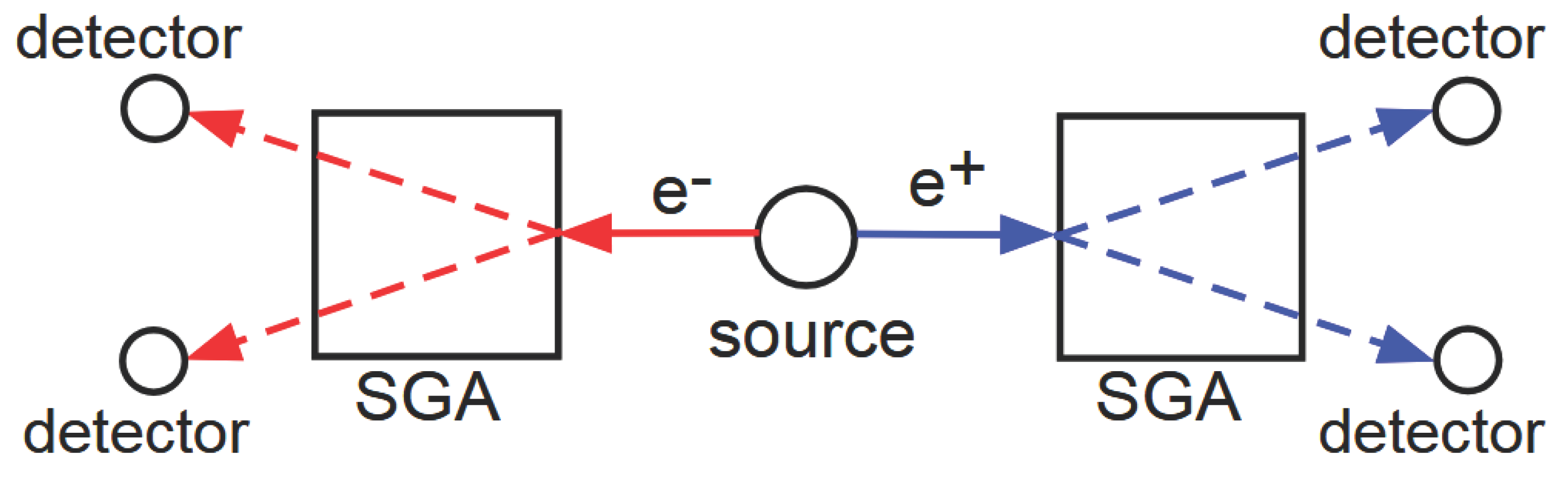
Figure 2.
(a) The conventional spatial traveling gaussian wavefunction . This wavefunction evolves in spacetime from being centered at until collapsing to at . (b) The time-symmetric spatial transition amplitude density . The transition amplitude density evolves continuously in spacetime from being centered at to being centered at . There is no collapse.
Figure 2.
(a) The conventional spatial traveling gaussian wavefunction . This wavefunction evolves in spacetime from being centered at until collapsing to at . (b) The time-symmetric spatial transition amplitude density . The transition amplitude density evolves continuously in spacetime from being centered at to being centered at . There is no collapse.
Disclaimer/Publisher’s Note: The statements, opinions and data contained in all publications are solely those of the individual author(s) and contributor(s) and not of MDPI and/or the editor(s). MDPI and/or the editor(s) disclaim responsibility for any injury to people or property resulting from any ideas, methods, instructions or products referred to in the content. |
© 2025 by the author. Licensee MDPI, Basel, Switzerland. This article is an open access article distributed under the terms and conditions of the Creative Commons Attribution (CC BY) license.
Copyright: This open access article is published under a Creative Commons CC BY 4.0 license, which permit the free download, distribution, and reuse, provided that the author and preprint are cited in any reuse.


