
Submitted:
30 December 2025
Posted:
31 December 2025
You are already at the latest version
Abstract
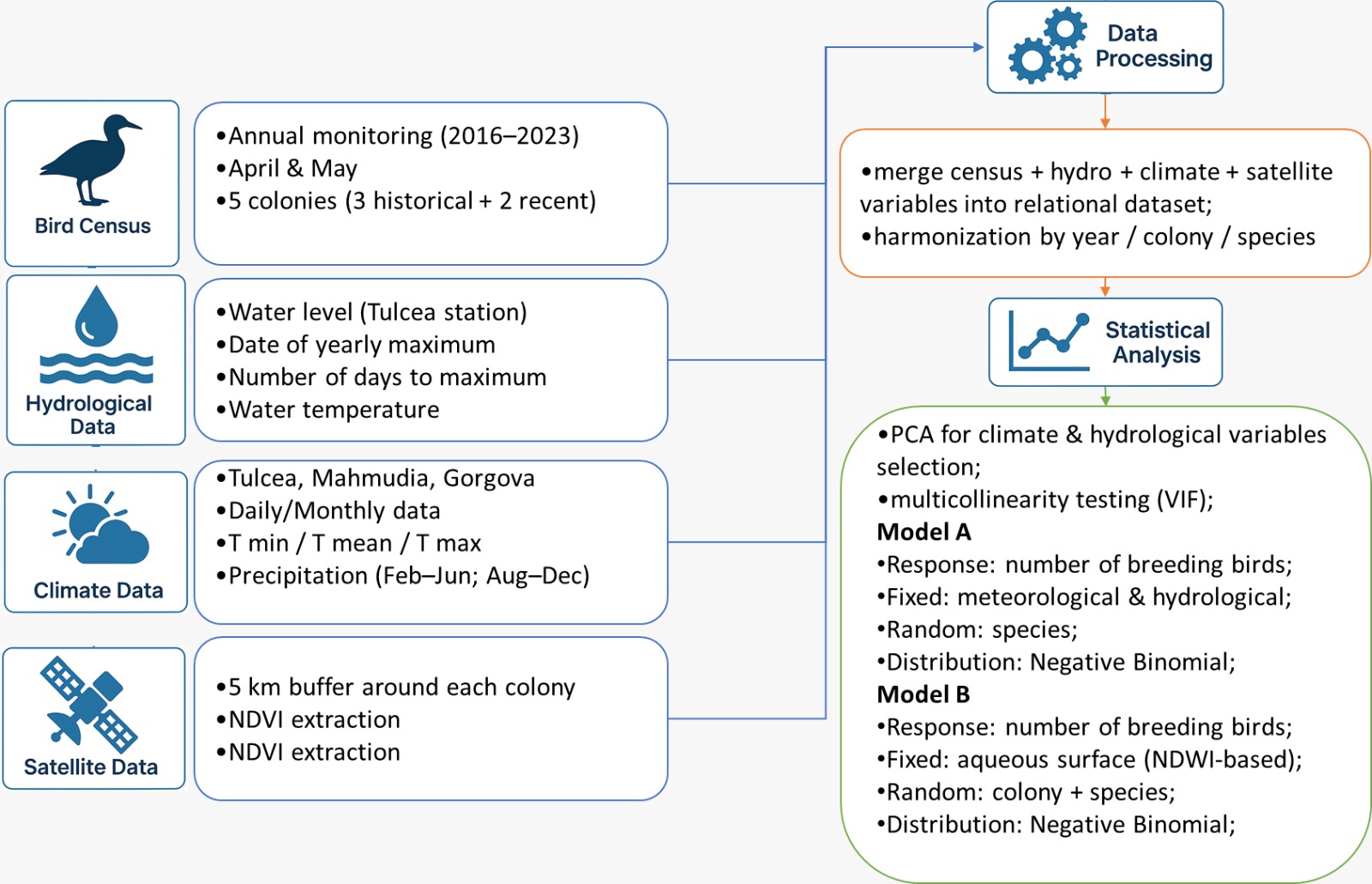
Climate change and altered hydrological regimes are restructuring wetland habitats globally, triggering cascading effects on colonial waterbirds. This study investigates how environmental drivers, including thermal anomalies, water level fluctuations, and aqueous surface extent influence the distribution, size, and diversity of waterbird colonies in the Danube Delta Biosphere Reserve. We integrated colony census data (2016–2023) with remote sensing-derived habitat metrics, in-situ meteorological and hydrological measurements to model site occupancy dynamics using Generalized Linear Mixed Models. Our results indicate that elevated early spring temperatures and water level variability are the primary determinants of nesting success. Spatial analysis revealed a heterogeneous response to hydrological stress: while the westernmost colony exhibited high site fidelity due to its proximity to persistent aquatic surfaces, the central colonies suffered severe declines or local extirpation during extreme drought periods (2020–2022). A discernible eastward shift in bird assemblages was observed toward zones with superior hydrological connectivity and proximity to anthropogenic hubs, suggesting remarkable behavioral plasticity. We propose prioritizing the investigation of sustainable solutions for lacustrine threshold regulation to maintain critical shallow-water foraging zones. This integrative framework provides essential insights for the long-term conservation of deltaic ecosystems, highlighting the pivotal role of remote sensing.
Keywords:
Ardeidae
; Threskiornithidae and Phalacrocoracidae
; Danube Delta
; remote sensing
; adaptive management
; ecological resilience
; habitat dynamics
; climate change
Copyright: This open access article is published under a Creative Commons CC BY 4.0 license, which permit the free download, distribution, and reuse, provided that the author and preprint are cited in any reuse.


