

Submitted:
29 December 2025
Posted:
30 December 2025
You are already at the latest version
Abstract
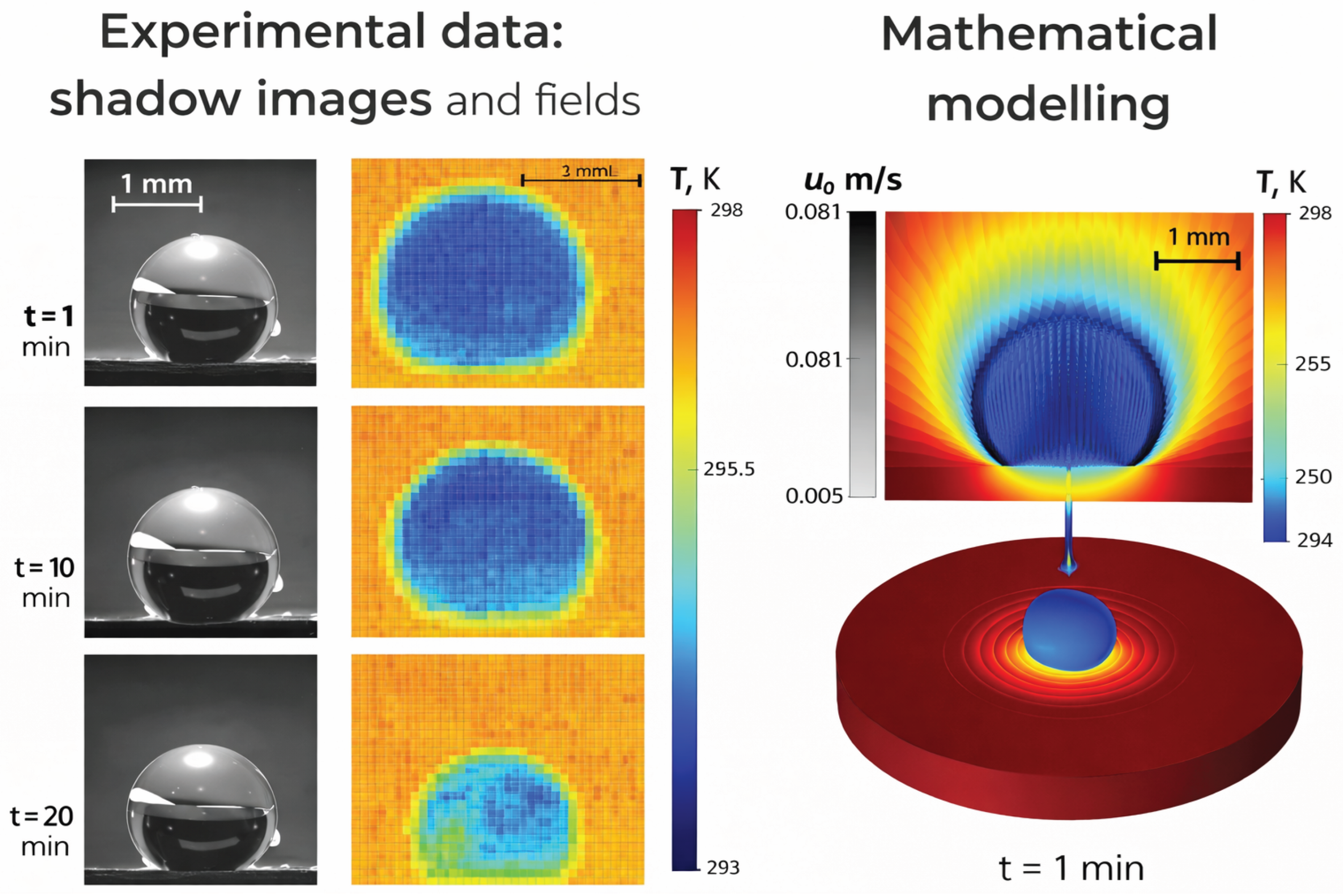
This work investigates in detail the evaporation-driven dynamics of reactive silver-ink sessile droplets that are relevant to high-precision inkjet printing of conductive tracks and pads. A two-dimensional axisymmetric numerical framework is developed in COMSOL Multiphysics to resolve, in a coupled way, heat transfer, fluid flow, species transport, and free-surface motion during droplet drying. Substrate temperature, solvent composition, and non-uniform evaporation patterns are systematically varied to quantify their influence on internal recirculating flows, compositional gradients, and final silver particle deposition. The results demonstrate that combining moderate substrate heating with a binary water/ethylene-glycol solvent can generate strong thermocapillary circulations that suppress the classical coffee-ring effect and promote more homogeneous particle distributions. The modeling framework therefore provides practical guidance for optimizing ink formulation and thermal processing conditions in printed electronics, and it offers a bridge between commonly used simplified models and more advanced, fully coupled simulations.
Keywords:
Key Objectives and Approach
1. Introduction
2. Physical System and Modeling Framework
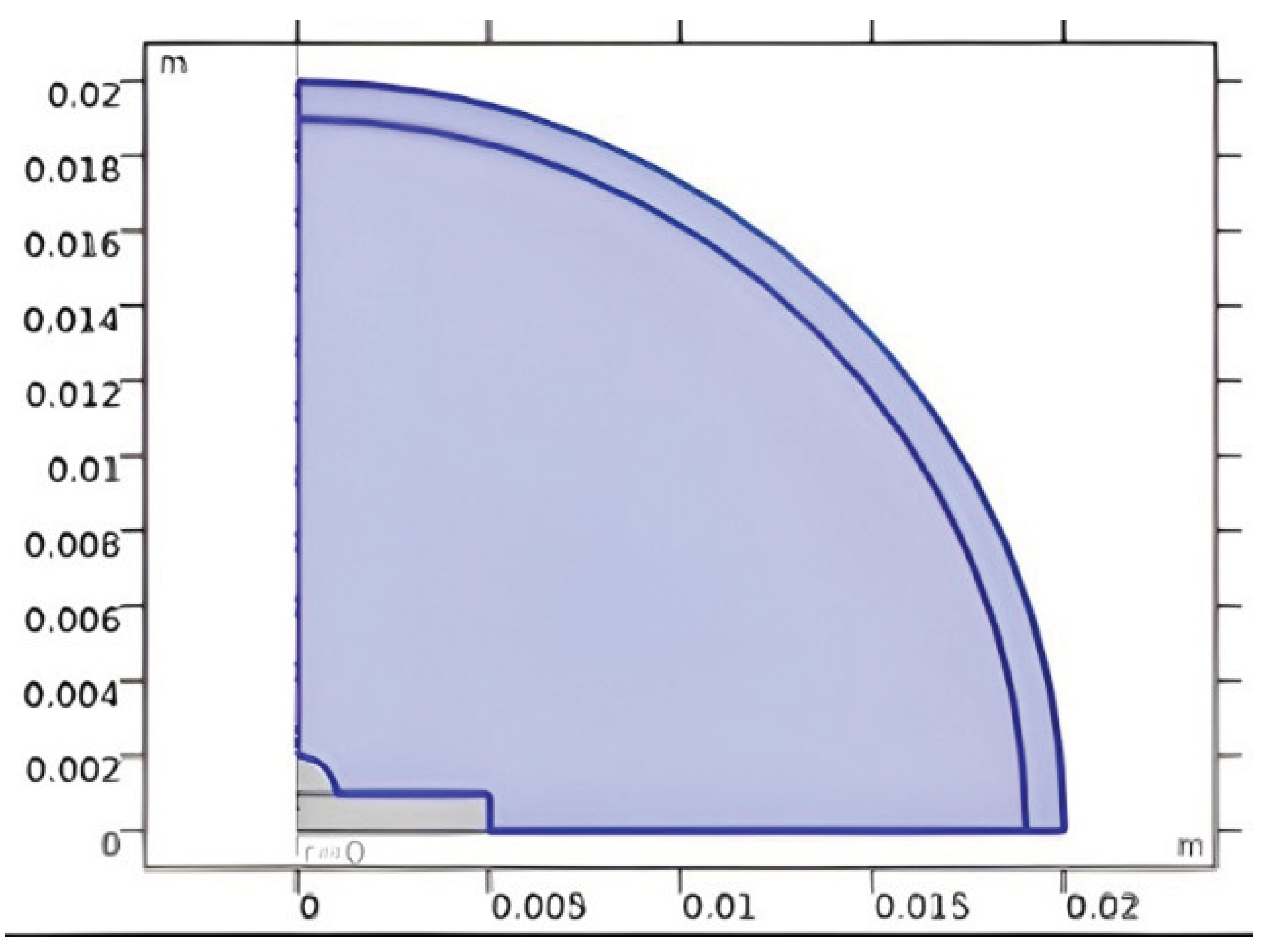
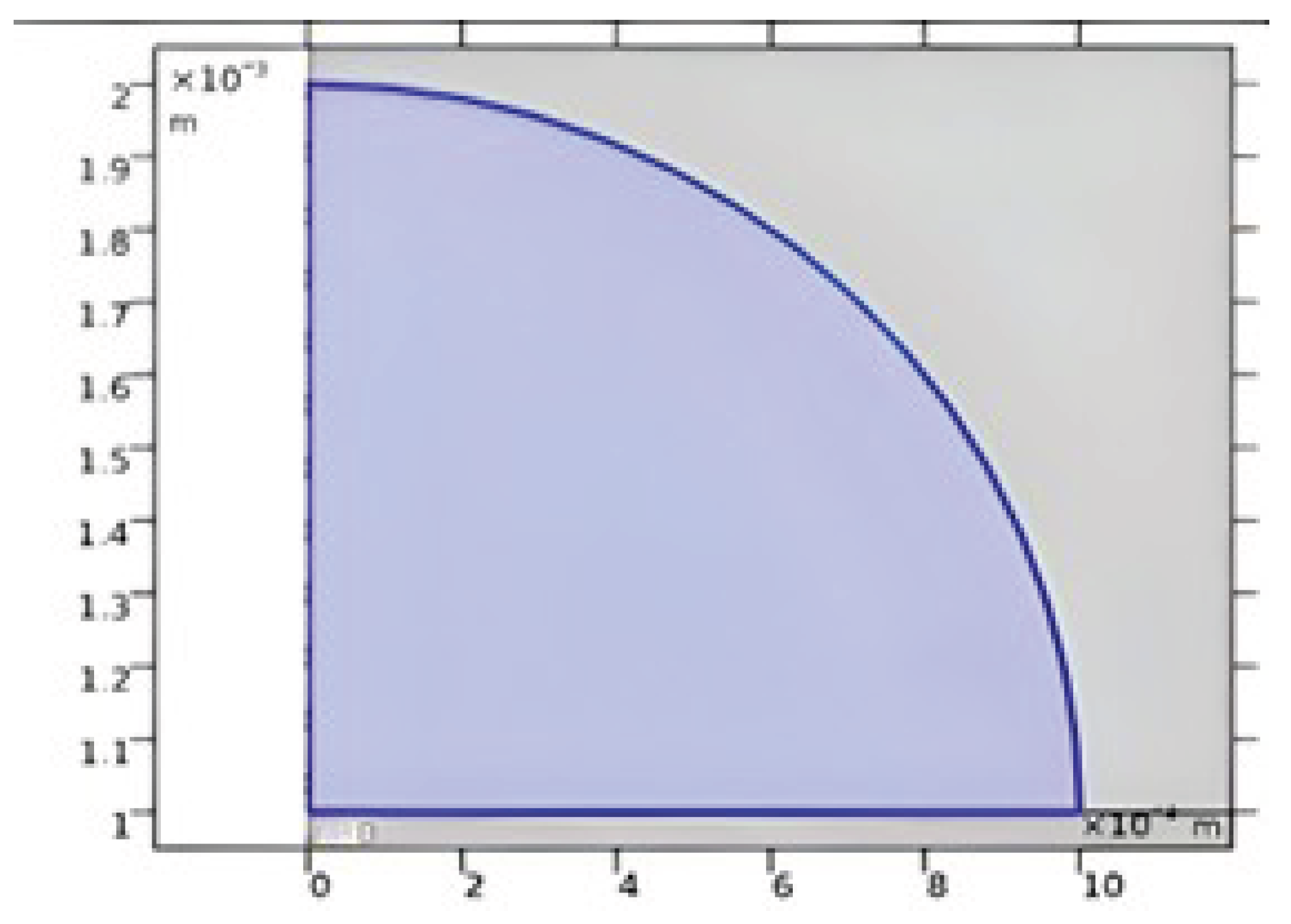
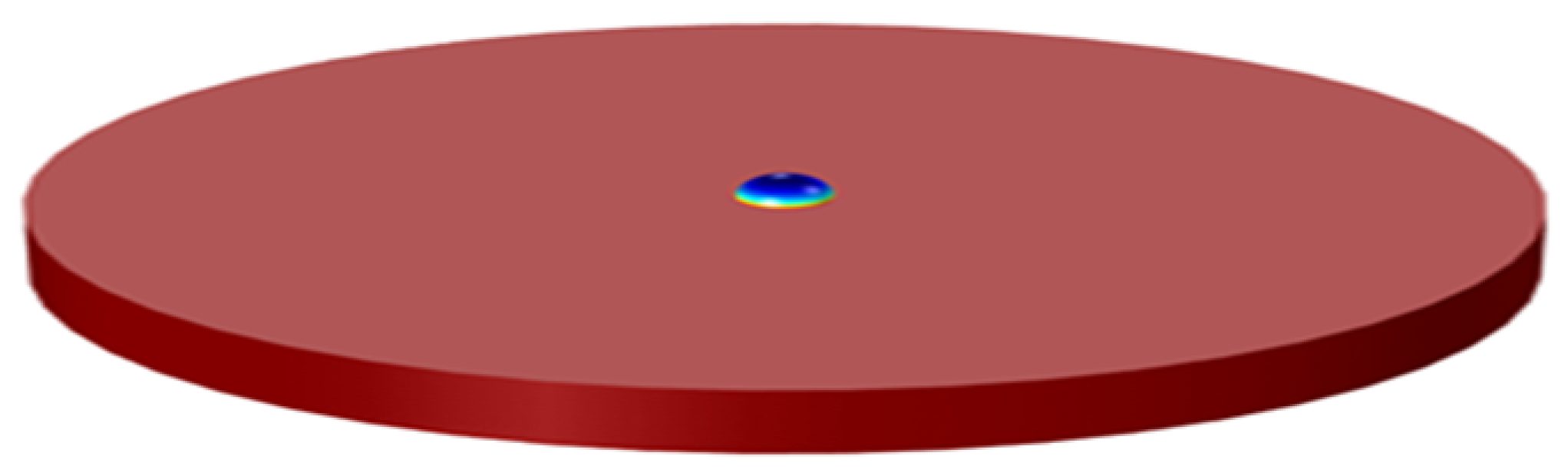
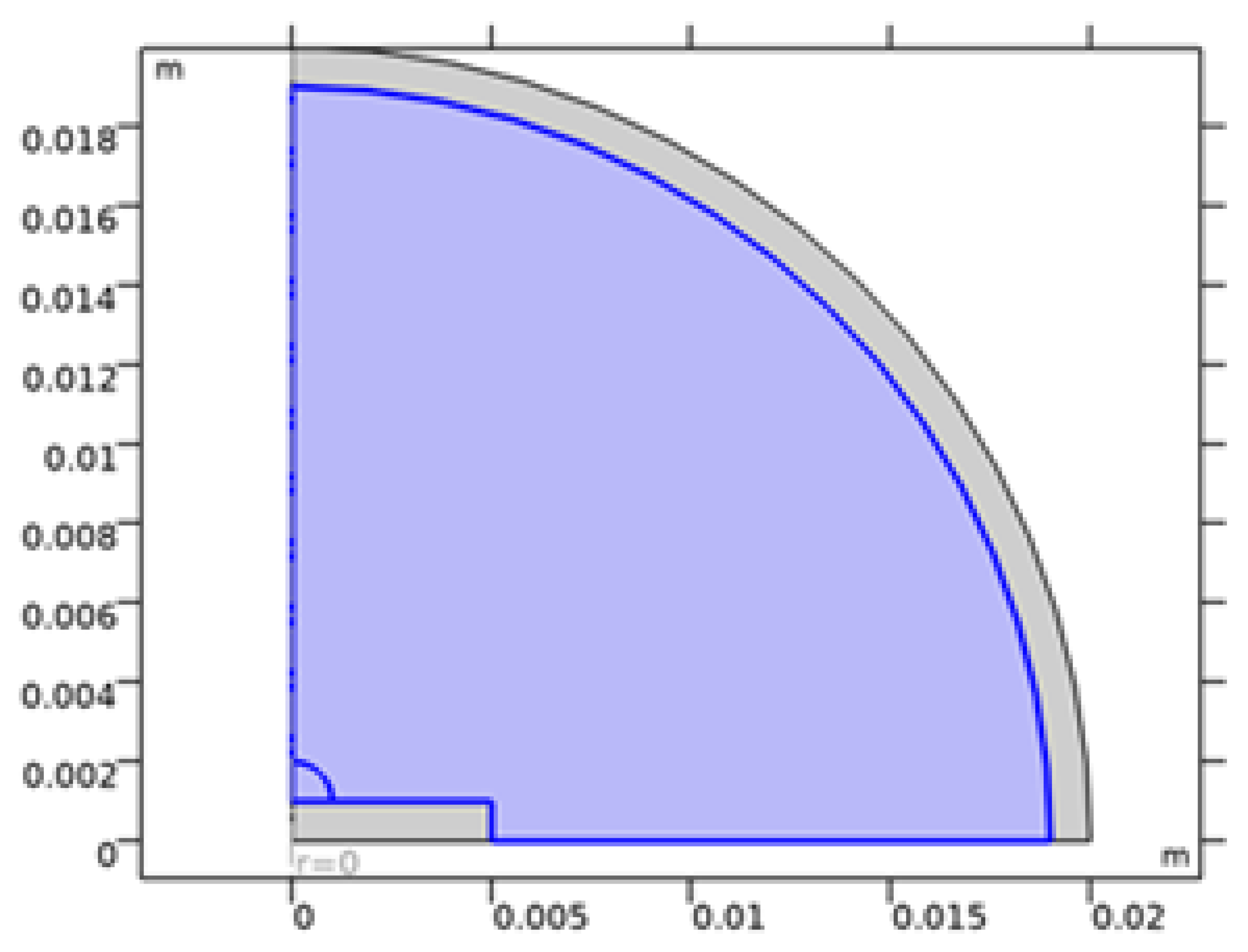
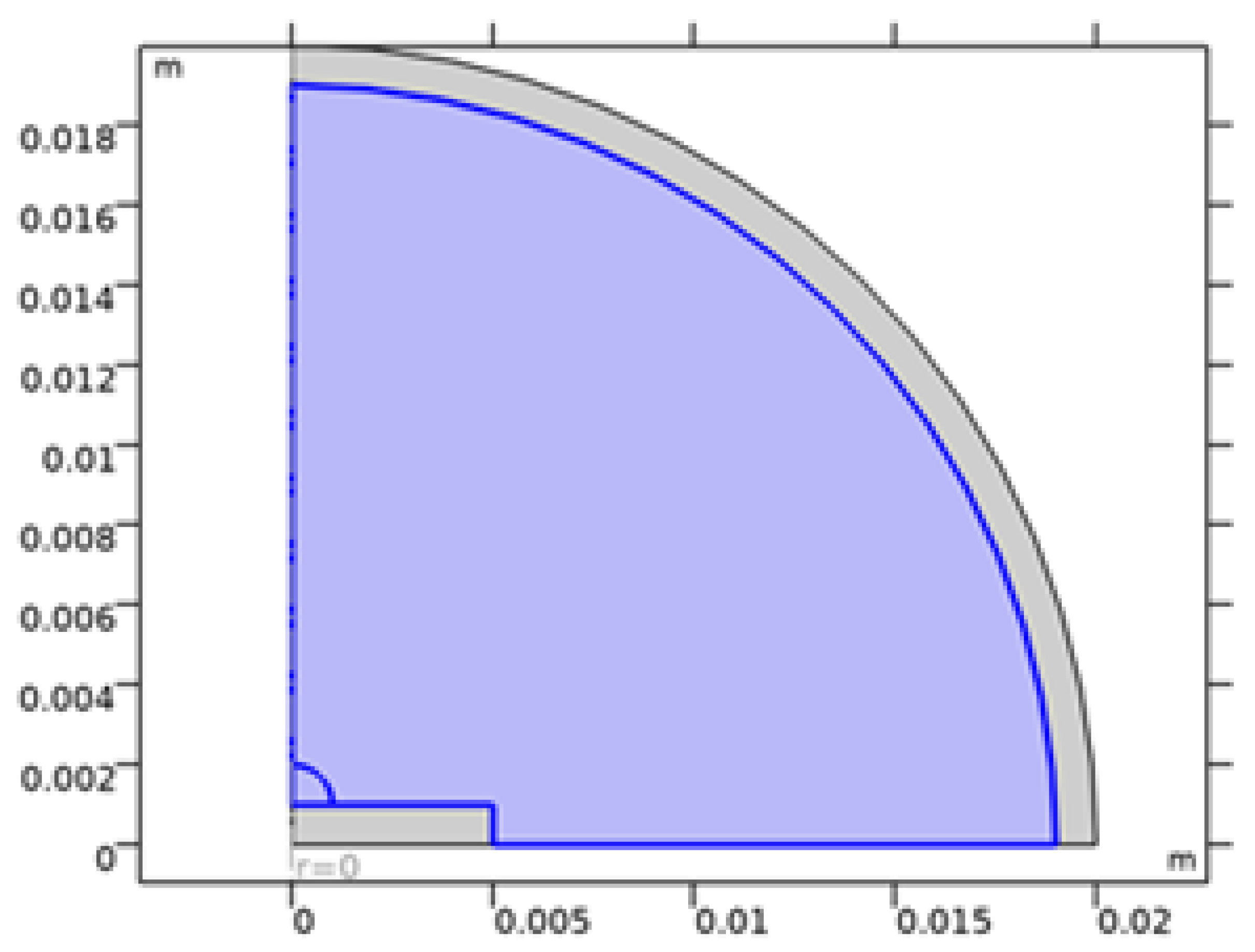
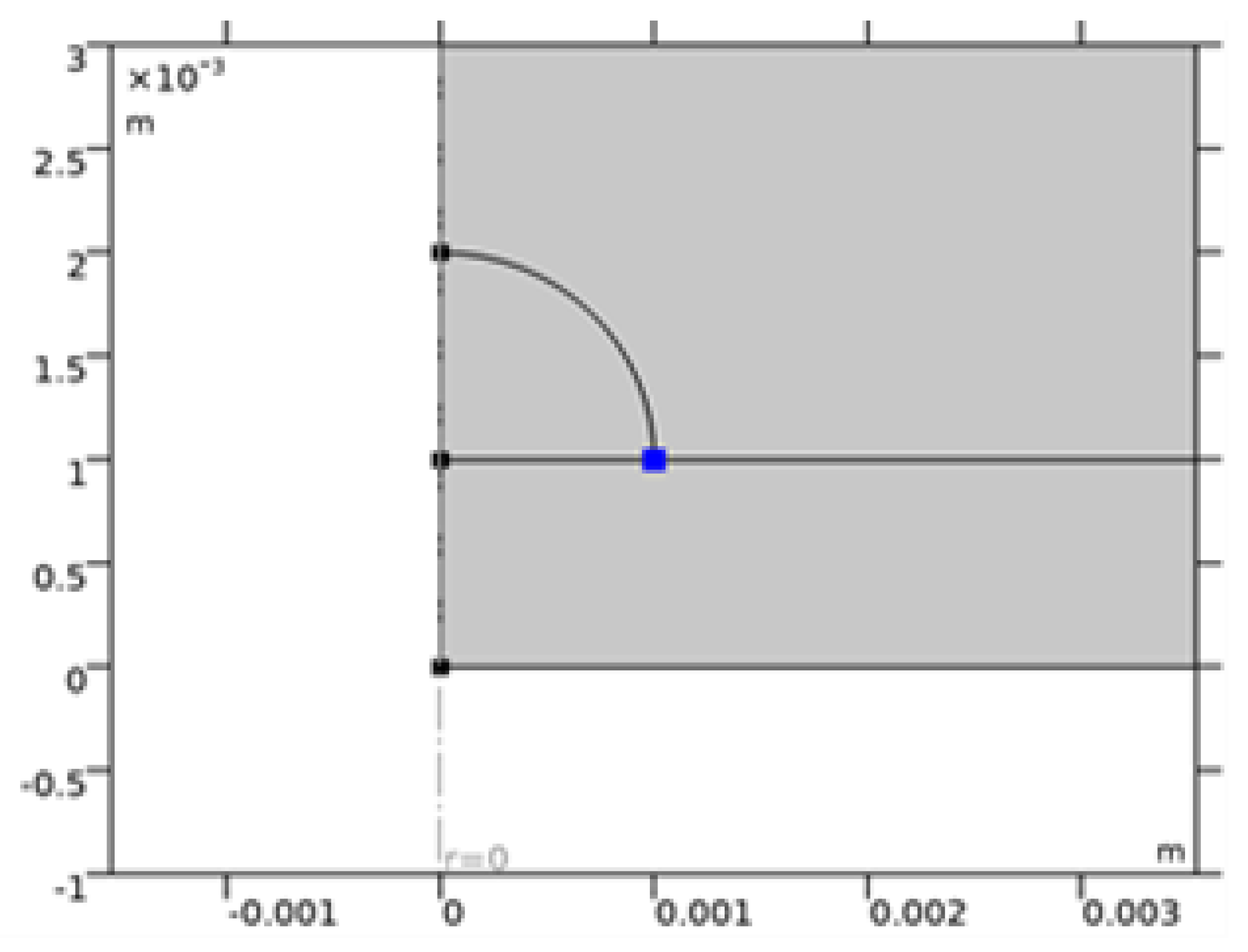
2.1. Geometry and Physical Setting
2.2. Governing Equations
Continuity (incompressible):
Energy (heat transfer in liquid):
Species transport (binary solvent + solute):
2.3. Marangoni Stresses at the Liquid–Gas Interface
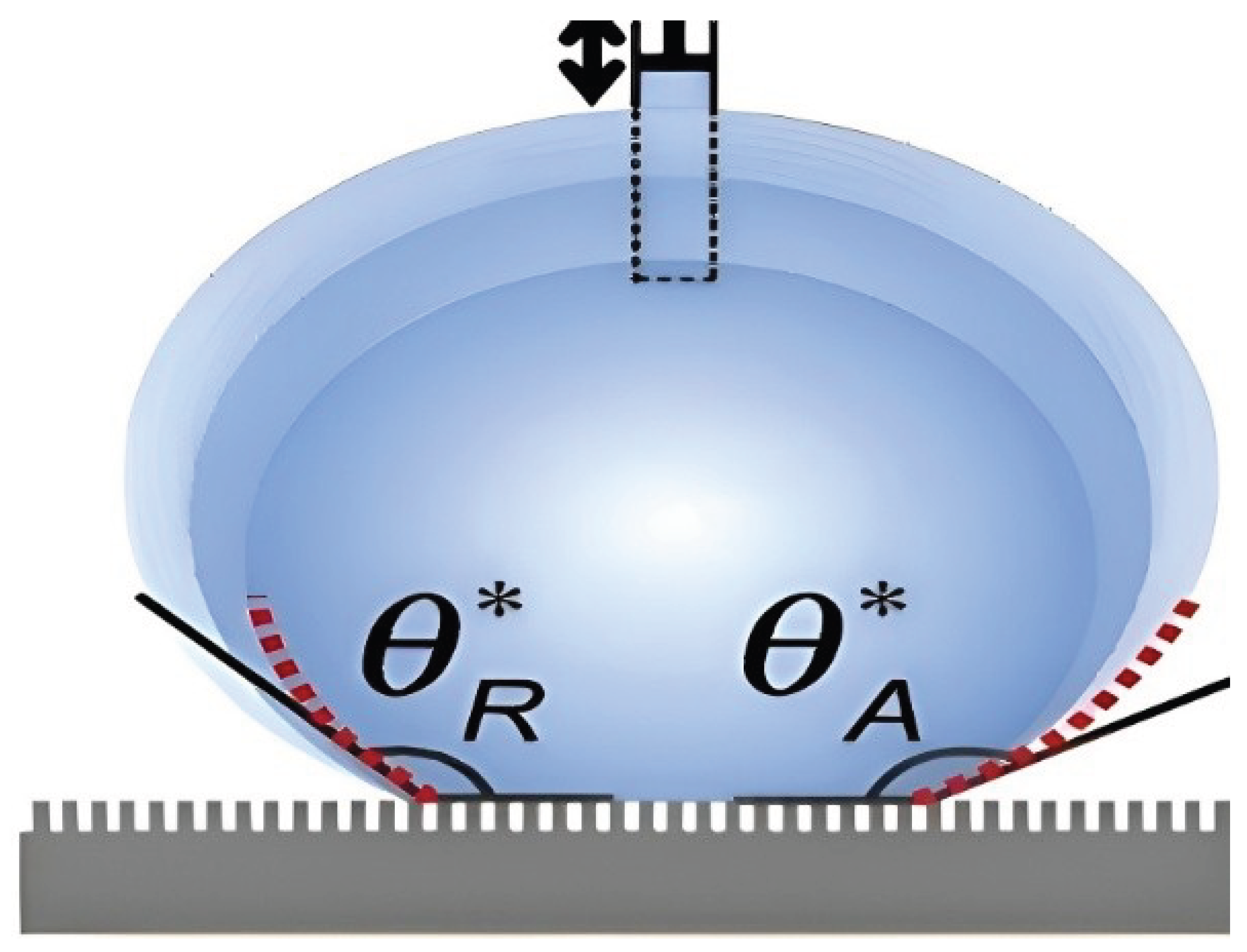
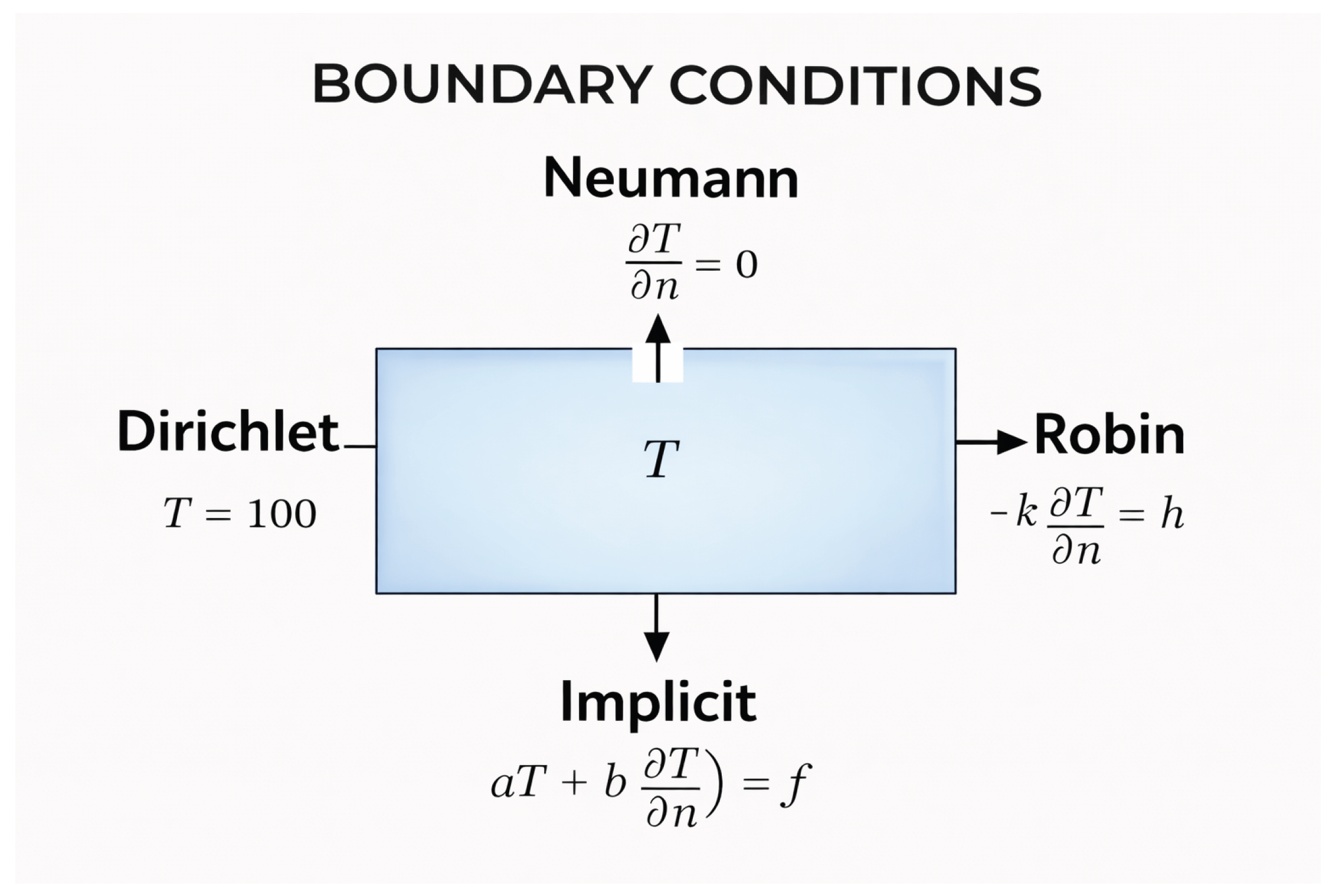
2.4. Boundary Conditions and Contact-Line Treatment
3. Numerical Implementation
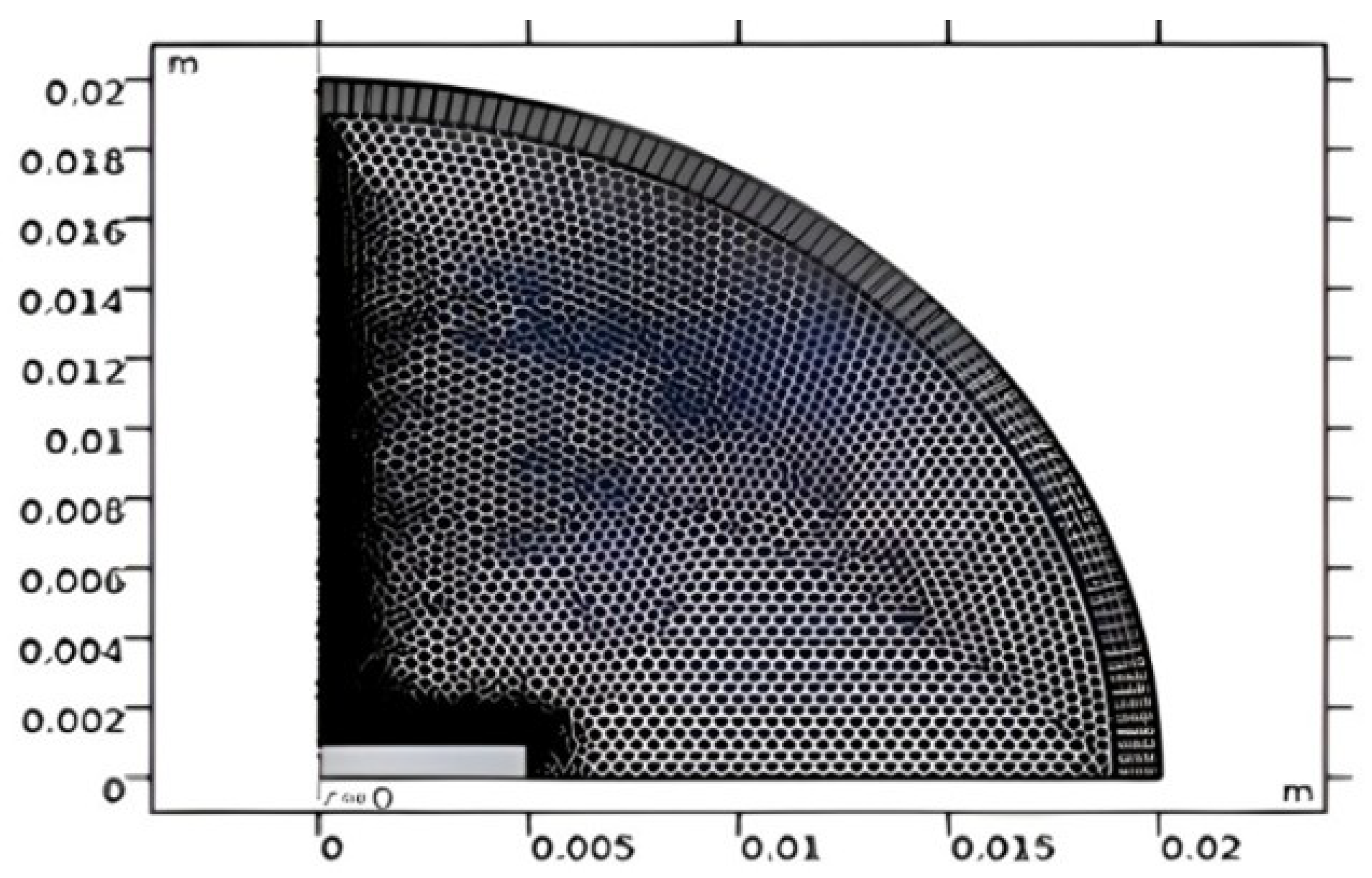
3.1. Meshing and Time Integration
3.2. Moving Mesh and Free-Surface Tracking
4. Results and Discussion
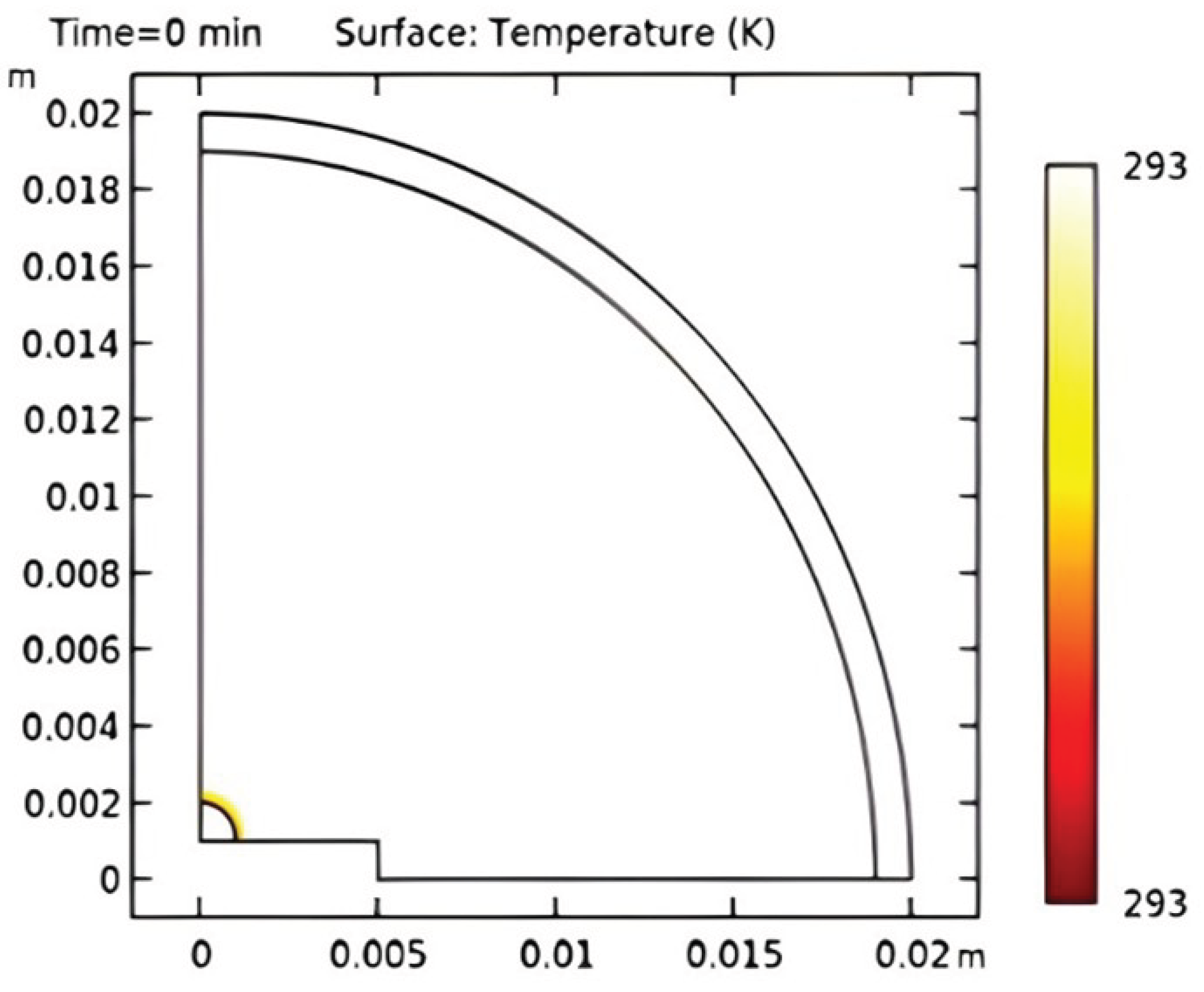
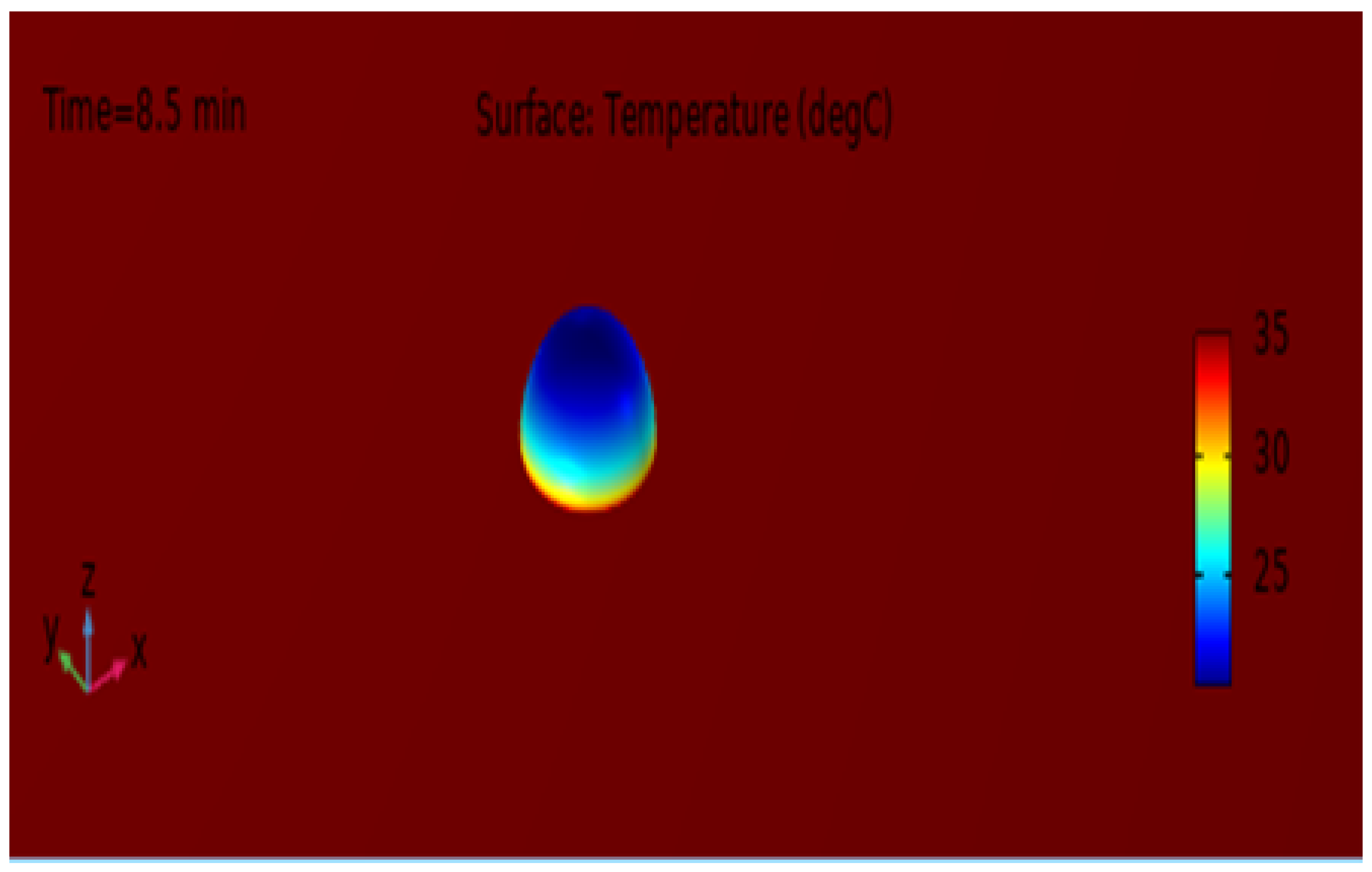
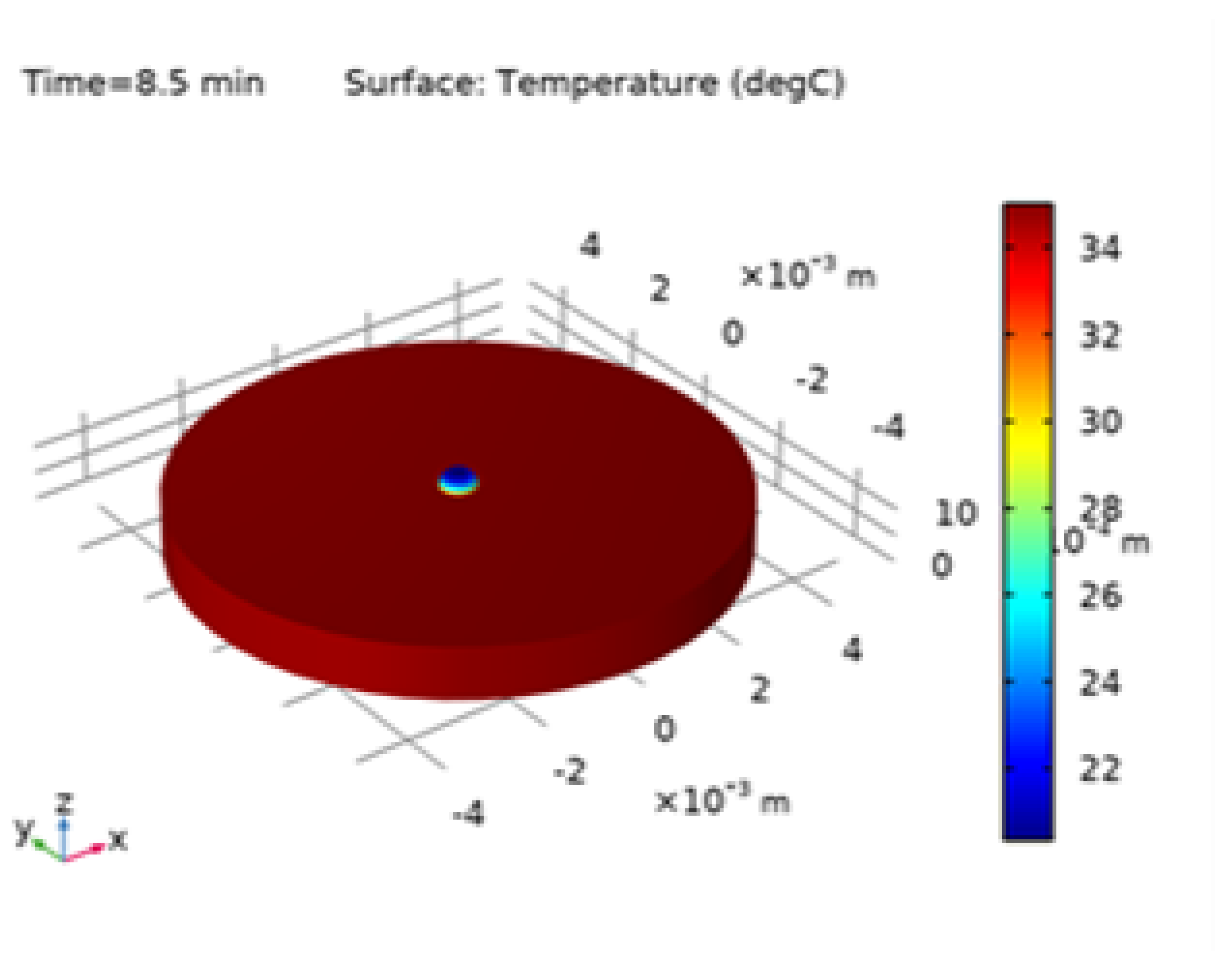
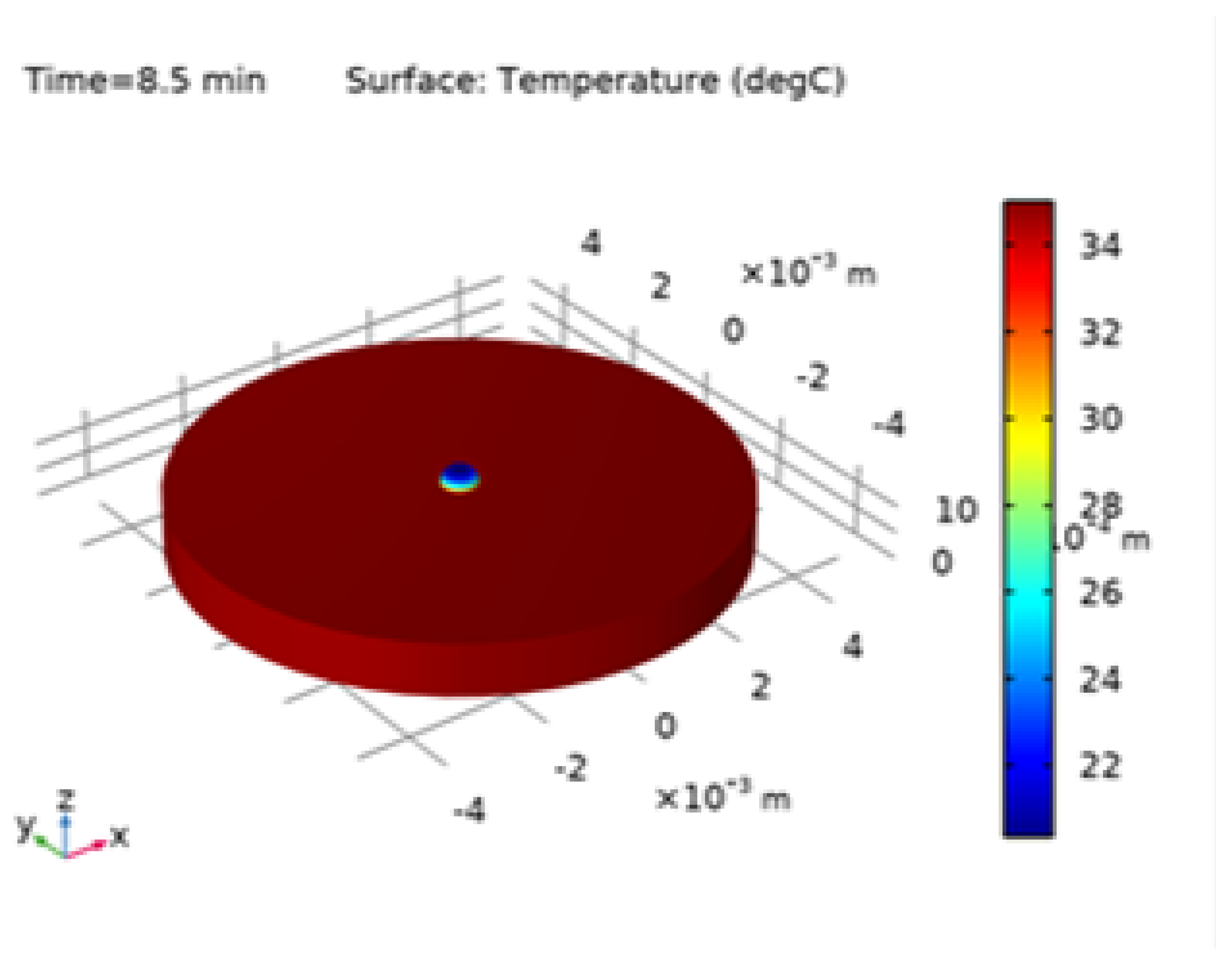
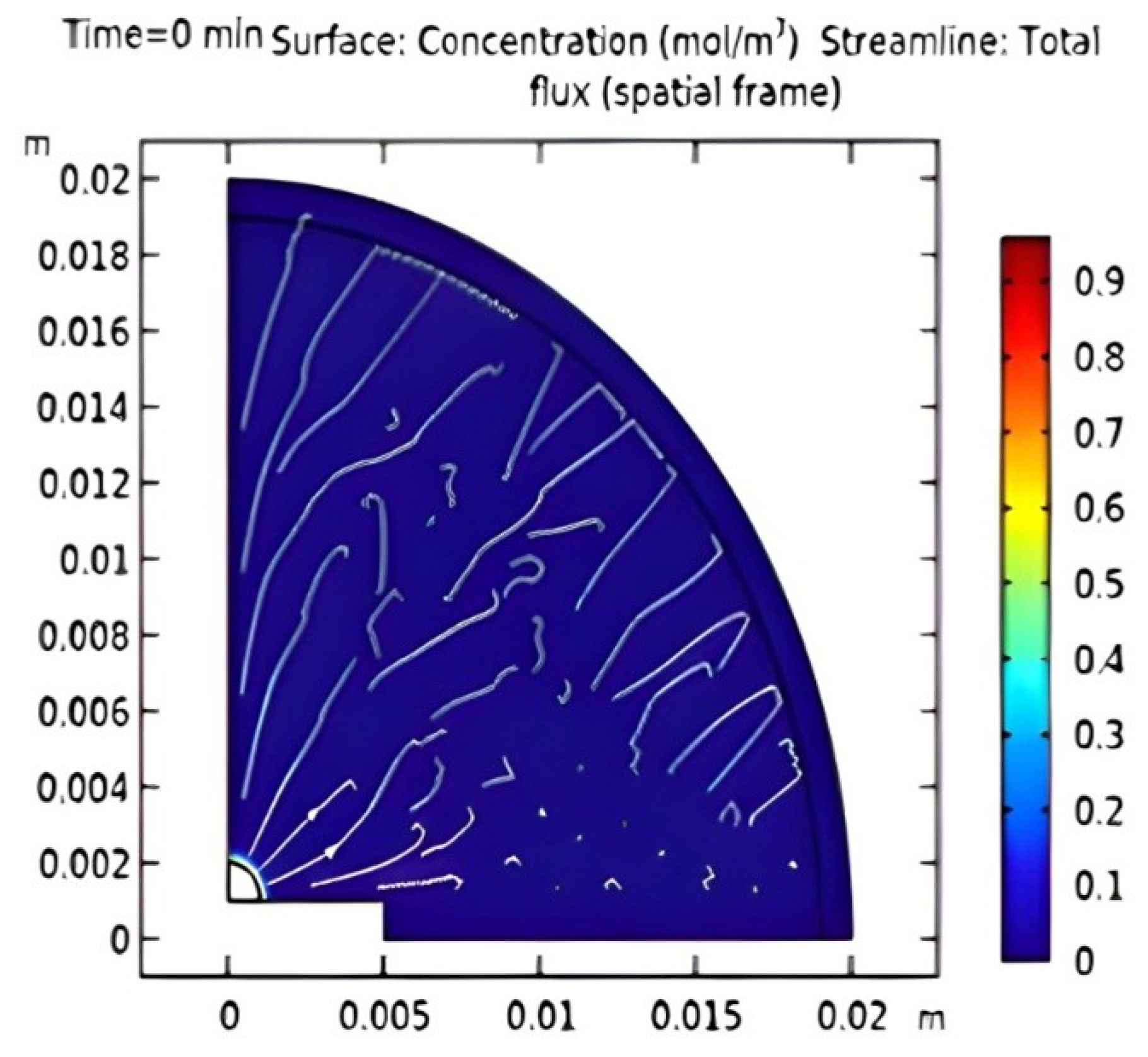
4.1. Initial and Surface Thermal Fields
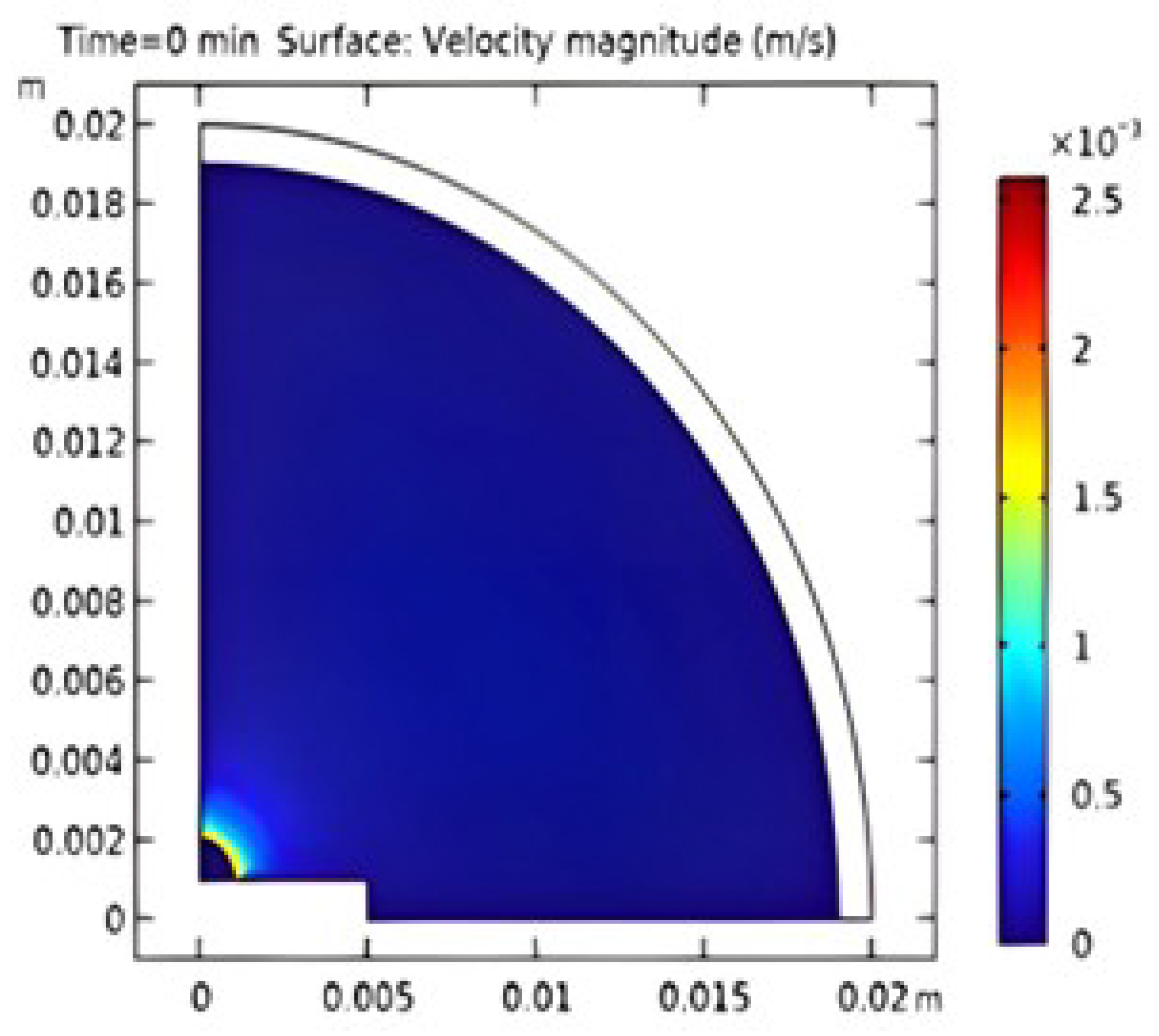
4.2. Flow and Transport Fields
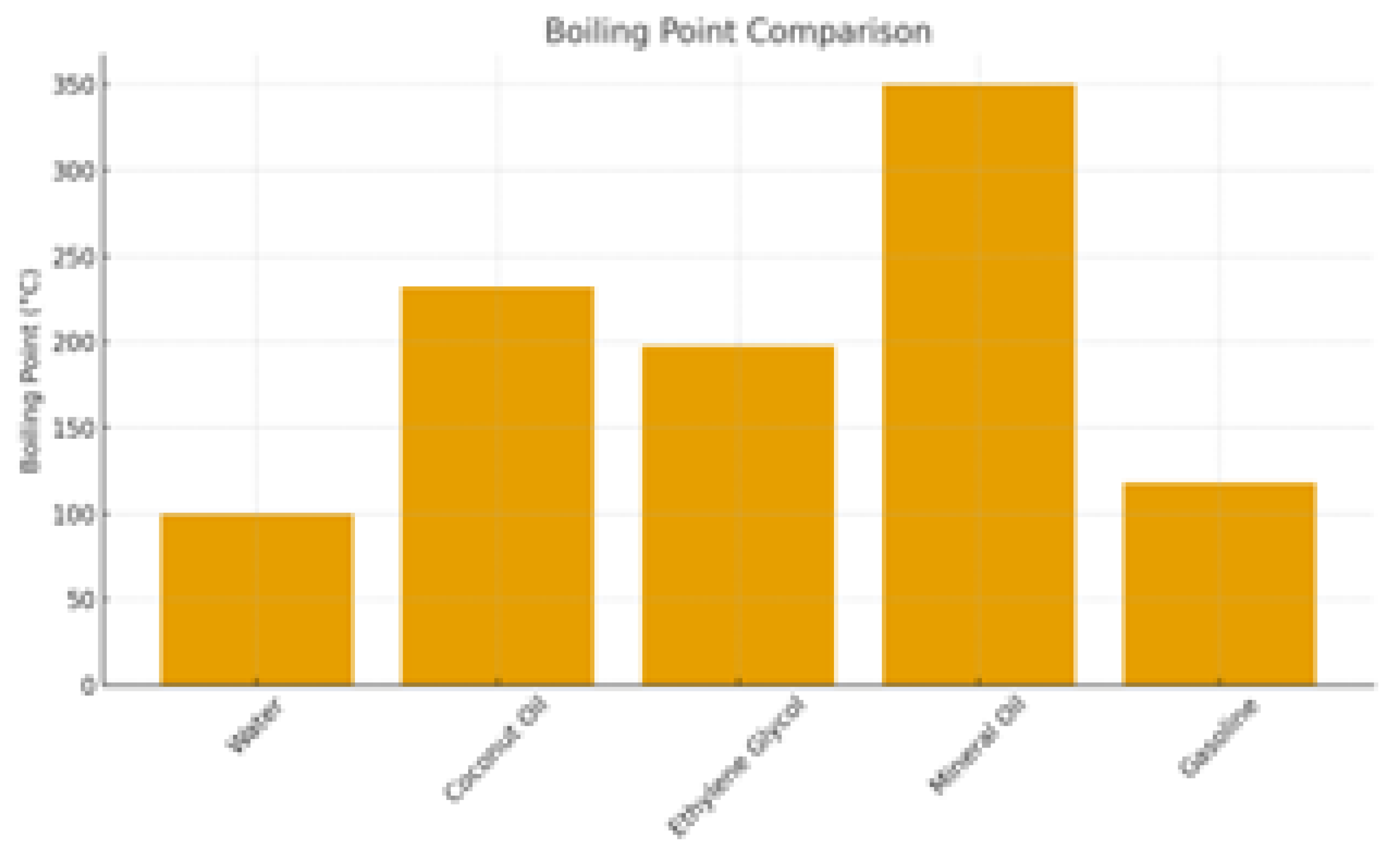
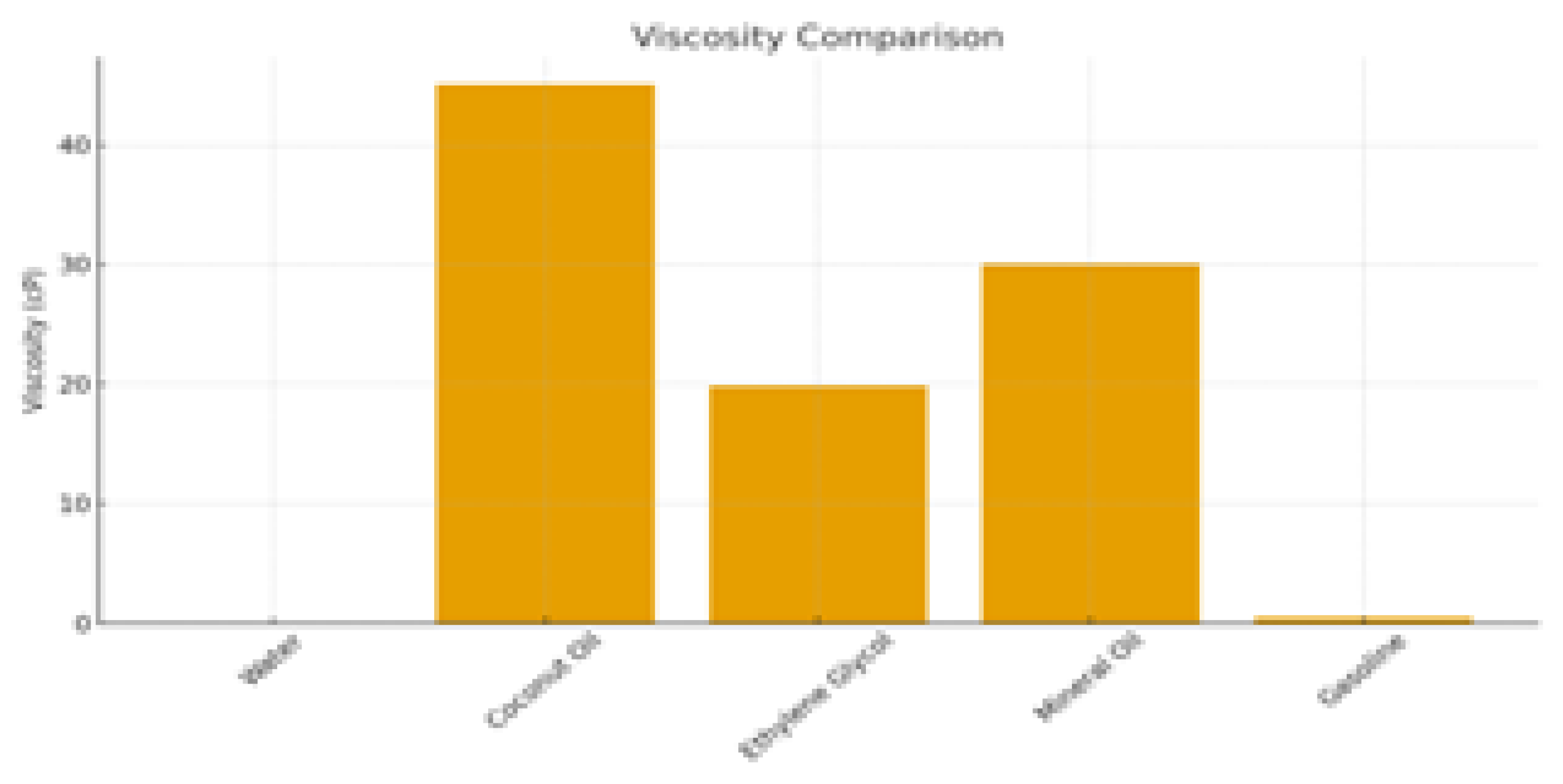
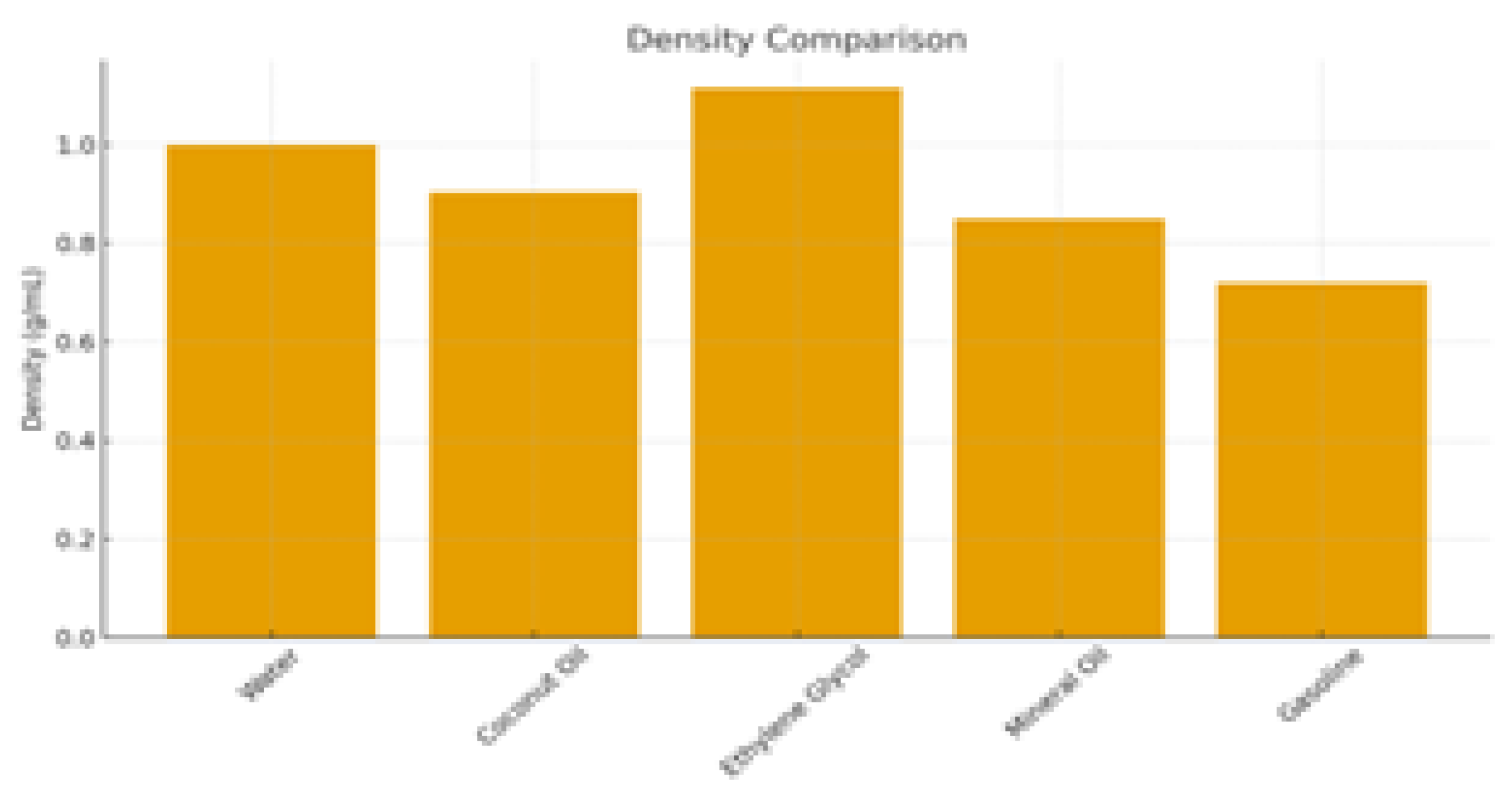
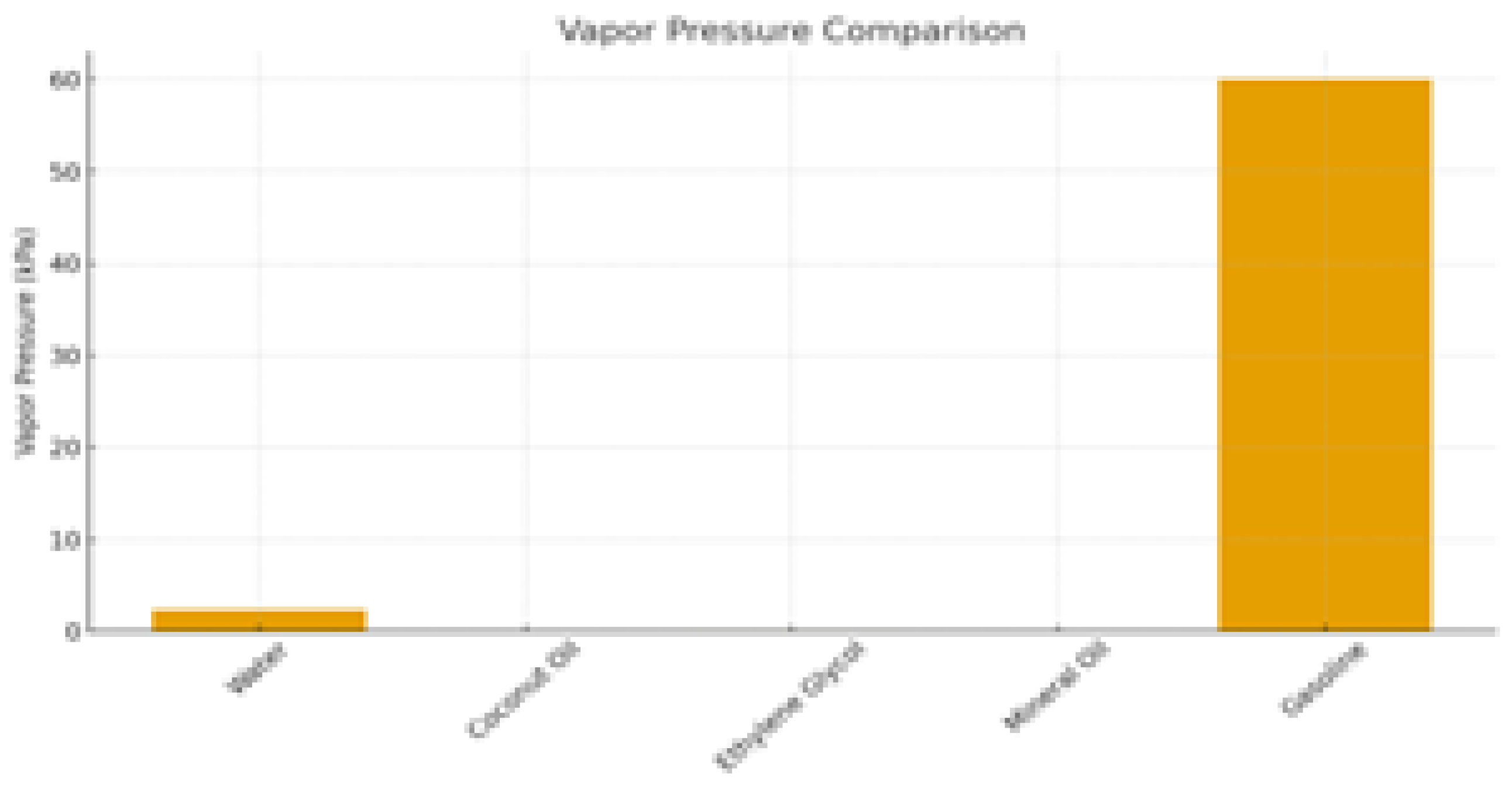
4.3. Comparison of Liquid Properties
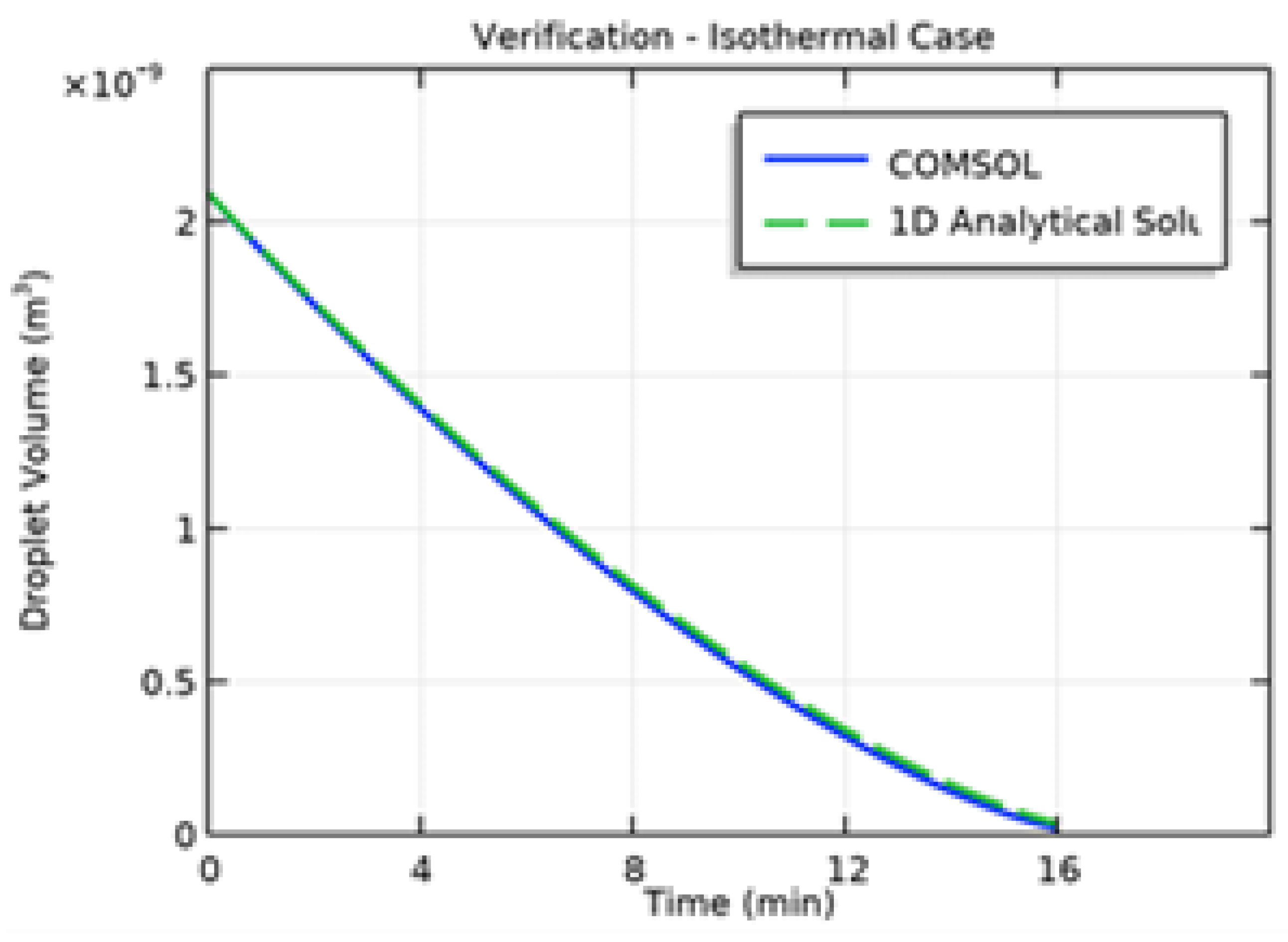
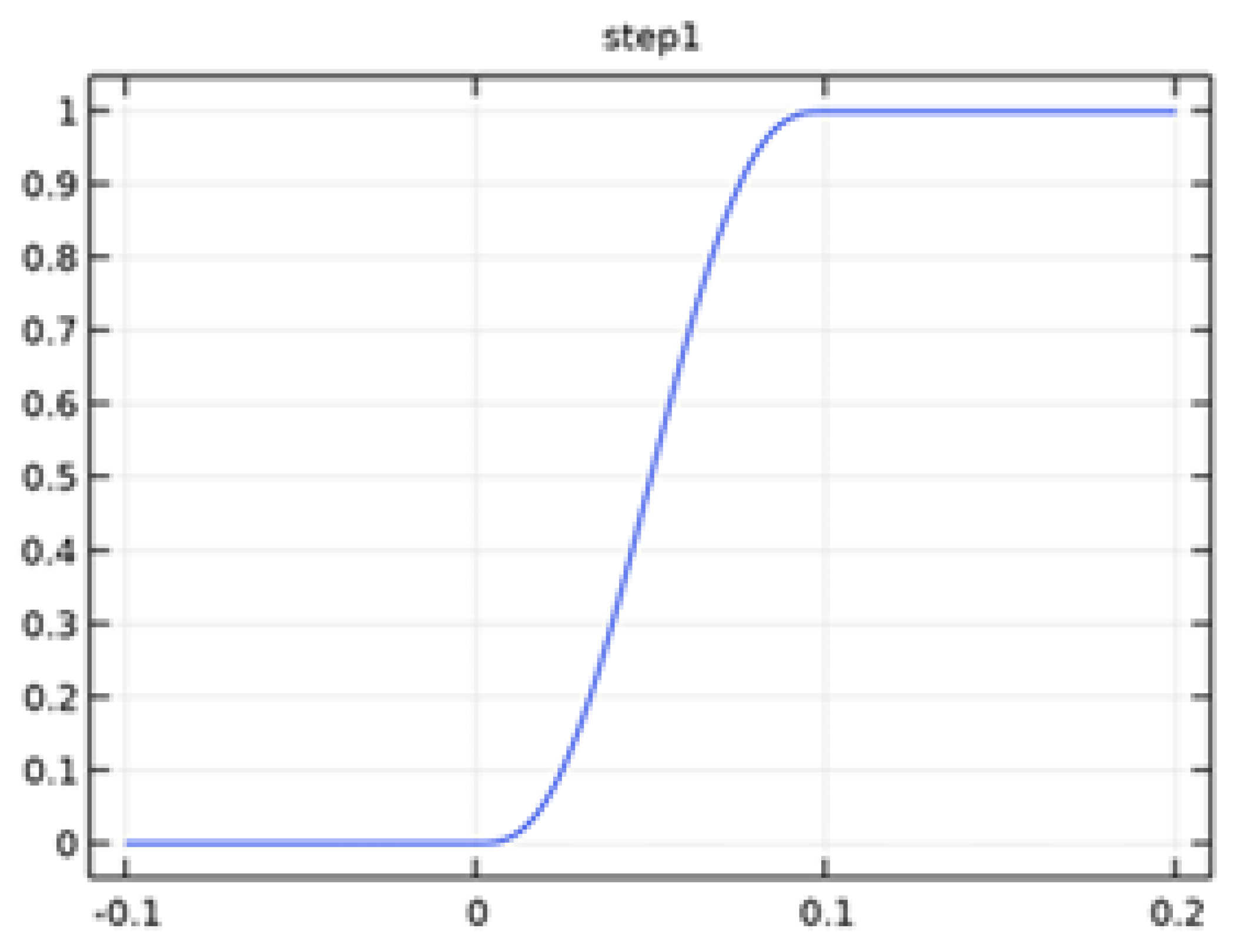
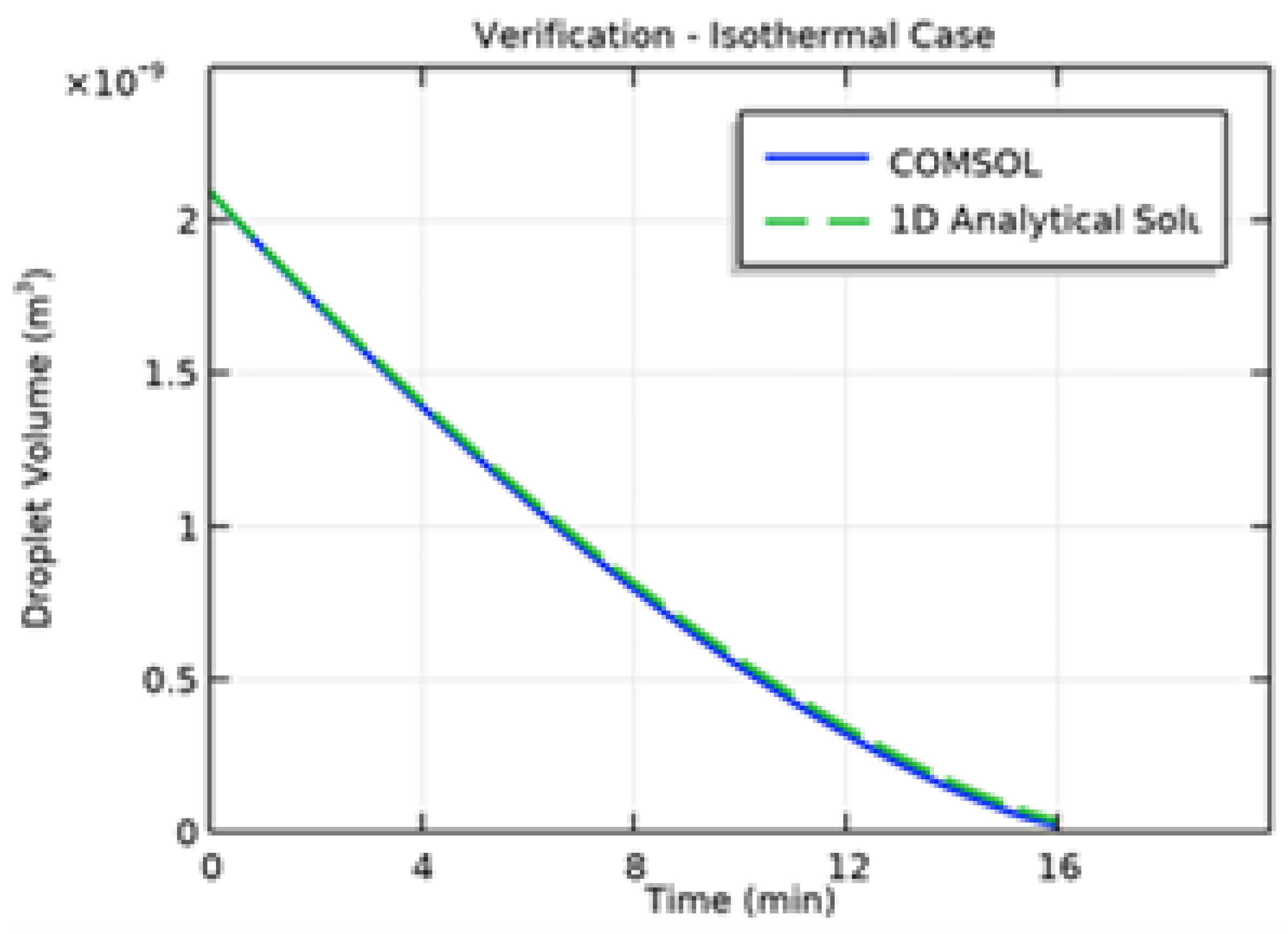
4.4. Model Verification and Numerical Regularization
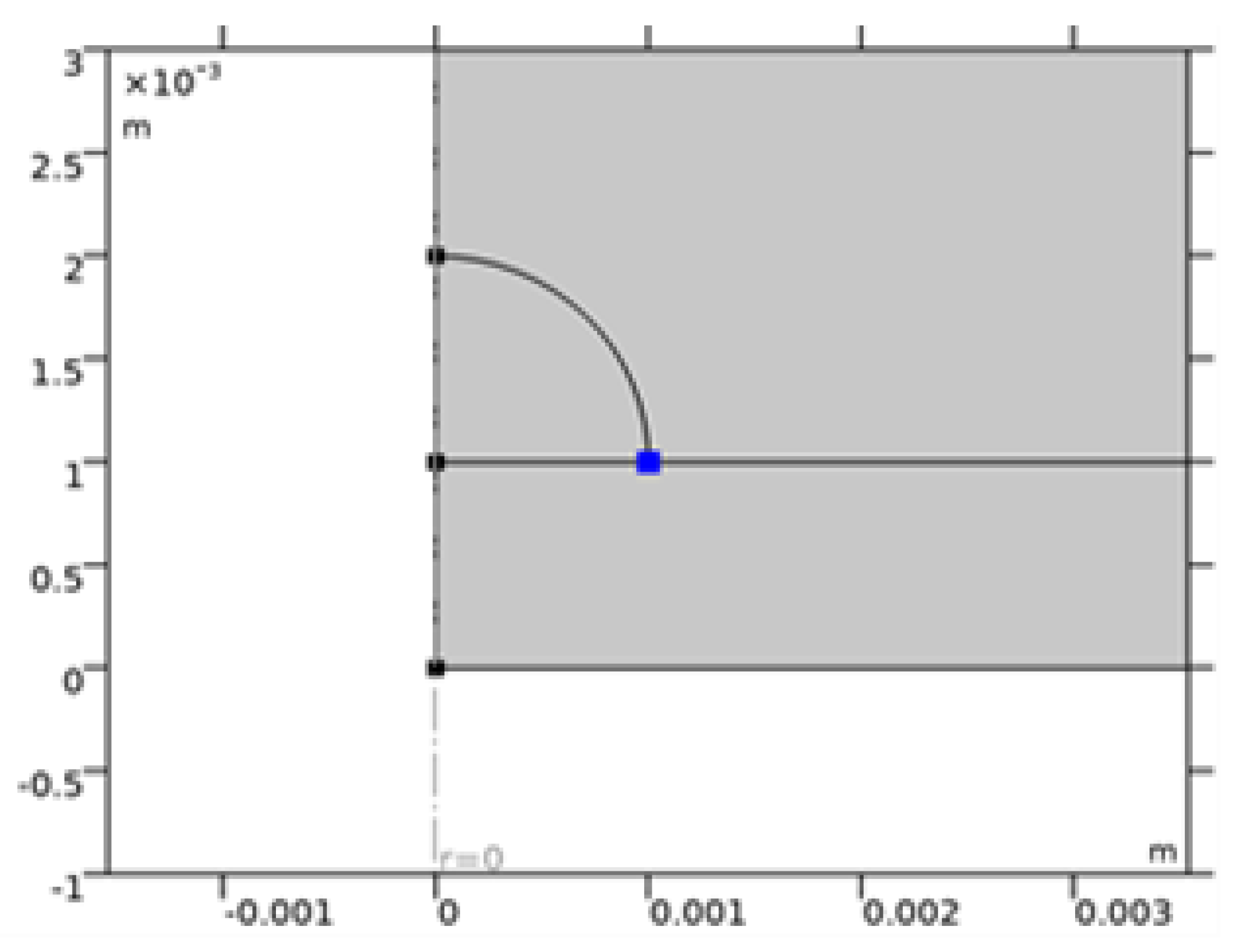
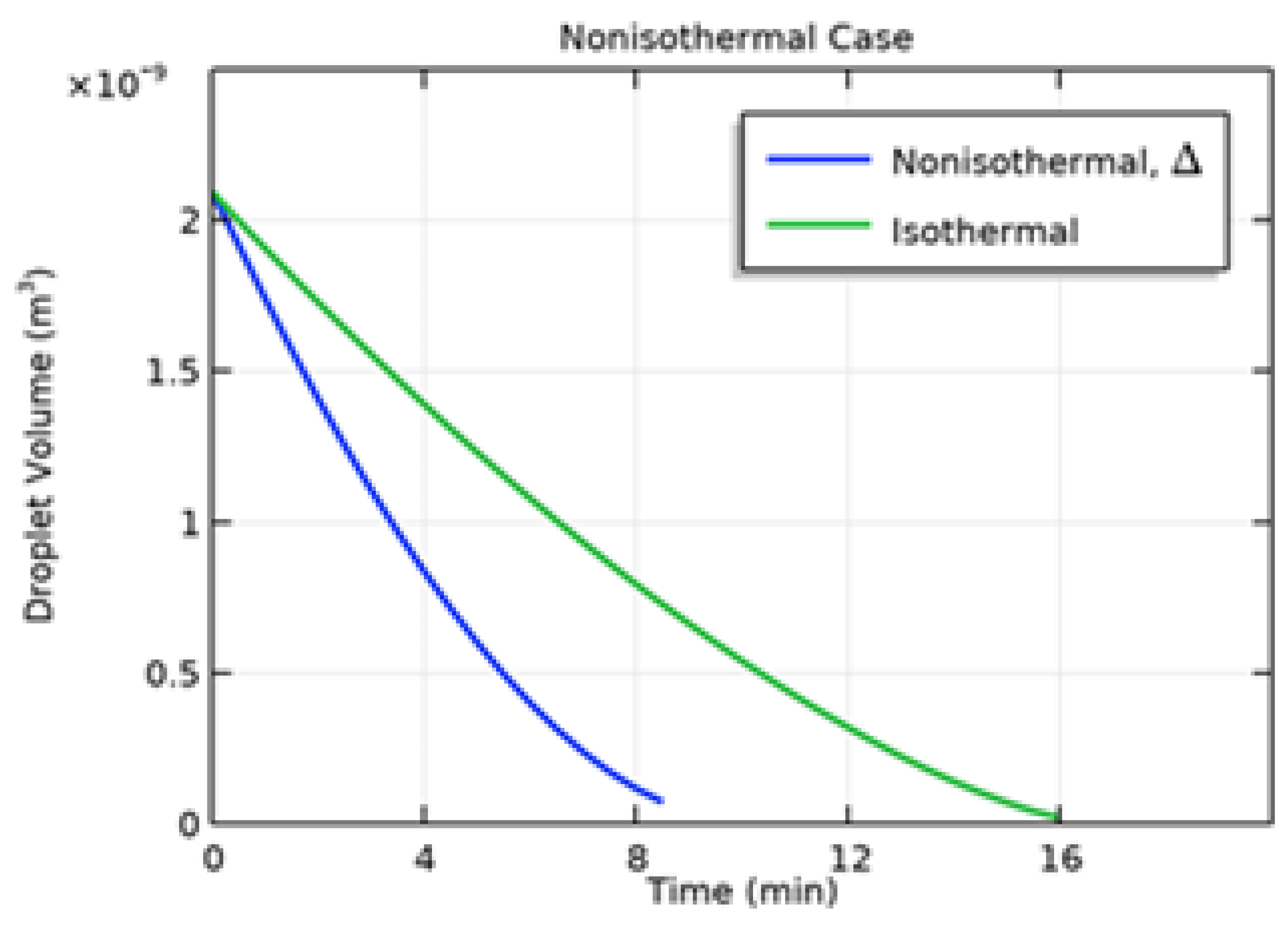
4.5. Additional Geometry and Isothermal vs Non-isothermal Comparison
5. Conclusions
Nomenclature
| C | Specific heat capacity [J/(kg K)] |
| D | Diffusion coefficient [/s] |
| k | Thermal conductivity [W/(m K)] |
| L | Latent heat of evaporation [J/kg] |
| Unit normal vector | |
| p | Pressure [Pa] |
| R | Distance from droplet center [m] |
| Droplet radius [m] | |
| t | Time [s] |
| T | Temperature [K] |
| Droplet volume [] | |
| Y | Mass fraction [-] |
| Contact angle [rad or deg] | |
| Dynamic viscosity [kg/(m s)] | |
| Density [] | |
| Surface tension [N/m] |
References
- Al Qubeissi, M.; et al. Heating and Evaporation of Droplets of Multicomponent and Blended Fuels: A Review of Recent Modeling Approaches. Energy Fuels 2021, 35(22), 18220–18256. [Google Scholar] [CrossRef]
- D’Ambrosio, H.-M.; Wilson, S. K.; Wray, A. W.; Duffy, B. R. Effect of gravity-induced shape change on the diffusion-limited evaporation of thin sessile and pendant droplets. Phys. Rev. E 2025, 111(4), 045107. [Google Scholar] [CrossRef] [PubMed]
- Diddens, C.; Kuerten, J. G. M.; van der Geld, C. W. M.; Wijshoff, H. M. A. Modeling the evaporation of sessile multi-component droplets. J. Colloid Interface Sci. 2017, 487, 426–436. [Google Scholar] [CrossRef] [PubMed]
- He, M.; Liao, D.; Qiu, H. Multicomponent Droplet Evaporation on Chemical Micro-Patterned Surfaces. Sci. Rep. 2017, 7, 41897. [Google Scholar] [CrossRef]
- Li, Y.; et al. Evaporation-Triggered Segregation of Sessile Binary Droplets. Phys. Rev. Lett. 2018, 120(22), 224501. [Google Scholar] [CrossRef]
- Sáenz, P. J.; Sefiane, K.; Kim, J.; Matar, O. K.; Valluri, P. Evaporation of sessile drops: a three-dimensional approach. J. Fluid Mech. 2015, 772, 705–739. [Google Scholar] [CrossRef]
- Thayyil Raju, L.; et al. Evaporation of a Sessile Colloidal Water–Glycerol Droplet: Marangoni Ring Formation. Langmuir 2022, 38(39), 12082–12094. [Google Scholar] [CrossRef]
- Widmann, J. F.; Davis, E. J. Evaporation of Multicomponent Droplets. Aerosol Sci. Technol. 1997, 27(2), 243–254. [Google Scholar] [CrossRef]
- Antonov, D. V.; Fedorenko, R. M.; Strizhak, P. A.; Sazhin, S. S. A simple model of heating and evaporation of droplets on a superhydrophobic surface. Int. J. Heat Mass Transf. 2023, 201, 123568. [Google Scholar] [CrossRef]
- Ozturk, T.; Erbil, H. Y. Evaporation of water-ethanol binary sessile drop on fluoropolymer surfaces: Influence of relative humidity. Colloids Surf. A 2018, 553, 327–336. [Google Scholar] [CrossRef]
- Tonini, S.; Cossali, G. E. Modeling the evaporation of sessile drops deformed by gravity on hydrophilic and hydrophobic substrates. Phys. Fluids 2023, 35(3), 032113. [Google Scholar] [CrossRef]
- Volkov, R. S.; Strizhak, P. A.; Misyura, S. Y.; Lezhnin, S. I.; Morozov, V. S. The influence of key factors on the heat and mass transfer of a sessile droplet. Exp. Therm. Fluid Sci. 2018, 99, 59–70. [Google Scholar] [CrossRef]
- Hussain, M. A.; Yesudasan, S.; Chacko, S. Nanofluids for solar thermal collection and energy conversion. Preprints preprint article 2020. [Google Scholar]
- Yesudasan, S. The critical diameter for continuous evaporation is between 3 and 4 nm for hydrophilic nanopores. Langmuir 2022, vol. 38(no. 21), 6550–6560. [Google Scholar] [CrossRef]
- S. Yesudasan, “Thermal dynamics of heat pipes with sub-critical nanopores,” arXiv:2406.xxxxx [physics.flu-dyn], 2024, arXiv preprint.
- M. M. Mohammed and S. Yesudasan, “Molecular dynamics study on the properties of liquid water in confined nanopores: Structural, transport, and thermodynamic insights,” in Proc. ASEE Northeast Section Conf., 2025, pp. 1–7. 1.
- Hotchandani, V.; Mathew, B.; Yesudasan, S.; Chacko, S. Thermo-hydraulic characteristics of novel MEMS heat sink. Microsyst. Technol. 2021, vol. 27(no. 1), 145–157. [Google Scholar] [CrossRef]
- Vlasov, V. A. Rigorous model of sessile droplet evaporation considering the kinetic factor. Phys. Rev. E 2025, 111(5), 055104. [Google Scholar] [CrossRef]
- Shaikeea, A. J. D.; et al. Universal representations of evaporation modes in sessile droplets. PLOS ONE 2017, 12(9), e0184997. [Google Scholar] [CrossRef]
- Rocha, D.; et al. Evaporating sessile droplets: solutal Marangoni effects overwhelm thermal Marangoni flow. arXiv 2024, arXiv:2410.17071. [Google Scholar] [CrossRef]
- Wang, Z.; Orejon, D.; Takata, Y.; Sefiane, K. Wetting and evaporation of multicomponent droplets. Phys. Rep. 2022, 960, 1–37. [Google Scholar] [CrossRef]
- Wang, Z.; et al. Surface properties and internal flows of evaporating multicomponent droplets. Curr. Opin. Colloid Interface Sci. 2022, 59, 101577. [Google Scholar] [CrossRef]
- Picknett, R. G.; Bexon, R. The evaporation of sessile or pendant drops in still air. J. Colloid Interface Sci. 1977, 61(2), 336–350. [Google Scholar] [CrossRef]
- Deegan, R. D.; et al. Capillary flow as the cause of ring stains from dried liquid drops. Nature 1997, 389, 827–829. [Google Scholar] [CrossRef]
- Hu, H.; Larson, R. G. Evaporation of a sessile droplet on a substrate. J. Phys. Chem. B 2002, 106(6), 1334–1344. [Google Scholar] [CrossRef]
- Cazabat, A.-M.; Guéna, G. Evaporation of macroscopic sessile droplets. Soft Matter 2010, 6, 2591–2612. [Google Scholar] [CrossRef]
- Davidovitch, B.; Yerushalmi-Rozen, E.; Safran, A. Coating a substrate with an evaporating solution: A simple model. Phys. Rev. E 2005, 72(4), 041605. [Google Scholar] [CrossRef]
- Erbil, H. Y. Evaporation of pure liquid sessile and spherical suspended drops: A review. Adv. Colloid Interface Sci. 2012, 170(1–2), 67–86. [Google Scholar] [CrossRef] [PubMed]
- Bennacer, R.; Sefiane, K. Vapor diffusion versus liquid convection in evaporating sessile drops. J. Fluid Mech. 2014, 749, 649–665. [Google Scholar] [CrossRef]
- Kim, H.; Lequeux, F.; Talini, L.; Allain, C. Dried colloidal suspensions on hydrophobic substrates: deposit morphology and cracking behavior. Soft Matter 2016, 12, 1547–1559. [Google Scholar] [CrossRef]
- Yarin, A. L. Drop impact dynamics: Splashing, spreading, receding, bouncing. Annu. Rev. Fluid Mech. 2006, 38, 159–192. [Google Scholar] [CrossRef]
- Sefiane, K. Patterns from drying drops. Adv. Colloid Interface Sci. 2014, 206, 372–381. [Google Scholar] [CrossRef] [PubMed]
- Kim, H.; et al. Controlled uniform coating from the interplay of Marangoni flows and surface-adsorbed macromolecules. Phys. Rev. Lett. 2017, 119(18), 184501. [Google Scholar] [CrossRef]
- Yakhno, T.; et al. Drying drops: deposit formation and patterning. Colloids Surf. A 2003, 231(1–3), 1–10. [Google Scholar] [CrossRef]
- Bird, J. C.; de Ruiter, R. R.; Courbin, L.; Stone, H. A. Daughter droplet production from a kink in a soap film. Phys. Rev. Lett. 2009, 103(16), 164502. [Google Scholar] [CrossRef]
- Sbragaglia, M.; et al. Slip and wettability of nanostructured surfaces. Phys. Rev. Lett. 2007, 99(15), 156001. [Google Scholar] [CrossRef] [PubMed]
- Kavehpour, H. P. Coalescence of drops. Annu. Rev. Fluid Mech. 2015, 47, 245–268. [Google Scholar] [CrossRef]
- Biance, A.-L.; Clanet, C.; Quéré, D. Evaporation of a sessile droplet. Langmuir 2003, 19(16), 6889–6894. [Google Scholar] [CrossRef]
- McHale, G.; Newton, M. I. Global geometry and the equilibrium shapes of liquid drops on fibers. Colloids Surf. A 2009, 333(1–3), 38–47. [Google Scholar] [CrossRef]
- Dash, S.; Garimella, M. R. Droplet evaporation dynamics on micropillar arrays. Langmuir 2014, 30(48), 14308–14315. [Google Scholar] [CrossRef]
- Brutin, D.; Starov, V. Recent advances in droplet wetting and evaporation. Chem. Soc. Rev. 2018, 47, 558–585. [Google Scholar] [CrossRef]
- Sobac, B.; Brutin, D. Thermal effects of the substrate on water droplet evaporation. Phys. Rev. E 2014, 90(5), 053011. [Google Scholar] [CrossRef] [PubMed]
- Ruscher, M.; Lohse, D.; Diddens, C. Mixed-mode evaporation of binary liquid droplets. Phys. Rev. Fluids 2020, 5(7), 073602. [Google Scholar] [CrossRef]
- Kumar, A.; et al. Drying of colloidal droplets on superhydrophobic surfaces: Suppression of the coffee-ring effect. Langmuir 2019, 35(31), 10212–10220. [Google Scholar] [CrossRef]

| Symbol | Value | Description |
|---|---|---|
| D | Diffusion coefficient of water vapor in air | |
| Latent heat of vaporization | ||
| 8.0713, 1730.6, 233.43 | Constants for Antoine equation (water vapor pressure) | |
| Specific gas constant of water vapor | ||
| Initial droplet radius | ||
| Substrate thickness | ||
| Surface tension (reference value) | ||
| Isothermal reference temperature |
| Property | Water | Coconut Oil | Ethylene Glycol | Mineral Oil | Gasoline |
|---|---|---|---|---|---|
| Melting point | 20– 28 °C | ≈ °C | °C | –40 to | |
| Boiling point | °C | °C | 300– 400 °C | 32– 204 °C | |
| Vapor pressure ( °C) | 2.3 kPa | negligible | very low | very low | relatively high |
| Density | 1.00 g/mL | 0.90 g/mL | 1.12 g/mL | g/mL | 0.72 g/mL |
| Viscosity | mPa s | 48–53 cP | cP | 30–100 cP | 0.4–0.6 cP |
Disclaimer/Publisher’s Note: The statements, opinions and data contained in all publications are solely those of the individual author(s) and contributor(s) and not of MDPI and/or the editor(s). MDPI and/or the editor(s) disclaim responsibility for any injury to people or property resulting from any ideas, methods, instructions or products referred to in the content. |
© 2025 by the authors. Licensee MDPI, Basel, Switzerland. This article is an open access article distributed under the terms and conditions of the Creative Commons Attribution (CC BY) license (http://creativecommons.org/licenses/by/4.0/).


