

Submitted:
26 December 2025
Posted:
29 December 2025
You are already at the latest version
Abstract
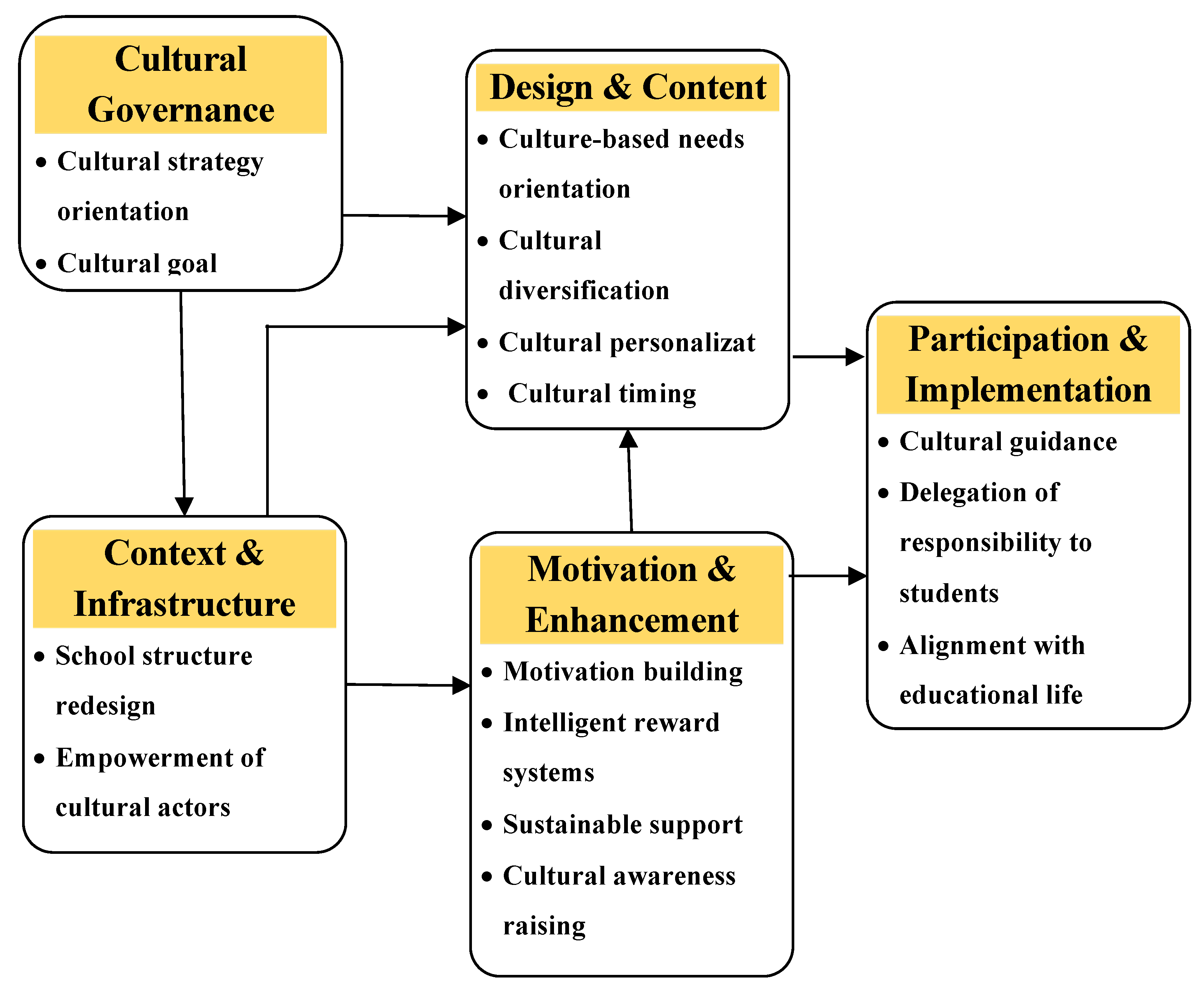
This study aimed to develop a comprehensive model for optimizing cultural events within the education sector through a sequential exploratory mixed-methods design. In the qualitative phase, grounded theory using Glaser’s emergent approach was applied via semi-structured interviews with purposively sampled planning and policymaking managers, school principals, educational counselors, and students, leading to the identification of five core constructs: cultural governance (strategy orientation, goal orientation, and unified decision-making), design and content (needs orientation, diversification, personalization, timing, and standardization), context and infrastructure (school structure redesign, actor empowerment, student networking, and school cultural economy), motivation and enhancement (motivation building, intelligent rewards, sustainable support, awareness raising, media engagement, and evaluation), and participation and implementation (cultural guidance, student responsibility delegation, alignment with educational life, and talent mapping). Subsequently, in the quantitative phase, a researcher-developed questionnaire was administered to 276 managers and 263 educational counselors (determined via Cochran’s formula), and second-order confirmatory factor analysis within structural equation modeling confirmed that these components collectively account for a substantial proportion of the variance in the optimization of cultural events. The proposed model offers practical implications for enhancing the efficiency, relevance, and impact of cultural programming in educational settings.
Keywords:
1. Introduction
2. Theoretical and Research Foundations
3. Methodology
3.1. Research Design
3.2. Data Collection Instruments
3.3. Population and Sampling
3.4. Data Analysis
4. Findings
4.1. Findings Related to Research Question 1 (What are the Main Components of Streamlining Cultural Events in the Education System?)
4.2. Findings Related to Research Question 2 (What are the Strategies and Policies Related to the Components of Streamlining Cultural Events in Education?)
4.3. Findings Related to Research Question 3 (What is the Optimal Model for Streamlining Cultural Events in the Education System?)
- Each conducted interview was reviewed to explicitly and implicitly identify the process of streamlining cultural events within the emerging discourse.
- The logical flow of any educational system, particularly the education sector, was considered to include three stages: inputs, processes, and outputs.
- Organizational excellence models and their elements were also taken into account as primary reference frameworks.
4.4. Findings Related to Research Question 4 (Does the Proposed Model for Streamlining Cultural Events in the Education System Possess Sufficient Validity?)
5. Discussion and Conclusions
- Comparative International Studies Conduct comparative analyses with successful educational systems (e.g., Finland’s focus on participation and well-being, or Singapore’s integration of technology and cultural identity) to enrich and refine the model. Such studies could provide concrete benchmarks and innovative mechanisms for strengthening the model’s components.
- Longitudinal Impact Assessment Undertake longitudinal research (e.g., over 3–5 years) to evaluate the sustainability and long-term effects of pilot implementation on outcomes such as school vitality, students’ social responsibility, and local cultural identity reinforcement. This would provide the strongest evidence of the model’s effectiveness and durability.
- In-Depth Stakeholder Lived Experiences Employ phenomenological qualitative studies to explore teachers’ and students’ lived experiences, barriers, facilitators, motivations, and interpretations of participation in cultural events based on this model. These insights would offer valuable data for refining implementation processes.
- Integration with Emerging Educational Technologies Investigate complementary technological models, such as the use of artificial intelligence for personalized cultural event promotion, augmented reality, or gamification to enhance engagement and attractiveness. Such research would align with the model’s emphasis on creativity in content and multimedia communication.
References
- Abuzar, M., Khondoker, S. U., & Rahman, O. (2024). Exploring the Dynamics of Student Motivation and Behavior: A Qualitative Analysis of Influencing Factors and Effective Interventions. Solo Universal Journal of Islamic Education and Multiculturalism, 2(03), 195–206. [CrossRef]
- Ahmadipour, R., Moazzemi, M., Tootian, S., & Kavousy, E. (2022). Designing a Model for Promoting Cultural Literacy in the Education of Iran. Teaching and Learning Research, 18(2), 65-82 (In Persian). [CrossRef]
- Aidi, M. , Bazdar, S. and Vahidzadeh, H. (2024). Investigating the effective marketing education strategies in attracting students in private schools. Research in Teaching, 12(1), 79-105. [CrossRef]
- American Psychologists Association. (2024). APA Dictionary of Psychology. Retrieved from APA Dictionary of Psychology.
- Apfeld, B., Coman, E., Gerring, J., & Jessee, S. (2023). Higher education and cultural liberalism: Regression discontinuity evidence from Romania. The Journal of Politics, 85(1), 34–48. [CrossRef]
- Ballantine, J., Stuber, J., & Everitt, J. (2021). The sociology of education: A systematic analysis. Routledge. [CrossRef]
- Bartolucci, F., Favaro, D., Pennoni, F. et al. An Analysis of the Effect of Streaming on Civic Participation Through a Causal Hidden Markov Model. Social Indicators Research, 172, 163–190 (2024). [CrossRef]
- Bazgoli, H., Safari, M., & Imani, M. N. (2021). Designing a Model for the Development of Cultural Capital in the Education System of Iran. Journal of Iranian Social Development Studies, 13(49), 63-80. (In Persian).
- Davies, S. (2024). Cultural capital—field connections for three populations of Chinese students: a theoretical framework for empirical research. Chinese Sociological Review, 56(3), 261–284. [CrossRef]
- Drajat, M., & Nor, M. R. M. (2020). The Models of Character and Akhlaq Education for Special Needs Children in an Inclusion School. Madania: Jurnal Kajian Keislaman, 24(1), 1-16. [CrossRef]
- Elsamanoudy, G. (2024) Cultivating Global Cultural Awareness Through University Event Design and Management: The Case of Global Day at Ajman University. In EDULEARN24 Proceedings (pp. 7973-7980). IATED. [CrossRef]
- Holloway, I., & Galvin, K. (2023). Qualitative research in nursing and healthcare. John Wiley & Sons.
- Hooper, D., Coughlan, J., & Mullen, M. R. (2008). Evaluating Model Fit:a Synthesis of the Structural Equation Modelling Literature, 7th European Conference on research methodology for business and management studies (Vol. 2008, No. 2, pp. 195-200). [CrossRef]
- Leppik, S. A., Ustinov, A. Y., & Chabanets, T. A. (2019). Event-driven approach to teaching Russian to school children of the Russian Ministry of Foreign Affairs. Russian Language Studies, 17(4), 445-459. [CrossRef]
- Meng, Q., Gray, M., Bradt, L., & Roets, G. (2024). Carving a Professional Identity for Chinese Social Work Shaped by Universalisation, Indigenisation, and Culturalism. The British Journal of Social Work, 54(4), 1679-1697. [CrossRef]
- Moeini, A., Maghool, A., & Cherabin, M. (2020). Conceptual model of the comprehensive cultural map of the Iranian education system Subject Areas. The Journal of Modern Thoughts in Education, 16(1), 200-220. (In Persian).
- Morovat, B. (2024). Pathology of University Cultural Programs and Activities to Provide an Optimal Model. Iranian journal of educational sociology, 7(3), 46-54. [CrossRef]
- Mueller, R. O., & Hancock, G. R. (2019). Structural equation modeling. In G. R. Hancock, L. M. Stapleton, & R. O. Mueller (Eds.), The reviewer’s guide to quantitative methods in the social sciences (2nd Ed., pp. 445–456). Routledge/Taylor & Francis Group. [CrossRef]
- Muldagaliyeva, A., Dosmagambetova, D., Aisultanova, K., Gumarova, S., & Zhyrenshina, K. (2025). Cultural-Communicative and Pragmatic Functions of Youth Socialization and Education Proverbs in the Kazakh Context. International Journal of Society, Culture & Language, 13(2), 179-192. [CrossRef]
- Namdari Pejman, M. (2024). School in the Evolutionary Level of the Education System: In Search of the Ideal Model. Islamic Perspective on Educational Science, 12(25), 5-35. [CrossRef]
- Namdari Pejman, M. (2025). Presenting a Model of Cultural Participation of Student-Teachers at Farhangian University. Culture in Islamic University, 14(53), 137-164. [CrossRef]
- Nonis, S. A., Relyea, C., & Hunt, C. S. (2020). Developing Students Global Mindset: An Event-Based Approach. Journal of Teaching in International Business, 31(2), 130–153. [CrossRef]
- Patton, L. D. (Ed.). (2023). Culture centers in higher education: Perspectives on identity, theory, and practice. Taylor & Francis. [CrossRef]
- Sawitri, S., Rahayu, N. T., Fatmawati, E., Zaelani, M., Elihami, E., & Arif, M. (2021). Implementation of Java cultural education in elementary school in Yogyakarta. Linguistics and Culture Review, 5(S3), 1285-1298. [CrossRef]
- Thelma, C. C. (2024). Civic education and national development: A comprehensive analysis of Zambia. Asian Journal of Education and Social Studies, 50(6), 170-190. [CrossRef]
- Tinsley, H. E. A., & Brown, S. D. (2000). Handbook of applied multivariate statistics and mathematical model in. Academic press. [CrossRef]
- Tintori, A., Ciancimino, G., Palomba, R., Clementi, C., & Cerbara, L. (2021). The impact of socialisation on children’s prosocial behaviour. A study on primary school students. International Journal of Environmental Research and Public Health, 18(22), 12017. [CrossRef]
- Weber, K., & Ali-Knight, J. (2012). Events and festivals in Asia and the Middle East North Africa (MENA) region. International Journal of Event and Festival Management, 3(1), 4-8. [CrossRef]

| A. Students | ||||||
| Code | Grade Level | Reason for Selection | ||||
| K-D-1 | Fifth | Top cultural ranking | ||||
| K-D-2 | Eleventh | No participation | ||||
| K-D-3 | Seventh | Top cultural ranking | ||||
| K-D-4 | Ninth | Top cultural ranking | ||||
| K-D-5 | Tenth | No participation | ||||
| K-D-6 | Twelfth | No participation | ||||
| K-D-7 | Eleventh | Top cultural ranking | ||||
| K-D-8 | Ninth | No participation | ||||
| B. Managers | ||||||
| Code | Degree | Field of Study | Position | |||
| K-KH-1 | PhD | Theology | Educational Counselor | |||
| K-KH-2 | Master's | Educational Management | Educational Counselor | |||
| K-KH-3 | Master's | Arabic Language | Educational Counselor | |||
| K-KH-4 | PhD | Educational Management | School Principal | |||
| K-KH-5 | PhD | Persian Literature | School Principal | |||
| K-KH-6 | Master's | Educational Technology | Cultural Expert | |||
| K-KH-7 | PhD | Curriculum Planning | Faculty Member | |||
| K-KH-8 | PhD | Educational Management | Faculty Member | |||
| Category | Description | Related Codes (Selected Examples) |
| Cultural Talent Mapping | Identifying and guiding students' cultural talents is the first step in effective streamlining. This dimension emphasizes mechanisms for talent discovery, support, and purposeful guidance of talented students. | Lack of knowledge of students’ talents (K-D-2), neglect of talent identification (K-D-2), talent assessment at entry (K-KH-1), proceeding based on talent (K-KH-1), talent recognition of students (K-KH-1, K-KH-2), welcoming and supporting various student talents (K-KH-4), identification and guidance of top cultural talents (K-KH-5), formation of talent identification working groups (K-KH-4) |
| Empowerment of Cultural Actors | Culturally competent human resources serve as the driving force of streamlining. This category addresses the necessity of recruiting, training, retaining, and role-modeling exemplary cultural experts and educational counselors. | Program-oriented cultural experts (K-KH-2), weakness in human resources (K-KH-2), recruitment of competent cultural human resources (K-KH-2), establishment of merit-based system for cultural experts (K-KH-2), merit-based retention system (K-KH-2), role modeling by cultural agents (K-KH-1) |
| Cultural Economy | Purposeful allocation of financial resources and facilities is a prerequisite for the sustainability of cultural events. This dimension focuses on the supply, equitable distribution, and optimal utilization of resources. | Absence of cost-benefit analysis for programs (K-D-1), inequitable and non-purposeful distribution of cultural budgets (K-D-1), purposeful budget allocation (K-KH-1), budgeting based on activity volume (K-KH-4), financial and facility support for students in program implementation (K-D-2) |
| Awareness Raising | Active student participation first requires building awareness and motivation. This category covers cultural orientation, persuasion, justification, and introduction at entry and throughout the educational journey. | Explaining the importance of cultural activities (K-D-1), orientation sessions (K-D-1), clarifying objectives of cultural events (K-D-1), persuasion of students (K-D-1), initial positive impression creation (K-KH-5), cultural awareness raising (K-D-3) |
| Purposefulness of Events | This dimension addresses the need to redefine event objectives and prevent superficiality. | Shifting objectives in festivals (K-D-1), unclear objectives (K-D-2), purposelessness in festivals (K-D-3), performative nature of activities (K-D-2, K-KH-2) |
| Sustainable Support | Culture-building requires continuous backing. This category emphasizes creating a supportive environment, honoring students, and maintaining post-event support. | Abandonment after festivals (K-KH-5, K-D-2, K-D-3), financial support for talented students (K-KH-1), fostering a respectful climate (K-KH-1), honoring student dignity (K-KH-1), close interaction between officials and students (K-KH-4) |
| Delegation of Responsibility | Streamlining becomes sustainable when students themselves take active roles. This dimension stresses assigning responsibility and authority to students. | Delegation of responsibility to students (K-D-1, K-D-4, K-KH-1), granting authority to students (K-KH-4) |
| Content Standardization | Low-quality content and activities hinder impact. This category focuses on developing frameworks, raising standards, and designing practical events. | Low quality of festivals (K-D-3), developing frameworks for activities (K-D-3), lack of content (K-D-4), raising standards (K-KH-3), alignment of content (K-D-3) |
| Timing of Events | Time is a critical factor in effectiveness. This dimension addresses time management, temporal alignment of content, and preventing program fatigue. | Having appropriate timing (K-D-1), prolonged program processes (K-D-1), time appropriateness in executing activities (K-D-4) |
| Diversification of Events | Broad attraction requires variety in activities. This category covers expanding scope, diversification, and innovation in cultural events. | Limited cultural activities (K-D-1, K-D-2, K-D-3), repetitive cultural activities (K-D-2), expansion of cultural-artistic competitions (K-KH-3) |
| Cultural Needs Orientation | Cultural events must be designed based on students’ real needs and developmental dimensions. This dimension stresses precise needs assessment and avoiding one-dimensional approaches. | Attention to students’ needs (K-D-1), needs assessment (K-D-1, K-D-3, K-D-4), needs assessment based on educational dimensions (K-D-3), mismatch with developmental dimensions (K-D-1) |
| Motivation Building | Sustained cultural participation depends on intrinsic motivation. This category focuses on internalizing activities, aligning with interests, and students’ innate nature. | Focus on students’ intrinsic motivation (K-D-1), creating motivation (K-D-3), alignment with students’ interests and nature (K-D-1), internalization of cultural work (K-KH-1) |
| Intelligent Reward System | Reward systems should be timely, meaningful, and persuasive. This dimension addresses designing effective incentive mechanisms. | Timeliness of rewards (K-D-5), magnitude of rewards (K-D-5), persuasive nature of prizes (K-KH-5) |
| Alignment with Educational Life | Culture should not be peripheral to education. This category emphasizes integrating cultural events with curricula and real-life experiences. | Integration of cultural activities with education (K-KH-4), alignment with real life (K-D-3), integration with curriculum (K-D-5) |
| Cultural Personalization | Each student has a unique world. This dimension stresses recognizing personality, interests, and individual contexts for tailored activities. | Alignment with students’ tastes and interests (K-KH-2), audience profiling (K-KH-2), personality recognition (K-D-4), situational adaptation (K-D-1) |
| Unity in Decision-Making | Multiple decision-making centers require coordination and coherence. This category covers inter-unit interaction, role clarification, and smart decentralization. | Decentralization of cultural activities (K-D-3), multiplicity of cultural centers (K-KH-1), coordination among decision-making units (K-KH-3) |
| Student Networking | Student teams and networks form the core of cultural dynamism. This dimension addresses team building, observational learning, and peer influence. | Team formation (K-D-5), networking (K-D-5), peer group attraction (K-D-5), utilization of active cultural students (K-KH-4) |
| Cultural Guidance | Teachers can serve as cultural leaders. This category covers the guiding role of teachers, scientific enhancement, and cultural counseling schemes. | Utilization of competent and committed teachers (K-D-1), lack of guidance system (K-D-3, K-D-5), cultural teacher-counselor scheme (K-D-5) |
| School Structure Redesign | School structure must be receptive to culture. This dimension focuses on correcting inefficiencies and designing facilitative structures. | School structure reform (K-KH-1), structural weaknesses (K-KH-2) |
| Cultural Strategy Orientation | Without strategy, streamlining is impossible. This category addresses strategic documents, participatory policymaking, and systematization. | Existence of strategic plans for activities (K-D-3), strategic perspective on cultural activities (K-KH-1), bottom-up policymaking (K-KH-2) |
| Event Evaluation | Continuous evaluation ensures cultural dynamism. This dimension covers assessment systems, cultural portfolios, and effective monitoring. | Continuous evaluation of cultural activities (K-D-3), ongoing assessment (K-KH-4), cultural portfolio implementation (K-KH-2) |
| Media Coverage | Media are tools for streamlining. This category addresses effective information dissemination, targeted promotion, student gatherings, and vitality creation. | Active engagement in virtual space (K-KH-2), improvement of information systems (K-D-5), effective advertising (K-D-5), student gatherings (K-D-1) |
| Component / Sub-component | Standardized Estimate | Standard Error | t-value | R² |
| Cultural Governance | 0.39 | – | 5.08* | 0.15 |
| - Cultural strategy orientation | 0.50 | 0.75 | 4.64* | 0.25 |
| - Cultural goal orientation (Purposefulness of events) | 0.31 | 0.90 | 3.90* | 0.10 |
| - Unity in decision-making | 0.54 | 0.71 | 4.75* | 0.29 |
| Context and Infrastructure | 0.91 | – | 16.29** | 0.83 |
| - School structure redesign | 0.74 | 0.45 | 15.06** | 0.55 |
| - Empowerment of cultural actors | 0.80 | 0.36 | 24.48** | 0.64 |
| - Student networking | 0.68 | 0.53 | 17.63** | 0.46 |
| - School cultural economy | 0.71 | 0.50 | 19.61** | 0.50 |
| Design and Content | 0.98 | – | 16.42** | 0.96 |
| - Culture-based needs orientation | 0.63 | 0.61 | 16.94** | 0.40 |
| - Content standardization | 0.79 | 0.38 | 20.18** | 0.62 |
| - Cultural diversification | 0.73 | 0.47 | 16.42** | 0.53 |
| - Cultural personalization | 0.77 | 0.41 | 17.37** | 0.59 |
| - Cultural timing | 0.77 | 0.41 | 17.22** | 0.59 |
| Participation and Implementation | 0.99 | – | 23.49** | 0.98 |
| - Cultural guidance | 0.77 | 0.38 | 17.30** | 0.59 |
| - Delegation of responsibility | 0.82 | 0.41 | 28.35** | 0.67 |
| - Alignment with educational life | 0.67 | 0.33 | 17.43** | 0.45 |
| - Talent mapping | 0.74 | 0.55 | 21.63** | 0.55 |
| Motivation and Enhancement | 0.88 | – | 17.62** | 0.77 |
| - Motivation building | 0.76 | 0.43 | 25.24** | 0.58 |
| - Intelligent reward systems | 0.76 | 0.42 | 25.22** | 0.58 |
| - Sustainable support | 0.78 | 0.39 | 22.91** | 0.61 |
| - Cultural awareness raising | 0.80 | 0.37 | 21.96** | 0.64 |
| - Cultural media engagement | 0.77 | 0.41 | 23.33** | 0.59 |
| - Cultural evaluation | 0.79 | 0.38 | 23.34** | 0.62 |
| Statistic | Value | df | p | RMSEA | RMR | GFI | AGFI | NFI |
| Chi-square | 924.21 | 204 | 0.001 | 0.07 | 0.03 | 0.98 | 0.97 | 0.98 |
Disclaimer/Publisher’s Note: The statements, opinions and data contained in all publications are solely those of the individual author(s) and contributor(s) and not of MDPI and/or the editor(s). MDPI and/or the editor(s) disclaim responsibility for any injury to people or property resulting from any ideas, methods, instructions or products referred to in the content. |
© 2025 by the authors. Licensee MDPI, Basel, Switzerland. This article is an open access article distributed under the terms and conditions of the Creative Commons Attribution (CC BY) license (http://creativecommons.org/licenses/by/4.0/).


