

Submitted:
19 December 2023
Posted:
19 December 2023
You are already at the latest version
Abstract
This comprehensive statement explores the concept of educational excellence, emphasizing the limitations of traditional metrics and proposing a holistic model for excellent educational systems. The discussion delves into the ambiguity surrounding excellence, challenges in measurement, and the influence of social, cultural, and economic factors on education. The objectives of the study include shedding light on the nature of excellence, its global significance, and introducing a model for improving school performance. The theoretical framework integrates constructivism, Maslow's Hierarchy of Needs, and Ecological Systems Theory to emphasize student-centered learning, holistic development, and environmental factors. The proposed model envisions an educational ecosystem prioritizing personalized, inclusive, and relevant education, with key components such as student-centered learning, inspirational educators, curriculum innovation, and community involvement. The abstract concludes by highlighting the model's potential implications in transforming education, challenging the status quo, and fostering well-rounded individuals equipped for a rapidly changing world.
Keywords:
Educational Excellence
; Holistic Education
; Student-Centered Learning
; Curriculum Innovation & Inspirational Educators
1. Introduction
The idea of having an excellent education system is a subject that has always been of interest and relevance both, in discussions and practical decision-making. Educators, policymakers, and scholars tirelessly strive to identify and enhance the qualities that distinguish practices worldwide. Traditional approaches to addressing this issue often prioritize indicators such as test scores, graduation rates, and funding levels. While these quantitative measures certainly provide insights, they often fail to paint a picture of what truly defines educational success. Education plays a role in the growth and development of every nation impacting political and economic progress positively. Given its significance, many countries across the globe work towards ensuring excellence at all levels of education to raise standards and gain an edge for their educational institutions (Aldaihani, 2014). However, the concept of excellence remains ambiguous and imprecise. Although policies frequently emphasize phrases like " standards" and "exceptional achievement " there is a lack of definitions for these terms. Excellence can be interpreted in ways; surpassing peers or meeting criteria. The conflicting interpretations make it challenging to establish a benchmark, for quality (Gillies 2007 & Guskey 2013).
Another problem is the restricted focus on greatness, which is frequently determined by standardized test results and is primarily defined as high accomplishment in cognitive skills. These steps are necessary, but they do not cover all aspects of education. Along with the development of cognitive capabilities, education should also focus on dispositions, interests, and other talents. Other important aspects of schooling may be neglected if quantifiable cognitive skills are given too much weight (Biesta, 2020 & D'Agnese, 2017). Additionally, it is problematic to utilize standardized testing as the main indicator of excellence. These assessments offer quantitative information, but they might fall short of capturing the depth of instruction. The value of less quantifiable educational achievements, which are as important, may be diminished if educational systems around the world are compared based solely on test scores (Duru-Bellatt; Mingat, 2011; Biesta, 2020).
Similar to any other system, education is influenced by and influenced by a variety of social, cultural, political, and economic variables. One educational system truly differs from another in several interactions (Masri 2009). Understanding what is desirable and beneficial in education has been the subject of debate in several studies and inquiries. Excellence has arisen over the past 50 years as an educational paradigm that has been crucial in attempts to reform and make educational policy (Bruno-Jofré & Hills, 2011).
Additionally, there are numerous definitions of excellence, which in fact change depending on the context—cultural, social, professional, professional, scientific, or research—in which the term is used. According to Lador (2010), excellence involves a variety of mental, physical, creative, and intellectual abilities that are focused on management or leadership for the advancement of the educational system. The school excellence model is a comprehensive tool that can be used in the self-assessment process of schools. It was originally adapted from quality models that were successfully and effectively applied in many business organizations (Ng & Chan, 2008). One may say that the school excellence model's main goal is to offer a thorough framework for evaluating school strengths and pinpointing areas that require improvement. The framework also strengthens all initiatives meant to enhance the school environment and, as a result, strengthen.
The concept of educational excellence continues to be vague and imprecisely defined, despite decades of legislative attempts and international assessments, when the research gap is examined in the context of the issue of excellence in the educational system. Although governments in nations like the United States and the United Kingdom have constantly stressed the pursuit of excellence, they have frequently had difficulty providing specific criteria that may successfully guide educational practice (National Committee, 1983 & DfEE, 1997). Furthermore, the international trend epitomized by the OECD's PISA Programme reflects a global drive towards benchmarking educational systems based on standardized tests. This approach, while providing comparative data, may not account for the multifaceted nature of educational excellence (OECD, 2012). The measurement of excellence solely through cognitive skills fails to recognize the significance of education in shaping well-rounded individuals with diverse talents, interests, and dispositions (D'Agnese, 2017).
2. Objectives of the Study
The upcoming study will aim to shed light on the nature of excellence and its significance for educational institutions. It will endeavor to offer insights into the nature of educational institutions worldwide. Furthermore, it will introduce a proposed model that can be implemented on a global scale or within national contexts to enhance school performance and elevate productivity and quality in all processes conducted within these schools.
3. Methodology of the Study
The researcher will first review and analyze the literature regarding the identification of the nature of excellence and the role it can play in different educational institutions. This analysis will be effective in helping the researcher formulate and introduce the model for improving the quality of the educational system.
4. Literature Review
The concept of excellence in education has long been a subject of philosophical inquiry and policy debate. It inherently involves normative questions about what constitutes excellence and how it should be pursued within educational systems. As this discussion highlights, excellence should be viewed in the context of promoting the well-being of individuals and society as a whole. This aligns with the perspective that education fundamentally serves to nurture the development of students as individuals and as contributors to society. Nussbaum (2009) argues that education should equip individuals to lead good lives and participate meaningfully in their social framework. Therefore, an expansive and plural conception of excellence, encompassing a wide range of abilities, including intellectual, artistic, and physical, is proposed. This notion emphasizes the intrinsic and instrumental value of high achievement, both for personal fulfillment and for the betterment of society (Sypnowich, 2017). It recognizes that fostering excellence across diverse talents and capacities contributes to the well-being of individuals and the broader community.
However, it's important to acknowledge the potential tension between the pursuit of excellence and the well-being of students. Critics argue that an exclusive focus on excellence may instrumentalize education, diminishing the inherent value of learning for its own sake. It is suggested that promoting 'good-enough' achievements for all students might be a more equitable approach. Nonetheless, proponents of a plural view of excellence contend that cultivating abilities to high levels need not be at odds with well-being, provided it is done in alignment with students' dispositions and interests. This perspective underscores that the pursuit of excellence can be personally fulfilling and lead to a diverse range of pathways for individual growth and societal progress (Hurka, 1993). In the context of real-world educational practices, the implementation of this conception of excellence necessitates careful consideration of how it aligns with the specific values and circumstances of the educational system, ultimately striving to balance the pursuit of excellence with the promotion of well-being.
5. Theoretical Framework
Constructivism is a foundational theoretical framework that underpins the model of educational excellence presented. According to Jonassen and Land (2012), constructivism posits that individuals actively construct their knowledge by engaging with new information and connecting it to their existing mental frameworks. This perspective aligns seamlessly with the model's emphasis on student-centered learning. As Amineh and Asl (2015) argued, in constructivist classrooms, learners are encouraged to explore, question, and discover knowledge for themselves, fostering a deep and lasting understanding of the subject matter. The model recognizes the teacher's role as a facilitator who guides students through this process, promoting active engagement and critical thinking.
Maslow's Hierarchy of Needs, as applied to the model, underscores the significance of addressing students' holistic development. As noted by Maslow (1943) himself, individuals have a hierarchy of needs that must be fulfilled, starting with physiological needs and safety and culminating in self-actualization. In the context of education, this means that before students can fully engage in learning and self-discovery, their basic needs, such as safety and a sense of belonging, must be met. According to Taylor et al., (2019), when these fundamental needs are satisfied, students are more likely to be intrinsically motivated, which aligns with the model's goal of fostering curiosity and self-driven learning.
The Ecological Systems Theory, developed by Bronfenbrenner (1979), offers a comprehensive framework for understanding the multifaceted nature of the educational environment. This theory highlights the interconnectedness of various systems, from the immediate microsystem of the school to the broader macrosystem of societal and cultural influences. In line with Bronfenbrenner's ideas, the model emphasizes the importance of creating an inclusive and supportive educational environment that extends beyond the classroom. As proposed by Bronfenbrenner, an individual's development is shaped by interactions with these environmental systems. Therefore, the model underscores the role of community involvement, curriculum innovation, and mental health support in creating a holistic and nurturing educational context, as these factors are integral components of the ecological systems affecting students' learning experiences.
These three theoretical frameworks, constructivism, Maslow's Hierarchy of Needs, and Ecological Systems Theory, provide a solid theoretical foundation for the model of educational excellence, emphasizing student-centered learning, holistic development, and the interconnectedness of various educational factors. Their integration into the model ensures that it addresses not only the cognitive but also the emotional, social, and environmental aspects of students' educational journeys, aligning with contemporary educational goals and challenges.
6. "My Model of Excellent Educational Systems"
My model will envision an educational ecosystem where students will be active participants in their learning journey. It will champion personalized, inclusive, and relevant education. Quality educators, supported by technology and a compassionate community, will empower learners to excel academically while fostering essential life skills.
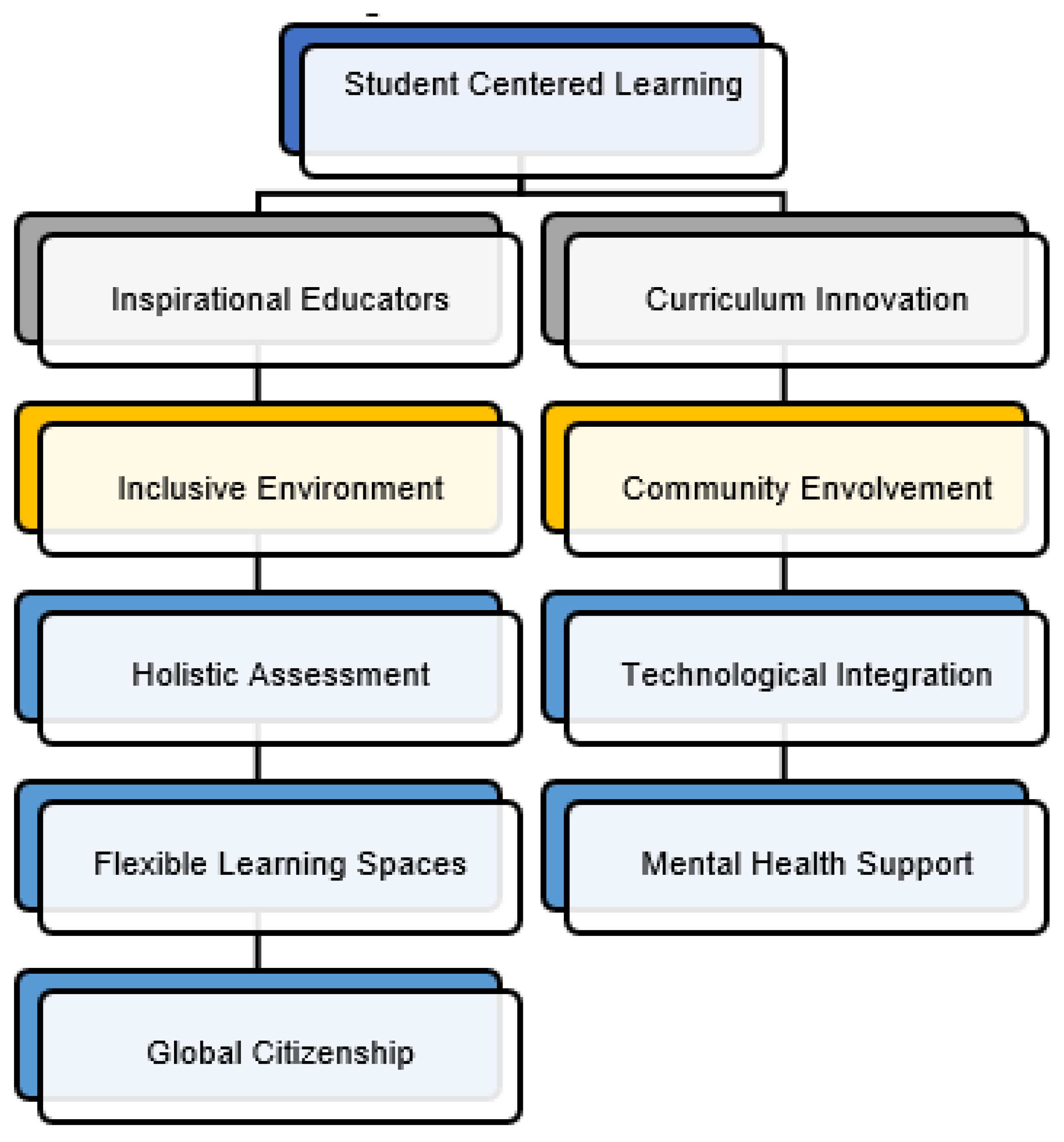
Figure 1.
7. Definition of Terms
This model prioritizes qualitative aspects of education, addressing the limitations of traditional models based solely on quantifiable metrics. It aligns with contemporary challenges by producing adaptable, empathetic, and globally aware citizens equipped to thrive in a rapidly changing world. The educational excellence model I provided is based on a set of key principles and components that are widely recognized as important for fostering an excellent educational system. Here's an explanation of why these components were chosen:
Student-Centered Learning: Placing students at the center of the educational experience is essential. This component emphasizes tailoring education to individual needs and fostering curiosity. It acknowledges that students have diverse learning styles and paces, and the educational system should adapt to accommodate these differences.
Inspirational Educators: Passionate and empathetic teachers play a crucial role in igniting the love for learning in students. Inspirational educators go beyond delivering content; they inspire and mentor students, creating a positive and motivating learning environment
Curriculum Innovation: To keep pace with a rapidly changing world, education must provide relevant, interdisciplinary, and real-world-oriented content. Curriculum innovation ensures that what students learn is directly applicable to their lives and future careers.
Inclusive Environment: Celebrating diversity and promoting empathy and equity within schools are vital for creating a welcoming and supportive atmosphere. Inclusive environments ensure that all students, regardless of their backgrounds, feel valued and respected.
Community Involvement: Collaboration with parents, local resources, and extracurricular activities extends learning beyond the classroom. Engaging the community creates a holistic educational experience and connects students to the real world.
Holistic Assessment: Moving beyond traditional exams, holistic assessment considers character development, ethics, and soft skills. It recognizes that education should not only focus on academic achievement but also students' personal and social growth.
Technological Integration: In a digitally connected world, leveraging technology for interactive learning and global awareness is essential. Effective use of technology enhances the educational experience and prepares students for the digital age.
Flexible Learning Spaces: Adaptable learning environments promote creativity and collaborative learning. Flexible spaces enable educators to tailor the physical setting to different teaching and learning styles.
Mental Health Support: Acknowledging and addressing students' mental health needs is crucial for their overall well-being. Schools should provide counseling and well-being programs to support students' emotional and psychological development.
Global Citizenship: Preparing students for a globalized world is essential. Global citizenship education instills a sense of responsibility, intercultural competence, and a commitment to addressing global challenges.
This model represents a holistic approach to education that recognizes the multifaceted nature of learning. It emphasizes the importance of not only academic achievement but also personal and social development, community engagement, and adaptability to a changing world. By incorporating these components into educational systems, we can work toward creating truly excellent educational experiences for students.
8. Conclusion and Implications:
In conclusion, the suggested framework for excellent educational systems will embody an innovative conception of education. It will reinvent the educational landscape by putting students first, valuing their uniqueness, and encouraging a passion for learning. This approach will support the importance of an innovative curriculum that keeps education current and useful, inspirational teachers who go above and beyond traditional teaching, and welcoming environments that embrace diversity. Moreover, it will emphasize the essential connection between schools and their communities, a holistic assessment that values character development, and the integration of technology to prepare students for the digital age. With flexible learning spaces, mental health support, and a focus on global citizenship, this model will envision education that transcends the boundaries of conventional systems and equips students with the skills and values needed to thrive in an ever-evolving world.
The model's implications will be significant. It will call into question the status quo in education and encourage institutions and policymakers to look beyond narrow academic results and adopt a more inclusive perspective. Educational institutions will develop well-rounded persons who are not just academically proficient but also socially aware, sensitive, and adaptive by including these principles and elements. This model will also emphasize the value of cooperation between educators, parents, communities, and technology, stressing that educational excellence is a shared enterprise. In the end, the suggested approach will have the potential to transform education as we currently understand it, training students not only to achieve academic success but also to be active, caring, and accountable members of society.
References
- Aldaihani, S. G. (2014). School excellence model in public schools in the State of Kuwait: A proposed model. Journal of Education and Practice, 5(34), 126-132.
- Amineh, R. J., & Asl, H. D. (2015). Review of constructivism and social constructivism. Journal of social sciences, literature, and languages, 1(1), 9-16.
- Biesta, G.J.J. (2020). Perfect education, but not for everyone: On society’s need for inequality and the rise of surrogate education. Zeitschrift für Pädagogik, 1, 8–14. [CrossRef]
- Bronfenbrenner, U. (1979). Contexts of child rearing: Problems and prospects. American psychologist, 34(10), 844. [CrossRef]
- Bruno-Jofré, R. & Hills, G. (2011), “Changing Visions of Excellence in Ontario School Policy: The Cases of Living and Learning and for the Love of Learning”, Educational Theory 61(3), 335-349. [CrossRef]
- D’Agnese, V. (2017). Reclaiming education in the age of PISA. Challenging OECD’s educational order. Routledge.
- DfEE (1997). Excellence for all children: Meeting special educational needs. Her Majesty’s Stationery Office.
- Duru-Bellatt, M. and Mingat, A. (2011) Measuring excellence and equity in education. Conceptual and methodological issues. In Van den Branden, K. Avermaet, P. and Van Houtte, M. (Eds.), Equity and excellence in education. (pp. 21-38). Routledge.
- Gillies, D. (2008) Quality and equality: The mask of discursive conflation in education policy texts. Journal of Education Policy, 23(6), 685–699. [CrossRef]
- Guskey, TR. (2013). Defining student achievement. In J. Hattie & Anderman, E.M. (eds.), International Guide to Student Achievement. Routledge.
- Hurka, T. (1993). Perfectionism. Oxford University Press.
- Lador, I. I. (2010). Research Trends, Focused on Excellence in the Fundamental Field of Science Physical Education and Sports. Gymnasium, 11(2).
- Land, S., & Jonassen, D. (Eds.). (2012). Theoretical foundations of learning environments. Routledge.
- Maslow, A. H. (1943). Preface to motivation theory. Psychosomatic medicine, 5(1), 85-92. [CrossRef]
- Masri, M.W. (2009), “Policy Process and Education Reform in the Arab World”, Mediterranean Journal of Educational Studies 14(1), 129-144.
- Ng, P.T. & Chan, D. (2008), “A Comparative Study of Singapore’s School Excellence Model with Hong Kong’s School-Based Management”, International Journal of Educational Management 22(6), 488-505.
- Nussbaum, (2009). Education for profit, education for freedom. https://files.eric.ed.gov/fulltext/EJ861161.pdf.
- OECD and Pisa tests are damaging education worldwide – academics. (2014, May 6). The Guardian. https://www.theguardian.com/education/2014/may/06/oecd-pisa-tests-damaging-education-academics.
- OECD, (2012). PISA 2012 results: Excellence through equity. Giving every student the chance to succeed. Vol 2. OECD Publishing.
- Sypnowich, C. (2017). Equality renewed: Justice, flourishing and the egalitarian ideal. Routledge.
- Taylor, S. N., Passarelli, A. M., & Van Oosten, E. B. (2019). Leadership coach effectiveness as fostering self-determined, sustained change. The Leadership Quarterly, 30(6), 101313. [CrossRef]
Disclaimer/Publisher’s Note: The statements, opinions and data contained in all publications are solely those of the individual author(s) and contributor(s) and not of MDPI and/or the editor(s). MDPI and/or the editor(s) disclaim responsibility for any injury to people or property resulting from any ideas, methods, instructions or products referred to in the content. |
© 2023 by the authors. Licensee MDPI, Basel, Switzerland. This article is an open access article distributed under the terms and conditions of the Creative Commons Attribution (CC BY) license (http://creativecommons.org/licenses/by/4.0/).
Copyright: This open access article is published under a Creative Commons CC BY 4.0 license, which permit the free download, distribution, and reuse, provided that the author and preprint are cited in any reuse.


