

Submitted:
26 December 2025
Posted:
29 December 2025
You are already at the latest version
Abstract
Firefighters are exposed to complex combustion products and to contaminants carried on personal protective equipment (PPE). Occupational exposure as a firefighter is classified as carcinogenic. This review summarizes current evidence on exposure environments, routes of uptake, contamination and secondary exposure from PPE, and the effectiveness and limits of decontamination approaches. Across incident types, smoke composition varies with fuels and combustion conditions, but fine and ultrafine particles and semi-volatile organic chemicals are common. Biomonitoring confirms uptake after incidents. Self-contained breathing apparatus reduces inhalation exposure during active suppression, yet exposures persist through dermal absorption at ensemble interfaces and post-incident tasks. Protective ensembles can retain soot-bound polycyclic aromatic hydrocarbons, additive chemicals, and metals; volatiles and particles resuspension in vehicles and stations can extend exposure. Studies show that on-scene preliminary exposure reduction and laundering can lower contaminant burdens on PPE; however, removal remains incomplete and is sensitive to delay before cleaning and gear age. Emerging evidence raises additional concern for per- and polyfluoroalkyl substances from foams and coating materials, with limited data on exposure metrics and removability. The field lacks standardized, realistic contamination platforms and a dose-based definition of clean PPE. Integrated intervention studies linking exposure, secondary exposure pathways, biomarkers, and decontamination methods are needed to set performance-based targets and evaluate emerging hazards.
Keywords:
firefighters
; fire smoke
; occupational exposure
; personal protective equipment
; contamination
; decontamination
1. Introduction
Firefighting is an extremely risky occupation in which personnel repeatedly encounter high temperatures, intense physical demands, and smoke from combustion [1,2,3,4]. In the United States, approximately 1,115,000 firefighters, including 370,000 career and 745,000 volunteer firefighters, respond to an estimated 1.2 to 1.4 million fires annually, with structure fires accounting for 475,000 to 500,000 of these incidents [5,6]. In 2020, approximately 64,875 injuries were reported among US firefighters [7,8]. While acute hazards such as burns and heat stress are obvious, a central occupational health concern is the cumulative burden of smoke and chemical exposure across a career, including exposures that occur during fire ground tasks such as fire attack and overhaul, and routine tasks such as equipment restoration, training, and station work [4].
Fire smoke is a dynamic, multi-phase mixture of gases and particles whose composition varies by fuel, combustion conditions, suppression tactics, and incident phase [9,10,11,12,13]. Across fire types, firefighters may encounter irritant and asphyxiants gases [14,15,16], particulate matter spanning ultrafine to coarse sizes [17,18,19,20,21,22], volatile organic compounds (VOCs, e.g., benzene, toluene, ethylbenzene, and xylenes [BTEXs]) [21,23,24,25], semi-volatile organic compounds (SVOCs, e.g., polycyclic aromatic hydrocarbons [PAHs]) [17,26,27,28,29], metals [11,12,17,30,31], and additive-related chemicals released from modern materials [32,33,34,35]. These mixtures evolve across minutes to hours, and the dominant hazards can shift across fire growth, knockdown, and overhaul [27,36,37]. Additionally, hazards partition between gas and particle phases and then redistribute onto skin, textiles, and surfaces, contributes a secondary exposure [24,38,39,40].
Exposure pathways are correspondingly multi-route and extend beyond the fireground. Inhalation can dominate during suppression when respiratory protection is not used or is removed early [41,42], but dermal deposition and uptake can be substantial at interface regions and during high-contact tasks, and exposure can continue during personal protective equipment (PPE) doffing and post-incident handling when contaminated gear releases vapors or resuspends particles in enclosed microenvironments (apparatus cabs, gear rooms) [24,38,43,44,45,46]. There is still no consensus across the literature on the dominant routes of uptake for key compound classes across tasks and phases, and many studies cannot fully disentangle fireground exposure from secondary pathways tied to contaminated PPE and station environments.
These exposure realities have clear implications for long-term health [47,48,49]. The International Agency for Research on Cancer (IARC) classifies firefighters’ occupational exposure as carcinogenic to humans (Group 1), citing sufficient evidence for mesothelioma and bladder cancer and limited evidence for several additional cancers [4]. Cancer has become a defining health issue for the fire service [3,29,48,50,51,52,53,54,55]. The International Association of Fire Fighters (IAFF) report highlights that in 2025, 79.4% of IAFF members honored at the IAFF Fallen Fire Fighter Memorial died of cancer (247 of 311) [56]. Although epidemiologic signals are increasingly strong, a persistent gap remains in the mechanistic linkage: connecting external exposure mixtures (which vary significantly by incident and task) to internal dose metrics and biomarkers in ways that support prevention, standards, and evaluation of interventions.
PPE is critical to risk reduction, yet the evidence base increasingly shows that turnout ensembles can also function as contaminant reservoirs [39,40,43,57,58,59,60,61]. Particle-bound chemicals and semi-volatile compounds can deposit on PPE outer shells [59,62,63], penetrate into seams and layers [64,65,66], and persist after incidents [67,68], creating opportunities for dermal contact [36,69,70,71,72], off-gassing and resuspension [24,38,43], and cross-contamination to vehicles and stations if decontamination is delayed or incomplete [44,45,46]. Current standards, such as NFPA 1851, provide operational guidance on cleaning frequency and processes, but the field still lacks a clinically grounded definition of “how clean is clean,” including health-based thresholds for acceptable post-cleaning residue across relevant chemical classes [43,73,74,75,76]. Progress is constrained by the absence of a widely adopted, systematic platform that can reproducibly generate representative smoke mixtures, contaminate full ensembles under realistic heat/moisture/compression situations, and evaluate both residue and secondary emission potential; as a result, decontamination research often remains limited, challenged by a narrow spectrum of target analytes and simplified contamination protocols.
Emerging contaminant classes further expand the scope of occupational health. Per- and polyfluoroalkyl substances (PFAS), which have been historically used in aqueous film-forming foams and are present in some protective gear materials, differing from classic smoke toxicants due to their environmental persistence, long biological half-lives, and complex toxicokinetic [77,78,79]. Evidence suggests multiple possible exposure sources (foam use, treated PPE materials, station dust, and contaminated gear) [32,80], but the literature still lacks robust source apportionment and longitudinal data on how aging processes (laundering, UV exposure, thermal cycling) change PFAS release and transport from PPE materials [81,82].
Figure 1 summarizes the exposure continuum discussed in this review: incident sources generate an airborne mixture; firefighters experience on-scene exposure through inhalation (self-contained breathing apparatus [SCBA] on/off), dermal deposition and uptake (especially at neck/hood, wrist, and other interfaces), and incidental ingestion; contaminants can then accumulate in PPE as a reservoir through deposition, sorption, and penetration; and secondary pathways (off-gassing, resuspension during handling, and cross-contamination to apparatus, stations, and homes) can prolong exposure after the fireground.
The objective of this review is to synthesize current evidence on firefighter exposure environments across incident types and phases, exposure routes and internal dose assessment using biomarkers, PPE contamination mechanisms and secondary exposure pathways, and PPE decontamination methods, effectiveness metrics, and trade-offs with protective performance. We emphasize where knowledge is robust versus where it remains limited, with particular attention to methodological gaps, especially the need for standardized contamination simulation and evaluation tools, as well as for integrated study designs that connect air/skin/PPE measurements to biomarkers and health-relevant endpoints.
2. Firefighters’ Exposure Environments
Firefighters operate in exposure environments that are chemically complex, physically dynamic, and strongly shaped by firefighting tactics. Fire smoke is a multiphase mixture of gases and particles that evolve across minutes to hours as fuels change, ventilation shifts, and suppression actions alter temperature and oxygen supply [9,10,11,12,13]. In the same incident, the dominant hazards can range from acute asphyxiants and irritant gases (e.g., CO, aldehydes, acid gases) to particle-bound toxicants and semi-volatile organics that persist during overhaul and post-incident handling [14,15,16,17,18,19,20,83]. Crucially, exposure does not end when visible smoke clears. Contaminants partition onto soot, skin, and textiles, creating secondary pathways through off-gassing, particle resuspension, and cross-contamination to vehicles and stations [39,40,43,44,45,46,57,58,59,60,61,84]. The sections below synthesize what is known across incident types, summarize how exposure has been measured, and highlight where current methods limit inference and control design.
2.1. Firefighters’ Exposure Across Fire Incident Types
Structural fires typically involve a combination of natural and synthetic fuels from modern buildings and furnishings. Ventilation-limited burning can generate soot-rich smoke and elevated products of incomplete combustion, including VOCs and particle-bound PAHs [85,86,87,88,89,90,91,92,93,94]. However, dominant chemical classes and their concentrations can change rapidly across fire growth, knockdown, and overhaul, and spatial gradients can be dramatic in real structures [27,95]. A major operational consequence is that time-weighted averages or area samples can fail to represent the peaks and microenvironments that drive personal exposure and dermal loading.
Wildland and prescribed fire smoke is dominated by biomass combustion, with a broad mix of organic gases and particles that varies with fuel moisture, fire intensity, and the balance of flaming versus smoldering [17,42,96,97,98,99,100]. Compared with structural fires, exposures may be lower at any single moment but can be substantial in cumulative terms because wildland work involves long shifts, repeated days, and limited use of respiratory protection under high heat and workload [17,42,101,102]. A recurring finding is that respiratory protection is often constrained by heat burden and exertion, shifting emphasis toward exposure reduction through tactics, time activity management, and post-shift hygiene [103,104,105,106].
Vehicle fires introduce fuels that differ from those found in buildings, including gasoline/diesel, lubricants, plastics, foams, and wiring insulation. As a result, smoke can include VOCs such as benzene, polymer decomposition products (including nitriles in some cases), and metal-containing particles, alongside soot and PAHs [19,107,108,109]. Modern electric vehicles (EVs) further introduce high-energy-density lithium-ion battery systems, which fundamentally alter fire dynamics and emission characteristics. Besides toxic gases, hydrocarbons, and particle emissions, the combustion of battery components, polymeric separators, electrolytes, and cathode materials contributes to more metal-containing aerosol emissions [12,110,111,112]. These scenarios may produce intense short-duration peaks that matter for acute dose but are easy to miss with coarse sampling windows. In addition, the growing presence of high-voltage battery systems may alter the chemical and metal profile of emissions during battery involvement; however, firefighter-focused exposure data in these scenarios remains limited [59,113].
Wildland-urban interface (WUI) fires combine biomass with residential and commercial materials, producing smoke that can change rapidly as the dominant fuel changes [114,115,116,117,118]. In practice, WUI smoke may include both biomass-derived products and combustion products from plastics, foams, treated wood, and household contents, increasing chemical diversity. Despite the importance of WUI fires, the inclusion of WUI by first responders and their exposure characterization remains relatively sparse, and many studies rely on broad indicators, such as bulk PM, that do not capture key aspects of mixture composition, phase partitioning, or persistence on PPE [115,116].
Live-fire training is a crucial and often underappreciated contributor to cumulative exposure and PPE loading, as it frequently involves repeated evolutions, variable ventilation, and the use of enclosed or semi-enclosed spaces [13,41,58,119,120,121,122]. Some studies use commercial wood boards to improve repeatability, but these packages may not accurately reflect the chemical makeup of contemporary home contents [13,121,122,123], while others create intense and sustained smoke conditions with complex furniture [36,124,125]. Training is also a setting where PPE may be used repeatedly before cleaning, which can increase cumulative PPE loading and post-training exposure [13,41,57,95,126]. A major barrier to data synthesis is that studies and training reports often lack detailed descriptions of fuels, ventilation, and tactics, limiting comparison across sites.
Figure 2 summarizes reported total PAH concentrations across fire scenarios to illustrate the broad range of field measurements. It should be interpreted as a qualitative context rather than a definitive comparison, because studies differ in sampling location (area vs personal), phase definition, analytical panels, and averaging time. The figure also highlights a consistent gap that wildland and WUI fires are less well represented in PAH databases than in structural contexts.
2.2. Firefighters’ Exposure to PFAS
PFAS are especially critical because they differ from many classic smoke toxicants in persistence, exposure pathways, and toxicokinetic. For firefighters, PFAS exposure is not only a consequence of burning but also linked to PFAS-treated materials and contaminated indoor environments. One important source is firefighting foams, especially the historical use of aqueous film-forming foam (AFFF) at training sites and in specific incident types [32,77,78,127]. Another is the material and treatment of turnout gear. PFAS have been used as fluorinated polymers in membranes (e.g., ePTFE) and as durable water repellent textile treatments, and PFAS classes have been documented in turnout gear and related storage environments [128].
Empirical evidence indicates that PFAS are present in the firefighter exposure system beyond the fireground. Fire station dust studies measuring suites of PFAS show that station environments can act as reservoirs, consistent with the idea that gear, surfaces, and indoor microenvironments contribute to ongoing exposure [129]. Biomonitoring studies in multiple firefighter populations also report measurable serum PFAS and, in some cohorts, elevations related to reference populations, although patterns differ by department and context [130,131]. A recent review of the literature emphasizes multiple pathways (foam, gear, dust, and station practices) and highlights that PFAS exposure is likely occupationally relevant for firefighters, even as legacy PFAS are phased out [132].
PFAS also underscores an important methodological limitation. A substantial proportion of PFAS found in textiles occurs as polymeric materials or precursor compounds; therefore, analytical approaches that target only a limited set of commonly regulated PFAS are likely to underestimate the total fluorinated content [133]. Weathering and aging of treated textiles may further change the extractability of PFAS and interaction with skin, but systematic longitudinal studies of the effect of turnout gear aging on PFAS release are still limited [128,129].
2.3. Routes of Exposure of Firefighters
Inhalation remains central when respiratory protection is not used during wildland firefighting, is removed during overhaul, or is compromised by leakage at face-seal interfaces. Overhaul studies demonstrate that hazardous compounds can persist after visible flames are controlled, and post-incident conditions can still produce meaningful inhalation exposure if protection is discontinued prematurely [83,103,134]. Inhalation exposure also extends to post-fire handling when contaminated PPE off-gasses VOCs or resuspends particles in enclosed spaces, such as apparatus cabs and gear storage areas [24,38,43,84,88].
A key shift in the recent literature is the growing evidence that dermal absorption contributes to internal dose even when SCBA is used [4,36,69,70,71,72,135]. Dermal loading is shaped by contaminant exposure (fire type, level, and firefighting) [36,59,69,135,136], PPE design (layers and interfaces) [18,84,137,138,139], elevated skin sweating and temperature [57,140], and contact transfer during PPE doffing and equipment handling [61,84]. Additionally, hands may become contaminated during activities such as crawling or removing gloves, with studies noting higher contamination levels on fingers compared to other body parts [57,141]. However, route attribution remains difficult because biomarkers integrate multi-route uptake and are sensitive to timing, metabolism, and background exposures [23,120]. The field needs more paired designs that measure air, skin, and PPE residue alongside biomarkers to support route-specific inference.
Ingestion is less studied but is relevant through hand-to-mouth transfer and contaminated station dust, especially when contaminated surfaces are present in living quarters or vehicles [4,32,142]. This pathway is often overlooked, yet it may be crucial for chemical classes that persist in indoor dust, including PFAS, and for scenarios where hand hygiene and doffing practices are inconsistent.
Fire smoke exposure should be understood as a continuum that extends beyond active suppression to include transportation and storage phases, during which vehicles and station environments may become contaminated by residual fire smoke and soiled protective gear. There is still no consensus on the quantitative apportionment of inhalation, dermal, and ingestion contributions for major chemical classes across realistic scenarios. Without route apportionment, intervention design is partly empirical (e.g., clean the gear) rather than optimized (e.g., control dermal uptake at interfaces and PPE doffing).
2.4. Methods for Characterizing Exposure Environments
Exposure studies commonly combine real-time monitoring (e.g., CO and aerosol metrics) [14,36,108,125], integrated air sampling (filters and sorbents for VOCs/SVOCs and metals) [36,125,143,144], passive sampler [119,145,146,147,148], surface or skin wipes [149,150], and biomonitoring [151,152,153]. Each method answers different questions, and methodological choices strongly constrain what can be inferred about route and source. For example, real-time sensors capture peaks and task timing but provide limited chemical resolution [36,125]; targeted analytical panels provide compound specificity but cover only a fraction of the mixture [154,155,156,157,158]; wipe sampling is useful for assessing contact hazards but is sensitive to sampling technique and may not distinguish surface contamination from embedded residues [159,160]; biomonitoring (urinary metabolites, blood/serum measurements) directly addresses internal dose but biomarker kinetics vary across compounds, baseline exposures vary across individuals and departments, and sampling timing strongly influences inference about route and source [161,162,163].
The dominant limitation is not the absence of measurement tools, but the lack of integrated study designs that link external exposure metrics to PPE contamination and internal dose under realistic operational variability. Many datasets still average across phases or rely on single surrogates, which can obscure the drivers of exposure and weaken translation into controls [164]. A priority is to harmonize protocols that pair task/phase logging with synchronized air, skin, and PPE measurements, and that report sufficient contextual detail (fuel, ventilation, suppression tactics) to support cross-study synthesis.
2.5. Research Platforms and Methods for Quantifying Firefighters’ Exposure Environments
2.5.1. Field Deployment Studies in Real Incidents and Training Fires
Field studies provide the strongest external validity because they capture real fuels, dynamic ventilation, and authentic work practices. They have established that exposure varies sharply by phase and task and that hazardous compounds can persist during overhaul [17,102,165,166,167]. Their limitations are equally important: sampling logistics often restrict personal monitoring, spatial gradients make area measurements hard to interpret, and the mixture differs across incidents in ways that are difficult to control. As a result, field data are essential but insufficient on their own for intervention testing and mechanistic inference.
Personal exposure monitoring can be one of the few approaches that can resolve the strong task- and phase-dependence of fireground exposure. Field studies typically integrate active air or passive samplers to quantify PM, aldehydes, VOCs, PAHs, and selected acid gases or metals. Active air samplers provide detailed inhalation exposure approximation using battery-powered pumps that draw air through filters to capture particulate matter, followed by chemical sorbents to collect specific compounds. However, these devices can be bulky, interfere with movement, and are prone to failure under extreme fire conditions, including high heat, moisture, and dense smoke [12,36,85,168]. Silicone passive samplers have recently attracted great attention for dermal exposure due to their unique advantages, including thermal stability, moisture resistance, mechanical durability, broad-spectrum chemical absorption, and ease of use in the field [35,72,169,170]. However, across fire types, personal monitoring still tends to be limited to a manageable panel of targets (CO, PM mass, selected VOCs/PAHs), while the broader mixture and transformation products remain under-characterized. Progress in this area will likely require study designs that explicitly link personal air data to exposure environments and biomarkers so that exposure metrics become actionable for control decisions.
2.5.2. Large Scale Exposure Simulators for Repeatability and Intervention Testing
Large-scale combustion simulators include burn rooms [36,125,171], containerized structures [25,41,124], instrumented training houses [122,146], mannequin trials [124], create controlled conditions that improve repeatability and enable synchronized sampling of air, PPE, and biological endpoints. These platforms are valuable for comparing tactics or controls, such as SCBA usage, PPE contamination, or preliminary decontamination reduction. Their main limitations include relatively high variability, substantial cost and maintenance requirements, and potential environmental impact. In addition, many simulations cannot fully reproduce the coupled effects of complex fuel, humidity, and dynamically changing ventilation conditions characteristic of real fire incidents.
2.5.3. Lab-Based Small Scale Combustion and Smoke Simulator
Bench-scale combustion systems include the cone calorimeter [172,173,174,175,176], tube-furnace systems [99,177,178], and other customized heating setups [30,179,180,181] are used to estimate fire behavior of fuel materials under tightly controlled conditions. When coupled with gas and particle sampling systems, the generated gaseous species, particulate matter, and selected toxicants can also be measured, thus enhancing understanding of the contribution of specific combustion conditions to emissions [182]. These methods are powerful for mechanistic studies and for screening changing material inventories, but they do not automatically reproduce the thermodynamic and fluid-dynamic complexity of fire scenes. In particular, oxygen limitation, water application, and turbulent mixing have a strong influence on smoke chemistry and particle properties, yet they are difficult to emulate in simple setups.
The cone calorimeter provides advantages in controlling combustion conditions and characterizing emissions in fire research. Its primary strength lies in the precise control of external heat flux, sample orientation, airflow, and the extensive function of oxygen supply, enabling reproducible ignition, burning rates, and heat release measurements under well-defined boundary conditions [172,173,174,183,184,185]. This level of control enables a systematic investigation of material-specific combustion behavior, allowing for direct comparisons across fuels, treatments, or aging states. In addition, the standardized configuration (e.g., ISO 5660 and ASTM E1354) supports inter-laboratory comparability and integration with established fire performance metrics [186,187], while the relatively small sample size reduces material requirements and experimental cost compared with large-scale fire tests. Recent research increasingly employs cone calorimeters as part of integrated experimental frameworks, coupling controlled combustion with high resolution chemical analysis and modeling to better link laboratory results to real-world exposure scenarios [87,90,184,188,189].
Tube furnaces, such as the Purser furnace (ISO/TS 19700) can produce reproducible yields of toxic products under an even smaller scale [190,191], and some laboratory systems extend to smoke aging or transformation studies [99,177,178,192,193,194]. Tube furnace provides precise control of temperature, heating rate, residence time, and atmospheric composition (e.g., inert, oxidative, or fuel-rich environments). This level of control allows systematic isolation of specific thermal processes such as pyrolysis, smoldering, and well ventilated, which is difficult to achieve in open-flame or radiant heating systems [99,193]. In addition, the uniform temperature field and laminar flow conditions support reproducible emission factor measurements and facilitate integration with downstream gas and particle sampling systems. The controlled gas flow and defined residence times allow researchers to probe the influence of oxygen concentration, humidity, and additives on emission composition with minimal confounding from fluctuating heat flux or turbulence.
Despite their advantages, these systems have several limitations, particularly in terms of emission representativeness, for smoke simulation. The imposed radiant heat flux and simplified ventilation do not fully replicate the complex, transient combustion environments encountered in real fires, where fuel geometry, mixed materials, oxygen availability, humidity, and dynamic ventilation strongly influence combustion efficiency and emission profiles. Scale effects are particularly relevant: small samples may not capture phenomena such as flame spread, melt dripping, secondary ignition, or interactions among multiple fuel components. As a result, emission factors and chemical speciation derived from bench scale experiments may exhibit substantial variability and limited representativeness when extrapolated to full-scale fire scenarios [36,87,90,125,188]. Without this bridge, it remains difficult to use controlled systems to predict field exposure or to set contamination targets for PPE decontamination and standards. Additionally, external sampling trains are needed coupled with these instruments that can introduce uncertainty and increase maintenance demands.
Contemporary studies increasingly integrate bench-scale experiments with open-flame tests, and full-scale burns to bridge scales and improve relevance. These efforts seek to address a shared methodological limitation: the limited capacity of existing approaches to reproduce repeated exposure cycles and long-term aging processes that likely drive contaminant persistence on PPE and subsequent secondary exposure. Experimental frameworks that explicitly incorporate deposition, storage, sunlight and oxidative aging, repeated cleaning, and material degradation would more accurately reflect the cumulative exposure system experienced by firefighters.
2.6. Synthesis of Research Gaps and Priorities
Overall, the literature supports a clear conclusion that firefighter exposures arise from a dynamic mixture that changes by incident type, phase, and task, and that continues through secondary pathways after the fire [17,18,23,24,38,42,43,57,120]. At the same time, key gaps directly limit prevention and standards development. These include incomplete characterization of complex mixtures beyond routine target lists, limited data for WUI and emerging vehicle scenarios, weak route attribution without paired air-skin-PPE-biomarker designs, and a lack of standardized methods that allow cross-study comparison.
The most pressing methodological priorities are integrated field protocols with phase/task resolution; improved analytical strategies that combine non-targeted screening and mixture-oriented interpretation (e.g., chemical class level metrics or toxicity weighted metrics); and the establishment of exposure platforms that explicitly link controlled smoke generation to firefighter exposure, PPE contamination, post-incident release, and internal dose in firefighters. These needs motivate the next sections on biomonitoring and PPE contamination, where the same measurement limitations reappear as barriers to mechanistic understanding and effective control.
3. Firefighter PPE Contamination
Firefighting PPE is designed primarily against thermal and physical hazards, but field and laboratory studies increasingly show that it also accumulates fireground contaminants and can transport them beyond the incident [57,195,196,197,198,199,200,201]. In practice, the ensemble does not only block hazards; it collects smoke particles and semi-volatile chemicals on the surface and within the textile system [36,39,57,58,59,60,61,63,95,202], extending exposure beyond active suppression through dermal contact, inhalation of resuspensions, and cross contamination to vehicles, stations, and other indoor environments [20,37,43,142,203,204,205]. Particle deposition, sorption of semi-volatile organics, and penetration into seams and interfaces can each dominate under different conditions, and each has different consequences for exposure and decontamination.
3.1. Contaminant Deposition, Sorption, and Penetration
Mechanistically, deposition and retention depend on the smoke environment and textile properties. Particle transport to fibers occurs through diffusion, interception, impaction, gravitational settling, and electrostatic attraction, producing strong size-dependence and sensitivity to air flow and surface structure [84,206,207,208,209]. Hazardous substances remaining on firefighter PPE following fire response are often in the form of particulate matter [28,36,57,59,61,125]. Particulate matter adhering to the surface is held in place by molecular-level forces. These adhesion forces include van der Waals forces, electrostatic forces (especially in non-conductive materials), chemical bonds, and the capillary action of moisture on the surface [84,210]. The strength of these forces is dependent on the particle size, the properties of the particle and the surface, the relative humidity of the air, and the length of time that the particle has resided on the surface [210,211,212,213,214]. Longer residence time on a surface may allow moisture to condense in small gaps between the particle and the surface, increasing the adhesion force. Even if this moisture is subsequently dried, crystallized impurities may remain, helping to “cement” the particle to the surface [210]. This indicates that the contaminant should be removed from the surface quickly before contamination dries on protective gear, and adhesion force increases [57,210]. For fabric contamination, fiber crevice or an interstitial void between fibers and yarns intend to provide geometric bond with particles [84,215]. Penetration is often modeled using single fiber or static fabric with Reynolds-number-dependent transport assumptions [65,206,213,216]. The effect of particle size, fiber diameter, and ambient wind velocities has been investigated.
The outer shell is the first and most visibly contaminated surface among firefighter PPE components, where soot and condensed organic compounds deposit rapidly. Empirical studies consistently detect PAHs, heavy metals, and plasticizers on PPE after exposure and subsequent laundering processes, indicating strong retention and incomplete removal [43,57,63,76,217]. Some contaminants can even pass through the outer shell and into deeper parts of the garment system [63,138,141,202,218]. This matters because where the contaminant resides (surface vs. embedded vs. within interfaces) strongly affects whether it can be removed by routine laundering or requires more specialized approaches.
Deposition and retention are not only affected by concentration in smoke. Material properties such as fiber type, weave, and finishes [84,215,219] and environmental conditions like temperature, humidity, and ventilation, impact the sorption and absorption [207,208,220,221]. However, these factors are rarely controlled or systematically varied in PPE studies. Much of the research still relies on retired or previously used gear with limited described exposure and laundering histories [141,222,223]. This makes it difficult to distinguish intrinsic contamination behavior from the accumulated history of the gear.
There is also strong spatial heterogeneity across the ensemble. Studies find higher PAHs and VOCs concentration on the exterior than inside. In addition, accessories and interfaces can behave differently. Gloves, hoods, and SCBA interface regions are repeatedly identified as high-risk reservoirs, likely because they experience frequent contact and are harder to clean effectively due to the complex structure [63,125,141,224]. Di-(2-Ethylhexyl) phthalate (DEHP) and lead are also prominent on SCBA facepieces, hoods, and gloves [225,226]. In addition, previous findings indicated that PAHs were strongly size-dependent, which would influence the deposition of PAHs in different regions of the textile structure [227,228]. Therefore, different chemical classes may partition to different components depending on contact patterns, material chemistry, and geometry.
Task and job roles further increase variability. Fire attack and search roles generally show higher PAH contamination on jackets than overhaul or exterior operators [57,83,95,229]. Analysis of a glove designated for search operations revealed a diverse presence of flame retardants, with measured PAH levels on firefighters’ hands differing significantly based on their roles—higher in fire attack and search tasks compared to other duties [224].
3.2. Contaminant Off-Gassing and Resuspension
Not only that contaminants exist on or in the gear, but also that they can be released again during doffing, transport, storage, and routine handling, often when respiratory protection is no longer worn [230,231,232,233]. Volatile chemicals of contaminated firefighter’s PPE will disperse soon when it comes to a normal environment to get equilibrium [24,38,57,234]. Other absorbed contaminants like particles and plasticizers within the PPE also re-emerge [43,88,235]. Post-storage activities involving significant manipulation of clothing, such as donning or folding, have been linked to noticeable spikes in PM10 concentrations within the breathing zone, underscoring potential exposure risks even from stored gear [84,219,236]. Despite the serious issue, off-gassing is often treated as low priority because many studies assume laundering removes most contaminants. However, real-world observations often depict PPE as perpetually unclean and inadequately decontaminated, contradicting outcomes derived from controlled contamination scenarios [76,223,237].
Contaminants that are not volatilized can still re-enter the breathing zone as particles when gear is handled. Particle resuspension is affected by deposited particles properties and environmental conditions [230,232,233,238], it is a mechanically driven process controlled by competing forces: adhesion mechanisms that bind particles to fibers (van der Waals, electrostatic, capillary forces) versus aerodynamic and contact forces during motion that detach them. In the PPE context, resuspension is more complicated because textiles are porous and layered; particles can be trapped, re-deposited internally, or released intermittently depending on how the fabric flexes and compresses during donning, doffing, and transport. Studies have found that physical activity releases around 30% of the contaminants that resuspend to the air [230,231]. In addition, firefighting PPE is made of fabrics that contain high performance synthetic fibers and fire retardant treated cotton, may have different contaminant partitioning behavior and moisture-holding capacities, which can alter the capacity to be reservoirs and releaser of chemical contaminants [84]. However, most resuspension knowledge comes from general aerosol and clothing-transport studies rather than firefighter-specific turnout systems, and the emission factors for typical station activities (carrying gear, loading apparatus, locker storage, brushing, routine movement) is still not validated.
Contamination also moves across hands, tools, cab interiors, lockers, fire stations, and even firefighters’ homes through repeated contact and repeated resuspension [44,45,223,239,240]. Firefighters often store their PPE in closets, where unclean gear can equilibrate with the contaminants prevalent in the storage area. The use of household washing machines by some volunteer firefighters can be another cross-contamination mechanism that can move residues into domestic environments.
Aging is the missing piece that links these pathways over time, and it deserves explicit attention. Particle–textile adhesion strengthens with residence time and drying, which is one reason immediate on-scene cleaning (i.e., NFPA defined preliminary exposure reduction) is recommended [73]. From a mechanism standpoint, aging is not only time since fire. It includes repeated heat/humidity cycles, mechanical abrasion, and repeated laundering that can change textile surface chemistry and finishes, alter pore structure, and shift where contaminants reside (surface-accessible vs embedded) [241,242,243]. These changes can plausibly modify both off-gassing (by changing sorption capacity and diffusion pathways) and resuspension (by changing particle binding and fabric roughness). Yet the literature rarely follows the same gear longitudinally across repeated exposure–cleaning cycles, and few studies explicitly test aged contamination (e.g., residues after days/weeks of storage) versus fresh contamination [141,196,225]. This is a critical gap because contamination and decontamination are often evaluated on freshly contaminated samples, whereas the operational problem frequently involves delayed cleaning and accumulated contamination history.
Method limitations are a core reason why off-gassing, resuspension, and cross-contamination remain poorly quantified. The field lacks a systematic, standardized tool to (i) generate realistic, repeatable contamination states that reproduce particle-bound SVOC behavior, (ii) quantify time-resolved emissions from gear under storage and handling conditions, and (iii) connect external residue to exposure-relevant metrics (breathing-zone concentrations during doffing/handling and transfer to surfaces/dust). Without the specific tool, decontamination development is forced into a trial-and-error mode: techniques can look effective against selected target analytes under simplified conditions, yet still fail to control the real exposure pathways that occur through storage, handling, and transfer.
3.3. Contamination Simulation and Studies
3.3.1. Methods to Simulate and Characterize PPE Contamination
Because real incident exposure is variable and hard to reproduce, contamination simulation has become central to PPE research, especially when the goal is to compare decontamination methods or materials. Existing simulation methods can be grouped along a spectrum from high realism/low control to high control/low realism.
From the realistic simulation perspective, some studies expose ensembles during live-fire training or controlled residential structure burns (with firefighters or instrumented mannequins dressed samples) [36,57,95,124,125]. Initial efforts by Intertek using a tube furnace with a set burning fuel to push smoke across a sample to simulate fabric contamination in the field. However, getting uniform and detectable forms of relevant contamination proved difficult using this approach [244]. Similarly, large-scale and small-scale contamination simulators were designed and engineered to mimic field fire contamination; however, efforts were unable to maintain sample integrity or attain consistent and repeatable contamination [245]. These designs preserve realistic smoke dynamics and tactical effects but often suffer from limited repeatability. For example, even when the room setup is similar, variation in burning behavior and ventilation produces large fluctuations in key contaminants such as PAHs and benzene. Though it has been shown that the completely same production of contaminants from combustions may be impossible, controlled combustion that generates similar contaminants to a certain level is achievable [99,193,246,247,248]. Recently, research has explored different set ups to control combustion, yet achieve a level of consistent fabric contamination [28,249].
Different combustion and exposure conditions of these studies prevent cross-comparison of results. This is troubling, as studies on fire and material degradation have shown fuel composition, as well as combustion conditions, have a significant effect on smoke product composition [115,250,251,252,253]. To simulate fireground smoke in reality, several representative combustible materials need to be burned simultaneously to generate desired types and amounts of contaminants. The amount, size, and composition of contaminants such as PM, PAHs, and VOCs are known to be affected by combustion conditions (e.g. heat load, gas feeding rate, combustion product gas recirculation, combustion time, etc.) and fuel properties (material composition, shape, size, amount, etc.) with different characterizing periods [87,90,246,247,254,255,256]. More specifically, in simulated wood fires, the variation of the flame temperature from 500 °C to 800 °C has been shown to result in a reduction in average PM size from 600 nm to 100 nm and an increase in PAH ring structure complexity [99,193,255]. In the pyrolysis and gasification fields of study, it is well understood that reduction of oxygen availability results in the production of more complex VOCs [254,257]. Building fire conditions are often oxygen-starved due to limited ventilation and abundant exhaust gas recirculation, which has not been considered in the combustion simulator experiments to date. Taken together, this information suggests that PAHs, VOCs, and PM loads produced by combustion simulators may not be representative of actual fire conditions, and as a result, PPE material contamination levels or cleaning procedures evaluated through such methods may not be effective.
From the simulation control perspective, the conventional approach in NFPA standards-driven decontamination efficacy testing is physical/chemical doping of fabric swatches by misting or dripping known quantities of selected compounds to create a consistent initial contamination load [73,258,259]. This approach enables repeatable comparisons across detergents, washing cycles, and washing technologies. However, pure chemical dosage is fundamentally different from real fire smoke contamination: it does not reproduce particle-mediated sorption, heat- and moisture-driven diffusion into multilayer systems, or the dynamic deposition process under steep thermal gradients [13,36,84,125,223]. Furthermore, PPE contamination will accumulate with long-term, repeated use, and smoke exposure, even with regular cleaning [141,222,223,260,261]. The current standard also focuses only on outer-shell contamination, while penetration through three layers and transfer through ensemble interfaces are often neglected [202,224,262]. Additionally, different types of contaminants like heavy metals and SVOCs can only be evaluated separately on independent samples due to their different sample preparation procedures. This kind of test may neglect the interaction between different types of contaminants as in real-world usage. For example, in most cases, SVOCs may transfer to small particles or remain within larger particles, which can result in heavier adhesion, mitigation, or cross-contamination of contaminants [95,166,263].
Between these perspectives are combustion furnaces and smoke-exposure simulators that generate smoke and transport it across fabric samples or ensembles. Early furnace-based approaches (e.g., tube-furnace smoke pushed across samples) struggled to achieve complex fire geometry and analytically detectable contamination for fabric or even products [99,193]. Larger contamination simulators designed to mimic field exposure have also faced reproducibility challenges, and in some cases the emitted particle size distribution and chemical composition were not fully characterized, limiting confidence that the simulated smoke represents firefighter-relevant conditions [28,124]. Even more advanced mannequin-based simulations improve realism but still show substantial variability in major contaminants [124,249].
3.3.2. Methods to Characterize Contaminant Deposition and Penetration
The most common methods to characterize contaminant deposition and penetration include surface wipe sampling (fast and field-friendly but partial and operator-dependent), destructive fabric sampling/extraction (more complete but sacrifices the sample and is difficult to scale to many gear components), and comparisons across layers (outer shell vs moisture barrier vs thermal liner) to infer penetration [36,57,63,160,223,249,264]. Quantitative methods for measuring deposited particle mass within fibrous structures remain limited, and many studies rely on indirect indicators such as deposition loss coefficients derived from particle counts near a surface [208]. These approaches are valuable for isolating transport physics, but they do not directly reproduce the coupled conditions of fireground exposure (high heat flux, moisture, soot chemistry, compression at interfaces, and repeated contamination cycles).
Across these approaches, the central methodological gap is the absence of a standardized, mechanism-oriented contamination platform that links (i) realistic smoke generation, (ii) controlled exposure of textiles or full ensembles (including interfaces), (iii) quantified penetration into layers, and (iv) downstream processes relevant to secondary exposure. Without such a tool, contamination mechanisms remain only partially understood, and decontamination development becomes largely empirical rather than mechanistically targeted.
4. Firefighter PPE Decontamination
Exposure can persist after firefighters leave the fireground, as many smoke constituents readily partition onto soot and textiles. Contaminated gear can lead to continued exposure during doffing, transport, storage, and reuse through dermal contact, inhalation of off-gassed vapors, particle resuspension, and transfer to vehicles and stations. Decontamination therefore serves two coupled objectives: reducing the wearer’s exposure (inhalation and dermal) and limiting contamination of shared environments. These goals must be balanced against PPE durability and protective performance, because cleaning approach can potentially damage moisture barriers, seam tapes, and water/oil repellency treatment, while insufficient cleaning allows contaminant accumulation that may also degrade performance over time [28,57,76,89,241,249,259].
A central reason PPE decontamination remains difficult is that contamination is complex, multidimensional, and changes with time. As shown in Figure 3, combustion products accumulate in at least three distinct compartments: (i) surface-accessible residue (loosely adhered soot and condensed organics), (ii) near-surface and pore-scale contamination (particles and SVOCs retained in yarn interstices and fabric roughness), and (iii) embedded contamination within multilayer assemblies and interfaces (SVOCs diffused into polymeric barriers, seam regions, closures, and compressed contact points). These compartments differ in how strongly contaminants are retained and how easily they can be mobilized by water, detergents, solvents, or mechanical agitation. As a result, cleaning effectiveness depends not only on the cleaning method but also on the initial contamination state, the time between exposure and cleaning, and whether assessment targets surface wipes, layer-resolved extraction, or secondary emission potential.
This compartment perspective also clarifies why decontamination may appear successful by one metric but not another. A method that reduces wipeable surface PAHs may still leave an embedded fraction that later contributes to off-gassing or resuspension [38,43,60,249]. Conversely, methods that mobilize chemicals from deeper layers to the surface can produce apparent post-wash increases in some compounds even when total contaminant mass has decreased, especially when sampling relies on surface wipes [57,63,76].
4.1. Decontamination Processes, Methods, and Issues
Decontamination is a staged exposure control system rather than a single wash. Preliminary exposure reduction (gross on-scene decontamination) aims to remove loosely adhered soot before it dries and becomes more strongly bound, thereby reducing subsequent transfer during doffing and transport [57,73,249]. Controlled transport and storage aim to prevent transfer to vehicle cabs and stations through bagging, dedicated compartments, and separation of clean and dirty zones [265]. Machine laundering targets removal of both particulate matter and a portion of sorbed SVOCs and metals [63,73,76,259,266]. Specialized processes (e.g., alternative solvents, oxidative treatments, or disinfection protocols) may be used when standard laundering is insufficient, when contamination involves unusual agents, or when specific gear components (e.g., moisture barriers) exhibit persistent contaminant retention [73,267].
Across field and controlled studies, preliminary exposure reduction using water and surfactant generally reduces surface contamination relative to water-only or no cleaning [57,249,268,269]. However, this evidence is stronger for surface residues than for embedded contaminants, and many studies focus on a limited set of target analytes (often PAHs) [76]. Accordingly, existing evidence supports gross decontamination as a practical measure for reducing exposure; however, it remains unclear to what extent such practices mitigate subsequent inhalation and dermal exposure across realistic duty cycles, or whether they meaningfully alter long-term contaminant accumulation within multilayer PPE systems.
For washer-extractor-based laundering, the literature broadly supports partial removal of many combustion-related contaminants, but also shows substantial variability by compound class, gear component, and experimental design [28,57,63,270,271]. Hydrophobic and higher-molecular-weight SVOCs are often less responsive to standard aqueous laundering, with decontamination efficiency less than 30%, consistent with diffusion- and partition-limited removal from internal domains [259,272]. Metals present additional complexity because their chemical form (e.g., insoluble oxides versus particle-associated metals) may respond differently to detergents and water chemistry [225,266]. Therefore, cleaning efficiency should be studied as an outcome of the contaminant-textile system under specific thermal and mechanical conditions.
Evidence for specialized technologies (e.g., liquid CO₂ and oxidative approaches) is emerging but not yet conclusive. Some studies report improved removal of selected SVOCs or better outcomes for specific layers, while others show comparable or lower performance than conventional laundering depending on the contamination challenge, analyte set, and system parameters [267,271,273]. At present, the conclusion is not that any advanced method is universally superior, but that method performance appears to be compound- and layer-specific, and robust head-to-head comparisons remain limited.
Table 1 gives a summary of current PPE cleaning efficiency evaluation studies under diverse conditions applying conventional laundering and liquid CO2 cleaning. Existing studies evaluating PPE cleaning efficiency demonstrate that conventional laundering can substantially reduce smoke-derived contaminants, including some PAHs and flame retardants, but with highly variable performance across compounds, materials, and washing conditions. Reported reductions for total PAHs commonly range from approximately 50% to higher than 90%, with consistently higher removal efficiencies for low-molecular-weight compounds that for high-molecular-weight, more hydrophobic compounds, which often contain fine particles, persist in structures of outer shell, moisture barriers, and thermal liners. Several studies also report unintended outcomes, including limited removal or even increased concentrations of certain additives (e.g., OPFRs or TDCPP), likely reflecting redistribution, transformation, or analytical artifacts. Washing temperature, detergent formulation, agitation, and repeated cycles all influence efficacy, while aging and weathering of fabrics tend to reduce contaminant removability.
By contrast, CO2 based cleaning approaches show markedly higher and more consistent removal efficiencies for a broad suite of NFPA 1851 target compounds, often achieving greater than 95% reduction. However, the available evidence remains limited in scope, with relatively few studies examining used, repeatedly contaminated gear and long-term material performance. Overall, the literature indicates that while conventional laundering is an effective and accessible mitigation strategy, it does not uniformly eliminate persistent contaminants, and advanced cleaning technologies may offer improved performance but require further evaluation under more realistic duty cycles and aging conditions.
4.2. Secondary Emissions and Cross-Contamination as Part of the Decontamination Problem
Decontamination research has often treated cleaning as an endpoint, but from an exposure perspective, post-incident emissions and transfer can be equally important. VOCs can off-gas from contaminated ensembles after firefighting, creating a potential inhalation pathway during doffing, transport, and storage [24,38,43,88]. Particles and particle-bound SVOCs can also be resuspended during handling and donning, producing short exposure peaks that are not captured by time-weighted averages [230,231,233]. These processes imply that decontamination effectiveness should be evaluated not only by residual mass on textiles but also by emission potential under realistic storage and handling scenarios.
Cross-contamination is another under-characterized mechanism. Washing contaminated PPE together with other textiles can transfer chemicals within a load, and residues can persist in washers and drying environments [63,259]. Some studies report post-wash increases in selected compounds on certain items, which may reflect redistribution within the load or mobilization from deeper layers to the sampled surface [63]. However, the field lacks a quantitative view that tracks where contaminants go during laundering (removed to wastewater, retained in the gear, transferred to other items, or retained in machine components). Without this accounting, it is difficult to identify when laundering is net removal versus net redistribution for specific chemical classes.
4.3. Aging, Repeated Contamination Cycles, and the Missing Longitudinal Evidence
Most decontamination studies evaluate a single exposure followed by one cleaning event, whereas real PPE experiences repeated smoke exposures, heat and moisture cycles, mechanical abrasion, and periodic laundering over months to years. Aging can change both contamination and cleaning behavior through loss of repellency finishes, changes in fabric roughness, microcracking or chemical changes in membranes, and accumulation of residues in hard to clean interfaces [141,222,223,260,261]. These changes may alter sorption capacity, diffusion rates, and adhesion forces, which in turn could change both off-gassing dynamics and resuspension potential. Yet longitudinal evidence tracking the same gear across service life with repeated exposures and cleaning remains scarce. This is a major gap because it limits the ability to predict cumulative contamination, to set realistic cleaning frequencies, and to design methods that remain effective over the lifetime of the ensemble.
4.4. Effect of Decontamination on PPE Performance
Cleaning has measurable costs. The concern about firefighter PPE reduced performance only requires it to be advanced cleaned twice a year [73,197]. Repeated laundering can reduce water/oil repellency and may affect moisture barrier integrity, while harsh chemistries or high temperatures can accelerate material degradation [223,241,276,277]. At the same time, contamination itself may impair performance and increase thermal burden and odor. Literature therefore supports a performance-aware approach in which decontamination strategies are evaluated on joint outcomes: contaminant reduction, secondary emissions and transfer, and changes in protective performance.
A deeper limitation is that most standards and studies focus on percent removal of selected analytes, but health risk depends on dose. Without dose-linked targets, it remains unclear whether a given residue level is safe and acceptable, which compounds should drive decision-making, or how to compare alternative decontamination technologies. Progress requires bridging three layers of evidence: residue on PPE, secondary emissions and transfer (off-gassing, resuspension, and cross-contamination), and internal dose biomarkers.
4.5. Cleaning Efficacy Definition: How Clean Is Clean?
Most studies quantify cleaning efficacy as percent reduction of selected target contaminants on PPE (often PAHs, and sometimes flame retardants, plasticizers, and/or metals), measured before and after a contamination step [268,271,278]. This approach is useful for comparing cleaning protocols, but it does not fully answer “how clean is clean” because it is sensitive to the starting contamination state, the sampling method (wipe vs extraction, sampling location, layer sampled), and the compound set chosen for evaluation. In practice, a high percent removal can still leave a meaningful residual burden if the initial loading is high, and it may not capture whether the remaining residue is likely to transfer to skin or re-enter air during later handling.
Empirical studies nonetheless provide several consistent signals about the current cleaning efficacy. In a controlled residential fire study, field decontamination using dish soap, water, and scrubbing can reduce PAH contamination on turnout jackets by a median of 85% [57]. In the same study, VOC off-gassing increased immediately post-fire and then declined within tens of minutes regardless of field decontamination, which underscores that volatile vapors and particle-associated/semi-volatile contaminants respond to different processes and may require different evaluation endpoints [57]. By contrast, a pilot study of water-only decontamination after live residential structure fires reported no apparent benefit and an overall 42% increase in measured PAHs; importantly, the authors note that this may reflect disparate pre/post sampling sites, illustrating how measurement limitations can overwhelm true cleaning effects if sampling is not standardized [268]. Laundering studies generally show substantial but incomplete reduction of contaminants. For example, a hood cleaning study reported large decreases in PAHs (e.g., total PAHs reduced ~75.5%), but also found that some flame-retardant classes did not decrease as expected (and some increased), raising the possibility of incomplete removal and/or redistribution during washing [63].
Technology-comparison studies further show that decontamination efficacy is not a single value for an ensemble; it depends strongly on where the contaminant resides. A 2021 study comparing multiple decontamination approaches on turnout materials reported that, for outer layers, aqueous laundering produced ~60–63% PAH removal (depending on temperature), while adding ozone increased removal (e.g., ~84% with aqueous laundering + ozone) [278,279]. However, for middle layers, most aqueous/oxidation approaches had low removal rate (≤ ~24%), whereas liquid CO2 achieved ~84% removal in middle layers [278]. A controlled comparison of liquid CO2 decontamination with conventional aqueous washing (uniform contamination; targeted compounds) reported higher average efficacy for liquid CO2 (~95.36%) than conventional wash (~68.77%), while also emphasizing a key limitation: the test used liquid contamination and did not represent soot-bound contamination typical of fire smoke [271]. The selection of pure chemicals significantly impacts the interaction between the contaminants and fabric. Additionally, the volatility and concentration of the chemicals applied need more justification to better represent the real fire smoke contamination scenario.
Across studies, several determinants repeatedly explain why cleaning efficacy varies and why defining satisfactory cleaning is difficult. Removal tends to decline as compounds become more hydrophobic (often proxied by Kow) and as molecular weight increases (e.g., higher-ring PAHs, many phthalates) [271,272]. Particle-bound contaminants demand mechanical action (brushing/agitation) and may be protected by soot matrices [271]. Bench-scale experiments with surfactant-based and charcoal-based detergent products also suggests that detergent dose can be a limiting factor for heavily contaminated gear; higher detergent concentrations can increase removal substantially in controlled protocols, while low concentrations remove far less of the high-molecular-weight fraction [272]. At the same time, evaluation frameworks based on a small target panel can miss compounds that are operationally persistent or toxicologically relevant; for example, critiques have been noted that the NFPA 1851 cleaning verification kit included contaminants may not represent the full spectrum of persistent high-molecular-weight PAHs that drive concern in fire smoke contamination [73,259,271].
The new NFPA 1851 gives the baseline of 50% average removal of SVOCs and 70% average removal of each heavy metal for determining the efficacy of decontamination methods. Besides US standards, European standards also provide guidance of limited doses of PAHs requirement on skin and clothing. While the standard of European chemical agency (ECHA) for individual PAHs is a maximum of 1 mg/kg, and the GS Mark regulated by German law for product safety uses 0.5 mg/kg for individual PAHs and a maximum of 10 mg/kg for all PAHs together on clothing [280](ref). In lots of study, some contaminants such as benzo(a)pyrene (IARC group 1 carcinogen) have exceeded the GS standard even after washing [76,259,270,278].
A persistent challenge is the lack of health-based residue thresholds that define satisfactory cleaning for turnout gear. In practice, standards and departmental procedures often rely on procedural compliance (when and how to clean) and on removal percentages for selected chemical panels. This approach is understandable given the mixture complexity of smoke, but it can lead to two problems. First, percent removal depends strongly on the starting contamination state and measurement method, limiting comparability. Second, meeting a removal target does not necessarily indicate that residual contamination is low enough to minimize dermal transfer, off-gassing, or resuspension during routine station activities.
A rigorous evidence base for decontamination should therefore integrate contaminant removal, post-cleaning emission/transfer potential, and PPE protective performance. At present, these endpoints are rarely evaluated together in the same study under realistic repeated-use conditions, which makes it difficult to propose optimized protocols that are both exposure-relevant and materials-compatible.
4.6. Methodological Gaps and Research Priorities for PPE Decontamination
The most important research limitation is methodological: the field lacks a standardized, mechanism-oriented contamination and cleaning evaluation platform that reproduces realistic smoke deposition, quantifies penetration into multilayer systems and interfaces, and evaluates secondary processes (off-gassing, resuspension, transfer) after cleaning. Without such a tool, contamination mechanisms remain only partly understood and decontamination development remains largely empirical. This gap constrains cross-study synthesis, slows technology comparison, and makes it difficult to translate laboratory removal results into operational guidance.
Priority directions include developing standardized contamination challenges that include soot matrices and realistic thermal/moisture conditions; adopting layer-resolved and interface-focused measurements; using mass-balance approaches during laundering to quantify removal versus redistribution; and conducting longitudinal studies that track contamination, cleaning efficacy, and performance changes over repeated cycles. Finally, connecting residual contamination metrics to exposure-relevant endpoints, such as dermal transfer potential and biomarker-based dose measures, would provide a more defensible basis for defining “effective decontamination” than percent removal of a small analyte panel.
5. Health Outcome and Biological Evidence Associated with Firefighting Smoke Exposure
Firefighting smoke exposure occurs as part of a broader occupational mixture that includes combustion products, heat stress, intense physical exertion, and additional non-smoke hazards (e.g., diesel exhaust and, for many departments, PFAS from foams and treated materials) [4,17,42,170,281]. The strongest evidence comes from cancer epidemiology and authoritative hazard evaluations, while evidence for non-cancer outcomes is supported mainly by acute physiological studies and shorter-term biomonitoring that capture internal dose and early biological effects but do not yet provide robust exposure–response functions for long-latency disease [4,282].
5.1. Cancer and Long-Latency Outcomes
The most policy-relevant conclusion in the field is the IARC’s evaluation that occupational exposure as a firefighter is carcinogenic to humans (Group 1). In its evaluation, IARC judged evidence in humans as sufficient for some cancers (notably mesothelioma and bladder cancer) and limited for several others (including colon, prostate, testis, melanoma, and non-Hodgkin lymphoma), reflecting both real heterogeneity in risk and limitations of exposure characterization across cohorts [4].
Large cohort and meta-analytic work generally support a pattern of modest excess overall cancer risk with site-specific elevations that vary by study design, calendar period, and reference group [48]. A long follow-up Nordic cohort (about 16,000 firefighters) reported a small excess for all cancers combined (SIR around 1.06) and site-specific elevations (e.g., prostate; mesothelioma in older groups) [283]. Recent meta-analysis work also synthesizes many cohorts/case-controls and highlights heterogeneity and exposure-assessment limitations across studies [282]. The interpretation of these studies is constrained by exposure misclassification (job title and duration as proxies for smoke dose), changes in building materials and PPE/SCBA practices over time, and correlated exposures that track with firefighting work but are not measured directly (diesel exhaust, asbestos, shift work). These limitations mean that the cancer literature is strong for hazard identification, but still weak for identifying which parts of the exposure system are most responsible and therefore which interventions (including PPE decontamination) should be prioritized.
5.2. Cardiovascular and Cardiometabolic Outcomes
Cardiovascular disease is a leading cause of on-duty mortality in firefighters, and the literature clearly shows that emergency duties can trigger acute physiological stress [284]. Controlled and semi-controlled studies of firefighting activities have documented acute increases in core temperature, heart rate, inflammatory markers, blood cell counts, and indicators of coagulation potential [3,285,286]. These responses interact with underlying cardiovascular risk profiles and may help explain why acute cardiac events cluster around strenuous duty periods.
However, a key gap is separating the contribution of inhaled/dermally absorbed combustion products from the contribution of heat stress and exertion, because these exposures co-occur. Wildland firefighter studies that pair smoke exposure surrogates with oxidative stress and vascular function measures provide suggestive evidence that smoke may contribute to vascular and oxidative pathways [4,287]. However, current cardiovascular evidence is strongest for risk timing and acute responses and weaker for quantitative long-term dose response attribution to smoke components.
5.3. Respiratory, Immune, and Other Non-Cancer Outcomes
Respiratory effects are biologically plausible given high particulate and irritant exposures, and many studies report acute symptoms or short-term lung function changes following smoke exposure [288]. Systematic reviews and meta-analyses indicate that firefighters can experience measurable respiratory impacts, but results vary by fire type (structural vs. wildland), task, protection practices, and the timing of measurement [289]. A persistent limitation is that many datasets lack detailed exposure characterization and rely on cross-sectional designs, making it difficult to distinguish reversible short-term effects from accelerated long-term decline.
More broadly, smoke profiles are changing with materials, WUI events, and modern furnishings, raising the possibility that legacy exposure profiles do not fully represent contemporary hazards. This is a major scientific gap: without updated exposure characterization linked to health-relevant endpoints, the field risks building intervention targets around incomplete chemical libraries.
5.4. Biomarkers and Mechanistic Evidence
Biomonitoring studies are essential because they demonstrate that fire responses lead to measurable internal dose, even when PPE and SCBA are used [153]. The best-developed exposure biomarkers include urinary hydroxylated PAH metabolites (OH-PAHs) and metabolites of selected VOCs [151,162,290,291]. A meta-analysis of urinary OH-PAHs in firefighters reported consistent post-activity increases (on the order of up to ~1.7-fold), supporting the use of OH-PAHs as short-window indicators of recent exposure [292]. Broader systematic reviews show that firefighters have been monitored for VOCs, SVOCs, persistent organic pollutants (including some flame retardants), and metals, with urine and blood as the dominant matrices [161].
At the same time, biomarker evidence is often over-interpreted. Many exposure biomarkers have short biological half-lives, so timing (pre/post sampling windows) largely determines signal strength, and values are difficult to translate into cumulative dose without repeated sampling and kinetic modeling [27,121,151]. Biomarkers can also be non-specific (e.g., PAH metabolites influenced by diet or ambient air), and many studies do not fully standardize task logging, PPE condition, decontamination timing, or background exposures. These weaknesses limit the ability to link a given decontamination practice to a measurable reduction in internal dose.
Mechanistic evidence helps interpret plausibility. IARC’s mechanistic evaluation summarizes evidence for pathways such as genotoxicity and oxidative stress in firefighter exposure studies, particularly when study designs include pre/post sampling around fire events [4,287]. However, mechanistic endpoints are still rarely integrated with exposure measurement and long-term follow-up, which is the key step needed to move from biomarker changes to health risk reduction.
5.5. Key Research Gaps and Future Directions
The central limitation across health impact research is the weak quantitative link from external exposure (including contaminated PPE) to internal dose, and from internal dose to long-term outcomes. Future work should prioritize integrated designs that (i) measure exposure mixtures with task resolution, (ii) quantify internal dose using standardized sampling protocols, and (iii) evaluate interventions (SCBA practices, on-scene gross decontamination, laundering frequency and method) against biological metrics that are plausibly upstream of disease.
6. Conclusions
While respiratory protection against acute fireground hazards has become largely normalized within the fire service, the battleground has increasingly shifted toward chronic exposure - particularly dermal and secondary inhalation exposure to complex chemical mixtures. The special PPE designed to prevent acute thermal injury is now implicated in long-term systemic disease through both contaminant absorption and subsequent off-gassing, resuspension, and transfer. Fire smoke exposure therefore remains a central occupational hazard, not only because the mixture is chemically complex and rapidly evolving across incident types and fire phases, but also because it persists well after visible smoke clears through deposition on skin, textile, apparatus, and station environments. This growing body of evidence aligns with the IARC classification of occupational exposure in firefighting as carcinogenic to humans and reinforces the need for controls that address cumulative dose in addition to short-term peaks.
A fundamental limitation in current occupational health assessments is the inability to comprehensively quantify individual firefighter dose. Reliance on assignments, incident counts, or task averages as proxies for exposure obscures substantial inter-individual variability driven by role, tactics, PPE, and work practices. Exposures occurring outside active suppression - including off-gassing within apparatus cabs, contamination in station living quarters, routine training evolutions, and cross-contamination during PPE donning and doffing - are rarely quantified at the personal level, yet likely contribute meaningfully to cumulative internal dose. The near-complete absence of practical, continuous personal exposure monitoring systems capable of capturing inhalation, dermal, and ingestion pathways across the fuel duty cycle remains a critical gap. Without personal-level exposure data linked to biomarkers and health outcomes, it is not possible to establish health-based thresholds for acceptable PPE residue or to rigorously evaluate intervention effectiveness at the individual level.
While on-scene gross decontamination represents a meaningful cultural shift, the effectiveness of advanced cleaning remains largely empirical. There are less standardized, firefighter-relevant metrics to verify that laundering or extraction has reduced carcinogenic residues to acceptable levels; success is often inferred from sensory cues rather than chemical evidence. Progress is further limited by the lab of standardized platforms that can reproducibly generate realistic multi-phase smoke, load full PPE ensembles under representative conditions, and quantify residue, off-gassing, and transfer in comparable ways. In parallel, tension remains between aggressive decontamination and long-term PPE material and design integrity.
Future work must therefore prioritize field-deployable verification tools for gear cleanliness, standardized exposure and PPE contamination platforms, and personal monitoring systems that span a full duty cycle. Advancing from descriptive measurements to validated, mechanistic frameworks is essential to demonstrate true reductions in internal dose and long-term health risk among firefighters.
Author Contributions
Conceptualization, Y.W. and G.S.; investigation, Y.W.; writing—original draft preparation, Y.W. and M.Z.; writing—review and editing, M.Z., R.L., and G.S.; visualization, M.Z.; supervision, R.L. and G.S.; funding acquisition, G.S. and R.L. All authors have read and agreed to the published version of the manuscript.
Funding
This work was supported by the Fire Prevention and Safety (FP&S) Research and Development Grant Program, administered by the Federal Emergency Management Agency (FEMA) [EMW-2021-FP-00088; EMW-2023-FP-00242].
Acknowledgments
During the preparation of this work the authors used AI-assisted technologies and grammar-checking tools in order to improve the language and readability of the manuscript. After using these tools/services, the authors reviewed and edited the content as needed and take full responsibility for the content of the publication.
Conflicts of Interest
The authors declare no conflicts of interest. The funders had no role in the design of the study; in the collection, analyses, or interpretation of data; in the writing of the manuscript; or in the decision to publish the results.
Abbreviations
The following abbreviations are used in this manuscript:
| VOCs | Volatile organic compounds |
| BTEXs | Benzene, toluene, ethylbenzene, and xylenes |
| PAHs | Polycyclic aromatic hydrocarbons |
| PM | Particulate matter |
| PFAS | Per- and polyfluoroalkyl substances |
| DEHP | Di-(2-Ethylhexyl) phthalate |
| AFFF | Aqueous film-forming foam |
| WUI | Wildland-urban interface |
| PPE | Personal protective equipment |
| SCBA | Self-contained breathing apparatus |
| IARC | International Agency for Research on Cancer |
| IAFF | International Association of Fire Fighters |
| NFPA | National Fire Protection Association |
| EVs | Electric vehicles |
| ECHA | European chemical agency |
References
- Quintela, D., et al., Working conditions of firefighters: Physiological measurements, subjective assessments and thermal insulation of protective clothing. Occupational Safety and Hygiene; CRC Press: Boca Raton, FL, USA, 2013: p. 521-526.
- Willi, J.M., G.P. Horn, and D. Madrzykowski, Characterizing a firefighter’s immediate thermal environment in live-fire training scenarios. Fire Technology, 2016. 52(6): p. 1667-1696.
- Navarro, K.M., et al., Wildland firefighter smoke exposure and risk of lung cancer and cardiovascular disease mortality. Environmental Research, 2019. 173: p. 462-468. [CrossRef]
- Demers, P.A., et al., Carcinogenicity of occupational exposure as a firefighter. The Lancet Oncology, 2022. 23(8): p. 985-986.
- Rita Fahy, B.E.a.G.P.S., Us fire department profile 2020. 2022.
- Hall, S. and B. Evarts, Fire loss in the united states during 2021. 2022, National Fire Protection Association (NFPA).
- Fahy, R.F. and J.T. Petrillo, Firefighter fatalities in the us in 2020. 2021, NFPA.
- Campbell, R. and S. Hall, United states firefighter injuries in 2022. 2023, NFPA. https://www.nfpa.org/education-and-research/research/nfpa-research/fire-statistical-reports/firefighter-injuries-in-the-united-states.
- Frielander, S.K., Smoke, dust, and haze-fundamentals of aerosol behavior. 1977.
- McAllister, S., J.-Y. Chen, and A.C. Fernandez-Pello, Fundamentals of combustion processes. Vol. 302. 2011: Springer.
- Fabian, T.Z., et al., Characterization of firefighter smoke exposure. Fire Technology, 2014. 50(4): p. 993-1019. [CrossRef]
- Kesler, R.M., et al., Evaluation of combustion products in air from electric and internal combustion engine vehicles during full-scale fire experiments. Fire Safety Journal, 2025. 158: p. 104558. [CrossRef]
- Fent, K.W., et al., Understanding airborne contaminants produced by different fuel packages during training fires. Journal of Occupational Environmental Hygiene, 2019. 16(8): p. 532-543. [CrossRef]
- Austin, C., Municipal firefighter exposures to toxic gases and vapours. 1997, McGill University Libraries.
- Wesolek, D. and R. Kozlowski, Toxic gaseous products of thermal decomposition and combustion of natural and synthetic fabrics with and without flame retardant. Fire Materials, 2002. 26(4-5): p. 215-224. [CrossRef]
- Lin, L. and O.A. Ezekoye, Time-resolved characterization of toxic and flammable gases during venting of li-ion cylindrical cells with current interrupt devices. Journal of Loss Prevention in the Process Industries, 2025. 94: p. 105488. [CrossRef]
- Teixeira, J., et al., Characterization of wildland firefighters’ exposure to coarse, fine, and ultrafine particles; polycyclic aromatic hydrocarbons; and metal(loid)s, and estimation of associated health risks. Toxics, 2024. 12(6): p. 422. [CrossRef]
- Islam, M.D.M., et al., Wildfire smoke and firefighter safety: A review of toxic particle exposure, clothing performance and health implications. Fire and Materials, 2025. n/a(n/a). [CrossRef]
- Evans, D.E. and K.W. Fent, Ultrafine and respirable particle exposure during vehicle fire suppression. Environmental Science: Processes Impacts, 2015. 17(10): p. 1749-1759. [CrossRef]
- Teixeira, J., et al., Assessment of coarse, fine, and ultrafine particulate matter at different microenvironments of fire stations. Chemosphere, 2023. 335: p. 139005. [CrossRef]
- Brandt-Rauf, P., et al., Health hazards of fire fighters: Exposure assessment. Occupational Environmental Medicine, 1988. 45(9): p. 606-612. [CrossRef]
- Zhou, X., et al., Excess of covid-19 cases and deaths due to fine particulate matter exposure during the 2020 wildfires in the united states. Science Advances, 2021. 7(33): p. eabi8789 DOI: doi:10.1126/sciadv.abi8789.
- Mayer, A.C., et al., Evaluating exposure to vocs and naphthalene for firefighters wearing different ppe configurations through measures in air, exhaled breath, and urine. International Journal of Environmental Research and Public Health, 2023. 20(12): p. 6057. https://www.mdpi.com/1660-4601/20/12/6057.
- Rogula-Kozłowska, W., et al., Off-gassing from firefighter suits (nomex) as an indoor source of btexs. Chemosphere, 2024. 350: p. 140996. [CrossRef]
- Mayer, A.C., et al., Characterizing exposure to benzene, toluene, and naphthalene in firefighters wearing different types of new or laundered ppe. International Journal of Hygiene and Environmental Health, 2022. 240: p. 113900. [CrossRef]
- Teixeira, J., et al., Human exposure to polycyclic aromatic hydrocarbons during structure fires: Concentrations outside and inside self-contained breathing apparatus and in vitro respiratory toxicity. Environmental Pollution, 2025. 373: p. 126112. [CrossRef]
- Fent, K.W., et al., Firefighters’ absorption of pahs and vocs during controlled residential fires by job assignment and fire attack tactic. Journal of Exposure Science Environmental Epidemiology, 2020. 30(2): p. 338-349. [CrossRef]
- Wang, H., et al., Contamination and removal of polycyclic aromatic hydrocarbons in multilayered assemblies of firefighting protective clothing. Journal of Industrial Textiles, 2022. 52: p. 15280837221130772. [CrossRef]
- Stec, A.A., et al., Occupational exposure to polycyclic aromatic hydrocarbons and elevated cancer incidence in firefighters. Scientific Reports, 2018. 8(1): p. 1-8. [CrossRef]
- Valavanidis, A., et al., Persistent free radicals, heavy metals and pahs generated in particulate soot emissions and residue ash from controlled combustion of common types of plastic. Journal of Hazardous Materials, 2008. 156(1-3): p. 277-284. [CrossRef]
- Al-Malki, A.L., Serum heavy metals and hemoglobin related compounds in saudi arabia firefighters. Journal of Occupational Medicine Toxicology, 2009. 4(1): p. 1-6. [CrossRef]
- Young, A.S., et al., Per- and polyfluoroalkyl substances (pfas) and total fluorine in fire station dust. J Expo Sci Environ Epidemiol, 2021. 31(5): p. 930-942. [CrossRef]
- Alexander, B.M. and C.S. Baxter, Plasticizer contamination of firefighter personal protective clothing–a potential factor in increased health risks in firefighters. Journal of Occupational Environmental Hygiene, 2014. 11(5): p. D43-D48. [CrossRef]
- Silver, G., et al., Study protocol for a randomised controlled trial examining the effect of blood and plasma donation on serum perfluoroalkyl and polyfluoroalkyl substance (pfas) levels in firefighters. BMJ Open, 2021. 11(5): p. e044833. [CrossRef]
- Papas, W., et al. Occupational exposure of on-shift ottawa firefighters to flame retardants and polycyclic aromatic hydrocarbons. Toxics, 2024. 12,. [CrossRef]
- Fent, K.W., et al., Evaluation of dermal exposure to polycyclic aromatic hydrocarbons in fire fighters. 2013: US Department of Health and Human Services, Centers for Disease Control and Prevention, National Institute for Occupational Safety and Health.
- Oliveira, M., et al., Polycyclic aromatic hydrocarbons at fire stations: Firefighters’ exposure monitoring and biomonitoring, and assessment of the contribution to total internal dose. Journal of Hazardous Materials, 2017. 323: p. 184-194. [CrossRef]
- Fent, K.W., et al., Volatile organic compounds off-gassing from firefighters’ personal protective equipment ensembles after use. Journal of Occupational Environmental Hygiene, 2015. 12(6): p. 404-414. [CrossRef]
- Islam, M.M., Characterizing the composition of contamination in wildland firefighters’ protective clothing due to the combustion of wood. 2024, Oklahoma State University: United States -- Oklahoma. p. 86. https://www.proquest.com/dissertations-theses/characterizing-composition-contamination-wildland/docview/3080053877/se-2?accountid=10906. https://quicksearch.lib.iastate.edu/openurl/01IASU_INST/01IASU_INST:01IASU?url_ver=Z39.88-2004&rft_val_fmt=info:ofi/fmt:kev:mtx:dissertation&genre=dissertations&sid=ProQ:ProQuest+Dissertations+%26+Theses+Global&atitle=&title=Characterizing+the+Composition+of+Contamination+in+Wildland+Firefighters%E2%80%99+Protective+Clothing+Due+to+the+Combustion+of+Wood&issn=&date=2024-01-01&volume=&issue=&spage=&au=Islam%2C+Md.+Momtaz&isbn=9798383217146&jtitle=&btitle=&rft_id=info:eric/&rft_id=info:doi/.
- Keir, J.L., et al., Polycyclic aromatic hydrocarbon (pah) and metal contamination of air and surfaces exposed to combustion emissions during emergency fire suppression: Implications for firefighters’ exposures. Science of the Total Environment, 2020. 698: p. 134211. [CrossRef]
- Kirk, K.M. and M.B. Logan, Firefighting instructors’ exposures to polycyclic aromatic hydrocarbons during live fire training scenarios. Journal of occupational and environmental hygiene, 2015. 12(4): p. 227-234.
- Navarro, K.M., et al., Characterization of inhalation exposures at a wildfire incident during the wildland firefighter exposure and health effects (wffehe) study. Annals of Work Exposures and Health, 2023. 67(8): p. 1011–1017. [CrossRef]
- Banks, A.P., et al., Off-gassing of semi-volatile organic compounds from fire-fighters’ uniforms in private vehicles—a pilot study. International Journal of Environmental Research Public Health, 2021. 18(6): p. 3030. [CrossRef]
- Oliveira, M., et al., Occupational exposure of firefighters to polycyclic aromatic hydrocarbons in non-fire work environments. Science of The Total Environment, 2017. 592: p. 277-287.
- Brown, F.R., et al., Levels of non-polybrominated diphenyl ether brominated flame retardants in residential house dust samples and fire station dust samples in california. Environmental Research, 2014. 135: p. 9-14. [CrossRef]
- Hwang, J., et al., Evaluation of accumulated polycyclic aromatic hydrocarbons and asbestiform fibers on firefighter vehicles: Pilot study. Fire Technology, 2019. 55(6): p. 2195-2213. [CrossRef]
- Fahy, R.F. and J.T. Petrillo, Firefighter fatalities in the us in 2021. 2022, NFPA.
- Daniels, R.D., et al., Mortality and cancer incidence in a pooled cohort of us firefighters from san francisco, chicago and philadelphia (1950–2009). Occupational Environmental Medicine, 2014. 71(6): p. 388-397. [CrossRef]
- Pinkerton, L., et al., Mortality in a cohort of us firefighters from san francisco, chicago and philadelphia: An update. Occupational Environmental Medicine, 2020. 77(2): p. 84-93. [CrossRef]
- Armstrong, B., et al., Lung cancer risk after exposure to polycyclic aromatic hydrocarbons: A review and meta-analysis. Environmental Health Perspectives, 2004. 112(9): p. 970-978. [CrossRef]
- Daniels, R.D., et al., Exposure–response relationships for select cancer and non-cancer health outcomes in a cohort of us firefighters from san francisco, chicago and philadelphia (1950–2009). Occupational Environmental Medicine, 2015. 72(10): p. 699-706. [CrossRef]
- Casjens, S., T. Brüning, and D. Taeger, Cancer risks of firefighters: A systematic review and meta-analysis of secular trends and region-specific differences. International Archives of Occupational Environmental Health, 2020: p. 1-14. [CrossRef]
- Howe, G.R. and J.D. Burch, Fire fighters and risk of cancer: An assessment and overview of the epidemiologic evidence. American Journal of Epidemiology, 1990. 132(6): p. 1039-1050. https://academic.oup.com/aje/article-abstract/132/6/1039/81375?redirectedFrom=fulltext.
- LeMasters, G.K., et al., Cancer risk among firefighters: A review and meta-analysis of 32 studies. Journal of Occupational Environmental Medicine, 2006. 48(11): p. 1189-1202. [CrossRef]
- Tsai, R.J., et al., Risk of cancer among firefighters in california, 1988–2007. American Journal of Industrial Medicine, 2015. 58(7): p. 715-729. [CrossRef]
- IAFF. Faq, what are some of the latest statistics related to cancer in the fire service? 2021; Available from: https://firefightercancersupport.org/resources/faq/.
- Fent, K.W., et al., Contamination of firefighter personal protective equipment and skin and the effectiveness of decontamination procedures. Journal of Occupational Environmental Hygiene, 2017. 14(10): p. 801-814. [CrossRef]
- Arouca, A.M., et al., Polycyclic aromatic hydrocarbon contamination of personal protective equipment of brazilian firefighters during training exercise. Journal of the Brazilian Chemical Society, 2025. 36(10): p. e-20250089.
- Szmytke, E., et al., Firefighters’ clothing contamination in fires of electric vehicle batteries and photovoltaic modules—literature review and pilot tests results. International Journal of Environmental Research and Public Health, 2022. 19(19): p. 12442.
- Krzemińska, S. and M. Szewczyńska, Pah contamination of firefighter protective clothing and cleaning effectiveness. Fire Safety Journal, 2022. 131: p. 103610. [CrossRef]
- Horn, G.P., et al., Airborne contamination during post-fire investigations: Hot, warm and cold scenes. Journal of occupational and environmental hygiene, 2022. 19(1): p. 35-49.
- Wingfors, H., et al., Impact of fire suit ensembles on firefighter pah exposures as assessed by skin deposition and urinary biomarkers. Annals of Work Exposures Health, 2018. 62(2): p. 221-231. [CrossRef]
- Mayer, A.C., et al., Firefighter hood contamination: Efficiency of laundering to remove pahs and frs. Journal of Occupational Environmental Hygiene, 2019. 16(2): p. 129-140. [CrossRef]
- Li, G., V. Shanov, and M.J. Schulz, Tracking toxic gases penetration through firefighter’s garment.
- He, M., T.A. Ghee, and S. Dhaniyala, Aerosol penetration through fabrics: Experiments and theory. Aerosol Science Technology, 2020. 55(3): p. 289-301. [CrossRef]
- Jaques, P.A. and L. Portnoff, Evaluation of a passive method for determining particle penetration through protective clothing materials. Journal of Occupational Environmental Hygiene, 2017. 14(12): p. 995-1002. [CrossRef]
- Shaw, S.D., et al., Persistent organic pollutants including polychlorinated and polybrominated dibenzo-p-dioxins and dibenzofurans in firefighters from northern california. Chemosphere, 2013. 91(10): p. 1386-1394. [CrossRef]
- Fang, T., et al., Wildfire particulate matter as a source of environmentally persistent free radicals and reactive oxygen species. Environmental Science: Atmospheres, 2023. 3(3): p. 581-594.
- Sjöström, M., et al., Airborne and dermal exposure to polycyclic aromatic hydrocarbons, volatile organic compounds, and particles among firefighters and police investigators. Annals of Work Exposures and Health, 2019. 63(5): p. 533-545. [CrossRef]
- Knipp, M.J., Assessment of municipal firefighters’ dermal occupational exposure to polycyclic aromatic hydrocarbons. 2010, University of Cincinnati.
- Keir, J.L.A., et al., Effectiveness of dermal cleaning interventions for reducing firefighters’ exposures to pahs and genotoxins. Journal of Occupational and Environmental Hygiene, 2023. 20(2): p. 84-94. [CrossRef]
- Bonner, E.M., et al., Silicone passive sampling used to identify novel dermal chemical exposures of firefighters and assess ppe innovations. International Journal of Hygiene and Environmental Health, 2023. 248: p. 114095. [CrossRef]
- NFPA, Nfpa 1851, standard on selection, care, and maintenance of protective ensembles for structural fire fighting and proximity fire fighting.
- Stull, J.O., Ppe: How clean is clean? 2018, Fire Engineering.
- Crown, E.M., A. Feng, and X. Xu, How clean is clean enough? Maintaining thermal protective clothing under field conditions in the oil and gas sector. International Journal of Occupational Safety Ergonomics, 2004. 10(3): p. 247-254. [CrossRef]
- Banks, A.P., et al., Assessing decontamination and laundering processes for the removal of polycyclic aromatic hydrocarbons and flame retardants from firefighting uniforms. Environmental Research, 2021. 194: p. 110616. [CrossRef]
- Graber, J.M., et al., Prevalence and predictors of per- and polyfluoroalkyl substances (pfas) serum levels among members of a suburban us volunteer fire department. International Journal of Environmental Research and Public Health, 2021. 18(7): p. 3730. https://www.mdpi.com/1660-4601/18/7/3730.
- Cornelsen, M., R. Weber, and S. Panglisch, Minimizing the environmental impact of pfas by using specialized coagulants for the treatment of pfas polluted waters and for the decontamination of firefighting equipment. Emerging Contaminants, 2021. 7: p. 63-76. [CrossRef]
- Bell, E.M., et al., Exposure, health effects, sensing, and remediation of the emerging pfas contaminants – scientific challenges and potential research directions. Science of The Total Environment, 2021. 780: p. 146399. [CrossRef]
- Glüge, J., et al., An overview of the uses of per-and polyfluoroalkyl substances (pfas). Environmental Science: Processes & Impacts, 2020. 22(12): p. 2345-2373. [CrossRef]
- Schellenberger, S., et al., An outdoor aging study to investigate the release of per- and polyfluoroalkyl substances (pfas) from functional textiles. Environmental Science & Technology, 2022. 56(6): p. 3471-3479. [CrossRef]
- Dai, X., et al., Comparative study of pfas treatment by uv, uv/ozone, and fractionations with air and ozonated air. Environmental Science: Water Research & Technology, 2019. 5(11): p. 1897-1907.
- Bolstad-Johnson, D.M., et al., Characterization of firefighter exposures during fire overhaul. AIHAJ-American Industrial Hygiene Association, 2000. 61(5): p. 636-641. [CrossRef]
- Licina, D., et al., Clothing-mediated exposures to chemicals and particles. Environmental Science Technology, 2019. 53(10): p. 5559-5575. [CrossRef]
- Fent, K.W., et al., Systemic exposure to pahs and benzene in firefighters suppressing controlled structure fires. Annals of Occupational Hygiene, 2014. 58(7): p. 830-845. [CrossRef]
- Hirschler, M.M. Fire retardance, smoke toxicity and fire hazard. in Flame Retardants. 1994.
- Reisen, F., Inventory of major materials present in and around houses and their combustion emission products. Report to Bushfire CRC, 2011. 7.
- Kirk, K.M. and M.B. Logan, Structural fire fighting ensembles: Accumulation and off-gassing of combustion products. Journal of Occupational Environmental Hygiene, 2015. 12(6): p. 376-383. [CrossRef]
- Horn, G.P., et al., Impact of repeated exposure and cleaning on protective properties of structural firefighting turnout gear. Fire Technology, 2021. 57(2): p. 791-813. [CrossRef]
- Reisen, F., M. Bhujel, and J. Leonard, Particle and volatile organic emissions from the combustion of a range of building and furnishing materials using a cone calorimeter. Fire Safety Journal, 2014. 69: p. 76-88. [CrossRef]
- Shemwell, B.E. and Y.A. Levendis, Particulates generated from combustion of polymers (plastics). Journal of the Air Waste Management Association, 2000. 50(1): p. 94-102. [CrossRef]
- Tame, N.W., B.Z. Dlugogorski, and E.M. Kennedy, Formation of dioxins and furans during combustion of treated wood. Progress in Energy Combustion Science, 2007. 33(4): p. 384-408. [CrossRef]
- Tomsej, T., et al., The impact of co-combustion of polyethylene plastics and wood in a small residential boiler on emissions of gaseous pollutants, particulate matter, pahs and 1,3,5- triphenylbenzene. Chemosphere, 2018. 196: p. 18-24. [CrossRef]
- Wheatley, L., Y.A. Levendis, and P. Vouros, Exploratory study on the combustion and pah emissions of selected municipal waste plastics. Environmental Science Technology, 1993. 27(13): p. 2885-2895.
- Fent, K.W., et al., Airborne contaminants during controlled residential fires. Journal of Occupational Environmental Hygiene, 2018. 15(5): p. 399-412. [CrossRef]
- Peterson, D.L., S.M. McCaffrey, and T. Patel-Weynand, Wildland fire smoke in the united states: A scientific assessment. 2022: Springer Nature.
- Nelson, J., et al., Physicochemical characterization of personal exposures to smoke aerosol and pahs of wildland firefighters in prescribed fires. Exposure and Health, 2021. 13(1): p. 105-118. [CrossRef]
- Prichard, S.J., et al., Wildland fire emission factors in north america: Synthesis of existing data, measurement needs and management applications. International Journal of Wildland Fire, 2020. 29(2): p. 132-147. [CrossRef]
- Kim, Y.H., et al., Mutagenicity and lung toxicity of smoldering vs. Flaming emissions from various biomass fuels: Implications for health effects from wildland fires. Environmental Health Perspectives, 2018. 126(1): p. 017011 DOI: doi:10.1289/EHP2200.
- Urbanski, S., Wildland fire emissions, carbon, and climate: Emission factors. Forest Ecology and Management, 2014. 317: p. 51-60. [CrossRef]
- Oliveira, M., et al., Individual and cumulative impacts of fire emissions and tobacco consumption on wildland firefighters’ total exposure to polycyclic aromatic hydrocarbons. Journal of Hazardous Materials, 2017. 334: p. 10-20. [CrossRef]
- Adetona, O., et al., Exposure of wildland firefighters to carbon monoxide, fine particles, and levoglucosan. Annals of Occupational Hygiene, 2013. 57(8): p. 979-991. [CrossRef]
- Burgess, J.L., et al., Adverse respiratory effects following overhaul in firefighters. Journal of Occupational Environmental Medicine, 2001. 43(5): p. 467-473.
- Jones, L., et al., Respiratory protection for firefighters—evaluation of cbrn canisters for use during overhaul. Journal of Occupational Environmental Hygiene, 2015. 12(5): p. 314-322. [CrossRef]
- Broznitsky, N., et al., A field investigation of 3 masks proposed as respiratory protection for wildland firefighters: A randomized controlled trial in british columbia, canada. Annals of Work Exposures and Health, 2024. [CrossRef]
- Garg, P., et al., The effectiveness of filter material for respiratory protection worn by wildland firefighters. Fire Safety Journal, 2023. 139: p. 103811. [CrossRef]
- Fent, K.W., D.E. Evans, and J. Couch, Evaluation of chemical and particle exposures during vehicle fire suppression training. 2010: Department of Health and Human Services, Centers for Disease Control and ….
- Fent, K.W. and D.E. Evans, Assessing the risk to firefighters from chemical vapors and gases during vehicle fire suppression. Journal of Environmental Monitoring, 2011. 13(3): p. 536-543. [CrossRef]
- Truchot, B., F. Fouillen, and S. Collet, An experimental evaluation of toxic gas emissions from vehicle fires. Fire Safety Journal, 2018. 97: p. 111-118. [CrossRef]
- Kuti, R., et al., Examination of harmful substances emitted to the environment during an electric vehicle fire with a full-scale fire experiment and laboratory investigations. Journal of Experimental and Theoretical Analyses, 2025. 3(1): p. 1. https://www.mdpi.com/2813-4648/3/1/1.
- Kim, Y.H., et al., Chemical components of electric vehicle and internal combustion engine vehicle fire smoke and their mutagenic effects. Environmental Science and Pollution Research, 2025. [CrossRef]
- Willstrand, O., et al., Toxic gases from electric vehicle fires. DOSTUPNÉ NA: https://www. ri. se/sites/default/files/2020-12/FIVE2020_Willstrand. pdf, 2020.
- Liu, J., et al., Are first responders prepared for electric vehicle fires? A national survey. Accident Analysis & Prevention, 2023. 179: p. 106903. [CrossRef]
- Tang, W., et al., Disproportionately large impacts of wildland-urban interface fire emissions on global air quality and human health. Science Advances, 2025. 11(11): p. eadr2616 DOI: doi:10.1126/sciadv.adr2616.
- Holder, A.L., et al., Hazardous air pollutant emissions estimates from wildfires in the wildland urban interface. PNAS Nexus, 2023. 2(6). [CrossRef]
- Benedict, K.B., et al., Wildland urban interface (wui) emissions: Laboratory measurement of aerosol and trace gas from combustion of manufactured building materials. ACS ES&T Air, 2024. [CrossRef]
- Silberstein, J.M., et al., Residual impacts of a wildland urban interface fire on urban particulate matter and dust: A study from the marshall fire. Air Quality, Atmosphere & Health, 2023. 16(9): p. 1839-1850. [CrossRef]
- Alshehri, T., et al., Wildland-urban interface fire ashes as a major source of incidental nanomaterials. Journal of Hazardous Materials, 2023. 443: p. 130311. [CrossRef]
- Keir, J.L.A., et al., Use of silicone wristbands to measure firefighters’ exposures to polycyclic aromatic hydrocarbons (pahs) during live fire training. Environmental Research, 2023. 239: p. 117306. [CrossRef]
- Fent, K.W., et al., Firefighters’ urinary concentrations of voc metabolites after controlled-residential and training fire responses. International Journal of Hygiene and Environmental Health, 2022. 242: p. 113969. [CrossRef]
- Fent, K.W., et al., Firefighters’ and instructors’ absorption of pahs and benzene during training exercises. International Journal of Hygiene Environmental Health, 2019. 222(7): p. 991-1000. [CrossRef]
- Fernando, S., et al., Evaluation of firefighter exposure to wood smoke during training exercises at burn houses. Environmental Science Technology, 2016. 50(3): p. 1536-1543. [CrossRef]
- Kirk, K.M. and M.B. Logan, Exposures to air contaminants in compartment fire behavior training (cfbt) using particleboard fuel. Journal of occupational and environmental hygiene, 2019.
- Horn, G.P., et al., Development of fireground exposure simulator (fes) prop for ppe testing and evaluation. Fire Technology, 2020. 56(5): p. 2331-2344. [CrossRef]
- Fabian, T., et al., Firefighter exposure to smoke particulates. 2010: Underwriters Laboratories.
- Kirk, K.M., M. Ridgway, and M.B. Logan, Firefighter exposures to airborne contaminants during extinguishment of simulated residential room fires. 2011, Research Report 2011-01/August 2011 (https://iab. gov/Uploads/).
- Rosenfeld, P.E., et al., Perfluoroalkyl substances exposure in firefighters: Sources and implications. Environmental Research, 2023. 220: p. 115164. [CrossRef]
- Maizel, A.C., et al., Per-and polyfluoroalkyl substances in new firefighter turnout gear textiles. 2023: National Institute of Standards and Technology, US Department of Commerce.
- Hall, S.M., et al., Per- and polyfluoroalkyl substances in dust collected from residential homes and fire stations in north america. Environmental Science & Technology, 2020. 54(22): p. 14558-14567. [CrossRef]
- Dobraca, D., et al., Biomonitoring in california firefighters: Metals and perfluorinated chemicals. Journal of Occupational Environmental Medicine, 2015. 57(1): p. 88. [CrossRef]
- Burgess, J.L., et al., Serum per- and polyfluoroalkyl substance concentrations in four municipal us fire departments. American Journal of Industrial Medicine, 2023. 66(5): p. 411-423. [CrossRef]
- Mazumder, N.-U.-S., et al., Firefighters’ exposure to per-and polyfluoroalkyl substances (pfas) as an occupational hazard: A review. Frontiers in Materials, 2023. Volume 10 - 2023. [CrossRef]
- Schöpel, M., et al., Analytical methods for pfas in products and the environment. 2022, Nordisk Ministerråd.
- Gainey, S.J., et al., Exposure to a firefighting overhaul environment without respiratory protection increases immune dysregulation and lung disease risk. PloS One, 2018. 13(8): p. e0201830. [CrossRef]
- Pleil, J.D., M.A. Stiegel, and K.W. Fent, Exploratory breath analyses for assessing toxic dermal exposures of firefighters during suppression of structural burns. Journal of Breath Research, 2014. 8(3): p. 037107. [CrossRef]
- Feunekes, F., et al., Uptake of polycyclic aromatic hydrocarbons among trainers in a fire-fighting training facility. American Industrial Hygiene Association Journal, 1997. 58(1): p. 23-28. [CrossRef]
- Morrison, G.C., et al., Role of clothing in both accelerating and impeding dermal absorption of airborne svocs. Journal of Exposure Science & Environmental Epidemiology, 2016. 26(1): p. 113-118. [CrossRef]
- Ireland, N., Y.-H. Chen, and C.S.-J. Tsai, Potential penetration of engineered nanoparticles under practical use of protective clothing fabrics. ACS Chemical Health & Safety, 2024. [CrossRef]
- Roberts, M., et al., Study on aerosol penetration through clothing and individual protective equipment. 2009, DEFENCE SCIENCE AND TECHNOLOGY ORGANISATION VICTORIA (AUSTRALIA) HUMAN ….
- Cherry, N., et al., Urinary 1-hydroxypyrene and skin contamination in firefighters deployed to the fort mcmurray fire. Annals of work exposures and health, 2019. 63(4): p. 448-458.
- Alexander, B.M., Contamination of firefighter personal protective gear. 2012, University of Cincinnati.
- Sousa, G., et al., Gravimetric, morphological, and chemical characterization of fine and ultrafine particulate matter inside fire stations. Building and Environment, 2024: p. 111403. [CrossRef]
- EPA, Epa to-13a determination of polycyclic aromatic hydrocarbons (pahs) in ambient air using gas chromatography/mass spectrometry (gc/ms).
- EPA, Epa to-17 determination of volatile organic compounds in ambient air using active sampling onto sorbent tubes.
- Jeramy, B., et al., Evaluation of silicone-based wristbands as passive sampling systems using pahs as an exposure proxy for carcinogen monitoring in firefighters: Evidence from the firefighter cancer initiative. Ecotoxicology and Environmental Safety, 2020. [CrossRef]
- Sen, P., et al., Evaluation of passive silicone samplers compared to active sampling methods for polycyclic aromatic hydrocarbons during fire training. Toxics, 2025. 13(2): p. 132. https://www.mdpi.com/2305-6304/13/2/132. https://pmc.ncbi.nlm.nih.gov/articles/PMC11860701/.
- Bonner, E.M., et al., Addressing the need for individual-level exposure monitoring for firefighters using silicone samplers. Journal of Exposure Science & Environmental Epidemiology, 2025. 35(2): p. 180-195. [CrossRef]
- Bakali, U., et al., Mapping carcinogen exposure across urban fire incident response arenas using passive silicone-based samplers. Ecotoxicology and Environmental Safety, 2021. 228: p. 112929. [CrossRef]
- Stephanie, C.H., et al., Comparing the use of silicone wristbands, hand wipes, and dust to evaluate children’s exposure to flame retardants and plasticizers. Environmental Science & Technology, 2020. [CrossRef]
- Gong, M., Y. Zhang, and C.J. Weschler, Measurement of phthalates in skin wipes: Estimating exposure from dermal absorption. Environmental Science & Technology, 2014. 48(13): p. 7428-7435. [CrossRef]
- Paiva, A.M., et al., Biomonitoring of polycyclic aromatic hydrocarbons exposure and short-time health effects in wildland firefighters during real-life fire events. Science of The Total Environment, 2024: p. 171801. [CrossRef]
- Gill, B. and P. Britz-McKibbin, Biomonitoring of smoke exposure in firefighters: A review. Current Opinion in Environmental Science & Health, 2020. 15: p. 57-65. [CrossRef]
- Engelsman, M., et al., Biomonitoring in firefighters for volatile organic compounds, semivolatile organic compounds, persistent organic pollutants, and metals: A systematic review. Environmental Research, 2020. 188: p. 109562. [CrossRef]
- Marín-Sáez, J., et al., From flames to lab: A robust non-destructive sampling method for evaluating pah exposure in firefighters’ personal protection equipment. Microchemical Journal, 2024. 207: p. 111909. [CrossRef]
- Tysinger, P.M., Characterization of polycyclic aromatic hydrocarbons (pahs) in smoke produced from a preliminary small-scale live burn methodology, in Textile Engineering. 2024, North Carolina State University: Raleigh, North Carolina.
- Andersson, J.T. and C. Achten, Time to say goodbye to the 16 epa pahs? Toward an up-to-date use of pacs for environmental purposes. Polycyclic Aromatic Compounds, 2015. 35(2-4): p. 330-354. [CrossRef]
- Wallace, M.A.G., et al., Targeted gc-ms analysis of firefighters’ exhaled breath: Exploring biomarker response at the individual level. Journal of Occupational Environmental Hygiene, 2019. 16(5): p. 355-366. [CrossRef]
- Geer Wallace, M.A., et al., Non-targeted gc/ms analysis of exhaled breath samples: Exploring human biomarkers of exogenous exposure and endogenous response from professional firefighting activity. Journal of Toxicology Environmental Health, Part A, 2019. 82(4): p. 244-260. [CrossRef]
- Kammer, R., H. Tinnerberg, and K. Eriksson, Evaluation of a tape-stripping technique for measuring dermal exposure to pyrene and benzo (a) pyrene. Journal of Environmental Monitoring, 2011. 13(8): p. 2165-2171.
- Fent, K.W., et al., Tape-strip sampling for measuring dermal exposure to 1, 6-hexamethylene diisocyanate. Scandinavian Journal of Work, Environment Health, 2006: p. 225-231.
- Barros, B., M. Oliveira, and S. Morais, Biomonitoring of firefighting forces: A review on biomarkers of exposure to health-relevant pollutants released from fires. Journal of Toxicology and Environmental Health, Part B, 2023. 26(3): p. 127-171. [CrossRef]
- Oliveira, M., et al., Firefighters exposure to fire emissions: Impact on levels of biomarkers of exposure to polycyclic aromatic hydrocarbons and genotoxic/oxidative-effects. Journal of Hazardous Materials, 2020. 383: p. 121179. [CrossRef]
- Keir, J.L.A., The use of urinary biomarkers to assess exposures to polycyclic aromatic hydrocarbons (pahs) and other organic mutagens. 2017, Université d’Ottawa/University of Ottawa.
- Sara A. Jahnke, et al., Fireground exposure of firefighters: A literature review. 2021, NFPA.
- Carrico, C.M., et al., Rapidly evolving ultrafine and fine mode biomass smoke physical properties: Comparing laboratory and field results. Journal of Geophysical Research: Atmospheres, 2016. 121(10): p. 5750-5768. [CrossRef]
- Cedeño Laurent, J.G., et al., Physicochemical characterization of the particulate matter in new jersey/new york city area, resulting from the canadian quebec wildfires in june 2023. Environ Sci Technol, 2024. [CrossRef]
- Austin, C., et al., Characterization of volatile organic compounds in smoke at municipal structural fires. Journal of Toxicology Environmental Health Part A, 2001. 63(6): p. 437-458. [CrossRef]
- Mayer, A.C., et al., Impact of select ppe design elements and repeated laundering in firefighter protection from smoke exposure. Journal of Occupational Environmental Hygiene, 2020. 17(11-12): p. 505-514. [CrossRef]
- Bakali, U., et al., Characterization of fire investigators’ polyaromatic hydrocarbon exposures using silicone wristbands. Ecotoxicology and Environmental Safety, 2024. 278: p. 116349. [CrossRef]
- Levasseur, J.L., et al., Characterizing firefighter’s exposure to over 130 svocs using silicone wristbands: A pilot study comparing on-duty and off-duty exposures. Science of The Total Environment, 2022. 834: p. 155237. [CrossRef]
- Baxter, C.S., et al., Exposure of firefighters to particulates and polycyclic aromatic hydrocarbons. Journal of Occupational Environmental Hygiene, 2014. 11(7): p. D85-D91. [CrossRef]
- Bray, R.J., S. Tretsiakova-McNally, and J. Zhang, The controlled atmosphere cone calorimeter: A literature review. Fire Technology, 2023. 59(5): p. 2203-2245. [CrossRef]
- Sonnier, R., H. Vahabi, and C. Chivas-Joly, New insights into the investigation of smoke production using a cone calorimeter. Fire Technology, 2019. 55(3): p. 853-873. [CrossRef]
- Chatenet, S., An instrumented controlled-atmosphere cone calorimeter to characterize electrical cable behavior in depleted fires. 2019, Université de Lille.
- Barabad, M.L.M., et al., Characteristics of particulate matter and volatile organic compound emissions from the combustion of waste vinyl. International Journal of Environmental Research Public Health, 2018. 15(7): p. 1390.
- Wang, S., et al., Smoldering and flaming of disc wood particles under external radiation: Autoignition and size effect. Frontiers in Mechanical Engineering, 2021. 7. [CrossRef]
- Goo, J., Study on the real-time size distribution of smoke particles for each fire stage by using a steady-state tube furnace method. Fire Safety Journal, 2015. 78: p. 96-101. [CrossRef]
- Blomqvist, P., et al., Detailed determination of smoke gas contents using a small-scale controlled equivalence ratio tube furnace method. Fire and Materials: An International Journal, 2007. 31(8): p. 495-521. [CrossRef]
- Guerrero, F., et al., Obtaining emission factors for pm2, 5, gases and particles size distribution generated from the combustion of eucalyptus globulus and nothofagus obliqua on ideal conditions using a controlled combustion chamber 3ce.
- Singh, D., et al., Physicochemical and toxicological properties of wood smoke particulate matter as a function of wood species and combustion condition. Journal of Hazardous Materials, 2023. 441: p. 129874. [CrossRef]
- Stec, A.A. and J. Rhodes, Bench scale generation of smoke particulates and hydrocarbons from burning polymers. Fire Safety Science, 2011. 10: p. 629-639.
- Stec, A.A., T.R. Hull, and K. Lebek, Characterisation of the steady state tube furnace (iso ts 19700) for fire toxicity assessment. Polymer Degradation and Stability, 2008. 93(11): p. 2058-2065. [CrossRef]
- Babrauskas, V., The cone calorimeter. SFPE handbook of fire protection engineering, 2016: p. 952-980.
- Malmborg, V., et al. Biomass burning emissions and influence of combustion variables in the cone-calorimeter. in International Aerosol Conference 2022. 2022.
- Mustafa, B.G., et al. Particle size distribution during pine wood combustion on a cone calorimeter. in Proceedings of the Cambridge Particles Meeting 2017. 2017. University of Cambridge.
- ASTM, E1354 − 22b standard test method for heat and visible smoke release rates for materials and products using an oxygen consumption calorimeter. 2022, ASTM International: West Conshohocken, PA DOI: DOI: 10.1520/E1354-17.
- ISO, 5660-1 reaction-to-fire tests — heat release, smoke production and mass loss rate, in Part 1: Heat release rate (cone calorimeter method) and smoke production rate (dynamic measurement). 2015: Geneva, Switzerland.
- Reisen, F., et al., Ground-based field measurements of pm2.5 emission factors from flaming and smoldering combustion in eucalypt forests. Journal of Geophysical Research: Atmospheres, 2018. 123(15): p. 8301-8314. [CrossRef]
- Salvador, S., M. Quintard, and C. David, Combustion of a substitution fuel made of cardboard and polyethylene: Influence of the mix characteristics—experimental approach. Fuel, 2004. 83(4-5): p. 451-462.
- Marsh, N.D., R.G. Gann, and M.R. Nyden, Smoke component yields from bench-scale fire tests: 2. Iso 19700 controlled equivalence ratio tube furnace. 2013: US Department of Commerce, National Institute of Standards and Technology.
- Purser, J.A., et al., Repeatability and reproducibility of the iso/ts 19700 steady state tube furnace. Fire Safety Journal, 2013. 55: p. 22-34. [CrossRef]
- Kim, Y.H., et al., Toxicity of fresh and aged anthropogenic smoke particles emitted from different burning conditions. Science of The Total Environment, 2023. 892: p. 164778. [CrossRef]
- Garg, P., et al., Variations in gaseous and particulate emissions from flaming and smoldering combustion of douglas fir and lodgepole pine under different fuel moisture conditions. Combustion and Flame, 2024. 263: p. 113386. [CrossRef]
- Borucka, M., et al. Analysis of flammability and smoke emission of plastic materials used in construction and transport. Materials, 2023. 16, 2444. [CrossRef]
- Wolffe, T.A.M., et al., Contamination of uk firefighters personal protective equipment and workplaces. Scientific Reports, 2023. 13(1): p. 65. [CrossRef]
- Krzemińska, S. and M. Szewczyńska, Analysis and assessment of hazards caused by chemicals contaminating selected items of firefighter personal protective equipment–a literature review. Safety & Fire Technology, 2020. 56(2).
- NFPA, Nfpa 1971, standard on protective ensembles for structural fire fighting and proximity fire fighting. 2018: Quincy MA, USA.
- Lu, Y., G. Song, and J. Li, Analysing performance of protective clothing upon hot liquid exposure using instrumented spray manikin. Annals of Occupational Hygiene, 2013. 57(6): p. 793-804. [CrossRef]
- Ross, K., R. Barker, and A. Deaton, Translation between heat loss measured using guarded sweating hot plate, sweating manikin, and physiologically assessed heat stress of firefighter turnout ensembles, in Performance of protective clothing and equipment: 9 th volume, emerging issues and technologies. 2012, ASTM International.
- Song, G., et al., Thermal protective performance of protective clothing used for low radiant heat protection. Textile Research Journal, 2011. 81(3): p. 311-323. [CrossRef]
- Su, Y., J. Li, and G. Song, The effect of moisture content within multilayer protective clothing on protection from radiation and steam. International Journal of Occupational Safety and Ergonomics, 2018. 24(2): p. 190-199. [CrossRef]
- Rosting, C., et al., Contamination of firefighters’ merino wool and mixed fibre sweater and hood undergarments with polycyclic aromatic hydrocarbons. Annals of Work Exposures and Health, 2025: p. wxaf031. [CrossRef]
- Engelsman, M., et al., Exposure to metals and semivolatile organic compounds in australian fire stations. Environmental Research, 2019. 179: p. 108745. [CrossRef]
- Banks, A.P.W., et al., The occurrence of pahs and flame-retardants in air and dust from australian fire stations. Journal of Occupational Environmental Hygiene, 2020. 17(2-3): p. 73-84. [CrossRef]
- Rogula-Kozłowska, W., et al., Respirable particles and polycyclic aromatic hydrocarbons at two polish fire stations. Building Environment, 2020. 184: p. 107255. [CrossRef]
- Bai, H., et al., Theoretical model of single fiber efficiency and the effect of microstructure on fibrous filtration performance: A review. Industrial Engineering Chemistry Research, 2020. 6(1): p. 3-36. [CrossRef]
- Al Assaad, D., et al., Modeling of indoor particulate matter deposition to occupant typical wrinkled shirt surface. Building and Environment, 2020. 179: p. 106965. [CrossRef]
- Wang, Y., et al., Deposition of fine particles on vertical textile surfaces: A small-scale chamber study. Building Environment, 2018. 135: p. 308-317. [CrossRef]
- Lai, A.C., Particle deposition and decay in a chamber and the implications to exposure assessment. Water, Air, Soil Pollution, 2006. 175(1): p. 323-334.
- Ranade, M., Adhesion and removal of fine particles on surfaces. Aerosol Science Technology, 1987. 7(2): p. 161-176. [CrossRef]
- Ibrahim, A., P. Dunn, and R. Brach, Microparticle detachment from surfaces exposed to turbulent air flow: Effects of flow and particle deposition characteristics. Journal of Aerosol Science, 2004. 35(7): p. 805-821. [CrossRef]
- Ibrahim, A., P. Dunn, and M. Qazi, Experiments and validation of a model for microparticle detachment from a surface by turbulent air flow. Journal of Aerosol Science, 2008. 39(8): p. 645-656.
- Friedlander, S., Particle diffusion in low-speed flows. Journal of Colloid and Interface Science, 1967. 23(2): p. 157-164.
- Gutfinger, C. and S. Friedlander, Enhanced deposition of suspended particles to fibrous surfaces from turbulent gas streams. Aerosol Science Technology, 1985. 4(1): p. 1-10. [CrossRef]
- Nayak, R. and S. Ratnapandian, Care and maintenance of textile products including apparel and protective clothing. 2018: CRC Press.
- Hill, M.A., et al., Investigation of aerosol penetration through individual protective equipment in elevated wind conditions. Aerosol Science Technology, 2013. 47(7): p. 705-713. [CrossRef]
- Fent, K.W., et al., Flame retardants, dioxins, and furans in air and on firefighters’ protective ensembles during controlled residential firefighting. Environment International, 2020. 140: p. 105756. [CrossRef]
- Gao, P., et al., Evaluation of nano-and submicron particle penetration through ten nonwoven fabrics using a wind-driven approach. Journal of Occupational Environmental Hygiene, 2011. 8(1): p. 13-22. [CrossRef]
- Licina, D. and W. Nazaroff, Clothing as a transport vector for airborne particles: Chamber study. Indoor Air, 2018. 28(3): p. 404-414. [CrossRef]
- Cho, M., et al., Simple formula for the non-uniform contaminant deposition on a cylindrical human body surrounded by porous clothing. Journal of Mechanical Science Technology, 2016. 30(4): p. 1595-1601. [CrossRef]
- Bell, K.F., Measurement of the deposition of aerosol particles to skin, hair and clothing. 1999.
- Easter, E., D. Lander, and T. Huston, Risk assessment of soils identified on firefighter turnout gear. Journal of Occupational Environmental Hygiene, 2016. 13(9): p. 647-657. [CrossRef]
- Stull, J.O., et al., Evaluating the effectiveness of different laundering approaches for decontaminating structural fire fighting protective clothing, in Performance of protective clothing: Fifth volume. 1996, ASTM International.
- Wilkinson, A.F., et al., Use of undergloves to assess pathways leading to contamination on firefighters’ hands. Journal of Occupational and Environmental Hygiene, 2025: p. 1-10. [CrossRef]
- Gagas, D.F., Characterization of contaminants on firefighter” s protective equipment a firefighter’s potential exposure to heavy metals during a structure fire. 2015.
- Huston, T.N., Identification of soils on firefighter turnout gear from the philadelphia fire department. 2014.
- Lao, J.-Y., et al., Size distribution and clothing-air partitioning of polycyclic aromatic hydrocarbons generated by barbecue. Science of the Total Environment, 2018. 639: p. 1283-1289. [CrossRef]
- Rakowska, J., M. Rachwał, and A. Walczak, Health exposure assessment of firefighters caused by pahs in pm4 and tsp after firefighting operations. Atmosphere, 2022. 13(8): p. 1263.
- Keir, J.L., et al., Elevated exposures to polycyclic aromatic hydrocarbons and other organic mutagens in ottawa firefighters participating in emergency, on-shift fire suppression. Environmental Science Technology, 2017. 51(21): p. 12745-12755. [CrossRef]
- McDonagh, A. and M. Byrne, The influence of human physical activity and contaminated clothing type on particle resuspension. Journal of Environmental Radioactivity, 2014. 127: p. 119-126. [CrossRef]
- McDonagh, A. and M. Byrne, A study of the size distribution of aerosol particles resuspended from clothing surfaces. Journal of Aerosol Science, 2014. 75: p. 94-103. [CrossRef]
- Ziskind, G., M. Fichman, and C. Gutfinger, Resuspension of particulates from surfaces to turbulent flows—review and analysis. Journal of Aerosol Science, 1995. 26(4): p. 613-644. [CrossRef]
- Tao, Y., K. Inthavong, and J. Tu, Dynamic meshing modelling for particle resuspension caused by swinging manikin motion. Building Environment, 2017. 123: p. 529-542. [CrossRef]
- Zhou, X., et al., Characterizing the partitioning behavior of formaldehyde, benzene and toluene on indoor fabrics: Effects of temperature and humidity. Journal of Hazardous Materials, 2021. 416: p. 125827.
- Girase, A., A. Shinde, and R.B. Ormond Qualitative assessment of off-gassing of compounds from field-contaminated firefighter jackets with varied air exposure time intervals using headspace gc-ms. Textiles, 2023. 3, 246-256. [CrossRef]
- Macy, G.B., et al., Examining behaviors related to retirement, cleaning, and storage of turnout gear among rural firefighters. Workplace Health Safety, 2020. 68(3): p. 129-138. [CrossRef]
- Helgesen, J., Management and decontamination of firefighters structural protective clothing and equipment. 2010.
- Qian, J., A.R. Ferro, and K.R. Fowler, Estimating the resuspension rate and residence time of indoor particles. Journal of the Air Waste Management Association, 2008. 58(4): p. 502-516. [CrossRef]
- Kim, K.-H., et al., A review of airborne polycyclic aromatic hydrocarbons (pahs) and their human health effects. Environment International, 2013. 60: p. 71-80.
- Shen, B., et al., High levels of polybrominated diphenyl ethers in vacuum cleaner dust from california fire stations. Environmental Science Technology, 2015. 49(8): p. 4988-4994. [CrossRef]
- Bates, B., et al., Effect of different laundering and drying procedures on the performance of fire-protective fabrics. Journal of Polymer Science, 2025. 63(16): p. 3496-3508. [CrossRef]
- Hoque, M.S. and P.I. Dolez, Aging of high-performance fibers used in firefighters’ protective clothing: State of the knowledge and path forward. Journal of Applied Polymer Science, 2023. 140(32): p. e54255. [CrossRef]
- Munevar-Ortiz, L., J.A. Nychka, and P.I. Dolez, Moisture barriers used in firefighters’ protective clothing: Effect of accelerated thermal aging on their mechanical and barrier performance. Journal of Applied Polymer Science. n/a(n/a): p. e55548. [CrossRef]
- Allen, J., Investig ation of turnout clothing contamination and validation of cleaning procedures – phase 1. 2017, Intertek Testing Services NA, Inc.
- Tarley, J., Ppe cleaning validation_supplement c: Investigation of simulated fire ground exposures. 2019, NIOSH NPPTL.
- Cereceda-Balic, F., et al., Emission factors for pm2. 5, co, co2, nox, so2 and particle size distributions from the combustion of wood species using a new controlled combustion chamber 3ce. Science of the Total Environment, 2017. 584: p. 901-910. [CrossRef]
- Guerrero, F., et al., Effects of wood moisture on emission factors for pm2. 5, particle numbers and particulate-phase pahs from eucalyptus globulus combustion using a controlled combustion chamber for emissions. Science of the Total Environment, 2019. 648: p. 737-744. [CrossRef]
- Wilson, A.L., et al., Particles emitted from smouldering peat: Size-resolved composition and emission factors. Environmental Science: Atmospheres, 2025. 5(3): p. 348-366.
- Wilkinson, A.F., et al., Use of preliminary exposure reduction practices or laundering to mitigate polycyclic aromatic hydrocarbon contamination on firefighter personal protective equipment ensembles. International Journal of Environmental Research and Public Health, 2023. 20(3): p. 2108. https://www.mdpi.com/1660-4601/20/3/2108.
- Trojanowski, R. and V. Fthenakis, Nanoparticle emissions from residential wood combustion: A critical literature review, characterization, and recommendations. Renewable and Sustainable Energy Reviews, 2019. 103: p. 515-528. [CrossRef]
- Hansen, N., et al., Investigating repetitive reaction pathways for the formation of polycyclic aromatic hydrocarbons in combustion processes. Combustion Flame, 2017. 180: p. 250-261. [CrossRef]
- Töpperwien, K., et al., Burn parameters affect pah emissions at conditions relevant for prescribed fires. Atmospheric Pollution Research, 2025. 16(5): p. 102438. [CrossRef]
- Holder, A.L. and A.P. Sullivan, Emissions, chemistry, and the environmental impacts of wildland fire. ACS ES&T Water, 2024. 4(9): p. 3614-3618. [CrossRef]
- Shen, G., et al., Influence of fuel mass load, oxygen supply and burning rate on emission factor and size distribution of carbonaceous particulate matter from indoor corn straw burning. Journal of Environmental Sciences, 2013. 25(3): p. 511-519. [CrossRef]
- Sánchez, N.E., et al., Polycyclic aromatic hydrocarbons (pah), soot and light gases formed in the pyrolysis of acetylene at different temperatures: Effect of fuel concentration. Journal of Analytical Applied Pyrolysis, 2013. 103: p. 126-133. [CrossRef]
- Zhou, H., et al., Effect of interactions of biomass constituents on polycyclic aromatic hydrocarbons (pah) formation during fast pyrolysis. Journal of Analytical Applied Pyrolysis 2014. 110: p. 264-269.
- Marquis, D., E. Guillaume, and A. Camillo. Effects of oxygen availability on the combustion behaviour of materials in a controlled atmosphere cone calorimeter. in Proceedings of the Eleventh International Symposium on Fire Safety Science. 2014.
- Forester, C.D. and J. Tarley, Effects of temperature and advanced cleaning practices on the removal of select organic chemicals from structural firefighter gear. Fire Technology, 2023. [CrossRef]
- Girase, A., D. Thompson, and R.B. Ormond, Bench-scale and full-scale level evaluation of the effect of parameters on cleaning efficacy of the firefighters’ ppe. Textiles, 2023. 3(2): p. 201-218. https://www.mdpi.com/2673-7248/3/2/14.
- Shinde, A. and R.B. Ormond, Headspace sampling-gas chromatograph-mass spectrometer as a screening method to thermally extract fireground contaminants from retired firefighting turnout jackets. Fire Materials, 2021. 45(3): p. 415-428. [CrossRef]
- Mitchell, J., et al., Preliminary analyses of accumulation of carcinogenic contaminants on retired firefighter ensembles. Journal of Occupational and Environmental Hygiene: p. 1-7. [CrossRef]
- Kander, M.C., et al., Evaluating the ingress of total polycyclic aromatic hydrocarbons (pahs) specifically naphthalene through firefighter hoods and base layers. Journal of Occupational and Environmental Hygiene: p. 1-9. [CrossRef]
- Shen, G., et al., Emission and size distribution of particle-bound polycyclic aromatic hydrocarbons from residential wood combustion in rural china. Biomass and Bioenergy, 2013. 55: p. 141-147. [CrossRef]
- Billets, S., A literature review of wipe sampling methods for chemical warfare agents and toxic industrial chemicals. 2007, US EPA.
- Horn, G.P., et al., Hierarchy of contamination control in the fire service: Review of exposure control options to reduce cancer risk. Journal of Occupational and Environmental Hygiene, 2022(just-accepted): p. 1-33.
- Stolpman, D., et al., Decontamination of metals from firefighter turnout gear. Journal of occupational and environmental hygiene, 2021(just-accepted): p. 1-11.
- SZMYTKE, E., et al., Firefighters’ protective clothing – water cleaning method vs liquid co method in aspect of efficiency. Architecture, Civil Engineering, Environment, 2022. 15(2): p. 169-176 DOI: doi:10.2478/acee-2022-0024.
- Calvillo, A., et al., Pilot study on the efficiency of water-only decontamination for firefighters’ turnout gear. Journal of Occupational Environmental Hygiene, 2019. 16(3): p. 199-205. [CrossRef]
- Laughlin, J. and R.E. Gold, Water hardness, detergent type, and prewash product use as factors affecting methyl parathion residue retained in protective apparel fabrics. Clothing and Textiles Research Journal, 1990. 8(4): p. 61-67.
- Krzemińska, S.M., et al. Effects of washing conditions on pah removal effectiveness in firefighter protective clothing materials. Materials, 2025. 18, 4073. [CrossRef]
- Girase, A., D. Thompson, and R.B. Ormond, Comparative analysis of the liquid co2 washing with conventional wash on firefighters’ personal protective equipment (ppe). Textiles, 2022. 2(4): p. 624-632. https://www.mdpi.com/2673-7248/2/4/36.
- Hossain, M.T., A.G. Girase, and R.B. Ormond, Evaluating the performance of surfactant and charcoal-based cleaning products to effectively remove pahs from firefighter gear. Frontiers in Materials, 2023. 10: p. 207.
- Aslanidou, D., I. Karapanagiotis, and C. Panayiotou, Tuneable textile cleaning and disinfection process based on supercritical co2 and pickering emulsions. The Journal of Supercritical Fluids, 2016. 118: p. 128-139.
- Farcas, D., et al., Survival of staphylococcus aureus on the outer shell of fire fighter turnout gear after sanitation in a commercial washer/extractor. Journal of Occupational Medicine Toxicology, 2019. 14(1): p. 1-14. [CrossRef]
- Sorbo, N.W., Firefighter turnout gear svoc cleaning efficiency of co2-based cleaning process compared to traditional water-based cleaning methods. 2020.
- Rezazadeh, M. and D.A. Torvi, Assessment of factors affecting the continuing performance of firefighters’ protective clothing: A literature review. Fire Technology, 2011. 47(3): p. 565-599. [CrossRef]
- Wang, L., et al., Interaction effects of washing and abrasion on thermal protective performance of flame-retardant fabrics. International Journal of Occupational Safety Ergonomics, 2018. 27(1): p. 86-94.
- Salmi, R. and J. Laitinen, Evaluation of the decontamination methods for turnout gear. Journal of Occupational and Environmental Hygiene, 2025: p. 1-17. [CrossRef]
- Lucena, M.A., et al., Evaluation of an ozone chamber as a routine method to decontaminate firefighters’ ppe. International journal of environmental research and public health, 2021. 18(20): p. 10587.
- Commission, P.S., Gs specification: Testing and assessment of polycyclic aromatic hydrocarbons (pahs) in the awarding of gs marks specification pursuant to article 21 (1) no. 3 of the product safety act (prodsg). 2020.
- Aranda-Rodriguez, R., et al., Profiles of per-and polyfluoroalkyl substances in firefighter turnout gear and their impact on exposure assessment. Environmental Science: Processes & Impacts, 2025.
- DeBono, N.L., et al., Firefighting and cancer: A meta-analysis of cohort studies in the context of cancer hazard identification. Safety and Health at Work, 2023. 14(2): p. 141-152. [CrossRef]
- Pukkala, E., et al., Cancer incidence among firefighters: 45 years of follow-up in five nordic countries. Occupational Environmental Medicine, 2014. 71(6): p. 398-404. [CrossRef]
- Soteriades, E.S., et al., Cardiovascular disease in us firefighters: A systematic review. Cardiology in Review, 2011. 19(4). https://journals.lww.com/cardiologyinreview/fulltext/2011/07000/cardiovascular_disease_in_us_firefighters__a.5.aspx.
- Chen, H., et al., Cardiovascular health impacts of wildfire smoke exposure. Particle and Fibre Toxicology, 2021. 18(1): p. 2. [CrossRef]
- Smith, D.L., et al., Cardiovascular strain of firefighting and the risk of sudden cardiac events. Exercise Sport Sciences Reviews, 2016. 44(3): p. 90-97. [CrossRef]
- Denise, M.G., et al., Arterial stiffness, oxidative stress, and smoke exposure in wildland firefighters. American Journal of Industrial Medicine, 2014. [CrossRef]
- Barbosa, J.V., et al., Firefighters’ occupational exposure to air pollution: Impact on copd and asthma--study protocol. BMJ Open Respiratory Research, 2024. 11(1): p. e001951. [CrossRef]
- Wah, W., et al., Systematic review of impacts of occupational exposure to wildfire smoke on respiratory function, symptoms, measures and diseases. International Journal of Hygiene and Environmental Health, 2025. 263: p. 114463. [CrossRef]
- Lim, J.-E., et al., Urinary concentrations of organophosphate esters and associated health outcomes in korean firefighters. Chemosphere, 2023. 339: p. 139641. [CrossRef]
- Hoppe-Jones, C., et al., Evaluation of fireground exposures using urinary pah metabolites. Journal of exposure science & environmental epidemiology, 2021. 31(5): p. 913-922.
- Hwang, J., et al. Urinary metabolites of polycyclic aromatic hydrocarbons in firefighters: A systematic review and meta-analysis. International Journal of Environmental Research and Public Health, 2022. 19, 8475. [CrossRef]
Figure 1.
Firefighter smoke exposure continuum.
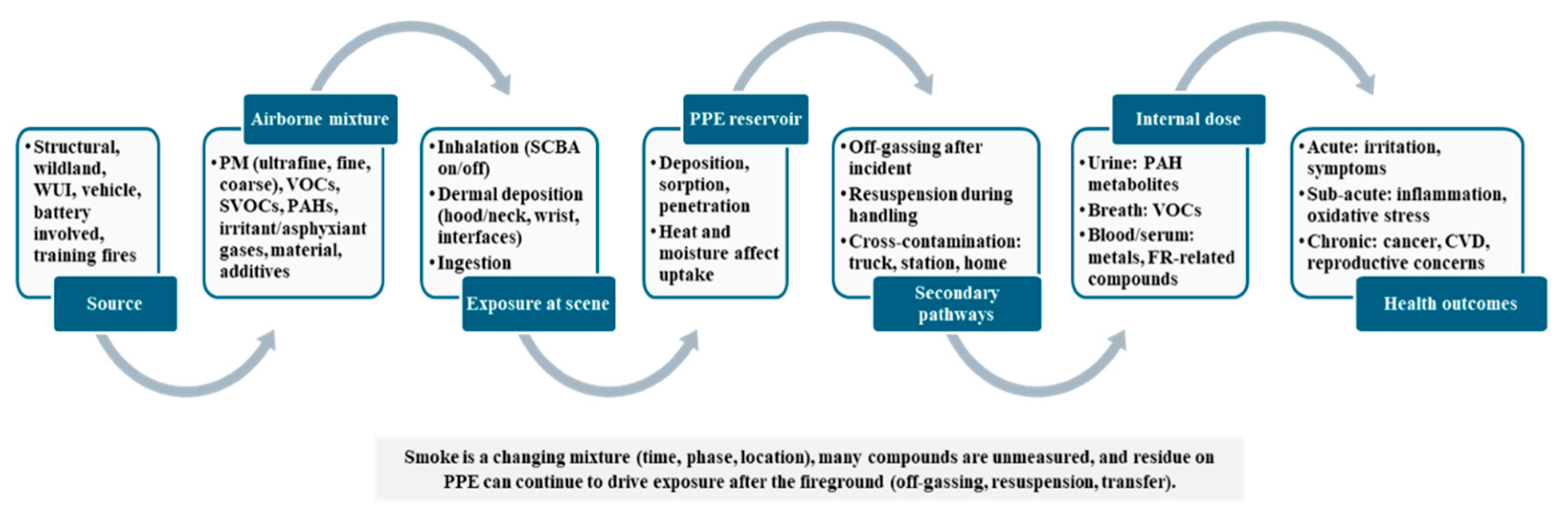
Figure 2.
Total PAH concentration in the field (unit: µg/m3).
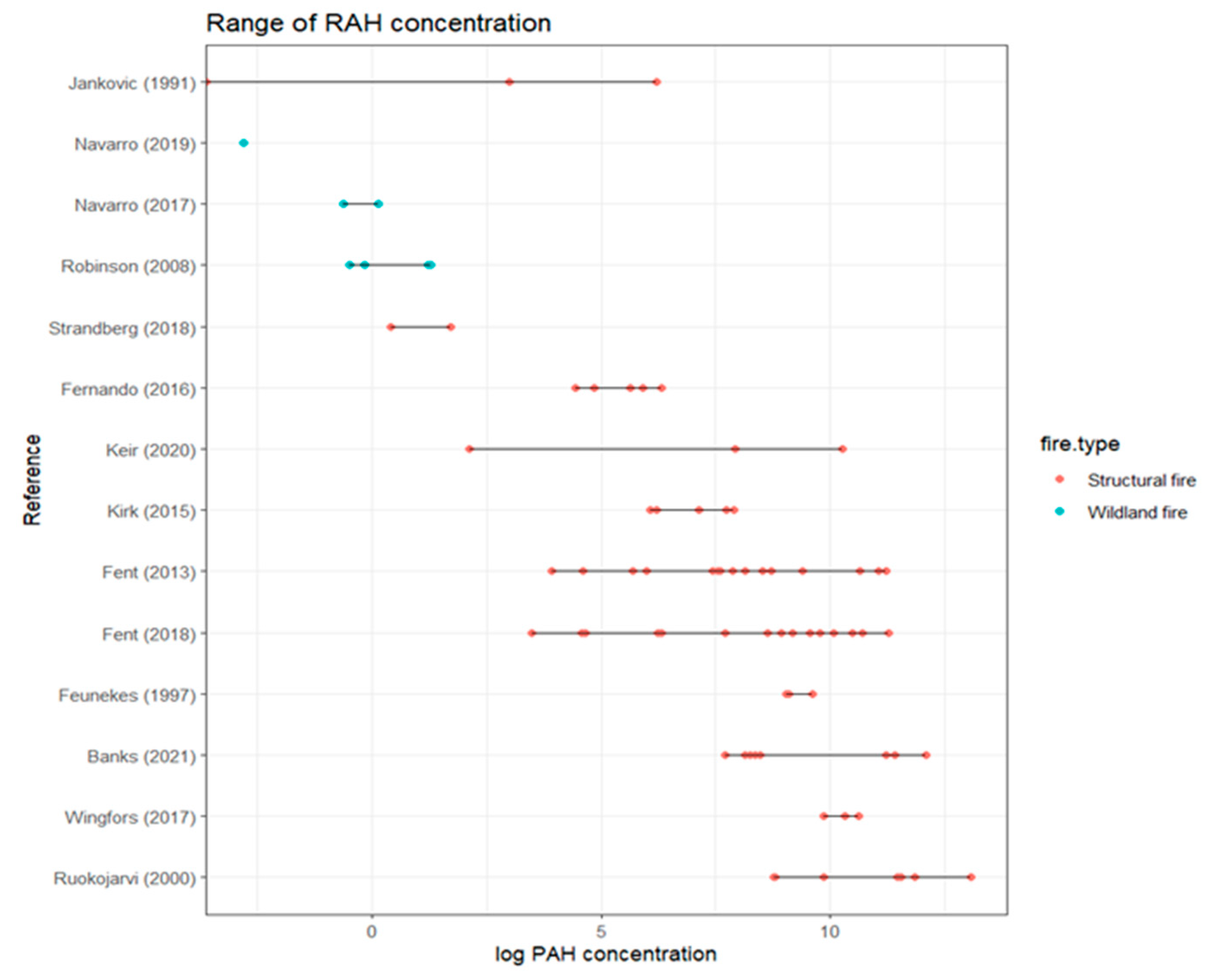
Figure 3.
Particles interact with PPE fabric system.
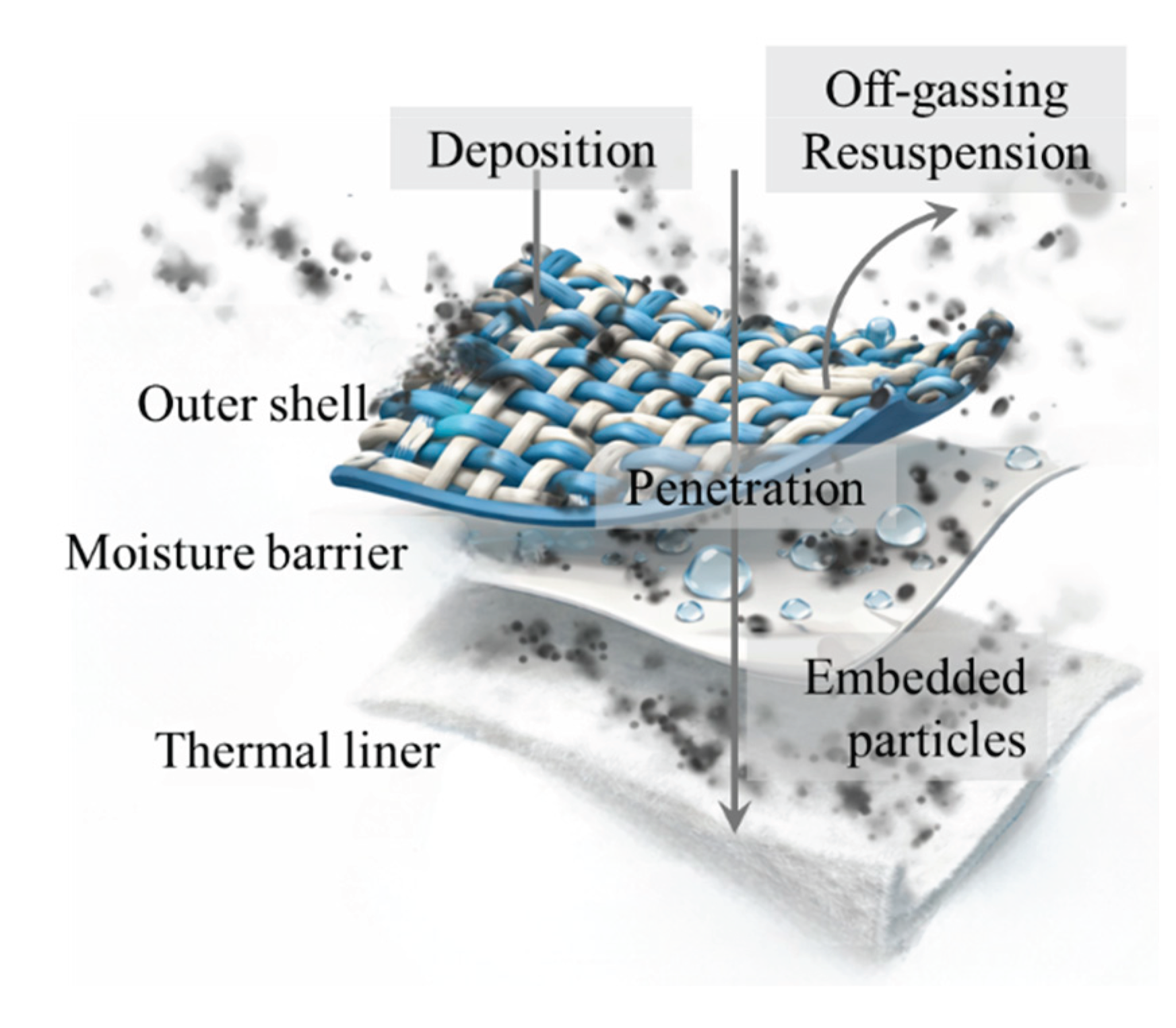

Table 1.
Summary of firefighter PPE decontamination approach and efficacy studies.
|
Sample preparation |
Decontamination method |
PPE item |
Decontamination efficacy and performance change | Ref |
| Fireground smoke exposure simulator, mannequin trial | On scene wet soap decontamination followed by machine laundering | Knit and particulate blocking hood, jacket | Laundering showed a positive association with PAH breakthrough and a negative association with benzene breakthrough | [168] |
| Firefighter exposed to live controlled fire in a single family residential structure | Front load washing machine without agitator, 55 min wash, ARM and HAMMER Plus OxiClean detergent | Hood | Total PAHs reduced by 75.5%. Benzo[a]pyrene 81.6%, phenanthrene 34.8%. Total PBDEs decreased by 98.9%, NPBFRs increased by 240%, OPFRs reduced by 41.9% | [63] |
| Simulated wood frame residential structure fire with ceiling lining and furnishings | Gross on scene decontamination | Jacket | BDE 47, BDE 99, and BDE 100 reduced by 82 to 97%. Limited or no removal observed for BDE 153 and TBBPA. TDCPP increased by 421% | [217] |
| Bench top combustion chamber | NFPA 1851 compliant washing using 60 L water, 40 g detergent, 45 RPM rotation, 20 min wash | Fabric swatch on protective clothing | Total PAH removal ranged from 65% to 97% depending on weathering and aging condition | [28] |
| Live fire training enclosure simulator | Laboratory washing machine using 65 L water at 60 C with non phosphate detergent | Fabric swatch attached to protective clothing | PAH reduction of 79 ± 14% for outer shell, 63 ± 25% for membrane, and 58 ± 14% for thermal barrier | [60] |
| Physical doping using 16 EPA PAHs | Industrial detergent containing D limonene, washer extractor programmed per NFPA 1851 | Fabric swatch | Total PAH removal ranged from 20 to 50% at standard temperature and 50 to 80% at elevated temperature | [258] |
| Physical doping using 16 EPA PAHs | Bench scale washing using water shaker bath and full-scale washer extractor at 40 and 65 C for 15 and 60 min using two commercial detergents | Fabric swatch | Greater than 90% removal for phenol, approximately 80% for phenanthrene, 45 to 55% for pyrene, 15 to 25% for benzo[a]pyrene, and 10 to 20% for DEHP | [259] |
| Outer shell fabric swatches inoculated with Staphylococcus aureus | ASTM E2274 washing followed by commercial washer for jacket | Outer shell fabric swatch | Ten second disinfection reduced bacterial viability by 73 to 100%. Commercial washer achieved 99.7% effectiveness | [274] |
| Physical doping using 16 EPA PAHs | Bench scale washing using water shaker with eight commercial detergents including charcoal based products at 0 to 50 mL | Fabric swatch | Low molecular weight PAHs reduced by 60 to 90%. High molecular weight PAHs reduced by 10 to 90% depending on detergent level | [272] |
| Physical doping using 10 NFPA 1851 compounds | CO2 plus system | Fabric swatch | Approximately 100% removal for all tested NFPA compounds | [275] |
| Used and repeatedly contaminated PPE donated from fire stations | Liquid CO2 cleaning under 53 bar pressure | Contaminated PPE | Total PAHs reduced to below detection limits in outer shell, membrane, and lining layers | [267] |
| Physical doping using 10 NFPA 1851 compounds | Liquid CO2 cleaning with 50 min cycle at 600 to 850 psi compared with conventional laundering | Fabric swatch | Conventional laundering removed 30.29 to 95.59%. Liquid CO2 removed 89.67 to 98.52% of target compounds | [271] |
Disclaimer/Publisher’s Note: The statements, opinions and data contained in all publications are solely those of the individual author(s) and contributor(s) and not of MDPI and/or the editor(s). MDPI and/or the editor(s) disclaim responsibility for any injury to people or property resulting from any ideas, methods, instructions or products referred to in the content. |
© 2025 by the authors. Licensee MDPI, Basel, Switzerland. This article is an open access article distributed under the terms and conditions of the Creative Commons Attribution (CC BY) license (http://creativecommons.org/licenses/by/4.0/).
Copyright: This open access article is published under a Creative Commons CC BY 4.0 license, which permit the free download, distribution, and reuse, provided that the author and preprint are cited in any reuse.


