

Submitted:
27 December 2025
Posted:
29 December 2025
You are already at the latest version
Abstract
Climate change will pose greater challenges to occupational safety and health, and advanced approaches for risk and reliability modeling that can include sustainability perspectives are needed. This scoping review aims to map and synthesize the current methodologies on modeling OSH risks in the context of climate change and sustainability. We systematically searched the Scopus, Web of Science, PubMed, ERIC, and other databases following the PRISMA-ScR guidelines for studies published from 2010 to 2025. Seventeen studies met the inclusion criteria and were categorized into four thematic groups: the reliability engineering and probabilistic models, climate-related occupational risk models, hybrid and AI-based models, and the sustainability-oriented reviews. Results The study indicates a methodological shift from deterministic toward probabilistic and systems-based toward data-driven approaches, while heat stress is identified as the key climate-related hazard. Sustainability considerations are increasingly embedded within the risk frameworks, linking safety outcomes with productivity, labor capacity, and resilience. Still, the integration is uneven, and key performance metrics are underreported. The advanced computational methods, such as Bayesian networks and machine learning techniques, along with hybrid models, show promise but need further validation in a wide range of occupational settings. CONCLUSION This review stresses the need for more integrative, transparent, and harmonized modeling practices, providing support to climate-resilient and sustainable OSH management systems.
Keywords:
reliability analysis
; sustainability
; industrial systems engineering
; risk modeling
; occupational safety
; public health
1. Introduction
Climate change is one of the significant occupational health challenges of the twenty-first century [1]. Workers in agriculture, construction, mining, waste management, and emergency response are among the groups who are highly exposed to climate-related hazards, which can be combined with recognized risks, like heat stress, vector-borne diseases, ergonomic strain, and respiratory illnesses [2]. According to the recommendations by the World Health Organization (WHO) and the International Labor Organization (ILO), addressing climate-related occupational risks should connect safety management with sustainability and resilience measures [3].
The body of quantitative research applying reliability and risk-modeling methods to occupational safety and health (OSH) under climate-related stressors remains limited. Existing studies employ diverse methodological approaches ranging from probabilistic reliability analyses that assess equipment performance and human factors under thermal and environmental strain to data-driven predictive frameworks incorporating machine learning, Bayesian inference, and hybrid statistical models [4]. However, substantial variability in analytical techniques, outcome definitions, and reporting of model performance metrics hampers methodological comparability across studies.
In OSH contexts, reliability analysis examines how effectively safety controls, protective technologies, and management processes prevent accidents and health losses [5]. When applied to climate-sensitive environments, reliability frameworks need to include unpredictable environmental factors like temperature changes, humidity extremes, dust storms, and floods that can impair both human performance and material systems [6].
There are several recent risk models have emerged that focus on sustainability and relate to environmental, social, and governance (ESG) indicators aiming to balance economic efficiency with workers’ well-being and environmental responsibility while predicting accident probabilities. Hybrid reliability-risk approaches are used to estimate industrial processes’ sustainability under climate pressure, utilizing life-cycle assessments (LCA) and fuzzy fault-tree analyses. Resilience metrics evaluate an organization’s ability to withstand climate shocks while maintaining safe operations [7,8].
Despite this progress, critical knowledge gaps exist. First, the integration of climate parameters into OSH risk modeling is inconsistent. Many traditional safety assessments depend on historical exposure data, which do not adequately represent future climatic extremes. Second, performance metrics like sensitivity, specificity, area under the curve (AUC), and reliability indices are often underreported or vaguely defined. Third, the relationship between reliability outcomes and sustainability goals is rarely quantified. We need empirical evidence to determine whether sustainable workplaces lead to higher model reliability and reduced occupational risks in a changing climate [9,10,11].
While some reviews have assessed occupational health risks or occupation-related health risks due to climate change in the past, existing summaries are largely centered on particular health risks or exposed outcome associations and/or traditional risk assessment in epidemiology. Furthermore, few reviews regarding health outcomes due to climate change analyze work-related health outcome models regarding their underlying architectures or concepts of reliability.
As far as the authors are aware, no previous literature review has explored in-depth the reliability-based, probabilistic, and more advanced risk models that exist in OSH with respect to the dual themes of climate change and sustainability. The purpose of this scoping literature review is thus not centred on the sizing of effect but rather on the form, paradigm, and development of risk model methodologies, even those that incorporate AI technology.
Through the compilation or synthesis of the existing but fragmentary body of evidence, the current scoping review aims to provide an overview of the methodologies used for modeling risks associated with occupational safety and health due to climate change-related sustainability pressures.
2. Methodology
2.1. Search Strategy
The current scoping review was conducted according to the PRISMA-ScR (Preferred Reporting Items for Systematic Reviews and Meta-Analyses extension for Scoping Reviews) checklist [12] (Figure 1). A comprehensive search was conducted in multiple electronic databases including Scopus, Web of Science, PubMed, Education Resources Information Centre (ERIC), Academic Consensus App, as well as the reference lists of relevant studies, reviews, and meta-analyses. The studies published between January 2010 and December 2025 in English language were considered eligible.
The search terms were outlined as: “occupational safety”, “workplace safety”, “occupational health”, “risk assessment”, “risk modelling”, “risk analysis”, “probabilistic risk assessment”, “Bayesian network”, “fault tree analysis”, “dynamic risk”, “hybrid risk model”, “systems thinking”, “systems-theoretic”, “reliability”, “heat stress”, “ambient temperature”, “extreme weather”, “climate change”, “sustainability”, “labor productivity”, “work capacity”, “resilience”, “artificial intelligence”, “AI”, “machine learning”, “predictive modelling”, “computational model”, and “data-driven model” employing “OR” and/or “AND” Boolean operators.
2.2. Study Selection Process
After duplicate records were removed, two reviewers independently screened the titles and abstracts according to the predefined eligibility criteria. Articles that clearly failed to meet the inclusion criteria were excluded at this stage. The full texts of potentially eligible studies were subsequently retrieved and independently evaluated by the same reviewers. Any discrepancies were resolved through discussion, and when agreement could not be achieved, a third reviewer was consulted to make the final determination.
2.3. Inclusion and Exclusion Criteria
The following inclusion criteria were considered: 1) Primary empirical studies of any design, including quantitative, qualitative, mixed-methods, modelling, and simulation-based studies, that examined reliability, risk assessment, or risk modelling approaches within an OSH context; 2) Studies focusing on workers, occupational groups, workplaces, or work-related systems, either in the general workforce or in specific sectors or vulnerable occupational groups (e.g., construction workers, agricultural workers, healthcare personnel, outdoor workers); 3) Studies that explicitly addressed climate change, climate-related hazards, environmental stressors, or sustainability-related factors (e.g., heat stress, extreme weather events, air quality, energy transition, resource constraints) as part of the OSH risk or reliability modelling framework; 4) Studies that clearly described the modelling approach, including model structure, assumptions, input variables, or validation procedures, and reported OSH-related outcomes (e.g., injury risk, accident probability, system reliability, safety performance indicators); 5) Peer-reviewed original research articles published in English between January 2010 and December 2025.
The following criteria were applied for study exclusion: 1) Non-primary study designs, including editorials, commentaries, letters, conference abstracts without full texts, dissertations, theses, and other publications containing non-original or secondary data; 2) Studies that addressed climate change or sustainability without an occupational safety and health focus, or OSH studies that did not incorporate risk, reliability, or modelling-based approaches; 3) Studies focusing solely on descriptive exposure assessments, policy discussions, or qualitative narratives without a clearly defined analytical or modelling framework relevant to OSH risk or reliability; 4) Studies for which key methodological details or outcomes could not be extracted, or where the reported outcomes did not align with the objectives of this scoping review; 5) Studies not published in English language.
2.4. Software and Data Analysis
All references were imported into Mendeley software for de-duplication. Data from the included studies were charted using Microsoft Excel following the Joanna Briggs Institute (JBI) guidelines for scoping reviews.
3. Results
3.1. Study Selection
The literature search identified a total of 2,305 records. Following the removal of 782 duplicate records, 1,523 unique records remained for title and abstract screening. During the screening phase, 1,297 records were excluded based on predefined inclusion and exclusion criteria, leaving 226 reports for full-text retrieval. Of these, 87 reports could not be retrieved, resulting in 139 full-text articles assessed for eligibility.
Subsequently, 122 full-text articles were excluded for the following reasons: publication in languages other than English; non-primary study designs (including editorials, commentaries, letters, conference abstracts without full texts, dissertations, theses, and other sources reporting secondary or non-original data); and studies with unclear or insufficient findings relevant to the review objectives.
Ultimately, 17 studies met all eligibility criteria and were included in the final review. The study selection process is summarized in Figure 1.
3.2. Overview of the Included Studies
A total of 17 studies were included in this scoping review, spanning multiple countries including Australia, Canada, China, Greece, India, Iran, Italy, and the USA, as well as international collaborations (Table 1). The studies were categorized into four thematic groups based on their primary focus and methodological approach:
1) Reliability engineering and probabilistic risk models (five studies): This group focused on foundational and advanced frameworks for general OSH and engineering system safety, utilizing reliability, uncertainty, Bayesian, and systems-theoretic models.
2) Climate change–related occupational risk modelling (six studies): These studies directly addressed the impacts of heat exposure, employing epidemiological, time-series, meta-analytic, and survey-based models to quantify injuries, productivity loss, and perceptual risks among vulnerable worker populations.
3) Hybrid, AI-based, and advanced risk modelling (five studies): This category encompassed studies applying innovative computational techniques, including hybrid decision-making frameworks, fuzzy logic, machine learning (ML), and artificial neural networks (ANNs) to assess and prioritize general or heat-specific OSH risks.
4) Sustainability and systems-oriented reviews (one study): This group consisted of conceptual and narrative reviews that integrated sustainability principles into safety management and provided high-level syntheses of modelling approaches.
The majority of studies (12 out of 17) employed quantitative or qualitative modelling approaches. The remaining studies were conceptual, narrative, or systematic reviews that provided methodological frameworks and syntheses for OSH risk assessment.
3.3. Key findings
3.3.1. Reliability Engineering and Probabilistic Risk Models
The foundational reliability engineering and probabilistic approaches in OSH were the subject of five studies. Conceptual frameworks for probabilistic and hybrid reliability modeling were presented by Aven et al. [13] and Zio et al. [14], emphasizing the significance of uncertainty quantification in risk assessment. Khakzad et al. [15,16] demonstrated that probabilistic approaches can capture intricate interactions and system dependencies in industrial settings by using Bayesian networks to model dynamic occupational hazards in their 2012 and 2015 studies. A systems-theoretic approach was presented by Leveson et al. [17], with a focus on sustainability-oriented safety design. Together, these studies highlight how probabilistic and systems-based approaches have replaced traditional deterministic methods in OSH risk assessment.
3.3.2. Climate change–Related Occupational Risk Modelling
Occupational risks associated with climate stressors, especially heat exposure, were specifically addressed in six studies. Xiang et al. [18] and Adam-Poupart et al. [19] established relationships between ambient temperature and work-related injuries, especially among outdoor workers, using quantitative and time-series exposure-risk models. While Han et al. [21] used observational modeling to measure climate-sensitive injury risks in construction, Messeri et al. [20] used survey data to examine differences in heat stress perception and productivity loss between native and migrant workers. Spector et al. [22] identified methodological gaps and the need for better predictive tools by synthesizing modeling approaches in a narrative review. Together, these studies demonstrate how important climate-sensitive risk assessment is to worker safety in the face of rising global temperatures.
3.3.3. Sustainability and Systems-Oriented Reviews
A single conceptual review in this category integrated sustainability principles into high-level safety frameworks. Kjellstrom et al. [23,24] conducted modelling and review studies that examined the impacts of climate change on work capacity and developed exposure–response functions linking heat to human performance, thereby integrating a sustainability perspective directly into occupational health analysis and intervention planning.
3.3.4. Hybrid, AI-Based, and Advanced Risk Modelling
Advanced computational techniques, such as hybrid decision-making and AI-based models, were investigated in five studies. To increase prediction accuracy, Marhavilas et al. [25] combined conventional and sophisticated risk assessment methods. An Artificial Neural Network (ANN) model was created by Aliabadi et al. [26] to forecast heat strain based on individual and environmental factors. The use of machine learning for predictive occupational risk models was shown by Sarkar et al. [27]. In order to prioritize OHS risks by weighting criteria based on causal relationships, Dabbagh & Yousefi [28] proposed a hybrid approach that integrates Failure Mode and Effect Analysis (FMEA), Fuzzy Cognitive Maps (FCM), and the MOORA method. Lastly, Han et al. [29] identified vulnerable subgroups and quantified heat-related productivity loss using a meta-analytic modeling approach. These studies illustrate a trend toward leveraging advanced computational and statistical techniques for dynamic and context-specific occupational risk assessment.
3.4. Summary of Modelling Approaches and Links to Climate/Sustainability
Probabilistic/Bayesian networks, systems-theoretic models, hybrid decision-making frameworks, statistical/epidemiological exposure–risk models, and AI/machine learning techniques were identified as important modeling approaches across all included studies. Ten studies, which mostly focused on heat stress, productivity, labor capacity, and vulnerable populations, had a clear conceptual or practical connection to climate change or sustainability. The remaining research offered risk assessment methodological frameworks that are tangentially relevant to sustainable OSH management. In order to improve occupational safety outcomes, the evidence suggests that integrative modeling, which integrates reliability engineering, predictive analytics, and climate-sustainability perspectives is becoming more and more important.
4. Discussion
This scoping review offers a synthesis of state-of-the-art research evidence available for the reliability methods, risk modeling practices, and approaches in occupational safety and health in the context of climate change and sustainability. It is clear from the findings that there is a shift in risk assessment methods from being deterministic to probabilistic risk modeling.
Heat exposure and work capacity remained the primary methods of operationalizing the climate-sensitive risk models in the studies included in the review. As a result, increasing ambient temperature has been promoted as the most significant globally prevalent occupational health stress. Both quantitative exposure-response models and time series have indicated significant associations of high temperature with the potential enhanced injury risks or diminished work capacity in the occupations that have been classified as outdoor/physically taxing. This supports earlier epidemiological data on the issue while pushing the frontiers of research forward through the development of models that enable climate-related prognostication in the future.
As for the level of reliability engineering, it can be noted from the reviewed studies that climate variability challenges traditional notions of reliability in a fundamental manner. Bayesian networks with probabilistic models of reliability are highly capable of addressing complex dependencies on human-environmental system elements, as presented by such works as Khakzad et al. [15,16]. Climate-related variables like temperature and humidity are included as prior inputs, hence providing a more realistic view for system performance when operating in non-stationary environments. This particular aspect is highly suitable to climate-dependent sectors like mining, construction, and agriculture, where system deterioration due to weather conditions as well as human performance influence is increasing.
An important thematic development in the reviewed literature is derived from the growing integration of sustainability views in models of risk and reliability in occupational health and safety. Some of the identified papers have linked outcomes of occupational risk to losses in productivity, capacity, and resilience of labor, in a combination of health objectives with sustainability ones. Modelling efforts by Kjellstrom et al. [23,24] and Han et al. [21] make important points in that reduced work capacity and productivity by heat exposure affect not only health outcomes but also overall sustainability in the financial sense. In doing so, the models go beyond those developed for injury prevention in health and safety, and rather integrate health and sustainability considerations.
Advanced computational methods such as hybrid models and artificial intelligence (AI) can be viewed as an emerging but still evolving area in the literature. Aliabadi et al. [26] presented the use of an artificial neural network (ANN) in the prediction of heat strain, whereas predictive models with risk by machine-learning methods were proposed by Sarkar et al. [27]. Hybrid models like that of Dabbagh & Yousefi [28] can integrate methods such as risk prioritization in FMEA and use Fuzzy Cognitive Maps with promising results. These methods presented improvements in predictive models and the ability to handle complex situations with multiple criteria. However, more generalizability was observed in controlled environment applications in manufacturing systems and heat-related risk prediction. However, generalization in general occupational environments needs further understanding. Still, the general movement towards data integration, sensing, and predictive analytics indicates an evolution in systems engineering with significant potential in proactive and climate-resilient OSH risk management.
Significantly, some of these studies also identified psychosocial and organizational aspects of occupational risk in the context of climate change and sustainability transitions. The research undertaken by Messeri et al. [20], for instance, focused on cultural and linguistic differences influencing perceptions and communication of heat risks among migrant workers and indicated a need for psychosocial and organizational adaptations. This means that occupational reliability could be understood not just from a technical perspective but also from a perspective of mental and social resilience to hazards and risks, and this corresponds to some current models of sustainability-oriented safety management systems and could be an unexplored research frontier for modeling studies.
In general, the findings from the collection of studies demonstrate innovation in the methodology for risk and reliability modeling in the domain of occupational safety and health. However, there seems to be poor integration with climate change and sustainability. Though a large number of studies [18&19, 29] have already included climate factors, sustainability factors have not been completely measured or addressed in the performance metrics in the selected studies.
Policy Implications
In a political and strategic sense, the integration of reliability analysis in sustainability models presents many advantages, including better accuracy in forecasting, better risk management, and enhanced safe infrastructure systems. The application of quantitative models in dealing with climate change is integral in national strategies in ensuring better Occupational Safety and Health [30,31,32]. The significance of predictive models in occupational risk, stress, and burnout among public health inspectors is becoming more prominent, considering the persistent health threats brought about by climate change [30 & 31, 33]. This report explores how AI models can be effectively used in dealing with this problem. This report highlights how AI models can be undertaken in better risk classification and management in public health inspectors amid the global climate crisis [30 & 31, 32].
The assessment within the framework encompasses a hybrid risk assessment system, which seeks to enhance confidence in network meta-analysis, particularly with regards to bias categorization [33]. This particular strategy not only targets the likelihood of risk but also offers evidence-based opportunities which might serve towards improving working conditions for public health inspectors, hence promoting a healthier workforce capable of dealing with emerging public health challenges [32,33].
Limitations
There are some limitations to the scoping review that should be noted. First, the search conducted was limited to English-language publications; this might mean that studies conducted in other languages were excluded. Additionally, the review was constrained by the nature of the studies included, which were comprised of varied designs, models, and reporting quality. Thirdly, even though the study endeavored to include a vast scope of study methodologies, the eventual sample size was rather low; this might be attributed to the nascent stage at which research at the nexus of OSH, climate change, and sustainability models lies. Fourthly, being a scoping review, the study did not aim to validate the quality of the included studies.
5. Conclusion
This scoping review confirms the changing environment for reliability and risk modeling in the workplace in the framework of climate change and a concern for sustainability. It can be noted that there has been a marked shift from deterministic models to dynamic models in the realm of climate change. The most common form of climate change related to workplace safety has been related to heat stress. There has also been a marked relevance between exposure to injury risk. The application of sustainable perspectives to risk models related to occupational safety and health is an interesting trend, which aligns occupational health, safety, and well-being strategies with other societal objectives. The application of new computational models, such as Bayesian networks, machine learning, or hybrid models, enables improved predictive power, although generalizability to practical contexts remains to be investigated. Nevertheless, there are some lacks in comparability and standardization due to irregularities in model reporting, performance measures, and integration of climate-related parameters. Future studies must focus on making model reporting more transparent and open, validating models for various work-related scenarios and developing models that could address issues related to reliability, risk, adaptation in a changing climate, and sustainability measures altogether. This would be very helpful in making an appropriate OSH system that can protect workers under a changing climate.
Author Contributions
I.A., N.S., M.M., and A.V.E. designed the study and wrote the manuscript; I.A., and A.V.E. performed the study, wrote and revised the manuscript, analysed the data, and edited the manuscript. The I.A. project administration conceived; supervised the study I.A., M.M., and A.V.E. All the authors read and approved the final manuscript.
Funding
This work was carried out without any financial support or other funding.
Data Availability Statement
The datasets used during the current study are available from the corresponding author upon reasonable request.
Acknowledgments
We are grateful to our colleagues and collaborators for their valuable insights and support during the study.
Conflicts of Interest
The authors have no competing interests to declare that are relevant to the content of this article.
References
- Jia, J. A.; Jia, N. I. Impacts of climate change on occupational health and safety: a comprehensive review. Asian J. Adv. Res. 2024, 18(10), 136–154. [Google Scholar] [CrossRef]
- Ndugga, N.; Pillai, D.; Artiga, S. Climate-related health risks among workers: Who is at increased risk. 2023. [Google Scholar]
- Scott, N.; Graczyk, H.; Papandrea, D. Ensuring safety and health at work in a changing climate: global report. 2024. [Google Scholar]
- Ferrari, G. N.; Leal, G. C. L.; Ossani, P. C.; Galdamez, E. V. C. Investigation of the usage of machine learning to explore the impacts of climate change on occupational health: a systematic review and research agenda. Front Public Health 2025, 13, 1578558. [Google Scholar] [CrossRef] [PubMed]
- Tabor, J. Improving occupational safety management with the use of human reliability analysis methods. Quality Production Improvement-QPI 2021, 3(1), 120–131. [Google Scholar]
- Schulte, P. A.; Chun, H. Climate change and occupational safety and health: establishing a preliminary framework. J. Occup. Environ. Hyg 2009, 6(9), 542–554. [Google Scholar] [CrossRef]
- Schneider, D.; Woerle, M.; Kagermeier, J.; Zaeh, M. F.; Reinhart, G. Sustainability risk assessment in manufacturing: A life cycle assessment-based failure mode and effects analysis approach. Sustain. Prod. Consum. 2024, 47, 617–631. [Google Scholar] [CrossRef]
- Serdar, M. Z.; Lahlou, F. Z.; Namany, S.; Ayyub, B. M.; Al-Ghamdi, S. G.; Al-Ansari, T. Assessing sustainability, resilience, and security triad of urban systems under climate change risks: A wholistic perspective. Curr Res Environ Sustain 2025, 10, 100319. [Google Scholar] [CrossRef]
- Ezerins, M. E.; Ludwig, T. D.; O’Neil, T.; Foreman, A. M.; Açıkgöz, Y. Advancing safety analytics: A diagnostic framework for assessing system readiness within occupational safety and health. Saf. Sci. 2022, 146, 105569. [Google Scholar] [CrossRef]
- Wuersch, L.; Neher, A.; Marino, F. E.; Bamberry, L.; Pope, R. Impacts of climate change on work health and safety in Australia: a scoping literature review. Int. J. Environ. Res. Public Health 2023, 20(21), 7004. [Google Scholar] [CrossRef]
- AREO, I. O.; Ashikodi, M. O.; Mupenzi, C.; Ediagbonya, T. F. Climate induced thermal stress in the workplace and its implications for health risks adaptation and policy responses. Discov. public health 2025, 22(1), 819. [Google Scholar] [CrossRef]
- Tricco, AC; Lillie, E; Zarin, W; O’Brien, KK; Colquhoun, H; Levac, D; Moher, D; Peters, MDJ; Horsley, T; Weeks, L; et al. PRISMA extension for scoping reviews (PRISMA-ScR): checklist and explanation. Ann. Intern. Med. 2018, 169, 467–473. [Google Scholar] [CrossRef]
- Aven, T. Risk assessment and risk management: Review of recent advances on their foundation. Eur. J. Oper. Res. 2016, 253(1), 1–13. [Google Scholar] [CrossRef]
- Zio, E. The future of risk assessment. Reliab. Eng. Syst. Saf. 2018, 177, 176–190. [Google Scholar] [CrossRef]
- Khakzad, N.; Khan, F.; Amyotte, P. Dynamic risk analysis using bow-tie approach. Reliab. Eng. Syst. Saf. 2012, 104, 36–44. [Google Scholar] [CrossRef]
- Khakzad, N. Application of dynamic Bayesian network to risk analysis of domino effects in chemical infrastructures. Reliab. Eng. Syst. Saf. 2015, 138, 263–272. [Google Scholar] [CrossRef]
- Leveson, N. G. Engineering a safer world: Systems thinking applied to safety; The MIT Press, 2016. [Google Scholar]
- Xiang, J.; Bi, P.; Pisaniello, D.; Hansen, A.; Sullivan, T. Association between high temperature and work-related injuries in Adelaide, South Australia, 2001–2010. Occup Environ Med 2014, 71(4), 246–252. [Google Scholar] [CrossRef]
- Adam-Poupart, A.; Smargiassi, A.; Busque, M. A.; Duguay, P.; Fournier, M.; Zayed, J.; Labrèche, F. Effect of summer outdoor temperatures on work-related injuries in Quebec (Canada). Occup Environ Med 2015, 72(5), 338–345. [Google Scholar] [CrossRef]
- Messeri, A.; Morabito, M.; Bonafede, M.; Bugani, M.; Levi, M.; Baldasseroni, A.; Binazzi, A.; Gozzini, B.; Orlandini, S.; Nybo, L.; Marinaccio, A. Heat stress perception among native and migrant workers in Italian industries—case studies from the construction and agricultural sectors. Int. J. Environ. Res. Public Health 2019, 16(7), 1090. [Google Scholar] [CrossRef]
- Han, S. R.; Wei, M.; Wu, Z.; Duan, S.; Chen, X.; Yang, J.; Xiang, J. Perceptions of workplace heat exposure and adaption behaviors among Chinese construction workers in the context of climate change. BMC Public Health 2021, 21(1), 2160. [Google Scholar] [CrossRef]
- Spector, J. T.; Masuda, Y. J.; Wolff, N. H.; Calkins, M.; Seixas, N. Heat exposure and occupational injuries: review of the literature and implications. Curr. Environ. Health Rep. 2019, 6(4), 286–296. [Google Scholar] [CrossRef]
- Kjellstrom, T.; Briggs, D.; Freyberg, C.; Lemke, B.; Otto, M.; Hyatt, O. Heat, human performance, and occupational health: a key issue for the assessment of global climate change impacts. Annu. Rev. Public Health 2016, 37(1), 97–112. [Google Scholar] [CrossRef]
- Kjellstrom, T.; Maître, N.; Saget, C.; Otto, M.; Karimova, T. Working on a warmer planet: The impact of heat stress on labour productivity and decent work; ILO, 2019. [Google Scholar]
- Marhavilas, P. K.; Koulouriotis, D.; Gemeni, V. Risk analysis and assessment methodologies in the work sites: On a review, classification and comparative study of the scientific literature of the period 2000–2009. Journal of Loss Prevention in the Process Industries 2011, 24(5), 477–523. [Google Scholar] [CrossRef]
- Aliabadi, M.; Farhadian, M.; Jalali, M.; Jahangiri, M.; Negahban, A. R. A new empirical approach for predicting heat strain in workers exposed to hot indoor environments. Indoor Built Environ. 2018, 27(5), 597–605. [Google Scholar] [CrossRef]
- Han, S.; Dong, L.; Weng, Y.; Xiang, J. Heat exposure and productivity loss among construction workers: a meta-analysis. BMC Public Health 2024, 24(1), 3252. [Google Scholar] [CrossRef] [PubMed]
- Sarkar, S.; Vinay, S.; Raj, R.; Maiti, J.; Mitra, P. Application of optimized machine learning techniques for prediction of occupational accidents. Comput. Oper. Res. 2019, 106, 210–224. [Google Scholar] [CrossRef]
- Dabbagh, R.; Yousefi, S. A hybrid decision-making approach based on FCM and MOORA for occupational health and safety risk analysis. J. Saf. Res 2019, 71, 111–123. [Google Scholar] [CrossRef]
- Adamopoulos, I. “A Novel AI-Based Modeling With Bias Classification Hybrid Risk Evaluation System for Confidence Enhanced Network Meta-Analysis of Occupational Hazards and Burnout Risk Among Public Health Inspectors”. Mesopotamian Journal of Artificial Intelligence in Healthcare 2025, 219–33. [Google Scholar] [CrossRef]
- Adamopoulos, IP; Syrou, NF; Lamnisos, D; Valamontes, A; Karantonis, JT; Tsirkas, P; et al. Classifying and mitigating occupational risks for public health inspectors in the context of the global climate crisis. EUR J SUSTAIN DEV RES 2026, 10(1), em0336. [Google Scholar] [CrossRef]
- Adamopoulos, I.; Valamontes, A.; Tsirkas, P.; Dounias, G. Predicting Workplace Hazard, Stress and Burnout Among Public Health Inspectors: An AI-Driven Analysis in the Context of Climate Change. Eur. J. Investig. Health Psychol. Educ. 2025, 15, 65. [Google Scholar] [CrossRef]
- Adamopoulos, I; Valamontes, A; Syrou, N; Tsirkas, P; Mpourazanis, G; Dounias, G; Younis, M; Diamanti, K; Katsogiannou, M; Lamnisos, D. Τhe State of Public Health: Challenges and Evidence-based Opportunities across the European Union. European Journal of Public Health 2025, Volume 35. Issue Supplement_4, October 2025, ckaf161.1127. [Google Scholar] [CrossRef]
Figure 1.
PRISMA flow diagram of the study design process.
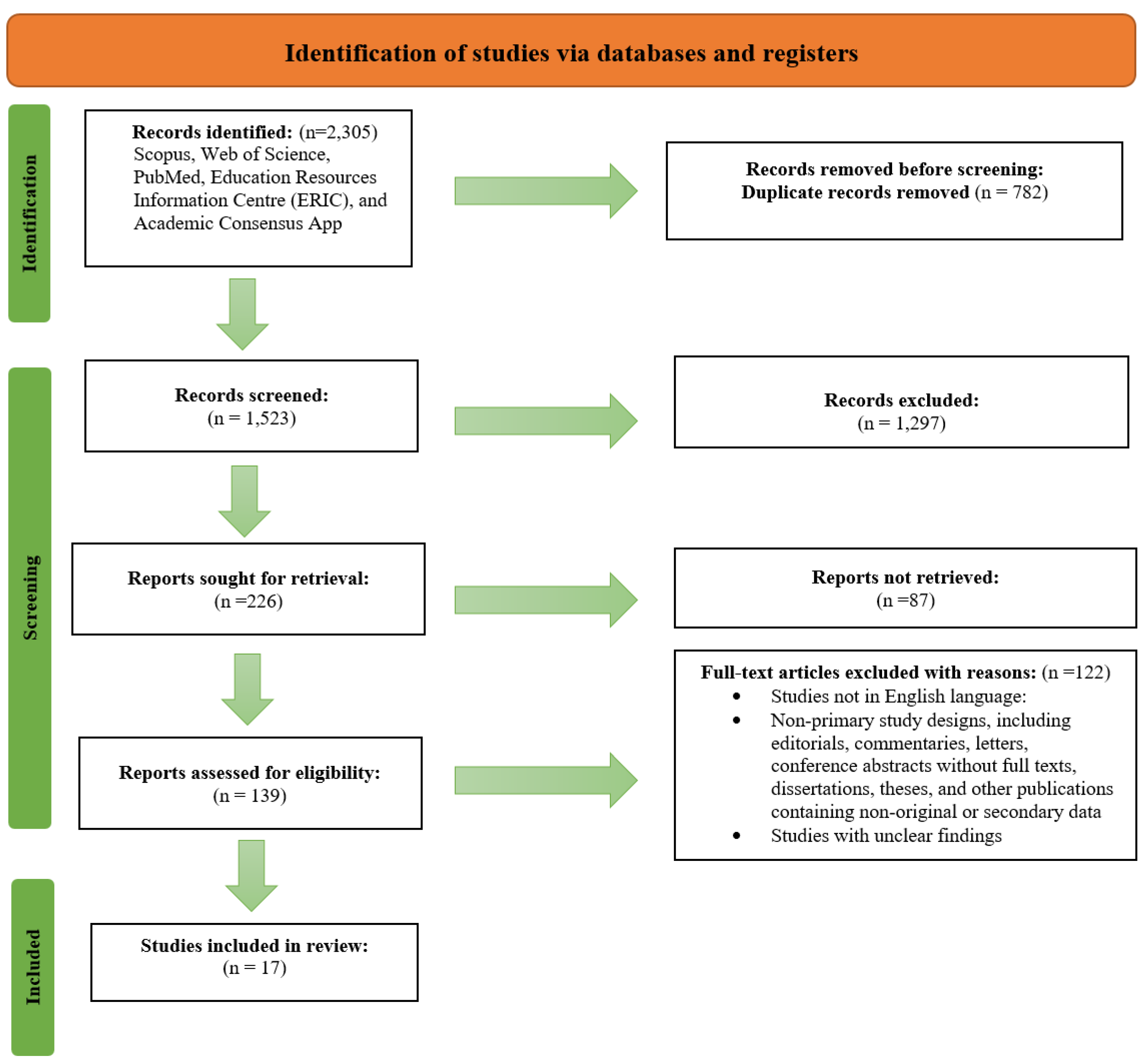

Table 1.
Characteristics of the included studies.
| Reference | Author(s) | Year | Country | Study Type | Hazard Focus | Modelling Approach | Climate/Sustainability Link | Main Findings/Contribution |
|---|---|---|---|---|---|---|---|---|
| [13] | Aven et al. | 2016 | International | Conceptual Review | General OSH/Safety Risks | Reliability & uncertainty modelling | Indirect; framework applicable to sustainable safety management | Provides core conceptual framework for reliability and uncertainty modelling; highlights advances in risk assessment methods. |
| [14] | Zio et al. | 2018 | Italy | Conceptual/Narrative Review | Engineering & OSH Systems | Probabilistic & hybrid reliability models | Indirect; can be applied to sustainability-oriented risk assessment | Discusses advanced probabilistic and hybrid reliability models; future directions in OSH risk assessment. |
| [15] | Khakzad et al. | 2012 | Canada | Modelling Study | Industrial/Occupational Hazards | Bayesian network modelling | Indirect; supports improved risk-based safety decisions | Demonstrates dynamic Bayesian reliability modelling for OSH hazards; shows applicability to complex systems. |
| [16] | Khakzad et al. | 2015 | Canada | Modelling Study | Industrial safety | Dynamic Bayesian networks | Indirect; supports system-level sustainable safety | Dynamic Bayesian networks applied to complex OSH systems; enables probabilistic risk prediction. |
| [17] | Leveson et al. | 2015 | USA | Conceptual/Systems Approach | System Safety | Systems-theoretic safety models | Indirect; emphasizes sustainable safety design | Introduces systems thinking for safety engineering; emphasizes sustainability-oriented safety modelling. |
| [18] | Xiang et al. | 2014 | Australia | Observational/Epidemiological | Heat-related injuries | Quantitative exposure–risk modelling | Direct; links ambient temperature to injury risk | Shows quantitative relationship between heat exposure and occupational injuries. |
| [19] | Adam-Poupart et al. | 2015 | Canada | Time-series/Epidemiological | Heat-related injuries | Time-series risk modelling | Direct; summer temperature trends associated with occupational injuries | Demonstrates temporal patterns linking heat and injuries; provides predictive risk modelling. |
| [20] | Messeri et al. | 2019 | Italy | Observational/Questionnaire Survey | Heat stress (Construction & Agriculture) | Statistical analysis (Chi-square, ANOVA) of perceptual/survey data | Direct; investigates vulnerability of migrant workers in a changing climate | Compares heat-stress perception and productivity loss between native and migrant workers; highlights need for culturally adapted heat risk communication and management. |
| [21] | Han et al. | 2021 | China | Observational/Cohort | Construction injuries | Exposure-risk modelling | Direct; models climate-sensitive injury risk | Links heat exposure to injury risk; provides climate-sensitive risk estimates. |
| [22] | Spector et al. | 2019 | USA | Narrative Review | Heat-related occupational injuries | Literature synthesis/modelling review | Direct; reviews climate-OSH risk links | Synthesizes modelling approaches in OSH heat research; identifies gaps in risk assessment methods. |
| [23] | Kjellstrom et al. | 2016 | International | Modelling/Review | Heat exposure & work capacity | Climate–work capacity modelling | Direct; sustainability link via labor capacity under warming | Examines climate impacts on work capacity; integrates sustainability perspective into OSH. |
| [24] | Kjellstrom et al. | 2019 | International | Exposure–response modelling | Heat and human performance | Exposure–response functions | Direct; informs sustainable work practices | Develops exposure–response functions linking heat and human performance; informs OSH interventions. |
| [25] | Marhavilas et al. | 2011 | Greece | Review/Comparative Analysis | General Occupational Hazards & Risk Assessment Methodologies | Systematic review and classification of risk analysis/assessment methods | Indirect; contributes to sustainable risk management frameworks | Reviews and classifies risk analysis and assessment methodologies (2000–2009); compares qualitative, quantitative, and hybrid methods; highlights trends and gaps in OSH risk assessment research. |
| [26] | Aliabadi et al. | 2018 | Iran | Modelling Study | Heat strain in hot indoor environments | Artificial Neural Network (ANN) predictive model | Indirect; model can support health surveillance and sustainable work design in warming climates | Develops an empirical ANN model to predict core body temperature based on environmental and personal factors; provides a tool for proactive heat strain assessment and prevention. |
| [27] | Sarkar et al. | 2019 | India | Machine Learning/Predictive Modelling | General occupational risks | ML-based predictive risk models | Indirect; AI can support sustainable OSH management | Demonstrates AI-based predictive models for OSH risk; highlights applicability of ML in risk management. |
| [28] | Dabbagh & Yousefi | 2019 | Iran | Modelling Study | General occupational hazards | Hybrid approach (FMEA, Fuzzy Cognitive Maps, MOORA) | Indirect; methodology aims to improve sustainable risk-based decision making | Proposes a hybrid decision-making model to prioritize OHS risks, overcoming limitations of traditional methods by weighting criteria based on causal relationships and reducing expert opinion bias. |
| [29] | Han et al. | 2024 | China | Meta-analysis | Heat-related productivity loss (Construction) | Random-effects meta-analysis, subgroup analysis | Direct; assesses climate impact on worker productivity in a vulnerable sector | Finds 60% of construction workers experience heat-related productivity loss; identifies older and female workers as more vulnerable; discusses implications for sustainable workforce management. |
Disclaimer/Publisher’s Note: The statements, opinions and data contained in all publications are solely those of the individual author(s) and contributor(s) and not of MDPI and/or the editor(s). MDPI and/or the editor(s) disclaim responsibility for any injury to people or property resulting from any ideas, methods, instructions or products referred to in the content. |
© 2025 by the authors. Licensee MDPI, Basel, Switzerland. This article is an open access article distributed under the terms and conditions of the Creative Commons Attribution (CC BY) license (http://creativecommons.org/licenses/by/4.0/).
Copyright: This open access article is published under a Creative Commons CC BY 4.0 license, which permit the free download, distribution, and reuse, provided that the author and preprint are cited in any reuse.


