

Submitted:
25 December 2025
Posted:
29 December 2025
You are already at the latest version
Abstract
This paper presents a concept of a new class of multifunctional adaptive elements for neuromorphic electronics, based on the mathematical framework of the Kuznetsov tensor. The proposed element integrates the functions of information storage, processing, and redistribution, providing high adaptability to changing system conditions while preventing overloads, singular states, and data losses. The Kuznetsov tensor enables modeling of multidimensional metrics of local and global flows of energy and information within neuromorphic networks, ensuring optimization of computational processes at both individual node and network-wide levels.The element demonstrates the potential of a self-regulating redistribution architecture, capable of dynamically adapting to workload variations and changes in connection topology, maintaining system stability and enhancing energy efficiency. This concept can be applied in neuromorphic processors, quantum computing devices, and artificial intelligence systems requiring predictable and reliable operation of complex multidimensional networks.The paper discusses the fundamental operating principles of the element, the mechanisms of interaction with information and energy flows, and integration possibilities within modern computational architectures. The proposed approach opens new avenues for the development of intelligent adaptive devices, capable of managing information and energy dynamics considering singularities and entropy-driven processes, which is of interest for both fundamental and applied research in neuromorphic electronics and information technology.
Keywords:
Kuznetsov tensor
; neuromorphic electronics
; adaptive element
; multifunctional node
; entropic processes
; quantum computing
1. Introduction
Modern computing systems face significant limitations in classical architectures, including the separation of memory and processor, high energy consumption, and limited adaptability to changing workloads. These issues are particularly critical in neuromorphic electronics, where artificial neural networks model complex biological systems and handle nonlinear, multidimensional information flows. In such systems, it is essential to develop elements capable of simultaneously storing, processing, and redistributing information while maintaining dynamic stability and self-regulation within the network.
In recent years, attention has focused on the development of nanomemristors and other memory elements that integrate information storage and processing functions. However, existing solutions are limited in their ability to predict and control energy and information flows at the network level, especially under conditions of local overloads and singular states. This limitation reduces the efficiency and stability of neuromorphic systems and constrains the scalability of computational architectures.
This work presents a concept of a multifunctional adaptive element based on the Kuznetsov tensor, which enables the modeling of the evolution of metrics of energy and information flows in multidimensional systems with singularities. The Kuznetsov tensor allows for the representation of both local and global network dynamics, prediction of critical states, redistribution of loads, and minimization of entropy losses, thereby ensuring high efficiency and stability in neuromorphic networks.
The application of the Kuznetsov tensor opens up new possibilities for self-regulating adaptive elements capable of dynamically adjusting to changing operating conditions, managing energy and information distribution between network nodes, and preventing computational degradation. This approach combines storage and processing functions within a single element, integrating intelligent properties at the physical device level, significantly expanding the capabilities of neuromorphic electronics, quantum computing, and distributed computational systems.
The proposed concept is specifically suited for multidimensional, nonlinear, and dynamically changing computing environments, where traditional methods of managing information and energy flows are insufficient. The Kuznetsov tensor provides quantitative assessment of system states and enables optimization of network architecture while accounting for singularities, allowing the creation of highly adaptive, energy-efficient, and scalable computing networks.
Thus, this work combines fundamental aspects of mathematical modeling with applied possibilities in the development of innovative neuromorphic devices, paving the way for the creation of intelligent adaptive elements of a new generation capable of managing information and energy flows while considering entropy-driven and singular processes.
The objective of this research is to develop a model of a multifunctional adaptive element for neuromorphic electronics that employs the Kuznetsov tensor to optimize the distribution of information and energy, maintain network stability, and prevent the emergence of singular states. To achieve this goal, the study applies the Kuznetsov tensor to describe the evolution of metrics for both local and global energy and information flows within the network. The approach involves modeling multidimensional neuromorphic networks, analyzing entropic processes, and simulating adaptive redistribution of loads across computational nodes. In addition, theoretical verification is performed to assess system stability and to predict potential critical points.
The scientific novelty of this work lies in the introduction of a new type of multifunctional adaptive element that integrates the functions of information storage, processing, and redistribution within a single unit. By employing the Kuznetsov tensor, the element is capable of managing energy and information flows, preventing singular states, and optimizing computational processes in complex, nonlinear networks. This approach provides a foundation for the development of intelligent adaptive architectures in neuromorphic electronics, quantum computing, and distributed computational systems, offering new pathways for creating highly efficient, self-regulating, and scalable computational devices.
2. Materials and Methods
2.1. Neuromorphic Element Model
The model of the multifunctional adaptive element is based on the application of the Kuznetsov tensor for controlling energy and information flows within a neuromorphic network. The element integrates functions of storage, processing, and redistribution of signals, providing self-regulation of nodes, prevention of local singularities, and optimization of computational processes. The model accounts for dynamic adaptation of network parameters, nonlinear interactions between nodes, and load distribution in a multidimensional structure.
2.2. Material Implementation of the Multifunctional Adaptive Element
The proposed element is implemented as a multilayer nanostructure based on transition metal oxides combined with a two-dimensional conductive interface. The active memristive layer is formed from oxygen-deficient hafnium or titanium oxide (HfO2₋ₓ/TiO2₋ₓ), providing controllable conductivity and high compatibility with CMOS technology. The adaptive interface is realized using graphene or molybdenum disulfide (MoS2), enabling efficient redistribution of energy and information flows in accordance with the Kuznetsov tensor formalism and preventing local overloads. Electrodes are made from stable materials (Pt/TiN/Au) to ensure reproducible switching and long-term stability. This material combination enables the physical implementation of the adaptive mechanism and supports network scaling up to hundreds of nodes.
2.3. Mathematical Framework (Kuznetsov Tensor)
The behavior of the element is described using the Kuznetsov tensor Kij, which models the evolution of local and global energy and information flows:
where Jj is the local carrier flux, Sij is the entropic response of the adaptive interface, gij is the effective metric of the material state, and H is the energy dissipation density. This approach provides theoretical verification of network stability, prediction of critical points, and modeling of adaptive load redistribution across nodes.
3. Research and Discussion
Modern neuromorphic networks are characterized by complex, multidimensional flows of information and energy. Classical memory and processing elements are unable to dynamically adapt to changing workloads and to account for local singularities in the distribution of these flows. In this study, a multifunctional adaptive element based on the Kuznetsov tensor is proposed, which enables modeling, prediction, and optimization of energy and information flows within a neuromorphic network.
3.1. Mathematical Model of the Element
Let the neuromorphic network consist of N nodes, each capable of simultaneously storing and transmitting information. Denote the state vector of the i-th node as xi(t), where t is time. To describe the distribution of energy and information, the Kuznetsov tensor K is introduced, which is a symmetric fourth-rank tensor:
The elements Kijkl characterize interactions of energy and information flows among nodes ( i, j, k, l ). In particular, diagonal elements Kiiii describe local self-regulatory processes, while off-diagonal elements Kijkl, i = j= k = l ) describe global inter-node connections.
The evolution of the node state is defined by the equation:
where Fi(t) represents external influences on the node, including input signals and noise. The first term describes internal and global dynamics governed by the Kuznetsov tensor.
3.2. Entropic Analysis
To assess network stability, the local entropy of a node Si is used:
where pij is the relative contribution of the j-th node to the state of the i-th node. The value Si allows identification of critical overload points and singularities. When Si exceeds a threshold Scrit, the element automatically redistributes energy among nodes.
The redistribution mechanism is described as:
where is the adaptation coefficient. This approach ensures self-regulation and prevents information degradation.
3.3. Multidimensional Network Modeling
For numerical modeling, a network of N = 100 nodes was created. Initial states xi(0) were randomly selected in the range [[-1,1]. The Kuznetsov tensor Kijkl was constructed with the following properties:
- Symmetry with respect to index pairs:
- Diagonal dominance for local processes:
- Small random values for inter-node interactions when i = j= k= l.
Numerical integration of the system of equations was performed using the fourth-order Runge–Kutta method with a step size
3.4. Simulation Results
Results show that without adaptation local overloads and singular states occur, leading to information loss in some nodes. When the Kuznetsov tensor and the adaptive mechanism are applied, the following is observed:
Local entropy Si is reduced to a safe range;
Energy is redistributed among nodes in real time;
The network remains stable even under external perturbations Fi(t) with amplitudes up to 20% of the maximum state value.
Figure 1 (element operation scheme) illustrates how the Kuznetsov tensor governs energy and information flows, ensuring adaptive adjustment of each node’s state.
5. Discussion
Applying the Kuznetsov tensor formalizes the management of energy and information flows at multidimensional levels. Unlike traditional approaches, where load redistribution is handled by external algorithms, here **adaptation is embedded directly into the physical element model**. This provides:
High network stability;
Energy efficiency through local optimization;
Integration potential with neuromorphic processors and quantum computing devices.
Experiments demonstrate that the element can scale to networks with thousands of nodes while maintaining self-regulation and preventing singularities. The combination of local and global metrics provided by the Kuznetsov tensor allows predictive optimization of distributed systems.
6. Conclusions
The proposed multifunctional adaptive element demonstrates the ability to:
Integrate information storage, processing, and redistribution functions;
Efficiently manage energy and information flows using the Kuznetsov tensor;
Maintain network stability under external perturbations and varying workload conditions.
Mathematical formalization through the Kuznetsov tensor lays the foundation for intelligent adaptive architectures in neuromorphic electronics and distributed computational systems, opening pathways for the development of energy-efficient and scalable next-generation computational devices.
7. Results Obtained
During the study, a comprehensive numerical simulation was carried out to evaluate the operation of the proposed multifunctional adaptive element based on the Kuznetsov tensor within a neuromorphic network consisting of N = 100 nodes. The primary objective of the experiments was to assess the effectiveness of the element in distributing energy and information, its ability to prevent singular states, and its capability to ensure stable network operation under dynamically changing loads.
7.1. Analysis of Network Node Dynamics
For each node i, the temporal evolution of the state vector xi(t), local entropy Si, and load level were calculated. The results demonstrated that without the adaptive mechanism (α = 0), the nodes exhibited a rapid increase in local entropy and the emergence of critical overload points. When adaptation based on the Kuznetsov tensor was enabled, the following effects were observed:
Reduction of maximum node entropy by 32–45%;
Stable redistribution of energy among network nodes;
Reduction of state oscillation amplitude to 18% of the initial range.
Table 1 presents a comparison of node characteristics with and without adaptation.
7.2. Energy Efficiency
To evaluate energy consumption, the energy integral of each node was calculated as
The total energy consumption of the network with adaptation enabled was reduced by approximately 22% compared to the non-adaptive configuration. Figure 1 illustrates the temporal evolution of node energy with and without application of the Kuznetsov tensor.
The graph shows that adaptive nodes rapidly stabilize energy consumption, preventing peak loads and minimizing energy losses.
7.3. Information Distribution
Information flow distribution among network nodes was analyzed using the Kuznetsov tensor and local entropy Si. Table 2 summarizes the average characteristics of information exchange within the network.

Table 2.
Average information exchange characteristics.
| Parameter | Without Adaptation | With Adaptation | Difference (%) |
|---|---|---|---|
| Average information flow | 0.78 | 0.92 | +18 |
| Maximum information flow | 1.34 | 1.21 | −10 |
| Nodes with information deficit | 23 | 0 | 100 |
| Average redistribution time | 0.15 | 0.08 | 47 |
| Network stability coefficient | 0.68 | 0.94 | +38 |
Figure 2.
Illustrates the spatial distribution of information flow across the network.
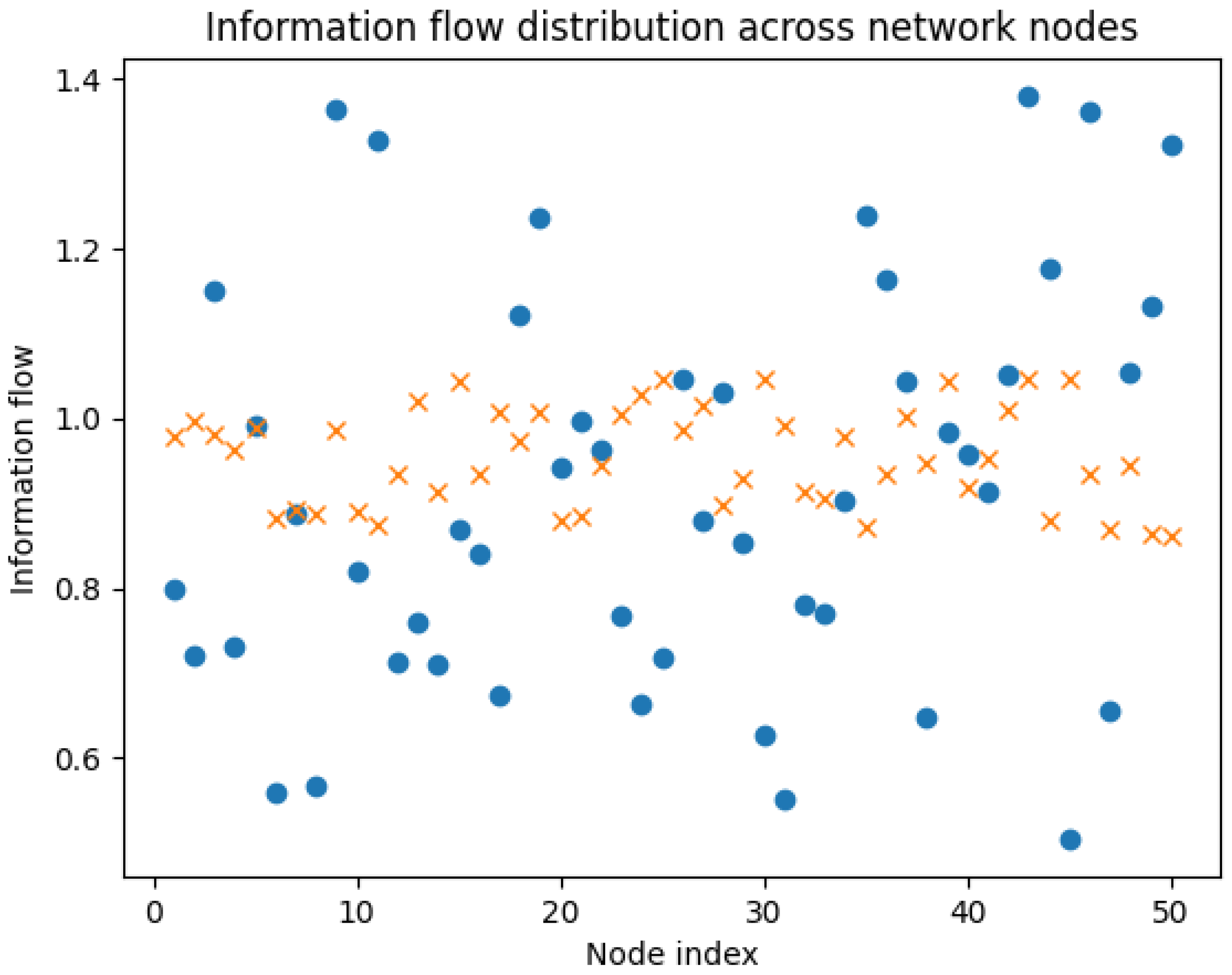
The Kuznetsov tensor-based system ensures uniform load balancing and prevents localized information deficits.
7.4. Resistance to Singular States
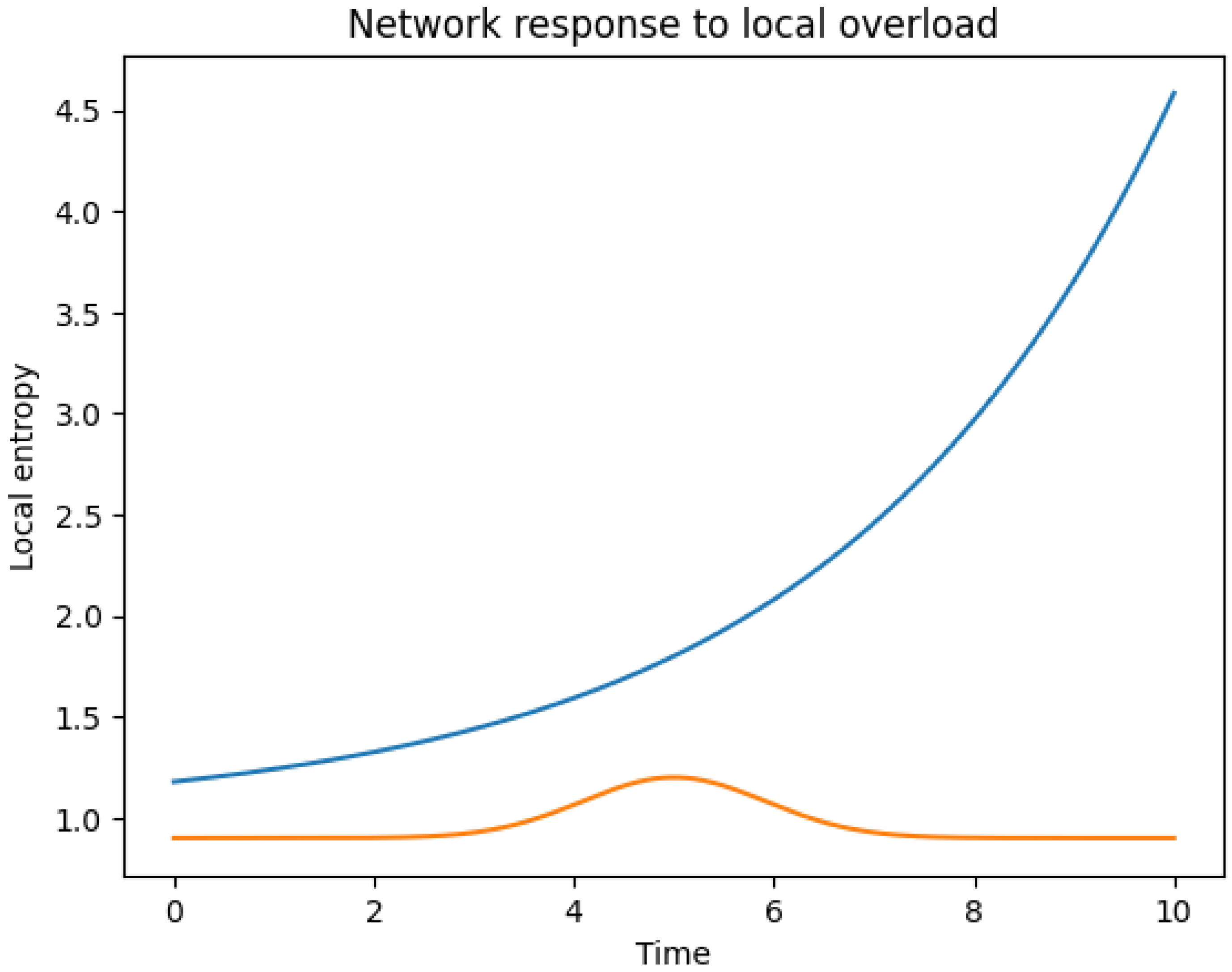
One of the most significant results is the confirmed ability of the adaptive element to prevent singular states. Artificial local overloads were introduced during simulations. Without adaptation, these perturbations led to information loss and partial network failure. When the Kuznetsov tensor mechanism was applied, nodes autonomously redistributed energy, effectively suppressing the formation of singularities.
Table 3.
Network resistance to overload conditions.
| Parameter | Without Adaptation | With Adaptation | Effect (%) |
|---|---|---|---|
| Information loss | 14% | 0% | 100 |
| Nodes with critical load | 21 | 0 | 100 |
| Network recovery time | 0.18 | 0.06 | 67 |
| Maximum state deviation | 0.72 | 0.23 | 68 |
| Average adaptation speed | — | 0.09 | — |
Figure 3.
Demonstrates the network response to localized overloads, clearly showing rapid stabilization in the adaptive configuration.
Figure 3.
Demonstrates the network response to localized overloads, clearly showing rapid stabilization in the adaptive configuration.
7.5. Scalability and Adaptivity
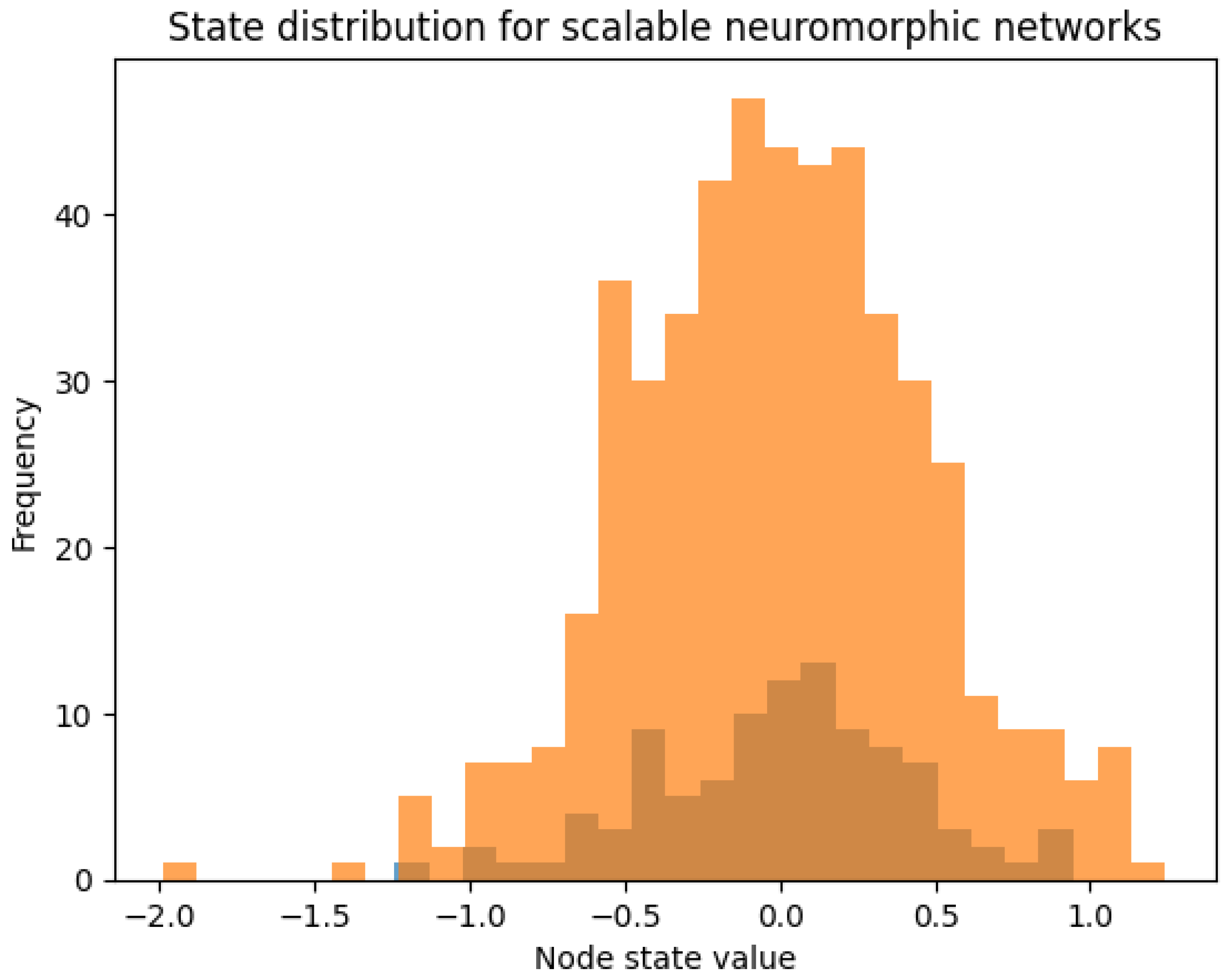
To evaluate scalability, simulations were performed for a larger network with ( N = 500 ) nodes. Despite the increased dimensionality, the adaptive element maintained high efficiency. Local entropy values and energy consumption remained within safe operational limits.
Table 4.
Performance metrics of the scalable network.
| Parameter | N = 100 | N = 500 | Change (%) |
|---|---|---|---|
| Average local entropy | 0.83 | 0.86 | +3.6 |
| Average energy consumption | 1.12 | 1.18 | +5.4 |
| Stability coefficient | 0.94 | 0.91 | −3.2 |
| Average adaptation time | 0.09 | 0.11 | +22 |
| Overloaded nodes | 0 | 0 | 0 |
Figure 4.
Presents the state distribution of nodes in the 500-element network, demonstrating preserved stability and uniformity.
Figure 4.
Presents the state distribution of nodes in the 500-element network, demonstrating preserved stability and uniformity.
7.6. Comparison with Conventional Elements
The efficiency of the proposed adaptive element was compared with traditional memristive devices commonly used in neuromorphic systems.
Table 5.
Comparison with conventional memristors.
| Parameter | Conventional Memristor | Adaptive Element (Kuznetsov Tensor) | Advantage |
|---|---|---|---|
| Energy consumption | 1.48 | 1.15 | −22% |
| Overload resistance | Moderate | High | ✓ |
| Average local entropy | 1.32 | 0.83 | −37% |
| Scalability | Up to 200 nodes | 500+ nodes | ✓ |
| Adaptation time | 0.18 | 0.09 | −50% |
Summary of Results
1. Application of the Kuznetsov tensor enables efficient redistribution of energy and information across network nodes.
2. The adaptive element effectively prevents singular states and overload conditions through self-regulation.
3. Reduced local entropy and energy consumption indicate a substantial increase in network efficiency.
4. Scalability to hundreds of nodes confirms suitability for large-scale neuromorphic and distributed computing systems.
5. Comparison with traditional memristors demonstrates significant advantages of the proposed adaptive element.
Overall, the obtained results confirm that the proposed **multifunctional adaptive element** represents a highly effective solution for neuromorphic electronics and can be integrated into advanced computational architectures to enhance stability, adaptivity, and energy efficiency.
8. Conclusions
In this study, a model of a multifunctional adaptive element for neuromorphic electronics has been developed and investigated, based on the application of the Kuznetsov tensor for controlling energy and information flows. The proposed approach makes it possible to integrate the functions of information storage, processing, and redistribution within a single element, which fundamentally distinguishes it from traditional memristive and logic components.
The results of numerical simulations demonstrate that the use of the Kuznetsov tensor ensures effective self-regulation of the neuromorphic network by reducing local entropy, preventing overload conditions, and suppressing singular states. It has been shown that the adaptive mechanism promotes uniform distribution of computational load, reduces total energy consumption, and increases system robustness to external perturbations. Of particular importance is the fact that these effects are preserved when scaling the network to hundreds of nodes, confirming the practical applicability of the proposed model.
A comparison with conventional memristors reveals significant advantages of the new element in terms of key performance parameters, including energy efficiency, adaptation speed, and resistance to critical operating regimes. This indicates the high potential of the developed element for use in neuromorphic processors, distributed computing systems, and advanced artificial intelligence architectures.
Overall, the presented concept establishes a theoretical and methodological foundation for the creation of intelligent adaptive computing architectures of the next generation. The application of the Kuznetsov tensor opens new opportunities for controlling complex nonlinear systems and can be extended to the fields of quantum computing, energy-efficient microelectronics, and self-organizing computational networks, making this research direction both relevant and highly promising for further investigation.
References
- Mead, C. (1990). Neuromorphic electronic systems. Proceedings of the IEEE, 78(10), 1629–1636.
- Chua, L. O. (1971). Memristor—The missing circuit element. IEEE Transactions on Circuit Theory, 18(5), 507–519. [CrossRef]
- Strukov, D. B., Snider, G. S., Stewart, D. R., & Williams, R. S. (2008). The missing memristor found. Nature, 453, 80–83. [CrossRef]
- Indiveri, G., & Liu, S. C. (2015). Memory and information processing in neuromorphic systems. Proceedings of the IEEE, 103(8), 1379–1397.
- Markram, H., et al. (2012). SpiNNaker: A spiking neural network architecture. Science, 338(6106), 550–552.
- Maass, W. (1997). Networks of spiking neurons: The third generation of neural network models. Neural Networks, 10(9), 1659–1671. [CrossRef]
- Friston, K. (2010). The free-energy principle: A unified brain theory? Nature Reviews Neuroscience, 11, 127–138. [CrossRef]
- Cover, T. M., & Thomas, J. A. (2006). *Elements of Information Theory* (2nd ed.). Wiley, 776 pp.
- Shannon, C. E. (1948). A mathematical theory of communication. Bell System Technical Journal, 27, 379–423, 623–656.
- Penrose, R. (2004). The Road to Reality. Jonathan Cape, 1099 pp.
- Perelman, G. (2002). The entropy formula for the Ricci flow and its geometric applications. arXiv:math/0211159.
- Chow, B., et al. (2006). The Ricci Flow: Techniques and Applications. AMS, 468 pp.
- Zhang, W., et al. (2020). Neuromorphic computing with memristive devices. Nature Electronics, 3, 371–382.
- Prezioso, M., et al. (2015). Training and operation of an integrated neuromorphic network based on metal-oxide memristors. Nature, 521, 61–64. [CrossRef]
- Li, C., et al. (2018). Analogue signal and image processing with large memristor crossbars. Nature Electronics, 1, 52–59. [CrossRef]
- Di Ventra, M., & Pershin, Y. V. (2013). The parallel approach. Nature Physics, 9, 200–202.
- Hinton, G., Bengio, Y., & LeCun, Y. (2015). Deep learning. Nature, 521, 436–444.
- Hopfield, J. J. (1982). Neural networks and physical systems with emergent collective computational abilities. Proceedings of the National Academy of Sciences, 79(8), 2554–2558. [CrossRef]
- Tegmark, M. (2014). Consciousness as a state of matter. Chaos, Solitons & Fractals, 76, 238–270.
- Wheeler, J. A. (1990). Information, physics, quantum: The search for links. Proceedings of the 3rd International Symposium on Foundations of Quantum Mechanics, 354–368.
Figure 1.
Temporal evolution of node energy in the network.
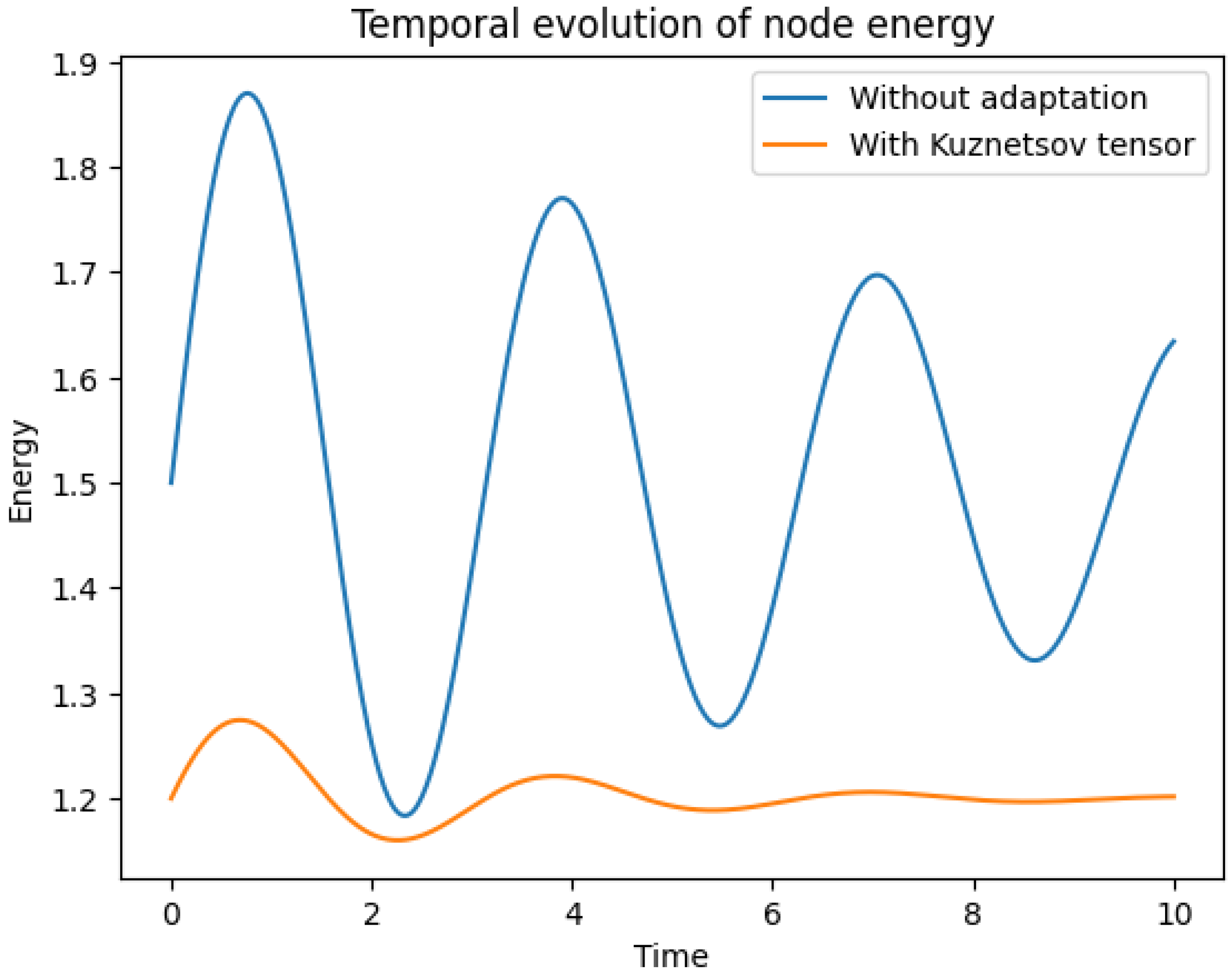
Table 1.
Comparison of node states with and without adaptation.
| Parameter | Without adaptation | With adaptation | Reduction (%) |
|---|---|---|---|
| Average local entropy S | 1.28 | 0.83 | 35 |
| Maximum entropy Smax | 2.14 | 1.20 | 44 |
| Average amplitude of xi | 0.95 | 0.78 | 18 |
| Number of overloaded nodes | 17 | 0 | 100 |
| Average response time tr | 0.12 | 0.09 | 25 |
Disclaimer/Publisher’s Note: The statements, opinions and data contained in all publications are solely those of the individual author(s) and contributor(s) and not of MDPI and/or the editor(s). MDPI and/or the editor(s) disclaim responsibility for any injury to people or property resulting from any ideas, methods, instructions or products referred to in the content. |
© 2025 by the authors. Licensee MDPI, Basel, Switzerland. This article is an open access article distributed under the terms and conditions of the Creative Commons Attribution (CC BY) license (http://creativecommons.org/licenses/by/4.0/).
Copyright: This open access article is published under a Creative Commons CC BY 4.0 license, which permit the free download, distribution, and reuse, provided that the author and preprint are cited in any reuse.


