Preprint
Article

This version is not peer-reviewed.

Construction of PANI/Zn2In2S5 Heterojunction for Synergistically Enhanced Photocatalytic C-C Coupling of Methanol to Ethylene Glycol

Submitted:

25 December 2025

Posted:

26 December 2025

You are already at the latest version

Abstract

The photocatalytic dehydrogenative coupling of methanol to produce the high-value-added chemical ethylene glycol (EG) has garnered widespread attention owing to its environmental benignity and mild reaction conditions. The ternary metal sulfide Zn2In2S5(ZIS), by virtue of its unique stoichiometric ratio, demonstrates a high intrinsic selectivity for the activation of the α-C-H bond in methanol. However, pristine ZIS faces the challenge of rapid recombination of photogenerated electron-hole pairs, which severely restricts its photocatalytic efficiency. In this study, the conductive polymer polyaniline (PANI) was successfully coupled with the ZIS photocatalyst via a simple one-step hydrothermal polymerization method to fabricate a series of PANI/ZIS nanocomposite photocatalysts. Systematic evaluation results indicate that the optimal catalyst, 7.5%-PANI/ZIS, exhibits exceptional catalytic performance under visible light, achieving an ethylene glycol generation rate as high as 4.87 mmol/g/h, representing a 6.76-fold enhancement over pristine ZIS (0.72 mmol/g/h). The significant performance enhancement is attributed to the synergistic effects of PANI and ZIS, which formed Type-II heterojunction effectively promotes the separation and transport of photogenerated charges and significantly reduces the charge transfer resistance. This research provides new insights into interfacial engineering based on conductive polymers and is of significant scientific importance for the high-value utilization of C1 small molecules.

Keywords: 
;  ;  ;  ;  

1. Introduction

In recent years, developing green chemical synthesis routes driven by solar energy has become a key scientific priority for addressing energy and environmental challenges[1,2,3]. Among numerous photocatalytic applications, the high-value utilization of abundant and widely sourced C1 small molecules, such as methanol, particularly their selective conversion into C2+ chemicals, offers significant potential but also presents considerable challenges[4,5,6]. Particularly, the photocatalytic dehydrogenative coupling of methanol for the direct synthesis of ethylene glycol (EG) is considered a highly attractive atom-economical reaction route due to its 100% atom economy, offering a sustainable alternative to traditional industrial processes that are reliant on fossil fuels and are highly energy-intensive[6,7,8].
Ternary metal sulfides, especially the zinc-indium-sulfide (Zn-In-S, ZIS) system, have attracted significant research interest in the field of photocatalysis owing to their tunable band structure and excellent visible light absorption capabilities[9,10,11]. However, the performance of pristine ZIS materials as photocatalysts is often limited by the severe recombination of photogenerated charges, which greatly restricts their quantum efficiency and application potential[12]. Recent studies have further revealed that the stoichiometric ratio of the ZIS system has a decisive impact on its catalytic selectivity: for instance, ZnIn2S4 tends to oxidize methanol to formaldehyde, whereas Zn2In2S5 exhibits high selectivity towards ethylene glycol, indicating its unique ability to preferentially activate C-H bonds[13,14]. Nonetheless, to fully exploit the potential of Zn2In2S5, it is imperative to address the core bottleneck of the rapid recombination of its photogenerated electron-hole pairs[15]. Consequently, various strategies have been employed to enhance its photocatalytic performance, such as constructing heterojunctions and loading cocatalysts, such as metals or metal compounds[16,17,18,19,20].
Coupling with visible-light-responsive conductive polymers is one of the effective strategies to achieve efficient charge transfer and strong photo-responsiveness in materials[21,22,23]. Polyaniline (PANI), as a typical p-type conductive polymer, possesses excellent electrical and optical properties and is environmentally friendly[24,25]. Compositing PANI with n-type semiconductors allows for the construction of p-n heterojunctions. The built-in electric field formed at the interface can greatly promote the effective separation and directional migration of photogenerated electron-hole pairs[26,27]. Previous studies have successfully coupled various semiconductor materials (e.g. WS2[28], BiOBr[29], BiVO4[30]) with PANI, applying them in fields such as photocatalytic degradation and photoelectrochemical water splitting, and have confirmed the advantages of this structure in enhancing charge separation efficiency. For the methanol conversion reaction, efficient charge separation is critical for improving photocatalytic activity. By accelerating the separation of electrons and holes, the lifetime of charge carriers can be effectively prolonged, thus providing more active species for the surface catalytic reaction and ultimately improving the overall efficiency of methanol conversion to ethylene glycol[31]. Therefore, combining PANI with Zn2In2S5 aims to utilize the heterojunction effect to optimize light absorption capacity and regulate charge dynamics, to significantly enhance photocatalytic performance.
This study aims to couple the conductive polymer PANI with the Zn2In2S5 photocatalyst, which possesses high C-H activation selectivity, via a simple hydrothermal method. We systematically investigated the performance of the prepared PANI/Zn2In2S5 nanocomposites in the photocatalytic conversion of methanol to ethylene glycol under visible light irradiation. The results indicate that the photocatalytic activity of the composite for the conversion of methanol to ethylene glycol is significantly superior to that of pristine Zn2In2S5. The enhancement in performance is attributed to the synergistic effects of PANI: it not only broadens the visible light absorption range but, more importantly, the formed Type-II heterojunction effectively promotes the separation and transport of photogenerated charges. This research provides new insights into the development of novel nanomaterials for applications in clean energy acquisition and the high-value utilization of C1 chemicals.

2. Materials and Methods

2.1. Reagents and instruments

All reagents used in the experiment were of analytical grade, except for methanol and ethylene glycol, which were of chromatographic grade. Zinc acetate hexahydrate (Zn(CH3COO)2·6H2O), indium(III) chloride tetrahydrate (InCl3·4H2O), thioacetamide (TAA), aniline monomer (C6H7N), and Sodium sulfate (Na2SO4) were purchased from Shanghai Titan Scientific Co, Ltd. Methanol (CH3OH), anhydrous ethanol (CH3CH2OH), ethylene glycol (C2H6O2) and hydrochloric acid (HCl) were all purchased from Sinopharm Chemical Reagent Co, Ltd. All chemicals were used as received without further purification. All aqueous solutions were prepared using high-purity deionized water.

2.2. Preparation of Photocatalysts

2.2.1. Preparation of Zn2In2S5

Zn2In2S5 (ZIS) nanomaterials were synthesized via a hydrothermal method. Specifically, 0.439 g (2 mmol) of zinc acetate hexahydrate (Zn(CH3COO)2·6H2O) and 0.596 g (2 mmol) of indium(III) chloride tetrahydrate (InCl3·4H2O) were dissolved together in a mixed solution of 30 mL deionized water and 30 mL anhydrous ethanol. The mixture was magnetically stirred at room temperature for 30 min to form a homogeneous solution. Subsequently, 0.371 g (2 mmol) of thioacetamide (TAA) was added, followed by an additional 30 min of stirring and ultrasonication to ensure thorough precursor mixing. The resulting solution was transferred into a 100 mL Teflon-lined autoclave, sealed, and maintained at 160 °C in an oven for 24 h. After the reaction concluded, the autoclave was allowed to cool naturally to room temperature, and the resulting yellow product was collected. The product was isolated by centrifugation (10000 rpm, 5 min) and subsequently washed three times with deionized water and anhydrous ethanol, respectively. Finally, the product was dried in a vacuum oven at 60 °C for 24 h and then thoroughly ground to obtain a yellow ZIS powder.

2.2.2. Preparation of PANI

Polyaniline (PANI) was synthesized via a chemical oxidative polymerization method. First, aniline monomer and hydrochloric acid were added to 500 mL of deionized water to achieve final concentrations of 0.05 M and 0.5 M, respectively. The mixture was vigorously stirred in an ice-water bath (approximately 1 °C) for 5 h. Subsequently, an aqueous solution of 0.05 M ammonium persulfate was slowly added dropwise to this mixture, and stirring was continued at this temperature. Upon completion, the resulting polyaniline precipitate (hydrochloric acid-doped form) was collected by filtration and washed thoroughly with deionized water and ethanol to remove impurities. Finally, the product was dried in a vacuum oven at 70 °C for 24 h and ground to yield a black PANI powder.

2.2.3. Preparation of PANI/Zn2In2S5

PANI/Zn2In2S5 composite materials were prepared via a one-step hydrothermal method. First, 0.439 g (2 mmol) of Zn(CH3COO)2·6H2O and 0.54 g (2 mmol) of InCl3·4H2O were dissolved in a mixed solvent of 30 mL deionized water and 30 mL anhydrous ethanol, followed by magnetic stirring for 30 min. Then, 0.371 g (2 mmol) of TAA was added, and the mixture was continuously stirred and ultrasonicated for 30 min. Subsequently, a designated mass of PANI powder was added to the precursor solution, and the mixture was subjected to an additional 30 min of ultrasonication and 30 min of magnetic stirring to ensure uniform PANI dispersion. The final suspension was transferred into a 100 mL Teflon-lined autoclave and maintained at 160 °C for 24 h. Upon completion, the product was isolated by centrifugation, washed (three times each with deionized water and ethanol), and dried under vacuum (60 °C, 24 h), yielding a dark green powder of the PANI/ZIS composite photocatalyst. By varying the mass of PANI added, a series of composite materials with theoretical PANI to Zn2In2S5 mass ratios of 2.5%, 5.0%, 7.5%, and 10.0% were prepared, denoted as 2.5%-PANI/ZIS, 5.0%-PANI/ZIS, 7.5%-PANI/ZIS, and 10.0%-PANI/ZIS, respectively. For comparison, a pure ZIS sample was prepared via the identical procedure but without the addition of PANI.

2.3. Photocatalytic experiments

The photocatalytic coupling of methanol to ethylene glycol was evaluated in a sealed quartz tube reactor (Volume: 20 mL; Inner Diameter: 16 mm). Typically, the height of the reaction solution was 19 mm. A 300 W Xenon lamp served as the light source. In a typical procedure, 10 mg of the catalyst was ultrasonically dispersed in a mixture of 4.0 mL of methanol and 1.0 mL of water. Subsequently, the reactor was evacuated and backfilled with nitrogen; this cycle was repeated three times to ensure thorough oxygen removal. The photocatalytic reaction was conducted for 4 h. After the reaction, the liquid-phase product, ethylene glycol, was analyzed using a gas chromatograph (Shimadzu GC-2014) equipped with an INERTCAP FFAP column (0.32 mm × 30 m).

2.4. Electrochemical Measurements

All electrochemical measurements were conducted using a CHI 660E electrochemical workstation (Shanghai Chenhua Instrument Co., Ltd.) in a standard three-electrode system under illumination from a 300 W Xenon lamp. To prepare the working electrode, 10 mg of the catalyst sample was ultrasonically dispersed in 1 mL of a solution containing 970 μL of ethanol and 30 μL of Nafion solution (0.3 wt%). An aliquot of 100 μL of this suspension was then uniformly drop-coated onto an FTO conductive glass (1×2 cm) and dried in an oven at 60 °C for 1 h. During the measurements, a platinum plate and an Ag/AgCl electrode served as the counter and reference electrodes, respectively. All tests were performed in a 0.5 M Na2SO4 aqueous solution. Electrochemical Impedance Spectroscopy (EIS) measurements were performed over a frequency range from 0.1 Hz to 10⁶ Hz. Mott-Schottky analyses were conducted in the potential range of -1.0 V to +1.0 V (vs. Ag/AgCl) at frequencies of 500, 1000, and 1500 Hz.

3. Results

3.1. Structural characterization of catalysts

Figure 1a illustrates the hydrothermal synthesis of Zn2In2S5 (ZIS). First, zinc acetate (Zn(Ac)2), indium trichloride (InCl3), and thioacetamide (CH3CSNH2), serving as precursors, were dissolved in a mixed solvent of water and ethanol. The solution was then subjected to stirring and ultrasonication to ensure uniform dispersion. The resulting suspension was transferred into a Teflon-lined stainless-steel autoclave and maintained at 160 °C for 24 h. Upon completion, the product was collected via centrifugation, washing, and drying, yielding the final Zn2In2S5 material.
To investigate the crystal structure of the materials, X-ray diffraction (XRD) analyses were conducted (Figure 1b). The pattern for pure ZIS displays diffraction peaks at 2θ ≈ 21.5°, 27.8°, 47.3°, and 51.5°, which are indexed to the (006), (102), (110), and (202) crystal planes of hexagonal ZIS, respectively[12,13,15,19]. This confirms that the target ZIS product was successfully synthesized. Pure polyaniline (PANI) exhibits several broad diffraction peaks (e.g., a characteristic peak in the 2θ range of 20-30°)[32], indicative of its semi-crystalline nature[33]. For the PANI/ZIS composite materials with varying PANI loading amounts (2.5%, 5.0%, 7.5%, and 10.0%), the main diffraction peaks of ZIS remain clearly observable, suggesting that ZIS retained its original crystal structure throughout the compositing process.
Figure 1c presents the Fourier Transform Infrared (FTIR) spectra of the prepared samples. Pure PANI exhibits distinct characteristic peaks at approximately 1560 cm-1 and 1480 cm-1, attributed to the C=C stretching vibrations of the quinoid and benzenoid rings, respectively[22,24]. Concurrently, absorption peaks at 1290 cm-1 (C-N stretching vibration) and 1120 cm-1 (N=Q=N quinoid ring vibration) are also clearly visible[34,35]. In the spectra of the PANI/ZIS composites, all the aforementioned characteristic peaks of PANI are discernible, and their intensities progressively increase with higher PANI content. This demonstrates that PANI was successfully integrated with ZIS.
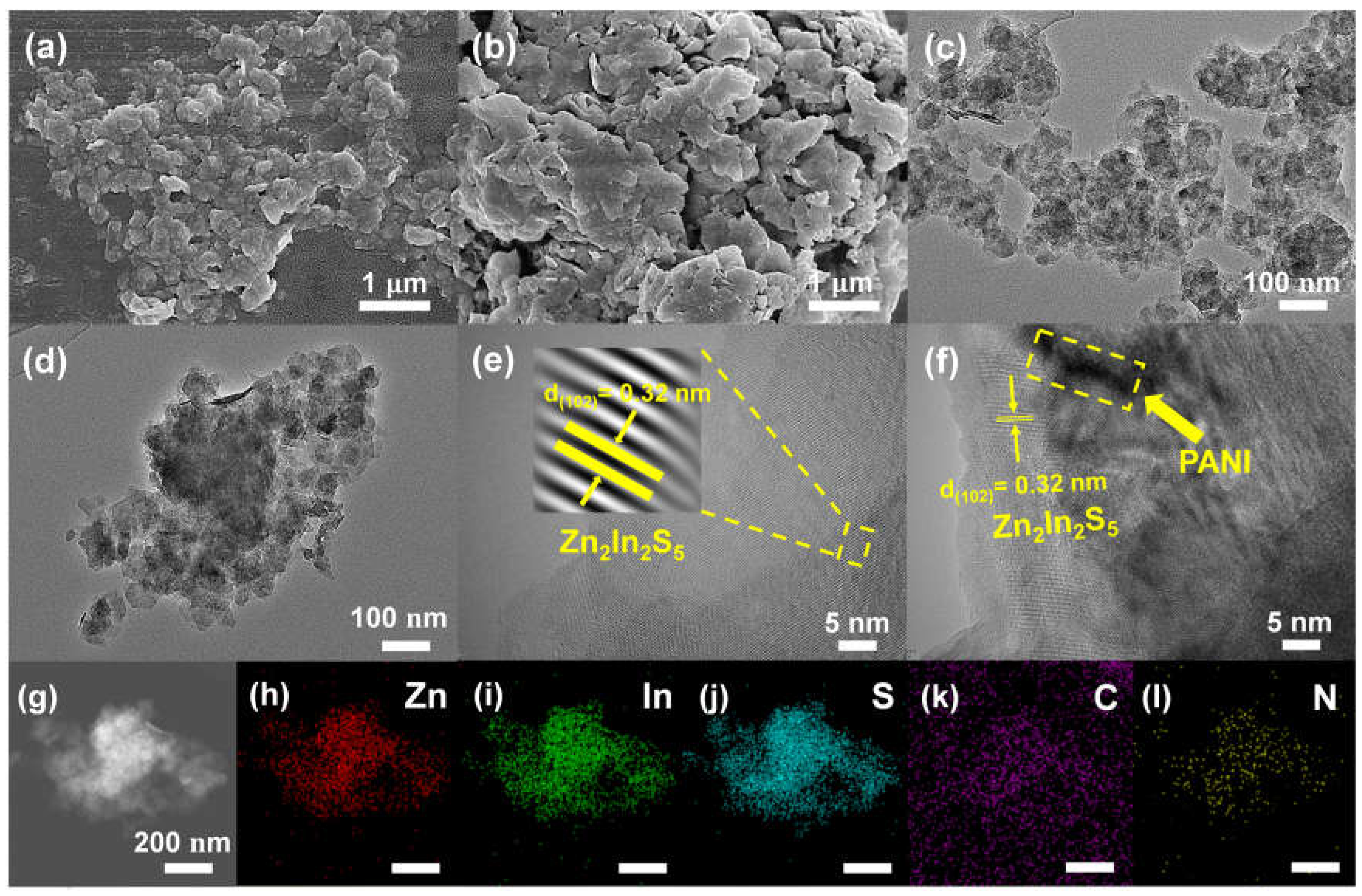
To further characterize the micro-morphology and structure of the materials, Scanning Electron Microscopy (SEM) and Transmission Electron Microscopy (TEM) analyses were performed (Figure 2). As shown in Figure 2a and Figure 2c, pure ZIS exhibits a structure composed of agglomerated nanoparticles. Upon PANI incorporation, the SEM image of the 7.5%-PANI/ZIS sample (Figure 2b) displays a similar agglomerated morphology, albeit with an increased degree of particle aggregation, resulting in a more compact structure. This indicates that PANI loading led to a more densely packed surface morphology for the catalyst. The High-Resolution Transmission Electron Microscopy (HRTEM) image (Figure 2e) further elucidates the crystalline nature of pure ZIS, displaying clear lattice fringes with a 0.32 nm spacing, which corresponds to the (102) crystal plane of ZIS[12,36]. Crucially, the HRTEM image of the 7.5%-PANI/ZIS composite (Figure 2f) clearly reveals the (102) plane of ZIS in intimate contact with amorphous PANI, establishing a distinct heterojunction interface. This confirms the successful formation of a heterojunction after the integration of PANI and ZIS[37,38]. This is further substantiated by the EDS elemental mapping (Figure 2g-l), which clearly shows that the constituent elements of ZIS (Zn, In, S) and PANI (C, N) are uniformly co-localized on the nanoparticles. Such an intimate interfacial architecture is crucial for promoting the separation and transport of photogenerated charges[37].
The surface chemical composition and chemical states of the synthesized catalysts were analyzed using X-ray Photoelectron Spectroscopy (XPS) (Figure 3). The XPS survey scan (Figure 3a) indicates that the pure ZIS sample is primarily composed of Zn, In, and S elements. For the 7.5%-PANI/ZIS composite, C 1s and N 1s signals were clearly detected alongside the constituent elements of ZIS, providing strong evidence that PANI was successfully integrated with the ZIS surface. To probe the electronic interaction between PANI and ZIS, high-resolution XPS spectra were analyzed. As shown in Figure 3b, the Zn 2p spectrum exhibits a spin-orbit doublet corresponding to Zn 2p3/2 and Zn 2p1/2[39]. For pure ZIS, these two peaks are located at 1022.3 eV and 1045.3 eV; in the 7.5%-PANI/ZIS composite, they shifted positively to 1022.5 eV and 1045.5 eV. Similarly, the In 3d spectrum (Figure 3c) also presents the In 3d5/2 and In 3d3/2 doublet[40], with binding energies shifting positively from 445.04 eV and 452.5 eV (pure ZIS) to 445.07 eV and 452.6 eV. In contrast, the S 2p spectrum (Figure 3d), deconvoluted into S 2p3/2 and S 2p1/2 peaks[41], exhibited a negative shift from 161.8 eV and 163.0 eV (pure ZIS) to 161.7 eV and 162.9 eV. These systematic shifts in the binding energies of all relevant elements indicate the formation of an intimate heterojunction interface between ZIS and PANI, implying significant charge transfer and redistribution[42]. The high-resolution C 1s spectrum of 7.5%-PANI/ZIS (Figure 3e) was deconvoluted into three peaks attributed to C-C/C-H (284.8 eV), C-N (286.3 eV), and a π-π satellite peak (288.9 eV)[22,43]. Concurrently, the presence of the N 1s spectrum (Figure 3f) further verifies the incorporation of PANI.

3.2. Photoelectric properties of composite photocatalysts

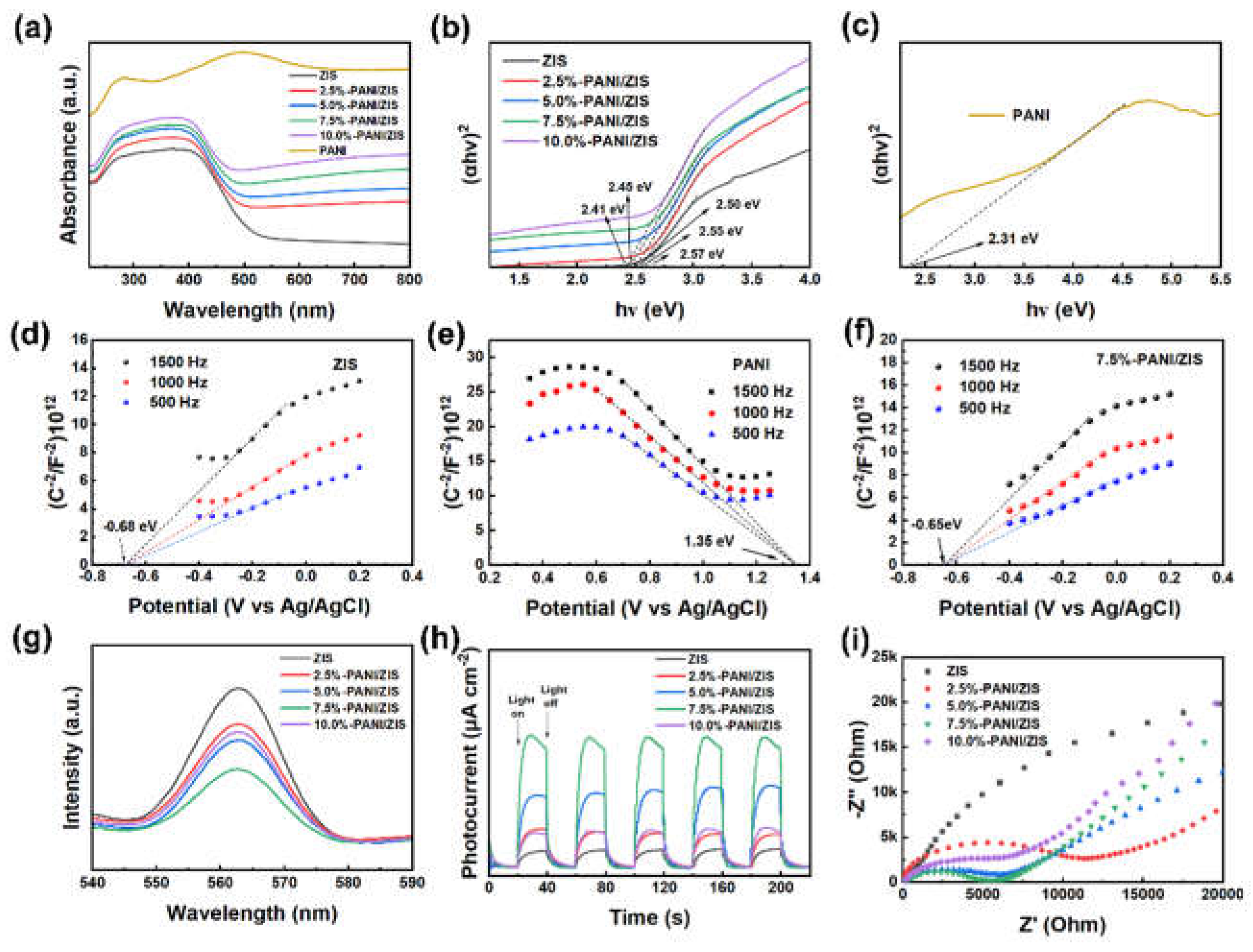
The optical properties of the materials were investigated using UV-visible diffuse reflectance spectroscopy (UV-vis DRS) and Tauc plots (Figure 4a-c). As shown in Figure 4a, pure ZIS exhibits an absorption cutoff edge at approximately 500 nm, whereas pure PANI shows strong absorption over the entire 200-800 nm visible light region. In comparison with pure ZIS, all PANI/ZIS composites demonstrate significantly enhanced absorption in the visible spectrum above 500 nm, accompanied by a redshift of the absorption edge. This indicates that the introduction of PANI effectively broadened the photoresponsive range of the catalyst. As calculated from the Tauc plots [(αhv)² vs. hv][43] (Figure 4b and Figure 4c), the band gaps (Eg) of pure ZIS and PANI are 2.57 eV and 2.31 eV, respectively. Following composite formation, the Eg of the composites gradually narrows with increasing PANI content, decreasing to 2.45 eV for 7.5%-PANI/ZIS. This enables the catalyst to absorb longer-wavelength visible light, facilitating the excitation of more photogenerated charge carriers[44].
To elucidate the charge separation mechanism, the band positions of the materials were determined using Mott-Schottky (M-S) measurements (Figure 4d-f). The M-S plots for both ZIS (Figure 4d) and 7.5%-PANI/ZIS (Figure 4f) exhibit positive slopes, indicating they are n-type semiconductors[45]. Their flat-band potentials (Efb) were determined to be -0.68 V vs. Ag/AgCl (−0.48 V vs. NHE) and -0.65 V vs. Ag/AgCl (−0.45 V vs. NHE), respectively. In contrast, PANI (Figure 4e) displays the characteristics of a p-type semiconductor[46], with an Efb of approximately +1.35 V vs. Ag/AgCl (1.55 V vs. NHE). Considering that the conduction band (CB) potential of an n-type semiconductor is typically 0.1 V more negative than its Efb[47], the CB potentials for ZIS and 7.5%-PANI/ZIS were estimated to be -0.58 V and -0.55 V (vs. NHE), respectively. For a p-type semiconductor, the valence band (VB) potential is usually 0.1 V more positive than its Efb[48]; thus, the VB potential of PANI is 1.65 V (vs. NHE). Based on the band structure formula (Evb = Ecb + Eg), the Evb for ZIS and 7.5%-PANI/ZIS were calculated to be 1.99 V and 1.90 V, respectively, while the Ecb for PANI is -0.66 V.
To evaluate the charge carrier dynamics, a series of photoelectrochemical tests were conducted (Figure 4g-i). First, the photoluminescence (PL) spectrum (Figure 4g) reveals a strong fluorescence emission peak for pure ZIS at ~565 nm, indicating severe recombination of its photogenerated electron-hole pairs[49]. Upon PANI incorporation, the fluorescence intensity of all samples was significantly quenched, with 7.5%-PANI/ZIS showing the lowest intensity. This demonstrates that PANI substantially suppresses carrier recombination[22,50]. Transient photocurrent responses (Figure 4h) further corroborate this finding: all PANI/ZIS composites exhibit higher photocurrent densities than pure ZIS, indicating that PANI promotes the effective separation and migration of photogenerated charges[51]. Finally, Nyquist plots derived from Electrochemical Impedance Spectroscopy (EIS) (Figure 4i) show that pure ZIS possesses the largest charge transfer resistance (largest semicircle arc radius), whereas the resistance of all PANI/ZIS composites is significantly reduced (7.5%-PANI/ZIS being the smallest)[52]. In summary, the heterostructure formed between PANI and ZIS establishes an efficient charge transport pathway, significantly promoting the separation and migration of photogenerated carriers[53,54]. This is the key factor underlying their enhanced photocatalytic performance..

3.3. Nitrogen adsorption-desorption analysis

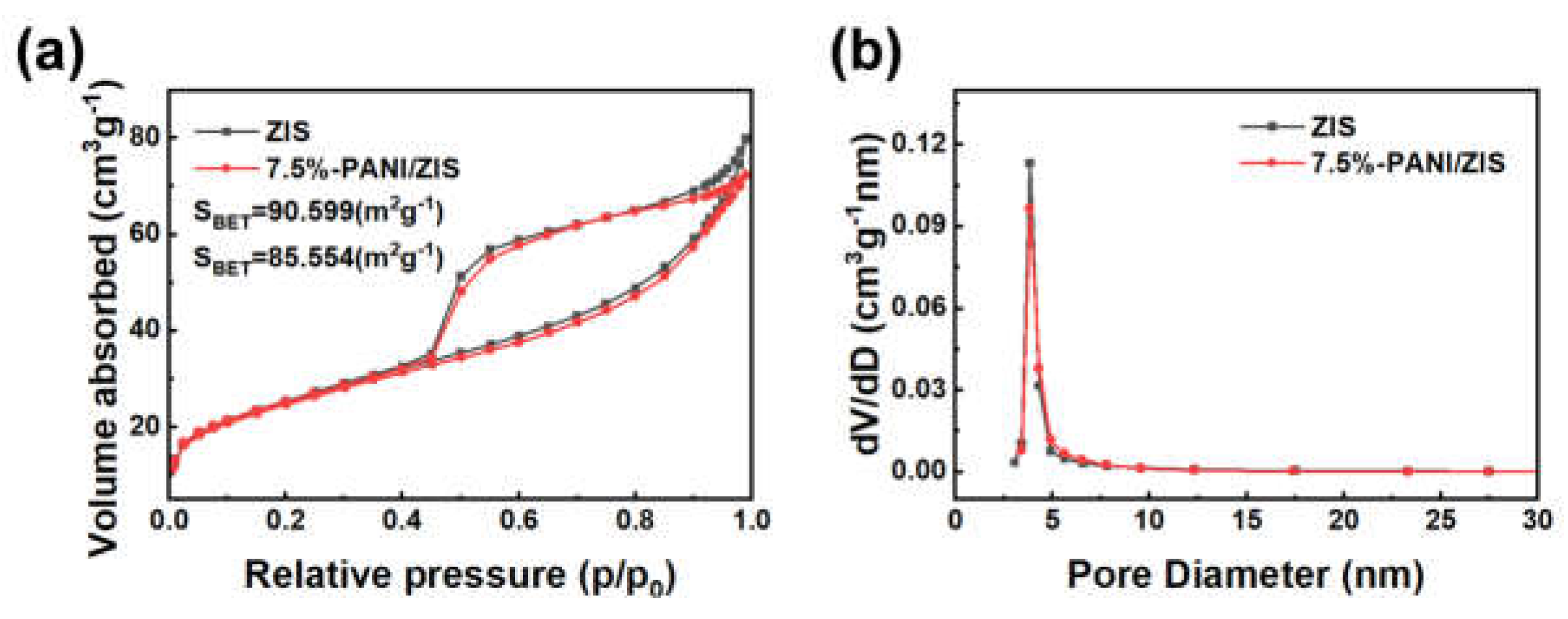
To examine the specific surface area and pore structure of the materials, nitrogen adsorption-desorption analysis was performed (Figure 5). As shown in Figure 5a, both pure ZIS and 7.5%-PANI/ZIS exhibit typical Type IV isotherms accompanied by H3-type hysteresis loops, indicating that both materials possess mesoporous structures [55]. Based on the Brunauer-Emmett-Teller (BET) method, the specific surface area of pure ZIS was calculated to be 90.599 m2/g. After compositing with PANI, the specific surface area of 7.5%-PANI/ZIS slightly decreased to 85.554 m2/g. The corresponding pore size distribution (Figure 5b) reveals that both materials have similar mesopore sizes, primarily concentrated in the 3-4 nm range. This minor difference in specific surface area suggests that the significant enhancement in catalytic performance is not primarily governed by changes in physical structure, but should be attributed to improvements in the electronic properties of the material.

3.4. Photocatalytic activity of composite catalyst

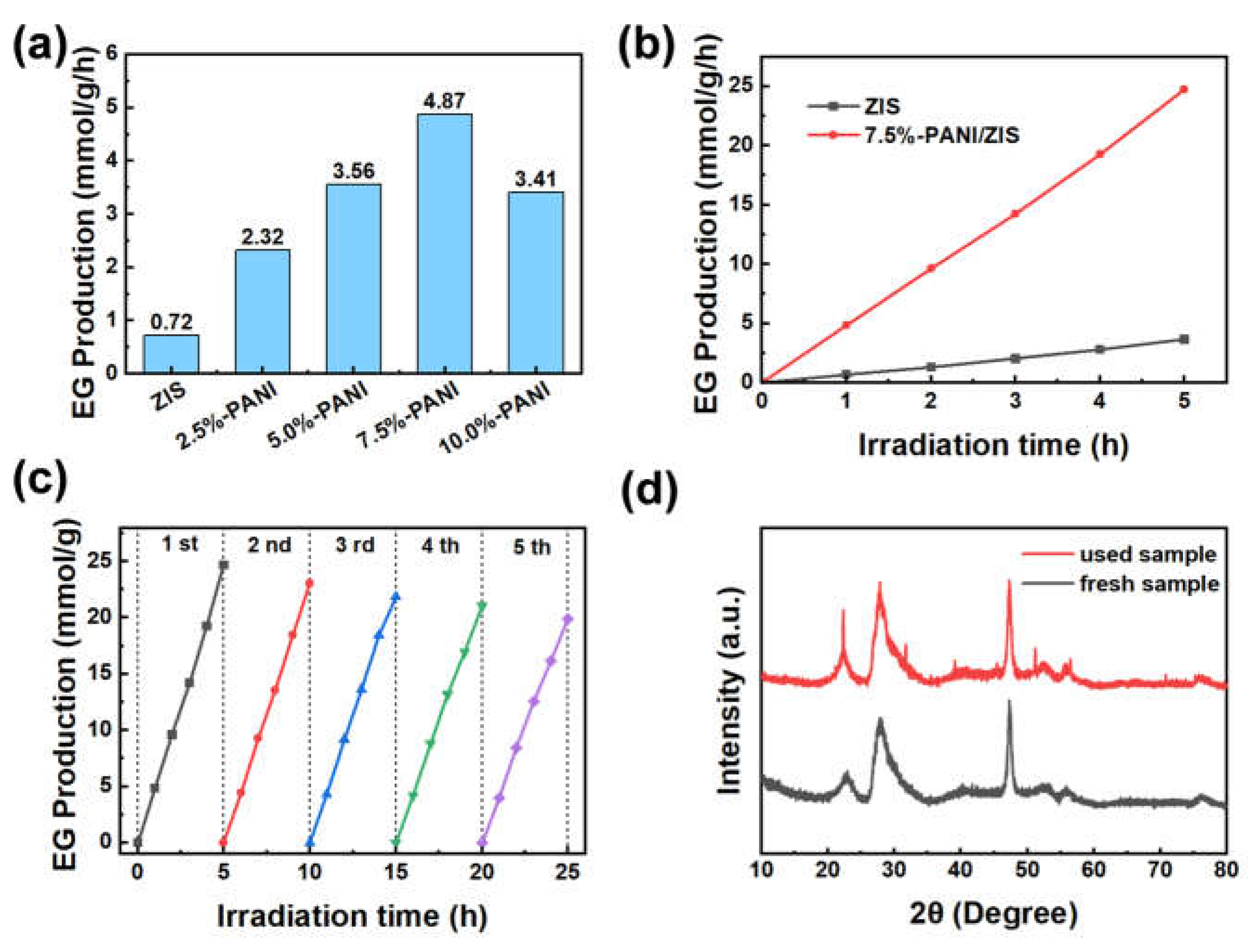
To evaluate the impact of PANI integration on the photocatalytic methanol coupling performance of ZIS, the ethylene glycol (EG) generation rates of the catalyst series were evaluated (Figure 6a). Pure ZIS exhibited an EG generation rate of only 0.72 mmol/g/h, a result attributed to its severe photogenerated charge recombination. Upon integration with PANI, the activity of all samples was significantly enhanced. The EG generation rate showed a volcano-type trend as a function of PANI loading, peaking at 4.87 mmol/g/h for the 7.5%-PANI/ZIS sample, representing a 6.76-fold enhancement over pure ZIS. This suggests that while an appropriate amount of PANI incorporation greatly promotes catalytic activity, excessive PANI loading (10.0%) may shield ZIS active sites or cause a light-screening effect, diminishing the activity (3.41 mmol/g/h).
Time-dependent experiments (Figure 6b) revealed that the EG yield of 7.5%-PANI/ZIS increased linearly over 5 hours of illumination, with a total yield significantly higher than that of pure ZIS, confirming the efficient and stable nature of the composite's catalytic process.
To further examine catalyst durability, the stability of the optimal 7.5%-PANI/ZIS sample was assessed. First, cycling stability tests (Figure 6c) showed that the catalyst retained 80.5% of its initial activity after 5 consecutive cycles (totaling 25 hours of illumination), demonstrating its excellent operational stability. Furthermore, post-reaction XRD analysis was conducted to verify structural integrity (Figure 6d). The diffraction peak positions and intensities of the post-reaction sample remained essentially unchanged compared to the fresh catalyst, with no significant structural degradation observed. This result confirms that the PANI/ZIS composite material maintained its structural integrity during the photocatalytic process, which is crucial for its long-term catalytic retention.

3.5. Photocatalytic mechanism

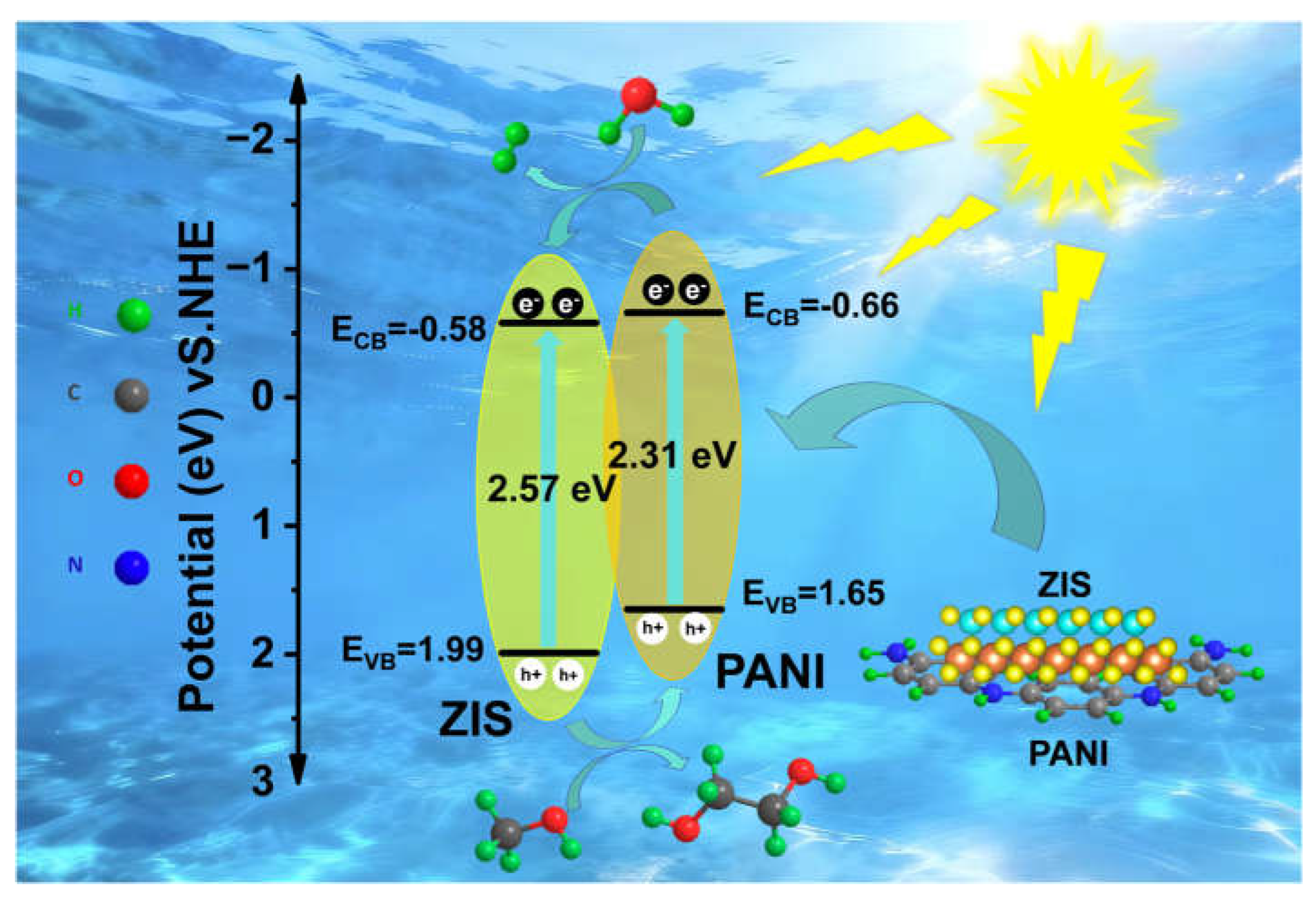
To elucidate the intrinsic mechanism underlying the enhanced photocatalytic activity of the PANI/ZIS composite, a Type-II heterojunction model is proposed (Figure 7). According to the Tauc plots (Figure 4b-c) and Mott-Schottky analysis (Figure 4d-f), the conduction band (CB) and valence band (VB) potentials of n-type ZIS were determined to be -0.58 V and +1.99 V, respectively, while those of p-type PANI were -0.66 V and +1.65 V (vs. NHE). This staggered band alignment (where E(CB, PANI) < E(CB, ZIS) and E(VB, ZIS) > E(VB, PANI) defines a typical Type-II heterojunction.
Upon visible light excitation, this band alignment thermodynamically drives the migration of photogenerated electrons from the CB of PANI to the CB of ZIS, while holes migrate from the VB of ZIS to the VB of PANI. This process promotes efficient spatial separation of photogenerated carriers, leading to the accumulation of electrons on ZIS and holes on PANI. This proposed charge separation pathway is supported by the significant PL quenching, the substantially enhanced photocurrent response, and the reduced charge transfer resistance observed via EIS. This effective suppression of electron-hole recombination ensures that sufficient charge carriers are available to participate in the subsequent surface redox reactions.
Accordingly, a detailed reaction pathway for the selective conversion of methanol to ethylene glycol is proposed as follows:
Carrier Generation and Separation:
PANI/ZIS + hv → h+(VB, PANI) + e-(CB, ZIS)
Methanol Oxidation: Holes accumulated in the VB of PANI abstract an α-H from methanol, generating hydroxymethyl radicals (·CH2OH).
CH3OH + h+ → H+ + ·CH2OH
Formation of Ethylene Glycol: Two hydroxymethyl radicals couple to form the target product, ethylene glycol.
2·CH2OH → HOCH2CH2OH
Proton Reduction: Concurrently, electrons accumulated on the CB of ZIS reduce protons in the system to produce H2.
2H++ 2e- → H2

4. Conclusions

In this study, PANI/ZIS nanocomposite photocatalysts were successfully prepared via a facile hydrothermal method. Characterization results confirmed the formation of an intimate heterojunction interface between PANI and ZIS. Compared to pure ZIS, the composite material exhibited a broader visible light absorption range and significantly enhanced photogenerated charge separation efficiency. In the photocatalytic conversion of methanol to ethylene glycol, the optimal 7.5%-PANI/ZIS catalyst demonstrated exceptional catalytic activity, achieving an ethylene glycol generation rate as high as 4.87 mmol/g/h—a 6.76-fold enhancement over pure ZIS. Furthermore, it maintained excellent stability over 5 cycling tests. The remarkable enhancement in performance is attributed to the formation of a Type-II heterojunction between n-type ZIS and p-type PANI; this band structure greatly facilitates the separation and migration of photogenerated electrons and holes. This work provides a valuable strategy for designing efficient composite photocatalysts for the high-value utilization of C1 small molecules.

Supplementary Materials

The following supporting information can be downloaded at the website of this paper posted on Preprints.org, Figure S1: Water contact angle measurements of (a-c) pure ZIS and (d) pure PANI; Figure S2. (a) UPS spectra of the secondary electron cutoff regions for (a) ZIS and (b) PANI; Table S1: Specific surface area, pore volume, and average pore diameter of ZIS and 7.5%-PANI/ZIS; Table S2: Comparison of photocatalytic activity for ethylene glycol production reported in the literature.

Author Contributions

Conceptualization, P.M.; methodology, P.M. and K.W.; software, P.M.; validation, P.M. and K.W.; formal analysis, P.M.; investigation, P.M., and K.W.; resources, P.M.; data curation, P.M.; writing—original draft preparation, P.M.; writing—review and editing, L.Z.; visualization, P.M.; supervision, B.J., W.W., Y.Z., H.X., L.Z. and Z.M.; project administration, L.Z. and Z.M.; funding acquisition, L.Z. and Z.M. All authors have read and agreed to the published version of the manuscript.

Funding

This work was supported by National Natural Science Foundation of China (21872025).

Data Availability Statement

The original contributions presented in this study are included in the article. Further inquiries can be directed to the corresponding authors.

Conflicts of Interest

The authors declare no conflicts of interest.

Abbreviations

The following abbreviations are used in this manuscript:
ZIS Zn2In2S5
PANI Polyaniline
EG Ethylene Glycol
CB Conduction Band
VB Valence Band
NHE Normal Hydrogen Electrode
EIS Electrochemical Impedance Spectroscopy
XPS X-ray Photoelectron Spectroscopy
XRD X-ray Diffraction
SEM Scanning Electron Microscopy
TEM Transmission Electron Microscopy
UV-vis DRS Ultraviolet-visible Diffuse Reflectance Spectroscopy
PL Photoluminescence

References

  1. Chandran, B.; Oh, J.-K.; Lee, S.-W.; Um, D.-Y.; Kim, S.-U.; Veeramuthu, V.; Park, J.-S.; Han, S.; Lee, C.-R.; Ra, Y.-H. Solar-Driven Sustainability: III–V Semiconductor for Green Energy Production Technologies. Nano-Micro Lett. 2024, 16, 1. [Google Scholar] [CrossRef]
  2. Bhattacharjee, S.; Linley, S.; Reisner, E. Solar Reforming as an Emerging Technology for Circular Chemical Industries. Nat. Rev. Chem. 2024, 8, 87–105. [Google Scholar] [CrossRef]
  3. Ng, S.; Foo, J. J.; Ong, W. Solar-powered Chemistry: Engineering Low-dimensional Carbon Nitride-based Nanostructures for Selective CO2 Conversion to C1-C2 Products. Infomat 2022, 4, e12279. [Google Scholar] [CrossRef]
  4. Jing, H.; Ma, Y.; Liu, T.; Liao, Y.; Wang, Y.; Zhou, Z.; Wang, Y.; Sun, H.; Su, C.; Liu, B. Uncovering the Photocatalytic Conversion of Methanol for C2+ Chemicals. Chin. Chem. Lett. 2025, 36, 111830. [Google Scholar] [CrossRef]
  5. Xie, S.; Ma, W.; Wu, X.; Zhang, H.; Zhang, Q.; Wang, Y.; Wang, Y. Photocatalytic and Electrocatalytic Transformations of C1 Molecules Involving C-C Coupling. Energy Environ. Sci. 2021, 14, 37–89. [Google Scholar] [CrossRef]
  6. Xie, S.; Shen, Z.; Deng, J.; Guo, P.; Zhang, Q.; Zhang, H.; Ma, C.; Jiang, Z.; Cheng, J.; Deng, D.; Wang, Y. Visible Light-Driven C-H Activation and C-C Coupling of Methanol into Ethylene Glycol. Nat. Commun. 2018, 9, 1181. [Google Scholar] [CrossRef] [PubMed]
  7. Wang, L.; Sun, Y.; Zhang, F.; Hu, J.; Hu, W.; Xie, S.; Wang, Y.; Feng, J.; Li, Y.; Wang, G.; Zhang, B.; Wang, H.; Zhang, Q.; Wang, Y. Precisely Constructed Metal Sulfides with Localized Single-Atom Rhodium for Photocatalytic C−H Activation and Direct Methanol Coupling to Ethylene Glycol. Adv. Mater. 35, 2205782. [CrossRef] [PubMed]
  8. Feng, J.; Xu, S.; Du, H.; Gong, Q.; Xie, S.; Deng, W.; Zhang, Q.; Wang, Y. Advances in the Solar-Energy Driven Conversion of Methanol to Value-Added Chemicals. Mol. Catal. 2022, 530, 112593. [Google Scholar] [CrossRef]
  9. Zhang, D.; Gao, Z.; Yang, D.; Wang, L.; Yang, X.; Tang, K.; Yang, H.; Zhan, X.; Wang, Z.; Yang, W. Crystal-Interface-Mediated Self-Assembly of ZnIn2S4/CdS S-scheme Heterojunctions Toward Efficient Photocatalytic Hydrogen Production. Carbon Energy 2025, 7, e707. [Google Scholar] [CrossRef]
  10. Sun, S.; Zhang, Z.; Meng, G.; Zhang, J.; Zhang, X.; Yin, Y.; Li, X.; Hu, G.; Wang, B. Sulfur Vacancy-Engineered O-Gradient ZnS@ZnIn2S4 Hollow Heterojunctions for Efficient Photocatalytic Co-Generation of Ethylene Glycol and Hydrogen from Methanol. Chem. Eng. J. 2025, 518, 164602. [Google Scholar] [CrossRef]
  11. Talebian-Kiakalaieh, A.; Li, H.; Guo, M.; Hashem, E. M.; Xia, B.; Ran, J.; Qiao, S.-Z. Photocatalytic Reforming Raw Plastic in Seawater by Atomically-Engineered GeS/ZnIn2S4. Adv. Energy Mater. 2025, 15, 2404963. [Google Scholar] [CrossRef]
  12. Wan, J.; Wang, Y.; Liu, J.; Song, R.; Liu, L.; Li, Y.; Li, J.; Low, J.; Fu, F.; Xiong, Y. Full-Space Electric Field in Mo-Decorated Zn2In2S5 Polarization Photocatalyst for Oriented Charge Flow and Efficient Hydrogen Production. Adv. Mater. 2024, 36, 2405060. [Google Scholar] [CrossRef]
  13. Huang, Z.; Sun, P.; Zhang, H.; Zhang, H.; Zhang, S.; Chen, Z.; Yi, X.; Xie, S. Solar-Driven Highly Effective Biomass-Derived Alcohols C–C Coupling Integrated with H2 Production by CdS Quantum Dots Modified Zn2In2S5 Nanosheets. ACS Catal. 2024, 14, 4581–4592. [Google Scholar] [CrossRef]
  14. Zhang, H.; Xie, S.; Hu, J.; Wu, X.; Zhang, Q.; Cheng, J.; Wang, Y. C-H Activations of Methanol and Ethanol and C-C Couplings into Diols by Zinc-Indium-Sulfide under Visible Light. Chem. Commun. 2020, 56, 1776–1779. [Google Scholar] [CrossRef] [PubMed]
  15. Yin, W.; Su, K.; Liu, X.; Cai, S.; He, P.; Xiao, Y.; Ren, T. Anchoring Bimetallic Phosphide NiCoP Cocatalyst on Marigold-like Zn2In2S5 for Enhanced Photocatalytic H2 Evolution Performance. Int. J. Hydrogen Energy 2025, 119, 178–185. [Google Scholar] [CrossRef]
  16. Song, Y.; Shen, Y.; Zhang, W.; Li, L.; An, C. Engineered Metal-Atom Aggregates Enable Selective Ethylene Glycol Production through Photocatalytic Methanol C–C Coupling. Nano Res. 2025, 18, 94907765. [Google Scholar] [CrossRef]
  17. Dong, G.-X.; Zhang, M.-R.; Yuan, S.-X.; Zhang, M.; Lu, T.-B. Chlorine Radical-Mediated Photocatalytic C─C Coupling of Methanol to Ethylene Glycol with Near-Unity Selectivity. Angew. Chem. Int. Ed. 2025, 64, e202510993. [Google Scholar] [CrossRef]
  18. Yan, W.; Li, N.; Yan, Z.; Wang, Z. Photo-Fenton-Induced Selective Dehydrogenative Coupling of Methanol into Ethylene Glycol over Iron Species-Anchored TiO2 Nanorods. Catal. Sci. Technol. 2023, 13, 1482–1487. [Google Scholar] [CrossRef]
  19. Wang, R.; Shi, L.; Su, J.; Li, J.; Xu, X. Selective Hydrobenzoin Photosynthesis from Benzyl Alcohol over AgIn5S8@Zn2In2S5 Seamless Heterostructures. Appl. Catal. B 2025, 378, 125613. [Google Scholar] [CrossRef]
  20. Wang, R.; Shi, L.; Konysheva, E. Y.; Xu, X. Selective Photocatalysis of Benzyl Alcohol Valorization by Cocatalyst Engineering Over Zn2In2S5 Nanosheets. Adv. Funct. Mater. 2024, 35, 2418074. [Google Scholar] [CrossRef]
  21. Hasnan, N. S. N.; Nordin, N. A.; Mohamed, M. A. Synergistic Interaction and Hybrid Association of Conducting Polymer Photocatalysts/Photoelectrodes for Emerging Visible Light Active Photocatalytic Applications. J. Mater. Chem. A 2024, 12, 27892–27931. [Google Scholar] [CrossRef]
  22. Wang, A.; Wang, R.; Pan, Y.; Ni, J.; Liang, X.; Du, M.; Zhang, J.; Liu, D.; Ma, J.; Wang, J.; Wang, W. High Conductive Polymer PANI Link Bi2MoO6 and PBA to Establish “Tandem Hybrid Catalysis System” by Coupling Photocatalysis and PMS Activation Technology. Appl. Catal. B 2024, 344, 123621. [Google Scholar] [CrossRef]
  23. Hu, C.; Yin, J.; Xun, S.; Zhu, L.; Li, H.; He, M.; Wu, P.; Li, H.; Zhu, W. Constructing Interface Chemical Coupling S-Scheme Heterojunction MoO3-x@PPy for Enhancing Photocatalytic Oxidative Desulfurization Performance: Adjusting LSPR Effect via Oxygen Vacancy Engineering. Appl. Catal. B 2024, 355, 124155. [Google Scholar] [CrossRef]
  24. Luo, C.; Xiong, J.; Zeng, H.; Liao, M. Polyaniline-ZnTi-LDH Heterostructure with d–π Coupling for Enhanced Photocatalysis of Pollutant Removal. J. Colloid Interface Sci. 2025, 684, 792–804. [Google Scholar] [CrossRef]
  25. Jadoun, S.; Yáñez, J.; Mansilla, H. D.; Riaz, U.; Chauhan, N. P. S. Conducting Polymers/Zinc Oxide-Based Photocatalysts for Environmental Remediation: A Review. Environ. Chem. Lett. 2022, 20, 2063–2083. [Google Scholar] [CrossRef]
  26. Tsai, C.-Y.; Li, H.-S.; Kuchayita, K. K.; Huang, H.-C.; Su, W.-N.; Cheng, C.-C. Exfoliated 2D Nanosheet-Based Conjugated Polymer Composites with P-N Heterojunction Interfaces for Highly Efficient Electrocatalytic Hydrogen Evolution. Adv. Sci. 2024, 11, 2407061. [Google Scholar] [CrossRef]
  27. Yang, S.; Ming, H.; Li, D.; Chen, T.; Li, S.; Zhang, J.; Xin, H.; Qin, X. Enhanced Phonon Scattering and Thermoelectric Performance for N-Type Bi2Te2.7Se0.3 through Incorporation of Conductive Polyaniline Particles. Chem. Eng. J. 2023, 455, 140923. [Google Scholar] [CrossRef]
  28. Fatima, T.; Husain, S.; Khanuja, M. Novel Ternary Z Scheme Carbon Quantum Dots (CQDs) Decorated WS2/PANI ((CQDs@WS2/PANI):0D:2D:1D) Nanocomposite for the Photocatalytic Degradation and Electrochemical Detection of Pharmaceutical Drugs. Nano Mater. Sci. 2025, 7, 259–275. [Google Scholar] [CrossRef]
  29. Qing, Y.; Huang, E.; Cao, L.; Gao, H.; Zhao, S.; Li, Y.; Li, W. Facile Synthesis of PA Photocatalytic Membrane Based on C-PANI@BiOBr Heterostructures with Enhanced Photocatalytic Removal of 17β-Estradiol. Chem. Eng. J. 2024, 490, 151617. [Google Scholar] [CrossRef]
  30. Li, H.; Lyu, M.; Chen, P.; Tian, Y.; Kang, J.; Lai, Y.; Cheng, X.; Dong, Z. Photothermal Effect and Hole Transport Properties of Polyaniline for Enhanced Photoelectrochemical Water Splitting of BiVO4 Photoanode. J. Colloid Interface Sci. 2025, 684, 758–768. [Google Scholar] [CrossRef] [PubMed]
  31. Ashraf, M.; Gouadria, S.; Alharbi, F.; Iqbal, M. W.; Sunny, M. A.; Hassan, H.; Ismayilova, N. A.; Alrobei, H.; Alawaideh, Y. M.; Umar, E. Design and Optimization of ZnIn2S4/Zr2C@PANI Hybrid Materials for Improved Energy Storage and Hydrogen Evolution Performance toward Advanced Energy Applications. Inorg. Chem. Commun. 2025, 180, 114987. [Google Scholar] [CrossRef]
  32. Jaiswal, R.; Joshi, M. C.; Ramadurai, R.; Sunkara, M.; Kannan, V. Structural and Electrical Conductivity Studies of Polyaniline - WO3 Hybrid Nanocomposites for Gas Sensing Applications. J. Phys. Conf. Ser. 2024, 2778, 012002. [Google Scholar] [CrossRef]
  33. Saib, F.; Abdi, A.; Haouchine, L. A.; Touahra, F.; Laoui, F. M.; Zemmache, S.; Lerari, D.; Bachari, K.; Trari, M. Synthesis, Physical Properties, and Photo-Electrochemical Characterization of a Novel n-Type PANI/PATSA Semiconductor. Polym. Bull. 2025, 82, 10947–10965. [Google Scholar] [CrossRef]
  34. Duong, H. N.; Le, T. V. Effect of Photoinduction in PANi/TiO2 Heterogeneous Structure on Conductance of PANi Component. Heliyon 2025, 11, e42807. [Google Scholar] [CrossRef]
  35. Ghafuri, H.; keshvari, M.; Eshrati, F.; Hanifehnejad, P.; Emami, A.; Zand, H. R. E. Catalytic Efficiency of GO-PANI Nanocomposite in the Synthesis of N-Aryl-1,4-Dihydropyridine and Hydroquinoline Derivatives. Sci. Rep. 2025, 15, 82907. [Google Scholar] [CrossRef]
  36. Ge, C.; Hu, J.; Liu, X.; Song, Y.; Liu, C.; Zou, Z. Self-Integrated Black NiO Clusters with ZnIn2S4 Microspheres for Photothermal-Assisted Hydrogen Evolution by S-Scheme Electron Transfer Mechanism. Acta Phys.-Chim. Sin. 2025, 42, 100154. [Google Scholar] [CrossRef]
  37. Fesseha, Y. A.; Kuchayita, K. K.; Su, W.-N.; Chiu, C.-W.; Cheng, C.-C. Organic-Inorganic Conjugated Polymer-Exfoliated Tungsten Disulfide Nanosheet P-N Heterojunction Composites for Efficient and Stable Hydrogen Evolution Reactions. Chem. Eng. J. 2025, 509, 161501. [Google Scholar] [CrossRef]
  38. Zhang, Y.; Gao, Y.; Deng, R.; Qin, Z.; Shi, F.; Zeng, J.; Zhao, C.; Pu, Y.; Duan, T. Effective Charge Separation in CdS@PANI Heterostructure for Ultrafast Visible Light-Driven Photocatalytic Reduction of Uranium(VI). Sep. Purif. Technol. 2025, 354, 129331. [Google Scholar] [CrossRef]
  39. Li, Q.; Lu, Q.; Guo, E.; Wei, M.; Pang, Y. Hierarchical Co9S8/ZnIn2S4 Nanoflower Enables Enhanced Hydrogen Evolution Photocatalysis. Energy Fuels 2022, 36, 4541–4548. [Google Scholar] [CrossRef]
  40. Li, X.; Wang, X.; Zhu, J.; Li, Y.; Zhao, J.; Li, F. Fabrication of Two-Dimensional Ni2P/ZnIn2S4 Heterostructures for Enhanced Photocatalytic Hydrogen Evolution. Chem. Eng. J. 2018, 353, 15–24. [Google Scholar] [CrossRef]
  41. Liu, T.; Xiong, Y.; Wang, X.; Xue, Y.; Liu, W.; Tian, J. Dual Cocatalysts and Vacancy Strategies for Enhancing Photocatalytic Hydrogen Production Activity of Zn3In2S6 Nanosheets with an Apparent Quantum Efficiency of 66.20%. J. Colloid Interface Sci. 2023, 640, 31–40. [Google Scholar] [CrossRef]
  42. Xu, A.; Sun, S.; Li, X.; Wang, N.; Wang, X.; Tao, H.; Ma, Y.; Zhang, Z.; Huang, B.; Li, X. Ultrasensitive Ammonia Sensor with Excellent Humidity Resistance Based on PANI/SnS2 Heterojunction. J. Hazard. Mater. 2025, 487, 137181. [Google Scholar] [CrossRef] [PubMed]
  43. Klein, J.; Kampermann, L.; Mockenhaupt, B.; Behrens, M.; Strunk, J.; Bacher, G. Limitations of the Tauc Plot Method. Adv. Funct. Mater. 2023, 33, 2304523. [Google Scholar] [CrossRef]
  44. Sarina, S.; Waclawik, E. R.; Zhu, H. Photocatalysis on Supported Gold and Silver Nanoparticles under Ultraviolet and Visible Light Irradiation. Green Chem. 2013, 15, 1814–1820. [Google Scholar] [CrossRef]
  45. Ruan, Q.; Miao, T.; Wang, H.; Tang, J. Insight on Shallow Trap States Introduced Photocathodic Performance in N-Type Polymer Photocatalysts. J. Am. Chem. Soc. 2020, 142, 2795–2802. [Google Scholar] [CrossRef]
  46. Jia, Y.; Yang, J.; Zhao, D.; Han, H.; Li, C. A Novel Sr2CuInO3S P-Type Semiconductor Photocatalyst for Hydrogen Production under Visible Light Irradiation. J. Energy Chem. 2014, 23, 420–426. [Google Scholar] [CrossRef]
  47. Hu, X.; Xu, Y.; Tang, S.; Shi, W.; Wang, X.; Yu, Y.-X.; Zhang, W.-D. Photoreduction of Aqueous Protons Coupling with Alcohol Oxidation on a S-Scheme Heterojunction Photocatalyst MnO/Carbon Nitride. Small 2023, 20, 2306563. [Google Scholar] [CrossRef] [PubMed]
  48. Cho, E.; Sung, S.-J.; Yang, K.-J.; Lee, J.; Hoang, V.-Q.; Kadiri-English, B.; Hwang, D.-K.; Kang, J.-K.; Kim, D.-H. Enhanced P-Type Conductivity in Sb2Se3 through Alkali and Alkaline Earth Metal Doping. J. Mater. Chem. A 2025, 13, 8507–8517. [Google Scholar] [CrossRef]
  49. Xiao, T.; Wang, L.; Li, K.; Tang, J.; Du, R.; Rao, S.; Wu, M. Donor-Acceptor-Donor Organic Small Molecules as Hole Transfer Vehicle Covalently Coupled Znln2S4 Nanosheets for Efficient Photocatalytic Hydrogen Evolution. Adv. Funct. Mater. 2024, 35, 2412644. [Google Scholar] [CrossRef]
  50. Wang, C.; Wang, L.; Jin, J.; Liu, J.; Li, Y.; Wu, M.; Chen, L.; Wang, B.; Yang, X.; Su, B.-L. Probing Effective Photocorrosion Inhibition and Highly Improved Photocatalytic Hydrogen Production on Monodisperse PANI@CdS Core-Shell Nanospheres. Appl. Catal. B 2016, 188, 351–359. [Google Scholar] [CrossRef]
  51. Zhang, J.; Tang, T.; Xie, Z.; Chen, Y.; Yang, H.; Ye, K.-H.; Chen, J.; Zou, W.; Shi, J.; Huang, Y. Polypyrrole as Photo-Thermal-Assisted Modifier for BiVO4 Photoanode Enables High-Performance Photoelectrochemical Water Splitting. Chem. Eng. J. 2024, 497, 154833. [Google Scholar] [CrossRef]
  52. Boasquevisque, L. M.; Marins, A. A. L.; Muri, E. J. B.; Lelis, M. F. F.; Machado, M. A.; Freitas, M. B. J. G. Synthesis and Evaluation of Electrochemical and Photocatalytic Properties of Rare Earth, Ni and Co Mixed Oxides Recycled from Spent Ni–MH Battery Anodes. Sustain. Mater. Technol. 2024, 41, e01036. [Google Scholar] [CrossRef]
  53. Zhang, J.; Wang, X.; Wang, X.; Li, C. Heterophase Junction Effect on Photogenerated Charge Separation in Photocatalysis and Photoelectrocatalysis. Acc. Chem. Res. 2025, 58, 787–798. [Google Scholar] [CrossRef] [PubMed]
  54. Yuan, H.; Shi, W.; Lu, J.; Wang, J.; Shi, Y.; Guo, F.; Kang, Z. Dual-Channels Separated Mechanism of Photo-Generated Charges over Semiconductor Photocatalyst for Hydrogen Evolution: Interfacial Charge Transfer and Transport Dynamics Insight. Chem. Eng. J. 2023, 454, 140442. [Google Scholar] [CrossRef]
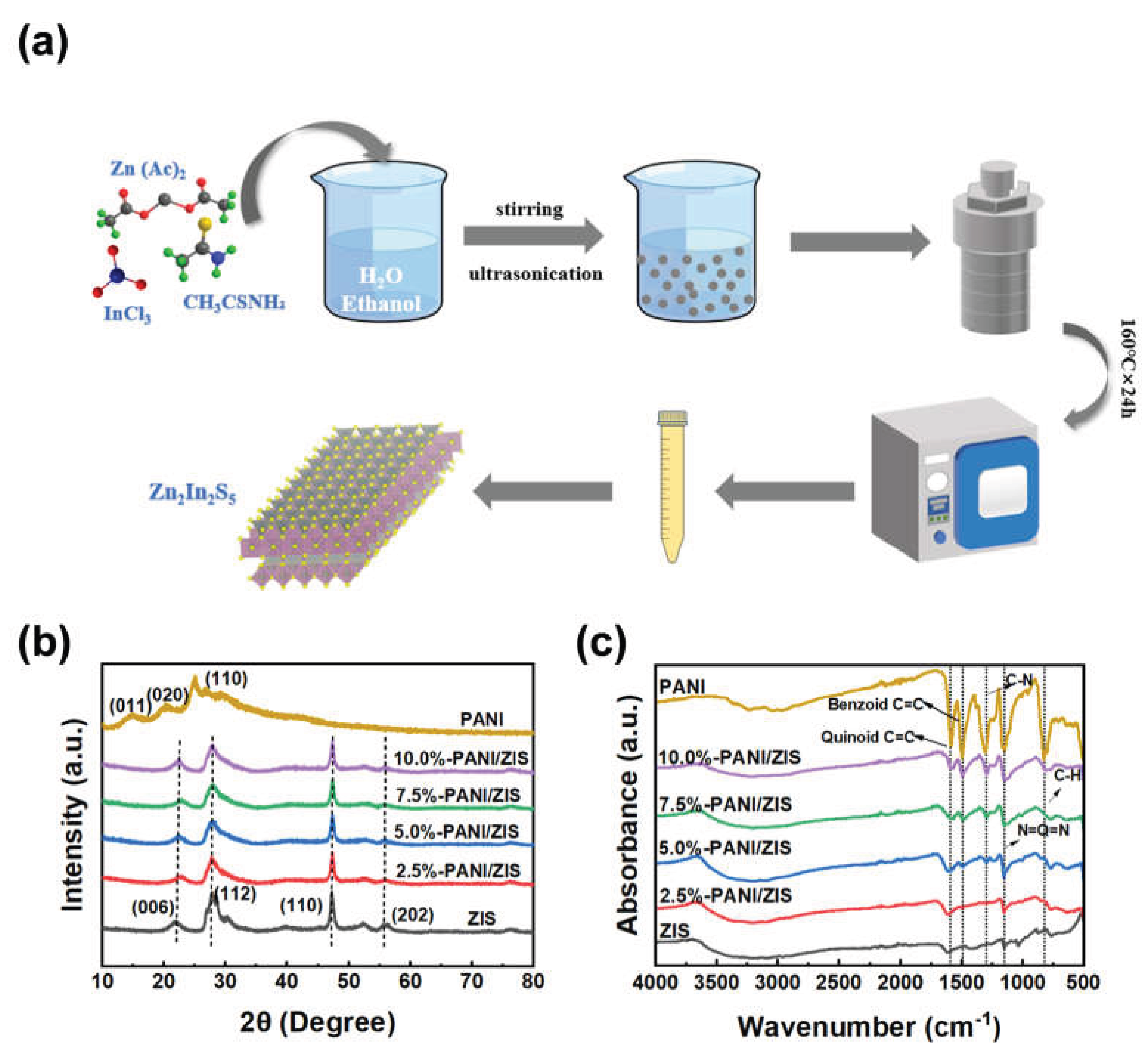
Figure 1. (a) Schematic representation of ZIS synthesis via the hydrothermal method; (b) XRD patterns of ZIS, PANI and x%-PANI/ZIS; (c) FT-IR spectroscopy of ZIS, PANI and x%-PANI/ZIS.
Preprints 191447 g001
Figure 2. SEM images of (a) ZIS and (b) 7.5%-PANI/ZIS; TEM images of (c) ZIS and (d) 7.5%-PANI/ZIS; HRTEM images of (e) ZIS and (f) 7.5%-PANI/ZIS; (g) HAADF-STEM image and EDS mapping images of (h) Zn, (i) In, (j) S, (k) C, and (l) N.
Preprints 191447 g002
Figure 3. XPS spectra of ZIS and 7.5%-PANI/ZIS: (a) Survey, (b) Zn 2p, (c) In 3d, (d) S 2p, (e) C 1s, (f) N 1s.
Preprints 191447 g003
Figure 4. (a) UV-vis DRS of ZIS, PANI and x%-PANI/ZIS; Tauc plots of (αhν)2 vs. (hν) for (b) ZIS and x%-PANI/ZIS, (c) PANI; Mott-Schottky plots of (d) ZIS, (e) PANI and (f) 7.5%-PANI/ZIS (pH = 6.8); (g) PL spectra, (h) photocurrents and (i) EIS of ZIS and 7.5%-PANI/ZIS.
Preprints 191447 g004
Figure 5. (a) Nitrogen adsorption-desorption isotherms; (b) The pore size distributions for ZIS, 7.5%-PANI/ZIS.
Preprints 191447 g005
Figure 6. (a) EG generation rates of ZIS and x%-PANI/ZIS (x = 2.5, 5.0, 7.5, 10.0); (b) Time-dependent EG yield over ZIS and 7.5%-PANI/ZIS; (c) Cyclic catalytic experiments over 7.5%-PANI/ZIS; (d) XRD patterns of 7.5%-PANI/ZIS before and after the photocatalytic reaction.
Preprints 191447 g006
Figure 7. Schematic diagram of the Type-II heterojunction charge transfer mechanism for photocatalytic methanol to ethylene glycol conversion over the PANI/ZIS composite.
Preprints 191447 g007
Disclaimer/Publisher’s Note: The statements, opinions and data contained in all publications are solely those of the individual author(s) and contributor(s) and not of MDPI and/or the editor(s). MDPI and/or the editor(s) disclaim responsibility for any injury to people or property resulting from any ideas, methods, instructions or products referred to in the content.
Copyright: This open access article is published under a Creative Commons CC BY 4.0 license, which permit the free download, distribution, and reuse, provided that the author and preprint are cited in any reuse.
Prerpints.org logo

Preprints.org is a free preprint server supported by MDPI in Basel, Switzerland.

Subscribe

Disclaimer

Terms of Use

Privacy Policy

Privacy Settings

© 2026 MDPI (Basel, Switzerland) unless otherwise stated