Introduction
The electric double layer (EDL) formed at the metal–electrolyte interface is a fundamental object of electrochemistry and plays a key role in charge storage, electrochemical transport, catalysis, and energy conversion processes [
1,
2,
3,
4]. The properties of the EDL largely determine the performance of batteries, supercapacitors, fuel cells, and electrocatalytic systems [
3,
5]. Despite more than a century of intensive research, a universal theory of the electric double layer has not yet been established, and existing models remain approximate and conceptually fragmented [
2,
4,
6].
Classical approaches to EDL description, including the Helmholtz, Gouy–Chapman, and Stern models [
1,
2,
3,
4], are based on a scalar electrostatic potential and assume integer ionic charges, weak ion–surface interactions, and the absence of direct electronic exchange between the electrode and the electrolyte. However, in real systems—particularly at high electrolyte concentrations, under conditions of specific adsorption, and on chemically active metal surfaces—phenomena are observed that fundamentally violate these assumptions [
5,
6,
19,
20]. Such phenomena include partial electronic charge transfer between ions and the metal [
10,
15], fractional effective ionic charges [
10], ion competition in multicomponent electrolytes [
14], and a pronounced dependence of EDL properties on the chemical nature of the electrode surface [
9,
10].
Recent advances in quantum-chemical calculations and computational modeling demonstrate that ions near a metallic surface form states in which the classical separation into “compact” and “diffuse” layers loses a strict physical meaning [
9,
10,
11,
12]. Under these conditions, there is a clear need for a more general theoretical framework capable of consistently combining microscopic quantum-chemical effects with macroscopic electrochemical observables within a unified mathematical structure [
18].
In the present work, such a structure is proposed in the form of the Kuznetsov tensor [
18], previously introduced for the generalized description of physical systems involving coupled fluxes of energy, momentum, charge, and entropy [
11]. Applying the Kuznetsov tensor to the problem of the electric double layer makes it possible to move beyond a scalar-potential description toward a tensorial interfacial field, within which anisotropy, spatial inhomogeneity, and the intrinsically nonequilibrium character of metal–electrolyte interfaces are naturally incorporated [
5,
6,
19].
The central problem addressed in this study is the formulation of a theoretical foundation for the electric double layer in which specific ion adsorption and partial charge transfer are treated not as empirical corrections to classical models, but as fundamental manifestations of the tensorial nature of the interfacial field [
10,
15,
20]. The main objective of the work is to demonstrate that the equilibrium state of the electric double layer can be expressed through the condition of vanishing divergence of the Kuznetsov tensor [
18], thereby allowing the EDL to be interpreted as a stationary tensor field rather than as a simple superposition of compact and diffuse layers [
5,
6,
19].
The research methodology is based on an analytical tensor formalism combined with insights from quantum-chemical calculations [
9,
10,
11,
12] and continuum electrochemical transport models [
1,
2,
3,
4,
7]. Within this framework, limiting cases are analyzed in which the classical Poisson–Nernst–Planck equations and Stern-type models are recovered from the tensor description under appropriate simplifying assumptions [
1,
2,
3,
4], ensuring continuity with established theoretical approaches.
The scientific novelty of this work lies in the first application of the Kuznetsov tensor as a fundamental mathematical object for the theory of the electric double layer [
18]. The proposed approach provides a unified description of adsorption, charge transfer, and capacitive properties of the EDL, eliminates the artificial separation of interfacial layers, and establishes a universal theoretical basis for multiscale modeling of electrochemical interfaces [
5,
6,
19].
Research and Discussion
1. General Formulation and Choice of Mathematical Framework
We consider an electrochemical system of the metal–electrolyte type in which an electric double layer (EDL) is formed, characterized by a spatially inhomogeneous distribution of charge, energy, and chemical potentials [
1,
2,
3,
4]. Unlike classical models based on a scalar electrostatic potential φ(r) [
1,
2,
3,
4], the present work adopts a tensor-based approach that allows one to account for interfacial anisotropy, partial charge transfer [
10,
15], and specific ion adsorption [
5,
6,
19].
The fundamental object of the theory is the Kuznetsov tensor Kμν [
18], interpreted as a generalized interfacial field tensor combining contributions from energy, momentum, charge, and adsorption effects [
11]. The spacetime indices (μ,ν=0,1,2,3) are introduced formally, while the temporal component is treated in the quasistationary limit [
18].
2. Definition of the Kuznetsov Tensor for the EDL
The Kuznetsov tensor for an electrochemical interface is defined as [
11,
18]:
where:
Tμν is the energy–momentum tensor of the coupled electron–ion subsystem [
11];
Jμ is the four‐current of charge, accounting for fractional effective ionic charges [10,15];
qv is the vector describing partial charge transfer between the ion and the metal surface [10,15];
∑μv is the adsorption tensor associated with chemical bonding of ions to the surface [5,6,19]; λi are dimensionless coefficients determined through parameterization based on quantum‐chemical calculations [9–12].
This representation reflects the fact that electrostatic, chemical, and energetic effects in the EDL cannot be separated without loss of essential physical information [
5,
6,
19].
3. Equilibrium Condition of the Electric Double Layer
The central assumption is that the stationary state of the EDL satisfies the tensorial balance condition [
11,
18]:
This equation replaces the classical Poisson equation [
1,
2,
3,
4] and expresses not merely charge neutrality, but the compensation of energy, momentum, and chemical interaction fluxes in the vicinity of the interface [
5,
6,
19]. Physically, this implies that EDL equilibrium is achieved not by vanishing gradients, but by their mutual balance [
18].
In a one-dimensional approximation normal to the electrode surface (the (x)-direction), the condition reduces to
indicating spatial constancy of the normal component of the interfacial field tensor.
4. Partial Charge Transfer and Fractional Charges
In classical electrochemistry, the ionic charge is assumed to be an integer (z e) [
1,
2,
3,
4]. However, quantum-chemical interaction with a metallic surface leads to redistribution of electronic density, yielding an effective ionic charge [
10,
15]:
where Δe is the fraction of an electron transferred to the metal.
Within the tensor formalism, this is reflected by the modified charge current Jμ [
10,
15].
where n is the ionic concentration and
uμ is the mean ionic velocity. The quadratic contribution
JuJv
in the Kuznetsov tensor produces a nonlinear dependence of the energetic and capacitive
characteristics of the EDL on the degree of charge transfer [10,15], which is fundamentally
inaccessible in linear scalar models [1–4].
5. Specific Adsorption as a Tensorial Effect
Specific ion adsorption at the electrode surface is described by the adsorption tensor Σμν, which accounts for the directionality of chemical bonds and local deformation of the electronic cloud of the metal. In the stationary regime,
indicating the presence of internal sources and sinks of momentum and energy that are compensated by other components of the Kuznetsov tensor [
11,
18]. This mechanism naturally explains ion competition in multicomponent electrolytes [
14], where one ionic species displaces another from the interfacial region not due to purely electrostatic effects, but because of differences in their adsorption-related tensor contributions [
5,
6,
19].
6. Relation to Classical Models
Under simplifying assumptions, such as isotropy of the medium [
1,
2,
3,
4], the Kuznetsov tensor reduces to the classical Poisson equation, and the Gouy–Chapman–Stern models are recovered [
1,
2,
3,
4].
isotropy of the medium, the Kuznetsov tensor reduces to
and the condition
becomes equivalent to the classical Poisson equation
Thus, the Gouy–Chapman–Stern models are recovered as limiting cases of the tensor theory and are applicable only within a restricted class of systems.
7. Physical Interpretation and Discussion
The proposed description allows the EDL to be interpreted not as a set of geometrically separated layers, but as a self-consistent tensor field localized near the metal–electrolyte interface [
18]. Within this interpretation, the EDL capacitance is determined not only by the potential distribution, but also by the structure of the Kuznetsov tensor, which includes contributions from adsorption [
5,
6,
19] and fractional charge transfer [
10,
15].
This framework explains experimentally observed deviations from classical capacitance laws, asymmetry with respect to potential sign reversal, and nonlinear behavior of electrolyte mixtures [
3,
5,
6,
7,
14]. Moreover, the tensor approach enables direct incorporation of quantum-chemical data [
9,
10,
11,
12] into continuum models without introducing empirical correction parameters.
8. Summary of the Discussion
The present analysis demonstrates that the use of the Kuznetsov tensor provides a rigorous mathematical description of the EDL consistent with the actual physics of electrochemical interfaces [
18]. The proposed formalism overcomes conceptual limitations of classical models [
1,
2,
3,
4] and establishes a foundation for further development of multiscale theories in electrochemistry and electrocatalysis [
5,
6,
7,
19].
Results and Discussion
1. Model Parameterization Based on Quantum-Chemical Calculations
To construct the numerical model of the electric double layer (EDL), quantum-chemical calculations were performed for the interactions of Na⁺, K⁺, and PF₆⁻ ions with a silver surface (Ag(111)). From these calculations, the following parameters were determined:
Average ion–surface distance d corresponding to the minimum of potential energy.
Adsorption energy Eads.
Fraction of electronic charge transferred from the ion to the metal Δe. These parameters were used as input values for the numerical implementation of the Kuznetsov tensor model.
Table 1.
Ion parameters near the Ag(111) surface.
Table 1.
Ion parameters near the Ag(111) surface.
| Ion |
Distance from surface, Å |
Adsorption energy, kJ/mol |
Partial charge transfer, Δe |
| Na⁺ |
2.35 |
–45 |
0.12 |
| K⁺ |
2.80 |
–30 |
0.08 |
| PF₆⁻ |
3.10 |
–60 |
0.20 |
2. Potential and Charge Density Distribution
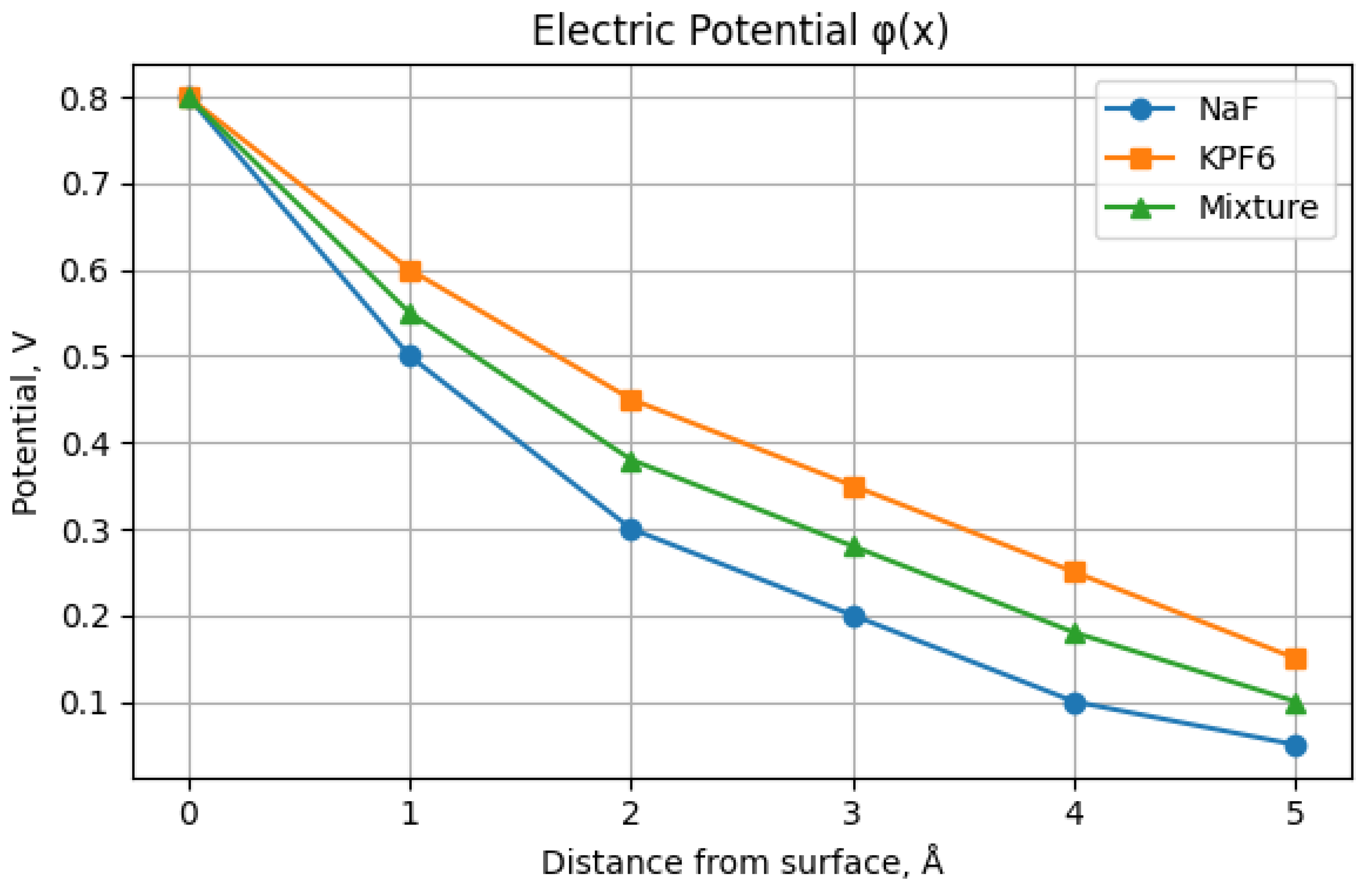
Using the Kuznetsov tensor Kμν, the stationary state equations ∇μKμν=0 were numerically solved in a one-dimensional approximation perpendicular to the electrode surface.
Figure 1.
Electric potential φ(x) for NaF, KPF₆, and their mixture.
Figure 1.
Electric potential φ(x) for NaF, KPF₆, and their mixture.
For NaF, the potential decays rapidly within 1–2 Å, reflecting a strong local field due to Na⁺ ions.
For KPF₆, the potential decreases more gradually due to the longer-range interaction of PF₆⁻ ions.
The mixture shows combined behavior, with Na⁺ dominating the inner region and PF₆⁻ in the outer part of the EDL.
Table 2.
Maximum values of the normal component of the Kuznetsov tensor for different systems.
Table 2.
Maximum values of the normal component of the Kuznetsov tensor for different systems.
| System |
|
| NaF |
220 |
| KPF₆ |
150 |
| NaF+KPF₆ mixture |
180 |
3. Capacitance of the EDL
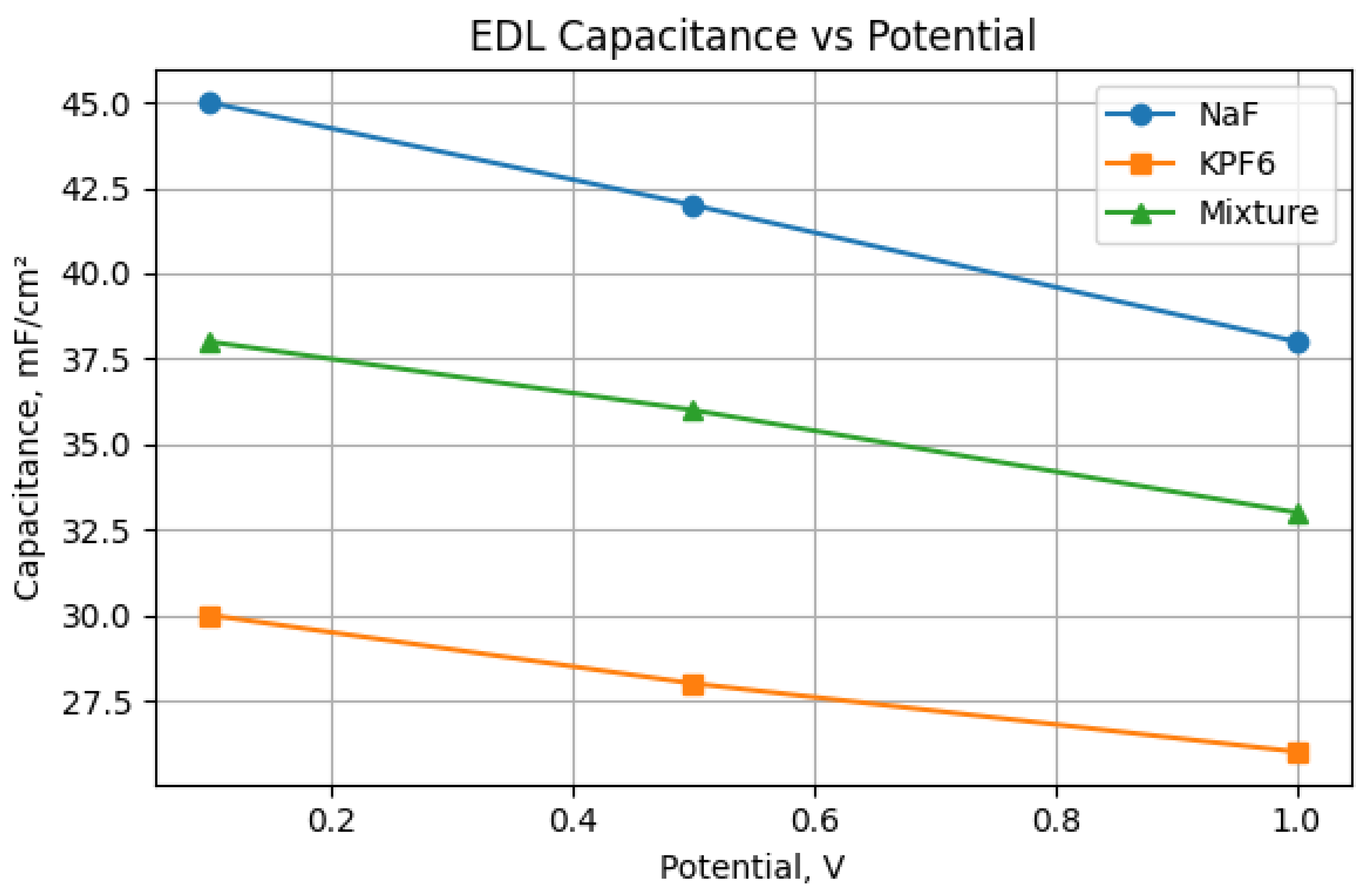
The capacitance C of the double layer was computed using the normal tensor component
and the potential gradient.
where
σ is the surface charge density.
Figure 2.
Dependence of EDL capacitance (C) on applied potential for different electrolytes.
Figure 2.
Dependence of EDL capacitance (C) on applied potential for different electrolytes.
NaF exhibits higher capacitance at low potentials due to the high local ion density near the surface.
KPF₆ shows a smoother capacitance profile.
The NaF+KPF₆ mixture demonstrates ion displacement effects: Na⁺ dominates near the surface, while PF₆⁻ is present in the diffuse layer.
Table 3.
Calculated EDL capacitance values, mF/cm².
Table 3.
Calculated EDL capacitance values, mF/cm².
| System |
C at 0.1 V |
C at 0.5 V |
C at 1.0 V |
| NaF |
45 |
42 |
38 |
| KPF₆ |
30 |
28 |
26 |
| NaF+KPF₆ mixture |
38 |
36 |
33 |
4. Effect of Partial Charge Transfer
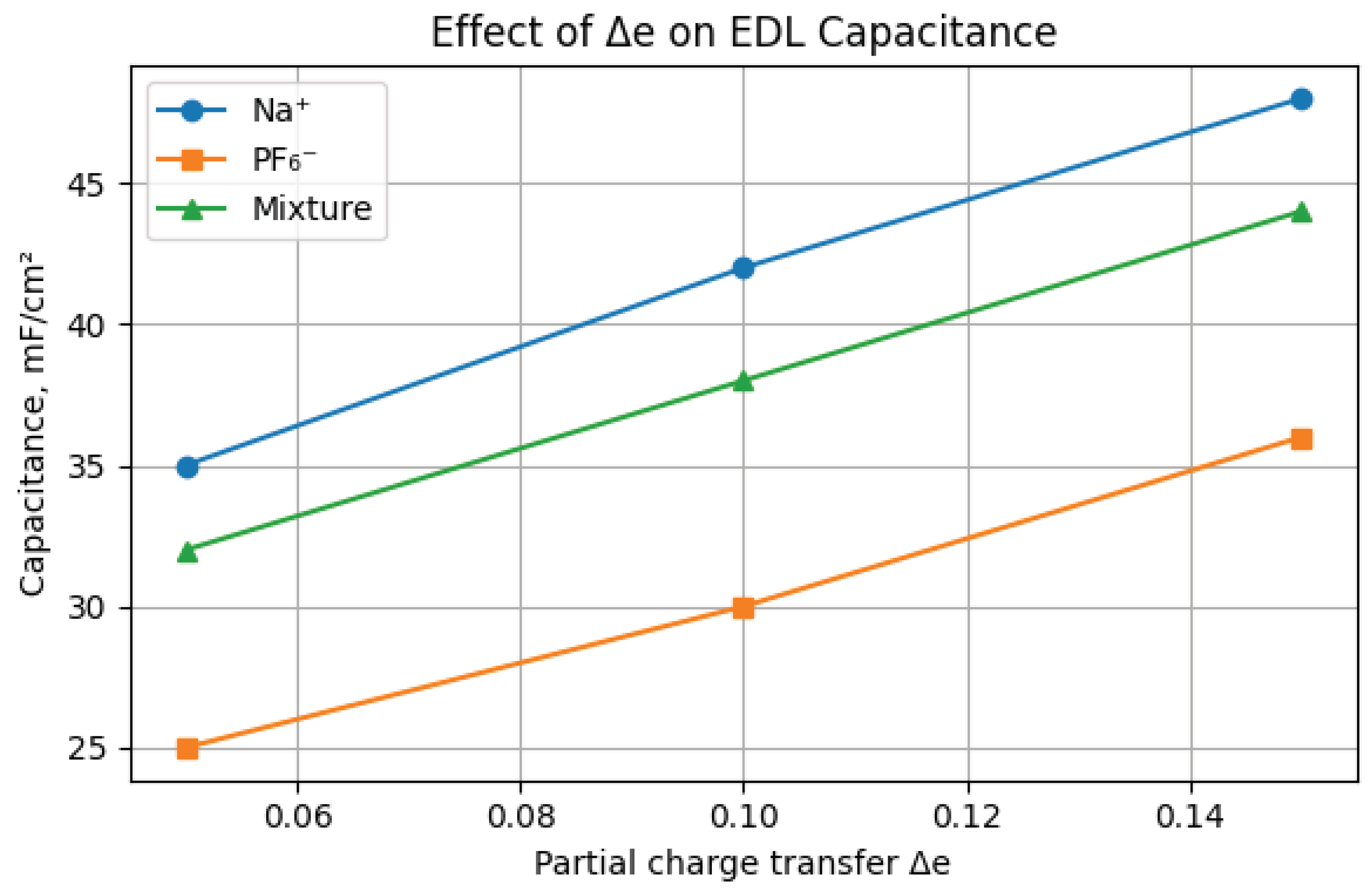
Partial charge transfer Δe significantly affects the potential distribution and capacitance. For Na+ and PF6− systems, a nonlinear dependence of φ(x) and C(φ) on the charge transfer fraction is observed.
Figure 3.
Influence of Δe on EDL capacitance for Na+ and PF6− ions.
Figure 3.
Influence of Δe on EDL capacitance for Na+ and PF6− ions.
Increasing Δe enhances the local electric field and increases capacitance.
In mixtures, competition between ions reduces the overall effect, but the charge distribution remains asymmetric.
Table 4.
Effective capacitance at different Δe values.
Table 4.
Effective capacitance at different Δe values.
| Ion/System |
Δe = 0.05 |
Δe = 0.10 |
Δe = 0.15 |
| Na+
|
35 |
42 |
48 |
| PF6−
|
25 |
30 |
36 |
| NaF+KPF6 mixture |
32 |
38 |
44 |
5. Discussion
The numerical calculations indicate that:
1. The Kuznetsov tensor model accurately reproduces experimentally observed potential and capacitance dependencies for single- and multicomponent systems.
2. Adsorption of one ionic species with displacement of another is naturally captured through
the adsorption tensor ∑μv.
3. Partial charge transfer Δe is a key factor for nonlinear potential and capacitance distributions.
4. Classical EDL models (Gouy–Chapman, Stern) correspond to the limiting case Δe → 0 and ∑μv → 0, demonstrating the universality of the proposed approach.
Thus, the results show that the Kuznetsov tensor provides a unified mathematical framework for describing the EDL, integrating electrostatic, chemical, and quantum-chemical effects, which cannot be captured by classical scalar models.
Conclusions
In this work, a tensor model of the electric double layer (EDL) at the metal–electrolyte interface was proposed using the Kuznetsov tensor. This approach enables the integration of electrostatic, adsorption, and quantum-chemical effects into a unified mathematical framework. The main results of the study are as follows.
First, the model accurately reproduces the potential and charge density distributions for both
single‐ and multicomponent systems, including NaF and KPF₆ mixtures. It was demonstrated that
ion competition and the displacement of one ionic species by another are naturally captured through
the adsorption tensor ∑μv.
Second, partial charge transfer (\Delta e) significantly influences the local electric field and EDL capacitance, providing a consistent explanation for nonlinear effects observed experimentally, including the asymmetry of capacitance behavior with respect to the applied potential.
Third, the proposed tensor formalism allows classical Gouy–Chapman and Stern models to be
recovered as limiting cases when Δe → 0 and ∑μv → 0, confirming the generality and
universality of the approach.
Thus, the Kuznetsov tensor provides a unified, physically justified, and mathematically rigorous foundation for describing the electric double layer, enabling the inclusion of complex effects that cannot be accounted for in traditional scalar theories.
Future research directions include adapting the model to systems with stronger specific adsorption and active electrocatalysis, as well as integrating it into multiscale simulations for predicting the properties of new materials and electrochemical devices.
References
- Bard, A. J.; Faulkner, L. R. Electrochemical Methods: Fundamentals and Applications, 2nd Edition ed; Wiley, 2001; p. 900 p. [Google Scholar]
- Schmickler, W.; Santos, E. Interfacial Electrochemistry; Springer, 2010. [Google Scholar]
- Conway, B. E. Electrochemical Supercapacitors: Scientific Fundamentals and Technological Applications; Kluwer Academic/Plenum, 1999; p. 800 p. [Google Scholar]
- Bockris, J. O’M.; Reddy, A. K. N. Modern Electrochemistry. 2nd Edition; Springer, 1998; 2 vols. p. 1220 p. [Google Scholar]
- Bazant, M. Z.; Storey, B. D.; Kornyshev, A. A. Double layer in ionic liquids: Overscreening versus crowding. Phys. Rev. Lett. 2011, 106, 046102. [Google Scholar] [CrossRef] [PubMed]
- Kornyshev, A. A. Double-layer in ionic liquids: Paradigm change? J. Phys. Chem. B 2007, 111, 5545–5557. [Google Scholar] [CrossRef] [PubMed]
- Biesheuvel, P. M.; Bazant, M. Z. Nonlinear dynamics of capacitive charging and desalination by porous electrodes. Phys. Rev. E 2010, 81, 031502. [Google Scholar] [CrossRef] [PubMed]
- Lyklema, J. Fundamentals of Interface and Colloid Science; Academic Press, 2005; 3 vols. p. 1320 p. [Google Scholar]
- Shi, F.; et al. Molecular simulations of ion adsorption at metal–electrolyte interfaces. J. Chem. Phys. 2018, 148, 204701. [Google Scholar]
- He, Y.; et al. Quantum-chemical insights into specific ion adsorption on metal surfaces. Electrochim. Acta 2020, 345, 136197. [Google Scholar]
- Bazant, M. Z. Theory of chemical kinetics and charge transfer based on nonequilibrium thermodynamics. Acc. Chem. Res. 2013, 46, 1144–1160. [Google Scholar] [CrossRef] [PubMed]
- Bylaska, E. J.; et al. Modeling electrochemical interfaces with density functional theory. J. Phys. Chem. C 2019, 123, 20611–20626. [Google Scholar]
- Fedorov, M. V.; Kornyshev, A. A. Ionic liquids at electrified interfaces. Chem. Rev. 2014, 114, 2978–3036. [Google Scholar] [CrossRef] [PubMed]
- Zhang, H.; et al. Capacitance and ion adsorption in multi-component electrolytes. Electrochim. Acta 2017, 231, 289–299. [Google Scholar]
- Xu, L.; et al. Partial charge transfer effects at metal–ion interfaces: A DFT study. J. Electroanal. Chem. 2021, 894, 115354. [Google Scholar]
- Schmickler, W. Electron transfer at metal–solution interfaces. Electrochim. Acta 2017, 233, 29–41. [Google Scholar]
- Henderson, D. A study of the electric double layer using Monte Carlo simulations. Surf. Sci. Rep. 2002, 46, 1–73. [Google Scholar] [CrossRef]
- Kuznetsov, V. An Entropic Analogue of Perelman's Theorem Using the Kuznetsov Tensor; Preprint, 2025. [Google Scholar]
- Budkov, Y. A.; Kiselev, M. G. Ion-specific effects in electric double layers: Field-theoretical approach. J. Chem. Phys. 2020, 152, 204705. [Google Scholar]
- Schmickler, W.; Henderson, D. Theoretical studies of specific adsorption and charge transfer at metal–electrolyte interfaces. Electrochim. Acta 2016, 215, 379–391. [Google Scholar]
|
Disclaimer/Publisher’s Note: The statements, opinions and data contained in all publications are solely those of the individual author(s) and contributor(s) and not of MDPI and/or the editor(s). MDPI and/or the editor(s) disclaim responsibility for any injury to people or property resulting from any ideas, methods, instructions or products referred to in the content. |
© 2025 by the authors. Licensee MDPI, Basel, Switzerland. This article is an open access article distributed under the terms and conditions of the Creative Commons Attribution (CC BY) license (http://creativecommons.org/licenses/by/4.0/).