

Submitted:
24 December 2025
Posted:
25 December 2025
You are already at the latest version
Abstract
This study explored the characteristics of social network service (SNS)-based marketing strategies and their impacts on customers’ buying behavior and to examine mediating roles of consumption value in small restaurant business settings. The following hypotheses were proposed: First, SNS-based marketing strategies (enjoyabiloty, socializability and informativeness) of restaurant business companies have a significant positive effect on customers’ buying behavior. Second, the consumption value (functional, social and economic values) plays role in mediating the relationship between SNS-based marketing strategies of restaurant business companies and customers’ buying behavior. A self-administered questionnaire survey was performed for a total of 500 Korean customers of restaurant business companies who use SNS. Of these, 361 eligible questionnaire sheets were analyzed. Results are as follows: First, enjoyability and informativeness, rather than socialization, had a significant positive effect on customers’ buying behavior. Second, social value had a mediating effect but functional and economic ones did not. Third, restaurant business companies provided the latest or diverse amusing information via an SNS and thereby had a significant positive effect on buying behavior. It can be concluded that SNS-based marketing strategies should be implemented considering their enjoyability and informativeness as well as social aspects of consumption.
Keywords:
social network service
; SNS
; buying behavior
; enjoyabiloty
; socializability
; informativeness
; functional value
; social value
; economic value
1. Introduction
To date, marketing strategies have depended on one-way communication between the business and customers. With emergence of novel methods of marketing since the early 2000s, however, their use has been decreased. This is followed by changes in marketing trends in certain types of business; there is a growing interest in the use of social network service (SNS) as a novel marketing method. The SNS has been used for business remodeling, operation and management. The SNS is advantageous in expanding reach to the customer at lower costs for shorter periods of time as compared with other marketing tools. This is beneficial for novel types of business [1,2,3,4]. Moreover, the SNS also plays a role in providing opportunities for them, which is greatly dependent on a solid base of users, an increased interaction between the business and consumers. Thus, the SNS is advantageous in promoting the bidirectional communication between the two parties although the traditional marketing method is solely dependent on unidirectional one. Furthermore, the SNS also mediates the transformation of the traditional marketing method to the modern one by inducing customers to view other aspects of the corresponding business [5,6,7].
The SNS is a powerful tool for the efficient planning and implementation of marketing strategies; it plays a role in combining the traditional and modern methods [8].
Integration of the SNS into the marketing strategy poses challenging problems for business owners. It remains uncertain, however, whether they use the SNS without making dedicated efforts to increase sales for their business. The SNS-based marketing strategies are recommended to consider the following four factors: (1) business goals, (2) content strategy, (3) methods and use of the SNS-based marketing implementation and (4) underlying risks [9,10]. Moreover, there are four issues that should be resolved for the integration of the SNS into the marketing strategy: (1) a lack of demographic and socio-economic information of customers, (2) a lack of data management, (3) an ability to validate the quality of customer data and (4) an ability to interpret customer voice [11,12,13].
It has been reported that small restaurant businesses are unwilling to use the SNS for the purposes connecting with current or potential customers. Presumably, this might be because they might be unaware of possible impacts of the SNS-based marketing strategies. This is in agreement with a published study showing that only 26% of small businesses are successful in increasing sales by efficiently reaching potential customers using the SNS. Thus. It remains problematic that there is no wide consensus on the importance of SNS-based marketing strategies [14,15,16,17].
Given the above background, this study was conducted to explore the characteristics of SNS-based marketing strategies and their impacts on customers’ buying behavior and to examine mediating roles of consumption value in small restaurant business settings. Results of the current study will be helpful for promoting the maintenance of relationship with potential and current customers, the growth of the business and the employment.
2. Materials and Methods
2.1. Literature Review
To identify the characteristics of the SNS-based marketing strategies that are optimal for small restaurant businesses, an extensive review of the previous published studies was performed. This mainly focuses on a variety of methods, tools and strategies that are closely associated with the SNS-based marketing as well as challenging problems with and the value of the SNS.
2.1.1. Consumer-Generated Advertising Based on Their Own Created Contents
Since the era of Web 2.0, online communities based on user-created contents have become prevalent on the internet. This has made it possible internet users to obtain information about products and services from others. Thus, consumer-generated advertising has been termed and it is considered a revolutionary innovation in marketing. Its combination with traditional marketing methods has become a more competitive strategy. This is followed by the appropriate management of a relationship between the business and customers. Collaboration and communication between the two parties lead to the formation of social alliance between the users. This activates the interaction between the users and Interactive participation of the business in the online community. It cannot be stated that all the internet users belonging to the online community are potential customers. But if they want to sign up for a certain community, they would be potential customers who are seeking information about products and services [3,14,16,18].
It has been suggested that the use of internet is closely associated with market insight, customer loyalty, customer support, product development, knowledge management and recruitment. A mutual understanding of a relationship between the business and customers is helpful for sharing merits and demerits of the corresponding business with each other. That is, involvement of the business in the online community is an efficient strategy for increasing sales, which is based on identification of key impacts on customers’ needs as well as the business insight into them [2,5,8,17,19,20,21].
2.1.2. The SNS-Based Marketing Strategies and the Relevant Challenges
The emergence of the SNS has affected a relationship between the business and customers, which can be notably seen in small restaurant business that is seeking a one-on-one relationship with customers as well as potential customers. Interaction between the business and customers through use of the SNS would affect sales and awareness of the corresponding business. The SNS has greatly affected online digital communities, thus being involved in the business’ methods for advertising their products and services. Its cost-effectiveness as well as efficiency would be appropriate for marketing strategies of small restaurant business. It is noteworthy, however, that the SNS also provides with the opportunity to choose one product before others [2,5,8,10,11,14,19].
The SNS is also considered a hybrid-marketing tool containing traditional marketing strategies. In more detail, the SNS also play a role in permitting the transfer of information about certain products and services from one customer to another and thereby performing a word-of-mouth function. This eventually leads to the SNS-based marketing based on user-created contents about it [20,21,22].
It has been suggested that the SNS has positive effects in increasing sales, profits and brand awareness through the transmission of opinions from one customer to others. Such opinions may be either positive or negative. Customers’ feedback and response to the businesses are monitored through the SNS. This affects the degree of brand awareness and the development of new products and services [4,6,8,11,17,21].
The SNS poses some challenges for small restaurant business, and these include a lack of the importance and possible impacts of the SNS-based marketing strategies, knowledge about information technology (IT), communication skills and technology-related matters. But a lack of technologies that are needed to operate the SNS can be resolved. Time and learning also serve a common barrier to the use of SNS as a marketing tool. The SNS-mediated transformation of traditional marketing therefore a challenge for small restaurant business. But this should be resolved because there is an increasing number of internet users who sign up for the SNS [2,5,9,18,23].
The SNS is a dynamic marketing tool that requires a constant, meticulous monitoring of essential factors contributing to increased sales. This is closely associated with optimal timing and methods for an appropriate, efficient use of the SNS-based marketing strategies [24,25].
The use of SNS-based marketing strategies is essential for not only staying connected with existing customers but also reaching new ones.. Moreover, the SNS-based marketing strategies should also be established and then successfully implemented in a competitive business environment. This is in agreement with a previous published study showing that the SNS should be incorporated in existing marketing strategies in the presence of five conditions, such as (1) a lack of opportunities to learn the different tools available for the use of SNS, (2) a commitment to forming a social network between the peers, (3) time-consuming establishment of trust and communication between the peers, (4) negative publicity and (5) the possibility of image of the business of influencing its benefits and experience [26,27].
2.2. Study Model
The current study was conducted to examine impacts of SNS-based marketing strategies on customers’ buying behavior and to explore the involvement of consumption value as a mediating variable in a relationship between SNS-based marketing strategies and buying behavior in restaurant business companies. The study model is illustrated in Figure 1.
2.3. Study Hypotheses
For the current study, the following hypotheses were proposed:
Hypothesis 1:
SNS-based marketing strategies of restaurant business companies have a significant positive effect on customers’ buying behavior.
Hypothesis 2:
The consumption value plays role in mediating the relationship between SNS-based marketing strategies of restaurant business companies and customers’ buying behavior.
2.4. Operational Definitions of Variables
SNS-based marketing strategies are composed of three outcome measures, such as enjoyabiloty, socializability and informativeness [28]. In addition, consumption value is defined as customers’ overall assessment of the utility of a product and service, and it is composed of three outcome measures, such as functional, social and economic values [29]. Furthermore, buying behavior is defined as the behavior towards the purchase of merchandise or service [30]. Respondents were instructed to respond to a questionnaire based on a 5-point Likert scale (0=“Never” and 4=“Always”).
2.5. A Questionnaire Survey and Data Collection
The study population comprises Korean customers of restaurant business companies who use SNS. They were evaluated for a self-administered questionnaire survey. Thus, a total of 500 questionnaire sheets were distributed to them between May 1 and June 30, 2019. Of these, 139 questionnaire sheets were not appropriate for analysis and then excluded from the current study. Therefore, a total of 361 questionnaire sheets were finally collected from the respondents.
2.6. Statistical Analysis
For the current study, baseline characteristics of the respondents were collected; these include sex, marital status, age, years of education, occupation and monthly income. To analyze the pattern of their use of SNS, type of SNS, total duration of use of SNS, frequency of daily use of SNS, daily duration of use of SNS and place of use of SNS were examined.
To test reliability and validity of variables, an exploratory factor analysis was performed using the Kaiser-Meyer-Olkin (KMO) and Bartlett’s test, for which the KMO measure of sampling adequacy and the Bartlett’s test of sphericity were provided. Moreover, a regression analysis was performed to identify factors affecting customers’ buying behavior. The hypothesis was tested by evaluating the path coefficients.
3. Results
3.1. Baseline Characteristics of the Respondents
A total of 361 respondents (n=361) were evaluated in the current study; their baseline characteristics are represented in Table 1.
3.2. Characteristics of SNS-Users
To analyze characteristics of SNS-users participating in the current study, pattern of their use of SNS was evaluated as shown in Table 2.
3.3. Results of Exploratory Factor Analysis
An exploratory factor analysis was performed using the KMO and Bartlett’s test. The KMO measure of sampling adequacy was 0.839. Moreover, the Bartlett’s test of sphericity showed approximate χ2=3688.57 and df=539 (P=0.000). Results of exploratory factor analysis are represented in Table 3.
3.4. Results of Correlation Analysis
Results of a correlation analysis are represented in Table 4.
3.5. Results of Regression Analysis
As shown in Table 5, a regression analysis showed that both enjoyability and informativeness of SNS-based marketing strategies had a significant positive effect on customers’ buying behavior (Durbin-Watson statistic=1.597, R=0.477, R2=0.228 Adj-R2=0.234, F=26.778).
3.6. Results of Hypothesis Testing
Results of hypothesis testing are represented in Table 6.
4. Discussion
The current study was conducted to assess impacts of SNS-based marketing strategies on customers’ buying behavior and to examine whether consumption value plays a role in mediating the relationship between SNS-based marketing strategies and customers’ buying behavior. Thus, it attempted to provide significant implications for those who are engaged in restaurant business companies who are in pursuit of diverse management strategies in an effort to survive restaurant business market where competition becomes more and more steep. As a result, it was shown that enjoyability and informativeness, rather than socialization, had a significant positive effect on customers’ buying behavior. This is in agreement with previous published studies showing that enjoyability and functional aspects of the SNS, rather than its social ones, had a significant positive effect on customers’ buying behavior [31,32]. Moreover, following an analysis of whether consumption value plays a role in mediating the relationship between SNS-based marketing strategies and customers’ buying behavior, it was shown that social value had a mediating effect but functional and economic ones did not. This is somewhat contradictory to previous studies in this series. On the other hand, it can be inferred that awareness of characteristics of and motives to use SNS by customers as well as marketing activities customized for customers’ latest trends are essential factors for the effective use of SNS by restaurant business companies [33,34,35]. It would therefore be mandatory to establish an efficient system by which brand value of restaurant business companies can be appreciated through a trustworthy relationship with customers. In particular, it is probable that SNS-based marketing activities may disfigure the image of a company; this may be a cause of customers’ complaints [7,13,22,28,36]. Considering that the major function of website is to deliver information to users, such information should be reliable, up to date and comprehensible [25]. It would therefore be mandatory to devise efficient methods for satisfying needs of SNS users, such as an improved access to services, a real-time feedback on customers’ demands and availability of diverse information. This is because customers commonly tend to select only reliable information or information they may need when making a decision [9,16,28,33,37]. In addition, the current study showed that restaurant business companies provided the latest or diverse amusing information via an SNS and thereby had a significant positive effect on buying behavior. This suggests that further studies are warranted to examine customer-oriented marketing activities. Recent trends have shown that customers posted photos about or left comments on luxurious or well-known restaurants for exhibition use. Thus, they use an SNS as a mean of self-promotion. It can therefore be inferred that marketing strategies for customer enjoyability should be continuously implemented through customer participation when planning for events from aspects of marketing [38,39,40].
In addition, considering latest trends that the use of SNS has been diversified and then increased, SNS-based marketing strategies should be implemented based on characteristics of customers who use an SNS. Of note, the informativeness of SNS-based marketing strategies had a significant positive effect on buying behavior [2,8,11,18,23,31,41,42]. This indicates that the degree of buying behavior is increased according to contents of SNS-based marketing activities. It would therefore be mandatory to continuously develop SNS-based marketing strategies by which restaurant business companies provide their customers with news, menu discount, events, new menus and customer benefits [4,16,22,38,43].
5. Conclusions
Results are as follows: First, enjoyability and informativeness, rather than socialization, had a significant positive effect on customers’ buying behavior. Second, social value had a mediating effect but functional and economic ones did not. Third, restaurant business companies provided the latest or diverse amusing information via an SNS and thereby had a significant positive effect on buying behavior. It can be concluded that SNS-based marketing strategies should be implemented considering their enjoyability and informativeness as well as social aspects of consumption.
Funding
Not applicable.
Acknowledgments
The author thanks Laon Medi Solution Inc. (Seoul, Republic of Korea) and KDH Medical Inc. (Gwangmyeong, Gyeonggi, Republic of Korea) for additional support of this study.
Conflicts of Interest
The authorsreports no competing interests to declare.
References
- Lan-Ying, H.; Ying-Jiun, H.; Yen-Chun, J.W. Gratifications and social network service usage: The mediating role of online experience. Inform. Manage. 2014, 51, 774–782. [Google Scholar]
- Kuan-Yu, L.; Hsi-Peng, L. Why people use social networking sites: An empirical study integrating network externalities and motivation theory. Comput. Human. Behav. 2011, 27, 1152–1161. [Google Scholar]
- Ohbyung, K.; Yixing, W. An empirical study of the factors affecting social network service use. Comput. Human. Behav. 2010, 26, 254–263. [Google Scholar]
- Celeste, S.N. Intention to purchase on social commerce websites across cultures: A cross-regional study. Inform. Manage. 2013, 50, 609–620. [Google Scholar]
- Won, K.; Ok-Ran, J.; Sang-Won, L. On social Web sites. Information Systems 2010, 35, 215–236. [Google Scholar] [CrossRef]
- Samar, M. Factors influencing continuance intention to use social network sites: The Facebook case. Comput. Human. Behav. 2015, 53, 102–110. [Google Scholar]
- Yen-Chun, J.W.; Ju-Peng, S.; Chan-Lan, C. Electronic service quality of Facebook social commerce and collaborative learning. Comput. Human. Behav. 2015, 51, 1395–1402. [Google Scholar]
- Young, S.K.; Heeseok, L. Understanding the role of an IT artifact in online service continuance: An extended perspective of user satisfaction. Comput. Human. Behav. 2010, 26, 353–364. [Google Scholar]
- Young, W.H.; Jimin, K.; Christian, F.L.; Younghoon, C.; Myeong-Cheol, P. Use and gratifications of mobile SNSs: Facebook and KakaoTalk in Korea. Telemat. Inform. 2015, 32, 425–438. [Google Scholar]
- Tahir, M.N.; Caroline, W. Brand interactions and social media: Enhancing user loyalty through social networking sites. Comput. Human. Behav. 2016, 62, 743–753. [Google Scholar]
- Carolyn, A.L.; Tonghoon, K. Predicting user response to sponsored advertising on social media via the technology acceptance. Comput. Human. Behav. 2016, 64, 710–718. [Google Scholar]
- Young-Hyuck, J.; Yunsik, K.; Suk-Joon, Y. Valuing customers for social network services. J. Bus. Res. 2011, 64, 1239–1244. [Google Scholar] [CrossRef]
- Sang, J.K.; Eunil, P.; Ki, J.K. What drives successful social networking services? A comparative analysis of user acceptance of Facebook and Twitter. Soc. Sci. J. 2014, 51, 534–544. [Google Scholar] [CrossRef]
- Young, S.K.; Soongeun, H.; Heeseok, L. Exploring continued online service usage behavior: The roles of self-image congruity and regret. Comput. Human. Behav. 2009, 25, 111–122. [Google Scholar]
- Eric, W.T.N.; Spencer, S.C.T.; Karen, K.L.M. Social media research: Theories, constructs, and conceptual frameworks. Int. J. Inform. Manage. 2015, 35, 33–44. [Google Scholar]
- Paul, P.M. A service science perspective on business model innovation. Ind. Market. Manag. 2013, 42, 665–670. [Google Scholar]
- Suk, B.C.; Myung, SL. Effects of social and technology overload on psychological well-being in young South Korean adults: The mediatory role of social network service addiction. Comput. Human. Behav. 2016, 61, 245–254. [Google Scholar]
- Rui, C. Member use of social networking sites — an empirical examination. Decis. Support. Syst. 2013, 54, 1219–1227. [Google Scholar]
- Ya, P.C.; Dong, H.Z. The role of perceived social capital and flow experience in building users’ continuance intention to social networking sites in China. Comput. Human. Behav. 2012, 28, 995–1001. [Google Scholar]
- Lütfiye, C.; Nihat, K. Social Networking Sites Addiction and the Effect of Attitude towards Social Network Advertising. Procedia. Soc. Behav. Sci. 2016, 235, 484–492. [Google Scholar]
- Shahrokh, N.; Harry, B. Ubiquitous use of mobile social network services. Telemat. Inform. 2014, 31, 422–433. [Google Scholar]
- Chia-Chin, C.; Shiu-Wan, H.; Min-Jhih, C.; Ching-Yi, W. Exploring the intention to continue using social networking sites: The case of Facebook. Technol. Forecast. Soc. Change. 2015, 95, 48–56. [Google Scholar]
- Dong-Ling X. Yann T.; Richard R.K. The effects of collectivism and polychronic time orientation on online social interaction and shopping behavior: A comparative study between China and France. Technol. Forecast. Soc. Change. 2014, 88, 265–275. [CrossRef]
- Soumaya, BL.; Bo, E.; Bård, T. The role of social platforms in transforming service ecosystems. J. Bus. Res. 2016, 69, 1933–1938. [Google Scholar] [CrossRef]
- Jieun, L.; Ilyoo, B.H. Predicting positive user responses to social media advertising: The roles of emotional appeal, informativeness, and creativity. Int. J. Inform. Manage. 2016, 36, 360–373. [Google Scholar]
- Tao, Z.; Hongxiu, L. Understanding mobile SNS continuance usage in China from the perspectives of social influence and privacy concern. Comput. Human. Behav. 2014, 37, 283–289. [Google Scholar]
- Seok, J.Y. The dynamic competitive recommendation algorithm in social network services. Inform. Sciences. 2012, 187, 1–14. [Google Scholar]
- Xiayu, C.; Qian, H.; Robert, M.D. The role of website quality and social capital in building buyers’ loyalty. Int. J. Inform. Manage. 2017, 37, 1563–1574. [Google Scholar]
- Heeju, C.; Eunju, K. Customer social participation in the social networking services and its impact upon the customer equity of global fashion brands. J. Bus. Res. 2016, 69, 3804–3812. [Google Scholar] [CrossRef]
- Young, S.K.; Jinyoung, M.; Jeoungkun, K.; Heeseok, L. Roles of alternative and self-oriented perspectives in the context of the continued use of social network sites. Int. J. Inform. Manage. 2013, 33, 496–511. [Google Scholar]
- Sang-Hoon, K.; Kun-Huang, H. Winning strategies for innovation and high-technology products management. J. Bus. Res. 2011, 64, 1147–1150. [Google Scholar] [CrossRef]
- Myungsuh, L.; Yoon, Y. Effects of users’ envy and shame on social comparison that occurs on social network services. Comput. Human. Behav. 2015, 300–311. [Google Scholar]
- Myung, J.K.; Choong-Ki, L.; Noshir, S.C. Seniors’ usage of mobile social network sites: Applying theories of innovation diffusion and uses and gratifications. Comput. Human. Behav. 2019, 90, 60–73. [Google Scholar]
- Jillian, C.S.; Geoffrey, N.S. Consumer perceived value: The development of a multiple item scale. J. Retail. 2001, 77, 203–220. [Google Scholar] [CrossRef]
- Sandra, M.F.; Bo, S. Consumer patronage and risk perceptions in Internet shopping. J. Bus. Res. 2003 2003, Volume 56(Issue 11), 867–875. [Google Scholar]
- Hee-Woong, K.; Sumeet, G.; Joon, K. Investigating the intention to purchase digital items in social networking communities: A customer value perspective. Inform. Manage. 2011, 48, 228–234. [Google Scholar]
- Hsi-Peng, L.; Kuo-Lun, H. The influence of extro/introversion on the intention to pay for social networking sites. Inform. Manage. 2010, 47, 150–157. [Google Scholar]
- Kem, Z.K.Z.; Morad, B. Consumer behavior in social commerce: A literature review. Decis. Support. Syst. 2016, 86, 95–108. [Google Scholar]
- Yoonhyuk, J.; Suzanne, D.P.; Hee-Woong, K. Exploring associations between young adults’ facebook use and psychological well-being: A goal hierarchy approach. Int. J. Inform. Manage. 2017, 1391–1404. [Google Scholar]
- Juhee, K.; Liang, T.; Ann, M.F. Enhancing consumer–brand relationships on restaurant Facebook fan pages: Maximizing consumer benefits and increasing active participation. Int. J. Hosp. Manag. 2014, 36, 145–155. [Google Scholar] [CrossRef]
- Fareena, S.; Andrew, J.R.; Tao, G. Factors Influencing Consumer Acceptance of Mobile Marketing: A Two-Country Study of Youth Markets. J. Interact. Mark. 2000, 23, 308–320. [Google Scholar]
- Stephen, J.G.; Raymond, P.F. The impact of other customers on service experiences: A critical incident examination of “getting along “. J. Retail. 1997, 73, 63–85. [Google Scholar]
- Yu-Hsiang, L.; Chia-Lin, H.; Mei-Fang, C.; Cheng-Hsi, F. New gratifications for social word-of-mouth spread via mobile SNSs: Uses and gratifications approach with a perspective of media technology. Telemat. Inform. 2017, 34, 382–397. [Google Scholar]
Figure 1.
Study model.
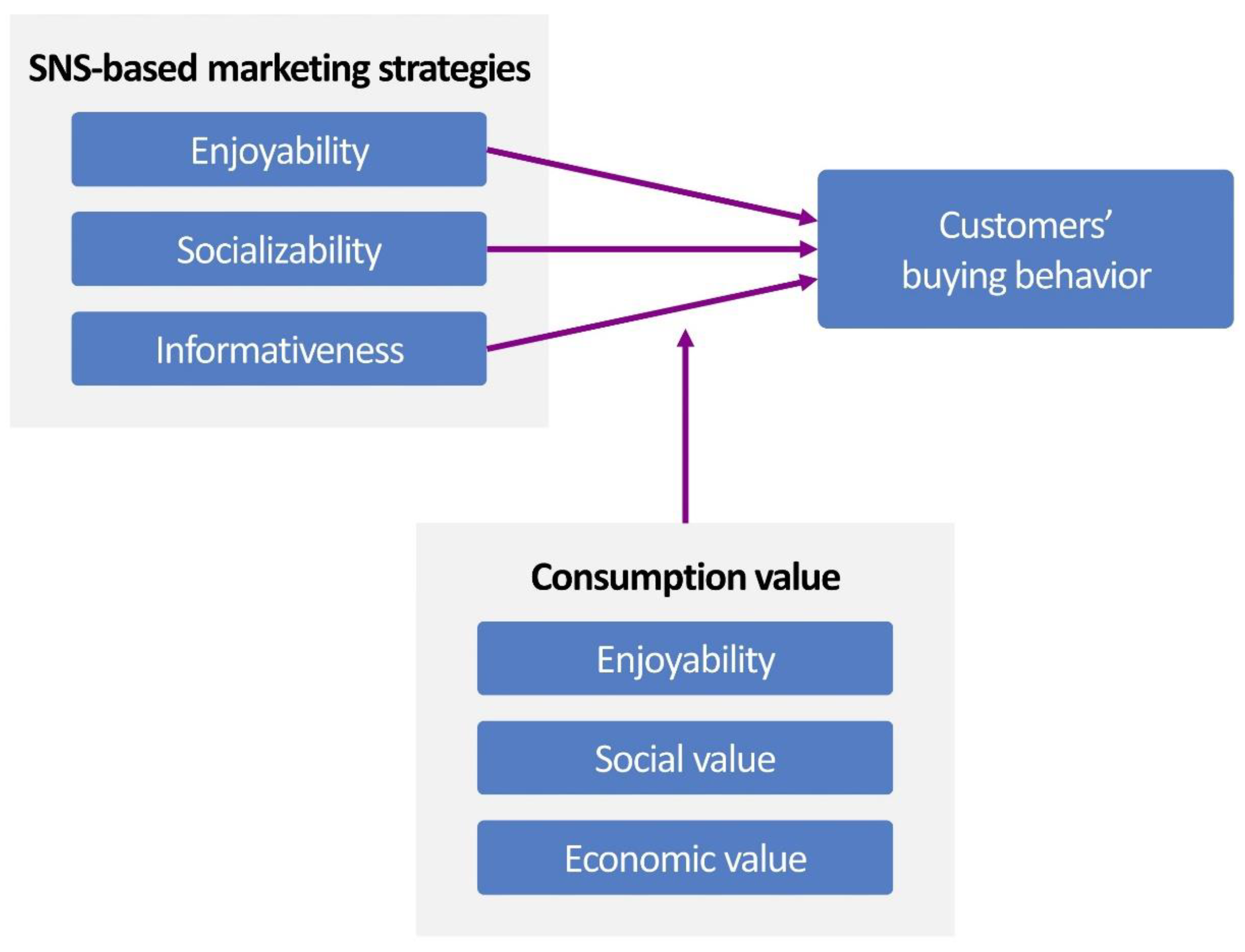

Table 1.
Baseline characteristics of the respondents (n=361).
| Values | Variables | ||||
| Sex | |||||
| Men | 187 (51.80%) | ||||
| Women | 174 (48.20%) | ||||
| Marital status | |||||
| Married | 121 (33.52%) | ||||
| Unmarried | 240 (66.48%) | ||||
| Age (years) | |||||
| ≤19 | 52 (14.40%) | ||||
| 20-29 | 120 (33.24%) | ||||
| 30-39 | 70 (19.39%) | ||||
| 40-49 | 53 (14.68%) | ||||
| 50-59 | 40 (11.08%) | ||||
| ≥60 | 26 (7.21%) | ||||
| Years of education | |||||
| Elementary school graduate | 1 (0.28%) | ||||
| Middle school graduate | 1 (0.28%) | ||||
| High school graduate | 113 (31.30%) | ||||
| College graduate | 82 (22.71%) | ||||
| University graduate | 164 (45.43%) | ||||
| Occupation | |||||
| High school student | 52 (14.40%) | ||||
| College or university student | 83 (22.99%) | ||||
| Office worker | 21 (5.82%) | ||||
| Self-employed person | 27 (7.48%) | ||||
| Profession | 135 (37.40%) | ||||
| Housewife | 32 (8.86%) | ||||
| Unemployed person | 8 (2.22%) | ||||
| Others | 3 (0.83%) | ||||
| Monthly income (USD) | |||||
| <1,238 | 19 (5.26%) | ||||
| 1,238-2,477 | 73 (20.22%) | ||||
| 2,477-4,128 | 139 (38.50%) | ||||
| 4,128-5,780 | 85 (23.55%) | ||||
| >5,780 | 45 (12.47%) | ||||
Values are the number of the respondents or percentage, where appropriate.
Table 2.
Pattern of the respondents’ use of social network service (SNS) (n=361).
| Variables | Values | |||
| Type of SNS | ||||
| Youtube | 92 (25.49%) | |||
| 195 (54.02%) | ||||
| 6 (1.66%) | ||||
| Naver blog | 36 (9.97%) | |||
| 32 (8.86%) | ||||
| Total duration of use of SNS | ||||
| <1 month | 8 (2.22%) | |||
| 1-6 months | 38 (10.53%) | |||
| 6 months - 1 year | 58 (16.07%) | |||
| 1-2 years | 131 (36.29%) | |||
| 2-3 years | 61 (16.90%) | |||
| >3 years | 65 (17.99%) | |||
| Frequency of daily use of SNS | ||||
| <1 | 8 (2.22%) | |||
| 1-3 | 81 (22.44%) | |||
| 3-5 | 90 (24.93%) | |||
| 5-10 | 94 (26.04%) | |||
| >10 | 88 (24.37%) | |||
| Daily duration of use of SNS | ||||
| <10 minutes | 32 (8.86%) | |||
| 10-30 minutes | 128 (35.46%) | |||
| 30-60 minutes | 118 (32.69%) | |||
| >60 minutes | 83 (22.99%) | |||
| Place of use of SNS | ||||
| Home | 82 (22.71%) | |||
| Work of school | 67 (18.56%) | |||
| Others | 212 (58.73%) | |||
Values are the number of the respondents or percentage, where appropriate.
Table 3.
Exploratory factor analysis.
| Variables | Cronbach’sα | Factor loadings | Eigenvalue | |
| SNS | Enjoyability | 0.788 | 0.713 | 7.732 |
| Socializability | 0.791 | 0.706 | 3.117 | |
| Informativeness | 0.648 | 0.699 | 2.546 | |
| Consumption value | Functional value | 0.689 | 0.644 | 1.884 |
| Social value | 0.776 | 0.717 | 1.566 | |
| Economic value | 0.758 | 0.743 | 1.231 | |
| Buying behavior | Buying behavior | 0.797 | 0.726 | 1.168 |
Abbreviations: SNS, social network service.
Table 4.
Correlation analysis.
| Variables | Enjoyability | Socializability | Informativeness | Functional value | Social value | Economic value | Buying behavior | |
| Mean±SD | ||||||||
| Enjoyability | 3.81±0.62 | 1 | ||||||
| Socializability | 3.75±0.77 | 0.348** | 1 | |||||
| Informativity | 4.01±0.58 | 0.417** | 0.238** | 1 | ||||
| Functional value | 4.09±0.46 | 0.369** | 0.199** | 0.536** | 1 | |||
| Social value | 3.12±0.78 | 0.198** | 0.177** | 0.038** | 0.063 | 1 | ||
| Economic value | 3.88±0.55 | 0.127** | 0.089 | 0.254 | 0.291** | 0.266** | 1 | |
| Buying behavior | 3.62±0.71 | 0.358* | 0.123* | 0.287** | 0.348** | 0.354** | 0.301** | 1 |
Abbreviations: SD, standard deviation. *Statistical significance at P<0.05. **Statistical significance at P<0.01.
Table 5.
Regression analysis.
| Independent variables | Dependent variable | SE | β | t | P | Tolerance | VIF |
|---|---|---|---|---|---|---|---|
| Enjoyability | Buying behavior | 0.063 | 0.412 | 7.069 | 0.000* | 0.716 | 1.385 |
| Socializability | 0.056 | -0.059 | -1.078 | 0.188 | 0.823 | 1.212 | |
| Informativeness | 0.066 | 0.118 | 2.106 | 0.029** | 0.809 | 1.226 |
Abbreviations: SE, standard error; VIF, variance inflation factor. *Statistical significance at P<0.001. **Statistical significance at P<0.05.
Table 6.
Hypothesis testing.
| Hypothesis |
Path coefficients (standardized) |
t | Results |
| Enjoyability → Buying behavior |
0.383* | 8.593 | Accepted |
| Informativeness → Buying behavior |
0.409* | 9.308 | Accepted |
| Socializability → Buying behavior |
0.068 | 1.468 | Rejected |
| Social value → Relationship between SNS-based marketing strategies and customers’ buying behavior |
0.246* | 5.543 | Accepted |
| Functional value → Relationship between SNS-based marketing strategies and customers’ buying behavior |
0.253 | 5.170 | Rejected |
| Economic value → Relationship between SNS-based marketing strategies and customers’ buying behavior |
0.126 | 2.932 | Rejected |
Abbreviations: SNS, social network service. *Statistical significance at P<0.001.
Disclaimer/Publisher’s Note: The statements, opinions and data contained in all publications are solely those of the individual author(s) and contributor(s) and not of MDPI and/or the editor(s). MDPI and/or the editor(s) disclaim responsibility for any injury to people or property resulting from any ideas, methods, instructions or products referred to in the content. |
© 2025 by the authors. Licensee MDPI, Basel, Switzerland. This article is an open access article distributed under the terms and conditions of the Creative Commons Attribution (CC BY) license (http://creativecommons.org/licenses/by/4.0/).
Copyright: This open access article is published under a Creative Commons CC BY 4.0 license, which permit the free download, distribution, and reuse, provided that the author and preprint are cited in any reuse.


