

Submitted:
09 February 2024
Posted:
09 February 2024
You are already at the latest version
Abstract
Promoting organic foods production and consumption contributes to accomplishing United Nations sustainable development goals. Social commerce provides a promising opportunity to develop the organic food industry. However, there is limited knowledge regarding customer behaviors in relation to purchasing organic foods via social commerce platforms. Therefore, this study expanded upon the unified theory of acceptance and use of technology (UTAUT-2) to develop a comprehensive model that explains how customers' social commerce trust and behavioral intentions to purchase organic foods using Instagram social commerce affect their purchasing behaviors. The research model was analyzed by employing partial least squares structural equation modeling (PLS-SEM) for the data collected from a quantitative survey of 410 customers who used Instagram to purchase organic foods in Iran. The results revealed that facilitated purchasing conditions, hedonic motivations, social influence, rating and reviews, and influencers’ endorsements increase customers' purchase intentions. Moreover, Instagram’s recommendations and referrals, influencers’ endorsements, as well as social influence boost customers' trust in the social commerce platform. Eventually, it was determined that influencers’ endorsements, social commerce trust, and purchase intention determine a customer’s organic foods purchasing behaviors. This research provides valuable insights for organic food marketers to optimize their social commerce strategies.
Keywords:
sustainable development
; organic food industry
; social commerce
; influencer marketing
; UTAUT-2
; purchase intention
; social commerce trust
; purchase behaviors
; Iran
1. Introduction
With its rich agricultural heritage, Iran is recognized as one of the world’s most ancient historical farming regions [1]. The economic foundation of this country is strongly dependent on agribusiness [2,3]. Iran’s agribusiness revenue is predicted to increase significantly, from USD 86.25 billion in 2023 to USD 135.70 billion in 2028 [4]. In the fiscal year ending March 2023, Iran exported a total of USD 5.2 billion worth of agricultural products, accounting for 6.37% of its total non-oil exports [5]. Moreover, the agricultural industry constituted around 16% of Iran’s overall employment [6]. Even though this industry plays a positive role in the economic growth of this country, it has also had a number of adverse environmental consequences [7]. One of the most urgent environmental issues that Iran is currently confronting is the severe threat of soil erosion [8]. The current estimated rate of soil erosion in Iran is 16.5 tons annually, which is five times higher than the average worldwide rate [9]. Soil erosion, as defined by the food and agriculture organization (FAO) of the United Nations (UN), refers to the accelerated loss of topsoil from the land’s surface via water, wind, and cultivation [10]. The process of soil erosion can be significantly contributed to and expedited through unsustainable human practices, particularly agricultural intensification, the destruction of forests, and excessive pasture usage, as well as unsustainable land use [10]. Soil erosion detrimentally affects the long-term sustainability of farmlands [11].
Fortunately, environmental concerns such as soil erosion can be effectively addressed through the implementation of organic agricultural practices [12,13,14], which is an essential component of sustainable development [15,16]. Organic-based agriculture offers solutions for the majority of challenges encountered in modern agriculture and food production, which ensures improved soil health and the sustainability of ecosystems [17,18,19]. The implementation of organic practices in the agriculture industry, which excludes the usage of synthetic fertilizers, is projected to result in a 40% reduction in nitrous oxide emissions from the soil per hectare [20]. In this regard, Skinner et al. [21] conducted experimental research in Switzerland to determine the distinctions and impacts of organic and non-organic agricultural practices. The results obtained from their investigation demonstrate that organic agricultural systems yield 40.2% less nitrous oxide emissions per hectare.
Organic foods are defined as foods and beverages that adhere to organic production regulations [19]. Iran’s primary organic food products consist of saffron, pistachios, dates, walnuts, peaches, apples, olives, pomegranates, rice, tomatoes, potatoes, carrots, safflower, figs, and roses, as well as medical herbs [22]. Evidently, there has been a worldwide increase in customer demand for organic food products [23], and consumers’ environmental and health concerns have become a significant factor driving this trend [24]. However, despite the global trend towards organic food production and consumption to improve human health and sustainability, there have been no significant efforts to organize and promote organic agriculture in Iran [25].
Even though organic agriculture has made progress in Iran [22,26], it still only makes up slightly more than 0.015% of the country’s total agricultural acreage [27], which is significantly lower than the global rate of 1.6% [27]. Moreover, the current developments in Iran’s agricultural sector are still far from meeting the target set in Iran’s vision 2025, which aims to achieve a 25% compliance with organic agriculture principles [22]. One of the primary reasons for the comparatively small size of the organic food industry in developing countries, such as Iran, is the lack of readily available sales and marketing channels [28,29,30,31]. Notwithstanding, organic food businesses might overcome challenges caused by limited access to conventional retail markets by expanding their operations toward social commerce marketing through social networking sites (SNSs) [32,33].
Social commerce (SC) is an emerging technology within the realm of electronic commerce (e-commerce) that leverages SNSs to facilitate online commerce activities and transactions [34]. The advent of SC technologies has transformed the landscape of online shopping by fostering robust connections between online businesses and their customers [35]. Meanwhile, the popularity of SNSs facilitates the global expansion of SC [36], allowing customers to purchase online while also exchanging information, such as commenting on their shopping experiences and rating their overall satisfaction [37].
In 2022, the SC sector approximately generated USD 728 billion in income globally [38]. This number is anticipated to show a compound annual growth rate (CAGR) of 31.6% from 2023 to 2030 and reach around USD 6.2 trillion by the end of this period [38]. This figure underscores the significance of SC and emphasizes the importance of acknowledging its potential for businesses. Moreover, the crucial role of SC in promoting socio-economic stability is increasingly being recognized in the context of the COVID-19 pandemic and its aftermath [39,40,41]. Although there is considerable potential for the development of the organic food industry through SC platforms [42,43], there remains a lack of understanding regarding the factors that influence customers’ behaviors in relation to using such platforms for purchasing organic food products [33,42,44].
In Iran’s agribusiness sector, the intense competition in the e-commerce market and highly perishable nature of organic foods have led to the rapid growth of Instagram as an effective platform for consumers to buy organic foods [32]. Instagram is one of the most popular social networking platforms in the world, particularly among Iranian users [45,46]. In 2022, the value of SC on Instagram in Iran was estimated to be USD 84.4 million [47]. This platform was especially important to Iran’s economy during the COVID-19 pandemic [48]. Leveraging Instagram as an SC platform for marketing and selling products and services is an emerging field of knowledge [49]. Thus, given the unique characteristics and functionalities of each SNS [50], Instagram was selected for this research to minimize potential biases that may arise from choosing multiple platforms.
The unified theory of acceptance and use of technology (UTAUT-2) [51], is employed as the theoretical foundation for the research model due to the fact it fulfills the underlying notion of this study, which is exploring costumers’ behavioral intentions and actual behaviors towards using Instagram social commerce technology for purchasing organic food products. Based on the literature reviews, the UTAUT-2 is one of the most comprehensive theories/models in the realm of individual consumer technology acceptance and usage behaviors owing to its holistic approach [52]. Moreover, UTAUT-2 has been tested in numerous studies, all of which have found it to be valid in explaining an individual’s technology adoption in consumption circumstances [53,54,55].
The primary objective of this research is to address the knowledge gap in the field of organic food marketing, with a particular emphasis on SC via the Instagram platform. The findings of this study can greatly assist organic food businesses in enhancing the purchasing experience for their customers and optimizing their SC strategies.
This article is organized as follows: It commences with a synopsis of the SC literature and organic food sector. After presenting the research hypotheses and model, the research methodology and statistical analysis results are detailed. The paper concludes with research implications, limitations, and recommendations for future studies.
2. Literature Review
SC technology is commonly regarded as an extension of e-commerce that is enhanced through web 2.0 (internet 2.0) capabilities and facilitates more user interaction and engagement [56]. The concept of SC was first used in 2005 when Yahoo.com launched “Yahoo Shoposphere” to describe a new collaborative shopping mechanism on its webpage [57]. Four years later, Flowers.com, which was a flower and gift business, established the first Facebook-based online marketplace in 2009, the formal launch of SNS-based commerce [58]. Scholars from various academic disciplines, ranging from social science, ICT, and marketing to consumer behavior, have been conducting studies exploring SC technologies [59]. The early studies predominantly centered on SC inception, distinguishing features, and architectural designs [60]. The current SC literature, however, primarily investigates the related variables that impact customers’ purchasing intentions and behaviors [59].
In light of the rising popularity of SNSs [61], and the growing usage of SC technologies [62], the organic food industry today has an unprecedented opportunity to develop and prosper by leveraging SNS-based SC technologies for marketing and selling their products [42,43]. However, there has been a scarcity of research that focuses on how consumers of organic food products perceive SNS-based SC as an online commerce channel for purchasing these products [33]. Furthermore, despite the vital role that consumers’ trust plays in SC [63], its determinants are still inadequately comprehended [64,65], especially in the Middle East’s SC sector [66].
In addition, the current literature regarding the impact of social media influencers’ (SMIs) endorsements on customers’ online purchase intention is limited [67]. Particularly, additional investigation is required to ascertain how SMIs-based marketing influences consumers’ behaviors in SC contexts [68,69]. Meanwhile, the overwhelming majority of previous studies on SMIs-based marketing have concentrated on the apparel, cosmetics, and tourism businesses [68]. Therefore, this is a need for further research into the possible effectiveness of influencer-based marketing in other sectors, including the food industry [70]. Moreover, the existing SC studies have overtly focused on customers’ purchase intentions as a proxy for their purchasing behaviors, neglecting the long-existing intention–behavior gap [71,72,73], which has limited their practical applications [74].
In order to address the aforementioned gaps, this study aims to investigate the underlying mechanisms that affect customers’ SC trust and behavioral intentions toward buying organic food products through the Instagram platform. The notion of customers’ trust is complex and has multiple aspects [63]. However, the present study concentrates specifically on the institutional dimension of trust that underlies Instagram as an SC platform. Hence, the combined questions in this research can be framed as follows: What are the determinants within the Instagram SC context that shape the customers’ SC trust and their intention to engage in purchase behaviors on this platform, and how do these determinants impact their actual purchasing behaviors?
To ensure a comprehensive examination of the research questions, this study incorporated management-, person-, and technology-related factors. This research primarily examined the phenomenon of Instagram social commerce within the organic food industry at a managerial level. The factors classified within the person-related dimension encompass SC constructs, social media influencer endorsement, social influence, SC trust, purchase intention, and purchasing behaviors. Ultimately, the technology component encompassed elements such as the platform’s accessible resources and capabilities for conducting online purchases. Accordingly, this paper explores a variety of social, technical, and socio-technical factors in an effort to develop a comprehensive framework that can be used to better understand the trust, intentions, and behaviors of the customers who employ Instagram as an SC platform for purchasing organic food products.
3. Development of Hypotheses and Research Model
Venkatesh et al. [51] define performance expectancy (PE) as practical utilities that impact an individual’s inclination to adopt new technologies. PE has been identified as an important determinant of customers’ purchase intentions in various online commerce channels, including omnichannel technology [75], fresh e-commerce platforms [76], online group buying platforms [77], and SC platforms [78]. Hence, it can be assumed that the customers’ perceptions of Instagram’s SC performance in relation to purchasing organic food products will have a direct impact on their purchase intention (PI), as well as an indirect impact on their purchasing behavior (PB) through the mediating role of PIs. Hence, the following hypotheses are formulated:
H1a.
PE has a positive and significant effect on PI.
H1b.
PE mediates the relationship between PI and PB.
The concept of effort expectancy (EE) describes a user’s perception that a given technology is relatively simple to learn and use [51]. EE is recognized as a key factor affecting customers’ purchase intentions across e-commerce technologies, such as online open market platforms [79], m-commerce applications [80], and SC platforms [78]. Therefore, this study postulated that consumers’ perceptions regarding Instagram’s ease of usage with regard to purchasing organic food products will significantly impact their purchase intentions, as well as their actual purchasing behaviors through the mediating role of PI. Accordingly, the following hypotheses have been developed:
H2a.
EE has a positive and significant effect on PI.
H2b.
EE mediates the relationship between PI and PB.
As defined by Venkatesh et al. [51], facilitating condition (FC) pertains to the users’ perceptions regarding the extent to which a particular technology can assist them in effectively completing specific tasks. FC serves as a fundamental predictor within the UTAUT-2 model, influencing users’ intentions towards using new technologies [81]. It has been determined that platform-facilitated purchasing conditions favorably impact the customers’ SC-based purchase intentions [82,83]. In the context of the current research, it is essential to take into consideration the recent developments in the SC capabilities of the Instagram platform [84]. These enhancements aim to streamline customers’ online purchasing experiences [85]. Therefore, it can be expected that Instagram’s SC facilitators have a direct impact on PI, as well as an indirect impact on PB via the mediating mechanism of PI. This line of reasoning resulted in the subsequent hypotheses:
H3a.
FC has a positive and significant effect on PI.
H3b.
FC mediates the relationship between PI and PB.
Hedonic motivation (HM) refers to the perception of enjoyment derived from using technologies [51]. The consumers who enjoy using Instagram for SC purposes have been reported to be significantly more inclined to purchase available products [49]. In this regard, Rahman et al. [65] stated that HM positively and significantly impacts a customer’s propensity towards using SC platforms for purchasing perishable food products. Therefore, it can be anticipated that the hedonistic motives behind purchasing organic food products using Instagram social commerce directly impact customers’ purchase intentions and indirectly impact their purchasing behaviors through the mediating role of PI. The aforementioned discussion resulted in the development of following hypotheses:
H4a.
HM has a positive and significant effect on PI.
H4b.
HM mediates the relationship between PI and PB.
The phenomenon in which the views of their peers influence an individual’s decision to adopt and use a particular technology is known as social influence (SI) [51]. The impact of SI on customers’ purchasing intentions across different online commerce technologies has been highlighted in earlier studies [65,86]. Moreover, it has been indicated that SI has favorable influence on customers’ SC trust [87]. In this regard, Maulida et el. [88] stated that SI significantly affects customers’ trust towards SC on the TikTok platform. In addition, SI holds significant relevance in current research due to the fact that Middle Eastern nations are typically characterized as collectivist cultures [89]. As a collectivist society, the decision-making processes of the Iranian people are profoundly affected by their social circles [89,90]. In light of these considerations, this study posits that SI has a favorable influence on both PI and SCT, as well as an indirect effect on PB via two mediators: PI and SCT. Accordingly, the following hypotheses have been formulated:
H5a.
SI has a positive and significant effect on PI.
H5b.
SI mediates the relationship between PI and PB.
H6a.
SI has a positive and significant effect on SCT.
H6b.
SI mediates the relationship between SCT and PB.
Social commerce constructs (SCCs) refer to the functionalities that have been added to e-commerce platforms with the aim of enhancing their interactivity [91]. This study investigated two components of SCCs: recommendations and referrals (RERs), and ratings and reviews (RARs). These SCCs are determined to have a positive impact on customers’ SC-based purchase intentions [41]. In addition, it has been stated that SCCs can help customers to manage the overwhelming amount of information in SC platforms and focus on the appropriate products and merchants [92]. In turn, perceived knowledge develops customers’ trust towards the SC platforms being used [93]. Hence, this study hypothesized that SCCs have favorable influence on PI and SCT, as well as an indirect effect on PB via two mediators: PI and SCT. Accordingly, the following hypotheses have been developed:
H7a.
RERs have a positive and significant effect on PI.
H7b.
RERs mediate the relationship between PI and PB.
H8a.
RERs have a positive and significant effect on SCT.
H8b.
RERs mediate the relationship between SCT and PB.
H9a.
RARs have a positive and significant effect on PI.
H9b.
RARs mediate the relationship between PI and PB.
H10a.
RARs have a positive and significant effect on SCT.
H10b.
RARs mediate the relationship between SCT and PB.
Social media influencers (SMIs) are people who actively participate in creating and sharing information on their social media accounts and have become renowned for their expertise in various fields, such as fashion, beauty, fitness, and health [94]. Endorsements are widely employed by businesses in prominent SMI-based marketing strategies to promote their products [95,96,97]. A social media influencer’s endorsement (SMIE) is found to be a significant determinant of customers’ purchase intentions across online commerce technologies, including as e-commerce [67], and SC platforms [88]. Moreover, there seems to be a notable correlation with consumer trust regarding SMIs and the technology that they endorse [98]. Given that Instagram is a popular platform for SMI-based marketing [96,99], this study posits that SMIEs enhance both PI and SCT. In addition, it has been stated that SMIEs have a significant impact on SC customers’ purchasing behaviors [100]. Therefore, it is expected that SMIEs will favorably affect PB both directly and indirectly through the mediating roles of two factors: SCT and PI. The aforementioned considerations resulted in the development of the following hypotheses:
H11a.
SMIEs have a positive and significant effect on PI.
H11b.
SMIEs mediate the relationship between PI and PB.
H12a.
SMIEs have a positive and significant effect on SCT.
H12b.
SMIEs mediate the relationship between SCT and PB.
H13.
SMIEs have a positive and significant effect on PB.
Social commerce trust (SCT) refers to customers’ perceptions of the provided assistance and support on a given SC platform, which simplifies their online purchasing experience [64]. It has been argued that trust facilitates online transactions in SC settings [66,101]. Moreover, it has been stated that trust positively influences customers’ SC-based purchase behaviors [102]. Accordingly, this study proposes that SCT significantly influences PB. Hence, the hypothesis that follows is developed:
H14.
SCT has a positive and significant effect on PB.
It has been determined that consumers’ behavioral intentions regarding using online commerce platforms play a crucial role in shaping their subsequent usage behaviors [103]. This research posits that customers’ behavioral intentions towards using the Instagram platform for purchasing organic food products significantly and positively impact their subsequent purchasing behaviors. Accordingly, the following hypothesis is proposed:
H11.
PI has a positive and significant effect on PB.
The credibility of the UTAUT-2 as one of the most comprehensive models for explaining the technology acceptance and usage behaviors of individual consumers [104] makes it the most suitable model for current investigation. Notwithstanding, in order to further enhance the applicability of the UTAUT-2 model in the context of SC on Instagram, this study expanded it through incorporating SCCs and SMIEs as novel exogenous constructs. In addition, SCT has been introduced as an additional mediation mechanism within the UTAUT-2’s framework. This study further considers the impact of three demographic variables, namely, customers’ age, gender, and frequency of using SC (SCF), in order to perform a thorough analysis and ensure that the empirical findings are not influenced by other factors. Accordingly, a thorough analysis is conducted on the paths through which consumers’ usage of Instagram social commerce is influenced by SCT, SMIEs, and PI. Throughout these interactions, various aspects are taken into account, including sociability, practicality, and the alignment between the socio-personal and technological elements. Figure 1 illustrates the model constructed for this research.
4. Research Methodology
4.1. Research Design
Exploratory research was conducted in this study by using a quantitative online survey to investigate the research hypotheses. The variables incorporated within the research framework were measured using a psychometric instrument, and the numerical information that was eventually collected was analyzed using statistical procedures [105]. Employing a quantitative method helps ensure that the findings of this study can be generalized and replicated [105]. This study focused on Iranian individuals aged eighteen and above who had experience purchasing organic food products through Instagram’s social commerce platform. A cross-sectional study was undertaken to gather the information from the research sample. In order to test the research hypotheses, partial least squares structural equation modeling (PLS-SEM) was performed using Smart-PLS 4. PLS-SEM is appropriate for conducting exploratory research [106]. PLS is one of the most commonly employed structural equation modelling (SEM) methods in social science [107]. Moreover, this study presented a comprehensive model with eleven latent and forty-two observed variables, with PLS-SEM being highly efficient at estimating such a complex model [108].
4.2. Measurement Development
The measured constructs in this research were derived from previous studies and adapted to align with the specific context of SC on Instagram. A seven-point Likert scale was used [109]. The survey items used for PE, EE, SI, HM, FC, and PI were adapted from Venkatesh et al. [51]. The measures employed for SCCs were adapted from Li et al. [110]. The items used for measuring SCT were adapted from Sharma et al. [64] and operationalized into an Instagram social commerce context. The measures used for SMIEs were adapted from Alotaibi et al. [111]. Lastly, the survey items for PB were adapted from Saffanah et al. [112], who first developed them in relation to Instagram social commerce.
These measurement items were further subjected to multiple tests in order to validate their capacity for assessing the components within the proposed research model. In order to ascertain the reliability of the survey items, a panel of 4 university professors specializing in marketing and economics, 10 business experts, and 5 individuals with prior experience of using Instagram for online purchases assessed the survey items and provided their feedback. The survey’s content validity was confirmed in light of the minor modifications recommended by the reviewers. Afterward, a pilot study including a sample of 50 participants was conducted to verify the precision of the initial scales and ascertain their appropriateness for the intended purpose [113]. Given the findings of the pilot test, all of the variables exhibited a high degree of internal consistency and proved to be reliable.
4.3. Data Collection
Because the public does not yet have access to a list of customers who use this platform for shopping purposes in Iran, non-probability and purposive sampling methods were used to collect the data [105]. The survey was carried out online using the JotForm platform. Following the recommendations of Podsakoff et al. [114], the prerequisite for the data collection procedure in this study was to ensure that the participants’ responses were grounded in concrete experiences with Instagram-based shopping, rather than hypothetical ones. Thus, by incorporating attention checker and screening questions, Iranian adults aged 18 and above with experience of using Instagram for purchasing organic food products over the six months leading up to the data collection period were selected as participants for completing the questionnaire.
The survey’s link was circulated via several social networking platforms, including Facebook, X (formerly known as Twitter), TikTok, Instagram, from mid-November, 2023, to December 25, 2023. The respondents were assured of the confidentiality and anonymity of the information they provided, which enabled them to express themselves openly and share their genuine opinions and feelings [113]. From 1377 participants, 410 valid completed responses were obtained. After checking for missing values and removing the univariate and multivariate outliers, a total of 410 valid, accurate responses made up the final set of data for the current investigation. The statistical software SPSS 29 was used to obtain descriptive statistics on the demographics of the respondents (Table 1).
5. Data Analysis and Results
In this research, a two-stage assessment, which included the measurement model and structural model analysis, was carried out [106]. The following sub-sections discuss the results obtained in each of these steps.
5.1. Measurement Model
The measurement model’s assessment in this study included evaluations of the consistency reliability as well as convergent and discriminant validity [106]. According to the results reported in Table 2, the majority of the items demonstrate excellent outer loadings exceeding 0.7. However, four items, including FC4, RERs4, SCT1, and SCT4, exhibited loadings that fall within the acceptable range from 0.45 to 0.70 [115].
The Cronbach’s alpha (CA) test was used to evaluate the internal consistency of the variables. As shown in Table 2, all of the scales had sufficient CA values that fell between 0.70 and 0.901, with the exception of FC (CA = 0.69), which had a value that could be considered as minimally acceptable [116]. Also, the construct reliability (CR) values of all the latent variables surpassed the required minimum of 0.7 [117]. In light of the results from the CA and CR analyses, it can be concluded that the scales demonstrate an adequate level of reliability.
Moreover, all the average variance extracted (AVE) values exceed the cut-off value of 0.5 [117]. Accordingly, the measurement model’s analysis results revealed that the research constructs have satisfactory convergent validity, and the measurement model exhibited good internal consistency. The discriminant validity was evaluated using the heterotrait–monotrait (HTMT) criteria [118]. The measurement items did not display any cross-loadings. Also, as demonstrated in Table 3, in all instances, the HTMT values are lower than the recommended threshold of 0.90 [119], indicating that the discriminant validity criteria was accomplished.
5.2. Common Method Bias (CMB)
The common method bias (CMB) is a prevalent measurement error that occurs when researchers attribute variations in outcomes to factors other than the construct under investigation [106]. The percentage of variation that may be attributable to CMB differs according to the research field [119]. In behavioral research, CMB might occur when the co-variance accounted for by a single component exceeds 40.7% [114]. To mitigate this bias, we first took measures to ensure that all the participants had a clear understanding of the survey’s confidentiality protocols as well as the nature of the questions being asked. Next, we performed Harman’s one-factor test. The common factor accounts for 34.924% of the variance in the model, indicating that CMB was not a major issue in this study.
5.3. Structural Model Analysis
The structural model offers insights into the degree to which the theoretical model accurately predicts the expected relationships [106]. In accordance with the principles recommended by Hair et al. [106], this study assessed the structural model through the following procedure: (1) testing for multicollinearity issues, (2) the assessment of path coefficient, (3) the assessment of coefficient of determination (R2), (4) the assessment of effect size (f2), and (5) the assessment of predictive relevance (Q2).
The variance inflation factor (VIF) values range from 1.270 to 2.882, as reported in Table 2. The determined values are below the threshold of 5 [106] and are relatively close to 3 or lower, aligning with the recommended optimal range suggested by Hair et al. [106]. In light of these results, it can be concluded that there is no cause for concern regarding collinearity issues among the predictor variables [106].
This study used a resampling bootstrap method to assess both the size and significance of the path coefficients, in which 410 samples were drawn 5000 times [120]. However, when bootstrapping is conducted using non-normal data, it is plausible that the final distributions will exhibit peakedness and skewness [106]. To address this concern, bias-corrected and accelerated (BCa) bootstrapping, which effectively adjusts for the impact of skewness on confidence intervals, was applied in this research [106].
As reported in Table 4, the analysis results indicate that FC (β = 0.132, t = 2.246, p < 0.05), HM (β = 0.121, t = 2.059, p < 0.05), SI (β = 0.198, t = 4.059, p < 0.001), RARs (β = 0.081, t = 2.008, p < 0.05), and SMIEs (β = 0.296, t = 5.764, p < 0.001) stand out as the significant predictors of PI. Accordingly, Hypotheses 3a, 4a, 5a, 9a, and 11a were confirmed. Meanwhile, it has been determined that there is no statistically significant relationship between PE, EE, and RERs with PI, leading to the rejection of Hypotheses 1a, 2a, and 7a. The effect size measurements indicated that RARs (f2 = 0.009), FC (f2 = 0.016), HM (f2 = 0.017), SI (f2 = 0.045), and SMIEs (f2 = 0.104) contribute to the R2 value of PI, explaining a relatively small-to-moderate proportion of the variance [121].
Addressing the determinants of SCT, a significant positive effect of SI (β = 0.210, t = 5.535, p < 0.001), RERs (β = 0.238, t = 5.462, p < 0.001), and SMIEs (β = 0.490, t = 12.097, p < 0.001), on SCT has been found, thus supporting Hypotheses 6a, 8a, and 12a. On the other hand, the direct effect of RARs on SCT was determined to be statistically non-significant. Thus, hypothesis 10a was rejected. The effect size measurements revealed that SI (f2 = 0.085), RERs (f2 = 0.103), and SMIEs (f2 = 0.428) demonstrate a moderate to large degree of explanatory power with respect to the R2 value of SCT [121].
With regard to the direct paths to PB, the analysis results indicated that SMIE (β = 0.247, t = 5.033, p < 0.001), SCT (β = 0.212, t = 4.074, p < 0.001), and PI (β = 0.457, t = 11.100, p < 0.001) all exert a significant and favorable impact on PB. Accordingly, Hypotheses 13, 14, and 15 were confirmed. The effect size measurements indicated that SCT (f2 = 0.052) and SMIEs (f2 = 0.081) hold a moderate effect size, whereas PI (f2 = 0.347) demonstrated a large effect size [121].
It was determined that the control variables have no significant impact on PB. It must be noted that the slight reduction in R2 values from 66.8% to 66.3% after removing the control variables shows that these variables accounted for only the marginal variance in customers’ Instagram-based purchasing behaviors. Table 4 provides an informative overview of the results obtained from the path analysis in the current research.
The Q2 value, which is used to assess the predictive relevance [99], can be determined using a blindfolding procedure [106]. The results of this research indicate that it holds a strong predictive relevance for the variables, with Q2 values of 0.484, 0.632, and 0.525 for PI, SCT, and PB, respectively [106]. Moreover, the R2 coefficients of PI (0.513), SCT (0.643), and PB (0.668) were all found to be satisfactory [106]. Accordingly, this study’s model has a robust ability to explain customers’ trust, intentions, and behaviors in the context of purchasing organic food products through Instagram social commerce.
5.4. Mediation Effects
The mediation analysis procedure requires the following primary steps: evaluating the significance and size of indirect effects and identifying the type of mediation effects [122]. In this research, the mediation roles of PI and SCT were evaluated by performing BCa bootstrap estimation (5000 times) [106].
Addressing the indirect effects on PB through the mediating mechanism of PI, the mediation analysis results revealed the significant and positive effects of FC (β = 0.060, t = 2.191, p < 0.05), HM (β = 0.055, t = 2.017, p < 0.05), SI (β = 0.091, t = 3.506, p < 0.001), and SMIEs (β = 0.136, t = 5.422, p < 0.001). The 97.5% confidence intervals that were bias-corrected for the indirect effects of FC (LL = 0.008, UL = 0.116), HM (LL = 0.005, UL = 0.114), SI (LL = 0.044, UL = 0.147), and SMIEs (LL = 0.094, UL = 0.194) do not include zero, indicating the existence of mediation effects [123]. These outcomes provide support for the research Hypotheses 3b, 4b, 5b, and 11b. Nevertheless, the indirect effects of PE, EE, RERs, and RARs on PB via the mediating function of PI have been found to be statistically insignificant, leading to the rejection of Hypotheses 1b, 2b, 7b, and 9b. Considering the significant direct influence of FC, HM, SI, and SMIEs on PI (see Table 4), the indirect effects of these constructs on PB via PI’s mediating role could be described as complementary partial mediation [106].
Regarding the indirect paths to PB via the mediating function of SCT, the mediation analysis outcomes indicated the significant positive impacts of SI (β = 0.045, t = 3.092, p < 0.01), RERs (β = 0.051, t = 3.233, p < 0.001), and SMIEs (β = 0.104, t = 3.807, p < 0.001). The 97.5% confidence intervals that were bias-corrected for the indirect effect of SI (LL = 0.020, UL = 0.077), RERs (LL = 0.024, UL = 0.085), and SMIEs (LL = 0.053, UL = 0.158) do not include zero, demonstrating the presence of the mediation effects [123]. These outcomes provide support for Hypotheses 6b, 8b, and 12b. Furthermore, the indirect effect of RARs on PB via SCT’s mediation role was found to be non-significant, which led to the rejection of hypothesis 10b. Taking into account the significant direct positive impacts of SI, RERs, and SMIEs on SCT (see Table 4), the indirect influence of these constructs on PB via the mediating function of SCT can be characterized as being complementary partial mediation effects [106]. Table 5 provides a summary of the mediation analysis results.
6. Discussion of Key Findings
In relation to the UTAUT-2-based factors, the results of this research indicate that facilitating conditions, hedonic motivations, and social influence all have a significant and positive impact on consumers’ purchase intentions, which in turn, indirectly influences their purchase behaviors through the mediation role of purchase intention. The study’s outcomes further demonstrate that social influence plays a significant and positive role in boosting consumers’ social commerce trust, which in turn functions as a mediating factor to indirectly affect consumers’ purchasing behaviors. This outcome is consistent with the conclusions of earlier investigations that have been carried out in the context of social commerce through social networking platforms [87,88].
Nevertheless, it was determined that neither the direct effects of performance or effort expectancies on purchase intention nor their indirect effects on purchase behavior through the purchase intention’s mediation role were statistically significant. These outcomes bring up the question of why these influential constructs in the UTAUT-2 model did not have any significant impact in the context of current investigation. One possible explanation for the obtained results is that the impact of the UTAUT-2 components is subject to variation depending on the specific conditions and populations under investigation [124]. For example, effort expectation has had a substantial impact on social commerce customers in the contexts of Sweden [125], France [126], Spain [127], and China [78], whereas its impact has not been significant in some other research populations, such as Tunisia [128], Turkey [129], Indonesia [130], Vietnam [131], and Qatar [132]. In the scope of current research, the possible explanation for the insignificant effects performance and effort expectancies might be that Instagram is the most popular social network site in Iran [133] and the preferred platform for social commerce [48,134]. Given these circumstances, Iranian customers may not prioritize the ease of use and social commerce performance of Instagram, as they are already familiar with it and proficient in utilizing the platform’s commercial functionalities.
Concerning the social commerce constructs, it has been found that, in contrast to recommendations and referrals, which had no significant effect on purchase intentions, the influence of ratings and reviews on customers’ purchasing intention was determined to be significant. On the other hand, customers’ social commerce trust is significantly and favorably influenced by recommendations and referrals, whereas the impact of ratings and reviews on customers’ social commerce trust was statistically insignificant. Furthermore, the mediation analysis results indicated that recommendations and referrals have a substantial and positive impact on consumers’ purchasing behavior through the mediating role of social commerce trust, whereas ratings and reviews did not have any significant indirect effect on consumers’ purchasing behaviors. These finding are especially important considering the fact that companies aim to gain a competitive edge by establishing effective social commerce constructs early on, rather than allocating their limited resources evenly across all components [135]. Based on these outcomes, recommendations and referrals from acquaintances are more valuable to social commerce customers than reviews and ratings posted by anonymous users.
In addition, the current research underscores the significance of influencer marketing, particularly through influencer endorsement mechanisms in the context of Instagram social commerce. The findings of this study demonstrate that customers’ intentions to purchase organic food products on Instagram and their social commerce trust are both significantly impacted by influencer endorsement. These results are consistent with the findings of several earlier investigations [67,88]. Moreover, in accordance with Fakhreddin and Foroudi [100], this study’s results revealed that the impact of influencer endorsement on social commerce consumers’ purchasing behaviors is significant. The mediation analysis outcomes further revealed that the indirect effects of influencer endorsement on customers purchasing behaviors are statistically significant. Purchase intention and social commerce trust acted as mediators for these indirect effects. This builds upon the findings of Alotaibi et al. [111], which demonstrated that influencer marketing enhances customers’ trust in Instagram social commerce along with their intentions to make purchases using the platform.
Moreover, in line with the findings of Zhao et al. [136], the current study’s results demonstrate customers’ social commerce trust significantly affects customers’ behaviors towards using this platform for the purpose of purchasing organic food products. These findings expand on the conclusions of the research conducted by Liu et al. [137], which stated that the customers’ trust in SC platforms plays a significant role in shaping their purchase intentions.
7. Implications
7.1. Academic Implications
The academic implications of this study are three-fold. First of all, this study takes a comprehensive approach to investigate consumers’ intentions and behaviors toward using Instagram social commerce while taking into account the specific context of organic food products, and acknowledges that customers consider multiple characteristics of products and platforms when making purchasing decisions. Thus, the results of this study have considerable value for marketing scholars and serve as a great resource for future researchers who want to investigate the online organic food sector. The application of social commerce models, particularly within the organic food sector, could be improved by making reference to this study.
Second, building upon prior UTAUT-2 developments in the SC context [140,141,142], this study broadened the scope of the UTAUT-2 model through the incorporation of new exogenous variables (social commerce constructs and influencer endorsement), presenting a fresh perspective on behavioral intention (intention to purchase organic foods using Instagram social commerce), and including a new concept of technology usage behavior (the utilization of Instagram social commerce for purchasing organic foods). In addition, by introducing trust as an additional mediating mechanism into the structure of the UTAUT-2 model, this research addressed the gap in knowledge concerning consumers’ social commerce behaviors [66], particularly in relation to the Instagram platform [143]. In accordance with findings of this research, social commerce trust, purchase intention, and influencer endorsement significantly predict consumers’ purchase behaviors with an R2 value equal to 66.8%. Accordingly, compared to the UTAUT-2, the developed model made a significant improvement in the variance explained in individuals’ behaviors (from 52% to 66.8%). Accordingly, the results obtained from this research provide fresh perspectives on the UTAUT-2′s applicability, opening up new opportunities for further social commerce studies.
Third, the reduction in the ‘intention–behavior gap’ is a significant concern in customer behavior research, particularly as it pertains to customers’ organic foods purchasing behaviors [144,145]. The current paper, however, addressed this knowledge gap by illustrating the critical significance of social media influencer endorsements in shaping customers’ purchase intentions and behaviors, as well as mediating the intention–behavior relationship as it relates to the usage of Instagram social commerce for purchasing organic food products.
7.2. Practical Implications
Acquiring insights into consumers’ purchasing behaviors can have a substantial impact on the marketing strategies of organic food businesses, which ultimately helps them in achieving sustainable growth [146,147]. In today’s world of collaborative social networking, where retailers and consumers have become increasingly reliant on social network platforms [148], the outcomes of this study are expected to assist organic food businesses in Iran and other developing countries through offering in-depth insights towards customers’ organic foods purchasing intentions and behavior in the context of on social commerce, subsequently assisting them to optimize their marketing strategies.
The results of this study reveal that implementing the social commerce functionalities that facilitate consumers’ purchasing procedures significantly and favorably affects their intentions and behaviors regarding the use of Instagram to purchase organic food products. In light of these findings, organic food businesses have to optimize the commercial layout of their business pages on Instagram, either directly by leveraging the platform’s commercial capabilities (e.g., Insta-Shop, checkout button, and taggable posts) or indirectly through third-party application program interface (API).
Furthermore, this study illustrated that recommendations and referrals directly and positively affect customers’ trust in social commerce platforms, and indirectly affect their purchase behaviors through the mediation roles of social commerce trust. Accordingly, organic food businesses may encourage customers to recommend (e.g., sharing with their peers) their products to other users. In addition, this research has demonstrated that social media influencer endorsements, as a form of influencer marketing, have a substantial and favorable effect on customers’ social commerce trust, their behavioral intentions, and their actual usage of Instagram for the purpose of purchasing organic food products. Hence, businesses can incorporate the findings of this study to enhance their social media marketing strategies.
7.3. Social Implications
Organic food businesses operating in developing nations experience major challenges when it comes to penetrating conventional retail markets [31]. Assumedly, the results of this research will be beneficial for these companies to effectively market and sell their products through Instagram social commerce. It has been observed that increased availability will lead to a rise in the consumption of organic foods, which could ultimately be beneficial for public health and environmental sustainability [149,150]. Thus, this study has the potential to promote sustainability by facilitating the expansion of the organic food sector, which would make a significant contribution to the sustainable development goals (SDGs) of the United Nations, especially goal number twelve (SDG-12), which is related to fostering environmentally friendly patterns of consumption and production [151].
8. Limitations and Future Research
Despite its significant theoretical and practical implications, this research has some limitations. First of all, this study relies on the individuals’ self-reported data regarding their technology usage behavior. Although a similar approach had been employed for establishing the UTAUT-2 model, it would be ideal to assess the users using real-world behavioral data (i.e., purchasing, rating, reviews, referrals, and so on). Moreover, this study focused on the purchase intentions and behaviors of the social commerce customers. This calls for an additional investigation into the customer’s whole shopping journey, including their post-purchase behaviors. Furthermore, the model developed for this research cannot be generalized to all SNSs (e.g., X, Facebook, and TikTok) or product categories (e.g., everyday convenience goods, home appliances, fashion, electronics, and so on), given that each platform and product category has its own distinctive characteristics and features [50]. Hence, future studies may be required to investigate other platforms and product classes.
It has been stated that the cultural background exerts a greater influence on the perceptions and behaviors of customers when using social commerce technologies [152]. In order to enhance its validity, the model may be applied to different populations from other nations and/or cultural contexts. The results of this study highlighted the substantial value of influencer endorsements in the context of social commerce on social networking platforms. Therefore, we suggest conducting additional studies in this direction in order to determine the effectiveness of other influencer marketing strategies, such as influencer affiliate marketing, influencer marketing campaigns, and guest blogging. Moreover, this study adopted a cross-sectional design, implying that data were gathered at discrete points in time, thereby giving rise to concerns regarding the existence of cause-and-effect relationships. Further research may therefore utilize longitudinal and/or experimental methods.
Author Contributions
Conceptualization, Y.A.A. and A.P.; methodology, Y.A.A. and A.P.; software, A.P.; validation, Y.A.A., S.-I.N. and A.P.; formal analysis, Y.A.A. and A.P.; investigation, A.P.; resources, A.P.; data curation, A.P.; writing—original draft preparation, A.P.; writing—review and editing, Y.A.A. and S.-I.N.; visualization, A.P.; supervision, Y.A.A. and S.-I.N.; project administration, Y.A.A., S.-I.N. and A.P. All authors have read and agreed to the published version of the manuscript.
Funding
This research received no external funding.
Institutional Review Board Statement
The study was conducted in accordance with the Declaration of Helsinki, and approved by the ethics committee for research involving human subjects (JKEUPM) of the Univeriti Putra Malaysia (reference no. JKEUPM-2023-677).
Informed Consent Statement
Informed consent was obtained from all subjects involved in the study.
Data Availability Statement
The data presented in this study are available on request from the corresponding author. The data are not publicly available due to confidentiality agreements.
Conflicts of Interest
The authors declare no conflicts of interest.
References
- Amiraslani, F.; Dragovich, D. Food-energy-water nexus in Iran over the last two centuries: A food secure future? Energy Nexus 2023, 10, 100189. [CrossRef]
- Shirzad, H.; Barati, A.A.; Ehteshammajd, S.; Goli, I.; Siamian, N.; Moghaddam, S.M.; Pour, M.; Tan, R.; Janečková, K.; Sklenička, P.; Azadi, H. Agricultural land tenure system in Iran: An overview. Land Use Policy 2022, 123, 1-15. [CrossRef]
- Barati, A.A.; Azadi, H.; Movahhed Moghaddam, S.; Scheffran, J.; Dehghani Pour, M. Agricultural expansion and its impacts on climate change: evidence from Iran. Environment, Development and Sustainability 2023. [CrossRef]
- Statista. Agriculture-Iran. 2023.
- TCCIMA. Iran Agriculture Sector Guide; Tehran Chamber of Commerce, Industries, Mines and Agriculture: Iran, 2023; pp. 1-72.
- ILO. Employment in agriculture (% of total employment) (modeled ILO estimate) - Iran, Islamic Rep. 2021.
- Najafabadi, M.M.; Mirzaei, A.; Laskookalayeh, S.S.; Azarm, H. An investigation of the relationship among economic growth, agricultural expansion and chemical pollution in Iran through decoupling index analysis. Environmental Science and Pollution Research 2022, 29, 76101-76118. [CrossRef]
- Savari, M.; Yazdanpanah, M.; Rouzaneh, D. Factors affecting the implementation of soil conservation practices among Iranian farmers. Scientific Reports 2022, 12, 1-13. [CrossRef]
- Mohammadi, S.; Balouei, F.; Haji, K.; Khaledi Darvishan, A.; Karydas, C.G. Country-scale spatio-temporal monitoring of soil erosion in Iran using the G2 model. International Journal of Digital Earth 2021, 14, 1019-1039. [CrossRef]
- FAO. Global Soil Partnership. 2024.
- Ali, A.A.; Al-Abbadi, A.M.; Jabbar, F.K.; Alzahrani, H.; Hamad, S. Predicting Soil Erosion Rate at Transboundary Sub-Watersheds in Ali Al-Gharbi, Southern Iraq, Using RUSLE-Based GIS Model. Sustainability 2023, 15, 1-14. [CrossRef]
- Clark, S. Organic Farming and Climate Change: The Need for Innovation. Sustainability 2020, 12, 1-7. [CrossRef]
- Niemiec, M.; Chowaniak, M.; Sikora, J.; Szeląg-Sikora, A.; Gródek-Szostak, Z.; Komorowska, M. Selected Properties of Soils for Long-Term Use in Organic Farming. Sustainability 2020, 12, 1-10. [CrossRef]
- Dan, I.S.; Jitea, I.M. Barriers and Levers in the Development of the Value Chain of Organic Vegetables in Romania. Sustainability 2023, 15, 1-17. [CrossRef]
- Bursić, V.; Vuković, G.; Cara, M.; Kostić, M.; Stojanović, T.; Petrović, A.; Puvača, N.; Marinković, D.; Konstantinović, B. Plant Protection Products Residues Assessment in the Organic and Conventional Agricultural Production. Sustainability 2021, 13, 1-13. [CrossRef]
- Pânzaru, R.L.; Firoiu, D.; Ionescu, G.H.; Ciobanu, A.; Medelete, D.M.; Pîrvu, R. Organic Agriculture in the Context of 2030 Agenda Implementation in European Union Countries. Sustainability 2023, 15, 1-31. [CrossRef]
- Gamage, A.; Gangahagedara, R.; Gamage, J.; Jayasinghe, N.; Kodikara, N.; Suraweera, P.; Merah, O. Role of organic farming for achieving sustainability in agriculture. Farming System 2023, 1, 100005. [CrossRef]
- Calabro, G.; Vieri, S. Limits and potential of organic farming towards a more sustainable European agri-food system. British Food Journal 2024, 126, 223-236. [CrossRef]
- Muhammad, D.R.A.; Zaman, M.Z.; Ariyantoro, A.R. Chapter 7 - Sustainable materials and infrastructures for the food industry. In Sustainable Development and Pathways for Food Ecosystems, Accorsi, R., Bhat, R., Eds.; Academic Press: 2023; pp. 147-182.
- IFOAM. Organic agriculture and its benefits for climate and biodiversity; IFOAM Belgium, 2022/04/27 2022; pp. 2-4.
- Skinner, C.; Gattinger, A.; Krauss, M.; Krause, H.-M.; Mayer, J.; van der Heijden, M.G.A.; Mäder, P. The impact of long-term organic farming on soil-derived greenhouse gas emissions. Scientific Reports 2019, 9, 1-10. [CrossRef]
- Maleksaeidi, H.; Memarbashi, P. Barriers of environmentally-friendly entrepreneurship development in Iran's agriculture. Environmental Development 2023, 46, 1-11. [CrossRef]
- Li, R.; Lee, C.-H.; Lin, Y.-T.; Liu, C.-W. Chinese consumers’ willingness to pay for organic foods: a conceptual review. International Food and Agribusiness Management Review 2020, 23, 173-188. [CrossRef]
- Yilmaz, B. Factors Influencing Consumers’ Behaviour towards Purchasing Organic Foods: A Theoretical Model. Sustainability 2023, 15, 1-17. [CrossRef]
- Bazhan, M.; Shafiei Sabet, F.; Borumandnia, N. Development and validation of a questionnaire to examine determinants of consumer intentions to purchase organic food. BMC Nutrition 2023, 9. [CrossRef]
- Yazdanpanah, M.; Tajeri Moghadam, M.; Javan, F.; Deghanpour, M.; Sieber, S.; Falsafi, P. How rationality, morality, and fear shape willingness to carry out organic crop cultivation: a case study of farmers in southwestern Iran. Environment, Development and Sustainability 2022, 24, 2145-2163. [CrossRef]
- Schlatter, B.; Trávníček, J.; Willer, H. Organic Agriculture Worldwide: Current Statistics. In The World of Organic Agriculture Statistics and Emerging Trends 2023 FiBL, IFOAM - Organics International: Switzerland, 2023; pp. 31-133.
- Kheirollahi; Taghizadeh. Prioritizing the factors affecting the promotion of customers’ attitude towards organic food products by employing the technique of fuzzy AHP. International Journal of Nonlinear Analysis and Applications 2023, 14, 75-89. [CrossRef]
- Tohidi, A.; Mousavi, S.; Dourandish, A.; Alizadeh, P. Organic food market segmentation based on the neobehavioristic theory of consumer behavior. British Food Journal 2023, 125, 810-831. [CrossRef]
- Babajani, A.; Muehlberger, S.; Feuerbacher, A.; Wieck, C. Drivers and challenges of large-scale conversion policies to organic and agro-chemical free agriculture in South Asia. International Journal of Agricultural Sustainability 2023, 21, 1-24. [CrossRef]
- Hagolani-Albov, S.E.; Ehrnström-Fuentes, M. The REKO model: Facebook as a platform for food system reconnection. Int. J. Food Des. 2023, 8, 61-87. [CrossRef]
- Sezavar, A.N.M. Review of importance of utilizing social messengers (Telegram) and e-commerce advantages to promote the sale of farming companies in Iran. Master's degree thesis, The Polytechnic University of Milan, Italy, 2020.
- Lin, J.; Guo, J.; Turel, O.; Liu, S. Purchasing organic food with social commerce: An integrated food-technology consumption values perspective. International Journal of Information Management 2020, 51, 1-11. [CrossRef]
- Hajli, N.; Sims, J.; Zadeh, A.H.; Richard, M.-O. A social commerce investigation of the role of trust in a social networking site on purchase intentions. Journal of Business Research 2017, 71, 133-141. [CrossRef]
- Attar, R.W.; Almusharraf, A.; Alfawaz, A.; Hajli, N. New Trends in E-Commerce Research: Linking Social Commerce and Sharing Commerce: A Systematic Literature Review. Sustainability 2022, 14, 1-38. [CrossRef]
- Dincer, C.; Dincer, B. Social Commerce and Purchase Intention: A Brief Look at the Last Decade by Bibliometrics. Sustainability 2023, 15, 2-37. [CrossRef]
- Marolt, M.; Zimmermann, H.-D.; Pucihar, A. Social Media Use and Business Performance in SMEs: The Mediating Roles of Relational Social Commerce Capability and Competitive Advantage. Sustainability 2022, 14, 1-14. [CrossRef]
- Chevalier, S. Social commerce revenue worldwide from 2022 to 2030. 2023.
- Subriadi, A.P.; Kusuma Wardhani, S.A. Survivability Scenario of SMEs in Facing COVID-19 Crisis Based on the Social Commerce Framework. Sustainability 2022, 14, 1-24. [CrossRef]
- Sheikh, Z.; Ghaffar, A.; Islam, T.; Sheikh, A. Consumers’ acceptance of social commerce during COVID-19 lockdown. Journal of Global Scholars of Marketing Science: Bridging Asia and the World 2023, 33, 210-230. [CrossRef]
- Elshaer, I.A.; Alrawad, M.; Lutfi, A.; Azazz, A.M.S. Social commerce and buying intention post COVID-19: Evidence from a hybrid approach based on SEM – fsQCA. Journal of Retailing and Consumer Services 2024, 76, 1-12. [CrossRef]
- Bazi, S.; Attar, R.W.; Adam, N.A.; Hajli, N. Consumers' social self-identity drivers on social commerce platforms-based food and beverage. British Food Journal 2023, 125, 3050-3068. [CrossRef]
- Shiri, N. Attitude toward organic agribusiness: an approach to developing sustainable business. British Food Journal 2021, 123, 3265-3276. [CrossRef]
- Tariq, A.; Wang, C.; Tanveer, Y.; Akram, U.; Akram, Z. Organic food consumerism through social commerce in China. Asia Pacific Journal of Marketing and Logistics 2019, 31, 202-222. [CrossRef]
- Melovic, B.; Cirovic, D.; Dudic, B.; Vulic, T.B.; Gregus, M. The Analysis of Marketing Factors Influencing Consumers’ Preferences and Acceptance of Organic Food Products—Recommendations for the Optimization of the Offer in a Developing Market. Foods 2020, 9, 259-259. [CrossRef]
- Tajpour, M.; Hosseini, E.; Ratten, V.; Bahman-Zangi, B.; Soleymanian, S.M. The Role of Entrepreneurial Thinking Mediated by Social Media on the Sustainability of Small and Medium-Sized Enterprises in Iran. Sustainability 2023, 15, 1-26. [CrossRef]
- .
- Naseri, A.; Kayvanfar, V.; Sheikh, S.; Werner, F. Social Media’s Role in Achieving Marketing Goals in Iran during the COVID-19 Pandemic. Social Sciences 2022, 11, 1-19. [CrossRef]
- Herzallah, D.; Muñoz-Leiva, F.; Liébana-Cabanillas, F. Selling on Instagram: Factors that Determine the Adoption of Instagram Commerce. International Journal of Human–Computer Interaction 2022, 38, 1004-1022. [CrossRef]
- Ahmadi, I.; Waltenrath, A.; Janze, C. Congruency and Users’ Sharing on Social Media Platforms: A Novel Approach for Analyzing Content. Journal of Advertising 2023, 52, 369-386. [CrossRef]
- Venkatesh, V.; Thong, J.Y.L.; Xu, X. Consumer Acceptance and Use of Information Technology: Extending the Unified Theory of Acceptance and Use of Technology. MIS Quarterly 2012, 36, 157-178. [CrossRef]
- Zaid Kilani, A.A.-H.; Kakeesh, D.F.; Al-Weshah, G.A.; Al-Debei, M.M. Consumer post-adoption of e-wallet: An extended UTAUT2 perspective with trust. Journal of Open Innovation: Technology, Market, and Complexity 2023, 9, 1-16. [CrossRef]
- Siyal, A.W.; Chen, H.; Jamal Shah, S.; Shahzad, F.; Bano, S. Customization at a glance: Investigating consumer experiences in mobile commerce applications. Journal of Retailing and Consumer Services 2024, 76, 1-13. [CrossRef]
- Kurniawan, A.C.; Rachmawati, N.L.; Ayu, M.M.; Ong, A.K.S.; Redi, A.A.N.P. Determinants of satisfaction and continuance intention towards online food delivery service users in Indonesia post the COVID-19 pandemic. Heliyon 2024, 10, e23298. [CrossRef]
- Nurkhin, A.; Mukhibad, H.; Daud, N.M. Determinants of halal food purchase decisions for Go Food and Shopee Food users. Innovative Marketing 2023, 19, 113-125. [CrossRef]
- Patwa, N.; Gupta, M.; Mittal, A. Modeling the influence of online communities and social commerce. Global Knowledge, Memory and Communication 2024, ahead-of-print. [CrossRef]
- Kavacik, M.; Çinar, K.; Zafer Kavacik, S. Visual Mapping of Social Commerce Articles on WoS Database Between 1995 and 2023. SAGE Open 2023, 13, 1-16. [CrossRef]
- Roper, J. The Rise of E-Commerce: From Dot to Dominance, 1 ed.; Pen & Sword History: Britain, 2023; p. 304.
- Zhao; Hu, F.; Wang, J.; Shu, T.; Xu, Y. A systematic literature review on social commerce: Assessing the past and guiding the future. Electronic Commerce Research and Applications 2023, 57, 1-12. [CrossRef]
- Leong, L.-Y.; Hew, T.S.; Ooi, K.-B.; Hajli, N.; Tan, G.W.-H. Revisiting the social commerce paradigm: the social commerce (SC) framework and a research agenda. Internet Research 2023, ahead-of-print. [CrossRef]
- Dixon, S.J. Number of social media users worldwide from 2017 to 2027. 2023.
- Becdach, C.; Kubetz, Z.; Brodherson, M.; Nakajima, J.; Gersovitz, A.; Glaser, D.; Magni, M. Social commerce: The future of how consumers interact with brands. 2022.
- Nadeem, W.; Khani, A.H.; Schultz, C.D.; Adam, N.A.; Attar, R.W.; Hajli, N. How social presence drives commitment and loyalty with online brand communities? the role of social commerce trust. Journal of Retailing and Consumer Services 2020, 55, 1-10. [CrossRef]
- Sharma, S.; Menard, P.; Mutchler, L.A. Who to Trust? Applying Trust to Social Commerce. Journal of Computer Information Systems 2019, 59, 32-42. [CrossRef]
- Rahman, F.B.A.; Hanafiah, M.H.; Zahari, M.S.M.; Jipiu, L.B. Social commerce adoption: a study on consumer's online purchase behaviour of perishable pastry products. British Food Journal 2023, 125, 318-344. [CrossRef]
- Al-kfairy, M.; Shuhaiber, A.; Al-khatib, A.W.; Alrabaee, S.; Khaddaj, S. Understanding Trust Drivers of S-commerce. Heliyon 2024, 10, 1-16. [CrossRef]
- Dwidienawati, D.; Tjahjana, D.; Abdinagoro, S.B.; Gandasari, D.; Munawaroh. Customer review or influencer endorsement: which one influences purchase intention more? Heliyon 2020, 6, 1-11. [CrossRef]
- Ye, G.; Hudders, L.; De Jans, S.; De Veirman, M. The Value of Influencer Marketing for Business: A Bibliometric Analysis and Managerial Implications. Journal of Advertising 2021, 50, 160-178. [CrossRef]
- Shamim, K.; Azam, M.; Islam, T. How do social media influencers induce the urge to buy impulsively? Social commerce context. Journal of Retailing and Consumer Services 2024, 77, 1-13. [CrossRef]
- Chetioui, Y.; Butt, I.; Fathani, A.; Lebdaoui, H. Organic food and Instagram health and wellbeing influencers: an emerging country's perspective with gender as a moderator. British Food Journal 2023, 125, 1181-1205. [CrossRef]
- Venciute, D.; Kazukauskaite, M.; Correia, R.F.; Kuslys, M.; Vaiciukynas, E. The effect of cause-related marketing on the green consumption attitude–behaviour gap in the cosmetics industry. Journal of Contemporary Marketing Science 2023, 6, 22-45. [CrossRef]
- Tawde, S.; Kamath, R.; ShabbirHusain, R.V. ‘Mind will not mind’ – Decoding consumers' green intention-green purchase behavior gap via moderated mediation effects of implementation intentions and self-efficacy. Journal of Cleaner Production 2023, 383, 135506. [CrossRef]
- Lim, W.M.; Weissmann, M.A. Toward a theory of behavioral control. Journal of Strategic Marketing 2023, 31, 185-211. [CrossRef]
- Chaudhuri, N.; Gupta, G.; Vamsi, V.; Bose, I. On the platform but will they buy? Predicting customers' purchase behavior using deep learning. Decision Support Systems 2021, 149, 113622. [CrossRef]
- Nguyen, N.M.H.; Borusiak, B. Using UTAUT2 model to examine the determinants of omnichannel technology acceptance by consumers. Logforum 2021, 17, 231-241. [CrossRef]
- Chen, L.; Rashidin, M.S.; Song, F.; Wang, Y.; Javed, S.; Wang, J. Determinants of Consumer’s Purchase Intention on Fresh E-Commerce Platform: Perspective of UTAUT Model. SAGE Open 2021, 11, 1-17. [CrossRef]
- Zhang, M.; Hassan, H.; Migin, M.W. Exploring the Consumers’ Purchase Intention on Online Community Group Buying Platform during Pandemic. Sustainability 2023, 15, 2-13. [CrossRef]
- Mensah, I.K.; Zeng, G.; Luo, C. Determinants of Social Commerce Purchase and Recommendation Intentions Within the Context of Swift Guanxi Among Chinese College Students. SAGE Open 2023, 13, 1-20. [CrossRef]
- Kim, S.S. Purchase Intention in the Online Open Market: Do Concerns for E-Commerce Really Matter? Sustainability 2020, 12, 1-21. [CrossRef]
- El-Ebiary, Y.A.B.; Pathmanathan, P.R.; Tarshany, Y.M.A.; Jusoh, J.A.; Aseh, K.; Moaiad, Y.A.; Al-Kofahi, M.; Pande, B.; Bamansoor, S. Determinants of Customer Purchase Intention Using Zalora Mobile Commerce Application. In Proceedings of the 2021 2nd International Conference on Smart Computing and Electronic Enterprise (ICSCEE), Cameron Highlands, Malaysia, 2021/08/02, 2021; pp. 159-163.
- Gharaibeh, M.K.; Arshad, M.R.M.; Gharaibh, N.K. Using the UTAUT2 model to determine factors affecting adoption of mobile banking services: A qualitative approach. International Journal of Interactive Mobile Technologies 2018, 12, 123-134. [CrossRef]
- Shoheib, Z.; Abu-Shanab, E.A. Adapting the UTAUT2 Model for Social Commerce Context. International Journal of e-Business Research 2022, 18, 1-20. [CrossRef]
- Andijani, A.; Kang, K. Social Commerce Acceptance after Post COVID-19 Pandemic in Saudi Women Customers: A Multi-Group Analysis of Customer Age. Sustainability 2022, 14, 1-19. [CrossRef]
- Gvili, Y.; Levy, S. I Share, Therefore I Trust: A moderated mediation model of the influence of eWOM engagement on social commerce. Journal of Business Research 2023, 166, 1-15. [CrossRef]
- Han, M.C. Checkout button and online consumer impulse-buying behavior in social commerce: A trust transfer perspective. Journal of Retailing and Consumer Services 2023, 74, 103431. [CrossRef]
- Hong, C.; Choi, E.-K.; Joung, H.-W. Determinants of customer purchase intention toward online food delivery services: The moderating role of usage frequency. Journal of Hospitality and Tourism Management 2023, 54, 76-87. [CrossRef]
- Inzaghi, N.; Sukmaningsih, D.W. Factors Affecting Purchase Intention In Social Commerce. In Proceedings of the 2022 5th International Seminar on Research of Information Technology and Intelligent Systems (ISRITI), Yogyakarta, Indonesia, 8-9 Dec. 2022, 2022; pp. 434-439.
- Maulida, M.; Sari, Y.; Rohmah, S. Influence of Electronic Word Of Mouth (e-WOM), Hedonic Motivation, and Price Value On Consumer's Purchase Intention Using Social Commerce “TikTok Shop”. In Proceedings of the 2022 Seventh International Conference on Informatics and Computing (ICIC), Denpasar, Bali, Indonesia, 8-9 Dec. 2022, 2022; pp. 1-7.
- Hofstede, G. Dimensionalizing Cultures: The Hofstede Model in Context. Online Readings in Psychology and Culture 2011, 2, 1-26. [CrossRef]
- Evason, N. Iranian Culture. 2016.
- Li, C.-Y. How social commerce constructs influence customers' social shopping intention? An empirical study of a social commerce website. Technological Forecasting and Social Change 2019, 144, 282-294. [CrossRef]
- Gvili, Y.; Levy, S. Consumer engagement in sharing brand-related information on social commerce: the roles of culture and experience. Journal of Marketing Communications 2021, 27, 53-68. [CrossRef]
- Goraya, M.A.S.; Jing, Z.; Shareef, M.A.; Imran, M.; Malik, A.; Akram, M.S. An investigation of the drivers of social commerce and e-word-of-mouth intentions: Elucidating the role of social commerce in E-business. Electronic Markets 2021, 31, 181-195. [CrossRef]
- Ao, L.; Bansal, R.; Pruthi, N.; Khaskheli, M.B. Impact of Social Media Influencers on Customer Engagement and Purchase Intention: A Meta-Analysis. Sustainability 2023, 15. [CrossRef]
- Rayasam, L.S.; Khattri, V. Social Media Influencer Endorsement: How Attitude Towards Endorsement Affects Brand Attitude. International Journal of Online Marketing 2022, 12, 1-14. [CrossRef]
- Glenister, G. Influencer Marketing Strategy: How to Create Successful Influencer Marketing, 1 ed.; Kogan Page: UK, 2021; p. 304.
- Ingrassia, M.; Bellia, C.; Giurdanella, C.; Columba, P.; Chironi, S. Digital Influencers, Food and Tourism—A New Model of Open Innovation for Businesses in the Ho.Re.Ca. Sector. Journal of Open Innovation: Technology, Market, and Complexity 2022, 8, 1-29. [CrossRef]
- Hu, H.; Zhang, D.; Wang, C. Impact of social media influencers' endorsement on application adoption: A trust transfer perspective. Social Behavior and Personality: an international journal 2019, 47, 1-12. [CrossRef]
- Stelzner, M.A. Social Media Marketing Industry Report; Social Media Examiner: 2023/05/15 2023; pp. 26-37.
- Fakhreddin, F.; Foroudi, P. Instagram Influencers: The Role of Opinion Leadership in Consumers’ Purchase Behavior. Journal of Promotion Management 2022, 28, 795-825. [CrossRef]
- Zhou, W.; Dong, J.; Zhang, W. The impact of interpersonal interaction factors on consumers’ purchase intention in social commerce: a relationship quality perspective. Industrial Management & Data Systems 2023, 123, 697-721. [CrossRef]
- Sun, X.; Pelet, J.-É.; Dai, S.; Ma, Y. The Effects of Trust, Perceived Risk, Innovativeness, and Deal Proneness on Consumers’ Purchasing Behavior in the Livestreaming Social Commerce Context. Sustainability 2023, 15, 1014. [CrossRef]
- Kim, J.; He, N.; Miles, I. Live Commerce Platforms: A New Paradigm for E-Commerce Platform Economy. Journal of Theoretical and Applied Electronic Commerce Research 2023, 18, 959-975. [CrossRef]
- Lee, Y.-C.; Nguyen, M.N.; Yang, Q. Factors Influencing Vietnamese Generation MZ’s Adoption of Metaverse Platforms. Sustainability 2023, 15, 1-17. [CrossRef]
- Creswell, J.W. Research design: Qualitative, quantitative, and mixed methods approaches, 6 ed.; Sage Publications, Inc.: USA, 2022; p. 320.
- Hair, J.F.; Hult, G.T.M.; Ringle, C.M.; Sarstedt, M. A Primer on Partial Least Squares Structural Equation Modeling (PLS-SEM), 3 ed.; SAGE Publications: 2021; p. 384.
- Gefen, D.; Rigdon, E.E.; Straub, D. Editor's Comments: An Update and Extension to SEM Guidelines for Administrative and Social Science Research. MIS Quarterly 2011, 35, 3-14. [CrossRef]
- Reinartz, W.; Haenlein, M.; Henseler, J. An empirical comparison of the efficacy of covariance-based and variance-based SEM. International Journal of Research in Marketing 2009, 26, 332-344. [CrossRef]
- Eutsler, J.; Lang, B. Rating Scales in Accounting Research: The Impact of Scale Points and Labels. Behavioral Research in Accounting 2015, 27, 35-51. [CrossRef]
- Li, C.Y. How social commerce constructs influence customers' social shopping intention? An empirical study of a social commerce website. Technological Forecasting and Social Change 2019, 144, 282-294. [CrossRef]
- Alotaibi, T.S.; Alkhathlan, A.A.; Saad Alzeer, S. Instagram Shopping in Saudi Arabia: What Influences Consumer Trust and Purchase Decisions? International Journal of Advanced Computer Science and Applications (IJACSA) 2019, 10, 606-613, doi:DOI:10.14569/IJACSA.2019.0101181.
- Saffanah, L.; Handayani, P.W.; Sunarso, F.P. Actual purchases on Instagram Live Shopping: The influence of live shopping engagement and information technology affordance. Asia Pacific Management Review 2023, 28, 204-214. [CrossRef]
- Hair, J.F.; Page, M.; Brunsveld, N.; Merkle, A. Essentials of Business Research Methods, 5 ed.; Routledge: 2023; p. 528.
- Podsakoff, P.M.; MacKenzie, S.B.; Podsakoff, N.P. Sources of Method Bias in Social Science Research and Recommendations on How to Control It. Annual Review of Psychology 2012, 63, 539-569. [CrossRef]
- Chin, W.W. Commentary: Issues and Opinion on Structural Equation Modeling. MIS Quarterly 1998, 22, vii-xvi.
- DeVellis, R.F. Scale development: Theory and applications; Sage Publications, Inc: Thousand Oaks, CA, US, 1991; p. 121.
- Fornell, C.; Larcker, D.F. Evaluating Structural Equation Models with Unobservable Variables and Measurement Error. Journal of Marketing Research 1981, 18, 39-50. [CrossRef]
- Henseler, J.; Ringle, C.M.; Sarstedt, M. A new criterion for assessing discriminant validity in variance-based structural equation modeling. Journal of the Academy of Marketing Science 2015, 43, 115-135. [CrossRef]
- Kline, R.B. Principles and Practice of Structural Equation Modeling, 5 ed.; Guilford Press: USA, 2023; p. 494.
- Latan, H.; Noonan, R. Partial Least Squares Path Modeling, 1 ed.; Springer Cham: 2017.
- Cohen, J. A power primer. Psychological Bulletin 1992, 112, 155-159. [CrossRef]
- Carrión, G.C.; Nitzl, C.; Roldán, J.L. Mediation Analyses in Partial Least Squares Structural Equation Modeling: Guidelines and Empirical Examples. In Partial Least Squares Path Modeling: Basic Concepts, Methodological Issues and Applications, 1 ed.; Latan, H., Noonan, R., Eds.; Springer International Publishing: Cham, 2017; pp. 173-195.
- Preacher, K.J.; Hayes, A.F. Asymptotic and resampling strategies for assessing and comparing indirect effects in multiple mediator models. Behavior Research Methods 2008, 40, 879-891. [CrossRef]
- Marikyan, D.; Papagiannidis, S. Unified Theory of Acceptance and Use of Technology: A review.; Papagiannidis, S., Ed.; TheoryHub: England, 2022; p. 219.
- Sadaoui, M. Electronic commerce: Consumers’ perception of mobile social commerce in Sweden. Linnaeus University, Sweden, 2020.
- Lebrument, N.; Zumbo-Lebrument, C.; Rochette, C. L’acceptation des applications mobiles de MaaS: une application de l’UTAUT2 au contexte des villes intelligentes françaises. Information systems & management 2022, 26, 19-54. [CrossRef]
- Liébana-Cabanillas, F.; Corral-Hermoso, J.A.; Villarejo-Ramos, Á.F.; Higueras-Castillo, E. New social consumer? Determining factors of Facebook commerce. Journal of Decision Systems 2018, 27, 213-237. [CrossRef]
- Nedra, B.-A.; Hadhri, W.; Mezrani, M. Determinants of customers' intentions to use hedonic networks: The case of Instagram. Journal of Retailing and Consumer Services 2019, 46, 21-32. [CrossRef]
- Akgül, Y.; Yaman Selçi, B.; Geçgil, G.; Yavuz, G. The Influencing Factors for Purchasing Intentions in Social Media by Utaut Perspective. In Structural Equation Modeling Approaches to E-Service Adoption; IGI Global: 2019; pp. 254-267.
- Rahman, A.; Fauzia, R.N.; Pamungkas, S. Factors Influencing Use of Social Commerce: An Empirical Study from Indonesia. Journal of Asian Finance, Economics and Business 2020, 7, 711-720. [CrossRef]
- Cutshall, R.; Changchit, C.; Pham, H.; Pham, D. Determinants of Social Commerce Adoption: An Empirical Study of Vietnamese Consumers. Journal of Internet Commerce 2022, 21, 133-159. [CrossRef]
- Shoheib, Z.; Abu-Shanab, E.A. Factors influencing consumer intention to use social commerce. International Journal of Electronic Marketing and Retailing 2022, 14, 61-86. [CrossRef]
- Statcounter. Social Media Stats Islamic Republic Of Iran. Oct 2022 - Oct 2023 2023.
- Shirkhodaie, M.; Fallah Lajimi, H.; Adabi Firoozjaei, A.; Khanjanzadeh Kakeroodi, N.; Nejat, S. Instagram Marketing: Choosing an Influencer for the Food Industry based on the Full Consistency Method (FUCOM). Journal of Business Management 2022, 14, 495-518. [CrossRef]
- Riaz, M.U.; Guang, L.X.; Zafar, M.; Shahzad, F.; Shahbaz, M.; Lateef, M. Consumers’ purchase intention and decision-making process through social networking sites: a social commerce construct. Behaviour & Information Technology 2021, 40, 99-115. [CrossRef]
- Zhao, L.; Xu, Y.; Xu, X. The effects of trust and platform innovation characteristics on consumer behaviors in social commerce: A social influence perspective. Electronic Commerce Research and Applications 2023, 60, 101284. [CrossRef]
- Liu, C.; Bao, Z.; Zheng, C. Exploring consumers’ purchase intention in social commerce. Asia Pacific Journal of Marketing and Logistics 2019, 31, 378-397. [CrossRef]
- Mutambik, I.; Lee, J.; Almuqrin, A.; Zhang, J.Z.; Homadi, A. The Growth of Social Commerce: How It Is Affected by Users’ Privacy Concerns. Journal of Theoretical and Applied Electronic Commerce Research 2023, 18, 725-743. [CrossRef]
- Vatanasakdakul, S.; Aoun, C.; Defiandry, F. Social Commerce Adoption: A Consumer’s Perspective to an Emergent Frontier. Human Behavior and Emerging Technologies 2023, 2023, 1-18. [CrossRef]
- Axcell, S.; Ellis, D. Exploring the attitudes and behaviour of Gen Z students towards branded mobile apps in an emerging market: UTAUT2 model extension. Young Consumers 2023, 24, 184-202. [CrossRef]
- Tarhini, A.; Alalwan, A.A.; Algharabat, R.S. Factors influencing the adoption of online shopping in Lebanon: An empirical integration of unified theory of acceptance and use of technology2 and DeLone-McLean model of IS success. International Journal of Electronic Marketing and Retailing 2019, 10, 368-388. [CrossRef]
- Negm, E.M. Consumers’ acceptance intentions regarding e-payments: a focus on the extended unified theory of acceptance and use of technology (UTAUT2). Management & Sustainability: An Arab Review 2023, ahead-of-print. [CrossRef]
- Ibrahim, B.; Aljarah, A. The era of Instagram expansion: matching social media marketing activities and brand loyalty through customer relationship quality. Journal of Marketing Communications 2023, 29, 1-25. [CrossRef]
- Thi Nguyen, N.P.; Dang, H.D. Organic food purchase decisions from a context-based behavioral reasoning approach. Appetite 2022, 173, 105975. [CrossRef]
- Ali, H.; Li, M.; Hao, Y. Purchasing Behavior of Organic Food among Chinese University Students. Sustainability 2021, 13, 1-17. [CrossRef]
- Yilmaz, B. Factors Influencing Consumers’ Behaviour towards Purchasing Organic Foods: A Theoretical Model. Sustainability 2023, 15. [CrossRef]
- Bazhan, M.; Shafiei Sabet, F.; Borumandnia, N. Development and validation of a questionnaire to examine determinants of consumer intentions to purchase organic food. BMC Nutrition 2023, 9, 1-10. [CrossRef]
- John, A.; Pujari, V.; Majumdar, S. Impact of social media marketing on purchasing intentions of luxury brands: The case of millennial consumers in the UAE. International Journal of Electronic Marketing and Retailing 2023, 14, 275-293. [CrossRef]
- Azzurra, A.; Massimiliano, A.; Angela, M. Measuring sustainable food consumption: A case study on organic food. Sustainable Production and Consumption 2019, 17, 95-107. [CrossRef]
- Chiriacò, M.V.; Castaldi, S.; Valentini, R. Determining organic versus conventional food emissions to foster the transition to sustainable food systems and diets: Insights from a systematic review. Journal of Cleaner Production 2022, 380, 1-10. [CrossRef]
- UN. The Sustainable Development Goals Report 2023; The United Nations (UN): USA, 2023.
- Yin, X.; Wang, H.; Xia, Q.; Gu, Q. How Social Interaction Affects Purchase Intention in Social Commerce: A Cultural Perspective. Sustainability 2019, 11, 1-18. [CrossRef]
Figure 1.
Research model.
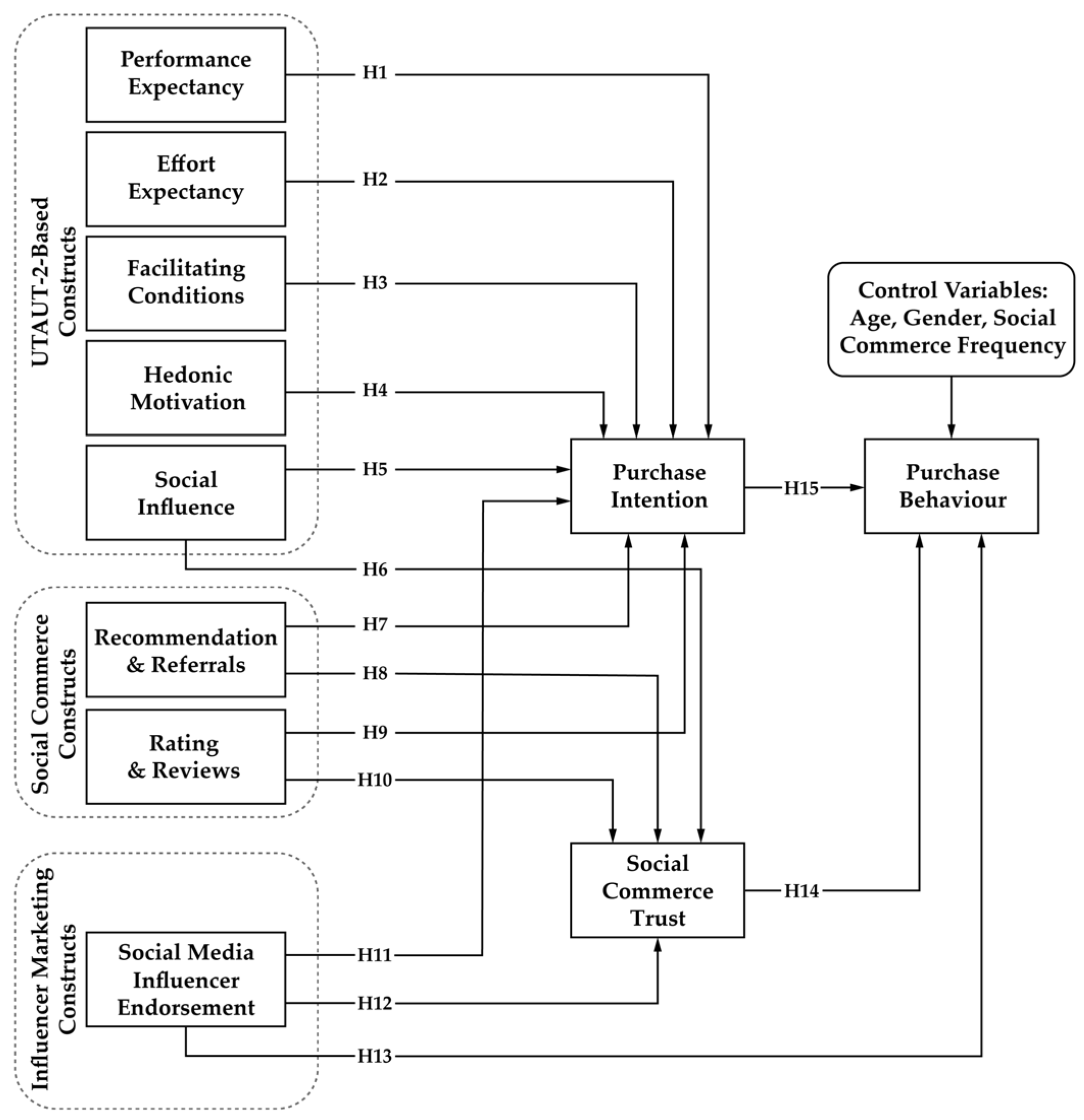

Table 1.
Participants demographics (n = 410).
| Demographic | Frequency | Percentage % | |
|---|---|---|---|
| Gender | Male | 151 | 36.8% |
| Female | 259 | 63.2% | |
| Age | 18–24 | 28 | 6.8% |
| 25–34 | 176 | 42.9% | |
| 35–44 | 158 | 38.5% | |
| 45–54 | 37 | 9% | |
| 55–64 | 11 | 2.7% | |
| Social Commerce Frequency | Multi times a day | 18 | 4.4% |
| Daily (once a day) | 10 | 2.4% | |
| Very often (4–6 times a week) | 31 | 7.6% | |
| Often (2–3 times a week) | 47 | 11.5% | |
| Sometimes (once a week) | 47 | 11.5% | |
| Occasionally (2–3 times a month) | 118 | 28.8% | |
| Rarely (once a month or less) | 139 | 33.9% | |
Table 2.
Cross-loading, validity, and reliability.1.
| Construct | Items | Mean | Std. Deviation | Outer Loadings | Cronbach’s Alpha ∂ |
CR | AVE | VIF |
|---|---|---|---|---|---|---|---|---|
| Performance Expectancy |
PE1 | 5.55 | 1.209 | 0.789 | 0.773 | 0.869 | 0.688 | 1.407 |
| PE2 | 5.47 | 1.286 | 0.847 | 1.795 | ||||
| PE3 | 5.54 | 1.306 | 0.851 | 1.740 | ||||
| Effort Expectancy | EE1 | 5.79 | 1.248 | 0.766 | 0.810 | 0.874 | 0.634 | 1.710 |
| EE2 | 5.61 | 1.256 | 0.799 | 1.692 | ||||
| EE3 | 5.64 | 1.232 | 0.817 | 1.636 | ||||
| EE4 | 5.70 | 1.263 | 0.802 | 1.591 | ||||
| Facilitating Condition |
FC1 | 5.58 | 1.297 | 0.711 | 0.690 | 0.810 | 0.517 | 1.335 |
| FC2 | 5.64 | 1.251 | 0.716 | 1.337 | ||||
| FC3 | 5.59 | 1.258 | 0.758 | 1.284 | ||||
| FC4 | 5.49 | 1.395 | 0.689 | 1.270 | ||||
| Hedonic Motivation |
HM1 | 5.32 | 1.365 | 0.867 | 0.838 | 0.902 | 0.755 | 2.036 |
| HM2 | 5.25 | 1.363 | 0.874 | 1.907 | ||||
| HM3 | 5.36 | 1.376 | 0.865 | 1.955 | ||||
| Social Influence | SI1 | 5.05 | 1.351 | 0.895 | 0.841 | 0.904 | 0.759 | 2.324 |
| SI2 | 4.99 | 1.335 | 0.848 | 1.800 | ||||
| SI3 | 4.93 | 1.470 | 0.869 | 2.050 | ||||
| Recommendation and Referrals |
RERs1 | 5.49 | 1.397 | 0.712 | 0.756 | 0.843 | 0.575 | 1.480 |
| RERs2 | 5.06 | 1.437 | 0.829 | 1.577 | ||||
| RERs3 | 5.27 | 1.469 | 0.791 | 1.613 | ||||
| RERs4 | 5.70 | 1.219 | 0.693 | 1.308 | ||||
| Rating and Reviews |
RARs1 | 5.51 | 1.214 | 0.736 | 0.700 | 0.831 | 0.621 | 1.366 |
| RARs2 | 5.01 | 1.364 | 0.826 | 1.340 | ||||
| RARs3 | 5.19 | 1.424 | 0.800 | 1.389 | ||||
| Social Media Influencer Endorsement |
SMIEs1 | 4.44 | 1.877 | 0.847 | 0.901 | 0.927 | 0.717 | 2.439 |
| SMIEs2 | 4.52 | 1.814 | 0.832 | 2.371 | ||||
| SMIEs3 | 4.52 | 1.791 | 0.881 | 2.868 | ||||
| SMIEs4 | 4.20 | 1.914 | 0.857 | 2.639 | ||||
| SMIEs5 | 4.94 | 1.748 | 0.815 | 2.051 | ||||
| Purchase Intention | PI1 | 5.29 | 1.181 | 0.860 | 0.817 | 0.891 | 0.732 | 1.916 |
| PI2 | 5.13 | 1.308 | 0.863 | 1.884 | ||||
| PI3 | 4.95 | 1.399 | 0.844 | 1.687 | ||||
| Social Commerce Trust | SCT1 | 5.43 | 1.360 | 0.694 | 0.842 | 0.883 | 0.559 | 1.524 |
| SCT2 | 4.88 | 1.518 | 0.813 | 2.003 | ||||
| SCT3 | 4.99 | 1.501 | 0.818 | 2.218 | ||||
| SCT4 | 5.46 | 1.398 | 0.630 | 1.811 | ||||
| SCT5 | 4.71 | 1.738 | 0.784 | 2.155 | ||||
| SCT6 | 5.62 | 1.339 | 0.729 | 1.880 | ||||
| Purchase Behavior | PB1 | 4.97 | 1.546 | 0.886 | 0.901 | 0.931 | 0.771 | 2.710 |
| PB2 | 5.11 | 1.473 | 0.875 | 2.529 | ||||
| PB3 | 5.11 | 1.555 | 0.893 | 2.882 | ||||
| PB4 | 5.01 | 1.711 | 0.858 | 2.292 |
Table 3.
Discriminant validity (HTMT).
| EE | FC | HM | PB | PE | PI | RARs | RERs | SCT | SI | SMIEs | |
|---|---|---|---|---|---|---|---|---|---|---|---|
| EE | |||||||||||
| FC | 0.839 | ||||||||||
| HM | 0.537 | 0.719 | |||||||||
| PB | 0.228 | 0.463 | 0.519 | ||||||||
| PE | 0.690 | 0.858 | 0.655 | 0.436 | |||||||
| PI | 0.429 | 0.667 | 0.630 | 0.865 | 0.607 | ||||||
| RARs | 0.371 | 0.520 | 0.511 | 0.525 | 0.491 | 0.597 | |||||
| RERs | 0.443 | 0.621 | 0.518 | 0.570 | 0.564 | 0.570 | 0.655 | ||||
| SCT | 0.359 | 0.646 | 0.649 | 0.787 | 0.575 | 0.771 | 0.617 | 0.723 | |||
| SI | 0.407 | 0.620 | 0.637 | 0.652 | 0.635 | 0.689 | 0.545 | 0.538 | 0.673 | ||
| SMIEs | 0.109 | 0.367 | 0.437 | 0.737 | 0.347 | 0.639 | 0.576 | 0.553 | 0.817 | 0.546 |
Table 4.
Results of structural model (hypotheses).
| Path | Hypothesis | Std. Beta (β) | Std. Deviation | t-Values | p-Values | Decision |
|---|---|---|---|---|---|---|
| PE -> PI | H1a | 0.072 | 0.058 | 1.244 | 0.213 (NS) | Rejected |
| EE -> PI | H2a | 0.065 | 0.061 | 1.064 | 0.288 (NS) | Rejected |
| FC -> PI | H3a | 0.132 | 0.059 | 2.246 | 0.025 * | Supported |
| HM -> PI | H4a | 0.121 | 0.059 | 2.059 | 0.040 * | Supported |
| SI -> PI | H5a | 0.198 | 0.049 | 4.059 | 0.000 *** | Supported |
| SI -> SCT | H6a | 0.210 | 0.038 | 5.535 | 0.000 *** | Supported |
| RERs -> PI | H7a | 0.027 | 0.043 | 0.619 | 0.536 (NS) | Rejected |
| RERs -> SCT | H8a | 0.238 | 0.044 | 5.462 | 0.000 *** | Supported |
| RARs -> PI | H9a | 0.081 | 0.040 | 2.008 | 0.045 * | Supported |
| RARs -> SCT | H10a | 0.049 | 0.041 | 1.212 | 0.226 (NS) | Rejected |
| SMIEs -> PI | H11a | 0.296 | 0.051 | 5.764 | 0.000 *** | Supported |
| SMIEs-> SCT | H12a | 0.490 | 0.041 | 12.097 | 0.000 *** | Supported |
| SMIEs -> PB | H13 | 0.247 | 0.049 | 5.033 | 0.000 *** | Supported |
| SCT -> PB | H14 | 0.212 | 0.052 | 4.074 | 0.000 *** | Supported |
| PI -> PB | H15 | 0.457 | 0.041 | 11.100 | 0.000 *** | Supported |
| Control Variables | ||||||
| Age | 0.100 | 0.063 | 1.590 | 0.112 (NS) | ||
| Gender | −0.002 | 0.061 | 0.034 | 0.973 (NS) | ||
| SC Frequency | −0.108 | 0.059 | 1.841 | 0.066 (NS) | ||
Note: *** p < 0.001; * p < 0.05; NS = not significant.
Table 5.
Mediation effect on the structural model paths.
| Path | Hypothesis | Std. Beta (β) | Std. Deviation |
t- Value |
p-Value | Confident Interval (BC) |
Decision | Mediation Effect | ||
|---|---|---|---|---|---|---|---|---|---|---|
| LL | UL | |||||||||
| PE- > PI- > PB | H1b | 0.033 | 0.026 | 1.243 | 0.214 (NS) | −0.017 | 0.087 | Rejected | No Effect | |
| EE- > PI- > PB | H2b | 0.030 | 0.028 | 1.074 | 0.283 (NS) | −0.027 | 0.081 | Rejected | No Effect | |
| FC- > PI- > PB | H3b | 0.060 | 0.028 | 2.191 | 0.028 * | 0.008 | 0.116 | Supported | Partial Mediation |
|
| HM- > PI- > PB | H4b | 0.055 | 0.027 | 2.017 | 0.044 * | 0.005 | 0.114 | Supported | Partial Mediation |
|
| SI- > PI- > PB | H5b | 0.091 | 0.026 | 3.506 | 0.000 *** | 0.044 | 0.147 | Supported | Partial Mediation |
|
| SI- > SCT- > PB | H6b | 0.045 | 0.014 | 3.092 | 0.002 ** | 0.020 | 0.077 | Supported | Partial Mediation | |
| RERs- > PI- > PB | H7b | 0.012 | 0.020 | 0.615 | 0.539 (NS) | −0.025 | 0.053 | Rejected | No Effect | |
| RERs- > SCT- > PB | H8b | 0.051 | 0.016 | 3.233 | 0.001 *** | 0.024 | 0.085 | Supported | Partial Mediation | |
| RARs- > PI- > PB | H9b | 0.037 | 0.019 | 1.956 | 0.050 (NS) | 0.001 | 0.075 | Rejected | No Effect | |
| RARs- > SCT- > PB | H10b | 0.010 | 0.009 | 1.155 | 0.248 (NS) | −0.007 | 0.030 | Rejected | No Effect | |
| SMIEs- > PI- > PB | H11b | 0.136 | 0.025 | 5.422 | 0.000 *** | 0.094 | 0.194 | Supported | Partial Mediation | |
| SMIEs- > SCT- > PB | H12b | 0.104 | 0.027 | 3.807 | 0.000 *** | 0.053 | 0.158 | Supported | Partial Mediation | |
Note: *** p < 0.001; ** p < 0.01; * p < 0.05; NS = not significant.
Disclaimer/Publisher’s Note: The statements, opinions and data contained in all publications are solely those of the individual author(s) and contributor(s) and not of MDPI and/or the editor(s). MDPI and/or the editor(s) disclaim responsibility for any injury to people or property resulting from any ideas, methods, instructions or products referred to in the content. |
© 2024 by the authors. Licensee MDPI, Basel, Switzerland. This article is an open access article distributed under the terms and conditions of the Creative Commons Attribution (CC BY) license (http://creativecommons.org/licenses/by/4.0/).
Copyright: This open access article is published under a Creative Commons CC BY 4.0 license, which permit the free download, distribution, and reuse, provided that the author and preprint are cited in any reuse.


