

Submitted:
16 December 2025
Posted:
24 December 2025
You are already at the latest version
Abstract
We demonstrate that the approach to a balance manifold dynamically suppresses curvature contributions, yielding an effectively flat universe without requiring fine-tuned initial conditions or a turning point in the evolution. Inflation corresponds to a regime of entropy imbalance along a scale-flow trajectory, and its termination occurs naturally as the system reaches balance, without engineered exit mechanisms, additional fields, or potential features. While the full mathematical structure is developed within Newell’s stochastic framework, its cosmological interpretation is most transparently understood through a logarithmic gauge mapping inherent to entropy-controlled evolution. This establishes an entropy clock as a minimal and physically natural description of early-universe dynamics in the Forced GUT setting.
Keywords:
cosmology
; GUT
; high energy
; plasma physics
; forced GUT
1. Introduction
A central challenge in early-universe cosmology is to explain why the universe is spatially flat, homogeneous, and dynamically stable over many orders of magnitude without relying on finely tuned initial conditions or engineered model features. Conventional inflationary scenarios successfully address these observations, but typically do so by prescribing dynamics in cosmic time and invoking specific potentials, auxiliary fields, or exit mechanisms whose physical origin lies outside the inflationary phase itself. This raises a structural question: whether accelerated expansion is fundamentally a time-driven process, or instead a manifestation of deeper constraints associated with scale, entropy, and renormalization flow.
In this work we argue that within Newell’s stochastic Forced Grand Unification (Forced GUT) framework [1], these cosmological properties emerge as consequences of entropy-controlled scale evolution, most transparently described in a logarithmic gauge. By treating a logarithmic scale variable as the fundamental evolution parameter (rather than a derived measure of expansion), flatness and exit arise dynamically without turning points or tuned endpoints, reframing inflation not as a special phase to be engineered, but as a generic relaxation process toward an entropy-balance manifold.
2. What is Universal vs. What is Novel: Logarithmic Expansion and the Choice of Clock
A central object in inflationary cosmology is the number of e-folds,
which measures multiplicative growth of the scale factor. It is important to distinguish (i) what is universal about Equation (1) from (ii) what is structurally distinct in the present framework.
2.1. Layer 1: The Logarithm Is Universal (Not Unique To Any Model)
The logarithmic form of Equation (1) follows directly from the definition of the Hubble parameter as a fractional expansion rate. For any FLRW cosmology with scale factor ,
2.2. Layer 2: Where The Real Mathematical Difference Lives
The substantive distinction is not the formula for N. The distinction is what the theory takes to be the independent evolution parameter (the “clock”).
2.2.0.1. Standard inflation (typical).
The standard formulation takes cosmic time t as fundamental. The dynamical system is evolved in t, and inflation is defined as an interval in time during which accelerated expansion occurs (often phrased via for ), with
Present framework (entropy/RG clock).
By contrast, the present framework takes a logarithmic RG/entropy variable as the fundamental evolution parameter,
and treats early-universe evolution as flow in rather than as an interval delimited in cosmic time. In this picture, the logarithmic variable is not derived as bookkeeping after integrating ; it is the primary coordinate along which the dynamics are formulated [1].
| Standard inflation (typical) | Present framework (this work) |
| Fundamental variable: cosmic time t | Fundamental variable: |
| Log enters as a consequence of | Log enters because scale is the physical evolution parameter [1] |
| Duration phrased as a chosen interval | Duration set by relaxation along the -flow toward balance |
| Exit typically implemented via model ingredients (potential, extra fields, reheating prescription) | Exit is structural: approach to an entropy-balance / unification manifold |
| Log status: derived bookkeeping after solving in t | Log status: dynamical coordinate used to formulate the evolution |
| The logarithmic identity is universal; the novelty lies in the role of the logarithmic variable as a fundamental evolution parameter rather than a derived quantity. | |
2.3. Initial Condition as an RG Offset (Not a Tuned “Start Time”)
In the present formulation one introduces only an initial RG/entropy offset as a reference point along the scale-flow trajectory and follows the flow toward . Crucially, is not a tuned start time. The termination point is selected dynamically by approach to the balance condition (fixed-point / attractor structure in -flow), and inflation persists precisely for as long as the entropy-imbalance drive remains nonzero.
3. Other Important High-Energy Contextual Limits
In standard inflationary language, accelerated expansion requires a dominant, slowly varying driver that suppresses curvature faster than matter or radiation. We argue that this condition is naturally realized in a high-energy, weakly dissipative Hamiltonian limit of the dynamics. In this regime, evolution is governed by Hamiltonian transport with entropy acting as a control variable, leading to monotonic relaxation toward equilibrium without turning points or engineered control mechanisms. Analogous limiting behavior appears in kinetic and plasma systems where Hamiltonian transport dominates over dissipation [1,5].
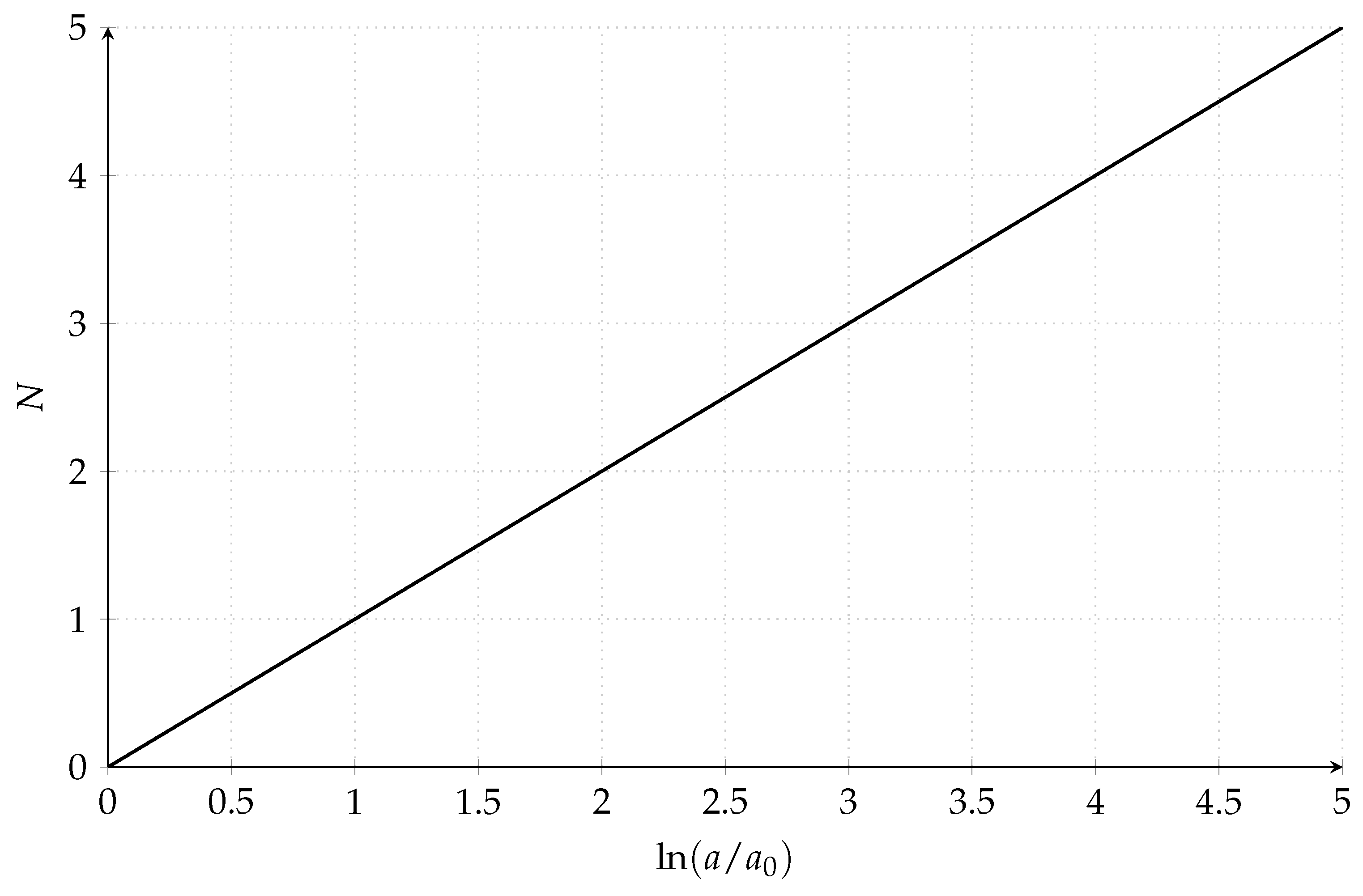
Figure 1.
Purely kinematic logarithmic expansion. Because , the relation follows as an identity. This figure is a one-to-one mapping and does not encode acceleration or observational viability.
Figure 1.
Purely kinematic logarithmic expansion. Because , the relation follows as an identity. This figure is a one-to-one mapping and does not encode acceleration or observational viability.
4. Conclusions
We have shown that the logarithmic expansion commonly encoded by the number of e-folds, , is a universal kinematic identity rather than a defining feature of any particular inflationary model. The physical distinction of the present work lies in the identification of a logarithmic scale variable as the fundamental evolution coordinate governing early-universe dynamics. Within Newell’s stochastic Forced Grand Unification framework, the natural clock is an entropy-controlled renormalization parameter, along which the system relaxes toward an entropy-balance (unification) manifold [1]. In this formulation, accelerated expansion, spatial flatness, and exit from the inflationary regime arise dynamically as structural consequences of entropy-driven scale flow, without requiring turning points, fine-tuned initial conditions, or engineered exit mechanisms.
5. Curvature Suppression as a Kinematic Criterion in Logarithmic Flow Variables
We begin with the FLRW Friedmann constraint including spatial curvature ,
and define the curvature density parameter
Introduce the logarithmic expansion variable
From Equation (8),
Taking logs and differentiating with respect to yields
Curvature is suppressed when , i.e.
Let the RG/entropy clock be
Conflicts of Interest
The author declare no known conflicts of interest.
References
- Newell, M.J. Entropy-Driven Unification Model: Recursive Field Evolution and Emergent Gravity. APS Division of Plasma Physics Meeting 2025. Session ZO06: Whistler Modes and Other Topics, Long Beach Convention Center.
- Liddle, A.R.; Lyth, D.H. Cosmological Inflation and Large-Scale Structure; Cambridge University Press, 2000. [Google Scholar]
- Langlois, D. Lectures on Inflation and Cosmological Perturbations. arXiv 2010, arXiv:1001.5259. [Google Scholar] [CrossRef]
- Marco, F.D.; Orazi, E.; Pradisi, G. Introduction to the Number of e-Folds in Slow-Roll Inflation. Universe 2024, 10, 284. [Google Scholar] [CrossRef]
- Johnson, G.; Juno, J.; Hakim, A. Solving the Plasma Kinetic Equation Numerically on Smooth Manifolds with Continuum Methods. APS Division of Plasma Physics 2025. Invited Kavli Institute for Theoretical Physics presentation.
Disclaimer/Publisher’s Note: The statements, opinions and data contained in all publications are solely those of the individual author(s) and contributor(s) and not of MDPI and/or the editor(s). MDPI and/or the editor(s) disclaim responsibility for any injury to people or property resulting from any ideas, methods, instructions or products referred to in the content. |
© 2025 by the authors. Licensee MDPI, Basel, Switzerland. This article is an open access article distributed under the terms and conditions of the Creative Commons Attribution (CC BY) license (http://creativecommons.org/licenses/by/4.0/).
Copyright: This open access article is published under a Creative Commons CC BY 4.0 license, which permit the free download, distribution, and reuse, provided that the author and preprint are cited in any reuse.