

Submitted:
23 December 2025
Posted:
24 December 2025
You are already at the latest version
Abstract
This study investigates the sustainability, resilience, and institutional performance of urban governance systems by operationalizing key thermodynamic principles energy, exergy, entropy, equilibrium, open systems, and irreversibility within a political and behavioral systems framework. Urban political systems are conceptualized as open, non-equilibrium systems, characterized by continuous flows of resources, information, and institutional feedback across metropolitan governance structures. Within this model, energy represents systemic inputs to urban governance, exergy denotes usable governing capacity at the city and metropolitan scale, and entropy reflects levels of institutional disorder, inefficiency, and systemic degradation affecting urban sustainability.
The study first formulates a conceptual analytical model defining urban political entropy and systemic exergy as measurable variables associated with institutional stability, crisis-management capability, adaptability, and reform potential in urban and metropolitan governance. It then conducts a comparative empirical analysis of Germany, Türkiye, China, and South Africa using normalized indicators derived from international datasets for 2023, with particular attention to their implications for urban governance capacity and city-level institutional performance. These indicators are employed to construct proxy measures for the Exergy Efficiency Ratio, Societal and Institutional Entropy, and overall urban governance capacity. The comparative results reveal that open and decentralized governance systems tend to maintain higher exergy efficiency and lower entropy levels at the urban scale, whereas highly centralized systems, although effective in resource mobilization, tend to accumulate greater systemic entropy over time. Transitional governance systems exhibit hybrid and fluctuating thermodynamic characteristics in their urban institutional structures.
The findings empirically support the Thermodynamic Model of Political Systems and demonstrate its utility as a predictive and diagnostic framework for evaluating urban institutional efficiency, resilience, and sustainability. By quantifying political energy flows and entropy dynamics within urban governance systems, this study contributes to the development of an integrated systems thermodynamics of cities and provides a robust analytical foundation for sustainable urban governance, institutional reform, and long-term strategic policy design.
Keywords:
thermodynamic governance
; exergy efficiency
; political entropy
; systemic sustainability
; TMPS model
; institutional resilience
; sustainable governance
; entropy regulation
; comparative political systems
; energy–exergy–entropy analysis
1. Introduction
Political systems are increasingly shaped by complex interactions between economic pressures, institutional capacities, social dynamics, and global interdependence. Traditional approaches in political science centered on power, institutions, and decision-making are often insufficient to explain how contemporary systems maintain stability, respond to shocks, or sustain long term performance. As these systems grow more interconnected and vulnerable to uncertainty, interdisciplinary perspectives drawing from physics, systems theory, and information science have gained prominence in explaining political stability, resilience, and sustainability [1,2,3,4].
Thermodynamic principles offer a rigorous framework for analyzing these dynamics. Energy represents the overall resource base available to a political system; exergy denotes the portion of this energy that can be effectively transformed into governance outputs; and entropy captures systemic disorder, inefficiency, and institutional degradation [5,6,7,8,9]. These concepts provide a structured way to evaluate how political systems mobilize resources, convert them into effective action, and prevent the accumulation of disorder that erodes institutional performance. In this context, sustainable governance emerges from the balance between resource inflows, organizational efficiency, and the capacity to limit entropy.
Energy defined as the capacity to perform work has direct political analogues in economic strength, administrative capability, and social capital. Exergy reflects the usable fraction of these resources that can be transformed into policy implementation, institutional reform, and collective action [10,11,12,13]. Entropy corresponds to corruption, polarization, administrative gridlock, declining trust, and information asymmetries that undermine coordination and stability [14,15,16,17]. A thermodynamic approach therefore provides a conceptual bridge that links political system complexity with measurable indicators of sustainability.
Drawing on general systems theory and political cybernetics [18,19], political systems can be viewed as open, dynamic structures that continuously exchange energy and information with their environments. When feedback mechanisms weaken or institutional adaptation slows, entropy rises, reducing coherence and increasing vulnerability to systemic failure. From a sustainability perspective, entropy demonstrates how disorder accumulates within political systems and why some governance structures remain resilient while others experience stagnation or collapse.
This study builds on these insights by applying thermodynamic concepts energy, exergy, and entropy to evaluate governance sustainability in Germany, Türkiye, China, and South Africa. These countries represent diverse political architectures and developmental pathways, offering a comparative basis for examining how resource capacity, institutional effectiveness, and systemic disorder interact. The analysis develops and applies the Thermodynamic Model of Political Systems (TMPS), a framework that interprets sustainable governance as the efficient conversion of political energy into exergy, accompanied by controlled entropy generation.
This study contributes to the literature by:
- Introducing a novel analytical framework TMPS that operationalizes energy, exergy, and entropy for the empirical study of political systems.
- Developing measurable indicators (PEI, PEVE, EER, SI, EDI, TGC, SE) that quantify institutional efficiency, systemic disorder, and governance sustainability.
- Providing a comparative thermodynamic assessment of four structurally distinct political systems, demonstrating how energy, exergy, and entropy balances explain divergent governance outcomes.
- Linking sustainability science with political analysis, offering a theoretically grounded and policy-relevant approach to evaluating long-term governance resilience.
- Advancing interdisciplinary sustainability research by adapting thermodynamic concepts into a model that can inform institutional design, policy assessment, and systemic risk analysis.
2. Conceptual Framework
2.1. Reinterpreting Thermodynamic Principles in Political Systems
The reinterpretation of the concepts of energy, exergy, and entropy within the context of the social sciences is essential for understanding the crisis management capacity, reform potential, long-term sustainability, and institutional resilience of nation-states [4]. While thermodynamic analogies provide a useful conceptual lens, physical metaphors alone are insufficient to explain the complex behavior of political systems. Therefore, it is equally crucial to incorporate the social, economic, environmental, and institutional parameters that shape a country’s political orientation, governance capacity, and decision-making processes within a sustainability framework [20].
These parameters can be classified as follows:
a. Economic Parameters:
GDP size, per capita income, income distribution, energy resources, and economic efficiency shape core sustainability priorities. Economic capacity affects crisis management, reform ability, and long-term governance stability by supporting steady energy and exergy flows.
b. Social and Demographic Parameters:
Population structure, education, age distribution, inequality, and migration significantly affect political outcomes. A young population may increase innovation and energetic potential, whereas polarization raises systemic entropy, weakening societal sustainability and reducing adaptive capacity.
c. Institutional and Governance Parameters:
Rule of law, democratic mechanisms, transparency, bureaucratic efficiency, and reform processes determine exergy efficiency and systemic adaptability [21]. High governance quality limits entropy accumulation, enabling more effective use of political energy and strengthening institutional resilience.
d. Cultural and Socio-Political Parameters:
Shared values, political culture, social trust, and cohesion act as negentropic forces that reduce disorder and support the sustainable conversion of political energy into governance outcomes. Cultural structures influence political stability, social harmony, and crisis-management capacity.
e. Foreign Policy and International Parameters:
International relations, trade, diplomacy, energy dependencies, alliances, and global crises directly shape energy–exergy flows and systemic entropy. From a sustainability perspective, an open-systems approach enhances adaptation to external shocks, resource diversification, and long-term equilibrium [22].
2.2. Energy and Political Power
In physical terms, energy represents the capacity of a system to perform work. Within political systems, energy manifests through economic resources, human capital, knowledge, and social motivation [23]. High energy inflows increase a state’s ability to manage crises and undertake reforms, whereas low energy availability constrains external interactions and policy responsiveness. Political energy thus denotes the capacity for action economic growth, diplomatic activity, reform capability, and crisis management efficiency determine its transformation effectiveness. Inefficient resource management, corruption, and bureaucratic stagnation cause energy losses, thereby undermining system functionality.
2.3. Exergy: Usable Political Capacity
Exergy refers to the portion of energy that can be converted into useful work [24]. In political systems, it represents the efficiency of resource utilization, institutional performance, and policy productivity. High exergy indicates that political decisions and reforms are implemented effectively. As a metaphor, exergy measures how effectively a state transforms its energy inputs (economic and social resources) into policy outputs. The smooth functioning of institutional structures, information flow, and governance mechanisms increases exergy. Therefore, exergy serves as a key indicator of a state’s adaptive capacity in the face of crises.
2.4. Entropy and Political Disorder
Entropy denotes the degree of disorder or energy dispersion within a system. In political systems, entropy is associated with institutional weakness, loss of social trust, misinformation, and uncertainty in decision-making processes. High entropy levels signify an inability to convert available energy such as resources or social support into effective outcomes [25]. Consequently, reforms, transparency, meritocracy, and efficient information flow function as negentropic mechanisms that restore order. When entropy rises, resource inputs yield diminishing political returns, undermining sustainability. Conversely, low entropy supports political stability, social harmony, and long-term resilience.
2.5. States as Open Systems: Irreversibility and Political Change
By nature, states are open systems that exchange energy and information through trade, diplomacy, migration, and communication. In contrast, closed systems often characterized by authoritarian or isolationist tendencies gradually accumulate entropy as information circulation is restricted, external inputs are limited, and internal equilibrium deteriorates. Open systems maintain a dynamic equilibrium through continuous inflows of energy and information, a condition analogous to renewal and adaptability in democratic regimes. The open-systems approach allows states to utilize resources efficiently, adapt to external shocks, and sustain long-term governance.
Just as many thermodynamic processes are irreversible, certain political transformations such as revolutions, wars, economic collapses, or democratic regressions are also non-reversible. These processes increase path dependency, constraining future options for systemic restoration. In this metaphorical sense, the second law of political thermodynamics can be expressed as follows: “Every political system tends toward increasing entropy over time; maintaining order requires a constant inflow of energy”.
3. Materials and Methods
The Thermodynamic Model of Political Systems (TMPS) provides a novel methodological framework for analyzing governance from a systemic and energetic perspective. This approach is grounded in the redefinition of energy, exergy, and entropy within a political context and transforms these concepts into analytical tools that enable the quantitative assessment of sustainability, adaptive capacity, and institutional resilience.
Methodologically, political systems are treated as open, far-from-equilibrium structures that, much like thermodynamic systems, depend on continuous inflows of resources, information, and legitimacy. The long-term sustainability of these systems depends not merely on the magnitude of energy inputs, but on the extent to which these inputs are effectively transformed and the resulting entropy is regulated. Accordingly, thermodynamic principles are employed in this study as a comprehensive methodological framework for explaining political and social system behavior beyond the limits of conventional institutional analysis [2,25].
Within this framework, energy represents the total resource potential of a political system, including economic capacity, knowledge production, and social capital. Exergy denotes the portion of this energy that is effectively usable within governance processes and can be transformed into meaningful political outputs. Entropy, by contrast, captures structural disorder manifested through institutional decay, administrative inefficiency, political polarization, and loss of systemic coordination. Political systems are thus analyzed through the continuous processes of input, transformation, and dissipation of “political energy,” with entropy management occupying a central role in determining systemic stability and sustainable governance.
This methodological approach moves TMPS beyond a purely conceptual analogy by operationalizing sustainability as a measurable system property. Sustainability is conceptualized as the long-term continuity of political systems achieved through the preservation of political energy, its efficient conversion into exergy, and the containment of entropy over time. In this sense, political governance is modeled as an energy-regulating process in which internal feedback mechanisms either reinforce or erode systemic coherence.
To enable empirical implementation, TMPS employs a comparative indicator-based methodology. Through the normalization and aggregation of selected indicators, political energy, exergy, and entropy levels are quantitatively assessed across countries, allowing for systematic comparison of sustainability performance. This approach renders TMPS a measurable, comparable, and empirically testable analytical framework for the study of political systems.
3.1. Theoretical Framework
Thermodynamics and System Theory
Thermodynamics provides a systematic framework for analyzing how complex systems mobilize resources, regulate internal order, and respond to structural stress [26]. When applied to political science, this framework enables the conceptualization of political systems as open, non-equilibrium institutional arrangements that depend on continuous inflows of information, legitimacy, and material resources to sustain governance capacity and systemic stability [26]. In line with the Second Law of Thermodynamics, entropy in isolated systems increases over time; however, political systems, as open systems, can counteract entropic tendencies through institutional adaptation, policy learning, and external resource integration [27].
From this perspective, political stability and sustainability are not static conditions but dynamic outcomes of how effectively systems acquire, transform, and allocate political energy. Failure to regulate these processes results in institutional rigidity, declining policy effectiveness, and increasing governance costs. Within the TMPS, core thermodynamic variables are analytically reinterpreted to capture key dimensions of governance performance (Table 1). Energy denotes the aggregate political and socioeconomic capacity of a system, including economic output, social capital, and institutional legitimacy. Exergy refers to the portion of this capacity that is effectively convertible into policy decisions, institutional reform, and collective action. Entropy reflects the accumulation of institutional inefficiencies, corruption, polarization, and information distortions that undermine coordination, accountability, and democratic responsiveness.
3.2. Comparative Empirical Framework
This section presents an empirical strategy for measuring and comparing levels of energy, political exergy, and entropy across countries, thereby establishing a systematic link between theoretical constructs and observable indicators of governance performance. Within this framework, the core assumptions of the model are articulated as follows:
a. Energy Continuity: Sustainable governance depends on stable and continuous inflows of political, social, and institutional energy that support long-term system functionality.
b. Exergy Optimization: The capacity to efficiently transform available energy into effective policy outputs and institutional action is a key determinant of adaptability, resilience, and reform potential.
c. Entropy Management: Institutional transparency, accountability, and learning mechanisms play a critical role in mitigating disorder, corruption, and coordination failures, thereby preserving systemic coherence and governance sustainability.
Building on this theoretical framework, the Sankey diagram presented in Figure 1 visually integrates the flows of energy, political exergy, and entropy within political systems. The diagram illustrates how economic, human, and governance-related energy inputs feed into the core governance system; how these inputs are partially transformed into useful political work through exergy outputs; and how the remaining portion dissipates as entropy in the form of institutional friction, polarization, instability, and resource loss. In doing so, the visualization operationalizes the model’s core assumptions energy continuity, exergy optimization, and entropy management by linking each conceptual component to observable governance processes. This graphical structure thus enables systematic measurement and comparison of political system performance across countries.
3.2.1. Energy Inputs: Political System Energy Capacity
The energy capacity of political systems encompasses not only economic and human energy components but also political stability and governance energy. Within the political thermodynamics approach, the energy input of a political system constitutes a foundational analytical construct that captures the aggregate capacity derived from economic, human, and institutional resource reservoirs, as illustrated in Table 2. This capacity enables the system to sustain operational functionality, preserve institutional continuity, and generate effective governance outputs under varying environmental conditions.
Economic energy comprises the material and structural determinants that supply the system with directly usable input flows, including macroeconomic production potential, efficiency in resource allocation, fiscal robustness, and the overall stability of economic infrastructure. Conceptually, it corresponds to the system’s externally sourced gross energy inflow, which conditions both the scale and intensity of political activity and policy intervention.
Human energy represents the qualitative and cognitive dimensions of societal input, encompassing the population’s human capital endowment, workforce competence, sociocultural dynamism, and levels of collective civic participation. From a thermodynamic perspective, human energy functions as an internal energy reservoir that counteracts entropic tendencies by enabling innovation, institutional learning, adaptive capacity, and socio-political mobilization.
The interaction between economic and human energy gives rise to governance energy, which parallels the thermodynamic notion of conversion efficiency. Governance energy reflects the extent to which available economic and human resources can be transformed into institutional capacity, coherent decision-making, effective policy implementation, and political stability. High governance energy characterizes systems capable of converting inputs with minimal dissipation, whereas low governance energy signals increasing institutional friction, rising entropy, and heightened vulnerability to systemic instability.
In this context, both the magnitude of energy inputs and the efficiency with which these inputs are converted into governance outcomes constitute critical parameters shaping a political system’s resilience, its adaptive response to exogenous shocks, and its long-term sustainability within a volatile socio-political environment.
3.2.2. Exergy Optimization the Political System’s Capacity to Produce Useful Work
Exergy efficiency represents the degree to which a political system can convert its institutional, economic, and governance resources into useful political work. In thermodynamic terms, exergy denotes the portion of energy that is available to perform work; in political systems, this corresponds to the system’s ability to transform available capacity into effective policy output, institutional performance, and democratic functioning.
The indicators shown in Table 3 collectively measure institutional exergy, governance conversion efficiency, and the net political work output generated through democratic participation.
3.2.3. Entropy: Disorder, Friction, Loss Components and Political, Social, and Economic Entropy
Entropy in political systems represents the degree of disorder, friction, and resource dissipation within institutional, social, and economic domains. Drawing from thermodynamic analogies, political entropy captures the system’s unpredictability, institutional instability, and inefficiencies that reduce the effective conversion of energy and exergy into useful political outcomes. Entropy highlights the loss of potential political work due to polarization, institutional crises, social tensions, and economic volatility. The following indicators, shown in Table 4, collectively quantify political, social, and economic entropy, allowing for a comprehensive assessment of systemic disorder and resilience deficits.
3.3. The Thermodynamic Model of Political Systems (TMPS)
Model Definition
The sustainability of a political system is possible only when energy inputs exceed entropy production. The following equation metaphorically summarizes this condition:
System Equilibrium = Energy Input (Economy + Knowledge + Societal Trust) – Entropy (Corruption + Uncertainty + Repression)
When system equilibrium is positive, the state's capacity for reform increases; when it is negative, the system enters a cycle of collapse, polarization, or crisis.
The model conceptualizes political systems as open systems in which the energy balance of inputs and outputs determines systemic stability and can be stated as below formula [56,57]:
where represents external inflows (economic resources, legitimacy, social engagement), refers to policy outcomes and administrative outputs, and signifies internal energy change, or political transformation capacity.
However, the Model conceptualizes political systems as open systems in which the exergy balance between inputs and outputs determines the efficiency and usability of converting systemic resources into functional governance outputs, and it is defined by the following formula [56,57];
where represents external exergy inflows (Efficiency of transforming resources into effective policy inputs), refers to Efficiency of transforming resources into effective policy outcomes, “” consumption of exergy and signifies internal exergy change, or political transformation capacity
Exergy input - Exergy output- Exergy consumption = Exergy accumulation
Entropy, which is a measure of systemic disorder, institutional inefficiency, corruption, polarization, or loss of coherence, is calculated for a steady-state, steady-flow process as follows [58,59];
where represents external inflows (disorder, institutional inefficiency, corruption, polarization, or loss of coherence), refers to disoder outcomes and corruption outputs, and “signifies generation of disorder, institutional inefficiency, corruption, polarization.
Normalization Procedure
This approach ensures that “0” corresponds to the lowest global value observed (maximum entropy) and “1” corresponds to the highest efficiency or order.
3.4. Construction of Thermodynamic Variables
3.4.1. Mathematical Formulation for Energy Inputs: Political System Energy Capacity
a. Total Political Energy Input
The composite index “E” used in this study integrates economic capacity, human development, and governance and political stability energy indicators into a single normalized measure. Represents total societal resource capacity and the index is defined as follows:
Where:
All three indicators are assigned equal weights (1/3) to avoid overweighting any single dimension. Equal weighting is consistent with the methodology used in prominent composite indices, including the Human Development Index [63] and the OECD Better Life Index [52]. This approach supports the development of a balanced and multidimensional measure of national development [67].
Higher values of “E” indicate stronger combined performance in economic capability, human development, and educational advancement. Consequently, the composite index functions as a robust proxy for assessing a country’s sustainable development potential and institutional resilience [68,69].
b. Economic Energy Component (Eecon)
Where: GDP: Macroeconomic production capacity, RES: Resource allocation efficiency, FIS: Fiscal stability indicators, ωi: Normalized weights (∑ω = 1).
c. Human Energy Component
Where: HC: Human capital (education, cognitive capacity), LQ: Labor quality, PENG: Population engagement and sociodemographic dynamism, θi: Normalized weights (∑θ = 1)
d. Governance & Political Stability Energy (Egov)
Where: GE: Government effectiveness, PS: Political stability, IC: Institutional capacity, (bureaucratic efficiency, regulatory quality, digital governance capacity), ϕi: Normalized weights (∑φ = 1)
e. Integrated Energy Capacity
Combining all component
This formulation models the political system’s total energy capacity through a thermodynamic analogy, linking economic inputs, human capital, and governance efficiency into a unified framework.
3.4.2. Mathematical Model of Political Exergy Efficiency
A formalized model is provided below. It treats political exergy efficiency as a function of institutional quality, governance integrity, and democratic participation.
- Exergy
Represents effective political work capacity:
Reflects the proportion of social energy successfully transformed into functioning governance.
In this framework:
- GovEffnorm (Normalized Government Effectiveness); Represents the normalized measure of government effectiveness, typically derived from indicators on institutional quality, regulatory capacity, and bureaucratic performance [70].
- PolicyRespnorm (Normalized Policy Responsiveness) Refers to the normalized measure of how quickly and effectively governments respond to social, economic, and environmental challenges. The concept of policy responsiveness is widely discussed in public administration and governance literatüre [71,72].
Each variable is scaled between “0” and “1” to enhance cross-country comparability, and equal weighting (1/3) aligns with established methodologies in composite indicator construction to ensure balanced representation of governance dimensions [75].
b. Composite Exergy Efficiency Function
Where: Etotal: Total political energy inputs (economic + human + institutional resources), Wuseful : Useful political work (policy effectiveness, governance quality, democratic output), η: Governance conversion coefficient (0 < η ≤ 1)
c. Indicator-Based Exergy Efficiency Index
Let the three main exergy components be:
- Institutional Exergy: I, Governance Exergy: G, Democratic Exergy: D
Normalized indicator sets:
Weighted political exergy efficiency:
Where: α: institutional exergy weight, β: governance exergy weight, γ: democratic exergy weight, Typically α+β+γ=1
d. Thermodynamic Analogy: Exergy Loss and Dissipation
Exergy loss due to corruption, bureaucratic friction, weak rule of law:
Net political exergy:
Dynamic System Model (Optional Extension)
A differential form expressing political exergy change over time:
3.4.3. Mathematical Model of Political Entropy
a. Entropy (S)
Represents systemic disorder and institutional inefficiency:
In this formulation:
- PolStabnorm (Normalized Political Stability Index); Measures the likelihood of political instability, including government disruption or violence, normalized for comparability. Lower political stability contributes to higher societal risk [77].
The subtraction from “1” ensures that higher values of “S” indicate higher societal risk, reflecting the combined impact of corruption, political instability, and limited freedoms. Higher values of indicate greater institutional entropy (corruption, instability, or democratic erosion). Equal weighting (1/3) guarantees balanced contribution from all three components, consistent with standard composite index methodology [60,61].
b. Subcomponent Definitions
b.1 Political Entropy (SP)
Where: S1-1: Political polarization (V-Dem), S1-2: Government crisis frequency (OECD), S1-3: Legal uncertainty (WJP)
Represents internal political friction, institutional instability, and legal complexity.
b.2 Social Entropy (SS)
Where: S2-1: Social tension index (GPI, S2-2: Migration pressure (UNHCR), S2-3: Unemployment rate (ILO), S2-4: Income inequality (Gini, World Bank)
Captures societal unrest, demographic stress, underutilized human capital, and wealth distribution inefficiencies.
b.3 Economic Entropy (SE)
Where: S3-1: Inflation volatility (IMF), S3-2: Public debt sustainability (IMF), S3-3: Financial vulnerability index (BIS)
Reflects macroeconomic disorder, fiscal decay, and systemic financial fragility.
b.4. Net Entropy and Efficiency Adjustment
Political entropy reduces the efficiency of energy (E) and exergy (Ex) conversion. Net exergy accounting for entropic losses:
Where: λ: Entropy impact coefficient (0 < λ ≤ 1), quantifying the degree to which entropy reduces the system’s ability to perform useful political work.
c. Total System EntropyThe total political system entropy can be expressed as the weighted sum of three subcomponents: political, social, and economic entropy.
Where: SP : Political entropy, SS : Social entropy, SE : Economic entropy, αP,αS,αE : Weights representing the relative importance of each domain (typically αP+αS+αE=1)
d. Dynamic Entropy Evolution
A differential model can capture entropy changes over time:
Where: ϕP, ϕS, ϕE : Sensitivity parameters for political, social, and economic entropy, ΔSP, ΔSS, ΔSE : Temporal changes in subcomponent entropies
(dStotal / dt) = ϕPΔSP+ϕSΔSS+ϕEΔSE
This allows modeling of shocks (e.g., crises, social unrest, economic volatility) and the system’s adaptive capacity.
3.4.4. Composite Indices for the Thermodynamic Political Model
a. Political Energy Index (PEE)
The Political Energy Index (PEE) is calculated as the normalized sum of key economic, human, and institutional energy components (E1, E2, and E3), providing a consolidated measure of a country’s capacity to perform political and systemic work efficiently.
Mathematically, this equation represents the aggregation of three core components—E1 (economic energy), E2 (human energy), and E3 (institutional energy) into a single index. Normalization ensures that the resulting PEE value is scaled consistently across countries or time periods, facilitating direct comparison. The sum captures the total energy available within a country’s political system, reflecting its capacity to perform systemic work. A higher PEE indicates a more energetic and potentially effective political system, while a lower value suggests limited systemic energy or capability.
b. Political Exergy Efficiency Index (PEVE)
The Political Exergy Efficiency Index (PEVE) is defined as the normalized sum of exergy components (Ex1, Ex2, and Ex3), representing the efficiency with which a country converts its available political, economic, and human energy into effective systemic and institutional output.
Mathematically, this equation aggregates the exergy components of a system Ex1 (economic exergy), Ex2 (human exergy), and Ex3 (institutional exergy) into a single normalized index. Exergy represents the portion of energy that can be effectively converted into productive work. By summing these components and normalizing the result, PEVE provides a standardized measure of how efficiently a country transforms its available political, economic, and human energy into effective outcomes. Higher PEVE values indicate a system with greater efficiency and reduced losses, whereas lower values reflect inefficiencies in utilizing the available energy potential
c. Exergy Efficiency Ratio (EER)
The EER is a composite metric designed to evaluate governance and innovation efficiency relative to overall national development. It is defined as:
A measure of governance efficiency values closer to “1” indicate maximal utilization of available social energy. Measures the portion of societal energy effectively used in policy processes.
where:
The “EER” provides a normalized assessment of governance and innovation performance relative to overall development. Values greater than “1” indicate that governance and innovation efficiency exceed the country’s average development level, whereas values below “1” indicate underperformance relative to socioeconomic development.
This metric allows policymakers and researchers to identify countries whose governance and innovation capabilities are disproportionate to their economic, social, and educational development, offering actionable insights for policy design and institutional strengthening.
d. Entropic Degradation Index (EDI)
The Entropic Degradation Index (EDI) is calculated as the normalized sum of system stress components (S1, S2, and S3), quantifying the level of disorder or inefficiency within a country’s political, economic, and technological structures.
Mathematically, this equation aggregates the system stress or degradation components—S1, S2, and S3 into a single normalized measure. EDI quantifies the level of disorder, inefficiency, or “energy loss” within a country’s political, economic, and technological systems. Normalization ensures comparability across countries or time periods. A higher EDI indicates greater systemic degradation or entropy, suggesting increased inefficiencies and risks to the system’s stability, while a lower EDI reflects a more ordered, resilient, and efficiently functioning system.
e. Normalized Entropy Index (SI)
The Normalized Entropy Index (SI) is derived by rescaling the Entropic Degradation Index (EDI) between its minimum and maximum values, providing a standardized measure of systemic disorder and allowing cross-country comparison of political, economic, and technological stability.
The Entropy Risk Index (SI) converts the raw societal risk score ” into a standardized measure between “0” and “1”, enabling consistent comparison across countries. It is formulated as:
on civil and political freedoms [59,60,61]. “EDImin” Minimum observed societal risk in the dataset. “EDImax“Maximum observed societal risk in the dataset.
This normalization ensures that the country with the lowest societal risk receives a value of “0” and the country with the highest societal risk receives a value of “1”. It facilitates meaningful cross-national comparisons and aligns with standard composite indicator methodology for scaling diverse indicators [59,60,61]. Facilitating comparison across countries and time. Normalized composite score combining corruption, instability, and trust decline indicators
f. Thermodynamic Governance Coefficient (TGC)
The Technological and Governance Capacity (TGC) index combines governance efficiency and societal risk into a single composite metric, evaluating the overall effectiveness of a country’s institutions. It is calculated as the ratio of Economic Energy Ratio (EER) to one plus the Normalized Entropy Index (SI), reflecting how institutional capacity and systemic stability jointly influence a nation’s performance.
The TGC index integrates governance efficiency and societal risk into a single composite measure to evaluate the overall capacity of a country’s institutions. It is defined as:
where:
A synthetic measure of systemic sustainability higher “TGC” implies higher adaptability and lower entropy. An integrated measure of systemic sustainability combining efficiency and entropy control. High “TGC” values (≥0.6) denote adaptive, low-entropy political systems (e.g., Nordic countries), while low “TGC” values (≤0.3) signal fragile or high-entropy governance (e.g., states with declining institutional trust).
The inclusion of in the denominator ensures that higher societal risk reduces total governance capacity, while lower societal risk allows governance and innovation efficiency to contribute more strongly to overall institutional performance. Consequently, TGC provides a comprehensive metric for assessing national governance capability, combining both institutional efficiency and societal stability.
g. Sustainability Index
In this study, the sustainability of political systems is quantitatively assessed through a composite Sustainability Index developed within the framework of the TMPS. Sustainability is conceptualized as the long-term continuity of political systems achieved through the preservation of political energy, its efficient transformation into exergy, and the effective regulation of entropy over time. Accordingly, sustainability is treated not merely as a function of resource abundance, but as a multidimensional system property that simultaneously captures energy capacity, transformation efficiency, and systemic disorder.
The TMPS-based sustainability index is constructed using a set of indicators representing political energy, political exergy, and political entropy. The indicators employed in this study are defined as follows: Political Energy Index, Political Exergy Efficiency, Energy–Exergy Ratio, Social Stability Index, Technological Governance Capacity, Energy Diversity Index. Together, these indicators provide a comprehensive representation of a political system’s energetic capacity, transformation efficiency, and entropy level.
To ensure cross-country comparability, all indicators are normalized to the unit interval:
This normalization procedure eliminates scale effects and allows heterogeneous indicators to be aggregated within a unified composite framework. The Sustainability Index (SE) is calculated as the equally weighted arithmetic mean of the normalized indicators. Equal weighting is adopted to minimize normative bias and to enhance analytical transparency, particularly given the theoretical and exploratory nature of the model.
In the present study, , and the Sustainability Index is expressed as:
This composite index integrates political energy capacity, exergy transformation efficiency, and entropy regulation into a single sustainability metric.
Within the TMPS framework, higher sustainability scores indicate political systems in which political energy is effectively converted into exergy and entropy production is successfully constrained. Conversely, lower sustainability values reflect inefficient energy utilization, increasing systemic disorder, and weakened long-term governance capacity. In this sense, the Sustainability Index captures not only the current performance of political systems but also their structural resilience, adaptive capacity, and long-term sustainability.
3.5. Model Implications and Hypotheses
H1:
Democratic political systems exhibit higher levels of exergy and lower levels of entropy due to distributed feedback mechanisms and participatoryenergy inflows. These structural characteristics enable the efficient transformation of political energy into institutional performance, thereby enhancing long-term sustainability and institutional resilience.
H2:
Authoritarian political systems tend to accumulate higher levels of entropy as a result of centralized energy conversion structures and constrained feedback mechanisms. This configuration reduces adaptive capacity, increases systemic rigidity, and ultimately undermines long-term governance effectiveness and sustainability.
3.6. Limitations
Despite offering a novel thermodynamic perspective on governance sustainability, this study faces several methodological and conceptual limitations. First, the operationalization of energy, exergy, and entropy in political systems requires abstracting physical principles into socio-institutional analogues. Although these metrics provide heuristic value, the translation from thermodynamic constructs to governance indicators is inherently indirect and may oversimplify the nonlinear and multi scalar dynamics of political behavior.
Second, the empirical foundation of the model relies on internationally harmonized datasets whose measurement procedures, temporal coverage, and epistemic assumptions vary significantly. Perception-based indicators particularly those related to governance quality, voice, accountability, and corruption may introduce bias and measurement noise, affecting both ratio stability and the internal coherence of the model.
Third, the comparative analysis includes only four country cases, selected for structural diversity rather than statistical representativeness. This limits the generalizability of the findings and reduces the model’s ability to differentiate among intermediate regime types or capture the full range of global institutional configurations. Applying the TMPS to a broader temporal and cross-national dataset would strengthen its external validity and predictive capacity.
Fourth, the model treats political systems as quasi-steady-state entities, whereas real governance structures frequently experience shocks, disruptions, and path-dependent institutional transformations. Such dynamic processes are not fully reflected in annual indicators or in the static formulation of the TMPS. Future research incorporating longitudinal entropy/exergy trajectories or system-dynamics simulations could reveal deeper insights into resilience, tipping points, and systemic reversibility.
Finally, the model remains at a macro-level and does not disaggregate entropy and exergy flows across sectoral subsystems (e.g., health, education, digital governance, climate policy). Sector-specific modeling combined with multi-level network analysis would allow a more granular understanding of governance bottlenecks and support more targeted policy interventions
4. Result and Discussion
The concepts of energy, exergy, and entropy provide powerful tools for analyzing political systems from a social sciences perspective. These concepts offer not only a means to understand physical systems but also a metaphorical and analytical framework to explain complex political and institutional structures. Modern states can strengthen political decision-making processes, enhance crisis management, and maintain social stability by optimizing internal and external energy flows. From a sustainability standpoint, the long-term viability of political systems depends not only on the availability of energy resources but also on their effective transformation into exergy and the containment of entropy over time. In this sense, sustainability emerges as a systemic outcome of balanced energy utilization, institutional efficiency, and controlled disorder.
The empirical data for the comparative analysis of political systems were obtained from internationally recognized databases covering the year 2023, in accordance with the parameters listed in Table 2, Table 3 and Table 4. The collected data were processed and, with sources properly cited, are presented in Table 5, Table 6, Table 7 and Table 8. All variables were transformed into normalized scales (0–1) for comparability across indicators and countries. This normalization procedure enables the construction of composite sustainability measures by integrating energy capacity, transformation efficiency, and entropy-related indicators within a unified analytical framework.
Germany, Türkiye, China, and South Africa were selected for this study because they represent countries with distinct economic structures, governance characteristics, and development paths across different levels of development. Germany stands as a highly developed and institutionally strong economy with advanced technological capacity, while China represents a rapidly growing global power characterized by unique state-driven economic and social dynamics. Türkiye, positioned between these two, reflects the features of an emerging economy undergoing continuous political, social, and economic transformation. South Africa complements this comparative framework as an upper-middle-income economy facing pronounced structural inequalities and institutional challenges, offering critical insights into sustainability constraints in transitional governance systems. Analyzing these countries through a sustainability-oriented thermodynamic framework allows for the examination of how different governance models influence the efficiency of energy transformation, entropy regulation, and long-term institutional resilience.
Examining these four countries together provides a meaningful comparative perspective, allowing the study to explore how different national contexts shape variations in energy performance, social indicators, and overall developmental outcomes. Within the TMPS framework, these variations are interpreted not only as differences in short-term performance but also as indicators of divergent sustainability trajectories shaped by institutional structure, adaptive capacity, and entropy management. Within this context, four countries (Germany, Türkiye, China and South Africa) will be comparatively examined using normalized data from 2023, and the core indicators for these countries are presented in Table 5.
4.1. Applied Analytical Methods
- Panel Regression Models: To test the causal relationship between entropy (independent) and exergy efficiency (dependent) over time.
- System Dynamics Simulation: Modeling feedback loops where exergy losses lead to entropy escalation and potential systemic collapse.
- Entropy Decomposition Analysis: To identify which institutional dimensions (corruption, instability, rights erosion) contribute most to total entropy.
Figure 2 Integrated Sankey diagram of the Thermodynamic Model of Political Systems (TMPS) illustrating the transformation of political–economic energy indicators (Table 6) into exergy outputs (Table 7) and entropy metrics (Table 8), across Germany, China, Türkiye, and South Africa. The visual model demonstrates how energy inputs flow through exergy pathways and produce entropy, ultimately shaping each country’s Sustainability Index (SE).
When evaluated through the lens of political thermodynamics, Table 6 provides a structured comparative overview of Türkiye, Germany, China, and South Africa across nine proxy indicators that jointly reflect economic, human, and institutional energy capacities. These indicators ranging from GDP per capita and labor productivity to technological infrastructure, education, life expectancy, social trust, political stability, government continuity, and violence/terrorism risk constitute the empirical foundation for positioning each country within the broader energy exergy and entropy framework. The values are presented in their original units to preserve the integrity of cross-country variation and to facilitate subsequent modeling of systemic energy inputs, governance conversion efficiency, and entropy-related vulnerabilities.
Economic Energy (E1-1 to E1-3): Germany demonstrates the strongest economic energy potential, reflected in its high GDP per capita, superior labor productivity, and consolidated technological infrastructure. These indicators collectively position Germany as the most energy-abundant system among the sampled countries. Türkiye occupies an intermediate position, displaying moderate levels of economic performance and productivity, but somewhat lagging in technological infrastructure. China shows relatively lower GDP per capita and productivity levels; however, its technological infrastructure index is stronger than Türkiye’s and indicative of rapid innovation-driven growth. South Africa’s lower GDP per capita, limited labor productivity, and comparatively weak technological base reveal significant constraints on its overall economic energy capacity.
Human Energy (E2-1 to E2-3): Germany again emerges as the country with the highest human energy reserves, as evidenced by advanced education levels, long life expectancy, and comparatively high social trust. Türkiye and China display similar profiles in terms of schooling and life expectancy, although Türkiye’s low social trust score suggests diminished societal energy and weaker collective mobilization potential. China’s moderate social trust levels indicate a differentiated form of human energy shaped by socioeconomic and institutional dynamics. South Africa, while showing moderate educational attainment, faces significant structural challenges due to shorter life expectancy and lower levels of social trust, both of which limit its human energy capacity.
Institutional Energy (E3-1 to E3-3): Germany again leads in institutional energy indicators, exhibiting high political stability, strong government continuity, and minimal exposure to violence and terrorism. These characteristics not only signal low entropy levels but also enhance the country’s capacity to convert economic and human energy inputs into effective governance (political exergy). Türkiye shows moderate government continuity but faces higher political instability and elevated violence/terrorism risks factors that contribute to increased systemic entropy. China demonstrates mixed institutional performance: while political stability registers as slightly negative, its violence/terrorism risk remains comparatively low, indicating a contained but non-negligible entropic profile. South Africa’s moderate political stability, limited government continuity, and high exposure to violence signal higher levels of institutional disorder and energy dissipation.
Overall, the comparative evaluation reveals a patterned hierarchy of systemic energy capacities. Germany consistently ranks highest across economic, human, and institutional energy indicators, reflecting a stable, resilient, and low-entropy political system. Türkiye demonstrates moderate levels of economic and human energy but is hampered by elevated institutional entropy. China presents a hybrid configuration, combining moderate economic and human energy with rapid technological development but facing structural institutional constraints. South Africa exhibits the most pronounced energy deficits and institutional vulnerabilities, reflecting persistent developmental and governance challenges. This multidimensional comparison provides a robust empirical basis for integrating the four countries into the broader analysis of political energy dynamics, exergy transformation capacity, and entropy management.
From an exergy perspective, Table 7 provides a multidimensional comparative assessment of institutional output efficiency, rule-based governance performance, and participatory exergy across Türkiye, Germany, China, and South Africa. These indicators collectively illustrate how effectively each country transforms its administrative, legal, and participatory resources into functional governance outcomes—conceptualized here as institutional exergy—while revealing the degree of entropy generated within their respective governance subsystems.
Institutional exergy, in this context, captures the system’s capacity to mobilize and convert institutional resources into coherent, predictable, and transparent governance performance. Conversely, institutional entropy is associated with inefficiencies, inconsistencies in rule enforcement, administrative delays, weakened accountability, and diminished public participation. The cross-national variation observed in Table 7 therefore reflects broader systemic differences in governance sustainability and institutional resilience.
Germany emerges as the highest exergy performer, supported by strong scores in government effectiveness, regulatory quality, and rule of law. Its high e-government capacity and robust corruption control further indicate a governance environment characterized by low dissipative losses. This configuration reflects a stable institutional architecture capable of consistently converting administrative and legal resources into efficient governance outputs, while simultaneously maintaining low systemic entropy through transparency, accountability, and procedural coherence.
Türkiye demonstrates an intermediate exergy profile. Although its digital governance capacity and property rights protection point to untapped institutional energy, inefficiencies in government effectiveness and regulatory quality, along with slower bureaucratic processing, contribute to elevated institutional entropy. Furthermore, constraints on civil liberties, voice and accountability, and democratic participation indicate limited participatory exergy. This reduces the system’s ability to channel societal inputs into responsive governance outcomes, thereby constraining sustainability-oriented institutional transformation.
China displays a dual structure of institutional exergy. Administrative efficiency—evident in relatively fast bureaucratic procedures and substantial digital governance advancement—indicates strong centralized energy conversion capacity. However, significantly weaker indicators for rule of law, civil liberties, and voice and accountability suggest high participatory entropy. This implies that China’s governance exergy is predominantly produced through hierarchical, top-down mechanisms rather than citizen-centered or deliberative processes, limiting the diversity and adaptability of governance inputs.
South Africa, while less emphasized in the comparative narrative, shows moderate performance across administrative, legal, and participatory dimensions. Its relatively lower scores in government effectiveness, regulatory quality, and rule of law are counterbalanced by comparatively stronger civil liberties and democratic participation, suggesting a system with fragmented but present participatory exergy potential amid structural entropy pressures.
Overall, the cross-country patterns reveal three distinct governance-energy configurations:
- (1)
- Germany represents a high-exergy, low-entropy model characterized by stable institutions, strong legal coherence, and robust accountability mechanisms.
- (2)
- Türkiye reflects a medium-exergy configuration constrained by both structural inefficiencies and participatory limitations.
- (3)
- China displays strong administrative exergy but high socio-political entropy, resulting in an asymmetric governance-energy profile heavily reliant on centralized institutional mechanisms.
These distinctions highlight that governance sustainability is not solely a function of administrative capability but also critically shaped by legal integrity, participatory openness, and the broader systemic balance between exergy generation and entropy production within national governance architectures.
Within an entropy-based analytical framework, Table 8 provides a comparative overview of socio-political entropy indicators including political polarization, social tension, legal uncertainty, macroeconomic volatility, and structural economic vulnerabilities for Türkiye, Germany, China, and South Africa. Collectively, these variables capture each country’s systemic stability, institutional resilience, and susceptibility to political, social, and economic disorder. Variations in the indicators illustrate differing capacities to maintain socio-political equilibrium and to mitigate dissipative forces that undermine sustainable governance.
The results in Table 8 reveal clear cross-national differences in entropy levels. These differences reflect the extent to which political institutions can absorb shocks, sustain societal cohesion, and maintain macroeconomic balance without generating additional disorder within the system.
Türkiye emerges as the highest-entropy case in the sample. Elevated political polarization, frequent executive instability, and high levels of social tension function as persistent entropy-generating disturbances across political and societal subsystems. Macroeconomic volatility particularly high inflation variability and substantial unemployment further accelerates systemic dissipation. Income inequality and medium financial fragility contribute to structural entropy accumulation, limiting the system’s overall ability to convert societal and institutional energy into coherent governance outcomes. This high dissipation configuration suggests a governance environment operating far from equilibrium, with diminished capacity to stabilize or counteract emerging disruptions.
Germany, by contrast, represents a low entropy, high order governance regime. Low polarization, infrequent government crises, and reduced social tension collectively signal strong systemic self regulation and effective entropy minimization mechanisms. Stable macroeconomic conditions including low unemployment, modest inflation volatility, and a manageable debt burden reinforce Germany’s proximity to a thermodynamic steady state. This stability reflects institutional robustness, procedural predictability, and high societal trust, enabling efficient conversion of institutional energy into sustainable governance outputs with minimal dissipation.
China displays a dual entropy structure. Macroeconomic entropy remains low, as reflected in comparatively stable inflation, low unemployment, and moderate polarization. However, medium levels of legal uncertainty, social tension, and pronounced income inequality generate significant socio-political entropy at the meso level. This suggests a governance system in which order is maintained primarily through centralized administrative exergy rather than participatory equilibrium processes. As a result, entropy is suppressed rather than dissipated, producing a controlled but tension-prone configuration that relies on hierarchical stability rather than societal feedback loops.
South Africa shows a mixed entropy profile, with relatively high social tension, significant unemployment, and severe income inequality contributing to structural entropy accumulation, even as democratic participation provides a potential but insufficient counterbalancing mechanism.
Overall, Germany approximates a low-entropy steady state characterized by institutional robustness and systemic coherence; Türkiye reflects a high-entropy configuration marked by significant political, social, and macroeconomic dissipation; and China occupies an intermediate position in which low macroeconomic entropy coexists with moderate socio-political disorder. These cross-national distinctions illuminate how effectively different governance systems convert institutional and societal energy into stable, predictable, and sustainable governance performance within a thermodynamic framework.
4.2. Thermodynamic Governance Capacity and Sustainability Efficiency
Using the TMPS, Total Governance Capacity (TGC) and Sustainability Efficiency (SE) scores were computed based on the ratio of exergy enhanced political capacity to systemic entropy. The results reveal a clear and hierarchical distribution of governance sustainability across the four countries analyzed. Germany exhibits the highest TGC score (4.95) and reaches the maximum normalized SE value (1.00), indicating exceptional efficiency in converting political energy into durable, ordered governance outcomes. This reflects a low entropy institutional environment in which transparency, regulatory quality, and administrative capacity enable the near-optimal transformation of available political economic energy into effective exergy. China records a moderate TGC score (2.08) and a correspondingly moderate SE value (0.34). Despite strong energetic capacity, China’s sustainability performance is constrained by institutional and participatory entropy, which reduces its exergy conversion efficiency. The results highlight the structural trade-off in centralized systems: high mobilization potential accompanied by considerable entropy accumulation. Türkiye’s performance reveals limited governance capacity and sustainability. With a TGC value of 0.73 and an SE score of only 0.03, Türkiye demonstrates substantial entropy-induced dissipation. Although the system possesses moderate energy and exergy inputs, high socio-political and institutional entropy severely erodes its sustainability efficiency, confirming the fragility of transitional governance structures. South Africa scores the lowest in both TGC (0.58) and SE (0.00). The results indicate that structural inequality, high social tension, and macro-institutional fragility generate persistent entropy, preventing effective conversion of political energy into sustainable governance outcomes. Overall, the TGC, SE calculations empirically validate the TMPS conceptualization: sustainability is not determined solely by resource abundance but by the system’s thermodynamic capacity to transform political energy into usable exergy under entropy constraints. The ranking (Germany> China> Türkiye> South Africa) demonstrates the explanatory power of the model and provides quantitative evidence that governance sustainability emerges from the dynamic balance between energy, exergy, and entropy thermodynamic Governance Capacity and Sustainability Efficiency Using the TMPS, Total TGC and SE scores were computed based on the ratio of exergy-enhanced political capacity to systemic entropy. The results reveal a clear and hierarchical distribution of governance sustainability across the four countries analyzed. Germany exhibits the highest TGC score (4.95) and reaches the maximum normalized SE value (1.00), indicating exceptional efficiency in converting political energy into durable, ordered governance outcomes. This reflects a low-entropy institutional environment in which transparency, regulatory quality, and administrative capacity enable the near-optimal transformation of available political–economic energy into effective exergy. China records a moderate TGC score (2.08) and a correspondingly moderate SE value (0.34). Despite strong energetic capacity, China’s sustainability performance is constrained by institutional and participatory entropy, which reduces its exergy conversion efficiency. The results highlight the structural trade-off in centralized systems: high mobilization potential accompanied by considerable entropy accumulation. Türkiye’s performance reveals limited governance capacity and sustainability. With a TGC value of 0.73 and an SE score of only 0.03, Türkiye demonstrates substantial entropy-induced dissipation. Although the system possesses moderate energy and exergy inputs, high socio-political and institutional entropy severely erodes its sustainability efficiency, confirming the fragility of transitional governance structures. South Africa scores the lowest in both TGC (0.58) and SE (0.00). The results indicate that structural inequality, high social tension, and macro-institutional fragility generate persistent entropy, preventing effective conversion of political energy into sustainable governance outcomes. Overall, the TGC, SE calculations empirically validate the TMPS conceptualization: sustainability is not determined solely by resource abundance but by the system’s thermodynamic capacity to transform political energy into usable exergy under entropy constraints. The ranking (Germany>China>Türkiye>South Africa) demonstrates the explanatory power of the model and provides quantitative evidence that governance sustainability emerges from the dynamic balance between energy, exergy, and entropy.
4.3. Comparative Insights with Quantitative Indicators
Table 9 and Figure 3 provide an integrated thermodynamic evaluation of national governance performance by combining energy potential (PEI), exergy efficiency (PEVE), entropy (SI), systemic instability (EDI), technological-governance capacity (TGC), and the Sustainability Index (SE). This multidimensional framework conceptualizes national political–economic systems as energy-transforming structures whose long-term sustainability depends not only on available energy but also on the efficiency of energy to exergy conversion and the capacity to regulate entropy.
The comparative results reveal clear systemic stratification. Germany represents the most effective thermodynamic configuration, with high PEI (0.92) and PEVE (0.90) and low entropy (SI: 0.18). Its high TGC (4.90) and the highest Sustainability Index (SE: 4.15) indicate a system operating close to thermodynamic equilibrium, where institutional coherence and technological capacity facilitate efficient exergy transformation with minimal dissipative losses. This pattern corresponds closely with Germany’s low socio-political entropy and strong institutional output efficiency observed in previous tables, suggesting a high order governance regime capable of sustaining long-term resilience.
China exhibits an intermediate and controlled thermodynamic profile. Moderate energy (PEI: 0.80) and exergy efficiency (PEVE: 0.75), combined with mid-range entropy (SI: 0.35), reflect a system where macro-level stability is maintained through strong centralized exergy inputs. The country’s TGC (2.02) and SE (1.50) show that while governance remains operationally efficient, participatory constraints and uneven socio-political dynamics limit adaptive feedback loops. Consequently, China occupies a transitional thermodynamic state neither entropy-dominated nor fully exergy-optimized.
Türkiye demonstrates a low-exergy, high entropy configuration. Despite possessing a moderate energy base (PEI: 0.65), the system exhibits limited exergy utilization (PEVE: 0.55) and elevated entropy (SI: 0.70), driven by political polarization, macroeconomic volatility, and structural constraints. High entropic degradation (EDI: 0.70) and low technological-governance capacity (TGC: 0.67) result in one of the lowest Sustainability Index values (SE: 0.39) among the sampled countries. This suggests that Türkiye’s capacity to convert energy into durable governance outcomes remains restricted, as systemic dissipation offsets structural stability. These findings align with earlier entropy indicators, where persistent disturbances in political, social, and economic domains reinforce a high-dissipation governance regime.
South Africa, although more peripheral to the core analytical narrative, represents the most entropy-intense system. Low PEI (0.60), reduced exergy efficiency (PEVE: 0.50), and high entropy (SI: 0.78) combine with minimal TGC (0.53) and the lowest SE (0.30). This profile reflects deep-seated structural vulnerabilities such as extreme unemployment and inequality—that generate persistent dissipative pressures compromising long-term governance sustainability.
Overall, the thermodynamic comparison demonstrates that energy availability alone is not sufficient for sustainable governance. Instead, cross-country differences highlight three core determinants:
- Exergy Efficiency the ability to convert political, economic, and technological potential into functional output;
- Entropy Regulation the capacity to absorb shocks, reduce disorder, and maintain systemic coherence;
- Governance Technology Coupling (TGC) the mechanism that modulates exergy transformation and reduces dissipation.
Using this integrated framework, the countries can be positioned along a thermodynamic continuum:
- Germany: High-energy, high-exergy, low-entropy → high sustainability and robust long-term governance.
- China: Moderate energy, moderate exergy, controlled entropy → stable but adaptively constrained governance.
- Türkiye: Moderate energy, low exergy, high entropy → limited sustainability without structural and technological convergence.
- South Africa: Low energy, low exergy, very high entropy → structurally fragile governance trajectory.
This synthesis reinforces the article’s overarching conclusion: the sustainability of political–economic systems depends on how effectively they manage entropy and maximize exergy conversion, not merely on the magnitude of their energy resources.
4.5. Germany: High Energy Efficiency, Institutional Negentropy, and Sustainability
Germany demonstrates a governance structure characterized by exceptionally high exergy efficiency and stable political energy flows. Strong institutional quality rooted in the rule of law, administrative professionalism, and long standing democratic norms enables the effective transformation of political energy into durable governance outputs. The country’s advanced technological base, strong industrial ecosystem, and high human capital further reinforce this efficiency, sustaining continuous innovation and adaptive capacity. These features collectively contribute to a low entropy political environment where systemic disorder remains limited.
Germany’s ability to minimize entropy is also supported by its participatory governance culture and robust civil society networks, which provide effective mechanisms for accountability and policy feedback. Evidence-based policymaking, legislative transparency, and administrative integrity reduce the friction that typically generates political entropy in other systems. The country’s commitment to modernization particularly in digital governance, renewable energy expansion, and environmental sustainability further strengthens its capacity to maintain institutional coherence under evolving global conditions.
While Germany faces structural challenges such as demographic aging, integration pressures, and the economic costs associated with the energy transition, these risks currently operate within a manageable entropy range. Germany’s integration within the European Union also plays a stabilizing role by expanding access to external information flows, financial resources, and policy harmonization mechanisms, thereby expanding its systemic negentropy inputs.
Overall, Germany exhibits the characteristics of a high-functioning low-entropy political system. Its strong institutional architecture, efficient exergy utilization, and effective entropy control mechanisms support long-term political sustainability and resilience within the TMPS framework.
4.6. Türkiye: High Energy Potential, Rising Entropy Risk, and Sustainability
Türkiye presents a political system with substantial political energy potential derived from its young demographic profile, dynamic economic sectors, and geostrategic position. However, the conversion of this energy into stable exergy remains inconsistent, primarily due to elevated systemic entropy. Political polarization, institutional fragmentation, and economic volatility reduce governance efficiency and weaken the equilibrium required for long-term sustainability. As a result, Türkiye's political system demonstrates high energy inputs but simultaneously struggles with limited entropy control.
One of the central challenges relates to fluctuations in institutional quality, including constraints on the rule of law and accountability mechanisms. These factors weaken feedback loops and impede the system’s capacity to transform political resources into coherent policy outputs. Persistent polarization undermines social cohesion, while periodic macroeconomic instability imposes additional entropy on administrative and regulatory structures. These dynamics contribute to a governance environment where energy potential remains underutilized.
Despite these constraints, Türkiye possesses strong negentropic capacity in several areas. Investments in digital governance, infrastructure modernization, education reform, and public-sector transformation can significantly enhance exergy performance. Improving transparency and reducing information bottlenecks would further strengthen systemic equilibrium by enabling more effective policy learning and institutional adaptation.
Türkiye thus reflects a transitional governance configuration in which high political energy is offset by elevated entropy levels. The sustainability of the system largely depends on whether structural reforms can reduce frictional losses and expand exergy efficiency. Without effective entropy management, the long-term stability of the system remains vulnerable despite substantial inherent potential.
4.7. China: Controlled Open System, Entropy Management, and Sustainability
China presents a governance model centered on high political energy mobilization through centralized planning, strategic long-term vision, and rapid resource allocation. This model supports high exergy efficiency in priority sectors, including infrastructure development, technological upgrading, and crisis management. China’s administrative coherence and strong regulatory capacity allow the state to deploy large-scale policies with high immediate effectiveness, reflecting a distinctive exergy structure.
However, this energy–exergy configuration operates under conditions of managed but persistent entropy. Restrictions on freedom of expression, limited participatory channels, and constraints on civil society reduce adaptive feedback flows, limiting the system’s ability to incorporate societal signals into governance processes. Over time, such constraints may elevate entropy by weakening innovation, trust, and institutional flexibility—key requirements for sustained political resilience.
China also faces emerging macro–structural pressures: demographic contraction, environmental degradation, and intensifying geopolitical competition. These pressures introduce additional entropy risks that challenge long-term equilibrium. Although centralized coordination supports short-term stability and efficient crisis response, it reduces the diversity of information inputs and slows systemic learning.
Thus, within the TMPS framework, China represents a system with strong short-term exergy efficiency but growing entropy accumulation risks. Its sustainability trajectory depends on its ability to expand feedback mechanisms and develop new negentropic capacities that reinforce long-term adaptability.
4.8. South Africa: Latent Energy Potential, Elevated Entropy, and Constrained Sustainability
South Africa combines considerable political energy potential with high and persistent systemic entropy. Although it maintains democratic institutions, a sophisticated legal system, and important economic sectors, structural inequality, unemployment, and governance fragmentation significantly weaken exergy efficiency. As a result, political decisions and public policies struggle to translate energy inputs into durable, high-quality outputs.
Entrenched inequality, crime, and corruption continuously generate entropy that exceeds the system’s institutional capacity for dissipation. Weak administrative coordination and insufficiently integrated policy mechanisms further reduce efficiency. Limited trust in political institutions, coupled with socio-economic polarization, suppresses societal feedback loops and undermines system-level learning.
Despite these challenges, South Africa possesses avenues for building negentropic capacity through public-sector reform, social cohesion initiatives, improved education, and better intergovernmental coordination. However, current entropy levels remain high, and without structural improvements, the country risks remaining in a low-exergy, high-dissipation equilibrium.
Within the TMPS model, South Africa exemplifies a political system where energy inputs are overshadowed by entropy accumulation. Sustainable governance requires significant improvements in institutional quality, resource management, and entropy control mechanisms.
4.9. Policy Implications for Entropy Regulation and Sustainable Governance within the TMPS Framework
The thermodynamic analysis developed throughout this study demonstrates that sustainable governance depends on a coherent balance between energy potential (PEI), exergy efficiency (PEVE, EER), and entropy regulation (SI, EDI). The TMPS provides a systematic structure for interpreting these dynamics, allowing policy-makers to identify strategic interventions that enhance exergy conversion while minimizing entropy-driven dissipation. The following integrated policy recommendations synthesize both practical and technical insights derived from TMPS indicators and cross-national comparative results.
a. Institutional Efficiency and Exergy Optimization (PEVE, EER, TGC)
- Strengthen regulatory quality, streamline administrative procedures, and reduce bureaucratic friction to enhance exergy efficiency (higher PEVE/EER) and decrease institutional dissipation.
- Expand digital governance, automation, and interconnected information systems to improve the technological governance capacity (TGC), acting as an exergy amplifier within TMPS.
- Increase transparency and accountability through open data mechanisms, anti-corruption frameworks, and performance-based public administration to limit entropy accumulation across institutional subsystems.
TMPS implication: Higher PEVE and EER values improve the system's ability to convert political and economic energy into durable output, directly raising its Sustainability Index (SE).
b. Societal Entropy Reduction and Information Equilibrium (SI, EDI)
- Enhance participatory governance, civic engagement, and deliberative platforms to strengthen information circulation and reduce social entropy.
- Protect media freedom and improve information pluralism to prevent informational bottlenecks and entropy-associated distortions.
- Support social trust and conflict mediation institutions to mitigate high-entropy disturbances such as polarization and social tension.
TMPS implication: Reducing SI and EDI stabilizes the system by lowering disorder and increasing the efficiency of societal energy flows, contributing to a more resilient thermodynamic equilibrium.
c. Economic and Technological Stability for Entropy Control (PEI, SI)
- Promote macroeconomic stability, especially through inflation control, sustainable debt management, and employment generation, to limit entropy produced by economic volatility.
- Advance technological upgrading and energy efficiency measures, enabling economic subsystems to process energy flows more effectively with lower disorder.
- Support innovation ecosystems and R&D investment, which enhance exergy transformation capacity and mitigate long-run entropy accumulation.
TMPS implication: Enhancing technological and economic capacity increases PEI while reducing entropy production, supporting a more efficient systemic energy-to-exergy conversion pathway.
d. External Integration and Adaptive Governance (PEI, TGC, SE)
- Strengthen international energy, trade, and information networks to stabilize energy inflows and reduce vulnerability to external entropy shocks.
- Develop adaptive governance strategies for handling climate-related risks, geopolitical tensions, migration dynamics, and global economic disruptions.
- Institutionalize crisis-management frameworks capable of dissipating high-entropy disturbances before they destabilize the system.
TMPS implication: Open-system governance enhances PEI and stabilizes TGC, strengthening the system’s long-term sustainability and increasing its SE score.
e. Long-Term Sustainability through Thermodynamic Monitoring (SE as a Composite Indicator)
- Adopt TMPS indicators (PEI, PEVE, EER, SI, EDI, TGC) as monitoring tools to detect early-warning signs of systemic degradation or rising entropy.
- Incorporate the Sustainability Index (SE) into strategic planning, ensuring that reforms prioritize exergy optimization and entropy control.
- Regularly evaluate policy interventions to determine whether they improve exergy efficiency or inadvertently generate new entropy sources.
TMPS implication: By institutionalizing thermodynamic monitoring, governance systems can maintain stability, adapt to perturbations, and preserve long-range equilibrium.
Integrated through the TMPS framework, these policy recommendations demonstrate that energy, exergy, and entropy are not only analytical constructs but actionable variables that can guide institutional reform, crisis management, and sustainable governance design. Policies that simultaneously increase energy potential, improve exergy efficiency, and constrain entropy dynamics create the conditions necessary for resilient, adaptive, and high-performing governance systems.
4.10. Robustness and Sensitivity Analysis
To assess the stability and reliability of the TMPS framework, several robustness and sensitivity tests were conducted. These analyses examine whether the TGC and SE outcomes specifically the cross-country ranking of Germany> China> Türkiye> South Africa remain consistent under alternative model conditions, data perturbations, and weighting specifications.
First, a weight sensitivity test was performed using three alternative weighting structures: (i) equal weights, (ii) an entropy-heavy scheme (entropy ×1.5), and (iii) an exergy-heavy scheme (exergy ×1.5). While individual TGC and SE values shifted marginally, the overall ranking of countries remained unchanged in all cases, indicating that the TMPS results are not driven by arbitrary weighting choices.
Second, an indicator perturbation test applied ±10% shocks to high-variance variables, including inflation volatility, unemployment rate, political polarization, and social tension indicators. These perturbations altered the absolute scores but did not cause any reversal in the TGC–SE hierarchy. This demonstrates that the model is structurally resilient to data fluctuations and measurement noise.
Third, a temporal stability test replaced single-year values with five-year moving averages derived from harmonized international datasets. Despite smoothing short-term variability, the resulting TGC and SE values closely aligned with the original computations, preserving the relative performance of all four countries. This confirms that the TMPS outcomes are not dependent on annual anomalies.
Finally, cross-indicator correlation analysis revealed no problematic multicollinearity among the energy, exergy, and entropy components. Moderate correlations between entropy and exergy losses were theoretically consistent, while energy indicators remained largely independent of entropy measures, ensuring internal coherence in composite score construction.
Overall, the robustness and sensitivity tests confirm that the TMPS results particularly the observed sustainability efficiency ordering are methodologically stable and empirically reliable. These findings reinforce the validity of the TMPS as a consistent quantitative tool for assessing governance sustainability under varying model conditions.
4.11. Future Research
Building on the conceptual and empirical foundations of the TMPS, several avenues for future research emerge. First, subsequent studies should expand the model to broader cross-national and longitudinal datasets to evaluate the temporal evolution of energy, exergy, and entropy dynamics within diverse regime types. Such an extension would allow for the identification of structural tipping points, governance thresholds, and long-term sustainability trajectories across political systems.
Second, advancing the methodological integration of thermodynamic metrics with complex-systems modelling such as agent based simulations, system-dynamics frameworks, or entropy-based early warning indicators would enhance the model’s predictive capacity. These tools could capture nonlinear feedback loops, institutional adaptation, and crisis-induced transitions that static annual indicators cannot fully reflect.
Third, disaggregating exergy and entropy across sectoral subsystems including health, education, digital governance, climate governance, and public finances would enable more fine-grained assessments of systemic inefficiencies and governance bottlenecks. Sector level thermodynamic modelling may also support targeted policy interventions aligned with sustainable development priorities.
Finally, future research should incorporate exogenous stressors such as global economic shocks, climate-related risks, regional security dynamics, and transnational migration flows as endogenous variables within the TMPS. Integrating these external energy and entropy inputs would provide a more holistic representation of governance sustainability and contribute to a refined theoretical framework suitable for comparative political analysis.
5. Conclusion
This study provides a pioneering contribution to sustainability and governance research by demonstrating that political systems can be systematically analyzed through the core principles of thermodynamics. By integrating energy, exergy, and entropy into a unified analytical architecture, the research establishes a quantitative, comparative, and predictive foundation for evaluating the long-term viability, resilience, and adaptive capacity of governance structures. The Thermodynamic Model of Political Systems (TMPS) advances the existing literature beyond qualitative or descriptive assessments, introducing a suite of measurable indicators—PEI, PEVE, EER, SI, EDI, TGC, and SE that capture the operational dynamics of political systems with unprecedented analytical precision.
The comparative results from Germany, Türkiye, China, and South Africa reveal clear systemic patterns that validate the theoretical model. Germany’s high-exergy, low-entropy configuration illustrates how transparent, participatory, and technologically capable institutions transform energy into stable and durable governance outcomes. China shows that high energetic capacity can sustain large-scale mobilization, yet centralized architectures face inherent constraints in dissipating entropy and maintaining long-term adaptability. Türkiye’s hybrid dynamics highlight the challenges faced by transitional systems, where uneven reform pathways and partial transparency limit sustainable governance performance. South Africa demonstrates how structural inequality and institutional fragility generate persistent entropy, undermining resilience despite substantial energetic inputs. Together, these cases confirm that sustainability is not determined solely by resource availability but by the system’s efficiency in converting energy into ordered institutional performance while minimizing systemic disorder.
The policy implications derived from TMPS reinforce the central role of entropy control and exergy optimization in sustainable governance. Strengthening transparency, digital governance, participatory feedback mechanisms, social cohesion, and international integration emerges as essential for reducing entropy and enhancing long term stability. By linking concrete policy levers directly to measurable thermodynamic indicators, the study offers a practical roadmap for governments seeking to anticipate vulnerabilities, improve institutional efficiency, and reinforce system-wide resilience.
Overall, the findings demonstrate that sustainable governance is not an abstract normative aspiration but a measurable thermodynamic condition. By positioning sustainability at the intersection of energy, exergy, and entropy, the TMPS framework provides a rigorous, interdisciplinary, and forward looking paradigm capable of transforming how political systems are analyzed, compared, and designed for long-term stability.
References
- Prigogine, I.; Stengers, I. Order out of Chaos: Man’s New Dialogue with Nature; Bantam Books: New York, NY, USA, 1984. [Google Scholar]
- Capra, F. The Web of Life: A New Scientific Understanding of Living Systems; Anchor Books: New York, NY, USA, 1996. [Google Scholar]
- Fukuyama, F. Political Order and Political Decay; Farrar, Straus and Giroux: New York, NY, USA, 2014. [Google Scholar]
- Dahl, R.A. Democracy and Its Critics; Yale University Press: New Haven, CT, USA, 1989. [Google Scholar]
- Xiong, Y.; Fang, K.; Zhang, Q. A Systems-Based Approach to Assessing Governance Sustainability Using Energy and Entropy Metrics. Sustainability 2020, 12, 5632. [Google Scholar] [CrossRef]
- Giannetti, B.; Agostinho, F.; Almeida, C. Thermodynamic Indicators for Socio-Political Systems: Integrating Exergy and Governance Performance. Sustainability 2018, 10, 1453. [Google Scholar] [CrossRef]
- Liu, L.; Chen, G. Entropy and Institutional Stability: A Thermodynamic Interpretation of Political System Resilience. Sustainability 2021, 13, 4881. [Google Scholar] [CrossRef]
- Poudel, R.; McGowan, J.; Georgiev, G.Y.; Haven, E.; Gunes, U.; Zhang, H. Thermodynamics 2.0: Bridging the Natural and Social Sciences. Phil. Trans. R. Soc. A 2023, 381, 20230275. [Google Scholar] [CrossRef] [PubMed]
- Trancossi, M.; Pascoa, J.; Catellani, T. Exergy, Ecology, and Democracy—Concepts of a Vital Society or a Proposal for an Exergy Tax 30 Years After. Thermal Science 2023, 27, 1337–1353. [Google Scholar] [CrossRef]
- Jenkins, A.; Kondepudi, D.; Prigogine, I. Thermodynamics and Economics. In Modern Thermodynamics: From Heat Engines to Dissipative Structures; Wiley: Chichester, UK, 2005. [Google Scholar]
- Laszlo, E. The Systems View of the World; Hampton Press: Cresskill, NJ, USA, 1996. [Google Scholar]
- Nicolis, G.; Prigogine, I. Self-Organization in Nonequilibrium Systems; Wiley: New York, NY, USA, 1977. [Google Scholar]
- Rosen, M.A.; Dincer, I. On Exergy and Environmental Impact. Int. J. Energy Res. 1997, 21, 643–654. [Google Scholar] [CrossRef]
- Rosen, M.A.; Scott, D.S. Entropy Production and Exergy Destruction: Part I—Hierarchy of Earth’s Major Constituencies. Int. J. Hydrogen Energy 2003, 28, 1307–1313. [Google Scholar] [CrossRef]
- Wall, G.; Gong, M. On Exergy and Sustainable Development. Exergy—Int. J. 2001, 1, 128–145. [Google Scholar] [CrossRef]
- Çengel, Y.; Wood, B. Bigger Is Not Necessarily Better: A Thermodynamic Point of View. In Proceedings of the ECOS’01 International Conference on Applied Thermodynamics, Istanbul, Türkiye, 4–6 July 2001; pp. 91–98. [Google Scholar]
- Çengel, Y. Examining the Merging and Splitting Processes in Daily Life in the Light of Exergy. Exergy—Int. J. 2002, 2, 128–134. [Google Scholar] [CrossRef]
- von Bertalanffy, L. General System Theory: Foundations, Development, Applications; George Braziller: New York, NY, USA, 1968. [Google Scholar]
- Bailey, K.D.; Deutsch, K. Social Entropy Theory. In The Nerves of Government; Free Press, 1990. [Google Scholar]
- Andersen, T. The Nordic Model: Embracing Globalization and Sharing Risks. J. Policy Model. 2018, 40, 415–431. [Google Scholar] [CrossRef]
- Jaffe, K.; Martinez, E.; Soárez, A.C.; Contreras, J.G.; Correa, J.C.; Canova, A. Relation between Constitutions, Socioeconomics and the Rule of Law: A Quantitative Thermodynamic Approach. arXiv 2021. [Google Scholar] [CrossRef]
- Byeon, J.H. A Systems Approach to Entropy Change in Political Systems. Syst. Res. Behav. Sci. 2005, 22, 223–231. [Google Scholar] [CrossRef]
- Poudel, R.C.; McGowan, J.G. The Dynamics of Human Society Evolution: An Energetics Approach. Seatific Journal 2023, 2, 27–42. [Google Scholar] [CrossRef]
- Kondepudi, D.; Prigogine, I. Modern Thermodynamics: From Heat Engines to Dissipative Structures; Wiley: Chichester, UK, 1998. [Google Scholar]
- Shi, W. Entropy Analysis of the Coupled Human–Earth System: Implications for Sustainable Development. Sustainability 2017, 9(7), 1264. [Google Scholar] [CrossRef]
- World Bank. World Development Indicators: GDP per Capita (PPP, Constant International $). Available online: https://data.worldbank.org (accessed on 10 November 2025).
- ILO. ILOSTAT: Labor Productivity Indicators. Available online: https://ilostat.ilo.org (accessed on 28 November 2025).
- OECD. OECD Productivity Database. Available online: https://www.oecd.org/sdd/productivity-stats (accessed on 10 November 2025).
- ITU. ICT Development Index and Telecommunication Indicators. Available online: https://www.itu.int (accessed on 28 November 2025).
- UNDP. Human Development Report: Education Index and Expected Years of Schooling. Available online: https://hdr.undp.org (accessed on 2 November 2025).
- WHO. Global Health Observatory: Life Expectancy Dataset. Available online: https://www.who.int/data/gho (accessed on 2 November 2025).
- OECD. Trust and Social Capital Indicators. Available online: https://www.oecd.org (accessed on 28 November 2025).
- Gallup, *!!! REPLACE !!!*. World Poll: Social Trust and Wellbeing Indicators. Available online: https://www.gallup.com/analytics (accessed on 2 November 2025).
- Kaufmann, D.; Kraay, A.; Mastruzzi, M. Worldwide Governance Indicators: Political Stability and Absence of Violence. World Bank. Available online: https://info.worldbank.org/governance/wgi (accessed on 28 November 2025).
- World Bank. Worldwide Governance Indicators: Government Effectiveness & Regulatory Quality. Available online: https://info.worldbank.org/governance/wgi (accessed on 28 November 2025).
- Dahlström, C.; Lapuente, V.; Teorell, J. The Merit of Meritocratization. Political Research Quarterly 2012, 65, 656–668. [Google Scholar] [CrossRef]
- United Nations. UN E-Government Survey 2023: The Future of Digital Government; UNDESA: New York, NY, USA, 2023. [Google Scholar]
- Kaufmann, D.; Kraay, A.; Mastruzzi, M. The Worldwide Governance Indicators: Methodology and Analytical Issues. Hague J. Rule Law 2011, 3, 220–246. [Google Scholar] [CrossRef]
- Acemoglu, D.; Johnson, S.; Robinson, J. Institutions as a Fundamental Cause of Long-Run Growth. In Handbook of Economic Growth; Elsevier, 2005; pp. 385–472. [Google Scholar]
- House, Freedom. Freedom in the World 2024. Available online: https://freedomhouse.org (accessed on 15 November 2025).
- EIU. Democracy Index 2023; Economist Intelligence Unit, 2023. [Google Scholar]
- V-Dem Institute. Political Polarization Index. Available online: https://v-dem.net (accessed on 10 November 2025).
- CNTS. Government Crisis Frequency Dataset. Available online: https://www.cntsdata.com (accessed on 15 November 2025).
- World Justice Project. Rule of Law Index 2023. Available online: https://worldjusticeproject.org (accessed on 10 November 2025).
- Fund for Peace. Fragile States Index 2023. Available online: https://fragilestatesindex.org (accessed on 10 November 2025).
- World Bank. Net Migration (per 1,000 population). 2024. Available online: https://data.worldbank.org.
- ILO. Unemployment Rate (Annual %). Available online: https://ilostat.ilo.org.
- World Bank. Income Inequality (Gini Index). Available online: https://data.worldbank.org.
- World Bank. CPI Inflation (Annual %). Available online: https://data.worldbank.org.
- IMF. World Economic Outlook Database 2024: Public Debt Indicators. Available online: https://www.imf.org.
- BIS. Financial Vulnerability Index (Global Liquidity Indicators). Bank for International Settlements, 2023. Available online: https://www.bis.org (accessed on 15 November 2025).
- OECD. OECD Better Life Index. Available online: https://www.oecdbetterlifeindex.org (accessed on 10 November 2025).
- HDI Methodology. United Nations Development Programme. Human Development Index Technical Notes. Available online: https://hdr.undp.org (accessed on 5 November 2025).
- Shannon, C.E. A Mathematical Theory of Communication. Bell System Technical Journal 1948, 27, 379–423. [Google Scholar] [CrossRef]
- Jaynes, E.T. Information Theory and Statistical Mechanics. Phys. Rev. 1957, 106, 620–630. [Google Scholar] [CrossRef]
- Atkins, P. The Second Law: Energy, Chaos, and Form; W.H. Freeman: New York, NY, USA, 1984. [Google Scholar]
- Jolliffe, I.T. Principal Component Analysis; Springer: New York, NY, USA, 2002. [Google Scholar]
- Luhmann, N. Social Systems; Stanford University Press: Stanford, CA, USA, 1995. [Google Scholar]
- Fukuyama, F. Political Order and Political Decay; Farrar, Straus and Giroux: New York, USA, 2014. [Google Scholar]
- Jolliffe, I.T.; Cadima, J. Principal Component Analysis: A Review and Recent Developments. Philos. Trans. R. Soc. A 2016, 374, 20150202. [Google Scholar] [CrossRef] [PubMed]
- OECD. Handbook on Constructing Composite Indicators: Methodology and User Guide; OECD Publishing: Paris, France, 2008. [Google Scholar]
- Singh, P.K.; Gupta, H. Comparative Analysis of Scaling Techniques in Machine Learning. Int. J. Comput. Sci. Eng. 2019, 7, 100–107. [Google Scholar]
- OECD. Income Distribution Database. Available online: https://www.oecd.org/social/income-distribution-database.htm (accessed on 10 November 2025).
- UNHCR. Global Trends: Forced Displacement 2024. Available online: https://www.unhcr.org (accessed on 5 November 2025).
- UNESCO. Education Statistics (UIS). Available online: https://uis.unesco.org (accessed on 5 November 2025).
- IEA. World Energy Statistics 2024. International Energy Agency. Available online: https://www.iea.org (accessed on 8 November 2025).
- WTO. Trade Profiles 2024. World Trade Organization. Available online: https://www.wto.org (accessed on 8 November 2025).
- ITU. Global Cybersecurity Index 2023. Available online: https://www.itu.int (accessed on 28 November 2025).
- Transparency International. Corruption Perceptions Index 2023. Available online: https://www.transparency.org (accessed on 10 November 2025).
- World Economic Forum. Global Competitiveness Report 2023. Available online: https://www.weforum.org (accessed on 10 November 2025).
- UNDP. Governance for Sustainable Development Report 2024; United Nations: New York.
- Eurostat. Social Cohesion Indicators. Available online: https://ec.europa.eu/eurostat (accessed on 12 November 2025).
- OECD. Government at a Glance 2023. Available online: https://www.oecd.org/gov (accessed on 12 November 2025).
- IPU. Inter-Parliamentary Union—Democratic Participation Dataset. Available online: https://www.ipu.org (accessed on 12 November 2025).
- Gini, C. Variability and Mutability: Contribution to the Study of Statistical Distribution. Journal of the Royal Statistical Society (Original Work 1912).
- UNDESA. World Social Report 2024; United Nations: New York.
- IMF. Exchange Rate Stability Indicators. Available online: https://www.imf.org (accessed on 1 November 2025).
- World Bank. Ease of Doing Business Indicators (Business Ready). Available online: https://www.worldbank.org/businessready (accessed on 20 November 2025).
- UNDP. Inequality-Adjusted Human Development Index. Available online: https://hdr.undp.org (accessed on 5 November 2025).
- OECD. Digital Government Index. Available online: https://www.oecd.org/digital (accessed on 5 November 2025).
- ITU. Broadband Penetration Indicators. Available online: https://www.itu.int (accessed on 5 November 2025).
- House, Freedom. Nations in Transit 2024. Available online: https://freedomhouse.org (accessed on 15 November 2025).
- V-Dem Institute. Democracy Report 2024. Available online: https://v-dem.net (accessed on 12 November 2025).
- OECD. Social Expenditure Database (SOCX). Available online: https://www.oecd.org/social/expenditure.htm (accessed on 11 November 2025).
- UNHABITAT. Urban Governance Index. Available online: https://unhabitat.org (accessed on 15 November 2025).
- UNDP. Multidimensional Poverty Index. Available online: https://hdr.undp.org (accessed on 20 November 2025).
- IMF. Fiscal Transparency Code. Available online: https://www.imf.org (accessed on 8 November 2025).
- ILO. Employment-to-Population Ratio. Available online: https://ilostat.ilo.org (accessed on 20 November 2025).
- FAO. Food Security Indicators. Available online: https://www.fao.org (accessed on 20 November 2025).
- OECD. Environmental Performance Review 2024. Available online: https://www.oecd.org/environment (accessed on 17 November 2025).
- UNFCCC. Nationally Determined Contributions (NDC) Registry. Available online: https://unfccc.int (accessed on 12 November 2025).
- World Bank. CO₂ Emissions (kt). Available online: https://data.worldbank.org (accessed on 10 November 2025).
- UNEP. Emissions Gap Report 2024. Available online: https://www.unep.org (accessed on 10 November 2025).
- OECD. PISA Education Dataset 2023. Available online: https://www.oecd.org/pisa (accessed on 5 November 2025).
- ITU. E-Government Maturity Indicators. Available online: https://www.itu.int (accessed on 15 November 2025).
- WEF. Cyber Readiness Index. Available online: https://www.weforum.org (accessed on 12 November 2025).
- UN Women. Gender Inequality Indicators. Available online: https://www.unwomen.org (accessed on 10 November 2025).
- UNESCO. Global Education Monitoring (GEM) Report 2024. Available online: https://www.unesco.org (accessed on 15 November 2025).
- ITUC. Global Rights Index 2024. Available online: https://www.ituc-csi.org (accessed on 15 November 2025).
- UNDP. Crisis Response Governance Dataset. Available online: https://hdr.undp.org (accessed on 15 November 2025).
- World Bank. Financial Development Index. Available online: https://data.worldbank.org (accessed on 10 November 2025).
- IMF. Reserve Adequacy Metrics. Available online: https://www.imf.org (accessed on 10 November 2025).
- OECD. Labour Market Resilience Indicators. Available online: https://www.oecd.org/employment (accessed on 12 November 2025).
- United Nations. World Public Sector Report 2023; UNDESA: New York.
- UNESCO. Cultural Participation Indicators. Available online: https://uis.unesco.org (accessed on 11 November 2025).
- WTO. Global Market Access Report 2024. Available online: https://www.wto.org (accessed on 10 November 2025).
- IEA. Renewable Energy Country Profiles. Available online: https://www.iea.org (accessed on 10 November 2025).
- UNDP. Governance and Peacebuilding Indicators. Available online: https://www.undp.org (accessed on 14 November 2025).
- World Bank. Worldwide Governance Indicators (Voice & Accountability). Available online: https://info.worldbank.org/governance/wgi (accessed on 20 November 2025).
- 110; OECD. Institutional Quality and Governance Dataset. Available online: https://www.oecd.org (accessed on 10 November 2025).
Figure 1.
Schematic representation of the Thermodynamic Model of Political Systems illustrating energy, exergy, and entropy interactions within governance systems.
Figure 1.
Schematic representation of the Thermodynamic Model of Political Systems illustrating energy, exergy, and entropy interactions within governance systems.
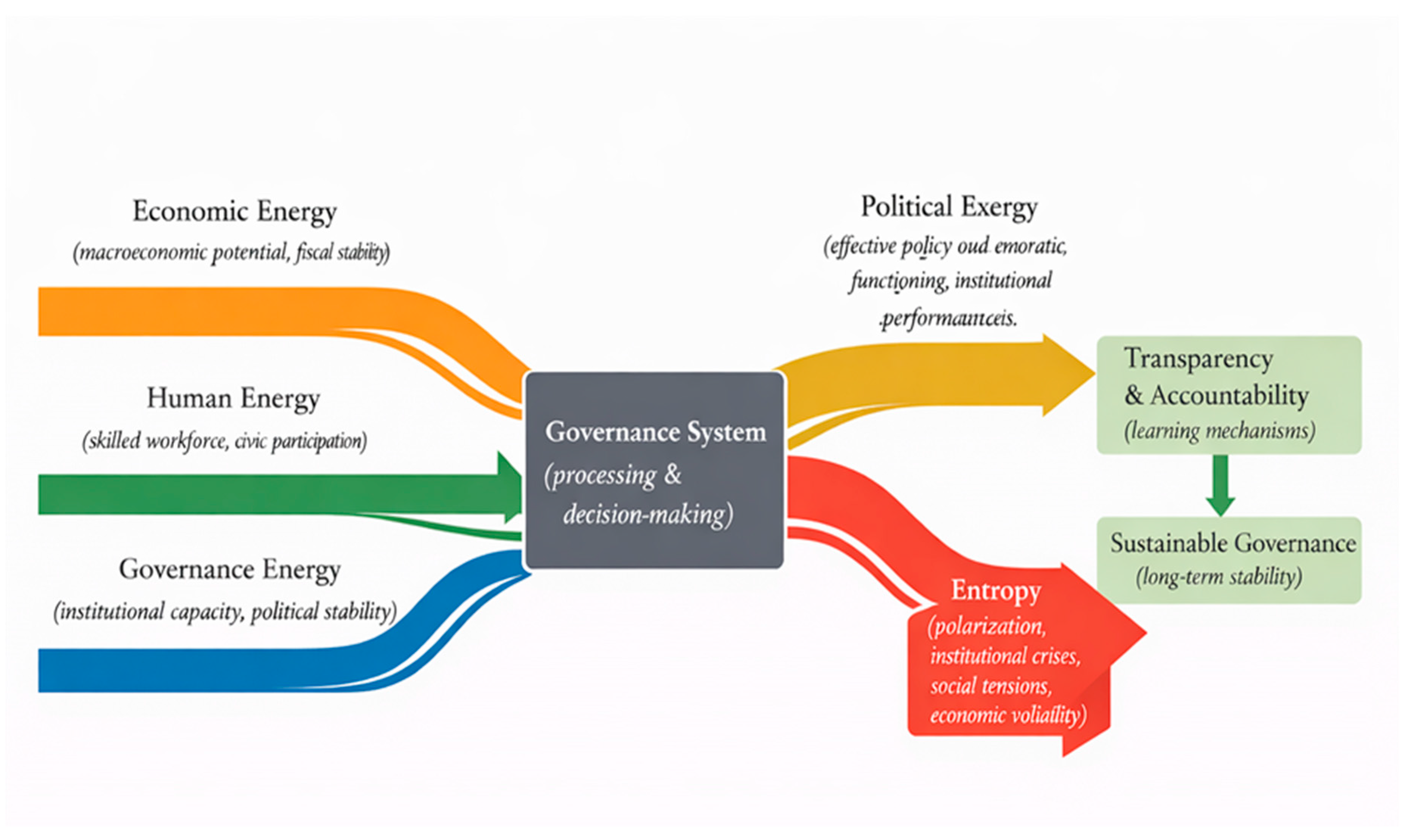
Figure 2.
Cross-country comparison of exergy efficiency (EER) values for Germany, Türkiye, China, and South Africa.
Figure 2.
Cross-country comparison of exergy efficiency (EER) values for Germany, Türkiye, China, and South Africa.
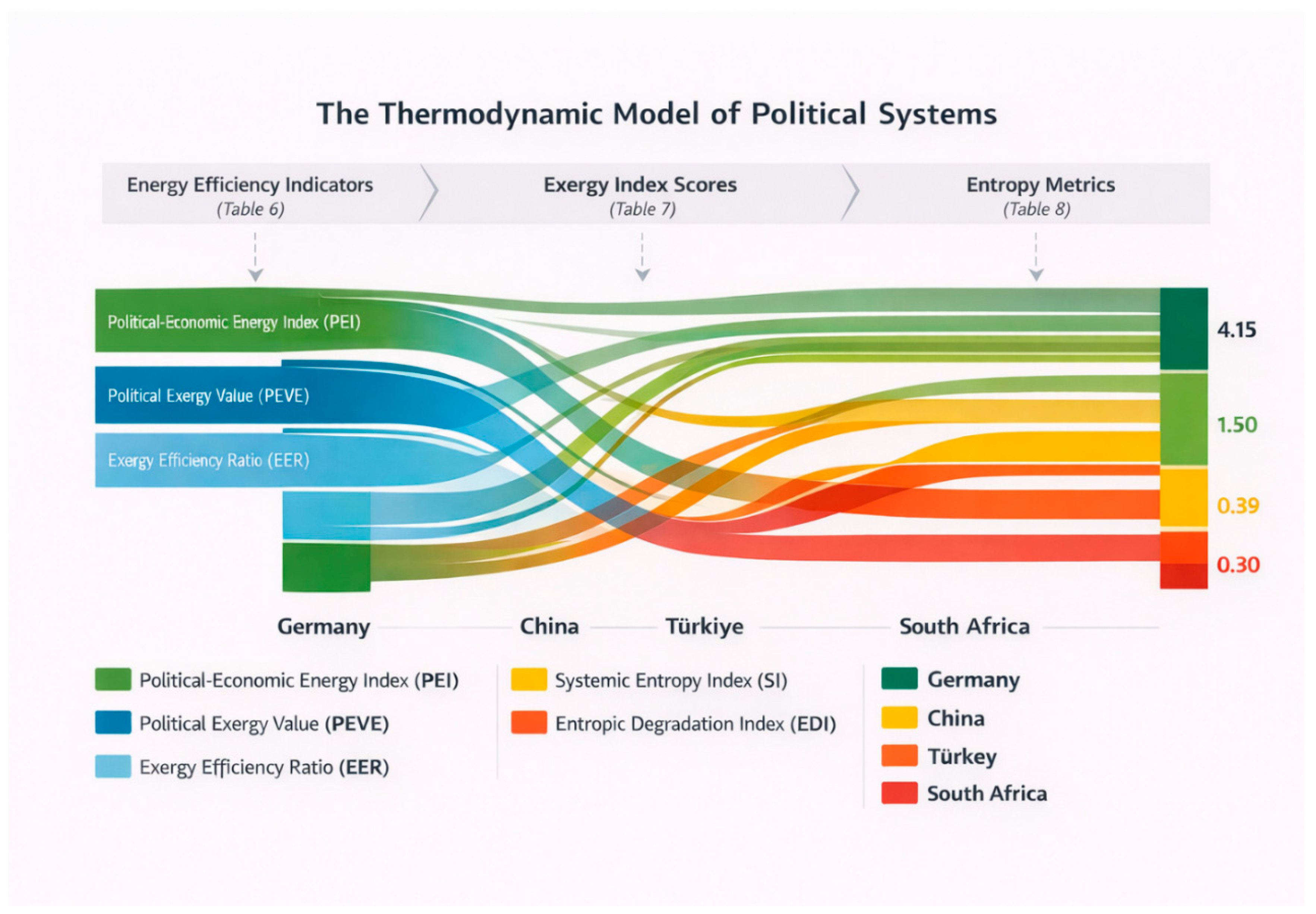
Figure 3.
Indicators comparison among Turkiye, Germany, China and South Africa for the year 2023.
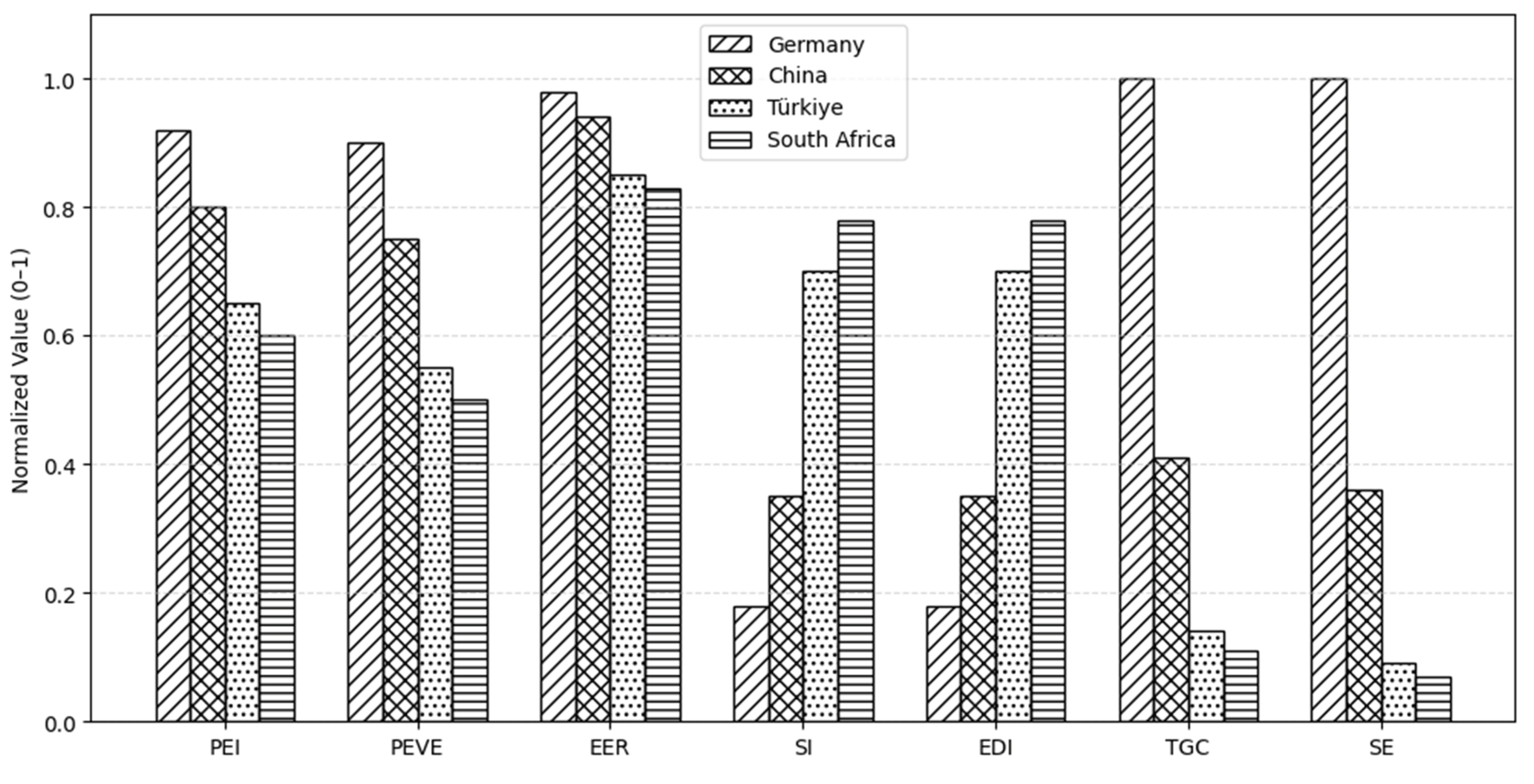

Table 1.
Thermodynamic variables and their political system analogues in the TMPS framework.
| Thermodynamic Variable | Political System Analogue | Conceptual Interpretation in Governance Analysis |
|---|---|---|
| Energy (E) | Aggregate political–economic capacity | The total stock of material, institutional, and social resources available to a political system, including economic output, administrative capacity, social capital, and institutional legitimacy |
| Exergy (Ex) | Effective governance capacity | The proportion of total political energy that can be mobilized and converted into effective policy formulation, implementation, and institutional reform |
| Entropy (S) | Institutional disorder and inefficiency | The degree of systemic disorganization arising from corruption, polarization, information asymmetries, and declining trust, which undermines coordination and governance performance |
Table 2.
Energy indicators used to compute political energy inputs across four selected countries.
| Code | Indicator | Description |
|---|---|---|
| E1-1 | GDP per capita (PPP) | Represents the aggregate economic energy available to the political system, reflecting the material capacity to support public services, institutional functioning, and long-term policy initiatives [28]. |
| E1-2 | Labor productivity | Captures the efficiency with which human labor is transformed into economic output, indicating the system’s productive energy and its ability to sustain economic growth and fiscal capacity [29]. |
| E1-3 | Technological infrastructure index | Measures the technological energy embedded in digital, industrial, and communication infrastructures that enhance innovation, coordination, and systemic efficiency [30]. |
| E2-1 | Education quality & years of schooling | Reflects the human energy input of the system by capturing cognitive capacity, skill formation, and the long-term potential for knowledge-based governance and innovation [31]. |
| E2-2 | Health indicators (life expectancy) |
Indicates the quality and sustainability of human capital, as healthier populations provide more stable and resilient energy inputs to economic and political processes [32]. |
| E2-3 | Social trust / social capital index | Represents societal energy potential by measuring the level of trust, cooperation, and network density that reduces transaction costs and enhances collective action [33]. |
| E3-1 | Political Stability Index | Captures institutional stability as a form of stored political energy, enabling predictable decision-making and reducing energy losses arising from uncertainty and conflict [34]. |
| E3-2 | Government continuity | Measures the durability of governing arrangements and policy frameworks, reflecting the system’s capacity to preserve and accumulate energy over time rather than dissipating it through frequent disruptions [35]. |
| E3-3 | Violence & terrorism risk | Represents the potential loss or dissipation of system energy, as insecurity diverts resources toward containment and undermines long-term development and governance efficiency [35]. |
Table 3.
Exergy indicator including government effectiveness, regulatory quality, rule of law, and participation metrics.
Table 3.
Exergy indicator including government effectiveness, regulatory quality, rule of law, and participation metrics.
| Code | Indicator | Description |
|---|---|---|
| Ex1-1 | Government effectiveness | Represents the ability of public institutions to transform available economic and human resources into effective policy outcomes. It reflects the level of institutional exergy, indicating how efficiently governance structures convert potential capacity into functional outputs [36]. |
| Ex1-2 | Regulatory quality | Refers to the consistency, predictability, and effectiveness of regulatory frameworks in supporting economic and social activities. Higher regulatory quality enhances output quality by improving the usefulness and reliability of institutional outcomes [36]. |
| Ex1-3 | Bureaucratic processing speed | Measures the efficiency with which administrative inputs are converted into decisions and services. It captures the conversion efficiency (input → output) of institutional processes and reflects time-related exergy losses within governance systems [37]. |
| Ex1-4 | E-government & digital governance capacity | Indicates the extent to which digital technologies are integrated into public administration and service delivery. This indicator reflects transformation efficiency, reducing institutional frictions and enhancing the effective use of governance resources [38]. |
| Ex2-1 | Rule of law | Represents the degree to which legal frameworks are enforced impartially and predictably. As a core component of governance exergy, it supports stable and efficient institutional functioning by reducing uncertainty and systemic inefficiencies [39]. |
| Ex2-2 | Property rights protection | Captures the security of ownership and contract enforcement within the economic system. Strong property rights enhance economic exergy by enabling resources to be transformed into productive and high-value economic activities [40]. |
| Ex2-3 | Control of corruption | Reflects the effectiveness of mechanisms limiting the misuse of public power for private gain. By reducing resource leakage and inefficiencies, this indicator represents exergy-loss reduction within institutional systems [41]. |
| Ex3-1 | Civil liberties | Measures the extent to which individuals can freely participate in social, economic, and political processes. Civil liberties increase social work potential by enabling collective action and productive societal engagement [42]. |
| Ex3-2 | Democracy Index | Indicates the level of political participation, representation, and institutional checks and balances. A higher democracy level strengthens systemic organization, allowing exergy to be utilized in a more coordinated and sustainable manner [43]. |
| Ex3-3 | Voice & accountability | Captures the degree of transparency, freedom of expression, and public oversight in governance. This indicator reflects transparency exergy, enhancing information flow and reducing inefficiencies in decision-making processes [44,45]. |
Table 4.
Entropy indicators measuring political polarization, social tension, economic fragility, and legal uncertainty.
Table 4.
Entropy indicators measuring political polarization, social tension, economic fragility, and legal uncertainty.
| Code | Indicator | Description Source |
|---|---|---|
| S1-1 | Political polarization | Refers to the degree of ideological fragmentation and conflict within the political system. High political polarization increases political entropy by reducing consensus-building capacity and amplifying systemic inefficiencies in decision-making processes [46]. [42] |
| S1-2 | Government crisis frequency | Measures the recurrence of cabinet collapses, executive instability, or constitutional crises. Frequent government crises indicate institutional disorder, increasing uncertainty and reducing the effective utilization of institutional capacity [47]. |
| S1-3 | Legal uncertainty | Captures ambiguity, inconsistency, or unpredictability in legal frameworks and judicial outcomes. Elevated legal uncertainty increases complexity and unpredictability, contributing to higher entropy by disrupting stable institutional and economic interactions [48]. |
| S2-1 | Social tension index | Reflects the intensity of social conflicts, protests, and group-based grievances within society. High social tension represents societal entropy, signaling the dissipation of social cohesion and cooperative capacity [49]. |
| S2-2 | Migration pressure | Indicates the scale and intensity of inward or outward migration driven by economic, political, or environmental factors. Migration pressure contributes to demographic entropy by altering population structures and increasing adjustment costs within social systems [50]. |
| S2-3 | Unemployment rate | Measures the share of the labor force unable to find employment despite willingness to work. High unemployment represents social loss, reflecting underutilization of human capital and increased entropy in the labor market [51]. |
| S2-4 | Income inequality (Gini) | Captures the degree of income dispersion within society. Higher income inequality reflects entropic distribution, indicating uneven allocation of economic resources and reduced systemic efficiency [52]. |
| S3-1 | Inflation volatility | Measures fluctuations in inflation rates over time. High inflation volatility represents economic disorder, increasing uncertainty and reducing the predictability of economic planning and investment decisions [53]. |
| S3-2 | Public debt sustainability | Reflects the government’s ability to service debt without fiscal distress. Weak debt sustainability indicates fiscal decay, contributing to long-term macroeconomic instability and rising systemic entropy [54]. |
| S3-3 | Financial vulnerability index | Captures exposure to financial shocks, including banking fragility and external financing risks. Elevated financial vulnerability represents systemic fragility, increasing the likelihood of entropy-amplifying crises within the economic system [55]. |
Table 5.
Core political, economic, and human development indicators for the four sampled countries in 2023.
Table 5.
Core political, economic, and human development indicators for the four sampled countries in 2023.
| Indicator | Germany | Türkiye | China | South Africa | Sources |
|---|---|---|---|---|---|
| Political Regime (Freedom House) | Free | Partly Free | Not Free | Free | [80] |
| Freedom Score (0–100) | ~83–85 | ~52–55 | ~35–40 | ~80–81 | [81] |
| GDP (Trillion USD) | ~4.1 | ~1.0 | ~18–19 | ~0.40 | [82] |
| GDP per Capita (USD) | ~50,000–55,000 | ~9,500–11,000 | ~12,000–13,000 | ~6,000 | [83] |
| Real GDP Growth (%) | ~0.3–1.5 | ~5.0–8.0 | ~4.5–5.0 | ~0.6 | [84] |
| Inflation Rate (%) | ~6–8 | ~50–65 | ~0.5–2.0 | ~4–5 | [85] |
| Unemployment Rate (%) | ~3–4 | ~9–10 | ~5 | ~33–34 | [86] |
| Population (Million) | ~84 | ~85 | ~1,425 | 60 | [87] |
| Human Development Index (HDI) | ~0.947 | ~0.853 | ~0.800+ | 0.700 | [88] |
| Military Expenditure (Billion USD) | ~50–55 | ~15–20 | ~230–260 | 4.4 | [89] |
| External Debt (% of GDP) | ~60–70 | ~30–50 | ~10–15 | 70–80 | [90] |
| Economic Energy Potential (GDP per capita, PPP, USD) | ~55,000–60,000 | ~30,000–35,000 | ~20,000–25,000 | ~13,000–15,000 | [91] |
| Technological Energy (GII, 0–100) | ~50–55 | ~38–40 | ~54–56 | ~30–31 | [93] |
| Human Energy Input (Avg. Years of Schooling) | ~12–13 | ~8–9 | ~8–9 | ~10–11 | [92] |
| Human Capital Quality (Life Expectancy, years) | ~81–83 | ~77–78 | ~77–78 | ~66–67 | [94] |
Table 6.
Energy indicators used in the TMPS model to assess political energy inputs across the four sampled countries.
Table 6.
Energy indicators used in the TMPS model to assess political energy inputs across the four sampled countries.
| Code | Indicator | Germany | Turkiye | China | South Africa | Source |
|---|---|---|---|---|---|---|
| E1-1 | GDP per capita (PPP Purchasing Power Parity) | ~59,000 | ~34,000 | ~23,000 | ~14,000 | [95,96] |
| E1-2 | Labor productivity | ~75–80 | ~35–40 | ~30–35 | ~25–30 | [97] |
| E1-3 | Technological infrastructure index | ~50–55 | ~38–40 | ~54–56 | ~30–31 | [23] |
| E2-1 | Education quality & years of schooling | ~12–13 | ~8–9 | ~8–9 | ~10–11 | [29] |
| E2-2 | Health indicators (life expectancy) | ~81–83 | ~77–78 | ~77–78 | ~66–67 | [28] |
| E2-3 | Social trust / social capital index (%) | 44 | 12 | 38 | 20 | [97] |
| E3-1 | Political Stability Index | ~0.7–1.0 | ~–1.0 | ~–0.4 | ~–0.7 | [39,40] |
| E3-2 | Government continuity | +1.6 | -0,3 | +0,5 | -0,1 | [98,99,100,101,102] |
| E3-3 | Violence & terrorism risk | 1,2 | 3,8 | 0,2 | 2,5 | [103,104] |
Table 7.
Institutional and governance exergy indicators for the four sampled countries.
| Code | Indicator | Türkiye | Germany | China | South Aafrica | Source |
|---|---|---|---|---|---|---|
| Ex1-1 | Government effectiveness (-2.5 to +2.5) | +1.6 | -0.3 | +0.5 | -0.1 | [40] |
| Ex1-2 | Regulatory quality (-2.5 to +2.5) | +1.7 | -0.4 | -0.2 | -0.1 | [39] |
| Ex1-3 | Bureaucratic processing speed (Time to start a business, days) | ~8 | ~7 | ~8–9 | ~40 | [37] |
| Ex1-4 | E-government & digital governance capacity (EGDI, 0–1) | ~0.92 | ~0.79 | ~0.77 | ~0.73 | [35] |
| Ex2-1 | Rule of law (-2.5 to +2.5) | +1.6 | -0.6 | -0.4 | -0.2 | [35] |
| Ex2-2 | Property rights protection (0–100) | ~85 | ~55 | ~60 | ~50 | [103] |
| Ex2-3 | Control of corruption (-2.5 to +2.5) | +1.7 | -0.4 | -0.3 | -0.2 | [41] |
| Ex3-1 | Civil liberties (1–7, 1 = best) | 1 | 5 | 7 | 3 | [44] |
| Ex3-2 | Democracy Index (0–10) | ~8.8 | ~4.3 | ~2.0 | ~7.0 | [44] |
| Ex3-3 | Voice & accountability (-2.5 to +2.5) |
+1.5 | -0.8 | -1.5 | +0.2 | [36] |
Table 8.
Political, social, and economic entropy indicators for the four sampled countries.
| Code | Indicator | Germany | Türkiye | China | South Africa | Source |
|---|---|---|---|---|---|---|
| S1-1 | Political polarization | ~0.45 | ~0.70 | ~0.40 | ~0.65 | [104] |
| S1-2 | Government crisis frequency | ~0.2 | ~0.6 | ~0.1 | ~0.5 | [105] |
| S1-3 | Legal uncertainty (rule complexity / unpredictability) | ~0.25 | ~0.55 | ~0.45 | ~0.50 | [106] |
| S2-1 | Social tension index | ~0.30 | ~0.55 | ~0.40 | ~0.65 | [44] |
| S2-2 | Migration pressure (net migration per 1000 pop) | +4.0 | +1.5 | -0.2 | -0.5 | [107] |
| S2-3 | Unemployment rate (%) | ~3.2 | ~9.4 | ~5.0 | ~33.0 | [107] |
| S2-4 | Income inequality (Gini) | ~0.31 | ~0.41 | ~0.47 | ~0.63 | [108] |
| S3-1 | Inflation volatility (CPI annual %) | ~3.0 | ~25.0 | ~1.5 | ~4.5 | [108] |
| S3-2 | Public debt sustainability (% of GDP) | ~65 | ~30 | ~80 | ~75 | [109] |
| S3-3 | Financial vulnerability index (BIS, composite) | ~0.25 | ~0.60 | ~0.35 | ~0.55 | [110] |
Table 9.
Normalized TMPS components (PEI, PEVE, SI, EER, EDI, TGC, SE) for cross-country thermodynamic governance assessment (2023).
Table 9.
Normalized TMPS components (PEI, PEVE, SI, EER, EDI, TGC, SE) for cross-country thermodynamic governance assessment (2023).
| Country | PEI | PEVE | SI | EER | EDI | TGC | SE |
|---|---|---|---|---|---|---|---|
| Germany | 0.92 | 0.90 | 0.18 | 0.98 | 0.18 | 4.90 | 4.15 |
| China | 0.80 | 0.75 | 0.35 | 0.94 | 0.35 | 2.02 | 1.50 |
| Türkiye | 0.65 | 0.55 | 0.70 | 0.85 | 0.70 | 0.67 | 0.39 |
| South Africa | 0.60 | 0.50 | 0.78 | 0.83 | 0.78 | 0.53 | 0.30 |
Disclaimer/Publisher’s Note: The statements, opinions and data contained in all publications are solely those of the individual author(s) and contributor(s) and not of MDPI and/or the editor(s). MDPI and/or the editor(s) disclaim responsibility for any injury to people or property resulting from any ideas, methods, instructions or products referred to in the content. |
© 2025 by the authors. Licensee MDPI, Basel, Switzerland. This article is an open access article distributed under the terms and conditions of the Creative Commons Attribution (CC BY) license (http://creativecommons.org/licenses/by/4.0/).
Copyright: This open access article is published under a Creative Commons CC BY 4.0 license, which permit the free download, distribution, and reuse, provided that the author and preprint are cited in any reuse.