

Submitted:
23 December 2025
Posted:
24 December 2025
You are already at the latest version
Abstract
We calculate and plot the Wigner functions of several families of highly excited even and odd superpositions of nonlinear coherent states, looking for conditions under which such superpositions can be interpreted as models of the ``Schr\"odinger cat'' states. It appears that the decisive factor is the form of the number distribution functions over the Fock basis: they must have well localized peaks. Otherwise, no ``cat'' structures are observed.
Keywords:
coherent states
; coherent phase states
; nonlinear coherent states
; Barut–Girardello coherent states
; binomial states
; negative binomial states
1. Introduction
The Wigner function [1] is a useful tool in many areas of quantum mechanics and quantum optics [2,3,4,5]. We use the definition (for one degree of freedom and )
where is a Hermitian positive-definite operator (the statistical operator) normalized as . In this case, Equation (1) defines a real function with the normalization
It is remarkable that the Wigner function is limited (in contrast to the wave function or the density matrix) [2,6,7,8]:
The extremal values are achieved for pure quantum states with definite parity [2,9], whose wave functions obey the relations . Moreover, the relation holds for all such states, as can be seen from Equation (1) after the replacement , writing as .
Simple examples of states with definite parity are the Fock states of the harmonic oscillator, i.e., eigenstates of the number operator , where and are the bosonic creation and annihilation operators satisfying the commutation relation . In this paper, we consider dimensionless canonical position and momentum operators, related to operators and as follows,
The Wigner functions of the Fock states are well known [2,3,4,10,11,12,13]:
where is the Laguerre polynomial defined as [14,15]
Functions (5) strongly oscillate when (they have exactly n zeros). Consequently, they have approximately n circular regions of negativity in the phase plane , in accordance with the property of the Fock states to be “the most nonclassical states”: see Figure 1.
On the other hand, the infinite superpositions of the Fock states in the form
known as coherent states (CS) [16,17,18], possess non-oscillating (Gaussian) Wigner functions. The states with definite parity can be obtained as the following superpositions of coherent states:
The states (7) (introduced in paper [19] under the name even/odd coherent states) turned out important in many applications to quantum mechanics, quantum optics and quantum information [20,21,22,23,24,25]. The Wigner functions of these states with have the form of two symmetric distant Gaussian peaks, well separated from the central strongly oscillating narrow peak (see Section 2). Due to this structure, the states (7) (as well as more general superpositions of Gaussian wave functions) are frequently considered as simple models of the famous “Schrödinger cat” states [26,27,28,29,30,31,32,33,34,35,36].
A lot of various generalizations of states (6) and their superpositions have been studied for the past decades [37]. In this connection, it seems natural to ask, whether all such superpositions can be considered as models of “cat” states or not? Searching for an answer to this question, we considered generalizations of states (7) of the form
where is some positive function and a complex number. The choice of the power dependence in the definition (9) is not accidental: due to the equidistant energy spectrum of the harmonic oscillator, the time evolution of the state (9) is reduced to the substitution (in the dimensionless units with ). Hence, the variations of phase are equivalent to the temporal evolution of the quantum state (9). In view of this observation, we plot everywhere the sections for different values of the phase . Note that the choice can be also interpreted as the transformation to the momentum representation: writing the Wigner function in the more detailed form as one can see that .
The states (9) are known under the name “nonlinear coherent states” [38,39,40] (although sometimes in slightly different forms), and their superpositions like (8) were considered, e.g., in papers [41,42,43]. It seems interesting to study how functions different from influence the shape of the corresponding Wigner functions. Earlier, the Wigner functions of even/odd superpositions of different quantum states were plotted in papers [44,45,46,47], as well as in many papers cited above. However, the authors of those studies considered small values of parameters like or , when the mean numbers of quanta in the superpositions are low (frequently, less than 1), due to technical difficulties in numeric calculations with big values of or . On the other hand, the well known examples of the “usual” even/odd coherent states show that the most interesting behavior can be observed in superpositions with big mean numbers of quanta.
Using the program Python, we have succeeded to overcome the numeric challenges and plot the Wigner functions for highly excited superpositions of different families of states like (9). Numerous examples demonstrated that the “cat” structures are maintained for rapidly growing (faster than ) functions . On the other hand, choosing , we have discovered a total disappearance of the “cat” structure. Therefore, we investigated several families of well known nonlinear coherent states with different functions , trying to see, under which conditions the “cat” structures can be observed.
Our plan is as follows. In Section 2, we remind the well known properties of the usual even/odd coherent states. In Section 3, we bring general formulas for arbitrary functions . In Section 4, we show examples of superpositions with rapidly growing functions (known under the name “Barut–Girardello coherent states), which maintain the “cat” structure. Interesting special cases of the “binomial states” are demonstrated in Section 5. Superpositions of “coherent phase states” with are considered in Section 6. Plots of the Wigner functions for more general “negative binomial states” with are shown in Section 7. Section 8 contains conclusions.
2. Wigner Functions of the Usual Even/Odd Coherent States
The wave function of the usual coherent state (6) in the coordinate representation has the well known Gaussian form
In this case, the right-hand side of Equation (1) for the states (7) is reduced to the calculation of four simple Gaussian integrals according to the decomposition of the statistical operator
The result can be expressed as follows,
where ,
If and , one can see three Gaussian peaks of the same width: the central peak of the height (or depth) and two symmetric distant positive peaks whose hights are twice lower than the height of the central one. The lateral peaks rapidly disappear with increase of the phase (equivalent to the evolution in time), due to the amplitude factor . The evolving central peak acquires a rapidly oscillating “fine structure” with almost Gaussian envelope of the same width as in the case of .
The right-hand side of Equation (11) depends on the difference of phases . Therefore, hereafter we fix the phase , studying the section of the total Wigner function for different values of the phase of the complex parameter (or parameter in the subsequent sections). Figure 2 shows the Wigner functions for (when the mean number of quanta in each component equals ) and two extreme phases: and .
The number distribution function over the Fock states has the following expressions for the even/odd coherent states:
Plots of these distributions as functions of are shown in Figure 3 for . Probably, it is worth remembering that even distributions are “super-Poissonian”, whereas odd distributions are “sub-Poissonian” for the distributions (13).
Note that the maximal probabilities in the even and odd distributions practically coincide. Probably, this is a mere accidental coincidence. However, it is interesting that the same coincidences can be seen in almost all similar figures, except for the case of “mid-binomial” distributions in Figure 6.
3. General Even/Odd Superpositions
If a pure state is a superposition of the Fock states,
the corresponding statistical operator can be written as a double sum over the diadic operators :
The related Wigner function can be written as
where is the Weyl symbol [48] of the operator . This symbol was calculated, e.g., in papers [10,11,12,13]:
Here, is the generalized Laguerre polynomial [14,15],
Note that the difference is an even number, both for the even and odd superpositions, whereas is even number for even superpositions and odd number for odd superpositions. Expansions of superpositions (8) over the Fock basis have the form
The total Wigner function (16) of even (odd) states (19) or (20) can be written as , where the first series contains the terms with only (hence, it does not depend on phases and ), whereas the summation in the double series over all numbers can be performed with respect to independent coefficients and . The explicit expressions are as follows,
In the numeric calculations performed in the following sections, all series were calculated up to the maximal summation indexes .
4. Even/Odd “Barut–Girardello” Coherent States
As an example of rapidly converging superpositions of the Fock states (faster than in the standard coherent states), we considered the so called “Barut–Girardello coherent states” [49] (studied also in [19]) with the nonlinearity function
where is the Euler gamma-function and g arbitrary real parameter. The normalization constants (21) can be expressed in terms of the Bessel functions of the first and third kinds (in this section, we use letter instead of and ):
Figure 4 shows the number distributions in the even/odd superpositions of the Barut–Girardello coherent states with and ,
5. Superpositions of Binomial States
We consider normalized binomial states in the form
Such states (or their modifications and generalizations) were considered, e.g., in Refs. [50,51,52]. The mean number of quanta and its variance in state (29) are as follows,
Defining the nonlinearity function as
and using Newton’s binomial expansion, one can find the normalization factors (21) of the even/odd superpositions:
Phase-dependent parts of the Wigner functions are finite double sums:
The phase-independent parts of the Wigner functions can be calculated analytically with the aid of formula 4.4.1.7 from Ref. [53]
The results are as follows,
These expressions can be simplified for the “mid-binomial” states with (when , and ):
The probability distributions over the Fock states have the following forms for “mid-binomial” states with :
These distributions are shown in Figure 6 for .
6. Even/odd Coherent Phase States
Among an infinite number of possible functions in Equation (9), the simplest choice seems to be . It gives the family of coherent phase states (CPS) [54,55,56,57,58,59,60,61,62,63,64] (called also as “harmonious” [65], “pseudothermal” [66] and “geometric” [67] states):
Even and odd superpositions of the CPS have the following normalized expansions in the Fock basis:
In this case, we have thermal-like distributions (slowly and monotonously decaying),
which are shown in Figure 8 for .
The superpositions (37) and (38) were considered in paper [68]. However, the corresponding Wigner functions were plotted there for small values of parameter only, while the most interesting features can be observed in the limit , as we demonstrate below.
A detailed study of statistical properties of the even/odd coherent phase states (squeezing, the uncertainty products, Mandel’s factor, etc.) was performed recently in paper [69]. Here, we show plots of the corresponding Wigner functions. Actually, their total difference from the case of usual even/odd coherent states induced writing the present paper.
The series (22) and (23) with can be calculated analytically as the even and odd parts of the known generating function for the Laguerre polynomials,
The results are as follows,
One can see that , as it must be for even or odd states. The off-diagonal parts of the Wigner functions can be reduced to the following double series:
Unfortunately, these series can be calculated only numerically.
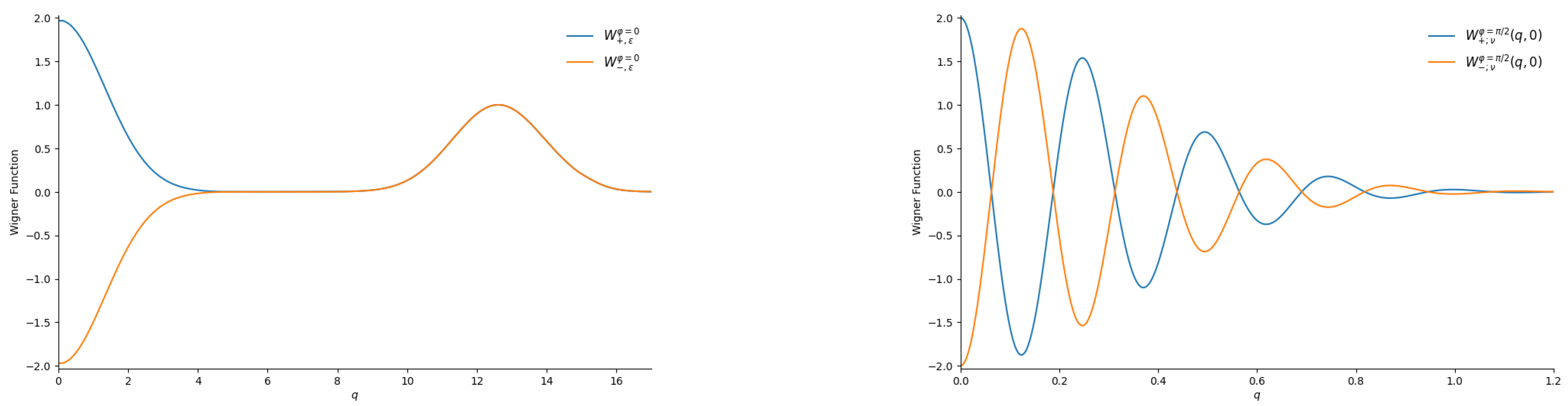
Figure 9 shows the Wigner functions for (when the mean number of quanta in each component equals ) and different phases. We plot the figures for in view of the relation . One can see a strong difference between Figs. 2 and 9. For example, there are no lateral peaks for in Figure 9. A probable explanation is the strong connection between the variance and the mean value in the coherent phase states with [64]: and . Therefore, the peaks of two components of the even superposition of CPS merge into a single central peak, in contrast to the even superpositions of the usual CS, whose peak widths do not depend on and . Although something remotely similar to lateral peaks is visible for odd superpositions, these peaks are smooth continuations of the central peak, whereas lateral peaks in usual odd CS are well separated from the central peak. Another striking difference from the case of usual even/odd coherent states is the absence of any “fine structure” for the phase , as can be seen in Figure 10.
7. Negative Binomial States
Coherent phase states can be considered as the special case () of negative binomial states (NBS), whose normalized expansion over the Fock states has the form
with the following simple expressions for the mean number of quanta and its variance [67]:
The early history of studies of such states goes to papers [19,55,67,70,71,72,73,74]. Even and odd NBS were introduced in paper [75]. The normalization factor in Equation (45) follows from the formula
Consequently, using the function
we obtain the following normalization coefficients in Equation (21):
The number distributions are as follows,
To plot the Wigner functions, we calculated numerically the following series:
Numeric calculations for the values resulted in figures looking qualitatively like Figure 9 and Figure 10, provided the difference is not very big. Figure 11 illustrates the case of .
Figures for different values of parameter have similar shapes for odd superpositions, both for and . A small difference between the cases of and was observed for even superpositions: their Wigner functions show practically no negative regions for , especially for . Such a behavior can be understood, if one takes into account that even superpositions go to the vacuum state in the limit (while odd superpositions continue to have an infinite number of terms).
If parameter increases, the number distribution function acquires more and more pronounced peaks: see Figure 12. The related plots for two different values of parameter are shown in Figure 12.
Note that Equation (46) yields the mean number of quanta in each component of the superposition for and .
Finally, the “cat” structure totally revives for , as can be seen in Figure 13.
8. Conclusions
The plots demonstrated in this paper show that the family of possible “cat-like” quantum states is significantly bigger than it was thought (probably) earlier. It includes, in particular, even and odd highly excited superpositions of several types of nonlinear coherent states. The decisive factor is the form of the number distribution functions over the Fock basis: they must have relatively narrow peaks. Otherwise, no “cat” structures can be observed. In all examples, the heights of lateral peaks of the cat-like Wigner functions are exactly twice smaller than the height of the central interference peak. Since all these lateral peaks have certainly non-Gaussian shapes, the discoveries of this paper open the new direction for the future studies: to try to understand how the shapes of new cat-like states can influence the decoherence, “classicalization” and thermalization times in the presence of different reservoirs (comparing, e.g., with the results of studies [21,46,76,77,78]).
Author Contributions
M.C.F.: conceptualization, analytical and numerical calculations, plotting figures, software; V.V.D.: conceptualization, methodology, analytical calculations and writing the paper. All authors have read and agreed to the published version of the manuscript.
Funding
This research received no external funding.
Acknowledgments
V.V.D. acknowledges partial financial support from Brazilian funding agency National Council for Scientific and Technological Development (CNPq). M.C.F. acknowledges a support from the Brazilian funding agency CAPES, process 88887.007464/2024-00.
Conflicts of Interest
The authors declare no conflict of interest.
References
- Wigner, E. On the quantum corrections for thermodynamic equilibrium. Phys. Rev. 1932, 40, 749–759. [Google Scholar] [CrossRef]
- Tatarskii, V.I. The Wigner representation of quantum mechanics. Sov. Phys. – Uspekhi 1983, 26, 311–327. [Google Scholar] [CrossRef]
- Hillery, M.; O’Connell, R.F.; Scully, M.O.; Wigner, E.P. Distribution functions in physics: fundamentals. Phys. Rep. 1984, 106, 121–167. [Google Scholar] [CrossRef]
- Schleich, W.P. Quantum Optics in Phase Space; Wiley: New York, USA, 2001. [Google Scholar]
- Vourdas, A. Analytic representations in quantum mechanics. J. Phys. A: Math. Gen. 2006, 39, R65–R141. [Google Scholar] [CrossRef]
- Takabayasi, T. The formulation of quantum mechanics in terms of ensemble in phase space. Prog. Theor. Phys. 1954, 11, 341–373. [Google Scholar] [CrossRef]
- Cahill, K.E.; Glauber, R.J. Density operators and quasiprobability distributions. Phys. Rev. 1969, 177, 1882–1902. [Google Scholar] [CrossRef]
- Royer, A. Wigner function as the expectation value of a parity operator. Phys. Rev. A 1977, 15, 449–450. [Google Scholar] [CrossRef]
- Dodonov, V.V. Wigner functions and statistical moments of quantum states with definite parity. Phys. Lett. A 2007, 364, 368–371. [Google Scholar] [CrossRef]
- Groenewold, H.J. On the principles of elementary quantum mechanics. Physica 1946, 12, 405–460. [Google Scholar] [CrossRef]
- Bartlett, M.S.; Moyal, J.E. The exact transition probabilities of quantum-mechanical oscillator calculated by the phase-space method. Proc. Cambr. Phil. Soc. 1949, 45, 545–553. [Google Scholar] [CrossRef]
- Cahill, K.E.; Glauber, R.J. Ordered expansions in boson amplitude operators. Phys. Rev. 1969, 177, 1857–1881. [Google Scholar] [CrossRef]
- Dodonov, V.V.; Man’ko, V.I. Phase space eigenfunctions of multidimensional quadratic Hamiltonians. Physica A 1986, 137, 306–316. [Google Scholar] [CrossRef]
- Bateman Manuscript Project: Higher Transcendental Functions; Erdélyi, A., Ed.; McGraw-Hill: New York, NY, USA, 1953; vol. 2. [Google Scholar]
- Gradshtein, I.S.; Ryzhik, I.M. Table of Integrals, Series, and Products, 7th edition; Academic: Amsterdam, The Netherlands, 2007. [Google Scholar]
- Klauder, J.R. The action option and a Feynman quantization of spinor fields in terms of ordinary c-numbers. Ann. Phys. (NY) 1960, 11, 123–168. [Google Scholar] [CrossRef]
- Glauber, R.J. Photon correlations. Phys. Rev. Lett. 1963, 10, 84–86. [Google Scholar] [CrossRef]
- Sudarshan, E.C.G. Equivalence of semiclassical and quantum mechanical descriptions of statistical light beams. Phys. Rev. Lett. 1963, 10, 277–279. [Google Scholar] [CrossRef]
- Dodonov, V.V.; Malkin, I.A.; Man‘ko, V.I. Even and odd coherent states and excitations of a singular oscillator. Physica 1974, 72, 597–615. [Google Scholar] [CrossRef]
- Hillery, M. Amplitude-squared squeezing of the electromagnetic field. Phys. Rev. A 1987, 36, 3796–3802. [Google Scholar] [CrossRef]
- Bužek, V.; Vidiella-Barranco, A.; Knight, P.L. Superpositions of coherent states: Squeezing and dissipation. Phys. Rev. A 1992, 45, 6570–6585. [Google Scholar] [CrossRef] [PubMed]
- Gerry, C.C. Nonclassical properties of even and odd coherent states. J. Mod. Opt. 1993, 40, 1053–1071. [Google Scholar] [CrossRef]
- Ansari, N.A.; Di Fiore, L.; Manko, M.A.; Manko, V.I.; Solimeno, S.; Zaccaria, F. Quantum limits in interferometric gravitational-wave antennas in the presence of even and odd coherent states. Phys. Rev. A 1994, 49, 2151–2156. [Google Scholar] [CrossRef]
- Bužek, V.; Knight, P.L. Quantum interference, superposition states of light, and nonclassical effects. In Progress in Optics; Wolf, E., Ed.; North-Holland: Amsterdam, The Netherlands, 1995; vol. XXXIV, pp. 1–158. [Google Scholar]
- de Matos Filho, R.L.; Vogel, W. Even and odd coherent states of the motion of a trapped ion. Phys. Rev. Lett. 1996, 76, 608–611. [Google Scholar] [CrossRef]
- Yurke, B.; Stoler, D. Generating quantum mechanical superpositions of macroscopically distinguishable states via amplitude dispersion. Phys. Rev. Lett. 1986, 57, 13–16. [Google Scholar] [CrossRef] [PubMed]
- Schleich, W.; Pernigo, M.; Kien, F.L. Nonclassical state from two pseudoclassical states. Phys. Rev. A 1991, 44, 2172–2187. [Google Scholar] [CrossRef] [PubMed]
- Brune, M.; Haroche, S.; Raimond, J.M.; Davidovich, L.; Zagury, N. Manipulation of photons in a cavity by dispersive atom-field coupling: quantum-nondemolition measurements and generation of “Schrödinger cat” states. Phys. Rev. A 1992, 45, 5193–5214. [Google Scholar] [CrossRef]
- Tara, K.; Agarwal, G.S.; Chaturvedi, S. Production of Schrödinger macroscopic quantum-superposition states in a Kerr medium. Phys. Rev. A 1993, 47, 5024–5029. [Google Scholar] [CrossRef] [PubMed]
- Janszky, J.; Domokos, P.; Adam, P. Coherent states on a circle and quantum interference. Phys. Rev. A 1993, 48, 2213–2219. [Google Scholar] [CrossRef]
- Janszky, J.; Vinogradov, A.V.; Kobayashi, T.; Kis, Z. Vibrational Schrödinger-cat states. Phys. Rev. A 1994, 50, 1777–1284. [Google Scholar] [CrossRef]
- Dodonov, V.V.; Kalmykov, S.Y.; Man’ko, V.I. Statistical properties of Schrödinger real and imaginary cat states. Phys. Lett. A 1995, 199, 123–130. [Google Scholar] [CrossRef]
- Castaños, O.; López-Peña, R.; Man’ko, V.I. Crystallized Schrödinger cat states. J. Russ. Laser Res. 1995, 16, 477–525. [Google Scholar] [CrossRef]
- Monroe, C.; Meekhof, D.M.; King, B.E.; Wineland, D.J. A “Schrödinger cat” superposition state of an atom. Science 1996, 272, 1131–1136. [Google Scholar] [CrossRef]
- Delgado, A.; Klimov, A.B.; Retamal, J.C.; Saavedra, C. Macroscopic field superpositions from collective interactions. Phys. Rev. A 1998, 58, 655–662. [Google Scholar] [CrossRef]
- Malbouisson, J.M.C.; Baseia, B. Higher-generation Schrödinger cat states in cavity QED. J. Mod. Opt. 1999, 46, 2015–2041. [Google Scholar] [CrossRef]
- Dodonov, V.V. Nonclassical’ states in quantum optics: a `squeezed’ review of first 75 years. J. Opt. B: Quantum Semiclass. Opt. 2002, 4, R1–R33. [Google Scholar] [CrossRef]
- de Matos Filho, R.L.; Vogel, W. Nonlinear coherent states. Phys. Rev. A 1996, 54, 4560–4563. [Google Scholar] [CrossRef]
- Man’ko, V.I.; Marmo, G.; Sudarshan, E.C.G.; Zaccaria, F. f-oscillators and nonlinear coherent states. Phys. Scripta 1997, 55, 528–541. [Google Scholar] [CrossRef]
- Sivakumar, S. Studies on nonlinear coherent states. J. Opt. B: Quantum Semiclass. Opt. 2000, 2, R61–R75. [Google Scholar] [CrossRef]
- Mancini, S. Even and odd nonlinear coherent states. Phys. Lett. A 1997, 233, 291–296. [Google Scholar] [CrossRef]
- Sivakumar, S. Even and odd nonlinear coherent states. Phys. Lett. A 1998, 250, 257–262. [Google Scholar] [CrossRef]
- Roy, B.; Roy, P. Time dependent nonclassical properties of even and odd nonlinear coherent states. Phys. Lett. A 1999, 263, 48–52. [Google Scholar] [CrossRef]
- Zhang, J.; Wu, W.; Meng, S.-Y. Quantum properties of two-mode squeezed even and odd coherent states. Commun. Theor. Phys. 2007, 47, 317–324. [Google Scholar] [CrossRef]
- Darwish, M. Even and odd nonlinear negative binomial states. Int. J. Theor. Phys. 2008, 47, 3035–3056. [Google Scholar] [CrossRef]
- Mohammadbeigi, A.; Tavassoly, M.K. The decoherence of the quantum excitation of even/odd coherent states in a photon-loss channel. J. Phys. B: At. Mol. Opt. Phys. 2014, 47, 165502. [Google Scholar] [CrossRef]
- Ren, G.; Du, J.-m.; Zhang, W.-h.; Yu, H.-j. Nonclassicality generated by applying Hermite–polynomials photon-added operator on the even/odd coherent states. Int. J. Theor. Phys. 2017, 56, 1537–1549. [Google Scholar] [CrossRef]
- Weyl, H. Quantenmechanik und Gruppentheorie. Z. Phys. 1928, 46, 1–46. [Google Scholar] [CrossRef]
- Barut, A.O.; Girardello, L. New “coherent” states associated with non-compact groups. Commun. Math. Phys. 1971, 21, 41–55. [Google Scholar] [CrossRef]
- Stoler, D.; Saleh, B.E.A.; Teich, M.C. Binomial states of the quantized radiation field. Optica Acta 1985, 32, 345–355. [Google Scholar] [CrossRef]
- Fu, H.C.; Sasaki, R. Generalized binomial states: ladder operator approach. J. Math. Phys. 1996, 29, 5637–5644. [Google Scholar] [CrossRef]
- Vidiella Barranco, A. The binomial states of light. In Theory of Non-classical States of Light; Dodonov, V.V., Man’ko, V.I., Eds.; Taylor & Francis: London, England, 2003; pp. 241–276. [Google Scholar]
- Prudnikov, A.P.; Brychkov, Y.A.; Marichev, O.I. Integrals and Series, vol. II; Gordon and Breach: London, England, 1986. [Google Scholar]
- Lerner, E.C.; Huang, H.W.; Walters, G.E. Some mathematical properties of oscillator phase operator. J. Math. Phys. 1970, 11, 1679–1684. [Google Scholar] [CrossRef]
- Aharonov, Y.; Lerner, E.C.; Huang, H.W.; Knight, J.M. Oscillator phase states, thermal equilibrium and group representations. J. Math. Phys. 1973, 14, 746–756. [Google Scholar] [CrossRef]
- Lévy-Leblond, J.-M. Who is afraid of nonhermitian operators? A quantum description of angle and phase. Ann. Phys. (NY) 1976, 101, 319–341. [Google Scholar] [CrossRef]
- Vourdas, A. SU(2) and SU(1;1) phase states. Phys. Rev. A 1990, 41, 1653–1661. [Google Scholar] [CrossRef]
- Shapiro, J.H.; Shepard, S.R. Quantum phase measurement: a system-theory perspective. Phys. Rev. A 1991, 43, 3795–3818. [Google Scholar] [CrossRef]
- Hall, M.J.W. Phase resolution and coherent phase states. J. Mod. Opt. 1993, 40, 809–824. [Google Scholar] [CrossRef]
- Vourdas, A.; Brif, C.; Mann, A. Factorization of analytic representations in the unit disc and number-phase statistics of a quantum harmonic oscillator. J. Phys. A: Math. Gen. 1996, 29, 5887–5898. [Google Scholar] [CrossRef]
- Wünsche, A. A class of phase-like states. J. Opt. B: Quantum Semiclass. Opt. 2001, 3, 206–218. [Google Scholar] [CrossRef]
- Dodonov, V.V.; Mizrahi, S.S. Creating quanta with an `annihilation’ operator. J. Phys. A: Math. Gen. 2002, 35, 8847–8857. [Google Scholar] [CrossRef]
- Gazeau, J.-P.; Hussin, V.; Moran, J.; Zelaya, K. Generalized Susskind–Glogower coherent states. J. Math. Phys. 2021, 62, 072104. [Google Scholar] [CrossRef]
- de Freitas, M.C.; Dodonov, V.V. Coherent phase states in the coordinate and Wigner representations. Quantum Rep. 2022, 4, 509–522. [Google Scholar] [CrossRef]
- Sudarshan, E.C.G. Diagonal harmonious state representation. Int. J. Theor. Phys. 1993, 32, 1069–1076. [Google Scholar] [CrossRef]
- Dodonov, V.V.; Mizrahi, S.S. Uniform nonlinear evolution equations for pure and mixed quantum states. Ann. Phys. (NY) 1995, 237, 226–268. [Google Scholar] [CrossRef]
- Fu, H.C.; Sasaki, R. Negative binomial states of quantized radiation fields. J. Phys. Soc. Jpn. 1997, 66, 1989–1994. [Google Scholar] [CrossRef]
- Obada, A.-S.F.; Darwish, M. Partial phase state as a nonlinear coherent state and some of its properties. J. Mod. Opt. 2004, 51, 209–222. [Google Scholar] [CrossRef]
- de Freitas, M.C.; Dodonov, V.V. Statistical properties of superpositions of coherent phase states with opposite arguments. Entropy 2024, 26, 977. [Google Scholar] [CrossRef]
- Aharonov, Y.; Huang, H.W.; Knight, J.M.; Lerner, E.C. Generalized destruction operators and a new method in group theory. Lett. Nuovo Cim. 1971, 2, 1317–1320. [Google Scholar] [CrossRef]
- Onofri, E.; Pauri, M. Analyticity and quantization. Lett. Nuovo Cim. 1972, 3, 35–42. [Google Scholar] [CrossRef]
- Joshi, A.; Lawande, S.V. The effects of negative binomial field distribution on Rabi oscillations. Opt. Commun. 1989, 70, 21–24. [Google Scholar] [CrossRef]
- Matsuo, K. Glauber–Sudarshan P-representation of negative binomial states. Phys. Rev. A 1990, 41, 519–522. [Google Scholar] [CrossRef]
- Stephen, S.M. Negative binomial states of the quantized radiation field. J. Mod. Opt. 1998, 45, 2201–2205. [Google Scholar] [CrossRef]
- Joshi, A.; Obada, A.-S.F. Some statistical properties of the even and the odd negative binomial states. J. Phys. A: Math. Gen. 1997, 30, 81–97. [Google Scholar] [CrossRef]
- Dodonov, V.V.; Mizrahi, S.S.; de Souza Silva, A.L. Decoherence and thermalization dynamics of a quantum oscillator. J. Opt. B: Quantum Semiclass. Opt. 2000, 2, 271–281. [Google Scholar] [CrossRef]
- Dodonov, V.V.; de Souza, L.A. Decoherence of superpositions of displaced number states. J. Opt. B: Quantum Semiclass. Opt. 2005, 7, S490–S499. [Google Scholar] [CrossRef]
- Dodonov, V.V.; Valverde, C.; Souza, L.S.; Baseia, B. Classicalization times of parametrically amplified “Schrödinger cat” states coupled to phase-sensitive reservoirs. Phys. Lett. A 2011, 375, 3668–3676. [Google Scholar] [CrossRef]
Figure 1.
The sections of the Wigner functions of the Fock states with (left) and (right).
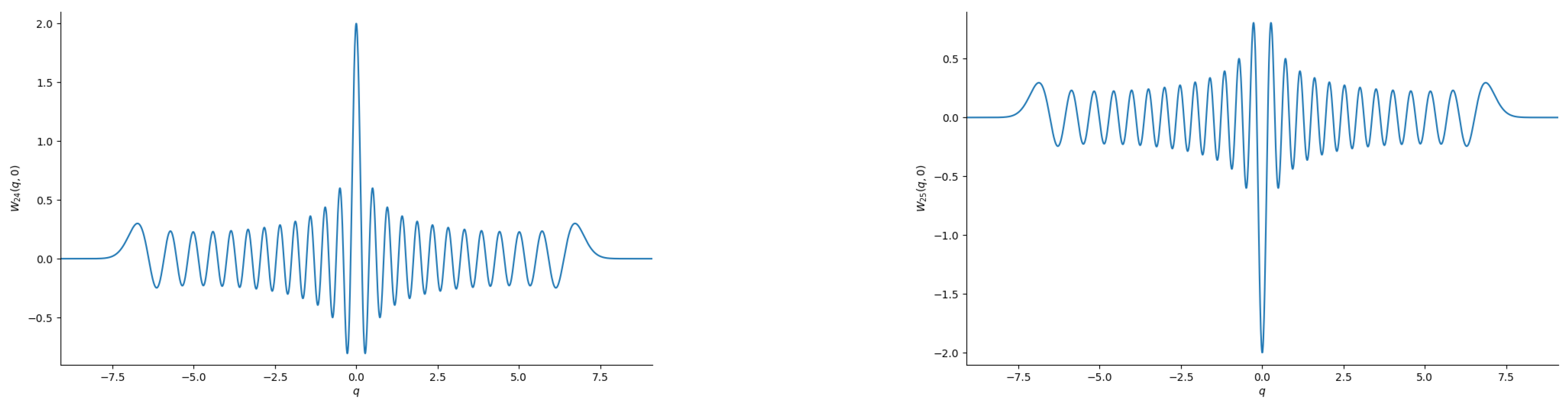
Figure 2.
The sections of the Wigner functions of the even (left) and odd (right) coherent states with and two extreme phases: and .
Figure 2.
The sections of the Wigner functions of the even (left) and odd (right) coherent states with and two extreme phases: and .
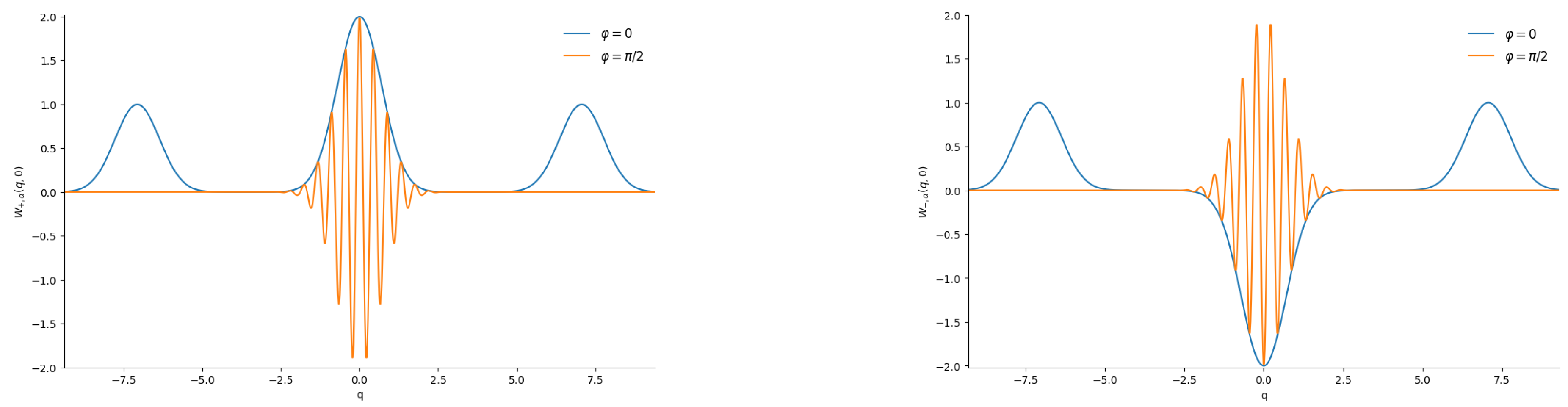
Figure 3.
The number distribution functions of the even and odd coherent states with .
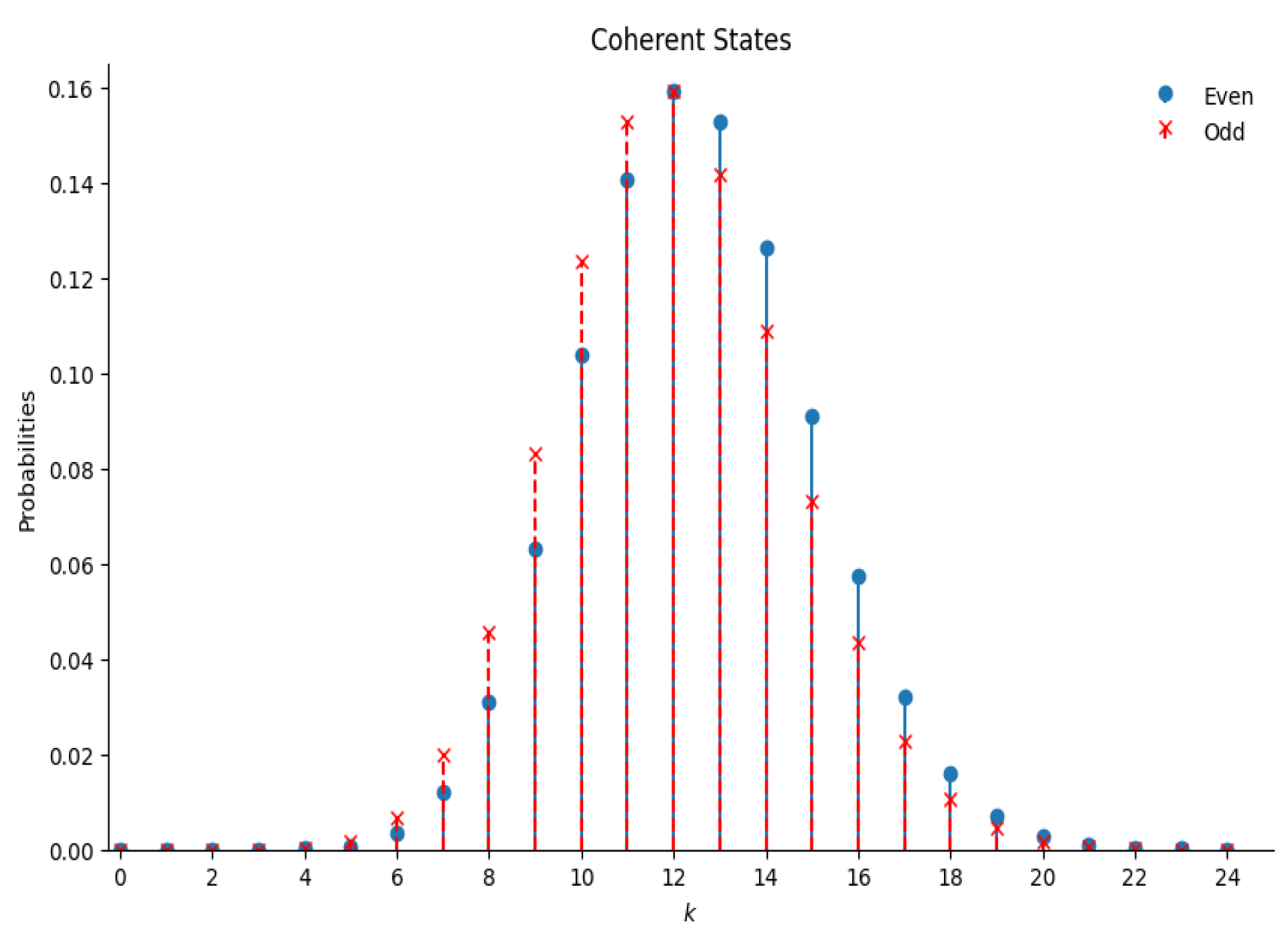
Figure 4.
The number distribution functions of the even and odd superpositions of the Barut–Girardello coherent states with .
Figure 4.
The number distribution functions of the even and odd superpositions of the Barut–Girardello coherent states with .
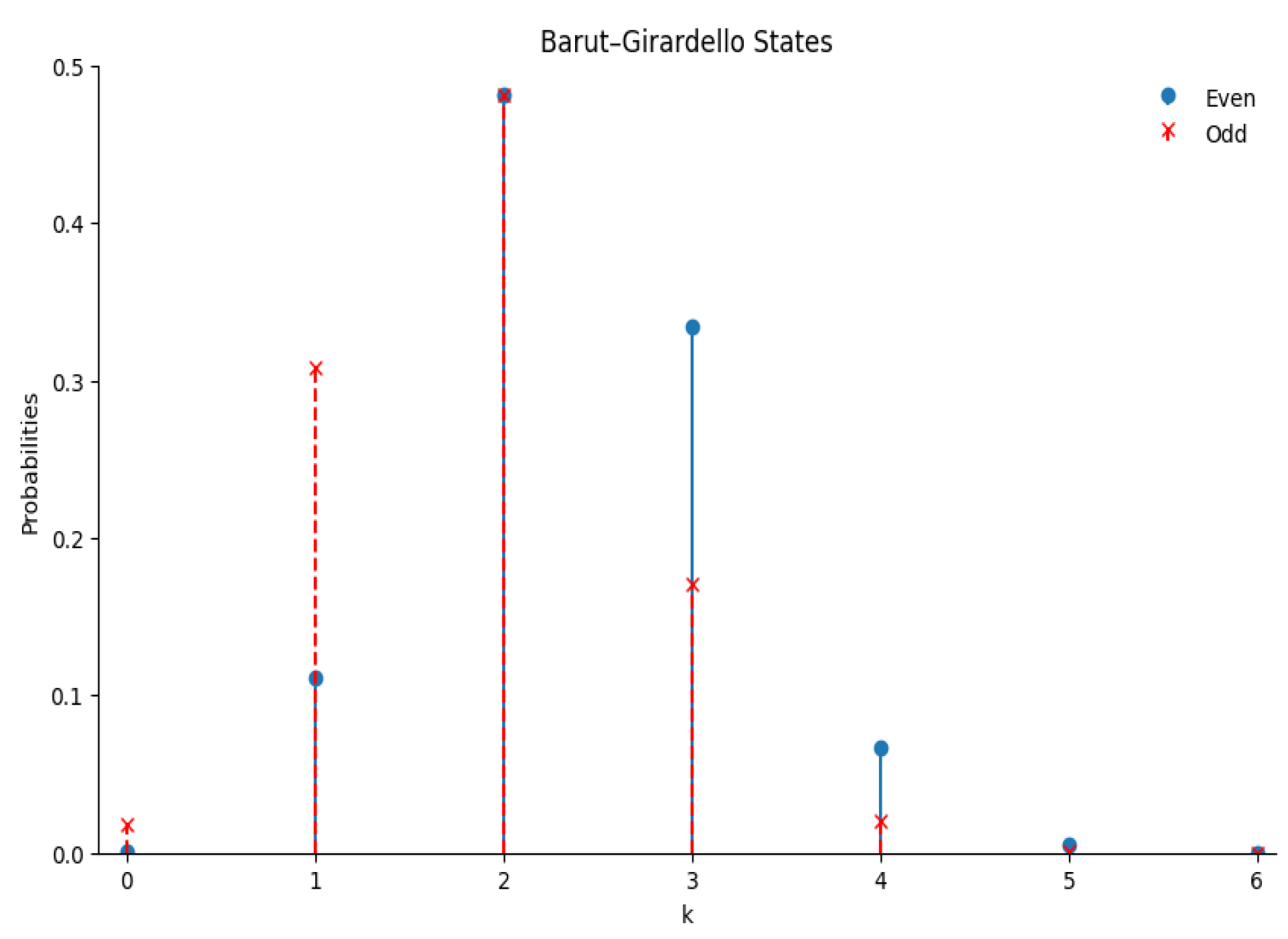
Figure 5.
The sections of the Wigner functions of the even (left) and odd (right) Barut-Girardello coherent states with function given by Equation (26); for , and two phases.
Figure 5.
The sections of the Wigner functions of the even (left) and odd (right) Barut-Girardello coherent states with function given by Equation (26); for , and two phases.
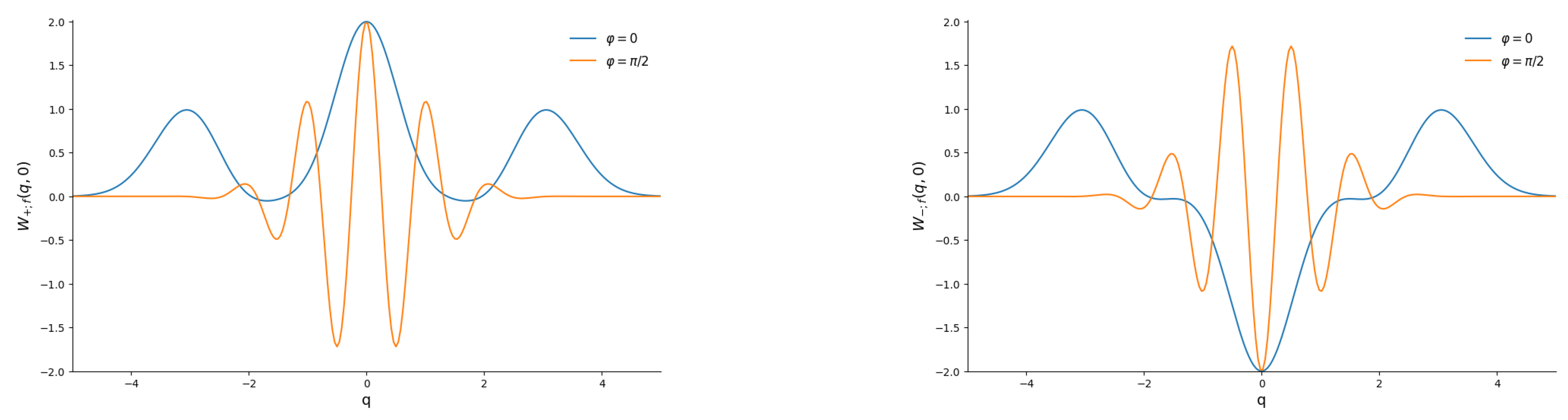
Figure 6.
The number distribution functions of the even and odd superpositions of the “mid-binomial” states with .
Figure 6.
The number distribution functions of the even and odd superpositions of the “mid-binomial” states with .
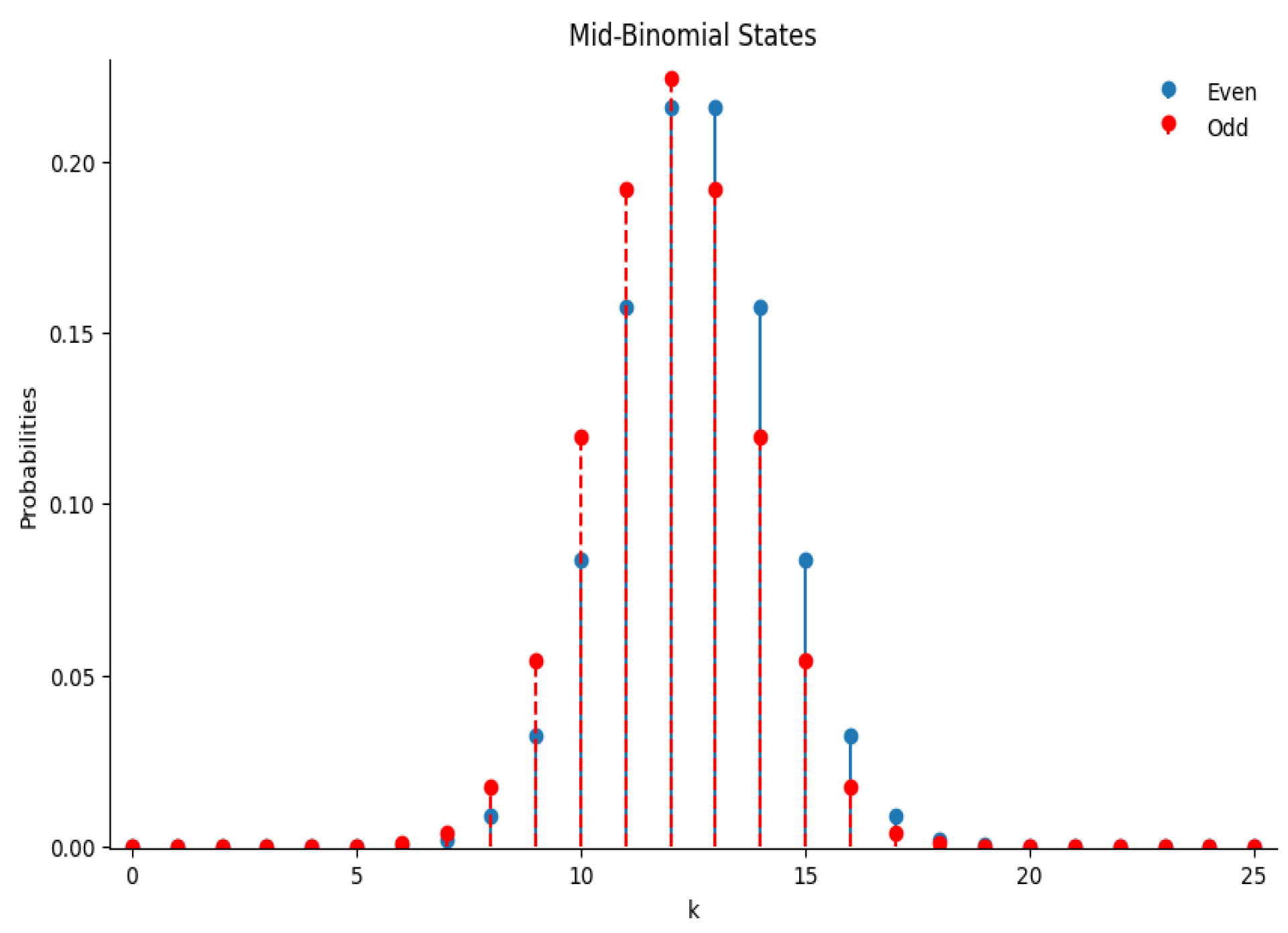
Figure 7.
The sections of the Wigner functions of the even and odd superpositions of “mid-binomial” states with . (Left): for . (Right): for .
Figure 7.
The sections of the Wigner functions of the even and odd superpositions of “mid-binomial” states with . (Left): for . (Right): for .
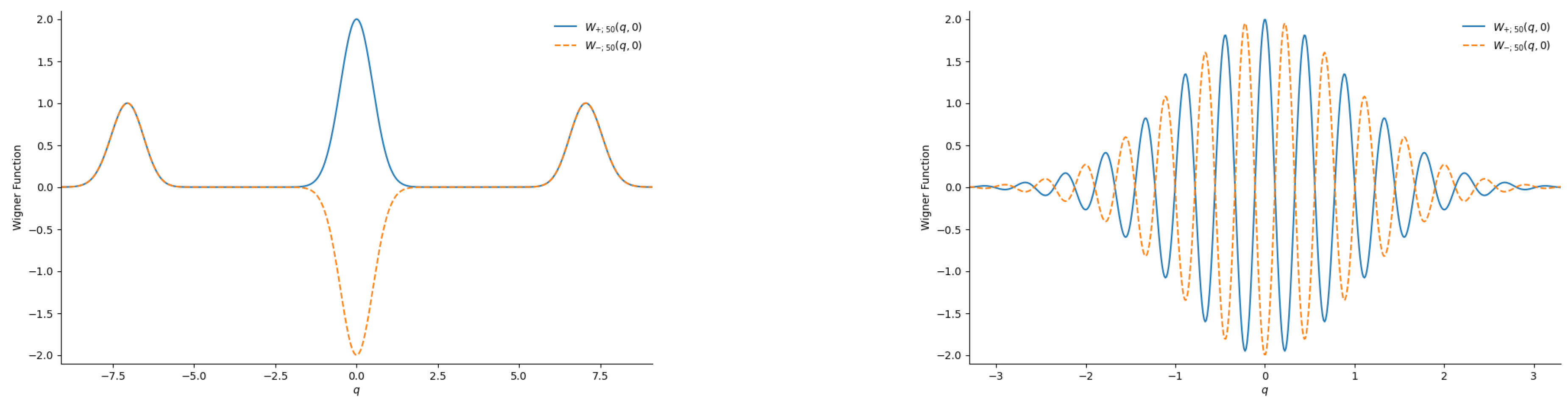
Figure 8.
The number distribution functions of the even and odd superpositions of the coherent phase states with .
Figure 8.
The number distribution functions of the even and odd superpositions of the coherent phase states with .
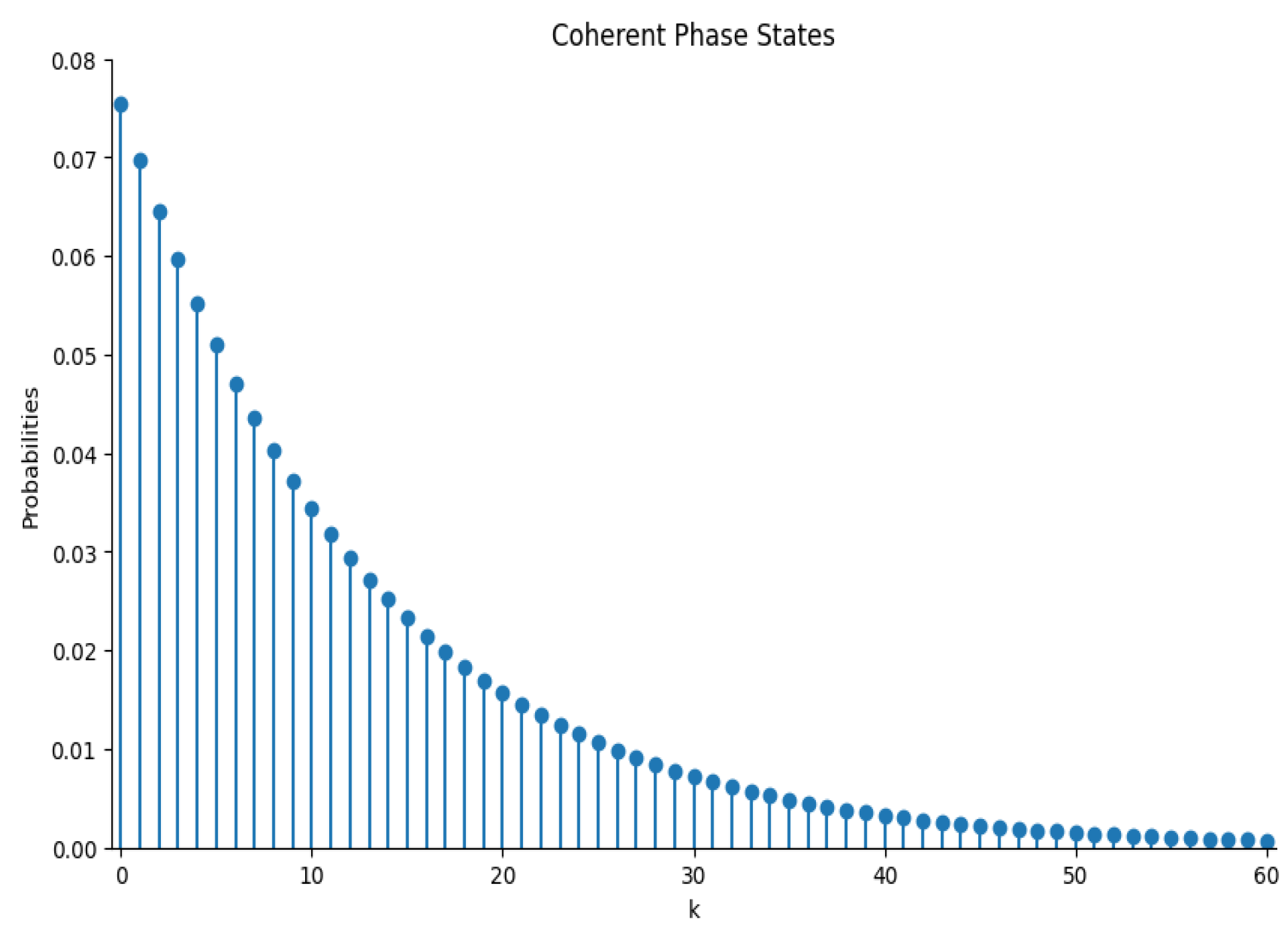
Figure 9.
The sections of the Wigner functions of the even (left) and odd (right) coherent phase states with and different phases.
Figure 9.
The sections of the Wigner functions of the even (left) and odd (right) coherent phase states with and different phases.
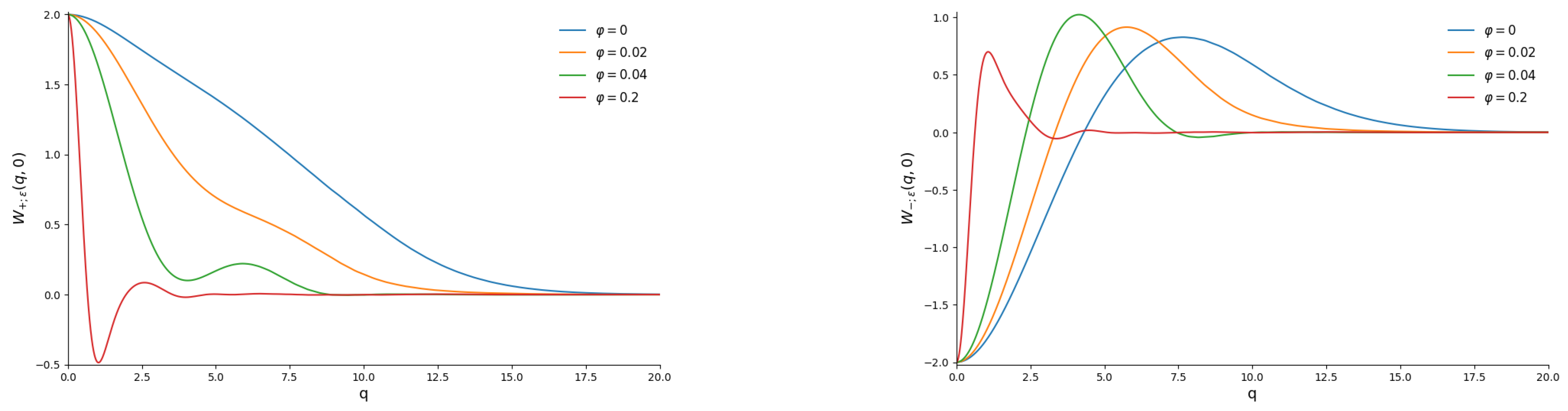
Figure 10.
The section of the Wigner functions of the even and odd coherent phase states with and .
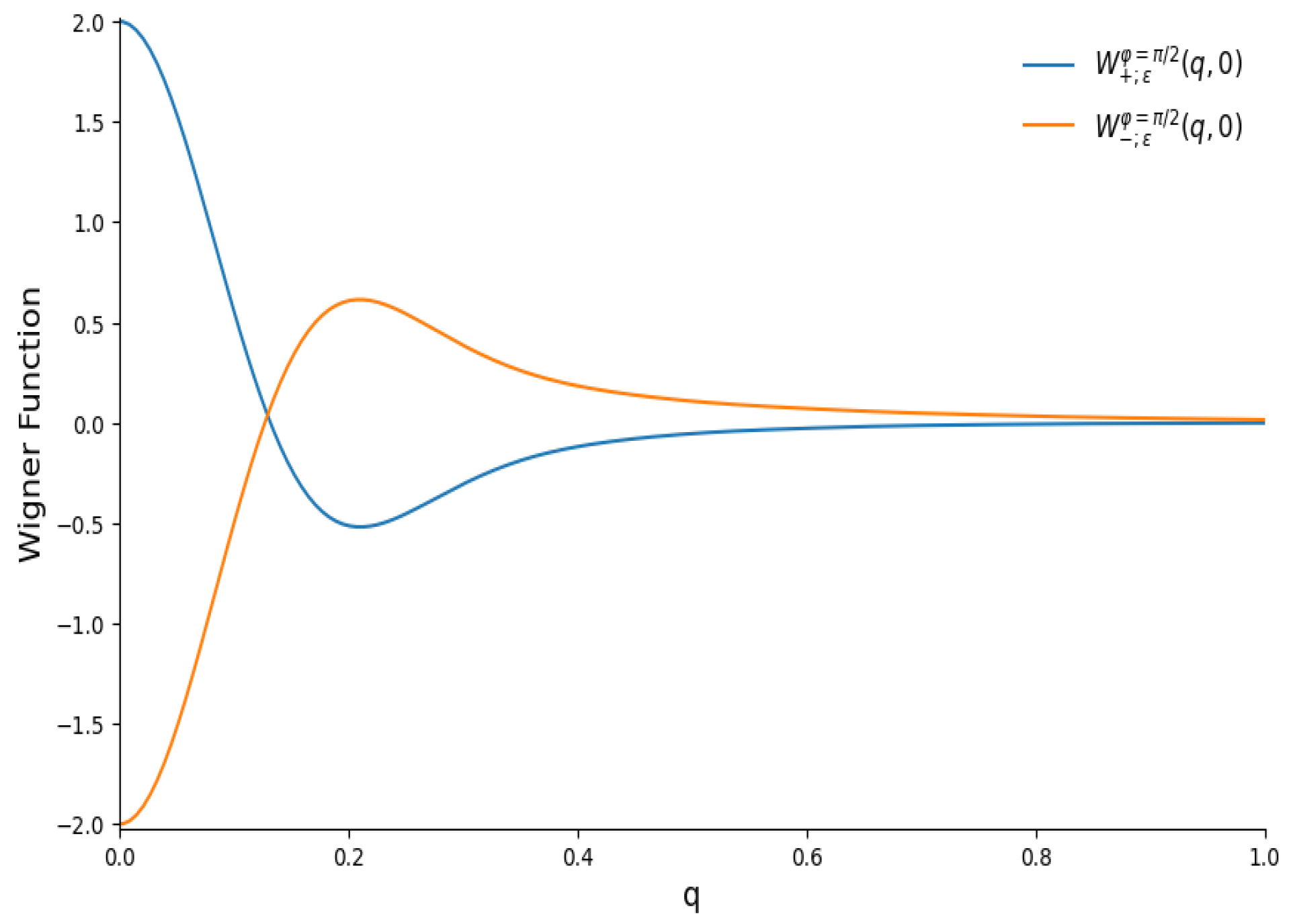
Figure 11.
Illustrations for the even and odd superpositions of the negative binomial states with and . (Left): the number distribution functions. (Right): Function for the even superpositions with different values of phase .
Figure 11.
Illustrations for the even and odd superpositions of the negative binomial states with and . (Left): the number distribution functions. (Right): Function for the even superpositions with different values of phase .
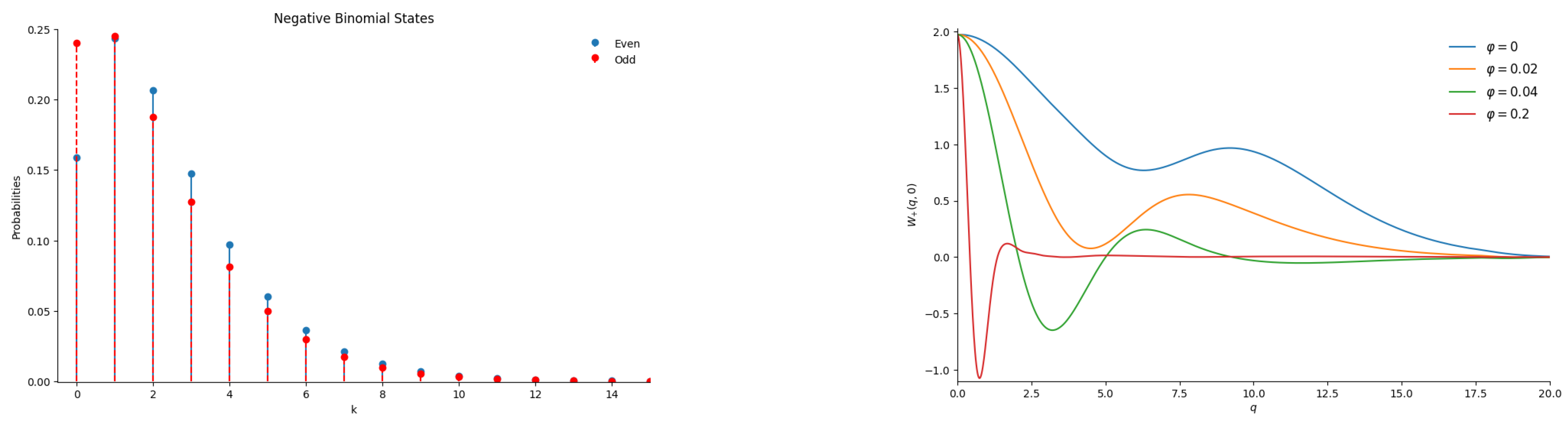
Figure 12.
The number distribution functions of the even and odd superpositions of the negative binomial states with for (left) and (right).
Figure 12.
The number distribution functions of the even and odd superpositions of the negative binomial states with for (left) and (right).
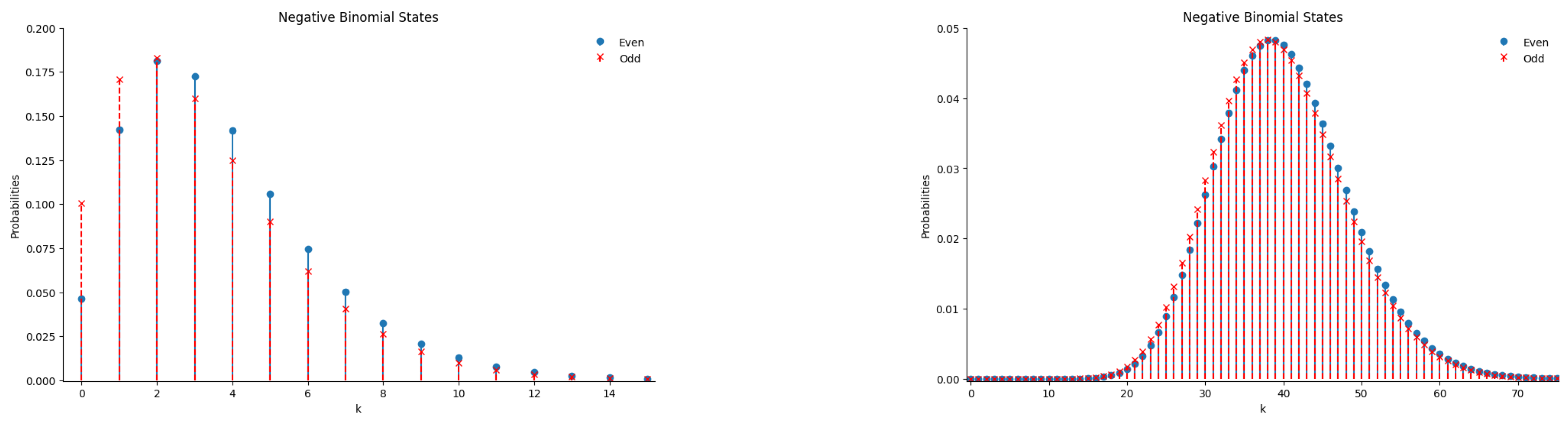
Figure 13.
The section of the Wigner functions of the even and odd negative binomial states with and , for (left) and (right).
Figure 13.
The section of the Wigner functions of the even and odd negative binomial states with and , for (left) and (right).
Disclaimer/Publisher’s Note: The statements, opinions and data contained in all publications are solely those of the individual author(s) and contributor(s) and not of MDPI and/or the editor(s). MDPI and/or the editor(s) disclaim responsibility for any injury to people or property resulting from any ideas, methods, instructions or products referred to in the content. |
© 2025 by the authors. Licensee MDPI, Basel, Switzerland. This article is an open access article distributed under the terms and conditions of the Creative Commons Attribution (CC BY) license (http://creativecommons.org/licenses/by/4.0/).
Copyright: This open access article is published under a Creative Commons CC BY 4.0 license, which permit the free download, distribution, and reuse, provided that the author and preprint are cited in any reuse.


