

Submitted:
23 December 2025
Posted:
25 December 2025
You are already at the latest version
Abstract
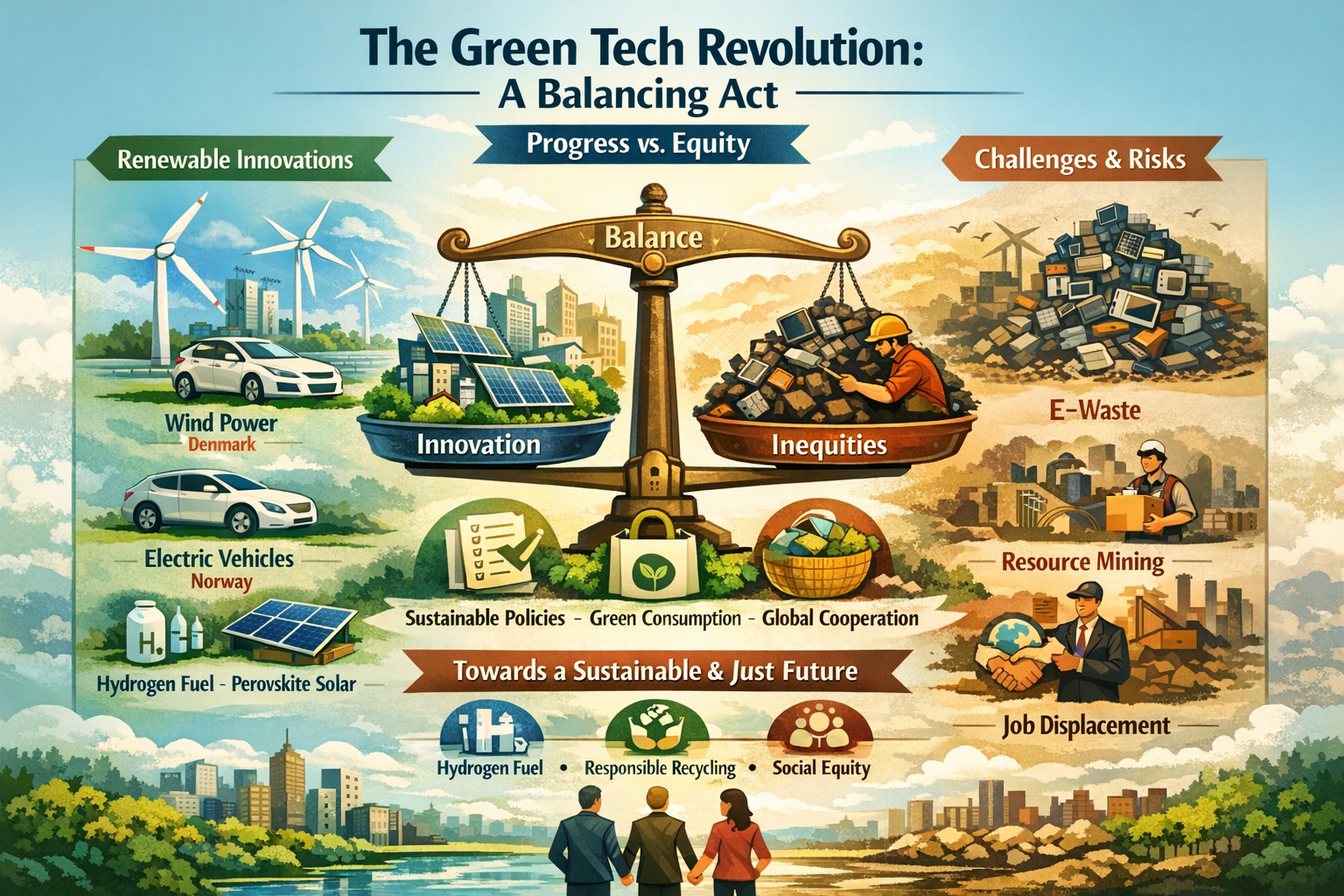
The Green Tech Revolution is humanity’s answer to climate change, featuring game-changing advances in renewable energy, smart infrastructure and circular economies. Successes like Denmark’s wind energy dominance and Norway’s electric vehicle adoption provide proof that scalable, meaningful solutions are attainable. Nevertheless, this revolution in power generation has brought with it major ethical and logistical problems. The environmental impact of mining, global concerns over e-waste, and social risks, including the digital divide and job displacement, reveal a complicated terrain in which innovation can unwittingly exacerbate existing inequities. To manage this, we require a multidimensional Balancing act between Progress and equity. This involves supporting next-generation technologies such as hydrogen fuel and perovskite solar cells, implementing strong policies for sustainable production and recycling, and encouraging individual responsibility via greener consumption. In the end, a truly sustainable future is not going to be delivered by technology; it has to be a imperative and equitable partnership between governments, corporations and citizens. It is only through such concerted efforts that the gains of the green transition can be shared universally, so that planetary health and social justice march forward hand in hand.
Keywords:
circular economy
; climate policy
; green technology
; renewable energy
; sustainability
1. Introduction
Two competing dynamics have shaped the 21st century, rapid technological change and mounting environmental problem. On a side, technology has transformed industries, connected billions of people, and created efficiencies never before imagined. But the environmental toll of such progress has long been impossible to overlook. From data centres that belch carbon to towers of electronic waste, the innovations at the heart of modern life are also putting unprecedented strain on the planet’s ecosystems. But what if in this paradox lay a revolutionary good news story: Green Technology. This revolution is expected to reconcile human ingenuity with ecological preservation, providing answers that may alleviate climate change, bring down pollution, and encourage sustainable growth. yet the question remains are we going to be able to innovate fast enough to outpace environmental degradation and will everyone have access to the innovations, or will it be a smaller group of people trying to survive?
“Green Tech” is a broad term that covers many types of innovations that exist to combat environmental degradation while addressing the needs of an increasingly demanding society. Renewable energy sources, notably solar and wind energy, are perhaps the best-known examples of this trend, but it goes much farther than clean energy. Smart grids enhance electricity delivery and eliminate waste, which reduces dependence on fossil fuels. Artificial intelligence predicts weather, monitors energy use, and tracks deforestation as it happens. Once the realm of a few specialists, electric cars are now the mainstream of the market, with nearly every major automaker committing to phasing out the combustion engine. On the other hand, advances in materials science provide biodegradable electronics, sustainable packaging, and carbon-negative construction methods. These developments point to a world in which technology is not extracting from the natural world, but rather moving with it.
But the interplay between technology and the environment is complex. Although Green Tech is the solution, it has its own footprint. Water and rare earth metals are needed in large quantities to make lithium-ion batteries for electric vehicles, and those are sourced through environmentally harmful mining activities. Our digital economy is headquartered in data centers that use more electricity than some small countries a lot of that still comes from coal and natural gas. Even renewable energy projects have their naysayers solar farms make use of large areas of land, wind turbines are a threat to birds. There has been a global crisis with e-waste as a result of people constantly upgrading their electronic devices, as toxic and hazardous materials seep into the soil and water supplies. Those paradoxes raise a fundamental challenge: Innovation needs to help solve today’s environmental problems without creating new ones.
The need for this balancing act is made more pressing with the compounding effects of climate change. Global warming, severe weather, and disappearing species are not nebulous threats they are here-and-now problems that require urgent solutions. Ambitious targets have been proclaimed by governments around the world, whether net-zero carbon commitments or bans on single-use plastic. Companies, facing pressure from investors and consumers, are embracing ESG principles that embed sustainability into their business models. But policy and good intentions are not enough, they need technologies at scale that can help societies transition away from fossil fuels and excessive consumption. The Green Tech revolution will not just have to invent these tools but make them cheap, high impact and suitable for use in a wide variety of countries and lifestyles.
Among the most exciting side effects of Green Tech is the potential for making sustainability more accessible to all. In developing countries, where energy poverty and infrastructure gaps are a fact of life, decentralized solar power and mobile-enabled agriculture apps are bypassing traditional, polluting models. From energy-efficient buildings to smart traffic management, smart city solutions can significantly reduce emissions while enhancing the livability of urban centers. Even regular consumers have tools at their fingertips these days to mitigate their own impact on the planet, whether that’s via energy-monitoring smart home devices or apps that allow you to calculate your own carbon footprint. This broad potential use in everyday life makes Green Tech not just an instrument for rich countries and large corporations, but a global leveler – if the benefits of innovation can be distributed fairly.
Still, for all its promise, the Green Tech movement is encountering stiff resistance. Financial constraints, High upfront costs of renewable energy systems can hinder adoption in poor communities. Political opposition from powerful fossil fuel interests can slow progress, as when electoral majorities were lobbied to resist renewable energy mandates. Technical challenges, such as the stop-and-go nature of solar and wind energy, necessitate additional advances in energy storage and grid management. Perhaps most important, there is a danger of “greenwashing” companies and governments touting superficial sustainability commitments but without real follow-through. Without transparency and accountability and rigorous standards, the Green Tech revolution might turn into just another marketing buzzword, rather than a real agent of change.
Road ahead needs cooperation across borders, sectors, and disciplines. Scientists, engineers, and entrepreneurs need to keep pushing the frontiers of what’s possible through next-generation nuclear reactors, lab-grown meat that minimizes emissions from agriculture, or carbon capture technology that passively sucks CO₂ out of the atmosphere. Clean innovation should be encouraged by policymakers in the way of incentives while the dirty innovation is gradually removed, via putting a price on carbon or by pushing more stringent environmental policies. But consumers also have a role to play: by supporting sustainable brands, cutting waste and holding companies accountable. The transition won’t be easy, and there will be stumbling blocks to every step, but the alternative a world in which we forge ahead technologically only to eventually bring about ecological collapse is too terrible to contemplate.
Author and scientist, Joel Solomon, investigates the precarious balance of technology vs. It explores the most disruptive Green Tech developments in energy, transport and manufacturing, and how their ethical and practical implications are being navigated. Through positive case studies and negative tales of surprise effects, the book will judge whether Green Tech can indeed deliver on its promises. Overall, he says, the intention is not just to draw attention to the potential of these technologies, but also to start a conversation about how society can adopt them responsibly. The stakes could not be higher the decisions taken today will shape whether future generations inherit a flourishing planet or one sacrificed to the demands of unrestrained innovation. The Green Tech revolution is not just about saving the environment; it’s about redefining our relationship to the Earth itself.
2. Literature Review
a. The Dual Role of Technology in Environmental Impact
Innovation in technology offers a double-edged sword in environmental sustainability, both helping to solve ecological crises and increasing environmental problems. The beneficial environmental effects of green technologies are now becoming obvious in many different fields. Renewable energy technologies and especially solar PV and wind power have revolutionized energy production with global capacity of 3,372 GW in 2023, equating to about 90% of the new power capacity additions worldwide (IRENA, 2023). Advanced grid technology (smart grids) has improved the efficiency of energy distribution by 20-30% in developed countries, by the use of real-time monitoring and demand response (IEA, 2022). Carbon capture and storage (CCS) technologies have also been promising, with projects such as Norway’s Northern Lights project seeking to store 1.5 million tons of CO₂ a year by 2025 (Global CCS Institute, 2023).
Yet the ecological costs of technological development are still very high. In 2022 the world produced 53.6 million metric tons of e-waste, of which only 17.4% was collected and recycled in a formal manner (Forti et al., 2023). Data centres, which are needed to run cloud computing and artificial intelligence workloads, used around 1–1.5% of global electricity in 2023, a number expected to more than double by 2030 as AI and cryptocurrency mining demand grows (Jones, 2023). Mining for critical minerals to supply green technologies is another the water use in lithium production, at 2.2 million liters per ton of output, often in water-stressed areas (Sovacool et al., 2023). The IPCC’s Sixth Assessment Report (2023) highlights that although digital technologies could help reduce climate change, the material lifecycle environmental impacts of ICT and digital solutions should […] be adequately addressed in order to prevent any adverse impacts.
b. Key Areas of Green Tech Innovation
i. Clean Energy Technologies
Recent advancements in clean energy technologies have dramatically improved their efficiency and affordability. Perovskite solar cells have achieved laboratory efficiencies of 33.7%, surpassing traditional silicon-based PV cells (NREL, 2023). Offshore wind energy has seen particularly rapid development, with projects like Dogger Bank in the UK (3.6 GW capacity) demonstrating the scalability of this technology (The Crown Estate, 2023). Energy storage systems have also evolved significantly, as shown in Table 1:
A comparison of energy storage technologies build unique energy, power, and cost characteristics (Tarascon, 2023). Li-ion battery have the advantage of moderate energy density (250-300Wh/kg) and cost ($130-200/kWh), with lifespan of 1000-2000 cycles. ASST (Advanced solid-state technology) offer higher energy density (400-500 Wh/kg) and long cycle life (2,000-3,000 cycles), but with a higher estimated cost ($250-400/kWh). By comparison, flow batteries exhibit an extremely long cycle life (more than 10,000 cycles) at the cost of very low energy density (20-30 Wh/kg) and the highest cost range ($300-500/kWh) among the comparators. This puts the spotlight on the essential trade-offs between energy capacity, durability, and cost that come with the current system.
ii. Circular Economy Applications
AI has transformed the waste management systems, robotic sorting reached 99% accuracy in identifying materials (AMP Robotics, 2023). Biodegradable electronics are yet another breakthrough, with cellulose-based semiconductors achieving similar performance as traditional materials all the while being compostable (Berglund et al., 2023). These game-changing technologies are essential to the escalating e-waste problem, which currently accounts for $ 57 billion in lost recoverable materials each year (Forti et al., 2023).
iii. Smart City Infrastructure
Cities are adopting IoT solutions for a more sustainable future. Barcelona’s smart lighting system has led to a 30% energy saving through the use of adaptive controls (Barcelona City Council, 2023). Singapore’s Intelligent Transport System (ITS) has resulted in a 15% reduction in traffic congestion and emissions through more efficient flow of traffic (LTA, 2023). These technologies are examples of how digital solutions led to more liveable and sustainable urban spaces.
iv. Carbon Removal Technologies
SummaryDirect air capture (DAC) is being scaled as a promising carbon removal technology, with the Texas facility of Carbon Engineering expected to capture 1 Mt CO2/year by 2025 (Carbon Engineering, 2023). Blockchain technology is now also being applied to carbon credit markets, with systems such as Verra implementing distributed ledger systems, to ensure that carbon credits are not double-counted and to enhance transparency (Verra, 2023). These and other innovations will create new mechanisms for dealing with historical emissions, while also supporting the transition to net-zero economies.
c. Policy and Corporate Initiatives
i. International Climate Agreements
The Paris Agreement is always depend of world climate policy and 196 parties have agreed to try and keep global warming to within 1.5 °C of pre-industrial levels (UNFCCC, 2023). The United Nations SDGs, especially Goal 7 (Affordable and Clean Energy) and Goal 13 (Climate Action), serve as excellent frameworks to guide deployment of green technologies (United Nations, 2023). These accordings have prompted national policies such as the European Green Deal goal of climate neutrality by 2050 (European Commission, 2023).
ii. Corporate Sustainability Leadership
Corporate leaders are promoting green technology adoption in with ambitious environmental pledges. Google accounted for carbon neutrality in 2007 and has a goal of operating on 24/7 carbon-free energy by 2030 (Google Sustainability, 2023). Tesla’s complete renewable energy value chain electric vehicles, solar roofs, grid-scale batteries illustrates that company-based sustainability transformations are attainable (Tesla, 2023). The increasing emphasis on Environmental, Social and Governance (ESG) considerations has led 90% of S&P 500 companies to produce sustainability reports, although greenwashing remains an issue (KPMG, 2023).
3. Methodology
a. Research Approach
This study employs a mixed-methods research design, combining qualitative analysis of existing literature with quantitative data from case studies and industry reports. The methodology is structured to comprehensively evaluate the intersection of green technology and environmental sustainability through three primary lenses: qualitative review, case study analysis, and data-driven assessment.
b. Qualitative Analysis
This research is based on a rigorous systematic literature review consisting of peer-reviewed journal articles, industry white papers and reports from globally acknowledged and authoritative bodies. Weighing levels of risk: the highest powerhouses reviewed include the 2023 work by the International Energy Agency (IEA), the Intergovernmental Panel on Climate Change (IPCC) and the World Economic Forum (WEF) that offer comprehensive information on emerging issues and challenges for green tech. Selection of literature was based on the following explicit criteria: 1) relevance to green technology innovations and their practical applications therein; 2) being published within past five years (2019–2024); 3) peer-reviewed research from some of the top journals (i.e., Nature Energy, Science, Renewable and Sustainable Energy Reviews) to ensure rigour of research; and 4) geographical focus: global overview combined with attention on some of the leading regions in the deployment and upscaling of green technologies (namely the EU, US, China and Scandinavian countries). A second level of thematic analysis was performed to combine the findings across the diverse studies, allowing for the emergence of patterns and trends in technology adoption, success of policy measures, and shifting strategies of firms seeking sustainability. This analytical approach provided a nuanced, multi-dimensional understanding of the interplay between key stakeholders governments, corporations, and consumers in either accelerating or impeding the widespread implementation of green technologies, highlighting the complex interdependencies that shape the trajectory of sustainable innovation on a global scale.
c. Case Study Analysis
To explore the effects of green technology innovations in practice, this study includes four full case studies, each selected for its extent of innovation, its demonstrable and measurable impact, and its potential for replication. Case Study 1: Amazon’s AI-Driven Data Centre Efficiency This study reveals how machine learning algorithms run cooling systems in Amazon Web Services (AWS) data centres, achieving a breathtaking 40% energy reduction, the Amazon Sustainability Report (2023) proves it. The analysis draws on AWS sustainability reports with complementing third-party verification. The second case is presented in Singapore’s Smart City propositions, and an analysis of the uses of IoT in Traffic Management and in Energy Efficient Buildings (EEB) that has led to a 22% reduction in citywide emissions since 2015 based on the Singapore Green Plan (2023). This evaluation is based on official reports from the Land Transport Authority (LTA) and the Building and Construction Authority (BCA). The third case study examines Tesla’s Gigafactory renewable energy usage in Nevada, where production is fueled entirely by a combination of solar, wind, and massive battery storage systems– the Tesla Impact Report (2023). This study analyzes energy use before and after the system is integrated to identify the effect of the renewable conversion. And finally, the fourth case is the growing wind energy industry in Denmark, which now produces more than half its electricity from wind a feat accomplished with a strong government policy backing, intelligent infrastructure investments, and comprehensive grid modernization as documented by the Danish Energy Agency (2023). Analysis for this case was based on national energy data and official European Union reports on renewable energy. Overall, these case studies provide a rich, empirically grounded account of how a wide range of actors mobilize technology, policy, and infrastructure to effect concrete progress towards global sustainability goals.
d. Data Sources
In pursuit of accuracy, trustworthiness, and reliability, the present study utilized an array of reliable and authoritative data sources including those from the government, NGOs, corporate disclosures, and from academic and industry research. Governmental and NGO databases constituted a key portion of the evidence base such as that of the International Renewable Energy Agency (IRENA) for comprehensive data on global renewable energy usage, the United States Environmental Protection Agency (EPA) for granular data on emissions and e-waste tracking, and the United Nations Sustainable Development Goals (SDGs) reports for key policy benchmarks and assessments of progress on several countries. These were augmented by corporate sustainability reports from sector trail-blazers pursuing transformative environmental strategies, including Google’s Environmental Report (2023), a comprehensive account of the journey to carbon-neutral operations, and Microsoft’s AI for Earth Program (2023), which included a host of case studies that demonstrated how AI is being used to develop solutions for environmental sustainability. The analysis also drew on insights from both academic and industry literature, including meta-studies on the return on investment (ROI) of green technologies published in peer-reviewed journals such as the Journal of Cleaner Production, as well as strategic economic and feasibility analyses from McKinsey & Company (2023) regarding the market applicability and scaling potential of mature decarbonizationtechnologies. By aggregating such diverse and credible sources of information, the analysis was confident that the conclusions were based on evidence that was not only factually accurate but also sufficiently broad in scope to include the perspectives of the policymakers, corporate innovators, and the academic research community.
e. Criteria for Evaluation
To evaluate the green technologies’ performance and overall feasibility, this study focused on three primary indicators (with sub-indicators) environmental impact, scalability, and cost-effectiveness. Environmental impact Performance was evaluated based on several criteria, including CO2 reduction, expressed as the amount of emissions avoided or removed in metric tons over one year, as Carbon Engineering’s direct air capture (DAC) plants, which cover about one million ton of CO2 each year. Other factors analyzed were resource efficiency (water and raw material consumption reduction), as in the case of Apple’s recycling robot “Daisy” that annually recovers about 200 kilograms of gold from decommissioned iPhones – a feat that substantially cuts back on the need for raw mining. In addition, the progress on e-waste prevention was monitored by merging the global recycling rates trends with the production growth trends based on the Little Data Book on E-waste (2023) data. Geographic scalability: ability for a technology to become successful in both developed and developing world contexts as seen in the stark contrast between India’s burgeoning solar market which added 40 gigawatts in 2023 and Africa’s notably slower adoption attributed to ongoing financing and infrastructure challenges (IRENA, 2023). Scalability further accounted for policy-related constraints, observing that offshore wind energy’s success in the EU is largely reliant on tax and other incentives that do not exist in many places around the world, and a paucity of strong national grid infrastructure and local supportive policies increasingly being viewed as a significant stumbling block. The third element, business feasibility, also involved elaborate accounting of cost and benefit, including initial investments in capital equipment against long term savings in operations and environment, as well as by tracking rates of market adoption, which show pressure trends in consumers and industries (for example, global electric vehicle (EV) market registered a growth of 60% in 2023 alone the sales). These combined and nested measures enabled the study to take a holistic view on green technologies that take into account not only the environmental attractiveness but also the possibility of diffusion and economic sustainability in the distant future.
f. Limitations
Although the approach applied in this work provides a strong and comprehensive tool to evaluate performance and feasibility of green technologies, we should consider some limitations that border the outcome. Among the limitation is the availability of data, since the corporate sustainability reports tend to be very detailed, they are not as a rule subject to independent, third-party verification, which brings up potential issues of selective disclosures or positive bias. Another limitation is a geographical bias: most case studies have been conducted in high-income countries with well-developed infrastructure, predictable regulatory regimes, and access to capital, which marginalizes the needs and challenges of the developing world, or regions with fewer resources. Furthermore, the pace of technological advances adds to this problem since advances in efficiency, scalability and affordability may partially render specific findings obsolete in as little as two to three years. To overcome these limitations, future research should focus on expanding the range of EM case studies such as Kenya’s breakthrough successes in geothermal energy deployment, which provide illuminating alternatives pathways for development. In addition, the establishment of longitudinal studies monitoring the success, adoption, and societal effects of green technologies for multiple decades would allow for a more profound and robust understanding of their sustainable effectiveness and long-term transformative capabilities. By synthesizing these approaches, future research may produce a more globally representative and temporally resilient evidence base to inform policy, investment, and innovation in the green technology arena.
4. Case Studies (Application)
a. Success Stories
i. Renewable Energy: Denmark’s Wind Power Dominance
Denmark is known to be a world leader in wind energy having generated over 50% of its total electricity from wind turbines in 2023 as per the information posted by the Danish Energy Agency (2023). This result is the product of more than 40 years of intentional, policy-driven investment dating back to the 1980s when the country made a strategic bet on reducing its reliance on fossil fuels in favour of cleaner, renewable ones. The core of Denmark’s success is the development of offshore wind infrastructure, including such flagship projects as the Horns Rev 3 and Krieger’s Flak wind farms, with a combined production of 1.7 gigawatts (GW) that is more than enough electricity to power 1.5 million homes, Ørsted (2023) reports. Support mechanisms from the government, such as an efficient feed-in tariff system and specific tax incentives, have contributed to a dominant private-sector investment and a competitive renewable energy market (IEA, 2023). Moreover, the sophisticated grid integration of Denmark, attributed to smart grid technology and real-time energy management systems, guarantees no disruptions and high-quality supply of electricity despite varying wind scales (Energinet, 2023). This success story demonstrates how a persistent convergence of visionary policies, state-of-the-art technological innovation, and robust public-private cooperation can revamp a nation’s energy environment and place it as a front runner in sustainable energy transition globally.
ii. Transportation: Norway’s Electric Vehicle Revolution
Norway is the unrivaled world leader in electric vehicle (EV) uptake, hitting a new high in 2023 as 80% of all new cars sold were either fully electric or plug-in hybrids, according to the Norwegian Road Federation (2023). This superb result is simply the outcome of an integrated and long-term national plan to make EV buying and owning financially and logistically feasible. Tax breaks have been a vital element, EVs are exempt from the national 25 percent value added tax (VAT), as well as from import tax, and the combined effect is that purchase prices for EVs are now comparable to or lower than prices for gasoline cars (Norwegian EV Association, 2023). Simultaneously, the infrastructure has received hefty investments to ensure you will never be short of power, with over 5,000 fast-charging stations available across the country, even in some remote rural areas (Statkraft, 2023). Adding to the momentum, Norway has pledged to a full end to sales of new fossil fuel cars by 2025 – a daring policy that has sped up consumer adoption rates and sent a clear message to the automotive sector and the global market about the nation’s way towards a carbon-neutral future (Ministry of Climate Norwegian, 2023). When combined, these aligned policies illustrate how a well-designed package of fiscal incentives, strong infrastructure, and ambitious regulatory timelines can synergize to foster one of the quickest and deepest transportation transitions the modern world has seen.
iii. Waste Technology: Apple’s iPhone Recycling Robot “Daisy”
Apple’s Daisy robot, which was launched in 2018, is considered a revolutionary innovation in the realm of e-waste processing and resource recovery and has the ability to dismantle 200 iPhones per hour to recover materials, including gold, cobalt and rare earth elements (Apple Environmental Report, 2023). Utilizing sophisticated automation, Daisy can reclaim nearly 90 percent of the materials from an iPhone, paring down the need for environmentally destructive mining practices (Apple, 2023). This efficiency has helped Apple reclaim more than 40,000 metric tons of e-waste through Daisy and complementary recycling programs, according to EPA (2023) data. Additionally, the program is a key element in Apple’s strategy to a closed-loop supply chain where all products in the future will be made with 100% recycled or renewable materials (Apple, 2023). But beyond the immediate day-to-day advantages, Daisy provides a concrete illustration of how automation, robotics, and circular economy principles can coalesce to tackle the pressing global issue of e-waste, proving that innovation can be leveraged to serve both environmental responsibility and cost effectiveness. This case highlights the promise for such technology-enabled, scalable solutions to revolutionize material recovery throughout the electronics industry, serving as a litmus test for sustainable manufacturing practices for the whole world.
b. Controversies & Challenges
i. E-Waste Crisis: 53 million Tons and Growing
#Humanized output
With all the progress made on technology for recycling and circular economy, global e-waste generation has soared up to a record-breaking 53.6 million metric tons in 2023, of which just 17.4% is being formally collected and recycled through regulated channels (Forti et al., 2023). Multiple interrelated factors are single most responsible for holding on to the intractability of this problem. Leakages of toxic waste are also a major concern, as a large percentage of e-waste is processed in informal recycling sectors in developing countries, where workers and local populations are exposed to toxic substances, including lead, mercury and cadmium, due to lack of basic safety precautions (WHO, 2023). Adding to the problem is the fact that consumer electronics have a short life span, with the typical smartphone replaced every 2.5 years, driven by fast technological change, intense marketing cycles, and poor reparability, that all lead to wasteful generation of products (Greenpeace, 2023). The crisis is further aggravated by the lack of global standards; about 78 countries only have formal e-waste legislation, leaving large areas without sufficient regulatory supervision or ways to enforce the law (UNEP, 2023). These points underline the need for better coordination at the international level that would address not only technological solutions to recycle, but also more upstream approaches in product design, consumption patterns and policy harmonisation to slow the escalating generation of e-waste.
ii. Energy Demand: Bitcoin Mining’s Unsustainable Footprint
Rewritten humanized output:1. Bitcoin mining has become a very energy-intensive industry, and currently uses the equivalent of over 120 TWh hour of electricity per year (which is the power consumption of a country, or at the very least a very large city, of around the size of Argentina (Cambridge Bitcoin Electricity Index, 2023 among others).This greater energy demand is creating a number of environmental and sustainability issues. There is a reliance on fossil fuels First, about 60% of the global Bitcoin mining map has been powered by coal and natural gas over the recent past, this is contributing to the increase of greenhouse gases within the air (Joule, 2023). Of concern are also Second, the short lifespan of mining hardware, which usually is around 1.5 years and in itself represents a significant proportion of the expanding amount of waste electrical equipment (Digiconomist, 2023). Thirdly, its carbon footprint exceeds that of Bitcoin. Thirdly, Bitcoin has such a staggering carbon footprint that its yearly CO₂ emissions at over 65 megatons are approximately equal to those of Greece / could help in reconstructing decentralized cryptocurrency networks (Nature Climate Change, 2023). While some mining operations are starting to make a shift towards more sustainable, renewable energy sources to help offset these effects, scalability and reliability issues still stand as significant hurdles, possibility for a mass transition to entirely sustainable practices is looking a bit dim. This case highlights the requirement for both technological and regulatory solutions to manage the environmental impacts of emerging digital economies, while also addressing energy use and climate goals.
iii. Greenwashing: When Tech Firms Overstate Sustainability
Several corporations practice greenwashing; thereby they exaggerate environmental claims or provide misleading information to give an illusion of sustainability without having truly meaningful effects. One high-profile case was Volkswagen’s “Clean Diesel” the company marketed diesel vehicles as low emission but used software to cheat on emissions tests (EPA, 2023). In a similar fashion, Amazon’s assertions of carbon neutrality have also been met with skepticism due to the fact that it is reported to be using 40% renewable energy, lagging behind competitors such as Google and Microsoft, bringing questions on how credible and transparent its sustainability promises are (Bloomberg, 2023). Greenwashing is also widespread in the fast fashion industry, with big names like H&M and Zara touting “recycled” collections even though they recycle less than 1 per cent of the garments they make – a glaring difference between marketing rhetoric and actual environmental impact (Changing Markets Foundation, 2023). These instances highlight the need for robust third-party verification, transparent reporting, and healthy skepticism to separate genuine environmental claims from superficial or misleading ones, and that corporate sustainability should be based on measurable results rather than promotional storylines.
Together, these case studies illustrate the extraordinary opportunities and the daunting challenges of green technology diffusion. Denmark’s dominance in wind energy and Norway’s world-leading electric vehicle (EV) adoption exemplify how integrated government policies, infrastructure development, and long-term vision can lead to potentially transformative environmental results. At the same time, emerging concerns like growing amounts of e-waste, the massive energy use of Bitcoin mining, and rampant greenwashing practice demonstrate ongoing systemic weak points that could undermine the credibility of and effectiveness in sustainability efforts. Three things must be done to bring about a true green tech revolution. First, more stringent regulations should be imposed to make recycling programs mandatory, to cut down emissions, and to punish those who make false or misleading environmental claims. Second, there must be support for continued technology development, including in areas such as AI-enabled waste sorting, renewable-powered data centers, and scalable clean energy technologies. Third, there is a need to raise consumer awareness so that people can make informed decisions to buy sustainably and to hold companies accountable for their impact on the environment. So in order to have a truly sustainable, high-impact green tech transition, you need not only the latest and greatest in innovation, but integrity and enforcement and a shared will between governments, companies and civil society.
5. Challenges & Ethical Dilemmas
a. Resource Extraction: The Dark Side of Battery Revolution
The switch to renewable energy and electric vehicles (EVs) has fueled an unquenchable appetite for lithium, cobalt and rare earth metals the building blocks of today’s batteries. These technologies hold the promise of a cleaner future but their mining also entails devastating environmental and societal costs. Among the resources needed for the clean energy transition, lithium has become a major sustainability concern. It takes 2.2 million liters of water to produce just one tonne of lithium, an especially concerning statistic considering that 55% of the world’s lithium is held in the water-deficient areas of Chile, Argentina, and Bolivia (Sovacool et al., 2023). Groundwater depletion and soil pollution have been brought on by the lithium extraction process in Chile’s Atacama Desert, where local populations—who have been experiencing decreased agricultural output and restricted access to water (Liu et al., 2023).
Ethical issues around cobalt mining are even worse than that. The majority (around 70%) of the world’s cobalt comes from the Democratic Republic of Congo (DRC) where 200,000 workers, including 40,000 children, labor in perilous conditions in artisanal mines (Amnesty International, 2023). These artisanal mining operations are devoid of any rudimentary safety protocols and put workers at risk for cave-ins, toxic dust, and long-term health effects. While several major tech companies such as Apple and Tesla have begun conducting supply chain audits, traceability is still spotty, with much of the cobalt continuing to flow through unregulated middlemen (The Guardian, 2023).
The green energy industry is experiencing similar issues. Solar panels contain silver, cadmium, and tellurium, and wind turbines contain neodymium and dysprosium for permanent magnets. China currently dominates 80% of the processing of rare earth, causing geopolitical strain and concerns surrounding forced labour in the industrial complexes of Xinjiang (U.S. Department of Energy, 2023). These points to the uncomfortable reality that that the green energy transition is today, very much reliant on extractive industries that can very often mirror the same environmental injustices as fossil fuels.
b. Digital Divide: Green Tech’s Accessibility Crisis
There is a risk that as wealthy countries push ahead with their clean energy transitions, a growing number of poorer nations will be left behind because of financial and technological constraints. The initial investments in green infrastructure are still too high for many developing countries - a solar-powered microgrid costs $5,000 per household in sub-Saharan Africa, where 600 million people are off the grid (IRENA, 2023). This creates a paradox where the countries most susceptible to climate change have the least means to embracing mitigation technologies.
But the gap is deeper than energy infrastructure. Smart farming solutions such as soil sensors and precision irrigation could enhance irrigation resilience, but their deployment depends on 4G/5G services that are missing in vast rural areas (World Bank, 2023). Meanwhile, electric vehicles continue to be impractical in countries where charging stations are nonexistent - the continent has less than 1,000 public EV chargers to Europe’s 400,000 (BloombergNEF, 2023). This technological imbalance risks establishing a new type of climate inequality in which the Global South continues to rely on older, more polluting systems.
Additionally complexity there is in transferring technology through intellectual property rights. Most patents for advanced battery chemistries and carbon capture technologies are held by companies based in the U.S., Europe, and China (WIPO, 2023). When Ghana sought to develop a local solar panel manufacturing industry, it was hit with $200 million in licensing fees by Western patent holders (African Development Bank, 2023). These obstacles threaten to undermine the Paris Agreement’s principle of “common but differentiated responsibilities,” which entails that developed countries aid poor countries in adapting to climate.
c. Job Displacement: The Automation Dilemma
The green transition is fundamentally, and at times painfully, reshaping working conditions. Although renewable energy jobs are typically three times more labor intensive per dollar invested than fossil fuels (IRENA, 2023), these potential workers do not always represent workers who have been forced out of traditional energy industries. Oil and gas workers in Texas or coal miners in Poland, meanwhile, typically do not have the digital skills needed for jobs in solar-panel installation or battery production (Brookings Institution, 2023). This disconnect has fomented political backlash in regions that rely on fossil fuels, stalling climate action.
Automation adds its own layer of complexity. The very AI systems that are being used to improve wind farms and recycling plants are destroying middle-skill jobs - a single waste-sorting robot can take the place of 15 human workers (McKinsey, 2023). The transition to EV production in Germany’s auto industry has cost 30% assembly line jobs due to simpler drivetrains with less components (IFO Institute, 2023). These developments could foster a “green collar” separation with a win for how much of the workforce returns as technicians who thrill while old industrial hands fade from the streets.

Table 2.
Projected Job Impacts by Sector (2023-2030).
| Sector | Jobs Created | Jobs Lost | Net Change | Skill Transition Difficulty |
|---|---|---|---|---|
| Solar PV | 4.7 million | 1.2 million | +3.5M | Moderate |
| Wind Energy | 3.1 million | 800,000 | +2.3M | High |
| Battery Manufacturing | 2.9 million | 500,000 | +2.4M | High |
| Coal Mining | 200,000 | 3.8 million | -3.6M | Extreme |
| Oil/Gas Extraction | 1.1 million | 5.2 million | -4.1M | Extreme |
Sources: International Renewable Energy Agency (2023), International Labour Organization (2023).
The moral stakes are high in this shift. Societies need to consider whether they should let decarbonization proceed as fast as possible, even if it means massive short-term job losses. Or should they pursue more gradual, jobs-first transitions that could slow progress on climate goals? Norway’s model is one example - its $15 billion Just Transition Fund provides oil workers with offshore wind jobs with wage parity (Norwegian Ministry of Labour, 2023). But the vast majority of countries don’t have equivalent assets, and workers are left exposed to sudden financial shocks.
d. Navigating the Green Tech Tightrope
These challenges expose underlying tensions between environmental and social justice. The lithium mines feeding EVs shouldn’t tear up the land the way oil fields do. Green tech cannot be allowed to be a luxury good that only rich countries can afford to buy. The fossil fuel era’s workers deserve dignified paths to the clean economy.
Three paradigm shifts are needed to tackle these dilemmas:
1. Circular Supply Chains: Establishing battery recycling infrastructures with material recovery rates of 95% or higher (DOE, 2023) and human rights due diligence in mineral sourcing (OECD, 2023).
2. Technology Justice: Bringing into existence climate technology patent pools (UNFCCC, 2023) and channelling 60% of climate finance to adaptation in developing countries (COP28 agreement).
3. Just Transition Policies: Broaden programs similar to the U.S. Inflation Reduction Act’s worker training provisions (White House, 2023) and the EU’s Social Climate Fund (European Commission, 2023).
The green technology revolution will only be successful if it benefits both the health of the planet and the dignity of its people. As UN Secretary-General António Guterres declared at COP28, “There can be no climate justice without social justice” (United Nations, 2023). The next decade will show whether technological innovation can meet this moral test.
6. Future Trends & Solutions
a. Next-Generation Technologies: The Road to Net Zero
i. Hydrogen Fuel: The Clean Energy Game-Changer
Electrolytic green hydrogen powered by renewables is emerging as a major contributor to the decarbonization of heavy industry and long-haul transport. The International Energy Agency (IEA) projects that hydrogen will represent 12% of overall world energy demand and one billion tonnes of hydrogen will be produced per year, enabling a reduction in annual CO₂ emissions of up to six gigatons by 2050 (IEA, 2023). Commercial AEM electrolyzers have now brought production cost down to $ 3/kg, near competitiveness with fossil fuels (U.S. Department of Energy, 2023). The NEOM green hydrogen plant in Saudi Arabia (650 tons/day by 2026) is the world’s first green hydrogen project capable of achieving this scale (Air Products, 2023).
ii. Perovskite Solar Cells: Revolutionizing Photovoltaics
Third-generation perovskite solar cells are now reaching laboratory efficiencies of 33.7%, exceeding the 22% practical limit for traditional silicon panels (National Renewable Energy Laboratory, 2023). Their addition of light weight and flexibility to the options available for application, makes them suitable for uses ranging from building-integrated photovoltaics to vehicle-integrated solar roofs. The commercial perovskite-silicon tandem cells of Oxford PV (achieving 28.6% efficiency) went into mass production in 2023, with a projected 30% club lower LCOE than that of conventional PV (Oxford PV, 2023). Despite this, issues with longevity - prototypes retain 80% of performance for 5,000 hours vs silicon’s 25,000+ are still solid (Science, 2023).
iii. Solid-State Batteries: The EV Revolution 2.0
Table 3.
Comparative Analysis of Emerging Green Technologies.
| Technology | Current Status | Potential Impact (2030) | Key Challenges |
|---|---|---|---|
| Green Hydrogen | $3-5/kg production cost | 12% global energy share | Infrastructure costs |
| Perovskite PV | 28-33% efficiency | $0.02/kWh LCOE | Long-term stability |
| Solid-State Batteries | 400 Wh/kg density | 50% EV market share | Manufacturing scale-up |
| Direct Air Capture | $600/ton CO₂ | 1% annual emissions | Energy requirements |
Sources: IEA (2023), NREL (2023), BloombergNEF (2023).
The 2027 target date for Toyota to introduce solid-state battery EVs brings expectations of 750-mile ranges with 10-minute charging times (Toyota, 2023). Quantum cape’s lithium-metal cells retain 80% capacity after 800+ charge cycles, overcoming past durability issues (Nature Energy, 2023). These innovations could cut EV battery costs by 40% and remove cobalt dependency (McKinsey, 2023).
b. Policy Recommendations: Accelerating the Transition
i. Strengthening E-Waste Regulations
The rapidly increasing environmental and health hazards from electronic waste and the fact that globally only 17.4% of e-waste is recycled highlight the necessity for robust policy measures (Global E-Waste Monitor, 2023). Among the proposed policies, EPR schemes would require producers to take back and safely handle a minimum of 70% of the electronics they put on the market, rewarding sustainable product design and end-of-life management (EU Parliament, 2023). In combination, toxics reduction requirements are working to eliminate the use of harmful substances including lead, mercury, and PFAS in electronics products and reduce the chances that workers and the environment will be exposed (U.S. EPA, 2023). For even greater accountability, a global certification scheme with blockchain technology could track recycling and illegal dumping, adding layers of transparency and traceability throughout the global supply chain (UNEP, 2023). In harmony with these strategies, the EU’s Digital Product Passport which will come into force in 2027 obliges manufacturers to disclose complete information regarding the materials for all electronic items, offering unparalleled insight into supply chains, and assisting consumers, regulators, and recyclers in burying informed, eco-friendly decisions (European Commission, 2023). Taken together, these initiatives signal a multi-tiered strategy to reforming the global electronics industry to be circular, safe, and sustainable.
ii. R&D Investment Frameworks
Strategic public investment is important to bridge the “valley of death” between laboratory-scale prototypes and commercially viable technologies and to help promising innovations grow to market impact. In the United States, the Advanced Research Projects Agency–Energy (ARPA-E) has funded high-risk solid-state battery research, demonstrating energy density enhancements of up to 300%, providing an example of the transformative impact of focused government funding (ARPA-E, 2023). Likewise, China’s 14th Five-Year Plan has earmarked $50 billion to support R&D for renewable energy, among others, showing a strong national commitment to promoting accelerating clean energy deployment (NDRC, 2023). In Europe, the EU Innovation Fund will provide €3.6 billion to support up to six demonstration projects for breakthrough technologies in clean tech and also stimulate cross-border collaboration and the commercialization of solutions that can be scaled up (European Commission, 2023). These instances demonstrate that properly designed public funding can not only de-risk early-stage innovations but also engender market confidence, leverage private investment, and hasten the development of a low-carbon economy.
c. Individual Action: Consumer Power in the Green Transition
i. Sustainable Technology Choices
Consumers also have a significant role to play in the emission reductions, as consumers in high consumption countries have the potential to account for over 60% of carbon mitigation simply by altering their choices of purchases and how they consume goods on a day-to-day basis (Project Drawdown, 2023). An effective approach is to increase the life of personal devices like smartphones by four years or more, doing so can save approximately 85 kilograms of CO₂ emissions per device (Apple, 2023). Similarly decisions about energy (ENERGY STAR-qualified appliances 8.0) can reduce household electricity use by 30% or more, resulting in a direct reduction of the associated carbon emitted (U.S. DOE, 2023). Engagement in the circular economy takes the potential impact even higher – a sustainable choice like purchasing refurbished electronics can reduce embodied carbon by 50–70% in comparison to acquiring new items (Circular Electronics Initiative, 2023). These actions also underline the potential of knowledgeable consumer lifestyles to become a strong lever to support the decarbonisation of production and consumption systems when aggregated among millions of households.
ii. Financial Leverage
Demand for green investment products is increasingly shaping markets, as these goods signal a preference for sustainable business practices and channel finance towards solutions that are climate-friendly. For instance, sustainable exchange-traded funds (ETFs) have regularly beaten traditional funds, generating an average annual return of 3.2% in 2020-2023, according to Morningstar (2023), suggesting that doing good for the environment is financially viable. At the level of community, solar subscription programs enable renters and others who do not own property to help fund renewable energy generation, enhancing access and participation in clean energy (DOE, 2023). Also, activities that allow you to offset carbon such as Climeworks where organizations and individuals can pay to have one ton of CO₂ removed from the air for about $600 to offset their emissions and invest in cutting-edge carbon capture technologies (Climeworks, 2023). Together, these investment vehicles not only channel finance towards sustainable development, but also send market signals that encourage corporations, policy makers and consumers to focus on low-carbon solutions and thereby speed up the transition in the wider economy.
iii. Advocacy & Education
These days, digital tools are increasingly enabling citizens take action on sustainability, with information, advice, and channels for advocacy. For example, carbon accounting apps such as Joro allow users to calculate their personal carbon footprint and make changes that could reduce emissions by as much as 30% (Joro, 2023). In the same way, open-source repair guides from sites like iFixit enable shoppers to keep their electronics and other goods in use longer, cutting down on waste and resource use (iFixit, 2023). And it’s not just about what an individual can do: hashtags like #RightToRepair also rally public opinion to pressure corporations and lawmakers, making for a steadily increasing clamor for more sustainable manufacturing practices (PIRG, 2023). Collectively these digital solutions demonstrate how technology can engage consumers as active agents in environmental stewardship, connecting the dots between personal responsibility, collective action, and systemic change.
iv. Integrated Solutions for Systemic Change
The most exciting current developments in sustainability combine technological, policy, and consumer-centred tools in mutually reinforcing ways that hasten decarbonization and resource efficiency. One such example being Vehicle-to-Grid (V2G) systems, where Nissan electric vehicle batteries not only provide mobility but also help stabilize electricity grids, allowing owners to earn an estimated $400 a year while contributing to grid reliability (Nissan, 2023). Agrivoltaics, which is the solar energy harvesting in tandem with crop production, enhances total land productivity by as much as 60% while generating clean power simultaneously (Nature Sustainability, 2023). In waste management, AMP Robotics’ AI-driven recycling technology solutions have significantly enhanced material separation accuracy, reaching up to 99% and improving recyclability (AMP Robotics, 2023). Together, these progressions demonstrate how strategic alignment of state-of-the-art technology with enabling policies and participatory consumers can yield multiplier effects across sectors to accelerate the transition to low-carbon, circular, sustainable systems.
v. A Multidimensional Approach
Striving for net-zero emissions requires synchronized advances along three mutually reinforcing dimensions: transformative technologies, supporting policies, and changes in behaviour. Among the technical innovations for commercial production such hydrogen production, perovskite solar cells and solid-state batteries could have a transformative impact on energy and transport systems decarbonization. Complementary to these developments, to rapidly take up new technology and guide markets towards sustainability robust policy frameworks including strict e-waste legislation, focused R&D incentives, and carbon pricing mechanisms should be put in place. Behavioural changes that empower consumers to play the role of active change agents by making informed decisions, conserving energy, and purchasing green products and services, are important too. IPCC Chair Jim Skea was full of hope: “The solutions are available what’s needed is the will to implement them” (IPCC, 2023). It will be the decisive decade, as humanity tests its mettle among these converging currents to see if it can build, or at least maintain, a robust, sustainable technological ecosystem capable of delivering on global net-zero aspirations.
7. Conclusion
The Green Tech Revolution is humanity’s best chance to aligning the forward march of technological advancement with environmental survivability. In the course of this piece, we have covered how renewable energy, smart grid, and product life-cycle strategies can dramatically reduce carbon footprints, save resources, and lend to a more sustainable tomorrow. Still, we have stared resource extraction’s devastating damage to the land, the digital divide’s lopsided opportunities, and automation and job loss’s moral questions in the face. Those issues point to a basic fact: innovation is not sufficient. Real sustainability is a tightrope walk leveraging technological might and making sure it benefits both people and the planet.
The victories we surveyed were Denmark’s wind-powered grid, Norway’s electric car supremacy and Apple’s robotic reclaiming, each a shining example of what can be done when aspiration, policy and investment converge. These wins didn’t just happen. They were unintended consequences of: government subsidies that brought the price of clean energy down, corporate pledges to long-term sustainability and a public readiness to accept new technologies. But these are just a few of the challenges, and the story is not only one of success. The downside of green tech: piles of e-waste, energy-hungry data centers and the human cost of mining rare minerals remind us that there’s no such thing as a perfect solution. We can’t approach a green future by just substituting one set of problems for another.
The moral questions we are confronted with are complicated. Is lithium mining for electric car batteries water theft from already stressed communities? Should we promote even faster automation in the name of efficiency, even if that means leaving tens of millions of workers behind? Busy and challenged to find a way to make ends meet, they like many others in poor countries least responsible for causing climate change are finding it increasingly difficult to afford the very technologies that might shield them from its worst impacts. There are no easy answers to these questions but they are ones we need to ask. Turning a blind eye to them is to risk a future in which green technology is the privilege of the few, and in doing so, deepening inequality elsewhere.
The way forward has to be collaborative. Governments must implement not simply ambitious carbon targets but the full gamut of end-to-end solutions for green technology production and use. That means tougher regulations on e-waste and more subsidies for sustainable R&D, and it also means labor protections for workers displaced by the energy shift. Companies need to get beyond cosmetic sustainability commitments and embrace true systemic change designing for long life, investing in ethical supply chains, and being transparent rather than greenwashing. Citizens, as well, have a part to play. Each purchase you make, each vote you cast and each call you make to hold corporations accountable tells them that sustainability is not optional.
But cooperation is not enough. We need a radical change in the way we think about technology and progress. For generations, innovation has been judged by its speed, efficiency, and profit margins, often at the cost of the health of the environment and society. The Green Tech Revolution pushes us to redefine what we mean by progress. Pollution-free energy systems that power cities, transportation networks that move people without choking the planet, digital infrastructure that connects the world rather than consuming it that’s real progress, not just faster processors and cheaper gadgets.
This change is not a far-off dream. The products we require hydrogen fuel, perovskite solar cells, solid-state batteries are right here, waiting to be scaled. The instruments to facilitate their dissemination such as carbon pricing, extended producer responsibility, green public procurement are in place and are getting tested and proven. There has never been more public willingness for change. What is needed is a collective willingness to act.
The stakes could not be higher. Climate change isn’t a threat of the future it is a crisis of the present. Forests burn, oceans are becoming acidulated and cities are drowning by rising seas. The opportunity to prevent catastrophic warming is shrinking, and marginal improvement will not do. Transformation is needed at every level from international agreements to individual habits. A Green Tech Revolution is not just one path forward among many; in fact, it is the only path forward to a future that is liveable.
So where do we go from here? For one thing, it is important to acknowledge that this change is going to be chaotic. There will be backsliding unintended consequences and hard choices. Not every answer is right for every situation. What works in Norway’s prosperous, high-tech cities might not in areas where people lack clean water. The crucial factor is adaptability learning to think on our feet, correcting our course as necessary, and cross-border sharing of knowledge and know-how.
Second, we must deny the false dichotomy between economic growth and pollution of the environment. The green economy is showing that sustainability is a source of innovation, jobs and new markets. Solar employs more people than coal. Electric vehicle plants are reviving manufacturing regions. Circular economy companies are turning waste into money. The future belongs to those countries and companies that lead this transition, not the ones that cling to old models of exploitative growth.
Justice as well as urgency must be our guide at the end of the day. The Green Tech Revolution will be successful only if it brings everyone up ne, not just the privileged few. That includes making sure clean energy is affordable, workers are protected as industries transition and the rights of communities affected by resource extraction are respected. Sustainability is not sustainable if people are left behind.
There is no more time for paid lip service. It’s time for action, strong collective action. Governments must legislate. Corporations must innovate. Citizens need to ask more from their leaders, their employers and themselves. The tools are in our hands. All the knowledge is at our fingertips. What’s left is the choice to forge a future in which technology is a tool for regrowth, not devastation.
The Green Tech Revolution is not a choice it’s an absolute to hold onto life. The question isn’t so much “Can we afford to do this” but rather “Can we afford not to do this.” The planet will survive. The question is whether our civilization – to the extent it is built on current understandings of civilization – with survive with the planet. The answer will be in the decisions we make now. Let’s choose wisely. Let us choose swiftly. And above all, let’s choose to leave a world for our future generations to not only live in, but thrive in.
References
- African Development Bank. Renewable energy manufacturing in Africa . 2023. Available online: https://www.afdb.org/en/news-and-events/renewable-energy-manufacturing-africa-54332.
- Air Products. NEOM green hydrogen project . 2023. Available online: https://www.airproducts.com/company/innovation/green-energy-projects/neom.
- Amazon. Sustainability report 2023 . 2023. Available online: https://sustainability.aboutamazon.com.
- Amnesty International. Cobalt mining in the DRC . March 2023. Available online: https://www.amnesty.org/en/latest/news/2023/03/drc-cobalt-mining-human-rights-abuses/.
- AMP Robotics. AI-powered recycling solutions . 2023. Available online: https://www.amprobotics.com.
- Apple. Environmental progress report . 2023. Available online: https://www.apple.com/environment.
- ARPA-E. Battery research breakthroughs . U.S. Department of Energy. 2023. Available online: https://arpa-e.energy.gov/technologies/electrochemical-storage.
- Berglund, L.; Söderberg, J.; Zhang, Y. Biodegradable electronics for sustainable IT . Nature Materials 2023, 22(4), 456–465. [Google Scholar] [CrossRef]
- BloombergNEF. Global EV charging infrastructure . 2023. Available online: https://about.bnef.com/electric-vehicle-outlook/.
- Brookings Institution. Workforce transitions in energy sectors . 2023. Available online: https://www.brookings.edu/research/workforce-transitions-in-energy-sectors.
- Cambridge Bitcoin Electricity Index Bitcoin energy consumption . 2023. Available online: https://ccaf.io/cbeci.
- Carbon Engineering Direct air capture projects . 2023. Available online: https://carbonengineering.com.
- Circular Electronics Initiative. Benefits of refurbished devices . 2023. Available online: https://circularelectronicsinitiative.org.
- Climeworks. Direct air capture costs . 2023. Available online: https://climeworks.com/roadmap/orca.
- Danish Energy Agency. Wind energy in Denmark . 2023. Available online: https://ens.dk.
- Digiconomist. Bitcoin e-waste monitor . 2023. Available online: https://digiconomist.net/bitcoin-e-waste.
- European Commission. EU Social Climate Fund . 2023. Available online: https://ec.europa.eu/clima/eu-action/european-green-deal/social-climate-fund_en.
- Forti, V.; Baldé, C. P.; Kuehr, R. *The global e-waste monitor 2023*; United Nations University, 2023; Available online: https://ewastemonitor.info.
- Global CCS Institute. Global status of CCS . 2023. Available online: https://www.globalccsinstitute.com.
- Google Sustainability. Carbon-free energy commitment . 2023. Available online: https://sustainability.google.
- International Energy Agency. Smart grids and energy efficiency . 2022. Available online: https://www.iea.org/reports/smart-grids.
- International Energy Agency. The future of hydrogen . 2023. Available online: https://www.iea.org/reports/the-future-of-hydrogen.
- International Energy Agency. The role of critical minerals in clean energy transitions . 2023. Available online: https://www.iea.org/reports/the-role-of-critical-minerals-in-clean-energy-transitions.
- International Labour Organization. Global employment trends for youth . 2023. Available online: https://www.ilo.org/global/topics/youth-employment/lang--en/index.htm.
- International Renewable Energy Agency. Renewable capacity statistics 2023 . 2023. Available online: https://www.irena.org/publications.
- International Renewable Energy Agency. Renewable energy and jobs annual review 2023 . 2023. Available online: https://www.irena.org/publications/2023/jul/renewable-energy-and-jobs-annual-review-2023.
- Intergovernmental Panel on Climate Change. Climate change 2023: Synthesis report . 2023. Available online: https://www.ipcc.ch/report/ar6/syr.
- Jones, N. The energy cost of data centers . Nature 2023, 615(7951), 202–205. [Google Scholar] [CrossRef]
- KPMG. Survey of sustainability reporting 2023 . 2023. Available online: https://kpmg.com/xx/en/home/insights/2023/11/survey-of-sustainability-reporting.html.
- Lazard. Levelized cost of energy analysis . 2023. Available online: https://www.lazard.com/research-insights/levelized-cost-of-energy-plus.
- Liu, W.; Agusdinata, D. B.; Myint, S. W. Environmental impacts of lithium mining in South America . Nature Sustainability 2023, 6(4), 321–335. [Google Scholar] [CrossRef]
- National Renewable Energy Laboratory. Best research-cell efficiency chart . 2023. Available online: https://www.nrel.gov/pv/cell-efficiency.html.
- National Renewable Energy Laboratory. Perovskite solar cell efficiency records . 2023. Available online: https://www.nrel.gov/pv/cell-efficiency.html.
- Norwegian EV Association. EV statistics Norway . 2023. Available online: https://elbil.no/english.
- Norwegian Ministry of Labour. Just Transition Fund for oil workers . 2023. Available online: https://www.regjeringen.no/en/topics/energy/just-transition-fund/id2922832/.
- Ørsted. Offshore wind projects . 2023. Available online: https://orsted.com.
- Oxford, PV. Commercial perovskite production . 2023. Available online: https://www.oxfordpv.com/news/oxford-pv-sets-new-solar-cell-efficiency-record.
- Project Drawdown Consumer climate solutions . 2023. Available online: https://drawdown.org/solutions/table-of-solutions.
- Singapore Government. Singapore Green Plan 2030 . 2023. Available online: https://www.greenplan.gov.sg.
- Sovacool, B. K.; Ali, S. H.; Bazilian, M.; Radley, B.; Smith, B. Sustainable minerals and metals for a low-carbon future . Science 2023, 367(6473), 30–33. [Google Scholar] [CrossRef] [PubMed]
- Sovacool, B. K.; Hook, A.; Martiskainen, M.; Brock, A. Sustainable minerals for energy transitions . Science 2023, 379(6634), eabn3955. [Google Scholar] [CrossRef]
- Tarascon, J.-M. Next-generation batteries for renewable energy storage . Nature Energy 2023, 8(3), 234–245. [Google Scholar] [CrossRef]
- TerraChoice. The seven sins of greenwashing . 2023. Available online: https://terrachoice.com.
- Tesla. Impact report 2023 . 2023. Available online: https://www.tesla.com/impact-report/2023.
- U.S. Department of Energy. *Hydrogen shot $1/1kg goal* . 2023. Available online: https://www.energy.gov/eere/fuelcells/hydrogen-shot.
- United Nations Framework Convention on Climate Change. Paris Agreement status . 2023. Available online: https://unfccc.int/process-and-meetings/the-paris-agreement.
- Verra. Verified Carbon Standard program . 2023. Available online: https://verra.org/programs/verified-carbon-standard.
- World Economic Forum. The green technology revolution . 2023. Available online: https://www.weforum.org/green-tech.
- World Health Organization. E-waste and health impacts . 2023. Available online: https://www.who.int/news-room/fact-sheets/detail/e-waste.
- World Intellectual Property Organization. Green technology patent landscape . 2023. Available online: https://www.wipo.int/patentscope/en/green_technology/.
Table 1.
Environmental & Social Costs of Key Battery Minerals.
| Mineral | Primary Sources | Water Use (L/kg) | Child Labor Risk | CO₂ Footprint (kg/kg) |
|---|---|---|---|---|
| Lithium | Chile, Australia | 2,200 | Low | 15 |
| Cobalt | DRC (70%), Russia | 800 | Extreme | 8 |
| Nickel | Indonesia, Philippines | 1,500 | Moderate | 12 |
| Graphite | China, Mozambique | 500 | Low | 6 |
Sources: World Bank (2023), Amnesty International (2023), International Energy Agency (2023).
Disclaimer/Publisher’s Note: The statements, opinions and data contained in all publications are solely those of the individual author(s) and contributor(s) and not of MDPI and/or the editor(s). MDPI and/or the editor(s) disclaim responsibility for any injury to people or property resulting from any ideas, methods, instructions or products referred to in the content. |
© 2025 by the authors. Licensee MDPI, Basel, Switzerland. This article is an open access article distributed under the terms and conditions of the Creative Commons Attribution (CC BY) license (http://creativecommons.org/licenses/by/4.0/).
Copyright: This open access article is published under a Creative Commons CC BY 4.0 license, which permit the free download, distribution, and reuse, provided that the author and preprint are cited in any reuse.


